Search Results: "bab"

19 April 2016

Norbert Preining: Gaming: Monument Valley

With a small baby invading your lifestyle, not much time for other activities is left over, especially for gaming. Most of the times even using my computer is a one-hand-action. In these times mobile games that can be played one-handed are greatly appreciated. And if it is one like Monument Valley, full of atmosphere and incredibly stimulating game play, then the level of gratitude is near infinite. monument-valley1 Set in an Escherian universe where space and distance is often an illusion, the player is guiding a small princess through several levels (10+1 in the basic game, 8 more in the In-App-Purchase) of astonishing simplicity and beauty at the same time. Carefully crafted graphics, atmospheric music, calm game play (no action, don t worry), and the lovely crows sitting around and craaaahing at the little princess. My favorite level was the first of the expansion pack Forgotten shores called The Chasm a wonderful homage to the Lord of the Rings and the descent to the Bridge of Khazad-d m. Not one of the difficult levels, but definitely one of the most funny. The middle image in the above collage is from that level. I guess my only complain about this game is that it doesn t last long. I remember only one really difficult level where I had to play around quite some time. Most of the others are quite straight forward, but despite of that, you cannot stop playing until you are all through it. Simply a wonderful game, that was well worth every Yen. Thanks to the developers for doing innovative things in a perfect setting. monument-valley2 Post scriptum: After finishing this game I also tried Evo Explores, a clone of Monument Valley. The difference cannot be more stunning: Evo Explores is mostly repetitive, with a focus on an irrelevant story, simple graphics, and riddles that miss the ingenuity of the original.

18 April 2016

Jonathan McDowell: Going to DebConf 16

Going to DebConf16 Whoop! Looking forward to it already (though will probably spend it feeling I should be finishing my dissertation). Outbound:
2016-07-01 15:20 DUB -> 16:45 LHR BA0837
2016-07-01 21:35 LHR -> 10:00 CPT BA0059
Inbound:
2016-07-10 19:20 CPT -> 06:15 LHR BA0058
2016-07-11 09:20 LHR -> 10:45 DUB BA0828
(image stolen from Gunnar)

Norbert Preining: TeX Live 2016 pretest and Debian packages

Preparation for the release of TeX Live 2016 have started some time ago with the freeze of updates in TeX Live 2015. Yesterday we announced the official start of the pretest period. That means that we invite people to test the new release and help fixing bugs. At the same time I have uploaded the first set of packages of TeX Live 2016 for Debian to the experimental suite. texlive-2016-debian-pretest Concerning the binaries we do expect a few further changes, but hopefully nothing drastic. The most invasive change on the tlmgr side is that cryptographic signatures are now verified to guarantee authenticity of the packages downloaded, but this is rather irrelevant for Debian users (though I will look into how that works in user mode). Other than that, many packages have been updated or added since the last Debian packages, here is the unified list: acro, animate, appendixnumberbeamer, arabluatex, asapsym, asciilist, babel-belarusian, bibarts, biblatex-bookinarticle, biblatex-bookinother, biblatex-caspervector, biblatex-chicago, biblatex-gost, biblatex-ieee, biblatex-morenames, biblatex-opcit-booktitle, bibtexperllibs, bxdvidriver, bxenclose, bxjscls, bxnewfont, bxpapersize, chemnum, cjk-ko, cochineal, csplain, cstex, datetime2-finnish, denisbdoc, dtx, dvipdfmx-def, ejpecp, emisa, fithesis, fnpct, font-change-xetex, forest, formation-latex-ul, gregoriotex, gzt, hausarbeit-jura, hyperxmp, imakeidx, jacow, l3, l3kernel, l3packages, latex2e, latex2e-help-texinfo-fr, latex-bib2-ex, libertinust1math, lollipop, lt3graph, lua-check-hyphen, lualibs, luamplib, luatexja, mathalfa, mathastext, mcf2graph, media9, metrix, nameauth, ndsu-thesis, newtx, normalcolor, noto, nucleardata, nwejm, ocgx2, pdfcomment, pdfpages, pkuthss, polyglossia, proposal, qcircuit, reledmac, rmathbr, savetrees, scanpages, stex, suftesi, svrsymbols, teubner, tex4ebook, tex-ini-files, tikzmark, tikzsymbols, titlesec, tudscr, typed-checklist, ulthese, visualtikz, xespotcolor, xetex-def, xetexko, ycbook, yinit-otf. Enjoy.

Matthew Garrett: One more attempt at SATA power management

Around a year ago I wrote some patches in an attempt to improve power management on Haswell and Broadwell systems by configuring Serial ATA power management appropriately. I got a couple of reports of them triggering SATA errors for some users, couldn't reproduce them myself and so didn't have a lot of confidence in them. Time passed.

I've been working on power management stuff again this week, so it seemed like a good opportunity to revisit these. I've made a few changes and pushed a couple of trees - one against master and one against 4.5.

First, these probably only have relevance to users of mobile Intel parts in the U or S range (/proc/cpuinfo will tell you - you're looking for a four-digit number that starts with 4 (Haswell), 5 (Broadwell) or 6 (Skylake) and ends with U or S), and won't do anything unless you have SATA drives (including PCI-based SATA). To test them, first disable anything like TLP that might alter your SATA link power management policy. Then check powertop - you should only be getting to PC3 at best. Build a kernel with these patches and boot it. /sys/class/scsi_host/*/link_power_management_policy should read "firmware". Check powertop and see whether you're getting into deeper PC states. Now run your system for a while and check the kernel log for any SATA errors that you didn't see before.

Let me know if you see SATA errors and are willing to help debug this, and leave a comment if you don't see any improvement in PC states.

comment count unavailable comments

16 April 2016

Scott Kitterman: Future of secure systems in the US

As a rule, I avoid writing publicly on political topics, but I m making an exception. In case you haven t been following it, the senior Republican and the senior Democrat on the Senate Intelligence Committee recently announced a legislative proposal misleadingly called the Compliance with Court Orders Act of 2016. The full text of the draft can be found here. It would effectively ban devices and software in the United States that the manufacturer cannot retrieve data from. Here is a good analysis of the breadth of the proposal and a good analysis of the bill itself. While complying with court orders might sound great in theory, in practice this means these devices and software will be insecure by design. While that s probably reasonably obvious to most normal readers here, don t just take my word for it, take Bruce Schneier s. In my opinion, policy makers (and it s not just in the United States) are suffering from a perception gap about security and how technically hard it is to get right. It seems to me that they are convinced that technologists could just do security right while still allowing some level of extraordinary access for law enforcement if they only wanted to. We ve tried this before and the story never seems to end well. This isn t a complaint from wide eyed radicals that such extraordinary access is morally wrong or inappropriate. It s hard core technologists saying it can t be done. I don t know how to get the message across. Here s President Obama, in my opinion, completely missing the point when he equates a desire for security with fetishizing our phones above every other value. Here are some very smart people trying very hard to be reasonable about some mythical middle ground. As Riana Pfefferkorn s analysis that I linked in the first paragraph discusses, this middle ground doesn t exist and all the arm waving in the world by policy makers won t create it. Coincidentally, this same week, the White House announced a new Commission on Enhancing National Cybersecurity . Cybersecurity is certainly something we could use more of, unfortunately Congress seems to be heading off in the opposite direction and no one from the executive branch has spoken out against it. Security and privacy are important to many people. Given the personal and financial importance of data stored in computers (traditional or mobile), users don t want criminals to get a hold of it. Companies know this, which is why both Apple IOS and Google Android both encrypt their local file systems by default now. If a bill anything like what s been proposed becomes law, users that care about security are going to go elsewhere. That may end up being non-US companies products or US companies may shift operations to localities more friendly to secure design. Either way, the US tech sector loses. A more accurate title would have been Technology Jobs Off-Shoring Act of 2016. EDIT: Fixed a typo.

John Goerzen: A Year of Flight

Dad-o, I m so glad you re a pilot! My 9-year-old son Jacob has been saying that, always with a big hug and his fond nickname for me ( dad-o ). It has now been a year since the first time I sat in the pilot s seat of a plane, taking my first step towards exploring the world from the sky. And now, one year after I first sat in the pilot s seat of an airborne plane, it s prompted me to think back to my own memories. vlcsnap-2015-07-24-20h35m16s96_1

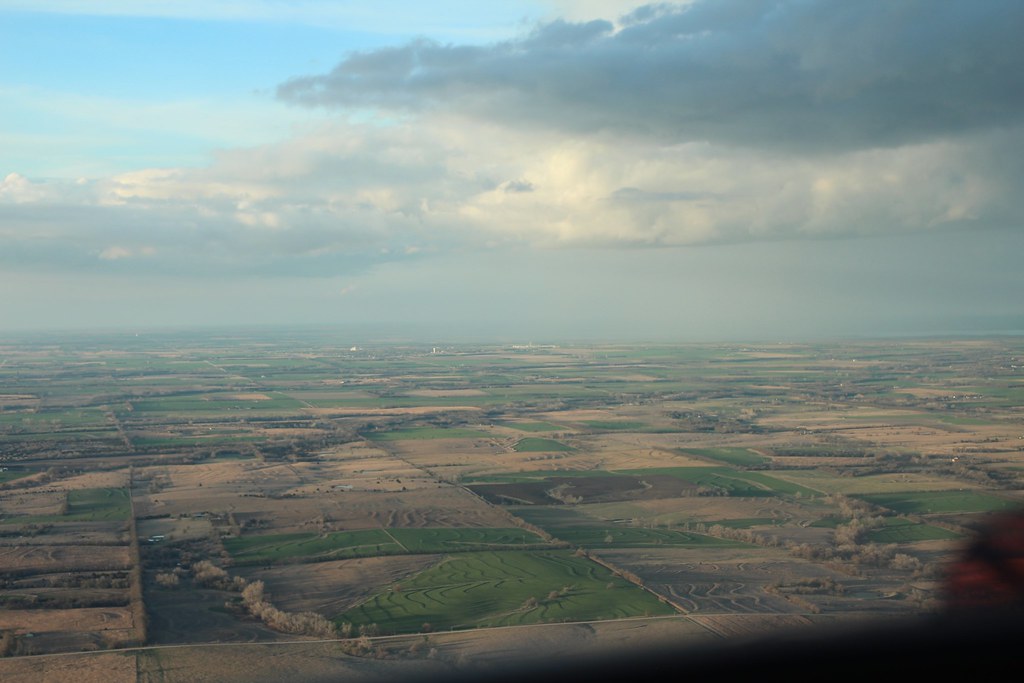
Flying over the airport at Moundridge, KS Memories Back when I was a child, maybe about the age my children are now, I d be outside in the evening and see this orange plane flying overhead. Our neighbor Don had a small ultralight plane and a grass landing strip next to his house. I remember longing to be up in the sky with Don, exploring the world from up there. At that age, I didn t know all the details of why that wouldn t work I just knew I wanted to ride in it. It wasn t until I was about 11 that I flew for the first time. I still remember that TWA flight with my grandma, taking off early in the morning and flying just a little ways above the puffy clouds lit up all yellow and orange by the sunrise. Even 25 years later, that memory still holds as one of the most beautiful scenes I have ever seen. Exploring I have always been an explorer. When I go past something interesting, I love to go see what it looks like inside. I enjoy driving around Kansas with Laura, finding hidden waterfalls, old county courthouses, ghost towns, beautiful old churches, even small-town restaurants. I explore things around me, too once taking apart a lawnmower engine as a child, nowadays building HF antennas in my treetops or writing code for Linux. If there is little to learn about something, it becomes less interesting to me. I see this starting to build in my children, too. Since before they could walk, if we were waiting for something in a large building, we d go exploring. IMG_7231

A patch of rain over Hillsboro, KS The New World A pilot once told me, Nobody can become a pilot without it changing the way they see the world and then, changing their life. I doubted that. But it was true. One of the most poetic sights I know is flying a couple thousand feet above an interstate highway at night, following it to my destination. All those red and white lights, those metal capsules of thousands of lives and thousands of stories, stretching out as far as the eye can see in either direction. IMG_7099

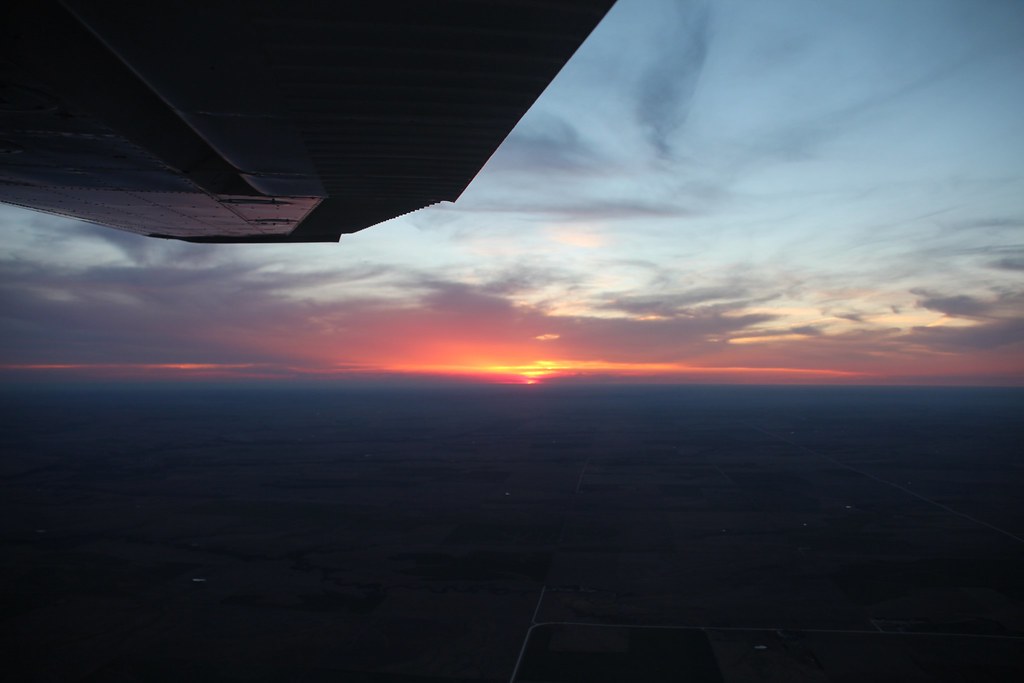
Kansas sunset from the plane When you re in a plane, that small town nowhere near a freeway that always seemed so far away suddenly is only a 15-minute flight away, not even enough time to climb up to a high cruise altitude. Two minutes after takeoff, any number of cities that are an hour s drive away are visible simultaneously, their unique features already recognizable: a grain elevator, oil refinery, college campus, lake, whatever. And all the houses you fly over each with people in them. Some pretty similar to you, some apparently not. But pretty soon you realize that we all are humans, and we aren t all that different. You can t tell a liberal from a conservative from the sky, nor a person s race or religion, nor even see the border between states. Towns and cities are often nameless from the sky, unless you re really low; only your navigation will tell you where you are. I ve had the privilege to fly to small out-of-the-way airports, the kind that have a car that pilots can use for free to go into town and get lunch, and leave the key out for them. There I ve met many friendly people. I ve also landed my little Cessna at a big commercial airport where I probably used only 1/10th of the runway, on a grass runway that was barely maintained at all. I ve flown to towns I d driven to or through many times, discovering the friendly folks at the small airport out of town. I ve flown to parts of Kansas I ve never been to before, discovered charming old downtowns and rolling hills, little bursts of rain and beautiful sunsets that seem to turn into a sea. Smith Center, KS airport terminal

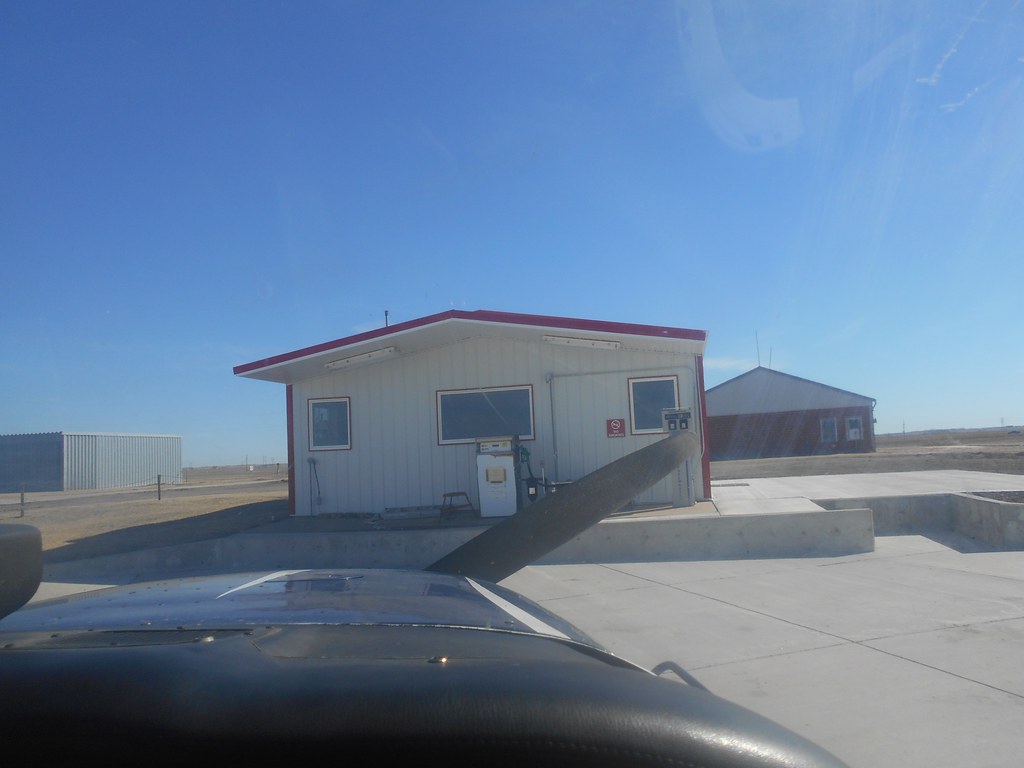
Parked at the Smith Center, KS airport terminal, about to meet some wonderful people For a guy that loves exploring the nooks and crannies of the world that everyone else drives by on their way to a major destination, being a pilot has meant many soul-filling moments. Hard Work I knew becoming a pilot would be a lot of hard work, and thankfully I remembered stories like that when I finally concluded it would be worth it. I found that I had an aptitude for a lot of things that many find difficult about being a pilot: my experience with amateur radio made me a natural at talking to ATC, my fascination with maps and navigation meant I already knew how to read aviation sectional maps before I even started my training and knew how to process that information in the cockpit, my years as a system administrator and programmer trained me with a careful and methodical decision-making process. And, much to the surprise of my flight instructor, I couldn t wait to begin the part of training about navigating using VORs (VHF radio beacons). I guess he, like many student pilots, had struggled with that, but I was fascinated by this pre-GPS technology (which I still routinely use in my flight planning, as a backup in case the GPS constellation or a GPS receiver fails). So that left the reflexes of flight, the art of it, as the parts I had to work on the hardest. The exam with the FAA is not like getting your driver s license. It s a multi-stage and difficult process. So when the FAA Designated Pilot Examiner said congratulations, pilot! and later told my flight instructor that you did a really good job with this one, I felt a true sense of accomplishment. IMG_20151021_193137

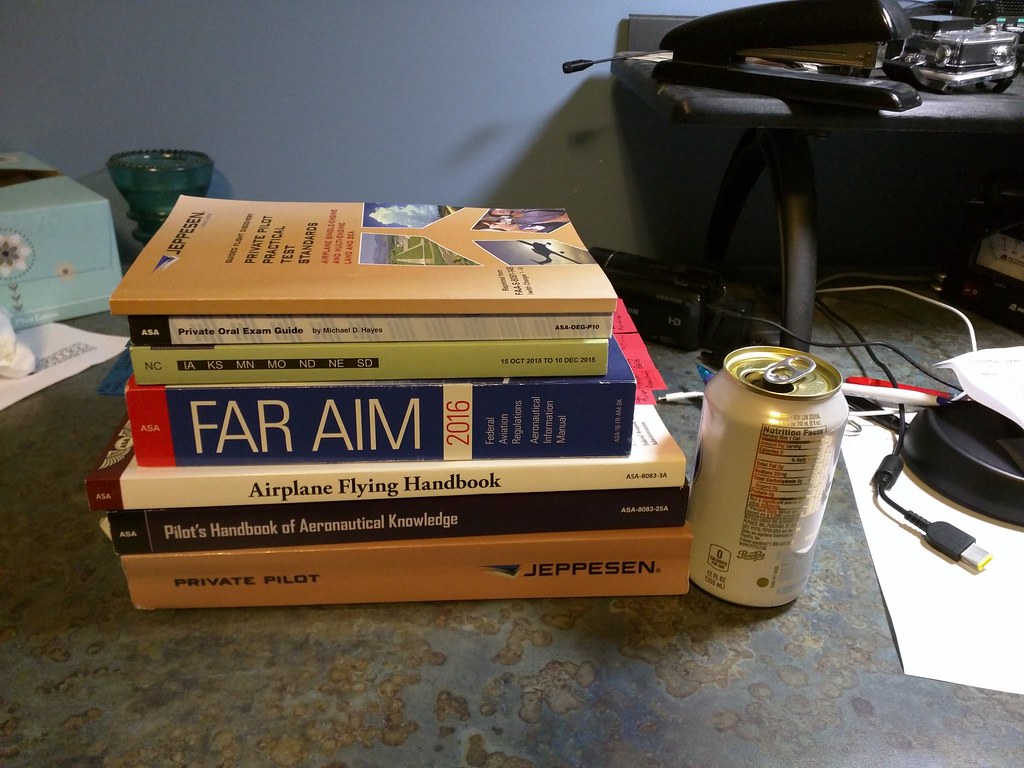
Some of my prep materials Worth It Passengers in a small plane can usually hear all the radio conversations going on. My family has heard me talking to air traffic control, to small and big planes. My 6-year-old son Oliver was playing yesterday, and I saw him pick up a plane and say this: Two-four-niner-golf requesting to land on runway one-seven . Two-four-niner-golf back-taxi on one-seven Two-four-niner-golf ready to takeoff on runway one-seven! That was a surprisingly accurate representation of some communication a pilot might have (right down to the made-up tailnumber with the spelling alphabet!) 20160408_203110

It just got more involved from there! Jacob and Oliver love model train shows. I couldn t take them to one near us, but there was one in Joplin, MO. So the day before Easter, while Laura was working on her Easter sermon, two excited boys and I (frankly also excited) climbed into a plane and flew to Joplin. We had a great time at the train show, discovered a restaurant specializing in various kinds of hot dogs (of course they both wanted to eat there), played in a park, explored the city, and they enjoyed the free cookies at the general aviation terminal building while I traded tips on fun places to fly with other pilots. When it comes right down to it, the smiles of the people I fly with are the most beautiful thing in the air. IMG_20151205_183440

Jacob after his first father-son flight with me

15 April 2016

Tanguy Ortolo: Let's Encrypt: threat or opportunity to other certificate authorities?

Let's Encrypt is a certificate authority (CA) that just left beta stage, that provides domain name-validated (DV) X.509 certificates for free and in an automated way: users just have to run a piece of software on their server to get and install a certificate, resulting in a valid TLS setup. A threat to other certificate authorities By providing certificates for free and automatically, Let's Encrypt is probably a threat a other CAs, a least for part of their activity. Indeed, for people that are satisfied with DV certificates, there are not many reasons to pay a commercial CA to get certificates in a non-automated way. For the CAcert non-commercial CA, that may mean a slow death, as this is their main activity . For people that want organization-validated (OV) or extended validation (EV) certificates, Let's Encrypt is not suitable, so it will not change anything regarding that. An opportunity for the most reactive The entrance of Let's Encrypt is also a significant opportunity for the certificate authorities that will be reactive enough to take advantage of their innovation. Indeed, they introduced automation in both domain name validation and certificate issuance (and revocation), by defining an open protocol that is meant to become an Internet standard. That protocol, named ACME, is not tied to Let's Encrypt and has several free software implementations, so it could be used for the same purpose by commercial CAs. A certification authority could, for instance: Such processes may require or benefit from improvements of the ACME protocol, which is the very reason Internet standards are defined in an open way. The first certification authority that would implement such a process could gain an advantage over its competitors, as it would greatly simplify getting and renewing certificates. I think even Let's Encrypt people would be happy to see that happen, as it would serve their goal, that is basically to help securing the Internet! Personally, I could buy such a service (assuming it is not restricted to juridical persons, according to a quite common (and detestable) sale discrimination against natural persons ). Notes
  1. CAcert is an unrecognised certificate authority, that provides an identity validation through a web of trust, and issues DV server certificates that do not include the validated identity. Now that Let's Encrypt can issue valid DV certificates, CAcert is no longer relevant for that activity. It also issues personal certificates, that do include the validated identity, and that can be used for encryption (e.g. S/MIME), signing (e.g. code signing) or authentication, which is an activity Let's Encrypt does not compete with.
  2. Yes, the Organization field of a certificate is probably not relevant to indicate a physical person's name, but the CommonName field is. Yes, that field is usually abused to store the domain name, but a proper use would be to put the owner's name in the CommonName field, and the domain names in the subjectAltName field.

Raphaël Hertzog: Freexian s report about Debian Long Term Support, March 2016

A Debian LTS logoLike each month, here comes a report about the work of paid contributors to Debian LTS. Individual reports In February, 111.75 work hours have been dispatched among 10 paid contributors. Their reports are available: Evolution of the situation The number of sponsored hours started to increase for April (116.75 hours, thanks to Sonus Networks) and should increase even further for May (with a new Gold sponsor currently joining us, Babiel GmbH). Hopefully the trend will continue so that we can reach our objective of funding the equivalent of a full-time position. At the end of the month the LTS team will be fully responsible of all Debian 7 Wheezy updates. For now paid contributors are still helping the security team by fixing packages that were fixed in squeeze already but that are still outstanding in wheezy. They are also looking for ways to ensure that some of the most complicated packages can be supported over the wheezy LTS timeframe. It is likely that we will seek external help (possibly from credativ which is already handling support of PostgreSQL) for the maintenance of Xen and that some other packages (like libav, vlc, maybe qemu?) will be upgraded to newer versions which are still maintained (either upstream or in Debian Jessie by the Debian maintainers). Thanks to our sponsors New sponsors are in bold.

No comment Liked this article? Click here. My blog is Flattr-enabled.

13 April 2016

Matthew Garrett: Skylake's power management under Linux is dreadful and you shouldn't buy one until it's fixed

(Edit to add: this issue is restricted to the mobile SKUs. Desktop parts have very different power management behaviour)

Linux 4.5 seems to have got Intel's Skylake platform (ie, 6th-generation Core CPUs) to the point where graphics work pretty reliably, which is great progress (4.4 tended to lose all my windows every so often, especially over suspend/resume). I'm even running Wayland happily. Unfortunately one of the reasons I have a laptop is that I want to be able to do things like use it on battery, and power consumption's an important part of that. Skylake continues the trend from Haswell of moving to an SoC-type model where clock and power domains are shared between components that were previously entirely independent, and so you can't enter deep power saving states unless multiple components all have the correct power management configuration. On Haswell/Broadwell this manifested in the form of Serial ATA link power management being involved in preventing the package from going into deep power saving states - setting that up correctly resulted in a reduction in full-system power consumption of about 40%[1].

I've now got a Skylake platform with a nice shiny NVMe device, so Serial ATA policy isn't relevant (the platform doesn't even expose a SATA controller). The deepest power saving state I can get into is PC3, despite Skylake supporting PC8 - so I'm probably consuming about 40% more power than I should be. And nobody seems to know what needs to be done to fix this. I've found no public documentation on the power management dependencies on Skylake. Turning on everything in Powertop doesn't improve anything. My battery life is pretty poor and the system is pretty warm.

The best thing about this is the following statement from page 64 of the 6th Generation Intel Processor Datasheet for U-Platforms:

Caution: Long term reliability cannot be assured unless all the Low-Power Idle States are enabled.

which is pretty concerning. Without support for states deeper than PC3, Linux is running in a configuration that Intel imply may trigger premature failure. That's obviously not good. Until this situation is improved, you probably shouldn't buy any Skylake systems if you're planning on running Linux.

[1] These patches never went upstream. Someone reported that they resulted in their SSD throwing errors and I couldn't find anybody with deeper levels of SATA experience who was interested in working on the problem. Intel's AHCI drivers for Windows do the right thing, but I couldn't find anybody at Intel who could get any information from their Windows driver team.

comment count unavailable comments

Jonathan McDowell: Software in the Public Interest contributing members: Check your activity status!

That s a longer title than I d like, but I want to try and catch the attention of anyone who might have missed more directed notifications about this. If you re not an SPI contributing member there s probably nothing to see here Although I decided not to stand for re-election at the Software in the Public Interest (SPI) board elections last July, I haven t stopped my involvement with the organisation. In particular I ve spent some time working on an overhaul of the members website and rolling it out. One of the things this has enabled is implementation of 2009-11-04.jmd.1: Contributing membership expiry, by tracking activity in elections and providing an easy way for a member to indicate they consider themselves active even if they haven t voted. The plan is that this will run at some point after the completion of every board election. A first pass of cleanups was completed nearly a month ago, contacting all contributing members who d never been seen to vote and asking them to update their status if they were still active. A second round, of people who didn t vote in the last board election (in 2014), is currently under way. Affected members will have been emailed directly and there was a mail to spi-announce, but I m aware people often overlook these things or filter mail off somewhere that doesn t get read often. If you are an SPI Contributing member who considers themselves an active member I strongly recommend you login to the SPI Members Website and check the Last active date displayed is after 2014-07-14 (i.e. post the start of the last board election). If it s not, click on the Update link beside the date. The updated date will be shown once you ve done so. Why does pruning inactive members matter? The 2015 X.Org election results provide at least one indication of why ensuring you have an engaged membership is important - they failed to make a by-laws change that a vast majority of votes were in favour of, due to failing to make quorum. (If you re an X.org member, go vote!)

12 April 2016

Reproducible builds folks: Reproducible builds: week 49 in Stretch cycle

What happened in the reproducible builds effort between March 27th and April 2nd: Toolchain fixes Packages fixed The following packages have become reproducible due to changes in their build dependencies: ctioga2, erlang-bitcask, libcommons-collections3-java, libjgoodies-animation-java, libjide-oss-java, octave-gsl, octave-interval, octave-io, octave-quaternion, octave-signal, octave-stk, segment, service-wrapper-java, sqlline, svnkit, uddi4j, velocity-tools. The following packages became reproducible after getting fixed: Some uploads fixed some reproducibility issues, but not all of them: Patches submitted which have not made their way to the archive yet: tests.reproducible-builds.org The i386 builders are now testing packages on i386 for reproducibility. It will probably take 4 weeks until everything has been build twice, on this arch. (h01ger) Package reviews 52 reviews have been removed, 24 added and 4 updated in the previous week. Chris Lamb reported 13 new FTBFS. New issue: copyright_year_in_comments_generated_by_ckbuilder. Misc. This week's edition was mostly written by Lunar, with some help by Reiner Herrmann and h01ger.

Reproducible builds folks: Reproducible builds: week 48 in Stretch cycle

What happened in the reproducible builds effort between March 20th and March 26th: Toolchain fixes Daniel Kahn Gillmor worked on removing build path from build symbols submitting a patch adding -fdebug-prefix-map to clang to match GCC, another patch against gcc-5 to backport the removal of -fdebug-prefix-map from DW_AT_producer, and finally by proposing the addition of a normalizedebugpath to the reproducible feature set of dpkg-buildflags that would use -fdebug-prefix-map to replace the current directory with . using -fdebug-prefix-map. Sergey Poznyakoff merged the --clamp-mtime option so that it will be featured in the next Tar release. This option is likely to be used by dpkg-deb to implement deterministic mtimes for packaged files. Packages fixed The following packages have become reproducible due to changes in their build dependencies: augeas, gmtkbabel, ktikz, octave-control, octave-general, octave-image, octave-ltfat, octave-miscellaneous, octave-mpi, octave-nurbs, octave-octcdf, octave-sockets, octave-strings, openlayers, python-structlog, signond. The following packages became reproducible after getting fixed: Some uploads fixed some reproducibility issues, but not all of them: Patches submitted which have not made their way to the archive yet: tests.reproducible-builds.org i386 build nodes have been setup by converting 2 of the 4 amd64 nodes to i386. (h01ger) Package reviews 92 reviews have been removed, 66 added and 31 updated in the previous week. New issues: timestamps_generated_by_xbean_spring, timestamps_generated_by_mangosdk_spiprocessor. Chris Lamb filed 7 FTBFS bugs. Misc. On March 20th, Chris Lamb gave a talk at FOSSASIA 2016 in Singapore. The very same day, but a few timezones apart, h01ger did a presentation at LibrePlanet 2016 in Cambridge, Massachusetts. Seven GSoC/Outreachy applications were made by potential interns to work on various aspects of the reproducible builds effort. On top of interacting with several applicants, prospective mentors gathered to review the applications.

6 April 2016

Steinar H. Gunderson: Nageru 1.2.0 released

I've just released version 1.2.0 of Nageru, my live video mixer. The main new feature is support for Blackmagic's PCI (and Thunderbolt) series of cards through their driver (in addition to the preexisting support for their USB3 cards, through my own free one), but the release is really much more than that. In particular, 1.2.0 has a lot of those small tweaks that takes it just to that point where it starts feeling like software I can use and trust myself. Of course, there are still tons of rough edges (and probably also bad bugs I didn't know about), but in a sense, it's the first real 1.x release. There's not one single thing I can point to it's more the sum. To that end, I will be using it at Solskogen this summer to run what's most likely the world's first variable-framerate demoparty stream, with the stream nominally in 720p60 but dropping to 720p50 during the oldschool compos to avoid icky conversions on the way, given that almost all oldschool machines are PAL. (Of course, your player needs to handle it properly to get perfect 50 Hz playback, too :-) Most likely through G-SYNC or similar, unless you actually have a CRT you can set to 50 Hz.) For more details about exactly what's new, see the NEWS file, or simply the git commit log.

5 April 2016

Matthew Garrett: There's more than one way to exploit the commons

There's a piece of software called XScreenSaver. It attempts to fill two somewhat disparate roles: XScreenSaver does an excellent job of the second of these[2] and is pretty good at the first, which is to say that it only suffers from a disastrous security flaw once very few years and as such is certainly not appreciably worse than any other piece of software.

Debian ships an operating system that prides itself on stability. The Debian definition of stability is a very specific one - rather than referring to how often the software crashes or misbehaves, it refers to how often the software changes behaviour. Debian is very reluctant to upgrade software that is part of a stable release, to the extent that developers will attempt to backport individual security fixes to the version they shipped rather than upgrading to a release that contains all those security fixes but also adds a new feature. The argument here is that the new release may also introduce new bugs, and Debian's users desire stability (in the "things don't change" sense) more than new features. Backporting security fixes keeps them safe without compromising the reason they're running Debian in the first place.

This all makes plenty of sense at a theoretical level, but reality is sometimes less convenient. The first problem is that security bugs are typically also, well, bugs. They may make your software crash or misbehave in annoying but apparently harmless ways. And when you fix that bug you've also fixed a security bug, but the ability to determine whether a bug is a security bug or not is one that involves deep magic and a fanatical devotion to the cause so given the choice between maybe asking for a CVE and dealing with embargoes and all that crap when perhaps you've actually only fixed a bug that makes the letter "E" appear in places it shouldn't and not one that allows the complete destruction of your intergalactic invasion fleet means people will tend to err on the side of "Eh fuckit" and go drinking instead. So new versions of software will often fix security vulnerabilities without there being any indication that they do so[3], and running old versions probably means you have a bunch of security issues that nobody will ever do anything about.

But that's broadly a technical problem and one we can apply various metrics to, and if somebody wanted to spend enough time performing careful analysis of software we could have actual numbers to figure out whether the better security approach is to upgrade or to backport fixes. Conversations become boring once we introduce too many numbers, so let's ignore that problem and go onto the second, which is far more handwavy and social and so significantly more interesting.

The second problem is that upstream developers remain associated with the software shipped by Debian. Even though Debian includes a tool for reporting bugs against packages included in Debian, some users will ignore that and go straight to the upstream developers. Those upstream developers then have to spend at least 15 or so seconds telling the user that the bug they're seeing has been fixed for some time, and then figure out how to explain that no sorry they can't make Debian include a fixed version because that's not how things work. Worst case, the stable release of Debian ends up including a bug that makes software just basically not work at all and everybody who uses it assumes that the upstream author is brutally incompetent, and they end up quitting the software industry and I don't know running a nightclub or something.

From the Debian side of things, the straightforward solution is to make it more obvious that users should file bugs with Debian and not bother the upstream authors. This doesn't solve the problem of damaged reputation, and nor does it entirely solve the problem of users contacting upstream developers. If a bug is filed with Debian and doesn't get fixed in a timely manner, it's hardly surprising that users will end up going upstream. The Debian bugs list for XScreenSaver does not make terribly attractive reading.

So, coming back to the title for this entry. The most obvious failure of the commons is where a basically malicious actor consumes while giving nothing back, but if an actor with good intentions ends up consuming more than they contribute that may still be a problem. An upstream author releases a piece of software under a free license. Debian distributes this to users. Debian's policies result in the upstream author having to do more work. What does the upstream author get out of this exchange? In an ideal world, plenty. The author's software is made available to more people. A larger set of developers is willing to work on making improvements to the software. In a less ideal world, rather less. The author has to deal with bug mail about already fixed bugs. The author's reputation may be harmed by user exposure to said fixed bugs. The author may get less in the way of useful bug fixes or features because people are running old versions rather than fixing new ones. If the balance tips towards the latter, the author's decision to release their software under a free license has made their life more difficult.

Most discussions about Debian's policies entirely ignore the latter scenario, focusing more on the fact that the author chose to release their software under a free license to begin with. If the author is unwilling to handle the consequences of that, goes the argument, why did they do it in the first place? The unfortunate logical conclusion to that argument is that the author realises that they made a huge mistake and never does so again, and woo uh oops.

The irony here is that one of Debian's foundational documents, the Debian Free Software Guidelines, makes allowances for this. Section 4 allows for distribution of software in Debian even if the author insists that modified versions[4] are renamed. This allows for an author to make a choice - allow themselves to be associated with the Debian version of their work and increase (a) their userbase and (b) their support load, or try to distinguish what Debian ship from their identity. But that document was ratified in 1997 and people haven't really spent much time since then thinking about why it says what it does, and so this tradeoff is rarely considered.

Free software doesn't benefit from distributions antagonising their upstreams, even if said upstream is a cranky nightclub owner. Debian's users are Debian's highest priority, but those users are going to suffer if developers decide that not using free licenses improves their quality of life. Kneejerk reactions around specific instances aren't helpful, but now is probably a good time to start thinking about what value Debian bring to its upstream authors and how that can be increased. Failing to do so doesn't serve users, Debian itself or the free software community as a whole.

[1] The X server has no fundamental concept of a screen lock. This is implemented by an application asking that the X server send all keyboard and mouse input to it rather than to any other application, and then that application creating a window that fills the screen. Due to some hilarious design decisions, opening a pop-up menu in an application prevents any other application from being able to grab input and so it is impossible for the screensaver to activate if you open a menu and then walk away from your computer. This is merely the most obvious problem - there are others that are more subtle and more infuriating. The only fix in this case is to nuke the site from orbit.

[2] There's screenshots here. My favourites are the one that emulate the electrical characteristics of an old CRT in order to present a more realistic depiction of the output of an Apple 2 and the one that includes a complete 6502 emulator.

[3] And obviously new versions of software will often also introduce new security vulnerabilities without there being any indication that they do so, because who would ever put that in their changelog. But the less ethically challenged members of the security community are more likely to be looking at new versions of software than ones released three years ago, so you're probably still tending towards winning overall

[4] There's a perfectly reasonable argument that all packages distributed by Debian are modified in some way

comment count unavailable comments

1 April 2016

Norbert Preining: Searching for a job

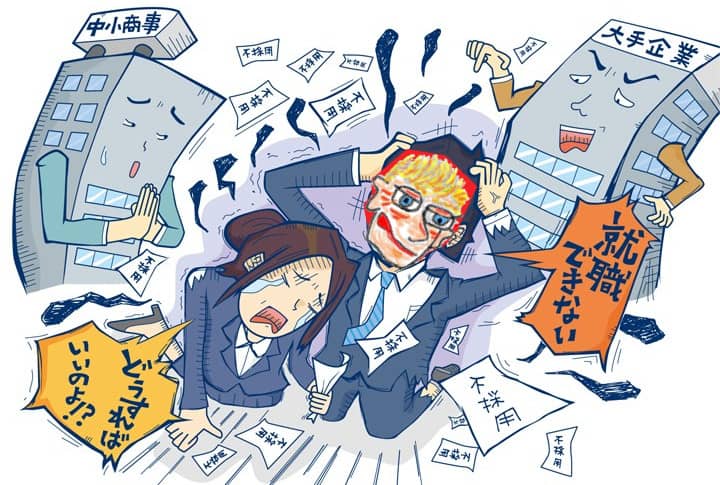
Yesterday my contract with my university JAIST ended. I was working there as Associate Professor for 6.5 years, but the university decided not to extend my contract (financial problems, foreigner in Japan). That means, I am now out on the job market again not the greatest fun for an academic at my age. Thanks to JAIST for circumventing the ominous 5-year clause of permanent employment.
shuushoku My prime interests are academic work, that is research and teaching, where research is in a variety of fields, mostly mathematical logic, theoretical computer science, and formal methods. Recently I am working on an extension of the Curry-Howard correspondence to cover different calculi, in particular Hyper Sequent Calculi, and relate them to some kind of process algebra. For more details see the logic dedicated page. My other focal point is programming and software development, where I have contributed to many open source projects, and act as main developer of the TeX Live infrastructure and distribution system (tlmgr). Main languages are Perl, PHP, C, but also Python, Vala, Lisp, CafeOBJ, and whatever comes around. For more details see the software page. I recently became father, so I would prefer either an academic position in Hokuriku, Japan, or a software developer position where I can work (most of the time) remotely. In case one of the readers here has some hints, please drop me a line. In the meantime I enjoy my unemployed life with my baby!

31 March 2016

Antoine Beaupr : My free software activities, march 2016

Debian Long Term Support (LTS) This is my 4th month working on Debian LTS, started by Raphael Hertzog at Freexian. I spent half of the month away on a vacation so little work was done, especially since I tried to tackle rather large uploads like NSS and Xen. I also worked on the frontdesk shift last week.

Frontdesk That work mainly consisted of figuring out how to best help the security team with the last uploads to the Wheezy release. For those who don't know, Debian 7 Wheezy, or "oldstable", is going to be unsupported by the security team starting end of april, and the Debian 6 Squeeze (the previous LTS) is now unsupported. The PGP signatures on the archived release have started yielding expiration errors which can be ignored but that are really a strong reminder that it is really time to upgrade. So the LTS team is now working towards backporting a few security issues from squeeze to wheezy, and this is what I focused on during triage work. I have identified the following high priority packages I will work on after I complete my work on the Xen and NSS packages (detailed below):
  • libidn
  • icu
  • phpmyadmin
  • tomcat6
  • optipng
  • srtp
  • dhcpcd
  • python-tornado

Updates to NSS and Xen I have spent a lot of time testing and building packages for NSS and Xen. To be fair, Brian May did most of the work on the Xen packages, and I merely did some work to test the packages on Koumbit's infrastructure, something which I will continue doing in the next month. For NSS, wheezy and jessie are in this weird state where patches were provided to the security team all the way back in November yet were never tested. Since then, yet more issues came up and I worked hard to review and port patches for those new security issues to wheezy. I'll followup on both packages in the following month.

Other free software work

Android TL;DR: there's an even longer version of this with the step-by-step procedures and that I will update as time goes on in my wiki. I somehow inherited an Android phone recently, on a loan from a friend because the phone broke one too many times and she got a new one from her provider. This phone is a HTC One S "Ville", which is fairly old, but good enough to play with and give me a mobile computing platform to listen to podcasts, play music, access maps and create GPS traces. I was previously doing this with my N900, but that device is really showing its age: very little development is happening on it, the SDK is closed source and the device itself is fairly big, compared to the "Ville". Plus, the SIM card actually works on the Ville so, even though I do not have an actual contract with a cell phone provider (too expensive, too invasive on my privacy), I can still make emergency phone calls (911)! Plus, since there is good wifi on the machine, I can use it to connect to the phone system with the built-in SIP client, send text messages through SMS (thanks to VoIP.ms SMS support) or Jabber. I have also played around with LibreSignal, the free software replacement for Signal, which uses proprietary google services. Yes, the VoIP.ms SMS app also uses GCM, but hopefully that can be fixed. (While I was writing this, another Debian Developer wrote a good review of Signal so I am happy to skip that step. Go read that.)
See also my apps list for a more complete list of the apps I have installed on the phone. I welcome recommendations on cool free software apps I should use!
I have replaced the stock firmware on the phone with Cyanogenmod 12.1, which was a fairly painful experience, partly because of the difficult ambiance on the #cyanogenmod channel on Freenode, where I had extreme experiences: a brave soul helped me through the first flashing process for around 2 hours, nicely holding my hand at every step. Other times, I have seen flames and obtuse comments from people being vulgar, brutal, obnoxious, if not sometimes downright homophobic and sexist from other users. It is clearly a community that needs to fix their attitude. I have documented everything I could in details in this wiki page, in case others want to resuscitate their old phones, but also because I ended up reinstalling the freaking phone about 4 times, and was getting tired of forgetting how to do it every time. I am somewhat fascinated by Android: here is the Linux-based device that should save us all from the proprietary Apple nightmares of fenced in gardens and censorship. Yet, public Android downloads are hidden behind license agreements, even though the code itself is free, which has led fellow Debian developers to work on making libre rebuilds of Androids to workaround this insanity. But worse: all phones are basically proprietary devices down to the core. You need custom firmware to be loaded on the machine for it to boot at all, from the bootloader all the way down to the GSM baseband and Wifi drivers. It is a minefield of closed source software, and trying to run free software on there is a bit of a delusion, especially since the baseband has so much power over the phone. Still, I think it is really interesting to run free software on those machines, and help people that are stuck with cell phones get familiar with software freedom. It seems especially important to me to make Android developers aware of software freedom considering how many apps are available for free yet on which it is not possible to contribute significantly because the source code is not published at all, or published only on the Google Store, instead of the more open and public F-Droid repository which publishes only free software. So I did contribute. This month, I am happy to announce that I contributed to the following free software projects on Android: I have also reviewed the literature surrounding Telegram, a popular messaging app rival to Signal and Whatsapp. Oddly enough, my contributions to Wikipedia on that subject were promptly reverted which made me bring up the subject on the page's Talk page. This lead to an interesting response from the article's main editors which at least added that the "its security features have been contested by security researchers and cryptography experts". Considering the history of Telegram, I would keep people away from it and direct people to use Signal instead, even though Signal has similar metadata issues, mostly because Telegram's lack of response to the security issues that were outlined by fellow security researchers. Both systems suffer from a lack of federation as well, which is a shame in this era of increasing centralization. I am not sure I will put much more work in developing for Android for now. It seems like a fairly hostile platform to work on, and unless I have specific pain points I want to fix, it feels so much better to work on my own stuff in Debian. Which brings me to my usual plethora of free software projects I got stuck in this month.

IRC projects irssi-plugin-otr had a bunch of idiotic bugs lying around, and I had a patch that I hadn't submitted upstream from the Debian package, which needed a rebuild because the irssi version changed, which is a major annoyance. The version in sid is now a snapshot because upstream needs to make a new release but at least it should fix things for my friends running unstable and testing. Hopefully those silly uploads won't be necessary in the future. That's for the client side. On the server side, I have worked on updating the Atheme-services package to the latest version, which actually failed because the upstream libmowgli is missing release tags, which means the Debian package for it is not up-to-date either. Still, it is nice to have a somewhat newer version, even though it is not the latest and some bugs were fixed. I have also looked at making atheme reproducible but was surprised at the hostility of the upstream. In the end, it looks like they are still interested in patches, but they will be a little harder to deploy than for Charybdis, so this could take some time. Hopefully I will find time in the coming weeks to test the new atheme services daemon on the IRC network I operate.

Syncthing I have also re-discovered Syncthing, a file synchronization software. Amazingly, I was having trouble transferring a single file between two phones. I couldn't use Bluetooth (not sure why), the "Wifi sharing" app was available only on one phone (and is proprietary, and has a limit of 4MB files), and everything else requires an account, the cloud, or cabling. So. Just heading to f-droid, install syncthing, flash a few qr-codes around and voil : files are copied over! Pretty amazing: the files were actually copied over the local network, using IPv6 link-local addresses, encryption and the DHT. Which is a real geeky way of saying it's completely fast, secure and fast. Now, I found a few usability issues, so much that I wrote a whole usability story for the developers, which were really appreciative of my review. Some of the issues were already fixed, others were pretty minor. Syncthing has a great community, and it seems like a great project I encourage everyone to get familiar with.

Battery stats The battery-status project I mentionned previously has been merged with the battery-stats project (yes, the names are almost the same, which is confusing) and so I had to do some work to fix my Python graph script, which was accepted upstream and will be part of Debian officially from now on, which is cool. The previous package was unofficial. I have also noticed that my battery has a significantly than when I wrote the script. Whereas it was basically full back then, it seems now it has lost almost 15% of its capacity in about 6 months. According to the calculations of the script:
this battery will reach end of life (5%) in 935 days, 19:07:58.336480, on 2018-10-23 12:06:07.270290
Which is, to be fair, a good life: it will somewhat work for about three more years.

Playlist, git-annex and MPD in Python On top of my previously mentioned photos-import script, I have worked on two more small programs. One is called get-playlist and is an extension to git-annex to easily copy to the local git-annex repository all files present in a given M3U playlist. This is useful for me because my phone cannot possibly fit my whole MP3 collection, and I use playlists in GMPC to tag certain files, particularly the Favorites list which is populated by the "star" button in the UI. I had a lot of fun writing this script. I started using elpy as an IDE in Emacs. (Notice how Emacs got a new webpage, which is a huge improvement was had been basically unchanged since the original version, now almost 20 years old, and probably written by RMS himself.) I wonder how I managed to stay away from Elpy for so long, as it glues together key components of Emacs in an elegant and functional bundle:
  • Company: the "vim-like" completion mode i had been waiting for forever
  • Jedi: context-sensitive autocompletion for Python
  • Flymake: to outline style and syntax errors (unfortunately not the more modern Flycheck)
  • inline documentation...
In short, it's amazing and makes everything so much easier to work with that I wrote another script. The first program wouldn't work very well because some songs in the playlists had been moved, so I made another program, this time to repair playlists which refer to missing files. The script is simply called fix-playlists, and can operate transparently on multiple playlists. It has a bunch of heuristics to find files and uses a MPD server as a directory to search into. It can edit files in place or just act as a filter.

Useful snippets Writing so many scripts, so often, I figured I needed to stop wasting time always writing the same boilerplate stuff on top of every file, so I started publishing Yasnippet-compatible file snippets, in my snippets repository. For example, this report is based on the humble lts snippet. I also have a base license snippet which slaps the AGPLv3 license on top of a Python file. But the most interesting snippet, for me, is this simple script snippet which is a basic scaffolding for a commandline script that includes argument processing, logging and filtering of files, something which I was always copy-pasting around.

Other projects And finally, a list of interesting issues en vrac:
  • there's a new Bootstrap 4 theme for Ikiwiki. It was delivering content over CDNs, which is bad for privacy issues, so I filed an issue which was almost immediately fixed by the author!
  • I found out about BitHub, a tool to make payments with Bitcoins for patches submitted on OWS projects. It wasn't clear to me where to find the demo, but when I did, I quickly filed a PR to fix the documentation. Given the number of open PRs there and the lack of activity, I wonder if the model is working at all...
  • a fellow Debian Developer shared his photos workflow, which was interesting to me because I have my own peculiar script, which I never mentionned here, but which I ended up sharing with the author

Steinar H. Gunderson: Signal

Signal is a pretty amazing app; it manages to combine great security with great simplicity. (It literally takes two minutes, even for an unskilled user, to set it up.) I looked at the Wikipedia article, and the list of properties the protocol provides is impressive; I had hardly any idea you would even want all of these. But I've tried to decode what they actually mean: (There are more guarantees and features for group chat.) Again, it's really impressive. Modern cryptography at its finest. My only two concerns is that it's too bound to telephone numbers (you can't have the same account on two devices, for instance it very closely mimics the SMS/MMS/POTS model in that regard), and that it's too clumsy to verify public keys for the IM part. It can show them as hex or do a two-way QR code scan, but there's no NFC support, and there's no way to read e.g. a series of plaintext words instead of the fingerprint. (There's no web of trust, but probably that's actually for the better.) I hear WhatsApp is currently integrating the Signal protocol (or might be done already it's a bit unclear), but for now, my bet is on Signal. Install it now and frustrate NSA. And get free SMS/MMS to other Signal users (which are growing in surprising numbers) while you're at it. :-)

30 March 2016

Niels Thykier: Easter patching of Britney

I decided to take a couple of days of vacation next to Easter and obviously ended up with tons of time. I ended up channelling most of the (productive) time into improving Britney. In raw results: The most exciting items in the patch series are probably: Once reviewed, these will be merged into master and we will have versioned provides support (in Britney).:)
Filed under: Debian, Release-Team

Next.

Previous.