Search Results: "ah"

18 November 2013

Russ Allbery: Review: Anathem

Review: Anathem, by Neal Stephenson
Publisher: William Morrow
Copyright: 2008
ISBN: 0-06-147409-6
Format: Hardcover
Pages: 935
Fraa Erasmas is a little less than twenty years old and is an avout of the decade math of the Concent of Saunt Edhar. As Anathem opens, he's approaching his first apert. All of those words are left for the reader to puzzle out for themselves, unless you cheat and read the glossary (which I would recommend doing only with caution, but more on that in a moment), since Erasmas, the first-person narrator of this story, writes (mostly) as if the reader is familiar with the mathic world and its concepts. Translated into English, it means that Erasmas was brought into something akin to a scientific monastery (the "math") at around the age of nine and has been there for ten years, since his math is a decade math and therefore remains closed to all outside (s cular) ideas and contact for periods of ten years at a time. He is still a student there, not yet declaring allegiance to one of the chapters. That's something that he will be expected to do after the first apert. Every ten years, the decade math opens its doors to the outside world for a period of ten days (apert), and the fraas and suurs can leave the math and travel through the outside world as they wish. The start of Anathem is an exercise in alienation and reorientation. Stephenson has constructed a complex society with a long history and its own specific technical jargon and throws the reader into it with a minimum of orientation. Despite being familiar with SF novels that use this technique, I did read the preface and recommend that other readers do as well unless they particularly love piecing together a world from hints and clues. The timeline, in particular, was invaluable and something I referred to throughout the story. But even with the preface, you should expect to read the first part of Anathem interpolating meanings from context or just letting things slip past until you later come to understand them. A lot of people bounce off of Anathem here, and it's one of the reasons why I'd been postponing reading it (the other being that it's a substantial doorstop and I wanted to give it my undivided attention). But it's really not as bad as I feared. One gets a feel for the terms fairly quickly, and the more difficult ones Stephenson defines as he goes with excerpts from a dictionary of the mathic world. I found it slightly disorienting for a chapter or two, and then it started growing on me. The terminology is sometimes different just for the sake of being different (jeejahs are indistinguishable from smartphones for all practical purposes), but usually the invented words provide either important links to the past of the constructed world of Arbre or are technical terms that add precision and clarity once you know their meanings. It can be a little bit frustrating to remember the mapping of famous theories and theorems to the Orth names, but only mildly. (And Diax's Rake is so useful of a name for something that English doesn't name that I may start using it myself.) This is also why I recommend against reading the glossary. The definitions of terms are linked to important parts of history, which are, in turn, linked to important parts of the plot, and the glossary therefore risks spoilers. I liked having the term introduced by the frequent dictionary excerpts scattered through the chapters, and enjoyed the feeling of the terminology unfolding with the plot. The glossary is there if you really get lost, but I think the experienced SF reader (particularly if you have enough history background to pick up on the obvious parallels and start mapping bits to Greece, Rome, the Catholic Church, etc.) will be able to navigate the language without that much difficulty. I also stopped caring about the terminology because the story is so engrossing that it pulled me right into the book, closed over me, and made Erasmas's world feel real, precious, and fascinating. Whether that's going to be true of other people is a surprisingly difficult question, and one that I'll try to tackle as part of this review. But I will say up-front that I think this is the best book that Stephenson has ever written, even better than Snow Crash, despite some undeniable flab and one extremely irritating choice. Anathem is, at its heart, a novel about the scientific method. I think it's the first book by Stephenson that elegantly mingles his tendencies (and obsessions) as a writer with the interests (and obsessions) of the characters and makes the whole novel feel coherent. All of Stephenson's books are prone to discursive infodumps, but they've usually had to be shoehorned in around the characters. Even with the Baroque Cycle, a series full of natural philosophers, the digressions are jammed in around the plot like the filling of an over-packed box and frequently stick out at odd angles or dribble out on the floor. With Anathem, Stephenson has populated a book full of characters who have completely believable and engrossing reasons to digress into scientific debate and analysis, can put them into dialogue and thereby avoid some of the strain of the infodump, and (most importantly) largely restrains himself from narrative digressions via first-person narration and careful attention to when the characters themselves would follow the same digression. In short, this is a book full of very smart and very well-educated people who figure things out from first principles using agreed-upon theory, thrown into an unknown and dangerous situation that requires a great deal of deep thinking, science, engineering, and philosophy. All of Stephenson's quirks are still here, on prominent display, but rarely have I ever seen a better match of writer, characters, plot, and world background than this book. I would go so far as to say that, if you don't like this book, you're unlikely to like any long Stephenson. I haven't said a lot about the plot. Erasmas's apert is only the first part, and barely touches on any significant plot elements. It's mostly there to set some groundwork, introduce characters, and get the reader oriented. I'm not going to say much more, since the way the novel transitions from routine to unusual to emergency, and the resulting scramble to understand the emergency, is the heart and soul of this book and should not be spoiled. (I spoiled myself slightly by reading some analysis that I shouldn't have and regretted it, although it wasn't too much of a problem.) This is one of Stephenson's best-plotted novels. It develops slowly enough for the reader (and the characters) to think hard about it and make some good and bad guesses, but fast enough to stay engrossing. Most of it is very well-paced provided that you find the background of science and philosophy of science interesting. (If you don't, this is probably not a book you're going to enjoy.) I say "most of it" because, as mentioned earlier, this book is a bit flabby. There are a couple of sections where the theory and analysis are pushed aside by exigent circumstances and more action-oriented plot elements, both of which reminded me that Stephenson is very bad at writing action sequences and both of which I wished were shorter. And there are a couple of sections where Erasmas is getting oriented to a new situation or working up the courage to do something where I wished he'd get on with it already. But for a novel of nearly 1,000 pages, the amount of tension and reader interest Stephenson maintained for me was quite impressive. But as good as the plot is, the best part of this book is its full-bore, no-apologies embrace of understanding things. This is a book about making sense of the world, and about what it means to make sense of the world, and how you go about it, and what preconditions are required to do so. It is not, contrary to so much science fiction, a book about knowing things. The people who are already experts appear in this book, but generally only in the context of figuring out new things they've not previously been exposed to. Rather, it's a book about learning things, the thrill that comes from applying theory to understand something new, and the satisfaction of working through something from first principles or previously-established theory, arriving at testable predictions, and then testing them. It's the first novel I've read that captures some of the joy and delight that I got from reading George Gamow's One Two Three... Infinity as a child. Stephenson novels have always been about showing the reader neat things he learned, but I think previous books relied on the reader to bring their own enthusiasm. Anathem, at least for me, goes a step farther and uses the passion and approach of its characters to create that enthusiasm. It's one of those books that I not only enjoyed but went away from feeling like it made me a better person in some subtle but detectable way. Sadly, this is also where the irritating part comes in. I'm going to be very careful and indirect here, since the details are all extremely significant spoilers. You may want to skip to the last paragraph of this review if you want to avoid any knowledge about the end of Anathem. Stephenson pulls several rabbits out of the hat in this book, but most of them are well-defended and nicely handled bits of misdirection. There are a few where I thought the science or engineering was dubious, but even those are usually backed with enough hand-waving about Arbre technology that I could swallow it enough for the purposes of this book. (The timeline here is very helpful in allowing one to write off a few things as unknown technology.) But he puts, at the core of the plot, one of the most scientifically dubious bits of the whole book, and there's simply no avoiding that by the end of the story. Now, this doesn't mean that he just expects the reader to swallow it. Much of Anathem is a carefully-constructed defense of the bits he uses for the plot, and the defense is not half-bad within his fictional world. There are substantial in-book justifications for believing these techniques will work on Arbre even if they wouldn't in our scientific domain. So it's not so much the plausibility that bothered me; the idea is at least as plausible as some of the FTL drive concepts that I've swallowed without complaint. I do hold Anathem to a higher standard because the book is about science in a way that most science fiction isn't, but even with that, I think Stephenson mostly managed to dance across the thin ice he built. The problem is more subtle but more serious: if taken seriously on its own terms, the approach Stephenson takes to the plot destroys science in his universe. I can't really say more than that, since all of the details are huge spoilers, but the more I thought about it, the more irritated and annoyed I got. Anathem is otherwise a brilliant defense of the scientific method, and it felt like Stephenson injected a poison pill in the center of it, leading necessarily to a world where the scientific method no longer works. This does not happen on camera, or even between the pages of the book; you have to think about the implications for a while before you realize that's what happened. But once you do, it's a bitter pill to swallow, and it's hard to escape the feeling that it fundamentally undermines Stephenson's whole project here. And, to make it worse (although also oddly better in a way), I think it was unnecessary. He would have had to reconstruct the ending, but I can't shake the feeling that there were ways to write the ending, even maintaining the same character strengths, without having to pull that particular rabbit out of the hat. Because I think it's, in the end, unnecessary, I was still able to enjoy the whole book, including the ending, despite this, but while the rest of Anathem is a wholehearted 10, that choice knocked a full point off my impression of the book. It's profoundly irritating precisely because Stephenson did such an excellent job with the rest of it. But, that said, this book is still exceptional. I think it's the book that Stephenson was meant to write. Not only did he get the overall construction nearly perfect, he gets so many of the details right, from the history (which for a while I thought was merely clever, once I started seeing the correspondences that moved it out of the realm of pure invention, but which transitioned back to profound with later revelations in the book) to the language to the way that he excerpted some theoretic digressions into very well-done appendices. If you've ever thought of a theory as beautiful, or like reading about smart people debating the nature of understanding and knowledge, I cannot recommend this book too highly. Despite the highly irritating flaw at its center, and despite a few sections that show Stephenson is not a well-rounded writer, I think it's brilliant. Rating: 9 out of 10

13 November 2013

Hideki Yamane: latest freetype package (2.5.0.1)


During MiniDebConf in Taiwan, I've heard about freetype package is not updated for a while. I'm not sure why freetype maintainers haven't update it but anyway I've made an updated package (freetype 2.5.0.1 - it has a feature "new Adobe CFF rasterizer", see Google's blog post and Adobe's).

Changes:
freetype (2.5.0.1-0.1) UNRELEASED; urgency=low
.
* Non-maintainer upload.
* Now make it "multiple upstream source" style instead of "tar-in-tar".
New style makes it easier to check source code with search engine like
sources.debian.net.
* use "3.0 (quilt)" in debian/source/format
- merge debian/patches-freetype and patches-ft2demos to debian/patches
- drop patches since merged to upstream
+ savannah-bug-37907.patch
+ savannah-bug-37906.patch
+ savannah-bug-37905.patch
+ savannah-bug-35847.patch
+ savannah-bug-35833.patch
+ ft2demos-2.1.7-no-rpath.patch (cannot be applied)
- refresh patches
+ fix compiler warning in compiler_hardening_fixes.patch
* simplify debian/rules and separate some thing to debian/* files
- don't install GPLv2.TXT (not GPL.TXT)
* debian/control
- add "Build-Depends: libpng12-dev libpng-dev"
* update debian/libfreetype6.symbols

You can get its source package by
$ dget http://www.mithril-linux.org/~henrich/debian/package/temp/freetype_2.5.0.1-0.1.dsc

and can get .deb package
$ wget http://www.mithril-linux.org/~henrich/debian/package/temp/libfreetype6_2.5.0.1-0.1_amd64.deb

I've tested it with sid in VirtualBox image and get no weird thing. Could you test it? After that, I'll post to BTS.

Andrea Veri: Configuring DNSSEC on your personal domain

Today I ll be working out how to properly configure DNSSEC on a BIND9 installation, I ll also make sure to give you all the needed instructions to properly verify if a specific domain is being correctly covered by DNSSEC itself. In addition to that a few more details will be provided about adding the relevant SSHFP s entries on your DNS zone files to be able to automatically verify the authenticity of your domain when connecting to it with SSH avoiding any possible MITM attack. First of all, let s create the Zone Signing Key (ZSK) which is the key that will be responsible to sign any other record on the zone file which is not a DNSKEY record itself:
dnssec-keygen -a RSASHA1 -b 1024 -n ZONE gnome.org


Note: the dnssec-keygen binary file should be part of bind97 (RHEL 5) or bind (RHEL6) package according to yum whatprovides: RHEL 5:
32:bind97-9.7.0-17.P2.el5_9.2.x86_64 : The Berkeley Internet Name Domain (BIND) DNS (Domain Name System) server
Repo : rhel-x86_64-server-5
Matched from:
Filename : /usr/sbin/dnssec-keygen


RHEL 6:
32:bind-9.8.2-0.17.rc1.el6.3.x86_64 : The Berkeley Internet Name Domain (BIND) DNS (Domain Name System) server
Repo : rhel-x86_64-server-6
Matched from:
Filename : /usr/sbin/dnssec-keygen


Then, create the Key Signing Key (KSK), which will be used to sign all the DNSKEY records:
dnssec-keygen -a RSASHA1 -b 2048 -n ZONE -f KSK gnome.org


Creating the above keys can take several minutes, when done copy the public keys to the zone file this way:
cat Kgnome.org*.key >> gnome.org


When done you can clean out the useless bits from the zone file and just leave the DNSKEY records (which are not commented out as you will notice) An additional and cleaner way of accomplishing the above is to use the INCLUDE rule on the zone file itself as follows:
$INCLUDE /srv/dnssec-keys/Kgnome.org+005+12345.key
$INCLUDE /srv/dnssec-keys/Kgnome.org+005+67890.key


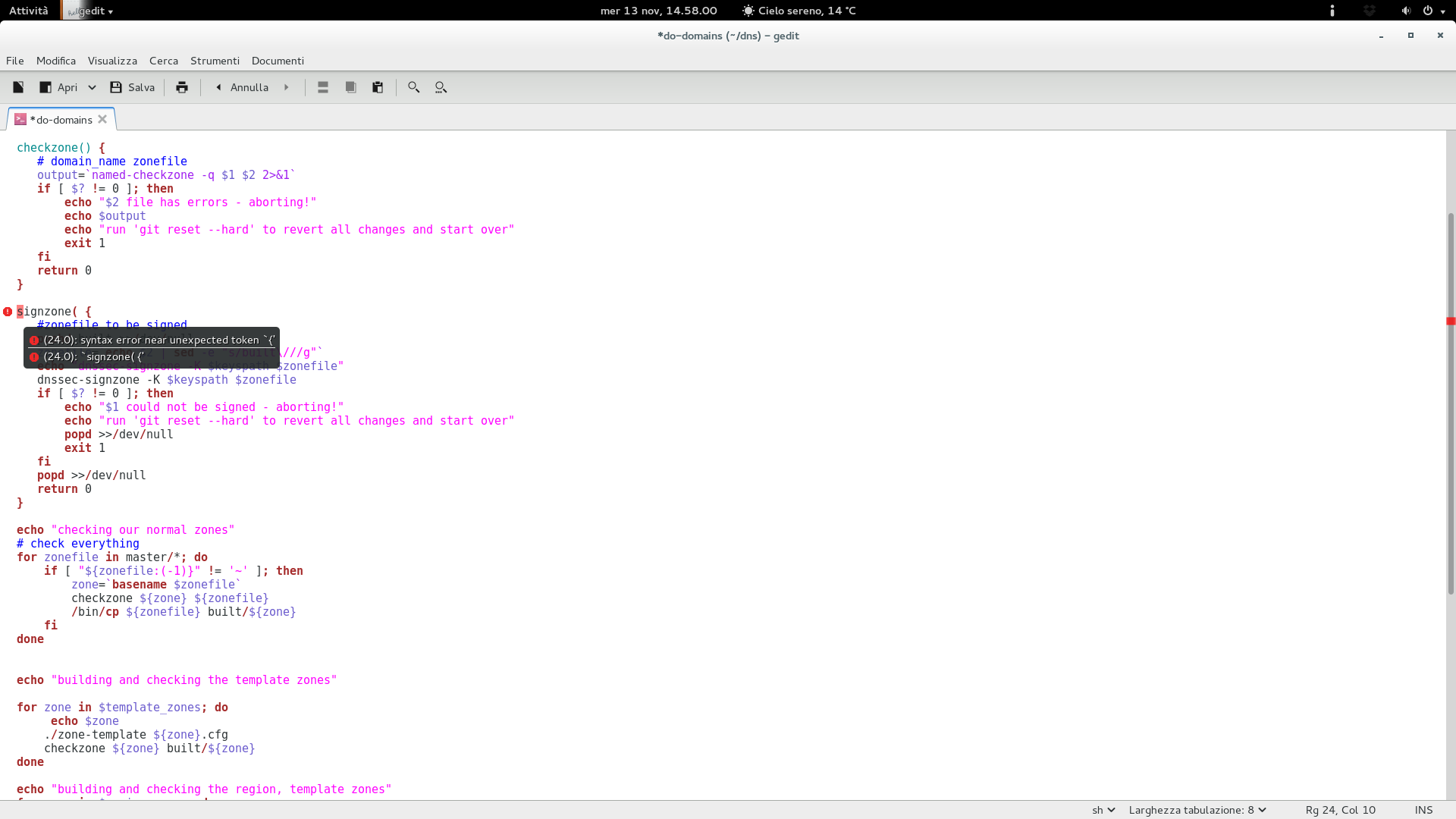
Choosing which method to use is really up to you. Once that is done you can go ahead and sign the zone file. As of myself I m making use of the do-domain script taken from the Fedora Infrastructure Team s repositories. If you are going to use it yourself, make sure to adjust all the relevant variables to match your setup, especially keyspath, region_zones, template_zone, signed_zones and AREA. The do-domain script also checks your zone file through named-checkzone before signing it.
/me while editing the do-domains script with the preview of gnome-code-assistance!

/me while editing the do-domains script with the preview of gnome-code-assistance!

If instead you don t want to use the script above, you can sign the zone file manually in the following way:
dnssec-signzone -K /path/to/your/dnssec/keys -e +3024000 -N INCREMENT gnome.org


By default, the above command will append .signed to the file name, you can modify that behaviour by appending the -f flag to the dnssec-signzone call. The -N INCREMENT will increment the serial number automatically making use of the RFC 1982 arithmetics while the -e flag will extend the zone signature end date from the default 30 days to 35. (this way we can safely run a monthly cron job that will sign the zone file automatically) You can make use of the following script to achieve the above:
#!/bin/sh
SIGNZONE="/usr/sbin/dnssec-signzone"
DNSSEC_KEYS="/srv/dnssec-keys"
NAMEDCHROOT="/var/named/chroot"
ZONEFILES="gnome.org"
cd $NAMEDCHROOT
for ZONE in $ZONEFILES; do
$SIGNZONE -K $DNSSEC_KEYS -e +3024000 -f $ZONE.signed -N INCREMENT $ZONE
done
/sbin/service named reload


Once the zone file has been signed just make sure to include it on named.conf and restart named:
zone "gnome.org"  
file "gnome.org.signed";
 ;


When you re done with that we should be moving ahead adding a DS record for our domain at our domain registrar. My example is taken from the known gandi.net registrar.
gandi

Gandi s DNSSEC interface

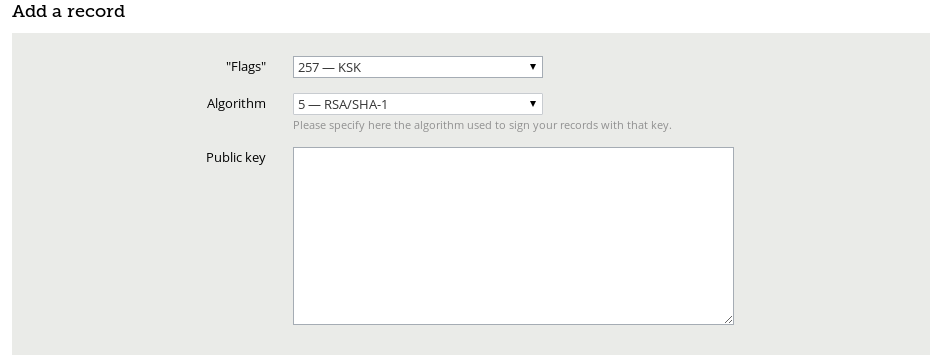
Select KSK (257) and (RSA/SHA-1) on the dropdown list and paste your public key on the box. You will find the public key you need on one of the Kgnome.org*.key files, you should look for the DNSKEY 257 entry as dig DNSKEY gnome.org shows:
;; ANSWER SECTION:
gnome.org. 888 IN DNSKEY 257 3 5 AwEAAbRD7AymDFuKc2iXta7HXZMleMkUMwjOZTsn4f75ZUp0of8TJdlU DtFtqifEBnFcGJU5r+ZVvkBKQ0qDTTjayL54Nz56XGGoIBj6XxbG8Es+ VbZCg0RsetDk5EsxLst0egrvOXga27jbsJ+7Me3D5Xp1bkBnQMrXEXQ9 C43QfO2KUWJVljo1Bii3fTfnHSLRUsbRn8Puz+orK71qxs3G9mgGR6rm n91brkpfmHKr3S9Rbxq8iDRWDPiCaWkI7qfASdFk4TLV0gSVlA3OxyW9 TCkPZStZ5r/WRW2jhUY/kjHERQd4qX5dHAuYrjJSV99P6FfCFXoJ3ty5 s3fl1RZaTo8=


Once that is done you should have a fully covered DNSSEC domain, you can verify that this way:
dig . DNSKEY   grep -Ev '^($ ;)' > root.keys
dig +sigchase +trusted-key=./root.keys gnome.org. A   cat -n


The result:
105 ;; WE HAVE MATERIAL, WE NOW DO VALIDATION
106 ;; VERIFYING DS RRset for org. with DNSKEY:59085: success
107 ;; OK We found DNSKEY (or more) to validate the RRset
108 ;; Ok, find a Trusted Key in the DNSKEY RRset: 19036
109 ;; VERIFYING DNSKEY RRset for . with DNSKEY:19036: success
110
111 ;; Ok this DNSKEY is a Trusted Key, DNSSEC validation is ok: SUCCESS

Bonus content: Adding SSHFP entries for your domain and verifying them You can retrieve the SSHFP entries for a specific host with the following command:
ssh-keygen -r $(hostname --fqdn) -f /etc/ssh/ssh_host_rsa_key.pub


When retrieved just add the SSHFP entry on the zone file for your domain and verify it:
ssh -oVerifyHostKeyDNS=yes -v subdomain.gnome.org


Or directly add the above parameter into your /etc/ssh/ssh_config file this way:
VerifyHostKeyDNS=yes


And run ssh -v subdomain.gnome.org , the result you should receive:
debug1: Server host key: RSA 00:39:fd:1a:a4:2c:6b:28:b8:2e:95:31:c2:90:72:03
debug1: found 1 secure fingerprints in DNS
debug1: matching host key fingerprint found in DNS
debug1: ssh_rsa_verify: signature correct

That s it! Enjoy!

10 November 2013

Sylvain Le Gall: opam2debian, a tool to create Debian binary package out of OPAM

One week ago, a thread in opam-devel mailing list started about the possibility to create binary snapshot to distribute OPAM packages. Distributing binary packages with everything already compiled is pretty useful when you want to make sure that everyone has the same version of packages installed and you don't want to spend time configuring all the computer of your colleague. As a matter of fact I was also interested to see that happening. I have several computers where I want to install a set of packages and I want to snapshot OPAM archives when I am ready for an upgrade. I have tested for a long time another source distribution: GODI. I even wrote a puppet module to drive it. This was a fun experience, but as with any source only distribution, there are some drawbacks. Especially even if it is fully automated, you get a lot of errors and timeout when trying to build automatically from source. This is how opam2debian has started. I wanted a replacement for puppet-godi that takes advantage of OPAM and the possibility to distribute my set of packages everywhere quickly. The goals of this project are:
  1. generate a Debian binary package with all the dependencies set on external packages (like libpcre)
  2. use OPAM to build everything
  3. use standard Debian process to build package
  4. create snapshot of OPAM repository that allow to rebuild exactly the same thing on different arches
The real challenge behind opam2debian was to be able to use standard Debian process to create package to get all the power of dependencies computation provided by the Debian maintainer scripts. My great achievement on this topic was to find a tool called proot that allows you to bind mount a directory as a user. This is an achievement because it allows to create a package using a directory where you are not allowed to write (i.e. /opt/opam2debian directory which is owned by root). This is a way to do it on any Jenkins builder without root access and a standard way for Debian to build packages. Usage example I need to compile a set of package to install on all my Jenkins builder. Here is the list of packages I need and I also want to use the latest OCaml version. I want to build a Debian package for Debian Wheezy which has only OCaml 3.12.1. Building the package:
$ opam2debian create --build --name opam2debian-test2 --compiler 4.01.0 \
 ocamlfind fileutils ocaml-data-notation ocaml-expect ounit \
 ocamlmod ocamlify oasis yojson sexplib extlib pcre-ocaml \
 calendar ocaml-inifiles ocamlnet ocurl gettext inotify ocaml-sqlexpr \
 ocamlrss ocaml-xdg-basedir
Getting the package list right can be tricky because the process will stop at the first error -- and if it is because the last package fails to build it can be long. I have implemented a --keep-build-dir in case you want to tune the package list live. The program will build everything and it can takes quite a while. At the end you get a file opam2debian-test2_20131105_amd64.deb which has a reasonable size of 232MB. That is big, but it looks like the biggest directory is $OPAMROOT/4.01.0/build, I am not sure if I can remove it but we may save some space here (the build directory represents 50% of the package size). Then you can just do a standard Debian installation:
$ sudo dpkg -i opam2debian-test2_20131105_amd64.deb
And you can use it:
$ eval $(opam config env --root /opt/opam2debian/opam2debian-test2/)
$ which ocamlfind
 /opt/opam2debian/opam2debian-test2/4.01.0/bin/ocamlfind
$ ocamlfind list
 [...]
 stdlib              (version: [distributed with Ocaml])
 str                 (version: [distributed with Ocaml])
 threads             (version: [distributed with Ocaml])
 threads.posix       (version: [internal])
 threads.vm          (version: [internal])
 type_conv           (version: 109.41.00)
 unidiff             (version: 0.0.2)
 unix                (version: [distributed with Ocaml])
 userconf            (version: 0.3.1)
 xdg-basedir         (version: 0.0.3)
 xmlm                (version: 1.1.1)
 yojson              (version: 1.1.5)
A nice thing to note, is that it is a standard OPAM install. You can install, update and upgrade OPAM from there, as root. However, I would recommend not to do it, and just rebuild a newer Debian package to upgrade. Install You will need the opam and proot Debian package available in Debian jessie and sid. You will also need various OCaml libraries (cmdliner, calendar, fileutils and jingoo). Download the opam2debian tarball on the forge, build and install it. The project is hosted on github. Open issues On the initial list of goals of the project. Not everything is completed. I have still several open issues. In particular 4. (create snapshot of OPAM repository) was blocked by a bug in opam-mk-repo, that prevents snapshots (see my pull-request to solve it). Another issues is about licenses of the included files. I should list them all and I need to figure out a way to extract every licences. Submit bugs directly to github.

Luke Faraone: Why I use my bank's mobile site on my desktop

(or, cutting out bloat by using a platform where bloat won't fly)

Let me start off by saying I'm generally a huge fan of my bank, USAA. Their offerings are free of hidden fees, their phone support excellent, and the perks they provide are competitive. They don't have the best savings interest rates, but you can always find a better deal online to park money not actively in your checking account.

However, USAA's website is a behemoth. My account page took about 8 seconds to fully load, downloading 1.4MiB of content.

The "My Accounts" page you're redirected to after logging in.
It is frequently buggy; whenever I log in via Google Chrome on Ubuntu 12.04 I land on a page with a URL beginning with "https://www.usaa.com/inet/gas_bank/AccountBannerAjax" and a bunch of GET parameters like "currentaccountkey" and "accnumber" with values like "encrypted12a1f4dd1[ ]". The server returns a 200 OK, promises a Content-Length of 20, but then actually returns zero bytes. After navigating to the homepage and clicking a button, I end up getting logged in, but I wonder what percentage of their userbase are experiencing this problem?

For some strange reason, I get a lot of checks. It appears that nobody else informed the banking system that it's 2013, and the easiest mechanism for people to send money without paying fees is still on paper. To its credit, USAA made remote deposit of checks available to all customers in 2006, when it was mostly an offering limited to businesses. However, it seems like they haven't updated their web workflow since then.


Using it on the web still requires using a signed Java applet (itself discouraged by CMU's CERT) that does the incredibly complex task of letting you select a file from your computer and upload it to their servers. At least, that's what I think it does, because any time I chose "Run", my browser complained a few minutes later that the tab had stopped responding. Regardless of functionality, you can accomplish almost anything their site could currently be doing with HTML5 and a third party service if they want to crop images locally.

Spinning after logging
in on Android
USAA's mobile app for Android has another host of problems; I haven't been able to log into it for 2 weeks, and when I chatted with someone today I was told they were "doing some maintenance this weekend", so I should try again in a few hours once that's finished.

I googled around a bit for some way to perhaps make the applet work in Ubuntu (which admittedly is not a supported platform), and came upon a Facebook thread where a rep suggested using the mobile web site.

A breath of fresh air
I loaded it in my browser, and was amazed at how well it functioned. Obviously designed for higher-end devices (It didn't even load in one WAP emulator I tried), the mobile web interface was a refreshing breath of fresh air. It scaled well to a full-screen device (see below), loaded quickly, and gave me all the information I would have wanted out of the normal web interface.

Most notably: remember the whole "upload a check" workflow that required a buggy Java applet on the main website? We get bog-standard HTML form fields, no additional magic. There goes any theories about the Java client doing some magic validation or prep of the image; here, all they're getting is the images and my session cookie.


I'm still shocked at whoever thought a My Yahoo!-style homepage was the best layout for a bank, but props to the web developers who managed to make a mobile interface that was both pretty and allowed me to work around broken functionality in their implementations on every other platform I had access to.

But why was the mobile web interface the least bloated? Easy. On the desktop, you generally have a nice pipe, or if not, the user knows it and won't be too upset if your site is just as slow as other sites similarly situated. On mobile, the user downloaded all the code already, so the only latency should be the API requests against the server, right?

On the mobile web users have come to expect relatively speedy mobile-optimised sites and there's less screen real estate to do fancy things that get in the way of content. For many sites, that's a huge improvement. Of course, it would be really nice if more banks supported open protocols for interactions (USAA has a read-only, limited-duration OFX feed), but I would settle for a better web interface.

So tl;dr: USAA, please make www.usaa.com redirect to m.usaa.com, kthxbai.

6 November 2013

Olivier Berger: Generating WebID profiles for Debian project members

I ve been investigating the generation of WebID profiles for Debian project members for some time. After earlier experiments on webid.debian.net, in a static and very hackish manner, I ve investigated the use of Django. Django is no random choice, as it is being used in several ongoing efforts to rewrite some Debian Web services. Among these is a new LDAP UserDir, which could replace the current version which runs db.debian.org, started by Luca Filipozzi and Martin Zobel-Helas. I ve worked on integrating some of the LDAP querying code written by Luca together with the Django WebID provider app written by Ben Nomadic (both modified by me), and the result is a bit hackish for the moment. It s very early, but allows the generation of WebID profiles for Debian project members, using data queried in Debian s LDAP directory, and adding TLS certs to the profiles. The TLS certs could in principle be used later as a WebID + TLS authentication mechanism. There s plenty of work ahead, and this may never be deployed, but as an example see the kind of way such WebID profile documents may look (in Turtle format) :
@prefix cert: <http://www.w3.org/ns/auth/cert#> .
@prefix foaf: <http://xmlns.com/foaf/0.1/> .
@prefix rdf: <http://www.w3.org/1999/02/22-rdf-syntax-ns#> .
@prefix rdfs: <http://www.w3.org/2000/01/rdf-schema#> .
@prefix wot: <http://xmlns.com/wot/0.1/> .
@prefix xml: <http://www.w3.org/XML/1998/namespace> .
@prefix xsd: <http://www.w3.org/2001/XMLSchema#> .
<> a foaf:PersonalProfileDocument ;
    foaf:primaryTopic <http://db.debian.org/olivier#me> .
<#gpgkey> a wot:Pubkey ;
    wot:fingerprint "ACE46EBD89F6656D6642660BE941DEDA7C5BB6A5" ;
    wot:pubkeyAddress <ttps://db.debian.org/fetchkey.cgi?fingerprint=ACE46EBD89F6656D6642660BE941DEDA7C5BB6A5> .
<http://db.debian.org/olivier#me> a foaf:Person ;
    cert:key [ a cert:RSAPublicKey ;
            rdfs:label "key made on [...] on my laptop" ;
            cert:exponent 65537 ;
            cert:modulus "bb7d5735181c7687a09abf3c88a064513badfe351f14fc2d738978a7f573d12eb831140a7a02c579f31f4617c14145493aeff4009832ba7fd1c579d6da92f68cd4437072266b000451d6eb45c03cd00b20e1f2230d83bdc3caeebb317e6618dd38a3f53abbbb2b6495a893495d3df685a2f0f599be8a74ef88841ce283dd8f65"^^xsd:hexBinary ],
        [ a cert:RSAPublicKey ;
            rdfs:label "key made on [...] on my laptop" ;
            cert:exponent 65537 ;
            cert:modulus "b078dedb61d215348adaa3315f478eca803513a8750753255f50fd335e3b6afdafd385afb62878edc412bbbc0c125d1805abef2920cb3dccb94d818b4973435f4f312ddfad960db7b7ec4522036e5c1fb1e5d7154756a97e924075b301cdf95e97e3bb665a97cdf0187c2aa229939962b0e9975dfb97c71ea60384af465aa40726fe8a2a1dd504da6a168e7f80fc37a1363d5f583a1a8d4f8253af0e7e5c0f3d2fabb61dd9cde17aba328022fd4be4e0214f407d83a95ec06b2d70c61835bb78ba3b46e8b82be3a4d6d53d88a94123144ef9b7a7c97e9396767505f34995488c62bcd697180f92244c82147a71a5b86a25f2c8ddf0ea965fc8ced8d6b84cff97"^^xsd:hexBinary ] ;
    foaf:homepage <http://www.olivierberger.org/> ;
    foaf:mbox "mailto:obergix@debian.org" ;
    foaf:name "Olivier Berger" ;
    foaf:nick "obergix" ;
    wot:hasKey <#gpgkey> .
If you re interested in WebID in the frame of Debian project services, see the discussion list.

5 November 2013

Johannes Schauer: announcing bootstrap.debian.net

The following post is a verbatim copy of my message to the debian-devel list. While botch produces loads of valuable data to help maintainers modifying the right source packages with build profiles and thus make Debian bootstrappable, it has so far failed at producing this data in a format which is:

  • human readable (nobody wants to manually go through 12 MB of JSON data)
  • generated automatically periodically and published somewhere (nobody wants to run botch on his own machine or update periodically update the TODO wiki page)
  • available on a per-source-package-basis (no maintainer wants to know about the 500 source packages he does NOT maintain)
While human readability is probably still lacking (it's hard to write in a manner understandable by everybody about a complicated topic you are very familiar with), the bootstrapping results are now generated automatically (on a daily basis) and published in a per-source-package-basis as well. Thus let me introduce to you: bootstrap.debian.net Paul Wise encouraged me to set this up and also donated the debian.net CNAME to my server. Thanks a lot! The data is generated daily from the midnight packages/sources records of snapshot.debian.org (I hope it's okay to grab the data from there on a daily basis). The resulting data can be viewed in HTML format (with some javascript for to allow table sorting and paging in case you use javascript) per architecture (here for amd64). In addition it also produces HTML pages per source package for all source packages which are involved in a dependency cycle in any architecture (for example src:avahi or src:python2.7). Currently there are 518 source packages involved in a dependency cycle. While this number seems high, remember that estimations by calculating a feedback arc set suggest that only 50-60 of these source packages have to be modified with build profiles to make the whole graph acyclic. For now it is funny to see that the main architectures do not bootstrap (since July, for different reasons) while less popular ones like ia64 and s390x bootstrap right now without problems (at least in theory). According to the logs (also accessible at above link, here for amd64) this is because gcc-4.6 currently fails compiling due to a build-conflict (this has been reported in bug#724865). Once this bug is fixed, all arches should be bootstrappable again. Let me remind you here that the whole analysis is done on the dependency relationships only (not a single source package is actually compiled at any point) and compilation might fail for many other reasons in practice. It has been the idea of Paul Wise to integrate this data into the pts so that maintainers of affected source packages can react to the heuristics suggested by botch. For this purpose, the website also publishes the raw JSON data from which the HTML pages are generated (here for amd64). The bugreport against the bts can be found in bug#728298. I'm sure that a couple of things regarding understandability of the results are not yet sufficiently explained or outright missing. If you see any such instance, please drop me a mail, suggesting what to change in the textual description or presentation of the results. I also created the following two wiki pages to give an overview of the utilized terminology: Feel also free to tell me if anything in these pages is unclear. Direct patches against the python code producing the HTML from the raw JSON data are also always welcome.

4 November 2013

Matthias Klumpp: AppStream Clarifications

appstream-logoWhile reading stuff posted by others about AppStream, and because of the discussion happening about AppData on kde-core-devel right now, I feel the need to clarify a few things. Especially because some are implementing AppStream in a way which is not really ideal right now. This is to some extend my fault, because I should have communicated this in a much more visible way. To those people who don t know it already: AppStream is a Freedesktop project aiming at providing basic building blocks to create distro- and desktop-agnostic software centers. So, let s answer some questions about AppStream! Is AppStream GNOME or $distro specific? No, not at all! It was originally created by people from at least 4 different distributions, and I took great care of it not becoming specific to any desktop or distribution. GNOME just happened to go ahead and implement the specs, which was absolutely necessary, since there was less progress in implementing AppStream for a long time. How does AppStream actually work? AppStream is a bunch of things, so I will only focus on what we have specified right now and what is working. Basically, the distributor compiles a list of applications available in the repositories, and makes it available in some defined directories on the system. AppStream defines an XML specification for that, but since some peple don t want to use it or can t use it, there are also others ways to publish AppStream application data. For example, Debian will likely use YAML for that. This data is taked by the AppStream software (running as a PackageKit plugin) and transformed into a Xapian database. This database is then in turn used by software-centers, in combination with PackageKit, to present applications. This is the reason why it is bad to use the XML data directly it might not be available on every distribution. The Xapian database is what matters. The database can be accessed using libappstream, a GLib based library (so far, there was no need for a Qt version). Why is GNOME using the XML data directly then? The libappsream stuff was under heavy construction, and GNOME wanted to be fast and ship the stuff with Fedora in their next release. They ll likely switch to the Xapian db soon, or offer it as backend. Is AppStream already used in KDE? Yes, Apper can utilize it, see one of my previous blogposts. What is AppData? AppData is an initiative started by Richard Hughes in order to enhance the quality of applications descriptions shipped with AppStream. It defines a small file $appname.appdata.xml, which describes the application, sets screenshots etc. These files can be parsed at the distribution s side in order to enhance the app metadata. They can also be translated upstream. AppData might be merged into the XDG AppStream pages later, but that is to be discussed. Are application authors forced to ship AppData files? No, nobody is forced ;-) However, the GNOME Software application-center prefers applications shipping more metadata, and punishes the others, so shipping an AppData file makes sense for higher lising in GS. This is a policy decision by GNOME, KDE can make it s own ones here. Shipping AppData files makes sense, in general, because it enhances the metadata distributed with your application. It is also the file-format used by Listaller (well, a superset of it) in order to generate cross-distro app-packages, so you might want to consider adding one. Are there any rules for the AppData files? Yes, you can find them on the AppData specification page. However, these are more recommendations than forced , and it is currently aimed at GNOME apps. I later want to generalize that and create an own page with recommendations for KDE (martin had some good ideas already). Where do software-centers get the screenshots from? The screenshots are defined in AppData files, and the cached by the distributor. If there are no official screenshots, user-provided screenshots will be taken, using a screenshots-service with screenshots.d.n-like API. Where do I find the specs? The official AppStream spec, the thing which distributors should implement, can be found on Freedesktop. The AppData spec can be found here. It also includes some nice hints on how to handle screenshots etc. and includes it s own FAQ. Where do I find libappstream? The source code can be found on Gitorious, releases are available on fd.o software. Contributions to the code are welcome! I want to change X in the spec, because of argument Y which brings improvement Z Great! Please get in contact with me or Richard. The only feature we would not consider for the official standard is desktop/distro-specific stuff (which should be obvious ;-) ). I will extend this FAQ, if I feel the need for it, so this article might change a bit.

2 November 2013

Erich Schubert: Numerical precision and "Big Data"

Everybody is trying (or pretending) to be "big data" these days. Yet, I have the impression that there are very few true success stories. People fight with the technology to scale, and have not even arrived at the point of doing detailed analysis - or even meta-analysis, i.e. whether the new solutions actuall perform better than the old "small data" approaches.
In fact, a lot of the "big data" approaches just reason "you can't do it with the existing solutions, so we cannot compare". Which is not exactly true.

In my experiments with large data (not big; it still fits into main memory) is that you have to be quite careful with your methods. Just scaling up existing methods does not always yield the expected results. The larger your data set, the more tiny problem surface that can ruin your computations.
"Big data" is often based on the assumption that just by throwing more data at your problem, your results will automatically become more precise. This is not true. On contrary: the larger your data, the more likely you have some contamination that can ruin everything.
We tend to assume that numerics and such issues have long been resolved. But while there are some solutions, it should be noted that they come at a price: they are slower, have some limitations, and are harder to implement.
Unforunately, they are just about everywhere in data analysis. I'll demonstrate it with a very basic example. Assume we want to compute the mean of the following series: [1e20, 3, -1e20]. Computing the mean, everybody should be able to do this, right? Well, let's agree that the true solution is 1, as the first and last term cancel out. Now let's try some variants:
  • Python, naive: sum([1e10, 3, -1e20])/3 yields 0.0
  • Python, NumPy sum: numpy.sum([1e10, 3, -1e20])/3 yields 0.0
  • Python, NumPy mean: numpy.mean([1e10, 3, -1e20]) yields 0.0
  • Python, less-known function: numpy.fsum([1e10, 3, -1e20])/3 yields 1.0
  • Java, naive: System.out.println( (1e20+3-1e20)/3 ); yields 0.0
  • R, mean: mean( c(1e20,3,-1e20) ) yields 0
  • R, sum: sum( c(1e20,3,-1e20) )/3 yields 0
  • Octave, mean: mean([1e20,3,-1e20]) yields 0
  • Octave, sum: sum([1e20,3,-1e20])/3 yields 0
So what is happening here? All of these functions (except pythons less known math.fsum) use double precision. With double precision, 1e20 + 3 = 1e20, as double can only retain 15-16 digits of precision. To actually get the correct result, you need to keep track of your error using additional doubles.
Now you may argue, this would only happen when having large differences in magnitude. Unfortunately, this is not true. It also surfaces when you have a large number of observations! Again, I'm using python to exemplify (because math.fsum is accurate).
> a = array(range(-1000000,1000001)) * 0.000001
> min(a), max(a), numpy.sum(a), math.fsum(a)
(-1.0, 1.0, -2.3807511517759394e-11, 0.0)
As it can be seen from the math.fsum function, solutions exist. For example Shewchuk's algorithm (which is probably what powers math.fsum). For many cases, Kahan summation will also be sufficient, which essentially gives you twice the precision of doubles.
Note that these issues become even worse once you use subtraction, such as when computing variance. never use the famous E[X^2]-E[X]^2 formula. It's mathematically correct, but when your data is not central (i.e. E[X] is not close to 0, and much smaller than your standard deviation) then you will see all kinds of odd errors, including negative variance; which may then yield NaN standard deviation:
> b = a + 1e15
> numpy.var(a), numpy.var(b)
(0.33333366666666647, 0.33594164452917774)
> mean(a**2)-mean(a)**2, mean(b**2)-mean(b)**2
(0.33333366666666647, -21532835718365184.0)
(as you can see, numpy.var does not use the naive single-pass formula; probably they use the classic straight forward two-pass approach)
So why do we not always use the accurate computations? Well, we use floating point with fixed precision because it is fast. And most of the time, when dealing with well conditioned numbers, it is easily accurate enough. To show the performance difference:
> import timeit
> for f in ["sum(a)", "math.fsum(a)"]:
>     print timeit.timeit(f, setup="import math; a=range(0,1000)")
30.6121790409
202.994441986
So unless we need that extra precision (e.g. because we have messy data with outliers of large magnitude) we might prefer the simpler approach which is roughly 3-6x faster (at least as long as pure CPU performance is concerned. Once I/O gets into play, the difference might just disappear altogether). Which is probably why all but the fsum function show the same inaccuracy: performance. In particular, as in 99% of situations the problems won't arise.

Long story. Short takeaway: When dealing with large data, pay extra attention to the quality of your results. In fact, even do so when handling small data that is dirty and contains outliers and different magnitudes. Don't assume that computer math is exact, floating point arithmetic is not.
Don't just blindly scale up approaches that seemed to work on small data. Analyze them carefully. And last but not least, consider if adding more data will actually give you extra precision.

Russ Allbery: Review: Fantasy & Science Fiction, May/June 2011

Review: Fantasy & Science Fiction, May/June 2011
Editor: Gordon van Gelder
Issue: Volume 120, No. 5 & 6
ISSN: 1095-8258
Pages: 258
The editorial in this issue is about the investigation into the troubling death of long-time contributor F. Gwynplain MacIntyre (which was not his real name). It's disturbing, but to me it underscores one of the things that I love about the Internet: people for whom life isn't working very well can still find an outlet, make friendships, and control how they choose to present themselves to the world on-line. That's something quite valuable, and part of why the pushes for "real names" always gives me pause. Somewhat thematically related, this issue also features a non-fiction essay by Maria E. Alonzo about her investigation of Jesse Francis McComas, her great-uncle but better known to the SF community as one of the founding editors of F&SF and co-editor of the famous classic anthology Adventures in Time and Space. This is mostly a curiosity, but it's fun to read about the sense of triumph in tracking down lost family history. This issue also features a Chris Moriarty book review column, always a plus, as well as a few positive reviews of obscure superhero movies by Kathi Maio (plus the required grumbling about a more mainstream film). "The Final Verse" by Chet Williamson: This is more of a horror story than I would normally like, but I got pulled into the investigation of an old bluegrass song and the guesswork and footwork required to track down where it came from. Williamson does a good job with the tone and first-person narration, and the degree to which the protagonist cares about the song to the exclusion of the horrific happenings of the story blunts the horror. Not quite my thing, but I thought it was well-done and played well with the possible meanings of song lyrics. (6) "Stock Photos" by Robert Reed: This is well-written, like nearly all Reed stories, but it lacked enough clues for the reader for me. It's a very short story about a man who's out mowing his lawn when approached by two strangers who apparently want to take photographs of him for stock image collections. Then things get rather weird, but without any explanation, and the ending lost me completely. Frustrating. (It is partially explained by the later "The Road Ahead" story in this same issue.) (4) "The Black Mountain" by Albert E. Cowdrey: From one of F&SF's most reliable story-tellers to another, and this is a more typical story. Cowdrey offers an abandoned and very strange cathedral for an obscure religion, a conflict over a development project, and some rather creepy results, all told in Cowdrey's entertaining fashion. Some places you just don't mess with. (6) "Agent of Change" by Steven Popkes: Told Dos-Passos-style with news excerpts, web sites, and the transcript of an emergency committee, this story shows the discovery of Godzilla, or something akin to Godzilla, in the Pacific, where it's destroying whaling vessels. I do like this style of storytelling, and here it mixes well with humor and a bit of parody as Popkes shows how each different news outlet puts its own recognizable spin on the story. The story isn't particularly memorable, and it doesn't end so much as just stop, but it was fun. (7) "Fine Green Dust" by Don Webb: This story is dedicated to Neal Barrett, which will give SFF short story readers a warning of weirdness to come. In a near future where global warming as continued to make summers even more miserable, the protagonist happens across a naked woman painted green. The green turns out to be a sun block that claims to assist humans in metamorphosis into animals. Most of the story is the protagonist trying to decide what to think of that, interspersed with staring at his neighbor's naked daughter. It's mildly amusing if you don't think about it too much and don't mind the rather prominent male gaze. (5) "Rampion" by Alexandra Duncan: The novella of the story, this is set in Muslim Spain some time during the long fights between Muslims and Christians in the north. It's told as two parallel stories: one telling the protagonist's first meeting with his love, and the second following him as a blind man, some time later, deciding whether, and how, to re-engage with the world. The style feels like fantasy, but there's very little overt fantasy here, and the story could be read as historical adventure. It's good adventure, though; conventional in construction, but with some romance and some drama and a good ending. (7) "Signs of Life" by Carter Scholz: This is to science fiction what "Rampion" is to fantasy: not really SF in the classic sense, but fiction about the process of science. The protagonist works on gene sequencing and is mildly obsessed with a visualization of junk DNA in an attempt to find patterns in it. Like a lot of fiction about science, it's primarily concerned with office politics, grant funding, and an awful boss. There is a faint touch of the supernatural, but that strand of the story doesn't amount to much. There's a happy ending of sorts, but the story left me with a bad taste in my mouth, and I'd completely forgotten it by the time I sat down to write this review. (4) "Starship Dazzle" by Scott Bradfield: I've never seen much in Bradfield's ongoing series of stories about Dazzle, the talking dog. In this one, he's sent via rocket on a one-way trip into outer space and ends up making a bizarre sort of first contact. Like the other Dazzle stories, it's full of attempts at humor that don't really work for me, even though you'd think I'd be sympathetic to the mocking of our commercialization of everything. The ending is just silly, and not in a good way. (3) "The Old Terrologist's Tale" by S.L. Gilbow: I love the setup for this story. It's set in some sort of far future in which terraforming has become routine, and a group of people are telling each other stories over drinks. The first-person protagonist is a terrologist, someone who designs planets (and the technology is available to do this almost from scratch). The conversation is taking a turn towards the humiliating, with a politician belittling the work of terrologists, when an old terrologist who has been listening quietly starts telling a story about designing worlds, both mundane and dangerously beautiful. Gilbow does a great job here capturing blithe self-importance, the habit of belittling other people's technical work, and revenge via storytelling with a nasty barb. This was my favorite story of the issue. (7) "Altogether Elsewhere, Vast Herds of Reindeer" by Ken Liu: This is a rather odd but quite touching story about mothers, daughters, nature, connection, and uploading. It's set after a singularity, in a time when all humans are uploaded into computers and exploring higher dimensions, digital natives in a much deeper sense than is meant today. But Rene 's mother is an Ancient, from before the singularity and still three-dimensional, and she wants to spend some time with her daughter. That leads to a memorable moment of connection, without pulling Rene entirely out of her father's world. Well done. (7) "The Road Ahead" by Robert Reed: Two Reed stories in one issue! And this one is a sequel to "Stock Photos" from earlier, since apparently I wasn't the only one who found it hopelessly confusing. It provides some backstory and makes a bit more sense of the first story, and that also makes it a more interesting story in its own right. The stock photo concept wasn't entirely a lie, as I had thought it was after the first story. There is analysis, anticipation, and trends behind who the pair take pictures of. But this story explores some internal tension, some conflict between them and some knowledge that the woman has that the man doesn't. And in the process it makes everything creepier, but also more interesting, and provides a hint at a really dark way of viewing the news media. I would say that this salvages "Stock Photos," except that I don't think "Stock Photos" is necessary now that one can read this story. (7) "Music Makers" by Kate Wilhelm: This is another story about investigation of the history of music, mingled with the supernatural, but unlike the story that opened this issue, it's not horror. Rather, it's a gentle and sweet fantasy about the power of music and benevolent ghosts and a community coming together. It's a positive and happy note on which to end the issue. (6) Rating: 6 out of 10

30 October 2013

Daniel Kahn Gillmor: getting to TLS (STARTTLS HOWTO)

Many protocols today allow you to upgrade to TLS from within a cleartext version of the protocol. This often falls under the rubric of "STARTTLS", though different protocols have different ways of doing it. I often forget the exact steps, and when i'm debugging a TLS connection (e.g. with tools like gnutls-cli) i need to poke a remote peer into being ready for a TLS handshake. So i'm noting the different mechanisms here. lines starting with C: are from the client, lines starting with S: are from the server. many of these are (roughly) built into openssl s_client, using the -starttls option. Sometimes this doesn't work because the handshake needs tuning for a given server; other times you want to do this with a different TLS library. To use the techniques below with gnutls-cli from the gnutls-bin package, just provide the --starttls argument (and the appropriate --port XXX argument), and then hit Ctrl+D when you think it's ok to start the TLS negotiation. SMTP The polite SMTP handshake (on port 25 or port 587) that negotiates a TLS upgrade looks like:
C: EHLO myhostname.example
S: [...]
S: 250-STARTTLS
S: [...]
S: 250 [somefeature]
C: STARTTLS
S: 220 2.0.0 Ready to start TLS
<Client can begin TLS handshake>
IMAP The polite IMAP handshake (on port 143) that negotiates a TLS upgrade looks like:
S: OK [CAPABILITY IMAP4rev1 [...] STARTTLS [...]] [...]
C: A STARTTLS
S: A OK Begin TLS negotiation now
<Client can begin TLS handshake>
POP The polite POP handshake (on port 110) that negotiates a TLS upgrade looks like:
S: +OK POP3 ready
C: STLS
S: +OK Begin TLS 
<Client can begin TLS handshake>
XMPP The polite XMPP handshake (on port 5222 for client-to-server, or port 5269 for server-to-server) that negiotiates a TLS upgrade looks something like (note that the domain requested needs to be the right one):
C: <?xml version="1.0"?><stream:stream to="example.net"
C:  xmlns="jabber:client" xmlns:stream="http://etherx.jabber.org/streams" version="1.0">
S: <?xml version='1.0'?>
S: <stream:stream
S:  xmlns:db='jabber:server:dialback'
S:  xmlns:stream='http://etherx.jabber.org/streams'
S:  version='1.0'
S:  from='example.net'
S:  id='d34edc7c-22bd-44b3-9dba-8162da5b5e72'
S:  xml:lang='en'
S:  xmlns='jabber:server'>
S: <stream:features>
S: <dialback xmlns='urn:xmpp:features:dialback'/>
S: <starttls xmlns='urn:ietf:params:xml:ns:xmpp-tls'/>
S: </stream:features>
C: <starttls xmlns="urn:ietf:params:xml:ns:xmpp-tls" id="1"/>
S: <proceed xmlns='urn:ietf:params:xml:ns:xmpp-tls'/>
<Client can begin TLS handshake>
NNTP RogerBW (in the comments below) points out that NNTP has TLS support:
C: CAPABILITIES
S: [...]
S: STARTTLS
S: [...]
S: .
C: STARTTLS
S: 382 Continue with TLS negotiation
PostgreSQL I got mail from James Cloos suggesting how to negotiate an upgrade to TLS over the PostgreSQL RDBMS. He points to the protocol docs, and in particular, to multiple protocol flow documents, and SSLRequest and StartupMessage chunks of the protocol spec (and clarification that data is sent in network byte order). It won't work in a text-mode communication, but it's worth noting here anyway: The client starts by sending these eight octets:
0x00 0x00 0x00 0x08 0x04 0xD2 0x16 0x2F
and the server replies with 'S' for secure or 'N' for not. If the reply is S, TLS negotiation follows. The message represents int32(8) specifying that there are 8 octets and int16(1234),int16(5678). All sent in network order. (The non-TLS case starts with a similar message with int16(3),int16(0) for protocol version 3.0. Starttls is essentially pg protocol version 1234.5678.) what else? I don't know (but would like to) how to do:
  • mysql TLS negotiation
  • other reasonable network protocols capable of upgrade
  • other free TLS wrapping tools like openssl s_client or gnutls-cli that can start off in the clear and negotiate to TLS. I am trying to get libNSS's tstclnt into the libnss3-tools package, but that hasn't happened yet.
If you know other mechanisms, or see bugs with the simple handshakes i've posted above, please let me know either by e-mail or on the comments here. Other interesting notes: RFC 2817, a not-widely-supported mechanism for upgrading to TLS in the middle of a normal HTTP session.Tags: gnutls, imap, pop, postgresql, smtp, starttls, tls, xmpp

24 October 2013

Daniel Pocock: Final report on GSoC 2013 projects

Google Summer of Code finished recently. This is the first year that I have participated as a mentor for the Debian Project. Its a big responsibility to be part of the Debian team and to be one of the Debian team members representing Debian at the GSoC Mentor Summit. Birthdays all round This has been a particularly important year for the Debian Project, as the project celebrated our 20th birthday recently, on 16 August 2013, one of the final days of DebConf13 in Switzerland. GSoC celebrates its 10th year in 2014, with a generous 10% boost in the student stipend to mark the occasion. Google: don't be evil Google's "Don't be evil" approach to business has always been an interesting point for discussion. In my view, there are few cases of absolute good or absolute evil that we can universally classify and agree on. At a more pragmatic level, various people have commented that GSoC is a recruiting program for Google: some have even cited this as a reason not to participate. This is a more interesting point for discussion. The results of the program are not exclusive to the headhunters at Google. Anybody can browse through the Debian GSoC weekly student reports from each student to find out exactly what the students were up to and try to recruit them. Mentors and the projects they belong to have not been forced to sign any wide-ranging non-disclosure agreements or non-compete agreements with Google. In one recent example, the xWiki open source project even went as far as setting up a new office in Romania and employing some former GSoC students on a permanent basis.
Assorted images from Iasi, Romania, where xWiki set up an office employing former GSoC students How does Google benefit then? Well, there appear to be several possibilities:
  • Generating a huge amount of goodwill and recognition for the value that they place on the development of the next generation of software engineers
  • Stimulating the expansion of high quality free software projects, many of which they use directly or indirectly for their internal projects
  • Access to private evaluations prepared by the mentors. These evaluations don't take more than an hour for the mentors to complete but they do serve to give Google's headhunters a slight headstart over anybody else who is scouring the web for the names of graduates who completed GSoC
Overall, it appears to fit the definition of a "win-win" scenario: yes, Google gets stuff out of it, but the benefit is not exclusive to Google and projects like Debian are winners too. My initial approach I started by reviewing some of these materials: One particular concept that I took note of was the need to give students some opportunity to be innovative and original in their project proposals. In other words, it has been suggested that students should not be given a precise specification: rather, they should be given some very general concepts or goals and asked to suggest some funky, innovative new idea. The wisdom of this approach varies. If your free software project has some very specific gap that you need to fill, you may only be interested in taking a student who can fill that gap and you may not want to waste the time of other applicants. On the other hand, if you do precisely document this gap you want filled, you may get a bunch of very similar proposals from students and it may be more difficult to distinguish which of them is the most desirable candidate. Furthermore, if your expectations are too rigid, you may not benefit from a top-gun coming in and contributing some really exciting piece of work that you hadn't even thought of. In the end, I opted for providing more generic project briefs and looking at how students responded. The briefs that I published are available here. Coding tasks during the selection process There is no doubt about it, coding tasks are an important part of ensuring students are capable of development work before they are selected. They are also very important for us as mentors. It is not uncommon for some of us to be completely out of touch with the capabilities of other developers. The coding tasks completed by the students during the selection phase allow us to get a feel for their capabilities and set reasonable expectations for how much they can achieve during the course of the project. To simplify the management of coding tasks and engage the students in the Debian community at large, I decided to create tasks as wishlist items in the Debian bug tracking system, such as this dynalogin bug report. The prospective GSoC students were asked to put their name in the bug tracker to take ownership of the task they would complete. Student project proposals For the real-time communications project, I felt all the students slightly underestimated the complexity of this field and would have to be extremely lucky to complete everything they hoped to. After all, this is a field that the free software movement has been wrestling with for years without gaining the upper hand. For somebody with good knowledge of the projects in this space, it is possible to guide the students towards meaningful and achievable subprojects. Nonetheless, the proposals were useful for me in understanding which part of the topics were most attractive to the students. For the other project areas, the student proposals were slightly more specific. Fabian's appeared to be the most specific and well considered proposal for the one-time-password project, in fact, it appeared very much like a project that he could work through from start to finish. Debian teamwork Anybody looking at the GSoC web site will notice that there is a certain amount of overhead in joining the program, promotion, payment administration and optional participation in the GSoC Mentor Summit. As a large organisation, Debian established a dedicated SoC administration team who looked after the GSoC and Outreach Program for Women administrivia. As a developer and mentor, I found this arrangement was highly effective and allowed me to focus over 99% of my efforts on the front-line work, selecting students and supporting them through their projects. Project results One of the more controversial issues during the Debian 7 (wheezy) release cycle was the inclusion of the Mumble voice conferencing software. Although the software has some serious issues, it was eventually escalated to the technical committee and allowed to remain in Debian, partly due to lack of any alternative. One of the first results from Catalin's project was the creation of an alternative, the new reConServer project, based on the librecon conversation manager API from the reSIProcate SIP stack. reConServer is a significantly more generic solution than Mumble, as it allows any SIP peer to participate in an audio conference. It supports TURN for NAT traversal too. Catalin then went on to make the first working implementation of a scheme for passing context information from a web site to SIP WebRTC call as described in the IETF draft. All work has been integrated into release tarballs and packaging. Fabian worked through the latest standards for one-time passwords, extending the oath-toolkit and dynalogin projects to implement mutual two-factor authentication with just about any arbitrary crypto suite using one-time passwords. This work is yet to be merged into an official release of dynalogin as it requires co-ordination with the oath-toolkit release and package updates. However, there is a compelling demonstration in his video from DebConf13 and the source is available under Fabian's github account. In the post-Snowden world, the work from both of these student projects will be hugely valuable to people wanting to tighten up their computer security and communication security practices. The development process Deciding to mentor more than one project turned out to be a worthwhile decision. At first, this might seem like a big risk but it is manageable with support from co-mentors. The upside is that different students work at different speeds, they have different code styles, they even work at different times of the day or week and mentoring more than one student/project allows the mentor to gain a better appreciation of how the students differ than if mentoring only a single project. For Catalin's project, it became obvious at an early stage that he would benefit from having a dedicated server to run the VoIP applications on public IP addresses and low-latency networks while testing them. I spun up a virtual machine with IPv4 and IPv6 in my Xen Cloud Platform and this was extremely helpful for both of us. Throughout the project, I took a hands-off approach and often left the students to their own devices. I gave some suggestions to Catalin about the object-oriented design and this was enough for him to fill in the gaps and write all the code by himself. Fabian's project had fewer ambiguities and he was able to use existing code as a model more frequently than Catalin. It is possible that the students may have produced more code if I had thought through the designs myself and given them definite blue-prints. However, I feel that this would have made it harder for me to appreciate their own abilities and test the limits of their design skills. DebConf13 participation One of the highlights for the students was their participation in DebConf13. Both students presented a session at the conference showcasing some of their work. The DebConf video team produces high quality videos of all sessions at the conference and this in turn provides some great evidence of the students' capabilities and what GSoC adds to Debian and the wider free software universe. I would encourage other mentors to actively contemplate ways to involve their students in conferences during or shortly after the completion of their project work. Looking ahead Google has recently confirmed that Google Summer of Code will be repeated in 2014. It is the 10th anniversary of the program and to celebrate, students will get 10% extra pay. Thank you There are many people to thank for the success of these projects and the wider success of the Debian GSoC team:
  • The Debian GSoC and OPW organisation admin team
  • Google and the Google Open Source Programs Office
  • All the co-mentors who assisted on these projects with me: Simon Josefsson, Luke Faraone, Sylvain Berfini, Eloy Coto and Jes s P rez Rubio
  • The students themselves, C t lin Constantin U urelu and Fabian Gr nbichler
  • All the other very capable and motivated students who applied, submitted code samples but were not selected to participate: many of these students could have also completed a successful project and turning them away is one of the most difficult tasks for mentors in a volunteer organisation like Debian

21 October 2013

Julian Andres Klode: python-apt 0.9 released

I released python-apt 0.9. This completely removes support for the old API from the code base (it was disabled for the entirety of 0.8 in Debian, and in Ubuntu since saucy). Highlights:
  • Cleanup: Complete removal of old-api support code
  • Bug fix: Various coverty bug fixes by Michael Vogt
  • Bug fix: Correctly handles multi-arch dependencies in apt.debfile, so packagekit and gdebi can now install local multi-arch packages correctly
  • Bug fix: A segmentation fault has been fixed. When releasing the value of the policy attribute of an apt_pkg.Cache object, its destructor deleted the pkgPolicy, but that was managed by a CacheFile from APT, causing it to be deleted twice.
  • Bug fix: Tests do not depend on the contents of /tmp anymore
  • Bug fix: All examples and old tests have been updated to the current python-apt API
  • Feature: Paths can now be specified using bytes objects instead of str in Python 3.
  • Ubuntu-specific: Meta-data for Ubuntu 14.04 although with a typo ( thar instead of tahr ), but that is fixed in git

Filed under: Debian

Aigars Mahinovs: Moved to Mezzanine

After my server that has hosted my blog for some years had given out its last breath (second motherboard failure), I decited it was time for a change. And not just server change, but also change in the blog engine itself. As I now focus on Python and Django almost exclusively at work, it felt logical to use some kind of Django-based blog or CMS. I tried django-cms and mezzanine and ... Mezzanine is so fast and simple, that I simply stopped looking. After simply following the tutorial and creating a skeleton project, I had a ready-to go site with all the CMS features, incuding a blog. I just had to change a few settings to have the blog module be the home page of the site, change site settings for the title and Google Analytics settings and such and tweak the theme a bit to my liking. This was my first real exposure to a Bootstrap design. I must say - it is very simple to understand and modify if your needs fit within its limits. For example, I wanted to remove the left sidebar and expand the main content block to fill that. All I had to do was to remove the div element with class "left-sidebar span-2" and change the class of the main content part from "span-7" to "span-9". To do that I simply copied the templates/base.html file from mezzanine default templates and modified it. The information from django-debug-toolbar showed me what files were used in rendering the page. But the feature that really got me hooked was the Wordpress import. Using a simple management command I was able to feed into Mezzanine instance the XML export file from Wordpress. It created blog posts, categories, comments, static pages and even redirects from Wordpress permalinks to Mezzanine permalinks. It was not flawless - there were a few issues:

  • I had to set the COMMENT_MAX_LENGTH setting to something higher than the default 3000 chars to accomodate some longer comments
  • As I failed to clean up the comments before exporting, comments marked as spam in Wordpress still got into the XML and showed up in the new blog without being marked as spam there
  • Some comments (mostly spam) had a much longer user name than 50 char maximum. Even with a --noinput setting that should have truncated the names, the import errored-out as Django passed the long strings to the Postgress database which promptly refused to store too much data or to truncate it. I chose to work around that by increasing the column size in Postgress.
  • One of the posts did not have a set title, so the import took the whole first paragraph as the title and then failed to create a good slug from it. This caused the redirect creation to fail. I fixed this by editing the XML file and setting a title.
  • It looks like the slug creation for the redirect and the actual slug are slightly different. Some permalink redirects for posts with non-ascii symbols in the title failed to link up correctly
After that was done it was a relatively straightforward process of picking up the code and data and deploying it to a Django-friendly hosting service. There is a plenty of good competition out there, most now offer a simple one-click Django installation, so I just created a simple Django skeleton via their web interface and then replace what they generated with my app while keeping their settings as local_settings.py . I should probably write a bit more details about the process. After I create a custom fabric file for this. It is quite a strange feeling to have a Mezzanine blog that responds faster from a shared server half a continent away, compared to a Wordpress on dedicated server in the same room There are a few features that I am still missing - most notably draft post autosave. That has bitten me hard while writing this post :P Also a Twitter digest post feature. But on the bright side - that is a great motivation to write such features, preferably in a portable way that other people can use too :)

Aigars Mahinovs: Moved to Mezzanine

After my server that has hosted my blog for some years had given out its last breath (second motherboard failure), I decited it was time for a change. And not just server change, but also change in the blog engine itself. As I now focus on Python and Django almost exclusively at work, it felt logical to use some kind of Django-based blog or CMS. I tried django-cms and mezzanine and ... Mezzanine is so fast and simple, that I simply stopped looking. After simply following the tutorial and creating a skeleton project, I had a ready-to go site with all the CMS features, incuding a blog. I just had to change a few settings to have the blog module be the home page of the site, change site settings for the title and Google Analytics settings and such and tweak the theme a bit to my liking. This was my first real exposure to a Bootstrap design. I must say - it is very simple to understand and modify if your needs fit within its limits. For example, I wanted to remove the left sidebar and expand the main content block to fill that. All I had to do was to remove the div element with class "left-sidebar span-2" and change the class of the main content part from "span-7" to "span-9". To do that I simply copied the templates/base.html file from mezzanine default templates and modified it. The information from django-debug-toolbar showed me what files were used in rendering the page. But the feature that really got me hooked was the Wordpress import. Using a simple management command I was able to feed into Mezzanine instance the XML export file from Wordpress. It created blog posts, categories, comments, static pages and even redirects from Wordpress permalinks to Mezzanine permalinks. It was not flawless - there were a few issues:
  • I had to set the COMMENT_MAX_LENGTH setting to something higher than the default 3000 chars to accomodate some longer comments
  • As I failed to clean up the comments before exporting, comments marked as spam in Wordpress still got into the XML and showed up in the new blog without being marked as spam there
  • Some comments (mostly spam) had a much longer user name than 50 char maximum. Even with a --noinput setting that should have truncated the names, the import errored-out as Django passed the long strings to the Postgress database which promptly refused to store too much data or to truncate it. I chose to work around that by increasing the column size in Postgress.
  • One of the posts did not have a set title, so the import took the whole first paragraph as the title and then failed to create a good slug from it. This caused the redirect creation to fail. I fixed this by editing the XML file and setting a title.
  • It looks like the slug creation for the redirect and the actual slug are slightly different. Some permalink redirects for posts with non-ascii symbols in the title failed to link up correctly
After that was done it was a relatively straightforward process of picking up the code and data and deploying it to a Django-friendly hosting service. There is a plenty of good competition out there, most now offer a simple one-click Django installation, so I just created a simple Django skeleton via their web interface and then replace what they generated with my app while keeping their settings as local_settings.py . I should probably write a bit more details about the process. After I create a custom fabric file for this. It is quite a strange feeling to have a Mezzanine blog that responds faster from a shared server half a continent away, compared to a Wordpress on dedicated server in the same room There are a few features that I am still missing - most notably draft post autosave. That has bitten me hard while writing this post :P Also a Twitter digest post feature. But on the bright side - that is a great motivation to write such features, preferably in a portable way that other people can use too :)

16 October 2013

Matthew Garrett: Standing for the Linux Foundation Technical Advisory Board

According to its charter, the Linux Foundation Technical Advisory Board exists "to advise The Linux Foundation Board of Directors (Board) and the management of The Linux Foundation (Management) on matters related to supporting the technical agenda of The Linux Foundation". It consists of 10 members, with 5 seats up for election each year. Elections take place at an event at Kernel Summit, but are also open to attendees of whichever conference is colocated with the Kernel Summit that year. The election announcement is emailed to the Linux kernel list and tech-board-discuss, a mostly moribund list that springs into life once a year for election announcements.

This arrangement seemed odd to me even back in 2007. Back then the Linux Foundation was already sponsoring development of certain non-kernel components, and now that list is even larger. While nominally open to all, nominations for the TAB tend to end up being people actively involved in the kernel community. That's probably better than people limited to any other single technical community (kernel developers tend to end up dealing with bugs from a fairly wide range of projects, so they're not entirely unaware of what other people have to deal with), but it still seems suboptimal. The current membership is mostly limited to people who spend little to no time working with userspace developers, let alone anyone active in other Linux Foundation projects. I don't think this is a good thing

So, after several years of considering it, I'm finally standing for the TAB. I've been an active developer at most levels of the Linux stack, from the kernel through to desktop environments. I've worked closely with distributions. I've even worked closely with firmware developers. I'm not intimately involved in any of the other Linux Foundation projects, but I have experience that allows me to better understand their needs and motivations than I'd have from having spent my entire life living in the kernel. Being on the TAB would make it easier to ensure that these projects are represented in a meaningful way.

Of the other people who I know are standing (and this list may well grow longer), I'm inclined to vote for:
  • Greg Kroah Hartman - while we've disagreed on a range of points, Greg's worked closely with userspace developers and even represents the Linux Foundation on the UEFI Forum. He's able to provide a wide range of expertise to the TAB and it benefits from that.
  • Jon Corbet - Jon's work on LWN should need no introduction. He's done an amazing job of keeping track of a range of technical developments across the entire Linux community, so is uniquely well suited to making sure that a range of opinions is represented.
  • Sarah Sharp - Sarah's certainly primarily a kernel developer, but she's been the loudest voice calling for the kernel community to spend some time thinking about whether it's as welcoming as it could be. Increasing the diversity of the kernel community allows us to hear a wider range of technical viewpoints, which benefits both the kernel and everything that depends on it.

The election is currently scheduled to be National Museum in Edinburgh on the evening of the 23rd of October. If you're attending Linuxcon or one of the colocated events, please do come along and vote.

(Updated to correct a typo)

comment count unavailable comments

15 October 2013

Matthew Garrett: Hacker News is a social echo chamber

Hacker News is a fairly influential link aggregation site, with stories submitted and voted on by users. As explained in the FAQ, the ranking of stories is roughly determined by the number of votes divided by a function of the time since submission. It's not a huge traffic driver (my personal experience of stories on the front page is on the order of 30,000 hits), but it's notable because the demographic tends to include a more technically literate and influential set of readers than most other sites. The discussion that ensues from technical posts often includes meaningful feedback from domain experts. Stories that appear there are likely to be noted by technology workers, especially in the Silicon Valley startup field[1].

That rather specific demographic appears to correlate with other traits. There's a rather more techno-libertarian bias on Hacker News than on most general discussion forums, which is consistent with the startup-oriented culture that it springs from - the desire to provide disruptive solutions to real world problems tends to collide with existing regulatory frameworks, so it's unsurprising that a belief in individual rights and small government would overlap with US startup culture. There's a leaning towards the use of web technologies rather than traditional client applications, which matches what people are doing in the rest of the world. And there's more enthusiasm for liberal open-source licenses over Copyleft licenses, which makes sense in a web-focused environment (as I wrote about here).

Now, personally I'm a big-government, client-app, Copyleft kind of person, but for the most part I don't think the above is actively dangerous. It's inevitable that political views will vary, we'll probably continue to cycle between thick and thin clients for generations and nobody's ever going to demonstrably prove that one licensing model deserves to win over another. But what is important is that the ongoing debates between these opinions be driven by facts, and that it remain obvious that these disagreements exist. As far as technical (and even political) discussion goes, Hacker News doesn't seem to
have a problem with that. Disagreeing with the orthodoxy is tolerated.


This seems less true when it comes to social issues. When a posting discussing the myth of the natural born programmer[2] hit the front page, the top rated comment is Paul Graham[3] off-handedly discounting the conclusions drawn. The original story linked to a review of peer-reviewed scientific research. Graham simply discounts it on the basis of his preconceptions. Shortly afterwards, the story plummeted off the front page, now surrounded by stories posted around the same time but with much lower scores.

How does this happen? There's two publicised methods which can result in stories dropping down the order. Users with high karma scores (either via submitting popular stories or writing popular comments) are able to flag submissions, and if enough do so then a negative weighting is applied to the story. There's also a flamewar detector, a heuristic that attempts to detect contentious subjects and pushes them off the front page.

The effect of both is to enforce the status quo of social beliefs. Stories that appear to challenge the narrative that good programmers are just naturally talented tend to vanish. Stories that discuss the difficulties faced by minorities in our field are summarily disappeared. There are no social problems in the technology industry. We have always been at war with Eastasia.

This isn't healthy. We don't improve the state of the software industry by hiding stories that expose conflicts. Flamewars don't solve problems, but without them we'd be entirely unaware of how much of a victim blaming mentality exists amongst our peers. It's true that conflict may reinforce preconceptions, causing people to dig in as they defend their beliefs. However, the absence of conflict does nothing to counteract that. If you're never exposed to opinions you disagree with, you'll never question your existing beliefs.

Hacker News is a privately run site and nobody's under any obligation to change how they choose to run it. But the focus on avoiding conflict to such an extent that controversial stories receive less exposure than ones that fit people's existing beliefs doesn't enhance our community. If we want to be able to use technology as an instrument of beneficial change to society as a whole, we benefit from building a diverse and welcoming community and questioning our preconceptions. Building a social echo chamber risks marginalising us from the rest of society, gradually becoming ignored and irrelevant as our self-reinforcing opinions drift ever further away from the mainstream. It doesn't help anybody.

[1] During the batch of interviews I did last year, two separate interviewers both mentioned a story they'd read on Hacker News that turned out to have been written by me. I'm not saying that that's what determined a hire/don't hire decision, but it seems likely that it helped.
[2] The article in question discusses the pervasive idea that some people are inherently good programmers. It turns out that perpetuating the idea that some people are just born good at a particular skill actually discourages others from even trying to learn it, even those who are just as capable.
[3] One of the co-founders of Y-Combinator and creator of Hacker News.

(Edited to fix a footnote reference)

comment count unavailable comments

14 October 2013

Clint Adams: The Windy City is full of meat

As you know, I am not big on reviews, so you should disregard the remainder of this entry. I recently found myself in what is called a theatre complex , watching an adaptation of Moli re's Les Femmes savantes by Freyda Thomas, who is apparently famous for playing Alenis Grem on Deep Space Nine. Called The Learned Ladies, this translation to English manages to approximate some of the rhyme of the original, thereby making it unquestionably better than DS9. Also noteworthy is the all-female cast, cobbled together from two all-female theater groups. Elizabeth Neptune plays Chrysale, occasionally channeling the spirit of Jackie Gleason or bringing adorable ardor to such epic lines as Tea! I won't say anything about her eyes, but I will say something about her slippers. Sara Montgomery, as B lise, is delightfully crazy in her singing, dancing, costume changes, and other antics, which serve to transform this otherwise-completely-serious play into a comedy. I definitely won't say anything about her shoes. Madeleine Maby begins playing Philaminte well before the show starts. Spoiler alert: she sits on the stage, pretending to look through a telescope and make notes from before the house opens until right before the start of the first scene. I still feel exhausted by the thought of having to do that myself. L' pine is portrayed by Alyssa Lott, who also plays three minor roles. Her mastery of physical comedy is not wasted on this production. Marta Kuersten plays Clitandre opposite Sarah Brill's Henriette. While Marta's performance was quite good, she looks much better as a woman. I will not be saying this about everyone. Katie Honaker delivers visceral smarm and sleaze as Trissotin. Even her hairstyle is somehow evocative of contempt. Susan Finch plays Vadius and Le notaire. Susan was definitely most convincing as a man. Despite mutterings to the contrary, some suspension of disbelief was necessary for the other male roles, but not for Vadius, oh no. Finishing out the list we have Janna Emig as Martine, Francesca Day as Armande, and Kathryn Alexander as Ariste, with good performances, particularly in the second half. Even though it didn't have Coppertop from Strangers With Candy and a boy-band song-and-dance cover of To Be with You by Mr. Big, I recommend this play.

Gunnar Wolf: C sar Y ez (@caesarcomptus) in the classroom: Process scheduling

I try to have some guests every now and then to my Operating Systems class. The class is not as practical/interactive as I'd like, and having some people show the students how the subjects I teach are reflected in the real world is, I feel, very useful for them to understand the topics' importance. The past semester (the first one for me) I had three guests: Chema Serralde, talking about process scheduling and in particular on the importance of real time, from his perspective as a musician, Rolando Cedillo, talking about the early stages of the boot process, and C sar Y ez, giving a review of file systems. This semester, there have been two guests so far: Felipe Esquivel, who spoke about parallelism, and used renders with Blender to illustrate the speed gains and limitations (i.e. Amdahl's law), and this last Thursday, I invited again C sar Y ez. C sar spoke about process scheduling, first giving a quite thorough review of what had taken me at least three sessions to go through, and second, giving some in-depth review based on his experience with Haiku OS. What else was different this time? I told our coordinator in the faculty, and she invited the other teachers of the subject (and attended herself). So, instead of the usual ~25 students, we have ~40 people in the classroom. And one of them, Adolfo, recorded most of C sar's explanation. Yay! Of course, I asked Adolfo for a copy of his recording, and recoded it in a format more suitable for Web viewing. Here it is (almost 300MB, Ogg Video, ~95 minutes). I still have the original video file given to me, in an Apple-generated badly-compressed .mov, but at over 1.5GB, it's too much for a Web download. I will try to record future sessions, as they will surely be useful!

13 October 2013

Robert Collins: key transition time

I ve transitioned to a new key announcement here or below. If you ve signed my key in the past please consider signing my new key to get it integrated into the web of trust. Thanks!
-----BEGIN PGP SIGNED MESSAGE-----
Hash: SHA1,SHA256
Sun, 2013-10-13
Time for me to migrate to a new key (shockingly late - sorry!).
My old key is set to expire early next year. Please use my new key effective
immediately. If you have signed my old key then please sign my key - this
message is signed by both keys (and the new key is signed by my old key).
old key:
pub 1024D/FBD3EB8E 2002-07-20
Key fingerprint = 9222 8732 859D 25CC 2560 B617 867B F9A9 FBD3 EB8E
new key:
pub 4096R/AAC0E286 2013-10-13
Key fingerprint = 8244 0CEA B440 83C7 9431 D2CC 298E 9A19 AAC0 E286
The new key is up on the keyservers, so you can just pull it from there.
- -Rob
-----BEGIN PGP SIGNATURE-----
Version: GnuPG v2.0.19 (GNU/Linux)
iEYEARECAAYFAlJZ8FEACgkQhnv5qfvT644WxACfWBoKdVW+YDrMR1H9IY6iJUk8
ZC8AoIMRc55CTXsyn3S7GWCfOR1QONVhiQEcBAEBCAAGBQJSWfBRAAoJEInv1Yjp
ddbfbvgIAKDsvPLQil/94l7A3Y4h4CME95qVT+m9C+/mR642u8gERJ1NhpqGzR8z
fNo8X3TChWyFOaH/rYV+bOyaytC95k13omjR9HmLJPi/l4lnDiy/vopMuJaDrqF4
4IS7DTQsb8dAkCVMb7vgSaAbh+tGmnHphLNnuJngJ2McOs6gCrg3Rb89DzVywFtC
Hu9t6Sv9b0UAgfc66ftqpK71FSo9bLQ4vGrDPsAhJpXb83kOQHLXuwUuWs9vtJ62
Mikb0kzAjlQYPwNx6UNpQaILZ1MYLa3JXjataAsTqcKtbxcyKgLQOrZy55ZYoZO5
+qdZ1+wiD3+usr/GFDUX9KiM/f6N+Xo=
=EVi2
-----END PGP SIGNATURE-----

Next.

Previous.