Search Results: "ed"

9 November 2011

Matthew Garrett: Properly booting a Mac

This is mostly for my own reference, but since it might be useful to others:

By "Properly booting" I mean "Integrating into the boot system as well as Mac OS X does". The device should be visible from the boot picker menu and should be selectable as a startup disk. For this to happen the boot should be in HFS+ format and have the following files:That's enough to get it to appear in the startup disk boot pane. Getting it in the boot picker requires it to be blessed. You probably also want a .VolumeIcon.icns in / in order to get an appropriate icon.

Now all I need is an aesthetically appealing boot loader.

comment count unavailable comments

Martin Zobel-Helas: How to read Debian's mailing list archives locally

From time to time i want to answer on mails on Debian mailinglists that i am not subcribed to. To have proper reply-headers set, i usually copied the archive mbox from master.debian.org to my local machine. Now i found a much nicer way.
apt-get install fuse afuse sshfs
adduser zobel fuse
mkdir ~/fuse/
afuse -o mount_template="sshfs %r:/ %m" -o unmount_template="fusermount -u -z %m" -o timeout=60 ~/fuse
mutt -f /home/zobel/fuse/master.debian.org/home/debian/lists/debian-user/debian-user.201111

Gunnar Wolf: On the social-based Web and my reluctance to give it my time

I recently started getting mails from no-reply@joindiaspora.com. Usually, a mail from no-reply@whatever is enough to make me believe that the admins of said whatever are clueless regarding what e-mail means and how should it work. And in this case, it really amazes me If I get an invite to Diaspora*, right, I should not pester a hypothetical sysadmin@joindiaspora.com to get me off his list, but I should be able to reply to the person mailing me Maybe requesting extra details on what he is inviting me to, or allowing me to tell him why I'm not interested. But yes, Diaspora* has fallen to the ease of requiring me to join their network to be able to communicate back with the "friend" who invited me. Some of the (three?) readers of this site might not be familiar with the Diaspora* project. It is a free reimplementation (as far as I know) of something similar to Facebook Free not only in the sense that it runs free software, but also because it is federated Your data will not belong to a specific company (that is, you are not the value object they sell and make money with), but you can choose and switch (or become) the provider for your information. A very interesting proposal, socially and technically. I find that a gross violation of netiquette. I should be able to reply to the mail - Even if in this case it were to (and sorry As you are spreading my name/mail, you will excuse me if I spread your name ;-) ) fernando.estrada.invite1501335@joindiaspora.com. Such an (fictional FWIW) address would allow for mail to reach back the submitter by the same medium it was sent, without allowing open spamming into the network. Now, what prompted me to write this mail (just before adding no-reply@joindiaspora.com to my blacklist) is the message I got (in an ugly HTML-only mail which erroneously promised to be text/plain, sigh...) is that Fernando sent me as the inviting message, So, at least are you going to give Diaspora a chance? The answer is: No.. But not because of being a fundamentalist. Right, I am among what many people qualify as Free Software zealots, but many of my choices (as this one is) is in no way related to the software's freeness. I use non-free Web services, as much as many of you do. Yes, I tend to use them less, rather than more (as the tendency goes). But the main reason I don't use Twitter is the same reason I don't use Identi.ca, its free counterpart And the reason I'm not interested in Facebook is the same reason I will not join Diaspora* Because I lack time for yet another stream of activity, of information, of things to do and think about. Yes, even if I care about you and I want to follow what's going on in your life: The best way to do it is to sit over a cup of coffee, or have some dinner, or to meet once a year in the most amazing conference ever. Or we can be part of distributed projects together, and we will really interact lots. Or you can write a blog! I do follow the blogs of many of my friends (plus several planets), even if they have fallen out of fashion A blog post pulls me to read it as it is a unit of information, not too much depending on context (a problem when I read somebody's Twitter/Identica lines: You have to hunt a lot of conversations to understand what's going on), gives a true dump of (at least one aspect of) your state of (mind life work), and is a referenceable unit I can forward to other people, or quote if needed. So, yes, I might look old-fashioned, clinging to the tools of the last-decade for my Social Web presence. I will never be a Social Media Expert. I accept it But please, don't think it is a Stallmanesque posture from me. It is just that of a person who can lose too much time, and needs to get some work done in the meantime. (oh, of course: Blog posts also don't have to make much sense or be logically complete. But at least they allow me to post a full argument!)

Jon Dowland: Minecraft

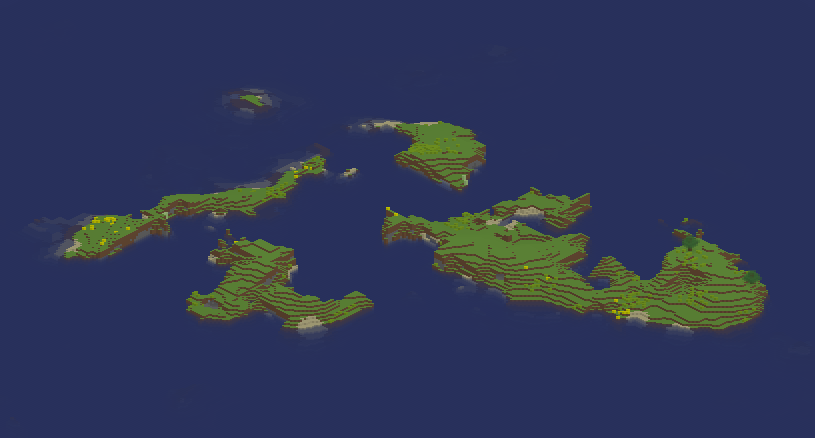
The Archipelago The Archipelago
Bird's eye view Bird's eye view
You're on a small island in the middle of a vast ocean. There's nothing but dirt, stone and grass on the your island, which is part of a tiny archipelago. One of the nearby islands features a dark cave, with what looks like a coal seam near the entrance. You can glimps two small trees on another island nearby. All around your little clutch of islands is what appears to be vast, unending ocean in all directions. It's midday and you need to make yourself safe for the night. You can use the wood from the trees to craft a pickaxe. With this, you can fetch some coal from the seam. With the coal, you can create some torches, to see in the dark. You might have enough wood left over to make a door, if you're lucky. Or perhaps you should save it to craft a boat, or a sword. Groans from something unknown emanate worryingly closely from the darkness of the cave. You're lucky: one of your two trees has dropped a sapling. You eagerly plant it. In a few days time, you might be able to harvest some more wood. You've been granted a temporary reprieve, but the law of diminishing returns means at some point, and soon, you'll run out of wood. Swimming is time-consuming. By the time you have assembled a meagre supply of wood and coal, it's almost sunset. You nervously dig a burrow in the mud of your original island, light it with a torch and block the entrance back up. Night passes slowly as you listen to things crawling around in the darkness outside. I first learned about Minecraft from this blog post by Mike Watson last year. Mike did a great job of demonstrating the narrative power of the game and his post left a lasting impression on me. Every now and then I dip in to Minecraft to see what's new since the last time I played it. In the last few months version 1.8 was released and so I started a new map to check it out. I ended up with a corker of a randomly-generated map. Inspired by Mike's post, I thought I'd write a bit about it. In a follow-up post I will provide the map itself.

Michal Čihař: Back on track with Gammu

During summer, I somehow managed to collect huge backlog on Gammu. This consisted on few hundredths of emails to reply, bug reports, not reviewed records in phone database and so on. Today I can finally say this is mostly over and I should be able to react more quickly. Though this does not change anything on previous statements about limiting my involvement there. Processing emails went quite smoothly, luckily some of them resolved themselves or others have helped on mailing list. With bug reports it is more troublesome, because there are topic which I don't want to touch and thus looking for volunteers to work on that. Maintaining Gammu packages in Ubuntu PPA so that users would be able to install latest version easily is one of such tasks, which are waiting for somebody. Anyway I feel much better without those unread emails and I hope not to collect so huge pile of them again :-).

Filed under: English Gammu 0 comments Flattr this!

8 November 2011

Christian Perrier: New update about Debian Installer localization

Sinhala and Slovak reach 100% for level 1. Full stats are here Status for D-I level 1 (core D-I files): Status for D-I level 2 (packages that have localized material that may appear during default installs, such as iso-codes, tasksel, etc.): Status for D-I level 3 (packages that have localized material that may appear during non-default installs, such as win32-loader) So, full 100% completeness (hall of fame) for: German (de), Persian (fa), French (fr), Portuguese (pt, Russian (ru)

Jan Hauke Rahm: On GNOME 3

Since there have been a few blog posts about GNOME 3 already, I m sure you don t mind me adding one. I m one of those who don t do any work, just lurk around and wait for stuff to be fixed or working in the first place. I also don t like compiling GNOME myself. I barely touched the already packaged stuff in the repository of our Debian GNOME packaging team. But I run unstable plus stuff from experimental. I ll thus have a bit of a different experience with GNOME 3 than current testing users who at least in parts don t seem to like what they re getting. That being said I love it. No, I don t mind running network manager on my systems, I even have it on my netbook (Atom processor). I used wicd for a long time because network manager really got nothing done back in the days (half a year ago or what :)). Nowadays, since version 0.9, it works fine for me. No fiddling around with config files, perfect integration in the desktop, and LAN and WLAN Just Work [tm]. No, I don t like if some weird dependencies dictate what tools to use. I usually used pidgin for messaging, for instance. Now I m using empathy, simply because it s best integrated in GNOME. And no, I won t switch from mutt to evolution. :-P And there are more such cases. Also, these weird accessibility tools that are stuck in the gnome-shell top panel , I don t need them. Still there. (There s an extension to remove it, by the way.) Also, I must say, GNOME 3.2 is a lot better than 3.0 already. And I think 3.4 might do the final trick for me. Fact is, with GNOME 3 I have a much cleaner desktop, there is more room for windows (which is nice on a netbook display), there are web apps which I already use a lot, and it has a professional, not too playful look (i.e. a few effects, clear and consistent theming, no bubbling windows). And the new notification stuff is just awesome, especially with the empathy integration. Oh, and too many mouse click to access an application? 1) Put your most used apps in the favorites bar (or whatever it is called); it s just one click then. 2) Press your meta-key (that way our name for the windows key, or was that the ESC key? Whatever, press your windows key), type in the first two or three letters of your application, and hit enter; you don t need a mouse at all. There. It had to be said. :)

Jon Dowland: GNOME 3

Oh, boy. Where do I start I postulate that there exists something called the "UI Singularity". Those who spend too much time considering the optimal way to interact with computing devices eventually pass through this singularity and can no longer effectively communicate with those of us on the other side. At least that's one way to explain what seems to be happening to free-software desktop environments. From the outside, it would appear this happened to KDE with KDE 4, and now, unfortunately, it has happened to GNOME, with GNOME 3. I've had GNOME 3.0 running on my Debian laptop for a few months, which I have used casually. At work, we installed Fedora 15 (GNOME 3.0) on our 69-seat Linux lab over the summer, which I have used on occasion to achieve specific things. I haven't dared upgrade my main work machine yet. So, it could be argued that I haven't spent enough time immersed in the GNOME 3 experience to really judge it fairly. On the face of it, I wish 3 was an iterative development from 2, and didn't throw so many babies out with the bathwater. My casual use of it so far has not endeared it to me at all. In the interests of being fair, rather than deliver my opinion of GNOME 3 as it currently stands, I've decided to try and use it in anger for a while to truly see whether I can "get it". Now that we're past the start of term, I am attempting to use a lab-configured Fedora 15 machine as my main work environment. I'll run with this for a while, and then try a Fedora 16 instance (I need to consider whether we should move to F16 for the second semester anyway) to see what improvements GNOME 3.2 brings.

Jonathan McDowell: The cost of progress

You should probably ignore this post. I'm just venting. I'll be better after a nice cup of tea. Things that are causing me to fume about the fact Gnome Shell just hit Debian/Testing: I update my testing boxes (work + home laptops) almost every day. It rarely breaks, and certainly when it does I accept that's what I get for doing rolling upgrades. I can't remember the last time I did an upgrade that actually made me angry. Also I suspect this thing is going to have a complete fit on my binary nVidia/hacked up DisplayLink configuration at work (the DisplayLink side refuses to do 3D for starters). Perhaps better not to upgrade there until I have a sufficient block of free time. Maybe it's time to go back to evilwm. I only stopped because I wanted a dock for wifi/bluetooth etc applets on my laptop that didn't get hidden when I fullscreened things. Implementing _NET_WM_STRUT might make that doable... (I'm sure some of this is just dealing with the change but it's a bit bloody difficult to deal with a complete change in user interface that hasn't even managed to carry across settings from the old one.)

7 November 2011

Alexander Reichle-Schmehl: Release Critical Bug report for Week 45

The bug webinterface of the Ultimate Debian Database currently knows about the following release critical bugs:
In Total:1893
Affecting Wheezy:1250
Wheezy only:180
Remaining to be fixed in Wheezy:1070
Of these 1070 bugs, the following tags are set:
Pending in Wheezy:47
Patched in Wheezy:190
Duplicates in Wheezy:51
Can be fixed in a security Update:33
Contrib or non-free in Wheezy:10
Claimed in Wheezy:0
Delayed in Wheezy:3
Otherwise fixed in Wheezy:87
Ignoring all the above (multiple tags possible) 709 bugs need to be fixed by Debian Contributors to get Debian 7.0 Wheezy released. However, with the view of the Release Managers, 1144 need to be dealt with for the release to happen. Please see Interpreting the release critical bug statistics for an explanation of the different numbers.

Wouter Verhelst: git-annex awesomeness

So a few days ago, there was this:
21:24 < wouter> hum.
21:24 < wouter> Anyone know of a tool to manage scanned documents?
21:25 < wouter> the idea being that I can tell this tool "here's a bunch of newly-scanned documents", and it will upload them to a server
21:25 < wouter> and it should allow me to easily find a specific file later on
21:25 < wouter> and I'd also like version control there
21:26 < wouter> and I do _not_ want to download the entire repository of scanned documents on my laptop (that's why I have a server)
21:26 < wouter> and perhaps I'd also like a pony to go with that.
21:29 < wouter> oh, yes, and I do _not_ want a webbrowser as the primary interface (that might be okay to look things up, but not to store stuff)
The answer, as it turned out, was git-annex: a tool to manage files with git, without checking them into git. What, I hear you say? Yes, that sounds a little weird, doesn't it? Perhaps it's easiest to explain with a little example.
$ git annex add 2011-11-07-belgacom.pdf
$ ls -l 2011-11-07-belgacom.pdf
lrwxrwxrwx 1 wouter wouter 191 nov  7 14:46 2011-11-07-belgacom.pdf ->
../.git/annex/objects/xx/3F/SHA256-s1537334--c44e1a057e247bfe7c196ac146c8a0ca32096c0b10df6c18fd3f1c2e99ecddbf/SHA256-s1537334--c44e1a057e247bfe7c196ac146c8a0ca32096c0b10df6c18fd3f1c2e99ecddbf
The file is now known to git-annex, and I can have it do all kinds of useful things with it now:
$ git annex drop 2011-11-07-belgacom.pdf
drop 2011-11-07-belgacom.pdf (unsafe)
  Could only verify the existence of 0 out of 1 necessary copies
  No other repository is known to contain the file.
  (Use --force to override this check, or adjust annex.numcopies.)
failed
git-annex: drop: 1 failed
Oops, we hadn't copied it to anywhere else yet. We don't want to lose our data!
$ git annex move --to server 2011-11-07-belgacom.pdf
move 2011-11-07-belgacom.pdf (checking server...) (to server...)
SHA256-s1537334--c44e1a057e247bfe7c196ac146c8a0ca32096c0b10df6c18fd3f1c2e99ecddbf
     1537334 100%    9.22MB/s    0:00:00 (xfer#1, to-check=0/1)
sent 30 bytes  received 1537668 bytes  1025132.00 bytes/sec
total size is 1537334  speedup is 1.00
ok
$
What just happened? git-annex copied the file to a git remote called "server", and then dropped it from my local copy. It's no longer here! The symlink in my local directory is now a dead link; I can not open it anymore. But, no worries! If we ever need it again, it's just a single command away.
$ git annex get 2011-11-07-belgacom.pdf
get 2011-11-07-belgacom.pdf (from server...) 
SHA256-s1537334--c44e1a057e247bfe7c196ac146c8a0ca32096c0b10df6c18fd3f1c2e99ecddbf
     1537334 100%    9.58MB/s    0:00:00 (xfer#1, to-check=0/1)
sent 30 bytes  received 1537668 bytes  3075396.00 bytes/sec
total size is 1537334  speedup is 1.00
ok
This allows me to save space on my local laptop while not having to care where the files are -- they're just there. And it gets more awesome if you know that git-annex can store multiple copies of each file (so you have automatic distributed backups, as with regular git), where you can enforce the minimum number of copies. Also, git-annex supports multiple backends -- you can store your data in Amazon S3, or on an encrypted USB drive, or whatever, and have git-annex manage it transparently for you. I said this already on IRC, but: Joey, I owe you beer.

Jo Shields: Bansheegeddon

It s seeming increasingly likely that reports regarding the future of Banshee, Tomboy, and the rest of the Mono stack in the default Ubuntu desktop install are accurate. Ubuntu 12.04 will likely be the first Ubuntu release since 5.10 not to ship with any Mono apps in the default install ending a run of 12 releases over 6 years. The decision seems to have come about during the default apps session at the Ubuntu Developer Summit just ended in Orlando, Florida. Prior to heavy vandalism, the only reasons cited for the change in the UDS session log are Banshee not well maintained and porting music store to GTK3 is blocked on banshee ported to GTK3 . Other reasons mentioned but not in the session logs are complaints that it doesn t work on ARM. I m using a lot of conjecture in this first paragraph because the news about the decision appeared on the blogosphere before anywhere else. The first many Banshee or Tomboy developers read about it was reading a flurry of activity on the Tweetosphere from the anti-Mono activists declaring victory. So first, a word on the cited reasoning. Banshee works fine on ARM, since Mono works fine on ARM. Xamarin, the company behind most upstream Mono work, earns their income almost entirely from ARM versions of Mono, running on the varied ARM implementations found in smartphones. Every major Banshee release is personally tested on my Genesi EfikaMX, an ARM system with a Freescale i.mx51 processor. I ve also demonstrated Banshee running in an Ubuntu chroot on my HP Touchpad, an ARM-based tablet. What is known is that Banshee has some problems running on Texas Instruments OMAP4 processors the target ARM platform for Canonical s ARM work. None of the Banshee upstream developers, Mono upstream developers, or Mono Ubuntu team has ever been able to reproduce the cited problems, since problems specific to an exact ARM chip are impossible to reproduce without the requisite hardware and none of us owns an ARM system matching Canonical s target. That Banshee is still a GTK+2 app is true. A port to GTK+3 is almost complete, but blocking on a single technical bug deep within GTK# s guts, which could be fixed by someone with sufficient knowledge of GTK+ semantics. Nobody with the required GTK+ knowledge has stepped forward with a fix at this point in time. As for the final point, that Banshee is not well maintained, this seems like a directed personal insult against the active and responsive Banshee maintainer, Chow Loong Jin, and upstream bug triager David Nielsen, in addition to the immeasurable hours contributed free of charge for the benefit of Ubuntu users by various other members of related Mono app and library teams, including myself. I need to stress at this point that my annoyance with this decision has nothing to do with the actual app changes. Keeping Tomboy and gbrainy, at a cost of about 25 meg of unsquashed disk space, is a hard argument to make compared with those two plus Banshee for 40 meg. Dropping gbrainy and Tomboy, and switching to Rhythmbox, will save about 30 meg of unsquashed space, all told.I m unconvinced that Rhythmbox is a technically superior app to Banshee several features which were gained by the first app swap will be lost again but that s another long tedious argument to be had. No, what has me deeply angered is the shambolic way the changes were made and announced. Significant accommodations were made by Banshee upstream in order to make life easier for Canonical to integrate Banshee into their OS. For one thing, that s why the Ubuntu One Music Store support is a core Banshee feature, not part of the third-party community extensions package. If Banshee was being considered for replacement due to unresolved technical issues, then perhaps it would have been polite to, I don t know, inform upstream that it was on the cards? Or, if Canonical felt that problems specific to their own itches required scratching, then is it completely beyond the realm of possibility to imagine they might have spent developer resources on bug fixing their OS and sending those fixes upstream? Or even and call me crazy providing access for upstream to specialized hardware such as a $174 Pandaboard to empower upstream to isolate and fix unreproducible bugs specific to Canonical s target hardware? And here s where it gets more astonishing for me Canonical paid money to ship one of the community-based packagers responsible for the stack, Iain Lane, to Orlando for UDS, and didn t think it was worth bothering to perhaps inform him hey, the stuff you work on is in danger of being axed from the default install, maybe you should go to this session . So I m not cross that the stuff I work on has been removed from the default install. I intend to continue working on it as I have for the last 4 years, through my work in Debian. No, why I m cross that I heard about it from fucking Boycott Novell. Regardless of your opinions regarding Banshee or its stack, if you read the above and don t see it as an abysmal failure of community engagement by a company whose community manager wrote a book on the damn topic, then there s something seriously wrong with your understanding of how community labour should be seen as a resource. Maybe someone at Canonical should try reading Jono s book. It s not a first-time offence, and this mail from a PiTiVi developer regarding changes in 11.10 makes for useful further reading. [edit] There is some worthwhile discussion going on on the ubuntu-desktop mailing list covering the technical issues surrounding the decision, I would suggest it s a good place for ongoing technical discussion.

Alastair McKinstry: Avoid Evil Social Networks

Avoid Evil Social Networks This is a test of a patch for the public atom feed from Diaspora*. If all is going well, the title in the web page should be h4 and a link, but plain text in the atom feed. And there should be links in the text. Well, the atom feed looked fine in vim for me. I recommend looking at Charlie Stross&#39;s latest post. Its about the evils of Klout, and how it is almost certainly illegal in Europe due to its very flagrant abuses of &quot;clients&quot; privacy.

Ritesh Raj Sarraf: Seagate FreeAgent GoFlex

I recently purchased a Seagate FreeAgent GoFlex 1 TB hard drive. It is a 2.5" compact disk that you connect over USB. It draws its power from the USB controller. My previous Extern HDDs were all 2.5" laptop drives, for which I bought a USB enclosure. Those devices always worked perfect, as in:The typical kernel messages I got for these devices were:
[56063.268107] usb 1-1: new high speed USB device number 13 using ehci_hcd
[56063.401635] usb 1-1: New USB device found, idVendor=14cd, idProduct=6116
[56063.401645] usb 1-1: New USB device strings: Mfr=1, Product=3, SerialNumber=2
[56063.401652] usb 1-1: Product: USB 2.0 SATA BRIDGE
[56063.401658] usb 1-1: Manufacturer: Super Top
[56063.401663] usb 1-1: SerialNumber: M6116018VF16
[56063.402857] scsi8 : usb-storage 1-1:1.0
[56064.400896] scsi 8:0:0:0: Direct-Access WDC WD50 00BEVT-24A0RT0 PQ: 0 ANSI: 0
[56064.401576] sd 8:0:0:0: Attached scsi generic sg2 type 0
[56064.402102] sd 8:0:0:0: [sdb] 976773168 512-byte logical blocks: (500 GB/465 GiB)
[56064.402615] sd 8:0:0:0: [sdb] Write Protect is off
[56064.402618] sd 8:0:0:0: [sdb] Mode Sense: 03 00 00 00
[56064.403101] sd 8:0:0:0: [sdb] No Caching mode page present
[56064.403105] sd 8:0:0:0: [sdb] Assuming drive cache: write through
[56064.404861] sd 8:0:0:0: [sdb] No Caching mode page present
[56064.404864] sd 8:0:0:0: [sdb] Assuming drive cache: write through
[56064.419657] sdb: sdb1
[56064.421850] sd 8:0:0:0: [sdb] No Caching mode page present
[56064.421854] sd 8:0:0:0: [sdb] Assuming drive cache: write through
[56064.421857] sd 8:0:0:0: [sdb] Attached SCSI disk
But for my Seagate FreeAgent GoFlex HDD, things were different. The kernel would detect but then it would not mount. The error reported is that the device is busy. My FreeAgent's kernel messages look similar to what the regular one has:

[ 168.520140] usb 1-1: new high speed USB device number 5 using ehci_hcd
[ 168.657424] usb 1-1: New USB device found, idVendor=0bc2, idProduct=5021
[ 168.657433] usb 1-1: New USB device strings: Mfr=1, Product=2, SerialNumber=3
[ 168.657439] usb 1-1: Product: FreeAgent GoFlex
[ 168.657444] usb 1-1: Manufacturer: Seagate
[ 168.657449] usb 1-1: SerialNumber: NA0C1BML
[ 168.659079] scsi5 : usb-storage 1-1:1.0
[ 169.657136] scsi 5:0:0:0: Direct-Access Seagate FreeAgent GoFlex 0148 PQ: 0 ANSI: 4
[ 169.708786] sd 5:0:0:0: Attached scsi generic sg3 type 0
[ 169.709079] sd 5:0:0:0: [sdc] 1953525167 512-byte logical blocks: (1.00 TB/931 GiB)
[ 169.709954] sd 5:0:0:0: [sdc] Write Protect is off
[ 169.709963] sd 5:0:0:0: [sdc] Mode Sense: 1c 00 00 00
[ 169.710567] sd 5:0:0:0: [sdc] Write cache: enabled, read cache: enabled, doesn't support DPO or FUA
[ 169.759942] sdc: sdc1
[ 169.762050] sd 5:0:0:0: [sdc] Attached SCSI disk
As the Device Mapper Multipath Debian Maintainer, I have multipath-tools installed on my laptop. Turns out, for some reason, the device is consumer by the device mapper multipath stack.
20:12:58 rrs@champaran:~$ ls /dev/mapper/
1Seagate@ 1Seagate FreeAgent GoFlex N 1Seagate FreeAgent GoFlex Np1 control LocalDisk-ROOT@ LocalDisk-SWAP@

Also the block device ID listing is enumerated as type SCSI.

19:56:44 rrs@champaran:~$ ls /dev/disk/by-id/
ata-HITACHI_HTS723216L9SA60_091220FC1220NCJASEVG@ scsi-SATA_HITACHI_HTS7232091220FC1220NCJASEVG@
ata-HITACHI_HTS723216L9SA60_091220FC1220NCJASEVG-part1@ scsi-SATA_HITACHI_HTS7232091220FC1220NCJASEVG-part1@
ata-HITACHI_HTS723216L9SA60_091220FC1220NCJASEVG-part2@ scsi-SATA_HITACHI_HTS7232091220FC1220NCJASEVG-part2@
ata-HITACHI_HTS723216L9SA60_091220FC1220NCJASEVG-part3@ scsi-SATA_HITACHI_HTS7232091220FC1220NCJASEVG-part3@
ata-HL-DT-ST_DVDRAM_GU10N_M189CNI1127@ scsi-SSeagate_FreeAgent_GoFle_NA0C1BML@
ata-ST1000LM010-9YH146_W1000ZD8@ usb-WDC_WD12_00BEVE-11UYT0_ST_Killer-0:0@
dm-name-1Seagate@ usb-WDC_WD12_00BEVE-11UYT0_ST_Killer-0:0-part1@
dm-name-LocalDisk-ROOT@ wwn-0x5000c5003d19c8c2@
dm-name-LocalDisk-SWAP@ wwn-0x5000cca586e112bc@
dm-uuid-LVM-buywwzKkpfKG2RegankA2nPkmFBBPFe3D5DepV8w8nLrHfoAjIIQVnakOQJZEqJX@ wwn-0x5000cca586e112bc-part1@
dm-uuid-LVM-buywwzKkpfKG2RegankA2nPkmFBBPFe3k9aJfc9B7wRmVIwfoagffHUZjuN6c4cM@ wwn-0x5000cca586e112bc-part2@
dm-uuid-mpath-1Seagate@ wwn-0x5000cca586e112bc-part3@
raid-1Seagate@
But I'm not sure why the same doesn't happend for my external laptop drive. It gets properly tagged as device type USB. So Laptop or Server, if you have a FreeAgent that you want to connect to your machine, and see the device busy error when accessing the device['s] directly, do the following:First, the ID of the device.

20:17:43 rrs@champaran:~$ /lib/udev/scsi_id --whitelisted --page=0x83 --device=/dev/sdc
1Seagate FreeAgent GoFlex N
Add the ID to /etc/multipath.conf under blacklist section

blacklist
wwid "1Seagate FreeAgent GoFlex*"
wwid "1Seagate FA GoFlex Desk*"
# devnode "^(ram raw loop fd md dm- sr scd st)[0-9]*"
# devnode "^hd[a-z][[0-9]*]"
# device
# vendor DEC.*
# product MSA[15]00
#
Run mulitpath -F to flush the unused maps. Run multipath -v3 to ensure that now the device is blacklisted.
Nov 03 20:19:02 sdc: (Seagate:FreeAgent GoFlex) wwid blacklisted

The front cause for the mis-behavior is:

# Coalesce multipath devices before multipathd is running (initramfs, early
# boot)
ACTION=="add change", SUBSYSTEM=="block", RUN+="/sbin/multipath -v0 /dev/$name"

But something else, maybe the default blacklist table, needs the actual fix.

Alexander Reichle-Schmehl: Weekly RC Bug Statistics enabled again

Friday David Pr vot reminded me about the statistics for release critical bugs I used to publish during the squeeze release cycle, and asked if I could enable them again. After tweaking the script generating the statistics a bit (mainly a s/squeeze/wheezy/g) the stats will be again published weekly, every Friday at 13:05 CET. The first report is already available, and it seems it is about time, that we got the Wheezy Bug Squashing Party Marathon started! So, see you at the first BSP in Hildesheim.

Timo Jyrinki: Free software mobile phone galore

Almost forgot to post this. My mobile phones running free software in photos. From left to right:


All of that software running on the devices is more or less free software, with Harmattan obviously being by far the least free, especially applications, but still better than any other on-the-shelf phone software *), and the others being 99% or "Ubuntu like" free ie. possibly with firmware and a few driver exceptions. N9 needs some bootloader work still before Nemo, Debian, Ubuntu etc. can be run there. I've collected a few things about N9 from this point of view at a wiki page.
*) Not sure about every Android phone, but Android is not openly developed anyway so it's hardly a similar free software project such as freedesktop.org projects or Qt

I gave my N900 away now since obviously I cannot make full use of each one of these. I'm multi-SIMming my N9 and the GTA02a7 Neo FreeRunner for daily use, while the other FreeRunner and N950 are purely for tinkering related purposes. The development FreeRunner will get on upgrade to GTA04 once it's available, and then hopefully that can be made into a daily usable phone as well.

By the way, see you in FSCONS in Gothenburg next weekend. Even rms will be there, which is always interesting of course :)

Roland Mas: Guitar Hero Controller (Wii) to MIDI

This is a follow-up on a previous post: I used a bit of a rainy Sunday to read some docs and write some Python, and I now have a script that converts events from a Guitar Hero World Tour drums controller to MIDI. A brief explanation of how it works: in its standard configuration, the drums controller has five pads and a pedal, and it uses a Wiimote to communicate the events (what pad was hit with what force, or what button was pressed/released, or the position of the mini-stick) to the Wii itself. This communication happens over Bluetooth and not over a dedicated cable or protocol, so it is possible to remove the Wii and use a standard computer with Bluetooth (built-in or via a dongle) instead, and the computer will receive messages. There's some decoding to do, but fortunately people have reverse-engineered the frames, and come up with the libcwiid library and its Python binding, which hides the complexity of the decoding and just delivers structured data to the programs that use it. Then we analyze this data and extract the relevant info from it (with some juggling of bits): "the X pad was hit with force Y". From there, it's a simple matter of mapping the pads to a MIDI note and the force to a MIDI velocity, and of sending the appropriate MIDI message to the target, for instance with the libportmidi library. What you do with the MIDI output is your call: I use it to add more pads to my electronic drum kit, but it could equally be used to drive a software synthetizer, or an external sound module. Or a light-show machine. Or fireworks. Or a model railway. Or whatever. Here's the current version of the wiigh2midi.py script (for updated versions, see the Bazaar repository).
#! /usr/bin/python
import cwiid, time, asyncore, pypm
class Wiimidi:
    wiimote = None
    midiout = None
    lastaction = time.time()
    wii2color =   27: 'kick',
                  25: 'red',
                  17: 'yellow',
                  15: 'blue',
                  14: 'orange',
                  18: 'green'  
    color2midi =   'kick': 36, # Bass drum
                   'red': 38, # Snare drum
                   'blue': 48, # High tom
                   'green': 43, # Low tom
                   'yellow': 42, # Closed hi-hat
                   'orange': 52, # Crash cymbal
                    
    def connect_wiimote(self):
        print "Press 1+2 on the Wiimote..."
        try:
            self.wiimote = cwiid.Wiimote()
        except:
            self.wiimote = None
            return None
        print "Connected."
        self.lastaction = time.time()
        self.wiimote.rumble=1
        time.sleep(.2)
        self.wiimote.rumble=0
        return self.wiimote
    def disconnect_wiimote(self):
        if self.wiimote is not None:
            print "Closing connection to the Wiimote."
            self.wiimote.close()
            self.wiimote = None
        return
    def connect_midi(self):
        for i in range(pypm.CountDevices()):
            interf,name,inp,outp,opened = pypm.GetDeviceInfo(i)
            if outp == 1:
                if name == 'UM-1G MIDI 1':
                    self.midiout = pypm.Output(i, 0)
                    return
        for i in range(pypm.CountDevices()):
            interf,name,inp,outp,opened = pypm.GetDeviceInfo(i)
            if outp == 1:
                print i, name," ",
                print
        dev = int(raw_input("Type output number: "))
        self.midiout = pypm.Output(dev, 0)
    def wiimote_callback(self, messages, timestamp):
        self.lastaction = time.time()
        m = messages[0][1]
        # rx = m['r_stick'][0]
        ry = m['r_stick'][1]
        l = m['l']
        # r = m['r']
        which = ( (l << 1) & 16) + (ry >> 1)
        softness = l & 7
        if softness == 7 or which == 0:
            return
        # print "rx=%d\t ry=%d\t l=%d\t r=%d\t rest=%d" % (rx,ry,l,r,rest)
        # print "which = %d, softness = %d" % (which, softness)
        strength = 7-softness
        color = self.wii2color[which]
        midi_vel = 16*strength
        midi_note = self.color2midi[color]
        self.midiout.WriteShort(0x9a,midi_note,midi_vel)
        self.midiout.WriteShort(0x9a,midi_note,0)
        # print "%s %d -> %d %d" % (color, strength, midi_note, midi_vel)
    def main(self):
        self.connect_midi()
        while True:
            if self.wiimote is None:
                self.connect_wiimote()
                if self.wiimote:
                    # Tell Wiimote to display rock sign
                    self.wiimote.led = cwiid.LED1_ON   cwiid.LED4_ON
                    # We only care for the extension data
                    self.wiimote.rpt_mode = cwiid.RPT_EXT
                    self.wiimote.enable(cwiid.FLAG_MESG_IFC   cwiid.FLAG_REPEAT_BTN)
                    self.wiimote.mesg_callback = self.wiimote_callback
                    self.lastaction = time.time()
                else:
                    print "Retrying... "
                    print
            asyncore.loop(timeout=0, count=1)
            if self.lastaction < time.time() - 3600:
                print "An hour passed since last action..."
                self.disconnect_wiimote()
            time.sleep(0.05)
        print "Exited safely."
# Instantiate and run
inst = Wiimidi()
inst.main()
There are a few obvious improvements to be made: first, handling guitar controllers in addition to drums. Second, handling the buttons could provide extra "pads", to trigger sound effects for instance (thunder, lasers, voices ), or to initiate program changes, or to change the mappings of the pads. Maybe storing the mutable parts (default MIDI adapter, pad-to-note mapping) in a configuration file. Maybe add a user interface to ease the configuration. Patches welcome, otherwise maybe I'll do that myself on another rainy Sunday. Notes and references (in other words, the giants on whose shoulders this program stands): More cowbell!

Mart&iacute;n Ferrari: Oh, hai!

Ugh, in the last year and a half I've only posted once. With the move to Ireland, starting a new job, and then using too much Google+, I forgot about this blog thing. So, to start with something easy, I'll tell you about some films I watched recently. This weekend I had a marathon of films, after sometime without watching any, I watched two at home and two at my favourite cinema in Dublin: the IFI, which I recommend to anyone living here. First, on Friday, I watched Brazil, the 1985 classic from Terry Gilliam. It was a long overdue obligation to watch it, and some discussions with a friend about cinema made me finally do it. It was an amazing film. Among the many memorable scenes, and cinephile winks, I liked the one copying the famous Odessa steps sequence. The problems related to its US release reminded me a bit of the problems with the edition of Touch of evil, although in the case of Brazil, what the big studio did to the film was to butcher it. On Saturday I continued on the Gilliam streak and re-watched 12 Monkeys, which I had forgotten completely. Another great film, with a clearly bigger budget, it does not rely on the money but in the plot, art, and acting to be memorable. Also, I love the main theme, a tune from Astor Piazzolla called "Suite Punta del Este". Just after finishing the film, I read that some people from the local Couch Surfing group were meeting at the IFI to see one of the many features of the Polish film festival that took place this weekend. So I went and saw A short film about killing, a powerful and shocking movie about the death penalty. Considered by many to be one of the most horrifying depictions of a killing (two, in fact), it didn't shock me as much as some other films had done, maybe it was because of the cinema overdose... Anyway, it was another must-see. IMDB asserts that the Polish government suspended the death penalty in Poland for five years after the release of this film, but I could not find sources to confirm this. This morning I woke up pretty early, which is completely uncommon for me on a Sunday. So I decided to use the tickets offered by the IFI for a pre-screening that I had assumed I would not use, since I had to be in the cinema at 11! This time it was an Irish documentary about Bernadette Devlin, called Bernadette: Notes on a political journey. It was really interesting, even if I had never heard about this important figure of Ulster politics in the sixties. Sadly, because of my ignorance on the topic (and some northern accents that I have trouble understanding), I missed many parts of the film. In any case, it has increased my appetite to know more about the Troubles, which had started when I visited the Republican neighbourhood of Belfast, specially Falls road. Tags: Life, Planet Debian

6 November 2011

Gregor Herrmann: RC bugs 2011/44

this week showed an interesting mixture of RC bug fixes: applying patches from others, writing one on my one, adjusting build dependencies, & also closing some bugs that did not occur anymore during the last Grid'5000 run & are also unreproducible locally (thanks to Lucas for the hint).

Joachim Breitner: gtk-vector-screenshot featured in freiesMagazin

I have published a small article in the November edition of the German electronic magazine freiesMagazin on gtk-vector-screenshot. Their format is especially nice for that, given that the vector screenshots are embedded as such in the PDF version of the magazine, so the reader can zoom in and check for herself that it is indeed a vector screenshot.

Flattr this post

Next.

Previous.