Search Results: "ag"

6 February 2011

Peter Eisentraut: Squeeze + PostgreSQL = Broken

The PostgreSQL package in Debian squeeze, just released, is linked with libedit instead of libreadline. This has two interesting properties:
If either of these is a concern, think carefully before you upgrade.

Is there a way to at least configure libedit to accept non-ASCII characters?

David Paleino: Bash-Completion 1.3 released

After almost 8 months from the previous release, the Bash Completion Team is proud to announce the release of bash-completion 1.3! Nothing really innovative in this release. Just "boring" new completions, and bugfixes :) For some stats, this release features 184 completions, the previous (1.2) had 168. For more numbers, please read previous posts. New completions are obviously welcome! Apart from the usual team members (Ville Skytt , Freddy Vulto, Guillaume Rousse and me), we've had contributions from (in no particular order): Anton Khirnov, Paul Walmsley, Miklos Vajna, Andrej Gelenberg, Stephen Gildea and Andrey G. Grozin. Thank you people for helping us! The exciting things will arrive with 2.0. So stay tuned, and enjoy the new bash-completion! -- David

Nikita Youshchenko: Keeping KDE3 when upgrading to squeeze

This post is for those who want to upgrade their debian to the shiny new release, but still wants to continue using KDE3 packages from lenny. This could be done by keeping lenny as a low-priority apt source, and proper package pinning. To keep system more consistent, I use the following rule: pin to lenny all packages from sources that build something depended on KDE libraries. This rule catches all of KDE3, and also everything that uses KDE3 libraries, but was not included into KDE3. Also, this keeps good practice of avoiding installation binary packages built from different versions of the same source package. One exception is OpenOffice.org. Due to it s KDE plugin, it is caught by the rule. But lenny has too old version of it. Better to take version from lenny-backports. Below is my script that generates needed configuration. It parses /var/lib/apt/lists/*_lenny_*_Packages files; to have these, lenny should be mentioned by name (not by oldstable alias) in /etc/apt/sources.list. Packages found are pinned with priority of 900 (this value may need to be adjusted). Output of the script could be put directly into a file in /etc/apt/preferences.d/ directory before upgrading system to squeeze.
#!/bin/bash
# Find out sources that build packages depending on kdelibs4c2a, and pin
# to lenny any package that comes from any of those sources.
# Exception is openoffice.org - pin it to lenny-backports instead
cat /var/lib/apt/lists/*_lenny_*_Packages   awk '
        BEGIN  
                found["kdelibs"] = 1
         
        /^Package: /  p=$2; s=$2 
        /^Source: /   s=$2 
        /^Depends:.*\<kdelibs4c2a\>/  found[s]=1 
        /^$/  allp[p]=1; p2s[p]=s 
        END  
                delete found["openoffice.org"]
                for (p in allp)  
                        if (p2s[p] in found)  
                                print("Package: " p)
                                print("Pin: release n=lenny")
                                print("Pin-Priority: 900")
                                print("")


'
cat /var/lib/apt/lists/*_lenny-backports_*Packages   awk '
        /^Package: /  p=$2; s=$2 
        /^Source: /   s=$2 
        /^$/ && s=="openoffice.org"  
                print("Package: " p)
                print("Pin: release n=lenny-backports")
                print("Pin-Priority: 900")
                print("")
         
'

Vincent Fourmond: Doxygen for Ruby, first working draft !

Quite some time ago, I complained about the lack of support of Ruby in doxygen, the ultimate code documentation generator (at least for me). Time has passed, and I had some time and motivation to look into it and write a patch. The code is now reasonably mature to be used, altough it still lacks many features, and, most importantly, testing. That's why I pushed my git-svn private repository to github today, in order to get enough testing to integrate it into mainstream doxygen. It's current features: You can get an opinion of how it looks on the code of ctioga2. The doxygen configuration file can be found there.

Christian Perrier: Squeeze released

This is the gazillionth entry on Planet Debian about Squeeze being released. If I had to say one thing about it, it would be that I think the way it was handled this time has been really great. The debian-publicity team, lead by the tireless Reichles, did great job in doing as many buzz as possible around that release....but managed to do it in the "spirit" of free software (pushing release parties, animating a feed on identi.ca, preparing press releases, etc.). The Release Team did a tremendous job during the 6 months of the freeze, by carefully balancing between conservatism and liberalism in accepting (or denying) our gazillion of request for freeze exceptions The FTP, CD, installer, website, documentation teams organized things really well for their respective fields of responsibility. A special mention to the tremendous effort done about the release notes, release announcements documents (and of course, their translators). I'm currently busy upgrading my servers (at home and at work) and things are going smoothly (except the first two I did without carefully reading warnings about missing firmwares...they're now waiting for me to provide them with the right non free firmware packages, 30km away from here). And, for myself, I celebrated the release this morning by squashing my personal best time on an half-marathon (officials races excepted) by nearly 7 minutes, bringing it just below 1h45 (PB in official races is 1h37). Release power! :) And, during that afternoon, I also had the please of having my pet package (geneweb) and my most important package (samba) having their first release in unstable, targeted for wheezy. Squeeeeeeze meeeeeeeeeeeee!

Martin Michlmayr: Upgrading to Debian 6.0 (squeeze) on ARM

Debian 6.0 (squeeze) has been released. Here are some notes if you're running Debian on an ARM-based NAS device or plug computer and are planning to upgrade. First of all, make sure to read the release notes for Debian 6.0 on ARM. This document contains a lot of information on performing a successful upgrade. Second, during the kernel upgrade, you'll get the following message about the boot loader configuration:
The boot loader configuration for this system was not recognized. These
settings in the configuration may need to be updated:
 * The root device ID passed as a kernel parameter;
 * The boot device ID used to install and update the boot loader.
On ARM-based NAS devices and plug computers, you can simply ignore this warning. We put the root device into the ramdisk so it will be updated automatically. Finally, after doing the upgrade and before rebooting your system, make sure to run flash-kernel to activate the new kernel.

Lars Wirzenius: Idea: addsysuser

Debian got squeeze released, and ideas are brewing for what to do during the next release cycle. Here's an idea I had lying around. I'm throwing it out there, since I won't have time to do anything about it for at least a little while, but perhaps someone else thinks it's a good idea? Or, better yet, you can all tell me in comments why this is a bad idea, or at least why it should be designed in a different way.
NAME
       addsysuser, delsysuser - create and remove systems user in Debian pack 
       ages
SYNOPSIS
       addsysuser [options] username
       delsysuser [options] username
DESCRIPTION
       addsysuser creates a system user, and delsysuser removes it.  The  pur 
       puse  of these tools is to make it easier for Debian packages to create
       and remove system users as  the  pacakges  are  installed  and  purged.
       These are wrappers around adduser(8) and deluser(8).
       addsysuser  will  create the system user, unless it already exists.  If
       the user already exists, it does nothing.
       delsysuser removes the user.  However,  the  system  administrator  may
       configure  it  to  never remove the user, or to remove only some users.
       Use the /etc/adduser.conf for the settings:
       DELETESYSTEMUSERS
          Set to true or false  depending  on  whether  delsysuser  should
          remove the system user or not.  Defaults to true.
OPTIONS
       -p, --packagePACKAGE
          Record the user as being used by a specific package.  Many pack 
          ages can use the same user.  delsysuser  will  only  remove  the
          user when no packages are using it anymore.
       --no-act
          Only  pretend  to call adduser or deluser without actually doing
          so.  This allows easier testing of command lines.
FILES
       /etc/adduser.conf
          Configuration file for addsysuser and delsysuser.
EXAMPLE
       In the postinst script:
          addsysuser --package hello hellouser
       In the postrm script:
          delsysuser --package hello hellouser
SEE ALSO
       adduser(8), deluser(8).

Benjamin Mako Hill: Editor-to-Reader Ratios on Wikipedia

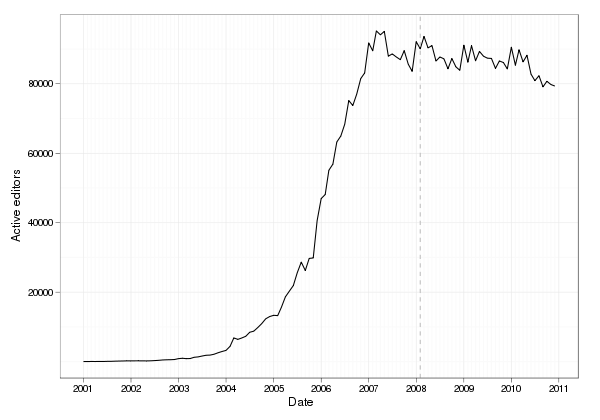
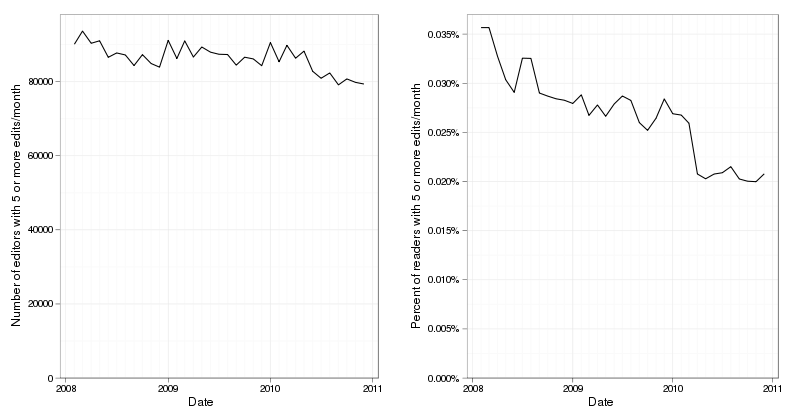
It's been reported for some time now that the number of active editors on Wikipedia (usually defined as people who have edited at least 5 times in a given month) peaked in 2007 and has been mostly stable since then. A graph of the total number of active editors in every month since Wikipedia's founding is shown below. The graph shows the aggregate numbers for all language Wikipedias. English Wikipedia is the largest component of this and is generally more variable. That said, very similar patterns exist for most larger languages. /copyrighteous/images/active_editors_all_wikpiedia.png Felipe Ortega, who has provided many of these statistics, has warned against fatalist claims. Although there seems to be a decrease in the total number of active editors over the last two years, the situation seems to have somewhat stabilized in most languages. New editors in Wikipedia are replacing folks at almost the rate that they are leaving. It is also widely known that the number of readers of Wikipedia has been increasing during this period. According to the report cards released by the foundation using comScore data, the number of unique visitors to Wikipedia each month has increased by 61 million people in the last year -- over 17%. This discrepancy between rising readership and stable or sinking editorship should raise major concern. After all, the Wikimedia Foundation's mission is two part: (1) to empower and engage people around the world to collect and develop educational content and (2) to disseminate it effectively and globally. Although the Foundation report cards include measures of raw levels of editorship, a better metric of engagement and empowerment might be the proportion of readers who engage in editing. I could not find reliable data on the number of unique readers reached each month for more than a few months in the last year. What is available, however, is wonderful data on page views each month going back to 2008. Analysis of the data from available report cards show that, at least during the last year, there is a very stable ratio of 35 page views per unique visitor, as estimated by comScore. Using that measure, we can do a back of the envelope estimation on the proportion of users that are editors for the period where page view data is available, dating back from February 2008 ( marked with the grey dashed lined above). The graphs below show the very different results you get when you consider the change in the number of Wikipedia editors and the change in the editor-to-reader ratio. Once again, these data are combined data for all language Wikipedias although graphs look very similar for most larger languages. The results are striking. Although there has been a 12% decrease between February 2008 and December 2010 in the number of active editors, there is a 42% decrease in the proportion of readers who edit at least five times a month. We can see that fulfilling the first half of the Wikimedia mission remains a struggle. /copyrighteous/images/wikipedia_editors_combined_graph.png Although the graphs above do not say anything directly about the most active core contributors to Wikipedia, the fact that Wikipedia is being maintained by a tiny -- and shrinking -- proportion of its readership does mean that the idea behind Wikipedia is under threat. Although none are as big as Wikipedia, there are lots of good encyclopedias out there. The reason Wikipedia is different, interesting, and important is because -- unlike all those others -- Wikipedia is the encyclopedia that anyone can edit. Wikipedia is powerful because it allow its users to transcend their role as consumers of the information they use to understand the world. Wikipedia allows users to define the reference works that define their understanding of the their environment and each other. But 99.98% of the time, readers do not transcend that role. I think that's a problem. Worse, that the number is growing. The Wikimedia Foundation recently ran a major successful effort to attract donations in its annual fundraiser. Jimmy Wales' smiling mug is apparently enough in the way of motivation to get something like 1% of its readers to donate money to support the project. I think that's very good news. If the Wikimedia community can entice even half of those people to contribute through an increased involvement in the projects themselves, they might do more than ensure Wikipedia's continued growth. They would help take a step toward the empowerment and engagement of those users in sharing their own knowledge, and the continued fulfillment of a critically important mission.
Bastian Venthur: Squeeze

Tonight Squeeze was released! Along with the release came a redesign of our website and planet. Nice! I m particularly happy that we ll see lots of fresh software and updates in unstable again, now that it is not frozen anymore. Thanks to all contributors. Keep up the good work!

Erich Schubert: Debian Squeeze released!

Debian GNU/Linux 6.0 "squeeze" has been released today.
Congratulations to everyone involved in ironing the last few bugs out.
(My own involvement had been a bit limited recently, but I at least kept my few remaining packages in a ready-to-release state and helped with the occasional bug report and patch.)
Some people think that Ubuntu is the better Debian - I do NOT. Debian is a fun place, has great people working on it and is true to its aims at creating a truly free and high-quality distribution. The long release cycles of Debian are a feature, not a bug. Stable is for production systems, not toy projects.
The proper way of attributing Debian stable is conservative and sustainable, but not outdated. It actually can do everything you need - and will do so in 10 years.
If you have been using Open Source for as long as me (say 15+ years) you will probably have seen software hypes come and go. The one thing that has been always the same was Debian: dead reliable. There was a time when everyone was crazy about enlightement for it's shiny pretty UI. Almost like Compiz-Beryl just two years ago. It came, as a matter of fact Debian also had it, but it also went.
I also remember how people complained that Debian didn't ship Xgl back in 2006 when this was the latest hype (there was no Debian release in 2006). Well, Xgl died in 2008. The features remained, but done in a much nicer way, and also found their way into Debian. In fact, I also ran Xgl at least once, on Debian, but just not on "stable". One could say that Xgl never was quite "stable", was it?
Debian stable is good the way it is: an administrators choice. Of course, developers might have different needs, but there also is testing, unstable and experimental. Just make sure to align your choice with your needs. And sometimes, also rethink your needs: there is no "latest beta versions" and "stable platform" at the same time.

Rapha&#235;l Hertzog: Debian 6.0 is out, Wheezy kicks off

As you probably already know, Debian released Squeeze aka Debian 6.0 this week-end. It was a really great week-end. I saw quite a few release already, but none with so much online social activity. Alexander and Meike Schmehl live commented the release on the Debian identi.ca account and Joey Hess held his Debian Party Line. On top of this, the team in charge of the website rolled out a new design on quite a few online services during the week-end including www.debian.org, wiki.debian.org, planet.debian.org and more. Congratulations to all the people who made this happen (and the release team in particular). It s great to see Debian achieve all of this. Do you know that it s the third time in a row that we manage to release in the 18-24 months timeframe? 3.1: June 2005 4.0: April 2007 5.0: February 2009 6.0: February 2011. Yes, despite our size and the fact that we are all volunteers, we have managed to stick to a reasonable schedule for a stable distribution that is deployed on a large scale. Wheezy kicks off The best part of the release for us the developers is that wheezy is now open for development and we can work on new features for the next release. ;-) And it started quickly: according to UDD, wheezy already features 488 new source packages that are not in squeeze, 1713 updated source packages and among those 1246 are new upstream versions. I really look forward to the upcoming projects and related discussions.
Click here to subscribe to my free newsletter and get my monthly analysis on what s going on in Debian and Ubuntu. Or just follow along via the RSS feed, Identi.ca, Twitter or Facebook.

For the curious, here are the UDD queries I used:
# Updated packages in wheezy
select count(source) from sources_uniq as su where (select version from sources_uniq where release='squeeze' and distribution='debian' and source = su.source) < su.version and release='wheezy' and distribution='debian';
# Updated with a new upstream version
select count(source) from sources_uniq as su where debversion(regexp_replace((select version from sources_uniq where release='squeeze' and distribution='debian' and source = su.source), '-.*', '')) < debversion(regexp_replace(su.version, '-.*', '')) and release='wheezy' and distribution='debian';
# New package in wheezy
select count(source) from sources_uniq as su where source not in (select source from sources_uniq where release='squeeze' and distribution='debian' and source = su.source) and release='wheezy' and distribution='debian';

No comment Liked this article? Click here. My blog is Flattr-enabled.

Charles Plessy: Long life to Squeeze !

Debian just published Squeeze today. It is an excellent release, that I hope I will keep for a long time on my machines. Among the improvements, boot has been accelerated. On my laptop with a second hand SSD, it only takes 20 seconds to see the login screen. I was amazed when I saw this for the first time. I was often upgrading from Stable to Testing quite quickly, to install more recent versions of desktop applications. But the backports change the game. I hope that I will not switch to Testing before one year or two. For Squeeze, I will also prepare backports for the packages I maintain. I hope that more people will enjoy them. Most of these packages are independant from the graphical system, and more in general from its core. The backports will allow to use recent version of these packages on top of a stable distribution. Since Lenny, Debian Med displays the contents of its metapackages with tasks pages, that include draft packages as well. Not all will make it in Debian, and I would like to have the feedback from our users to better chose our priorities. Contact us on the debian-med@lists.debian.org mailing list ! These new packages will also be distributed for Squeeze through the backports. Thanks again to everybody who contributed to the release of Squeeze !

Tiago Bortoletto Vaz: Released!

Nice try tassia! I'm sure you can do even better for Wheezy :)

Meike Reichle: Squeeze Release Live Dent Finished

That's it! Squeeze is released and the website's new design is in place. What a great day! In addition to the usual announcements on the website and mailing lists we decided to also do a live coverage of the whole process using identi.ca this time! Alex and me have been doing a live coverage of Debian's release process for almost 19 hours straight and, although we're dead beat now, I think it was well worth it! People seemed to enjoy being included in the process and many expressed their admiration for Debian's well-coordinated and purposeful proceedings. Congratulations to all involved: the FTP team, the release team, the CD team, the www team and the publicity team! Great work everyone!

Kees Cook: fun with game memory

So, I was testing a (closed source) single-player offline game recently and thought this exercise might be fun to document. I didn t want to spend any time actually earning in-game money since I d played it before and I wanted to just skip ahead to other aspects of the game. I was curious how straight-forward adjusting my cash might be. So, noting the in-game bank account number of 219393 and account balance of 3000, I dived right in. First up, what s the memory layout of the heap look like? I looked at the brk and the mmap regions without a mapped library or file, marked with w in the permissions column, from /proc/PID/maps:

0827e000-08282000 rw-p 00000000 00:00 0
0a22e000-0b08a000 rw-p 00000000 00:00 0 [heap]
efa59000-efd00000 rw-p 00000000 00:00 0
efd00000-efd21000 rw-p 00000000 00:00 0
Knowing these, I could use gdb s find command, after attaching to the process:
$ gdb /some/cool/game

(gdb) attach PID

(gdb) find /w 0 0827e000, 0 08282000, 219393
(gdb) find /w 0 0a22e000, 0 0b08a000, 219393
0xaf03d08
0xaf06ca8
No hits in the first region, but I see two hits for the account number value in the second region. Let s start there and see what s near them
(gdb) x/8x 0xaf03d08
0xaf03d08: 0 00035901 0 00000000 0 00000000 0 0af06ce0
0xaf03d18: 0 0af06be0 0 00000059 0 0af03d98 0 0af041e8
(gdb) x/8x 0xaf06ca8
0xaf06ca8: 0 00035901 0 00000bb8 0 00000bb8 0 0820b148
0xaf06cb8: 0 00000001 0 00000000 0 00000000 0 00000000
In that second hit, I see the value 0xBB8, which is 3000, and matches our account balance. Let s see what happens if we just change both of those to add a bit a few orders of magnitude above the current value
(gdb) set var *0xaf06cac = 0 00100bb8
(gdb) set var *0xaf06cb0 = 0 00100bb8
(gdb) x/32x 0xaf06cac
0xaf06cac: 0 00100bb8 0 00100bb8 0 0820b148 0 00000001
(gdb) continue
And presto, clicking on the bank account details in-game shows a huge account balance of 1051576 now. No need to reverse-engineer any saved games, whew.

Debian News: Debian 6.0.0, codename Squeeze, is out!

After two years of intense work, the Debian project has published a new stable release.

You are welcome to read the full release announcement to get an overview of the changes, the installation manual if you are doing a fresh installation and the release notes before upgrading your systems.

Choose your preferred installation media from http://deb.li/squeeze Squeeze Countdown

Also, don t miss checking out the new design of the Debian website, Debian Wiki, Debian Lists Archive, Debian Planet , package information system and Debian Git web.

Thank you to everybody who made it possible!

Jan Wagner: Debian 6.0 squeeze released

Our baby was release just some moments ago. Many thanks to all who made this happen, I m very proud!
Also many thanks to the release team, ftpmaster, cd people, www-team, press folks and all who worked so hard today instead of having release party, to make it real.

5 February 2011

Tim Retout: Swirl

My employer moved offices to Park Gate about a year ago - there's a coffee/sandwich place just down the road, which I generally walk past to get my lunch. And it's got a sign outside: Cafe Crema served here I can't believe I didn't notice that swirl sooner. It will join my picture of the FreeBSD naughty toys machine from DebConf7. In other news, Debian squeeze is being released as I write this. It's been a fun two years. :) Also currently happening is FOSDEM - this is the second year I've missed it, so I reckon I'll make an effort for next year. Instead, today I was at a choral workshop with the Soton Phil, which was really good fun - especially when we danced (yes) through the Osanna from Mozart's Mass in C Minor.

Joerg Jaspert: Squeeze Release

So after quite a while I again had the opportunity to do the ftpmaster works of a Debian release. Not quite my first and hopefully not my last one, lets see. And, like last time, Mark joined to help with the work. Again, a few moments and not a detailed log (times in UTC): Right now (that is, 21:38 UTC) I am mosty waiting for the rest of the people working on the release (CD builders, press, website, ) to finish their task (building hundreds of images just takes ages). When that is done we can then do a coordinated push to the world. Last plans for that would mean in about an hour . Lets see, Mr. Murphy sure can be around. Thanks go out to everyone involved in preparing this release, be it in the past by fixing bugs, uploading packages, doing whatever was needed, as well as doing the work today. Update: If you miss us setting the new testing AKA wheezy to something inside there - there is no need to. It is simply the continutation of testing with just another name, which did not get changed contents, so nothing done for that. :)

Vincent Fourmond: ctioga superseded by ctioga2

First, some historical details: some 6 years ago, I discovered Ruby together with Tioga, a great library for producing plots. That immediately resulted in my first Ruby program, ctioga. But as years passed and more features were forced into ctioga, I was compelled to see my initial design mistakes, and think about a complete rewrite. This is where ctioga2 was born, some time at the beginning of 2009. I completely stopped using the old ctioga a few month after starting to work on ctioga2, but it took ages before I finally came up with a decent enough documentation to release and announce publicly. But now, it's done, and the first public release of ctioga2 is out, still fresh ! Here are a few highlights of the differences: In any case, you can make yourself an opinion of ctioga2 by looking at the galleries. Enjoy !

Next.

Previous.