Search Results: "ag"

11 February 2011

Pau Garcia i Quiles: Nokia + Microsoft WTF

We just learned about the Nokia and Microsoft strategic partnership today and many people are concerned. I think the agreement is worrying for Qt, but even more worrying for Nokia. I foresee an exodus of current developers and Nokia mobile device users. Many Windows developers will come. Hopefully? I really wonder who is actually benefited by this strategic partnership. Nokia already had many mobile devices with Symbian, one with Maemo (and there could have been many more with Maemo, but for some unknown reason there weren t) and Meego could have been adopted already (but again, for some reason, Nokia had not). On the other hand, Microsoft had an operating system but no users. Virtually nobody wanted Windows 7. It was either Android or your own solution (MeeGo, WebOS, Bada, etc). In my opinion, the next move we will see is Microsoft buying Nokia to be able to compete one-to-one with Apple and Google. I think it will not take too longer, probably they are just waiting for Nokia stock to fall a bit more. So what should have been the change of direction Nokia should have done a few years ago? In my opinion, when Nokia acquired TrollTech, they should have released at least 10 devices with Qtopia. Immediately. And dump Maemo. In parallel, they could have added more and more Maemo features to Qtopia. By doing that, they would have had a good mobile operating system and applications in no time. There was even an X11 compatibility layer for Qtopia back then. I did not understand why Nokia adopted Qt and went on with Maemo and Meego based on Gtk+, and tried to keep as much backwards compatibility (regarding to source compatibility, development methodology,e tc) with devices which barely had users (N770, N800 and N810). I think noone understood that move. From my point of view, that was a waste of time, money and effort, which ultimately led to Nokia s demise. PS: Yes, I still am a KDE on Windows developer and part of the Debian Qt-KDE team

Joachim Breitner: GNUnify started

Yesterday night I arrived in Pune for the GNUnify conference where I m a speaker. I should speak more often at such conferences, they really pamper the speakers: I was picked up with a car from the train station, brought to a posh restaurant where other speakers were already dining and afterwards accommodated in the guest house of the Symbiosis University, which means a spacious room with my own bathroom (with running hot water) and best of all: Internet connectivity after midnight! Tonight I was alone, the next night I ll be sharing it with another speaker.
Today we had breakfast at the conference venue and the first talks started. I attended a talk about Openmoko, but nothing new to me so far. I was happy to see Debian listed as one of the Distributions for the FreeRunner, given that I once co-initiated that port. Nevertheless it could not bring me to try using the FreeRunner again, reliability is just not good enough. I asked for the next best (in terms of freedom and geek-compatibility) phone, but there is no obvious good answer. The n700 seems to be a dead end, given that Nokia might ditch Meego. The Geeksphone sounds like a good candidate, but is out of stock. My Haskell talk will start in 30 minutes. I hope I ll reach my audience and haskell-cafe will see more Indian names soon... The talks are recorded. I guess I should have dressed better.

10 February 2011

Jan Wagner: package updates

After Debian Squeeze was released last weekend, development will speed up again.
Today I uploaded a new postfwd package which ships also the postfwd2 script, a prefork server version.
I also started to orphan packages I m not using anymore or having dead upstream. The first candidate was policyd-weight, fortunately Chris Butler took the package over.
I m happy to be the first uploader into squeeze-backports with . icinga.

Marco Silva: Using Horizontal Sharding in SQLAlchemy to display multiple DBs

My problem was: I had a number of databases generated in different machines and I wanted to query them as if they were one, using the database the data came from as a field while querying and while showing results. The databases are SQLite3 files, generated using SQLAlchemy in a Python program. I solved this by using SQLAlchemy, which was good because I could use the same ORM mapping that the program used. I noticed that the Horizontal Sharding SQLAlchemy extension would fit well the problem, although not perfectly. I had to make some changes in some classes of this extension, and now it works fine. It was possible to filter the data using database as a criteria, but I couldn't get the database information from each line of a query result. I made a simple patch to SQLAlchemy, which wasn't likely to be introduced in the distribution, but worked for me, and sent it to its bug tracker. The change was included in SQLAlchemy in a very different fashion, as expected, but since I'm using the released version from SQLAlchemy, I kept on using my version of the patch. I don't want to do direct changes in SQLAlchemy source code, so I made the change in my program:
class ShardedSessionShardId(ShardedSession):
    def __init__(self, *args, **kwargs):
        super(ShardedSessionShardId, self).__init__(*args, **kwargs)
        self._query_cls = ShardedQueryShardId
class ShardedQueryShardId(ShardedQuery):
    def _execute_and_instances(self, context):
        if self._shard_id is not None:
            result = self.session.connection(
                            mapper=self._mapper_zero(),
                            shard_id=self._shard_id).execute(context.statement, self._params)
            news = list(self.instances(result, context))
            for new in news:
                new.shard_id = self._shard_id
            return iter(news)
        else:
            partial = []
            for shard_id in self.query_chooser(self):
                result = self.session.connection(
                            mapper=self._mapper_zero(),
                            shard_id=shard_id).execute(context.statement, self._params)
                news = list(self.instances(result, context))
                for new in news:
                    new.shard_id = shard_id
                partial = partial + news
            # if some kind of in memory 'sorting'
            # were done, this is where it would happen
            return iter(partial)
create_session = sessionmaker(class_=ShardedSessionShardId)
Another problem is that I had to make each result be included in the query, even if two results from different DBs have the same primary key. I achieved this by changing two classes: WeakInstanceDict, and Mapper. For using the new WeakInstanceDict, I had again to change the ShardedSession variation:
class WeakInstanceDictNoIdentity(WeakInstanceDict):
    def add(self, state):
        # if state.key in self:
        #     if dict.__getitem__(self, state.key) is not state:
        #         raise AssertionError("A conflicting state is already "
        #                             "present in the identity map for key %r"
        #                             % (state.key, ))
        # else:
            dict.__setitem__(self, state.key, state)
            self._manage_incoming_state(state)
class ShardedSessionShardId(ShardedSession):
    def __init__(self, *args, **kwargs):
        super(ShardedSessionShardId, self).__init__(*args, **kwargs)
        self._query_cls = ShardedQueryShardId
        self._identity_cls = WeakInstanceDictNoIdentity
        self.identity_map = self._identity_cls()
To start using the new Mapper, I simply replaced each call to mapper with MapperNoIdentity:
class MapperNoIdentity(Mapper):
    def _instance_processor(self, context, path, adapter,
                                polymorphic_from=None, extension=None,
                                only_load_props=None, refresh_state=None,
                                polymorphic_discriminator=None):
        """Produce a mapper level row processor callable
           which processes rows into mapped instances."""
        pk_cols = self.primary_key
        if polymorphic_from or refresh_state:
            polymorphic_on = None
        else:
            if polymorphic_discriminator is not None:
                polymorphic_on = polymorphic_discriminator
            else:
                polymorphic_on = self.polymorphic_on
            polymorphic_instances = util.PopulateDict(
                                        self._configure_subclass_mapper(
                                                context, path, adapter)
                                        )
        version_id_col = self.version_id_col
        if adapter:
            pk_cols = [adapter.columns[c] for c in pk_cols]
            if polymorphic_on is not None:
                polymorphic_on = adapter.columns[polymorphic_on]
            if version_id_col is not None:
                version_id_col = adapter.columns[version_id_col]
        identity_class = self._identity_class
        def identity_key(row):
            return identity_class, tuple([row[column] for column in pk_cols])
        new_populators = []
        existing_populators = []
        load_path = context.query._current_path + path
        def populate_state(state, dict_, row, isnew, only_load_props):
            if isnew:
                if context.propagate_options:
                    state.load_options = context.propagate_options
                if state.load_options:
                    state.load_path = load_path
            if not new_populators:
                new_populators[:], existing_populators[:] = \
                                    self._populators(context, path, row,
                                                        adapter)
            if isnew:
                populators = new_populators
            else:
                populators = existing_populators
            if only_load_props:
                populators = [p for p in populators
                                if p[0] in only_load_props]
            for key, populator in populators:
                populator(state, dict_, row)
        session_identity_map = context.session.identity_map
        if not extension:
            extension = self.extension
        translate_row = extension.get('translate_row', None)
        create_instance = extension.get('create_instance', None)
        populate_instance = extension.get('populate_instance', None)
        append_result = extension.get('append_result', None)
        populate_existing = context.populate_existing or self.always_refresh
        if self.allow_partial_pks:
            is_not_primary_key = _none_set.issuperset
        else:
            is_not_primary_key = _none_set.issubset
        def _instance(row, result):
            if translate_row:
                ret = translate_row(self, context, row)
                if ret is not EXT_CONTINUE:
                    row = ret
            if polymorphic_on is not None:
                discriminator = row[polymorphic_on]
                if discriminator is not None:
                    _instance = polymorphic_instances[discriminator]
                    if _instance:
                        return _instance(row, result)
            # determine identity key
            if refresh_state:
                identitykey = refresh_state.key
                if identitykey is None:
                    # super-rare condition; a refresh is being called
                    # on a non-instance-key instance; this is meant to only
                    # occur within a flush()
                    identitykey = self._identity_key_from_state(refresh_state)
            else:
                identitykey = identity_key(row)
            # instance = session_identity_map.get(identitykey)
            # if instance is not None:
            #     state = attributes.instance_state(instance)
            #     dict_ = attributes.instance_dict(instance)
            #     isnew = state.runid != context.runid
            #     currentload = not isnew
            #     loaded_instance = False
            #     if not currentload and \
            #             version_id_col is not None and \
            #             context.version_check and \
            #             self._get_state_attr_by_column(
            #                     state,
            #                     dict_,
            #                     self.version_id_col) != \
            #                             row[version_id_col]:
            #         raise orm_exc.ConcurrentModificationError(
            #                 "Instance '%s' version of %s does not match %s"
            #                 % (state_str(state),
            #                     self._get_state_attr_by_column(
            #                                 state, dict_,
            #                                 self.version_id_col),
            #                         row[version_id_col]))
            # elif refresh_state:
            if refresh_state:
                # out of band refresh_state detected (i.e. its not in the
                # session.identity_map) honor it anyway.  this can happen
                # if a _get() occurs within save_obj(), such as
                # when eager_defaults is True.
                state = refresh_state
                instance = state.obj()
                dict_ = attributes.instance_dict(instance)
                isnew = state.runid != context.runid
                currentload = True
                loaded_instance = False
            else:
                # check for non-NULL values in the primary key columns,
                # else no entity is returned for the row
                if is_not_primary_key(identitykey[1]):
                    return None
                isnew = True
                currentload = True
                loaded_instance = True
                if create_instance:
                    instance = create_instance(self,
                                                context,
                                                row, self.class_)
                    if instance is EXT_CONTINUE:
                        instance = self.class_manager.new_instance()
                    else:
                        manager = attributes.manager_of_class(
                                                instance.__class__)
                        # TODO: if manager is None, raise a friendly error
                        # about returning instances of unmapped types
                        manager.setup_instance(instance)
                else:
                    instance = self.class_manager.new_instance()
                dict_ = attributes.instance_dict(instance)
                state = attributes.instance_state(instance)
                state.key = identitykey
                # manually adding instance to session.  for a complete add,
                # session._finalize_loaded() must be called.
                state.session_id = context.session.hash_key
                session_identity_map.add(state)
            if currentload or populate_existing:
                if isnew:
                    state.runid = context.runid
                    context.progress[state] = dict_
                if not populate_instance or \
                        populate_instance(self, context, row, instance,
                            only_load_props=only_load_props,
                            instancekey=identitykey, isnew=isnew) is \
                            EXT_CONTINUE:
                    populate_state(state, dict_, row, isnew, only_load_props)
            else:
                # populate attributes on non-loading instances which have
                # been expired
                # TODO: apply eager loads to un-lazy loaded collections ?
                if state in context.partials or state.unloaded:
                    if state in context.partials:
                        isnew = False
                        (d_, attrs) = context.partials[state]
                    else:
                        isnew = True
                        attrs = state.unloaded
                        # allow query.instances to commit the subset of attrs
                        context.partials[state] = (dict_, attrs)
                    if not populate_instance or \
                            populate_instance(self, context, row, instance,
                                only_load_props=attrs,
                                instancekey=identitykey, isnew=isnew) is \
                                EXT_CONTINUE:
                        populate_state(state, dict_, row, isnew, attrs)
            if loaded_instance:
                state._run_on_load(instance)
            if result is not None and \
                        (not append_result or
                            append_result(self, context, row, instance,
                                    result, instancekey=identitykey,
                                    isnew=isnew)
                                    is EXT_CONTINUE):
                result.append(instance)
            return instance
        return _instance
I had to include some auxiliary definitions to make the rewrites work:
_none_set = frozenset([None])
_runid = 1L
_id_lock = util.threading.Lock()
def _new_runid():
    global _runid
    _id_lock.acquire()
    try:
        _runid += 1
        return _runid
    finally:
        _id_lock.release()
It would be good to be able to set these identity requirements as a parameter. My last problem was selecting more than one database to search. setshard only worked for one, so I created a new field in query, called shards, and checked for it on querychooser:
def query_chooser(query):
    try:
        return query.shards
    except AttributeError:
        pass
    return tcs.keys()
So, when I want to look only in a list of shards, I set this field. I'm aware that this is not a recommended python idiom, but, well, it works fine.

Jurij Smakov: My own little Squeeze release

Squeeze installer for sparc is affected by a number of problems, discovered late in the release cycle. In particular: These are documented in Squeeze installation notes, however it would be nice to push available fixes for these bugs into the first point release. In order to test the fixes I've created a couple of unofficial Squeeze installer images for sparc, which can be found here. See the README file for details. If you have a sparc system where install is affected by one of these bugs, it would be great if you could try it out and send a report to debian-sparc or directly to me. There is also #611314 (sym53c8xx module is not loaded automatically), but we don't know what causes it yet. For now just use a simple workaround described in the bug.

Raphaël Hertzog: Best practices when sponsoring Debian packages

Sponsoring a package means uploading a package for someone else (usually a new contributor starting out as package maintainer). This is an activity reserved to Debian Developer who are supposed to be knowledgeable about packaging. This article tries to document the process to ensure the sponsor is doing a reasonably good job according to Debian s standards. Sponsoring a package in the Debian archive is not a trivial matter. It means that you verified the packaging and that it is of the level of quality that Debian strives to have. Let s have a look to what you can and should do when you re sponsoring a package. Sponsoring the initial upload Sponsoring a brand new package into Debian requires a thorough review of the Debian packaging. Building the package and testing the software is definitely not enough! You should open every file in the debian directory and look out for potential problems. Here s a checklist that you can use to perform the audit: If the audit did not reveal any problem, you can upload the package. But remember that even if you re not the maintainer, the sponsor is still responsible of what he uploaded to Debian. That s why you re encouraged to keep up with the package through the Package Tracking System. Sponsoring an update of an existing package You will usually assume that the package has already gone through a full review. So instead of doing it again, you will carefully analyze the difference between the current version and the new version prepared by the maintainer. If you have not done the initial review yourself, you might still want to have a more deeper look just in case the initial reviewer was sloppy. To be able to analyze the difference you need both versions. Download the current version of the source package (with apt-get source) and rebuild it (or download the current binary packages with aptitude download). Download the source package to sponsor (usually with dget). Read the new changelog entry, it should tell you what to expect during the review. The main tool you will use is debdiff, you can run it with two source packages (.dsc files), or two binary packages, or two .changes files (it will then compare all the binary packages listed in the .changes). If you compare the source packages (excluding upstream files in the case of a new upstream version, for example by filtering the output of debdiff with filterdiff -i '*/debian/*'), you must understand all the changes you see and they should be properly documented in the Debian changelog. If everything is fine, build the package and compare the binary packages to verify that the changes on the source package have no unexpected consequences (like some files dropped by mistake, missing dependencies, etc.). You might want to check out the Package Tracking System to verify if the maintainer has not missed something important. Maybe there are translations updates sitting in the BTS that could have been integrated. Maybe the package has been NMUed and the maintainer forgot to integrate the changes from the NMU in his package. Maybe there s a release critical bug that he has left unhandled and that s blocking migration to testing. Whatever. If you find something that she could have done (better), it s time to tell her so that she can improve for next time. And so that she has a better understanding of her responsibilities. If you have found no problem, upload the new version. Otherwise ask the maintainer to provide you a fixed version.
This article will be repurposed to enhance the Debian Developers Reference, hopefully leading to a fix for the wishlist bug #453313. Click here and help me fix more of those. You re also welcome to suggest improvements in the comments. Are there other checks that you re always doing? Do you have some handy tip to make it easier to review a package?

7 comments Liked this article? Click here. My blog is Flattr-enabled.

Adrian von Bidder: Freedom

LWN Coverage of Eben Moglen's FOSDEM keynote. A very thoughtful article on freedom and how to get there. While we can, technically, build these free systems that Eben Moglen talks about, history has shown that we won't. People don't care until it's too late until the police is on their doorstep with an arrest warrant (if the regime cares about such details at all.) So it's up to the small minority of people who actually cares and is prepared to pay the price (in money or in being isolated by not being on Facebook or whatever) to create systems that are both Free and also appealing to the uneducated masses. People will move to Free systems only when they're much cheaper and also offer more value as perceived by them, in terms of features, or coolness or whatever. Bling. We're almost there in terms of software (Firefox managed to get noticeable market share, and people at least talk about OpenOffice / LibreOffice.) We're nowhere close in terms of networks and content, though. Wikipedia and Openstreetmap are the rare exceptions, but there's not much in terms of social networking, searching, messaging, collaboration platforms etc.: all firmly in corporate hands. I'm not sure that Moglen's Freedom Box idea will succeed either: so far, I can't see the must have element for people who don't care about these things that might change the game.

Russell Coker: LCA2011, Harassment, etc

The conference LCA 2011 had an anti-harassment policy [1] which was violated by a keynote speech. The speaker and the conference organisers apologised, but of course the matter didn t end there.Discussion continued on the lca-chat list (for conference delegates) [2], on the Linux-aus list (for members of Linux Australia the parent body of the LCA conference) [3], and in some blog posts.There is also some discussion on an LWN article that is linked from an ITWire article [4].I think that the policy was reasonable and from all the descriptions it seems to have worked reasonably well. With such things there are always possibilities to tweak things, so probably there will be future policies which are better in some ways, but it seemed to do the job. The way that the LCA organisers handled the situation was appropriate. In the discussion there were some comments with logical failures that I think need further analysis, I ll summarise them one per paragraph with the heading being a para-phrase of the claim.Is it Offensive?A particularly relevant blog post is Skud s post about avoiding the use of the word offense [5]. In the various discussions about the speech in question most of the people who disapprove of the erotic images don t use the word offense , this is presumably due in part to the influence of Skud s post. This hasn t stopped people claiming that the debate is about whether the images are offensive, I m not sure if this is a deliberate straw-man attack or just cluelessness.The anti-harassment policy does use the word offensive in two places, I think that this was a mistake but it doesn t detract from the overall meaning of the document.Is it Harassment?There was some discussion about whether the actions in question were harassment. Wordnet s definition of harassment includes the act of tormenting by continued persistent attacks and criticism . It seems unlikely that any of the people in the audience who objected to the erotic content in the lecture slides had never seen unwanted erotic material before. So I think that it s worth considering this incident as just another entry in a list of similar incidents that some of the delegates have experienced, and thus as a continuation of persistent attacks IE harassment. Melissa McEwan s post about the variety of harassment that she has received from men is worth reading in this regard [6].I think that a reasonable analogy here is the school bullying campaigns that were experienced by many members of the Linux community when they were younger. School bullying in most cases is not about a small number of extreme incidents, but about a large number of small incidents each of which when considered independently can be rationalised as something that isn t significant (excusing such incidents independently is what allows bullying to be rife in most schools). In many cases of high school bullying the victim is blamed for supposedly over-reacting after a reaction is compared to some small incident at the end of a long harassment campaign, some of the criticism of the Geek Feminists seems to echo this pattern.It seems to me that some of the more dismissive comments which demonstrated a lack of regard for the experiences of other people can reasonably be considered as harassment too (which is also something that Melissa McEwan mentions). Note that I am specifically not advocating that the discussion be shut down, merely that the people who claim that it s only the (supposed) opinion of the majority that matters are part of the problem. However the fact that the apology for the talk received applause from the majority of the audience seems to indicate that the majority is in fact in favor of the anti-harassment policy.Derald Wing Sue, Ph.D. and David P. Rivera (a doctoral candidate in counseling psychology) have written a couple of interesting short articles about this for Psychology Today. Bullying and Microaggressions describes bullying as more than physical violence and also discusses adult bullies [7]. The Power to Define Reality describes the way that the experiences of people who lack power can have the reality of their experiences denied [8] this one really relates to some of the discussions about harassment.But it s Legal!It has been claimed that the legal system works well in Australia and that Australian law should be the only necessary guide to content. A trivial counter-case that was noted in the discussion is the fact that pure sales presentations are not accepted at LCA and such presentations are certainly legal! There is a good precedent for prohibiting things that are legal as part of the conference speaker agreement.More generally the legal system changes slowly and still infringes on what many people in our community regard as basic human rights. There is no reason why an Australian conference should have as it s standards the bare minimum that is required by Australian law.It was pointed out that workplace social norms translate well between cultures, they are usually more stringent than Australian law requires and Australian workplace law is a lot more stringent than the laws relating to conferences and other public events. It seems to me that a presentation which would result in a visit from HR if given at the office shouldn t be regarded as suitable for a conference such as LCA.But there is a Balance of Men and Women in Erotic Pictures!The complaints are not about a lack of balance in the erotic material, but it s presence there at all. Defending the slides on the basis that there was a supposed balance of male and female misses the point that most people just want no erotic material in presentations at conferences.Also it seems to me that if there are pictures which aren t offensive then the way to demonstrate this would be to publish them and say look, they aren t offensive . If it takes 600 words in a blog post to justify the use of some images then that alone seems to be evidence that the images were poorly chosen.But the talk was EffectiveSome of the people who have commented on this issue mentioned that they couldn t remember what was said when the images in question were displayed. When images from the talk are remembered and the main content of the talk isn t that seems to be a failure of the talk.When a major sponsor of the conference complains and requests that the talk video never be published that also seems like a major failure of the talk.I think that the effective talks are ones that educate people and inspire them to do something positive and useful. A talk that inspires a discussion about whether the speaker deserves censure doesn t seem effective.There are claims that there is no way the talk could have made the point as well if it wasn t for the images in question. But I can t believe that someone who is capable enough to get awarded a keynote speaking position at a conference such as LCA is incapable of finding other images to make the same point.But Similar Images are on MTVWhen people want MTV content they can watch MTV.Why Can t we just try Educating Men?It was claimed that education works in dealing with such issues in corporate environments and sporting clubs. My observation of the corporate environment is that such training must be extremely rare in Australia, the Netherlands, and probably the UK due to the fact that none of my employers have done it. I have heard first-hand reports of diversity training from people who work in the US. I expect that the fact that people who fail diversity training in a corporate environment get a meeting with HR is a major factor in it s effectiveness.The long email discussions and blog comment threads when these incidents happen could theoretically be used as training. But when you have some men using multiple mailing lists and dozens of posts arguing without appearing to learn it seems clear that they are not about to learn anything no matter what education is offered. It seems to me that you could broadly divide the free software community into two groups, those who want to learn how to do things better (but who are unlikely to make gross errors anyway), and those who won t learn.Besides, having a keynote speaker at a major conference apologise should be educational.But Clueless Nerds Hit on GirlsI don t know why every discussion about the treatment of women ends up getting a mention of this supposed issue.But Women Could make False AccusationsIn any classification system you have to make some sort of balance between false-positives and false-negatives. If the aim is to get zero false-positives then the incidence of false-negatives will increase. So if the aim was to never ever have a false accusation brought against a man for sexual harassment then the vast majority of real harassment cases would result in no action at all.I don t think it s reasonable to expect that most women who are mistreated should suffer in silence just to reduce the possibility that men might be falsely accused.The Rape Statistics cited in the discussion may be InaccurateThere is no possible way of interpreting rape statistics to make it not be a serious problem, now matter how you analyse the available information it happens far too often and has a significant impact on the victim. Also the suggested reinterpretation of the statistics didn t contradict the claim that it is likely that there are multiple rape victims attending LCA. So interpreting the statistics in a different way to get different numbers doesn t change anything. Trying to diminish the significance of rape generally doesn t support any other arguments that you might make.There are things that you can just discuss for the heck of it and things which should be discussed with care (if at all) to avoid needlessly hurting people. In these sorts of discussions the right thing to do is to avoid debating the numbers as much as possible.I think that the numbers produced by RAINN [9] are as good as we can get.But I am very supportive of women in our communityIf you spend all your time arguing with women and don t listen to what they have to say then you really aren t supporting them.ConclusionAfter publishing this post I ll email the URL to a few of the men who helped inspire it, I will explain how disappointed I am and how I expect better from them. I encourage others to do the same.Also when such discussions happen I encourage men to vote in favor of the positions advocated by women. Writing a message that addresses points in the debate can be difficult and if the debate is rapid then you may find that every point that you might make has been made by someone else. But in that case just posting to agree with the women can really mean a lot.

Charles Plessy: Chain reaction

Now that maintain several dozens of packages in Debian, I think twice before uploading a new one. Does it have a future, a public ? Some of the packages I prepare are available on git.debian.org, and are listed in Debian Med's tasks pages. It would not take me long to finish most of them, but that does not take into account the time others will spend on it. They will make our archive bigger and our quality tests longer to execute. Somebody will translate their description. Somebody else will perhaps write a security patch someday, or a patch to make the package compilable with a new version of GCC. All in all, each package has a footprint in Debian's ecosystem. That footprint starts early, as soon as the package is sent to the NEW queue. For instance, I kept by mistake some old content in the copyright file of clustalw, that was recently freed and has to go through the NEW queue to be transferred from the non-free to the main area of our archive. That costed a small of exchange of emails, that could have been avoided. Our packages should be perfect, but that is difficult to achieve alone. For that reason, I proposed two years ago a package review system, that functions like a chain reaction. The principle is simple. After uploading to the NEW queue, download two neighbor packages and check their copyright file. The errors found can be corrected by their maintainer before the the FTP team inspects it, which save their time. For instance, after uploading tabix, I found an error in mediathekview, that was corrected. That compensates for my mistake with clustalw. If each person receiving a package review does a review of two other packages, that will create a chain reaction that will clean the queue from the simplest mistakes, leaving only the really problematic cases. As Torsten noted recently, the NEW queue is getting long. So how about trying to help ?

9 February 2011

Jonathan Wiltshire: Point Release Security Co-ordinator

In Bits from the Security Team a few weeks ago, Thijs Kinkhorst wrote:
Since a couple of years we ve been handing off security issues of minor or
theoretical impact but for which a fix would be desirable at some point, like
certain classes of denial-of-service attacks, off to stable point updates.
We re looking for a person that wants to coordinate this: monitor the Security
Tracker for issues classified as such by the Security Team, converse with
maintainers to get such updates done and coordinate with the stable release
managers on this.
I m happy to confirm, now that it s been announced, that I am that person: point release security co-ordinator. Affected packages If your package fulfils these criteria: it is a candidate for updating in stable or oldstable, and you ll probably receive a mail from me at some point asking you to do so. You can pre-empt this mail of course, by backporting your fix to the affected versions and contacting the release team to get your fix into stable, without waiting for me. In such a case, please drop me a note with the details so I can tick your off on my hit^W candidate list. Making a stable/oldstable upload This is documented in the Developer s Reference, but to summarise:
  1. Prepare your fix, targetting stable or oldstable, and build it in an up-to-date chroot for that release
  2. Send a diff of the new package to the release team, asking for permission to upload
  3. Upload as normal, and wait for it to be included in the next point release. Meanwhile, notify the security team of your upload, if it fixes a CVE.
Tracking candidate packages I m going to start off tracking filed bugs for SPU candidates and OSPU candidates with usertags in the BTS, under my own address. In time that might be merged into an address used by the security team, but for now I m still finding a good workflow so it s much easier this way.
Comments
Point Release Security Co-ordinator is a post from: jwiltshire.org.uk Flattr

Steve Kemp: Random tools I would use - and pictures

So previously I talked about pictures. Having spent a while playing with some new lighting ideas I'll present three recent images:

Now that's out of the way lets talk software. There are two specific things I think would be useful to me right now:
Opportunistic "cron"
I've got a few jobs that don't take long to run, and I schedule for once a day when my systems are idle. It'd be nice to have some long-running daemon which could trigger these odd-jobs (which do things like update my list of mutt mailboxes) when the system has been idle for >30 minutes, or some similar criterion. Ideally I'd say "Run this job when the system is idle, but if the system is never idle run it once a day, or once an hour regardless".
Content-aware tracking software
I use rsync to archive images across a number of systems. Imagine I rename a few images locally, I have to re-rsync even though ideally all I need to do is rename the contents remotely. The issue is remembering what I've changed. So given:
~/Images/Stolen-Souls/2011.02/
~/Images/Stolen-Souls/2011.02/02-Borcsa
~/Images/Stolen-Souls/2011.02/02-Camilla
~/Images/Stolen-Souls/2011.02/06-Indigo
~/Images/Stolen-Souls/2011.02/07-Rosa
If I rename "06-Indigo" then it's trivial to ssh to the remote host and do the same job. But what if I rename a bunch of individual files? Ideally I'd be able to run something like:
~$ tool --snapshot ~/Images/
~$ mv Images/old.jpg Images/new.jpg
~$ tool --show-changes ~/Images
mv Images/old.jpg Images/new.jpg
I half believe git can do something like this, but it seems like you should be able to index the filename+SHA1+size to ~/.snapshot, then later do the same thing and output a list of "mv" commands.
Anyway; I'm drunk. I'm probably not making sense, and I need to sleep. Goodnight. ObQuote: "Hello Mr. Svenning how have you been?" - Mallrats

Matthew Garrett: LCA 2011

I'm both back from LCA 2011 and also over the associated brutal jetlag, so if you sent me mail and I still haven't replied then it's fallen down some sort of cliff and you should probably shout at me until I do something about it. LCA was, as usual, excellent. Especially given that the original venue was the same distance above the river as the now somewhat misleadingly described dry dock on the opposite bank.

I did a bunch of talks this year, and they're now all online, so without further ado:

Enterprise power management - a discussion of power management with a focus on enterprise users, given at the plumbers miniconf. LWN did a writeup here, and every time I say "Tera" you should pretend that I'm saying "Giga". I have no good excuse.

Linux license compliance - about the poor observance of the GPL's conditions by vendors, given at the business miniconf. A useful example presented itself in the form of a GPL-violating Android tablet that I bought in literally the first store I went into in Australia this year. Probably also the last appearance of my Knuth t-shirt, because it appears to have several holes in places where it shouldn't.

Making laptops work in Linux - talking about identifying how laptop-specific functionality is wired up, with an emphasis on reverse-engineering ACPI methods to figure out how to make things work. This one was my presentation at the main conference.

The organisers and volunteers deserve incredible gratitude for the way the conference was managed, especially considering that the CBD was underwater a week and a half earlier.

Alexander Reichle-Schmehl: WOW! We are on the front page of the taz!

The taz (short for die tageszeitung) is one of the major German daily newspapers. And they currently feature the Squeeze release on their frontpage! The article is very good (and well investigated), managing to explain some technical details quite well, and...
It's currently the most read article! Wow! Update: The online version of the austrian newspaper der Standard has also an article about the Squeeze release!

Alexander Wirt: squeeze-backports and lenny-backports-sloppy started

The backports team is proud to announce the next generation of backports:
squeeze-backports. From now on all contributors will be able to upload
backports of packages available in wheezy (testing) to squeeze-backports.
Additionally the previously announced lenny-backports-sloppy is now officially
open for uploads.

To ensure the basic principle that a system consisting of lenny plus
lenny-backports can be upgraded to squeeze proper, the handling of the
lenny-backports branch has changed. From now on uploads to lenny-backports
need manual approval from a backports team member similar to the handling of
the proposed-updates queue within the regular archive. Feel free to upload
packages here, especially security updates to previously backported versions,
but please ensure the versions are lower than those in stable /
stable-security.

If you feel the need of newer versions for lenny than which are available in
squeeze, please do upload them to lenny-backports-sloppy. The rules for this
suite are practically the same as for squeeze-backports: Do base your uploads
on packages available in testing (wheezy) and build them in the appropriate
environment.

Please remember when using lenny-backports-sloppy you can't easily upgrade to a
plain squeeze. This suite is specificly meant to contain newer versions than
squeeze. While the aim is to only carry packages that will also be provided in
squeeze-backports for upgrade possibilities, we can't guarantee that, so be
careful.

User visible change to squeeze-backports

As the apt maintainers had been so kind to introduce a new archive wide option
in squeeze, the usage of backports.debian.org is easier than ever before: In
the past you had to explicitly configure pinning for the backports repository
to enjoy the full feature set including upgrades to new versions of packages
you had installed from there. As this is cumbersome, errorprone and a nuisance
this new setting got introduced. With this feature backports get handled in a
way that updates for packages installed from squeeze-backports will happen out
of the box.

And last but definitely not least, let us send a big "thank you" to all
contributors that backports.debian.org enjoys to have - you made it possible to
serve more than 1400 binary packages through 837 source backports since
lenny-backports got kicked into life. Keep up the good work.

Thank you very much!

Michal Čihař: Another new theme for phpMyAdmin

Today we've got new submission for phpMyAdmin theme contest and I must say it really looks great. The new theme is called pmahomme after it's author Mike Homme: pmahomme theme It's now also available on the demo server, so don't hesitate and try it there. Looking forward for other submissions to our contest.

Filed under: English Phpmyadmin 0 comments Flattr this!

Richard Darst: whiteboard.debian.net

A while ago (early 2009), I created whiteboard.debian.net as a way to do real-time editing collaboration. While working for DebConf, I really wanted to be able to collaboratively edit text with people, and all of the web-based solutions I found at the time were non-free. Thus, I took mobwrite and wrote a very thin wrapper around it. Mobwrite is where all the cleverness is (and mobwrite is way beyond my expertise, by the way). Mobwrite is Apache licensed, so you can use it in other places, too.Thus, whiteboard.debian.net was begun. It was never publicized very much. It has no authentication required and no history (the "static link" does provide limited recovery for mistakes, though). Here is a test whiteboard; open it in two tabs and watch the text areas sync. Any whiteboard is created if you go to a valid URL.I just deployed a slightly newer version of whiteboard. You can now see an options page for each whiteboard, and it can render in several lightweight markup languages (good for drafting+previewing things). If you have other options to add there, let me know.If you are interested in collaborative text editing, there are some other options. There is a Debian titanpad, an "open" instance of now-open-sourced Etherpad, and it has history support. Use titanpad.com and you don't have to log in. Here is a test pad. For a non-web application, Gobby exists. Use gobby-0.5 for smart undo history if everyone uses squeeze or above.Is whiteboard still relevant in light of the options above that store history? I'm sure it depends, but for now, whiteboard works well for a low-overhead scratch space and for cases where you don't want to have a history trail. I also tend to use it as a simple pastebin or a personal notepad when I don't want to worry about having traces left behind. In short, it is so minimal you don't have to think about starting one up for something. I have found that collaborative writing really helps to get things done, thus, I hope that whiteboard (or a similar tool) can be useful to you.

MJ Ray: SPI February 2011

The regular monthly board of SPI (Software in the Public Interest, the contributor-run non-profit which supports debian, drupal and many other projects not beginning with the letter d) is on IRC this evening at 20:30 UTC in #spi on irc.oftc.net. If you need an Internet Relay Chat client, check what s available in your package manager, or you could do worse than adding Chatzilla to Iceweasel or Firefox. The agenda has been posted and the reports really ought to be included by the time this blog post appears. Come along and see FOSS project support infrastructure do its thing, then maybe chat a bit afterwards.

8 February 2011

Cyril Brulebois: Debian XSF News #4

Here comes the forth Debian XSF News issue! I usually try to keep the items sorted chronologically (but grouped by topic when possible), so if you re wondering about the current status of X in unstable, make sure you read the last entry.

Christoph G hre: Squeeze finally landed

Half a year after I found three Squeezes in my luggage, some more of these cute green guys landed at FOSDEM.

Thanks to Gavin for the fun and all involved Debian people for Squeeze!
landed squeezes

Mike Hommey: Knowing how much disk seeks hurt

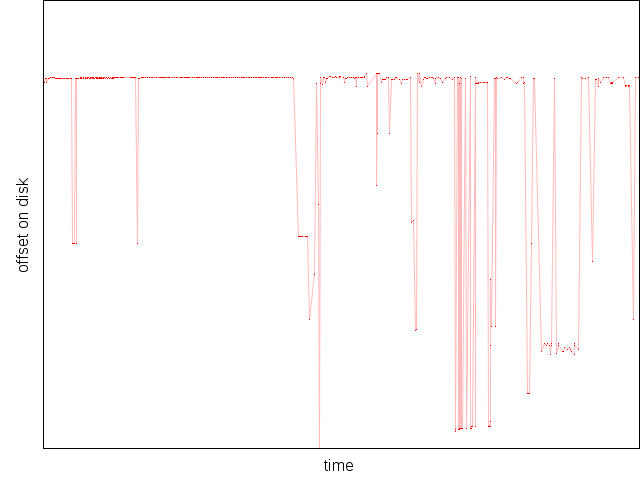
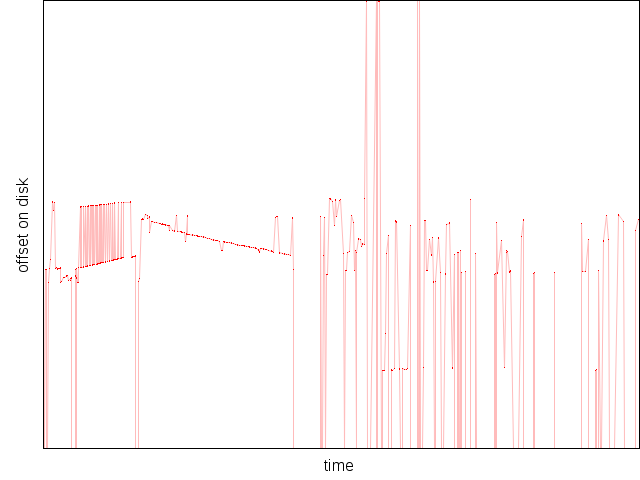
We all know disk seeks hurt. But we usually don t have a precise idea how much. How about getting that idea? Here is a little experiment I ran a few days ago. I took the output from the systemtap script tracking I/O I wrote, on a Firefox startup after boot. Each line of that output, which gives a timestamp (which we don t care about here), a file name, and an offset, represents a 4096 bytes read (one page). The first set of data points I got is how much time it takes to reproduce this read pattern after a reboot, and how that compares to Firefox startup time. For what it s worth, I did group following reads, to avoid doing too many system calls, and also avoided kernel readahead by using direct I/O, meaning I would only read exactly what the kernel reads when Firefox normally starts. All the following tests were done under the usual conditions (see previous posts), but I limited the tests to the x86-64 architecture, because all that really matters is the disk. I ll mention, however, that the amount of data read in these tests is 34,729,984 bytes, and that the original I/O pattern looks like this: Zooming around the main location where most I/O happen, we can see the pattern is still bumpy: This somehow looks familiar, doesn t it? We already know for a fact that even these patterns that, on the whole disk, look like pretty much insignificant, have an important impact on startup time. Try to imagine what kind of difference could be observed if we were reordering all these reads. Anyways, back to that I/O simulation, we first need to see how far it is from the actual Firefox startup. We would rather that simulated I/O + warm startup/hot cache end up close to the real thing. However, we need to keep in mind, as we saw in a previous post, that CPU scaling, when mixed with I/O, has an influence on startup time. Warm startup not involving I/O, the CPU can run at maximum speed the whole time. As such, for a fair comparison, we need to compare to cold startup time with the CPU forced at maximum speed, which we saw is faster than startup time with CPU scaling.
Average time (ms)
Simulated cold startup 2,764.26 0.42%
Warm startup 250.74 0.18%
Simulated cold + warm 3015
Real cold startup 3087.47 0.31%
Difference 72.47 (2.35%)
Close enough, I d say. The difference is most probably caused by metadata reads and a few other things, that isn t in the systemtap script scope. Now we know our simulated I/O is close to reality, what happens if we reorder all these reads according to the position on disk?
Average time (ms) Corresponding transfer rate
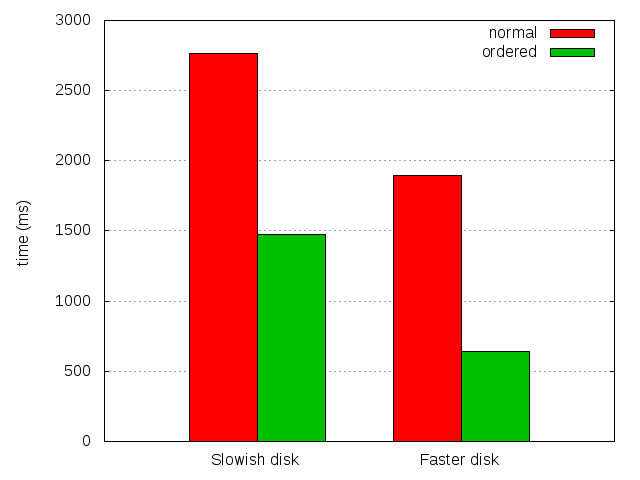
Simulated I/O 2,764.26 0.42% 12.56 MB/s
Reordered I/O 1,473.34 0.43% 23.57 MB/s
Difference 1,290.92 (46.7%) n/a
That s almost twice as fast ! And the disk doesn t even have a big throughput (around 30MB/s). Let s see what it does with a disk with a bigger throughput (85MB/s).
Average time (ms) Corresponding transfer rate
Simulated I/O 1,898.66 0.16% 18.29 MB/s
Reordered I/O 644.0 0.15% 53.93 MB/s
Difference 1,254.66 (66.08%) n/a
That s almost three times as fast ! The faster the disk, the bigger the improvement we can get by reordering and grouping I/O, which is not unexpected, but here we can see how much having to go back and forth on the disk hurt badly. Obviously, the numbers from the faster disk can t be directly compared to the ones from the slower disk, because the data was not arranged the same way on the disk, and file system fragmentation, as well as how the file system is filled also have their own share to add to the problem. And because it s more impressive to see on a graph than in a result table: Disks seeks hurt. Badly.

Next.

Previous.