Search Results: "rra"

10 July 2011

Christian Perrier: Cheese and Wine party for DebConf 11, aka C&W7

Do I need to explain what is the Cheese and Wine (C&W) party? Still, if some of you need more information, please feel free to ask. The C&W7 wiki page now exists on DebConf wiki. Information will come there until the day of the C&W, which is scheduled for Tuesday July 26th, so the day before the planned daytrip, if I'm correct. C&W orga details are currently very vague, but the most important point is: start planning what YOU will be bringing for the event. Remember that the event is only successful when many of us manage to bring good stuff to share (preferrably cheese, wine...or other ethanol-improved beverages). If you think about something *else* than cheese, please feel free to bring it: just try to have it representative of your part of the world...or a part of the world you love. Any further questions can be asked in the debconf-discuss mailing list or in #debconf channel on irc.debian.org

6 July 2011

Ritesh Raj Sarraf: Console Gaming - Sony Playstation 3

I have been thinking of this topic for some time. I am a happy owner of the old Phat PS3 Model. At one time, I use to do a fair amount of gaming on my computers. So when Sony marketed the PlayStation 3 product, it was cool to see a machine that did:
  1. Gaming
  2. Movies, Music, Pictures
  3. Blu-Ray
  4. Ran Linux
I convinced myself to buy a PlayStation 3, that I'd use it for playing with Linux apart from gaming. The regular gaming did not excite any more, perhaps it had to do with the limitation of time. On running Debian on it, was when I realized that the Linux support was merely a joke. The Linux support included running a Linux distribution in a VM with not much access to the full hardware resources. Not a Great Experienceread more

5 July 2011

John Goerzen: The Lives of Others

It s not very often that I watch a movie anymore. It s been a few years since I ve actually purchased one (normally I see them from Netflix). But yesterday I saw one that may change that. The Lives of Others is an incredible film set in the former East Germany (GDR/DDR) mostly in 1984. The authenticity of it is incredible and so is the story. It s subtitled, but if you re an American wary of subtitled European films, don t be wary of this one. It is easy to watch and worth every minute. The story revolves around the Stasi, the GDR Ministry for State Security ( secret police ). It is an incredible picture of what living in a police state was like, and how many of the informants were victims of the regime too. My breath caught near the beginning of the film, showing the inside of a Stasi building. A prisoner was being interrogated for helping someone attempt to escape to the west. But the reason my breath caught was this incredible feeling of I was there . Last year, Terah and I were in Leipzig and visited the Stasi museum there, Museum in der Runden Ecke . I always have an incredible sense of history when being in a preserved place, and this building was literally the Stasi headquarters for Leipzig. Much of it was preserved intact, and seeing it in the film brought home even more vividly the terrible things that happened in that building, and others like it, not so very long ago. IMG_2717 We watched the special features on the Blu-Ray disc, and one of them was an interview with director Florian Henckel von Donnersmarck. He described how he spent a lot of time interviewing both victims of the Stasi, as well as ex-Stasi officers. One of the most disturbing things to me was his almost offhand comment that most of the former Stasi officers still had some pride in performing their jobs well. Even now, freed of the state s ideology, they were proud of the work they did which could be put most charitably as ruining people s lives. What leads a person to view life that way? How can we try to make sure it doesn t happen again elsewhere? I am happy to say that most of us have never experienced anything like the Stasi. And yet, small reflections of that mindset can be seen almost everywhere. Societies at wartime or feeling under threat, even Western democracies, can drum up those feelings. In the USA, for instance, the McCarthyism era saw people s careers ruined for alleged anti-state behavior. Contemporary examples include the indefinite detention (I hate that word; shouldn t we say imprisonment ?) of terrorism suspects at Guantanamo Bay, and the terrible treatment of Bradley Manning, who revealed some true but embarrassing things about the US military which really needed to be revealed. Even tobacco farmers and companies are selling a product they know ruins lives, but somehow keep doing it. And there are still members of the public that try to make life difficult for people that don t think like they do. From organizing campaigns of telephone harassment of colleges that don t perform the American national anthem before sporting events, to tossing about the term un-American (a loaded McCarthyist one, which many may not even be aware) at an inflated rate, we are not immune from attempts at forcing conformity or silence in others, and blind loyalty to state. I am never in a particularly celebratory mood on July 4, the biggest day for American boasting, faux patriotism, militarism, and general flag-waving. We do have a lot to be proud of and thankful for, but it seems that we celebrate all the wrong things on July 4, and see it as an occasion to proclaim American exceptionalism rather than as one to see how far we ve come and bolster hope for how far we can, and should, yet go. No, I don t think that the land of the free ought to have operated secret prisons in Europe (nor the Europeans to have been complicit in it), or that the American military was defending our freedom 100% of the time they were deployed, or that it is right for governments to mandate daily recitation of an untrue document (the pledge of allegiance) in schools. And yet, I am mindful that I have a lot to be thankful for stability, lack of much internal violent conflict, etc. And this particular day I am happy that a post like this is not something that gets the attention of some government agency and mostly that I will have a handful of angry emails to delete.

4 July 2011

Lars Wirzenius: strncpy? just say no

This is a rant. I've made it in various forms in various places over the years, and I think it's time to put it somewhere so I can point people at it, and stop repeating myself. Here's the pebble in my shoe: people keep claiming that strncpy is a safer alternative to strcpy. It's not. It's a slower function that is not going to make you significantly safer. The problem with strcpy is that it's somewhat easy to overflow the target array:
char src[] = "hello, world";
char dst[5];
strcpy(dst, src); // Oops.
The suggested alternative with strncpy would be this:
strncpy(dst, src, sizeof(dst));
strncpy gets the size of the destination array as a parameter, and can therefore make sure the string will fit there. Problem solved? Not so much. Every time you do any string handling with C's native string types and functions, you need to make sure you have allocated enough memory for each string, you need to keep track of how much memory you've allocated, and you neet to make sure the zero byte ('NUL', '\0') is put there correctly. This is a lot of details to keep track of, and it's not surprising things sometimes go wrong. If your arrays are allocated statically, which is the simplest, but least useful case, you need to something like this with strcpy:
if (strlen(src) + 1 > sizeof(dst))
    panic(); // or however you want to handle your errors
strcpy(dst, src);
The +1 after strlen is to make room for the zero byte (NUL, '\0') that is used in C to indicate the end of a string. With strncpy, your code is slightly simpler. This is its attraction. Problem is, this only works if dst is an array defined within the scope of the code. If, as is common, you have received dst as an argument to a function, sizeof(dst) is the size of a pointer to an element of the array, not the size of the array. So now you need to track the size explicitly in a second variable:
strncpy(dst, src, dst_size);
Further, strncpy has an unfortunate error handling mode: it merely fills the destination array and stops. It does not indicate failure in any way. It does not terminate the target array with a zero byte. Since all C string processing assume the zero byte is there, as soon as you try to use dst as a string, you're in trouble. But luckily you can check for that before you call strncpy:
if (strlen(src) + 1 > dst_size)
    panic(); // or whatever
strncpy(dst, src, dst_size);
By this time, the code is equally hard whether you use strcpy or strncpy. With strncpy you often waste some extra time, though, filling the unused parts of the target array with zero bytes: they're almost never necessary. Alternatively, you can force the zero byte there yourself, silently truncating a string.
strncpy(dst, src, dst_size);
dst[dst_size - 1] = '\0'; // let's hope dst_size > 0
If your string handling is OK with strings being randomly shorter than they should be, possibly you could replace all of them with empty strings, and save yourself a world of pain. Instead of strncpy, use snprintf. It has sensible error behavior, and is much more versatile:
n = snprintf(dst, dst_size, "%s", src);
if (n >= dst_size)
    panic();
snprintf still isn't very nice to use. It still requires you to allocate memory yourself, and keep track of the size of each array manually. It's also slower for small destination buffers (but faster for large ones). The real solution is to abandon C's antiquated string handling, and use a more sensible helper library instead. There's a bunch of them around, though none have gained much popularity. I'm not going to name any of them, but just imagine how much nicer it would be to write code like this instead:
Dynstr *src = dynstr_new_from_cstring("hello, world\n");
Dynstr *cat = dynstr_cat_many(src, src, src, src, src, NULL);
Dynstr *dog = dynstr_substr(cat, 15, 5);
Let the library take care of memory allocations and related tracking, and concentrate on real problem solving instead. We did this in Kannel, back in 1999, and it wiped out all the buffer overflow problems (until a co-worker decided it was "more efficient" to use native C strings instead, promptly introducing a buffer overflow). All of this string handling is, of course, way nicer in higher level languages. In fact, whenever you need to deal with string handling in C, it is probably a sign that you should consider switching to a higher level language instead. But whatever you do, stop claiming that strncpy is safe or solves any real problems strcpy has. Update: Fixed "It does terminate" to say "It does not terminate". Thanks to Matthew Garrett for pointing that out. Update2: Fixed example call to snprintf. Update3: Fixed the test for snprintf example. Thanks, Redditor axylone. Also pointed out that snprintf is slower than the rest.

3 July 2011

Vincent Bernat: Dealing with missing locales on remote hosts

On my system, I happen to set LANG to fr_FR.utf8 and LC_MESSAGES to en_US.utf8. This means that applications should follow French cultural conventions for most things except for messages which should be displayed in US English. On my own system, /etc/locale.gen contains those two locales. However, when I connect to some random remote system, they may be unavailable. Most applications will fallback silently to C. However, Perl can be quite noisy:
$ perl -e 'print "Hello\n";'
perl: warning: Setting locale failed.
perl: warning: Please check that your locale settings:
        LANGUAGE = (unset),
        LC_ALL = (unset),
        LC_MESSAGES = "en_US.utf8",
        LANG = "fr_FR.utf8"
    are supported and installed on your system.
perl: warning: Falling back to the standard locale ("C").
Hello
This is an incredibly annoying message. I don t understand why we still need to bear it. Perl documentation explains how to get rid of this message. The simplest way is to set PERL_BADLANG environment variable to 0. Problem solved.
$ PERL_BADLANG=0 perl -e 'print "Hello\n";'
Hello
Well, no. Keep reading. When you connect to a remote host with ssh, all your environment variables are thrown away, except those defined in AcceptEnv directive in /etc/ssh/sshd_config file on the remote host. On Debian, this directive defaults to LANG LC_*. Since I cannot install my favourite locales on all hosts or fiddle environment variables on them, I use something like this in my .zshrc:
ssh()  
  [ -t 1 ] && echo -ne "\033]0;$@\007"
  LANG=C LC_MESSAGES=C =ssh "$@"
 
Unfortunately, on systems where my locales are present, I still fallback to the crappy C locale. I could just unset LANG and LC_MESSAGES to allow fallback to the proper default locale but if the remote system starts to speak Spanish, I will not be pleased. Moreover, the behaviour of C locale (also known as POSIX locale) is undefined with characters not in the portable character set. From IEEE Std 1003.1:
Conforming systems shall provide a POSIX locale, also known as the C locale. The behavior of standard utilities and functions in the POSIX locale shall be as if the locale was defined via the localedef utility with input data from the POSIX locale tables in Locale Definition. The tables in Locale Definition describe the characteristics and behavior of the POSIX locale for data consisting entirely of characters from the portable character set and the control character set. For other characters, the behavior is unspecified. For C-language programs, the POSIX locale shall be the default locale when the setlocale() function is not called. The POSIX locale can be specified by assigning to the appropriate environment variables the values C or POSIX.
There is no way to detect the locales installed on the remote system unless you connect to it. Starting a connection just to check the locale is too expensive. On my own systems, I use another snippet in .zshrc to reconfigure the locales to my favourite ones if they are available:
export LANG=C
export LC_MESSAGES=C
(( $+commands[locale] )) && function  
    local locales
    locales=( "LANG fr_FR.utf8 en_US.utf8 C.UTF-8 C" \
              "LC_MESSAGES en_US.utf8 fr_FR.utf8 C.UTF-8 C" )
    for locale in $locales; do
        for l in $=locale[(w)2,-1]; do
            if locale -a   grep -qx $l; then
                export $locale[(w)1]=$l
                break
            fi
        done
    done
  2> /dev/null
This is an interesting snippet which uses some ZSH features. Feel free to tell me if you have found a better way to handle this problem!

2 July 2011

Joey Hess: databranches: using git as a database

I've just released git-annex version 3, which stops cluttering the filesystem with .git-annex directories. Instead it stores its data in a git-annex branch, which it manages entirely transparently to the user. It is essentially now using git as a distributed NOSQL database. Let's call it a databranch. This is not an unheard of thing to do with git. The git notes built into recent git does something similar, using a dynamically balanced tree in a hidden branch to store notes. My own pristine-tar injects data into a git branch. (Thanks to Alexander Wirt for showing me how to do that when I was a git newbie.) Some distributed bug trackers store their data in git in various ways. What I think takes git-annex beyond these is that it not only injects data into git, but it does it in a way that's efficient for large quantities of changing data, and it automates merging remote changes into its databranch. This is novel enough to write up how I did it, especially the latter which tends to be a weak spot in things that use git this way. Indeed, it's important to approach your design for using git as a database from the perspective of automated merging. Get the merging right and the rest will follow. I've chosen to use the simplest possible merge, the union merge: When merging parent trees A and B, the result will have all files that are in either A or B, and files present in both will have their lines merged (and possibly reordered or uniqed). The main thing git-annex stores in its databranch is a bunch of presence logs. Each log file corresponds to one item, and has lines with this form:
timestamp [0 1] id
This records whether the item was present at the specified id at a given time. It can be easily union merged, since only the newest timestamp for an id is relevant. Older lines can be compacted away whenever the log is updated. Generalizing this technique for other kinds of data is probably an interesting problem. :) While git can union merge changes into the currently checked out branch, when using git as a database, you want to merge into your internal-use databranch instead, and maintaining a checkout of that branch is inefficient. So git-annex includes a general purpose git-union-merge command that can union merge changes into a git branch, efficiently, without needing the branch to be checked out. Another problem is how to trigger the merge when git pulls changes from remotes. There is no suitible git hook (post-merge won't do because the checked out branch may not change at all). git-annex works around this problem by automatically merging */git-annex into git-annex each time it is run. I hope that git might eventually get such capabilities built into it to better support this type of thing. So that's the data. Now, how to efficiently inject it into your databranch? And how to efficiently retrieve it? The second question is easier to answer, although it took me a while to find the right way ... Which is two orders of magnitude faster than the wrong way, and fairly close in speed to reading data files directly from the filesystem. The right choice is to use git-cat-file --batch; starting it up the first time data is requested, and leaving it running for further queries. This would be straightforward, except git-cat-file --batch is a little difficult when a file is requested that does not exist. To detect that, you'll have to examine its stderr for error messages too. Perhaps git-cat-file --batch could be improved to print something machine parseable to stdout when it cannot find a file. Takes some careful parsing, but straightforward. Efficiently injecting changes into the databranch was another place where my first attempt was an order of magnitude slower than my final code. The key trick is to maintain a separate index file for the branch. (Set GIT_INDEX_FILE to make git use it.) Then changes can be fed into git by using git hash-object, and those hashes recorded into the branch's index file with git update-index --index-info. Finally, just commit the separate index file and update the branch's ref. That works ok, but the sad truth is that git's index files don't scale well as the number of files in the tree grows. Once you have a hundred thousand or so files, updating an index file becomes slow, since for every update, git has to rewrite the entire file. I hope that git will be improved to scale better, perhaps by some git wizard who understands index files (does anyone except Junio and Linus?) arranging for them to be modified in-place. In the meantime, I use a workaround: Each change that will be committed to the databranch is first recorded into a journal file, and when git-annex shuts down, it runs git hash-object just once, passing it all the journal files, and feeds the resulting hashes into a single call to git update-index. Of course, my database code has to make sure to check the journal when retrieving data. And of course, it has to deal with possibly being interrupted in the middle of updating the journal, or before it can commit it, and so forth. If gory details interest you, the complete code for using a git branch as a database, with journaling, is here. After all that, git-annex turned out to be nearly as fast as before when it was simply reading files from the filesystem, and actually faster in some cases. And without the clutter of the .git-annex/ directory, git use is overall faster, commits are uncluttered, and there's no difficulty with branching. Using a git branch as a database is not always the right choice, and git's plumbing could be improved to better support it, but it is an interesting technique.

29 June 2011

Russell Coker: Pool Parties

Periodically Free Software people from other countries visit Melbourne on business trips. Usually when someone is sent any distance on a business trip (IE to Australia from anywhere other than NZ) they will stay in a good hotel (4 star or better), this generally means that they have a pool in their hotel. 5 star hotels and the newer serviced apartment hotels tend to have really good pools (1/4 olympic size isn t uncommon). Hotel pools are very under-utilised, their main purpose AFAIK is to boost the hotel star rating my experience is that it s not common to meet other people in a hotel pool. While food and drinks are often banned in the pool area my observation is that the only rule which matters is no glass . So hotel pools are almost ideal for pool parties, you just need to drink from cans or from drinks in plastic bottles that are poured into plastic cups. If any Free Software person finds themself staying in a hotel in Melbourne Australia with not much to do in the evenings or weekends then one option is to call for a pool party. I ve asked on a local mailing list and it seems that there is enough interest for a small party, the local mailing lists can be used to arrange a party. Also one thing to note is that some hotels have outdoor pools, while Australia is generally a warm place the southern parts of Australia (such as Melbourne) get quite cold in winter, an outdoor pool is not going to be fun for the colder half of the year. So getting a hotel with an indoor pool is very important during the April-September period.

28 June 2011

Sam Hartman: Dream Plug

As part of trying to help with Freedom Box, I gained access to a Dream Plug The Dream Plug is one of the leading possible platforms for Freedom Box. Computationally it s sexy for a low-power device. There s a 1200 mhz arm with 512m of RAM. As a platform to enable people to create novel applications, it s great. It has multiple USB ports, two ethernets, a built-in 802.11B/G access point, bluetooth, audio, ESATA, Micro SD and full-sized SD. So, whether you application needs storage, networking, audio, or some interesting side device, you re covered. With the optional JTAG adapter it s even fairly friendly to developers: there are options for recovering from most failures and full console access. If you re looking at a reference platform that s still nominally embedded, but that allows you to play around thinking about what your application could do, this is a great option. However, especially for Freedom Box, it s important to remember that the reference board a developer wants is not the same as a cost-reduced product on which to actually deploy something for people to buy. The Dream Plug is wrong for every actual deployment I ve imagined. First, it s huge. If you happen to have free power plugs on your wall with lots of space above and below them, it might be an option. If however, you re like everyone I know and have power strips, constrained spacing, etc, then the industrial engineering will disappoint at every turn. I was hoping for something that kind of looked like an Apple Airport Express. It s significantly larger than that in every dimension. Also, the plug is oriented the wrong way for minimizing the fraction of the power strip it takes up. The power supply part of the device can be detached, although even that is way too huge for a power strip, and the cable between the power supply and the computer is fairly short. You can reconfigure the device without its plug nature: running a cord from a normal power outlet to the power supply. But then if you have to detach the power supply for heat management reasons, you get a cord from the outlet to the power supply and another cord from the supply to the device. Add a few USB or ESATA devices and the octopus of cables begins to resemble some arcane mechanism. (So far, no elder gods have appeared though.) The other issue is that you almost never want all the functionality. You pay for the bluetooth, audio and ESATA in terms of cost, heat and space regardless of whether you use them. I don t have a lot of applications that really take advantage of the full array of hardware. The firmware update mechanism is decidedly not targeted at end-users. The version I obtained had a hacked copy of Debian lenny. No mechanism was provided for replacing the image in a safe manner that did not potentially require the optional highly-non-end-user-compatible JTAG board if something got interrupted. You could either unscrew the device and get to the micro SD card containing the image, or run software to replace the image from within Debian lenny. It s possible to configure the boot loader to run an update image off USB or SD until that succeeds, but doing that is also a non-end-user operation. In conclusion, the name is perfect. This is exactly what hackers need to dream about the power of small computers everywhere. However we must not forget that there s a step required to turn dreams into reality. Just as with any fully proprietary product, Freedom Box will require cost reduction steps, semi-custom boards and actual OEMs to truly be usable. The claim in the previous sentence that the Freedom Box may have proprietary elements is disquieting to some. I think we can put together a software stack that is free with the possible exception of some device firmware. However, my suspicion is that anyone who turns that into a fully realized end-user product will add proprietary elements. I suspect some of the results of the cost reduction process such as resulting semi-custom boards will be proprietary. In many cases though, I suspect some proprietary software elements will be introduced.

24 June 2011

Dirk Eddelbuettel: RcppArmadillo 0.2.23

Conrad Sanderson released version 1.99.5 of Armadillo yesterday. This provides the fifth release candidate en route to version 2.0.0. He was even kind enough to post on rcpp-devel about it too as it entails some minor API changes. His version 1.99.5 has been integrated into RcppArmadillo version 0.2.23 which is now on CRAN. By way of background, Armadillo is a templated C++ library for linear algebra---which RcppArmadillo brings to R based on our Rcpp library. A minor internal change was the rearrangement of arguments for the (mostly internal) function fastLmPure so that it is closer to the R function lm.fit which it mimics. The user-facing function for fastLm, using either the formula method or the default method, have not changed. The short NEWS file extract follows below. I also include the entry for the bugfix release 0.2.22 (based on Armadillo 1.99.4) which preceded it, and which does not seem to have gotten its own blog post.

0.2.23  2011-05-23
    o   Upgraded to Armadillo release 1.99.5 "v2.0 beta 5"
          * Forms of chol(), eig_sym(), eig_gen(), inv(), lu(), pinv(),
	    princomp(), qr(), solve(), svd(), syl() that do not return a bool
	    indicating success now throw std::runtime_error exceptions when
	    failures are detected 
          * princomp_cov() has been removed; princomp() in conjunction with
	    cov() can be used instead
          * set_log_stream() & get_log_stream() have been replaced by
	    set_stream_err1() & get_stream_err1()
          * det(), inv() and solve() can be forced to use more precise
	    algorithms for tiny matrices (  4x4)
          * Added loading & saving of matrices as CSV text files 
    o   fastLmPure() now uses same argument order as R's lm.fit()
    o   Export and document S3 methods in NAMESPACE and manual page as such
0.2.22  2011-06-06
    o   Upgraded to Armadillo release 1.99.4 "v2.0 beta 4" 
          * fixes for handling of tiny matrices
Courtesy of CRANberries, here is the diff to the previous release.
 RcppArmadillo-0.2.22/RcppArmadillo/inst/include/armadillo_bits/fn_princomp_cov.hpp        only
 RcppArmadillo-0.2.22/RcppArmadillo/inst/include/armadillo_bits/op_princomp_cov_bones.hpp  only
 RcppArmadillo-0.2.22/RcppArmadillo/inst/include/armadillo_bits/op_princomp_cov_meat.hpp   only
 RcppArmadillo-0.2.23/RcppArmadillo/ChangeLog                                                 21
 RcppArmadillo-0.2.23/RcppArmadillo/DESCRIPTION                                               10
 RcppArmadillo-0.2.23/RcppArmadillo/NAMESPACE                                                 14
 RcppArmadillo-0.2.23/RcppArmadillo/R/fastLm.R                                                22
 RcppArmadillo-0.2.23/RcppArmadillo/inst/NEWS                                                 22
 RcppArmadillo-0.2.23/RcppArmadillo/inst/include/armadillo                                     3
 RcppArmadillo-0.2.23/RcppArmadillo/inst/include/armadillo_bits/Cube_meat.hpp                 12
 RcppArmadillo-0.2.23/RcppArmadillo/inst/include/armadillo_bits/Mat_bones.hpp                  2
 RcppArmadillo-0.2.23/RcppArmadillo/inst/include/armadillo_bits/Mat_meat.hpp                 150 +++-
 RcppArmadillo-0.2.23/RcppArmadillo/inst/include/armadillo_bits/arma_version.hpp               4
 RcppArmadillo-0.2.23/RcppArmadillo/inst/include/armadillo_bits/auxlib_bones.hpp              15
 RcppArmadillo-0.2.23/RcppArmadillo/inst/include/armadillo_bits/auxlib_meat.hpp              352 +++++-----
 RcppArmadillo-0.2.23/RcppArmadillo/inst/include/armadillo_bits/config.hpp                     8
 RcppArmadillo-0.2.23/RcppArmadillo/inst/include/armadillo_bits/debug.hpp                    224 ++++--
 RcppArmadillo-0.2.23/RcppArmadillo/inst/include/armadillo_bits/diskio_bones.hpp              12
 RcppArmadillo-0.2.23/RcppArmadillo/inst/include/armadillo_bits/diskio_meat.hpp              301 +++++++-
 RcppArmadillo-0.2.23/RcppArmadillo/inst/include/armadillo_bits/field_meat.hpp                18
 RcppArmadillo-0.2.23/RcppArmadillo/inst/include/armadillo_bits/fn_chol.hpp                   30
 RcppArmadillo-0.2.23/RcppArmadillo/inst/include/armadillo_bits/fn_eig.hpp                    84 +-
 RcppArmadillo-0.2.23/RcppArmadillo/inst/include/armadillo_bits/fn_inv.hpp                    36 -
 RcppArmadillo-0.2.23/RcppArmadillo/inst/include/armadillo_bits/fn_log_det.hpp                10
 RcppArmadillo-0.2.23/RcppArmadillo/inst/include/armadillo_bits/fn_lu.hpp                     33
 RcppArmadillo-0.2.23/RcppArmadillo/inst/include/armadillo_bits/fn_misc.hpp                   12
 RcppArmadillo-0.2.23/RcppArmadillo/inst/include/armadillo_bits/fn_pinv.hpp                   33
 RcppArmadillo-0.2.23/RcppArmadillo/inst/include/armadillo_bits/fn_princomp.hpp               49 +
 RcppArmadillo-0.2.23/RcppArmadillo/inst/include/armadillo_bits/fn_qr.hpp                     11
 RcppArmadillo-0.2.23/RcppArmadillo/inst/include/armadillo_bits/fn_rank.hpp                   13
 RcppArmadillo-0.2.23/RcppArmadillo/inst/include/armadillo_bits/fn_solve.hpp                  13
 RcppArmadillo-0.2.23/RcppArmadillo/inst/include/armadillo_bits/fn_svd.hpp                    25
 RcppArmadillo-0.2.23/RcppArmadillo/inst/include/armadillo_bits/fn_syl_lyap.hpp               18
 RcppArmadillo-0.2.23/RcppArmadillo/inst/include/armadillo_bits/forward_bones.hpp              3
 RcppArmadillo-0.2.23/RcppArmadillo/inst/include/armadillo_bits/glue_join_meat.hpp            71 +-
 RcppArmadillo-0.2.23/RcppArmadillo/inst/include/armadillo_bits/glue_solve_meat.hpp           13
 RcppArmadillo-0.2.23/RcppArmadillo/inst/include/armadillo_bits/lapack_bones.hpp              95 ++
 RcppArmadillo-0.2.23/RcppArmadillo/inst/include/armadillo_bits/op_chol_meat.hpp               6
 RcppArmadillo-0.2.23/RcppArmadillo/inst/include/armadillo_bits/op_inv_bones.hpp               6
 RcppArmadillo-0.2.23/RcppArmadillo/inst/include/armadillo_bits/op_inv_meat.hpp               39 -
 RcppArmadillo-0.2.23/RcppArmadillo/inst/include/armadillo_bits/op_max_meat.hpp               50 -
 RcppArmadillo-0.2.23/RcppArmadillo/inst/include/armadillo_bits/op_median_meat.hpp           115 +--
 RcppArmadillo-0.2.23/RcppArmadillo/inst/include/armadillo_bits/op_min_meat.hpp               50 -
 RcppArmadillo-0.2.23/RcppArmadillo/inst/include/armadillo_bits/op_misc_bones.hpp             14
 RcppArmadillo-0.2.23/RcppArmadillo/inst/include/armadillo_bits/op_misc_meat.hpp              46 -
 RcppArmadillo-0.2.23/RcppArmadillo/inst/include/armadillo_bits/op_pinv_meat.hpp              39 -
 RcppArmadillo-0.2.23/RcppArmadillo/inst/include/armadillo_bits/op_princomp_bones.hpp         20
 RcppArmadillo-0.2.23/RcppArmadillo/inst/include/armadillo_bits/op_princomp_meat.hpp         248 ++-----
 RcppArmadillo-0.2.23/RcppArmadillo/inst/include/armadillo_bits/op_prod_meat.hpp              34
 RcppArmadillo-0.2.23/RcppArmadillo/inst/include/armadillo_bits/op_stddev_meat.hpp            38 -
 RcppArmadillo-0.2.23/RcppArmadillo/inst/include/armadillo_bits/op_sum_meat.hpp               36 -
 RcppArmadillo-0.2.23/RcppArmadillo/inst/include/armadillo_bits/op_var_meat.hpp               38 -
 RcppArmadillo-0.2.23/RcppArmadillo/inst/include/armadillo_bits/running_stat_meat.hpp          4
 RcppArmadillo-0.2.23/RcppArmadillo/inst/include/armadillo_bits/running_stat_vec_meat.hpp      4
 RcppArmadillo-0.2.23/RcppArmadillo/inst/unitTests/runit.fastLm.R                              8
 RcppArmadillo-0.2.23/RcppArmadillo/man/fastLm.Rd                                             32
 RcppArmadillo-0.2.23/RcppArmadillo/src/fastLm.cpp                                            15
 57 files changed, 1695 insertions(+), 886 deletions(-)
More information is on the RcppArmadillo page. Questions, comments etc should go to the rcpp-devel mailing list off the R-Forge page.

23 June 2011

Evgeni Golov: monitoring Adaptec RAID controllers in Debian

So I got my hands on that new machine, somewhere, somehow, and I had to make myself comfortable on it. The biggest difference in that machine and the ones I used before is the RAID controller, an Adaptec 5405, instead of the 3ware ones I used to have before. That means getting used to new tools, messages and all these things which I ll try to document here.Step 1: does vendor deliver?Well, yes, mostly. There is (mainline) kernel support for the controller, Squeeze s kernel will boot up just fine and I just throw my junk into /dev/sda and it will handle the whole raidy thingy itself. But what is when I want to check the health of the disks, to add a spare or modify the caching? Ask the mighty vendor and it will answer Yes, you can! .So I downloaded that asm_debian_x86_x64_v6_50_18570.tgz, unpacked and faced two debs, one i368 and one amd64. Yes, you could have saved half of the bandwidth if someone would have asked for the arch before, but who cares for some additional 60MiB today? So let s see what it does. Oh no, wait, there is a README ASM_IUG_for_Debian_and_Ubuntu.txt:
1. Make sure to be in root level access.
2. Install the ASM storman .deb package. For example, if the package is storman_6.50-18570_i386.deb,
   then install it using the following command dpkg -i storman_6.50-18570_i386.deb
3. Adaptec Storage Manager will get installed at /usr/StorMan
4. Add the line /usr/StorMan to /etc/ld.so.conf. Then run "ldconfig". This is needed for the arcconf
   utility to find the path of the libstdc++.so.5 library
Well, 1 is obvious, so is 2.
For 3: hum, /usr/StorMan? Ever heard of FHS? Don t think so.
For 4: WTF?! I prefer to get libstdc++5 from my local Debian mirror instead.But at least they provide a .deb, right? Uhm, no, it s an RPM converted via alien :( And don t dare to look at preinst, postinst and postrm (it extracts an own copy of Sun JRE 1.6u16, chmods around wildly on install and does rm -rf something on uninstall, did I see that some days ago on the webs?). Let s get rid of that package as soon as possible, I decided, and just keep arcconf (which will be described later), esp because StorMan itself seems to include some call-home functionality which I d like not to have:
cp -a /usr/StorMan/arcconf /usr/local/sbin/
apt-get remove --purge storman
Step 2: does community deliver?You can, by the way, get (better) packages at http://hwraid.le-vert.net/wiki/DebianPackages from Adam C cile (Le_Vert). I didn t test those much, but I currently use the arcconf package from there, which seems to be exactly what I need: proper dependencies and just the arcconf binary, no Java sh*t.Step 3: monitor the controllerAs this post is about monitoring, not ranting, let s continue. As mentioned before, I only have arcconf installed, which is just a cli to do stuff with the controller. If I understood the docs right, the actual StorMan is able to send notification mails when a disk dies or the controller gets eaten by aliens, but as I don t have StorMan, I have to do things myself.Adam has a aacraid-status package in his repository, which includes some minimalistic shell-daemon to monitor the output of arcconf. It didn t perfectly fit my needs (and had some hickups with my disks which refuse to report a vendor, whyever), so I decided to write something myself (slightly based on what Adam has done in aacraid-status, though).The result is on GitHub: https://github.com/evgeni/aacraidAs you can see the code contains (at the time of writing) exactly ZERO comments and there is no README either, but it s actually quite usable already.I am now running aacraidd and get happy mails when something breaks :) [running = running from /etc/rc.local, no init script yet :)]Step 4: monitor the disks via smartmontoolsThere is one little problem I have with arcconf: it s closed source and does magic to the controller.With the old 3ware controller I was able to monitor the disks with smartmontools/smartd using something like this:
/dev/twa0 -d 3ware,0 -a -s L/../../2/01 -m root
/dev/twa0 -d 3ware,1 -a -s L/../../2/03
This is possible with Adaptect controllers too (not through /dev/twaX obviously). You have to have the sg module loaded, which will result in /dev/sg[012] on my machine, with sg0 being the controller itself and sg1/sg2 the both disks attached to it. Having sg loaded, one can now use smartd with:
/dev/sg1 -d sat -a -s L/../../7/01 -m root
/dev/sg2 -d sat -a -s L/../../7/02 -m root
(-d sat is the important option here!)Thanks to Thomas Krenn Wiki: Smartmontools mit Adaptec RAID Controller for the basic info and ostlogd.spenneberg.net: Adaptec-Raid-Controller S.M.A.R.T.-Healthstatus monitoren for the pointer to the sg module!Step 5: relaxYupp, 4 steps are enough, go relax until the next disk dies (you will be doing something REALLY important that moment according to Murphy).

22 June 2011

Martin Zobel-Helas: How YOU can help Debian!

I recently had been ask how persons usually not involved in Debian's development process can help Debian. This is a question that pops up quite often, so I thought I should write down a bit of that.

Help to make Debian a better OS
If you are using Debian, and you want something of your OS changed, open a bug report. This varies from wishlist bugs if you want to have an enhancement of a package over normal bugs for stuff that you think is a real bug up to serious or grave bug, if you found a security bug. Send a mail to submit@bugs.debian.org or use the tool reportbug and describe the problem you have found. Find more information here. Be as verbose as possible when explaining your problem. This will make it easier for the package maintainer to help you and to understand the problem. If you are not sure which package to report the bug against, report it against unknown. The bug will be taken care of, there are guys redirecting those bug reports to the appropriate package!
You could also help to verify bug reports. There are dozens of packages around, that have hundred of open bug reports. It will help the Debian package maintainer if you can tell him a "me too", esp for complex problems, or if you found out how to reproduce a bug.

Help by spreading the word
If you are using Debian, speak about it! If you have problems with Debian, speak about it! If you like Debian, speak about it. Read the debian-user mailing list (or a localized one) and jump in if users have the same problem you had, and help them.
All sort of publicity will help Debian. If there is a small exhibition near to your living, speak there about Debian, and how you are using it. Speak also to Debian, we can help you to announce your presence at that exhibition and provide you with information material in various languages. Good contact point for that is events@debian.org, or one of the debian-events-* mailing lists on lists.debian.org. If you need help, ask for it. Also, you can help Debian manning an exhibition. If you see events in your area, offer to help and don't be shy. Other way to help is working with the publicity team and prepare press announcements, the Debian Project News (DPN), contact journalists or press media if interesting things happen in Debian.

Help Debian to organize stuff
There are many ways to help Debian organize itself. For example the annual Debian Conference DebConf is a big organisation monster, and you don't need to be developer to help with that. Sometimes it's as easy as helping in the video team taping the conference, help at the front desk with registration, sorting badges or speaking to the caterer about needed foods. We also have miniDebConf or so called Debian Bug Squashing parties from time to time. Your company could provide office rooms, you could provide crash space for developers to sleep or even by sponsoring some beverages or food. Also helping around exhibition is a good idea. If your company is willing to print some flyers or posters this can help us.

Help by translating or writing documentation
Debian's website and all of the software Debian delivers should be available in all languages around the world! Good starting point for that is http://www.debian.org/international/ and the Debian Internationalization Mailing list. Also writing or extending documentation is a job everyone can do. If you are using a piece of software heavily and miss documentation, speak to the Debian package maintainer (you can find our at http://packages.debian.org/$yourpackage) and start submitting bugs with documentation.

Help by donating
There are actually many ways to help by donating (not only by money). Surely Debian will accept money donations via one of it's official representation (ffis, SPI, debian.ch, ...). On the other hand donating can be as simple as allowing your employees to work some specified time on the week on Debian! Or you donate machine hardware (probably not your old ones that you used five years and which are not under warranty now any more, sorry...), bandwith or colocation in your datacenter. Speak to the hardware donations team if you want to know the current needs.

Conclusion
I only wrote down a very few areas where you can help Debian, and there are plenty more! Don't hesitate to jump in to help. If you don't understand stuff: ask! But be prepared that you will be pointed to URLs where the stuff you ask for is documented. Helping Debian sometimes starts with reading tons of documentation (and i am sure you will find errors in that documentation to fix!), but after a while it makes a lot of fun to work for and with Debian. Find your own area to work on within Debian, and don't think you can't help. Even graphic designers, lawyers or clerks can help Debian!

I started using Debian around 15 years ago and became Debian Developer around 6 years ago. Within the last six years I had been in various positions inside Debian (listmaster team member, volatile team member, release team member and Stable Release Manager, Debian Sysadmin Team member) and got to those just by jumping in where help needed.


20 June 2011

Nathan Handler: Google Summer of Code Report #2

A lot of work has taken place since my last report. First, since my original mentor, Matt Zimmerman, is going to be moving, he helped arrange for Stefano Zacchiroli to fill in for him temporarily. I have had a call with Stefano, and I am looking forward to getting to work with him more over the next couple of weeks. Shortly after my first report, we realized that having the dashboard only display bugs severely limited its usefulness. In our original design, we had it pulling a list of bugs with specific usertags from the BTS. This forced all information to be added to bugs, which we viewed as a good thing since it made the information available to the Debian Maintainers without requiring them to familiarize themselves with DEX. The issue was that when looking back at the ancient-patches project or forward to the big merges project, a large portion of the work will be triaging and determining whether or not the changes are even applicable in Debian. If they aren t, there is no reason for a bug to be filed on the BTS. As a result, I spent a fair amount of time re-writing most of the dashboard. It still supports finding bugs on the BTS that have been tagged with a specific DEX usertag, but it is now task-based rather than bug-based. A task can be a bug number, a package name, a patch name, or anything. It is merely something that needs to be done for a project. Each task will have a name, an assignee, a status, a note, and a bug associated with it. There are two ways to define a list of tasks for a project. The first is to tag bugs on the BTS with a user of debian-derivatives@lists.debian.org and a tag with a format of dex-<distribution>- <project> (i.e. dex-ubuntu-ancient-patches). The script will convert the bugs to tasks and automatically set all of the fields. The second method is to specify the list of tasks in a plain text file on the server the scripts are being run on. Eventually, this list will be able to be specified via a web interface. Currently, you are only able to specify the task name in the file. This means that all of the other fields for a task created in this manner are initially blank. I am still deciding on the best way to specify additional information about each task in the file. Once I decide on a method, it should not be too difficult to modify the script to parse and store that additional information. For the ancient patches DEX project, everyone involved had to update a status file stored in a VCS on alioth. This was rather annoying, so we decided early on that we want to be prevent this from being necessary for future projects. This means that the dashboard needs a way for users to modify the information on it. For tasks that are based on bugs, this is rather easy; you simply use the BTS email interface to adjust the bug. However, for other tasks, we needed the ability to modify them on the dashboard. I have managed to get this partially implemented. Currently, all cells on the table are text input fields (with css being used to hide the boxes). This means that you can click on any cell and edit its contents. Hitting the submit button will execute a script to save these changes. This is the tricky part. The dashboard is a collection of html files generated by a python script. The script is meant to be run by cron every n minutes. When you update something via a web interface, you usually expect to see the changes instantly. This means that we can t wait for the python script to run again and re-generate the html files. As a result, I currently have it setup so that when you submit the form, it will go and modify the html files to reflect the changes. The next time cron runs the python script, the html files will be re-created, and the changes made by the user will be lost. Once I come up with a method for storing additional information about a task, it shouldn t be too hard to make changes made by a user via the web interface permanent. I also did some work on a script to generate graphs. There are two types of graphs I hope to be able to display on the dashboard. One graph will help show which individuals have done the most work on a project. I have not started working on this graph yet. The second type of graph is meant to show the number of open tasks versus time. This will allow people to quickly see the progress of a project, estimate how long the project will take to complete, and notice if things start to slow down. I have some initial code for this graph using matplotlib. However, due to the many changes that were made to the dashboard, I had to hold off a bit on this graph, as it relies on certain information provided by the dashboard. I hope to sort out some of the last few issues with this graph, such as getting the axes to display properly, and then merge it with the dashboard sometime in the next few weeks. Allison Randal approached me a while ago to see if my Summer of Code project might be in a state where it could be used to assist with a Python 2.7 DEX project that she was working on. For a while, I did not think that it would be ready. However, last week, I helped her get the related bugs usertagged appropriately, and they now show up in the DEX dashboard. While the dashboard is still not complete, it does allow her and everyone else working on the project to clearly see the tasks (bugs) that they need to focus on and the current status of each of them. I plan to try and incorporate any feedback I receive from people working on this project into my designs. All of my code is available in a git repository on alioth. Keep in mind that it should not be considered stable at this point. Further status updates will be posted on my blog, and I will try to keep the wiki page updated. I am still trying work out where we will host the actual dashboard. In the meantime, you can try out my testing version of it. During the next few weeks, I will be focusing my efforts on coming up with a method for storing additional task information. That will allow me to support permanently storing changes made by users via the web interface. I also hope to finish the first graph script and merge it with the dashboard. Finally, I hope to find a permanent home for the dashboard, as having it on my personal server is not a viable long-term solution. Finally, if anyone is interested in getting involved with DEX, feel free to join the debian-derivatives mailing list, join #debian-derivatives on OFTC, or contact me via email or on IRC (nhandler).</project></distribution>

17 June 2011

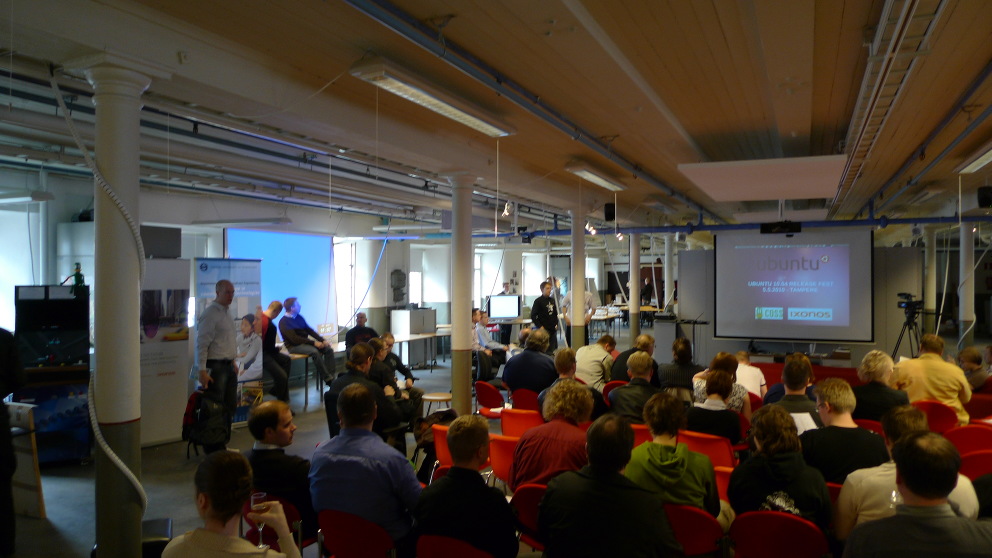
Timo Jyrinki: Ubuntu 10.04 LTS release fest in Tampere, Finland

The main release party in Finland was held at Tampere, Finland and organized by Ixonos Plc and COSS. It was a great success, as proven by the almost 200 participants and great speakers.

The first sessions were mostly about the basics of Ubuntu and its roots in Debian and elsewhere. Then Tuure Vartiainen from Tampere University of Technology shared with us the release from the official Finnish mirror perspective (fi.archive.ubuntu.com, fi.releases.ubuntu.com, ...). 10.04 LTS release date was very hectic and the transfer speeds were not constantly optimal, but quite good anyway. For 10.10 they hope to up the network connectivity to 10G. I also took the opportunity to thank him later personally for the Ubuntu Finnish Remix mirroring which was arranged right before the release as well.

The next-to-final session was about Ubuntu for senior people with brief demoing of how Ubuntu UI can be customized. To give a little different perspective to usage of Ubuntu, the final speaker was a theater director and dramatist Jotaarkka Pennanen from Interactive Film Productions. Blender among else was praised.

In addition to speakers, we had 300 Ubuntu Finnish Remix CD:s, Ubuntu posters, Free Software Foundation Europe flyers, COSS flyers et cetera. After the main program there was a dinner and some wine offered to participants, which was a great social ending to the event.

Now a few photos follow. Unfortunately they are from before the event actually began, so others have probably more crowded photos and photos of the speakers themselves.


Nathan Handler: Google Summer of Code Update #4

Since Matt is going to be busy the next few weeks moving and traveling, he arranged for Stefano Zacchiroli to fill in for him temporarily as my mentor. I must say, I am quite lucky to have the chance to have both Matt and Stefano as mentors this summer. Yesterday, I had my first call with Stefano. I started by filling him in on the current status of the project. We discussed how the dashboard is going to be based on tasks rather than bug . He reminded me that we want to make sure all useful information makes its way back to the BTS (ideally in an automated or) in a fast and easy way. Most of the information that will be stored in the dashboard probably won t be that useful to the package maintainers. However, there will be a column for DEX members to add notes about tasks. This column could potentially contain some useful information. That is one reason that the dashboard will parse this column for bug numbers and then display extended information about the bug. Hopefully, this will encourage DEX members to send information to the BTS when relevant. Having the bug numbers will also allow us to automate sending information from the DEX dashboard to the BTS if we choose to. I also spent some time this week working on a script to generate some graphs. These graphs will allow us to track the number of remaining tasks in a project vs. time. Stefano mentioned possibly borrowing some code from the Ubuntu burndown charts, but right now, I think the Ubuntu charts might be a bit more complicated than what we need. We can always decide to borrow some features/code down the road if necessary. It is also just about time for me to prepare my second formal report for the Summer of Code. I will use that to showcase the current status of the code and make it available for people to test and review.

16 June 2011

Rapha&#235;l Hertzog: Installing GNOME 3 on Debian 6.0 Squeeze? No, sorry

Ever since I blogged about the status of GNOME 3 in Debian experimental, my web logs show that many people are looking for ways to try out GNOME 3 with Debian Squeeze. No GNOME 3 for Debian 6.0 Don t hold your breath, it s highly unlikely that anyone of the Debian GNOME team will prepare backports of GNOME 3 for Debian 6.0 Squeeze. It s already difficult enough to do everything right in unstable with a solid upgrade path from the current versions in Squeeze But if you are brave enough to want to install GNOME 3 with Debian 6.0 on your machine then I would suggest that you re the kind of person who should run Debian testing instead (or even Debian unstable, it s not so horrible). That s what most people who like to run recent versions of software do. How to run Debian testing You re convinced and want to run Debian testing? It s really easy, just edit your /etc/apt/sources.list and replace stable with testing . A complete file could look like this:

# Main repository
deb http://ftp.debian.org/debian testing main contrib non-free
deb-src http://ftp.debian.org/debian testing main contrib non-free
# Security updates
deb http://security.debian.org/debian-security testing main contrib non-free
Now you should be able to run apt-get dist-upgrade and end up with a testing system. How to install GNOME 3 on Debian testing aka wheezy If you want to try GNOME 3 before it has landed in testing, you ll have to add unstable and experimental to your sources.list:
deb http://ftp.debian.org/debian unstable main contrib non-free
deb http://ftp.debian.org/debian experimental main contrib non-free
You should not install GNOME 3 from experimental if you re not ready to deal with some problems and glitches. Beware: once you upgraded to GNOME 3 it will be next to impossible to go back to GNOME 2.32 (you can try it, but it s not officially supported by Debian).
To avoid upgrading all your packages to unstable, you will tell APT to prefer testing with the APT::Default-Release directive:
# cat >/etc/apt/apt.conf.d/local <<END
APT::Default-Release "testing";
END
To allow APT to upgrade the GNOME packages to unstable/experimental, you will also install the following pinning file as /etc/apt/preferences.d/gnome:
Package: *gnome* libglib2.0* *vte* *pulse* *peas* libgtk* *gjs* *gconf* *gstreamer* alacarte *brasero* cheese ekiga empathy* gdm3 gcalctool baobab *gucharmap* gvfs* hamster-applet *nautilus* seahorse* sound-juicer *totem* remmina vino gksu xdg-user-dirs-gtk dmz-cursor-theme eog epiphany* evince* *evolution* file-roller gedit* metacity *mutter* yelp* rhythmbox* banshee* system-config-printer transmission-* tomboy network-manager* libnm-* update-notifier shotwell liferea *software-properties* libunique-3.0-0 libseed-gtk3-0 libnotify* libpanel-applet-4-0 libgdata11 libcamel* libcanberra* libchamplain* libebackend* libebook* libecal* libedata* libegroupwise* libevent* gir1.2-* libxklavier16 python-gmenu libgdict-1.0-6 libgdu-gtk0
Pin: release experimental
Pin-Priority: 990
Package: *gnome* libglib2.0* *vte* *pulse* *peas* libgtk* *gjs* *gconf* *gstreamer* alacarte *brasero* cheese ekiga empathy* gdm3 gcalctool baobab *gucharmap* gvfs* hamster-applet *nautilus* seahorse* sound-juicer *totem* remmina vino gksu xdg-user-dirs-gtk dmz-cursor-theme eog epiphany* evince* *evolution* file-roller gedit* metacity *mutter* yelp* rhythmbox* banshee* system-config-printer transmission-* tomboy network-manager* libnm-* update-notifier shotwell liferea *software-properties* libunique-3.0-0 libseed-gtk3-0 libnotify* libpanel-applet-4-0 libgdata11 libcamel* libcanberra* libchamplain* libebackend* libebook* libecal* libedata* libegroupwise* libevent* gir1.2-* libxklavier16 python-gmenu libgdict-1.0-6 libgdu-gtk0
Pin: release unstable
Pin-Priority: 990
Package: *
Pin: release experimental
Pin-Priority: 150
Note that I used Pin-Priority: 990 this time (while I used 500 in the article explaining how to install GNOME 3 on top of unstable), that s because you want these packages to have the same priority than those of testing, and they have a priority of 990 instead of 500 due to the APT::Default-Release setting. You re done, your next dist-upgrade should install GNOME 3. It will pull a bunch of packages from unstable too but that s expected since the packages required by GNOME 3 are spread between unstable and experimental.
If you want to read more articles like this one, click here to subscribe to my free newsletter. You can also follow me on Identi.ca, Twitter and Facebook.

13 comments Liked this article? Click here. My blog is Flattr-enabled.

15 June 2011

Christian Perrier: So, what happened with Kikithon?

I mentioned this briefly yesterday, but now I'll try to summarize the story of a great surprise and a big moment for me. All this started when my wife Elizabeth and my son Jean-Baptiste wanted to do something special for my 50th birthday. So, it indeed all started months ago, probably early March or something (I don't yet have all the details). Jean-Baptiste described this well on the web site, so I won't go again into details, but basically, this was about getting birthday wishes from my "free software family" in, as you might guess, as many languages as possible. Elizabeth brought the original idea and JB helped her by setting up the website and collecting e-mail addresses of people I usually work with: he grabbed addresses from PO files on Debian website, plus some in his own set of GPG signatures and here we go. And then he started poking dozens of you folks in order to get your wishes for this birthday. Gradually, contributions accumulated on the website, with many challenges for them: be sure to get as many people as possible, poking and re-poking all those FLOSS people who keep forgetting things... It seems that poking people is something that's probably in the Perrier's genes! And they were doing all this without me noticing. As usually in Debian, releasing on time is a no-no. So, it quickly turned out that having everything ready by April 2nd wouldn't be possible. So, their new goal was offering this to me on Pentecost Sunday, which was yesterday. And...here comes the gift. Aha, this looks like a photo album. Could it be a "50 years of Christian" album? But, EH, why is that pic of me, with the red Debconf5 tee-shirt (that features a world map) and a "bubulle" sign, in front of the book? But, EH EH EH, what the .... are doing these word by H0lger, then Fil, then Joey doing on the following pages? And only then, OMG, I discover the real gift they prepared. 106, often bilingual, wishes from 110 people (some were couples!). 18 postcards (one made of wood). 45 languages. One postcard with wishes from nearly every distro representatives at LinuxTag 2011. Dozens of photos from my friends all around the world. All this in a wonderful album. I can't tell what I said. Anyway, JB was shooting a video, so...we'll see. OK, I didn't cry...but it wasn't that far and emotion was really really intense. Guys, ladies, gentlemen, friends....it took me a while to realize what you contributed to. It took me the entire afternoon to realize the investment put by Elizabeth and JB (and JB's sisters support) into this. Yes, as many of you wrote, I have an awesome family and they really know how to share their love. I also have an awesome virtual family all around the world. Your words are wholeheartedly appreciated and some were indeed much much much appreciated. Of course, I'll have the book in Banja Luka so that you can see the result. I know (because JB and Elizabeth told me) that many of you were really awaiting to see how it would be received (yes, that includes you, in Germany, who I visited in early May!!!). Again, thank you so much for this incredible gift. Thank you Holger Levsen, Phil Hands, Joey Hess, Lior Kaplan, Martin Michlmayr, Alberto Gonzalez Iniesta, Kenshi "best friend" Muto, Praveen Arimbrathodiyil, Felipe Augusto van de Wiel, Ana Carolina Comandulli (5 postcards!), Stefano Zacchiroli (1st contribution received by JB, of course), Gunnar Wolf, Enriiiiiico Zini, Clytie Siddall, Frans Pop (by way of Clytie), Tenzin Dendup, Otavio Salvador, Neil McGovern, Konstantinos Margaritis, Luk Claes, Jonas Smedegaard, Pema Geyleg, Meike "sp tzle queen" Reichle, Alexander Reichle-Schmehl, Torsten Werner, "nette BSD" folks, CentOS Ralph and Brian, Fedora people, SUSE's Jan, Ubuntu's Lucia Tamara, Skolelinux' Paul, Rapha l Hertzog, Lars Wirzenius, Andrew McMillan (revenge in September!), Yasa Giridhar Appaji Nag (now I know my name in Telugu), Amaya Rodrigo, St phane Glondu, Martin Krafft, Jon "maddog" Hall (and God save the queen), Eddy Petri or, Daniel Nylander, Aiet Kolkhi, Andreas "die Katze geht in die K che, wunderbar" Tille, Paul "lets bend the elbow" Wise, Jordi "half-marathon in Banja Luka" Mallach, Steve "as ever-young as I am" Langasek, Obey Arthur Liu, YAMANE Hideki, Jaldhar H. Vyas, Vikram Vincent, Margarita "Bronx cross-country queen" Manterola, Patty Langasek, Aigars Mahinovs (finding a pic *with* you on it is tricky!), Thepittak Karoonboonyanan, Javier "nobody expects the Spanish inquisition" Fern ndez-Sanguino, Varun Hiremath, Moray Allan, David Moreno Garza, Ralf "marathon-man" Treinen, Arief S Fitrianto, Penny Leach, Adam D. Barrat, Wolfgang Martin Borgert, Christine "the mentee overtakes the mentor" Spang, Arjuna Rao Chevala, Gerfried "my best contradictor" Fuchs, Stefano Canepa, Samuel Thibault, Eloy "first samba maintainer" Par s, Josip Rodin, Daniel Kahn Gillmor, Steve McIntyre, Guntupalli Karunakar, Jano Gulja , Karolina Kali , Ben Hutchings, Matej Kova i , Khoem Sokhem, Lisandro "I have the longest name in this list" Dami n Nicanor P rez-Meyer, Amanpreet Singh Alam, H ctor Or n, Hans Nordhaugn, Ivan Mas r, Dr. Tirumurti Vasudevan, John "yes, Kansas is as flat as you can imagine" Goerzen, Jean-Baptiste "Piwet" Perrier, Elizabeth "I love you" Perrier, Peter Eisentraut, Jesus "enemy by nature" Climent, Peter Palfrader, Vasudev Kamath, Miroslav "Chicky" Ku e, Mart n Ferrari, Ollivier Robert, Jure uhalev, Yunqiang Su, Jonathan McDowell, Sampada Nakhare, Nayan Nakhare, Dirk "rendez-vous for Chicago marathon" Eddelbuettel, Elian Myftiu, Tim Retout, Giuseppe Sacco, Changwoo Ryu, Pedro Ribeoro, Miguel "oh no, not him again" Figueiredo, Ana Guerrero, Aur lien Jarno, Kumar Appaiah, Arangel Angov, Faidon Liambotis, Mehdi Dogguy, Andrew Lee, Russ Allbery, Bj rn Steensrud, Mathieu Parent, Davide Viti, Steinar H. Gunderson, Kurt Gramlich, Vanja Cvelbar, Adam Conrad, Armi Be irovi , Nattie Mayer-Hutchings, Joerg "dis shuld be REJECTed" Jaspert and Luca Capello. Let's say it gain:

13 June 2011

Jonathan Wiltshire: StartSSL: finally, a trustworthy certifier*

Matt Brown writes about StartCom, the Israeli issuer providing basic SSL certificates for nothing. In fact I ve been using StartSSL certificates for about three years now, but I get them issued to Level 2 verification which incurs a fee. (It s more expensive now than when I was first validated, but still good value.) StartCom are the only issuer I ve ever dealt with who work like this. They validate the individual, using: This makes me trust them far more than other issuers, who don t bother with any meaningful validation at all. Their approach is to establish identity, then allow you to: Although this doesn t make up for trust (the presence of an SSL certificate doesn t guarantee the data you send is safe upon arrival) it does make me much happier to see a CA taking proper verification measures instead of just handing out certificates at random and it s much cheaper for me too, being verified once and then issuing as many certificates as I need. Highly recommended. *that is, more trustworthy
Comments
StartSSL: finally, a trustworthy certifier* is a post from: jwiltshire.org.uk Flattr

Christian Perrier: So, what happened with Kikithon?

I mentioned this briefly yesterday, but now I'll try to summarize the story of a great surprise and a big moment for me. All this started when my wife Elizabeth and my son Jean-Baptiste wanted to do something special for my 50th birthday. So, it indeed all started months ago, probably early March or something (I don't yet have all the details). Jean-Baptiste described this well on the web site, so I won't go again into details, but basically, this was about getting birthday wishes from my "free software family" in, as you might guess, as many languages as possible. Elizabeth brought the original idea and JB helped her by setting up the website and collecting e-mail addresses of people I usually work with: he grabbed addresses from PO files on Debian website, plus some in his own set of GPG signatures and here we go. And then he started poking dozens of you folks in order to get your wishes for this birthday. Gradually, contributions accumulated on the website, with many challenges for them: be sure to get as many people as possible, poking and re-poking all those FLOSS people who keep forgetting things... It seems that poking people is something that's probably in the Perrier's genes! And they were doing all this without me noticing. As usually in Debian, releasing on time is a no-no. So, it quickly turned out that having everything ready by April 2nd wouldn't be possible. So, their new goal was offering this to me on Pentecost Sunday, which was yesterday. And...here comes the gift. Aha, this looks like a photo album. Could it be a "50 years of Christian" album? But, EH, why is that pic of me, with the red Debconf5 tee-shirt (that features a world map) and a "bubulle" sign, in front of the book? But, EH EH EH, what the .... are doing these word by H0lger, then Fil, then Joey doing on the following pages? And only then, OMG, I discover the real gift they prepared. 106, often bilingual, wishes from 110 people (some were couples!). 18 postcards (one made of wood). 45 languages. One postcard with wishes from nearly every distro representatives at LinuxTag 2011. Dozens of photos from my friends all around the world. All this in a wonderful album. I can't tell what I said. Anyway, JB was shooting a video, so...we'll see. OK, I didn't cry...but it wasn't that far and emotion was really really intense. Guys, ladies, gentlemen, friends....it took me a while to realize what you contributed to. It took me the entire afternoon to realize the investment put by Elizabeth and JB (and JB's sisters support) into this. Yes, as many of you wrote, I have an awesome family and they really know how to share their love. I also have an awesome virtual family all around the world. Your words are wholeheartedly appreciated and some were indeed much much much appreciated. Of course, I'll have the book in Banja Luka so that you can see the result. I know (because JB and Elizabeth told me) that many of you were really awaiting to see how it would be received (yes, that includes you, in Germany, who I visited in early May!!!). Again, thank you so much for this incredible gift. Thank you Holger Levsen, Phil Hands, Joey Hess, Lior Kaplan, Martin Michlmayr, Alberto Gonzalez Iniesta, Kenshi "best friend" Muto, Praveen Arimbrathodiyil, Felipe Augusto van de Wiel, Ana Carolina Comandulli (5 postcards!), Stefano Zacchiroli (1st contribution received by JB, of course), Gunnar Wolf, Enriiiiiico Zini, Clytie Siddall, Frans Pop (by way of Clytie), Tenzin Dendup, Otavio Salvador, Neil McGovern, Konstantinos Margaritis, Luk Claes, Jonas Smedegaard, Pema Geyleg, Meike "sp tzle queen" Reichle, Alexander Reichle-Schmehl, Torsten Werner, "nette BSD" folks, CentOS Ralph and Brian, Fedora people, SUSE's Jan, Ubuntu's Lucia Tamara, Skolelinux' Paul, Rapha l Hertzog, Lars Wirzenius, Andrew McMillan (revenge in September!), Yasa Giridhar Appaji Nag (now I know my name in Telugu), Amaya Rodrigo, St phane Glondu, Martin Krafft, Jon "maddog" Hall (and God save the queen), Eddy Petri or, Daniel Nylander, Aiet Kolkhi, Andreas "die Katze geht in die K che, wunderbar" Tille, Paul "lets bend the elbow" Wise, Jordi "half-marathon in Banja Luka" Mallach, Steve "as ever-young as I am" Langasek, Obey Arthur Liu, YAMANE Hideki, Jaldhar H. Vyas, Vikram Vincent, Margarita "Bronx cross-country queen" Manterola, Patty Langasek, Aigars Mahinovs (finding a pic *with* you on it is tricky!), Thepittak Karoonboonyanan, Javier "nobody expects the Spanish inquisition" Fern ndez-Sanguino, Varun Hiremath, Moray Allan, David Moreno Garza, Ralf "marathon-man" Treinen, Arief S Fitrianto, Penny Leach, Adam D. Barrat, Wolfgang Martin Borgert, Christine "the mentee overtakes the mentor" Spang, Arjuna Rao Chevala, Gerfried "my best contradictor" Fuchs, Stefano Canepa, Samuel Thibault, Eloy "first samba maintainer" Par s, Josip Rodin, Daniel Kahn Gillmor, Steve McIntyre, Guntupalli Karunakar, Jano Gulja , Karolina Kali , Ben Hutchings, Matej Kova i , Khoem Sokhem, Lisandro "I have the longest name in this list" Dami n Nicanor P rez-Meyer, Amanpreet Singh Alam, H ctor Or n, Hans Nordhaugn, Ivan Mas r, Dr. Tirumurti Vasudevan, John "yes, Kansas is as flat as you can imagine" Goerzen, Jean-Baptiste "Piwet" Perrier, Elizabeth "I love you" Perrier, Peter Eisentraut, Jesus "enemy by nature" Climent, Peter Palfrader, Vasudev Kamath, Miroslav "Chicky" Ku e, Mart n Ferrari, Ollivier Robert, Jure uhalev, Yunqiang Su, Jonathan McDowell, Sampada Nakhare, Nayan Nakhare, Dirk "rendez-vous for Chicago marathon" Eddelbuettel, Elian Myftiu, Tim Retout, Giuseppe Sacco, Changwoo Ryu, Pedro Ribeoro, Miguel "oh no, not him again" Figueiredo, Ana Guerrero, Aur lien Jarno, Kumar Appaiah, Arangel Angov, Faidon Liambotis, Mehdi Dogguy, Andrew Lee, Russ Allbery, Bj rn Steensrud, Mathieu Parent, Davide Viti, Steinar H. Gunderson, Kurt Gramlich, Vanja Cvelbar, Adam Conrad, Armi Be irovi , Nattie Mayer-Hutchings, Joerg "dis shuld be REJECTed" Jaspert and Luca Capello. Let's say it gain:

12 June 2011

Neil Williams: Ideas for TDeb packages

This is a follow-up on TDebs with some detail of how existing packages can be adapted to support TDebs.

$ cat debian/package-tdeb.tdeb

[gettextdir] po
[gettextname] package
[po4apodir] doc/po
[po4amandir] doc/package/man/
[po4acommand] po4a-build


What's happening then? Well, the first thing to take into account is that a lot of the values for these settings will be dictated by upstream, which is why it is necessary for maintainers to add this information as a support file in debian/. I tried determining all this information automatically but the script got far too long and still was far from complete.
Other changes
The (currently unsupported in Debian) XC-Package-Type: tdeb option is used in debian/control to mark a new or existing package as a TDeb. To use an existing package, it must comply with the rules for a TDeb including that it must be Architecture: all. The other rules centre around build issues. If any of the files in the existing package would require execution of any part of the normal build process of the package, these would have to be moved out of the package before that package could be a TDeb. The reason is that TDeb generation by translators needs to not require a full build environment for every individual package and must not risk modifying package contents in ways which are related to the build environment. So, unchanged images and other architecture-independent files are OK, any files which need build-dependencies are a problem. I don't know how many packages there are out there with such files. If you have a -data or -common package which contains translated data and that package also includes architecture-independent files, I'd be interested in knowing the name of the packages involved. If those packages also include files which are generated or modified within the package build, I'll be particularly interested in knowing about those source packages.
debconf
The most common use of TDebs during a release cycle is probably going to be debconf template updates by Christian and these are handled without needing a listing in the .tdeb file.
Other formats
I'm looking at QtLinguist support and it should be fairly straightforward using the .tdeb file arrangement.

Once that's done (in a branch, please - these can't be uploaded yet), the package can be tested with the soon-to-be-uploaded emdebian-tdeb package. The old content has been moved into the emdebian-grip-server package and the dependencies of the old version stripped back. The package contains two scripts dpkg-gentdeb and dh_gentdeb which I hope to get included into the respective packages in time for Wheezy. The idea will be that build systems (dh7, CDBS, debhelper-plain etc.) includes a call to the relevant script. (dh_ is just a wrapper around dpkg- in this case). This would allow maintainers to create the first TDeb, get that through NEW and then the fun starts. Once the translation mechanism is set up, I would like a nominated person (likely to be Christian if he agrees) to co-ordinate translation updates for particular packages to allow for a single upload including updates for many translations. This would be package_version+t1_all.tdeb and an appropriate .diff.gz or debian.tar.gz. No binary upload, no impact on testing migrations.

This is mostly theory right now but the scripts do exist in Emdebian SVN.

Still more testing to do but I hope to upload these scripts to unstable in the next few days.

Steve McIntyre: How to not embarrass yourself with missing attachments in mutt

I keep on seeing people sending messages saying "see attached file" or similar in their emails, but then forgetting to actually attach the file. I used to do it myself lots, but then with the help of some ideas I found on the net I wrote the following script to use with mutt. To use it, use the setting "set sendmail=" to point at it.
#!/bin/bash
#
# mutt-sendmail
# helper script to reduce embarrassment with mutt :-)
#
# Copyright 2011 Steve McIntyre <steve>
# GPL v2
###
# save msg in file to re-use it for multiple tests
###
TMPFILE= mktemp -p ~/tmp -t mutt.XXXXXX    exit 2
cat > $TMPFILE
## Attachment keywords that the message body will be searched for:
KEYWORDS='attach patch'
## Define test for multipart message.
function multipart  
    grep -q '^Content-Type: multipart' "$TMPFILE"
 
## Define test for keyword search.
function word-attach  
    grep -v '^>' "$TMPFILE"   grep -v "^X-attached:"   grep -E -i -q "$KEYWORDS"
 
## Header override.
function header-override  
    grep -i -E "^X-attached: *none *$" "$TMPFILE"
 
###
# FINAL DECISION:
# chain series of functions, use !   && for logic connections,
###
if multipart   ! word-attach   header-override; then
    formail -I bcc < $TMPFILE   /usr/lib/sendmail -oi -oem "$@"
    status=$?
else
    echo "No file was attached but a search of the message text suggests there"
    echo "should be one.  Add a header \"X-attached: none\" to override this"
    echo "check if no attachment is intended."
    status=1
fi
rm -f $TMPFILE
exit $status

Next.

Previous.