Search Results: "nion"

11 June 2007

Isaac Clerencia: Is Google the biggest threat to our privacy? I don t think so.

Privacy International has just issued a report slamming Google on privacy.
Google may indeed be the biggest pool of user data out there, but IMHO they do a decent job at protecting its users privacy in most areas.
Google’s Matt Cutts shares his opinions about PI’s article and talks about Google’s goodness in his blog.

10 June 2007

Russell Coker: submissions for LCA and other conferences

In this post I recommended that job seekers not publish their CV. In a comment Gunnar suggested having a special CV for conferences. I think that Gunnar’s idea is good and have started writing my conference CV at http://etbe.coker.com.au/conferences. When I complete it I will make it part of every submission for speaking at a conference. The LCA 2008 call for presentations is now open. One of the most interesting, noteworthy, and slightly controversial items is the suggestion that people submit a video. I think that the video submission is a great idea, either a video or testimony from audience members from past presentations should be required for all submissions (NB I’m not involved with organising LCA2008 so my opinion means little in this regard). The reason is that I have attended many presentations which fell far short of their potential due to poor speaking skills. I’ve been to great presentations by people with strong accents, by people with speech impediments, by people who are incredibly shy, and by people who just don’t have a clue about public speaking. However my observation is that if a speaker has more than one of these disadvantages then the presentation is likely to fail. I have previously written at length about how to give a good presentation to a technical audience (such as is found at LCA). Dave Hall blogs about Should I do a presentation at LCA 2008. He mentions lack of a web-cam as a disincentive, but I am happy to lend him my digital camera (which makes really high quality movies) to solve this problem. In fact I have considered recording some short Linux talks at the SGI office during lunch breaks (Dave and I both work for SGI). Dave also mentions a nightmare scenario about a laptop not working with presentation hardware. My post about getting laptops working for presentations will hopefully help some people in this regard. I’m not sure if I’ll make an offer for LCA this year, I haven’t been doing much cutting-edge work recently. Maybe I’ll just offer some talks for mini-confs, I could probably get several offers accepted by mini-conf organisers if I try.

9 June 2007

Isaac Clerencia: How to hire great people: drive, curiosity and ethics

I’ve just come across this article from Marc Andreessen about hiring. It raises some interesting points about the hiring process, which he bases in three criteria. Drive
I like to see what someone has done. Not been involved in, or been part of, or watched happen, or was hanging around when it happened. If you’re a programmer: the open source project to which you’ve made major contributions. Something. If you can’t find anything — if a candidate has just followed the rules their whole lives, showed up for the right classes and the right tests and the right career opportunities without achieving something distinct and notable, relative to their starting point — then they probably aren’t driven. And you’re not going to change them. Motivating people who are fundamentally unmotivated is not easy.
Curiosity
Sit a programmer candidate for an Internet company down and ask them about the ten most interesting things happening in Internet software. REST vs SOAP, the new Facebook API, whether Ruby on Rails is scalable, what do you think of Sun’s new Java-based scripting language, Google’s widgets API, Amazon S3, etc. If the candidate loves their field, they’ll have informed opinions on many of these topics. That’s what you want.
Ethics
Pick a topic you know intimately and ask the candidate increasingly esoteric questions until they don’t know the answer.
They’ll either say they don’t know, or they’ll try to bullshit you.
Guess what. If they bullshit you during the hiring process, they’ll bullshit you once they’re onboard.
He also links to Software Interview, a site which lists questions and answers that several companies use in their hiring processes.

5 June 2007

Antti-Juhani Kaijanaho: Book selections

A friend recommended me Steve Miller and Sharon Lee’s Liaden books. The first question, reading order, was not very easy to find an answer to. I went with publication order within the Agent of Change sequence – Agent of Change, Conflict of Honors, Carpe Diem, Plan B, and I Dare. In retrospect it would have been better to start with Conflict of Honors followed by Agent of Change, as this corresponds to story chronology, and AoC and CD have the same protagonists while CoH doesn’t. The story speed between Plan B and I Dare was too fast to break the sequence, but it might have made the latter book fuller if I had read the first batch of prequels Local Custom and Scout’s Progress before it. The second prequel sequence Crystal Soldier and Crystal Dragon works well at any point in the series, as does the third (single-book) prequel sequence Balance of Trade. I’m still reading Fledgling and the first short story collection. Confusing? I thought so, but it definitely is worth the investment. Instead of all the usual superlatives, I’ll say something unique to this series: These books changed my perspective in that I now cannot read (in any fiction) about a character bowing without asking in my head “in which mode, dammit!?”. (Update on 8th June: The friend referred to above, after reading this section, said (I paraphrase): “In the peculiar mode of humans, of course”.) The Liaden books are romances in a (very good) science-fictional setting. With two exceptions, each book creates at least one new lifetime romantic pairing, and they’re in my opinion convincing romances. One of the exceptions deepens one of the earlier relationships, so there is no lack of romance there. The only place I know where one can get all the novels reliably is Webscriptions, as e-books. Some of the paper books seem to be hard to find, and the recent closing down of the main publisher Meisha Merlin cannot help there. * * * The promotional material for The Mote in God’s Eye by Larry Niven and Jerry Pournelle includes a quote by Robert Heinlein: Possibly the finest science fiction novel I have ever read. It is hard for me to disagree with that statement (including the qualifier, in all honesty), having recently read this book. Mote is a complex first-contact story, set in Pournelle’s alternate history (originally future history) universe. It begins in the year 3017. The recently created Second Empire of Man gets a visit from the aliens, leading to a counter-visit by humans to the aliens’ star system. The aliens seem friendly, but are they? What could they possibly be hiding? In retrospect, the Moties remind me (in style, not in detail) of Orson Scott Card’s Piggies (Speaker for the Dead and sequels); I would be surprised if Card had not read this book before writing his. The sequel, The Gripping Hand is not the masterpiece that Mote is, but I had no trouble enjoying it. The solution to the Motie problem has held for decades, but it won’t hold forever, and it might actually be breaking down now. The mission: save both humans and Moties from an eventual assured mutual destruction. * * * I actually started reading Pournelle’s alternate/future history from the cronological beginning. This is another series where reading order becomes a complicated matter, as many of the books tell parallel subthreads of the story; and it becomes even more complicated by the fact that there is an omnibus edition in which the story is told in chronological order, this having been accomplished by breaking the books down into chunks and then arranging the chunks in chronological order. My reading order went as follows: West of Honor, The Mercenary, Prince of Mercenaries, Go Tell the Spartans and Prince of Sparta. This is a good reading order; my only problem with it is that the protagonist of West of Honor fails to appear in most of the other books. The following is not in my opinion a real spoiler, even though it reveals certain key events of the series. The premise is that sometime between the 1970’s and the early decades of the 21st Century the United States and the Soviet Union form a union, called the CoDominium, which dominates the international politics of the Earth for most of the 21st Century. In early 21st Century, faster-than-light travel is discovered, and the CoDominium starts to colonise other star systems, first with voluntary colonists and then with convicts and involuntary colonists. The series takes place in the final decades of CoDominium, and focuses on the actions of one John Christian Falkenberg (though he is not the protagonist of all the books), first as an officer in the CoDominium (extraterrestrial) military, and then as the Colonel of a mercenary outfit, Falkenberg’s Legion. The Legion is at the center of events that eventually (after the events described in these books) leads to the creation of the first Empire of Man. The books are entertaining military science fiction, solid, enjoyable journeyman pieces.

Martin-Éric Racine: New Blogation

Elver convinced me to start blogging again. This time, instead of bothering with setting up my own blog engine, I decided to go back and try Blogger again. Hacking the CSS template to match my regular website took even less time than I expected. Elver took the opportunity to ask his pal X-G for a second opinion on the current template. The result is what you see. Here I go again, blogging in excess. A new blogation.

Martin-Éric Racine: Gratuitous plug

People who understand French and who follow EU policy-making issues might find my other blog interesting.

MJ Ray: Wondering about Fon Rangers

While I was in Paris, I used a FON WiFi Access Point a couple of times. The rate seemed very reasonable - EUR 3 for a day's access compared to 10 (EUR 15) per day for The Cloud - and I paid with some money that's currently trapped by paypal's incompetence (they wouldn't accept letters in a UK Companies House registration number). I'm wondering whether to run a FON point. I've line-of-sight down the hill to a holiday park less than 400m away. If I aim a 6dBi directional antenna at it from inside a window, will it reach? Would the 2dBi built-in antenna reach the pub and shops 100m away? I used wifi while on a city break, but do people want internet while on a seaside holiday? Fon has adopted Ubuntu as its preferred operating system and the CEO also wrote:
"Fon already is an Open Source company and our software is an Open Source project called http://www.openwrt.org and we should support other Open Source movements/companies"
which is a good cooperative viewpoint, in my opinion. I'm a bit troubled by its Skype, Paypal and Google promotions, BBC Panorama: Wi-Fi: a warning signal and Andrew Savory's Fon not so much fun but it seems like a good idea at the moment because it would save or make money and I'd finally have OpenWRT on a router. Are those good enough reasons? Are there other options? What are they?

Martin-Éric Racine: Falsetto la Fox

The killer feature in Opera, compared to Firefox and other Mozilla products, is the ability to restore the content of all tabs at every browsing session; not just after experiencing a crash, but in a systematic way, whenever starting the application. I have finally found a Firefox plug-in that does that: Session Manager. Why isn't this a standard feature in Epiphany and Firefox? Epiphany vs Firefox compatibility issues Meanwhile, I have encountered yet another essential site (online booking for my favorite airline - this time) that blocks Epiphany but allows Firefox. Yes, I know that their webmaster is to blame for resorting to browser-agent filtering. No, I don't expect anyone at customer service to understand and to rouse their javascripting minion into fixing it. Unfortunately, it also means that I still cannot switch to Epiphany. Even though Firefox and xulrunner are essentially the same codebase, the different browser-agent is enough to make Epiphany unsuitable for everyday use. As I recall, Rosbeh and several others reported this as being one of two reasons for shipping Firefox as their default browser, the other being a question of brand recognition: Firefox had the full-page ad in the New York Times and is multi-platform, while Epiphany is virtually unknown and GNOME-specific. This must be fixed.

4 June 2007

Clint Adams: Riddle

I spout ignorant and antagonistic tripe on mailing lists. I tell people how they ought to behave. I vote, and I make, on average, fewer than two package uploads per year, but I feel that I am respected and admired enough for my opinions to not require any real contributions to back me up. Who am I?

3 June 2007

Nico Golde: debian.net domains

There are a lot of inofficial debian domains (known as debian.net domains). Some of then are really useful like changelogs.debian.net for example and others are just funny.

However I thought it might be useful to have a list of all debian.net domains so I wrote a small script.
The resulting page is on: http://people.debian.org/~nion/net-domains.html.

Bernd Zeimetz: gimp-plugin-registry

gimp-plugin-registry Dear lazyweb, since a few days there s gimp-plugin-registry waiting in unstable. At the moment the package contains several tiny GIMP plugins I like to use and which are not included in the gimp package or in other gimp-* packages. In my opinion a collection like this one was missing in Debian, since there re a lot of very nice plugins/scripts out there, which are too small to package them on their own.
Which plugins would you like to see in the collection? Packaging all plugins from http://registry.gimp.org/ doesn t make sense, so I d like to know which plugins other people are using and put them into the next release of the package. Any feedback is appreciated. P.S.: As I didn t find a real alternative for my needs, I ll stay with Dokuwiki. As far as I remember is a rss feed with proper html on Andi s todo list, and there re more other nice features going to come :-) Although somehow I still would like to rewrite Dokuwiki in python ;-)

31 May 2007

Kai Hendry: Chinese font adventures

Sina test rendering, take 2 I wanted to spill the discussion of fonts from Mark’s blog and share what little I know on the topic. So I am localising Webconverger for each locale and learning as I go. My aim is for each locale version to meet the requirements of that locale. That allows some focus, as making a distro that can hit every locale is really hard. On my unstable system, I have somehow have 179 fonts installed.
monty$ fc-list   wc -l
179
Ok, 50 of them are ttf fonts. ttf fonts are what get used on the Web, so they count the most to Webconverger. I am going to ignore bitmap fonts et al for some simplicity and sanity. I am also not going to talk about hinting and anti-aliasing, though I do have opinions. :) Anyway, 50 ttfs is still too many considering the “free fonts” often don’t really replace the msttcorefonts, which I think they should really try do. The leading free fonts like Bitstream Vera Sans and DejaVu Sans look the same to me (~sans-serif) and are seriously boring. I guess they’re comparable to msttcorefont’s Verdana. Great… one down. :) Though DejaVu Sans has really good i18n coverage, another thing I’m interested in. Unfortunately i18n coverage esp. with China/Japan/Korea (CJK) markets is difficult.
AFAIK there is no CJK msttcorefonts, so general ‘free software’ compatibility with proprietary font faces out there is really bad. There are free CJK fonts though many of these free fonts are really bad quality. Some are OK quality, though they aren’t comparable to the proprietary fonts and hence too often the Web page renders badly. Ouch. Then some people in China prefer some font over another so this problem gets quite complex. Add Korea and Japan to the mix who also use Chinese characters in their own “special way”. I’ve been testing out sina.com.cn and taking screenshots. So I have a Chinese friend and asked him to try a special Chinese specific Debian live build of Webconverger. He says all the Ubuntu geeks use VeraSansYuanTi. However that’s non-free, sigh…. My friend also writes:
sorry for Chinese there is no best font..
because China government never try hard for this;
all kinds of fonts is some company create;
and u know China had so log history so many great beautiful font style
.. but not become computer free fonts...
I think the opensource evolution model doesn’t work very well with fonts. They need to be super high quality from the outset. Throwing a bunch of fonts at the problem gets us in our current confused situation. I think it would be great if governments could settle on some core fonts instead dictated to by Microsoft, or by whatever proprietary font gains acceptance in other markets.

Kai Hendry: Chinese Web fonts

Webconverger Portal in Chinese I wanted to spill the discussion of fonts from Mark’s blog and share what little I know on the topic and learn from the lazyweb. :) So I am localising Webconverger for each locale and learning as I go. My aim is for each locale to have it’s own Webconverger i18n version. I hope this approach allows some focus, as making a distro that can hit every locale well is really hard. On my unstable system, I have somehow have 179 fonts installed.
monty$ fc-list   wc -l
179
Ok, 50 of them are ttf fonts. ttf fonts are what get used on the Web, so they count the most to Webconverger. I am going to ignore bitmap fonts et al for some simplicity and sanity. I am also not going to talk about hinting and anti-aliasing, though I do have opinions. :) Anyway, 50 ttfs is still too many considering the “free fonts” often don’t really replace the msttcorefonts, which I think they should really try do. The leading free fonts like Bitstream Vera Sans and DejaVu Sans look the same to me (actually they are the same, thnks Panthera!) and are seriously boring. I guess they’re comparable to msttcorefont’s Verdana. Great… one down. :) Update: Mike Day informs me this is what Red Hat are doing, developing a set of fonts that are metrically equivalent to the key Microsoft fonts. DejaVu Sans has really good i18n coverage, though unfortunately i18n coverage esp. with China/Japan/Korea (CJK) markets is difficult.
AFAIK there is no CJK msttcorefonts, so general ‘free software’ compatibility with proprietary font faces out there is really bad. There are free CJK fonts though many of these free fonts are really bad quality. Some are OK quality, though they aren’t comparable to the proprietary fonts and hence too often the Web page renders badly, as it was designed with some other proprietary font in mind. Ouch! Web designers please use ‘em’ units and this problem such as over lapping text could be avoided. Then some people in China prefer some font over another so this problem gets quite complex. Add Korea and Japan to the mix who also use Chinese characters in their own “special way”. I’ve been testing out sina.com.cn and taking screenshots. Sina test rendering, take 2 So I have a Chinese friend and asked him to try a special Chinese specific Debian live build of Webconverger. He says all the Ubuntu geeks use VeraSansYuanTi. However that’s non-free theft, sigh…. My friend also writes:

sorry for Chinese there is no best font..
because China government never try hard for this;
all kinds of fonts is some company create;
and u know China had so log history so many great beautiful font style
.. but not become computer free fonts…
I think the opensource evolution model doesn’t work very well with fonts. They need to be super high quality from the outset. Throwing a bunch of fonts at the problem gets us in our current confused situation. Update: Henri Sivonen wisely points out that “in the case of DejaVu, adding glyphs to Vera as an open source project seems to work”. I think it would be great if governments could settle on some cultural core fonts for their locality instead of being dictated to by Microsoft, or by whatever proprietary font gains acceptance in other markets.

29 May 2007

Nico Golde: libacpi general purpose acpi library

During the last time I developed a general purpose library for ACPI on linux.
Initially I just wanted to rewrite yacpi but since there is no shared lib for acpi information I decided to
put the important stuff in a seperate library.

Before releasing it I want some people to test it because my notebook doesn't support all of the information it can gather.

If you want to help me a bit, download a snapshot from:
http://nion.modprobe.de/libacpi-unreleased.tar.gz.

Install cmake, unpack the tarball and do:
$ cmake .
$ make
$ ./test-libacpi

and send me the output of test-libacpi together with tmpfile which should be generated like:

for i in find /proc/acpi -type f ; do
    echo -e "FILE: $i ================\n" >> tmpfile
    cat $i >> tmpfile
done

via mail to:


Thanks!

UPDATE: yes I totally fucked up the install instructions and the generation of the tmpfile :-) Sorry.
And in case I didn't reply to every mail I got until now, thanks very much for you help all!

27 May 2007

Jos Parrella: Recent political issues, travelling to DC and emdevs hacking

A few days ago, some people in Venezuela were shocked by Mark Shuttleworth’s claims against Hugo Ch vez Government and supporting Mar a Corina Machado, a minor opposition leader in the Country. Today, at 23:59:59, the nationwide open air TV broadcaster RCTV will cease operations. In Venezuela, as in several other countries in the World, the economically profitable portion of the electromagnetic spectrum is State’s property, thus requiring a concession to make use of it. RCTV concession was granted in 1987 for twenty years, and the Government has decided to deny the renewal, which is quite unusual (right-wing governments in the past simply would have shut up the antennas) Of course, RCTV is not a pro-Government channel, accounting between 90 and 100 percent of the airtime with anti Government news and opinions, which is not bad per se, though in Venezuela there’s a law requiring equilibrium in times devoted to political ads. Both situations (Mark’s comments and the Government’s decision) pose the threats of a now common situation in our Country: people taking very valid decisions with somewhat doubtful consequences. In the first case, Mark is using his right to freely write what he likes in his blog but it seems that it has damaged a little bit Ubuntu’s image in Venezuela (not that it’s Mark’s fault, of course) In the second case, the Government is taking a lawful decision, but it has actually raised an important discomfort in the population (polls, which are not always accountable, point out as much as 80% rejection rate), the journalists of other media and most foreign observers, which state that they’re actually closing a TV channel and destroying freedom of speech in the Country. Expressing political POVs is quite critical nowadays in Venezuela. Some famous etiquette bookwriters, such as the one at Emily Post’s, always tend to promote a be honest, be respectful position while listening or expressing your points of views in order to keep a productive attitude. I do think that politics are important: I just think mixing them with practical daily tasks, including FLOSS development and promotion, is becoming obnoxious and dangerous. Cheeseconf On June 15th., I’ll be departing to DC7 in Edimburgh. I’ll stay a night in Frankfurt, probably in a hostel, and then I’ll stay at one of the hostels in EDI. I plan to carry white cheese to the Cheese and Wine BoF, and I’d love any comments on how to transport them without posing a biological threat for Europe. I’ll be carrying a 65 liters backpack. How long will it take for the cheese to become a lifeform? Any special tips and tricks to avoid that? Copying files to embedded devices I’ve been trying to copy some binary files into an Axesstel D800 EvDO modem which runs Linux over a tiny ARM processor on less than 16 MB. of memory. I’m actually trying to get netcat in so I can get more useful stuff such as snmpd in. The modem has telnetd, but it has no zmodem utilities, particularly rz. Neither it has wget, nor ftpd. It has thttpd to serve the administrative webpages, but it can’t process shell CGI programs so I can’t send the file through a CGI form. Any ideas? I would love to read comments from hackers who have already managed their ways into embedded devices such as 802.11 devices with Linux, and any generic ideas on how to provide new firmware images for devices such as this Axesstel modem.

25 May 2007

Alastair McKinstry: Jets seen from a Brown Dwarf Star

Artists impression of Jets from Brown Dwarf
Outflows have been discovered from a Brown Dwarf star, 2MASS1207-3932, the lightest yet. Found by Emma Whelan and Tom Ray of DIAS and others , using the ESO's Very Large Telescope (VLT), this is the first time that Jets have been seen from an astronomical object as small as this. The Brown Dwarf is 2MASS1207-3932, a 24-Jupiter mass 'near star'. Jets of material are a common feature in astrophysics, seen from Galaxies and young stars, but this is the first time they have been seen in something this small. It opens the possibility of similar outflows from smaller objects, such as giant planets. The brown dwarf 2MASS1207-3932 is full of surprises. Its companion, a 5 Jupiter-mass giant, was the first confirmed exoplanet for which astronomers could obtain an image, thereby opening a new field of research - the direct detection of alien worlds. It was then later found that the brown dwarf has a disc surrounding it, not unlike very young stars. Tags , ,

24 May 2007

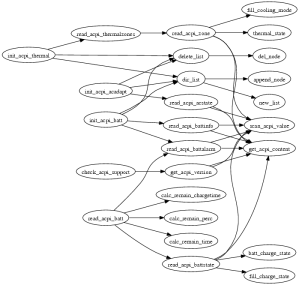
Nico Golde: creating (dynamic) function call graphs

I am currently writing a general purpose shared library for acpi (more on that soon).
I was interested in having a function call graph especially to see if the interface looks somehow clean and to include it in the documentation of the library. Of course I wanted to do it with open source tools. There are several tools for static call graphs but if you want dynamic call graphs you have to use additional features of your compiler to generate a graph based on code during runtime.

The first variant I tried was using egypt a small perl script to generate a dot file. Dot (today included into graphviz? is a tool originally developed at AT&T to generate hierarchical or layered drawings of directed graphs.

So what is needed?
First install software (here on a Debian systen, egypt is not included in Debian):
$ aptitude install graphviz graphicsmagick (+ download egypt from the homepage)

Compile your software using gcc with the option -dr to dump an RTL file of the source.
Most of gcc's work is done in an intermediate representation of your code, called register transfer language (RTL). This pretty much describes the instructions in plain text and is inspired by LISP lists.
Ok, here we go:
$ gcc -dr list.c libacpi.c test.c
This generates three RTL files, for every source file one. Depending on the gcc version the names may vary, here the names are libacpi.c.00.expand list.c.00.expand and test.c.00.expand.

Now use egypt to create a dot file (I don't want one for test.c now):
$ egypt libacpi.c.00.expand list.c.00.expand dot -Gsize=100,100 -Grankdir=LR -Tps -o graph.ps
Egypt will create dot-output and by piping it to dot with -Tps -o graph.ps you get the resulting graph as a ps file. -Grankdir is used to generate a graph which runs from the left to the right, default is up-down which looks a bit strange.

Now convert the ps file into a png:
$ gm convert graph.ps graph.png
The result looks like this (looks cool huh? :-)):


The second variant I tested is a bit different and in my opinion the resulting graph looks a bit better.
The gcc commandline switch -finstrument-functions allows easy creations of call-graphs for C/C++ (script languages used but I haven't tried).
You need to compile every file with the -finstrument-functions switch. Then gcc places a call to the functions __cyg_profile_func_enter upon entering a function and __cyg_profile_func_exit on leaving a function.

Compile your sources with -g and -finstrumental-functions:
$ gcc -g -finstrumental-functions list.c libacpi.c test.c -o test
Now you need to get some source code by Sebastian Krahmer (SuSE):
$ wget http://www.suse.de/~krahmer/instrumental/instrumental.tgz && tar xvfz instrumental.tgz && cd instrumental
Compile a shared object file:
$ cc -fPIC -c instrumental.c && ld -Bshareable instrumental.o -o inst.so
This generates a shared object file you can preload with LD_PRELOAD
$ LD_PRELOAD=./inst.so test
.....

Now you will find a log.inst.dot.<pid> and log.inst.ascii.<pid> in /tmp (path can be modified in instrumental.c).
The first file is a dot file you can now create a ps and a png file with but you need to attach a closing bracket at the end of the file since the package is not
able to intercept exit() or aborts. echo ' ' >> log.inst.dot.<pid>
$ dot -Gsize=15,20 -Grankdir=LR -Tps -o graph.ps log.inst.dot.<pid> && gm convert graph.ps graph.png
The result looks like:


PDF file which scales a bit better

The other file represents the call graph in ascii:
~ [1000 1000 1000] -- main (0x8049ea4)
~ [1000 1000 1000] -- check_acpi_support (0x8048984)
~ [1000 1000 1000] -- get_acpi_version (0x8048782)
~ [1000 1000 1000] -- get_acpi_content (0x80486b4)
~ [1000 1000 1000] -- scan_acpi_value (0x8048837)
~ [1000 1000 1000] -- init_acpi_batt (0x80489d6)
~ [1000 1000 1000] -- dir_list (0x804a447)
~ [1000 1000 1000] -- new_list (0x804a23c)
~ [1000 1000 1000] -- append_node (0x804a309)
~ [1000 1000 1000] -- read_acpi_battinfo (0x80497d3)
~ [1000 1000 1000] -- get_acpi_content (0x80486b4)
....

So both methods work but the first seems to be more useful if you want a graph for a specific file, not a specific program since you get an RTL file for each source file and you don't need all to create the dot file. The second method however looks better but has the limitation that you actually need to run the program (but that's dynamic and not static) and you can't (correct me if I miss something) create graphs for single files.

Have fun creating graphs for your favorite software and have a look into Sebastian Krahmers paper http://www.suse.de/~krahmer/instrumental/instrumental.pdf and http://www.ibm.com/developerworks/library/l-graphvis/. He also created a graph for openssh http://www.suse.de/~krahmer/ossh4.6.pdf.

23 May 2007

Evan Prodromou: 3 Prairial CCXV

I just finished reading Ben Yoskowitz's Top 10 reasons to join a startup, and I feel like I have to say something. As an experienced programmer, I think of a startup as an abusive relationship. Most technology startups I've been in have been run by charismatic sociopaths with no actual management or technology experience. They make wild, ignorant, unfounded promises to employees, investors and potential customers, then get increasingly anxious and unpleasant as their unsupportable predictions of schedule and market share don't come through. Employees end up working 80-hour weeks, typically for low or no pay and worthless stock options that never pay out. Guilty that living the "startup lifestyle" (work from home, come in late, have fun) has caused schedule or feature slips, they push themselves too hard at work, to the detriment of their health and home life. It doesn't help you much get another job later. Most startups don't succeed, which means that you end up with 1, 2 or 3 years of space on your r sum consumed by a made-up company name that no one has ever heard of and whose phone line has been disconnected. If people have heard of the name, they'll associate it with failure ("Oh, yeah, wasn't that the company that spent all that money and went nowhere?"). On top of all that, the tech experience of working in a startup is usually pretty bad. The engineers are typically unexperienced -- just out of school, or close to it -- and they waste a lot of time and effort trying to reinvent the wheel. The idea that you're changing the world encourages this kind of bad engineering. You end up cutting a lot of corners and developing a lot of bad habits that you have to unlearn later on. Schedule pressures make you drop important engineering steps like analysis, design, unit tests, documentation. That is, if you even knew you were supposed to do them in the first place. It takes a lot of experience in this kind of pressure-cooker environment to come out of a startup sane, healthy, and wealthy. The vast majority of people end up with broken relationships, poor mental and physical health, and not much in the way of money to show for their efforts. tags:

Wikiclock in the news So, Niko, Hugh, Mike and Leoben Richardson all blogged about the Wikiclock. As far as I know, no MSM coverage yet, but it should be coming down the pipe any day. I talked to Niko tonight, and he said that he saw Hugh at La ka, and Hugh was updating the wikiclock. They traded off updating all afternoon. Sigh. It's actually quite addictive. tags:

Transit strike We've got a transit strike on in Montreal (see the CBC for deetz). It's a pretty heinous problem -- the maintenance workers are asking for X% pay increases over Y years with blah blah blah pension and fie fo fum and... Whatever. The city is refusing to budge, which makes our mayor, G rald Tremblay, officially a hypocritical idiot. Tremblay has been wagging fingers at provincial, federal and international figures for years about sticking to the Kyoto protocol, but when the hard decisions had to be made, he was willing to shut down Montr al's transit system... in summer... after one of the warmest winters in history. You can blame both sides on this issue, but when it comes down to it the union's job is to get the best deal it can for its workers, and Tremblay's job is to keep the Montreal M tro running. Someone's not doing his job. The city spends millions trying to get commuters out of their cars and into the public transit system. And all that work's out the window, now. Despite the public call for more people to rollerblade to work (riiiiiiiight), traffic is way up and auto use is way up. That means air quality is going to go down, and our city can go from being an environmental leader to an environmental mistake. I'm glad to hear that the Quebec government is stepping in to break up the fight, but I hope it doesn't take too long. tags:

Calling graphic designers: Universal edit button One of the interesting movements to come out of RoCoCoCamp this weekend is the idea of a universal wiki edit button. This would be an icon similar to the RSS radio-wave icon that's become ubiquitous for indicating an RSS feed. The UWEB would symbolize that the current page can be edited. Folks at AboutUs.org have taken the lead on this effort, which could be really interesting. Getting a universally-understood sign for "edit this page" would greatly help with acceptance of the wiki way by the general public. I don't think it'd have to be limited to wikis; any page that could be edited (e.g., on a CMS) could also have the UWEB. I highly encourage skilled graphic designers who want to take a crack at designing the Next Big Icon to look at the UWEB effort and give it a try. tags:

Gunnar Wolf: On sending out the right image

At my Institute, we get the El Financiero newspaper - I like it quite a bit. It's very well balanced, with opinions from all of the political and economical points of view. Of course, it has huge business and market sections which I don't usually even care on looking at, as I won't understand much anyway. Those sections usually include advertisements for potential courses and businesses.
Today, Nadezhda showed me an ad that's just beautiful - It shows off the level of commitment and seriousness a company has. It is so beautiful that it deserves me copying it in Spanish and translating it for your further enjoyment. Of course, if somebody stumbles upon this advertisement at my personal blog - I don't know them, they might just be serious but clueless :)
GRUPO DE ASESORES PROFESIONALES
CONVOCA
A acad micos, investigadores, intelectuales, economistas y expertos en reformas estructurales para el an lisis de las siguientes:
  • Econom a y finanzas
  • Educaci n y empleo
  • Seguridad y desarrollo social
  • Pol tica y Energ a
  • Reforma del estado
Para integrarse a un equipo serio y propositivo de Profesionales en estas reas que brinde asesor a puntual sobre las antes descritas.
REQUISITOS: Titulados con Maestr a y/o Doctorado. Contar con publicaciones especializadas.
Interesados enviar CV al correo electr nico:
juan_zzz_at_starmedia_dot_com
juan_3zzz_at_yahoo_dot_com_dot_mx
Bosque de Ciruelos No. 140, piso 12, oficina 1202, col. Bosques de las Lomas
And now, for your further amusement, in my hastily translated English, as faithfully as I can do it.
GROUP OF PROFESSIONAL ADVISORS
INVITES
Academics, researchers, intelectuals, economists and structural reform experts for the analysis of the following areas:
  • Economics and finances
  • Education and employment
  • Social security and development
  • Politics and Energy
  • State reform
To join a serious and propositive team of Professionals in the above areas that gives punctual advice regarding the aforementioned.
REQUIREMENTS: Holders of a title, with M.Sc. or Ph.D. studies. Having specialized publications.
Interested people, send your CV by email to:
juan_zzz_at_starmedia_dot_com
juan_3zzz_at_yahoo_dot_com_dot_mx
Bosque de Ciruelos No. 140, piso 12, oficina 1202, col. Bosques de las Lomas
Yes, several of the redaction mistakes are in the original text (and several more were introduced due to my English translation, of course).
Anyway... Would you believe in the seriousness of a professional-looking group of economists, paying around US$2000 for 1/4 page in one of the leading Mexican newspapers? By the way, their offices are located at one of Mexico City's most exclusive, expensive areas. But... For $ deity 's sake... COME ON! Please tell juan_zzz to get a decent-looking mail and domain! Having their main contact addresses at two free mail providers, Starmedia and Yahoo, does no service at all to their professional image! How can people still not pay even a bit of attention to those basic details?

22 May 2007

Adam Rosi-Kessel: Mind Walker and Cookies

Pete, an old high school friend and biology-project partner, recently discovered my email address and we reconnected. It occurred to me that the next generation may never experience reunion with long-lost friends: they’re all on Facebook and Myspace from middle school on up, so how will they ever lose touch in the first place? Peter wrote to ask me the name of an Amiga game we used to play in the late 1980’s. I knew immediately which game he was asking about: Mind Walker. I remembered it as a fantastic surreal action/video game exploration of the human psyche. I think it was probably more Freudian than Jungian. Only a few games stuck with me at this level — another one was Weird Dreams. (The problem with Weird Dreams was that it was impossibly difficult to get past the level where you have to smack Dali-esque statues with flying fish. If anyone ever did, I’d like to know what happened next.) This review gives a good summary of Mind Walker:
You are a physics professor gone mad. Your course of action? Delve into your Mind, to inspire “Ideas” by tracing “Paths of Coherent Thought”, with the help of your split ego. Then through opened-up Tubes, enter your Brain, to retrieve “Shards of Sanity”. Finally, put them back together in Subconscious.
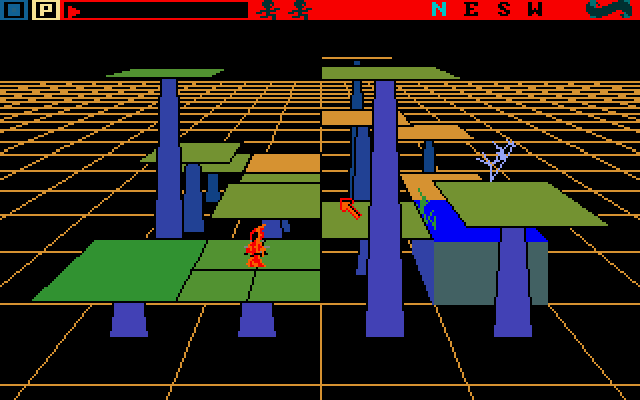
I remember Mind Walker as having amazingly spooky and captivating graphics. Then I found this screenshot: Mind Walker Screenshot Oh well. I’m sure it actually was impressive at the time. This discovery reminded of times when I’ve rediscovered a favorite food from childhood — for example, a certain type of cookie — only to find that it really isn’t very good at all. Just kind of sugary and low-quality chocolate. It’s also like going back to watch the original Jurassic Park again. The amazement is gone. Actually, even though the Mind Walker graphics aren’t as impressive as I remember them, I’m sure it was still a great game. Anyone have screenshots from Weird Dreams?

Next.

Previous.