Search Results: "nic"

4 October 2021

Paul Wise: FLOSS Activities September 2021

Focus This month I didn't have any particular focus. I just worked on issues in my info bubble.

Changes

Issues

Review

Administration
  • Debian BTS: reopened bugs closed by a spammer
  • Debian wiki: unblock IP addresses, approve accounts

Communication
  • Respond to queries from Debian users and contributors on the mailing lists and IRC

Sponsors The purple-discord/harmony/pyemd/librecaptcha/esprima-python work was sponsored by my employer. All other work was done on a volunteer basis.

3 October 2021

Junichi Uekawa: Using podman for most of my local development environment.

Using podman for most of my local development environment. For my personal/upstream development I started using podman instead of lxc and pbuilder and other toolings. Most projects provide reasonable docker images (such as rust) and I am happier keeping my environment as a whole stable while I can iterate. I have a Dockerfile for the development environment like this:

Louis-Philippe V ronneau: ANC is not for me

Active noise cancellation (ANC) has been all the rage lately in the headphones and in-ear monitors market. It seems after Apple got heavily praised for their AirPods Pro, every somewhat serious electronics manufacturer released their own design incorporating this technology. The first headphones with ANC I remember trying on (in the early 2010s) were the Bose QuietComfort 15. Although the concept did work (they indeed cancelled some sounds), they weren't amazing and did a great job of convincing me ANC was some weird fad for people who flew often. The Sony WH-1000X M3 folded in their case As the years passed, chip size decreased, battery capacity improved and machine learning blossomed truly a perfect storm for the wireless ANC headphones market. I had mostly stayed a sceptic of this tech until recently a kind friend offered to let me try a pair of Sony WH-1000X M3. Having tested them thoroughly, I have to say I'm really tempted to buy them from him, as they truly are fantastic headphones1. They are very light, comfortable, work without a proprietary app and sound very good with the ANC on2 if a little bass-heavy for my taste3. The ANC itself is truly astounding and is leaps and bounds beyond what was available five years ago. It still isn't perfect and doesn't cancel ALL sounds, but transforms the low hum of the subway I find myself sitting in too often these days into a light *swoosh*. When you turn the ANC on, HVAC simply disappears. Most impressive to me is the way they completely cancel the dreaded sound of your footsteps resonating in your headphones when you walk with them. My old pair of Senheiser HD 280 Pro, with aftermarket sheepskin earpads I won't be keeping them though. Whilst I really like what Sony has achieved here, I've grown to understand ANC simply isn't for me. Some of the drawbacks of ANC somewhat bother me: the ear pressure it creates is tolerable, but is an additional energy drain over long periods of time and eventually gives me headaches. I've also found ANC accentuates the motion sickness I suffer from, probably because it messes up with some part of the inner ear balance system. Most of all, I found that it didn't provide noticeable improvements over good passive noise cancellation solutions, at least in terms of how high I have to turn the volume up to hear music or podcasts clearly. The human brain works in mysterious ways and it seems ANC cancelling a class of noises (low hums, constant noises, etc.) makes other noises so much more noticeable. People talking or bursty high pitched noises bothered me much more with ANC on than without. So for now, I'll keep using my trusty Senheiser HD 280 Pro4 at work and good in-ear monitors with Comply foam tips on the go.

  1. This blog post certainly doesn't aim to be a comprehensive review of these headphones. See Zeos' review if you want something more in-depth.
  2. As most ANC headphones, they don't sound as good when used passively through the 3.5mm port, but that's just a testament of how a great job Sony did of tuning the DSP.
  3. Easily fixed using an EQ.
  4. Retrofitted with aftermarket sheepskin earpads, they provide more than 32db of passive noise reduction.

1 October 2021

Russell Coker: Getting Started With Kali

Kali is a Debian based distribution aimed at penetration testing. I haven t felt a need to use it in the past because Debian has packages for all the scanning tools I regularly use, and all the rest are free software that can be obtained separately. But I recently decided to try it. Here s the URL to get Kali [1]. For a VM you can get VMWare or VirtualBox images, I chose VMWare as it s the most popular image format and also a much smaller download (2.7G vs 4G). For unknown reasons the torrent for it didn t work (might be a problem with my torrent client). The download link for it was extremely slow in Australia, so I downloaded it to a system in Germany and then copied it from there. I don t want to use either VMWare or VirtualBox because I find KVM/Qemu sufficient to do everything I want and they are in the Main section of Debian, so I needed to convert the image files. Some of the documentation on converting image formats to use with QEMU/KVM says to use a program called kvm-img which doesn t seem to exist, I used qemu-img from the qemu-utils package in Debian/Bullseye. The man page qemu-img(1) doesn t list the types of output format supported by the -O option and the examples returned by a web search show using -O qcow2 . It turns out that the following command will convert the image to raw format which is the format I prefer. I use BTRFS for storing all my VM images and that does all the copy-on-write I need.
qemu-img convert Kali-Linux-2021.3-vmware-amd64.vmdk ../kali
After converting it the file was 500M smaller than the VMWare files (10.2 vs 10.7G). Probably the Kali distribution file could be reduced in size by converting it to raw and then back to VMWare format. The Kali VMWare image is compressed with 7zip which has a good compression ratio, I waited almost 90 minutes for zstd to compress it with -19 and the result was 12% larger than the 7zip file. VMWare apparently likes to use an emulated SCSI controller, I spent some time trying to get that going in KVM. Apparently recent versions of QEMU changed the way this works and therefore older web pages aren t helpful. Also allegedly the SCSI emulation is buggy and unreliable (but I didn t manage to get it going so can t be sure). It turns out that the VM is configured to work with the virtio interface, the initramfs.conf has the configuration option MODULES=most which makes it boot on all common configurations (good work by the initramfs-tools maintainers). The image works well with the Spice display interface, so it doesn t capture my mouse, the window for the VM works the same way as other windows on my desktop and doesn t capture the mouse cursor. I don t know if this level of Spice integration is in Debian now, last time I tested it didn t work that way. I also downloaded Metasploitable [2] which is a VM image designed to be full of security flaws for testing the tools that are in Kali. Again it worked nicely after converting from VMWare to raw format. One thing to note about Metasploitable is that you must not make it available on the public Internet. My home network has NAT for IPv4 but all systems get public IPv6 addresses. It s usually nice that those things just work on VMs but not for this. So I added an iptables command to block IPv6 to /etc/rc.local. Conclusion Installing VMs for both these distributions was quite easy. Most of my time was spent downloading from a slow server, trying to get SCSI emulation working, working out how to convert image files, and testing different compression options. The time spent doing stuff once I knew what to do was very small. Kali has zsh as the default shell, it s quite nice. I ve been happy with bash for decades, but I might end up trying zsh out on other machines.

Junichi Uekawa: Garbage collecting with podman system prune.

Garbage collecting with podman system prune. Tells me it freed 20GB when it seems to have freed 4GB. Wondering where that discrepancy comes from.

29 September 2021

Ingo Juergensmann: LetsEncrypt CA Chain Issues with Ejabberd

UPDATE:
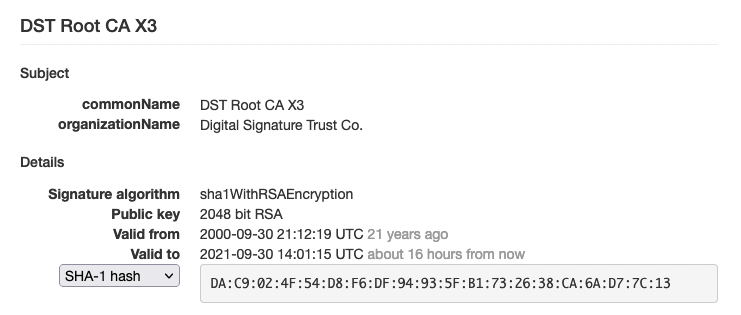
It s not as simple as described below, I m afraid It appears that it s not that easy to obtain new/correct certs from LetsEncrypt that are not cross-signed by DST Root X3 CA. Additionally older OpenSSL version (1.0.x) seems to have problems. So even when you think that your system is now ok, the remote server might refuse to accept your SSL cert. The same is valid for the SSL check on xmpp.net, which seems to be very outdated and beyond repair. Honestly, I think the solution needs to be provided by LetsEncrypt
I was having some strange issues on my ejabberd XMPP server the other day: some users complained that they couldn t connect anymore to the MUC rooms on my server and in the logfiles I discovered some weird warnings about LetsEncrypt certificates being expired although they were just new and valid until end of December. It looks like this:
[warning] <0.368.0>@ejabberd_pkix:log_warnings/1:393 Invalid certificate in /etc/letsencrypt.sh/certs/buildd.net/fullchain.pem: at line 37: certificate is no longer valid as its expiration date has passed
and
[warning] <0.18328.2>@ejabberd_s2s_out:process_closed/2:157 Failed to establish outbound s2s connection nerdica.net -> forum.friendi.ca: Stream closed by peer: Your server's certificate is invalid, expired, or not trusted by forum.friendi.ca (not-authorized); bouncing for 237 seconds
When checking out with some online tools like SSLlabs or XMPP.net the result was strange, because SSLlabs reported everything was ok while XMPP.net was showing the chain with X3 and D3 certs as having a short term validity of a few days:
After some days of fiddling around with the issue, trying to find a solution, it appears that there is a problem in Ejabberd when there are some old SSL certifcates being found by Ejabberd that are using the old CA chain. Ejabberd has a really nice feature where you can just configure a SSL cert directory (or a path containing wildcars. Ejabberd then reads all of the SSL certs and compare them to the list of configured domains to see which it will need and which not. What helped (for me at least) was to delete all expired SSL certs from my directory, downloading the current CA file pems from LetsEncrypt (see their blog post from September 2020), run update-ca-certificates and ejabberdctl restart (instead of just ejabberdctl reload-config). UPDATE: be sure to use dpkg-reconfigure ca-certificates to uncheck the DST Root X3 cert (and others if necessary) before renewing the certs or running update-ca-certificates. Otherwise the update will bring in the expired cert again. Currently I see at least two other XMPP domains in my server logs having certicate issues and in some MUCs there are reports of other domains as well. Disclaimer: Again: this helped me in my case. I don t know if this is a bug in Ejabberd or if this procedure will help you in your case nor if this is the proper solution. But maybe my story will help you solving your issue if you experience SSL certs issues in the last few days, especially now that the R3 cert has already expired and the X3 cert following in a few hours.

28 September 2021

Jonathan McDowell: Adding Zigbee to my home automation

SonOff Zigbee Door Sensor My home automation setup has been fairly static recently; it does what we need and generally works fine. One area I think could be better is controlling it; we have access Home Assistant on our phones, and the Alexa downstairs can control things, but there are no smart assistants upstairs and sometimes it would be nice to just push a button to turn on the light rather than having to get my phone out. Thanks to the fact the UK generally doesn t have neutral wire in wall switches that means looking at something battery powered. Which means wifi based devices are a poor choice, and it s necessary to look at something lower power like Zigbee or Z-Wave. Zigbee seems like the better choice; it s a more open standard and there are generally more devices easily available from what I ve seen (e.g. Philips Hue and IKEA TR DFRI). So I bought a couple of Xiaomi Mi Smart Home Wireless Switches, and a CC2530 module and then ignored it for the best part of a year. Finally I got around to flashing the Z-Stack firmware that Koen Kanters kindly provides. (Insert rant about hardware manufacturers that require pay-for tool chains. The CC2530 is even worse because it s 8051 based, so SDCC should be able to compile for it, but the TI Zigbee libraries are only available in a format suitable for IAR s embedded workbench.) Flashing the CC2530 is a bit of faff. I ended up using the CCLib fork by Stephan Hadinger which supports the ESP8266. The nice thing about the CC2530 module is it has 2.54mm pitch pins so nice and easy to jumper up. It then needs a USB/serial dongle to connect it up to a suitable machine, where I ran Zigbee2MQTT. This scares me a bit, because it s a bunch of node.js pulling in a chunk of stuff off npm. On the flip side, it Just Works and I was able to pair the Xiaomi button with the device and see MQTT messages that I could then use with Home Assistant. So of course I tore down that setup and went and ordered a CC2531 (the variant with USB as part of the chip). The idea here was my test setup was upstairs with my laptop, and I wanted something hooked up in a more permanent fashion. Once the CC2531 arrived I got distracted writing support for the Desk Viking to support CCLib (and modified it a bit for Python3 and some speed ups). I flashed the dongle up with the Z-Stack Home 1.2 (default) firmware, and plugged it into the house server. At this point I more closely investigated what Home Assistant had to offer in terms of Zigbee integration. It turns out the ZHA integration has support for the ZNP protocol that the TI devices speak (I m reasonably sure it didn t when I first looked some time ago), so that seemed like a better option than adding the MQTT layer in the middle. I hit some complexity passing the dongle (which turns up as /dev/ttyACM0) through to the Home Assistant container. First I needed an override file in /etc/systemd/nspawn/hass.nspawn:
[Files]
Bind=/dev/ttyACM0:/dev/zigbee
[Network]
VirtualEthernet=true
(I m not clear why the VirtualEthernet needed to exist; without it networking broke entirely but I couldn t see why it worked with no override file.) A udev rule on the host to change the ownership of the device file so the root user and dialout group in the container could see it was also necessary, so into /etc/udev/rules.d/70-persistent-serial.rules went:
# Zigbee for HASS
SUBSYSTEM=="tty", ATTRS idVendor =="0451", ATTRS idProduct =="16a8", SYMLINK+="zigbee", \
	MODE="660", OWNER="1321926676", GROUP="1321926676"
In the container itself I had to switch PrivateDevices=true to PrivateDevices=false in the home-assistant.service file (which took me a while to figure out; yay for locking things down and then needing to use those locked down things). Finally I added the hass user to the dialout group. At that point I was able to go and add the integration with Home Assistant, and add the button as a new device. Excellent. I did find I needed a newer version of Home Assistant to get support for the button, however. I was still on 2021.1.5 due to upstream dropping support for Python 3.7 and not being prepared to upgrade to Debian 11 until it was actually released, so the version of zha-quirks didn t have the correct info. Upgrading to Home Assistant 2021.8.7 sorted that out. There was another slight problem. Range. Really I want to use the button upstairs. The server is downstairs, and most of my internal walls are brick. The solution turned out to be a TR DFRI socket, which replaced the existing ESP8266 wifi socket controlling the stair lights. That was close enough to the server to have a decent signal, and it acts as a Zigbee router so provides a strong enough signal for devices upstairs. The normal approach seems to be to have a lot of Zigbee light bulbs, but I have mostly kept overhead lights as uncontrolled - we don t use them day to day and it provides a nice fallback if the home automation has issues. Of course installing Zigbee for a single button would seem to be a bit pointless. So I ordered up a Sonoff door sensor to put on the front door (much smaller than expected - those white boxes on the door are it in the picture above). And I have a 4 gang wireless switch ordered to go on the landing wall upstairs. Now I ve got a Zigbee setup there are a few more things I m thinking of adding, where wifi isn t an option due to the need for battery operation (monitoring the external gas meter springs to mind). The CC2530 probably isn t suitable for my needs, as I ll need to write some custom code to handle the bits I want, but there do seem to be some ARM based devices which might well prove suitable

27 September 2021

Wouter Verhelst: SReview::Video is now Media::Convert

SReview, the video review and transcode tool that I originally wrote for FOSDEM 2017 but which has since been used for debconfs and minidebconfs as well, has long had a sizeable component for inspecting media files with ffprobe, and generating ffmpeg command lines to convert media files from one format to another. This component, SReview::Video (plus a number of supporting modules), is really not tied very much to the SReview webinterface or the transcoding backend. That is, the webinterface and the transcoding backend obviously use the ffmpeg handling library, but they don't provide any services that SReview::Video could not live without. It did use the configuration API that I wrote for SReview, but disentangling that turned out to be very easy. As I think SReview::Video is actually an easy to use, flexible API, I decided to refactor it into Media::Convert, and have just uploaded the latter to CPAN itself. The intent is to refactor the SReview webinterface and transcoding backend so that they will also use Media::Convert instead of SReview::Video in the near future -- otherwise I would end up maintaining everything twice, and then what's the point. This hasn't happened yet, but it will soon (this shouldn't be too difficult after all). Unfortunately Media::Convert doesn't currently install cleanly from CPAN, since I made it depend on Alien::ffmpeg which currently doesn't work (I'm in communication with the Alien::ffmpeg maintainer in order to get that resolved), so if you want to try it out you'll have to do a few steps manually. I'll upload it to Debian soon, too.

25 September 2021

Junichi Uekawa: Wrote a HTML ping-like something.

Wrote a HTML ping-like something. Uses fetch to fetch a page and measures time until 404 returns to js. Here's my http ping. The challenge was writing code to calculate standard deviation in multiple languages and making sure it matched, d'oh.

22 September 2021

Gunnar Wolf: New book out! Mecanismos de privacidad y anonimato en redes, una visi n transdisciplinaria

Three years ago, I organized a fun and most interesting colloquium at Facultad de Ingenier a, UNAM about privacy and anonymity online. I would have loved to share this earlier with the world, but The university s processes are quite slow (and, to be fair, I also took quite a bit of time to push things through). But today, I m finally happy to share the result of that work with all of you. We managed to get 11 of the talks in the colloquium as articles. The back-cover text reads (in Spanish):
We live in an era where human to human interactions are more and more often mediated by technology. This, of course, means everything leaves a digital trail, a trail that can follow and us relentlessly. Privacy is recognized, however, as a human right although one that is under growing threats. Anonymity is the best tool to secure it. Throughout history, clear steps have been taken legally, technically and technologically to defend it. Various studies point out this is not only a known issue for the network's users, but that a large majority has searched for alternatives to protect their communications' privacy. This book stems from a colloquium held by *Laboratorio de Investigaci n y Desarrollo de Software Libre* (LIDSOL) of Facultad de Ingenier a, UNAM, towards the end of 2018, where we invited experts from disciplines so far apart as law and systems development, psychology and economics, to contribute with their experiences to a transdisciplinary vision.
If this interests you, you can get the book at our institutional repository. Oh, and What about the birds? In Spanish (Mexican only?), we have a saying, hay p jaros en el alambre , meaning watch your words, as uninvited people might be listening, as birds resting over the wires over which phone calls used to be made (back in the day where wiretapping was that easy). I found the design proposed by our editor ingenious and very fitting for our topic!

Ian Jackson: Tricky compatibility issue - Rust's io::ErrorKind

This post is about some changes recently made to Rust's ErrorKind, which aims to categorise OS errors in a portable way. Audiences for this post Background and context Error handling principles Handling different errors differently is often important (although, sadly, often neglected). For example, if a program tries to read its default configuration file, and gets a "file not found" error, it can proceed with its default configuration, knowing that the user hasn't provided a specific config. If it gets some other error, it should probably complain and quit, printing the message from the error (and the filename). Otherwise, if the network fileserver is down (say), the program might erroneously run with the default configuration and do something entirely wrong. Rust's portability aims The Rust programming language tries to make it straightforward to write portable code. Portable error handling is always a bit tricky. One of Rust's facilities in this area is std::io::ErrorKind which is an enum which tries to categorise (and, sometimes, enumerate) OS errors. The idea is that a program can check the error kind, and handle the error accordingly. That these ErrorKinds are part of the Rust standard library means that to get this right, you don't need to delve down and get the actual underlying operating system error number, and write separate code for each platform you want to support. You can check whether the error is ErrorKind::NotFound (or whatever). Because ErrorKind is so important in many Rust APIs, some code which isn't really doing an OS call can still have to provide an ErrorKind. For this purpose, Rust provides a special category ErrorKind::Other, which doesn't correspond to any particular OS error. Rust's stability aims and approach Another thing Rust tries to do is keep existing code working. More specifically, Rust tries to:
  1. Avoid making changes which would contradict the previously-published documentation of Rust's language and features.
  2. Tell you if you accidentally rely on properties which are not part of the published documentation.
By and large, this has been very successful. It means that if you write code now, and it compiles and runs cleanly, it is quite likely that it will continue work properly in the future, even as the language and ecosystem evolves. This blog post is about a case where Rust failed to do (2), above, and, sadly, it turned out that several people had accidentally relied on something the Rust project definitely intended to change. Furthermore, it was something which needed to change. And the new (corrected) way of using the API is not so obvious. Rust enums, as relevant to io::ErrorKind (Very briefly:) When you have a value which is an io::ErrorKind, you can compare it with specific values:
    if error.kind() == ErrorKind::NotFound   ...
  
But in Rust it's more usual to write something like this (which you can read like a switch statement):
    match error.kind()  
      ErrorKind::NotFound => use_default_configuration(),
      _ => panic!("could not read config file  :  ", &file, &error),
     
  
Here _ means "anything else". Rust insists that match statements are exhaustive, meaning that each one covers all the possibilities. So if you left out the line with the _, it wouldn't compile. Rust enums can also be marked non_exhaustive, which is a declaration by the API designer that they plan to add more kinds. This has been done for ErrorKind, so the _ is mandatory, even if you write out all the possibilities that exist right now: this ensures that if new ErrorKinds appear, they won't stop your code compiling. Improving the error categorisation The set of error categories stabilised in Rust 1.0 was too small. It missed many important kinds of error. This makes writing error-handling code awkward. In any case, we expect to add new error categories occasionally. I set about trying to improve this by proposing new ErrorKinds. This obviously needed considerable community review, which is why it took about 9 months. The trouble with Other and tests Rust has to assign an ErrorKind to every OS error, even ones it doesn't really know about. Until recently, it mapped all errors it didn't understand to ErrorKind::Other - reusing the category for "not an OS error at all". Serious people who write serious code like to have serious tests. In particular, testing error conditions is really important. For example, you might want to test your program's handling of disk full, to make sure it didn't crash, or corrupt files. You would set up some contraption that would simulate a full disk. And then, in your tests, you might check that the error was correct. But until very recently (still now, in Stable Rust), there was no ErrorKind::StorageFull. You would get ErrorKind::Other. If you were diligent you would dig out the OS error code (and check for ENOSPC on Unix, corresponding Windows errors, etc.). But that's tiresome. The more obvious thing to do is to check that the kind is Other. Obvious but wrong. ErrorKind is non_exhaustive, implying that more error kinds will appears, and, naturally, these would more finely categorise previously-Other OS errors. Unfortunately, the documentation note
Errors that are Other now may move to a different or a new ErrorKind variant in the future.
was only added in May 2020. So the wrongness of the "obvious" approach was, itself, not very obvious. And even with that docs note, there was no compiler warning or anything. The unfortunate result is that there is a body of code out there in the world which might break any time an error that was previously Other becomes properly categorised. Furthermore, there was nothing stopping new people writing new obvious-but-wrong code. Chosen solution: Uncategorized The Rust developers wanted an engineered safeguard against the bug of assuming that a particular error shows up as Other. They chose the following solution: There is now a new ErrorKind::Uncategorized which is now used for all OS errors for which there isn't a more specific categorisation. The fallback translation of unknown errors was changed from Other to Uncategorised. This is de jure justified by the fact that this enum has always been marked non_exhaustive. But in practice because this bug wasn't previously detected, there is such code in the wild. That code now breaks (usually, in the form of failing test cases). Usually when Rust starts to detect a particular programming error, it is reported as a new warning, which doesn't break anything. But that's not possible here, because this is a behavioural change. The new ErrorKind::Uncategorized is marked unstable. This makes it impossible to write code on Stable Rust which insists that an error comes out as Uncategorized. So, one cannot now write code that will break when new ErrorKinds are added. That's the intended effect. The downside is that this does break old code, and, worse, it is not as clear as it should be what the fixed code looks like. Alternatives considered and rejected by the Rust developers Not adding more ErrorKinds This was not tenable. The existing set is already too small, and error categorisation is in any case expected to improve over time. Just adding ErrorKinds as had been done before This would mean occasionally breaking test cases (or, possibly, production code) when an error that was previously Other becomes categorised. The broken code would have been "obvious", but de jure wrong, just as it is now, So this option amounts to expecting this broken code to continue to be written and continuing to break it occasionally. Somehow using Rust's Edition system The Rust language has a system to allow language evolution, where code declares its Edition (2015, 2018, 2021). Code from multiple editions can be combined, so that the ecosystem can upgrade gradually. It's not clear how this could be used for ErrorKind, though. Errors have to be passed between code with different editions. If those different editions had different categorisations, the resulting programs would have incoherent and broken error handling. Also some of the schemes for making this change would mean that new ErrorKinds could only be stabilised about once every 3 years, which is far too slow. How to fix code broken by this change Most main-line error handling code already has a fallback case for unknown errors. Simply replacing any occurrence of Other with _ is right. How to fix thorough tests The tricky problem is tests. Typically, a thorough test case wants to check that the error is "precisely as expected" (as far as the test can tell). Now that unknown errors come out as an unstable Uncategorized variant that's not so easy. If the test is expecting an error that is currently not categorised, you want to write code that says "if the error is any of the recognised kinds, call it a test failure". What does "any of the recognised kinds" mean here ? It doesn't meany any of the kinds recognised by the version of the Rust stdlib that is actually in use. That set might get bigger. When the test is compiled and run later, perhaps years later, the error in this test case might indeed be categorised. What you actually mean is "the error must not be any of the kinds which existed when the test was written". IMO therefore the right solution for such a test case is to cut and paste the current list of stable ErrorKinds into your code. This will seem wrong at first glance, because the list in your code and in Rust can get out of step. But when they do get out of step you want your version, not the stdlib's. So freezing the list at a point in time is precisely right. You probably only want to maintain one copy of this list, so put it somewhere central in your codebase's test support machinery. Periodically, you can update the list deliberately - and fix any resulting test failures. Unfortunately this approach is not suggested by the documentation. In theory you could work all this out yourself from first principles, given even the situation prior to May 2020, but it seems unlikely that many people have done so. In particular, cutting and pasting the list of recognised errors would seem very unnatural. Conclusions This was not an easy problem to solve well. I think Rust has done a plausible job given the various constraints, and the result is technically good. It is a shame that this change to make the error handling stability more correct caused the most trouble for the most careful people who write the most thorough tests. I also think the docs could be improved.
edited shortly after posting, and again 2021-09-22 16:11 UTC, to fix HTML slips


comment count unavailable comments

21 September 2021

Russell Coker: Links September 2021

Matthew Garrett wrote an interesting and insightful blog post about the license of software developed or co-developed by machine-learning systems [1]. One of his main points is that people in the FOSS community should aim for less copyright protection. The USENIX ATC 21/OSDI 21 Joint Keynote Address titled It s Time for Operating Systems to Rediscover Hardware has some inssightful points to make [2]. Timothy Roscoe makes some incendiaty points but backs them up with evidence. Is Linux really an OS? I recommend that everyone who s interested in OS design watch this lecture. Cory Doctorow wrote an interesting set of 6 articles about Disneyland, ride pricing, and crowd control [3]. He proposes some interesting ideas for reforming Disneyland. Benjamin Bratton wrote an insightful article about how philosophy failed in the pandemic [4]. He focuses on the Italian philosopher Giorgio Agamben who has a history of writing stupid articles that match Qanon talking points but with better language skills. Arstechnica has an interesting article about penetration testers extracting an encryption key from the bus used by the TPM on a laptop [5]. It s not a likely attack in the real world as most networks can be broken more easily by other methods. But it s still interesting to learn about how the technology works. The Portalist has an article about David Brin s Startide Rising series of novels and his thought s on the concept of Uplift (which he denies inventing) [6]. Jacobin has an insightful article titled You re Not Lazy But Your Boss Wants You to Think You Are [7]. Making people identify as lazy is bad for them and bad for getting them to do work. But this is the first time I ve seen it described as a facet of abusive capitalism. Jacobin has an insightful article about free public transport [8]. Apparently there are already many regions that have free public transport (Tallinn the Capital of Estonia being one example). Fare free public transport allows bus drivers to concentrate on driving not taking fares, removes the need for ticket inspectors, and generally provides a better service. It allows passengers to board buses and trams faster thus reducing traffic congestion and encourages more people to use public transport instead of driving and reduces road maintenance costs. Interesting research from Israel about bypassing facial ID [9]. Apparently they can make a set of 9 images that can pass for over 40% of the population. I didn t expect facial recognition to be an effective form of authentication, but I didn t expect it to be that bad. Edward Snowden wrote an insightful blog post about types of conspiracies [10]. Kevin Rudd wrote an informative article about Sky News in Australia [11]. We need to have a Royal Commission now before we have our own 6th Jan event. Steve from Big Mess O Wires wrote an informative blog post about USB-C and 4K 60Hz video [12]. Basically you can t have a single USB-C hub do 4K 60Hz video and be a USB 3.x hub unless you have compression software running on your PC (slow and only works on Windows), or have DisplayPort 1.4 or Thunderbolt (both not well supported). All of the options are not well documented on online store pages so lots of people will get unpleasant surprises when their deliveries arrive. Computers suck. Steinar H. Gunderson wrote an informative blog post about GaN technology for smaller power supplies [13]. A 65W USB-C PSU that fits the usual wall wart form factor is an interesting development.

20 September 2021

Holger Levsen: 20210920-Debian-Reunion-Hamburg-2021

Debian Reunion Hamburg 2021, we still have free beds We still have some free slots and beds available for the "Debian Reunion Hamburg 2021" taking place in Hamburg at the venue of the 2018 & 2019 MiniDebConfs from Monday, Sep 27 2021 until Friday Oct 1 2021, with Sunday, Sep 26 2021 as arrival day. So again, Debian people will meet in Hamburg. The exact format is less defined and structured than previous years, probably we will just be hacking from Monday to Wednesday, have talks on Thursday and a nice day trip on Friday. Please read https://wiki.debian.org/DebianEvents/de/2021/DebianReunionHamburg and if you intend to attend, please register there. If additionally you would like to stay on site (in a single room or shared with one another person), please mail me. I'm looking forward to this event, even though (or maybe also because) it will be much smaller than last years. I suppose this will lead to more personal interactions and more intense hacking, though of course it is to be seen how this works out exactly!

Junichi Uekawa: podman build (user namespace) and Rename.

podman build (user namespace) and Rename. It seems like Debian bullseye, if I run podman, it runs in user namespace mode if you run it inside a regular user. That's fine, but it uses fuse overlayfs driver. Now I am yet to pinpoint what is happening, but rename() is handled in a weird way, I think it's broken. os.Rename() in golang is copying the file and not deleting the original file.

16 September 2021

Chris Lamb: On Colson Whitehead's Harlem Shuffle

Colson Whitehead's latest novel, Harlem Shuffle, was always going to be widely reviewed, if only because his last two books won Pulitzer prizes. Still, after enjoying both The Underground Railroad and The Nickel Boys, I was certainly going to read his next book, regardless of what the critics were saying indeed, it was actually quite agreeable to float above the manufactured energy of the book's launch. Saying that, I was encouraged to listen to an interview with the author by Ezra Klein. Now I had heard Whitehead speak once before when he accepted the Orwell Prize in 2020, and once again he came across as a pretty down-to-earth guy. Or if I were to emulate the detached and cynical tone Whitehead embodied in The Nickel Boys, after winning so many literary prizes in the past few years, he has clearly rehearsed how to respond to the cliched questions authors must be asked in every interview. With the obligatory throat-clearing of 'so, how did you get into writing?', for instance, Whitehead replies with his part of the catechism that 'It seemed like being a writer could be a cool job. You could work from home and not talk to people.' The response is the right combination of cute and self-effacing... and with its slight tone-deafness towards enforced isolation, it was no doubt honed before Covid-19. Harlem Shuffle tells three separate stories about Ray Carney, a furniture salesman and 'fence' for stolen goods in New York in the 1960s. Carney doesn't consider himself a genuine criminal though, and there's a certain logic to his relativistic morality. After all, everyone in New York City is on the take in some way, and if some 'lightly used items' in Carney's shop happened to have had 'previous owners', well, that's not quite his problem. 'Nothing solid in the city but the bedrock,' as one character dryly observes. Yet as Ezra pounces on in his NYT interview mentioned abov, the focus on the Harlem underworld means there are very few women in the book, and Whitehead's circular response ah well, it's a book about the criminals at that time! was a little unsatisfying. Not only did it feel uncharacteristically slippery of someone justly lauded for his unflinching power of observation (after all, it was the author who decided what to write about in the first place), it foreclosed on the opportunity to delve into why the heist and caper genres (from The Killing, The Feather Thief, Ocean's 11, etc.) have historically been a 'male' mode of storytelling. Perhaps knowing this to be the case, the conversation quickly steered towards Ray Carney's wife, Elizabeth, the only woman in the book who could be said possesses some plausible interiority. The following off-hand remark from Whitehead caught my attention:
My wife is convinced that [Elizabeth] knows everything about Carney's criminal life, and is sort of giving him a pass. And I'm not sure if that's true. I have to have to figure out exactly what she knows and when she knows it and how she feels about it.
I was quite taken by this, although not simply due to its effect on the story it self. As in, it immediately conjured up a charming picture of Whitehead's domestic arrangements: not only does Whitehead's wife feel free to disagree with what one of Whitehead's 'own' characters knows or believes, but that Colson has no problem whatsoever sharing that disagreement with the public at large. (It feels somehow natural that Whitehead's wife believes her counterpart knows more than she lets on, whilst Whitehead himself imbues the protagonist's wife with a kind of neo-Victorian innocence.) I'm minded to agree with Whitehead's partner myself, if only due to the passages where Elizabeth is studiously ignoring Carney's otherwise unexplained freak-outs. But all of these meta-thoughts simply underline just how emancipatory the Death of the Author can be. This product of academic literary criticism (the term was coined by Roland Barthes' 1967 essay of the same name) holds that the original author's intentions, ideas or biographical background carry no especial weight in determining how others should interpret their work. It is usually understood as meaning that a writer's own views are no more valid or 'correct' than the views held by someone else. (As an aside, I've found that most readers who encounter this concept for the first time have been reading books in this way since they were young. But the opposite is invariably true with cinephiles, who often have a bizarre obsession with researching or deciphering the 'true' interpretation of a film.) And with all that in mind, can you think of a more wry example of how freeing (and fun) nature of the Death of the Author than an author's own partner dissenting with their (Pulitzer Prize-winning) husband on the position of a lynchpin character?
The 1964 Harlem riot began after James Powell, a 15-year-old African American, was shot and killed by Thomas Gilligan, an NYPD police officer in front of 10s of witnesses. Gilligan was subsequently cleared by a grand jury.
As it turns out, the reviews for Harlem Shuffle have been almost universally positive, and after reading it in the two days after its release, I would certainly agree it is an above-average book. But it didn't quite take hold of me in the way that The Underground Railroad or The Nickel Boys did, especially the later chapters of The Nickel Boys that were set in contemporary New York and could thus make some (admittedly fairly explicit) connections from the 1960s to the present day that kind of connection is not there in Harlem Shuffle, or at least I did not pick up on it during my reading. I can see why one might take exception to that, though. For instance, it is certainly true that the week-long Harlem Riot forms a significant part of the plot, and some events in particular are entirely contingent on the ramifications of this momentous event. But it's difficult to argue the riot's impact are truly integral to the story, so not only is this uprising against police brutality almost regarded as a background event, any contemporary allusion to the murder of George Floyd is subsequently watered down. It's nowhere near the historical rubbernecking of Forrest Gump (1994), of course, but that's not a battle you should ever be fighting. Indeed, whilst a certain smoothness of affect is to be priced into the Whitehead reading experience, my initial overall reaction to Harlem Shuffle was fairly flat, despite all the action and intrigue on the page. The book perhaps belies its origins as a work conceived during quarantine after all, the book is essentially comprised of three loosely connected novellas, almost as if the unreality and mental turbulence of lockdown prevented the author from performing the psychological 'deep work' of producing a novel-length text with his usual depth of craft. A few other elements chimed with this being a 'lockdown novel' as well, particularly the book's preoccupation with the sheer physicality of the city compared to the usual complex interplay between its architecture and its inhabitants. This felt like it had been directly absorbed into the book from the author walking around his deserted city, and thus being able to take in details for the first time:
The doorways were entrances into different cities no, different entrances into one vast, secret city. Ever close, adjacent to all you know, just underneath. If you know where to look.
And I can't fail to mention that you can almost touch Whitehead's sublimated hunger to eat out again as well:
Stickups were chops they cook fast and hot, you re in and out. A stakeout was ribs fire down low, slow, taking your time. [ ] Sometimes when Carney jumped into the Hudson when he was a kid, some of that stuff got into his mouth. The Big Apple Diner served it up and called it coffee.
More seriously, however, the relatively thin personalities of minor characters then reminded me of the simulacrum of Zoom-based relationships, and the essentially unsatisfactory endings to the novellas felt reminiscent of lockdown pseudo-events that simply fizzle out without a bang. One of the stories ties up loose ends with: 'These things were usually enough to terminate a mob war, and they appeared to end the hostilities in this case as well.' They did? Well, okay, I guess.
The corner of 125th Street and Morningside Avenue in 2019, the purported location of Carney's fictional furniture store. Signage plays a prominent role in Harlem Shuffle, possibly due to the author's quarantine walks.
Still, it would be unfair to characterise myself as 'disappointed' with the novel, and none of this piece should be taken as really deep criticism. The book certainly was entertaining enough, and pretty funny in places as well:
Carney didn t have an etiquette book in front of him, but he was sure it was bad manners to sit on a man s safe. [ ] The manager of the laundromat was a scrawny man in a saggy undershirt painted with sweat stains. Launderer, heal thyself.
Yet I can't shake the feeling that every book you write is a book that you don't, and so we might need to hold out a little longer for Whitehead's 'George Floyd novel'. (Although it is for others to say how much of this sentiment is the expectations of a White Reader for The Black Author to ventriloquise the pain of 'their' community.) Some room for personal critique is surely permitted. I dearly missed the junk food energy of the dry and acerbic observations that run through Whitehead's previous work. At one point he had a good line on the model tokenisation that lurks behind 'The First Negro to...' labels, but the callbacks to this idea ceased without any payoff. Similar things happened with the not-so-subtle critiques of the American Dream:
Entrepreneur? Pepper said the last part like manure. That s just a hustler who pays taxes. [ ] One thing I ve learned in my job is that life is cheap, and when things start getting expensive, it gets cheaper still.
Ultimately, though, I think I just wanted more. I wanted a deeper exploration of how the real power in New York is not wielded by individual street hoodlums or even the cops but in the form of real estate, essentially serving as a synecdoche for Capital as a whole. (A recent take of this can be felt in Jed Rothstein's 2021 documentary, WeWork: Or the Making and Breaking of a $47 Billion Unicorn and it is perhaps pertinent to remember that the US President at the time this novel was written was affecting to be a real estate tycoon.). Indeed, just like the concluding scenes of J. J. Connolly's Layer Cake, although you can certainly pull off a cool heist against the Man, power ultimately resides in those who control the means of production... and a homespun furniture salesman on the corner of 125 & Morningside just ain't that. There are some nods to kind of analysis in the conclusion of the final story ('Their heist unwound as if it had never happened, and Van Wyck kept throwing up buildings.'), but, again, I would have simply liked more. And when I attempted then file this book away into the broader media landscape, given the current cultural visibility of 1960s pop culture (e.g. One Night in Miami (2020), Judas and the Black Messiah (2021), Summer of Soul (2021), etc.), Harlem Shuffle also seemed like a missed opportunity to critically analyse our (highly-qualified) longing for the civil rights era. I can certainly understand why we might look fondly on the cultural products from a period when politics was less alienated, when society was less atomised, and when it was still possible to imagine meaningful change, but in this dimension at least, Harlem Shuffle seems to merely contribute to this nostalgic escapism.

15 September 2021

Ian Jackson: Get source to Debian packages only via dgit; "official" git links are beartraps

tl;dr dgit clone sourcepackage gets you the source code, as a git tree, in ./sourcepackage. cd into it and dpkg-buildpackage -uc -b. Do not use: "VCS" links on official Debian web pages like tracker.debian.org; "debcheckout"; searching Debian's gitlab (salsa.debian.org). These are good for Debian experts only. If you use Debian's "official" source git repo links you can easily build a package without Debian's patches applied.[1] This can even mean missing security patches. Or maybe it can't even be built in a normal way (or at all). OMG WTF BBQ, why? It's complicated. There is History. Debian's "most-official" centralised source repository is still the Debian Archive, which is a system based on tarballs and patches. I invented the Debian source package format in 1992/3 and it has been souped up since, but it's still tarballs and patches. This system is, of course, obsolete, now that we have modern version control systems, especially git. Maintainers of Debian packages have invented ways of using git anyway, of course. But this is not standardised. There is a bewildering array of approaches. The most common approach is to maintain git tree containing a pile of *.patch files, which are then often maintained using quilt. Yes, really, many Debian people are still using quilt, despite having git! There is machinery for converting this git tree containing a series of patches, to an "official" source package. If you don't use that machinery, and just build from git, nothing applies the patches. [1] This post was prompted by a conversation with a friend who had wanted to build a Debian package, and didn't know to use dgit. They had got the source from salsa via a link on tracker.d.o, and built .debs without Debian's patches. This not a theoretical unsoundness, but a very real practical risk. Future is not very bright In 2013 at the Debconf in Vaumarcus, Joey Hess, myself, and others, came up with a plan to try to improve this which we thought would be deployable. (Previous attempts had failed.) Crucially, this transition plan does not force change onto any of Debian's many packaging teams, nor onto people doing cross-package maintenance work. I worked on this for quite a while, and at a technical level it is a resounding success. Unfortunately there is a big limitation. At the current stage of the transition, to work at its best, this replacement scheme hopes that maintainers who update a package will use a new upload tool. The new tool fits into their existing Debian git packaging workflow and has some benefits, but it does make things more complicated rather than less (like any transition plan must, during the transitional phase). When maintainers don't use this new tool, the standardised git branch seen by users is a compatibility stub generated from the tarballs-and-patches. So it has the right contents, but useless history. The next step is to allow a maintainer to update a package without dealing with tarballs-and-patches at all. This would be massively more convenient for the maintainer, so an easy sell. And of course it links the tarballs-and-patches to the git history in a proper machine-readable way. We held a "git packaging requirements-gathering session" at the Curitiba Debconf in 2019. I think the DPL's intent was to try to get input into the git workflow design problem. The session was a great success: my existing design was able to meet nearly everyone's needs and wants. The room was obviously keen to see progress. The next stage was to deploy tag2upload. I spoke to various key people at the Debconf and afterwards in 2019 and the code has been basically ready since then. Unfortunately, deployment of tag2upload is mired in politics. It was blocked by a key team because of unfounded security concerns; positive opinions from independent security experts within Debian were disregarded. Of course it is always hard to get a team to agree to something when it's part of a transition plan which treats their systems as an obsolete setup retained for compatibility. Current status If you don't know about Debian's git packaging practices (eg, you have no idea what "patches-unapplied packaging branch without .pc directory" means), and don't want want to learn about them, you must use dgit to obtain the source of Debian packages. There is a lot more information and detailed instructions in dgit-user(7). Hopefully either the maintainer did the best thing, or, if they didn't, you won't need to inspect the history. If you are a Debian maintainer, you should use dgit push-source to do your uploads. This will make sure that users of dgit will see a reasonable git history.
edited 2021-09-15 14:48 Z to fix a typo


comment count unavailable comments

14 September 2021

Joachim Breitner: A Candid explainer: Quirks

This is the fifth and final post in a series about the interface description language Candid. If you made it this far, you now have a good understanding of what Candid is, what it is for and how it is used. For this final post, I ll put the spotlight on specific aspects of Candid that are maybe surprising, or odd, or quirky. This section will be quite opinionated, and could maybe be called what I d do differently if I d re-do the whole thing . Note that these quirks are not serious problems, and they don t invalidate the overall design. I am writing this up not to discourage the use of Candid, but merely help interested parties to understand it better.
References in the wire format When the work on Candid began at DFINITY, the Internet Computer was still far away from being a thing, and many fundamental aspects about it were still in the air. I particular, there was still talk about embracing capabilities as a core feature of the application model, which would be implemented as opaque references on the system level, likely building on WebAssembly s host reference type proposal (which only landed recently), and could be used to model access permissions, custom tokens and many other things. So Candid is designed with that in mind, and you ll find that its wire format is not just a type table and a value table, but actually
a triple (T, M, R), where T ( type ) and M ( memory ) are sequences of bytes and R ( references ) is a sequence of references.
Also the wire format for values of function service tyeps have an extra byte to distinguish between public references (represented by a principal and possible a method name in the data part), and these opaque references. Alas, references never made it into the Internet Computer, so all Candid implementations simply ignore that part of the specification. But it s still in the spec, and if it confused you before, now you know why.

Hashed field names Candid record and variant types look like they have textual field names:
type T = record   syndactyle : nat; trustbuster: bool  
But that is actually only true superficially. The wire format for Candid only stores hashes of field names. So the above is actually equivalent to
type T = record   4260381820 : nat; 3504418361 : bool  
or, for that matter, to
type T = record   destroys : bool; rectum : nat  
(Yes, I used an english word list to find these hash collisions. There aren t that many actually.) The benefit of such hashing is that the messages are a bit smaller in most (not all) cases, but it is a big annoyance for dynamic uses of Candid. It s the reason why tools like dfx, if they don t know the Candid interface of a service, will print the result with just the numerical hash, letting you guess which field is which. It also complicates host languages that derive Candid types from the host language, like Motoko, as some records (e.g. record trustbuster: bool; destroys : int ) with field name hash collisions can not be represented in Candid, and either the host language s type system needs to be Candid aware now (as is the case of Motoko), or serialization/deserialization will fail at runtime, or odd bugs can happen. (More discussion of this issue).

Tuples Many languages have a built-in notion of a tuple type (e.g. (Int, Bool)), but Candid does not have such a type. The only first class product type is records. This means that tuples have to encoded as records somehow. Conveniently(?) record fields are just numbers after all, so the type (Int, Bool) would be mapped to the type
record   0 : int; 1 : bool  
So tuples can be expressed. But from my experience implementing the type mappings for Motoko and Haskell this is causing headaches. To get a good experience when importing from Candid, the tools have to try to reconstruct which records may have been tuples originally, and turn them into tuples. The main argument for the status quo is that Candid types should be canonical, and there should not be more than one product type, and records are fine, and there needs to be no anonymous product type. But that has never quite resonated with me, given the practical reality of tuple types in many host languages.

Argument sequences Did I say that Candid does not have tuple types? Turns out it does, sort of. There is no first class anonymous product, but since functions take sequences of arguments and results, there is a tuple type right there:
func foo : (bool, int) -> (int, bool)
Again, I found that ergonomic interaction with host languages becomes relatively unwieldy by requiring functions to take and return sequences of values. This is especially true for languages where functions take one argument value or return one result type (the latter being very common). Here, return sequences of length one are turned into that type directly, longer argument sequences turn into the host language s tuple type, and nullary argument sequences turn into the idiomatic unit type. But this means that the types (int, bool) -> () and (record 0: int, 1: bool ) -> () may be mapped to the same host language type, which causes problems when you hope to encode all necessary Candid type information in the host language. Another oddity with argument and result sequences is that you can give names to the entries, e.g. write
func hello : (last_name : text; first_name : text) -> ()
but these names are completely ignored! So while this looks like you can, for example, add new optional arguments in the middle, such as
func hello : (last_name : text; middle_name: opt text, first_name : text) -> ()
without breaking clients, this does not have the effect you think it has and will likely break. My suggestion is to never put names on function arguments and result values in Candid interfaces, and for anything that might be extended with new fields or where you want to name the arguments, use a single record type as the only argument:
func hello : (record   last_name : text; first_name : text ) -> ()
This allows you to add and remove arguments more easily and reliably.

Type shorthands The Candid specification defines a system of types, and then adds a number of syntactic short-hands . For example, if you write blob in a Candid type description, it ought to means the same as vec nat8. My qualm with that is that it doesn t always mean the same. A Candid type description is interpreted by a number of, say, consumers . Two such consumers are part of the Candid specification:
  • The specification that defines the wire format for that type
  • The upgrading (subtyping) rules
But there are more! For every host language, there is some mapping from Candid types to host language types, and also generic tools like Candid UI are consumers of the type algebra. If these were to take the Candid specification as gospel, they would be forced to treat blob and vec nat8 the same, but that would be quite unergonomic and might cause performance regressions (most language try to map blob to some compact binary data type, while vec t tends to turn into some form of array structure). So they need to be pragmatic and treat blob and vec nat8 differently. But then, for all practical purposes, blob is not just a short-hand of vec nat8. They are different types that just happens to have the same wire representations and subtyping relations. This affects not just blob, but also tuples (record blob; int; bool ) and field names , as discussed above.

The value text format For a while after defining Candid, the only implementation was in Motoko, and all the plumbing was automatic, so there was never a need for users to to explicitly handle Candid values, as all values were Motoko values. Still, for debugging and testing and such things, we eventually needed a way to print out Candid values, so the text format was defined ( To enable convenient debugging, the following grammar specifies a text format for values ). But soon the dfx tool learned to talk to canisters, and now users needed to enter Candid value on the command line, possibly even when talking to canisters for which the interface was not known to dfx. And, sure enough, the textual interface defined in the Candid spec was used. Unfortunately, since it was not designed for that use case, it is rather unwieldy:
  • It is quite verbose. You have to write record , not just . Vectors are written vec ; instead of some conventional syntax like [ , ]. Variants are written as variant error = " " with braces that don t any value here, and something like #error " " might have worked as well. With a bit more care, a more concise and ergonomic syntax might have been possible.
  • It wasn t designed to be sufficient to create a Candid value from it. If you write 5 it s unclear whether that s a nat or an int16 or what (and all of these have different wire representations). Type annotations were later added, but are relatively unwieldy, and don t cover all cases (e.g. a service reference with a recursive type cannot be represented in the textual format at the moment).
  • Not really the fault of the textual format, but some useful information about the types is not reflected in the type description that s part of the wire format. In particular not the field names, and whether a value was intended to be binary data (blob) or a list of small numbers (vec nat8), so pretty-printing such values requires guesswork. The Haskell library even tries to brute-force the hash to guess the field name, if it is short or in a english word list!
In hindsight I think it was too optimistic to assume that correct static type information is always available, and instead of actively trying to discourage dynamic use, Candid might be better if we had taken these (unavoidable?) use cases into account.

Custom wire format At the beginning of this post, I have a Candid is list. The list is relatively long, and the actual wire format is just one bullet point. Yes, defining a wire format that works isn t rocket science, and it was easiest to just make one up. But since most of the interesting meat of Candid is in other aspects (subtyping rules, host language integration), I wonder if it would have been better to use an existing, generic wire format, such as CBOR, and build Candid as a layer on top. This would give us plenty of tools and libraries to begin with. And maybe it would have reduced barrier of entry for developers, which now led to the very strange situation that DFINITY advocates for the universal use of Candid on the Internet Computer, so that all services can smoothly interact, but two of the most important services on the Internet Computer (the registry and the ledger) use Protobuf as their primary interface format, with Candid interfaces missing or an afterthought.

Sideways Interface Evolution This is not a quirk of Candid itself, but rather an idiom of how you can use Candid that emerged from our solution for record extensions and upgrades. Consider our example from before, a service with interface
service   add_user : (record   login : text; name : text  ) -> ()  
where you want to add an age field, which should be a number. The official way of doing that is to add that field with an optional type:
service   add_user : (record   login : text; name : text; age : opt nat  ) -> ()  
As explained above, this will not break old clients, as the decoder will treat a missing argument as null. So far so good. But often when adding such a field you don t want to bother new clients with the fact that this age was, at some point in the past, not there yet. And you can do that! The trick is to distinguish between the interface you publish and the interface you implement. You can (for example in your documentation) state that the interface is
service   add_user : (record   login : text; name : text; age : nat  ) -> ()  
which is not a subtype of the old type, but it is the interface you want new clients to work with. And then your implementation uses the type with opt nat. Calls from old clients will come through as null, and calls from new clients will come through as opt 42. We can see this idiom used in the Management Canister of the Internet Computer. The current documented interface only mentions a controllers : vec principal field in the settings, but the implementation still can handle both the old controller : principal and the new controllers field. It s probably advisable to let your CI system check that new versions of your service continue to implement all published interfaces, including past interfaces. But as long as the actual implementation s interface is a subtype of all interfaces ever published, this works fine. This pattern is related to when your service implements, say, http_request (so its implemented interface is a subtype of that common interface), but does not include that method in the published documentation (because clients of your service don t need to call it).

Self-describing Services As you have noticed, Candid was very much designed assuming that all parties always have the service type of services they want to interact with. But the Candid specification does not define how one can obtain the interface of a given service, and there isn t really a an official way to do that on the Internet Computer. That is unfortunate, because many interesting features depend on that: Such as writing import C "ic:7e6iv-biaaa-aaaaf-aaada-cai" in your Motoko program, and having it s type right there. Or tools like ic.rocks, that allow you to interact with any canister right there. One reason why we don t really have that feature yet is because of disagreements about how dynamic that feature should be. Should you be able to just ask the canister for its interface (and allow the canister to vary the response, for example if it can change its functionality over time, even without changing the actual wasm code)? Or is the interface a static property of the code, and one should be able to query the system for that data, without the canister s active involvement. Or, completely different, should interfaces be distributed out of band, maybe together with API documentation, or in some canister registry somewhere else? I always leaned towards the first of these options, but not convincingly enough. The second options requires system assistance, so more components to change, more teams to be involved that maybe intrinsically don t care a lot about this feature. And the third might have emerged as the community matures and builds such infrastructure, but that did not happen yet. In the end I sneaked in an implementation of the first into Motoko, arguing that even if we don t know yet how this feature will be implemented eventually, we all want the feature to exist somehow, and we really really want to unblock all the interesting applications it enables (e.g. Candid UI). That s why every Motoko canister, and some rust canisters too, implements a method
__get_candid_interface_tmp_hack : () -> (text)
that one can use to get the Candid interface file. The name was chosen to signal that this may not be the final interface, but like all good provisional solutions, it may last longer than intended. If that s the case, I m not sorry. This concludes my blog post series about Candid, for now. If you want to know more, feel free to post your question on the DFINTY developer forum, and I ll probably answer.

13 September 2021

John Goerzen: Facebook s Blocking Decisions Are Deliberate Including Their Censorship of Mastodon

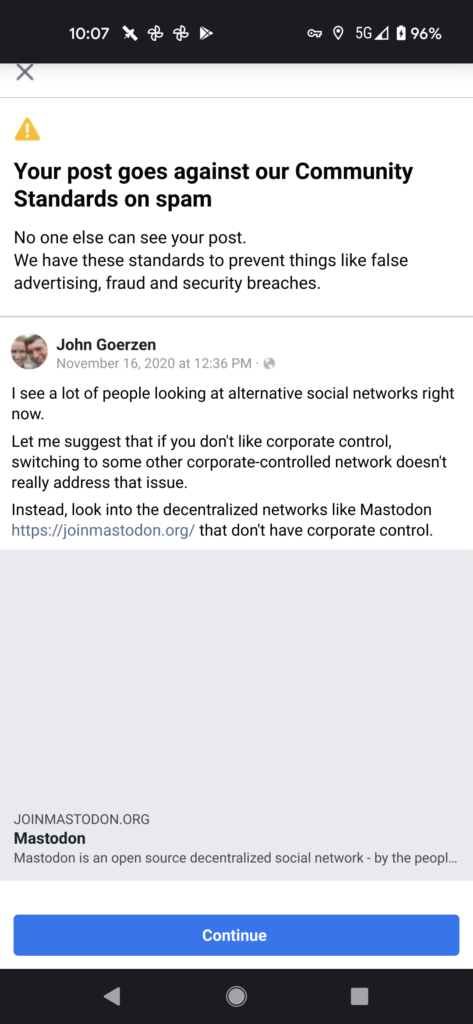
In the aftermath of my report of Facebook censoring mentions of the open-source social network Mastodon, there was a lot of conversation about whether or not this was deliberate. That conversation seemed to focus on whether a human speficially added joinmastodon.org to some sort of blacklist. But that s not even relevant. OF COURSE it was deliberate, because of how Facebook tunes its algorithm. Facebook s algorithm is tuned for Facebook s profit. That means it s tuned to maximize the time people spend on the site engagement. In other words, it is tuned to keep your attention on Facebook. Why do you think there is so much junk on Facebook? So much anti-vax, anti-science, conspiracy nonsense from the likes of Breitbart? It s not because their algorithm is incapable of surfacing the good content; we already know it can because they temporarily pivoted it shortly after the last US election. They intentionally undid its efforts to make high-quality news sources more prominent twice. Facebook has said that certain anti-vax disinformation posts violate its policies. It has an extremely cumbersome way to report them, but it can be done and I have. These reports are met with either silence or a response claiming the content didn t violate their guidelines. So what algorithm is it that allows Breitbart to not just be seen but to thrive on the platform, lets anti-vax disinformation survive even a human review, while banning mentions of Mastodon? One that is working exactly as intended. We may think this algorithm is busted. Clearly, Facebook does not. If their goal is to maximize profit by maximizing engagement, the algorithm is working exactly as designed. I don t know if joinmastodon.org was specifically blacklisted by a human. Nor is it relevant. Facebook s choice to tolerate and promote the things that service its greed for engagement and money, even if they are the lowest dregs of the web, is deliberate. It is no accident that Breitbart does better than Mastodon on Facebook. After all, which of these does its algorithm detect keep people engaged on Facebook itself more? Facebook removes the ban You can see all the screenshots of the censorship in my original post. Now, Facebook has reversed course: We also don t know if this reversal was human or algorithmic, but that still is beside the point. The point is, Facebook intentionally chooses to surface and promote those things that drive engagement, regardless of quality. Clearly many have wondered if tens of thousands of people have died unnecessary deaths over COVID as a result. One whistleblower says I have blood on my hands and President Biden said they re killing people before walking back his comments slightly . I m not equipped to verify those statements. But what do they think is going to happen if they prioritize engagement over quality? Rainbows and happiness?
12 September 2021

Vincent Bernat: Short feedback on Cisco pyATS and Genie Parser

Cisco pyATS is a framework for network automation and testing. It includes, among other things, an open-source multi-vendor set of parsers and models, Genie Parser. It features 2700 parsers for various commands over many network OS. On the paper, this seems a great tool!
>>> from genie.conf.base import Device
>>> device = Device("router", os="iosxr")
>>> # Hack to parse outputs without connecting to a device
>>> device.custom.setdefault("abstraction",  )["order"] = ["os", "platform"]
>>> cmd = "show route ipv4 unicast"
>>> output = """
... Tue Oct 29 21:29:10.924 UTC
...
... O    10.13.110.0/24 [110/2] via 10.12.110.1, 5d23h, GigabitEthernet0/0/0/0.110
... """
>>> device.parse(cmd, output=output)
 'vrf':  'default':  'address_family':  'ipv4':  'routes':  '10.13.110.0/24':  'route': '10.13.110.0/24',
       'active': True,
       'route_preference': 110,
       'metric': 2,
       'source_protocol': 'ospf',
       'source_protocol_codes': 'O',
       'next_hop':  'next_hop_list':  1:  'index': 1,
          'next_hop': '10.12.110.1',
          'outgoing_interface': 'GigabitEthernet0/0/0/0.110',
          'updated': '5d23h' 
First deception: pyATS is closed-source with some exceptions. This is quite annoying if you run into some issues outside Genie Parser. For example, although pyATS is using the ssh command, it cannot leverage my ssh_config file: pyATS resolves hostnames before providing them to ssh. There is no plan to open source pyATS. Then, Genie Parser has two problems:
  1. The data models used are dependent on the vendor and OS, despite the documentation saying otherwise. For example, the data model used for IPv4 interfaces is different between NX-OS and IOS-XR.
  2. The parsers rely on line-by-line regular expressions to extract data and some Python code as glue. This is fragile and may break silently.
To illustrate the second point, let s assume the output of show ipv4 vrf all interface is:
  Loopback10 is Up, ipv4 protocol is Up
    Vrf is default (vrfid 0x60000000)
    Internet protocol processing disabled
  Loopback30 is Up, ipv4 protocol is Down [VRF in FWD reference]
    Vrf is ran (vrfid 0x0)
    Internet address is 203.0.113.17/32
    MTU is 1500 (1500 is available to IP)
    Helper address is not set
    Directed broadcast forwarding is disabled
    Outgoing access list is not set
    Inbound  common access list is not set, access list is not set
    Proxy ARP is disabled
    ICMP redirects are never sent
    ICMP unreachables are always sent
    ICMP mask replies are never sent
    Table Id is 0x0
Because the regular expression to parse an interface name does not expect the extra data after the interface state, Genie Parser ignores the line starting the definition of Loopback30 and parses the output to this structure:1
 
  "Loopback10":  
    "int_status": "up",
    "oper_status": "up",
    "vrf": "ran",
    "vrf_id": "0x0",
    "ipv4":  
      "203.0.113.17/32":  
        "ip": "203.0.113.17",
        "prefix_length": "32"
       ,
      "mtu": 1500,
      "mtu_available": 1500,
      "broadcast_forwarding": "disabled",
      "proxy_arp": "disabled",
      "icmp_redirects": "never sent",
      "icmp_unreachables": "always sent",
      "icmp_replies": "never sent",
      "table_id": "0x0"


While this bug is simple to fix, this is an uphill battle. Any existing or future slight variation in the output of a command could trigger another similar undetected bug, despite the extended test coverage. I have reported and fixed several other silent parsing errors: #516, #529, and #530. A more robust alternative would have been to use TextFSM and to trigger a warning when some output is not recognized, like Batfish, a configuration analysis tool, does. In the future, we should rely on YANG for data extraction, but it is currently not widely supported. SNMP is still a valid possibility but much information is not accessible through this protocol. In the meantime, I would advise you to only use Genie Parser with caution.

  1. As an exercise, the astute reader is asked to write the code to extract the IPv4 from this structure.

11 September 2021

John Goerzen: Facebook Is Censoring People For Mentioning Open-Source Social Network Mastodon

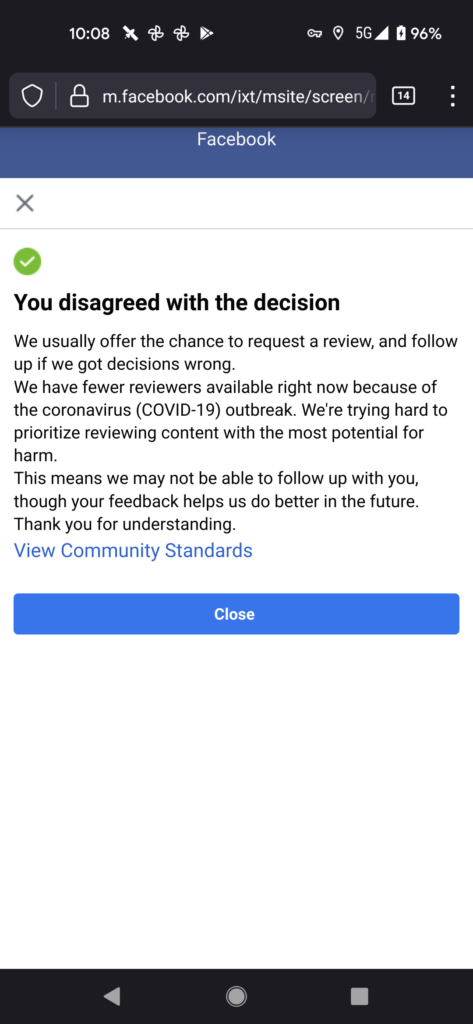
Update: Facebook has reversed itself over this censorship, but I maintain that whether the censorship was algorithmic or human, it was intentional either way. Details in my new post. Last November, I made a brief post to Facebook about Mastodon. Mastodon is an open-source and open social network, which is decentralized and all about user control instead of corporate control. I ve blogged about Mastodon and the dangers of Facebook before, but rarely mentioned Mastodon on Facebook itself. Today, I received this notice that Facebook had censored my post about Mastodon: Facebook censoring a post Wonder with me for a second what this one-off post I composed myself might have done to trip Facebook s filter . and it is probably obvious that what tripped the filter was the mention of an open source competitor, even though Facebook is much more enormous than Mastodon. I have been a member of Facebook for many years, and this is the one and only time anything like that has happened. Why they decided today to take down that post I have no idea. In case you wondered about their sincerity towards stamping out misinformation which, on the rare occasions they do something about, they deprioritize rather than remove as they did here this probably answers your question. Or, are they sincere about thinking they re such a force for good by connecting the world s people? Well, only so long as the world s people don t say nice things about alternatives to Facebook, I guess. Well, you might be wondering, Why not appeal, since they obviously made a mistake? Because, of course, you can t: Indeed I did tick a box that said I disagreed, but there was no place to ask why or to question their action. So what would cause a non-controversial post from a long-time Facebook member that has never had anything like this happen, to disappear? Greed. Also fear. Maybe I d feel sorry for them if they weren t acting like a bully. Edit: There are reports from several others on Mastodon of the same happening this week. I am trying to gather more information. It sounds like it may be happening on Twitter as well. Edit 2: And here are some other reports from both Facebook and Twitter. Definitely not just me. Edit 3: While trying to reply to someone on Facebook, that was trying to defend Facebook, I mentioned joinmastodon.org and got this: Anyone else seeing it? Edit 4: It is far more than just me, clearly. More reports are out there; for instance, this one and that one.

Next.

Previous.