Search Results: "mt"

2 May 2009

Lior Kaplan: Checking OLPC usability with children


Last semester I took a usability course in my university, as a final project I decided to test the OLPC usability for/with children. The full report is available (in Herew), but I ll summerise the main points. The checks goal was to see how do small children interact with the OLPC, and how does the language barrier affects them. In Israel the children starts to learn reading and writing in Hebrew at the age of 6, and most also start their English (very common as the second language) at the age of 8. So the language also creates another challenge for the child and he must relay on his other skills, as he can t understand the interface language. My target audience were children between 4 and 10, while the official target audience for the OLPC is between 6 and 12. I used 5 children:
  • a boy, age 4.5
  • a girl, age 9.5
  • a girl, age 4
  • a girl, age 7.5
  • a boy, age 7
The test environment was a OLPC laptop running Sugar with an English interface. After some of the tests I found out the mouse pad wasn t functioning all the time, but it was intersting to see how that effected the children. The tests:
  • Can a child find how to open the computer?
  • Can the child find how to use the computer? Mainly understand the main screen icons and open programs.
  • Can a child find how to exit a program back to the main screen? Don t forget he can t look for the butten says exit/quit .
  • Recored the child s first impression for the laptop and his thoughts after using the computer.
  • Check whether the child got some educational benefit from the use of the laptop.
Summery of the results: Only once child (the oldest) succseeded with understanding how to open the laptop without help. The other needed a hint or directions. The small children found in difficelt (physically) to open the laptop. Seems that there should be some marks near the antenas that indicate they should be opened first. And maybe making the antenas to open with less force (but still insuring the locking mechanisem works in the laptop falls to the ground). All the children recognized the general meaning of the icons in the main screen as programs or stuff the comptuer does . Not all the icons are clear to the children (and also to me). The language (English) was the main method the big children found out the meaning of the game, while the small one could only guess or just start the program. Clear icons were paint, maze, memory (although one tought it s tik-tak-toe). Unclear icons were: the snake (python/pippy), the dolphin (distance), tamtam s multipal icons and the browse icon. The exit button was a challenge to all children, the old ones used trail and error while reading the buttons labels, but the other needed direction about how can them exit the program. The icon just isn t clear enough. The mouse usage seemed to also be an issue, partly by been half brokem and partly becuase the young children don t handle it so smoothly and can t always be very accurate. While in most actions that wasn t a problem, in the task of exiting a program that was a big issue. As the exit button is near the frame edges, missing it makes the frame menu to appear and move or hide the exit button. For some children that was a very annoying experience. All the children said the computer is heavy for them, but the degree changed wih the age. The 4 years old children said it is heavier than the 9 years old children. Don t forget the from the first grade (age 6) the children start taking a bag to scholl and carry books. So any improvement in the wieght is good, but I don t think it s critical. Finally, I found out that all the children got some educational benefit from the use of the OLPC. The small one got some math practice with the memory game, or by trying to solve their way out of the maze (I actually saw how they improve while playing). The bigger children got a good practice with spelling words with speak, and one even surprised me and his mother with his spelling. In the end, the OLPC is indeed revolutionary machine and interface (thought Sugar), but some small changes should be made. The overall experience of the children was very good. Posted in Proud to use free software Tagged: OLPC, usability

1 May 2009

Martin Michlmayr: Adventures with the Qstarz BT-Q1000X GPS logger and receiver

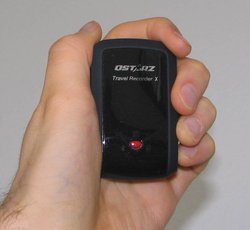
Qstarz BT-Q1000X GPS in my hand Spring has arrived in Europe and I'm looking forward to spending more time outdoors. While I was pondering some plans, I thought it would be nice to have a GPS. I've never used a GPS before but it seems it will allow me to combine outdoors activities such as walking and hiking with geek things. In particular, I'm interested in tracking where I'm going (what route, what distance, what speed, etc), geotagging photos and possibly contributing to OpenStreetMap. Since last week, I have a Qstarz BT-Q1000X (Travel Recorder X), a GPS logger and receiver, and I've been playing around with it a bit. This device uses the new MTK II chip, which gives good accuracy and long battery time. I've created a new gps category in which I'll share my experience using a GPS in general and specifically the Qstarz BT-Q1000X. I've also created a Qstarz BT-Q1000X and Debian page to describe how to use this GPS device on Linux and I'll add more information to the page as I try out different applications.

24 April 2009

Jon Dowland: my first attempt at hacking on Linux: a story

I have a little job that runs on my web server and tells me what URIs people have tried to fetch over the last 24 hours which were not successful. One of these URIs was for a page that used to contain my first ever Linux device driver. That device driver is now obsolete and so there was little point in tracking down the code and putting it back in place, but I did think there was a story to tell, so today I wrote down what happened with this driver at the URI. Thanks to the magic of ikiwiki's "inline" directive, here it is in the log: This is a story about my first real attempt to contribute to the Linux kernel. The Davicom DM9601 is a cheap USB NIC that I picked up on ebay at some point in late 2006. Suprisingly, at the time, there was no driver for it in the Linux kernel. I'd had some experience hacking on the kernel whilst working for IBM and I've always wanted to get more involved, so I thought this would be a good opportunity. I searched around and managed to find a vendor-written driver for the 2.4.x kernel series, but nothing newer. I felt that the best approach would be to start porting this driver to 2.6, improving it along the way. I got to work, and after several hours I had something that would compile against 2.6 series headers, at least, so I put my progress online and wrote a short log post about it (dm9601). A really invaluable resource whilst doing this was LWN.net's "Porting device drivers to the 2.6 kernel". Once I had the code up there, kernel hacker Arnd Bergmann got in touch with me. He said, quite frankly, that my driver had a long way to go, but that he would be willing to help mentor me and guide me in improving it so that it would make it into mainline. This was fantastic news: this is exactly what people need when trying to get up to speed with the customs of something as complex as the kernel development community. Arnd sent me a long list of things I needed to fix. Whilst I had my code online I had several other people get in touch with me and provide things like device IDs for their NICs that they needed to add in order to get it to work for their hardware. Several weeks later, after implementing a good chunk of Arnd's suggestions, I had a driver that worked, at least a little bit, with 2.6, so I got back in touch with Arnd. Bad news, for me at least: Peter Korsgaard, another kernel hacker, had implemented a dm9601 driver from scratch over a weekend. Apparently he was at a friend's house, his friend had this device, he noticed there wasn't a driver in the kernel already and sat down to write it as a fun project. From scratch. In one weekend. This was a bit of a blow. I couldn't imagine having the skill and knowledge required to be able to pump out a driver like that, but I knew the first step on the road was what I was doing, and that road was now closed. I couldn't really blame Peter, I could only really feel quite jealous at his prowess, so that was the end of that. His driver was much leaner, much tidier, fitted the kernel programming style properly, and was thus accepted. However, for my hardware at least, it didn't actually work, and he didn't have access to the device after that one weekend, so he wasn't in a position to fix it. This situation lasted about 4 months from 2007-02-23, when Peter's driver was accepted, until about 2007-06-27 with this patch. From this whole experience, I did manage to get one small patch into the kernel: one which added the device IDs for my NIC and those of the people who had got in touch with me.

Jon Dowland: pdf tools.mwdn

23 April 2009

Joey Hess: AT blogs

Finding power and internet to post to a blog while hiking for half a year up the Appalachian Trail doesn't seem like a very likely combination, but nowadays some people manage it in various ways. I've read and enjoyed three or four books about AT thru-hikes, but blogs are a more immediate, interactive medium. I've been following with interest a group who came down with food poisoning as they hiked along the Holston Mtn. ridge in my "backyard" and look forward to reading about others as they pass by. So, I'm aggregating all such blogs I can find for the 2009 season on a page I call Planet A.T.. It's a nice way to read these contrasting accounts juxtaposed together in real time. One includes cell phone photos and fairly frequent updates of a hiker who's already reached Damascus; another is frequently updated by Blackberry by a guy I could well have crossed paths with on Roan this week; another has more infrequent, interesting long essays by a hiker who has just reached Tennesee; another is a teacher sending educational videos home to his school. There's even an 86 year old who I understand is the oldest person to hike the whole trail -- and is doing it again. I thought I'd only find a few blogs, but I've now added over a hundred! So maybe one in ten of all thru-hikers this year have a blog. And the number of bloggers will presumably dwindle toward twenty-five before they reach the end in Maine.

21 April 2009

Jon Dowland: xorg.confless x and two monitors

This new xorg.conf-less X is a great idea, but now I have to add all the sections back in order to define "Virtual" and get monitor-spanning. Or maybe I'm missing another xrandr trick.

17 April 2009

Erich Schubert: Web data time series

For a research project, I'm looking for some real-world time series data. Time-series are an interesting thing to study, however it is hard to get access to interesting non-trivial real-world data.I was wondering if some people could contribute me some summarized web access data; no URLs or IP addresses.The data I'd like to get can best be explained by the preprocessing step:
...   perl -ne '/\[(\d+\/\w+\/\d 4 :\d\d):\d\d/
&& print $1."\n";'   sort   uniq -c
(Sorry if you aren't fluent in regexp - it extracts the date and hour out of an Apache default log file, nothing else. These lines are then summarized by counting their unique appearances.)That should produce 24 lines per day (one per hour), looking like this:
  count day-of-month/month/year:hour
It would be cool if you could send me some series for a couple of sites, if you happen to be in the position to provide this data. The data should cover at least a few weeks, the longer the better even up to a few years.Too small sites are however not very useful but might be too noisy (so probably not the personal home page of your mom). If you are providing a larger number of series, you are of course free to include them.I don't care much about what the site actually contains, I'd just ask you to give a tiny amount of meta information:Data use:The main project idea is to evaluate different distance metrics in their capability of separting the different data sources, assuming that there is some difference in the shape in these curves. A different problem can be constructed by breaking the series into chunks covering approximately a day and then trying do separate different days, starting hours of the series (or offset server timezone vs. user timezone) and/or weekdays from weekends.In our experiments, we've come to the conclusion that the experimental results are most interesting when there is a sufficient number of classes; so I'd like to get like 20 different interesting data series. At the same time, the series should be long enough, so I can break them into multiple chunks to have a reasonable number of 'sub-series' per class. If I have really long series, or e.g. series covering the same site but from multiple servers, I could even experiment with taking sample of different length from these sets.(Say I have series covering 2 years, that is ~17k samples, from 3 servers, then I can take 51 disjoint sub-series of length 1000, or 102 of length 500, ...)But it's obviously not possible for me to collect this data myself - I don't operate two dozen of such sites myself ...An extra project I've been considering some time is some peak prediction for web accesses. Say you're running some fast growing site, wouldn't it be useful to have a prediction when the number of accesses will likely hit some magical limit (and e.g. overload your server) so you can increase your capacity on time? Of course it would be more sensible to apply this prediction e.g. onto CPU usage, e.g. predicting when your system might hit 90% load average over a 5 minute window in regular operation. Network bandwidth and disk IO also come into mind. You get the idea.Please send them via email to erich.schubert AT gmail comThank you.[P.S. Already recieved the first series, thank you! I can take care of sorting myself, no need to worry about that. And yes, I'm aware that the series will probably all be quite similar - common computer usage patterns such as work hours - but that is common in real world data and part of the challenge. Separting apples from dinosaurs is not a challenge.]

15 April 2009

Axel Beckert: Useless Statistics, the 2nd

Myon recently posted a nice statistic about popular single letter package name prefixes. Just out of curiosity I started wondering about popular single letter package name suffixes: On a machine with Debian oldstable, stable, testing, unstable and experimental in its sources.list, I ran the following command:
$ apt-cache search -n .   \
    awk ' print $1 '   \
    sed -e 's/.$//'   \
    sort   \
    uniq -c   \
    sort -n
And to my surprise there is a non-obvious winner:
$ apt-cache search -n '^gp.$'
gpa - GNU Privacy Assistant
gpc - The GNU Pascal compiler
gpe - The G Palmtop Environment (GPE) metapackage
gpm - General Purpose Mouse interface
gpp - a general-purpose preprocessor with customizable syntax
gpr - GUI for lpr: print files and configure printer-specific options
gps - Graphical Process Statistics using GTK+
gpt - G-Portugol is a portuguese structured programming language
gpw - Trigraph Password Generator
But since I searched through the binary packages many other hits are more obvious, like the seven packages hbf-cns40-1 to hbf-cns40-7:
      [...]
      4 ar
      4 aspell-f
      4 automake1.
      4 cpp-4.
      4 e
      4 g++-4.
      4 gappletviewer-4.
      4 gcc-4.
      4 gcj-4.
      4 gcompris-sound-e
      4 gfortran-4.
      4 gij-4.
      4 go
      4 gobjc-4.
      4 gobjc++-4.
      4 h
      4 iceweasel-l10n-e
      4 iceweasel-l10n-k
      4 kde-i18n-f
      4 kde-i18n-h
      4 kde-l10n-e
      4 kde-l10n-s
      4 kile-i18n-e
      4 koffice-i18n-e
      4 koffice-i18n-s
      4 koffice-l10n-e
      4 koffice-l10n-f
      4 libqbanking
      4 myspell-f
      4 myspell-h
      4 openoffice.org-help-e
      4 openoffice.org-l10n-b
      4 openoffice.org-l10n-h
      4 openoffice.org-l10n-k
      4 sd
      4 tcl8.
      4 tk8.
      5 aspell-e
      5 aspell-h
      5 iceweasel-l10n-s
      5 kde-i18n-b
      5 kde-i18n-e
      5 kde-i18n-t
      5 kde-l10n-k
      5 openoffice.org-l10n-e
      5 openoffice.org-l10n-t
      5 pa
      5 tc
      6 gc
      6 kde-i18n-s
      6 libdb4.
      6 m
      6 openoffice.org-l10n-n
      6 openoffice.org-l10n-s
      6 s
      7 hbf-cns40-
      9 gp
But there are also some other interesting observations to make: I leave it as an exercise to the reader to find the full names of the other package names starting with s, m, gc, pa or tc and having just one additional character. ;-)

Michal Čihař: Gammu stable version 1.24.0

Gammu 1.24.0 is out! It does not bring any new outstanding features, just small optimizations in SMSD, documentation improvements and various bug fixes. Full list of changes: You can download from usual place: http://cihar.com/gammu/, Debian users will find packages in unstable soon, SUSE, Fedora and Mandriva users can check repository in OpenSuse Build Service and Ubuntu in my PPA.

Jon Dowland: debian holiday

I've been largely offline for the last few weeks as I've just bought a flat. This means I haven't been able to do much Debian work. Although I am now back online, I have a lot of other things to be catching up on, so I've decided to to take a break from Debian stuff until 15th May. I will still do some bug work (reporting and following up) and if I somehow find the time I may well do some Debian work regardless. I just feel that having an explicit break (rather than an implicit or imposed one) will make me feel a little bit more in control of things, and hopefully when I return I will have some new positive energy.

11 April 2009

Chris Lamb: Installing FogBugz the Debian way

Yeah, proprietary software is bad, but let's at least install it the Debian way. The following walkthrough assumes Debian lenny.
#!/bin/sh
set -e
for PEAR_PKG in Auth_SASL HTTP_Client Mail_Mime XML_Tree
do
        PKG_TEMP=$(mktemp -d)
        cd $ PKG_TEMP 
        pear download $ PEAR_PKG 
        dh-make-pear $ PEAR_PKG *.tgz
        cd $(find -mindepth 1 -type d   head -n1)
        dpkg-buildpackage -uc -us -rfakeroot
        sudo dpkg -i ../*.deb
        rm -rf $ PKG_TEMP 
done
$ sudo ./install.sh
/***************************************\
*            FogBugz 6 Setup
\***************************************/
--    Checking for required tools
 +      found mono 1.9.1
[..]

10 April 2009

Daniel Leidert: Abit AirPace, ath5k and eduroam

I tried to connect my university workstation to the wireless eduroam network on the campus. The workstation was delivered with an Abit AirPace wlan card (probably an Atheros 5006 chipset). The first thing necessary was the ath5k kernel module (my first shot using ndiswrapper didn t work). Both Debian lenny and Ubuntu intrepid-updates provide it. Now there are generally 3 ways to connect to the AP. All making use of wpasupplicant. Further the certificate (may differ for the universities) is necessary. /etc/wpa_supplicant/wpa_supplicant.conf This is described at the sites of my university. It s written in German, but it should still be easy to understand. Let s just mention the snippet for /etc/wpa_supplicant/wpa_supplicant.conf:
ctrl_interface=/var/run/wpa_supplicant
ctrl_interface_group=0
eapol_version=2
ap_scan=1
fast_reauth=1
network= 
	ssid="eduroam"
	key_mgmt=WPA-EAP
	proto=RSN
	pairwise=CCMP
	group=TKIP
	eap=TTLS
	anonymous_identity="anonymous@tu-dresden.de"
	identity="****@tu-dresden.de 
	password= **** 
	ca_cert= /etc/wpa_supplicant/TUD-CACert.pem 
	phase2= auth=PAP 
 
Instead of the script suggested at the site above, you can also use this snippet in /etc/network/interfaces:
auto wlan0
iface wlan0 inet dhcp
	wpa-conf /etc/wpa_supplicant/wpa_supplicant.conf
/etc/network/interfaces It is also possible to put the values directly into /etc/network/interfaces:
auto wlan0
iface wlan0 inet dhcp
	wpa-ssid eduroam
	wpa-proto RSN
	wpa-group CCMP TKIP
	wpa-pairwise CCMP TKIP
	wpa-key-mgmt WPA-EAP
	wpa-eap TTLS
	wpa-ca-cert /etc/wpa_supplicant/TUD-CACert.pem
	wpa-phase2 "auth=PAP"
	wpa-anonymous-identity anonymous@tu-dresden.de
	wpa-identity ****@tu-dresden.de
	wpa-password ****
network-manager Here is a screenshot of the authentication dialog. So now everybody at the University of Dresden wanting to use eduroam should hopefully be able to configure this connection on his Debian/Ubuntu system.

Daniel Leidert: (WW) AllowEmtpyInput is on, devices using drivers kbd or mouse will be disabled.

Maybe you will observe a changed mouse and keyboard behaviour after updating X.org recently in Debian Sid. Then you will probably discover the warning mentioned in the title in your X.org server log /var/log/Xorg.0.log. The very short and dirty solution to get things working for the moment is to put this into your /etc/X11/xorg.conf:
Section "ServerLayout"
    Option "AutoAddDevices" "off"
EndSection
See the first entry in /usr/share/doc/xserver-xorg/NEWS.Debian.gz and follow the mentioned links for more information. However, the above solution should only be a temporary workaround: Try to migrate things (I will post changes for my system asap).

Obey Arthur Liu: Google Summer of Code 2009: Debian s Shortlist

Copy of http://lists.debian.org/debian-devel/2009/04/msg00421.html. Hi folks, We have been pretty busy these past few weeks with the whole Google Summer of Code 2009 student application process.
I can say that we have this year a very good set of proposals and I d like to thank all the students and mentors for this. I am going to present to you our shortlist of projects that we would like to be funded and believe we can reasonably manage to get funded. As always, remember that the number of slots is not final yet at this point so we can t promise anything. The first preliminary slot count given today was *10* (same as last year) and we hope to get *2* more (as we did last year). This shortlist is alphabetically ordered because we don t want to reveal the current internal rankings. I am inviting you to debate what you think is cool, what is useful, what is important to Debian, maybe give us pointers to resources or people that could be helpful for the projects. We will try to alter our current rankings to reflect the zeitgeist in Debian, while taking into account the personal information that we have about each student involved. The deadline for any modification is on the 15th, so get everything in by the 14th. The final selected projects will be announced by Google April 20th, ~12 noon PDT / 19:00 UTC. We ll have another announcement then. Three proposals need or may need a mentor, I indicated it. For more information about the projects or mentoring and how to talk to us directly, scroll down past the list. Debian s Shortlist : - Aptitude Package Management History Tracking
- Automatic Debug Packages Creation and Handling
- Debbugs Web UI: Amancay Strikes Back
- Control Files Parsing/Editing Library/Qt4-Debconf Qt4-Perl bindings
- Debian-Installer Support for GNU/kFreeBSD
- KDE/Qt4 Adept 3.0 Package Manager
- Large Scientific Dataset Package Management
- MIPS N32 ABI Port
- MTD Embedded Onboard flash Partitioning and Installation
- On-demand Cloud Computing with Amazon EC2 and Eucalyptus Integration
- Port back update-manager to Debian and all Derivatives
- Debian Autobuilding Infrastructure Rewrite And the details: Aptitude Package Management History Tracking Student: Cristian Mauricio Porras Duarte, Mentor: Daniel Burrows Aptitude currently does not track actions that the user has performed beyond a single session of the program. One of the most frequent requests from users is to find out when they made a change to a package, or why a package was changed; we want to store this information and expose it in the UI in convenient locations. As a side effect, this might also provide some ability to revert past changes. Automatic Debug Packages Creation and Handling Student: Emilio Pozuelo Monfort, Mentor: Marc Brockschmidt This proposal aims at providing debug binary packages for the packages in the Debian archive in an automatic manner, moving them away from the official Debian archive to an special one. This has the benefits of providing thousands of debug packages without any work needed from the developers, for all the architectures, without bloating
the archive. Debbugs Web UI: Amancay Strikes Back Student: Diego Escalante Urrelo, Mentor: Margarita Manterola The Amancay project aims to be a new read/write web frontend to Debian s BTS; allowing DDs and contributors to easily interact with bugs via an intuitive yet powerful interface, enabling new workflows and creating new contribution opportunities like triaging while upholding reporting quality. Control Files Parsing/Editing Library/Qt4-Debconf Qt4-Perl bindings Student: Jonathan Yu, Mentor: (probably) Dominique Dumont see below This project proposes a common library for parsing and manipulating Debian Control files, including control, copyright and changelog. Main ideas include validating and parsing of these files, with both Strict and Quirks modes for the parser. The second idea is a new frontend for Debconf using Qt4 (for which Perl bindings will be written). Debian-Installer Support for GNU/kFreeBSD Student: Luca Favatella, Mentor: Aurelien Jarno GNU/kFreeBSD is currently using a hacked version of the FreeBSD installer combined with crosshurd as its own installer. While this works more or less correctly for standard installations (read: the exact same installation as in the documentation), it does not allow any changes in the installation process except the hard disk partitioning. This project is about porting debian-installer on GNU/kFreeBSD, and to a bigger extent, make debian-installer less Linux dependant. KDE/Qt4 Adept 3.0 Package Manager Student: Mateusz Marek, Mentor: NEEDS MENTOR, see below. Finish Adept 3.0, a fully integrated package manager for Qt4/KDE4. Adept is currently the only viable path to a Debian native package manager on KDE that would support modern features such as tags, indexed search or good conflict resolving. With Aptitude-gtk still in development and only available for GTK+ and (K)PackageKit having fundamental problems, Debian needs this project to stay in control of its package management on KDE after much neglect in the recent years. Large Scientific Dataset Package Management Student: Roy Flemming Hvaara, Mentor: Charles Plessy Large public datasets, like databases for bioinformatics are typically too big and too volatile to fit the traditional source/binary packaging scheme of Debian. There are some programs that are distributed in Debian, like blast and emboss, that can index specialised databases, but Debian lacks a tool to install or update the datasets they need and keep their indexing in sync. MIPS N32 ABI Port Student: Sha Liu, Mentor: Anthony Fok This project first focuses on creating a new MIPS N32 ABI port for Debian. Different from O32 and N64, N32 is an address model which has most 64-bit capabilities but using 32-bit data structures to save space and process time. A second focus will be given on making such a mipsn32el arch fully optimized for the Loongson 2F CPU which gains more and more popularity in subnotebooks/netbooks in many countries. MTD Embedded Onboard flash Partitioning and Installation Student: Per Andersson, Mentor: Wookey Many embedded devices have MTD onboard flash as persistent storage like the Kurobox Pro NAS, the Neo Freerunner, the Sheeva Plug or the OLPC. With MTD flash being so popular and with increases in capacity, support for MTD partition/installation would make Debian even more interesting to a wide range of of devices, making it one step closer to being universal. On-demand Cloud Computing with Amazon EC2 and Eucalyptus Integration Student: David Wendt Jr, Mentor: (probably) Steffen Moeller see below In many academic fields, as well as commercial industries, people use clusters to distribute tasks among multiple machines. Many times this is done by packaging a whole operating system disk image, uploading it onto the cluster, and having the cluster run it in a VM. This project intends to make it easier for Debian to distribute prepared disk images templates like they distribute CD images now, for the users to recreate or customise these templates with Debian packages and for administrators to host such clusters with Debian. Port back update-manager to Debian and all Derivatives Student: Stephan Peijnik, Mentor: Michael Vogt The project would involve taking the distribution-(Ubuntu-)specific update-manager code, analyzing it, and creating a package with just its core functionality, decoupling the distribution-specific parts and thus making the core code extensible by distribution-specific add-ons. This in turn would remove the need of porting update-manager to Debian with every upstream release. An additional optional goal would be replacing the synaptics-backend with a python-apt based one. Debian Autobuilding Infrastructure Rewrite Student: Philipp Kern, Mentor: Luk Claes Rewrite the software that currently runs the Debian autobuilding infrastructure in a way that makes it more maintainable and robust. It will use Python as its programming language and PostgreSQL for the database backend. By harmonizing buildds, many build failures can be prevented and wasteful workload on buildd volunteers can be reduced. On mentoring: Petr Rockai, the original developer of Adept has offered help to anyone willing to adopt Adept. Sune Vuorela has offered help for any Qt4 and KDE related issues. *We really need a mentor here*. The student is quite competent but Google dictates that we provide a mentor to handle student management. Dominique Dumont, although not DD, has signaled interest in mentoring this, although it hasn t been confirmed yet. Sune Vuorela has offered to help co-mentor for the Qt4-Debconf and Qt4-Perl bindings part. Steffen Moeller has signaled interest in mentoring this, although it hasn t been formally confirmed yet. Charles Plessy of the Debian Med team will provide help for use cases related issues. Eric Hammond, developer of the original vmbuilder image creation tool and maintainer of a set of Debian and Ubuntu images will provide help for Amazon EC2 and image creation issues. Chris Grzegorczyk from the Eucalyptus team will provide help for Eucalyptus and Eucalyptus/Debian integration issues. Contacting us: Considering the tight schedule, most stuff happens live on IRC: #debian-soc on irc.debian.org You can also consult our wiki page for some additional information:
<http://wiki.debian.org/SummerOfCode2009> We have a mailing-list at:
<http://lists.alioth.debian.org/mailman/listinfo/soc-coordination> Keep this discussion on debian-devel@lists.debian.org while cc-ing soc-coordination@lists.alioth.debian.org. This thread is for debian-devel primarily.

9 April 2009

Manoj Srivastava: Manoj: kernel-package: Add support for kernel image debug package

A new version of kernel-package in Incoming at the time of writing adds support for creating a package which contains the Linux kernel debug image. This means the debugging information for the modules in the kernel image package, and the uncompressed vmlinux image. This builds on suggestions and code from Troy Heber, Theodore Y. Ts o, and Dann Frazier. As support for kexec/kdump support becomes more real, it will be very useful to be able to build kernels that have debugging information available, but not necessarily to install the debugging information on every single client system. The .ko object files are stripped of the debugging information before they are placed in the standard linux-image installation package. However, before that, a copy of the vmlinux and unstripped .ko files are saved in a debuginfo package, and everything except for the debugging information is removed from them using objcopy --keep-only-debug. This means that if someone ends up with a crash dump, they can send it to a support engineer and only the support engineer needs to install the debuginfo package and use the crash utility to debug the crash dump. It s also useful for developers, since the debuginfo information can be stored somewhere outside of /lib for storing its debug information, for example. This is useful for keeping the size of the root partition small, for those who keep / separate from /usr. The locations used are compatible also with SystemTap, which provides free software infrastructure to simplify the gathering of information about the running Linux system. This assists diagnosis of a performance or functional problem. SystemTap eliminates the need for the developer to go through the tedious and disruptive instrument, recompile, install, and reboot sequence that may be otherwise required to collect data. Also, I had to clear out some FUD about kernel-package from the ircbot dpkg on the OFTC Debian IRC channel, since someone had implied that kernel-package was some how obsolete. As can be seen, it is being actively developed, and features are being added apace.

7 April 2009

Steve Kemp: I think you should let this one go

I work with log files a lot. Most of the logfiles I work with are in a standard format of some kind, and most often they are rotated upon a daily basis. (Examples include syslog, qpsmtpd, and Apache logfiles.) I wish there were a general purpose way to say "grep time-range pattern logfile". Right now, for example, I've just deployed some changes upon a cluster of hosts. Now I want to see only messages that refer to a particular area of the codebase only those that occurred after 23:00 - which is when I did the commit/push/pull dance. I've written a quick hack - tgrep (time-grep) - which allows simple before/equal/after/range grepping :

# show matching lines after 23:00PM
tgrep \>23:00:00 -i subject /var/log/qpsmtpd/qpsmtpd.log
# show matching lines in the interval 23:00PM 23:15PM
tgrep 23:00:00-23:15:00 -i -r subject /var/log/qpsmtpd/
If there is a common way of doing this "properly" then I'd love to be educated, failing that take it if it is useful (moreutils?) ObFilm: Chasing Amy

Jon Dowland: zte mf622

I'm currently waiting for my ADSL to be setup and so I've borrowed my mum's "three" 3G mobile broadband USB dongle. The device is a "ZTE MF622" and getting this working in Linux apparently used to be a bit of a nightmare. However, with Debian Lenny and 2.6.26-1-amd64 it is trivial: you plug it in, it appears as a USB mass storage device; wait a little bit and it disappears and comes back as some USB serial devices. You can then chat to /dev/ttyUSB0 (or whatever the first ttyUSB device belonging to the dongle is). There's a working wvdial configuration at http://ubuntuforums.org/archive/index.php/t-665332.html, reproduced here for convenience:
[Dialer Defaults]
Init2 = ATZ
Init3 = ATQ0 V1 E1 S0=0 &C1 &D2 +FCLASS=0
Stupid Mode = 1
Modem Type = Analog Modem
ISDN = 0
Phone = *99#
Modem = /dev/ttyUSB0
Username = user
Dial Command = ATDT
Password = pass
Baud = 460800
IF you don't want to use wvdial there are bare ppp scripts at http://hillj.co.uk/2008/01/31/how-to-get-online-with-three-mobile-uk-and-linux-ubuntu/, although I haven't tested these. Whilst researching this I stumbled across several examples of more extreme ways of getting the initial switchover to work, including http://blog.ufsoft.org/zte-mf622-usb-modem-under-linux#extended which includes a udev snippet that forcefully calls rmmod and modprobe. This will totally fail if you are using usb-storage or usb-serial for anything else, which is probably not the case for the majority of people trying to get this to work at the time they are trying, but there are several examples out there of people complaining that their USB has failed since trying these instructions. We are often accused of having a problem of missing documentation in the free software world. I'm wondering if this is one example of where we have bad, damaging documentation. How can we deal with that? Incidentally, for those whose devices won't automatically switch over to the serial device, there's a program usb-modeswitch (currently in sid) that can do the job for you. There are apparently hacks in the usb-storage Linux kernel module that special-case the switchover for some Huawei devices. I couldn't find anything in there for the ZTE device.

5 April 2009

Jose Carlos Garcia Sogo: Backup your system for a desktop user

While Linux and Debian are plenty of programs for backing up your system, things change when you need a backup system for a common desktop user. In this area there is a lot of room for improvement, as programs for KDE and GNOME are years behind what programs for Windows and Mac OS X are offering.
There has been some programs intents of writing a good program, full featured and with a nice graphical interface, as Simple Backup, and its fork Not So Simple Backup, pybackpack, or TimeVault, an intent to clone Apple s TImeMachine, and it s fork TimeVaultNG written for KDE. Those are projects that start with a great impulse, even some of the mentored by Google Summer of Code, and when they reach some basic functionality, they get abandoned or not being properly maintained.
What I would like to see for a backup system for desktop user is: A lot of improvement and innovation has taken place in Linux Desktop during all these years, but backups are also important for SOHO users, and they need a well integrated program for doing that, as console based solutions usually require configuration skills which desktop users don t have.
Updated 6th April 22:26 CEST: I have been recommended in comments to try Back in Time and D j Dup. Both are in active delopment, which is a bonus. The first one works in a similar way to TimeVault, while the second one works using duplicity as backend, but has support to upload the resulting files to a remote server using SSH or to Amazon S3. I will investigate more on these apps.

2 April 2009

Martin Michlmayr: Test kernel for Orion with performance patches available

Marvell posted some performance patches for ARM that speed up the copy_to_user and clear_user functions which are used to copy data around. I see quite a bit of performance increase with these patches on Orion, and I've prepared a test kernel so you can try them out too. This kernel should be treated as experimental, but I'm looking for testers with Orion-based hardware (e.g. QNAP TS-109, TS-209, and TS-409) who are interested in giving it a go. If your system has a rescue mode (the QNAP devices and the HP mv2120 do), I suggest you first make a backup of your flash. On the QNAP devices, you can do this with:
cat /dev/mtdblock1 /dev/mtdblock2 /dev/mtdblock3 > qnapimg.bin
Then edit the file /etc/apt/sources.list and add the following line:
deb http://people.debian.org/~tbm/orion lenny main
Now you can install the new kernel:
apt-get update
apt-get install linux-image-2.6.29-1-orion5x
Please ignore the warning that the package cannot be authenticated. This is because I haven't signed the repository. After the installation of the kernel, reboot and do some tests: Do you see any speedup? Do you see any problems?

Thijs Kinkhorst: IPCCommTimeout not working with mod_fcgid 2.2

In a setup where we use Apache FastCGI with PHP through mod_fcgid and suEXEC, we experienced the problem that long running scripts always resulted in a 500 Internal Server Error after exactly 40 seconds. This is due to the IPCCommTimeout setting, but changing that setting didn't seem to yield any effect. I stumbled on a blog entry saying that they only work within the VirtualHost block. I tried this for my test-vhost but it also didn't work. It took me a while to find the complete solution (workaround): you need to specify IPCommTimeout in every VirtualHost block, because a later VirtualHost will globally reset your setting in a previous one. So until this bug is fixed the neat workaround is to place the mod_fcgid settings in a separate configuration file and Include that file inside each VirtualHost.

Next.

Previous.