Search Results: "ina"

5 May 2023

Valhalla's Things: Hiking Slippers

Posted on May 5, 2023
image When I travel for a few days I don t usually1 bring any other shoe than the ones I m wearing, plus some kind of slippers for use inside hotel / B&B rooms. It s good for not carrying useless weight, but it always leave me with a vague feeling of what if my only shoes break , followed by on a Sunday, when the shops are closed . So I started to think in the general direction of hiking sandals, shoes that are designed to be worn when resting, and lightweight to carry, but are a passable substitute for regular shoes in case of an accident to the main ones, maybe with the help of an extra pair of socks2 (or when crossing fords, but that s not really a usecase I have). My requirements are easier than the ones for real hiking sandals, since I m only going to be walking on paved streets (or at most easy unpaved ones), and the weight considerations are a thing, but not as strict as if I had to carry these on my back while hiking many hours in a day. My first attempt was a pair of hiking sandals from things I already had in my stash, with vibram soles, neoprene padding and polyester webbing. After a couple fixes they sort of worked, but they had a few big issues.
  • While comfortable when worn, the neoprene made the sandals hard to make, as it tended to deform while being assembled.
  • Polyester webbing is slippery. Some strips of hot glue in strategical places helped, but they weren t perfect and in time they are peeling off.
  • Most importantly, to make the sandals stable enough to wear while walking I had to add a strap around the ankle that needs closing: this makes it a bit of a hassle to use the sandals, say, when waking up in the middle of the night for metabolic reasons.
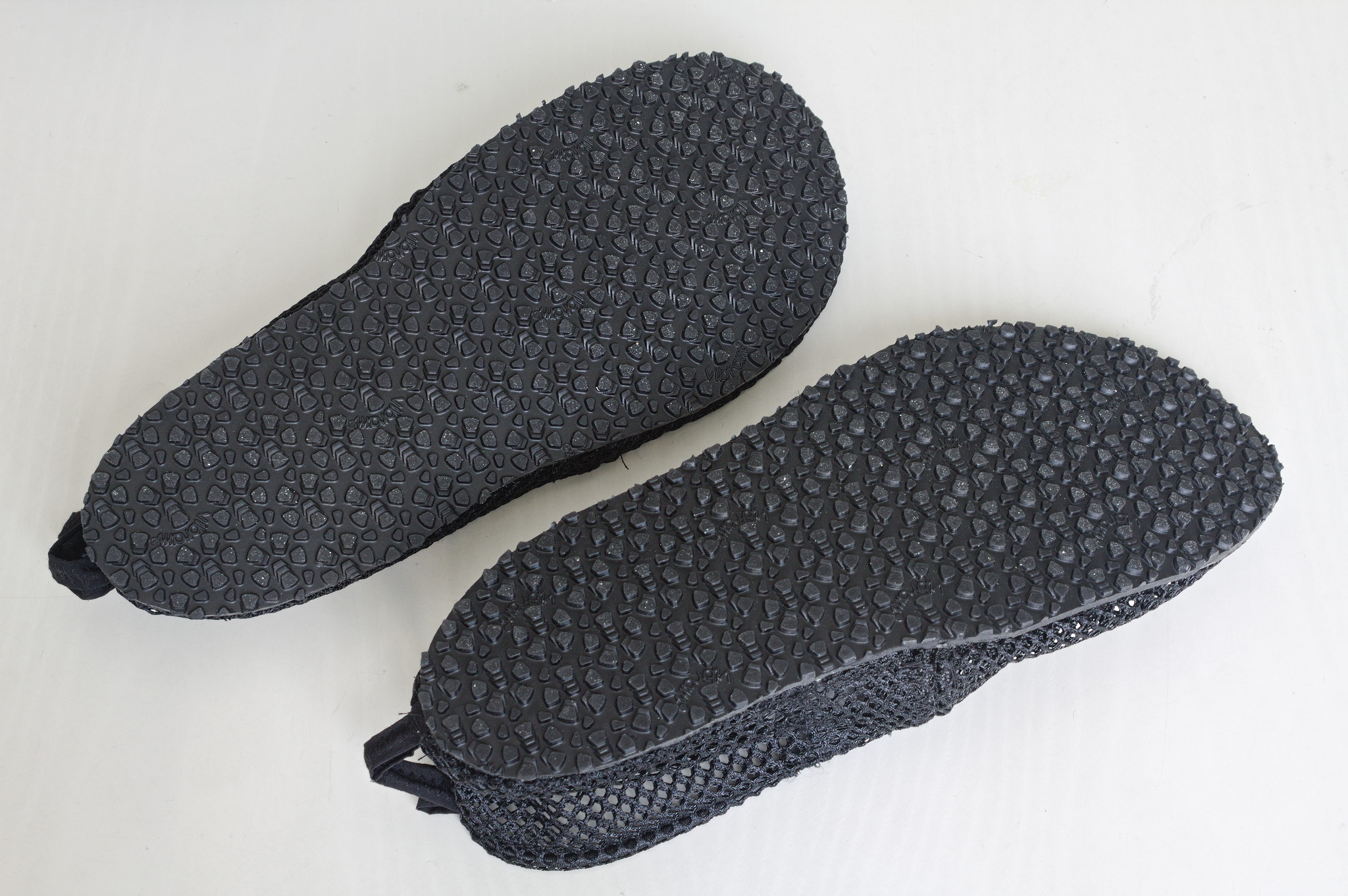
And then, one day I made my linen slippers, and that lead me to think again about the problem: what if I made a pair of slippers with a rubber sole, technical materials and maybe uppers made of net, so that they would be lightweight, breathable and possibly even still suitable in case I ever need to cross a ford. This was also readily attainable from the stash: some polycotton for the sole lining, elastic mesh for the uppers, EVA foam for padding and vibram soles. I decided to assemble most of them by machine, and it was quick and painless (possibly also thanks to the elasticity of the mesh) image For the soles I may have gone a bit overboard with the vibram claw, but:
  • I already had it in the stash;
  • if I need to wear them on an unpaved road, they are going to be suitable;
  • why not?
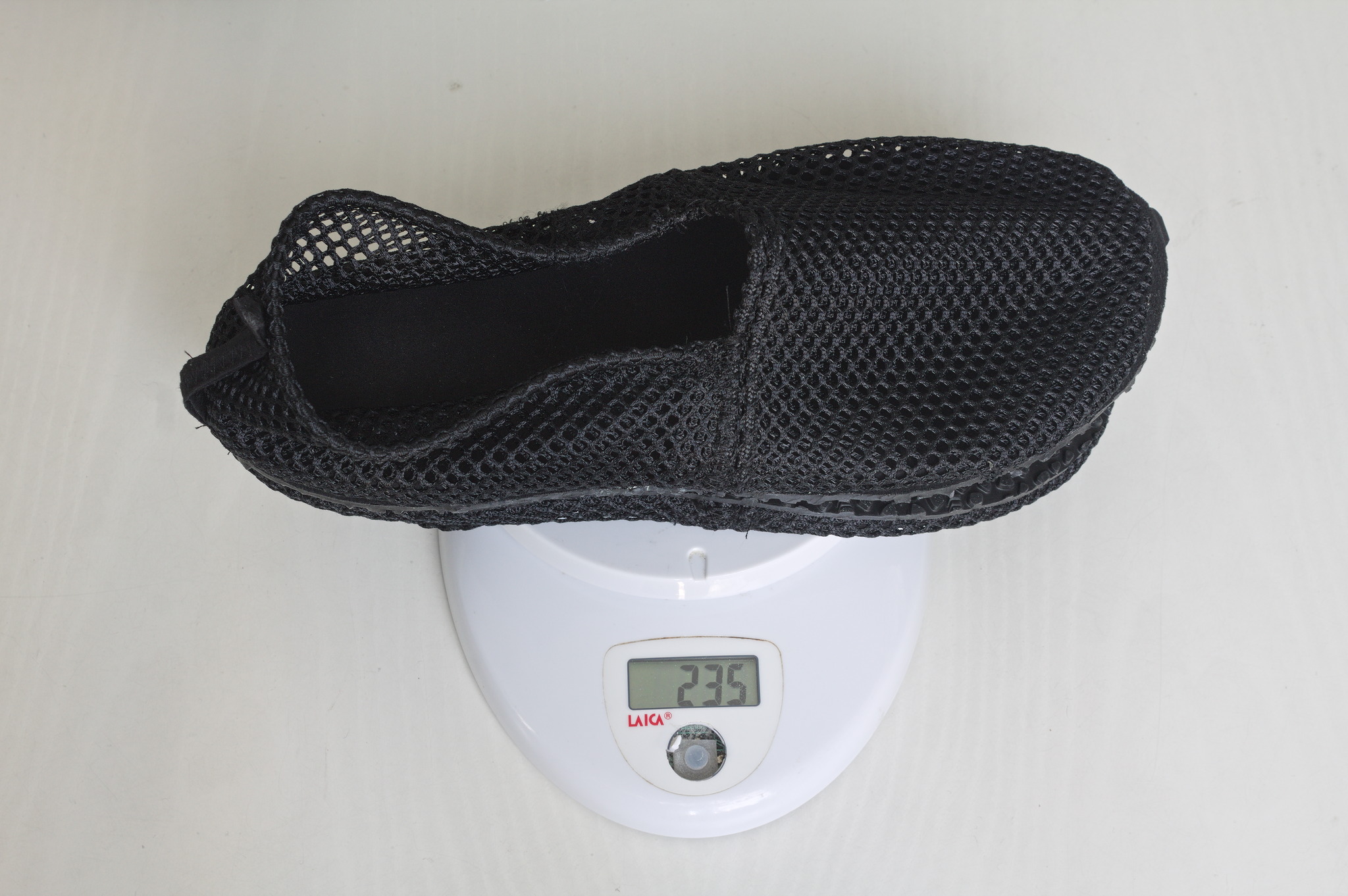
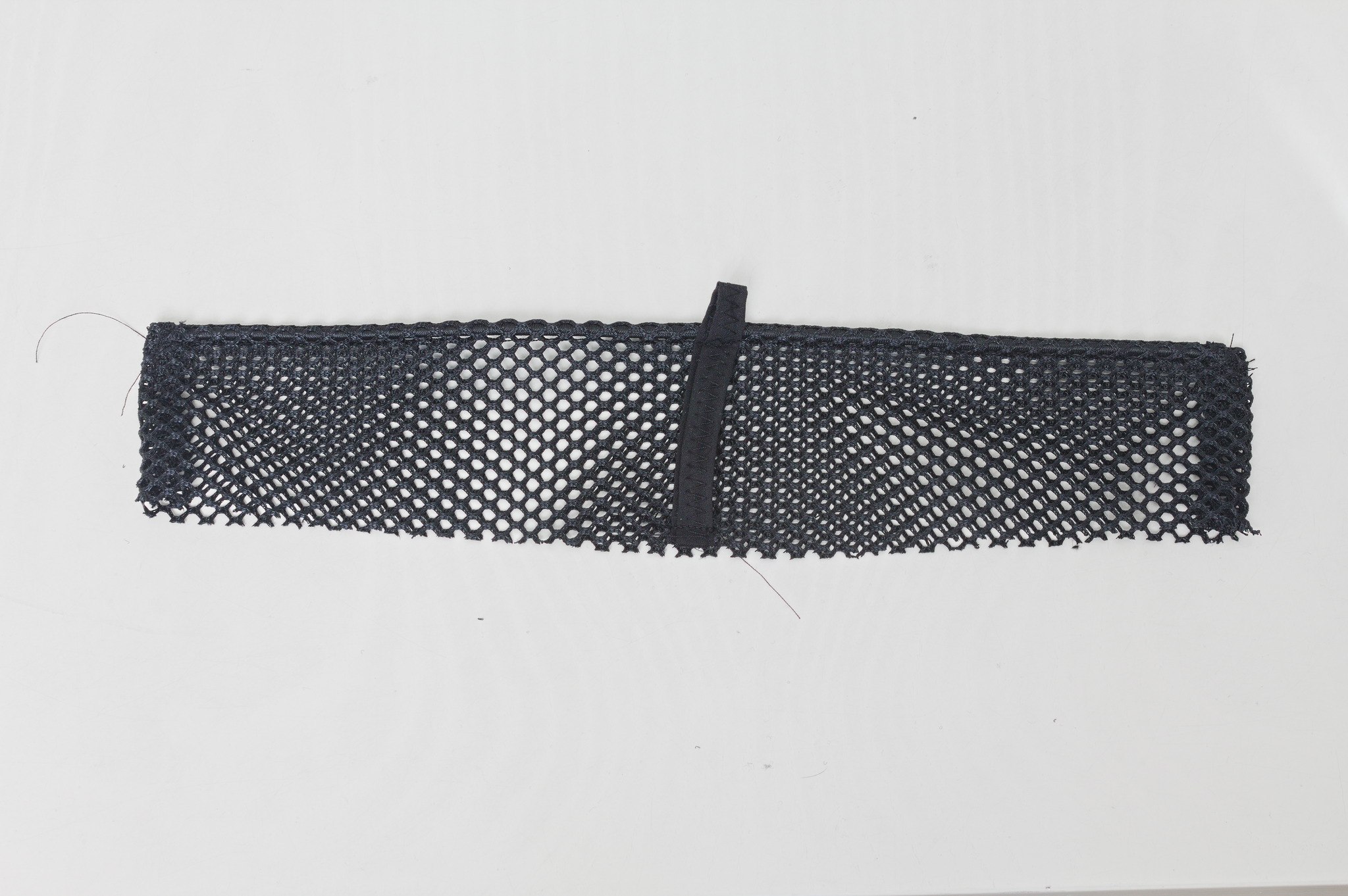
The soles were glued to the slippers rather than being sewn, as I don t think there is a reasonable way to sew these soles; I hope it won t cause durability issues later on (if it does, there will be an update) the slippers on a kitchen scale As for the finished weight, at 235 g for the pair I thought I could do better, but apparently shoes are considered ultralight if they are around 500 g? Using just one layer of mesh rather than two would probably help, but it would have required a few changes to the pattern, and anyway I don t really to carry them around all day. image I ve also added a loop of fabric (polycotton) to the centre back to be able to hang the slippers to the backpack when wet or dirty; a bit of narrow webbing may have been better, but I didn t have any in my stash. The pattern is the same as that used for the linen slippers, and of course it s released as #FreeSoftWear. I ve worn these for a few days around the home and they worked just fine, except for the fact that I had to re-glue the sole in a few places (but I suspect it was glued badly in the first place, since the other sole had no issues). Right now I have no plans to travel, so I don t know how much I will be able to test these in the next few months, but sooner or later I will (or I ll keep wearing them at home after I ve thoroughly tested the linen ones), and if there are issues I will post them here on the blog (and add a link to this post).

  1. the exception would be when I m also bringing some kind of costume, and even there it s not always true.
  2. and one should always carry an extra pair of clean socks, as they are useful for so many things, as Pratchett reminds us.

4 May 2023

Emanuele Rocca: UEFI Secure Boot on the Raspberry Pi

UPDATE: this post unexpectedly ended up on Hacker News and I received a lot of comments. The two most important points being made are (1) that Secure Boot on the RPi as described here is not actually truly secure. An attacker who successfully gained root could just mount the firmware partition and either add their own keys to the EFI variable store or replace the firmware altogether with a malicious one. (2) The TianCore firmware cannot be used instead of the proprietary blob as I mentioned. What truly happens is that the proprietary blob is loaded onto the VideoCore cores, then TianoCore is loaded onto the ARM cores. Thanks for the corrections.

A port of the free software TianoCore UEFI firmware can be used instead of the proprietary boot blob to boot the Raspberry Pi. This allows to install Debian on the RPi with the standard Debian Installer, and it also makes it possible to use UEFI Secure Boot. Note that Secure Boot had been broken on arm64 for a while, but it s now working in Bookworm!.

Debian Installer UEFI boot
To begin, you ll need to download the appropriate firmware files for the RPi3 or RPi4. I ve got a Raspberry Pi 3 Model B+ myself, so the rest of this document will assume an RPi3 is being installed.
Plug the SD card you are going to use as the RPi storage device into another system. Say it shows up as /dev/sdf. Then:
# Create an msdos partition table
$ sudo parted --script /dev/sdf mklabel msdos
# Create, format, and label a 10M fat32 partition
$ sudo parted --script /dev/sdf mkpart primary fat32 0% 10M
$ sudo mkfs.vfat /dev/sdf1
$ sudo fatlabel /dev/sdf1 RPI-FW
# Get the UEFI firmware onto the SD card
$ sudo mount /dev/sdf1 /mnt/data/
$ sudo unzip Downloads/RPi3_UEFI_Firmware_v1.38.zip -d /mnt/data/
$ sudo umount /mnt/data
At this point, the SD card can be used to boot the RPi, and you ll get a UEFI firmware.
Download the Bookworm RC 2 release of the installer, copy it to a USB stick as described in the Installation Guide, and boot your RPi from the stick. If for some reason booting from the stick does not happen automatically, enter the firmware interface with ESC and choose the USB stick from Boot Manager.
Proceed with the installation as normal, paying attention not to modify the firmware partition labeled RPI-FW. I initially thought it would be nice to reuse the firmware partition as ESP partition as well. However, setting the esp flag on makes the RPi unbootable. Either configuring the partition as ESP in debian-installer, or manually with sudo parted --script /dev/sda set 1 esp on, breaks boot. In case you accidentally do that, set it back to off and the edk2 firmware will boot again.
What I suggest doing in terms of partitioning is: (1) leave the 10M partition created above for the firmware alone, and (2) create another 512M or so ESP partition for EFI boot.
The installation should go smoothly till the end, but rebooting won t work. Doh. This is because of an important gotcha: the Raspberry Pi port of the TianoCore firmware we are using does not support setting UEFI variables persistently from a "High Level Operating System (HLOS)", which is the debian-installer in our case. Persistently is the keyword there: variables can be set and modified regularly with efibootmgr or otherwise, but crucially the modifications do not survive reboot. However, changes made from the firmware interface itself are persistent. So enter the firmware with ESC right after booting the RPi, select Boot Maintenance Manager Boot Options Add Boot Option Your SD card Your ESP partition EFI debian shimaa64.efi. Choose a creative name for your boot entry (eg: "debian"), save and exit the firmware interface. Bookworm should be booting fine at this point!

Enabling Secure Boot
Although the TianoCore firmware does support Secure Boot, there are no keys enrolled by default. To add the required keys, copy PK-0001.der, DB-0001.der, DB-0002.der, KEK-0001.der, and KEK-0002.der to a FAT32 formatted USB stick.
Here s a summary of the Subject field for each of the above:
PK-0001.der.pem
        Subject: O = Debian, CN = Debian UEFI Secure Boot (PK/KEK key), emailAddress = debian-devel@lists.debian.org
DB-0001.der.pem
        Subject: C = US, ST = Washington, L = Redmond, O = Microsoft Corporation, CN = Microsoft Windows Production PCA 2011
DB-0002.der.pem
        Subject: C = US, ST = Washington, L = Redmond, O = Microsoft Corporation, CN = Microsoft Corporation UEFI CA 2011
KEK-0001.der.pem
        Subject: O = Debian, CN = Debian UEFI Secure Boot (PK/KEK key), emailAddress = debian-devel@lists.debian.org
KEK-0002.der.pem
        Subject: C = US, ST = Washington, L = Redmond, O = Microsoft Corporation, CN = Microsoft Corporation KEK CA 2011
Plug the stick into the RPi, boot and enter the firmware interface with ESC. Select Device Manager Secure Boot Configuration Secure Boot Mode choose Custom Mode Custom Secure Boot Options PK Options Enroll PK choose PK-0001.der. Do the same for DB Options, this time choose DB-0001.der and DB-0002.der. As you may have guessed by now, the same must be done for KEK Options, but adding KEK-0001.der and KEK-0002.der. Save, exit, reboot. If everything went well, your RPi now has booted with Secure Boot enabled.
See https://wiki.debian.org/SecureBoot for the details on how to check whether Secure Boot has been enabled correctly and much more.

3 May 2023

John Goerzen: Martha the Pilot

Martha, now 5, can t remember a time when she didn t fly periodically. She s come along in our airplane in short flights to a nearby restaurant and long ones to Michigan and South Dakota. All this time, she s been riding in the back seat next to Laura. Martha has been talking excitedly about riding up front next to me. She wants to be my co-pilot . I promised to give her an airplane wing pin when she did one I got from a pilot of a commercial flight when I was a kid. Of course, safety was first, so I wanted to be sure she was old enough to fly there without being a distraction. Last weekend, the moment finally arrived. She was so excited! She brought along her Claire bear aviator, one that I bought for her at an airport a little while back. She buckled in two of her dolls in the back seat. Martha's dolls And then up we went! Martha in the airplane Martha was so proud when we landed! We went to Stearman Field, just a short 10-minute flight away, and parked the plane right in front of the restaurant. We flew back, and Martha thought we should get a photo of her standing on the wing by the door. Great idea! Martha standing on the wing She was happily jabbering about the flight all the way home. She told us several times about the pin she got, watching out the window, watching all the screens in the airplane, and also that she didn t get sick at all despite some turbulence. And, she says, Now just you and I can go flying! Yes, that s something I m looking forward to!

2 May 2023

Neil Williams: Carrying Grief

This isn't a book review, although the reason that I am typing this now is because of a book, You Are Not Alone: from the creator and host of Griefcast, Cariad Lloyd, ISBN: 978-1526621870 and I include a handful of quotes from Cariad where there is really no better way of describing things. Many people experience death for the first time as a child, often relating to a family pet. Death is universal but every experience of death is unique. One of the myths of grief is the idea of the Five Stages but this is a misinterpretation. Denial, Anger, Bargaining, Depression and Acceptance represent the five stage model of death and have nothing to do with grief. The five stages were developed from studying those who are terminally ill, the dying, not those who then grieve for the dead person and have to go on living without them. Grief is for those who loved the person who has died and it varies between each of those people just as people vary in how they love someone. The Five Stages end at the moment of death, grief is what comes next and most people do not grieve in stages, it can be more like a tangled knot. Death has a date and time, so that is why the last stage of the model is Acceptance. Grief has no timetable, those who grieve will carry that grief for the rest of their lives. Death starts the process of grief in those who go on living just as it ends the life of the person who is loved. "Grief eases and changes and returns but it never disappears.". I suspect many will have already stopped reading by this point. People do not talk about death and grief enough and this only adds to the burden of those who carry their grief. It can be of enormous comfort to those who have carried grief for some time to talk directly about the dead, not in vague pleasantries but with specific and strong memories. Find a safe place without distractions and talk with the person grieving face to face. Name the dead person. Go to places with strong memories and be there alongside. Talk about the times with that person before their death. Early on, everything about grief is painful and sad. It does ease but it remains unpredictable. Closing it away in a box inside your head (as I did at one point) is like cutting off a damaged limb but keeping the pain in a box on the shelf. You still miss the limb and eventually, the box starts leaking. For me, there were family pets which died but my first job out of university was to work in hospitals, helping the nurses manage the medication regimen and providing specialist advice as a pharmacist. It will not be long in that environment before everyone on the ward gets direct experience of the death of a person. In some ways, this helped me to separate the process of death from the process of grief. I cared for these people as patients but these were not my loved ones. Later, I worked in specialist terminal care units, including providing potential treatments as part of clinical trials. Here, it was not expected for any patient to be discharged alive. The more aggressive chemotherapies had already been tried and had failed, this was about pain relief, symptom management and helping the loved ones. Palliative care is not just about the patient, it involves helping the loved ones to accept what is happening as this provides comfort to the patient by closing the loop. Grief is stressful. One of the most common causes of personal stress is bereavement. The death of your loved one is outside of your control, it has happened, no amount of regret can change that. Then come all the other stresses, maybe about money or having somewhere to live as a result of what else has changed after the death or having to care for other loved ones. In the early stages, the first two years, I found it helpful to imagine my life as a box containing a ball and a button. The button triggers new waves of pain and loss each time it is hit. The ball bounces around the box and hits the button at random. Initially, the button is large and the ball is enormous, so the button is hit almost constantly. Over time, both the button and the ball change size. Starting off at maximum, initially there is only one direction of change. There are two problems with this analogy. First is that the grief ball has infinite energy which does not happen in reality. The ball may get smaller and the button harder to hit but the ball will continue bouncing. Secondly, the life box is not a predictable shape, so the pattern of movement of the ball is unpredictable. A single stress is one thing, but what has happened since has just kept adding more stress for me. Shortly before my father died 5 years ago now, I had moved house. Then, I was made redundant on the day of the first anniversary of my father's death. A year or so later, my long term relationship failed and a few months after that COVID-19 appeared. As the country eased out of the pandemic in 2021, my mother died (unrelated to COVID itself). A year after that, I had to take early retirement. My brother and sister, of course, share a lot of those stressors. My brother, in particular, took the responsibility for organising both funerals and did most of the visits to my mother before her death. The grief is different for each of the surviving family. Cariad's book helped me understand why I was getting frequent ideas about going back to visit places which my father and I both knew. My parents encouraged each of us to work hard to leave Port Talbot (or Pong Toilet locally) behind, in no small part due to the unrestrained pollution and deprivation that is common to small industrial towns across Wales, the midlands and the north of the UK. It wasn't that I wanted to move house back to our ancestral roots. It was my grief leaking out of the box. Yes, I long for mountains and the sea because I'm now living in a remorselessly flat and landlocked region after moving here for employment. However, it was my grief driving those longings - not for the physical surroundings but out of the shared memories with my father. I can visit those memories without moving house, I just need to arrange things so that I can be undisturbed and undistracted. I am not alone with my grief and I am grateful to my friends who have helped whilst carrying their own grief. It is necessary for everyone to think and talk about death and grief. In respect of your own death, no matter how far ahead that may be, consider Advance Care Planning and Expressions of Wish as well as your Will. Talk to people, document what you want. Your loved ones will be grateful and they deserve that much whilst they try to cope with the first onslaught of grief. Talk to your loved ones and get them to do the same for themselves. Normalise talking about death with your family, especially children. None of us are getting out of this alive and we will all leave behind people who will grieve.

Dirk Eddelbuettel: RQuantLib 0.4.18 on CRAN: Maintenance

A new release 0.4.18 of RQuantLib arrived at CRAN earlier today, and will be uploaded to Debian as well. QuantLib is a very comprehensice free/open-source library for quantitative finance; RQuantLib connects it to the R environment and language. This release of RQuantLib comes about six months after the previous maintenance release. It brings a few small updates triggered by small changes in the QuantLib releases 1.29 and 1.30. It also contains updates reflecting changes in the rgl package kindly contributed by Duncan Murdoch. Last but not least, Jeroen Ooms helped with two pull requests updating builds on, repspectively, macOS and Windows by updating the pre-made libraries of QuantLib.

Changes in RQuantLib version 0.4.18 (2023-05-01)
  • Use of several rgl functions was updated to a new naming scheme in the package (kindly contributed by Duncan Murdoch in #174)
  • A default argument is now given for option surface plots
  • Changed call from SwaptionVolCube1 to SabrSwaptionVolatilityCube (conditional on using QuantLib 1.30 or later)
  • Some other deprecation warnings were tweaked as in QL test file
  • Builds for macOS and Windows were updated with more library build (changes kindly contributed by Jeron Ooms in #176 and #175)
  • Some remaining throw calls were replace by Rcpp::stop

Courtesy of my CRANberries, there is also a diffstat report for the this release. As always, more detailed information is on the RQuantLib page. Questions, comments etc should go to the new rquantlib-devel mailing list. Issue tickets can be filed at the GitHub repo. If you like this or other open-source work I do, you can now sponsor me at GitHub.

This post by Dirk Eddelbuettel originated on his Thinking inside the box blog. Please report excessive re-aggregation in third-party for-profit settings.

1 May 2023

Gunnar Wolf: Scanning heaps of 8mm movies

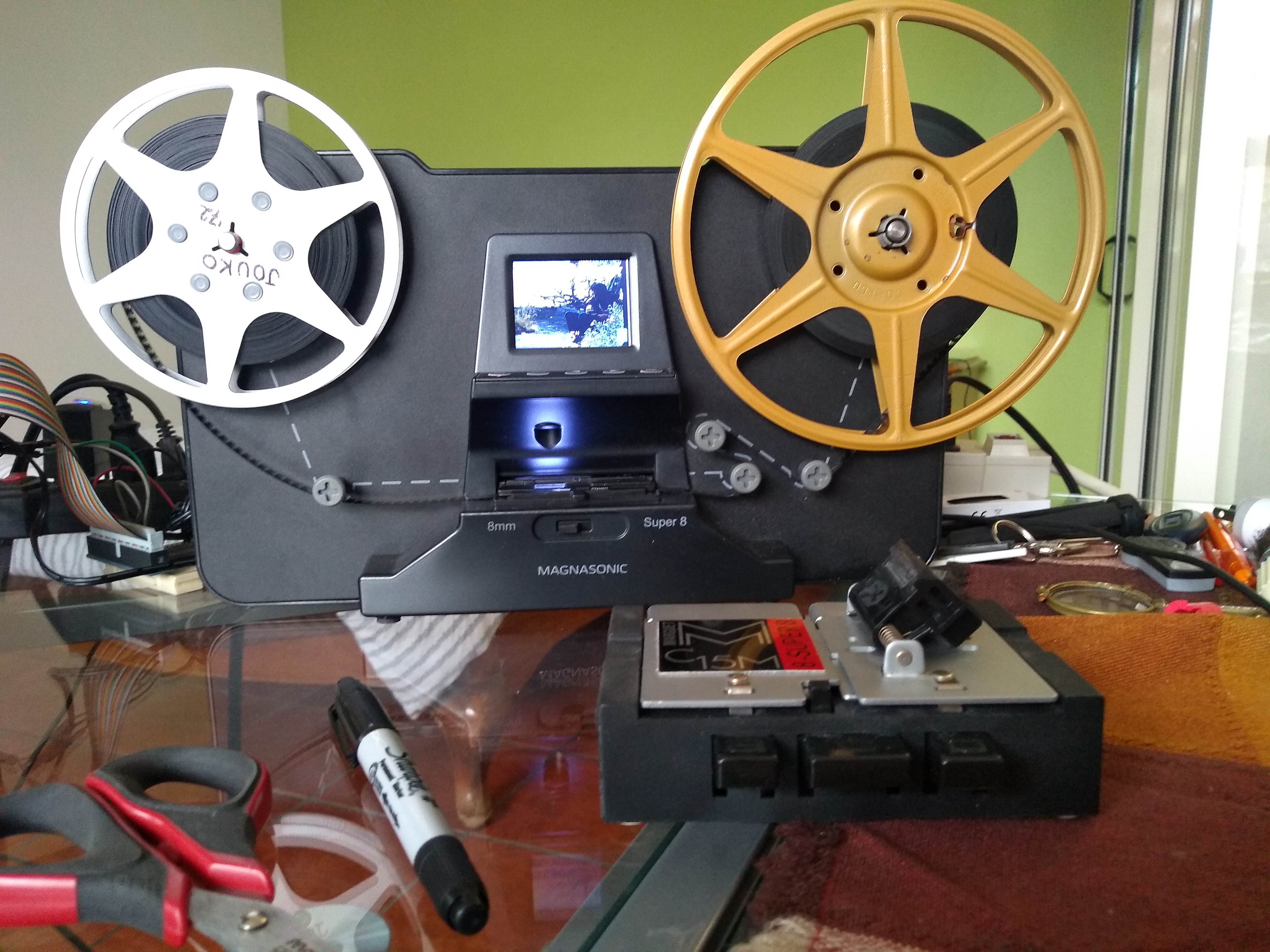
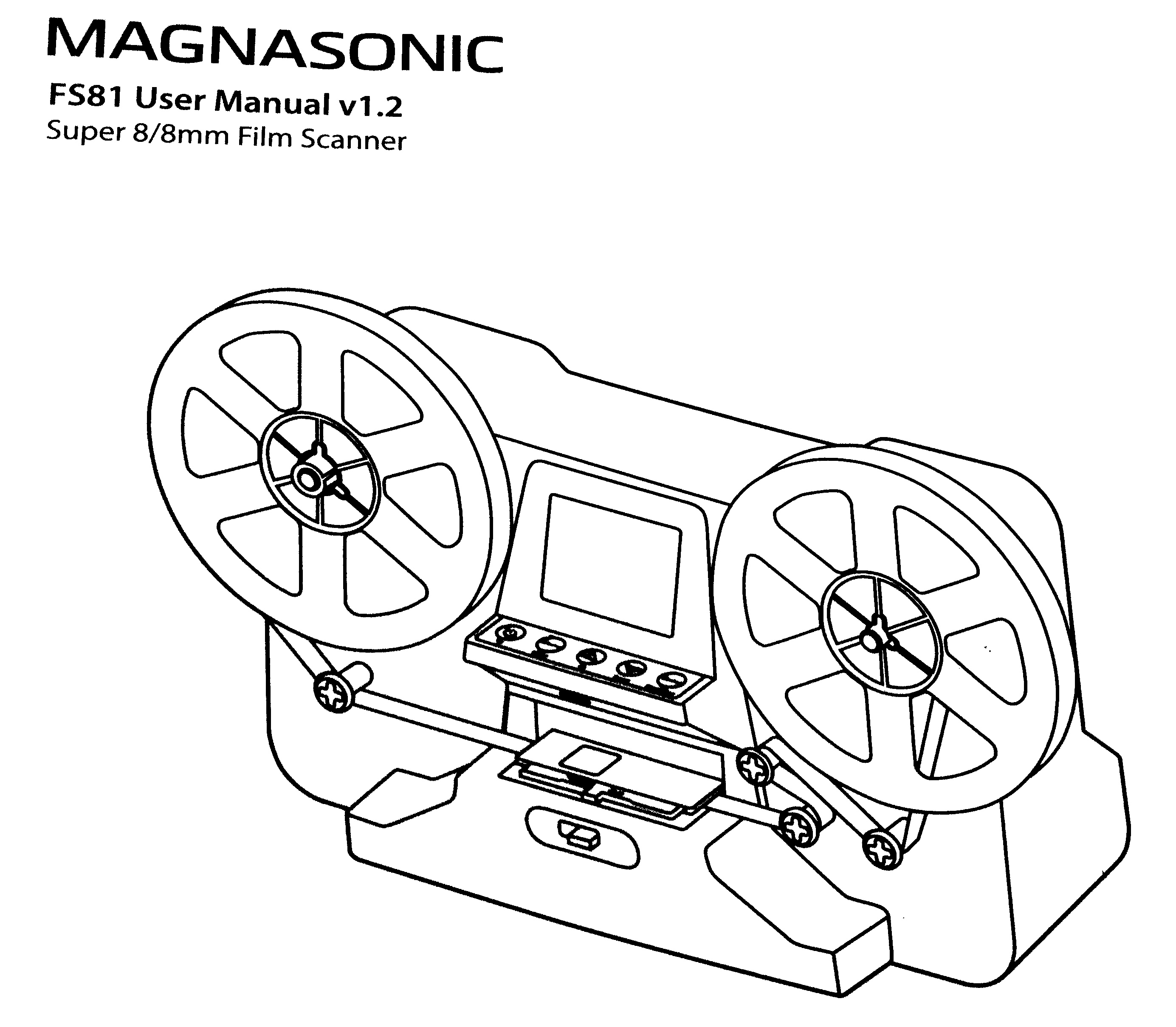
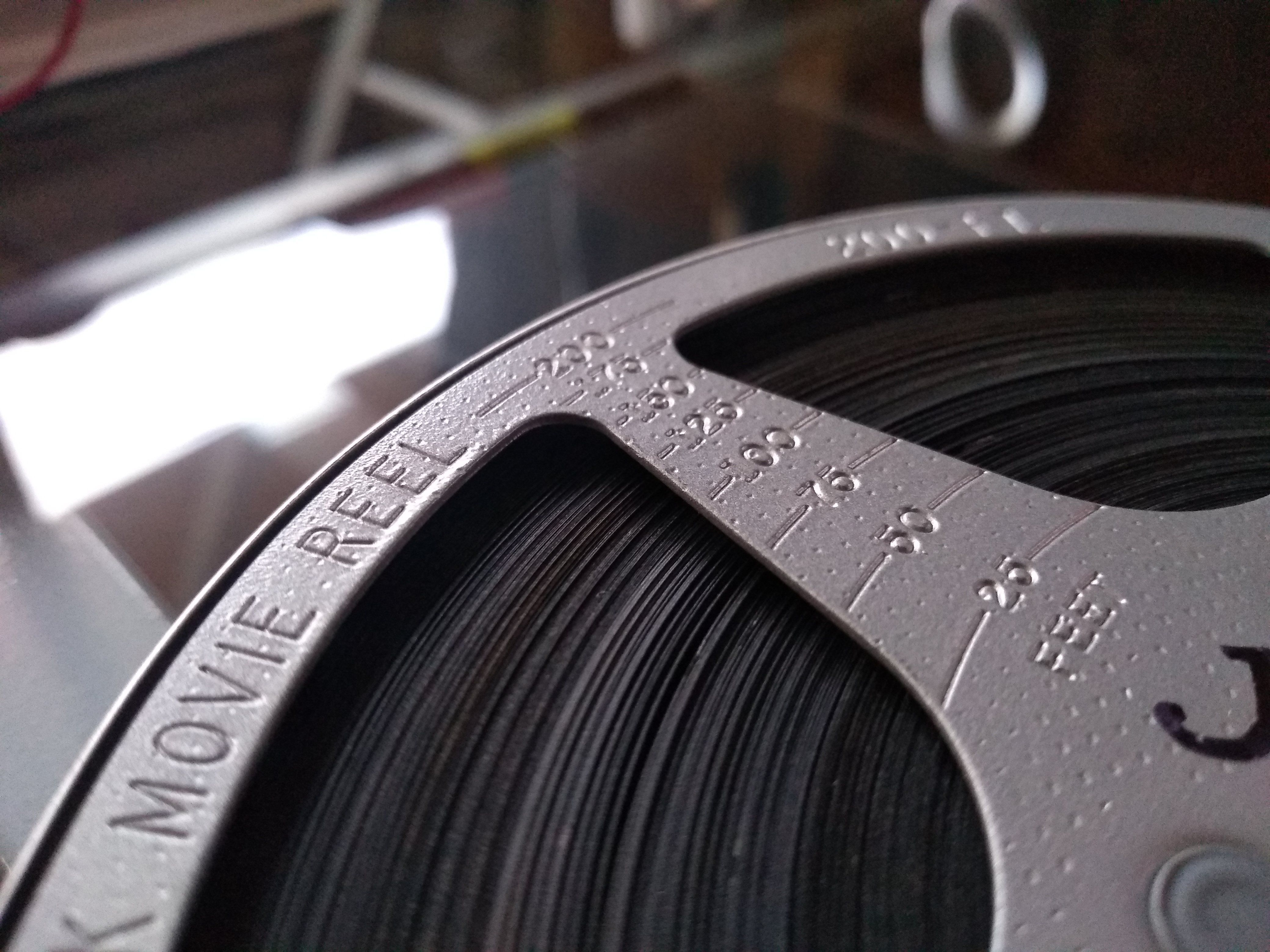
After my father passed away, I brought home most of the personal items he had, both at home and at his office. Among many, many (many, many, many) other things, I brought two of his personal treasures: His photo collection and a box with the 8mm movies he shot approximately between 1956 and 1989, when he was forced into modernity and got a portable videocassette recorder. I have talked with several friends, as I really want to get it all in a digital format, and while I ve been making slow but steady advances scanning the photo reels, I was particularly dismayed (even though it was most expected most personal electronic devices aren t meant to last over 50 years) to find out the 8mm projector was no longer in working conditions; the lamp and the fans work, but the spindles won t spin. Of course, it is quite likely it is easy to fix, but it is beyond my tinkering abilities and finding photographic equipment repair shops is no longer easy. Anyway, even if I got it fixed, filming a movie from a screen, even with a decent camera, is a lousy way to get it digitized. But almost by mere chance, I got in contact with my cousin Daniel, ho came to Mexico to visit his parents, and had precisely brought with him a 8mm/Super8 movie scanner! It is a much simpler piece of equipment than I had expected, and while it does present some minor glitches (i.e. the vertical framing slightly loses alignment over the course of a medium-length film scanning session, and no adjustment is possible while the scan is ongoing), this is something that can be decently fixed in post-processing, and a scanning session can be split with no ill effects. Anyway, it is quite uncommon a mid-length (5min) film can be done without interrupting i.e. to join a splice, mostly given my father didn t just film, but also edited a lot (this is, it s not just family pictures, but all different kinds of fiction and documentary work he did). So, Daniel lent me a great, brand new, entry-level film scanner; I rushed to scan as many movies as possible before his return to the USA this week, but he insisted he bought it to help preserve our family s memory, and given we are still several cousins living in Mexico, I could keep hold of it so any other of the cousins will find it more easily. Of course, I am thankful and delighted! So, this equipment is a Magnasonic FS81. It is entry-level, as it lacks some adjustment abilities a professional one would surely have, and I m sure a better scanner will make the job faster but it s infinitely superior to not having it! The scanner processes roughly two frames per second (while the nominal 8mm/Super8 speed is 24 frames per second), so a 3 minute film reel takes a bit over 35 minutes And a long, ~20 minute film reel takes Close to 4hr, if nothing gets in your way :- And yes, with longer reels, the probability of a splice breaking are way higher than with a short one not only because there is simply a longer film to process, but also because, both at the unwinding and at the receiving reels, mechanics play their roles. The films don t advance smoothly, but jump to position each frame in the scanner s screen, so every bit of film gets its fair share of gentle tugs. My professional consultant on how and what to do is my good friend Chema Serralde, who has stopped me from doing several things I would regret later otherwise (such as joining spliced tapes with acidic chemical adhesives such as Kola Loka, a.k.a. Krazy Glue even if it s a bit trickier to do it, he insisted me on best using simple transparent tape if I m not buying fancy things such as film-adhesive). Chema also explained me the importance of the loopers (las Lupes in his technical Spanish translation), which I feared increased the likelihood of breaking a bit of old glue due to the angle in which the film gets pulled but if skipped, result in films with too much jumping. Not all of the movies I have are for public sharing Some of them are just family movies, with high personal value, but probably of very little interest to others. But some are! I have been uploading some of the movies, after minor post-processing, to the Internet Archive. Among them: Anyway, I have a long way forward for scanning. I have 20 3min reels, 19 5min reels, and 8 20min reels. I want to check the scanning quality, but I think my 20min reels are mostly processed (we paid for scanning them some years ago). I mostly finished the 3min reels, but might have to go over some of them again due to the learning process. And Well, I m having quite a bit of fun in the process!

Russ Allbery: Review: The Amazing Maurice and His Educated Rodents

Review: The Amazing Maurice and His Educated Rodents, by Terry Pratchett
Series: Discworld #28
Publisher: HarperCollins
Copyright: 2001
Printing: 2008
ISBN: 0-06-001235-8
Format: Mass market
Pages: 351
The Amazing Maurice and His Educated Rodents is the 28th Discworld novel and the first marketed for younger readers. Although it has enough references to establish it as taking place on Discworld, it has no obvious connections with the other books and doesn't rely on any knowledge of the series so far. This would not be a bad place to start with Terry Pratchett and see if his writing style and sense of humor is for you. Despite being marketed as young adult, and despite Pratchett's comments in an afterward in the edition I own that writing YA novels is much harder, I didn't think this was that different than a typical Discworld novel. The two main human characters read as about twelve and there were some minor changes in tone, but I'm not sure I would have immediately labeled it as YA if I hadn't already known it was supposed to be. There are considerably fewer obvious pop culture references than average, though; if that's related, I think I'll prefer Pratchett's YA novels, since I think his writing is stronger when he's not playing reference bingo. Maurice (note to US readers: Maurice is pronounced "Morris" in the UK) is a talking cat and the mastermind of a wandering con job. He, a stupid-looking kid with a flute (Maurice's description), and a tribe of talking rats travel the small towns of Discworld. The rats go in first, making a show of breaking into the food, swimming in the cream, and widdling on things that humans don't want widdled on. Once the townspeople are convinced they have a plague of rats, the kid with the flute enters the town and offers to pipe the rats away for a very reasonable fee. He plays his flute, the rats swarm out of town, and they take their money and move on to the next town. It's a successful life that suits Maurice and his growing hoard of gold very well. If only the rats would stop asking pointed questions about the ethics of this scheme. The town of Bad Blintz is the next on their itinerary, and if the rats have their way, will be the last. Their hope is they've gathered enough money by now to find an island, away from humans, where they can live their own lives. But, as is always the case for one last job in fiction, there's something uncannily wrong about Bad Blintz. There are traps everywhere, more brutal and dangerous ones than they've found in any other town, and yet there is no sign of native, unintelligent rats. Meanwhile, Maurice and the boy find a town that looks wealthy but has food shortages, a bounty on rats that is absurdly high, and a pair of sinister-looking rat-catchers who are bringing in collections of rat tails that look suspiciously like bootlaces. The mayor's daughter discovers Maurice can talk and immediately decides she has to take them in hand. Malicia is very certain of her own opinions, not accustomed to taking no for an answer, and is certain that the world follows the logic of stories, even if she has to help it along. This is truly great stuff. I think this might be my favorite Discworld novel to date, although I do have some criticisms that I'll get to in a moment. The best part are the rats, and particularly the blind philosopher rat Dangerous Beans and his assistant Peaches. In the middle of daring infiltration of the trapped sewers in scenes reminiscent of Mission: Impossible, the rats are also having philosophical arguments. They've become something different than the unaltered rats that they call the keekees, but what those differences mean is harder to understand. The older rats are not happy about too many changes and think the rats should keep acting like rats. The younger ones are discovering that they're afraid of shadows because now they understand what the shadows hint at. Dangerous Beans is trying to work out a writing system so that they can keep important thoughts. One of their few guides is a children's book of talking animals, although they quickly discover that the portrayed clothing is annoyingly impractical. But as good as the rats are, Maurice is nearly as much fun in an entirely different way. He is unapologetically out for himself, streetwise and canny in a way that feels apt for a cat, gets bored and mentally wanders off in the middle of conversations, and pretends to agree with people when that's how he can get what he wants. But he also has a weird sense of loyalty and ethics that only shows up when something is truly important. It's a variation on the con man with a heart of gold, but it's a very well-done variation that weaves in a cat's impatience with and inattention to anything that doesn't directly concern them. I was laughing throughout the book. Malicia is an absolute delight, the sort of character who takes over scenes through sheer force of will, and the dumb-looking kid (whose name turns out to be Keith) is a perfect counterbalance: a laid-back, quiet boy who just wants to play his music and is almost entirely unflappable. It's such a great cast. The best part of the plot is the end. I won't spoil it, so I'll only say that Pratchett has the characters do the work on the aftermath that a lot of books skip over. He doesn't have any magical solutions for the world's problems, but he's so very good at restoring one's faith that maybe sometimes those solutions can be constructed. My one complaint with this book is that Pratchett introduces a second villain, and while there are good in-story justifications for it and it's entangled with the primary plot, he added elements of (mild) supernatural horror and evil that I thought were extraneous and unnecessary. He already had enough of a conflict set up without adding that additional element, and I think it undermined the moral complexity of the story. I would have much rather he kept the social dynamics of the town at the core of the story and used that to trigger the moments of sacrifice and philosophy that made the climax work. The Discworld books by this point have gotten very good, but each book seems to have one element like that where it felt like Pratchett took the easy way out of a plot corner or added some story element that didn't really work. I feel like the series is on the verge of having a truly great book that rises above the entire series to date, but never quite gets there. That caveat aside, I thoroughly enjoyed this and had trouble putting it down. Mrs. Frisby and the Rats of Nimh was one of my favorite books as a kid, and this reminded me of it in some good ways (enough so that I think some of the references were intentional). Great stuff. If you were to read only one Discworld book and didn't want to be confused by all the entangled plot threads and established characters, I would seriously consider making it this one. Recommended. Followed by Night Watch in publication order. There doesn't appear to be a direct plot sequel, more's the pity. Rating: 8 out of 10

30 April 2023

Junichi Uekawa: Lots of Windows dependencies in Debian Rust packages.

Lots of Windows dependencies in Debian Rust packages. As cargo tries to check even the optional dependencies exist, Debian has lots of rust packages that are not needed on Debian platforms. I would think it would be okay to have a stub that mirrors the version number but nothing else, but Debian seems to have a full copy of the packages. An alternative is to patch out the dependencies in Cargo.toml, which some packages. As a result so many packages depend on winapi package, but don't really use in our configuration. Seems like a waste of our resources to keep these around (albeit maybe a small resource).

Matthew Palmer: dev-dependencies and Rust's unused_crate_dependencies lint

I m in the process of getting super-strict about the code quality of cretrit, the comparison-revealing encryption library that underlies the queryable encryption of the Enquo project. While I m going to write a whole big thing about Rust linting in the future, I bumped across a rather gnarly problem that I thought was worth sharing separately. The problem, in short, is that the unused_crate_dependencies lint interacts badly with crates that are only needed for benchmarking, such as (in my case) criterion. Rust has a whole bucketload of lints that can help your codebase adhere to certain standards, by warning (or exploding) if the problem is detected. The unused_crate_dependencies lint, as the name suggests, gets snippy when there s a crate listed in your Cargo.toml that doesn t appear to be used anywhere. All well and good so far. However, while Rust has the ability to specify crates needed for running the testsuite (the [dev-dependencies] section of Cargo.toml) separately from crates needed for actually using this thing ([dependencies]), it doesn t have a way to specify crates needed for running the benchmarks . That is a problem when you re using something like criterion for benchmarking, because it doesn t get refered to at all in your project code it only gets used in the benchmarks. When building your codebase for running the test suite, the compiler sees that you ve specified criterion as one of your testsuite dependencies , but it never gets used in your testsuite. This causes the unused_crate_dependencies lint to lose its tiny mind, and make your build look ugly (or fail). Thankfully, the solution is very simple, once you know the trick (this could be the unofficial theme song of the entire Rust ecosystem). You need to refer to the criterion crate somewhere in the code that gets built during the testsuite. The lint tells you most of what you need to do (like most things Rust, it tries hard to be helpful), but since it s a development dependency, you need a little extra secret sauce. All you need to do is add these two lines to the bottom of your src/lib.rs (or src/main.rs for a binary crate):
#[cfg(test)]
use criterion as _;
For the less Rust-literate, this means when the build-time configuration flag test is set, import the criterion crate, but don t, like, allow it to actually be referred to . This is enough to make the lint believe that the dependency is being used, and making it only happen when the test build-time config flag is set avoids the ugliness of it trying to refer to the crate during regular builds (which would fail, because criterion is only a dev-dependency). Simple? Yes. Did it take me a lot of skull-sweat to figure out? You betcha. That s why I m writing it down even if everyone else already knows this, at least future Matt will find this post next time he trips over this problem.

29 April 2023

Russell Coker: Write a blog post in the style of Russell Coker

Feeling a bit bored I asked ChatGPT Write a blog post in the style of Russell Coker and the result is in the section below. I don t know if ChatGPT knows that the person asking the question is the same as the person being asked about. If a human had created that I d be certain that great computer scientist and writer was an attempt at flattery, for a machine I m not sure. I have not written a single book, but I expect that in some alternate universe some version of me has written several. I don t know if humans would describe my writing as being known for clarity, precision, and depth . I would not be surprised if no-one else wrote about it so I guess I m forced to read what he wrote would be a more common response. The actual article part doesn t seem to be in my style at all. Firstly it s very short at only 312 words, while I have written some short posts most of them are much longer. To find this out I did some MySQL queries to get the lengths of posts (I used this blog post as inspiration [1]). Note that multiple sequential spaces counts as multiple words.
# get post ID and word count
SELECT id, LENGTH(post_content) - LENGTH(REPLACE(REPLACE(REPLACE(REPLACE(post_content, "\r", ""), "\n", ""), "\t", ""), " ", "")) + 1 AS wordcount FROM wp_posts where post_status = 'publish' and post_type='post';
# get average word count
SELECT avg(LENGTH(post_content) - LENGTH(REPLACE(REPLACE(REPLACE(REPLACE(post_content, "\r", ""), "\n", ""), "\t", ""), " ", "")) + 1) FROM wp_posts where post_status = 'publish' and post_type='post';
# get the first posts by length
SELECT id, LENGTH(post_content) - LENGTH(REPLACE(REPLACE(REPLACE(REPLACE(post_content, "\r", ""), "\n", ""), "\t", ""), " ", "")) + 1 AS wordcount, post_content FROM wp_posts where post_status = 'publish' and post_type='post' ORDER BY wordcount limit 10;
# get a count of the posts less than 312 words
SELECT count(*) from wp_posts where (LENGTH(post_content) - LENGTH(REPLACE(REPLACE(REPLACE(REPLACE(post_content, "\r", ""), "\n", ""), "\t", ""), " ", "")) + 1) < 312 and post_status = 'publish' and post_type='post';
# get a count of all posts
select count(*) from wp_posts where post_status = 'publish' and post_type='post';
It turns out that there are 333/1521 posts that are less than 312 words and the average length is 665 words. Of the shortest posts a large portion were written before Twitter became popular and had the sort of unimportant content that Twitter is good for. It seems ironic that ChatGPT says that I'm known for "depth" and then writes a short post allegedly in my style. As for the actual content of the "post", it's not something that I greatly disagree with but it's definitely not something I'd write. If some manager or marketing person wrote something like this and asked my opinion I'd probably suppress a sigh and say it's OK for it's target market. I think that free software is better in many ways and for many reasons and that separately from the issue of merit free software is important because of the ways that it is used. We could debate various issues related to the quality of free software vs proprietary software but even people who don't believe that free software is of high quality have to admit that software that runs most mobile phones and most web servers is important. As much as I dislike Windows most desktop PCs and laptops run it so I can't claim it to be unimportant. So my first disagreement with the content is the issue of importance vs quality. One thing that ChatGPT is known for is weak arguments that appear convincing. "This diversity often leads to better software, as bugs are found and fixed faster, and new features are added more quickly" could be opposed by "the payment for proprietary software often leads to better software, as bugs are found and fixed faster, and new features are added more quickly". I think that any case where "feature of option A gives this list of good results" can be rewritten as "feature of the opposite of option A gives the same list of good results" and be equally convincing is a poor argument. Also any argument that seems to rest on "free software is all written by hobbyists" is ignoring the demands of users who need things done on a non-hobby timeframe, the many profitable companies that develop and support free software, and the employment status of a large portion of my Facebook friends (many of whom are paid for ~2000 hours a year of free software development and many more of whom have paid free software development as part of their work supporting the use of free software). Really the entire blog post it wrote seems to me like something a human might write if their boss assigned them to write about the benefits of free software, and that they would then write a new article saying the exact opposite if their boss asked them to. Finally I prefer the term "free software" to "open source software". The difference doesn't seem important to some people, but any being that doesn't know the difference won't do well at impersonating me. ChatGPT Result Hello everyone, I'm ChatGPT, and today I'm going to try my best to write a blog post in the style of the great computer scientist and writer, Russell Coker. Russell Coker is a renowned software engineer and writer, who is best known for his contributions to the Linux community, especially the Debian project. He has authored several books and articles on topics ranging from security to software engineering, and his writing style is known for its clarity, precision, and depth. So, without further ado, let's dive into the topic of this blog post, which is the importance of open-source software. Open-source software is software whose source code is available for anyone to inspect, modify, and distribute. This means that anyone can use, study, and improve the software, without any restrictions or fees. Open-source software has been around for a long time, but it has become more prevalent and important in recent years, thanks to the rise of the internet and the digital economy. Open-source software has several benefits, both for individuals and for society as a whole. One of the most significant benefits is that it fosters innovation and collaboration. When software is open-source, it means that anyone can contribute to it, which leads to a diverse range of perspectives and ideas. This diversity often leads to better software, as bugs are found and fixed faster, and new features are added more quickly. Another benefit of open-source software is that it is often more secure than proprietary software. Because the source code is available for anyone to inspect, vulnerabilities and security flaws can be found and fixed faster. This means that open-source software is often more reliable and trustworthy than proprietary software, which may have hidden backdoors or vulnerabilities that can be exploited by attackers. Open-source software is also often more cost-effective than proprietary software. Because it is free to use and distribute, organizations can save money on licensing fees and other costs associated with proprietary software. This can be particularly important for non-profit organizations or small businesses that may not have the resources to invest in expensive software licenses. In conclusion, open-source software is an important part of the digital landscape, and its benefits are numerous. Whether you are a software developer, a business owner, or an individual user, open-source software has something to offer. So, the next time you are looking for software to use, consider open-source options, and help support the collaborative and innovative spirit of the open-source community.

Simon Josefsson: How To Trust A Machine

Let s reflect on some of my recent work that started with understanding Trisquel GNU/Linux, improving transparency into apt-archives, working on reproducible builds of Trisquel, strengthening verification of apt-archives with Sigstore, and finally thinking about security device threat models. A theme in all this is improving methods to have trust in machines, or generally any external entity. While I believe that everything starts by trusting something, usually something familiar and well-known, we need to deal with misuse of that trust that leads to failure to deliver what is desired and expected from the trusted entity. How can an entity behave to invite trust? Let s argue for some properties that can be quantitatively measured, with a focus on computer software and hardware: Essentially, this boils down to: Trust, Verify and Hold Accountable. To put this dogma in perspective, it helps to understand that this approach may be harmful to human relationships (which could explain the social awkwardness of hackers), but it remains useful as a method to improve the design of computer systems, and a useful method to evaluate safety of computer systems. When a system fails some of the criteria above, we know we have more work to do to improve it. How far have we come on this journey? Through earlier efforts, we are in a fairly good situation. Richard Stallman through GNU/FSF made us aware of the importance of free software, the Reproducible/Bootstrappable build projects made us aware of the importance of verifiability, and Certificate Transparency highlighted the need for accountable signature logs leading to efforts like Sigstore for software. None of these efforts would have seen the light of day unless people wrote free software and packaged them into distributions that we can use, and built hardware that we can run it on. While there certainly exists more work to be done on the software side, with the recent amazing full-source build of Guix based on a 357-byte hand-written seed, I believe that we are closing that loop on the software engineering side. So what remains? Some inspiration for further work: Onwards and upwards, happy hacking! Update 2023-05-03: Added the Liberating property regarding free software, instead of having it be part of the Verifiability and Transparency .

28 April 2023

Enrico Zini: Handling keyboard-like devices

CNC control panel and Bluetooth pedal page turner I acquired some unusual input devices to experiment with, like a CNC control panel and a bluetooth pedal page turner. These identify and behave like a keyboard, sending nice and simple keystrokes, and can be accessed with no drivers or other special software. However, their keystrokes appear together with keystrokes from normal keyboards, which is the expected default when plugging in a keyboard, but not what I want in this case. I'd also like them to be readable via evdev and accessible by my own user. Here's the udev rule I cooked up to handle this use case:
# Handle the CNC control panel
SUBSYSTEM=="input", ENV ID_VENDOR =="04d9", ENV ID_MODEL =="1203", \
   OWNER="enrico", ENV ID_INPUT =""
# Handle the Bluetooth page turner
SUBSYSTEM=="input", ENV ID_BUS =="bluetooth", ENV LIBINPUT_DEVICE_GROUP =="*/ mac ", ENV ID_INPUT_KEYBOARD ="1" \
   OWNER="enrico", ENV ID_INPUT ="", SYMLINK+="input/by-id/bluetooth- mac -kbd"
SUBSYSTEM=="input", ENV ID_BUS =="bluetooth", ENV LIBINPUT_DEVICE_GROUP =="*/ mac ", ENV ID_INPUT_TABLET ="1" \
   OWNER="enrico", ENV ID_INPUT ="", SYMLINK+="input/by-id/bluetooth- mac -tablet"
The bluetooth device didn't have standard rules to create /dev/input/by-id/ symlinks so I added them. In my own code, I watch /dev/input/by-id with inotify to handle when devices appear or disappear. I used udevadm info /dev/input/event to see what I could use to identify the device. The Static device configuration via udev page of libinput's documentation has documentation on the various elements specific to the input subsystem Grepping rule files in /usr/lib/udev/rules.d was useful to see syntax examples. udevadm test /dev/input/event was invaluable for syntax checking and testing my rule file while working on it. Finally, this is an extract of a quick prototype Python code to read keys from the CNC control panel:
import libevdev
KEY_MAP =  
    libevdev.EV_KEY.KEY_GRAVE: "EMERGENCY",
    # InputEvent(EV_KEY, KEY_LEFTALT, 1)
    libevdev.EV_KEY.KEY_R: "CYCLE START",
    libevdev.EV_KEY.KEY_F5: "SPINDLE ON/OFF",
    # InputEvent(EV_KEY, KEY_RIGHTCTRL, 1)
    libevdev.EV_KEY.KEY_W: "REDO",
    # InputEvent(EV_KEY, KEY_LEFTALT, 1)
    libevdev.EV_KEY.KEY_N: "SINGLE STEP",
    # InputEvent(EV_KEY, KEY_LEFTCTRL, 1)
    libevdev.EV_KEY.KEY_O: "ORIGIN POINT",
    libevdev.EV_KEY.KEY_ESC: "STOP",
    libevdev.EV_KEY.KEY_KPPLUS: "SPEED UP",
    libevdev.EV_KEY.KEY_KPMINUS: "SLOW DOWN",
    libevdev.EV_KEY.KEY_F11: "F+",
    libevdev.EV_KEY.KEY_F10: "F-",
    libevdev.EV_KEY.KEY_RIGHTBRACE: "J+",
    libevdev.EV_KEY.KEY_LEFTBRACE: "J-",
    libevdev.EV_KEY.KEY_UP: "+Y",
    libevdev.EV_KEY.KEY_DOWN: "-Y",
    libevdev.EV_KEY.KEY_LEFT: "-X",
    libevdev.EV_KEY.KEY_RIGHT: "+X",
    libevdev.EV_KEY.KEY_KP7: "+A",
    libevdev.EV_KEY.KEY_Q: "-A",
    libevdev.EV_KEY.KEY_PAGEDOWN: "-Z",
    libevdev.EV_KEY.KEY_PAGEUP: "+Z",
 
class KeyReader:
    def __init__(self, path: str):
        self.path = path
        self.fd: IO[bytes]   None = None
        self.device: libevdev.Device   None = None
    def __enter__(self):
        self.fd = open(self.path, "rb")
        self.device = libevdev.Device(self.fd)
        return self
    def __exit__(self, exc_type, exc, tb):
        self.device = None
        self.fd.close()
        self.fd = None
    def events(self) -> Iterator[dict[str, Any]]:
        for e in self.device.events():
            if e.type == libevdev.EV_KEY:
                if (val := KEY_MAP.get(e.code)):
                    yield  
                        "name": val,
                        "value": e.value,
                        "sec": e.sec,
                        "usec": e.usec,
                     
Edited: added rules to handle the Bluetooth page turner

27 April 2023

Jonathan McDowell: Repurposing my C.H.I.P.

Way back at DebConf16 Gunnar managed to arrange for a number of Next Thing Co. C.H.I.P. boards to be distributed to those who were interested. I was lucky enough to be amongst those who received one, but I have to confess after some initial experimentation it ended up sitting in its box unused. The reasons for that were varied; partly about not being quite sure what best to do with it, partly due to a number of limitations it had, partly because NTC sadly went insolvent and there was less momentum around the hardware. I ve always meant to go back to it, poking it every now and then but never completing a project. I m finally almost there, and I figure I should write some of it up. TL;DR: My C.H.I.P. is currently running a mainline Linux 6.3 kernel with only a few DTS patches, an upstream u-boot v2022.1 with a couple of minor patches and an unmodified Debian bullseye armhf userspace.

Storage The main issue with the C.H.I.P. is that it uses MLC NAND, in particular mine has an 8MB H27QCG8T2E5R. That ended up unsupported in Linux, with the UBIFS folk disallowing operation on MLC devices. There s been subsequent work to enable an SLC emulation mode which makes the device more reliable at the cost of losing capacity by pairing up writes/reads in cells (AFAICT). Some of this hit for the H27UCG8T2ETR in 5.16 kernels, but I definitely did some experimentation with 5.17 without having much success. I should maybe go back and try again, but I ended up going a different route. It turned out that BytePorter had documented how to add a microSD slot to the NTC C.H.I.P., using just a microSD to full SD card adapter. Every microSD card I buy seems to come with one of these, so I had plenty lying around to test with. I started with ensuring the kernel could see it ok (by modifying the device tree), but once that was all confirmed I went further and built a more modern u-boot that talked to the SD card, and defaulted to booting off it. That meant no more relying on the internal NAND at all! I do see some flakiness with the SD card, which is possibly down to the dodgy way it s hooked up (I should probably do a basic PCB layout with JLCPCB instead). That s mostly been mitigated by forcing it into 1-bit mode instead of 4-bit mode (I tried lowering the frequency too, but that didn t make a difference). The problem manifests as:
sunxi-mmc 1c11000.mmc: data error, sending stop command
and then all storage access freezing (existing logins still work, if the program you re trying to run is in cache). I can t find a conclusive software solution to this; I m pretty sure it s the hardware, but I don t understand why the recovery doesn t generally work.

Random power offs After I had storage working I d see random hangs or power offs. It wasn t quite clear what was going on. So I started trying to work out how to find out the CPU temperature, in case it was overheating. It turns out the temperature sensor on the R8 is part of the touchscreen driver, and I d taken my usual approach of turning off all the drivers I didn t think I d need. Enabling it (CONFIG_TOUCHSCREEN_SUN4I) gave temperature readings and seemed to help somewhat with stability, though not completely. Next I ended up looking at the AXP209 PMIC. There were various scripts still installed (I d started out with the NTC Debian install and slowly upgraded it to bullseye while stripping away the obvious pieces I didn t need) and a start-up script called enable-no-limit. This turned out to not be running (some sort of expectation of i2c-dev being loaded and another failing check), but looking at the script and the data sheet revealed the issue. The AXP209 can cope with 3 power sources; an external DC source, a Li-battery, and finally a USB port. I was powering my board via the USB port, using a charger rated for 2A. It turns out that the AXP209 defaults to limiting USB current to 900mA, and that with wifi active and the CPU busy the C.H.I.P. can rise above that. At which point the AXP shuts everything down. Armed with that info I was able to understand what the power scripts were doing and which bit I needed - i2cset -f -y 0 0x34 0x30 0x03 to set no limit and disable the auto-power off. Additionally I also discovered that the AXP209 had a built in temperature sensor as well, so I added support for that via iio-hwmon.

WiFi WiFi on the C.H.I.P. is provided by an RTL8723BS SDIO attached device. It s terrible (and not just here, I had an x86 based device with one where it also sucked). Thankfully there s a driver in staging in the kernel these days, but I ve still found it can fall out with my house setup, end up connecting to a further away AP which then results in lots of retries, dropped frames and CPU consumption. Nailing it to the AP on the other side of the wall from where it is helps. I haven t done any serious testing with the Bluetooth other than checking it s detected and can scan ok.

Patches I patched u-boot v2022.01 (which shows you how long ago I was trying this out) with the following to enable boot from external SD:
u-boot C.H.I.P. external SD patch
diff --git a/arch/arm/dts/sun5i-r8-chip.dts b/arch/arm/dts/sun5i-r8-chip.dts
index 879a4b0f3b..1cb3a754d6 100644
--- a/arch/arm/dts/sun5i-r8-chip.dts
+++ b/arch/arm/dts/sun5i-r8-chip.dts
@@ -84,6 +84,13 @@
 		reset-gpios = <&pio 2 19 GPIO_ACTIVE_LOW>; /* PC19 */
 	 ;
 
+	mmc2_pins_e: mmc2@0  
+		pins = "PE4", "PE5", "PE6", "PE7", "PE8", "PE9";
+		function = "mmc2";
+		drive-strength = <30>;
+		bias-pull-up;
+	 ;
+
 	onewire  
 		compatible = "w1-gpio";
 		gpios = <&pio 3 2 GPIO_ACTIVE_HIGH>; /* PD2 */
@@ -175,6 +182,16 @@
 	status = "okay";
  ;
 
+&mmc2  
+	pinctrl-names = "default";
+	pinctrl-0 = <&mmc2_pins_e>;
+	vmmc-supply = <&reg_vcc3v3>;
+	vqmmc-supply = <&reg_vcc3v3>;
+	bus-width = <4>;
+	broken-cd;
+	status = "okay";
+ ;
+
 &ohci0  
 	status = "okay";
  ;
diff --git a/arch/arm/include/asm/arch-sunxi/gpio.h b/arch/arm/include/asm/arch-sunxi/gpio.h
index f3ab1aea0e..c0dfd85a6c 100644
--- a/arch/arm/include/asm/arch-sunxi/gpio.h
+++ b/arch/arm/include/asm/arch-sunxi/gpio.h
@@ -167,6 +167,7 @@ enum sunxi_gpio_number  
 
 #define SUN8I_GPE_TWI2		3
 #define SUN50I_GPE_TWI2		3
+#define SUNXI_GPE_SDC2		4
 
 #define SUNXI_GPF_SDC0		2
 #define SUNXI_GPF_UART0		4
diff --git a/board/sunxi/board.c b/board/sunxi/board.c
index fdbcd40269..f538cb7e20 100644
--- a/board/sunxi/board.c
+++ b/board/sunxi/board.c
@@ -433,9 +433,9 @@ static void mmc_pinmux_setup(int sdc)
 			sunxi_gpio_set_drv(pin, 2);
 		 
 #elif defined(CONFIG_MACH_SUN5I)
-		/* SDC2: PC6-PC15 */
-		for (pin = SUNXI_GPC(6); pin <= SUNXI_GPC(15); pin++)  
-			sunxi_gpio_set_cfgpin(pin, SUNXI_GPC_SDC2);
+		/* SDC2: PE4-PE9 */
+		for (pin = SUNXI_GPE(4); pin <= SUNXI_GPE(9); pin++)  
+			sunxi_gpio_set_cfgpin(pin, SUNXI_GPE_SDC2);
 			sunxi_gpio_set_pull(pin, SUNXI_GPIO_PULL_UP);
 			sunxi_gpio_set_drv(pin, 2);
 		 

I ve sent some patches for the kernel device tree upstream - there s an outstanding issue with the Bluetooth wake GPIO causing the serial port not to probe(!) that I need to resolve before sending a v2, but what s there works for me. The only remaining piece is patch to enable the external SD for Linux; I don t think it s appropriate to send upstream but it s fairly basic. This limits the bus to 1 bit rather than the 4 bits it s capable of, as mentioned above.
Linux C.H.I.P. external SD DTS patch diff diff --git a/arch/arm/boot/dts/sun5i-r8-chip.dts b/arch/arm/boot/dts/sun5i-r8-chip.dts index fd37bd1f3920..2b5aa4952620 100644 --- a/arch/arm/boot/dts/sun5i-r8-chip.dts +++ b/arch/arm/boot/dts/sun5i-r8-chip.dts @@ -163,6 +163,17 @@ &mmc0 status = "okay"; ; +&mmc2 + pinctrl-names = "default"; + pinctrl-0 = <&mmc2_4bit_pe_pins>; + vmmc-supply = <&reg_vcc3v3>; + vqmmc-supply = <&reg_vcc3v3>; + bus-width = <1>; + non-removable; + disable-wp; + status = "okay"; + ; + &ohci0 status = "okay"; ;

As for what I m doing with it, I think that ll have to be a separate post.

Arturo Borrero Gonz lez: Kubecon and CloudNativeCon 2023 Europe summary

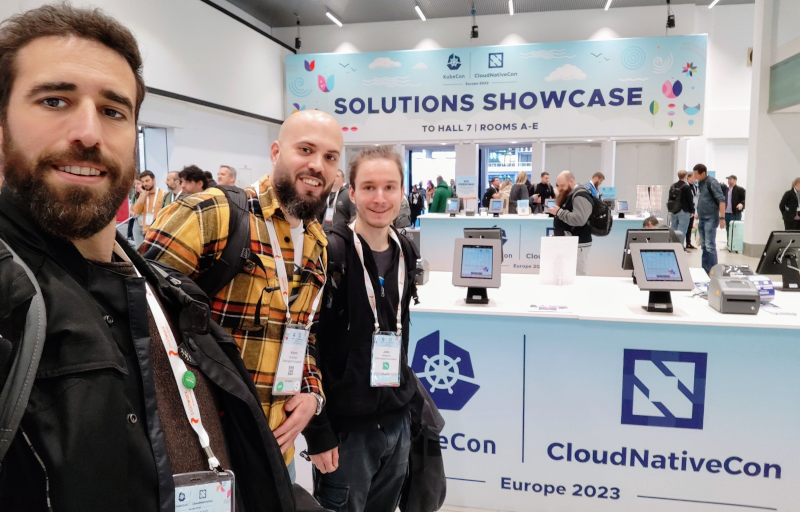
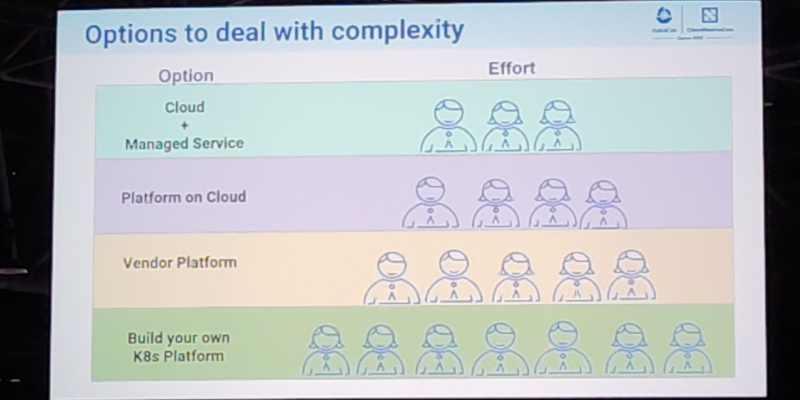
Post logo This post serves as a report from my attendance to Kubecon and CloudNativeCon 2023 Europe that took place in Amsterdam in April 2023. It was my second time physically attending this conference, the first one was in Austin, Texas (USA) in 2017. I also attended once in a virtual fashion. The content here is mostly generated for the sake of my own recollection and learnings, and is written from the notes I took during the event. The very first session was the opening keynote, which reunited the whole crowd to bootstrap the event and share the excitement about the days ahead. Some astonishing numbers were announced: there were more than 10.000 people attending, and apparently it could confidently be said that it was the largest open source technology conference taking place in Europe in recent times. It was also communicated that the next couple iteration of the event will be run in China in September 2023 and Paris in March 2024. More numbers, the CNCF was hosting about 159 projects, involving 1300 maintainers and about 200.000 contributors. The cloud-native community is ever-increasing, and there seems to be a strong trend in the industry for cloud-native technology adoption and all-things related to PaaS and IaaS. The event program had different tracks, and in each one there was an interesting mix of low-level and higher level talks for a variety of audience. On many occasions I found that reading the talk title alone was not enough to know in advance if a talk was a 101 kind of thing or for experienced engineers. But unlike in previous editions, I didn t have the feeling that the purpose of the conference was to try selling me anything. Obviously, speakers would make sure to mention, or highlight in a subtle way, the involvement of a given company in a given solution or piece of the ecosystem. But it was non-invasive and fair enough for me. On a different note, I found the breakout rooms to be often small. I think there were only a couple of rooms that could accommodate more than 500 people, which is a fairly small allowance for 10k attendees. I realized with frustration that the more interesting talks were immediately fully booked, with people waiting in line some 45 minutes before the session time. Because of this, I missed a few important sessions that I ll hopefully watch online later. Finally, on a more technical side, I ve learned many things, that instead of grouping by session I ll group by topic, given how some subjects were mentioned in several talks. On gitops and CI/CD pipelines Most of the mentions went to FluxCD and ArgoCD. At that point there were no doubts that gitops was a mature approach and both flux and argoCD could do an excellent job. ArgoCD seemed a bit more over-engineered to be a more general purpose CD pipeline, and flux felt a bit more tailored for simpler gitops setups. I discovered that both have nice web user interfaces that I wasn t previously familiar with. However, in two different talks I got the impression that the initial setup of them was simple, but migrating your current workflow to gitops could result in a bumpy ride. This is, the challenge is not deploying flux/argo itself, but moving everything into a state that both humans and flux/argo can understand. I also saw some curious mentions to the config drifts that can happen in some cases, even if the goal of gitops is precisely for that to never happen. Such mentions were usually accompanied by some hints on how to operate the situation by hand. Worth mentioning, I missed any practical information about one of the key pieces to this whole gitops story: building container images. Most of the showcased scenarios were using pre-built container images, so in that sense they were simple. Building and pushing to an image registry is one of the two key points we would need to solve in Toolforge Kubernetes if adopting gitops. In general, even if gitops were already in our radar for Toolforge Kubernetes, I think it climbed a few steps in my priority list after the conference. Another learning was this site: https://opengitops.dev/. Group On etcd, performance and resource management I attended a talk focused on etcd performance tuning that was very encouraging. They were basically talking about the exact same problems we have had in Toolforge Kubernetes, like api-server and etcd failure modes, and how sensitive etcd is to disk latency, IO pressure and network throughput. Even though Toolforge Kubernetes scale is small compared to other Kubernetes deployments out there, I found it very interesting to see other s approaches to the same set of challenges. I learned how most Kubernetes components and apps can overload the api-server. Because even the api-server talks to itself. Simple things like kubectl may have a completely different impact on the API depending on usage, for example when listing the whole list of objects (very expensive) vs a single object. The conclusion was to try avoiding hitting the api-server with LIST calls, and use ResourceVersion which avoids full-dumps from etcd (which, by the way, is the default when using bare kubectl get calls). I already knew some of this, and for example the jobs-framework-emailer was already making use of this ResourceVersion functionality. There have been a lot of improvements in the performance side of Kubernetes in recent times, or more specifically, in how resources are managed and used by the system. I saw a review of resource management from the perspective of the container runtime and kubelet, and plans to support fancy things like topology-aware scheduling decisions and dynamic resource claims (changing the pod resource claims without re-defining/re-starting the pods). On cluster management, bootstrapping and multi-tenancy I attended a couple of talks that mentioned kubeadm, and one in particular was from the maintainers themselves. This was of interest to me because as of today we use it for Toolforge. They shared all the latest developments and improvements, and the plans and roadmap for the future, with a special mention to something they called kubeadm operator , apparently capable of auto-upgrading the cluster, auto-renewing certificates and such. I also saw a comparison between the different cluster bootstrappers, which to me confirmed that kubeadm was the best, from the point of view of being a well established and well-known workflow, plus having a very active contributor base. The kubeadm developers invited the audience to submit feature requests, so I did. The different talks confirmed that the basic unit for multi-tenancy in kubernetes is the namespace. Any serious multi-tenant usage should leverage this. There were some ongoing conversations, in official sessions and in the hallway, about the right tool to implement K8s-whitin-K8s, and vcluster was mentioned enough times for me to be convinced it was the right candidate. This was despite of my impression that multiclusters / multicloud are regarded as hard topics in the general community. I definitely would like to play with it sometime down the road. On networking I attended a couple of basic sessions that served really well to understand how Kubernetes instrumented the network to achieve its goal. The conference program had sessions to cover topics ranging from network debugging recommendations, CNI implementations, to IPv6 support. Also, one of the keynote sessions had a reference to how kube-proxy is not able to perform NAT for SIP connections, which is interesting because I believe Netfilter Conntrack could do it if properly configured. One of the conclusions on the CNI front was that Calico has a massive community adoption (in Netfilter mode), which is reassuring, especially considering it is the one we use for Toolforge Kubernetes. Slide On jobs I attended a couple of talks that were related to HPC/grid-like usages of Kubernetes. I was truly impressed by some folks out there who were using Kubernetes Jobs on massive scales, such as to train machine learning models and other fancy AI projects. It is acknowledged in the community that the early implementation of things like Jobs and CronJobs had some limitations that are now gone, or at least greatly improved. Some new functionalities have been added as well. Indexed Jobs, for example, enables each Job to have a number (index) and process a chunk of a larger batch of data based on that index. It would allow for full grid-like features like sequential (or again, indexed) processing, coordination between Job and more graceful Job restarts. My first reaction was: Is that something we would like to enable in Toolforge Jobs Framework? On policy and security A surprisingly good amount of sessions covered interesting topics related to policy and security. It was nice to learn two realities:
  1. kubernetes is capable of doing pretty much anything security-wise and create greatly secured environments.
  2. it does not by default. The defaults are not security-strict on purpose.
It kind of made sense to me: Kubernetes was used for a wide range of use cases, and developers didn t know beforehand to which particular setup they should accommodate the default security levels. One session in particular covered the most basic security features that should be enabled for any Kubernetes system that would get exposed to random end users. In my opinion, the Toolforge Kubernetes setup was already doing a good job in that regard. To my joy, some sessions referred to the Pod Security Admission mechanism, which is one of the key security features we re about to adopt (when migrating away from Pod Security Policy). I also learned a bit more about Secret resources, their current implementation and how to leverage a combo of CSI and RBAC for a more secure usage of external secrets. Finally, one of the major takeaways from the conference was learning about kyverno and kubeaudit. I was previously aware of the OPA Gatekeeper. From the several demos I saw, it was to me that kyverno should help us make Toolforge Kubernetes more sustainable by replacing all of our custom admission controllers with it. I already opened a ticket to track this idea, which I ll be proposing to my team soon. Final notes In general, I believe I learned many things, and perhaps even more importantly I re-learned some stuff I had forgotten because of lack of daily exposure. I m really happy that the cloud native way of thinking was reinforced in me, which I still need because most of my muscle memory to approach systems architecture and engineering is from the old pre-cloud days. List of sessions I attended on the first day: List of sessions I attended on the second day: List of sessions I attended on third day: The videos have been published on Youtube.

25 April 2023

B lint R czey: Improve build time of Rust, Java and Intel Fortran projects with Firebuild s new release!

Rust is a hugely popular compiled programming language and accelerating it was an important goal for Firebuild for some time. Firebuild s v0.8.0 release finally added Rust support in addition to numerous other improvements including support for Doxygen, Intel s Fortran compiler and restored javac and javadoc acceleration.

Firebuild s Rust + Cargo support Firebuild treats programs as black boxes intercepting C standard library calls and system calls. It shortcuts the program invocations that predictably generate the same outputs because the program itself is known to be deterministic and all inputs are known in advance. Rust s compiler, rustc is deterministic in itself and simple rustc invocations were already accelerated, but parallel builds driven by Cargo needed a few enhancements in Firebuild.

Cargo s jobserver Cargo uses the Rust variant of the GNU Make s jobserver to control the parallelism in a build. The jobserver creates a file descriptor from which descendant processes can read tokens and are allowed to run one extra thread or parallel process per token received. After the extra threads or processes are finished the tokens must be returned by writing to the other file descriptor the jobserver created. The jobserver s file descriptors are shared with the descendant processes via environment variables:
# rustc's environment variables
...
CARGO_MAKEFLAGS="-j --jobserver-fds=4,5 --jobserver-auth=4,5"
...
Since getting tokens from the jobserver involves reading them as nondeterministic bytes from an inherited file descriptor this is clearly an operation that would depend on input not known in advance. Firebuild needs to make an exception and ignore jobserver usage related reads and writes since they are not meant to change the build results. However, there are programs not caring at all about jobservers and their file descriptors. They happily close the inherited file descriptors and open new ones with the same id, to use them for entirely different purposes. One such program is the widely used ./configure script, thus the case is far from being theoretical. To stay on the safe side firebuild ignores jobserver fd usage only in programs which are known to use the jobserver properly. The list of the programs is now configurable in /etc/firebuild.conf and since rustc is on the list by default parallel Rust builds are accelerated out of the box!

Writable dependency dir The other issue that prevented highly accelerated Rust builds was rustc s -L dependency=<dir> parameter. This directory is populated in a not fully deterministic order in parallel builds. Firebuild on the other hand hashes directory listings of open()-ed directories treating them as inputs assuming that the directory content will influence the intercepted programs outputs. As rustc programs started in parallel scanned the dependency directory in different states depending on what other Rust compilations finished already Firebuild had to store the full directory content as an input for each rustc cache entry resulting low hit rate when rustc was started again with otherwise identical inputs. The solution here is ignoring rustc scanning the dependency directory, because the dependencies actually used are still treated as input and are checked when shortcutting rustc. With that implemented in firebuild, too, librsvg s build that uses Rust and Cargo can be accelerated by more than 90%, even on a system having 12 cores/24 threads!:
Firebuild accelerating librsvg s Rust + Cargo build from 38s to 2.8s on a Ryzen 5900X (12C/24T) system

On the way to accelerate anything Firebuild s latest release incorporated more than 100 changes just from the last two months. They unlocked acceleration of Rust builds with Cargo, fixed Firebuild to work with the latest Java update that slightly changed its behavior, started accelerating Intel s Fortran compiler in addition to accelerating gfortran that was already supported and included many smaller changes improving the acceleration of other compilers and tools. If your favorite toolchain is not mentioned, there is still a good chance that it is already supported. Give Firebuild a try and tell us about your experience! Update 1: Comparison to sccache came up in the reddit topic about Firebuild s Rust acceleration , thus by popular demand this is how sccache performs on the same project:
Firebuild 0.8.0 vs. sccache 0.4.2 accelerating librsvg s Rust + Cargo build
All builds took place on the same Ryzen 5900X system with 12 cores / 24 threads in LXC containers limited to using 1-12 virtual CPUs. A warm-up build took place before the vanilla (without any instrumentation) build to download and compile the dependency crates to measure only the project s build time. A git clean command cleared all the build artifacts from the project directory before each build and ./autogen.sh was run to measure only clean rebuilds (without autotools). See test configuration in the Firebuild performance test repository for more details and easy reproduction. Firebuild had lower overhead than sccache (2.83% vs. 6.10% on 1 CPU and 7.71% vs. 22.05% on 12 CPUs) and made the accelerated build finish much faster (2.26% vs. 19.41% of vanilla build s time on 1 CPU and 7.5% vs. 27.4% of vanilla build s time on 12 CPUs).

24 April 2023

Jonathan Dowland: Separate hledgers

In a previous blog post I described the use of virtual postings to track accidental personal/family expenses. I've always been uncomfortable with that, and in hledger 1yr I outlined a potential scheme for finally addressing the virtual posting problem. separate journals My outline built on top of continuing to maintain both personal and family financial data in the same place, but I've decided that this can't work, because the different "directions" (or signs) of accidental transactions originating from either the family or personal side can't be addressed with any kind of alternate view on the same data. To illustrate with an example. A negative balance in family:liabilities:jon means "family owes jon". A coffee bought by mistake on the family credit card will have a negative posting on the credit card, and thus a positive one on the liabilities account. ("jon owes family"). That's fine. But what about when I buy family stuff on a personal card? The other side of of the transaction is also going to have a positive sign, so it can't be posted to family:liabilities:jon: it would have to go to somewhere else, like jon:liabilities:family. Now I have two accounts which track versions of the same thing, and they cannot be combined with a simple transaction since they're looking at the same value from opposite directions (and signs). Back when I first described the problem I was using a single journal file for all my transactions. After moving to lots of separate journal files (in hledger 1yr), it's become clearer to me that I don't need to maintain the Family and Personal data together, at all: they can be entirely separate journals. getting data between journals When I moved to a new set of ledger files for 2023, I needed to carry forward the balances from 2022 in the form of "opening balance" transactions. This was achieved by a report on the 2022 data, exported as CSV, and imported into the 2023 data (all following the scheme outlined by fully-fledged hledger.)) Separate Personal and Family journals need some information from each other, and I can achieve that in the same way as for opening balances: with an export of the relevant transactions as CSV, then imported on the other side. HLedger's CSV import system is flexible enough that we can effectively invert the sign of liabilities, addressing the problem above. Worked example We start with an accidental coffee purchased on the family card (and so this belongs to the Family ledger)
2022-08-20 coffee
    liabilities:creditcard             -3
    liabilities:jon:expenses:coffee     3
I've encoded the expense category that the Personal ledger will be interested in (the last bit, expenses:coffee) as a sub-account of the liabilities category that the Family ledger is interested in1 (the first bit, liabilities:jon). When viewed on the Family side, the expense category is not interesting, and we can hide it with HLedger's alias feature2:
    alias /^liabilities:jon(.*)$/ = liabilities:jon
It then looks like this from the Family side:
2022-08-20 coffee
    liabilities:creditcard             -3
    liabilities:jon                     3
This transaction (and others like it) are exported via
hledger reg -f family/2023-back.journal liabilities:jon: -O csv \
        jon/import/family/liabilities.csv
(The trailing colon on liabilities:jon: is important here!) In the resulting CSV file, the running example transaction looks like
"55","2022-08-20","","coffee","liabilities:jon:expenses:coffee","  3.00","  3.00"
This is then converted into a journal file by hledger import. The rules file for the import is very simple: the fields date, description, account1 and amount are taken as-is; account2 is hard-coded to liabilities:family. The resulting transaction looks like
2022-08-20 coffee
    liabilities:jon:expenses:coffee     3
    liabilities:family                 -3
Before this journal is included by the main one, we have to adjust the expense account, to remove the liabilities:jon: prefix. The import rules can't do this3 , so we use another journal file as a go-between with another alias rule:
    alias /^liabilities.jon:/ =
This results, finally, in the following transaction in the Personal ledger:
2022-08-20 coffee
    expenses:coffee                     3
    liabilities:family                 -3
avoiding double-counting There's one set of transactions that we don't want to export across this divide, and that's because they're already there: any time I transfer money from myself to the family accounts (or vice versa) to address the accrued debt, the transaction is visible from both my family and personal statements. To avoid exporting these and double-counting them, I make sure those transactions don't post to an account matching the pattern used in the hledger reg report. That's what the trailing colon is for: It ensures I only export transactions which are to a sub-account of liabilities:jon, and not to the root account liabilities:jon itself: which is where I put the repayment transactions. I could instead use a more explicit sub-account like liabilities:jon:repayments or similar, since the trailing colon is quite subtle, but this works for me. Wrap up I've been really on the fence as to whether the complexity of this scheme is worth it to avoid the virtual postings. The previous scheme was much simpler. I have definitely made some mistakes with it, which didn't get caught by the double-entry rules that virtual postings ignore, but they're for small sums of money anyway. On the other hand, a lot of the "machinery" of this already existed for getting opening balances between calendar years, and the gory details are written down and hidden inside the Makefile. I also expect that I will continue to see advantages in having Family and Personal entirely separate, as they can each develop and adapt to their own needs without having to consider the other side of things every time. It's a running experiment, and time will tell if it's a good idea.

  1. This scheme was originally suggested to me by Pranesh on Twitter (described in dues), but I discounted it at the time because of the exact arrangement they suggested, not realising the broader idea might work.
  2. I've hand-waved one problem with using hledger aliases here. If we use them as described, to hide the Personal expense details, we need them to not be applied when performing the CSV-generating report. Therefore, in practise I have them in a front-most family/2023.journal file, which imports the data from another family/2023-back.journal, and the CSV export is performed on the backing journal with the data and not the alias.
  3. HLedger import rules can't manipulate the fields from the CSV a great deal, but one change I proposed and started hacking on would allow for this: to expose Regexp match-groups as interpolatable tokens: https://github.com/simonmichael/hledger/issues/2009.

23 April 2023

Petter Reinholdtsen: Speech to text, she APTly whispered, how hard can it be?

While visiting a convention during Easter, it occurred to me that it would be great if I could have a digital Dictaphone with transcribing capabilities, providing me with texts to cut-n-paste into stuff I need to write. The background is that long drives often bring up the urge to write on texts I am working on, which of course is out of the question while driving. With the release of OpenAI Whisper, this seem to be within reach with Free Software, so I decided to give it a go. OpenAI Whisper is a Linux based neural network system to read in audio files and provide text representation of the speech in that audio recording. It handle multiple languages and according to its creators even can translate into a different language than the spoken one. I have not tested the latter feature. It can either use the CPU or a GPU with CUDA support. As far as I can tell, CUDA in practice limit that feature to NVidia graphics cards. I have few of those, as they do not work great with free software drivers, and have not tested the GPU option. While looking into the matter, I did discover some work to provide CUDA support on non-NVidia GPUs, and some work with the library used by Whisper to port it to other GPUs, but have not spent much time looking into GPU support yet. I've so far used an old X220 laptop as my test machine, and only transcribed using its CPU. As it from a privacy standpoint is unthinkable to use computers under control of someone else (aka a "cloud" service) to transcribe ones thoughts and personal notes, I want to run the transcribing system locally on my own computers. The only sensible approach to me is to make the effort I put into this available for any Linux user and to upload the needed packages into Debian. Looking at Debian Bookworm, I discovered that only three packages were missing, tiktoken, triton, and openai-whisper. For a while I also believed ffmpeg-python was needed, but as its upstream seem to have vanished I found it safer to rewrite whisper to stop depending on in than to introduce ffmpeg-python into Debian. I decided to place these packages under the umbrella of the Debian Deep Learning Team, which seem like the best team to look after such packages. Discussing the topic within the group also made me aware that the triton package was already a future dependency of newer versions of the torch package being planned, and would be needed after Bookworm is released. All required code packages have been now waiting in the Debian NEW queue since Wednesday, heading for Debian Experimental until Bookworm is released. An unsolved issue is how to handle the neural network models used by Whisper. The default behaviour of Whisper is to require Internet connectivity and download the model requested to ~/.cache/whisper/ on first invocation. This obviously would fail the deserted island test of free software as the Debian packages would be unusable for someone stranded with only the Debian archive and solar powered computer on a deserted island. Because of this, I would love to include the models in the Debian mirror system. This is problematic, as the models are very large files, which would put a heavy strain on the Debian mirror infrastructure around the globe. The strain would be even higher if the models change often, which luckily as far as I can tell they do not. The small model, which according to its creator is most useful for English and in my experience is not doing a great job there either, is 462 MiB (deb is 414 MiB). The medium model, which to me seem to handle English speech fairly well is 1.5 GiB (deb is 1.3 GiB) and the large model is 2.9 GiB (deb is 2.6 GiB). I would assume everyone with enough resources would prefer to use the large model for highest quality. I believe the models themselves would have to go into the non-free part of the Debian archive, as they are not really including any useful source code for updating the models. The "source", aka the model training set, according to the creators consist of "680,000 hours of multilingual and multitask supervised data collected from the web", which to me reads material with both unknown copyright terms, unavailable to the general public. In other words, the source is not available according to the Debian Free Software Guidelines and the model should be considered non-free. I asked the Debian FTP masters for advice regarding uploading a model package on their IRC channel, and based on the feedback there it is still unclear to me if such package would be accepted into the archive. In any case I wrote build rules for a OpenAI Whisper model package and modified the Whisper code base to prefer shared files under /usr/ and /var/ over user specific files in ~/.cache/whisper/ to be able to use these model packages, to prepare for such possibility. One solution might be to include only one of the models (small or medium, I guess) in the Debian archive, and ask people to download the others from the Internet. Not quite sure what to do here, and advice is most welcome (use the debian-ai mailing list). To make it easier to test the new packages while I wait for them to clear the NEW queue, I created an APT source targeting bookworm. I selected Bookworm instead of Bullseye, even though I know the latter would reach more users, is that some of the required dependencies are missing from Bullseye and I during this phase of testing did not want to backport a lot of packages just to get up and running. Here is a recipe to run as user root if you want to test OpenAI Whisper using Debian packages on your Debian Bookworm installation, first adding the APT repository GPG key to the list of trusted keys, then setting up the APT repository and finally installing the packages and one of the models:
curl https://geekbay.nuug.no/~pere/openai-whisper/D78F5C4796F353D211B119E28200D9B589641240.asc \
  -o /etc/apt/trusted.gpg.d/pere-whisper.asc
mkdir -p /etc/apt/sources.list.d
cat > /etc/apt/sources.list.d/pere-whisper.list <<EOF
deb https://geekbay.nuug.no/~pere/openai-whisper/ bookworm main
deb-src https://geekbay.nuug.no/~pere/openai-whisper/ bookworm main
EOF
apt update
apt install openai-whisper
The package work for me, but have not yet been tested on any other computer than my own. With it, I have been able to (badly) transcribe a 2 minute 40 second Norwegian audio clip to test using the small model. This took 11 minutes and around 2.2 GiB of RAM. Transcribing the same file with the medium model gave a accurate text in 77 minutes using around 5.2 GiB of RAM. My test machine had too little memory to test the large model, which I believe require 11 GiB of RAM. In short, this now work for me using Debian packages, and I hope it will for you and everyone else once the packages enter Debian. Now I can start on the audio recording part of this project. As usual, if you use Bitcoin and want to show your support of my activities, please send Bitcoin donations to my address 15oWEoG9dUPovwmUL9KWAnYRtNJEkP1u1b.

20 April 2023

Dirk Eddelbuettel: qlcal 0.0.5 on CRAN: Updates from QuantLib 1.3.0

The fifth release of the still new-ish qlcal package arrivied at CRAN just now. qlcal delivers the calendaring parts of QuantLib. It is provided (for the R package) as a set of included files, so the package is self-contained and does not depend on an external QuantLib library (which can be demanding to build). qlcal covers over sixty country / market calendars and can compute holiday lists, its complement (i.e. business day lists) and much more. This release brings updates to five calendars from the QuantLib 1.30 release from this week.

Changes in version 0.0.5 (2023-04-19)
  • Calendars routines for Australia, Denmark, New Zealand, Turkey and the US have been updated from QuantLib 1.30.
  • Support for 'Australia/ASX' has been added.
  • Added demo showing all US holidays in current year

We also added a quick little demo using xts to column-bind calendars produced from each of the different US sub-calendars. This is a slightly updated version of the sketch we tooted a few days ago. The output now is
> print(Reduce(cbind, Map(makeHol, cals)))
           LiborImpact NYSE GovernmentBond NERC FederalReserve
2023-01-02        TRUE TRUE           TRUE TRUE           TRUE
2023-01-16        TRUE TRUE           TRUE   NA           TRUE
2023-02-20        TRUE TRUE           TRUE   NA           TRUE
2023-04-07          NA TRUE             NA   NA             NA
2023-05-29        TRUE TRUE           TRUE TRUE           TRUE
2023-06-19        TRUE TRUE           TRUE   NA           TRUE
2023-07-04        TRUE TRUE           TRUE TRUE           TRUE
2023-09-04        TRUE TRUE           TRUE TRUE           TRUE
2023-10-09        TRUE   NA           TRUE   NA           TRUE
2023-11-10        TRUE   NA             NA   NA             NA
2023-11-23        TRUE TRUE           TRUE TRUE           TRUE
2023-12-25        TRUE TRUE           TRUE TRUE           TRUE
> 
(and we just discovered a tiny h -> hols bug in the demo so see the git repo sorry!). The release was finalized uploaded yesterday morning. But because we have to set CXX_STD=CXX14 as satisfy requirements of some of the Boost headers, we get ourselves a NOTE and with that a manual inspection and a delay of 1 1/2 days. Not really all that meaningful in the grand scheme of things but still suboptimal relative to the fully automated passage this release should have gotten. Oh well. Courtesy of my CRANberries, there is a diffstat report for this release. See the project page and package documentation for more details, and more examples. If you like this or other open-source work I do, you can now sponsor me at GitHub.

This post by Dirk Eddelbuettel originated on his Thinking inside the box blog. Please report excessive re-aggregation in third-party for-profit settings.

Simon Josefsson: Sigstore for Apt Archives: apt-cosign

As suggested in my initial announcement of apt-sigstore my plan was to look into stronger uses of Sigstore than rekor, and I m now happy to announce that the apt-cosign plugin has been added to apt-sigstore and the operational project debdistcanary is publishing cosign-statements about the InRelease file published by the following distributions: Trisquel GNU/Linux, PureOS, Gnuinos, Ubuntu, Debian and Devuan. Summarizing the commands that you need to run as root to experience the great new world:
# run everything as root: su / sudo -i / doas -s
apt-get install -y apt gpg bsdutils wget
wget -nv -O/usr/local/bin/apt-verify-gpgv https://gitlab.com/debdistutils/apt-verify/-/raw/main/apt-verify-gpgv
chmod +x /usr/local/bin/apt-verify-gpgv
mkdir -p /etc/apt/verify.d
ln -s /usr/bin/gpgv /etc/apt/verify.d
echo 'APT::Key::gpgvcommand "apt-verify-gpgv";' > /etc/apt/apt.conf.d/75verify
wget -O/usr/local/bin/cosign https://github.com/sigstore/cosign/releases/download/v2.0.1/cosign-linux-amd64
echo 924754b2e62f25683e3e74f90aa5e166944a0f0cf75b4196ee76cb2f487dd980  /usr/local/bin/cosign   sha256sum -c
chmod +x /usr/local/bin/cosign
wget -nv -O/etc/apt/verify.d/apt-cosign https://gitlab.com/debdistutils/apt-sigstore/-/raw/main/apt-cosign
chmod +x /etc/apt/verify.d/apt-cosign
mkdir -p /etc/apt/trusted.cosign.d
dist=$(lsb_release --short --id   tr A-Z a-z)
wget -O/etc/apt/trusted.cosign.d/cosign-public-key-$dist.txt "https://gitlab.com/debdistutils/debdistcanary/-/raw/main/cosign/cosign-public-key-$dist.txt"
echo "Cosign::Base-URL \"https://gitlab.com/debdistutils/canary/$dist/-/raw/main/cosign\";" > /etc/apt/apt.conf.d/77cosign
Then run your usual apt-get update and look in the syslog to debug things. This is the kind of work that gets done while waiting for the build machines to attempt to reproducibly build PureOS. Unfortunately, the results is that a meager 16% of the 765 added/modifed packages are reproducible by me. There is some infrastructure work to be done to improve things: we should use sbuild for example. The build infrastructure should produce signed statements for each package it builds: One statement saying that it attempted to reproducible build a particular binary package (thus generated some build logs and diffoscope-output for auditing), and one statements saying that it actually was able to reproduce a package. Verifying such claims during apt-get install or possibly dpkg -i is a logical next step. There is some code cleanups and release work to be done now. Which distribution will be the first apt-based distribution that includes native support for Sigstore? Let s see. Sigstore is not the only relevant transparency log around, and I ve been trying to learn a bit about Sigsum to be able to support it as well. The more improved confidence about system security, the merrier!

Jamie McClelland: Electron doesn't like negative layout coordinates

I got a second external monitor. Overkill? Probably, but I like having a dedicated space to instant messaging (now left monitor) and also a dedicated space for a web browser (right monitor). But, when I moved signal-desktop to the left monitor, clicks stopped working. I moved it back to my laptop screen, clicks started working. Other apps (like gajim) worked fine. A real mystery. I spent a lot of time on the wrong thing. I turned this monitor into portrait mode. Maybe signal doesn t like portrait mode? Nope. Maybe signal doesn t think it has enough horizontal space? Nope. Maybe signal suddently doesn t like being on an external monitor? Nope. Maybe signal will output something useful if I start it via the terminal? Nope (but that was a real distraction). Then, I discovered that mattermost desktop behaves the same way. A clue! So, now I know it s an electron app limitation, not a signal limitation. Finally I hit on the problem: Via my sway desktop, I set my laptop screen to the x,y coordinates: 0,0 (since it s in the middle). I set the left monitor to negative coordinates so it would appear on the left. Well, electron does not like that, not sure why. Now, my left monitor occupies 0,0 and the rest are adjusted to that center. I originally used negative coordinates so when I unplugged my monitors, my laptop would still be 0,0 and display all desktops properly. Fortunately, sway magically figures that all out even when the center shifts by unplugging the monitors. Hooray for sway.

Next.

Previous.