Search Results: "ed"

9 December 2011

Vincent Sanders: And one man in his time plays many parts

Perhaps the immortal bard was making a more noble and deep reference to the stages of ones life but I feel no compunction lifting the line for my purpose.

And it is about changes in my own life I wish to speak. I have been employed by Simtec for more than a decade now. There have been great changes in the embedded electronics industry in that time, especially for those using open source software.

A decade ago we were considered cutting edge and strange for advocating and using NetBSD and Linux, especially for our committing of our changes back upstream, today that is considered normal behaviour.

Alas the last couple of years have shown that Simtec is not the best place for me to continue, so I have decided to move on to pastures new. From the new year I will be working with a great bunch of people at Collabora.

This should not have any great detrimental impact on my open source activities but as with any big life change, it may take a while to settle down and I apologize in advance if I am not as responsive as usual.

Alexander Reichle-Schmehl: Release Critical Bug report for Week 49

The bug webinterface of the Ultimate Debian Database currently knows about the following release critical bugs:
In Total:1656
Affecting Wheezy:1005
Wheezy only:156
Remaining to be fixed in Wheezy:849
Of these 849 bugs, the following tags are set:
Pending in Wheezy:53
Patched in Wheezy:157
Duplicates in Wheezy:50
Can be fixed in a security Update:31
Contrib or non-free in Wheezy:9
Claimed in Wheezy:0
Delayed in Wheezy:9
Otherwise fixed in Wheezy:67
Ignoring all the above (multiple tags possible) 551 bugs need to be fixed by Debian Contributors to get Debian 7.0 Wheezy released. However, with the view of the Release Managers, 906 need to be dealt with for the release to happen. Please see Interpreting the release critical bug statistics for an explanation of the different numbers.

Alexander Reichle-Schmehl: RCBW (Release Critical Bugs of the Week) work flow addendum

Gregor Herrmann kindly posted his usual workflow for preparing non maintainer uploads (NMUs) fixing Release Critical bugs. I'd like to add, that it is usually a very good idea to also pts-subscribe to the package you uploaded, just in case you introduce some new bugs (see for #651452 or #651112 for examples of bugs I got to know after uploading NMUs). When subscribing you'll get copies of BTS activity, teesting migration and similar. You can either subscribe to that via the package tracking system at http://packages.qa.debian.org/<packagename> (see for example the iftop PTS) in the lower left box, or via the pts-subscribe command in the devscripts package. I prefer the later method, as that also creates a pts-unsubscribe job via at. But please know, that you need a working mail transfer agent as well as the tool at for that. Well, and it helps if you have a machine running most of the time ;)

Russell Coker: Cocolo Chocolate

Cocolo Overview I recently wrote about buying a fridge for storing chocolate [1]. Jason Lewis (the co-founder of Organic Trader [2]) read that post and sent me some free samples of Cocolo chocolate [3] (Cocolo is an Organic Trader product that is made in Switzerland). It s interesting to note that Cocolo seem very focussed on a net presence [3], their URL is printed on the back of the packet in an equal size font to the main label on the front (although the front label is in upper case). The main web page has a prominent link to their Twitter page which appears to be updated a couple of times a month. PIcture of Cocolo chocolate packaging Cocolo makes only organic fair-trade chocolate. Every pack lists the percentage of ingredients that are Fairtrade (presumably milk and some other ingredients are sourced locally in Switzerland and Fairtrade doesn t apply to them). Their chocolate packages have the URL www.fairtrade.com.au printed on them and their web site links to an international Fairtrade organisation. The packages also list the organic and Fairtrade certification details and state that they are GMO free. The final geek data on the package is advise to store the chocolate at a temperature between 16C and 18C (I have now set my fridge thermostat to 17C). The above picture shows the front of a pack of Dark Orange chocolate and the back of a pack of Milk chocolate. Reviews One thing that is different about Cocolo is that they use only unrefined evaporated organic cane sugar juice to sweeten their chocolate. This gives it a hint of molasses in the flavor. Children who like white sugar with brown coloring might not appreciate this, but I think that the use of natural cane sugar juice will be appreciated by most people who appreciate products with complex and subtle flavors. The Milk chocolate contains a minimum of 32% cocoa solids, this compares to the EU standard of a minimum of 25% for milk chocolate and the UK standard of a minimum of 20% for Family Milk Chocolate . The EU standard for dark chocolate specifies a minimum of 35% cocoa solids, so it seems that Cocolo milk chocolate is almost as strong as dark chocolate. If you are used to eating dark and bittersweet chocolate then the Cocolo milk chocolate is obviously not that strong, but it is also significantly more concentrated than most milk chocolate that is on the market. The high chocolate content combined with the evaporated cane sugar extract gives a much stronger flavor than any of the milk chocolates that I have eaten in recent times. The Dark Mint Crisp chocolate has a minimum of 61% cocoa mass. The mint crisp is in very small pieces that give a good texture to the chocolate with a faint crunch when you bite it. It has a good balance of mint and chocolate flavors. The Dark Orange chocolate contains 58% cocoa solids and has a subtle orange flavor. The white chocolate tastes quite different from most white chocolate. While most white chocolate is marketed to children the Cocolo white chocolate will probably appeal more to adults than children. This is one of the few white chocolates that I ve wanted to eat since the age of about 14. They also have many other flavors, most common types of chocolate (such as with almonds or hazelnuts) are available. I highly recommend Cocolo products!

Russell Coker: Some OWS Stuff

There is an interesting interview with Richard Wilkinson on ted.com about the damage to society that is caused by excessive inequality [1]. The conclusion is interesting, it seems that one part of the solution is to send the message that excessive greed is anti-social. The demonstrations against the greedy 1% seem likely to do some good in this regard. He also has a TED talk about this in which he shows that even the rich don t benefit from great inequality [2]. If nothing else the links between great inequality and high rates of mental illness and murder should convince people that they don t want to live in such a society. Buying Cameras Some of the radio news reports have claimed that some of the people in OWS camps in Australia are somehow unworthy because they have smart-phones and digital cameras. They seem to believe that people have to demonstrate great poverty to have standing to complain. The problem here is that owning a mobile phone is essential to getting employment in many industries, so the vast majority of people who are old enough to work but not near retirement age just have to own a mobile phone. Once you have decided to use a phone if you are going to use it a lot (which you probably will if living in a tent in a public place) then being on a contract usually makes economic sense. As the cheapest contracts include a free Android phone that means almost everyone who is old enough to be allowed out alone at night and young enough to be willing to sleep rough for a cause will have such a phone. A related complaint is about people owning good cameras. One reason for this is the fact that the huge number of cameras deters the police from using excessive force that s a good justification for spending money on a good camera. But then a good camera doesn t cost much nowadays, the specs on $100 cameras are quite impressive and a camera that costs $400 new will have features that are useful for professional photographers and cameras are even cheaper on ebay. In Australia social security payments for a single person who is out of work are as much as $486.80 per fortnight [3]. Therefore someone who is living on social security could buy a great camera if they saved up two weeks of social security payments or buy a similar camera on ebay for one week s worth of payments. When at a protest the widespread use of cameras is essential for protection against police brutality. It s worth saving up for a camera. But really they are missing the point, OWS is about representing ~99% of the population. Even people on the average income are suffering because of the greed of the rich. Is Australia such a Great Place? There have been claims that Australia is such a great place that OWS protests are not needed, supposedly we have a very egalitarian society. The ABS data shows that the level of inequality as expressed by numbers isn t that great when restricted to just income if you restrict the analysis to the top 20% [4]. The mean gross household income per week is $340 for the lowest quintile and $2,380 for the highest quintile giving a ratio of 1:7.0. But when you look at total household net worth it s $27,400 vs $1,720,700 a ratio of 1:62.8! The ratio for the richest 1% would surely be a lot greater but a quick search of abs.gov.au didn t turn up any statistics on them. Also Richard Wilkinson s analysis puts Australia quite close to the US. If the people who are in the top 1% earned their money, paid taxes, and didn t pervert the political process then there wouldn t be any OWS protests. The corruption in the political process and rent seeking by corporations isn t as bad here as it is in the US, but it s bad enough that we need some serious changes. Emily Manuel wrote an interesting article for Tiger Beatdown about the need for an Occupy movement in Australia [5]. Her description of the political problems in Australia is quite clear. But I wasn t convinced by her analysis which suggested that Australia is different from the US in any significant way. Really Comparing Income To properly compare income it doesn t make sense to compare a ratio of money earned, or disposable income which is often misleading due to disagreements about what is considered disposable. It s really about which of the things that you want to do can be achieved on your income. One possible way of comparing it is based on Maslow s hierarchy of human needs. The poorest 20% of households in Australia have a gross income of $340 per week. The ABS shows that the average of private rental prices in the 8 capital cities (where most of the population lives) is $218 per week [6]. Obviously the poorest households can t afford an average rent unless you have lots of people packed in one house. No matter how you look at the numbers it s going to be difficult for low income people to pay for rent and food. That puts them on the bottom level of Maslow s higherarchy. It seems to me that the benefits of increased income diminish and it becomes more of a contest to be richer than other people. Owning an old car is a significant benefit over having no car. Owning a new car has some real benefits over an old car. Luxury cars usually have safety features before they are introduced to cheaper cars, but apart from that the benefit of owning a luxury car is small. Owning multiple Rolls-Royces doesn t seem to provide any real benefit, someone who would want to do that would probably be better served by hiring a good psychologist. Update: In a comment Brendan Scott cited The Theory of the Leisure Class by Thorstein Veblen. That s a great point, and I ll have to read that book! I still maintain that owning two Rolls Royces is a symptom of psychological problems, people who can sort out such problems won t feel the need to try and prove that they have more money than others. Charles Stross has an interesting article about wealth disparity etc [7]. Being a sci-fi author he also explores what life might be like after Drexler boxes satisfy most of our current materiel needs. The Age has an informative article by Suzy Freeman-Greene contrasting the OWS protests in Melbourne which were broken up by police to the Catholic anti-abortion protests that have been going on for more than 20 years [8]. It seems that corporations aren t the only large organisations that are pwning democracy!

Dirk Eddelbuettel: RInside 0.2.5

RInside 0.2.5 arrived on CRAN earlier today. RInside is a set of convenience classes which facilitate embedding of R inside of C++ applications and programs, using the classes and functions provided by the Rcpp R and C++ integration package. The big news for this release is that Windows applications once again run! James Bates gets full credit for noticing why Windows binaries died on startup, and provided a short patch which we (after some further simplicifcation) added. So for the first time since the 0.2.0 release, Windows users can just change into the examples/standard directory and issue a simple make -f Makefile.win, and the twelve example binaries will actually work. Yay, and kudos to James. The other main addition is a new examples directory examples/wt containing the web-application of the density estimation demo I had blogged about last week. By combining the Wt toolkit with RInside, we get C++ "web" applications containing R which is pretty nifty. The example otherwise follows the earlier Qt-based example of a standard desktop application with RInside. One minor snafu I just noticed is that I was overzealous with the .Rbuildignore file. By excluding the wt and qtbinaries, I also excluded their source files with the same name (up to the .cpp or .h ending). If you desire to run the examples, just grab these examples files from the SVN repo at R-Forge. All changes since the last release are summarized below:
0.2.5   2011-12-07
   o    Applied (somewhat simplified) patch by James Bates which restores
        RInside to working on Windows -- with a big Thank You! to James for
        fixing a long-standing bug we inadvertendly introduced right after
        0.2.0 almost two years ago
   o    New example embedding R inside a Wt (aka Webtoolkit, pronounced 
        'witty') application, mirroring the previous Qt application
   o    Qt example qtdensity now uses the new svg() device in base R; removed
        test for cairoDevice package as well as fallback png code
   o    Very minor fix to qmake.pro file for Qt app correcting link order
CRANberries also provides a short report with changes from the previous release. More information is on the RInside page. Questions, comments etc should go to the rcpp-devel mailing list off the Rcpp R-Forge page.

8 December 2011

Tanguy Ortolo: Return codes

According to Eric S. Raymond, one rule for Unix programming is the Rule of Silence: When a program has nothing surprising to say, it should say nothing. Since return codes are a form of information, I would like to add: when a program has carried out its task with no surprise, it should exit(0).Take xscreensaver-command -lock, for instance. That command is meant to make a running XScreenSaver to lock the screen. I have never seen it fail in doing so, however I sometimes get a non-zero code:
% xscreensaver -lock
xscreensaver-command: could not frobnicate window 4212
zsh: exit 1   xscreensaver-command -lock
Well, xscreensaver-command, I have the deep regret to announce you that despite of your surprising return code, you successfully succeeded to lock my screen. But that return code is wrong and annoying. Wrong, because as a user, I do not care if xscreensaver-command -lock failed to frobnicate some window he would have loved to as long as it does its job and locks my screen. To the user's point of view, locking the screen is binary: either it is done and it is a success or it is not done and that is a failure. And it is annoying, because it makes the return code meaningless and prevents you from using it to do things like:
% # Lock screen and suspend to RAM (only if locking was successful)
% xscreensaver -lock && sudo pm-suspend
With xscreensaver-command sometimes returning a non-zero code with no apparent reason, you end with a locked screen and your computer still running, and have to unlock it and try again. This looks like this meaningless dialogue: So please, when you write a utility, design your return code for the user, not for you. If your utility has done the job, it should exit(0). What happened inside does may interest you as the developer but it does not matter to the user as long as the job is done, so it should not be reported to him, especially not with a misleading failure code.

Michal &#268;iha&#345;: GePeS 0.2.0

Today, I've released GePeS 0.2.0. The only major difference is that it should reduce power consumption of your phone while it is running. Reducing CPU usage when application is not active was definitely on my roadmap, though email from "Publisher Support Specialist for Nokia" about this actually pushed me to investigate the issue. It turned out to be quite easy to disable sensors while application is not active and it did the trick. While doing this I also moved to using AlignedTimer to synchronize wakeups with other possible wakeups in the device. As usual, the application sources can be downloaded on GePeS page, binary will be soon available in Nokia store.

Filed under: English Meego 0 comments Flattr this!

Thomas Koch: On distributing binaries

Many software developers don't care about security. A typical Java developer downloads the Eclipse binary from eclipse.org, a website that doesn't even support https. He then continues to install binary eclipse plugins from several different web sites. Once development starts, maven continues to pull in hundreds of plugins and dependencies without checking their origin.
How do you still want to trust this machine with your private passwords or gpg key? I don't. Therefor I do java development at least in a chroot'ed environment. To make this point a bit less theoretic I've collected examples of compromised downloads or servers in recent months.
And another funny example, why you should not run sudo make install on any downloaded source code: The bumblebee rm -rf /usr disaster. Not so funny: 154 people killed in malware caused airplane crash. or Malware compromises USAF Predator drones
What's the morale? If you're a developer, then please get a gpg key, get it signed by many other developers and sign your release artifacts! And no, just publishing a SHA-1 or (god beware) MD5 hash of the artifact does not provide any security. It may just fool people to believe they'd be secure. (Google Code team, please fix this! Apache people, signing artifacts with gpg keys that don't have any signatures is at best useless!)
This blog post has been triggered by a post relating to the issue of binary incompatibilities between Scala versions. If I understand Josh Suereth correctly, he recommends to not worry about binary incompatibilities but to distribute libraries as source code and recompile them when necessary. AMEN! Please, make this a habbit in Scala land! If you then distribute source code in Git repositories you can make use of gpg signed tags.
And while you're at it, why not help your favorite linux distribution to package Scala stuff?

Craig Sanders: How to set the application icon for chromium

This has been a minor annoyance for the last few months, and I've finally figured out how to fix it: Sometime within the last few months, an upgrade prevented Chromium from finding its application icon with the result that when minimised (or displayed in the panel window list or Alt-Tab) it used the default application icon. It looks to me as if the problem is that Chromium is now looking for chromium-browser.svg but chromium.svg is what's on my debian system. To restore, all you need to do is:
$ mkdir -p ~/.local/share/icons/hicolor/scalable/apps
$ cd ~/.local/share/icons/hicolor/scalable/apps
$ ln -s /usr/share/icons/hicolor/scalable/apps/chromium.svg chromium-browser.svg
great, done. Now my chromium windows don't look the same as my mrxvt windows in Alt-Tab, they're quite clearly Chromium windows. The icon now looks like this: rather than an icon i'd insert here if i knew what its filename is it looks like a white window with a blue title bar and a thinner blue bar at the bottom (about half the height/thickness of the "title bar") I've spent half an hour searching for it and have given up anyone know what it is? alternatively, use cp rather than ln just in case some future upgrade removes or renames the chromium.svg file How to set the application icon for chromium is a post from: Errata

Dirk Eddelbuettel: Rcpp talk at Seattle RUG

Thanks to Zach and the Seattle R User Group for the invitation. Earlier this evening I gave a talk about R, C++ and our Rcpp package, focussing on the why, how, what, who, and "one more thing" higher-level aspects of extending R. This was supposed to be an hour long, and with the examples at the end went a little over, butat least nobody started to snore. The slides are now up at the top of my presentations page.

Nikita Youshchenko: 632305222316434

Long time has passed since last entry in this blog. Moderation panel is full of spam comments. It s still unclear if I will ever will continue it. However, given what is happening in my country these days, I *must* write at least one entry, just to put a number there. 632305222316434 Everyone who disagrees with criminal behaviour of Russian president, government and all those rascals, must do that.

Dirk Eddelbuettel: RcppArmadillo 0.2.33

Conrad Sanderson made a first 2.4.1 bug fix release of Armadillo. We now have RcppArmadillo release 0.2.33 on CRAN which contains it. earlier today. The NEWS entry below summarises the changes.
0.2.33  2011-12-07
    o   Upgraded to Armadillo release 2.4.1
          * added .resize()
          * fix for vector initialisation
Courtesy of CRANberries, there is also a diffstat reports for 0.2.33 relative to 0.2.32 As always, more detailed information is on the RcppArmadillo page. Questions, comments etc should go to the rcpp-devel mailing list off the R-Forge page.

7 December 2011

Gustavo Noronha Silva: WebKitGTK+ hackfest \o/

It s been a couple days since I returned from this year s WebKitGTK+ hackfest in A Coru a, Spain. The weather was very nice, not too cold and not too rainy, we had great food, great drinks and I got to meet new people, and hang out with old friends, which is always great!
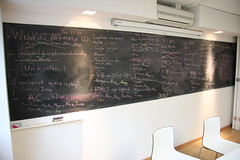
Hackfest black board, photo by Mario

I think this was a very productive hackfest, and as usual a very well organized one! Thanks to the GNOME Foundation for the travel sponsorship, to our friends at Igalia for doing an awesome job at making it happen, and to Collabora for sponsoring it and granting me the time to go there! We got a lot done, and although, as usual, our goals list had many items not crossed, we did cross a few very important ones. I took part in discussions about the new WebKit2 APIs, got to know the new design for GNOME s Web application, which looks great, discussed about Accelerated Compositing along with Joone, Alex, Nayan and Martin Robinson, hacked libsoup a bit to port the multipart/x-mixed-replace patch I wrote to the awesome gio-based infrastructure Dan Winship is building, and some random misc. The biggest chunk of time, though, ended up being devoted to a very uninteresting (to outsiders, at least), but very important task: making it possible to more easily reproduce our test results. TL;DR? We made our bots and development builds use jhbuild to automatically install dependencies; if you re using tarballs, don t worry, your usual autogen/configure/make/make install have not been touched. Now to the more verbose version! The need
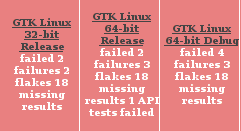
Our three build slaves reporting a few failures

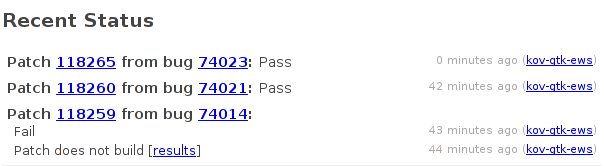
For a couple years now we have supported an increasingly complex and very demanding automated testing infrastructure. We have three buildbot slaves, one provided by Collabora (which I maintain), and two provided by Igalia (maintained by their WebKitGTK+ folks). Those bots build as many check ins as possible with 3 different configurations: 32 bits release, 64 bits release, and 64 bits debug. In addition to those, we have another bot called the EWS, or Early Warning System. There are two of those at this moment: one VM provided by Collabora and my desktop, provided by myself. These bots build every patch uploaded to the bugzilla, and report build failures or passes (you can see the green bubbles). They are very important to our development process because if the patch causes a build failure for our port people can often know that before landing, and try fixes by uploading them to bugzilla instead of doing additional commits. And people are usually very receptive to waiting for EWS output and acting on it, except when they take way too long. You can have an idea of what the life of an EWS bot looks like by looking at the recent status for the WebKitGTK+ bots. Maintaining all of those bots is at times a rather daunting task. The tests require a very specific set of packages, fonts, themes and icons to always report the same size for objects in a render. Upgrades, for instance, had to be synchronized, and usually involve generating new baselines for a large number of tests. You can see in these instructions, for instance, how strict the environment requirements are yes, we need specific versions of fonts, because they often cause layouts to change in size! At one point we had tests fail after a compiler upgrade, which made rounding act a bit different! So stability was a very important aspect of maintaining these bots. All of them have the same version of Debian, and most of the packages are pinned to the same version. On the other hand, and in direct contradition to the stability requirement, we often require bleeding edge versions of some libraries we rely on, such as libsoup. Since we started pushing WebKitGTK+ to be libsoup-only, its own progress has been pretty much driven by WebKitGTK+ s requirements, and Dan Winship has made it possible to make our soup backend much, much simpler and way more featureful. That meant, though, requiring very recent versions of soup. To top it off, for anyone not running Debian testing and tracking the exact same versions of packages as the bots it was virtually impossible to get the tests to pass, which made it very difficult for even ourselves to make sure all patches were still passing before committing something. Wow, what a mess. The explosion^Wsolution So a few weeks back Martin Robinson came up with a proposed solution, which, as he says, is the nuclear bomb solution. We would have a jhbuild environment which would build and install all of the dependencies necessary for reproducing the test expectations the bots have. So over the first three days of the hackfest Martin and myself hacked away in building scripts, buildmaster integration, a jhbuild configuration, a jhbuild modules file, setting up tarballs, and wiring it all in a way that makes it convenient for the contributors to get along with. You ll notice that our buildslaves now have a step just before compiling called updated gtk dependencies (gtk is the name we use for our port in the context of WebKit), which runs jhbuild to install any new dependencies or version bumps we added. You can also see that those instructions I mentioned above became a tad simpler. It took us way more time than we thought for the dust to settle, but it eventually began to. The great thing of doing it during the hackfest was that we could find and fix issues with weird configurations on the spot! Oh, you build with AR_FLAGS=cruT and something doesn t like it? OK, we fix it so that the jhbuild modules are not affected by that variable. Oh, turns out we missed a dependency, no problem, we add it to the modules file or install them on the bots, and then document the dependency. I set up a very clean chroot which we could use for trying out changes so as to not disrupt the tree too much for the other hackfest participants, and I think overall we did good. The aftermath By the time we were done our colleagues who ran other distributions such as Fedora were already being able to get a substantial improvements to the number of tests passing, and so did we! Also, the ability to seamlessly upgrade all the bots with a simple commit made it possible for us to very easily land a change that required a very recent (as in unreleased) version of soup which made our networking backend way simpler. All that red looks great, doesn t it? And we aren t done yet, we ll certainly be making more tweaks to this infrastructure to make it more transparent and more helpful to the users (contributors and other people interested in running the tests). If you ve been hit by the instability we caused, sorry about that, poke mrobinson or myself in the #webkitgtk+ IRC channel on FreeNode, and we ll help you out or fix any issues. If you haven t, we hope you enjoy all the goodness that a reproducible testing suite has to offer! That s it for now, folks, I ll have more to report on follow-up work started at the hackfest soon enough, hopefully =).
Benjamin Mako Hill: Wide Scream

<object data="https://upload.wikimedia.org/wikipedia/commons/d/de/Aspect-ratio-4x3.svg" type="image/svg+xml"> https://upload.wikimedia.org/wikipedia/commons/d/de/Aspect-ratio-4x3.svg</object> <object data="https://upload.wikimedia.org/wikipedia/commons/f/f8/Aspect-ratio-16x9.svg" type="image/svg+xml"> https://upload.wikimedia.org/wikipedia/commons/f/f8/Aspect-ratio-16x9.svg</object> It seems that nearly all computer monitors have now switched from a 4:3 aspect ratio popular several years ago to a "wide screen" 16:10 and now mostly to an even wider 16:9. But screen sizes are usually measured by their diagonal length and those sizes have not changed. For example, before I had my Thinkpad X201, I had a X60 and a X35. They are similar laptops in the same product line with 12.1" screens. But 12.1" describes the size along the diagonal and the aspect ratio switched from 4:3 to 16:10 between the X60 and the X201. As the screen stretched out but maintained the same diagonal length, the area shrunk: from 453 square centimeters to 425. But screens are not only getting smaller, they are also getting less useful. The switch to wider aspect ratios is done so that people can watch wide screen movies while using a larger proportion of their screens. Of course, the vast majority of people's time on their laptops is not spent watching wide screen movies but in programs like browsers, word processors, and editors. Because most of our writing systems lay out documents from top to bottom, the tools we most frequently use to display (and then scroll through) the things we read primarily use vertical screen space -- the dimension that is shrinking. If you have a desktop monitor, you might rotate the whole thing 90 degrees and "solve" the problem. If you're on a laptop though (as I usually am) this is clearly not an option. I am not the first person to be annoyed by this trend. In fact, many recent desktop UI changes are designed to work around this issue. In the free software world, both Unity and GNOME 3 have made efforts to hide, merge, or otherwise get ride of title bars, menu bars, and panels that take up dwindling vertical space. I use Awesome which I've mostly set up to do two side-by-side terminals with very little in the way of menu bars. /copyrighteous/images/awesome_screenshot_2011-small.png Applications are the worst offenders and the solutions for those things that won't run in a terminal (or people that don't want to live there) are still lacking. I have been using Firefox's Tree Style Tab extension to move tabs to the side and hand-customized toolbars that squeeze everything I need (i.e., back, forward, stop, refresh, and URL bar) onto a single menu bar. /copyrighteous/images/iceweasel_menu_eg_screenshot_2011-small.png But the situation still drives me crazy. I'd love to hear what others are doing.

Kees Cook: how to throw an EC2 party

Prepare a location to run juju and install it:
mkdir ~/party
cd ~/party
sudo apt-get install juju
Initialize your juju environment. Be sure to add juju-origin: ppa to your environment, along with filling in your access-key and secret-key from your Amazon AWS account. Note that control-bucket and admin-secret should not be used by any other environment or juju won t be able to distinguish them. Other variables are good to set now too. I wanted my instances close to me, use I set region: us-west-1 . I also wanted a 64bit system, so using the AMI list, I chose default-series: oneiric , default-instance-type: m1.large and default-image-id: ami-7b772b3e
juju
$EDITOR ~/.juju/environments.yaml
Get my sbuild charm, and configure some types of builders. The salt should be something used only for this party; it is used to generate the random passwords for the builder accounts. The distro and releases can be set to whatever the mk-sbuild tool understands.
bzr co lp:~kees/charm/oneiric/sbuild/trunk sbuild-charm
cat >local.yaml <<EOM
builder-debian:
    salt: some-secret-phrase-for-this-party
    distro: debian
    releases: unstable
builder-ubuntu:
    salt: some-secret-phrase-for-this-party
    distro: ubuntu
    releases: precise,oneiric
EOM
Bootstrap juju and wait for ec2 instance to come up.
juju bootstrap
Before running the status, you can either accept the SSH key blindly, or use ec2-describe-instances to find the instance and public host name, and use my wait-for-ssh tool to inject the SSH host key into your ~/.ssh/known_hosts file. This requires having set up the environment variables needed by ec2-describe-instances , though.
ec2-describe-instances --region REGION
./sbuild-charm/wait-for-ssh INSTANCE HOST REGION
Get status:
juju status
Deploy a builder:
juju deploy --config local.yaml --repository $PWD local:sbuild-charm builder-debian
Deploy more of the same type:
juju add-unit builder-debian
Now you have to wait for them to finish installing, which will take a while. Once they re at least partially up (the builder user has been created), you can print out the slips of paper to hand out to your party attendees:
./sbuild-charm/slips   mpage -1 > /tmp/slips.ps
ps2pdf /tmp/slips.ps /tmp/slips.pdf
They look like this:
Unit: builder-debian/3
Host: ec2-256-1-1-1.us-west-1.compute.amazonaws.com
SSH key fingerprints:
  1024 3e:f7:66:53:a9:e8:96:c7:27:36:71:ce:2a:cf:65:31 (DSA)
  256 53:a9:e8:96:c7:20:6f:8f:4a:de:b2:a3:b7:6b:34:f7 (ECDSA)
  2048 3b:29:99:20:6f:8f:4a:de:b2:a3:b7:6b:34:bc:7a:e3 (RSA)
Username: builder
Password: 68b329da9893
To admin the machines, you can use juju itself, where N is the machine number from the juju status output:
juju ssh N
To add additional chroots to the entire builder service, add them to the config:
juju set builder-debian release=unstable,testing,stable
juju set builder-ubuntu release=precise,oneiric,lucid,natty
Notes about some of the terrible security hacks this charm does: Enjoy!

2011, Kees Cook. This work is licensed under a Creative Commons Attribution-ShareAlike 3.0 License.
Creative Commons License

Kees Cook: juju bug fixing

My earlier post on juju described a number of weird glitches I ran into. I got invited by hazmat on IRC (freenode #juju) to try to reproduce the problems so we could isolate the trouble. Fix #1: use the version from the PPA. The juju setup documentation doesn t mention this, but it seems that adding juju-origin: ppa to your ~/.juju/environment.yaml is a good idea. I suggest it be made the default, and to link to the full list of legal syntax for the environment.yaml file. I was not able to reproduce the missing-machines-at-startup problem after doing this, but perhaps it s a hard race to lose. Fix #2: don t use terminate-machine . :P There seems to be a problem around doing the following series of commands: juju remove-unit FOO/N; juju terminate-machine X; juju add-unit FOO . This makes the provisioner go crazy, and leaves all further attempts to add units stick in pending forever. Big thank you to hazmat and SpamapS for helping debug this.

2011, Kees Cook. This work is licensed under a Creative Commons Attribution-ShareAlike 3.0 License.
Creative Commons License

Julien Danjou: New job, new blog

It has been a while since I blogged but I've been very busy, with my new job and this new blog! New job! I quitted my job last September, and found another one that I started in October. I'm now the lead developer of eNovance Labs, where I work on the OpenStack project. So far, this allowed me to contribute heavily to the Debian packaging of OpenStack. New blog! In the meantime, I took some time to redesign my personal homepage and this blog, which is now using Hyde, the Python equivalent of Jekyll, which is in Ruby. Since I dislike Ruby (sorry), I preferred to use a Python based generator, and I admit Hyde is really cool. Since I really suck at Web design, this one is obviously based on Twitter's bootstrap

Russ Allbery: Packaging the Sun Java JCE Policy

This is a less useful writeup now than it would be six months ago when I was first going to do it, but oh well. Some people are still stuck running the Sun Java JDK for a while longer, and maybe it will be useful. Due to a variety of silly reasons too long to get into, the non-free Sun JDK comes with some encryption functionality disabled, particularly 256-bit AES. Those who want to use it have to download and install two replacement JAR files, which are not redistributable. While the Sun JDK is packaged for Debian in squeeze for those who have to use it (usually for legacy applications that haven't been ported to OpenJDK 7), the JCE policy files cannot be packaged. The hardest part of this is that, due to how the Sun JDK is packaged and where the files have to be installed, it's tricky to install them without having to redo that work each time the Sun JDK is upgraded or reinstalled. I wrote up instructions and packaging files for building packages that do the right thing, including across version upgrades of the Sun JDK. If you still have to use the Sun JDK, take a look. (And work on converting your software to work with OpenJDK 7 for the wheezy release!)

Daniel Stone: why you don't actually want dpi

Inspired by a discussion in #wayland today, here are snippets from three people explaining why X declares its DPI as 96, and why a single 'DPI' sledgehammer isn't actually what basically anyone<super>*</super> wants. Please read them. Thanks. Adam Jackson:
I am clearly going to have to explain this one more time, forever. Let's see if I can't write it authoritatively once and simply answer with a URL from here out.
Matthew Garrett:
But what about the single monitor case? Let's go back to your Vaio. It's got a high DPI screen, so let's adjust to that. Now you're happy. Right up until you plug in an external monitor and now when you run any applications on the external display your fonts are twice the size they should be. WOOHOO GO TEAM of course that won't make us look like amateurs at all. So you need another heuristic to handle that, and of course "heuristic" is an ancient african word meaning "maybe bonghits will make this problem more tractable".
Federico Mena-Quintero:
People who know a bit of typography may know a few factoids:
- Printed books generally use fonts which can be from about 9 to about 12 points in size.
- A point is roughly 1/72 of an inch. For people in civilized countries, this translates to "I have no idea what the fuck a quarter pounder is".
*: Yes, I know you need to have actual point equivalence, and you've had all your displays and printer colour-calibrated for the past ten years too. You're doing all this in the GIMP or some other kind of design tool, so please yell at them to use the display size information that XRandR gives you right now, already, today.

Next.

Previous.