Search Results: "ed"

22 December 2011

Lars Wirzenius: Cafe coding and other productivity hacks

I've come to realize that I quite like coding in cafes, from time to time, and it can be very productive for me. This is strange, since I'm usually very sensitive to noise when I work. Almost any unpredictable sounds at the office distract me, which is why I often listen to music. However, in a cafe, I don't need that, I just automatically block out everything but my laptop. At the office, everything that happens around me might concern or interest me. In a cafe, nobody says anything that I'm interested in. Another distraction that cafes lack is the Internet. Even when there's Internet access, I tend to turn my laptop's wifi off so that I have a longer battery life. I might occasionally check mail or IRC, but only for a few minutes at a time. The rest of the time I crank the widget and write code or take care of other things from my next actions list.

Gustavo Noronha Silva: AIClass and vacations

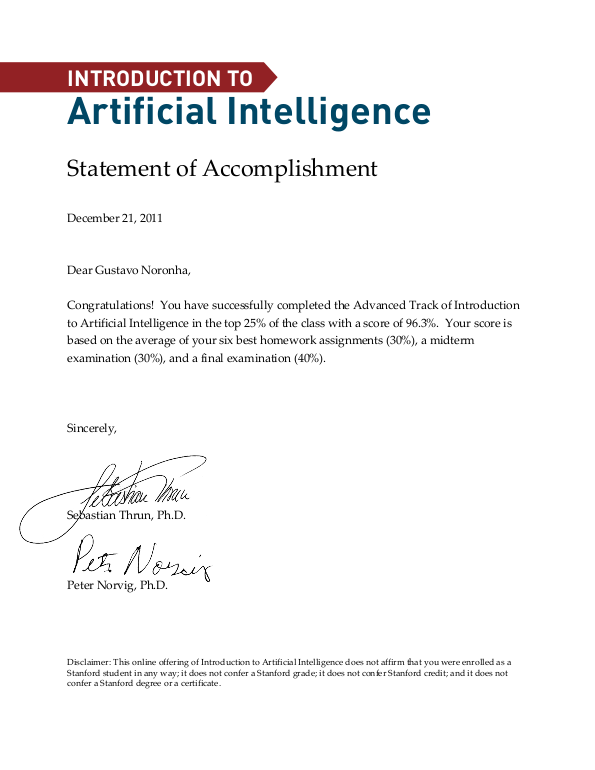
One of my side projects for these last months was to enroll on the online Introduction to AI class, with Peter Norvig and Sebastian Thrun, professors at Stanford. Through it I also learned about the Kahn Academy. I must say that getting to know these efforts made me feel similar to when I found Free Software: it s hard to believe that such great things exist! I learned some really cool stuff, and was also introduced to the amazing work of Sebastian Thrun with self-driving cars, it was an awesome experience! Last weekend I took the final exam, and today I got the certificate of accomplishment. It was delivered as a signed PDF which can be checked with a certificate they provided, pretty neat. I m very happy, and motivated to enroll on more such courses in the future =). Now it s time to cool down, though. My vacations start today, and on the weekend I ll travel to the sunny Fortaleza, in northeastern Brazil, to enjoy some nice beaches and get some tan. See you next year!
Statement of Accomplishment - AIClass 2011

Statement of Accomplishment - AIClass 2011

Dirk Eddelbuettel: Rcpp 0.9.8

A new release 0.9.8 of Rcpp is now on CRAN and will also get into Debian shortly (once I finish building R 2.14.1). This release contains a few incremental changes. Romain, sponsored by by the Open Source Programs Office at Google, had released a new package int64 bringing larger integers to R, and this is now supported by Rcpp as well. John Chambers contributed some code to have Reference Classes extend existing C++ classes (typically brought in via Rcpp Modules). Jelmer Ypma sent us a patch to add a Rcout device not unlike cout, but aligned with R's io buffering. We added some more unit tests, and made a few small fixes here or there. The complete NEWS entry is below; more details are in the ChangeLog file in the package and on the Rcpp Changelog page.
0.9.8   2011-12-21
    o   wrap now handles 64 bit integers (int64_t, uint64_t) and containers 
        of them, and Rcpp now depends on the int64 package (also on CRAN).
        This work has been sponsored by the Google Open Source Programs
        Office.
    o   Added setRcppClass() function to create extended reference classes 
        with an interface to a C++ class (typically via Rcpp Module) which
        can have R-based fields and methods in addition to those from the C++.
    o   Applied patch by Jelmer Ypma which adds an output stream class
        'Rcout' not unlike std::cout, but implemented via Rprintf to
        cooperate with R and its output buffering.
        
    o   New unit tests for pf(), pnf(), pchisq(), pnchisq() and pcauchy()
    o   XPtr constructor now checks for corresponding type in SEXP
    o   Updated vignettes for use with updated highlight package
    o   Update linking command for older fastLm() example using external 
        Armadillo
Thanks to CRANberries, you can also look at a diff to the previous release 0.9.7. As always, even fuller details are on the Rcpp Changelog page and the Rcpp page which also leads to the downloads, the browseable doxygen docs and zip files of doxygen output for the standard formats. A local directory has source and documentation too. Questions, comments etc should go to the rcpp-devel mailing list off the R-Forge page

Michal Čihař: GePeS 0.3.0

After fighting with i18n in QML, I've released GePeS 0.3.0. The only major change is that it now can be properly translated, for the first release Czech and Spanish translations were completed, however you are welcome to contribute translations! As usual, new version was submitted to Nokia store, hopefully it will pass QA review before Christmas. You can get sources from GePeS homepage or from Git.

Filed under: English Meego 0 comments Flattr this!

21 December 2011

Julien Valroff: My own StatusNet instance

After using identi.ca microblogging patform for 2 years or so, I have recently decided to set up my own StatusNet instance to benefit from the power of federation. The setup is quite easy, but I still have some tuning left. Most of the plugins I have tried (XMPP, realtime and twitter bridge) were very resource intensive, especially for my tiny virtual server, I hence had to disable them. I can live without them. You can now follow my dents on sn.kirya.net. If you were following me on identi.ca, please update your subscription, the account will remain there but I do not expect to use it anymore. The current problems with identi.ca show how important federation and decentralization are. My timeline is very quiet for now though, I encourage more people to setup their own instances.

Jon Dowland: mail archiving script

Here's the mail archiving script I was talking about: http://github.com/jmtd/detachment. Sorry about the name-pun. There's still a LOT of work to do, but it's useful enough to deploy, with modifications, now. If you set up a way of pushing stuff in a local directory to a remote webserver (ideally behind an SSL certificate and with access control configured) and you have a resolvable hostname for that site, then you can get at your files from most mail/web client combinations, including smartphones. Here's some stats from running it on a sample mailbox: Before
$ du -sh ncl/archive/2010
116M    ncl/archive/2010
After
$ du -sh ncl/archive/2010 bucket
41M     ncl/archive/2010
51M     bucket
Or, approximately 20% smaller. (That's the on-disk usage for the mail and the attachments, now not base64-encoded, and saved to disk). The above folder was a local Maildir copy of a folder on an Exchange mail system, synchronised via offlineimap. Here are the sizes reported by Exchange for the same folder: Or, approximately 70% smaller. (That's the mails without the attachments counted, which are not in the Exchange server any more). Lots of caveats:

20 December 2011

Mark Brown: What s wrong with switch statements?

Recently I ve been noticing a surprising pattern in code I m reviewing for the kernel. A lot of people seem to have taken to writing code that I d expect to look like this:
switch (thing)  
case VALUE:
        /* Stuff */
        break;
case BAR:
        /* Nonsense */
        break;
default:
        /* Whatever */
        break;
 
with if statements instead:
if (thing == VALUE)  
        /* Stuff */
  else if (thing == BAR)  
        /* Nonsense */
  else  
        /* Whatever */
 
(where stuff, nonsense and whatever are usually a bit larger). I really don t understand where this has come from the if based form isn t nearly so idiomatic for selecting between a range of values and this seems to have come from nowhere pretty much. Is there some code base out there where this is common practice or something?

Craig Small: When a dynamic library and program share functions

This is about making procps have a proper library but it really is a generic sort of question. Say you are making a library and a program that uses that library. Now at times you may have convience type functions; procps has them for things like escaping command names or allocation different sorts of memory. Both the library and the programs use some of these functions. Now, there seems only two approaches to this setup. The first is to have the function stay in the library and for the program to call this function, just like all the other library functions. But this means the library has exposed for all other programs that link to it and that doesn t really make a lot of sense. The second method is to have the functions defined in both places, perhaps in a file that is linked with the program and the library. That seems to be duplicating the code in two different places. Namespace collision could be a problem but that easily fixed with using some unqiue prefix. I really don t think having procfsmalloc, procfscalloc and procfs_strdup are that useful. I m sure this sort of problem has been solved elsewhere. Has anyone else come across this? The functions are simple utility type functions such as malloc a block of memory, if there is a problem print to stderr.

Raphaël Hertzog: 300 EUR for Debian

It s the amount of the wire transfer that I made to ffis e.V., the German association that works together with Software in the Public Interest to hold Debian s monetary assets. This amount includes the 10% of the benefits of my Debian DVD sales (for a total of 47 USD =~ 36 EUR) and the 15% affiliate revenue that was granted to Debian by some supporters of the Debian Administrator s Handbook crowdfunding campaign (for a total of 259.49 EUR). Thank you everybody, this donation is really yours and not mine! If you want to complement this donation, and make a nice gift to Debian for Christmas, go to this page and follow the instructions.

No comment Liked this article? Click here. My blog is Flattr-enabled.

19 December 2011

Jonathan Wiltshire: Reinstalling at arm s length

Recently I had need to re-purpose a server and for convenience, I decided to do a complete wipe and reinstall since it had previously been used for all sorts of package testing, experiments, dak debugging, the list goes on. I took a careful backup and then cooked up some USB installation media, but it took so long to boot (USB1.1, yay) I ran out of time before the building was locked. Since this box has two hard disks, and not being one to back down from a challenge, I eventually reinstalled it over the weekend with nothing no install media, no reinstall robot or intelligent hands just a reliable internet connection and a healthy dose of courage. Here s how. Target: reinstalled machine with the same network settings, ssh host keys, and other minor configuration ported. The disk layout is to be RAID-1 containing LVM, with separate /var volume and separate /boot partition, also RAID-1.
  1. One disk in the box contained old data, so I cleared that out and wiped it (including the MBR for good measure) and partitioned it.
  2. I set up a degraded RAID-1 array for a small /boot partition, a large RAID-1 array for the LVM and a swap partition.
  3. I mounted the new partitions in the correct layout in /mnt and used debootstrap(8) to get a very basic root set up. I also bind-mounted /sys, /proc, /dev and /dev/pts for now, they can be done properly when the root is a bit more mature.
  4. Next, I copied into the new root /etc/apt/sources.list and chroot(8)ed into it. Now I could apt-get update and tasksel install standard to get an almost fully-functional base system. At this point it is also sensible to install locales, tzdata and console-data and dpkg-reconfigure them, followed by mdadm and lvm2 if required and openssh-server so you can get back in after rebooting. Some or all of these may already be installed by tasksel.
  5. Time to install a kernel before leaving the chroot: apt-get install linux-image-2.6, followed by grub-pc which should detect both installations and set up menu entries for them.
  6. Back in the old system, I copied in the network, hosts, resolv and hostname configuration files, and set up /etc/fstab to my liking.
  7. Install grub to both hard disks if it isn t already so (dpkg-reconfigure grub-pc) and again check that it detects both installations and creates the right menu entries. At this stage, booting from either hard disk will allow the loading of either the new or old installations, which is exactly what we want. It s now time to umount the new installation.
  8. Now I followed the excellent guide for remote kernel upgrades at http://ariekanarie.nl, except in this case we are using the same method to try booting the new system and fall back to the old one if it s a disaster.
  9. Reboot and hope!
At this point I rebooted to find myself back in the old kernel, which was disappointing this means the new kernel has panicked and rebooted, and grub has fallen back to the old system (exactly as planned). It turned out there was nothing in /dev at boot time, and udev doesn t start early enough to populate it before panic. That s easily solved by mounting the installation again and using MAKEDEV as a seed.
  1. With a bit of luck, you re now in the new installation and can dpkg-reconfigure grub-pc again to install grub to both hard disks again. This isn t strictly necessary, but it records this choice in debconf so future upgrades will automatically upgrade the bootloader everywhere it s needed.
  2. Now I could do some tidying up, mount the old installation and copy over all the data I wanted, and after careful checking wipe the first disk clean ready to be added into the RAID arrays.
  3. Finally, add the old disk to the RAID arrays so they are fully redundant.
Sources:
http://www.michael-hammer.at/server_config/debootstrap/
http://d-i.alioth.debian.org/tmp/en.i386/apds03.html
http://www.debian.org/releases/stable/amd64/apds03.html.en
https://wiki.archlinux.org/index.php/Convert_a_single_drive_system_to_RAID
http://ariekanarie.nl/archives/211/remote-kernel-upgrade-with-debianubuntu-and-grub2
Comments
Reinstalling at arm s length is a post from: jwiltshire.org.uk Flattr

Robert Millan: ZFS v28

ZFS v28 (finally, with deduplication) is available in latest D-I daily builds when selecting kernel of FreeBSD 9 as boot option. Testers wanted!!

Felipe Augusto van de Wiel: 19 Dec 2011

29 and counting
Time flies... and very fast.

There are so many things I'd like to share and tell you about but that would make a long and boring post, so I'll divide it in future entries, so I can keep this diary alive, keep people informed and tell a little bit about my story. Eventually, I may split this diary into a technical and a non-technical blog, but for now, I will stick around mixing topics. :-) Last time I wrote was back in 2009 at DebConf9 in Spain and a lot of things happened that year. Not only for Debian, but also for me.


My last year studying Computer Science was 2009 and that same year I was working full time, I helped organizing a large event for Computer Students (ENECOMP 2009), we had some troubles and side effects with Influenza A (H1N1) in my city (Curitiba, PR) and towards the end of the year I got really sick (not from Influenza) and it took a while to know what was going, during this process I did hurt some people I really love and I'm truly sorry. The past, 2010 went on as busy and unstable as 2009, my laptop's hard disk broke twice (January and October) and I survived thanks to backup and recovery procedures. I took some wrong decisions but fixed it later and learned a lot from my mistakes, decisions and choices.


Then 2011 came, my laptop's hard disk broke again and I lost almost 6 months of emails, I find out that after the second crash in 2010 part of my backup got b0rk3d. Fine, I didn't die, everything seems to be fine, but I'm still catching up with a lot of work and backlog. At different times one of my parents also got really sick and I learned quite a bit on how to deal with it.


Due to the laptop and the different things going on in my life I didn't work for Debian as much as I want and I still feel guilty. :-( But that's fine, this is a kind of public apologize for my peers in Debian (i18n, mirrors, release), I still want to help all of you, but I still have quite a bit of backlog to clean and quite a few things to learn in the process. And in general, I'm really sorry if I didn't (or I couldn't) work for Debian as much as I want.


Although I'm taking the chance to apologize in this post, I still want to make clear that I'm quite happy. This last year was pretty good, I had the opportunity to attend DebConf again and also got to know Sarajevo and Zagreb. New lessons were learned, better work cycles, nicer solutions. Today I'm completing 29 years old. 29. This is quite some time, not a long ride, but for one reason or another, I have high hopes for 2012 and what awaits me. And I do plan to learn more, to help more and whenever possible, to contribute back.

Last time I wrote here I mentioned about my graduation and another post to talk about that, I'll write about it as soon as I get my diploma (because of different printing problems it was delayed for almost 2 years). And I do plan to write more frequently. :-)

John Sullivan: Where Shall I Wander

Google Maps is now mapping the indoors. I saw an ad for this while passing through MSP yesterday (given how much time I spend on the Internet, it's strange and a little embarrassing to learn about new things on the Internet from airport billboards), since one of their initial targets is the infamous Mall of America.
Detailed floor plans automatically appear when you re viewing the map and zoomed in on a building where indoor map data is available. The familiar blue dot icon indicates your location within several meters, and when you move up or down a level in a building with multiple floors, the interface will automatically update to display which floor you re on. All this is achieved by using an approach similar to that of My Location for outdoor spaces, but fine tuned for indoors.
Thoughts about this: Title from John Ashbery

Jon Dowland: wadc

I'm happy to announce the release of wadc version 1.2.
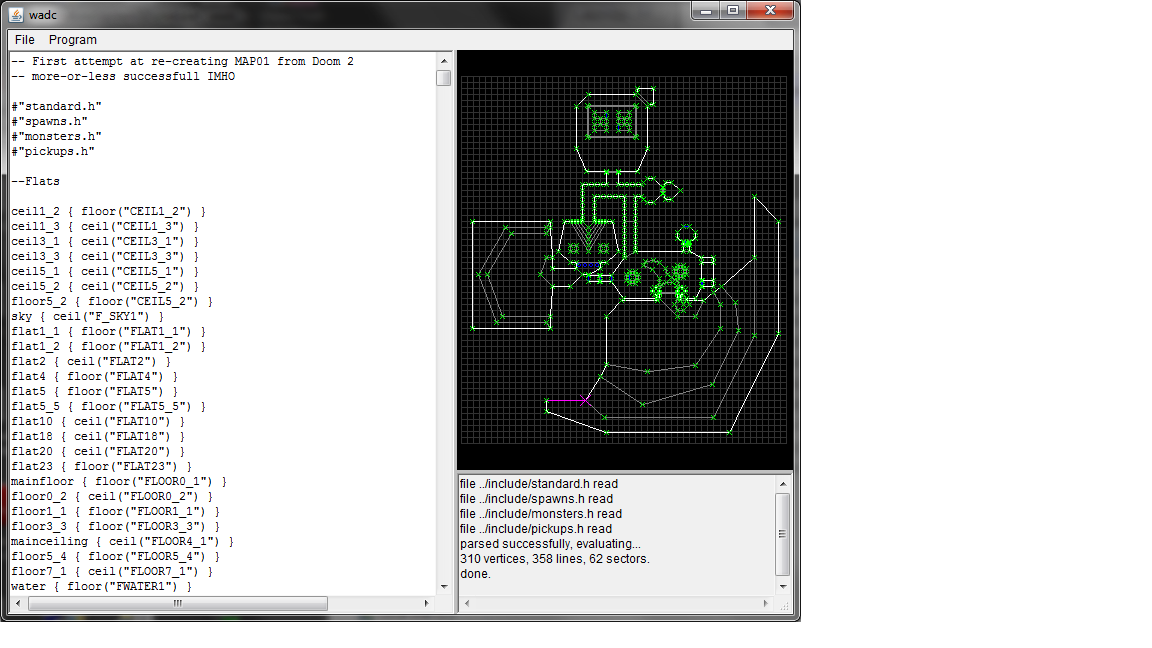
A WadC session A WadC session
WadC is a functional programming language for the composition of Doom-format maps. Originally created by Wouter "Aardappel" van Oortmerssen, I was granted permission to take over the project over a year ago, but didn't get around to releasing anything until now. This version adds a few functions that permit you to draw two-sided lines which are textured and impassible: important for a lot of detailing techniques. You can also create friendly monsters for Boom-compatible ports. There's a new example demonstrating these features; plus a recreation of Doom 2's "entryway", courtesy of GreyGhost. See WadC for a summary, or go straight to the binaries or source on github. Discussions: reddit, doomworld.

Lars Wirzenius: Like/dislike buttons in free software

It's a perennial problem that authors of free software get little feedback from users. Here's an idea: add "I like this program" and "I don't like this program" buttons to Help/About dialogs. They would send some kind of anonymous signal to the author, probably by making an HTTP call to some server somewhere. This is not a "call home" functionality, which is questionable in many ways. It's completely opt-in, and it's pretty clear to the user what's going on.

Pau Garcia i Quiles: Reminder: FOSDEM 2012 CrossDesktop DevRoom Call for Talks

FOSDEM is one of the largest gatherings of Free Software contributors in the world and happens each February in Brussels (Belgium). One of the developer rooms will be the CrossDesktop DevRoom, which will host Desktop-related talks. Are you interested in giving a talk about open source and Qt, KDE, Enlightenment, Gnome, XFCE, Windows, Mac OS X, general desktop matters, mobile development, applications that enhance desktops and/or web? Hurry up and submit your proposal, deadline is December 20th! There is more information in the Call for Talks we published one month ago. If you are interested in Qt/KDE, come visit us at the KDE booth. If you add yourself to the KDE FOSDEM 2012 wiki page, we will be able to better organize the usual dinner on Sunday and/or smaller meetings for special interest groups .

Sune Vuorela: Am I online? Network status aware apps II

So. Recently I blogged about Network status aware apps, and some time later, I got asked by a developer How do I see if I m online if I m not using network manager? and I replied with some dbus commands and he shook his head in despair. So, I ended up writing a small plasma widget targetting developers and very powerusers that can tell you the current state of the network and offers to add yet another manual datapoint to the network status. So. In line with another blog post of mine about getting the small utilities we all write and just let stay in a drawer (or somewhere in ~ on a local computer), I m announcing it s existance. That application became famous and even mentioned in Linux Weekly News, but I don t expect that here. But anyways, here it is: http://quickgit.kde.org/?p=scratch/sune/networkstatus.git. And a picture of it, it is not pretty but well, it s a tool mostly for developers, not for end users. Have fun, and I hope to see more of these small projects from various people.

Nikita Youshchenko: Disabled NoSpamNX

NoSpamNX and OpenID wordpress plugins don t work properly with each other. Sorry people for calling you spammers, and many thanks for your comments. I ve manually approved everything that NoSpamNX incorrectly filtered, and disabled NoSpamNX for now. Will look for a good replacement.

Benjamin Mako Hill: The Influence of the Ecstasy of Influence

/copyrighteous/images/andy-warhol-mickey.jpg Back in 2007, Harpers Magazine published The Ecstasy of Influence: a beautiful article by Jonathan Lethem on reuse in art and literature. Like Lewis Hyde in The Gift (quite like Hyde, as readers discover) Lethem blurs the line between plagiarism, remix, and influence and points to his subject at the center of artistic production. Lethem's gimmick, which most readers only discover at the end, is that the article is constructed entirely out of "reused" (i.e., plagiarized) quotations and paraphrases. A couple months ago, I suggested to my friend Andr s Monroy-Hern ndez a very similar project: a literature review on academic work on remixing and remixing communities constructed entirely of text lifted from existing research. After some searching around, Andr s pointed out that Lethem had essentially beaten us to the punch and linked me to his article. Only after I visited the link did I remember that I had read Lethem's article when it was published and loved the idea then. Over time, I'd forgotten I read ever it. Without knowing it, I had read, loved, forgotten, and then -- influenced, if unconsciously -- copied and reproduced the idea myself in slightly modified form. And I suppose that was the point.

Next.

Previous.