Search Results: "uli"

20 May 2007

Julien Blache: Fixing SANE s SCSI interface in 32/64bit mixed environments

I’ve just uploaded to unstable a new revision of SANE which fixes the longstanding SCSI interface problem in 32/64bit mixed environments. If you own a SCSI scanner, please read on and give it a go. For the past several years, it wasn’t possible to scan using a SCSI scanner if you were running a 64bit kernel and a 32bit userland. The sg_hdr struct, which is the base of the Linux SG3 interface, contains pointers (you see that coming, right?) so its size obviously differs in 32bit and 64bit mode; and a 32bit pointer is kind of useless as-is for a 64bit kernel. The SG3 asynchronous interface (read/write calls on /dev/sgX) does not handle the 32/64bit conversion and returns an error while sanity checking the sg_hdr struct passed to it. Hopefully, the SG_IO ioctl interface, also part of SG3 and now generalized to every SCSI device (not limited to /dev/sgX), uses the same sg_hdr struct with the added bonus that the ioctl 32bit compat layer built into the kernel converts the 32bit sg_hdr it gets from userland to a 64bit sg_hdr it passes on to the 64bit ioctl handler, and back again. Only difference, the SG_IO ioctl interface is synchronous, whereas the read/write interface is asynchronous and thus allows command queueing. So SANE (sanei_scsi) now has lost its command queueing feature but it looks like (after testing) it wasn’t making any difference anymore. This problem affects users on the following architectures, when running a 64bit kernel with a 32bit userland: i386/amd64, MIPS, MIPSel, SPARC, PowerPC, ia64. That makes for an important part of our supported architectures. If you own a SCSI scanner, here’s a test you can do: scan using the current version of SANE in unstable (1.0.19~cvs20070505-2), then with the new, patched version (1.0.19~cvs20070505-3) and report back if: If all goes well, this patch will make it into SANE upstream RSN.

19 May 2007

Julien Blache: pommed v1.5: fixes

A really minor release here, fixing keyboard backlight support on the PowerBook5,4 (at least) which apparently doesn’t have a type attribute for the LMU controller in the device tree and we are back to using eject(1) for the CD ejection feature. eject(1) unmounts the CD if it’s mounted at eject time, which is a nice feature to have if you use some sort of automounter. Hopefully the next release will have some new things and not only fixes. Still on the TODO list: video mode switch at least for the MacBook & MacBook Pro and a better automatic backlight algorithm. Oh, by the way, in the ATI-still-sucks-ass category: fglrx crashes when I enable crt2 on my x86_64 MBP, yet it works fine on an i386 MBP. When do I get the code for the fglrx X server ? I’d really like to fix this.

Julien Valroff: New 16:10 wide screen

acer-al2002w.jpgI have purchased a new screen, and I have chosen an Acer AL2002W, mainly because of its low price. It is a 20″ wide screen, with a native resolution of 1680×1050 @60Hz. For now, it seems to be good value for money, and working with this screen is very confortable (I previously used a standard 4:3 17″ screen at 1280×1024). While configuring Xorg was painless (with both free nv and proprietary nvidia drivers), I still haven’t managed to get the framebuffer working with the native resolution of the screen. As vesafb doesn’t seem to be able to use a 1680×1050 resolution (hwinfo --framebuffer only gives 4:3 modes), I have tried to patch my kernel with vesafb-tng, which haven’t yield better results. While nvidiafb allows me to get a 1680×1050 framebuffer, it conflicts with proprietary nvidia driver, preventing it from being loaded. With the free nv driver, I can’t have the display centered both in console and in X (they both use the same mode, and the screen is able to stroe user modes at the condition the new display information habe 1Khz difference for horizontal frequency or 1Hz for vertical frequency or the syn signal polarities are different from the default modes). By the way, I have noticed that two of my laptops have the same Intel 915 video chipset, and one only is able to have a 1280×800 framebuffer (using the undocumented vga=0x362 code). I can’t understand the reason of this difference.

17 May 2007

Gunnar Wolf: When bad system design leads to pain...

A long time ago, I wrote the system that still manages the Cuerpo Acad mico Historia del Presente group in the Universidad Pedag gica Nacional. Yes, I'm happy a good portion of my project, which took me over a year of work... But I must admit a nice deal of shame as well.
Of course, it comes from not properly understanding the domain data and information volume my system would be working with - and coming up with a stupid way to implement searches. I won't get too much in detail because, even if you had access to the full search facility in the system (no, it's not available for the general public), I would not like a swarm of curious people to make last week's events come back... Anyway, the group works by daily filling in tens or hundreds of articles in the system, and having some interesting search sessions every couple of months.
I knew the performance problem was caused by an inefficient searching mechanism (explicitly, category exclusion is the prime killer). I knew loadavg jumped through the roof, memory usage did so as well... But it was not until some weeks ago we installed the mighty Munin on the machines at UPN that we got this jewel - Thanks, Victor, for putting the graphics somewhere they can be shown! ;-)
So... How much does memory usage increase during searches?

Whoa. The system has 640MB real RAM. It has as well 1GB swap. Don't ask me how the hell it reports it was using ~2GB swap - but still... And how is our load average?

Have you ever seen a (single CPU, Pentium 4 1.7GHz) Linux system with a loadavg of 80?! For those who don't know, loadavg gives you the general status on how many jobs are pending scheduling by the CPU. 1 means that all of the CPU's time during a specified timeframe was used (and, on single-core systems, it's the optimal usage level). On this machine, things start getting uncomfortable at 6 or 7. I had never before seen values even half this large.
Sigh... Well, in my defense, I must say I've warned them about this problem for over two years. My contract with them has long passed - I've repeatedly recommended them to hire somebody to fix it. So far, they have not.

16 May 2007

Edd Dumbill: XTech heatmaps

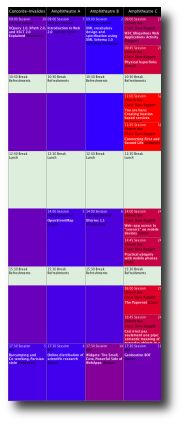
One of the fun and useful things we've been able to do in Expectnation with the personal scheduler is to use the data to help us as organizers. We recently added in dynamic overlays to the organizer's view of the schedule, enabling us to create heatmaps of the most popular talks. Heatmap
Screenshot of personal scheduler popularity overlaid on event timetable As well as satisfying natural curiosity, the heatmaps let us identify issues such as possible room overcrowding in advance. We're able also to record actual attendance figures as the conference goes on, and I will try and make an analysis of how attendees' intentions stack up against their actions. 

12 May 2007

Julien Danjou: Another one!

I beat my last record: the last time I killed my keyboard was 2 year and 1 month ago. Yesterday, some beer decided to go between keys... Argh, another Keytronic dead. Now I'm looking for a good keyboard for typing every day (please don't recommend me IBM model M or Keytronic, or tell me where to order them :-) ).

11 May 2007

Edd Dumbill: Up close and personal at XTech

It's been a long time since I last wrote, mostly because we've been pulling out all the stops for XTech. Next week is set to be stimulating and challenging. I'm amazed at the collection of thinkers and innovators we've drawn together, and am looking forward to getting a boost of energy and inspiration from the conference.
Browser summit On Tuesday next week, Molly Holzschlag and I are sponsoring a Web Browser, Standards and Interop Summit. This is an opportunity for browser vendors, standards advocates, W3C and related standards supporters to talk in a vendor (and standards-body) neutral atmosphere about tackling the problem of browser interoperability. As the full announcement mentions, we're also throwing open the doors to interested bloggers and journalists to get involved in and cover the discussion. The summit came about after Molly and I got talking about our desire to provide a forum for effective exchange between the people shaping the future of HTML. This is something that spawned the vision of the Browser Track and XTech in the first place three years ago. I don't know how much we'll solve at the first summit, but it puts down a marker and a challenge for participation. I am not the only one concerned at the increasing fragmentation of the HTML landscape, the breakdown in communication, and the ultimate ill-effects for web developers and users. Personal scheduler and evaluations As my conference software Expectnation nears its public launch, we'll be using some of its fun features at XTech. Normally, the bulk of the work is done behind the scenes, so it's nice to have a feature to show off to attendees and the wider public. Personal scheduler The personal scheduling feature lets you compose your own timetable for the conference, just by clicking on the stars throughout the schedule. As a bonus, you can subscribe to your personal schedule as iCal, allowing you to take it with you on your phone or PDA. In addition, we'll be allowing attendees to submit evaluations of sessions online. If you're using the personal scheduler, it gets even neater as you can quickly find links to submit your evaluations, and review ones you've already submitted. Behind the scenes, I can see which sessions are the most popular and get advance warning if we're likely to need to move rooms to avoid overcrowding. I'm pretty excited about this. Features like this aren't exactly new, but now we've made them a standard feature for every conference. We're looking forward to adding more social software facilities to enhance the conference experience.Submitting session evaluations 

10 May 2007

Martin Zobel-Helas: Packages considered for 4.0r1

As there are currently four persons working on the next stable release (Dann Frazier, Luk Claes, Julien Danjou and me), we decided to track all issues for the next stable release (4.0r1) also in the Debian BTS. So if you would like to look what we currently consider for 4.0r1, have a look here. Before adding a bug (eg. with the command bts user debian-release@lists.debian.org . usertag 420759 + SRM) please contact the stable release team first, or even better, let the stable release team add your bug there on their own. Also, not all uploaded packages to proposed-updates will automatically considered for the next stable release. Update: With “contact the stable release team first” i do mean, please send requests to debian-release@lists.d.o, not contacting release team members in private over IRC or direct eMail. And NO, h01ger, cellphone is also not an option!!!1!!!elf!!!!

8 May 2007

MJ Ray: Travelling to Debconf7

I've booked my travel to Debconf7. Here are some tips for anyone making the trip over land from England: There are cheap megatrains and megabuses from central Edinburgh to/from Manchester (train, weekdays) and Sheffield Meadowhall (bus, everyday) which give useful connections to points further south, avoiding London. Caledonian Sleeper Bargain Berths are now bookable, but Fridays go quickly (and seem to have gone for 15th). Similarly, there seem to be no cheap tickets left on the train up the Welsh border to Manchester for most useful dates. Find your "magic towns" for train tickets: stations where you can break long journeys to save money. They're often stations with more than one fast train operator, so these are usually old railway towns. For example, mine are Crewe and Derby from Somerset. Sometimes you don't even need to get off the train, but if you do change trains, you might be gambling on delays on the way to that town (if using timed tickets and so on), so allow enough time! Debconf's arrivals day (Saturday 16 June) is the European Day of Action Against Airport Expansion so arriving over land is a damn good idea, even without the CO2 reasons. (Debconf's last day is Pride Scotia - is all the silly scheduling deliberate?) Anyway, I think I'll have a bit of time in Manchester and Derby - anyone got tips on where to eat or what to see?

Martin F. Krafft: Linux pains #517: unregistering network devices

Somehow my network device does not want to recognise that it actually has a carrier. This being Linux (and not Windows), I thus decide to reload the driver, after taking down the network interface:
lapse:~# ip l dev eth0
2: eth0: <BROADCAST,MULTICAST> mtu 1500 qdisc pfifo_fast qlen 1000
    link/ether 00:0a:e4:30:43:16 brd ff:ff:ff:ff:ff:ff
# notice: not UP
lapse:~# rmmod e1000
lapse kernel: unregister_netdevice: waiting for eth0 to become free.
  Usage count = 1
lapse kernel: unregister_netdevice: waiting for eth0 to become free.
  Usage count = 1
[...]
# goes on forever, uninterruptible; thus new shell:
lapse:~# ps u -C rmmod
USER       PID %CPU %MEM    VSZ   RSS TTY      STAT START   TIME COMMAND
root      5624  0.0  0.0   1656   480 pts/2    D+   00:02   0:00 rmmod e1000
As we all well know, state 'D' uninterruptible sleep means: reboot. Especially since I cannot ssh into the box anymore (doh!), and su and sudo just end up in state 'D' as well, if I try them. So, on to reboot. Or wait, that doesn't work as the shutdown process will hang long before the filesystems get unmounted. Great. It's become impossible to argue that Linux is the more stable operating system Update: a few people responded with workarounds, ranging from use of watchdog to automate the reboot (this is my laptop, so it's not really necessary) to various combinations of flags to /sbin/shutdown or the use of sysrq to force the system to reboot without cleaning up or unmounting filesystems essentially the same as pressing the reset button. Ben Hutchings says:
I think this happens when the driver repeatedly attempts to fix an error condition and keeps scheduling future work (retaining a reference to the device) rather than giving up.
I thus ended up filing a bug against the kernel.

7 May 2007

Sam Hocevar: Bits from the DPL: blog, talks, FTP-master

blog posts I am going to identify all my DPL-related posts with a dpl tag. All such posts will be accessible through http://sam.zoy.org/blog/?cat=dpl. talks On May 5th I attended an Etch Install Party at the Carrefour du Num rique in the Cit des Sciences et de l'Industrie in Paris, organised by the Parinux LUG. Fellow developers Christian Perrier and Julien Cristau as well as not-yet-but-now-almost-really-soon-to-be developer Yves-Alexis Perez were also present. I did a (rather dull, sorry; I didn't prepare it well enough) talk about the Debian project, its organisation and how people, even beginners, can help Debian and its community. My slides (French) are available, and the Carrefour du Num rique people kindly recorded it and made it available for download. interviews Since the DPL elections I have given several interviews, of which a few have already been published. They may be of interest because I share my thoughts about topics that were not covered in my platform, or not very deeply. You can also check whether I am consistent. And it s important that people know what I may say about Debian to the rest of the world. The interviews are: FTP-master and other teams Zobel is frustrated by things not happening in the FTP team which were apparently going better when AJ was DPL. I don t really know how to understand that blog post. A DPL+FTP-master hat is something that cannot happen this year, so if this is what allowed AJ to be efficient we ll have to find something else. For the record, after my first bits from the DPL on debian-devel-announce and its request for candidacy I have received one offer to help the DSA team and one offer (this morning) to help with the NEW-handling part of FTP-master work.

6 May 2007

Julien Blache: pommed v1.4: support for PMU05 machines

This is again a bugfix & enhancement release for pommed: Bugs, patches and ideas welcome, at the usual place.

Alastair McKinstry: The God Delusion, by Richard Dawkins

The God Delusion by Richard Dawkins is an 'Atheism Consciousness-raising book', according to the author. It makes the case for Atheism, saying Atheists should stand up and be counted, and stand against the growing tide (in the U.S. in particular) of irrationality and belief. Although as one of Atheisms most visible proponents Dawkins has 'make converts' to the cause, in this book he is mostly speaking to the converted, presenting the evidence. The book documents the main arguments in favour of God. These are dismissed fairly abruptly; while a lot of pages are taken up going into them, they are probably not a comprehensive list. A book by a theologian or believer would probably be a better source for such a list. Nevertheless, Dawkins as a scientist does consider and list the opposing arguments. As presented however, they are extremely threadbare and easily dismissed. Mostly they are backed up by a willingness for people to take God (and Theology!) seriously: since so many people believe in God, it must be taken seriously, or so the reasoning goes. Not so: the proofs of Gods existence don't stand up and should be dismissed. Dawkins makes the case that we should instead of investigating God, investigate why people believe in God, given the lack of evidence. He gives some good hypotheses in terms of Darwinian thinking: reasons why faith, accepting what your parents said without evidence, has survival benefits, that in other circumstances lead people to believe nonsense stories with faith. Another under-estimated problem is the different definitions people have for 'God' and 'religion'. Most people from a Christian / Judaic background have a habit of framing belief and Religion in terms of the religion they grew up in. They may accept that you have a different God(s), but still view God(s) as something you pray to, that intercede on your behalf, etc. By confusing all the different aspects given to 'God' in the Christian tradition, they think that if you have 'proved' one of them, all the rest follow. If you prove / claim that something created the Universe, and label that God, then, they imply, there must be one overall, kind, monotheistic God, Jesus died on the Cross for your sins, that God will change the laws of physics to suit you (miracles), etc. Not so: all you have done is label something, not proved your religion. Dawkins (rightly) dismisses Buddhism, etc. as 'principles for living' rather than religions for the purposes of this book, and we need to be careful what we call religion, too. Dawkins also makes a good case against Agnosticism. He argues we should be more forthright and say we are Strongly Atheistic rather than Agnostic. Agnosticism was created by Thomas Huxley to explain his beliefs. He defined Athiesm is a positive belief in the lack of God, a proposition for which there is no evidence. He argued that, until we have proof that God does not exist, scientifically correct to consider ourselves 'sceptics' on this matter, and neither believe nor disbelieve in God. This sounds good, however in Science there are huge numbers of theories that in practice we have no evidence for either way that Occams razor mows down for us. We don't claim to be agnostic about them, we simply ignore them until they are actually needed to explain something. Which, given modern science and Darwins explanation of evolution in particular, God no longer is. The later chapters of the book cover whether, despite the lack of evidence, belief in God or Religion is a good thing, whether religion gives a moral purpose and direction to life, and defines a sense of "Good" that Atheists cannot have. For this he goes through the Bible with a disbelieving eye, pointing to the horrors of genocide that it promotes in the Old Testament, etc. He points out that we don't actually use the bible for moral guidance, but instead decide our own morality: we pick examples from the Bible a la carte to defend our choices. We don't decide, as an Old Testament interpretation would put it, that murder of an non-Jew is acceptable; that rape of an enemy is acceptable, that killing non-believers and witches necessary. Instead we pick examples to back up what we've decided already. If you're going to do that, stop pretending the Bible is giving you moral guidance and instead accept that we decide. Dawkins underestimates the social and ethnic aspects of religion. He is overly critical of religion, blaming it for much of the worlds violence, genocides, etc. It would be truer to say that Northern Ireland, etc. are examples of ethic rather than religious strife. "God says so" is just the ultimate argument. But conversely religion is a cohesive element in most societies. I suspect that a cause of the growth of christianity in the U.S. is that its proselytising nature goes out to be inclusive in Americas highly mobile society. When work, etc. causes people and families to move across the continent, they will find a church to welcome them into the community. Its against this background that atheists are the most distrusted minority. Shared beliefs, whatever those beliefs, bring neighbours closer. James Lovelock, (co-creator with Lynn Margulis of the Gaia Hypothesis) proposes that atheists can treat Gaia as an alternative religion, something to celebrate and to give moral direction to life. This I have sympathy with, that life is important, and to be celebrated, but not to be confused with something to be prayed to, or imagine that it is biased towards towards our existence. In these times when people are again using religion as a justification for war, claiming a "clash of civilisations", this is a book worth reading, but beyond deciding whether gods exist we need to understand why people believe. The Darwinian arguments are as Richard Dawkins points out, just a start, but I think more is needed to explain religion. Tags , ,

Evan Prodromou: 15 Flor al CCXV

Today is my one-year blogging anniversary. I started this blog on Journal/15 Flor al CCXIV, kind of trepidatiously and with ambiguous intentions. Now, a year later, I feel much more confident in the format and clear in my purpose. I've varied between an almost maniacally consistent one-post-per-day regimen to a more impressionistic, when-I-feel-like-it once-a-week schedule. I'll admit that I'm happier with the more frequent update schedule; I feel like I deliver more to the reader that way. I think the main thing I've enjoyed from having this blog has been the personal satisfaction in frequent and informal writings on my own schedule and to my own whim. Working with wikis makes a lot of my life about careful collaboration and consensus gathering, and having a place where I can speak out with my own voice on my own thoughts is really refreshing... and addictive. Most of all, I've enjoyed how having this blog has connected me with new people, and with friends I already had, in new and different ways. This year of blogging has been contemporaneous with a deepening of my connection with the Montreal technology community, and I can't help but think there's some causation involved. I think that my blogging is bringing me into a common medium and a common language with a group of people I want to spend time with. I've had some side effects I didn't anticipate, either. My family has started reading this blog, which means they know how I'm doing and what I'm up to more often than when I do once-a-week phone calls. And my more extended family -- aunts, uncles, cousins -- also read regularly. I can only wonder what they think about my complaints over various, say, Scheme module formats, but they seem to like it, too. Even Maj's mother reads it (hi Rita!). I think that m-c's 10 reasons to blog really hold true for me; it's good reading with a year's perspective behind me. I'm looking forward to the next year and what it has in store. tags:

Great day It was actually a great day for a blogiversary. Last night, Maj went out with her friend Sam for Sam's birthday, so this morning Amita June had a very quiet breakfast and then went out to Best Buy to do some shopping. I just bought a Canon MP600 printer, and toner cartridges weren't included in the package, so I had to go buy more. (Later, while configuring the printer, I found the toner packages in the bottom of the box. D'oh!) Amita fell asleep on the way home, so I just dropped her in bed. Maj and I walked through a brisk but sunny Montreal weekend afternoon down to the me dia offices, where Creacamp was already in full swing. There were lots of old friends and new ones, and the offices were light and airy and nicely connected. There was a talk by Guylaine Couture about her painted books, and by Luce Beaulieu about her awesome codesigner business, POSCH. Both really interesting. Of course my favourite talk was Anne-Marie's, about her great video series Music Spins the World (or La musique spin le monde). It's an incredible first-person series about her travel adventures with various rockstars to obscure and dangerous parts of the globe. A-M is becoming quite the rock diva, but I'm glad she's staying down-to-earth about it. You can check her work on 33mag.tv. Tonight I had a great time, too. Alex Roberts and Jon Phillips of Creative Commons are in town for the awesome Libre Graphics Meeting being held at the cole Polytechnique this weekend. The event seems great -- bringing together developers from all the great Open Source/Open Content graphics projects together in one room to talk. Jon and Alex met me and Niko at Concordia to see the Montreal premiere of the Helvetica movie. Helvetica is a great documentary about the history of this ubiquitous, unassuming font that epitomizes the modernist view of typography and design. The movie gives Helvetica a personality all its own, and in the process explicates the history of graphic design over the last fifty year. It also introduces us to a rogue's gallery of design and typography legends, all of whom are amusingly and passionately opinionated about design in general and Helvetica in particular. It has that characteristic of great documentaries: it illuminates the camera obscura of global culture through the pinhole of its narrow subject, a single font. Incredible. After the movie the four of us went to La Banquise, the landmark 24-hour poutine parlour right near my house. Alex and Jon indulged deeply in the local specialty -- they each got poutines with lots of bacon and ground beef -- and we all chatted about San Francisco, Web culture, Creative Commons and the cast of characters that surround it. A great, fun time. tags:

3 May 2007

Julien Danjou: Never lose hope

Five years old wishlist bug might be fulfilled by some people with 5 lines code!

29 April 2007

Evan Prodromou: 9 Flor al CCXV

Ah, beautiful Sunday! This is the first day this week we've had a little peace around the house. It'll all go crazy on Monday, of course, but it's nice to have something like a day off. tags:

BarCampMontreal2 I had a great time yesterday at BarCampMontreal2. It was pretty fortunate that my parents are visiting this week, because it meant that both Maj and I could go to the event together. We also had our friend and fellow Wikitraveller Jani Patokallio visiting from Singapore, so we brought him along with us. Jani's a community and technology hacker and he's a lot of fun, too. This was our first event in the new BarCamp venue at the SAT, and it turned out to be a good one. The space is really big, with about 3 huge spaces. We used the back room, which is wide enough for a lot of video displays, to good advantage. The front area became an informal caf and it was really great for personal talks -- isolated from the main presentation area. Damian DiFede gave a great talk about his Ajax-based MUD, Mujax. I think it looks really cool -- I hope he can get the kind of participation and content to make it a more immersive space. I gave the second talk. I'd really wanted to do a talk about The Keiki Project, our upcoming venture, but it was too soon for a real hands-on demo. So I'd planned to do a presentation about RDF and our use of Wikitravel:Turtle RDF on Wikitravel, but I kind of got too busy by the end of the week. So I ended up recycling my talk about Commercialization of Wikis (see Talks/SXSW07), which got a lot of positive feedback. I liked seeing Sylvain Carle's presentation on what he'd learned in Silicon Valley. Sylvain is one of the best presenters at BarCampMontreal -- he's a big goofball who loves his work and communicates that passion with intelligence and sincerity. For example, he themed his talk with songs by Quebec rocker Robert Charlebois. Candid and ingenious. Also great was Hugh McGuire's talk about lessons learned in development of the cool podcasting platform Collectik. His talk came down to one great point: that you have to be able to communicate the purpose of your Web site (or other project) in one sentence. He didn't do that for Collectik, and now he's trying to figure out how to. It's great hearing people talk about their mistakes. Maj gave a great talk about Wikitravel Extra, the new personal-opinion and -experience platform that we've built to complement the objective, consensus information in Wikitravel. I keep forgetting what a good public speaker she is. She did a good job talking about the needs we were trying to fill, and she demo'd the platform (flawlessly). I think she's got a good presentation to take to other conferences now (lucky dog). Another talk I found fascinating was Chris Car's discussion of his past project, MeshCube. The MeshCube is a tiny mesh networking tool that Chris and a partner developed in Hamburg. Chris talked about what worked and what didn't work with that project, showed off some cool hacks (mesh network robots!) and was (like Hugh) open about mistakes. Sitting in the middle of about 8 WiFi networks (in my home office) as I type this, I'm really interested in mesh networking and I was glad to hear from Chris why it doesn't currently work and what can be done to make it work. Probably the most important talk, for me, was Martine Pag 's discussion of what we need to do to bring more women to technology conferences. She did a great, fair overview of the topic, and then opened the floor to discussion. We had a really great, frank talk about -- both men and women -- and a lot of diverse points of view were expressed. I'm really appreciative of Martine opening up this discussion, and I'm glad we're going to be more proactive in the Montreal technical community about being inclusive of the really great women working in technology in this city. There were some other good talks, of course: apenwarr gave a good talk about the new, new way to have a startup; the mysterious and elusive Madame Woo talked about traveling alone; and Australian visitor Moomlyn gave a great description of lucid dreaming. There were good demos of Cake Mail and My Carpool Station. All in all a great set of presentations. I also liked meeting up with some of the people there. Patrick Tanguay gave a great lunchtime standup symposium about the state of Montreal's coworking space and where we're going from here. I also liked talking with Tamu Townsend, who I hadn't met before. Probably my best talk was with Sylvain and Martine about what the boundaries of BarCamp are. Why do we have talks about solo travel, digital photography, and lucid dreaming? Sylvain had a great answer: BarCamp comes out of the hacker ethic: that spirit of curiosity, humor, passion and playfulness that makes working on computers so enjoyable for so many. If someone can communicate that same passion and intellectual captivation with another subject, it's going to go over well at BarCamp, no problem. Well said!

Pros and cons Here are some things I liked and didn't like about BarCampMontreal2. First, things I liked:
  • The people. Yet again, meeting up with my favourite technologists in Montreal. Many people I first met at BarCampMontreal1, and it was nice to see how our friendships have developed in the 6 months since then.
  • Diversity. I was really glad that there were many more women at this vent than at previous ones. My guess is somewhere around 20-25%, which isn't anywhere near where it should be but a big improvement over the 5-10% we had at BarCampMontreal1. Special props to Hugh, whose invite to women was, I think, pretty helpful. And of course to all the women who took the extra step to show up at a majority-male event.
  • The presentations. Almost uniformly really, really good. Some were just excellent.
  • Lunch. Simple and easy, didn't get in the way of socializing.
  • The Bar. I liked having the bar open at lunch. Having a beer with friends really changes the dynamic of the event; and SAT has a decent selection of brews and friendly barstaff.
  • The screens. A-V was great this time around -- good job by SAT on this.
  • The space. It was cool having the back room at SAT. It's a really nice place for this kind of event.
  • Powerpoint Karaoke. A great idea (people have to give 5-minute presentations based on off-topic slidesets they've never seen before), but I think the scheduling was off. It would have been great to spread these out between other sessions during the day for comic relief, rather than clumped all together at once.
Second, things I wasn't happy about:
  • Registration. It was really great being welcomed at BarCampMontreal1, and this was distinctly missing at our second event. We had a pile of nametags on the table by the door, and no other form of greeting. For a space like SAT, this just didn't work. I'm going to volunteer to help out with this step at future events, since it's so important.
  • Coffee. I realize I'm a coffeeholic, but it would have been nice to have a coffee table out. It's nice to have on a rainy Saturday, and it gives shy people something to do.
  • T-shirts. I think every BarCamp should be an event worthy of a t-shirt. Fred gave out some shirts left over from BarCampMontreal1, but it would have been nice to have new ones for this event, too.
  • Tables. I realize they're expensive to rent, but dang, they're really great to have if you've got your laptop and other techno doodads. It changes the event from being a show to being a symposium.
  • Schedule timing. The (very important) talk by Martine about women in tech conferences ran far over schedule and wiped a few talks off the board. I think that was a mistake. After it was done, the joke segment of Powerpoint Karaoke started. By the time it was finished, 60% of the audience was gone, even though there were 4 serious talks still to go. We need to do a better job with timing this kind of thing so we keep the energy going through the entire day.
  • Too much noise from the caf area. As people drifted off from the main presentation area, the caf filled up, making for lots of loud chatter that drowned out the presentations. We should probably figure out how to fix this problem; it would be nice to stimulate this casual conversation while still being respectful to the speakers. Maybe more breaks (one in the morning and one in the afternoon)?
  • <100% participation. It seemed like there were a lot of spectators this time around, which drags down the participative nature of the event. I think that asking registrants how they're going to participate when they come to the door is a great way to gently remind people that they're expected to be involved (we do this for Burning Man events sometimes). I think Powerpoint Karaoke and other exercises would be a great way to get better hands-on participation by people who didn't prepare talks. (I hope that MadameWoo does a talk in the future about how to do an ad-hoc talk at BarCamp.)
My net feeling about the event was extremely positive, and I'm making these notes not to criticize anyone but to remind myself to do something about them for the next BarCampMontreal. I think that we can continuously improve this event to be inclusive, stimulating, fun and exciting, and I hope we keep this great barcamp spirit going in this city for a long time. tags:

27 April 2007

Martin F. Krafft: Moving in pieces, with and without morphine

As readers of my blog know, I moved to a new flat just after Easter. Unfortunately, on that Monday afternoon, just after we finished hauling most of the furniture (the heavy stuff at least) over to the new place, I slipped as I was leaping off the transporter vehicle, lost an argument against gravity and hit the asphalt more or less horizontally after a 1.5 metre fall. I landed on both wrists and my left knee, and while my consciousness never left, reality sort of blurred away, as I rolled over on the ground and waves of pain began rippling through my body. People started assembling around me and the adrenaline faded away, then I realised that this move of mine was not going to end as smoothly as it had begun. My body refused to bend my left wrist and knee and I knew I was injured, but it did not hurt so much for me to conclude anything serious. I remembered the ice packs in my freezer and had my cousin fetch them, then let two colleagues carry me to bed to regain my bearing, but the pain got worse and I started to accept that I would have to go to the hospital. Still optimistic ("it's just a contusion, it's just a sprain"), I crawled from my cousins car to the wheel chair, into the hospital and onto a bed to await the verdict. Still thinking about returning home tomorrow, I spent hours on the bed, being pushed between the x-ray, casting, and diagnostic rooms until finally I was told of my fate: multiple fractures of my left knee cap, broken ulna and radius on my left arm with splinters in the joints, and a fractured metacarpal bone on the right my pinky's tendon was supposed to snap, but it proved too strong and rather caused the part of the bone to which it was attached to rip off. They deciced to perform surgery on the two left limbs but to leave the metacarpal bone alone because of the complexity of the fracture and the proximity of all my hand's and fingers' nerves. Because everything was swollen like a balloon ready to burst, I had to wait three days for the surgery with casts and a splint on my leg. The surgery was scheduled for Thursday morning and even though I was actually looking forward to it all (especially the administration of the anesthetic), I was simply too tired in the early morning hours, and the Dormicum tablet they fed me did the rest: I was asleep when we entered the surgery room and woke up at noon with new casts and a morphine injection pumping a comparatively large dose of the drug into my veins every eight minutes apparently, my body was going through a lot of pain during the surgery, so the "pain management service" (in German, they're just called "Schmerzdienst" "pain service", actually) opted to pump it up. Here's what I looked liked shortly after the surgery: madduck post-surgery Meanwhile, Gian-marco, my future flat mate, had spent the day packing up everything that was left in my old flat, where I had left an utter mess. A colleague of mine was to sublet the place starting that Saturday, so there were roughly 48 hours left to empty and clean it, and to hand it over. There are more pleasant things in heaven and earth than to have someone else empty your flat for you. Morphine is a really crazy drug. Most people think of it as fuzzy and often joke about taking it if only they could get their hands on it. Having made the experience, I'd rather not take it again unless I have to. Watching television turned out to be impossible, even the weather report went too fast for me. Visitors appeared sort of blurry, I would often not follow the things they said, and it was definitely impossible to entertain thoughts for prolonged periods of time, or to engage in any sort of productive thinking. Organising a cleaning lady for my old flat and giving instructions to my cousin, who would hand over the flat took all my energy On Friday, I was to have an important business meeting with three people, so I organised a room in the hospital and asked the nurses to put me on optional morphine so I could be a bit more present during the meeting. As a consequence, I could press a button once every ten minutes for a dose of morphine, and with this new level of control, I began to reduce the drug amount in my blood gradually. The meeting did not take place in the end but I came to regret my choice to reduce the morphine at around midnight, when the pain in my knee became unbearable. I kept pressing the button for more morphine like a madman, but the device would only deliver a new shot every 10 minutes. The nurse was not authorised to change that and instead gave me other pain and sleep medication, but not even the combination of morphine, Tramal (an opiod), Novalgin, Mefenacid, and Paracetamol could dampen the level of pain, and so I spent almost three hours in real agony, biting the pillow with tears running down my cheeks, until finally the medication won, I became indifferent (thanks to Temesta) and drifted off into sleep. After breakfast the next morning, the morphine applicator suddenly had a fit, started beeping, and pumped more drug into my body than it should have. It took me about 20 minutes or maybe an hour (who knows ) to put my brain together, realise what had happened, and come up with a way to lift my finger to the button to call the nurse. Despite the horrible night, I told them to remove the morphine because I'd rather stand the pain than have my brain mushed like that, plus there are always plain morphine injections delivered by humans instead of machines. In fact, the next night I could feel the pain approaching and since it's easier to suppress pain than it is to remove it, I asked for a sleeping pill and a morphine injection. The injection did three things: first, it hurt so much that my knee immediately became pain-free while nerve central was occupied trying to figure out what the heck had just happened in my right thigh. Second, it did not take three minutes to kick in, and it kicked in so strongly that I just barely realised that my head was suboptimally positioned on the pillow and the lights still on, but failed to do anything about it. I did not wake once until breakfast. And third, I am glad to know that morphine does actually (still) work. Pain is complex, fascinating, useful, sometimes even pleasurable to some, but when you know the cause and you'd rather make it stop, it's comforting to know that there are ways the previous night had instilled some doubt in me. From then it was all downhill and I left the hospital after eleven days on Thursday, got by without pain medication the same day and off the sleeping pills the next night. Two days later I was already racing around town in my wheel chair: madduck racing in a wheel chair By now I can actually walk again, albeit slowly, and even though I still cannot lift heavy stuff or get my hands wet, my hands are a lot better; on 21 May, the casts shall be removed and I'll be able to bend my knee again, but it may take up to a year to return to sports, such as running, to which I had just become addicted. In fact, I can comfortably claim that I had just reached an acceptable level of fitness just before the injury. Tough luck. My mother has come to Zurich twice already to help unpack and with her invaluable help, as well as the help of Gian-marco and several others, we are actually almost done moving in. Ironically, it's actually quite annoying to sit and watch others do your work; I would have helped as well, had the roles been inverted, and yet I am still greatly indebted. Human relations tend to be funny like that. Let me end with two points: first, Zurich's university hospital probably ranks among the best hospitals in the world, and that makes Zurich even more attractive to me (even though I certainly don't plan my next hospital stay). I felt very comfortable throughout my stay, had the impression of being in very capable hands, and had most of my countless questions answered. In addition, the hospital is very nicely surrounded by a park and could not be more central, which makes it easier for visitors. And that brings me to my final thought: thanks to everyone who stopped by or called in to make my stay a lot more pleasant. I spent eleven days in the hospital and I got bored and annoyed for the first time on Wednesday, the day before my release. Most of the credit for those ten days of lack of boredom goes to everyone who supported me. It did help that I had Internet access via a convenient 2 /day GPRS flatrate (even though I could not really type), but it became crystal clear to me that visiting someone in the hospital, whether you're close to the patient or not, is one of the most beautiful gifts you can give. In the past I have neglected this opportunity occasionally; now I would want to make a special effort (even though I hope there won't be any need). And I would not be a geek if I did not end this post with a reference to Debian: I know of a case when one of our developers ended up in hospital and two others (or was it more?) drove hours to visit and check in on him/her. Now even more than before can I say that I am proud to be a member of a project in which such things happen. PS: this post took me about 4 hours to compose. Sucks to be typing one-handed.

Julien Blache: MacBook Pro status update: now this is weird

I’ve just built a 2.6.21 kernel for my machine, only to realize that the machine doesn’t behave like some other similar (if not identical) MacBook Pro do. Facts: So, now I’m really confused. A colleague here has got the exact same machine, except he bought it in mid-february and I bought mine back in november (the day after they were announced by Apple, so my machine is one of the “very first” Core2 Duo MacBook Pro). Either there has been a new hardware revision, or there’s something weird happening. I’m running an x86-64 kernel and my colleague is running an i386 kernel, but I really can’t believe it makes any difference at all. I guess I’ll have to find out what’s going on …

25 April 2007

Julien Blache: pommed v1.3: enhancements and fixes

This is mainly an enhancement release as far as pommed itself is concerned: This last item is probably the most important one for quite a few pommed users; hope it’ll behave better after suspend and will no longer get “stuck”. Gpomme has got 2 new themes, the elegant-bright and elegant-dark themes, along with a configuration GUI which will let you set the theme and the timeout. Enjoy!

Next.

Previous.