Search Results: "rul"

17 November 2011

Raphaël Hertzog: People Behind Debian: Mark Shuttleworth, Ubuntu s founder

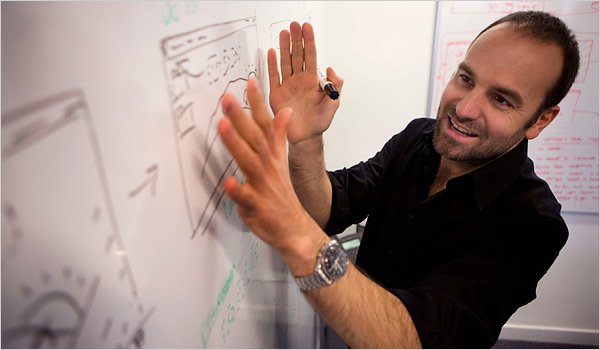
I probably don t have to present Mark Shuttleworth he was already a Debian developer when he became millionaire after having sold Thawte to Verisign in 1999. Then in 2002 he became the first African (and first Debian developer) in space. 2 years later, he found another grandiose project to pursue: bring the Microsoft monopoly to an end with a new alternative operating system named Ubuntu (see bug #1). I have met Mark during Debconf 6 in Oaxtepec (Mexico), we were both trying to find ways to enhance the collaboration between Debian and Ubuntu. The least I can say is that Mark is opinionated but any leader usually is, and in particular the self-appointed ones! :-) Read on to discover his view on the Ubuntu-Debian relationship and much more. Raphael: Who are you? Mark: At heart I m an explorer, inventor and strategist. Change in technology, society and business is what fascinates me, and I devote almost all of my time and wealth to the catalysis of change in a direction that I hope improves society and the environment. I m 38, studied information systems and finance at the University of Cape Town. My hearts home is Cape Town, and I ve lived there and in Star City and in London, now I live in the Isle of Man with my girlfriend Claire and 14 precocious ducks. I joined Debian in around 1995 because I was helping to setup web servers for as many groups as possible, and I thought Debian s approach to packaging was very sensible but there was no package for Apache. In those days, the NM process was a little easier ;-) Raphael: What was your initial motivation when you decided to create Ubuntu 7 years ago? Mark: Ubuntu is designed to fulfill a dream of change; a belief that the potential of free software was to have a profound impact on the economics of software as well as its technology. It s obvious that the technology world is enormously influenced by Linux, GNU and the free software ecosystem, but the economics of software are still essentially unchanged. Before Ubuntu, we have a two-tier world of Linux: there s the community world (Debian, Fedora, Arch, Gentoo) where you support yourself, and the restricted, commercial world of RHEL and SLES/SLED. While the community distributions are wonderful in many regards, they don t and can t meet the needs of the whole of society; one can t find them pre-installed, one can t get certified and build a career around them, one can t expect a school to deploy at scale a platform which is not blessed by a wide range of institutions. And the community distributions cannot create the institutions that would fix that. Ubuntu brings those two worlds together, into one whole, with a commercial-grade release (inheriting the goodness of Debian) that is freely available but also backed by an institution. The key to that dream is economics, and as always, a change in economics; it was clear to me that the flow of money around personal software would change from licensing ( buying Windows ) to services ( paying for your Ubuntu ONE storage ). If that change was coming, then there might be room for a truly free, free software distribution, with an institution that could make all the commitments needed to match the commercial Linux world. And that would be the achievement of a lifetime. So I decided to dedicate a chunk of my lifetime to the attempt, and found a number of wonderful people who shared that vision to help with the attempt. It made sense to me to include Debian in that vision; I knew it well as both a user and insider, and believed that it would always be the most rigorous of the community distributions. I share Debian s values and those values are compatible with those we set for Ubuntu.
Debian would always be the most rigorous of the community distributions.
Debian on its own, as an institution, could not be a partner for industry or enterprise. The bits are brilliant, but the design of an institution for independence implies making it difficult to be decisive counterparty, or contractual provider. It would be essentially impossible to achieve the goals of pre-installation, certification and support for third-party hardware and software inside an institution that is designed for neutrality, impartiality and independence. However, two complementary institutions could cover both sides of this coin. So Ubuntu is the second half of a complete Debian-Ubuntu ecosystem. Debian s strengths complement Ubuntu s, Ubuntu can achieve things that Debian cannot (not because its members are not capable, but because the institution has chosen other priorities) and conversely, Debian delivers things which Ubuntu cannot, not because its members are not capable, but because it chooses other priorities as an institution. Many people are starting to understand this: Ubuntu is Debian s arrow, Debian is Ubuntu s bow. Neither instrument is particularly useful on its own, except in a museum of anthropology ;)
Ubuntu is Debian s arrow, Debian is Ubuntu s bow.
So the worst and most frustrating attitude comes from those who think Debian and Ubuntu compete. If you care about Debian, and want it to compete on every level with Ubuntu, you are going to be rather miserable; you will want Debian to lose some of its best qualities and change some of its most important practices. However, if you see the Ubuntu-Debian ecosystem as a coherent whole, you will celebrate the strengths and accomplishments of both, and more importantly, work to make Debian a better Debian and Ubuntu a better Ubuntu, as opposed to wishing Ubuntu was more like Debian and vice versa. Raphael: The Ubuntu-Debian relationship was rather hectic at the start, it took several years to mature . If you had to start over, would you do some things differently? Mark: Yes, there are lessons learned, but none of them are fundamental. Some of the tension was based on human factors that cannot really be altered: some of the harshest DD critics of Canonical and Ubuntu are folk who applied for but were not selected for positions at Canonical. I can t change that, and wouldn t change that, and would understand the consequences are, emotionally, what they are. Nevertheless, it would have been good to be wiser about the way people would react to some approaches. We famously went to DebConf 5 in Porto Allegre and hacked in a room at the conference. It had an open door, and many people popped a head in, but I think the not-a-cabal collection of people in there was intimidating and the story became one of exclusion. If we d wanted to be exclusive, we would have gone somewhere else! So I would have worked harder to make that clear at the time if I d known how many times that story would be used to paint Canonical in a bad light. As for engagement with Debian, I think the situation is one of highs and lows. As a high, it is generally possible to collaborate with any given maintainer in Debian on a problem in which there is mutual interest. There are exceptions, but those exceptions are as problematic within Debian as between Debian and outsiders. As a low, it is impossible to collaborate with Debian as an institution, because of the design of the institution.
It is generally possible to collaborate with any given maintainer [ ] [but] it is impossible to collaborate with Debian as an institution.
In order to collaborate, two parties must make and keep commitments. So while one Debian developer and one Ubuntu developer can make personal commitments to each other, Debian cannot make commitments to Ubuntu, because there is no person or body that can make such commitments on behalf of the institution, on any sort of agile basis. A GR is not agile ;-) . I don t say this as a critique of Debian; remember, I think Debian has made some very important choices, one of those is the complete independence of its developers, which means they are under no obligation to follow a decision made by anyone else. It s also important to understand the difference between collaboration and teamwork. When two people have exactly the same goal and produce the same output, that s just teamwork. When two people have different goals and produce different product, but still find ways to improve one anothers product, that s collaboration. So in order to have great collaboration between Ubuntu and Debian, we need to start with mutual recognition of the value and importance of the differences in our approach. When someone criticises Ubuntu because it exists, or because it does not do things the same way as Debian, or because it does not structure every process with the primary goal of improving Debian, it s sad. The differences between us are valuable: Ubuntu can take Debian places Debian cannot go, and Debian s debianness brings a whole raft of goodness for Ubuntu. Raphael: What s the biggest problem of Debian? Mark: Internal tension about the vision and goals of Debian make it difficult to create a harmonious environment, which is compounded by an unwillingness to censure destructive behaviour. Does Debian measure its success by the number of installs? The number of maintainers? The number of flamewars? The number of packages? The number of messages to mailing lists? The quality of Debian Policy? The quality of packages? The freshness of packages? The length and quality of maintenance of releases? The frequency or infrequency of releases? The breadth of derivatives? Many of these metrics are in direct tension with one another; as a consequence, the fact that different DD s prioritise all of these (and other goals) differently makes for interesting debate. The sort of debate that goes on and on because there is no way to choose between the goals when everyone has different ones. You know the sort of debate I mean :-) Raphael: Do you think that the Debian community improved in the last 7 years? If yes, do you think that the coopetition with Ubuntu partly explains it? Mark: Yes, I think some of the areas that concern me have improved. Much of this is to do with time giving people the opportunity to consider a thought from different perspectives, perhaps with the benefit of maturity. Time also allows ideas to flow and and of course introduces new people into the mix. There are plenty of DD s now who became DD s after Ubuntu existed, so it s not as if this new supernova has suddenly gone off in their galactic neighbourhood. And many of them became DD s because of Ubuntu. So at least from the perspective of the Ubuntu-Debian relationship, things are much healthier. We could do much better. Now that we are on track for four consecutive Ubuntu LTS releases, on a two-year cadence, it s clear we could collaborate beautifully if we shared a freeze date. Canonical offered to help with Squeeze on that basis, but institutional commitment phobia reared its head and scotched it. And with the proposal to put Debian s first planned freeze exactly in the middle of Ubuntu s LTS cycle, our alignment in interests will be at a minimum, not a maximum. Pure <facepalm />. Raphael: What would you suggest to people (like me) who do not feel like joining Canonical and would like to be paid to work on improving Debian? Mark: We share the problem; I would like to be paid to work on improving Ubuntu, but that s also a long term dream ;-) Raphael: What about using the earnings of the dormant Ubuntu Foundation to fund some Debian projects? Mark: The Foundation is there in the event of Canonical s failure to ensure that commitments, like LTS maintenance, are met. It will hopefully be dormant for good ;-) Raphael: The crowdfunding campaign for the Debian Administrator s Handbook is still going on and I briefly envisioned the possibility to create the Ubuntu Administrator s Handbook. What do you think of this project? Mark: Crowdfunding is a great match for free software and open content, so I hope this works out very well for you. I also think you d find a bigger market for an Ubuntu book, not because Ubuntu is any more important than Debian but because it is likely to appeal to people who are more inclined to buy or download a book than to dive into the source. Again, this is about understanding the difference in audiences, not judging the projects or the products. Raphael: Is there someone in Debian that you admire for their contributions? Mark: Zack is the best DPL since 1995; it s an impossible job which he handles with grace and distinction. I hope praise from me doesn t tarnish his reputation in the project!
Thank you to Mark for the time spent answering my questions. I hope you enjoyed reading his answers as I did.

Subscribe to my newsletter to get my monthly summary of the Debian/Ubuntu news and to not miss further interviews. You can also follow along on Identi.ca, Google+, Twitter and Facebook .

32 comments Liked this article? Click here. My blog is Flattr-enabled.

14 November 2011

Bdale Garbee: RF Immunity

We've had sporadic Altus Metrum customer reports about RF susceptibility issues with their TeleMetrum installations. In almost every case, these problems have been completely resolved by either making sure the system battery has sufficient charge before launch, or through the application of standard engineering techniques such as twisting wire pairs to reduce differential coupling. However, even when every technique we could think of had been applied, once in a while someone still had issues. Around the time of LDRS this year, the incidence of such reports seemed to increase. One customer, in particular, had an installation in which he virtually always saw continuous resets of the board once his 54mm airframe was put on a launch rail, and several customers reported seeing board resets during ejection charge firing. Keith and I saw a board reset during main charge firing happen in person at NCR's Oktoberfest, and with a couple days available to work together after that launch, we decided it was time to figure out what was really going on. Here's what we've learned. In bench testing, it quickly became clear that the problem was the 3.3 volt power supply rail getting pulled down far enough to reset the CPU. This most frequently happened during ejection charge firing, when the input of the LDO regulator is pulled down by the near-short presented by the e-match when a pyro FET is turned on. To keep the 3.3 volt rail voltage up during firing, we include a 100uF bulk capacitor on the regulator's output. In all of our prior bench testing, we never saw the 3.3 volt rail droop significantly. Clearly something had changed... or maybe several things had changed? The first thing I wondered about was whether the new Kalman filtering code, which requires more compute cycles from the processor, might be consuming enough more power to pull the rail down faster during charge firing. After poking around at it, though, we have no data to suggest the new code makes a measurable difference in power consumption. The next thing we pondered was that at least some of the e-matches we and others are using in the hobby now come from the fireworks industry, where it is apparently considered a feature for the match to retain continuity after firing. This means the input of the LDO gets held down for longer than with the e-matches we used to use and Quest Q2G2 igniters that open when fired. But that still didn't make sense as the root cause, as we chose the FET firing time such that even with a dead short across the igniter terminals, the 3.3 volt rail wouldn't be pulled down far enough to cause trouble during firing. One of the big changes between v1.0 and v1.1 on TeleMetrum was that the newer boards incorporate a better reset circuit. This helps ensure the GPS chip always comes up running at power on, which was a problem at temperature extremes with older boards. However, a side-effect of this change is that a v1.1 board will reset any time the 3.3 volt rail drops below 3.15 volts, whereas older boards didn't trip until a much lower voltage. So the recent increase in reports might just be related to more v1.1 boards being placed in service? While experimenting on the bench, we observed that injecting RF energy into the input of the LDO regulator had the effect of pulling down the output voltage, presumably because the internal reference source accumulates charge and is fooled into thinking the output is too high. Since our designs all have the power switch contacts ahead of the LDO, the wires going out to the switch and back are effectively an antenna... as are, to a lesser extent, the wires going to the e-matches. There is some variability from part to part in just how badly the LDO reacts. But by attaching a tuned length of wire as an antenna to the LDO input and playing around, we were finally able to reproduce the problem reliably on a test board at my bench! On further analysis, we realized that the output of the USB battery charger chip and the input of the LDO both expect a 1uF bypass cap to ground. At some point, those looked redundant and we eliminated one of the two. Unfortunately, we weren't internalizing the fact that the switch leads were between the two caps, and the one we left was on the output of the charger and not at the input of the LDO. Placing a suitable bypass cap right at the input of the LDO turns out to have a truly dramatic effect on RF immunity! Once we realized that RF getting into the LDO input was the problem, Keith pointed out that we used to see "noise" in the accelerometer data on earlier boards that was caused by the 3.3 volt rail moving slightly during radio transmit, which we fixed with a hardware change on v1.1. We are now convinced that this was at least partly related to RF coupling to the LDO input, not just the change in power consumption on the LDO output. We didn't realize what was going on in earlier testing because we often didn't have ematches wired up, so RF coupling was minimal. But going back to flights logged with v1.0 boards that included deployment, and studying the magnitude of the "steps" in acceleration data observed when the transmitter was on, Keith was able to compute the amount the 3.3 volt rail must have sagged if the real acceleration wasn't changing... which in some cases was as much as 180mV! We think this proves that RFI could cause the LDO to drop its output voltage below the reset controller set point on v1.1 boards. Based on these observations, I'm making two hardware changes for the next version of TeleMetrum (version 1.2), and Keith is also making a software change. We have tested all of these changes on real boards both on the bench and in test flights, and the net effect is a major improvement in the RF immunity of TeleMetrum. The first hardware change is moving to a slightly lower trip voltage on the reset controller. Instead of 3.15, the new part trips at 3.00 volts nominal. This gives us more "headroom" to tolerate 3.3 volt rail droop during charge firing, and will allow the board to operate longer on a given battery charge. This change is not relevant for v1.0 and prior. The second hardware change is adding an appropriate bypass capacitor right at the LDO input. This requires a PCB update, but it's possible for me to update existing production boards by adding an 0402 cap right across the appropriate pins on the regulator chip. The software change prevents our altimeters from turning on the radio transmitter while an ejection charge is firing. Since the RF transmitter draws substantial additional power, this should help keep the 3.3 volt rail from drooping. This may not really matter, but it feels like the right thing to do. This change will be part of our next stable firmware release. We think most TeleMetrum customers need not worry about these updates. But if you have seen odd resets on the rail or during ejection charge firing in flight with a TeleMetrum v1.1, feel free to contact me about updating your existing board to include these improvements.

13 November 2011

Niels Thykier: Status on build-arch target goal Nov 13th

We have been working on adding build-arch support for about a week now and I figured a little status update would be in order. :) According to UDD, we had 506 packages to fix when we started and after todays update it has dropped to 485. It is a little less than the 4 packages a day needed to ensure that they are all fixed in Wheezy, but I think it has been a good start. :) On a related note, I am very pleased to see the progress on the general build-arch fixes. According to the statistics collected by Lintian on lintian.d.o[1], maintainers in Debian has fixed a total of 67 packages since we started. To put that into perspective, we fixed about 36 packages the week before that. [1] Currently only DD-accessible on lintian.debian.org /srv/lintian.debian.org/history/tags/debian-rules-missing-recommended-target.dat

12 November 2011

John Goerzen: Greece part 5: Friends and Radios

See also parts 1, 2, 3, and 4. This is the biggest highlight of our trip to Greece for me. I enjoy having the chance to meet people, visit for awhile, and make new friends and that certainly happened in Greece. In one of the shops we happened to step into, I noticed a radio behind the counter. That s not unusual itself; radios often catch my eye these days. But this radio was tuned to 21.070, an amateur radio frequency. So I asked the shop owner if he happened to be a ham. And indeed he was. He was Lakis (SV5KKU), and Terah and I had a great time visiting with him. Terah took some photos of us, and then we made our purchases and headed out. I had brought my HT (handheld radio, weighs a few ounces and is powered by batteries) with me, and Lakis told me about the repeaters in the area. I had known about some of that since I had emailed Panos of the amatuer radio club in Rhodes before leaving home (I found his name via Google). A couple of days later, on Tuesday, we found ourselves back in Lindos. It was mid-afternoon, so the shops were quiet. After a late lunch, I thought it would be nice to drop in on Lakis one more time, since we were scheduled to fly back the following morning. I m not sure how long we stayed it must have been at least an hour and enjoyed the fresh orange juice he prepared. After we got back to our hotel Tuesday, I learned that our flights on Wednesday were canceled due to a nationwide air traffic controller strike in Greece. After 3 hours on the phone with Delta (more on that experience later), we got rescheduled to fly back Friday. On Wednesday morning, I remembered that the Rhodes amateur radio club meets every Wednesday evening, and now I would be able to go! I knew how to contact Lakis by email and on the radio, and he kindly offered to pick me up and take me there. So that evening, I got a tour of his impressive mountaintop installation, and then it was on to the club the Radio Amateur Association of the Dodecanese (SZ5RDS). There I met Panos, whom I had emailed earlier (and I think surprised him a bit). It was a friendly group, and they translated into English for me every so often so I knew what was being discussed. When I was about to leave, they gave me this: The translation, partly from my memory and partly with the help of Google Translate, is:
Radio Amateur Association of the Dodecanese, SZ5RDS Our friend and radio colleague KR0L JOHN GOERZEN, who visited the island, has our recognition as an HONORARY CLUB MEMBER. PRESIDENT KAVALAKIS PANAGIOTIS SV5AZK (Panos) SECRETARY PAPADIMITRIOU CHRISTOS SV5DDT RHODES Oct. 5, 2011
(I hope that any Greeks reading this will send me corrections.) I truly appreciated that gesture and meeting all the people in the club. On the way back to the hotel, Lakis and I stopped by a restaurant, which I believe had the best souvlaki I ve ever tasted thanks! We brought some back for Terah. She had chosen to stay at the hotel that evening and had a small hotel meal earlier, but enjoyed the souvlaki and pita. Terah had explained to the ma tre d that I wasn t along that evening because I had gone to an amateur radio club meeting. Judging by the surprised reaction, this was probably the first time they had heard that particular comment! Experiences like this make travel fun and worthwhile. Thank you very much, Lakis and everyone in the club I hope to have a chance to visit again.

8 November 2011

Jon Dowland: GNOME 3

Oh, boy. Where do I start I postulate that there exists something called the "UI Singularity". Those who spend too much time considering the optimal way to interact with computing devices eventually pass through this singularity and can no longer effectively communicate with those of us on the other side. At least that's one way to explain what seems to be happening to free-software desktop environments. From the outside, it would appear this happened to KDE with KDE 4, and now, unfortunately, it has happened to GNOME, with GNOME 3. I've had GNOME 3.0 running on my Debian laptop for a few months, which I have used casually. At work, we installed Fedora 15 (GNOME 3.0) on our 69-seat Linux lab over the summer, which I have used on occasion to achieve specific things. I haven't dared upgrade my main work machine yet. So, it could be argued that I haven't spent enough time immersed in the GNOME 3 experience to really judge it fairly. On the face of it, I wish 3 was an iterative development from 2, and didn't throw so many babies out with the bathwater. My casual use of it so far has not endeared it to me at all. In the interests of being fair, rather than deliver my opinion of GNOME 3 as it currently stands, I've decided to try and use it in anger for a while to truly see whether I can "get it". Now that we're past the start of term, I am attempting to use a lab-configured Fedora 15 machine as my main work environment. I'll run with this for a while, and then try a Fedora 16 instance (I need to consider whether we should move to F16 for the second semester anyway) to see what improvements GNOME 3.2 brings.

5 November 2011

Dominique Dumont: Debian NM process: it s not bureaucracy, it s

Hello Before entering Debian NM process (formerly New Maintainer process, now New Member process) , I ve often read that it was too long, too hard, or too bureaucratic. It s certainly true that becoming a Debian Developer takes some time. Even if you re already actively packaging. You have to answer a lot of questions regarding several aspects of Debian project. Some of them are not fun but necessary: All in all, the NM process was time well spent. I ve learned a lot. IMHO, Debian NM process isn t bureaucracy, it s more like a training. And an interesting one. So, if you re thinking about becoming a Debian Member, to paraphrase someone, what the bloody hell are you waiting for ? :-) Many thanks to all people that helped me become a DD: All the best

4 November 2011

Michael Prokop: FAI: switch from Subversion to Git

Revision one in the Subversion repository of the FAI project dates back to the 27th of June 2000. Over the last few months we were discussing the switch to Git. At the last FAI meeting we decided to finally switch to Git and I volunteered to drive the migration. Today I officially did the migration. I ve been using git-svn to handle the FAI svn repository for at least as long as I m wearing the FAI stable release manager hat. But the tags, author information, inside my git-svn checkout weren t ready for official publishing yet There are at least two different well known and referenced svn2git implementations out there. I decided to give the one hosted on github a shot because it s mentioned at http://help.github.com/import-from-subversion/. It basically uses git-svn and just does the few annoying steps for you that I d had to do manually otherwise. For more complex repositories the other svn2git implementation might be worth a try, especially since it s supported by the svneverever tool. svneverever supports more flexible rules regarding the repository layout (it was used for switching Gentoo s Portage from Subversion to Git). Luckily we didn t need it in our situation and I had experience with git-svn on the FAI repository already, so Converting the repository was as simple as running:

% svn2git svn://svn.debian.org/svn/fai --authors ../fai-svnauthors
The ../fai-svnauthors file contains all the svnuser = Realname <mail@example.org> mappings to get the author information right. Some 41 minutes later svn2git finished its work. Finally I pushed the result to the FAI repository at github. If you re interested in the repository size of svn vs. git:

3 November 2011

Josselin Mouette: The lies of Merkozy

When George Papandreou announced its will to submit the European help program to the approbation of the Greek people, I don t know whether he wanted to scare people, but man, he really achieved something. From Wall Street to the Bundestag, through the lys e Palace, they are all in a state of advanced panic. There s a joke that s been circulating since: for next Hallowe en, disguise yourself as a referendum. Yes, these guys are afraid. Afraid of the people. They are afraid because it is now clear that their interests are not the same as the interests of the people. And what do you do when you are afraid? Well, you find yourself some way out, often by lying. And indeed, Mrs Merkel and Mr Sarkozy have been repeating over and over something that has been then repeated over and over by most so-called journalists: that Greeks can only choose between two endings:

  1. they pay their debts to banks and rich people, and stay in the Euro zone;
  2. they don t pay their debts to banks and rich people, and find themselves another currency.
That s it: Mrs Merkel and Mr Sarkozy are outrageous liars. There is another option for Greek people:
3. they don t pay their debts to banks and rich people, and they stay in the Euro zone.
It s as simple as that: nothing in European treaties can force a country to leave the Euro zone. And nothing in these treaties can force a country to honor their bonds. Greece is a sovereign state and, as such, can choose not to honor its sovereign debt. And choose to stay in the Euro zone: why would they want to go out? What does it have to do with the currency those bonds have been emitted in? If California were to cease payment of its public debt (something not likely to happen at all, hmm?), would it have to abandon the Dollar? But here is a thing that has been forbidden for a long time in European treaties: for a country to help financially another one to pay its debts. This rule was introduced by Jacques Delors (a man who knows what being European means) precisely in order to avoid the contagion we are facing currently because of stupid help plans all across Europe. Yes: the whole idea of Merkozy s grand plan to save Euro while helping Greece (a weird kind of help, starving people, really) is illegal. So in addition to being liars, Mrs Merkel and Mr Sarkozy are delinquents. So let Greece cease payment of its debt. A few banks will sink: so what? This will create less unemployment than letting our whole economy sink. European States will guarantee citizens savings up to 30 k , that s one of the other clever European rules (some countries guarantee more). Other people, rich people only, will lose their savings. Will that prevent you from sleeping? Not me. But that could prevent from sleeping a number of friends of Mrs Merkel s and Mr Sarkozy s. And wouldn t that be a good reason for lying and violating European treaties?

2 November 2011

Andrew McMillan: Teaching our children to lie

My son is being encouraged to lie. It's a fairly regular occurrence around here, and I'm sure you've seen it yourself. It's that checkbox on the website you're visiting where you say "Yes, I am over X years of age".

How could you not trust this child?

It's well-known that there are 10 year olds on Facebook, and everyone agrees that they lied to get those accounts, but nobody really cares much. Facebook don't care. Facebook just see another pair of eyeballs, and another node in their social graph, but actually Fraser, Max (and even Heather) aren't nodes on that particular graph. Today's annoyance was that Fraser's Youtube account has been blocked. That just seems silly. It's an open website where anyone can read pretty much anything, except that to have an account on there you have to be older than X years (I haven't bothered to discover how old X is - it's not relevant). So it seems there's this website, worth many billions of dollars and these guys can only control the functionality available to signed up members with an "on/off" switch. Is it bad if under 12 year olds post comments in a public forum? Oh, we should not let them create accounts then. Is it bad if under 8 year olds see soft porn? Oh, if we stop them creating accounts they'll be safe from that! What about the 14 year old with the videos of her cat? Well we definitely, definitely don't want that! That's ludicrous! Can these people not design a website to accept a child? Someone who might want to log into the website just like mummy and daddy do? Then, when the honest child is logged in, perhaps the account can be linked to a parent's account, or perhaps it could just be restricted in different ways. Let's see what they say an account on Youtube offers you:
  1. Subscribe to your favorite channels.
  2. Rent or purchase top Hollywood movies
  3. Save videos to watch later
  4. Get recommendations based on what you've watched
  5. Share videos you like on Facebook, Twitter, and more
  6. Find your Facebook, Yahoo, Hotmail and Gmail contacts on YouTube
  7. Watch private videos from friends and family
OK, so as far as I can see:
  1. Might be useful to any age person, and is entirely innocuous in the context of the
    content of Youtube which is available to anonymous visitors of any age.
  2. Well, Fraser wouldn't be able to pay, since he doesn't have anything to pay
    with. I guess he could steal my credit card, but if he's already at that level
    of skullduggery then some silly checkbox would be "child's play" to his lying
    skillz.
  3. Entirely innocuous.
  4. Seems pretty innocuous too.
  5. Presumably he wouldn't because 10 year old's can't have identities. And this
    functionality could easily be restricted, in any case
  6. And if there are no relationships, there are no friends. Maybe there is family,
    which is fine, I guess. I think the risks here are controllable.
So there's plenty of value to a 10 year old in having an account. There's nothing that most reasonable parents would be concerned about, if there was a clear policy of limited functionality in place that parents could see and have confidence in. The Youtube thing actually seems to be related to (maybe) to Google's recent push towards "identity". Children younger than X are not allowed to have an on-line identity, because they might run amok on the intarwebs. Or see scary stuff. Or something. And yet, by denying them an account, they are removing any ability to actually apply a level of control that reflects the presumed maturity (since, after all, age is no more a direct measure of maturity than height). Truly though, what totally pisses me off about this situation, is that Fraser associated a bunch of channels with his Youtube account, and he receives a weekly digest of the activity. Unfortunately we can't log in to turn it off.

1 November 2011

Vincent Bernat: SSL computational DoS mitigation

Some days ago, a hacker group, THC, released a denial of service tool for SSL web servers. As stated in its description, the problem is not really new: a complete SSL handshake implies costly cryptographic computations. There are two different aspects in the presented attack:

Mitigation techniques There is no definitive solution to this attack but there exists some workarounds. Since the DoS tool from THC relies heavily on renegotiation, the most obvious one is to disable this mechanism on the server side but we will explore other possibilities.

Disabling SSL renegotiation Tackling the second problem seems easy: just disable SSL renegotiation. It is hardly needed: a server can trigger a renegotiation to ask a client to present a certificate but a client usually does not have any reason to trigger one. Because of a past vulnerability in SSL renegotiation, recent version of Apache and nginx just forbid it, even when the non-vulnerable version is available. openssl s_client can be used to test if SSL renegotiation is really disabled. Sending R on an empty line trigger renegotiation. Here is an example where renegotiation is disabled (despite being advertised as supported):
$ openssl s_client -connect www.luffy.cx:443 -tls1
[...]
New, TLSv1/SSLv3, Cipher is DHE-RSA-AES256-SHA
Server public key is 2048 bit
Secure Renegotiation IS supported
Compression: zlib compression
Expansion: zlib compression
[...]
R
RENEGOTIATING
140675659794088:error:1409E0E5:SSL routines:SSL3_WRITE_BYTES:ssl handshake failure:s3_pkt.c:591:
Disabling renegotation is not trivial with OpenSSL. As an example, I have pushed a patch to disable renegotiation in stud, the scalable TLS unwrapping daemon.

Rate limiting SSL handshakes Disabling SSL renegotiation on the client side is not always possible. For example, your web server may be too old to propose such an option. Since those renegotiations should not happen often, a workaround is to limit them. When the flaw was first advertised, F5 Networks provided a way to configure such a limitation with an iRule on their load-balancers. We can do something similar with just Netfilter. We can spot most TCP packets triggering such a renegotiation by looking for encrypted TLS handshake record. They may happen in a regular handshake but in this case, they usually are not at the beginning of the TCP payload. There is no field saying if a TLS record is encrypted or not (TLS is stateful for this purpose). Therefore, we have to use some heuristics. If the handshake type is unknown, we assume that this is an encrypted record. Moreover, renegotiation requests are usually encapsulated in a TCP packet flagged with push .
# Access to TCP payload (if not fragmented)
payload="0 >> 22 & 0x3C @ 12 >> 26 & 0x3C @"
iptables -A LIMIT_RENEGOCIATION \
    -p tcp --dport 443 \
    --tcp-flags SYN,FIN,RST,PSH PSH \
    -m u32 \
    --u32 "$payload 0 >> 8 = 0x160300:0x160303 && $payload 2 & 0xFF = 3:10,17:19,21:255" \
    -m hashlimit \
    --hashlimit-above 5/minute --hashlimit-burst 3 \
    --hashlimit-mode srcip --hashlimit-name ssl-reneg \
    -j DROP
The use of u32 match is a bit difficult to read. The manual page gives some insightful examples. $payload allows to seek for the TCP payload. It only works if there is no fragmentation. Then, we check if we have a handshake (0x16) and if we recognise TLS version (0x0300, 0x0301, 0x0302 or 0x0303). At least, we check if the handshake type is not a known value. There is a risk of false positives but since we use hashlimit, we should be safe. This is not a bullet proof solution: TCP fragmentation would allow an attacker to evade detection. Another equivalent solution would be to use CONNMARK to record the fact the initial handshake has been done and forbid any subsequent handshakes. If you happen to disable SSL renegociation, you can still use some Netfilter rule to limit the number of SSL handshakes by limiting the number of TCP connections from one IP:
iptables -A LIMIT_SSL \
    -p tcp --dport 443 \
    --syn -m state --state NEW \
    -m hashlimit \
    --hashlimit-above 120/minute --hashlimit-burst 20 \
    --hashlimit-mode srcip --hashlimit-name ssl-conn \
    -j DROP
Your servers will still be vulnerable to a large botnet but if there is only a handful of source IP, this rule will work just fine1. I have made all those solutions available in a single file.

Increasing server-side power processing SSL can easily be scaled up and out. Since SSL performance increases linearly with the number of cores, scaling up can be done by throwing in more CPU or more cores per CPU. Adding expensive SSL accelerators would also do the trick. Scaling out is also relatively easy but you should care about SSL session resume.

Putting more work on the client side In their presentation of the denial of service tool, THC explains:
Establishing a secure SSL connection requires 15 more processing power on the server than on the client.
I don t know where this figure comes from. To check it, I built a small tool to measure CPU time of a client and a server doing 1000 handshakes with various parameters (cipher suites and key sizes). The results are summarized on the following plot: Plot to compare computational power required by servers and clients For example, with 2048bit RSA certificates and a cipher suite like AES256-SHA, the server needs 6 times more CPU power than the client. However, if we use DHE-RSA-AES256-SHA instead, the server needs 34% less CPU power. The most efficient cipher suite from the server point of view seems to be something like DHE-DSS-AES256-SHA where the server needs half the power of the client. However, you can t really uses those shiny cipher suites:
  1. Some browsers do not support them: they are limited to RSA cipher suites2.
  2. Using them will increase your regular load a lot. Your servers may collapse with just legitimate traffic.
  3. They are expensive for some mobile clients: they need more memory, more processing power and will drain battery faster.
Let s dig a bit more on why the server needs more computational power in the case of RSA. Here is a SSL handshake when using a cipher suite like AES256-SHA: SSL full handshake When sending the Client Key Exchange message, the client will encrypt TLS version and 46 random bytes with the public key of the certificate sent by the server in its Certificate message. The server will have to decrypt this message with her private key. Those are the two most expensive operations in the handshake. Encryption and decryption are done with RSA (because of the selected cipher suite). To understand why decryption is more expensive than encryption, let me explain how RSA works. First, the server needs a public and a private key. Here are the main steps to generate them:
  1. Pick two random distinct prime numbers p and q , each roughly the same size.
  2. Compute n=pq . It is the modulus.
  3. Compute \varphi(n)=(p-1)(q-1) .
  4. Choose an integer e such that 1<e<\varphi(n) and \gcd(\varphi(n),e) = 1 (i.e. e and \varphi(n) are coprime). It is the public exponent.
  5. Compute d=e^ -1 \mod\varphi(n) . It is the private key exponent.
The public key is (n,e) while the private key is (n,d) . A message to be encrypted is first turned into an integer m<n (with some appropriate padding). It is then encrypted to a ciphered message c with the public key and should only be decrypted with the private key:
  • c=m^e\mod n (encryption)
  • m=c^d\mod n (decryption)
So, why is decryption more expensive? In fact, the key pair is not really generated like I said above. Usually, e is a small fixed prime number with a lot of 0, like 17 (0x11) or 65537 (0x10001) and p and q are choosen such that \varphi(n) is coprime with e . This allows encryption to be fast using exponentiation by squaring. On the other hand, its inverse d is a big number with no special property and therefore, exponentiation is more costly and slow. Instead of computing d from e , it is possible to choose d and compute e . We could choose d to be small and coprime with \varphi(n) and then compute e=d^ -1 \mod\varphi(n) and get blazingly fast decryption. Unfortunately, there are two problems with this: Therefore, we cannot use a small private exponent. The best we can do is to choose the public exponent to be e =4294967291 (the biggest prime 32bit number and it contains only one 0). However, there is no change as you can see on our comparative plot. To summarize, no real solution here. You need to allow RSA cipher suites and there is no way to improve the computational ratio between the server and the client with such a cipher suite.

Things get worse Shortly after the release the denial of service tool, Eric Rescorla3 published a good analysis on the impact of such a tool. He asks himself about the efficiency to use renegotiation for such an attack:
What you should be asking at this point is whether a computational DoS attack based on renegotiation is any better for the attacker than a computational DoS attack based on multiple connections. The way we measure this is by the ratio of the work the attacker has to do to the work that the server has to do. I ve never seen any actual measurements here (and the THC guys don t present any), but some back of the envelope calculations suggest that the difference is small. If I want to mount the old, multiple connection attack, I need to incur the following costs:
  1. Do the TCP handshake (3 packets)
  2. Send the SSL/TLS ClientHello (1 packet). This can be a canned message.
  3. Send the SSL/TLS ClientKeyExchange, ChangeCipherSpec, Finished messages (1 packet). These can also be canned.
Note that I don t need to parse any SSL/TLS messages from the server, and I don t need to do any cryptography. I m just going to send the server junk anyway, so I can (for instance) send the same bogus ClientKeyExchange and Finished every time. The server can t find out that they are bogus until it s done the expensive part. So, roughly speaking, this attack consists of sending a bunch of canned packets in order to force the server to do one RSA decryption.
I have written a quick proof of concept of such a tool. To avoid any abuse, it will only work if the server supports NULL-MD5 cipher suite. No sane server in the wild will support such a cipher. You need to configure your web server to support it before using this tool. While Eric explains that there is no need to parse any SSL/TLS messages, I have found that if the key exchange message is sent before the server send the answer, the connection will be aborted. Therefore, I quickly parse the server s answer to check if I can continue. Eric also says a bogus key exchange message can be sent since the server will have to decrypt it before discovering it is bogus. I have choosen to build a valid key exchange message during the first handshake (using the certificate presented by the server) and replay it on subsequent handshakes because I think the server may dismiss the message before the computation is complete (for example, if the size does not match the size of the certificate). With such a tool and 2048bit RSA certificate, a server is using 100 times more processing power than the client. Unfortunately, this means that most solutions, except rate limiting, exposed on this page may just be ineffective.

  1. However, since this rule relies on source IP to identify the attacker, the risk of false positive is real. You can slow down legitimate proxies, networks NATed behind a single IP, mobile users sharing an IP address or people behind a CGN.
  2. Cipher suites supported by all browsers are RC4-MD5, RC4-SHA and 3DES-SHA. Support for DHE-DSS-AES256-SHA requires TLS 1.2 (not supported by any browser).
  3. Eric is one of the author of several RFC related to TLS. He knows his stuff.

Bernhard R. Link: File ownership and permissions in Debian packages

As you will know, every file on a unixoid system has some meta-data like owner, group and permission bits. This is of course also true for files part of some Debian package. And it is not very surprising that different files should have different permissions. Or even different owners or groups. Which file has which settings is of course for the package maintainer to decide and Debian would not be Debian if there were not ways for the user to give their own preferences and have them preserved. This post is thus about how those settings end up in the package and what is to be observed when doing it. As you will also have heard, a .deb file is simply a tar archive stored as part of an ar archive, as you can verify by unpacking a package manually:
$ ar t reprepro_4.8.1-1_amd64.deb
debian-binary
control.tar.gz
data.tar.gz
$ ar p reprepro_4.8.1-1_amd64.deb data.tar.gz   gunzip   tar -tvvf -
drwxr-xr-x root/root         0 2011-10-10 12:05 ./
drwxr-xr-x root/root         0 2011-10-10 12:05 ./etc/
drwxr-xr-x root/root         0 2011-10-10 12:05 ./etc/bash_completion.d/
-rw-r--r-- root/root     19823 2011-10-10 12:05 ./etc/bash_completion.d/reprepro
drwxr-xr-x root/root         0 2011-10-10 12:05 ./usr/
drwxr-xr-x root/root         0 2011-10-10 12:05 ./usr/share/
--More--
(For unpacking stuff from scripts, you should of course use dpkg-deb --fsys-tarfile instead of ar gunzip. Above example is about the format, not a recipe to unpack files). This already explains how the information is usually encoded in the package: A tar file contains that information for each contained file and dpkg is simply using that information. (As tar stores numeric owner and group information, that limits group and owner information to users and groups with fixed numbers, i.e. 0-99. Other cases will be covered later.) The question for the maintainer is now: Where is the information which file has which owner/group/permissions in the .tar inside the .deb, and the answer is simple: It's taken from the files to be put into the .deb. This means that package tools could simply be implemented first by simply calling tar and there is no imminent need to write you own tar generator. It also means that the maintainer has full control and does not have to learn new descriptive languages or tools to change permissions, but can simply put the usually shell commands into debian/rules. There are some disadvantages, though: A normal user cannot change ownership of files and one has to make sure all files have proper permissions and owners. This means that dpkg-deb -b (or the usually used wrapper dh_builddeb) must be run in some context where you could change the file ownership to root first. This means you either need to be root, or at least to fake being root by using fakeroot. (While this could be considered some ugly workaround, it also means upstream's make install is run believing to be root, which also avoids some -- for a packager -- quite annoying automatisms in upstream build scripts assuming a package is not installed system wide if not installed as root). Another problem are random build host characteristics changing how files are created in the directory later given to dpkg-deb -b. For example an umask which might make all files non-world-readable by default. The usual workaround is to first fix up all those permissions. Most packages use dh_fixperms for this, which also sets executable bits according to some simple rules and has some more special cases so that the overall majority of packages does not need to look at permissions at all. So using some debhelper setup, every special permissions and all owner/group information for owner groups with fixed numbers only needs to be set using the normal command line tools between dh_fixperms and dh_builddeb. Everything else happens automatically. Note that games is a group with fixed gid. So it is not necessary (and usually a bug) to change group-ownership of files withing the package to group games in maintainer scripts (postinst,...). If a user wants to change permissions or ownership of a file, dpkg allows this using the dpkg-statoverride command. This command essentially manages a list of files to get special treatment and ownership and permission information they should get. This way a user can specify that files should have different permissions and this setting is applied if a new version of this file is installed by dpkg. Being a user setting especially means, that packages (that means their maintainer scripts) should not usually use dpkg-statoverride. There are two exceptions, though: Different permissions based on interaction with the user (e.g. asking question with debconf) and dynamically allocated users/groups with dynamic id. In both cases one should note that settings to dpkg-statoverride are settings of the user, so the same care should be given as to files in /etc, especially one should never override something the user has set in there. (I can think of no example where calling dpkg-statoverride --add without dpkg-statoverride --list in some maintainer script is not a serious bug: Either you override user settings or you are using debconf as a registry. Moral To recap, your package is doing something wrong if:

Francois Marier: Adding X-Content-Security-Policy headers in a Django application

Content Security Policy is a proposed HTTP extension which allows websites to restrict the external content that can be displayed by visiting web browsers. By expressing a set of rules to be enforced by the browser, a website is able to prevent the injection of outside resources by malicious users.

While adding support for the March 2011 draft in Libravatar, I looked at three different approaches.

Controlling the headers in the applicationThe first approach I considered was to have the Django application output all of the headers, which is what the django-csp module does. Unfortunately, I need to be able to vary the policy between pages (the views in Libravatar have different requirements) and that's one of the things that hasn't been implemented yet in that module.

Producing the same headers by hand is fairly simple:
response = render_to_response('app/view.html')
response['X-Content-Security-Policy'] = "allow 'self'"
return response
but it would mean adding a bit of code to every view and/or writing a custom wrapper for render_to_response().

Setting a default header in ApacheIdeally, I'd like to be able to set a default header in Apache using mod_headers and then override it as needed inside the application.

The first problem with this solution is that it's not possible (as far I can tell) for a Django application to override a header set by Apache:
The second problem is that mod_headers doesn't have an action that adds/sets a header only if it didn't already exist. It does have append and merge actions which could in theory be used to add extra terms to the policy but it unfortunately uses a different separator (the comma) from the CSP spec (which uses semi-colons).

Always set headers in ApacheWhile I would have liked to get the second approach working, in the end, I included all of the CSP directives within the main Apache config file:
Header set X-Content-Security-Policy: "allow 'self'; options inline-script; img-src 'self' data:"

<Location /account/confirm_email>
Header set X-Content-Security-Policy: "allow 'self'; options inline-script; img-src *"
</Location>

<Location /tools/check>
Header set X-Content-Security-Policy: "allow 'self'; options inline-script; img-src *"
</Location>
The first Header call sets a default policy which is later overriden based on the path to the Django view that's being used.

Related technologiesIf you are interested in Content Security Policy, you may also want to look into Application Boundaries Enforcer (part of the NoScript Firefox extension) for more security rules that can be supplied by the server and enforced client-side.

It's also worth mentioning the excellent Request Policy extension which solves the same problem by letting users whitelist the cross-site requests they want to allow.

Rapha&#235;l Hertzog: My Debian activities in October 2011

This is my monthly summary of my Debian related activities. If you re among the people who made a donation to support my work (130.30 , thanks everybody!), then you can learn how I spent your money. Otherwise it s just an interesting status update on my various projects. Dpkg work The month started with fixing newly reported bugs to prepare the 1.16.1.1 release: With the help of Guillem, we decided on a proper fix for a race condition sometimes triggered by parallel builds when 2 concurrent dpkg-gencontrol try to update debian/files (see #642608). This ended up requiring a new package (libfile-fcntllock-perl) that the Debian perl team kindly packaged for us. With all this sorted, it was a rather easy fix. Multiarch progress I also spent lots of time on multiarch. I fixed an old bug that requested to support the multi-arch paths in case of cross-building (see #595144), the discussion was not really conclusive on which of the two proposed patches was better so I ended up picking my own patch because it was closer to how we currently deal with cross-building. Then I fixed 2 issues that have been reported on Ubuntu s dpkg. The first one (LP #863675) was rather severe since an installed package ended being disappeared in favor of its foreign counterpart that was removed (but that had some config files left). The second one (LP #853679) only affected dselect users (apparently there are still some!) who had a self-conflicting library (Provides: foo, Conflicts: foo) installed for multiple architectures. But the bulk of the time spent on multiarch has been spent discussing with various parties on how to go forward with multiarch. The release team commented on the schedule of the merge to ensure it makes it into Wheezy, and the Debian project leader also commented on the problems encountered so far. While not the best course of action I could have hoped for, it certainly helped since Guillem started pushing some reviewed commits. Out of the 66 commits that were in my pu/multiarch/full branch one week ago, 20 have been merged in the master branch already. Python-django security update and RC bug Since python-django s maintainer did not manage to prepare the required security updates, I stepped in and prepared version 1.2.3-3+squeeze2 for Squeeze and 1.0.2-1+lenny3 for Lenny. Unfortunately this security update is an example of how an inactive maintainer is likely to result in a severe delay for the release of security updates. Furthermore in this specific case, the security team did not want to release the Squeeze security update until the Lenny one had been investigated (which required some time since upstream no longer supports the version in Lenny) but they did not make this very clear. Later another release critical bug had been filed against the package (#646634) but after investigation, it turned out to be a local configuration problem so I downgraded it. I still forwarded the test suite failure to upstream authors since the test could be enhanced. In any case, co-maintainers for python-django are welcome. I really preferred the situation where I can quietly sit down as backup maintainer :-) WordPress packaging WordPress sounds similar to python-django. I m also only a backup maintainer but Giuseppe has been inactive for many months and I had to step in August because I wanted the new upstream version. I discovered a bit late that I was not subscribed to wordpress bugs and thus the release critical bug #639733 (that I introduced with my new upstream version) went unattended for a rather long time. Once aware, though, I quickly fixed it. I also took the opportunity to start a discussion on debian-devel about how to deal with embedded javascript libraries and proposed a mechanism of opportunistic replacement with symlinks . WordPress is my testbed package for this mechanism, you can check out its debian/dh_linktree that implements the replacement logic. The discussion has not been very interesting but at least I learned that Debian now requires that each source package shipping minified javascript files includes the original files too. It s somewhat of a pain since it s not a license requirement in many cases (many of those libraries are not under the GPL), but just a Debian requirement that many upstreams are not complying with. WordPress is affected and Jakub Wilk thus opened #646729 which is going to be a long-standing RC bug. To give good measures, I spent several hours investigating the case of each javascript file in the WordPress source package and I filed a new ticket on the upstream bugtracker. Dropbox packaging work A few months after the introduction of nautilus-dropbox to Debian and Ubuntu, I can say that the decision to only support the download of dropbox in the postinst has been a mistake. Because of this decision I had to make the postinst fail if the download failed. Even if the error message is relatively clear, this lead to many (mostly automated) bug reports on the Ubuntu side. Various other problems cropped up on top of this (trying to start dropbox while the package was not configured would result in an error because the user did not have the required rights to install the software, reinstalling the package while dropbox was running would result in a failure too, etc.). I have fixed all those issues in the version 0.7.0-2 of the package. Now if the user has to install dropbox, it will use PolicyKit to request the root rights. The postinst will no longer fail if the dropbox download fails since it can be run later by the user. And I fixed the download code to remove the replaced file before unpacking a new file (insead of overwriting the existing file). All this work has been forwarded upstream. The Debian Administrator s Handbook Update I m glad to tell you that the translation will happen because we reached the minimal funding goal on October 22th with the help of 380 supporters. Now the fundraising continues, but this time the goal is the liberation of the resulting book. For this to happen, we need to reach 25000 EUR in the liberation fund. So far we re at 37% of this goal with 9400 EUR in the liberation fund (which means that 59% of the money raised has been put in the liberation fund).
Click here if you want to contribute towards the liberation of this book. With (less than) 27 days left, it s going to be a challenge to meet the goal, but we do like challenges, don t we? Misc work

Thanks See you next month for a new summary of my activities.

2 comments Liked this article? Click here. My blog is Flattr-enabled.

26 October 2011

Russ Allbery: Review: Scrum and XP from the Trenches

Review: Scrum and XP from the Trenches, by Henrik Kniberg
Publisher: InfoQ
Copyright: 2007
ISBN: 1-4303-2264-0
Format: Trade paperback
Pages: 127
For those not already familiar with it, Scrum is a project management methodology that's most often seen in the agile software development community. It attempts to do for project management what agile techniques do for software development (and, other than test-driven development, I think is more useful than most of agile). I'm not going to explain it here in detail, but if you do software development or project management of software-style projects (including integration and computing infrastructure), it's worth your attention. It provides some nice techniques for dealing with some of the banes of technical projects, particularly constantly changing requirements and the difficulties of estimates. Scrum and XP from the Trenches is subtitled "How we do Scrum" and is exactly what it says on the tin. It is a fairly detailed description of how Crisp (an agile Java development company in Sweden) does Scrum (with a little discussion of Extreme Programming). It doesn't explain what Scrum is, although it does provide a few pointers to resources if you've never heard of it (but this isn't the sort of book you'd be buying if you'd never heard of it). It also doesn't try to convince you that Scrum is wonderful, which is a nice trap to avoid. It gets right down to business and packs quite a bit of relentlessly practical content into a small number of pages. I've been doing Scrum for about a year, across two large projects, both times not entirely following the full Scrum model. Both times, most of the team was learning Scrum during the project. I've gone to some Scrum training and read a bit, largely on-line, but I haven't made an exhaustive study of it. I think I'm exactly the ideal audience for this book, although my guess is that people who have been doing Scrum for longer will also get something out of it. This is not an introduction; I don't think one is likely to get much benefit out of it without a couple of Scrum projects under one's belt so that one has a feel for the problems and failure modes. As Kniberg accurately points out, Scrum is a framework, not a precise rule set, and it can't be applied blindly in one situation using analysis from another. For that audience, though, this book is great. Kniberg has used Scrum in a variety of different situations and tried multiple solutions to many of its problems, so he can provide guidance not only on his preferred solutions but on the other solutions he's tried and why they don't work. I started taking extensive notes just a few pages in; it was exactly the book I needed to read for the full-project retrospective on how Scrum worked for a just-concluded work project, and for planning what changes we'll want to make for the next project. He goes through every step of the Scrum cycle and offers advice on each step, particularly for the sprint planning (which was extremely helpful). He then walks through release planning and advance estimation (one of the best parts of the book; I've seen the concept of a focus factor before, but this is one of the best and clearest explanations I've seen), talks about XP (Extreme Programming) techniques and testing, and then discusses how to coordinate multiple Scrum teams in a larger organization. The chapter on testing was the reason why I bought the book; the rest of the book lives up to it. As mentioned, my Scrum exposure is not broad, so Kniberg may just be following different orthodoxies. That said, he broke with the ones I was previously familiar with in some useful places. One is to attach a time unit to story points, something that I was told was close to anethema, but as presented here looks very useful. Another, not so much a break but an idea that I'd not encountered elsewhere, is downtime between sprints, an brilliant solution to a problem that I'd not even fully articulated but which had been plaguing our Scrum process. He also has some suggestions about communication that, while fairly obvious and common-sense stuff, still were things that hadn't occurred to me and that we should adopt. I paid for a hard-copy version of this book from Lulu because I like things like this on paper and am happy to support the author financially, but you can download a PDF file and read it for free from InfoQ and see whether it works as well for you as it did for me. If you're ramping up on Scrum, seeing some problems, and looking for good ideas on how to fix them, I highly recommend it. I'd love to read two or three more case studies like this to get some more perspectives on how to make Scrum work. The paper book will likely be making a circuit around our office to serve as fodder for our upcoming Scrum projects. Rating: 8 out of 10

Gunnar Wolf: Construcci n Colaborativa del Conocimiento , the book: Finally!

Finally! Last Friday, after two years worth of work, I finally got the first box of books for the Construcci n Colaborativa del Conocimiento (Collaborative Knowledge Construction) project I worked on as a coordinator together with Alejandro Miranda (pooka), and together with a large group of 11 authors: Translating over from the back cover text (and this is just a quick translation from me It reads better in Spanish ;-) ):

What defines us as humans is our ability, on one side, to
create knowledge, and on the other, to share or communicate it with our neighbors. Both features have worked together over tens of thousands of years, and, working together, have led the knowledge to transcend the individual, avoiding the need to rediscovery or reinvention of is already known. Sharing knowledge is what has taken our species to the dominant role it occupies today. But knowledge creation and sharing has seen a deep transformation in recent decades, thanks to the quick evolution of telecommunications, specially the massification of Internet and cellular telephony. We are transiting towards the so desired and at the same time so feared knowledge society. In this book, eleven authors from very different disciplinary backgrounds and geographic origins ellaborate on how a hyper-connected world has modified the basic rules of interaction in areas as diverse as artistic creation, social organizations, computer code development, education or the productive sector. This book is the result of a year worth of work for in the "Collaborative Construction of Knowledge" seminar, during which we
used the same new forms of knowledge production we have studied. The videos of the sessions, electronic participations and the full contents of this book are available under a permisive license at
http://seminario.edusol.info/seco3/
We will soon have the book ready in IIEc's e-store (which is mostly meant for national requests). I am also uploading the book to the lulu.com self-publishing service, and we are working on a epub-like edition. Right now it is still not available, but it should be there in some days. I will keep you posted. Meanwhile, the full contents can be read online at http://seminario.edusol.info/seco3

23 October 2011

Gregor Herrmann: RC bugs 2011/42

this week my activities were split between some freshly-reported pkg-perl bugs, & looking at some of the older RC bugs. for most of the ones in the latter category I found again ready-to-be-applied patches, many of them from Ubuntu again. details:

22 October 2011

Adnan Hodzic: My DebConf11 summary and its after effects

Even though some three months have passed since DebConf11 has successfully ended, I still wanted to give you just a glimpse on how some parts were played through the eyes of a lunatic (read: organizer). Of course, blog post can t come close near of explaining anything but at least it should give some insight and hopefully some pointers to the future DebConf organizers. If you don t feel like reading this much text you can listen to last episode of This Week In Debian podcast and after it just head to Beginning of the end part. DebConf11 First of all I d like to apologize if I offended or hurt anyone in this whole process as it wasn t my intention and during DebConf organization this is nothing irregular, for you to get hurt or you hurting somebody else. One thing that got stuck with me this whole time is when Mart n Ferrari approached me after I did bid proposal of Bosnia/Herzegovina for DebConf11 back on DebConf9 and told me you have no idea what you just got yourself into I played cool and said something along the line of coure I do and boy did I lie. During DebConf organization you re bound to make some of your decisions instantaneously in which you ll lose something, the most you can do is assess what s the thing you can cut the cord on, even though if that thing or a person for that matter might have meant something to you. You ll lose things, relationships, friendships, contacts at the times sense of humor and maybe even common logic. Some of it comes back to you, some the very next day and for some it may take longer. Some of it was lost irreversibly, but even in that case it wasn t lost and could even be traced to some other cause. One thing that I m thankful for is that I didn t lose, not lose but even get distanced from those close to me, and that I didn t lose guy who was with me in this from very first day, my right hand, my partner in crime Velimir ( aroundthfur ). It s not even losing I m talking about here, because even by losing you re gaining something and this is part of your everyday life, it s just that your life frame kinda gets stuck on fast forward button. So once the ride s over you may feel bit dizzy asking yourself what just happened. During this time I was also contacted by Google recruiter regrading software engineer internship but to make a long story short I didn t make it due to my heavy involvement and my lack of time (read: fail). But I don t find this as losing either, first time I was contacted by them, next time they ll be contacted by me maybe even for different position this time (project manager? Big Smile. Even this DebConf wasn t our first bid we lost DebConf7 bid to Edinburgh, but it is perseverance that got us here. The moral I m trying to tell here is if you have a goal never back down from it. What I found to be our biggest problem and what I personally found as most painstaking in all of this was having and reporting to so many different sides and different groups while trying to keep them in same communication channel. Even my right hand (Velimir) was apart from me (Vienna), then place where two of us are coming from is not the place where DebConf is getting organized in. As in the end we ended up having all the parties separated and pulling to their own side, from Government of Republika Srpska to NGO to Debian to local team and to those who remained as undeclared . Option of cutting the cord in this case was missing as these were the components that DebCon11 was made of. Of course this meant you ll be missing workforce and there were days you d wake up driving >= 200 km/h (literally) with one hand on the wheel, other on the phone and your other right hand (Velimir) holding your RedBull. But you wouldn t do this just because you had to and there was no one else to do it, you d do it because you re responsible for the sake of the project and won t be just sitting there because by some unwritten hierarchy rules you re supposed to sit and supervise things. I d advise you do the same thing when you see there s no one else to do something, even if it means making coffee for one of the teams. I m not trying to scare you away from organizing your own DebConf, on the contrary after all I ve been through in past two years if someone asked me would I do it if I knew it was like this, without a doubt my answer would still be fsck yea . All the previous DebConf organizers told me about all of this, but why didn t I give up? For the same reason you won t give up and for the same reason why we believe in the same goal. If anything this is one of the stories you ll want to tell your kids about so When I was your age I used to sleep naked in the snow would turn to When I was your age I organized DebConf11 in Maybe this blog post wasn t even necessary and some things weren t supposed to be said, I guess sometimes I just can t shut up Smile For those who were on DebConf11 I hope you enjoyed and had a great time, otherwise I m saying all of this in vein. As organizer all you see is problems and you miss most of the confrence, but by what I know there are 11 candidate bids for DebConf13 and for me hearing that tells me the results of our efforts. DebConf11 after effects I could write a whole novel about this, but to keep it as short as possible, for last two years as a side project I was working on an idea of Government or some of its institutions migrating to Linux. At first I was somewhat loud about it, then after Microsoft heard about it and after they tried stopping the idea by trying to scare me by trying to interfere with my private life; as that didn t work its lobbyist came even near of obstructing the whole conference within the Government. For the sake of the conference, I convinced the Government that by supporting DebConf it doesn t mean they need to move to Linux and publicly stopped talking about it. I also convinced them that our only goal was to have successful conference and promote alternative options and open ideas. I wasn t lying as I saw this as new opportunity of them concluding on their own why they should or shouldn t not move, the better conference was the more chances of success we had. That s why I tried pushing as many representatives from various companies as in this case we would use reverse psychology where basically no one or few know what Linux or Debian for that matter is, but everybody knows who Google is, so if you have participants from i.e: Google or Austrian E-Health care system talking about how they are using your technology is better way to explain what s it all about really. Eventually Microsoft even had their first ever conference in Bosnia/Herzegovina and you wanna take a wild guess where it was held? Smile In the end we had a great conference, after the conference we were the ones that were approached by some big local companies interested in future co-operation and in the end a meeting with Mark Shuttleworth and President along with the core of Government was scheduled. Topic? Migration to Linux. For me personally this meeting went better then I could possibly even picture it, many topics were discussed and basically it was up to us/me to make a draft of the project plan and submit request for proposal to the Government. There was still some lobbying but it seemed as it all disappeared, runway was clear and open for the lift off. Necessary contacts with potential future partners were made and before any meetings were scheduled I announced I ll be taking a short break. I missed this years vacation, for matter of a fact I missed going to a vacation for last two years. I decided going to Dubrovnik for few days, just to recollect my thoughts, recompile my kernel and switch to lower gear as I was stuck in 6th gear for way too long. Beginning of the end Being on this vacation , even if it was only for few days this gave me an opportunity to look at it all from a different prospective, different angle and that s when it came to me. I realized that even before I was finished with one project without even realizing I was already involved with another one, one that would take much more time and one that might leave me wondering ~5 years later with question what if? After all if get involved with something I m not going to back out, it s either failure is not an option or I won t start doing it at all. Even if it brought me everything I wanted, how would you know if that s what you wanted if you haven t thought about it first? Having DebConf for the first time in this region already showed some (positive) results, but for seeing the actual results it may take a bit longer. We sowed the seeds now the best thing we can do is leave them as it is and see if anything grows out. Of course I could lean over them and protect them from any natural or any other type of hazards, this would also mean when I m not around it wouldn t know how to protect itself on its own. Besides all, interfering with natures way of doing things is rarely a good option. I consider myself to still be relatively young and threatening my well being over safe keeping some seeds and watching over if they grow into something or not doesn t really seem that attractive to me. Maybe one day I ll decide to leave the land, maybe I won t even get to see if anything grows out after all. Maybe some day someone will find this fruit, recognize its worth and claim it as it s own, maybe over time everybody forgets everything and even that this land once was a fertile ground. Maybe, maybe not. I m still a student, I was supposed to graduate last year but I took less classes last year so I wouldn t snap under all the pressure. That s why this year I have less classes and am supposed to graduate in May, that s less then a year until then and I just want to devote some time to myself, figure out what I want with me life, learn the things I want to learn, do the things I want to do. I want to turn back to working on Eclipse, I have some good plans for Eclipse and Android developers, lately I ve been slacking off way too much but I think I have a good excuse Smile In the end, all I know is that I still want to change the world, whether it s doing that inside of Google or in my own company, or some third place; or I ll just be laughing at this statement only time will show. I m hoping that now with all of this out of me I can finally finish the DebConf11 chapter of my life.

19 October 2011

Yves-Alexis Perez: Debian grsec kernels

I received recently a mail about my attempt to provide Grsecurity kernels in Debian. The sender found the bug by accident, and asked me why I didn't do some more publicity here. So here we are. I won't go into details on what grsecurity is, it's fairly complex. But it's basically a hardening patch for the Linux kernel, with three main components: A lot of this touches low level stuff in the kernel, especially memory management. Ideally this patch would be pushed upstream, but Brad Spengler (grsecurity main developper) already said he wasn't interested in upstreaming it and upstream already said the patch was too huge and invasive to include it like that (especially since the original authors aren't interested in maintaining it upstream). There's an ongoing effort to split the patch and merge things little by little, but in the meanwhile having a mid-term solution would be nice. I know Debian users rebuilding grsecurity-patched kernels themselves, and I know some of them would appreciate having them included in the Debian kernel. Fortunately, the linux-2.6 source package has a nice feature which is called featureset. Basically it's a way to build some (binary) packages using a different set of patches and a different config. For example this was used to provide xen/openvz/vserver patchsets, and is now used to provide rt kernels. So I though it'd be nice to provide a grsec featureset, and starting doing the work. I have a working setup for producing those kernels, so I've opened a wishlist bug against the kernel (#605090) to have this merged. Those packages follow the sid kernel. There's an ongoing work for Squeeze, but it's a bit harder there because both the grsecurity patchset and the Debian kernel ship a whole lot of backports to the Linux kernel, meaning the grsecurity patch doesn't apply directly to the Debian source package. Basically I need to remove some of the hunks (since they are already applied to the source) and port some others (since there are some backported code not present in the vanilla 2.6.32, for example the drm code). Until the patches are merged and the bug is closed, I host some of the built packages at:

deb http://molly.corsac.net/~corsac/debian/kernel-grsec/packages/ sid/ The repository is signed by my key which you can add to your apt setup using apt-key add. If you want to rebuild the packages yourself, here's the method:

mkdir kernel-grsec
cd kernel-grsec
svn checkout svn://svn.debian.org/svn/kernel/dists/sid/linux-2.6
git clone git://anonscm.debian.org/users/corsac/grsec-patches.git
wget http://www.kernel.org/pub/linux/kernel/v3.0/linux-3.0.tar.bz2
wget http://www.kernel.org/pub/linux/kernel/v3.0/linux-3.0.tar.bz2.sign
gpg --verify linux-3.0.tar.bz2
cd linux-2.6
apt-get build-dep linux-2.6
export QUILT_PATCHES=../grsec-patches
quilt push -a
python debian/bin/genorig.py ../linux-3.0.tar.bz2
debian/rules orig
fakeroot debian/rules source
fakeroot make -f debian/rules.gen binary-arch_amd64_grsec_amd64 You could also do dpkg-buildpackage, pdebuild or whatever. Kernel handbook is a nice reading too if you want more information on how to rebuild Debian kernels. The quilt push -a may fail if you checkout an svn version more recent than mine. I try to keep patches up to date but I usually have some delay. Note that installing the kernel will require installing linux-grsec-base package. Binary is not yet available on my mirror but you can easily build it. Source can be found on git.debian.org. If you're interested by this, don't hesitate to mail me or the bug.

Matthew Garrett: Management of UEFI secure booting

This post is made in a personal capacity. While it represents the outcome of multiple discussions on the topic with a variety of people, nothing written below should be construed as Red Hat's corporate position

The FSF have released a statement on UEFI secure boot. It explains the fundamental issue here, which isn't something as simple as "will OEMs let me install Linux". It's "Does the end user have the ability to manage their own keys".

Secure boot is a valuable feature. It does neatly deal with the growing threat of pre-OS malware. There is an incentive for it to be supported under Linux. I discussed the technical aspects of implementing support for it here - it's not a huge deal of work, and it is being worked on. So let's not worry about that side of things. The problem is with the keys.

Secure boot is implemented in a straightforward way. Each section of a PE-COFF file is added together and a hash taken[1]. This hash is signed with the private half of a signing key and embedded into the binary. When you attempt to execute a file under UEFI, the firmware attempts to decrypt the embedded hash. This requires that the firmware have a either a copy of the public half of the signing key in its key database, or for there to be a chain of trust from the signing key to a key in its key database. Once it has the decrypted hash, it generates its own hash of the binary and compares them. If they match, the binary is executed.

What happens if it doesn't match? Per the UEFI specification, the firmware can then prompt the user and ask if they want to execute it anyway. If the user accepts then the hash of the binary is remembered[4] and can continue to be executed in future. This is similar to what you get when you visit a self-signed https site, or when you connect to an ssh server for the first time - the user must explicitly state that they trust the software that is being booted.

This is a little awkward for a couple of reasons. First, it means that any updates to the bootloader would require the user to manually accept the binary again. Second, as we've seen with https, there's the risk of uesrs just blindly accepting things. If it's acceptable to do this off internal media[5] then malware could just rely on some number of users saying "yes". And thirdly, we've been told that Microsoft's Windows logo requirements forbid this option.

The first is problematic but manageable with appropriate documentation. The second is a real risk that makes this approach far less compelling. And the third is probably a showstopper.

So signed but untrusted binaries are probably out, on technological, UI and policy grounds. What else?

We can sign binaries with a trusted key. This gets us interoperability, but comes at a cost. The first issue here is that we still don't know what the process for getting a trusted key is going to be. One option is for something like a generic Linux key that's provided by all firmware vendors. As long as the OEM doesn't remove it, then that Linux key could be used to sign other keys that are used by individual Linux vendors. The main difficulty involved in this is having the Linux key be managed by an authority that OEMs can trust to only provide keys to trustworthy organisations and maintain control of the private half of the key. Remember, if any malware is signed with any of these keys, it'll boot on any machine carrying this key. It's a lot of trust. It's not obvious that there's an organisation with sufficient trust at the moment.

The second approach is for each Linux vendor to generate their own key and get every OEM to carry it. Let's rule this out on the basis that it's an approach that doesn't scale at all. Red Hat could probably get its key into a bunch of OEM systems. Canonical too. Oracle? Probably for the vendors they care about. It's likely to be much harder for everyone else, and you still end up with the risk that you've just bought a computer that'll boot Red Hat but not Ubuntu.

The third approach is for each Linux vendor to obtain a key from someone who's already trusted. The most obvious authority here is Microsoft. Ignoring the PR unpleasantness involved with Linux vendors having to do business with Microsoft to get signed, so far Microsoft haven't given us any indication that this will be possible.

So every approach that involves us signing with a trusted key comes with associated problems. There's also a common problem with all of them - you only get to play if you have your own trusted key. Corporate Linux vendors can probably find a way to manage this. Everyone else (volunteer or hobbyist vendors, end users who want to run their own OS, anyone who wants to use a modified bootloader or kernel) is shut out.

The obvious workaround is for them to just turn off secure boot. Ignoring the arguments over whether or not OEMs will provide that option[6], it benefits nobody for Linux installation to require disabling a legitimate security feature. It's also not likely to be in a standard location on all systems and may have different naming. It's a support nightmare. Let's focus on trying to find a solution that provides the security and doesn't have obvious scaling issues.

There's a pretty simple one. If the problem centres around installing signing keys, why not have a standardised way of installing signing keys?

What we've proposed for this is an extension of the current UEFI standard for booting off removable media. There's a standardised location for putting the bootloader for USB sticks or optical media. For 32-bit PCs, it's EFI/BOOT/BOOTIA32.EFI. For 64-bit, it's EFI/BOOT/BOOTX64.EFI. Our proposal is to specify a path for key storage on the media. If the user attempts to boot off an item of removable media and finds a key file, we would like the firmware to prompt the user to install the key. Once the key is installed, the firmware will attempt to boot the bootloader on the removable media.

How does this avoid the problems associated with prompting the user to boot untrusted binaries? The first is that there's no problem with updates. Because a key has been imported, as long as future bootloader updates are signed with the same key, they'll boot without prompting the user. The second is that it can be limited to removable media. If malware infects the system and installs itself onto the hard drive, the firmware won't prompt for key installation. It'll just refuse to boot and fall back on whatever recovery procedures the OEM has implemented. The only way it could get on the system would involve the user explicitly booting off removable media, which would be a significant hurdle. If you're at that stage then you can also convince the user to disable secure boot entirely.

This proposal has been brought up with the UEFI standards working group, and with the UEFI plugfest taking place next week we're hoping it'll be discussed. It seems to satisfy the dual requirements of maintaining system security and ensuring that users have the flexibility to choose what they run on their system. But as with all technical proposals, feedback is entirely welcome.

[1] Hilariously, Microsoft's signing tool gets this wrong by also adding the contents of gaps between sections in direct contravention of their own specification. This is fine for binaries generated by Microsoft's toolchain because they don't have any gaps, but since our binaries do contain gaps[2] and since the standard firmware implementation[3] does implement the specification correctly, any Linux-generated binaries signed with the Microsoft tool fail validation. Go team.
[2] Something that is, as far as we can tell, permitted by the PE-COFF specification
[3] Written by Intel, not Microsoft
[4] Note that this means that only the specific binary is considered trusted. No key is imported, and any other binaries signed with the same key will also need to be manually trusted in the same way.
[5] As would be required if you ever want to be able to update your bootloader
[6] And to forestall panic, at this point we expect that most OEMs will provide this option on most hardware, if only because customers will still want to boot Windows 7. We do know that some hardware will ship without it. It's not implausible that some OEMs will remove it in order to reduce their support burden. But for the foreseeable future, you'll be able to buy hardware that runs Linux.

comment count unavailable comments

Steve Langasek: Debian: not stale, just hardened

Rapha l Hertzog recently announced a new dpkg-buildflags interface in dpkg that at long last gives the distribution, the package maintainers, and users the control they want over the build flags used when building packages. The announcement mail gives all the gory details about how to invoke dpkg-buildflags in your build to be compliant; but the nice thing is, if you're using dh(1) with debian/compat=9, debhelper does it for you automatically so long as you're using a build system that it knows how to pass compiler flags to. So for the first time, /usr/share/doc/debhelper/examples/rules.tiny can now be used as-is to provide a policy-compliant package by default (setting -g -O2 or -g -O0 for your build regardless of how debian/rules is invoked). Of course, none of my packages actually work that way; among other things I have a habit of liberally sprinkling DEB_MAINT_CFLAGS_APPEND := -Wall in my rules, and sometimes DEB_LDFLAGS_MAINT_APPEND := -Wl,-z,defs and DEB_CFLAGS_MAINT_APPEND := $(shell getconf LFS_CFLAGS) as well. And my upstreams' build systems rarely work 100% out of the box with dhauto* without one override or another somewhere. So in practice, the shortest debian/rules file in any of my packages seems to be 13 lines currently. But that's 13 lines of almost 100% signal, unlike the bad old days of cut'n'pasted dh_* command lists. The biggest benefit, though, isn't in making it shorter to write a rules file with the old, standard build options. The biggest benefit is that dpkg-buildflags now also outputs build-hardening compiler and linker flags by default on Debian. Specifically, using the new interface lets you pick up all of these hardening flags for free:
-fstack-protector --param=ssp-buffer-size=4 -Wformat -Wformat-security -Werror=format-security -Wl,-z,relro
It also lets you get -fPIE and -Wl,-z,now by adding this one line to your debian/rules (assuming you're using dh(1) and compat 9):
export DEB_BUILD_MAINT_OPTIONS := hardening=+pie,+bindnow
Converting all my packages to use dh(1) has always been a long-term goal, but some packages are easier to convert than others. This was the tipping point for me, though. Even though debhelper compat level 9 isn't yet frozen, meaning there might still be other behavior changes to it that will make more work for me between now and release, over the past couple of weekends I've been systematically converting all my packages to use it with dh. In particular, pam and samba have been rebuilt to use the default hardening flags, and openldap uses these flags plus PIE support. (Samba already builds with PIE by default courtesy of upstream.) You can't really make samba and openldap out on the graph, but they're there (with their rules files reduced by 50% or more). I cannot overstate the significance of proactive hardening. There have been a number of vulnerabilities over the past few years that have been thwarted on Ubuntu because Ubuntu is using -fstack-protector by default. Debian has a great security team that responds quickly to these issues as soon as they're revealed, but we don't always get to find out about them before they're already being exploited in the wild. In this respect, Debian has lagged behind other distros. With dpkg-buildflags, we now have the tools to correct this. It's just a matter of getting packages to use the new interfaces. If you're a maintainer of a security sensitive package (such as a network-facing daemon or a setuid application), please enable dpkg-buildflags in your package for wheezy! (Preferably with PIE as well.) And if you don't maintain security sensitive packages, you can still help out with the hardening release goal.

Next.

Previous.