Search Results: "nion"

7 July 2007

Martin F. Krafft: Hacker tools in Germany

I am sure you've heard that "hacker tools", including nmap and other system administrastion essentials, may be considered illegal in Germany as of now. It'll depend on whether judges determine that e.g. nmap is a tool primarily used to do harm, so we all have not become criminals overnight, but there will be complications and ridiculous showdowns in courtrooms. I was only one of thousands of protestors, when this bill was first discussed by our politicians. Back in October 2006, I wrote an email to Ilse Aigner, the spokesperson for education, research and the estimation of consequences of techynology (whatever that may be) of the Christian Democratic and Christian Socialist Unions, who is a member of the German Bundestag. She's the Bundestag representative for my hometown. Surprisingly, I got a reply from her secretary, which I shall quote in full below:
im Auftrag von Frau Ilse Aigner ich habe mich bez glich Ihres Anliegens bei unserem Referenten der CDU/CSU-Arbeitsgruppe f r Recht erkundigt. Ich wurde darauf hingewiesen, dass die Bedenken Ihrer Branche hinsichtlich des Refentenentwurfs eines Strafrechts nderungsgesetzes zur Bek mpfung der Computerkriminalit t bekannt sind. Auch hat der Bundesrat eine Pr fbitte ge u ert. Zwar ist der Referent der Meinung, dass die Gefahr der Illegalisierung schon jetzt nicht best nde, trotzdem wolle man aber im laufenden Gesetzgebungsverfahren alle Bedenken beseitigen. Seien Sie versichert, dass Sie auch in Zukunft weiterhin Ihre Arbeit ganz legal aus ben k nnen.
That last sentence says: rest assured that you may continue to exercise your profession legally in the future. In the spring of 2007, it seemed as if all protests were overheard, the Bundestag pushed the new legislation 202c StGB, and the Bundesrat drew in their horns and failed to appeal the decision. I wrote another email to the secretary of Ilse Aigner asking whether I can still "rest assured", but this time, no response came back. And now the law has been passed. Politics as we know it. On the topic of whether the Debian project now has to provide a non-German archive for Germany, I find myself in the middle of the swamp of German legislation. On the one hand, publication or distribution of "hacker tools" has been made illegal, in addition to their (ab)use. On the other hand, however, the law only makes tools illegal which are (a) primarily used for cracking, and (b) are used with malevolent intentions. It's the "yes or no?" "maybe." bullshit which makes it impossible for people to do their job in Germany, if they actively want to stay on the legal side. A good example is the tax system where you have three options: do it yourself with minimal time investment and pay way more taxes than you have to, or let a tax advisor do it, or try to do it right yourself. If you do the latter, it's like walking a thin ridge in absolute darkness, except you won't be told immediately when you fall off. I think Debian should not take any action. We're not malevolently or intentionally distributing tools primarily used for cracking, so we stand good chances of getting by with it. Apart, Debian is not a legal entity in Germany anyway, so who are they to sue? NP: Overhead: Metaepitome Update: Thomas Jollans writes in that Debian can't be sued, but the German mirror operators can, with which I have to agree. Then the solution is obviously to move the German mirrors. That's a topic for this thread.

6 July 2007

Russell Coker: Terrorism Foolishness

The Age has published a remarkably stupid article about terrorism titled “It’s hard to prevent the hard to imagine” which contains some amusing statements such as “a plan to use liquid explosives hidden in soft-drink bottles and destroy commercial jets crossing the Atlantic. The scale of this plot, combined with the innovative bomb design, threatened to kill thousands of people and cause massive disruption to global commerce“. This however has been debunked by many chemists, here is one of the many expert analysis of the claims. Here’s another inane claim from The Age “So the perpetrators in the UK looked elsewhere and compiled a crude yet potentially deadly bomb from materials available in everyday life a mix of gas cylinders, petrol and nails. Finding a way to govern access to such otherwise mundane items will be expensive, and perhaps ultimately, impossible.“. It’s surprising that The Age editorial team were unable to find someone who knows the basics of chemistry or who has ever had a need to start a fire to review the article. Everyone should know that an oxidising agent is necessary for combustion - and a huge quantity of an oxidising agent is needed for an explosion. Petrol vapour won’t ignite if it’s too concentrated (it can displace enough oxygen to prevent combustion). When a gas cylinder is damaged and set alight you get a fireball surrounding it which may be several meters wide (the one occasion that I witnessed a damaged gas cylinder on fire the fire-ball was about 4 meters wide). But no explosion. To propell nails or other solid objects you need the combustion to be rapid and only on one side of the object. Combustion on all sides (IE a 4 meter wide fire-ball) will not propell nails. Here’s what a British Army bomb-disposal operator has to say about it in The Register. If you want to talk about dangerous items that are difficult to control how about cars? A terrorist who drove a 4WD along the footpath of Oxford St could potentially kill more people than the London bombings and would take almost no preparation. The article inevitably concludes with claims about the efforts that al Qaeda operatives are supposedly making to recruit people for terrorist missions. Naturally it ignores the best recruiting method of al Qaeda - the huge civilian death toll in Iraq since the US led invasion. The best available medical research (by researchers from Johns Hopkins University and published in The Lancet - the most reputable and prestigious medical journal) estimates that there were 655,000 “excess deaths” as a result of the invasion in the period up to July 2006. Over the last year the best available reports suggest that the violence in Iraq has got worse (among other things the number of US air-strikes is twice what it was last year). For more analysis of the fear-mongering being done by much of the media (including The Age) here’s another article from The Register. It’s interesting to read The Age’s article Truth first casualty of the internet?. Maybe they should publish an article titled Intelligence first casualty of print media?.

Thijs Kinkhorst: Korenslag

Dekoor, a student choir which includes our friend Jense, from Utrecht participates in a television show Korenslag, a pop-idol like contest for choirs. As we've been devoted fans of Jense from the "Miracle Man" up to now, we attended the semi finals of this program. Being in the audience of this show that is broadcast live on national television is an experience in itself. An "applause master" instructed us when to be silent, when to applaud, and when to go absolutely crazy. To which we faithfully complied. During the show Dekoor did very well in our unbiased ears, although the others did okay too. Although we SMS'ed a fortune to vote for Dekoor, the choir "Re-Flax" got the popular vote. Quite to my suprise because they were the least original and dynamic of the four, in my opinion. Luckily the professional jury was again impressed and decided that Dekoor must go to the finals together with "Re-Flax". Unfortunately the finals are decided by popular vote (eur 0,60 per vote) which might work against them. So remember, next Thursday, 20.30 Nederland 1: the finals. Vote Dekoor! P.S. I made some pictures aswell.

5 July 2007

MJ Ray: More on Tardorrists

Kevin Mark commented:
"I see--Redarded Terrorist--ok. So this Gareth fellow is making a comparison with smarter, more intelligent terrorist that was the IRA. Which kind of says that everyone should be far less afraid of the current crop of folks and yet the media, as it does so well, inflates their dangerousness for the sake of ... well, beats me. Oh, maybe it help Tony get a job ;-) If the IRA came to the US, what color (or is that colour) code would their activities get on our terror scale as opposed to these Tardorrists?"
How about Emerald Green? More seriously, I think it's entirely fair to suggest we should fear this lot less than the often-USian-funded Provisional IRA, or local groups like animal liberationists. Those didn't just attack the big cities - it was everywhere, an attempt at terrorism. I lived about three miles outside Milton Keynes, then a fairly small midlands city, which was firebombed by both those groups. Ultimately, it didn't work. Most people weren't terrified. We carried on regardless. The government may be over-hyping this threat to ride in a new load of "expensive and ineffective" Security Theatre measures, like ID cards. Some media is sceptical, but the Murdoch-run media is mostly complicit, which is hardly surprising given the historic relationship. We should not let these "tardorrists" change our way of life, yet that is exactly what our spineless politicians seem to be doing. Let's continue as before: beware, but be happy. Update: niq comments:
"Recommended reading: Terry Pratchett "Interesting Times". Written before "9/11" and set in the wrong part of the world, but nevertheless beautifully relevant."

2 July 2007

Nico Golde: less colors for man pages

I recently wrote how to use terminfo to get colored manpages.
Today ft came up with a nice feature of less which enables you to set termcap colors by environment variables.

Just use
export LESS_TERMCAP_mb=$'\E[01;31m'
export LESS_TERMCAP_md=$'\E[01;31m'
export LESS_TERMCAP_me=$'\E[0m'
export LESS_TERMCAP_se=$'\E[0m'
export LESS_TERMCAP_so=$'\E[01;44;33m'
export LESS_TERMCAP_ue=$'\E[0m'
export LESS_TERMCAP_us=$'\E[01;32m'

in your ~/.$SHELLrc to get the same effect without having a terminfo file.

And again for all the people writing "Install most and set it as PAGER", I know about this but using most because it has colors instead of less is just stupid since less has way more features most doesn't have. D'oh this sounds really strange :-)

UPDATE: from strcat's comment. FOO_TERMCAP can be for all programs which compiled/linked with/against termcap. See man 5 termcap for definitions.

Sven Mueller: Improving graphs

In Improving simple charts, Dirk Eddelbuettel wrote a nice little summary how to produce “nicer” charts using R. However, in my opinion, the charts he provided as alternate options to the original, purely linear graph are less readable for the average person. If anything, using a logarithmic scale on the original Y axis (number of packages not built after a specific date) would be of use, but the other graphs only hide the original point of the post Dirk replied to (How old are our (Debian’s) packages?). The point was that 94% of all packages had been rebuilt since the release of Sarge or, if you want to put it the other way around, 1264 (6%) were built before Sarge was released. This relationship is hidden from immediate recognition by the reader of the graphs. I admit though, that Dirk’s second graph (Number of packages against age in days with the age being on y logarithmic scale) is also insightful. The other two graphs he presents might make sense in a scientific publication if some point in the “more detailed” areas of the graph needs proving, but for this specific problem, they really don’t make sense to me. Actually, I would question their use even in scientific publications, since they distort the original data a lot. Scientists are pretty much used to logarithmic scales these days, but I couldn’t work out how the scales work on those two graphs. And another note on the second graph (logarithmic age): The way the X axis is labeled (10, 20, 50, 100,..) is also pretty non-intuitive to me. I’m much more used to something like 5, 10, 20, 40, 80, 160 and so on, which gives the same distance between each label and seems a lot more usable to me.. (edit: Fix spelling of Dirk’s surname)

Gunnar Wolf: Keep rolling!

It seems that I've held up -at least for half a year- what I stated back in January - I come by bike to work almost every day, and really enjoy the time spent on two wheels. My times have -of course- improved, as has my dominion of the bike - I make ~10 minutes each way (must be a bit more on my way to work than on my way back, as it is uphill).
My city's government seems to be seriously promoting people to consider using the bicycle as means for regular transport and not just as a recreational device - I see some of its measures as quite silly, but some are just perfect. One week ago, while I was on the plane from Edinburgh, we had the first Ciclot n, a 32Km ride open to everybody (and of course, Nadezhda was among them). Over 70,000 people took part, reportedly, and it seems it will be held monthly. Besides that, yesterday we had the paseo dominical in Coyoac n very close to my house - What's that? Something similar to the ciclot n, only much smaller (14Km), much less publicized, and in a different place of the city every Sunday. Well, we started up the day at 8 AM by cycling from Metro Copilco to Miguel ngel de Quevedo, Av. Universidad, R o Churubusco, Divisi n del Norte and Henriquez Ure a back to Metro Copilco. We later learnt that around 10,000 people took part. 14 Km, 30 minutes - not bad, and quite enjoyable!
We didn't go for the second round, because we wanted to be by ~10 AM at Reforma, probably the city's most emblematic avenue, to be part of the demonstration marking one year of the electoral fraud. But... Well, we didn't want to just leave the bikes at home and go by metro - What can we do? Yes, take the open streets. We followed a bit of the path we had taken a bit earlier, then took Minerva, Insurgentes until Reforma (~45 minutes). And once we got to the meeting point, we didn't want to step down and crawl the bikes along... So we both found out that not only we dared take the main streets where people are not really used to cyclists and where taxi drivers will often try to make a point that if you don't own a car you should use a taxi and not a bike - We were able to cycle most of our way to Z calo, going slowly and moving through people, in what seemed to be almost an unthinkable feat for me just a couple of months ago. We can now control the bike, we can even be almost still while riding it, and not crash into anybody!
Of course, the way back was similar - We took our bikes across Obrera, Doctores, Algar n and lamos, then took Av. Universidad all the way down to Copilco, and -after some three hours riding, with my arms quite red and of course somewhat dehydrated and sore-butted- got home.
It feels great to have a well-deserved siesta! And... Well, biking is just too enjoyable. I guess we had ~45Km yesterday, plus some ~5 extra zig-zagging through the crowd. It rules.

29 June 2007

MJ Ray: Sustainability, Search Engine Traffic and free software webmasters

Regular readers may remember that I'm a vocal critic of some search engines and the unreliability of their fast-changing algorithms. One day you're top ten and the next you're gone. If you're building your business on search engine referrals, you're building your castle on shifting sands. SEOBook: Website Sustainability: What Percent of Your Traffic Comes From Search Engines? has good advice:-
"one of the best moves you can make for the sustainability of that site is to lower the percentage of traffic that comes from search"
That's one reason why I'm glad to see the suggestion of etbe: Advertising Free Software Projects - nearly every free software project would be better off improving their web sites, adding cross-links and building more sustainable traffic, instead of wasting resources competing in the Google-ad Games. Unless you've got the thousands of pounds a year that successful AdWords marketers spend, your Google-ad success will probably be short-lived, as people with more money will outbid you for keywords that work. It's even less sustainable than search result traffic, because it's consuming your financial resources as well as your vounteer time. Meanwhile, most free software project webmasters I know are over-stretched, but many wannabe-contributors seem to want to nuke the entire site to rebuild it with their pet tool. Those offers are really about their ego more than helping the project, in my opinion. They want to Get Themslves Noticed, but I've seen far too many unfinished site rebuilds to like those offers. In fact, I don't think any good webmaster would offer a rebuild without the site owner asking for it - even in the rare cases where I really strongly want to restart a site, I explain why and ask permission first, not just wade in with an offer to nuke-and-rebuild. If the site owner says no, I move on: there's no shortage of work here, after all and very few free software projects pay their webmasters. So, if you want to help a free software project, ask their webmasters for suggestions and access to the site source code.

Nico Golde: stfl-0.14

Just uploaded the new version of stfl a library which implements a curses-based widget set for text terminals.

The new version of the package introduces unicode awareness of stfl (introduced in stfl 0.9, Clifford released very often : ) and the often requested packages for the bindings stfl ships, namely ruby(1.8/1.9), python, perl and spl.

The package is now going through NEW, in the meantime you can get the packages (for i386) on:
http://nion.modprobe.de/stfl/

Oh and Michael Mende is my new Co-Maintainer, also thanks to him for his help!

28 June 2007

Biella Coleman: Minimizing Lingusitic Drift for the Sake of Political Clarity and Integrity

I am finally catching up with the remarkably thick goulash of email and blogs entries that comes from traveling for well over a month and today I read one in particular When is Open Source not Open Source? that captivated my interest for it compellingly addresses the dangers that follow from diluting, or one might say hijacking, the term open source. When people learn that I study “free software” one of the most common questions I get asked is: why did I chose free software over open source? The answer is quite simple: given that the bread and butter of my research covers ethics, freedom, and liberalism, free software is the obvious path to follow, yet I also feel like a lot of my work is still relevant to the open source camp because of the affinities between the two. I have long maintained that the ideological gulf between open source and free software is not so great nor impassable, but more modest. As most know, both share a certain strong commitment to access and in a strict technical sense they refer to the same set of licenses. Philosophically there is agreement that openness and, especially, non-discrimination are essential for the quality of software and often by close extension, the vibrancy of community responsible for the software. Of course, when pontificating the ramifications and implications of openness, they do part company and enter into different territories. Free software tends to flag rights and freedoms, while open source meanders into a discussion of markets, business, and competition and in this regard they do craft different visions of the social world and human behavior, etc. But the case that Karl Fogel writes about, where OSI is strongly opposing the use of the term open source for licenses that don’t adhere to the definition demonstrates where the two positions join. As Michael Tiemann from the OSI succinctly put it:
The FSF may have got the orthodoxy wrong, and the OSI may have got the interpretation wrong, but we both agree that prohibition of commercial use without special permission is antithetical to both positions.
There is a unmistakable kernel of agreement and it is great to see the OSI taking such a strong stance in this regard. Now, David Richard’s response, who seeks, I think, to essentially dilute the term open source, is as (or perhaps even more) fascinating for in a nut shell, and using a lot of florid religious imagery, it accuses the OSI of being too rigid! In his own words:
I believe the OSI has a wonderful opportunity to continue being relevant and helping to lead the movement forward. If, however, y’all choose to define your denomination of this religion in a way that we don’t fit in, that’s fine. No hard feelings. It’s your choice. You’ll ultimately be excluding a large congregation and we for one will continue trying to build a church made up of others like ourselves.
In response, I would say that the goal of F/OSS is not to be inclusive of anyone who wants to release bits of source code, but to create the conditions under which software, as it has been defined by the community, can be created. Join the church if you would like to make free/open source software as defined and you can go elsewhere (i.e., create a different term) if you are creating something different, even if it is only slightly different. Integrity matters. And again inclusiveness, if it comes at the expense of the main goal, is not a boon but a danger to F/OSS. The OSI will remain relevant by halting the dilution of the term OSI, not by expanding the definition so that it is left with no substance. And in contradistinction to what David Richard maintains, however, there is a great degree of flexibility within this domain but it does not lie in the strict definition of F/OSS but in the realm of interpretation. You are also free, as Mako and I have argued elsewhere to interpret the significance of F/OSS in multiple ways. And I think this is where the political strength of free software lies. There is interplay between a well-defined goal (in this case for creating free software) and a more flexible realm of interpreting the significance of these technical practice. And we wold lose and I might add, a lot if we became flexible about the strict definition of F/OSS and inflexible about its political significance. I get irked with folks like David Richards who would like to bend open source rules to meet their (often commercial) interests and I find it pretty na ve when folks say the political significance of F/OSS is just x (or worse should be x) for in reality its political significance lies in the fact that it has spawned multiple types of political and economic projects. And there is something almost playfully ironic, (or at least it makes me smile) in this fact. Though there is strict definition contained withing F/OSS, this strictness has, at least to some extent, encouraged by an extreme and very healthy form of political proliferation and promiscuity. More than anyone else I know, Mako has most passionately and thoughtfully argued for the importance of what I would call political clarity and integrity. That is, the importance of having a well articulated definition for social movements, for they act, as he says a rallying point to realize a social movement. Urging the Creative Commons to learn from F/OSS and dare to simultaneously narrow and more clearly define their goals, he states it quite nicely in the following terms:
Free software advocates have been able to use the free software definition as the rallying point for a powerful social movement. Free software, like the concept of freedom in any freedom movement, is something that one can demand, something that one can protest for, and something that one can work toward. Working toward these goals, free and open source software movements have created the GNU/Linux operating system and billions of lines of freely available computer code.
In essence, a definition that people can abide by, respect, and perhaps eventually cherish is the condition of possibility to make working political code. And given how hard it is to make social change happen (at least in comparison to build computer code), we should learn from what F/OSS has to offer. And at the same time there is another lesson embedded in F/OSS. The Free Software Definition is well defined; but it must be emphasized, narrowly so. It does not try to do everything and have everyone pledge allegiance to an inordinately complex set of commitments. Clarity, narrowness, and well-defined goals –> these three attributes have powered it far and wide and I hope it remains so. Now, since the term open source is not trademarked, we are left with the problem of how to challenge the current hijacking of the term. For the solution, I will leave you with Karl Fogel, who I think proposes a good solution:
Note that the OSI s objection is not to the Zimbra license per se. The objection is just to Zimbra s calling that license open source . They can use any license they want, but they shouldn t call it open source unless it actually is. Freedom is freedom, and no amount of spin will change that. So what should we do about this? The term open source isn t trademarked. Years ago, the OSI tried to register it, but it was apparently too generic. …But there is public opinion. What Danese and Michael are proposing doing is organizing a lot of open source developers (and I mean open source according to the traditional definition, the one the OSI and I and most other open source developers I know adhere to) to stand up and, basically, say All of us agree on what the definition of open source is, and we reject as non-open source any license that does not comply with the letter and spirit of the Open Source Definition.

MJ Ray: BBC Two's Money Programme Tonight

I wrote this yesterday:
"Dear BBC Money Programme, I'm really surprised that BBC Two's Money Programme "How Green is Your High Street?" correctly mentions that the recent greenwashing of public listed companies is motivated by shareholder returns rather than ethics, yet doesn't mention that cooperative businesses are motivated by ethics. [pic of agm lunch] Nor does it mention that the UK's largest cooperative retailer, the Cooperative Group, has been at the forefront of moving its stores to renewable energy and developing friendlier food packaging across its whole range, from biodegradable onion nets to thin-but-tough whisky bottles. I think it's also the first high street retailer to commit to only selling A-rated electrical appliances in its stores. It does this because it is motivated by ethics as well as dividends. As a result, the Co-operative Group food stores are outperforming competitors in the IGD reports and winning awards such as the Queens Award for Enterprise in Sustainable Development. Why do you ignore this success of green and ethical principles in your report?"
and this morning Sam notes he's seen the Daily Mirror report that the co-operative food came top in the original research so will there be a nice present on the end of the TV show?

27 June 2007

Paul van Tilburg: Back Home

And before you know it, another week has passed… I arrived back home yesterday, sooner that I had expected. The flight, landing and taxiing went very quickly and smoothly; this is probably to compensate for the enormously slow and dramatic check-in and boarding. I had a great time meeting all the Debian people, getting to know each developer’s backgrounds, talking, discussing, eating, etc. In my opinion, the people at Debconf and especially the organisation team cannot be thanked enough for making this possible, so here we go: thank you very much everyone, for making Debconf 7 possible and fun. :-) See you in Argentina, I hope! My own photos containing some general impressions will follow shortly. Though, I left most of the Debconf photographing to people with real cameras and some of these photo have already been published on the Debconf 7 gallery.

26 June 2007

Nico Golde: Installing molly-guard

Yeah I now did an aptitude install molly-guard (I guess most sysadmins know this tool, thanks mika for the hint) after I
halt'ed modprobe.de by accident (Strato dedicated server). I was also able to reboot my file server at home 2 times last week because of.... ssh, well and of course bad shell prompts, inattention etc.

The tool is basically a replacement for halt, reboot and shutdown to prevent such accidents. To give you an impression what this looks like:

[root@bone] /home/nion/ halt
W: molly-guard: SSH session detected!
Please type in hostname of the machine to halt:

UPDATE from madducks comment:
Please note that etch's molly-guard has a bug that hits people running shutdown -h: http://bugs.debian.org/cgi-bin/bugreport.cgi?bug=426107.

I suggest to install version 0.3-1 from testing, which shall be in etch r2 soon.

24 June 2007

Nico Golde: colored manpages

Last Friday we had a small but pretty cool linux event at University. There was also a presentation about grml and when Valentin showed that the manuals on grml are in color there were alot of people saying "wow I want that too" :-)

grml includes this feature since version 0.1 (thanks to Matthias Kopfermann who brought this up and had the initial idea) but alot of people don't know how that works (without using most as PAGER, most has some disadvantages over less).

So here is how it works:

colored manpage
$ mkdir ~/.terminfo/ && cd ~/.terminfo
Now get the terminfo description:
$ wget http://nion.modprobe.de/mostlike.txt
Now compile it using tic (the terminfo entry-description compiler)
$ tic mostlike.txt
(you may want to delete the mostlike.txt file after compiling)

And then just define an alias in the rc file of your favorite shell.
alias man="TERMINFO=~/.terminfo/ LESS=C TERM=mostlike PAGER=less man"

That's it!

If you want to modify the terminfo file, use infocmp mostlike to get the content of it later.

22 June 2007

Edd Dumbill: Collecting minimal user information

Web applications are in constant competition for a user's attention. Unlike shrink-wrap software, there's often no captive audience, and web apps must gently guide and woo users to help them to the best experience of the software. This is particularly true when considering the problem of collecting personal details from a user. Collect too little information, and your app might not be able to function effectively. Collect too much information, and you raise the barrier for participation with your application. Users may either not be bothered, be alarmed at the apparent intrusion into their privacy, or fill out bogus information.  One size doesn't fit all
I originally stumbled on the issue in the development of Expectnation. The amount of information a conference speaker needs to give the organizers is significantly more than that of, say, a reviewer. An organizer will often want postal and phone details for a speaker, which are largely irrelevant to the review process. All conferences and events rely on the willingess of participants, so the path to participation needs to be as frictionless as possible.
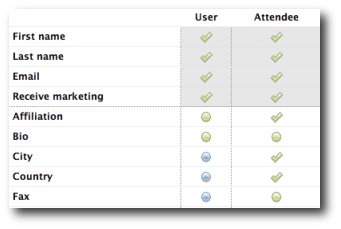
Thus, a one-size-fits-all personal details form didn't make sense for us. At best, we could have simply made more fields optional, but that would result in missing information that we really did need. Another solution would be to provide a dedicated personal details form per user type, e.g. different forms for speakers and reviewers. This is a non-starter, however, as users can take on many roles within a conference. So, we had a problem on our hands: different levels of interaction with our application requires different levels of personal information. We also had a second problem, which is that not all events and organizers want the same level of information. For example, a user group event is unlikely to need the same amount of information from speakers as an academic conference. Thus we have two axes on which the amount of information required varies: by role, and by event.  Our solution: progressive disclosure We concluded that we wanted to adhere to two principles in the collection of user information for Expectnation: The first objective was achieved by constructing a matrix of information items against user role, with the possible values of required, optional, unused for each item. We then achieved the second objective by allowing this matrix to be varied over each event. We've named this concept "progressive disclosure." What this means in practice is that a user is only ever asked for the information required to fulfil the roles they have within Expectnation. If they take on another role, they are asked for the additional information at that point, and not before. Implementation concerns Expectnation user disclosure editing
Extract from disclosure level editing UI It would be untrue to say that progressive disclosure is simple to implement. A user in our system will have disclosure requirements that are the union of all of their roles in all of the events they attend. Within Ruby on Rails, this means the conventional validation logic is useless to us, as it only deals with static requirements. Secondly, disclosure requirements are expensive to compute, so we need to cache them, with the inevitable addition of issues such as cache invalidation. Beyond the data model issues, the user interface issues are, if anything, more troublesome. From an end-user's point of view, the difficulty arises when we need extra information from them, and presenting this in a way that makes sense. From the event organizer's point of view, we have the challenge of presenting a controlling user interface for rather a complex concept. Organizers must be able to change the level of required information either globally, or per-event. We opted for a grid presentation, an extract from which is shown in the screenshot in this article. Over time we'll be able to see how effective this interface is, and what we can do to improve it. Finally, we have chosen sensible defaults for all disclosure levels, as the best result would be that organizers have little need to reconfigure the settings in the first place. Making it look easy Because Expectnation is a general application for organizing events, rather than targetting one specific one, we've had to construct a framework for minimizing user information collection, as opposed to simple implementation of known scenarios. At the end of the day we have added a fairly complicated subsystem and an extra degree of complexity to our codebase. However, the result from the user's point of view is increased simplicity and a streamlined experience. Every time you embark on something that wide-reaching and complex, you have to ask yourself whether the feature is really worth it. In this case, though, the answer is a resounding "yes". The user is the most important factor in our software, and making their life easier in an unobtrusive manner is a priority.

19 June 2007

Scott James Remnant: Slippery Slopes

One of the most interesting thing about slippery slopes is how you never seem to be standing at the top of them, looking down. The slope seems fine at the top, and it’s only once you start down it that you realise this could end up with some broken limbs. When Ubuntu was formed, Debian were having a debate about how to treat GFDL documentation. It was their opinion that the GFDL was inherently non-free, and they’ve since taken steps to remove all such licensed documentation from their main distribution. We took a more pragmatic approach, and decided that it maintained the spirit of freedom, and thus we continue to this day to ship that documentation in our main distribution. A similar discussion resulted in the handling of data files such as graphics, icons, fonts, etc. We decided that such things didn’t necessarily need to ship with corresponding source code, as frequently they don’t have any such thing or when they do, it’s just as easy to modify the data file directly. The slope didn’t seem at all slippery back then. Then came the issue of firmware, binary blobs in the kernel which are uploaded into a flash (or similar) chip in the hardware. Could we distribute these? On one hand, these blobs have always existed, they just used to be in ROM in the hardware; the move to firmware doesn’t change that. On the other hand, they’re machine code and if we had the source, we could improve the hardware as well. And what if we didn’t distribute them? Our users would be stuck without being able to use some fairly (to them) critical parts of their computer. In the end, the argument that firmware isn’t inherently any less free on the disk than in the ROM won, so we opted to continue to ship it. Perhaps that slope is a bit slippery, but we’ve got a good foothold. Of course, at that point somebody notices the binary “Hardware Access Layer” in the Atheros WiFi card driver. It’s not firmware, it’s run on the host processor, and is separate to “comply with FCC law”. (The ipw3495 driver has a binary daemon that allegedly performs the same legal function). Again, if we don’t distribute that, a large section of laptop users will not be able to use their WiFi cards. A compromise was reached; because the driver is necessary we’d ship it, but in a special restricted component that makes it absolutely clear that it’s not completely free. Users could choose to remove that component and any packages from it, to keep their system untainted. Ok, foothold wasn’t as strong as we thought; tumbled a bit, but we’re definitely on solid ground now! That’s what we thought, anyway. Unfortunately it seems that there’s a point a little bit lower down the slope which has a fantastic vista. The views from there are just incredible, people are saying, much prettier than where we are now. The only trouble is that we’re not sure there’s a foothold down there, if we try for the better view, we could end up broken at the bottom. I’m talking, of course, about the NVIDIA binary X driver. (Some reports/blogs/etc. indicate we’re also considering the ATI fglrx driver, this isn’t true – that driver doesn’t support AIGLX, so it’s not being considered.) We’ve shipped this driver in our restricted section, but not enabled it by default. It’s been there for people who want it to switch on, if they know how, but the default driver has always been the free (albeit obfuscated) one in the Xorg distribution. The problem is that users do not need this driver, they can get decent enough 2D graphics support from the free(ish) driver. In the long term, they may even get decent 3D graphics support from the nouveau driver effort. What’s the problem then? Simple, other operating systems use the 3D GPU to make the desktop seriously beautiful. If Linux doesn’t catch up and do the same, then we’ll be considered obsolete again. And just to drive the point home, some of our Linux friends shipped similar support in their last releases. They don’t enable the NVIDIA binary driver, but this means that a large percentage of their user base can’t get the bling without manual hackery. We needed a way to catch up with both the commerical operating systems and other Linux distributions; we have a policy of not doing our own software development, but only packaging what others have developed, so the only way for us to get ahead was to package something that others wouldn’t. Which brings us back to the NVIDIA binary driver. If we install that by default, we’ll be bringing a 3D desktop to more people. And we’ll gain a step ahead of the other distributions. Will our users care? To be brutally honest, I think the answer is no! In fact, I suspect our users will largely love us for this decision. Most probably already install the NVIDIA driver anyway, because they think it’s better, or because (sadly, like me) they have a card combination not supported by the free one. Will this make any difference to the effort to get NVIDIA to free up the driver, or at least the specs? Sorry, but to be honest again, I don’t think it’ll make one little difference. Linux distributions have been refusing to install it for years, and yet NVIDIA haven’t budged in their position. Perhaps a new tactic is required. Maybe if we do install it, we’ll be more likely to be chosen by OEMs as we can actually support the hardware they install. Then later, we may be able to actually affect their decision as to what hardware they install, and maybe then NVIDIA will pay attention. Will this change the perception of Ubuntu in the Linux developer community? I’m not sure about this one, I think that those who already feel strongly about the distribution of binary drivers are probably already pretty grumpy at us distributing things like the Atheros and ipw3495 drivers. I suspect this will change the opinion of a lot of people who’ve been on the fence until now, probably equal in both directions. Will we be able to sleep at night? Despite all of the above, personally I still think that installing and using the nvidia driver by default, when the nv driver would do, is the wrong decision. If the nv driver doesn’t work, I’m willing to accept the nvidia driver being used; provided that there’s some message informing the user what’s happened, why it has happened, and which alternate graphics cards they can purchase if they aren’t willing to accept a non-free binary driver. If the nv driver is good enough for 2D, I would prefer that we instead disabled the 3D desktop effects for this group of users (by default). A similar message could explain why this is disabled, again which alternate graphics cards provide this by default, but also provide a button for the user to enable it if they wish. While we should make the correct moral decision for the defaults, we shouldn’t stand in the way of users who wish to make a different decision for themselves. Later as the nouveau driver becomes stable, we may be able to activate 3D support for nvidia users by default. I think that preserves our current foothold, we’d only activate it if there is no free alternative. Where there is, we’d be educating users about why they may wish to consider alternatives to NVIDIA in future, while at the same time not getting too much in their way if they want to see the better view down the slope. Unfortunately it’s not my decision, and I suspect that the lure of the bling will win out. With any luck, we’ll find a foothold there, and the fallout of doing so won’t be too bad. I’m just worried that once we compromise on this, we’ll start compromising on other things … would we replace Firefox with a non-free web browser that rendered web pages “better”? The slippery slope only gets steeper from here on …

18 June 2007

Ross Burton: Hito Lives!

Hito is alive! Hito I admit that the contact preview needs some work, there is some tasty code in Contacts I need to refactor. So, what is happening here? The tree view is a HitoContactView, which subclasses GtkTreeView. This displays the contents of a HitoContactStore, a subclass of GtkListStore which holds the EContacts from an EBookView. In between the store and the view is a HitoContactFilterModel, which can filter both on groups (currently the most useful implementation is HitoCategoryGroup, which groups on the CATEGORY vCard field) and text, which does decomposed matches against the contact's name. The combo box is a HitoGroupCombo, which controls the group being filtered. The entry is the only widget which isn't a subclass (yet), and controls the text being filtered. The final bit of magic is HitoGroupStore, which collects categories from contacts and creates HitoCategoryGroups as required (this is used as the model for the combo). Now for the hard work of writing a usable preview widget, and the nightmare of a decent contact editor... NP: Live At the Union Chapel, Damien Rice

14 June 2007

Daniel Stone: avivo and donations

Just a quick note to say a huge thanks to everyone who's offered support (financial, hardware-wise, or just verbal) to the r5xx project -- we really appreciate it. A couple of FAQs:

  • Thanks! Where can I send money?
  • Sadly, money isn't the issue: we have jobs/university theses/lives to tend to. We just lack for time right now.

  • Thanks! Where can I send hardware?
  • If you have a card that you won't be needing back (we may lose or fry it), please email myself (daniel@fooishbar.org) and J r me (j.glisse@gmail.com), detailing what you have, and we'll get back to you if it'll be useful to us.

  • Will this work with the X2xxx cards (r6xx)?
  • Yeah, pretty much. It just needs someone to hack up the small amount of code to deal with it.

  • What's happening with X1650 and above (r530/r580)?
  • Most of the code is written, however, initialisation doesn't happen correctly for some reason.

  • What's happening with 3D support?
  • It should be relatively simple to implement from the existing driver, as the engine is believed to be extremely similar, but we want to get the basics working before we start attacking things like this.

  • Which tools do you guys use?
  • For tracing the video BIOS, we use a hacked version of xresprobe: vbetool will instrument the BIOS quite well. For tracing fglrx, we use a hacked version of valgrind: run it against the X server, making sure that it is not suid root. For getting impatient and playing with registers, we use avivotool.

  • Where does the development happen?
  • On IRC, #dri-devel seems to serve somewhat as the ATI development centre. This gets fairly well coalesced into The Irregular Radeon Development Companion, however, so you may prefer to just follow that.

  • Shouldn't all this be on a wiki page somewhere?
  • Yes, but I have to get up in less than four hours.

    Once again, thanks for the support, from all of us. It's been great.

    Nico Golde: libacpi-0.1

    After asking for testers of a libacpi snapshot I got a fair amount of test mails. Thanks to all the people who tried it and helped me!!

    Now I finished with coding, testing and documenting everything and happy to release version 0.1 of libacpi.

    It is a general purpose shared library for programs gathering ACPI information. It fully implements information about fans, batteries, ac states and thermal zones (apart from trap points).

    Try it out on: http://www.ngolde.de/download/libacpi-0.1.tar.gz.

    There is also an online documentation (well doxygen generated) on http://www.ngolde.de/libacpi/doc/html/.
    test-libacpi.c is an example on how to write programs using libacpi.

    For more information download the tarball, have a look into the manual, test-libacpi.c, README and the doxygen documentation.

    The next step for me is to port yacpi to libacpi which was also the reason for libacpi since I first wanted to rewrite it and thought it might be useful to have the functionality in a library. There are not yet Debian packages for it because I am really busy at the moment so if you want to maintain it, feel free to do so.

    12 June 2007

    Antti-Juhani Kaijanaho: On recursion

    Note: This entry has been edited a couple of times (and might be edited in the future) to remove errors. Thanks to Benja Fallenstein for critique. My previous post about recursion drew some comments. This is a topic that frequently confuses me, and there is a lot of confusion (some of it mine) in the blog post and its comments. On reflection, it seems prudent to examine what recursion really is. Consider the following recursive definition: 0 is an expression; if T is an expression, then sT is an expression; nothing is an expression that doesn’t have one of these two forms. Now, it is clear that 0 is an expression. It is equally clear that sssssK is not an expression. In some applications, it makes sense to consider infinite expressions like “…ssssss0“; that is, an infinite number of ss before the final 0, and in others it doesn’t. Is that infinite utterance and expression? It does have one of the forms given in the definitions, so it is not forbidden from being an expression, but neither is there anything in the definition requiring that it is. It is helpful to do this a bit more formally. Let us translate the self-referential definition into a set equation: The set of expressions is the set E that satisfies the equation

    E = 0 ∪ se e ∈ E

    But this definition is bogus! There are more than one set E that satisfies the equation, as remarked above, and thus there is no “the set E”! We need to fix the definition in a way that makes the set E unique. The key question is, do we want to regard the infinite utterance discussed above as an expression. It is simplest to just say “the set of expressions is the smallest set E that …” if we want it to not be an expression, and if we want it to be an expression we should say “the set of expressions is the largest set E that …” Let us make the following definitions:
    Consider the set equation S = … S …, in which the set S is alone on the left-hand side and occurs at least once on the right-hand side. This equation is a recursive definition of the smallest set S satisfying this equation, and a corecursive definition of the largest set S satisfying this equation.
    Thus, a definition like

    E = 0 ∪ se e ∈ E

    is not recursive because of its form; it is self-referential. By itself, it is an ambiguous and thus bogus definition. We use the words “recursive” and “corecursive” to indicate the intended method of disambiguation. A rather nice example of this can be seen in the treatment of algebraic data types in strict (ML-style) and nonstrict (Haskell-style) functional programming languages. Consider the declaration (using Haskell syntax)
    data IntList = Nil   Cons Int IntList
    
    This can be read as a set equation as follows:

    IntList = Nil ∪ Cons n x n ∈ Int ∧ x ∈ IntList

    Now, as a recursive definition, it is restricted to finite lists as found in ML, but as a corecursive definition, it also allows infinite lists as found in Haskell. (It unfortunately fails to address the question of bottom-terminated lists, which also can be found in Haskell.) As it happens, the technique is not limited to set definitions; but to generalise it, we need to discuss a bit what we mean by the terms “smallest” and “largest”. In a set context, a set is smaller than another set if it is the other’s subset. Notice how this makes the ordering partial, that is, there are sets that are not comparable (for example 1 and 2 ; neither is smaller than the other, but neither are they equal). A collection of sets does not necessarily have a “smallest” set (that is, one of the sets that is a subset of all the others). However, we can always find the lowest upper bound (”lub” or “join”) of a collection of sets as the union of the sets, and the greatest lower bound (”glb” or “meet”) as the intersection of the sets, and if the lub or glb is itself a member of the collection, it is the smallest or largest set of the collection. Haskellists will find things instantly familiar when I say that the smallest element of a mathematical universe (if it exists) is called bottom and is denoted by ⊥; somewhat less familiar will be that the greatest element (if it exists) is called top and is denoted by ⊤. A partial function is any function that needs not be defined everywhere. For example, f(x) = 1/x is a partial function on the reals (it is not defined for x = 0). We can form a partial ordering of (partial) functions having the same domain and codomain by specifying that f is smaller than g if f(x) = g(x) for all such x that f(x) is defined. Sometimes it will make sense to specify that f is smaller than g if f(x) is smaller than g(x) for all such x that f(x) is defined. Now, it happens that all collections of functions have a lub; and in particular, the partial function that is defined nowhere is the smallest function (the bottom function). Now, with this definition of “ordering” of functions we can apply the definitions of recursion and corecursion to functions. For example, consider f(x) = f(x) + 1. The bottom function (defined nowhere) qualifies, since undefined + 1 is undefined; thus it is the smallest solution to the equation and thus this equation is a recursive definition of bottom. However, consider f(x) = if x = 0 then 1 else x*f(x-1): any solution to this equation must have f(0) = 1 and thus the bottom function is disqualified. In fact, the smallest solution is the factorial function, and thus the equation is a recursive definition of factorial. In the comments to my previous entry, I was asked whether the Haskell definition “ones = 1 : ones” is recursive. Of course, the question in itself is nonsensical; whether it is a recursive definition or something else (such as corecursive) depends on what the programmer intends. I will interpret this question as whether the equation is a recursive definition of the intended result, the infinite list of all ones. First, observe that we can order Haskell lists (including the special “undefined” list) partially as follows: l1 is smaller than l2 if l1 is undefined, if they both are empty lists or if a) the first element of l1 is smaller than the first element of l2 and b) the tail (the list with the first element removed) of l1 is smaller than the tail of l2. The undefined list does not qualify as a solution for “ones = 1 : ones”. No finite list qualifies either. The infinite list of all ones does qualify, and it is the only solution; hence, the equation is a recursive definition of the infinite list of all ones; it is also a corecursive definition of the same list. Finally, let us consider the question that started it all: what should we make of the definition “recursion: see recursion”. First, note that a equation x = x admits all elements of the universe as a solution; hence, the proper reading of “recursion: see recursion” as a definition is that it is ambiguous and hence bad. It is a recursive definition of the bottom element of the universe (whatever that might be for a dictionary), and a corecursive definition of the top element of the universe (whatever that might be). In any case, it does not define recursion (unless of course, the concept of recursion is the smallest or the largest concept in the universe of concepts).

    Next.

    Previous.