Search Results: "hug"

12 August 2008

Enrico Zini: apt-xapian-index: dynamically generated tag clouds

apt-xapian-index: dynamically generated tag clouds About apt-xapian-index, I have already posted: Today I'll show how to create tag clouds. Not only that, but I'll show how to implement tag clouds that change as the user types a query. This example uses python-gtk, and has been created together with Matteo Zandi. axi-searchcloud screenshot Generating a tag cloud out of any Xapian query is simple, and it is just a matter of presenting into a tag cloud the information that you get with the technique shown in a smart way of querying tags: you get the tags related to the query, and you lay out their names with a font size proportional to their Xapian rank. For the presentation, we can load pretty names from the Debtags vocabulary in /var/lib/debtags/vocabulary:
from debian_bundle import deb822
# Facet name -> Short description
facets = dict()
# Tag name -> Short description
tags = dict()
for p in deb822.Deb822.iter_paragraphs(open("/var/lib/debtags/vocabulary", "r")):
    if "Description" not in p: continue
    desc = p["Description"].split("\n", 1)[0]
    if "Tag" in p:
        tags[p["Tag"]] = desc
    elif "Facet" in p:
        facets[p["Facet"]] = desc
The query then goes on as usual, and when we get the tags from the eset we also record their score and normalise it between 0 and 1. I found that computing the logarithm of scores helps to avoid having a tag cloud with a few huge tags and a lot of tiny tiny tags:
class Filter(xapian.ExpandDecider):
    def __call__(self, term):
        return term[:2] == "XT"
def format(k):
    if k in tags:
        facet = k.split("::", 1)[0]
        if facet in facets:
            return "<i>%s: %s</i>" % (facets[facet], tags[k])
        else:
            return "<i>%s</i>" % tags[k]
    else:
        return k
taglist = []
maxscore = None
for res in enquire.get_eset(15, rset, Filter()):
    # Normalise the score in the interval [0, 1]
    weight = math.log(res.weight)
    if maxscore == None: maxscore = weight
    tag = res.term[2:]
    taglist.append(
        (tag, format(tag), float(weight) / maxscore)
    )
taglist.sort(key=lambda x:x[0])
Finally, you mark up a gtkhtml2.Document to display in a gtkhtml2 widget:
def mark_text_up(result_list):
    # 0-100 score, key (facet::tag), description
    document = gtkhtml2.Document()
    document.clear()
    document.open_stream("text/html")
    document.write_stream("""<html><head>
<style type="text/css">
a   text-decoration: none; color: black;  
</style>
</head><body>""")
    for tag, desc, score in result_list:
        document.write_stream('<a href="%s" style="font-size: %d%%">%s</a> ' % (tag, score*150, desc))
    document.write_stream("</body></html>")
    document.close_stream()
    return document
That's it, try it out. You can use the git web interface to get to the full source code and the module it uses.

11 August 2008

Alexander Reichle-Schmehl: Thanks to the DebConf video team

I'm not attending DebConf. I don't have much time these days :( But if I can, I enjoy watching the video streams and participating via IRC. So many thanks to the DebConf video team! By the way: Something that seems to haven't found it's way to planet, yet: You can send kudos to the video team at http://wiki.debconf.org/wiki/DebConf8/Videoteam/Thanks! Please add something nice to keep them motivated; they are doing a HUGE job!

8 August 2008

Lucas Nussbaum: Of popular packages removed from testing, and the Ultimate Debian Database GSOC project

Some time ago, there was some flamewars^H^Hdebate about the Release Team’s removals of RC-buggy packages from testing. Basically, some people claimed that popular packages shouldn’t be removed, even if RC-buggy. But, do we really miss popular packages in testing? It’s difficult to know. You could get the popcon data, and compare it with the Packages files for testing and unstable. Or work with source packages (which removes a lot of noise), but then, you have to convert the popcon data (which uses binary packages names) to source packages. Not completely trivial. That’s where the Ultimate Debian Database GSOC project comes to the rescue. The goal of Christian von Essen’s project is to gather data from various sources in Debian into a single SQL DB, so queries that combine all those data sources can easily be written. For example, here is the query that lists the source packages that are in unstable, but not in testing, sorted by their popcon (using the number of insts of the most popular binary package of the source package as value for the source package):
SELECT DISTINCT unstable.package, insts
FROM (SELECT DISTINCT package FROM sources
WHERE distribution = 'debian' and release = 'sid') AS unstable, popcon_src
WHERE unstable.package NOT IN (
   SELECT package FROM sources
   WHERE distribution = 'debian' AND release = 'lenny')
AND popcon_src.source = unstable.package ORDER BY insts DESC;

And the results are available on the web! Top packages (> 1000 insts):
lzo	64962
gnome-cups-manager	32346
db4.6	20708
ffmpeg-debian	12908
freetype1	10569
flashplugin-nonfree	7116
perlftlib	6769
nvidia-graphics-drivers	3864
wxwindows2.4	3640
dvi2tty	2239
kdebase-runtime	1725
easytag	1717
g-wrap	1582
yaird	1507
slocate	1499
youtube-dl	1390
hugin	1275
w3c-libwww	1058
Interested in UDD? Join #debian-qa or debian-qa@lists.d.o (or talk to me @DebConf!)

5 August 2008

Wouter Verhelst: Re: Government

One of the things of getting too much mail is that you will get swamped in it, sometimes to the level of not even managing to figure out there's been replies on your blog for the past several weeks. Oops. Apparently quite a number of people answered to my blog post about the belgian government issues, and I only found out right before leaving for Argentina. They're now all accepted from moderation, but that doesn't mean I can't follow up on them anymore. Most of them just agree with what I have to say, or posit another opinion (which is fine), but some clearly show a misunderstanding of what I was trying to say. So, since I don't want to appear as one posting gibberish, allow me to clarify:

"I could say that some other things about the past deb cle also puzzle me, such as the insistence of some people to get an unconditional split of BHV, thereby destroying all chances of even remotely reaching a compromise." You are saying that you would accept giving in to the demands of the Francophones that the Flemish give up territory. (Think about it, what century are they from? In what other country does one community demand the enlargement of its territory as an exchange for fixing a situation which the constitutional court has ruled to be illegal?)
Thanks for asking, but no, I'm not saying that. Let's be clear about this: there's a huge difference between a position that says "we need to split BHV, period" on the one hand, and "we need to give territory to the francophone community" on the other. It should be perfectly possible to, say, have the flemish community come up with some benefit to the francophone community in some respect somewhere that does not include "giving territory to the south of france"; but apparently the "negotiators" think not. To quote just one example: at some point Reinders (MR) suggested that a federal election circle be created to replace BHV, so that francophone politicians could still be elected in flanders, but also the other way around. This proposal was however killed by flemish politicians before the press as "not even negotiable" without even having discussed it. This, and other similar examples, I do not understand. After all, the fact that the constitutional court has ruled the current situation to be illegal does not change anything about the fact that this is still a request from the Flemish part of the country, and not from the Francophones; anyone telling you anything else is simply lying. There's nothing wrong with wanting something and being declared correct in court, of course; but there is something wrong with wanting that unconditionally. Unless you won a war, that is. And then still. Of course, not caring about much of the definitions of many political parties and not being a politician in any way, I ticked off someone who just happens to be a member of one of the parties I don't even like in the first place. Amedee, in case it matters: I didn't call CD&V a "Catholic" party to imply anything, but simply because I'm blissfully ignorant of the difference between Catholic and Christian. And happily so, too, given the CD&V's current behaviour. Oh, and the SP.A is not my favourite party; it's just that they seemed to be the more sensible of the lot during the last elections' campaigns. What's really my favourite party isn't something I'll tell you (or anyone), though.

4 August 2008

Russell Coker: Lenny SE Linux on the Desktop

I have been asked about the current status of Lenny SE Linux on the Desktop. The first thing to consider is the combinations of policies and configurations. I will number them if only for the purpose of this post, if the numbering is considered generally helpful it could be more widely adopted to describe configurations.

  1. Default configuration. This has the default policy and is configured with all users having the domain unconfined_t and daemons such as POP servers are allowed to access home directories of type unconfined_home_dir_t. This allows such daemons to attack privileged user accounts.

  2. Some restricted users. This is the same as above but with some users restricted. Daemons such as POP servers are only allowed to access the home directories of restricted users. This means that if a user is to have an unconfined account and receive email they must have two Unix accounts or receive their mail under /var/spool/mail. This is one setsebool command and one (or maybe a few) “semanage login -m” commands from the default configuration.

  3. All users restricted. The system administrator has the domain sysadm_t and users have domains such as user_t. This requires a few more semanage commands. It is equivalent to the old strict policy.

  4. MLS. This is anything that is based around the MLS policy.

Currently I have two Desktop machines running Lenny (a test machine and my EeePC) and one server. I have only just switched my test machine to enforcing mode so have no good data on it (apart from the fact that I can boot it up and login - which is always a good start). The server is running in permissive mode because I have not yet written the policy to allow the POP server to read from unconfined_home_dir_t. I could get it working by switching from level 1 to level 2 or 3, but I want to get level 1 server policy working for the benefit of others else first. My EeePC however is fully functional, I have been doing some work on it - that mostly means running a ssh client under GNOME but that’s OK (desktop environments such as GNOME and KDE are quite complex and demanding, getting a machine to boot and run such a desktop environment tests out many parts of the system). It’s only at level 1 for the moment because I want to get level 1 working everywhere before moving to the higher levels. I want to get things ready for real users ASAP. With the way the policy is managed now it will be possible to move from level 1 to 2 or 3 without rebooting or interrupting running services. So once users have systems running well at level 1 they can easily increase the security at a later date. The problems that I have had are due to text relocations in libraries (see my previous post about execmod permission [1]). I’ve filed bug report #493678 against libtheora0 [2] in regard to this issue and included a patch from Fedora (which disables the non-relocatable assembly code in question). It seems that upstream have some new assembler code to try and fix this issue, so hopefully we’ll have something that can make it into Lenny! I’ve filed bug report #493705 against libswscale0 for the same issue [3]. I included a patch to turn off the assembler code in question but that was not well received. If anyone has some i386 assembler skill and some spare time I would appreciate it if you could try and find a way to make the code position independent while losing little or no performance. One thing to note is that I am now using an Opteron 1212 (2.0GHz dual-core) system for compiling, I run the i386 DomU with a 64bit kernel (I expect that 32bit user-space runs faster with a 64bit kernel than a 32bit kernel), and the disks are reasonably fast. Even so it takes about 15 minutes to build libswscale0 and the other packages from the same source tree. Previously I was using a 1.0GHz Pentium-3 for my Lenny i386 development until I had the libswscale0 build process go for more than 90 minutes before running out of disk space! If your build machine is old enough to only be 32bit then you should probably plan on watching a movie or going to bed while the build is in progress. I have built packages that work around the above bugs and included them in my Lenny repository [4]. If you take the packages from that repository plus the Lenny packages then you should have a functional desktop system at level 1. I would appreciate it if people would start testing that and providing feedback. One important issue is the discovery of libraries that want shared stacks, text relocations, and executable memory. The deadline for fixing them properly is even more of a problem due to the number of people who have to be involved in a solution (as compared to the policy where I can do it on my own). One finally problem is a bug in xdm which causes it to give the wrong context for login sessions due to having an old version of the SE Linux related code [5]. Due to a combination of this and some policy bugs you can not login with xdm. This is not a hugely important issue as most people will use gdm (which has the newer patch) or kdm (which has no SE Linux patch but can use pam_selinux.so). Also another option is wdm which works with pam_selinux.so. I’ve had a response to my bug report suggesting that there’s a bug in the patch (which was taken from gdm so maybe there’s a bug in gdm code too). I haven’t responded to that yet as I’ve been concentrating on the things that will make the most impact for Lenny. At this stage I’m still unsure of when the release team will cut me off and prevent further SE Linux related fixes from going in Lenny. I need at least one more update to the policy packages before Lenny is released. I could release one right now with some useful improvements over what is currently in unstable, but am waiting until I get some other things fixed. If I get everything fully working at level 1 (both client and server) before Lenny then I will provide a similar status report for users and testers of levels 2 and 3. I don’t expect that I will even get a chance to test level 4 (MLS) properly before Lenny releases.

3 August 2008

Bastian Venthur: What is group x in /etc/group for and should I be a member?

A few days ago I noticed that suspend to RAM didn’t work anymore on my T60 running sid. By chance I stumbled upon #484248 which explains that the user now has to be in the powerdev group to be able to suspend the machine. If I hadn’t found this information, I would have had no idea what to change to make me able to suspend my machine again. Shouldn’t we have a central list somewhere in /usr/share/doc explaining all the different groups and what they mean? Most of the times the package a group belongs to already explains what the meaning of this group is, but if you don’t know the package, you’re pretty much screwed. I’m not saying, we already have too many groups, but a list with all the important groups and what they’re for would be a huge usability improvement. We can’t expect the user to find that information for every group alone.

30 July 2008

Pablo Lorenzzoni: DNS mess and what I think about DNSSEC

I am following closely this new DNS mess. In fact, there s nothing really new in that. DNS has been attacked lots of times over the years as a result of not being designed with security in mind from the ground up -, just this new one is a combination of known attacks against known security flaws. The quick fix is not a real fix, and just incorporate old ideas into the most used DNS software, strengthening it to face the attack. The details leaked, and there s already at least one public exploit (and who knows how many in the wild). The new buzzword is DNSSEC. I don t like DNSSEC. I never did. The first time I heard of it, around year 2001, it was a centralization of a decentralized database: A proposed company (called Network Solutions) would serve as a central authority, signing every root DNS entry. It was a joke! Come on! DNS is suppose to be decentralized! Having a central company anywhere is just a huge step back in decentralization (not to mention a huge step back in security). Time passed, and the DNSSEC specs evolved to a more decentralized way of thinking. The state it is now, and the implementations we saw so far are not good. No! I am not talking about security I am talking about the KISS principle: DNSSEC turns something really simple to deploy into a full-time job, with frequent key roll-overs and re-signing everytime you change the zone a huge mess! Yes, there are automated tools, but, come on! you still have to wait for TTL to expire before publishing this part or that part of the cryptographic machinery And, if we are talking about real security, are we going to build some automated tool fire-and-forget -style and not follow it? If we are not looking at it as it goes, and it fails, we could end up with a completely wrong set-up or (even worse) a non-validating zone. And I haven t yet mentioned the increase in payload I am not completely convinced that this alone would not lead to DoS attacks just by compromising the responsiveness of the servers (and DoS attacks are already available for quite some time maybe the DNSSEC-medicine is worse than the disease ). The root ( . ) servers are not even DNSSEC-aware, and there s a whole class of other stuff to work-around the fact that they may not be DNSSEC-aware for quite some time yet. There has to be a simpler way! I can imagine at least three ways to fix the problem until we can fix DNS in a KISS way And they re all KISS also: Maybe some of those three solutions are flawed Maybe none are flawed and can be deployed together Maybe I am wrong and DNSSEC is the only way to go But let s not panic, let s cool our minds and begin thinking it through. I still don t think DNSSEC is the holy grail Now I already spent more time than intended on this let me go back signing some zones ;-)

26 July 2008

Amaya Rodrigo: My silly smile (again)

For a week now, I couldn t get rid of this smile on my face (again).

It has been a hard year so far (back to therapy, again, back to medication, again, nasty insomnia, again, depression, again, getting phat as hell, again, my usual stuff, again). This has affected my job, which is the hardest of it all. Not being able to perform well has been troubling me to no avail, destroying my self-esteem.

But I have been feeling slightly better recently, I guess thanks to sunny days and chemistry reactions in (what used to be) my brain. And believe me: slightly better is a huge improvement. But what really put me on a great mood was reading the Wikipedia page on Mar del Plata, the Hotels web sites, the Debconf8 site... and realizing what a HUGE effort the localteam has made. I know they are exhausted, I know they are stressed, I know this week is probably the worst in their life. But the smile they ve put on my face! They have done a huge+great work.

Also, it looks like it will be a smaller event this year, I managed to count the assistants and I came up with 180, approx, and not all of them simultaneously. I must confess EDI was a bit too big for me to handle, so was MEX. I believe I will be able to spend more quality time with fellow debconfers, which I value a lot in this sort of events.This is precisely why I only attend the Debian room during FOSDEM, I cannot seem to enjoy getting out there in the (huge) crowd of attendees.

Anyway, I am smiling while typing this, and believe me: I look silly :)

I can t wait to meet the wonderful Debconf crowd again, specially my Argentinian friends.

See you in MDQ!

24 July 2008

Christian Perrier: Holidays

Tomorrow, I'll leave /home for more than 3 weeks: For people who are not tired of this, I've had the great honor of being sollicited to hold a keynote lecture at Debconf. As you'd guess, that will be about i18n in Debian. I plan it to be a kinda general thing, giving the current rough picture of how things are going (or not going). No deep technical stuff (aha, how could *I* do that anyway?), just talking with hands. From informations I have, it should be on Aug. 14th, at the beginning of the talks schedule (9:30 or so, local time...check this when the official schedule is out). Apart from that, my personal schedule for DebConf is mostly working with the i18n folks who will be there (Felipe A. van de Wiel aka "faw", Nicolas Fran ois aka "nekral") on the i18n server. Work/talk with Neil Williams about tdebs stuff and all things related to i18n and embedded stuff is also planned as well as preparing the Extremadura meeting we need to have at the end of the year.

Russ Allbery: Slashdot promotion

Congratulations, Luk, on your new position as the Debian project's maintainer! Now you can fix the bugs in all of our packages! It's a huge job, which presumably is why Slashdot has given you an extra E to help out. Or maybe that's just for plausible deniability....

16 July 2008

David Nusinow: Goings On

I've been rather disconnected lately, trying to finish my PhD, find a job, etc. I got permission from my committee to start writing my thesis a few weeks ago, so I've been trying to get that in gear, as well as finishing up data for publication. This should all be done by November, if all goes well, so I can get back to spending more time on the things that I love.

I've tried to stay somewhat current with what's going on, and there's been a noticeable change over the past couple weeks in the tone of discussion around the community. I've personally been fascinated by the appearance of two things: the Linux Hater's Blog and the debate about Gtk 3.0. What's striking about both of these things is that they focus very much on the more consumer-oriented side of Linux. It's all about pleasing the independent vendors and grandma, and not about doing cool things. This is a huge shift from a few years ago. When I (and I assume many of us) got started with Free Software it wasn't really about these things, but more about getting your own work done and less about pleasing other people. Pleasing others was good of course, but it wasn't really expected. Just getting the system up and running was cool at the time, but using it exclusively for all your work? Only if you were in the right line of work!

We've come to a point where we expect a hell of a lot more though. We've got very vocal community members who want to spread Linux far and wide, and they want to do it today. And arguably, Linux is ready for it. We have good software that works rather well, can be easily installed and set up, and will run most of what people need. Yay us. On the other hand, after spending the better part of the decade using Linux on the desktop I'm finding that I agree with almost everything that the Linux Hater's Blog says. It's hard to argue with the truth, and the truth is that things are still difficult for people. I've spent the last few years trying to make X in Debian easier for people to deal with, and I've barely made a dent in just this one problem. And there's plenty more to pick and choose from. Sure, you can talk about how Windows and OSX have problems too, but we can't just be as good as them. We have to be better if we want to spread Linux and Free Software far and wide.

But do we really want to do that? Well, to be honest, I don't think it matters. No matter whether or not you care about grandma using Linux, we all want to have systems that work well and are easy to manage. Currently we have a lot of things in modern distros that could be a hell of a lot better. And many of them are directly related to fundamental assumptions we've made that don't really hold up as well as they should. They lead to lots of extra work leading to a sub-par product. We can do better and we should do better. If we have the absolute best system, world domination would be a natural side effect.

That's why I think that things like this need to stop and that we need more things like this. Sure, one is a hell of a lot harder, but no one cares if you solve an easy problem. It's the hard ones that matter, and provide the real payoff in the end. We need a better system to stop the hemorrhage of developers to OSX. When Miguel talks about how the people pushing for gtk 3.0 are all using OSX, I get very worried. If we want to be in control of our own destiny then we need to face our problems head on, and solve them.

14 July 2008

Cyril Brulebois: Package updates

This (extended) weekend features: pkg-phototools collab-maint More to come

13 July 2008

Matthew Garrett: My trip to Istanbul by Matthew Garrett aged 28 and 4/365ths

Saturday

Arrive at Heathrow. Richard gets to be my special lounge buddy - we later discover Bastien sitting outside looking like a lost puppy. Flight is delayed by a mere hour, so we get to the hotel with little trouble and check in. Dinner with Luis and co on pillows on the street. This becomes a recurring theme. Drinking is involved. This also becomes a recurring theme. People complain about my shortcut finding skills.

Sunday

See beautiful things. Thankful to finally get to see buildings older than my old college. Dinner under some bridge with Red Hat folks where we discover the joys of the "special price". People once more complain about my shortcut finding skills. Suspect pillows are involved, but hazy recollections.

Monday

Arrive at the university by taxi. More to the point, arrive at the university by taxi without taking a 30km detour. Dinner with Canonical people, then a party in some overpriced bar on the top of a very big hill. Discover that taxi drivers in Istanbul either have no fucking clue where anything in the entire world is, or that driving tourists to bizarre locations is a national pastime. Avoid this fate and arrive home at something like 4AM.

Tuesday

Corporate whoring continues with dinner with Collabora people (delayed by two and a half hours because Christian values getting sweaty with other men over eating, or something), followed by more drinks on the pillows. Am vindicated when it turns out that my route back to the hotel would in fact be the shortest possible route back if people didn't keep insisting on making random left turns when we're almost there.

Wednesday

Fascinating (and increasingly drunken) discussion of the neurobiological aspects of colour spaces with Pippin precedes drinks on the roof of the university. Narrowly prevent Luis' attempt to leave the foundation open to flagrant copyright violation suits. More pillows.

Thursday

Wake up with a twisted ankle and a broken laptop. I had a good birthday, it seems. Collabora host a party on a boat. Miraculously, nobody falls off the boat. We head back to the pillows while others trudge up the hill to Taksim. Aaron wins the inaugural Aaron Bockover award for services to the GNOME community.

Friday

Dinner with Novell, demonstrating my even-handedness when it comes to accepting corporate favours. Miguel reveals his true nature as a Microsoft shill by admitting to owning an XBox. I advise him to raise his free software credentials by getting a Freerunner - as a bonus it'll crash whenever anyone tries to call him, preventing Microsoft from whispering more sweet nothings in his ear. A foolproof plan. Party paid for by Google. Ear bleedingly loud. Some drinking involved. Return to bizarro deviant pillows where we are treated to the spectacle of child labour. Spend some time wondering why Planet Fedora is discussing upskirt photos and decide that hating the entire human race is probably the best option.

Saturday

Turns out that while the Grand Bazaar is effectively just a shopping centre, it's a fucking giant shopping centre that sells nothing I can find any excuse to want. Wander over to Asia for dinner. Conversation with Lennart about using cgroups as a mechanism for providing application latency requirements and how the current lack of standardisation of mountpoints and exposure of irritating implementation details makes it almost impossible to use them for anything. Fascinating diversion into how to deal with getting a SIGBUS when your mmap()ed soundcard gets hotswapped, including deciding that the easiest way of getting a reliable indication of your current process maps is by, erm, parsing /proc/self/maps. Final pillows trip. Emotional farewells (by which I mean more drinking)

Sunday

Airport. Plane. Train. Home. Transfer hard drive into laptop with working screen. Discover that productivity not actually enhanced by having more than a 300x200 pixel area of functionality. Decide to write libelous article about previous week instead.

10 July 2008

Robert McQueen: GUADEC, Telepathy and a Party on a Boat

For everyone at GUADEC, there’s a boat party sponsored by Collabora this evening. Our sponsorship was confirmed after the program was printed so it’s listed anonymously, but it’s mostly sponsored by Collabora, of course with huge thanks to Baris and his team for the organisation, and local sponsors for food and discounted beer. The boat leaves from Kabatas at 9pm today (Thursday). It’s actually pretty close to the 3rd anniversary of Collabora’s incorporation, so I think we could call this our birthday party. :D I gave my presentation earlier today about using Telepathy to make collaborative applications. My slides are available, as well as the apps I demoed, which are the python VNC demo based on telepathy-python’s examples, Elliot’s Tic Tac Tube game, and Guillaume and Alban’s quick hack to Empathy and Vinagre to share your desktop over a stream tube. I was followed up by Senko’s presentation (slides also available) which had an overview of the libraries and APIs currently available to embed Telepathy functionality in applications on the desktop. The talks were all recorded so hopefully some videos will turn up on-line too. Speaking about collaborative stuff with Telepathy, we’re really keen to hear from the authors of applications like Abiword, Inkscape, Vinagre, Jokosher, Tomboy, Gobby, etc, to find out how we can help you integrate with Telepathy, what features you need before you can get started, or just try and convince you that it’s a good idea. :) If you’re at GUADEC, come and grab one of the Collaborans or drop by on #telepathy on FreeNode and tell us what you’d like to do and how we can help. Yesterday after the talks on Soylent and the People project, Travis and I met up with the guys behind the People project (Ali Sabil and Johann Prieur) and some of the Online Desktop team (Owen Taylor and Marina Zhurakhinskaya). We sketched out a way of plugging together Telepathy, People, Soylent and the Online Desktop to deal a lot better with meta-contacts on the desktop, providing “first-class” people objects. It all looks pretty promising and hopefully we’ll all find some time to make moves towards our vision. This afternoon at 3:30pm, Olivier is also presenting our work on Farsight 2, which is really cool stuff and should include some exciting demos of the multi-person video conferencing stuff we’ve been doing. More generally, GUADEC is awesome. I’m having a great time in Istanbul (despite it being pretty hot for a pale-faced Brit like me), and enjoying the sights and sounds of such an interesting city and culture. I’ve caught up with many of the usual suspects (like Lennart, who never turns down the chance to turn up at a conference and sample the local bars and clubs), and had some great discussions.

8 July 2008

Russell Coker: Label vs UUID vs Device

Someone asked on a mailing list about the issues related to whether to use a label, UUID, or device name for /etc/fstab. The first thing to consider is where the names come from. The UUID is assigned automatically by mkfs or mkswap, so you have to discover it after the filesystem or swap space has been made (or note it during the mkfs/mkswap process). For the ext2/3 filesystems the command “tune2fs -l DEVICE” will display the UUID and label (strangely mke2fs uses the term “label” while the output of tune2fs uses the term “volume name“). For a swap space I don’t know of any tool that can extract the UUID and name. On Debian (Etch and Unstable) the file command does not display the UUID for swap spaces or ext2/3 filesystems and does not display the label for ext2/3 filesystems. After I complete this blog post I will file a bug report. If you are using a version of Debian earlier than Lenny (or a version of Unstable with this bug fixed) then you will be able to easily determine the label and UUID of a filesystem or swap space. Other than that the inconvenience of determining the UUID and label will be a reason for not using them in /etc/fstab (keep in mind that sys-admin work sometimes needs to be done at 3AM). One problem with mounting by UUID or label is that it doesn’t work well with snapshots and block device backups. If you have a live filesystem on /dev/sdc and an image from a backup on /dev/sdd then there is a lot of potential for excitement when mounting by UUID or label. Snapshots can be made by a volume manager (such as LVM), a SAN, or an iSCSI server. Another problem is that if a file-based backup is made (IE tar or cpio) then you lose the UUID and label. tune2fs allows setting the UUID, but that seems like a potential recipe for disaster. So this means that if mounting by UUID then you would potentially need to change /etc/fstab after doing a full filesystem restore from a file-based backup, this is not impossible but might not be what you desire. Setting the label is not difficult, but it may be inconvenient. When using old-style IDE disks the device names were of the form /dev/hda for the first disk on the first controller (cable) and /dev/hdd for the second disk on the second controller. This was quite unambiguous, adding an extra disk was never going to change the naming. With SCSI disks the naming issue has always been more complex, and which device gets the name /dev/sda was determined by the order in which the SCSI HAs were discovered. So if a SCSI HA which had no disks attached suddenly had a disk installed then the naming of all the other disks would change on the next boot! To make things more exciting Fedora 9 is using the same naming scheme for IDE devices as for SCSI devices, I expect that other distributions will follow soon and then even with IDE disks permanent names will not be available. In this situation the use of UUIDs or LABELS is required for the use of partitions. However a common trend is towards using LVM for all storage, in this case LVM manages labels and UUIDs internally (with some excitement if you do a block device backup of an LVM PV). So LV names such as /dev/vg0/root then become persistent and there is no need for mounting via UUID or label. The most difficult problem then becomes the situation where a FC SAN has the ability to create snapshots and make them visible to the same machine. UUID or label based mounting won’t work unless you can change them when creating the snapshot (which is not impossible but is rather difficult when you use a Windows GUI to create snapshots on a FC SAN for use by Linux systems). I have had some interesting challenges with this in the past when using a FC based SAN with Linux blade servers, and I never devised a good solution. When using iSCSI I expect that it would be possible to force an association between SCSI disk naming and names on the server, but I’ve never had time to test it out. Update: I have submitted Debian bug #489865 with a suggested change to the magic database. Below are /etc/magic entries for displaying the UUID and label on swap spaces and ext2/3 filesystems:
The following magic entry will display the UUID of a swap space as well as displaying the label in the same manner as the mkswap program:
# according to man page of mkswap (8) March 1999
# volume label and UUID Russell Coker
# http://etbe.coker.com.au/2008/07/08/label-vs-uuid-vs-device/
4086 string SWAPSPACE2 Linux/i386 swap file (new style),
>0×400 long x version %d (4K pages),
>0×404 long x size %d pages,
>1052 string \0 no label,
>1052 string >\0 LABEL=%s,
>0×40c belong x UUID=%x
>0×410 beshort x \b-%x
>0×412 beshort x \b-%x
>0×414 beshort x \b-%x
>0×416 belong x \b-%x
>0×41a beshort x \b%x The following magic entry will display the UUID and label (AKA volume name) of an ext2/3/4 filesystem:
# ext2/ext3 filesystems - Andreas Dilger <adilger@dilger.ca>
# ext4 filesystem - Eric Sandeen <sandeen@sandeen.net>
# volume label and UUID Russell Coker
# http://etbe.coker.com.au/2008/07/08/label-vs-uuid-vs-device/
0×438 leshort 0xEF53 Linux
>0×44c lelong x rev %d
>0×43e leshort x \b.%d
# No journal? ext2
>0×45c lelong ^0×0000004 ext2 filesystem data
>>0×43a leshort ^0×0000001 (mounted or unclean)
# Has a journal? ext3 or ext4
>0×45c lelong &0×0000004
# and small INCOMPAT?
>>0×460 lelong <0×0000040
# and small RO_COMPAT?
>>>0×464 lelong <0×0000008 ext3 filesystem data
# else large RO_COMPAT?
>>>0×464 lelong >0×0000007 ext4 filesystem data
# else large INCOMPAT?
>>0×460 lelong >0×000003f ext4 filesystem data
>0×468 belong x \b, UUID=%x
>0×46c beshort x \b-%x
>0×46e beshort x \b-%x
>0×470 beshort x \b-%x
>0×472 belong x \b-%x
>0×476 beshort x \b%x
>0×478 string >0 \b, volume name "%s"
# General flags for any ext* fs
>0×460 lelong &0×0000004 (needs journal recovery)
>0×43a leshort &0×0000002 (errors)
# INCOMPAT flags
>0×460 lelong &0×0000001 (compressed)
#>0×460 lelong &0×0000002 (filetype)
#>0×460 lelong &0×0000010 (meta bg)
>0×460 lelong &0×0000040 (extents)
>0×460 lelong &0×0000080 (64bit)
#>0×460 lelong &0×0000100 (mmp)
#>0×460 lelong &0×0000200 (flex bg)
# RO_INCOMPAT flags
#>0×464 lelong &0×0000001 (sparse super)
>0×464 lelong &0×0000002 (large files)
>0×464 lelong &0×0000008 (huge files)
#>0×464 lelong &0×0000010 (gdt checksum)
#>0×464 lelong &0×0000020 (many subdirs)
#>0×463 lelong &0×0000040 (extra isize)

6 July 2008

John Goerzen: Look out Nebraska, Here Comes Jacob!

img_5195.jpg

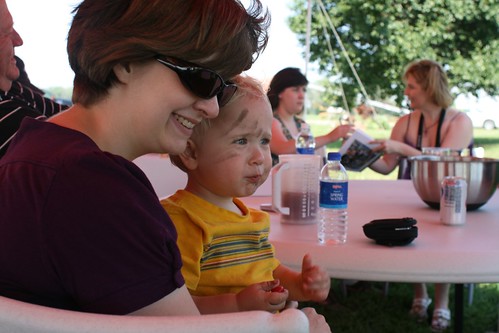
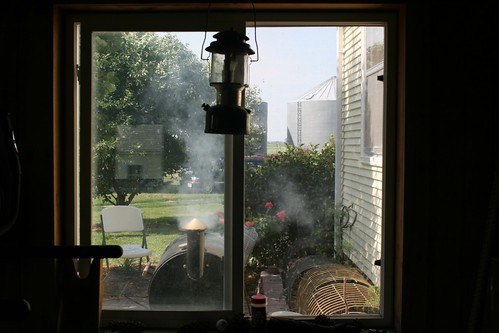
This weekend, the three of us got in the car and drove up to Tekamah, NE for Blogstock 08 at Cliff's. That's Jacob when we were stopped at a park halfway there. Sure looks like he's about to do something ornery, doesn't it? I think he looks even more ornery than the photo of Cliff. That's saying something.

We all really enjoyed Blogstock. Ralph, Cliff, and the rest of the Morrows sure know how to have an event. Ralph said that Cliff's BBQ smoked chicken is the best we'll ever have, and he may just have been right.

I'm going to include a few of my photos in this post; you can see all of my 200+ Blogstock photos on Flickr. (In case anyone else uploads Blogstock photos, you might tag them blogstock08).

Jacob had a blast, and I think he took special pleasure in keeping Terah and me busy. I recall saying something like this, all strung together:

"Jacob, please stop throwing dirt at the cat. That cat doesn't like to have dirt thrown on it. Jacob, stop throwing grass on the cat. Jacob, stop hitting the cat. The cat doesn't like to be hit. Can you pet the cat gently like this? Good job! Jacob, stop sitting on the cat. That hurts the cat. Stop throwing dirt at the cat. Would you like to go play in the corn?"

The Morrow cat was the most tolerant cat I've ever seen, and didn't really seem to mind having a toddler sit on its head. However, we noticed this morning that Jacob's legs mysteriously have some scratches that look very much like cat scratches. We didn't see anything happen, and Jacob didn't come crying to us or anything. I suspect the cat found a way to communicate that it doesn't very much like to have someone sit on it. I also suspect that Jacob understood the message.

img_4996.jpg

As for corn -- Jacob loves corn. He first noticed it within the past week or two, and always gets excited when we drove past some. He calls it "koh!", and particularly tall corn is "koh-koh" or "ah-koh". Cliff has tall corn, and when I first asked Jacob if he wanted to see it, he immediately stopped pestering the cat, yelled "KOOHHHHH!!! KOH KOH KOH KOH!!!" and started running towards it. He started by carefully inspecting the corn from the edge of the field. (I can't help but thinking he looks a bit like is great-grandpa Yoder in this picture.) I can almost hear him saying "yep, this corn looks pretty good" in a couple of years.

img_5051.jpg

The real fun begins when you get into the corn, apparently. With a little bit of holding my hand to balance while walking over the rows of dirt, he'd get between the rows of corn and have a blast. That means mainly picking up a full handful of dirt, running to another random corn plant somewhere, throwing the dirt in the general direction of the corn, and cackling like this was the best thing ever. I had to watch out with the camera, because I didn't really care for it to be hit by dirt, and well, I was in the general direction of corn, too.

img_5062.jpg

And, in case you didn't know, having fun in the corn is serious business.

Now, what can a toddler possibly do after playing in the corn, eating some cherries off a tree, and smearing some dirt on his face with cherry juice?

img_5088.jpg

Well, plan his next activity, of course! From the look on his face, it will be another one to keep Terah and me busy.

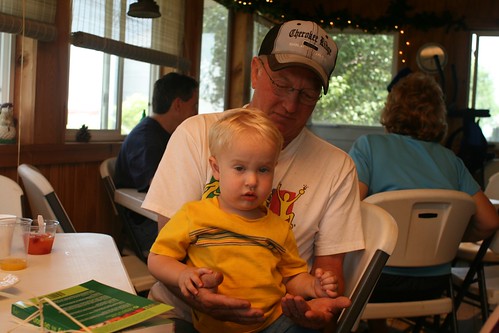
Jacob seemed to get along really well with everyone. But Ralph said that everytime he came close, Jacob would give him a nasty glare. Here's Ralph holding Jacob. Was this the look, Ralph?

img_5078.jpg

Or maybe it was this:

img_5116.jpg

Friday evening, Cliff and Ralph made up some great hamburgers, hot dogs, and sausages. We all ate under the big tent, and had a nice time visiting. It was sort of an unusual thing -- meeting people you already know for the first time -- but very nice. We left somewhere around 8. Jacob enjoyed the hotel room, too.

img_5027r.jpg

That's Jacob talking on the telephone. Well, I would normally use it as a TV remote, but to Jacob it looks like a phone, so a phone it is. (I can see his point.) This is Jacob answering the phone by saying Hi! Jacob's word for a phone, by the way, is "hi." He'll find a remote by the TV in the room, point to it, and yell "hi!"

Jacob's usual bedtime is 6:30PM. He normally falls asleep fairly easily and sleeps soundly until 6:30AM. Well, we got him in bed well after 6:30PM. Then he made the discovery that the hotel crib/playpen has a mattress that is not attached to the bottom like our mattresses at home are. This was good for at least an hour of excited playing. As Terah and I were trying to sleep, we'd hear these cackles from Jacob's crib, and the noises of a very active boy. I'd peek around and see him using the mattress as a tent, as a peek-a-boo toy, or just as something to throw. I think he fell asleep at about 11.

And woke up promptly at 6:30 on Saturday, just like clockwork, ready to make some phone calls and start the day.

Now, just a tidbit for anyone that doesn't have kids: a toddler, low on sleep, and endless excitement all combine to make for busy parents. Jacob did pretty well, and got in a good long nap in the afternoon. We did take several trips to the corn field.

For most of us, Saturday was a day for brunch, for sitting around and visiting under the tent, for horse rides, and maybe a massage for those that wanted it. Terah got to ride a horse, and Jacob got to ride a pony, too.

For Jacob, it was a day to make new friends, too.

img_5095.jpg

I took this picture just a second after she had given him a hug. I was just a little too slow whipping out the camera.

But when it comes to cherry picking, it's all serious business once again.

img_5098.jpg

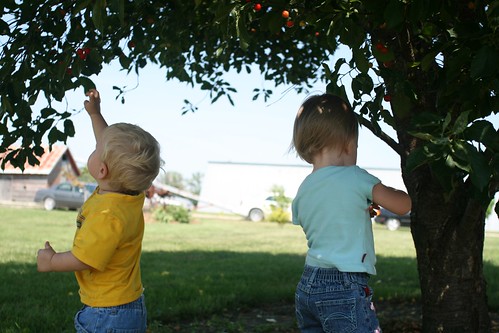
Jacob loved eating these sour cherries. At first, he would pick one cherry off the tree, run over to the tent, give it to Terah for her to get the pit out, eat it, then go back to the tree for another one. He must have decided this was inefficient not long after I did. After a few roundtrips, he started trying to get the closest adult, whoever that might be, to pit the cherry for him. When he found one that would do it, he'd keep bringing cherries back to that person.

And then he was under the tree for a long time. Terah and I noticed, and had a conversation about just how many cherry pits it's OK to swallow. But when I checked it out, I found out that Jacob had figured out how to pit cherries himself. He did lose about half a cherry each time he did it, but I guess that was more efficient than pestering adults to do it for him. Though it may have also worked to carry two cherries to the tent at a time.

img_5123.jpg

Late in the afternoon, Cliff started up the smoker for the chicken. He had rented a big smoker for the occasion, but it wasn't working, so he made do with his regular smoker, ovens for the corn, and an array of dutch ovens or side grills for everything else. I couldn't keep track of it all, and I was just watching, but somehow it all turned out perfect.

img_5140.jpg

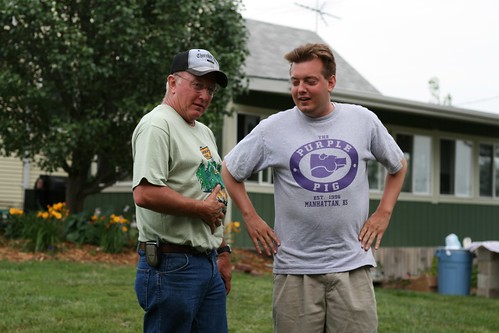
While the chicken was cooking, Ralph and son-of-Ralph (SOR) were having a conversation and patting their bellies. I couldn't hear, and didn't ask questions, so I'm choosing to believe that they were discussing how many pieces of chicken they could eat. When they heard my camera click, Ralph said, "He didn't just take a photo, did he?" Thereby guaranteeing a spot on my blog.

I had the distinction, I think, of being the least-read blogger at Blogstock. I can't quite remember how many times I'd meet someone, and they'd say, "Oh, you're the computer guy, right? I tried reading your blog, but I didn't understand it, sorry!" Completely understandable, I assure you!

After dinner Saturday, we talked about how we got started blogging (hi, Marty and Andy if you're reading), why we were there. Cliff said some very kind things about Terah and me, which really meant a lot.

Later, Cliff told me how Terah showed up in the kitchen with her tray of deviled eggs. Cliff saw them, and said, "Terah, I love you." Later, Cliff said "I love you" to someone else. From the next room, Terah piped up, "What food did she bring?"

Saturday evening, Terah took her horse ride. Jacob was quite tired by that point, and threw a tantrum about not being able to go with mom and ride a horse, too. We were talking about it when Rachel came over. Jacob asked her to pick him up, she did, and he instantly stopped fussing. Maybe it was a "so there" to me, since I had been holding him a minute before, and he took the opportunity to scream in my ear. But in any case, Jacob loved Rachel. She let him sit on a pony, carried him all around the yard, and he managed to hold it together until Terah came back at 9:30.

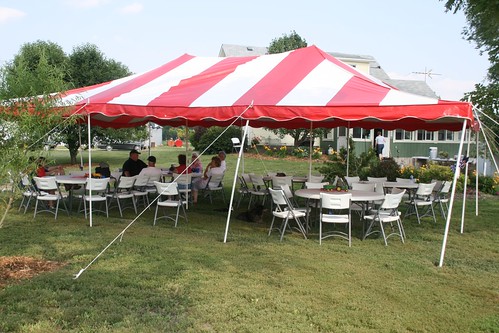
Saturday evening it was time for goodbyes. We all had a blast and I'm sure we'll do this again. If you weren't there, here's what Blogstock looks like:

img_4991.jpg

A bunch of friends sitting around chatting under a tent pretty well sums it up.

(There was a full tent of people; some were just elsewhere when this particular photo was taken.)

Jacob shared his thoughts on the whole trip on the way home, too. Well put, Jacob.

img_5202.jpg

3 July 2008

Ingo Juergensmann: Xen and NFS performance

Today I discovered that one of my domUs at work is performing slow on its mounted NFS share. Bonnie++ and dd tests showed a network throughput of just 300 kB/s whereas the throughput was up to 110 MB/s from dom0 to NFS server. Some Google searches revealed that Xen has problems with NFS performance with non-standard rsize and wsize setting and especially with NFS over UDP.
Reducing rsize and wsize settings didn't help at all. The performance was still awful. After remounting the NFS share via TCP the performance was as expected. Such a huge difference in perfomance surprised me. Still, a strange bug in Xen, at least in Etch. Maybe it's already fixed in Sid?

John Goerzen: Video uploading sites?

I'm working on switching from using a Mac to using Linux for editing video. I have a mini-DV camcorder that a bought a few years back, and I've been looking at capture and editing software for Linux.

Along with that, I want to post some videos online for family to be able to see I want to preserve the original quality as much as possible, offer the option to download the video, and be able to share some videos with family only (not the entire Internet).

I've been looking at various reviews of video sites (such as this PCWorld one) and decided to look at blip.tv and Vimeo in more detail.

Blip seems to have lots of controls, options, etc. And, they seem to really care about end users, respond fast, and care about freedom. There's an impressive response from their support team concerning Ogg Theora out there. They offer FTP uploads (which are a huge improvement over HTTP POST uploading, in my opinion, and easily scriptable). They can also automatically post your video to archive.org or about a dozen other video or blogging sites.

But what I want to do is not really what they are aiming at. They are set up for "channels" (you can apparently only have one channel per user), and for more professional users. Most notably, you can't make videos private or restricted without paying for their $100/year or so "pro" account.

Vimeo looks very much like the Flickr of video. They do offer various options for restricting who can see a video. When they transcode video to Flash, they have the option of preserving it in HD, which blip.tv doesn't (both go 640x480 or so by default, and blip maximizes out that that). Though both offer the option to download the full, unmodified original. Vimeo has only one option for uploading, and it doesn't seem to work well with Firefox. They have little detail about anything in their docs. Maybe it's more the Photobucket of video than the Flickr of video. (Oh, who am I kidding -- that's Youtube).

Of course, there is Youtube. Maxes out at 320x240, doesn't offer the original for downloading. Doesn't make me think all that positively about them.

I could also use Flickr. I'm not sure if they offer the original, but there's a 90-second limit on uploads there.

Any other thoughts?

2 July 2008

Jan Wagner: Bayreuth Festival - Online streaming of Die Meistersinger von N rnberg

Actual I’m involved into a project which maybe of interest for you if you like opera particular when you are a Richard Wagner enthusiast.
Since long time, the waiting period for obtaining tickets increases a lot. At the moment I think you have to wait around 8 years, which is a worse.
Time changes also at Bayreuth Festival, they seems to refocus their audience. Looks like the aspects of huge waiting list and new medias influenced that process. This year the opera “Die Meistersinger” is broadcasted online under the slogan “live dabei” (live there) via the great thing called “Internet” and to a public viewing area in Bayreuth, which is a premiere in both cases. So if you don’t have a ticket for the Festspielhaus and not in a position to make use of the public viewing but interested to have a look at the opera, you may want to check if your system matches the technical requirements and give it a try.

30 June 2008

Riku Voipio: Creating community friendly embedded systems

Netgear has jumped the bandwagon and released Open Source Wireless-G Router (WGR614L). Like the earlier Linksys WRT54GL, it's an existing model with a Linux "L" added to end. It does not really add any hardware to make it community friendly, the "open source" part feels like just a marketing gimmick.

With just a couple of small features, these devices could really become community friendly:


Not as necessary, but nice to have features for a community-oriented product:

Next.

Previous.