Search Results: "eric"

12 November 2009

Russell Coker: Links November 2009

Credit Writedowns has a populist interpretation of the latest Boom-Bust cycle [1]. It s an interesting analysis of the way the US economy is working. Bono writes for the NY Times about Rebranding America [2]. He praises Barack Obama suggesting a different reason to believe that the peace prize is deserved and describes what he believes to be the world s hope for the US. IsMyBlogWorking.com is a useful site that analyses your blog [3]. It gives some advice on how to improve some things as well as links to feed validation sites. Evgeny Morozov gave an interesting TED talk How the Net Aids Dictatorships [4]. I don t agree with his conclusion, he has some evidence to support his claims but I think that a large part of that is due to people not using the Internet well. I expect things to improve. The one claim that was particularly weak was when he mentioned radio stations in Rwanda as an example of technology being used for bad purposes the entire point about the first-world discussion about such things is the radio vs the Internet. Ray Anderson gave an inspiring talk about The Business Logic of Sustainability [5]. He transformed his carpet company, decreasing it s environmental impact by 82% and it s impact per volume of product by more than 90% while also significantly increasing it s profitability. He says that corporate managers who don t protect the environment should be regarded as criminals. Making his company more environmentally friendly reduced expenses (through efficiency), attracted more skillful employees, and attracted environmentally aware customers. Managers who don t follow Ray s example are not only doing the wrong thing for the environment, they are doing the wrong thing for their stockholders! Ray s company Flor takes carpet orders over the web [6]. They won t ship a catalogue outside the US, so presumably they only sell carpet to the US too. Marc Koska gave an interesting TED talk about a new syringe design that prevents re-use [7]. His main aim is to prevent the spread of AIDS in the developing world where even hospital staff knowingly reuse syringes. It will also do some good in developed countries that try to prohibit drug use. David Logan gave an interesting TED talk about tribal leadership [8]. His use of the word tribe seems rather different from most other uses, and I am a bit dubious about some of his points. But it is definitely a talk worth seeing and considering. Deirdre Walker is a recently retired Assistant Chief of Police who has worked for 24 years as a police officer, she describes in detail her analysis of the flaws in the TSA security checks at US airports [9]. Brian Krebs wrote an article for the Washington Post recommending that Linux Live CDs be used for Internet banking [10]. Windows trojans have been used to take over bank accounts that were accessed by security tokens, that could only be accessed by certain IP addresses, and that required two people to login. It seems that nothing less than a Linux system that is solely used for banking is adequate when a lot of money is at stake. The NY Times has an interesting review of the book Ayn Rand and the World She Made [11]. It seems that Ayn was even madder than I thought. Gary Murphy has written an interesting analysis of the latest stage in the collapse of the US Republican party [12]. The ABC (AU) Law Report has an interesting article about Evony s (of China and the US) attempting to sue Bruce Everiss (of the UK) in Australia [13]. The Guardian has an insightful article about the IEA making bogus claims about the remaining oil reserves [14]. It seems that the experts who work for the IEA estimate that oil is running out rapidly while the US is forcing them to claim otherwise. Dean Baker of the Center for Economic and Policy Research has written an interesting article about the economic effects of the war in Iraq [15]. Apparently it caused the loss of over 2,000,000 jobs considerably more than the job losses that could ever result from efforts to combat global warming.

10 November 2009

Gunnar Wolf: PieSpy: Modelling IRC interactions

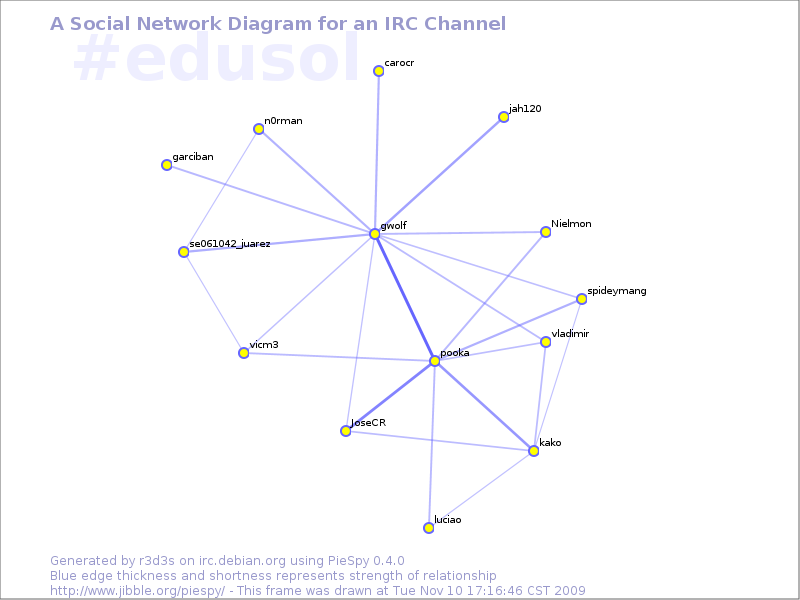
As some of you know, yesterday we started the two weeks of activities for the Fifth On-line Encounter of Free Education, Culture and Software. This year, the main topic for the conference is social networks, but not in the twitter-facebook sense Social networks as ways of understanding and modelling human-to-human interactions. Of course, there is interest from many attendees in using and taking advantage of said social network systems (and others), but the topic is far broader. One of the core tools of EDUSOL, and the only tool that is constantly active through our two weeks of activity, is IRC Which is somewhat of a challenge, as we receive some not-tech-savvy users from all over the world. The first year or two we asked everybody to connect via an IRC client (and we had even decided that it would be a technological filter We thought we would not cater for people without the technical skills to install and use IRC). Life proved us wrong, and we ended up using two web-to-IRC gateways: One of them, via an instance of CGI:IRC, and the other one via a third-party service, Mibbit. Now, the core mind behind EDUSOL is Alejandro Miranda, Pooka; I am not really into education (it is a very interesting topic but far from what I am good at). Pooka has been invovled in on-line communities analysis for several years already, since we worked together at FES Iztacala. For a long time he wanted to graph the interactions at EDUSOL, which was obviously possible given it was all centered on three tools (IRC for live chat, Drupal for generic information and Moodle for the talks and workshops' material This has changed this year, as we are giving much more weight to Drupal and taking it off Moodle), and so last year he was finally able to generate a EDUSOL 2008 conference photo (warning: 2MB image, 4311x3352px), where each person's avatar appears where most of his interactions were. This photo was (unfortunately) achieved using non-free software, but is very much looking at! Now, this year Pooka stumbled upon a great tool, PieSpy (available in Debian package piespy). Piespy generates very interesting interaction graph for IRC channels, as you can see here: Piespy is a bot that sits in the IRC channel logging everything that any given user "says" directly to another one, and graphs it. Not much to say here, only that it generates a very good (and practically real-time) view of what happens on the channel. For this particular channel, and during EDUSOL, you can see here the latest IRC snapshots. Very fun to see - and somewhat addictive how it morphs across time :)
AttachmentSize
EDUSOL 2008 - Conference photo1.97 MB
Current (Monday+Tuesday) interaction graph for our IRC channel39.89 KB

Dirk Eddelbuettel: R / Finance 2010 Call for Papers

Jeff sent the following while I had connectivity issues and I hadn't gotten around to posting it here. So without further ado, and given the success of our initial R / Finance 2009 conference about R in Finance, here is the call for papers for next spring:
Call for Papers: R/Finance 2010: Applied Finance with R
April 16 and 17, 2010
Chicago, IL, USA
The second annual R/Finance conference for applied finance using R will be held this spring in Chicago, IL, USA on April 16 and 17, 2010. The two-day conference will cover topics including portfolio management, time series analysis, advanced risk tools, high-performance computing, market microstructure and econometrics. All will be discussed within the context of using R as a primary tool for financial risk management and trading. One-page abstracts or complete papers (in txt or pdf format) are invited for consideration. Academic and practitioner research proposals related to R are encouraged. We will accept submissions for full talks, abbreviated "lightning talks", and a limited number of pre-conference tutorial sessions. Please indicate with your submission if you would be willing to produce a formal paper (10-15 pages) for a peer-reviewed conference proceedings publication. Presenters are strongly encouraged to provide working R code to accompany the presentation/paper. Data sets should also be made public for the purposes of reproducibility (though we realize this may be limited due to contracts with data vendors). Preference may be given to presenters who have released R packages. Please send submissions to: committee at RinFinance.com The submission deadline is December 31st, 2009. Submissions will be evaluated and submitters notified via email on a rolling basis. Determination of whether a presentation will be a long presentation or a lightning talk will be made once the full list of presenters is known. R/Finance 2009 included keynote presentations by Patrick Burns, Robert Grossman, David Kane, Roger Koenker, David Ruppert, Diethelm Wuertz, and Eric Zivot. Attendees included practitioners, academics, and government officials. We anticipate another exciting line-up for 2010 and will announce details at the conference website http://www.RinFinance.com as they become available. For the program committee:
Gib Bassett, Peter Carl, Dirk Eddelbuettel, John Miller,
Brian Peterson, Dale Rosenthal, Jeffrey Ryan
See you in Chicago in April!

9 November 2009

Joey Hess: king kong vs godzilla from a mouse's perspective

In Ubuntu Server Edition 9.10: No hardware required, Matt Zimmerman announces that from now on, "every release of Ubuntu Server Edition is simultaneously available on EC2". Amazon's EC2 documentation says: "the ability to create and publish kernels and ramdisks is restricted to Amazon EC2 and selected vendors". Canonical appears to be one of those vendors. Their newest EC2 AMI's contain modules from an Ubuntu build of linux-xen (2.6.27-23). Eric Hammond, who has been for a while making both Ubuntu and Debian images for EC2 says
Historically on EC2, neither Debian nor Ubuntu have had completely Debian and Ubuntu stacks from the kernel up. Instead, we've had to make do with patching the runtime on top of older kernels (2.6.16, 2.6.18, 2.6.21) built for other distros (Fedora Core). Amazingly, we've managed to hold this together and keep it running well for a couple years on EC2.
He goes on to describe current problems with eg, Debian's new udev version and the available EC2 kernels. Furthermore, anticipating today's news:
When the point comes where I am not publishing the base Ubuntu server AMIs, it will not make sense for me to publish new Debian AMIs either.
Those wanting to run Debian on EC2 will be stuck with duct-taping together Debian with the available kernels. Maybe I'm wrong. Maybe Ubuntu is actually working with Debian's kernel team, and will be letting them use Canonical's access to publish AKI's of official Debian kernels. Or maybe Ubuntu is working with Debian's kernel team to include identical linux-xen kernel in Debian, so the Ubuntu AKI's could be used. But appearances are that this is another case where Ubuntu has managed to take a situation that was less than ideal for all concerned, and turn it into an advantage for Ubuntu, while at the same time being a unfixable loss for Debian. My mouse's perspective is that a) we maybe only have so many losses left in us (altho we did get thru that whole dinosaur thing ok!) and b) King Kong is still oddly dependent on his mammilian heritage to be up there with his head in the cloud, tearing at Godzilla and stamping on us.

8 November 2009

Stephan Peijnik: Android s roaming detection & its implementation

I know I wrote about Android already today, but there is another thing that concerns me right now. I am owner of an Android-based phone (an HTC Dream) and recently switched my mobile network provider. The problem is that my new provider is a virtual provider and as such there is no real network of that provider. Now Android has a feature to turn off broadband connections when in roaming mode, which itself is a great idea and can save you from paying quite a lot of money when the phone connects to 3G abroad, but this feature also turns off broadband connections when roaming locally. All this is being discussed in bug report #3499. After noticing this problem I became curious on how Android detects that it is roaming and I found the GsmServiceStateTracker.isRoamingBetweenOperators method to be responsible for that magic, but soon noticed that the method is not only inefficient, but also doesn t work as intended. This is hardly related to the bug mentioned above, but let s have a look at the code in question:

/**
* Set roaming state when gsmRoaming is true and, if operator mcc is the
* same as sim mcc, ons is different from spn
* @param gsmRoaming TS 27.007 7.2 CREG registered roaming
* @param s ServiceState hold current ons
* @return true for roaming state set
*/
    private
    boolean isRoamingBetweenOperators(boolean gsmRoaming, ServiceState s)  
        String spn = SystemProperties.get(PROPERTY_ICC_OPERATOR_ALPHA, "empty");
        String onsl = s.getOperatorAlphaLong();
        String onss = s.getOperatorAlphaShort();
        boolean equalsOnsl = onsl != null && spn.equals(onsl);
        boolean equalsOnss = onss != null && spn.equals(onss);
        String simNumeric = SystemProperties.get(PROPERTY_ICC_OPERATOR_NUMERIC, "");
        String operatorNumeric = s.getOperatorNumeric();
        boolean equalsMcc = true;
        try  
            equalsMcc = simNumeric.substring(0, 3).
                    equals(operatorNumeric.substring(0, 3));
          catch (Exception e) 
         
        return gsmRoaming && !(equalsMcc && (equalsOnsl   equalsOnss));
     
Okay, let me summarize what this piece of code does wrong, at least from my understanding: Now in my case my SIM card doesn t seem to provide the phone with a alphanumeric identifier, so the first two comparisons always fail for obvious reasons and, looking at the inline-if in the last line of that method my phone will always indicate that I am in roaming mode, even when I am not. The problem is not only the logic which seems to be wrong, but I rather see the inefficient comparisons used there to be a major problem in embedded systems like mobile phones. This is the first piece of Android code I have had a look at, but if all other code is as ugly and inefficient as these few lines Android really needs some major fixes. Related to this I have reported bug #4590 and forked the git repository in question over at github, to fix this method, should be a matter of 5 minutes.

7 November 2009

Andrew Pollock: [life] Whirlwind visit to Brisbane

Sarah's Mum is flying her back for the scattering of her grandmother's ashes, and I figured that as this will be her third trip back this year, and she's seen my family more than I have in the last 12 months, I should come as well. So I'm getting my first opportunity to sample V Australia's service. I must say that flying Virgin America to LAX and then transferring to V Australia to fly direct to Brisbane seems like a fairly civilised way to do it. Anything that involves Virgin America is always a delight. My only complaints so far are that the SFO-LAX flight left late, and the check in line for V Australia in LAX was ridiculously slow given it was so short. The time of the flight is pretty good - it leaves LAX at 10:30pm, so hopefully we'll get a semi-decent amount of sleep. It gets into Brisbane at 6:30am on Sunday, so we'll have to try and imitate the living dead for the day. I'm heading back again on Saturday, as I have to be in Dallas next week for the Ubuntu Developer Summit.

3 November 2009

Daniel Leidert: Toshiba Tecra A10 (PTSB5E) - Part I

I recently got a Toshiba Tecra A10-1HU laptop. This is a series describing my experiences with this hardware using Debian Sid. This one comes without any operating system. So I got a recent testing-netinstall CD-image and ran the installer procedure (in expert mode). Everything went fine and I ended with a shiny Squeeze and kernel 2.6.30. Because I use Sid as my usual system, my first action was a dist-upgrade to Sid. This is what lspci -nn tells:
00:00.0 Host bridge [0600]: Intel Corporation Mobile 4 Series Chipset Memory Controller Hub [8086:2a40] (rev 07)
00:02.0 VGA compatible controller [0300]: Intel Corporation Mobile 4 Series Chipset Integrated Graphics Controller [8086:2a42] (rev 07)
00:02.1 Display controller [0380]: Intel Corporation Mobile 4 Series Chipset Integrated Graphics Controller [8086:2a43] (rev 07)
00:03.0 Communication controller [0780]: Intel Corporation Mobile 4 Series Chipset MEI Controller [8086:2a44] (rev 07)
00:19.0 Ethernet controller [0200]: Intel Corporation 82567LM Gigabit Network Connection [8086:10f5] (rev 03)
00:1a.0 USB Controller [0c03]: Intel Corporation 82801I (ICH9 Family) USB UHCI Controller #4 [8086:2937] (rev 03)
00:1a.1 USB Controller [0c03]: Intel Corporation 82801I (ICH9 Family) USB UHCI Controller #5 [8086:2938] (rev 03)
00:1a.2 USB Controller [0c03]: Intel Corporation 82801I (ICH9 Family) USB UHCI Controller #6 [8086:2939] (rev 03)
00:1a.7 USB Controller [0c03]: Intel Corporation 82801I (ICH9 Family) USB2 EHCI Controller #2 [8086:293c] (rev 03)
00:1b.0 Audio device [0403]: Intel Corporation 82801I (ICH9 Family) HD Audio Controller [8086:293e] (rev 03)
00:1c.0 PCI bridge [0604]: Intel Corporation 82801I (ICH9 Family) PCI Express Port 1 [8086:2940] (rev 03)
00:1c.1 PCI bridge [0604]: Intel Corporation 82801I (ICH9 Family) PCI Express Port 2 [8086:2942] (rev 03)
00:1c.2 PCI bridge [0604]: Intel Corporation 82801I (ICH9 Family) PCI Express Port 3 [8086:2944] (rev 03)
00:1d.0 USB Controller [0c03]: Intel Corporation 82801I (ICH9 Family) USB UHCI Controller #1 [8086:2934] (rev 03)
00:1d.1 USB Controller [0c03]: Intel Corporation 82801I (ICH9 Family) USB UHCI Controller #2 [8086:2935] (rev 03)
00:1d.2 USB Controller [0c03]: Intel Corporation 82801I (ICH9 Family) USB UHCI Controller #3 [8086:2936] (rev 03)
00:1d.7 USB Controller [0c03]: Intel Corporation 82801I (ICH9 Family) USB2 EHCI Controller #1 [8086:293a] (rev 03)
00:1e.0 PCI bridge [0604]: Intel Corporation 82801 Mobile PCI Bridge [8086:2448] (rev 93)
00:1f.0 ISA bridge [0601]: Intel Corporation ICH9M-E LPC Interface Controller [8086:2917] (rev 03)
00:1f.2 SATA controller [0106]: Intel Corporation ICH9M/M-E SATA AHCI Controller [8086:2929] (rev 03)
01:00.0 Network controller [0280]: Intel Corporation Wireless WiFi Link 5100 [8086:4232]
05:0b.0 CardBus bridge [0607]: Ricoh Co Ltd RL5c476 II [1180:0476] (rev ba)
05:0b.1 FireWire (IEEE 1394) [0c00]: Ricoh Co Ltd R5C832 IEEE 1394 Controller [1180:0832] (rev 04)
05:0b.2 SD Host controller [0805]: Ricoh Co Ltd R5C822 SD/SDIO/MMC/MS/MSPro Host Adapter [1180:0822] (rev 21)
05:0b.3 System peripheral [0880]: Ricoh Co Ltd R5C843 MMC Host Controller [1180:0843] (rev ff)
05:0b.4 System peripheral [0880]: Ricoh Co Ltd R5C592 Memory Stick Bus Host Adapter [1180:0592] (rev 11)
05:0b.5 System peripheral [0880]: Ricoh Co Ltd xD-Picture Card Controller [1180:0852] (rev 11)
Things that worked out-of-the-box: Display/Graphics (Intel GMA 4500M HD) The integrated graphics chipset, an Intel GMA 4500M HD, works with the xserver-xorg-video-intel package and the default X.org configuration. No custom /etc/X11/xorg.conf is necessary. The (IMHO non-reflecting?) display runs at 1280 800 at 60 Hz. Cable network device The integrated Intel 82567LM Gigabit Network device works with the e1000e kernel module. No customization was necessary. Touchpad/Trackpoint The notebook comes with the so called Toshiba Dual Pointing Device a touchpad (+2 buttons) and a trackpoint (+2 buttons). Both worked without customization. Energy savings/Suspend/Resume apmd and acpid handle this. No problems yet. Suspend/Resume works. I did not yet test (and I m not sure if I should) hibernate and uswsusp. Webcam The webcam is a CNA7157 model or at least detected as such. The video4linux modules handle it and the cheese application produces pictures. Volume-control wheel It works. Module and package information will follow as soon as I figure them out. Things that needed customization WLAN (Intel WiFi Link 5100) The notebook comes with an Intel WiFi Link 5100 device. It does not work out-of-the-box. Following this article, I ve installed the firmware-iwlwifi package and loaded the iwlagn module. Sound (Intel) For the sound device to work the snd_hda_intel module is necessary. Further the following lines must be added to /etc/modprobe.d/alsa-base.conf
# not sure about the first line, start adding the second only
options snd-cmipci mpu_port=0x330 fm_port=0x388
options snd-hda-intel index=0 model=toshiba position_fix=1
Unsure/Not yet working Temperature sensor After installing the sensors-applet I got two identical temperature displays. I m not sure what they show. Anybody an idea how to examine this? Modem The notebook comes with an internal modem device:
00:03.0 Communication controller [0780]: Intel Corporation Mobile 4 Series Chipset MEI Controller [8086:2a44] (rev 07)
From what I read I need hsfmodem or the sl-modem packages. Unfortunately the latest version is not available for amd64 from the archive, although it seems to have been built. Untested I did not yet test Summit This what lspci -k -nn tells about the used kernel modules:
00:00.0 Host bridge [0600]: Intel Corporation Mobile 4 Series Chipset Memory Controller Hub [8086:2a40] (rev 07)
	Subsystem: Toshiba America Info Systems Device [1179:0001]
	Kernel driver in use: agpgart-intel
00:02.0 VGA compatible controller [0300]: Intel Corporation Mobile 4 Series Chipset Integrated Graphics Controller [8086:2a42] (rev 07)
	Subsystem: Toshiba America Info Systems Device [1179:0004]
00:02.1 Display controller [0380]: Intel Corporation Mobile 4 Series Chipset Integrated Graphics Controller [8086:2a43] (rev 07)
	Subsystem: Toshiba America Info Systems Device [1179:0004]
00:03.0 Communication controller [0780]: Intel Corporation Mobile 4 Series Chipset MEI Controller [8086:2a44] (rev 07)
	Subsystem: Toshiba America Info Systems Device [1179:0001]
00:19.0 Ethernet controller [0200]: Intel Corporation 82567LM Gigabit Network Connection [8086:10f5] (rev 03)
	Subsystem: Toshiba America Info Systems Device [1179:0001]
	Kernel driver in use: e1000e
00:1a.0 USB Controller [0c03]: Intel Corporation 82801I (ICH9 Family) USB UHCI Controller #4 [8086:2937] (rev 03)
	Subsystem: Toshiba America Info Systems Device [1179:0001]
	Kernel driver in use: uhci_hcd
00:1a.1 USB Controller [0c03]: Intel Corporation 82801I (ICH9 Family) USB UHCI Controller #5 [8086:2938] (rev 03)
	Subsystem: Toshiba America Info Systems Device [1179:0001]
	Kernel driver in use: uhci_hcd
00:1a.2 USB Controller [0c03]: Intel Corporation 82801I (ICH9 Family) USB UHCI Controller #6 [8086:2939] (rev 03)
	Subsystem: Toshiba America Info Systems Device [1179:0001]
	Kernel driver in use: uhci_hcd
00:1a.7 USB Controller [0c03]: Intel Corporation 82801I (ICH9 Family) USB2 EHCI Controller #2 [8086:293c] (rev 03)
	Subsystem: Toshiba America Info Systems Device [1179:0001]
	Kernel driver in use: ehci_hcd
00:1b.0 Audio device [0403]: Intel Corporation 82801I (ICH9 Family) HD Audio Controller [8086:293e] (rev 03)
	Subsystem: Toshiba America Info Systems Device [1179:0001]
	Kernel driver in use: HDA Intel
00:1c.0 PCI bridge [0604]: Intel Corporation 82801I (ICH9 Family) PCI Express Port 1 [8086:2940] (rev 03)
	Kernel driver in use: pcieport-driver
00:1c.1 PCI bridge [0604]: Intel Corporation 82801I (ICH9 Family) PCI Express Port 2 [8086:2942] (rev 03)
	Kernel driver in use: pcieport-driver
00:1c.2 PCI bridge [0604]: Intel Corporation 82801I (ICH9 Family) PCI Express Port 3 [8086:2944] (rev 03)
	Kernel driver in use: pcieport-driver
00:1d.0 USB Controller [0c03]: Intel Corporation 82801I (ICH9 Family) USB UHCI Controller #1 [8086:2934] (rev 03)
	Subsystem: Toshiba America Info Systems Device [1179:0001]
	Kernel driver in use: uhci_hcd
00:1d.1 USB Controller [0c03]: Intel Corporation 82801I (ICH9 Family) USB UHCI Controller #2 [8086:2935] (rev 03)
	Subsystem: Toshiba America Info Systems Device [1179:0001]
	Kernel driver in use: uhci_hcd
00:1d.2 USB Controller [0c03]: Intel Corporation 82801I (ICH9 Family) USB UHCI Controller #3 [8086:2936] (rev 03)
	Subsystem: Toshiba America Info Systems Device [1179:0001]
	Kernel driver in use: uhci_hcd
00:1d.7 USB Controller [0c03]: Intel Corporation 82801I (ICH9 Family) USB2 EHCI Controller #1 [8086:293a] (rev 03)
	Subsystem: Toshiba America Info Systems Device [1179:0001]
	Kernel driver in use: ehci_hcd
00:1e.0 PCI bridge [0604]: Intel Corporation 82801 Mobile PCI Bridge [8086:2448] (rev 93)
00:1f.0 ISA bridge [0601]: Intel Corporation ICH9M-E LPC Interface Controller [8086:2917] (rev 03)
	Subsystem: Toshiba America Info Systems Device [1179:0001]
00:1f.2 SATA controller [0106]: Intel Corporation ICH9M/M-E SATA AHCI Controller [8086:2929] (rev 03)
	Subsystem: Toshiba America Info Systems Device [1179:0001]
	Kernel driver in use: ahci
01:00.0 Network controller [0280]: Intel Corporation Wireless WiFi Link 5100 [8086:4232]
	Subsystem: Intel Corporation Device [8086:1201]
	Kernel driver in use: iwlagn
05:0b.0 CardBus bridge [0607]: Ricoh Co Ltd RL5c476 II [1180:0476] (rev ba)
	Subsystem: Toshiba America Info Systems Device [1179:0001]
	Kernel driver in use: yenta_cardbus
05:0b.1 FireWire (IEEE 1394) [0c00]: Ricoh Co Ltd R5C832 IEEE 1394 Controller [1180:0832] (rev 04)
	Subsystem: Toshiba America Info Systems Device [1179:0001]
	Kernel driver in use: firewire_ohci
05:0b.2 SD Host controller [0805]: Ricoh Co Ltd R5C822 SD/SDIO/MMC/MS/MSPro Host Adapter [1180:0822] (rev 21)
	Subsystem: Toshiba America Info Systems Device [1179:0001]
	Kernel driver in use: sdhci-pci
05:0b.3 System peripheral [0880]: Ricoh Co Ltd R5C843 MMC Host Controller [1180:0843] (rev ff)
	Kernel driver in use: ricoh-mmc
05:0b.4 System peripheral [0880]: Ricoh Co Ltd R5C592 Memory Stick Bus Host Adapter [1180:0592] (rev 11)
	Subsystem: Toshiba America Info Systems Device [1179:0001]
05:0b.5 System peripheral [0880]: Ricoh Co Ltd xD-Picture Card Controller [1180:0852] (rev 11)
	Subsystem: Toshiba America Info Systems Device [1179:0001]

2 November 2009

Axel Beckert: 192.168.noone.org

About a year ago, Eric Poscher invented the IP address blog and installed his one at http://192.168.epe.at/. Every hour his netbook notes down the IP address of the interface which currenntly the default route goes through and if it has an internet connection, it uploads the list of IP adresses it had. Additionally, he filters the list to IP addresses in 192.168.0.0/16. June this year he published the source code behind his IP blog under GPL and Creative Commons. I modified his script slighty to just write down the new IP address if it s different to the previous one, but without any filter. This makes the list much more colorful (and my online times less traceable :-) as you can see at http://192.168.noone.org/. But the biggest disadvantage of Eric s code design is not the fact that it s a (quite nice to read :-) shell script but that it doesn t save the list of IPs separately and is not able to regenerate everything if you want to change the design, but always just adds a line to the HTML page. So I rewrote the whole thing in Perl last Saturday while sitting the dog of my parents. If you change the templates and call the script again, it regenerates the whole list with the new templates. The code is also under GPL, the HTML parts are under Creative Commons, too. And hey, this is one of the very few (if not only) applications which are much more fun with IPv4 than with IPv6. ;-)

Axel Beckert: Still happy with the ASUS EeePC 701

Recently Eric asked on the LUG Vorarlberg mailing list about netbook experience. I wrote a lengthy reply summarizing my experiences with the ASUS EeePC 701. And I thought this is something I probably should share with more people than only one LUG: I ordered an ASUS EeePC 701 (4G) with US keyboard layout at digitec in Spring 2008, got it approximately one month later and posted a first resum after one month in my blog. I m still very happy with the EeePC 701, despite two commonly mentioned drawbacks (the small screen resolution and the small SSD which I both don t see as real problems) and some other minor issues. What mattersNice to haveWhat doesn t matterWhat s not so niceSimilar models Technically, most of this also counts for the EeePC 900SD (not 901) which only differs in screen, resolution and disk size as well as CPU, but not on the the case. So same size, same robustness, same battery, same mainboard, bigger screen, resolution, disk and faster CPU. (The 901 has a different CPU, a different battery, and a different, glossy and partially chromed case.) See Wikipedia for the technical specifications of all EeePC models. ASUS only big FAILure Stopping to sell most EeePCs with Linux and cowardly teaming up with Microsoft after having shown big courage to come out with a Linux only netbook. Well, you probably already know, but it s better without Windows So basically you no more get these really neat netbooks from ASUS anymore and you get nearly no netbooks with Linux from ASUS in the stores anymore. It s a shame. Would I buy it again? Sure. Well, maybe I would also buy the 900SD or 702 (8G) instead of the 701, but basically they re very similar. See Wikipedia for the differences between these EeePC models. And of course I still prefer the versions without Windows. But despite the low price, the EeePC 701 is surprisingly robust and still works as on the first day (ok, except battery, the mouse button bar and the n key ;-), so I recently bought a second power supply (only white ones were available *grrrr*) and ordered a bigger third party battery plus an adapter to load the battery directly from the (second) power supply without EeePC inbetween. What desktop do I use on the EeePC? None. I use ratpoison as window manager, uxterm, urxvt, and yeahconsole as terminal emulators (running zsh with grml based .zshrc even as root s login shell :-), wicd-curses as network manager and xmobar (previously dzen2) with i3status as text-only panel. Installed editors are GNU Emacs 23, GNU Zile and nvi. (No vim. :-) And of course a netbook wouldn t be a netbook if it wouldn t have a lot of network applications installed. For me the most important ones are: ssh, scp, autossh, sshfs, miredo, conkeror, git, hg, and rsync.

1 November 2009

John Goerzen: First impressions of the iPod Touch

So far, our household has resisted any piece of the iPhone onslaught. Yes, I carry an iPod Classic, but that s different. Terah s old Palm m100 is becoming a problem. The platform is dead, and the desktop sync drivers for it are decaying rapidly in every operating system. Not only that, but we would really like to be able to share calendars between us. Terah doesn t need a phone or a mobile data plan. After thinking about it a bit and getting some advice, we decided to get her the $200 8GB iPod Touch. And it arrived Friday. I ve used portable devices plenty before. I had my share of PalmOS devices: III, V, Clie; an HP 200LX DOS-based err netbook; a Zaurus; and an N810. The first thing that struck me about the iPod Touch was beauty no surprise there. The interface exuded an air of stability, like it wasn t going to just crash when something went wrong. It felt solid and well-planned. Physically, it s thin. Really thin. That s perhaps the most impressive thing about it of all. Sometimes the GUI masked underlying performance issues. For instance, it may take awhile to draw a web page. On the N810, you get to watch as different bits of the screen appear. On the iPod Touch, you sit there staring at a white screen with a spinning wheel for awhile, and then suddenly poof, the webpage is there. I d have to say the Apple approach feels better. Terah and I decided to sync with Google Calendar, and that setup was easy and well-done on the iPod Touch easier than on the Blackberry with Google s own app, in fact. The only question was that Contacts was a bit counter-intuitive; select the Google account and nothing shows up, but everything is there under the generic Contacts bucket. The Calendar worked very well, even properly handling meetings and invitations. The mail app works well, though it takes a long very long time to scroll through a lengthy email to get to the attachment at the bottom. There s no go to bottom of message feature that I could see, and my idea of pinching the screen to make the text tiny to make scrolling faster didn t work. The mail setup, though, is a complete and utter pain. There is no way anybody that doesn t know a lot of details about SSL certs could have made this work. When you add a mail account, it requires you to have an IMAP and SMTP server defined. It would like to use SSL/TLS with these, which is great. But if it can t validate the cert, it pops up a dialog box asking if you want to continue. You can say yes, but it just sits there for a couple of minutes and then fails with a mysterious error. I had to put my cert up on a webserver, point Safari at it, and install the cert to the device before it would talk to it. That solved IMAP. SMTP was another matter too. Strangely, on the initial account setup, there is no way to put in the port number for SMTP server. Yet it won t save your account until it can connect to one. Of course, most ISPs block the smtp port, so this was bound to fail. Finally I pointed it at a server on my local network temporarily, then went in and edited the account to point it to the real server with the second non-25 port it listens on for just such situations. Safari works really well. It s probably the best mobile browser I ve seen yet (I haven t seen Android or Palm Pre yet.) It is far better than the N810 browser, both in terms of speed and in terms of ability to reformat pages to fit the device. The tabbed browsing is a lot faster switching than the N810 s separate windows, and nicer too. The app store essentially lived up to my expectations. It was very easy to use, and obviously a closed proprietary ecosystem. The free apps that existed there mostly were adware. I looked for a Jabber client, and wasn t happy with any option. Some of them required Apple Push Notifications, with a complex network of two servers between the device and the Jabber server. No thanks to that invasion of privacy. And that brings me to the topic of weird limitations. iPod Touch apps, in general, can t run in the background. You exit Safari, and when you get back in, it s reloading that webpage. Now many apps are good at remembering their state, but this feels very PalmOS to me. You can t use the iPod Touch at all until you first sync it with iTunes. That is incredibly weird. The device has Wifi, people. Plus, why should I have to register it with Apple anyhow? And then there s the lack of a file manager, or anything like it. I can t scp a file from my computer to the iPod Touch like I can my N810, nor the other way round. It is generally unclear how much of the 8GB is in use, and by what. Terah needs a password-keeping program. There are several in the app store. I d really like one that uses Bruce Schneier s standard Password Safe format which is supported on just about any platform you care to name. Couldn t find one. Even if I could, I guess it wouldn t do me any good, since you can t copy the file to a PC anyhow. Sigh. Overall, Terah is very excited with the device, and I must admit to being so too. Its faster web browser means it s probably a good replacement for the N810 especially if you want a calendar, which the N810 completely lacks. It makes an excellent PDA, perhaps the first PDA I ve seen that equals the usability of the old PalmOS. On the other hand, it isn t really a power user s device. There are a lot of surprising limitations and missing features that competing devices have had for years.

27 October 2009

Patrick Schoenfeld: Things that make you a good programmer

If you ever wondered if you are a good programmer (not), you might think about the following points:

1. Repeat yourself. How else would you keep yourself busy, if your customer has new requirements?

2. Re-Using code is for people who take the other side of the street if a big dog walks along. No risk, no fun. How else would you find out that the common idiom you use is really the way the job has to be done?

3. If you have a coding convention (e.g. how code has to be indented): Just ignore it. Its a good thing to have editors go crazy, when trying to automatically detect the indenting of a source file. By always confusing the editor you keep up the fun of the people, who try to change your code. It would be too boring for them, to simply edit the file, without the quiz which quoting applies to your code. Extra points for those who additionaly (to mixing tabs, spaces, 4 and 8 space, expandtab and no expandtab) write a vim modeline into their file that - by guarantee - does not match the indenting of the file.

4. If you can complicate things: Do it. Numeric indices in arrays can be exchanged by arbitrary strings, this makes your code more interesting. Especially if you have to move elements in that array. And complicated codes makes people, who don't know it, think that you are a good programmer. One step nearer to your goal, isn't it?

5. When working with different classes invent a system that auto-loads the classes you need. Don't document it, that would be a risk for your job. Its not neccessary anyway, because good programmers like the riddle and finding out what gets called, where and why, is a simple but entertaining riddle. After all documenting is a bad idea as well. Especially if you make your system open source, because with a good documentation, it might be to easy for competitors to use your code to make money.

6. If you find ways to do extra function calls: Do it. It gives you the chance to refactor your code, if the customer notices that it is too slow. Great opportunity, hu?

(But, seriously: Don't hear on me. Its just a cynical way to express my feelings.)

26 October 2009

Mohammed Sameer: My old Geocities website

It'll disappear any moment soon... May you rest in peace :

Patrick Schoenfeld: Building a 15W Debian GNU/Linux system

When the Intel Atom was revealed to the public I didn't came around to say: "Wow!", because that piece of hardware promises to be a generic-x86 1.6 GHZ CPU with a total power consumption of 2 Watt, which is amazing considering that x86 hardware generally wasn't an option if you wanted to build a low-power system. But then the first chipsets were presented to the public and the Atom became a farce, because you don't want to have a chipset that eats over 25W for a CPU which consumes 2W. That was basically laughable.

Recently I managed to find out that there is a new chipset out there, the Intel i945GSE, which runs at about 11W TDP, including the soldered-on-board N270 atom cpu. And I convinced myself that this could get my new homeserver. So together with a 2.5" drive I could get a system which runs with about 15W maximum power consumption, which is amazing, given that the Arcor Easybox my provider gave to me seems to have similar maximum power consumptions. And it isn't able to provide me with the great flexibility, the new Atom system is.

So I bought the following components:

It took a while to get those components together, especially because I previously decided for an Antec case which I ordered from K&M Elektronik, but as they didn't keep their delivery promise I came to the M350. What a luck.

Running Debian on this machine is the easy part, you would think. This is true, for some exceptions. First: Lenny runs fine. I've installed the notebook hd in my desktop and then put it in the atom, when I got the first hardware and it worked right away. Except of a grub message, which is disturbing and which I didn't manage to fix right now (grub says "Error: No such disk" just to get the menu a seconds later anyway and boot the system flawless).

What didn' t work exactly reliable was the included network chip. Its quiet a shame to say that, but if you buy an Intel board, wouldn't you expect that it would run Intel components? Unfortunately this is not true for the atom board. It has a Realtek RTL8111 network chip, which isn't properly supported by the 2.6.26 kernel (that means the kernel think it is and loads a rtl8169 module, which isn't able to properly detect a link).
The workaround for this is to use a 8168 module from Realtek and compile it for your kernel, but as I equipped this system with an Atheros 2424 PCIe chipset for playing WLAN AP, too, I had to upgrade to 2.6.31 anyway and there the chip is fully supported by 8169.

Making the system an access point has been surprisinly easy as well. The greatest pain was to find a Mini PCIe WLAN card, because after all this isn't very common. However I found one based on an Atheros 2424 chipset and bought it. I additionaly bought an SMA-antenna connector that I could mount into the case (the M350 has a preparation hole for it) and an SMA antenna.
Setting this up, has been fairly easy. You need to know, that running master mode with newer mac-subsystem-drivers in Linux doesn't allow setting master mode directly. Instead you need to use an application to manage everything, which is capable of running cards over netlink. Thats hostapd. The unfortune is, that the lenny version is too old and so I built myself a (hacky) backport of the sid version, which isn't that hard anyway, because rebuilding against Lenny is enough. Additional you need a kernel 2.6.30 with compat-wireless extensions, or an 2.6.31, because previously the ath5k driver didn't support the master mode. After that getting hostapd up is a matter of a 4 - 15 lines configuration file. For me its now running in 802.11g with WPA and a short rekeying interval with 14 lines of configuration.

After all I'm satisfied with the system. Without any fan the CPU constantly runs at 55 C, which is okay, given that it must operate within 0 and 90 C according to the tech specs. The system and the disk are somewhat lower (47 and 39 C). The power of this system is more then enough. Its booting quick and working with it works without latencies, even when the system is doing something. What I haven't yet tested is weither the power consumption actually fulfills the expactations. I will do so, once I got a wattmeter.

25 October 2009

Erich Schubert: Facebook tweaks

Every time Facebook changes anything, people complain. Most of the time just because something has changed, without knowing actually what changed.The october layout change for example isn't too big in fact. As far as I can tell it's not much more than turning the "hot" items that were in the right sidebar into a special tab (and breaking the refresh for the live feed, but I guess they'll fix that soon). The "live" tab is basically all information (see below for getting rid of certain restrictions); the "News" tab tries to reduce this amount of information by only showing you certain posts Facebook magic considers to be "important". If you are a heavy user you will probably prefer the "Live" feed, if you are a casual Facebook user, go with the "News" feed to have less crap posts to read.Still there are some things you should be aware of when you are a facebook user (not all of these are new): Also you should never forget that all the data you put online is hard to get rid of again. Just don't put anything there you don't want everyone to know. Facebook can be really powerful when used right for example as promotion channel. But the way you should be using it is to first consider what you want people to have an impression of you, then try to present yourself this way. Don't just throw everything that comes to your mind there. (This even more applies to blogs and web sites, obviously, that don't have any privacy control)

22 October 2009

Gunnar Wolf: How can we advance without a tax increase?

There has been a lot of buzz recently in Mexico after a tax increase that has been announced for next year. The two main points I have seen criticized are:
Value Added Tax (IVA) increase from 15% to 16%
There was a great improvement regarding the original proposal by our de-facto ruler (why de-facto? Because it is still unclear whether he won the popular vote. He has about the same legitimacy as George Bush during his first term: Legal but illegitimate): In Mexico, there is a category of items regarded as fundamental, which are exempt of IVA (tasa cero). This category includes food and medicines Of course, this category makes up the bulk of the poorer people's consumptions, so they pay much less IVA than people with higher living standards. For a very long time, there has been a push to remove this exemption. This has been fortunately clearly understood and fought against. So, the presidential initiative, as I was saying, contemplated a global 2% tax which would not be IVA, and which would be applied universally. This tax would be earmarked to be applied to social programs, and was euphemistically called Impuesto de Combate a la Pobreza (poverty combat tax). Many people applied the concept of duck typing (if it looks like a duck, walks like a duck and quacks like a duck... It is a Value Added Tax). As many analysts, I believe this tax was meant to be the foot in the doorstop, leading to point out in a couple of years that anyway nothing is IVA-exempt anymore and the world has not come to an end, and we should apply universal IVA... So, the reduction in the increase (2% 1%) is not the most notable thing here The notable (and good!) thing is that they didn't succeed into killing the tasa cero.
3% tax on telecommunications
Many friends have started rallying (with the IMHO least effective way of protest you can find on Earth, just by stating their adherence in their Twitter and Facebook profiles. Wow, great deal!) that the original proposal included a 4% tax on telecommunications, and it appears that 3% will be applied. They say, quite fairly, that telephone and Internet access are no longer considerable a luxury, but a need to power the society into becoming better prepared, more competitive. My friends state as a contrast the Finnish ruling broadband access as a citizen right. What they seem not to realize is that the proportion of taxes in Mexico (collected from the responsible taxpayers, which is not by far the way for the bulk of the money in this country) is close to 30%, taking into account the big taxes (IVA, ISR/IETU) and the host of smaller ones. In Finland, the percentage of taxes payed by every person and remember that tax evasion is way lower than here!) is over 50%.
So What is my opinion on this? What would my ideal tax scheme be?
  • Nobody likes taxes. But the country needs far more infrastructure, far wider inverstments. We need higher taxes But we need those taxes to be collected from people with higher income. And yes, that would mean I would most probably pay more (as I do sit relatively high on the income scale Qualified work, even if you do not seek money for the sake of it, pays much better than non-qualified work; remember the minimal wage in Mexico is around MX$50 a day - Less than US$4 or 3).
  • The increases should be applied to the income tax (ISR). It is supposed to be around 30% for income levels over MX$5000 a month, with a very slight increase after that point. Income tax is highly deductible now, and most people with high income manage to ellude most of it. Many cases have been documented of companies as small as Walmart paying less than MX$1000 a year due to several (intentional? you bet!) holes in the legislation. That is where the bulk of the extra government income should come from!
  • For a couple of years, since I registered as a taxpayer (people receiving money exclusively as salaries under a given limit don't have to declare taxes) I have decided not to hire an accountant to make the numbers look prettier, and just do the numbers myself over the platform provided by SAT/Hacienda (the tax collecting authority). Yes, that means I am paying more than what I could But it also means I am paying what I should! And it is an expensive point of view, but I strongly invite others to do the same. If we criticize Walmart for making numbers look prettier, shouldn't each of us do the same? Shouldn't we all care to pay what we are supposed to, so that the government has enough funds to carry out its tasks?
Yes, I am painfully aware that an important portion of what gets into the government disappears due to corruption and ineptitude. Still, the only position from where I can criticize is from being clearly legal. The same point as I do with software: I cannot ask people to comply with my Free Software licensing if I use ilegally propietary software, can I? So no, I don't use any. Even legal propietary software, free-as-in-beer (i.e. Flash player). So, please think this over before you join the Lemmings into complaining about the tax increase. Yes, this is a bad moment to increase taxes. Yes, Mexico is the worst faring country in all of America in its response to the crisis; the GDP will probably fall between 8% and 10% this year and 2010 will not be much better. Yes, it would be better to increase competitivity. But, yes, we pay ridiculously low amounts of taxes And those of us who can afford a little reduction in our expenditure should do it. And those who make gross money should just stop it. Oh, and last point, regarding the #internetnecesario Twitter hashtag: Don't be Lemmings. Internet should be recognized a basic need for a free society. But right now in our country, it completely is a luxury, even if you cannot live without it. If you are Internet-addicted as myself, you most probably will not notice the 3% increase. FFS, We will pay MX$360 instead of MX$350 a month for my Infinitum connection. Will we really notice? In Mexico, middle and upper class are Internet-enabled. Lower classes are not. Things should change, no doubt. But it is not at all comparable to an universal IVA. Things should change and universal connectivity should be a given. But right now, calling Internet a basic good... is just out of touch with reality.

16 October 2009

Gunnar Wolf: Getting closer to the fifth EDUSOL Encounter

This is the fifth year we hold an EDUSOL, and we are closing in on it. EDUSOL is an online encounter whose topics are Education and Free Software Actually, this year we are widening our scope, and we will include Free Culture as well as a base area. Now, besides those three general areas, each year we have had a base topic around which we invite the speakers to talk about (although it is a lax requirement). This year, the base topic is social networks No, not in the Twitter/Facebook/blah sense, but as a wider phenomenon, studying interaction between people, the forming of communities. And for our particular areas, the forming of knowledge-based communities. Anyway I agreed with the organizers to provide the English translation of the participation invitation. I will skip the call for papers, as we are basically at the proposal deadline (October 17), but if you have anything you want to propose, please tell us so! Leaving that aside... Please excuse the quality of my translation, it is late and I'm tired. We will work on it :) Videoconference reception EDUSOL spans several participation categories. The closest category to a traditional, face to face conference. Each year, we invite a group of speakers to talk about a topic related to our main discoursive line. Among the speakers that have confirmed so far, we have: We invite you to be active participants in the videoconference cycle. You can invite your social or user group to be part of the Encounter. There are three ways to do it:
  1. Using the videoconference facilities in your University network
  2. Connecting from a personal computer with broadband access, by using Ekiga or any other H.323 client
  3. Following the .ogg stream and participating back via IRC
In any case (specially in the first two, which require more coordination), please contact us. For further information, visit http://edusol.info/es/e2009/convocatorias/videoconfrencias November 6: Free Education and Free Culture day We invite social and user groups to host talks regarding Free Education and Free Culture. This is not a call to promote Free Software, as there are many other spaces devoted to it. We should start with the idea that freedom resides in us, not in the software. Some of the topics our community recommends are: Further details at http://edusol.info/es/e2009/convocatorias/dialternativo We need some help in this area to generate contents with slides, making it easier for proposed scripts for the talks. If you want to collaborate, please write to our academic support list, http://lists.edusol.info/listinfo.cgi/soporte-academico-edusol.info Want to collaborate? Further questions or comments? We are holding on-line meetings for this group of topics on Thursday 22:00 GMT-5, in the #edusol channel in OFTC (irc.debian.org); you can enter the IRC channel using the Web client at http://irc.bine.org.mx or http://edusol.info/irc About EDUSOL EDUSOL started as a proposal seeking to provide a space so that people interested in education could discuss and analize the good and bad points about Free Culture and Free Software, with no geographic restrictions. Year after year, freedom-loving educators of all Latin America and Spain gather for our annual party. EDUSOL's core language is Spanish, although participation in English is allowed and encouraged (although understanding Spanish will be a strong aid). We invite you to participate and contribute in this collective effort using and commenting on our blogs, or adding your personal blog to our planet: http://edusol.info/es/node/add/blog
http://edusol.info/es/node/add/feedapi-node You can follow us by identi.ca or RSS: http://identi.ca/group/edusol
http://edusol.info/rss.xml

14 October 2009

Patrick Schoenfeld: PHP and the great "===" operator

Lets suppose you've got an array with numeric indices:
[0] => 'bla'
[1] => 'blub'
Now you want to do something if the element 'bla' is found in that array.
Well, you know that PHP has a function array_search, which returns the key(s) of the found values. Lets say, you write something like this:
if(array_search($array, 'bla')) do_something

Would you expect that do_something would actually do something?
If yes: You are wrong.
If no: Great, you've understand some parts of PHP - insanitygoodness..

Actually, if 'bla' wouldn't have the index 0 it would work, because 1, 2, 3, 4, etc. is TRUE. But unfortunately PHP has some sort of implicit casting, which makes 0 behave like a FALSE, depending on the context. So following this, the if() works for all elements except 0.

You might be tempted to write
if(array_search... != FALSE)
But this wouldn't help you, because 0 would still evaluate to FALSE, leading to if(FALSE != FALSE) which is (hopefully obviously) never true.

A PHP beginner (or even an intermediate, if he never stumbled across this case) might ask:
Whats the solution for this dilemma?

Luckily the PHP documentation is great. It tells you about this. And additionally PHP has got this great operator (===), which causes people to ask "WTF?" when they hear about it for the first time. Additionaly to comparing the values to each other, they also check the type of the variable. This leads to the wanted result because 0 is an integer, while FALSE is Boolean. So the solution for our problem looks like this:
if (array_search($array, 'bar') !== FALSE)
Isn't this great?

10 October 2009

Jaldhar Vyas: Barack Obama is a Keynesian

pointless award I haven't written about politics since the election for several reasons. First and foremost, Obama won fair and square. While I might wish the other guy had won, I can't whine and pout or threaten to move to Canada like some people. The vox populi chose and that choice has to be respected. Secondly, one of the worst aspects of the current American political scene is the paranoid obsession with personalities in which the president is not just an implementor of policies good or bad, but personally responsible for the entire state of the cosmos. It started with Nixon, started getting alarming with Clinton and reached batshit levels of insanity with George W. Bush. But just because the left does it it, doesn't mean we have to follow suit. Although I figured Obamas policies would end up a trainwreck, I wanted to see what he actually did before calling him on it. The Nobel comittee isn't hoping and changing with me. In a decison that is bizarre even by the lax standards of a prize that long since jumped the shark, the President is to receive the Nobel Peace prize for...not being George Bush? It's difficult to see what substantive reasons they could have for their choice. But apparently one of these days he is going to make extraordinary efforts to strengthen international diplomacy and cooperation between peoples...democracy and human rights are to be strengthened. Well let's see now: Perhaps I am being a little unfair in not taking into consideration all the great things the president is going to do real soon now. It's just that I'm worried that this might be an attempt to sway him in the task of winning the war in Afghanistan (and more likely than not carrying it into Iran and Pakistan.) I take solace in the knowledge that heretofore Obama has shown a refreshing inclination to throw people under the bus when they are no longer convenient. If he can do that to the guy who says he wrote his book than some silly Norwegians won't be a problem.

1 October 2009

Martin F. Krafft: Thesis submitted to examiners

At 14:45 CEST, today, 1 October 2009, I submitted my thesis to the print shop. Sarah has kindly agreed to pick it up tomorrow and drop it off at Brian s office, from where it will go to the three examiners. On 30 October at 9:30 IST, I will stand to publicly defend my work at the University of Limerick. I expect to receive a list of changes to be made from the examiners, hopefully minor, such that there won t be much in the way before I submit the final version to the University Board by 3 December. Once they give their green light, I will make it available on my research website, along with the data. I expect this to happen in January 2010. I have many many people to thank and will do so in due time. Right now I just want to thank Brian Fitzgerald and Kieran Conboy for their flexibility. I was supposed to have the thesis done by the end of August to given them a month to read it over, but by then, I only had the first six (of eight) chapters done. We hence spent all of September sending back and forth PDFs and paper comments, working iteratively so that today, I could put the finishing touch on the work and keep the schedule. The next thing on my agenda is the second edition of my book, which we are targetting for Debian squeeze . If you would like to be the first to receive more details, sign up to the announcement mailing list.

30 September 2009

John Goerzen: Sen. Brownback s Visit

Since I asked for suggestions on the Brownback town hall, I figured I ought to report what happened. He was scheduled to spend about 30 minutes in it; he probably spent a total of 40 or 45. He arrived a few minutes early, went around the room shaking hands and asking each person their name (including me). It was polite on the one hand, and a little odd on the other, as he was occasionally reaching over chairs to reach people far away. Anyhow, he stood up front and had a little speech to start with. He spent the first 5-10 minutes talking about local sports teams. It might have been a nice icebreaker if it was 30-60 seconds, but it just felt weird by the time it was over. Everybody knew he was here to talk about other things and had very limited time. He then launched into the economy, talking about keeping taxes down and making sure they re low in Kansas for the recovery. He touched on energy, supporting wind energy (which led to his most memorable comment of the morning: This state blows, and it s got lots of wind, too. ) He also came out in favor of coal, oil, and gas. Basically he s pro-energy. Can t go wrong with that, eh? He rode our prototype all-electric ZTR mower, and praised it quite a bit. He touched on health care briefly, saying that he favors incremental changes to bring down costs. He thought health savings accounts and high-deductible health plans (such as one option at my employer with a $2500 deductible) were good innovations. He then opened it up for questions. There was a brief awkward moment when nobody raised their hand, so I did. I started by saying where I agreed with him. I told him I agreed that health care is way too expensive, that I agree that we need liability reform, and said that we pay almost as much each month in health care as we do in all federal taxes combined. I was going to continue, but he interrupted, and said, Are you serious? Yes. 80% as much in fact. Do you have an illness in your family? My wife has asthma, a thyroid disorder, and we had a baby this year. That s it. Wow. So I continued. I told him I was concerned about the 46 million uninsured Americans, that they weren t getting the care they needed. I pointed out that many of them wouldn t be able to afford that $2500 deductible in the HDHP, let alone regular doctor visits. And I said that it is our moral and even religious duty to take care of the least of these when it comes to health care. He answered by first saying that nobody goes without care that s the law because anybody can get care in any emergency room in the country. Then he spent several minutes describing how he thinks the government can t manage anything, and thus a single-payer system wasn t right for us. After a few minutes of this, he asked if that answered my question. I said that I don t care how the 46 million people get care, whether it s a public option or subsidies for private companies, just that they get it. I also acknowledged that ERs must provide necessary stabilizing care , but pointed out that 20,000 Americans die each year due to inadequate health care and reminded him that ERs are not required to provide diagnostic or preventative services, or long-term treatment of things like cancer. For the first, but not the last, time of the day, at that, he got really quiet, sort of hung his head, and said something like, Yeah, I agree. It is hard on the least of these. I wish we could do more. And moved on to the next question. At this point, it got weird. The next question was a guy that stood up, saying how we ve got to put God back into the constitution. He said he s lived long enough to see the moral decline in this country, and it s going to hell faster than we know. We need to be God-fearing again, he said. Brownback, in reply, again did the quiet hang-his-head thing and said, I agree. Then moved on. We then had a question about state s rights, nullification , and the 10th amendment. Though it was obvious some issue was underneath it, I couldn t figure out just what it was. Brownback, predictably, thinks that the federal government has grown way too powerful. (Ironic for someone that supported the Patriot Act, but hey.) Then one other question, and as he was going to wrap it up, a yelled question from the back: What s good about Kansas? Brownback was caught a bit off-guard, but launched into talking about aerospace, and how he hopes to lure wealthy retirees from California to settle here. All in all, an interesting experience. More respectful than I feared, more scary than I imagined, and about as genuine as I expected a politician at that level gets.

Next.

Previous.