Search Results: "bod"

1 May 2015

Petter Reinholdtsen: What would it cost to store all phone calls in Norway?

Many years ago, a friend of mine calculated how much it would cost to store the sound of all phone calls in Norway, and came up with the cost of around 20 million NOK (2.4 mill EUR) for all the calls in a year. I got curious and wondered what the same calculation would look like today. To do so one need an idea of how much data storage is needed for each minute of sound, how many minutes all the calls in Norway sums up to, and the cost of data storage. The 2005 numbers are from digi.no, the 2012 numbers are from a NKOM report, and I got the 2013 numbers after asking NKOM via email. I was told the numbers for 2014 will be presented May 20th, and decided not to wait for those, as I doubt they will be very different from the numbers from 2013. The amount of data storage per minute sound depend on the wanted quality, and for phone calls it is generally believed that 8 Kbit/s is enough. See for example a summary on voice quality from Cisco for some alternatives. 8 Kbit/s is 60 Kbytes/min, and this can be multiplied with the number of call minutes to get the storage requirements. Storage prices varies a lot, depending on speed, backup strategies, availability requirements etc. But a simple way to calculate can be to use the price of a TiB-disk (around 1000 NOK / 120 EUR) and double it to take space, power and redundancy into account. It could be much higher with high speed and good redundancy requirements. But back to the question, What would it cost to store all phone calls in Norway? Not much. Here is a small table showing the estimated cost, which is within the budget constraint of most medium and large organisations:
YearCall minutesSizePrice in NOK / EUR
200524 000 000 0001.3 PiB3 mill / 358 000
201218 000 000 0001.0 PiB2.2 mill / 262 000
201317 000 000 000950 TiB2.1 mill / 250 000
This is the cost of buying the storage. Maintenance need to be taken into account too, but calculating that is left as an exercise for the reader. But it is obvious to me from those numbers that recording the sound of all phone calls in Norway is not going to be stopped because it is too expensive. I wonder if someone already is collecting the data?

27 April 2015

Matthew Garrett: Reducing power consumption on Haswell and Broadwell systems

Edit to add: These patches on their own won't enable this functionality, they just give us a better set of options. Once they're merged we can look at changing the defaults so people get the benefit of this out of the box.

Haswell and Broadwell (Intel's previous and current generations of x86) both introduced a range of new power saving states that promised significant improvements in battery life. Unfortunately, the typical experience on Linux was an increase in power consumption. The reasons why are kind of complicated and distinctly unfortunate, and I'm at something of a loss as to why none of the companies who get paid to care about this kind of thing seemed to actually be caring until I got a Broadwell and looked unhappy, but here we are so let's make things better.

Recent Intel mobile parts have the Platform Controller Hub (Intel's term for the Southbridge, the chipset component responsible for most system i/o like SATA and USB) integrated onto the same package as the CPU. This makes it easier to implement aggressive power saving - the CPU package already has a bunch of hardware for turning various clock and power domains on and off, and these can be shared between the CPU, the GPU and the PCH. But that also introduces additional constraints, since if any component within a power management domain is active then the entire domain has to be enabled. We've pretty much been ignoring that.

The tldr is that Haswell and Broadwell are only able to get into deeper package power saving states if several different components are in their own power saving states. If the CPU is active, you'll stay in a higher-power state. If the GPU is active, you'll stay in a higher-power state. And if the PCH is active, you'll stay in a higher-power state. The last one is the killer here. Having a SATA link in a full-power state is sufficient to keep the PCH active, and that constrains the deepest package power savings state you can enter.

SATA power management on Linux is in a kind of odd state. We support it, but we don't enable it by default. In fact, right now we even remove any existing SATA power management configuration that the firmware has initialised. Distributions don't enable it by default because there are horror stories about some combinations of disk and controller and power management configuration resulting in corruption and data loss and apparently nobody had time to investigate the problem.

I did some digging and it turns out that our approach isn't entirely inconsistent with the industry. The default behaviour on Windows is pretty much the same as ours. But vendors don't tend to ship with the Windows AHCI driver, they replace it with the Intel Rapid Storage Technology driver - and it turns out that that has a default-on policy. But to make things even more awkwad, the policy implemented by Intel doesn't match any of the policies that Linux provides.

In an attempt to address this, I've written some patches. The aim here is to provide two new policies. The first simply inherits whichever configuration the firmware has provided, on the assumption that the system vendor probably didn't configure their system to corrupt data out of the box[1]. The second implements the policy that Intel use in IRST. With luck we'll be able to use the firmware settings by default and switch to the IRST settings on Intel mobile devices.

This change alone drops my idle power consumption from around 8.5W to about 5W. One reason we'd pretty much ignored this in the past was that SATA power management simply wasn't that big a win. Even at its most aggressive, we'd struggle to see 0.5W of saving. But on these new parts, the SATA link state is the difference between going to PC2 and going to PC7, and the difference between those states is a large part of the CPU package being powered up.

But this isn't the full story. There's still work to be done on other components, especially the GPU. Keeping the link between the GPU and an internal display panel active is both a power suck and requires additional chipset components to be powered up. Embedded Displayport 1.3 introduced a new feature called Panel Self-Refresh that permits the GPU and the screen to negotiate dropping the link, leaving it up to the screen to maintain its contents. There's patches to enable this on Intel systems, but it's still not turned on by default. Doing so increases the amount of time spent in PC7 and brings corresponding improvements to battery life.

This trend is likely to continue. As systems become more integrated we're going to have to pay more attention to the interdependencies in order to obtain the best possible power consumption, and that means that distribution vendors are going to have to spend some time figuring out what these dependencies are and what the appropriate default policy is for their users. Intel's done the work to add kernel support for most of these features, but they're not the ones shipping it to end-users. Let's figure out how to make this right out of the box.

[1] This is not necessarily a good assumption, but hey, let's see

comment count unavailable comments

Zlatan Todori : Hell just froze

It's at least an interesting story that Microsoft celebrated Debian release. Once arch enemy of Linux world, now obviously on their knees when they must do such things to sustain their business model. Next stop, Microsoft goes open source, and still nobody cares. Then they go out of business - and no one cares. Maybe they survive as open hardware producer? ^_^
First they ignore you, then they laugh at you, then they fight you, then you win. - Mahatma Gandhi

26 April 2015

Erich Schubert: Your big data toolchain is a big security risk!

This post is a follow-up to my earlier post on the "sad state of sysadmin in the age of containers". While I was drafting this post, that story got picked up by HackerNews, Reddit and Twitter, sending a lot of comments and emails my way. Surprisingly many of the comments are supportive of my impression - I would have expected to see much more insults along the lines "you just don't like my-favorite-tool, so you rant against using it". But a lot of people seem to share my concerns. Thanks, you surprised me!
Here is the new rant post, in the slightly different context of big data:

Everybody is doing "big data" these days. Or at least, pretending to do so to upper management. A lot of the time, there is no big data. People do more data anylsis than before, and therefore stick the "big data" label on them to promote themselves and get green light from management, isn't it?
"Big data" is not a technical term. It is a business term, referring to any attempt to get more value out of your business by analyzing data you did not use before. From this point of view, most of such projects are indeed "big data" as in "data-driven revenue generation" projects. It may be unsatisfactory to those interested in the challenges of volume and the other "V's", but this is the reality how the term is used.
But even in those cases where the volume and complexity of the data would warrant the use of all the new toys tools, people overlook a major problem: security of their systems and of their data.

The currently offered "big data technology stack" is all but secure. Sure, companies try to earn money with security add-ons such as Kerberos authentication to sell multi-tenancy, and with offering their version of Hadoop (their "Hadoop distribution").
The security problem is deep inside the "stack". It comes from the way this world ticks: the world of people that constantly follow the latest tool-of-the-day. In many of the projects, you no longer have mostly Linux developers that co-function as system administrators, but you see a lot of Apple iFanboys now. They live in a world where technology is outdated after half a year, so you will not need to support product longer than that. They love reinstalling their development environment frequently - because each time, they get to change something. They also live in a world where you would simply get a new model if your machine breaks down at some point. (Note that this will not work well for your big data project, restarting it from scratch every half year...)
And while Mac users have recently been surprisingly unaffected by various attacks (and unconcerned about e.g. GoToFail, or the fail to fix the rootpipe exploit) the operating system is not considered to be very secure. Combining this with users who do not care is an explosive mixture...
This type of developer, who is good at getting a prototype website for a startup kicking in a short amount of time, rolling out new features every day to beta test on the live users is what currently makes the Dotcom 2.0 bubble grow. It's also this type of user that mainstream products aim at - he has already forgotten what was half a year ago, but is looking for the next tech product to announced soon, and willing to buy it as soon as it is available...
This attitude causes a problem at the very heart of the stack: in the way packages are built, upgrades (and safety updates) are handled etc. - nobody is interested in consistency or reproducability anymore.
Someone commented on my blog that all these tools "seem to be written by 20 year old" kids. He probably is right. It wouldn't be so bad if we had some experienced sysadmins with a cluebat around. People that have experience on how to build systems that can be maintained for 10 years, and securely deployed automatically, instead of relying on puppet hacks, wget and unzipping of unsigned binary code.
I know that a lot of people don't want to hear this, but:
Your Hadoop system contains unsigned binary code in a number of places, that people downloaded, uploaded and redownloaded a countless number of times. There is no guarantee that .jar ever was what people think it is.
Hadoop has a huge set of dependencies, and little of this has been seriously audited for security - and in particular not in a way that would allow you to check that your binaries are built from this audited code anyway.
There might be functionality hidden in the code that just sits there and waits for a system with a hostname somewhat like "yourcompany.com" to start looking for its command and control server to steal some key data from your company. The way your systems are built they probably do not have much of a firewall guarding against such. Much of the software may be constantly calling home, and your DevOps would not notice (nor would they care, anyway).
The mentality of "big data stacks" these days is that of Windows Shareware in the 90s. People downloading random binaries from the Internet, not adequately checked for security (ever heard of anybody running an AntiVirus on his Hadoop cluster?) and installing them everywhere.
And worse: not even keeping track of what they installed over time, or how. Because the tools change every year. But what if that developer leaves? You may never be able to get his stuff running properly again!
Fire-and-forget.
I predict that within the next 5 years, we will have a number of security incidents in various major companies. This is industrial espionage heaven. A lot of companies will cover it up, but some leaks will reach mass media, and there will be a major backlash against this hipster way of stringing together random components.
There is a big "Hadoop bubble" growing, that will eventually burst.
In order to get into a trustworthy state, the big data toolchain needs to:
  • Consolidate. There are too many tools for every job. There are even too many tools to manage your too many tools, and frontends for your frontends.
  • Lose weight. Every project depends on way too many other projects, each of which only contributes a tiny fragment for a very specific use case. Get rid of most dependencies!
  • Modularize. If you can't get rid of a dependency, but it is still only of interest to a small group of users, make it an optional extension module that the user only has to install if he needs this particular functionality.
  • Buildable. Make sure that everybody can build everything from scratch, without having to rely on Maven or Ivy or SBT downloading something automagically in the background. Test your builds offline, with a clean build directory, and document them! Everything must be rebuildable by any sysadmin in a reproducible way, so he can ensure a bug fix is really applied.
  • Distribute. Do not rely on binary downloads from your CDN as sole distribution channel. Instead, encourage and support alternate means of distribution, such as the proper integration in existing and trusted Linux distributions.
  • Maintain compatibility. successful big data projects will not be fire-and-forget. Eventually, they will need to go into production and then it will be necessary to run them over years. It will be necessary to migrate them to newer, larger clusters. And you must not lose all the data while doing so.
  • Sign. Code needs to be signed, end-of-story.
  • Authenticate. All downloads need to come with a way of checking the downloaded files agree with what you uploaded.
  • Integrate. The key feature that makes Linux systems so very good at servers is the all-round integrated software management. When you tell the system to update - and you have different update channels available, such as a more conservative "stable/LTS" channel, a channel that gets you the latest version after basic QA, and a channel that gives you the latest versions shortly after their upload to help with QA. It covers almost all software on your system, so it does not matter whether the security fix is in your kernel, web server, library, auxillary service, extension module, scripting language etc. - it will pull this fix and update you in no time.
Now you may argue that Hortonworks, Cloudera, Bigtop etc. already provide packages. Well ... they provide crap. They have something they call a "package", but it fails by any quality standards. Technically, a Wartburg is a car; but not one that would pass todays safety regulations...
For example, they only support Ubuntu 12.04 - a three year old Ubuntu is the latest version they support... Furthermore, these packages are roughly the same. Cloudera eventually handed over their efforts to "the community" (in other words, they gave up on doing it themselves, and hoped that someone else would clean up their mess); and Hortonworks HDP (any maybe Pivotal HD, too) is derived from these efforts, too. Much of what they do is offering some extra documentation and training for the packages they built using Bigtop with minimal effort.
The "spark" .deb packages of Bigtop, for example, are empty. They forgot to include the .jars in the package. Do I really need to give more examples of bad packaging decisions? All bigtop packages now depend on their own version of groovy - for a single script. Instead of rewriting this script in an already required language - or in a way that it would run on the distribution-provided groovy version - they decided to make yet another package, bigtop-groovy.
When I read about Hortonworks and IBM announcing their "Open Data Platform", I could not care less. As far as I can tell, they are only sticking their label on the existing tools anyway. Thus, I'm also not surprised that Cloudera and MapR do not join this rebranding effort - given the low divergence of Hadoop, who would need such a label anyway?
So why does this matter? Essentially, if anything does not work, you are currently toast. Say there is a bug in Hadoop that makes it fail to process your data. Your business is belly-up because of that, no data is processed anymore, your are vegetable. Who is going to fix it? All these "distributions" are built from the same, messy, branch. There is probably only a dozen of people around the world who have figured this out well enough to be able to fully build this toolchain. Apparently, none of the "Hadoop" companies are able to support a newer Ubuntu than 2012.04 - are you sure they have really understood what they are selling? I have doubts. All the freelancers out there, they know how to download and use Hadoop. But can they get that business-critical bug fix into the toolchain to get you up and running again? This is much worse than with Linux distributions. They have build daemons - servers that continuously check they can compile all the software that is there. You need to type two well-documented lines to rebuild a typical Linux package from scratch on your workstation - any experienced developer can follow the manual, and get a fix into the package. There are even people who try to recompile complete distributions with a different compiler to discover compatibility issues early that may arise in the future.
In other words, the "Hadoop distribution" they are selling you is not code they compiled themselves. It is mostly .jar files they downloaded from unsigned, unencrypted, unverified sources on the internet. They have no idea how to rebuild these parts, who compiled that, and how it was built. At most, they know for the very last layer. You can figure out how to recompile the Hadoop .jar. But when doing so, your computer will download a lot of binaries. It will not warn you of that, and they are included in the Hadoop distributions, too.
As is, I can not recommend to trust your business data into Hadoop.
It is probably okay to copy the data into HDFS and play with it - in particular if you keep your cluster and development machines isolated with strong firewalls - but be prepared to toss everything and restart from scratch. It's not ready yet for prime time, and as they keep on adding more and more unneeded cruft, it does not look like it will be ready anytime soon.

One more examples of the immaturity of the toolchain:
The scala package from scala-lang.org cannot be cleanly installed as an upgrade to the old scala package that already exists in Ubuntu and Debian (and the distributions seem to have given up on compiling a newer Scala due to a stupid Catch-22 build process, making it very hacky to bootstrap scala and sbt compilation).
And the "upstream" package also cannot be easily fixed, because it is not built with standard packaging tools, but with an automagic sbt helper that lacks important functionality (in particular, access to the Replaces: field, or even cleaner: a way of splitting the package properly into components) instead - obviously written by someone with 0 experience in packaging for Ubuntu or Debian; and instead of using the proven tools, he decided to hack some wrapper that tries to automatically do things the wrong way...

I'm convinced that most "big data" projects will turn out to be a miserable failure. Either due to overmanagement or undermanagement, and due to lack of experience with the data, tools, and project management... Except that - of course - nobody will be willing to admit these failures. Since all these projects are political projects, they by definition must be successful, even if they never go into production, and never earn a single dollar.

24 April 2015

Richard Hartmann: Release Critical Bug report for Week 17

At the current rate, Jessie should release... tomorrow! :) The UDD bugs interface currently knows about the following release critical bugs: How do we compare to the Squeeze and Wheezy release cycles?
Week Squeeze Wheezy Jessie
43 284 (213+71) 468 (332+136) 319 (240+79)
44 261 (201+60) 408 (265+143) 274 (224+50)
45 261 (205+56) 425 (291+134) 295 (229+66)
46 271 (200+71) 401 (258+143) 427 (313+114)
47 283 (209+74) 366 (221+145) 342 (260+82)
48 256 (177+79) 378 (230+148) 274 (189+85)
49 256 (180+76) 360 (216+155) 226 (147+79)
50 204 (148+56) 339 (195+144) ???
51 178 (124+54) 323 (190+133) 189 (134+55)
52 115 (78+37) 289 (190+99) 147 (112+35)
1 93 (60+33) 287 (171+116) 140 (104+36)
2 82 (46+36) 271 (162+109) 157 (124+33)
3 25 (15+10) 249 (165+84) 172 (128+44)
4 14 (8+6) 244 (176+68) 187 (132+55)
5 2 (0+2) 224 (132+92) 175 (124+51)
6 release! 212 (129+83) 161 (109+52)
7 release+1 194 (128+66) 147 (106+41)
8 release+2 206 (144+62) 147 (96+51)
9 release+3 174 (105+69) 152 (101+51)
10 release+4 120 (72+48) 112 (82+30)
11 release+5 115 (74+41) 97 (68+29)
12 release+6 93 (47+46) 87 (71+16)
13 release+7 50 (24+26) 97 (77+20)
14 release+8 51 (32+19) ???
15 release+9 39 (32+7) 82 (49+17)
16 release+10 20 (12+8) 53 (49+4)
17 release+11 24 (19+5) 66 (57+9)
18 release+12 2 (2+0)
Graphical overview of bug stats thanks to azhag:

21 April 2015

Dirk Eddelbuettel: Introducing ghrr: GitHub Hosted R Repository

ghrr logo

Background R relies on package repositories for initial installation of a package via install.packages(). A crucial second step is update.packages(): For all currently installed packages, a list of available updates is constructed or offered for either one-by-one or bulk updates. This keeps the local packages in sync with upstream, and provides for a very convenient way to obtain new features, bug fixes and other improvements. So by installing from a repository, we automatically have the ability to track the repository for updates.

Enter drat Fairly recently, the drat package was added to the R ecosystem. It makes both aspects of package distribution easy: providing a package (if you are an author) as well as installing it (if you are a user). Now, because drat is at the same time source code (as it is also a package providing the functionality), and a repository (using what drat provides ib features), the "namespace" becomes a little cluttered. But because a key feature of drat is the "one variable" unique identification via the GitHub, I opted to create a drat repository in the name of a new organisation: ghrr. This is a simple acronym for GitHub Hosted R Repository.

Use cases We can outline several use case for packages in ghrr:
  • packages not published in a repo by their authors: I already use two like that:
    • fasttime, an impeccably fast parser for ISO datetimes by Simon Urbanek which was however never released into a repo by Simon, and
    • RcppR6, a very nice extension to both R6 (by Winston) and Rcpp, by Rich FitzJohn; similarly never released beyond GitHub;
  • packages possibly unsuitable for mainline repos:
    • Rblpapi is a great package by Whit Armstong and John Laing to which I have been contributing quite a bit of late. As it requires a free-to-use but not open source library and headers from Bloomberg, it will never make it to the mainline repository for R, but hosting it in ghrr is perfect as I can easily update several machines at work once I cut a new development release;
    • winsorize is a small package I needed a few weeks ago; it is spun out of robustHD but does not yet contain new code so Andreas and I are content to keep it in this drat for now;
  • packages in pre-relase mode:
    • RcppArmadillo where I announced both a release candidate before Armadillo 5.000 came out, as well as the actual RcppArmadillo 0.500.0.0 which is not (yet) on the mainline repository as two affected packages need a small update first. Users, however, can get RcppArmadillo already from the sibling Rcpp drat repo.
    • RcppToml is a new package I am currently working on implementing a toml parser based on cpptoml. It works, but it not quite ready for public announcements yet, and hence perfect for ghrr.

Going forward ghrr is meant to be open. While anybody can open a drat repository, particularly on GitHub, it may be beneficial to somehow group packages. This is however not something that can be planned ex-ante: it may just happen if others who see similar benefits in this can in fact contribute. In that spirit, I strongly encourage pull requests. Early on, I made my commit messages conform to a pattern of package version sha1 repourl to make code provenance of every commit very clear. Ideally, subsequent commits would conform to such a scheme, or replace it with a better one.

Some Resources A few links to learn more about drat and ghrr: Comments and questions via email or issue tickets are more than welcome. We hope that others find ghrr to be a useful tool for easy repository management and use via GitHub.

This post by Dirk Eddelbuettel originated on his Thinking inside the box blog. Please report excessive re-aggregation in third-party for-profit settings.

20 April 2015

Daniel Pocock: WebRTC video from mini-DebConf Lyon, France

Thanks to the Debian France community for putting on another very successful mini-DebConf in Lyon recently. It was a great opportunity to meet more people for the first time and share ideas. On the first day, I gave a talk about the current status of WebRTC and the Debian WebRTC portal. You can now watch the video of the talk online. Unfortunately, we had some wifi problems that delayed the demonstration but we did eventually see it work successfully towards the end of the talk.

Russ Allbery: Review: The Girls from Alcyone

Review: The Girls from Alcyone, by Cary Caffrey
Series: Girls from Alcyone #1
Publisher: Tealy
Copyright: 2011
ISBN: 1-105-33727-8
Format: Kindle
Pages: 315
Sigrid is a very special genetic match born to not particularly special parents, deeply in debt in the slums of Earth. That's how she finds herself being purchased by a mercenary corporation at the age of nine, destined for a secret training program involving everything from physical conditioning to computer implants, designed to make her a weapon. Sigrid, her friend Suko, and the rest of their class are a special project of the leader of the Kimura corporation, one that's controversial even among the corporate board, and when the other mercenary companies unite against Kimura's plans, they become wanted contraband. This sounds like it could be a tense SF thriller, but I'll make my confession at the start of the review: I had great difficulty taking this book seriously. Initially, it had me wondering what horrible alterations and mind control Kimura was going to impose on the girls, but it very quickly turned into, well, boarding school drama, with little of the menace I was expecting. Not that bullying, or the adults who ignore it to see how the girls will handle it themselves, are light-hearted material, but it was very predictable. As was the teenage crush that grows into something deeper, the revenge on the nastiest bully that the protagonist manages to not be responsible for, and the conflict between unexpectedly competent girls and an invasion of hostile mercenaries. I'm not particularly well-read or informed about the genre, so I'm not the best person to make this comparison, but the main thing The Girls from Alcyone reminded me of was anime or manga. The mix of boarding-school interpersonal relationships, crushes and passionate love, and hypercompetent female action heroes who wear high heels and have constant narrative attention on their beauty had that feel to it. Add in the lesbian romance and the mechs (of sorts) that show up near the end of the story, and it's hard to shake the feeling that one is reading SF yuri as imagined by a North American author. The other reason why I had a hard time taking this seriously is that it's over-the-top action sequences (it's the Empire Strikes Back rescue scene!) mixed with rather superficial characterization, with one amusing twist: female characters almost always end up being on the side of the angels. Lady Kimura, when she appears, turns into exactly the sort of mentor figure that one would expect given the rest of the story (and the immediate deference she got felt like it was lifted from anime). The villains, meanwhile, are hissable and motivated by greed or control. While there's a board showdown, there's no subtle political maneuvering, just a variety of more or less effective temper tantrums. I found The Girls from Alcyon amusing, and even fun to read in places, but that was mostly from analyzing how closely it matched anime and laughing at how reliably it delivered characteristic tropes. It thoroughly embraces its action-hero story full of beautiful, deadly women, but it felt more like a novelization of a B-grade sci-fi TV show than serious drama. It's just not well-written or deep enough for me to enjoy it as a novel. None of the characters were particularly engaging, partly because they were so predictable. And the deeper we got into the politics behind the plot, the less believable I found any of it. I picked this up, along with several other SFF lesbian romances, because sometimes it's nice to read a story with SFF trappings, a positive ending, and a lack of traditional gender roles. The Girls from Alcyone does have most of those things (the gender roles are tweaked but still involve a lot of men looking at beautiful women). But unless you really love anime-style high-tech mercenary boarding-school yuri, want to read it in book form, and don't mind a lot of cliches, I can't recommend it. Followed by The Machines of Bellatrix. Rating: 3 out of 10

19 April 2015

Richard Hartmann: Release Critical Bug report for Week 16

The UDD bugs interface currently knows about the following release critical bugs: How do we compare to the Squeeze and Wheezy release cycles?
Week Squeeze Wheezy Jessie
43 284 (213+71) 468 (332+136) 319 (240+79)
44 261 (201+60) 408 (265+143) 274 (224+50)
45 261 (205+56) 425 (291+134) 295 (229+66)
46 271 (200+71) 401 (258+143) 427 (313+114)
47 283 (209+74) 366 (221+145) 342 (260+82)
48 256 (177+79) 378 (230+148) 274 (189+85)
49 256 (180+76) 360 (216+155) 226 (147+79)
50 204 (148+56) 339 (195+144) ???
51 178 (124+54) 323 (190+133) 189 (134+55)
52 115 (78+37) 289 (190+99) 147 (112+35)
1 93 (60+33) 287 (171+116) 140 (104+36)
2 82 (46+36) 271 (162+109) 157 (124+33)
3 25 (15+10) 249 (165+84) 172 (128+44)
4 14 (8+6) 244 (176+68) 187 (132+55)
5 2 (0+2) 224 (132+92) 175 (124+51)
6 release! 212 (129+83) 161 (109+52)
7 release+1 194 (128+66) 147 (106+41)
8 release+2 206 (144+62) 147 (96+51)
9 release+3 174 (105+69) 152 (101+51)
10 release+4 120 (72+48) 112 (82+30)
11 release+5 115 (74+41) 97 (68+29)
12 release+6 93 (47+46)
13 release+7 50 (24+26)
14 release+8 51 (32+19)
15 release+9 39 (32+7)
16 release+10 20 (12+8)
17 release+11 24 (19+5)
18 release+12 2 (2+0)
Graphical overview of bug stats thanks to azhag:

Patrick Schoenfeld: Resources about writing puppet types and providers

When doing a lot of devops stuff with Puppet, you might get to a point, where the existing types are not enough. That point is usually reached, when a task at hand becomes extraordinary complex when trying to achieve it with the Puppet DSL. One example of such a case could be if you need to interact with a system binary a lot. In this case, writing your own puppet type might be handy. Now where to start, if you want to write your own type? Overview: modeling and providing types First thing that you should know about puppet types (if you do not already): a puppet resource type consists of a type and one or more providers. The type is a model of the resource and describes which properties (e.g. the uid of a user resource) and parameters (like the managehome parameter) a resource has. It s a good idea to start with a rough idea of what properties you ll be manage with your resource and what values they will accept, since the type also does the job of validation. What actually needs to be done on the target system is what the provider is up to. There can be different providers for different implementations (e.g. a native ruby implementation or an implementation using a certain utility), different operating systems and other conditions. A combination of a type and a matching provider is what forms a (custom) resource type. Resources Next I ll show you some resources about puppet provider development, that I found useful: Official documentation: Actually types and resources is quiet well documented in the official documentation, although it might not get to much in the details: Blog posts:
A hands-on tutorial in multiple parts with good explanations are the blog posts by Gary Larizza: Books:
The probably most complete information, including explanations of the puppet resource model and it s resource abstraction layer (RAL), can be found in the book Puppet Types and providers by Dan Bode and Nan Liu. The puppet source:
Last but not least, it s always worth a peek at how others did it. The puppet source contains all providers of the official puppet release, as well as the base libraries for puppet types and providers with their api documentation: https://github.com/puppetlabs/puppet/

Laura Arjona: Six months selfhosting: my userop experiences

Note: In this post I mention some problems and ask questions (to myself, like thinking aloud ). The goal is not to get answers to those questions (I suppose that I will find them soon or later in the internet, manuals and so), but to show the kind of problems and questions that arise in my selfhosting adventures, which I suppose are common to other people trying to administer a home server with some web services. Am I an userop? Well I m something in the middle of (GNU/Linux) user and sysadmin: I have studied computer technical engineering but most of my experience has been in helpdesk, providing support for Windows users. I m running Debian in some LAMP boxes at work (without GUI) since 2008 or so, and in my desktops (with GUI) since 2010. I don t code nor package, but I don t mind trying to read code and understand it (or not). I know a bit of C, a bit of Python, of PHP, and enough Perl to open a Perl file and close it after two minutes, understanding that it s great, but too much for me :) I translate software, so I m not scared to clone a repository, edit files, commit or submit a patch. I m not scared of compiling a program (except if it s an Android app: I try to avoid setting up the development environment just to try some translation that I made but I built my Puma before it was the binary available for download or in F-Droid). In conclusion, I feel more like a GNU/Linux power user than a sysadmin . Sometimes just a user or even a newbie (for example, I don t know very well the Unix/Linux folder tree where are the wallpapers stored? Does it depend on the desktop that I use?). Anyway. I won t stop my free software + free networks digital life because I don t know many things. I bought a small server for home last September, and I wanted to try to selfhost some services, for me and for my family. I want to be a home sysadmin or something like that, so I joined the userops mailing list :) Here you have my experiences on selfhosting/being an userop until now. Mail I even didn t try to setup my mail server, because many people say it s a pain (although nice articles were published about how to do it, for example this series in ArsTechnica) and I need a static IP which is 14 /month more to my ISP, and Gandi, the place where I rented my domain name, provides mail, and they use Debian and Roundcube, and sponsor Debian too, so I decided to trust on them. So this is my strategy now, to try to keep mail under my control: MediaGoblin I ve setup two MediaGoblin instances (yes, two!). I managed to do it in Debian 7 stable (I think NodeJS npm was not needed then), but soon later I upgraded to Jessie so now it s even better. I installed Nginx and PostgreSQL via apt, to use them for both instances (and probably some more software later). One instance is public, and I use a Debian user, a PostgreSQL database, and it s running in http://media.larjona.net
I have requested an SSL cert to Gandi but I still didn t deployed it (lazy LArjona!!). The other instance is private, for family photos. I didn t know very well how much of my existing setup could reuse and how to keep both instances in case of downtimes or attack I know more or less the concept or chroot but I don t know how to deploy it in my machine. So I decided to use another Debian user, another PostgreSQL database, deploy MediaGoblin in a different folder, and create another virtual server in my Nginx to serve it. I managed to setup that virtual server to http-authenticate and to serve content via a different port, and use a self-signed SSL certificate (it s only for family, so it does not matter). I created another (unprivileged) Debian user with a password for the nginx authentication, and gave my family the URL in the form https://mediaprivate.larjona.net:PortNumber and the user and password (mediaprivate is a string, and PortNumber is a number). I think they don t use the instance too much, but at least I upload photos there from time to time and email the link instead of emailing the photos themselves (they don t use GPG either ). Upgrades I upgraded MediaGoblin from 0.7.1 to 0.8.0 successfully, I sent a report about how I did it to the mailing list. First I upgraded the public instance, when I figure out the process, I upgraded the second instance to test my instructions, and then, I sent the report with the instructions to the mailing list. Static site and LimeSurvey: the power of free software (with instructions) I wanted to act as a mirror of floss2013.libresoft.es and surveys.libresoft.es since they suffer a downtime and I participated in that project (not in the sysadmin part, but in the research and content creation). The static site floss2013.libresoft.es offered a zip with the whole website tree (since the website was licensed as AGPL), and I had access to the git repo holding the development copy of the website. So I just cloned the repository and setup another nginx virtual server in my machine, and tuned my DNS zone in Gandi website to serve floss2013.larjona.net from home. 10 minutes setup YAY! #inGitWeTrust #FreeSoftwareFTW :) For surveys.larjona.net I had to install a LimeSurvey instance. I knew how to do it because we use LimeSurvey at work, but at home I had Nginx instead of Apache, and PostgreSQL instead of MySQL. And no PHP I searched about how to install PHP in Nginx (I can use apt-get, nice!) and how to install LimeSurvey with Nginx and PostgreSQL (I had documentation about that, so I followed, and it worked). For making available the data (one survey and its results, so people can login as visitor to query and get statistics), I downloaded the LimeSurvey export dataset that we were providing in the static website, followed the replication instructions (hey, I wrote them!), and they worked #oleole! (And here, dear researchers, gets demonstrated that free software and free culture really empower your research and help spreading your results). Etherpad: not so easy, it seems! I m trying to install Etherpad-Lite, but I m suffering a bit. I think I did everything ok according to some guides but I get Bad Gateway and these kind of errors when trying to browse with Lynx in the host:
[error] 3615#0: *24 upstream timed out (110: Connection timed out) 
while reading response header from upstream, 
client: 127.0.0.1, 
server: pad.larjona.net, 
request: "GET / HTTP/1.0", 
upstream: "http://127.0.0.1:9001/", 
host: "pad.larjona.net"
2015/04/17 20:52:56 [error] 3615#0: *24 connect() failed 
(111: Connection refused) while connecting to upstream, 
client: 127.0.0.1, 
server: pad.larjona.net, 
request: "GET / HTTP/1.0", 
upstream: "http://[::1]:9001/", 
host: "pad.larjona.net"
I m not sure if I need to open some port in iptables, my router, or change my nginx configuration because the guides assume you re only serving one website in the port 80 (and I have several of them, now ), or what I ve spent three chunks of time (maybe ~2h each?) on this, in different days, and couldn t figure it out, so I decided to round-robin in my TODO list. Userops thoughts Debian brings peace of mind (for me) On one side, maintaining a Debian box it s quite easy, and the more software that it s packaged, the less time that I spend installing or upgrading. I like being in stable, I m in Jessie now (I migrated when it was frozen), but I ll stay in stable as much as I can. I like that I can use the software that I installed via apt-get for several services (nginx, PostgreSQL ). About the software that is not packaged (MediaGoblin, LimeSurvey, EtherPad, maybe others later), I wonder how dependencies and updates are handled. And maybe (probably) I have installed some components several times, one for each service (this sounds like a Windows box #grr). For example MediaGoblin uses PyPump. PyPump 0.5 is packaged in Debian Jessie. MediaGoblin uses PyPump 0.7+. What if PyPump 0.7+ gets, let s say, into Jessie-backports? Can I benefit from that? I know that MediaGoblin upgrade instructions includes upgrading the dependencies, but what about some security patch in one dependency? Should I upgrade the pip modules periodically? How to know if some upgrade is recommended because patches a vulnerability, or it s just new features (and maybe breaking my setup)? This kind of things are the peace of mind that Debian packaging brings to me: when some piece of software is packaged, I know maybe I need to care about proper setup and configuration, but later, it s kind-of-easy to maintain (since the Debian maintainers care about the rest). I don t mind about cloning a repo and compiling, I mind about later, or coexistance with other program/services. I trust in the MediaGoblin community and I m an active member (I m not developer, but hang on IRC, follow the mailing list, etc) but for example I don t know anything about the EtherPad project. And I don t feel like joining the community (I m already an active member in Debian, MediaGoblin, F-Droid, Pump.io, translator of LimeSurvey and many other small apps that I use, and in the future will use more services, like OwnCloud, XMPP ), joining the community of each software that I use is becoming not sustainable :s Free software is more than software I follow the userop mailing list, and it s becoming very technical. I mostly understand the problems (which are similar to the problems that I face: how to isolate different services, how to easily-configure them, how to make them installable by average user ) But I don t understand most of the solutions proposed, and I think that probably we need technical solutions, but in the meanwhile, some issues can be addressed not with software, but with other means: good documentation, community support, translations, beta-testers This is my conclusion until now. When a project is well documented, I think I can find my way to selfhost no matter if the software is packaged (or contained ) or not. MediaGoblin, and LimeSurvey, are well documented, and the user support channels are very responsive. I find lots of instructions that assume that you will use a whole machine for their service (and not for other things). And lots of documentation for the LAMP stack, but not for Nginx + PostgreSQL and Node instead of PHP So, for each particularity of my setup, I search the internet and try to pick good sources to help me do what I wanted to do. I m kind of privileged Some elements, not software related, to take into account as pre-requisites for succeed selfhosting services: These aspects are not present in a lot of people. If I look around to the computer users that I know (mostly Windows+Android, some GNU/Linux users, some Mac OSX users, some iOS users), I find that they search things like X does not work or they cannot write a proper search query in English. Or they trust some random person writing a recipe in their blog, without trying first to understand what the recipe does. Other people just say I m not a professional sysadmin, I ll just do what everybody does (aka use Google services or whatever). What if I try and I don t succeed? . Things like that. We may need some technical solutions (and hackers are thinking about that, and working on that). But I feel that we need (more) a huge group of beta-testers, dogfooding people, aventurers that try the half-cooked solutions and provide successful and unsuccessful experiences, to guide the research and make software technologies advance. I m not sure if I am an userop, but I feel part of that vanguard force , I want to be part of the future of free software and free networks. Comments? You can comment about this post on this pump.io thread.
Filed under: My experiences and opinion Tagged: Communities, Contributing to libre software, Debian, Developer motivations, English, free networks, Free Software, Freedom, innovation, MediaGoblin, Moving into free software, Project Management, selfhosting, sysadmin

18 April 2015

Russ Allbery: Review: The Long Way to a Small, Angry Planet

Review: The Long Way to a Small, Angry Planet, by Becky Chambers
Publisher: CreateSpace
Copyright: 2014
ISBN: 1-5004-5330-7
Format: Kindle
Pages: 503
The Wayfarer is a tunneling ship: one of the small, unremarked construction ships that help build the wormhole network used for interstellar transport. It's a working ship with a crew of eight (although most people would count seven and not count the AI). They don't all like each other particularly not the algaeist, who is remarkably unlikeable but they're used to each other. It's not a bad life, although a more professional attention to paperwork and procedure might help them land higher-paying jobs. That's where Rosemary Harper comes in. At the start of the book, she's joining the ship as their clerk: nervous, hopeful, uncertain, and not very experienced. But this is a way to get entirely away from her old life and, unbeknownst to the ship she's joining, her real name, identity, and anyone who would know her. Given that introduction, I was expecting this book to be primarily about Rosemary. What is she fleeing? Why did she change her identity? How will that past come to haunt her and the crew that she joined? But that's just the first place that Chambers surprised me. This isn't that book at all. It's something much quieter, more human, more expansive, and more joyful. For one, Chambers doesn't stick with Rosemary as a viewpoint character, either narratively or with the focus of the plot. The book may open with Rosemary and the captain, Ashby, as focal points, but that focus expands to include every member of the crew of the Wayfarer. We see each through others' eyes first, and then usually through their own, either in dialogue or directly. This is a true ensemble cast. Normally, for me, that's a drawback: large viewpoint casts tend to be either jarring or too sprawling, mixing people I want to read about with people I don't particularly care about. But Chambers avoids that almost entirely. I was occasionally a touch disappointed when the narrative focus shifted, but then I found myself engrossed in the backstory, hopes, and dreams of the next crew member, and the complex ways they interweave. Rosemary isn't the center of this story, but only because there's no single center. It's very hard to capture in a review what makes this book so special. The closest that I can come is that I like these people. They're individual, quirky, human (even the aliens; this is from more the Star Trek tradition of alien worldbuilding), complicated, and interesting, and it's very easy to care about them. Even characters I never expected to like. The Long Way to a Small, Angry Planet does have a plot, but it's not a fast-moving or completely coherent one. The ship tends to wander, even when the mission that gives rise to the title turns up. And there are a lot of coincidences here, which may bother you if you're reading for plot. At multiple points, the ship ends up in exactly the right place to trigger some revelation about the backstory of one of the crew members, even if the coincidence strains credulity. Similar to the algae-driven fuel system, some things one just has to shrug about and move past. On other fronts, though, I found The Long Way to be refreshingly willing to take a hard look at SF assumptions. This is not the typical space opera: humans are a relatively minor species in this galaxy, one that made rather a mess of their planet and are now refugees. They are treated with sympathy or pity; they're not somehow more flexible, adaptable, or interesting than the rest of the galaxy. More fascinatingly to me, humans are mostly pacifists, a cultural reaction to the dire path through history that brought them to their current exile. This is set against a backdrop of a vibrant variety of alien species, several of whom are present onboard the Wayfinder. The history and background of the other species are not, sadly, as well fleshed out as the humans, but each with at least a few twists that add interest to the story. But the true magic of this book, the thing that it has in overwhelming abundance, is heart. Not everyone in this book is a good person, but most of them are trying. I've rarely read a book full of so much empathy and willingness to reach out to others with open hands. And, even better, they're all nice in different ways. They bring their own unique personalities and approaches to their relationships, particularly the complex web of relationships that connects the crew. When bad things happen, and, despite the overall light tone, a few very bad things happen, the crew rallies like friends, or like chosen family. I have to say it again: I like these people. Usually, that's not a good sign for a book, since wholly likeable people don't generate enough drama. But this is one of the better-executed "protagonist versus nature" plots I've read. It successfully casts the difficulties of making a living at a hard and lonely and political job as the "nature" that provides the conflict. This is a rather unusual book. It's probably best classified as space opera, but it doesn't fit the normal pattern of space opera and it doesn't have enough drama. It's not a book about changing the universe; at the end of the book, the universe is in pretty much the same shape as we found it. It's not even about the character introduced in the first pages, or really that much about her dilemma. And it's certainly not a book about winning a cunning victory against your enemies. What it is, rather, is a book about friendships, about chosen families and how they form, about being on someone else's side, about banding together while still being yourself. It's about people making a living in a hard universe, together. It's full of heart, and I loved it. I'm unsurprised that The Long Way to a Small, Angry Planet had to be self-published via a Kickstarter campaign to find its audience. I'm also unsurprised that, once it got out there, it proved very popular and has now been picked up by a regular publisher. It's that sort of book. I believe it's currently out of print, at least in the US, as its new publisher spins up that process, but it should be back in print by late 2015. When that happens, I recommend it to your attention. It was the most emotionally satisfying book I've read so far this year. Rating: 9 out of 10

16 April 2015

Daniel Pocock: Debian Jessie release, 100 year ANZAC anniversary

The date scheduled for the jessie release, 25 April 2015, is also ANZAC day and the 100th anniversary of the Gallipoli landings. ANZAC day is a public holiday in Australia, New Zealand and a few other places, with ceremonies remembering the sacrifices made by the armed services in all the wars. Gallipoli itself was a great tragedy. Australian forces were not victorious. Nonetheless, it is probably the most well remembered battle from all the wars. There is even a movie, Gallipoli, starring Mel Gibson. It is also the 97th anniversary of the liberation of Villers-Bretonneux in France. The previous day had seen the world's first tank vs tank battle between three British tanks and three German tanks. The Germans won and captured the town. At that stage, Britain didn't have the advantage of nuclear weapons, so they sent in Australians, and the town was recovered for the French. The town has a rue de Melbourne and rue Victoria and is also the site of the Australian National Memorial for the Western Front. Its great to see that projects like Debian are able to span political and geographic boundaries and allow everybody to collaborate for the greater good. ANZAC day might be an interesting opportunity to reflect on the fact that the world hasn't always enjoyed such community.

13 April 2015

Russ Allbery: Review: Zero Sum Game

Review: Zero Sum Game, by S.L. Huang
Series: Russell's Attic #1
Publisher: S.L. Huang
Copyright: 2014
ISBN: 0-9960700-1-X
Format: Kindle
Pages: 326
Cas Russell finds things for people, often involving some strategic violence. She belongs to that genre of action novel protagonists who have a rough code of ethics, but who don't exactly follow the law. Her friend Rio is much worse: a functioning sociopath with his own code of ethics, the derivation of which is a key plot point. When the book opens, Cas is on a mission to find a person and rescue them from a drug cartel not her normal mission, but her contact said she was referred by Rio. Oh, and Rio is currently hitting her in the face. This setup matches any number of present-day thrillers. The SFnal twist is that Cas is very good at numbers, in a completely unrealistic action hero way. (I found it unsurprising that Huang was inspired by the superhero genre; that's the right model to have in mind when reading about Cas.) She can calculate where bullets are going to go, knows just the right angle and velocity with which to throw things (and, even more notably, can get her body to do that), and, in one particularly memorable scene, sets up an eavesdropping sound concentrator by changing the angles of available random surfaces in the neighborhood, like trash cans. This ability is not without drawbacks. When she's not in a middle of a job, with something to focus on, she usually ends up drinking herself into a stupor to get her brain to stop working. But it's an extremely useful ability that requires the villains of this book go to great efforts to try to kill her. The plot starts out as fairly typical thriller material, involving threats and dire consequences to those Cas loves (or at least likes a lot) and an unfolding sense that this retrieval of a kidnapped woman is the tip of a very deep iceberg. The expected counterpart, a private investigator with a less casual attitude towards killing than Cas, shows up early on. (Rio does not play that role in the story. His role is much more complex.) But the superhero inspirations show up in the villains as well, in a twist that many on-line summaries spoil, but which I will leave unmentioned. Mostly, Zero Sum Game is a fast-moving story with lots of violence, lots of guns, shadowy conspiracies, and a hypercompetent protagonist. (Female, refreshingly, particularly since she doesn't fall in love with any of the other characters in the book.) It's a recipe for enjoyable brain candy, and I think that's the best attitude to bring to it. However, a couple of things set it apart for me. First, Cas spends quite a bit of time really thinking about her life and questioning her decisions, rather than just blithely enjoying her world of stress and violence. There's more introspection here than in the typical thriller plot, but she stops short of wallowing in angst and stays decisive. I liked that balance: a bit of inner discomfort, and a few hard ethical decisions, but not to the point of paralyzing her. Second, her relationship with Rio is something special. Rio himself is a character type that I've seen before in books like this, but I don't think I've seen the dynamic with a character like that handled this well before. I particularly liked that the focus of the book stayed on Cas, not on Rio, and the reader was encouraged to see that relationship as a reflection on Cas and her sense of internal ethics. Seeing Rio through Cas's eyes, and then seeing other characters react to him and react to their relationship, touched some chords that I really enjoyed reading. Unfortunately, the villains weren't as successful, at least for me. Partly this is a personal quirk: the nature of the threat posed (not revealed for about half the book) is a kind that I dislike reading about. It makes my skin crawl in a way that I don't enjoy. But, even putting that aside, the story ends on a very odd and disturbing anti-climax. It's clearly the first book of an ongoing series, and I hope later books will salvage this. (I certainly liked it well enough to read on.) But the ending left me unsettled and rather irritated at the author. Huang plays fair, and the ending is consistent with what we know by the end of the book, but I read this sort of action-thriller story for catharsis and the glory of competent people doing what they do well. I got deeply engrossed in this book and had a hard time putting it down. Both Cas and Rio are great characters, as are most of the supporting cast. I wish the ending wasn't quite as much of a letdown so that I could recommend it more strongly. But it's still a fun superhero thriller. If you're looking for something with unrealistic superpowers, a large helping of competence, and a high body count, this may be worth picking up. (And no, I don't know what the series title means. I know what the series title refers to, but I haven't yet figured out what connection it or the Axiom of Choice has to the plot.) Followed by Half Life. Rating: 7 out of 10

10 April 2015

Richard Hartmann: Release Critical Bug report for Week 15

Still on the road with shittynet; sorry for missing last week. The UDD bugs interface currently knows about the following release critical bugs: How do we compare to the Squeeze and Wheezy release cycles?
Week Squeeze Wheezy Jessie
43 284 (213+71) 468 (332+136) 319 (240+79)
44 261 (201+60) 408 (265+143) 274 (224+50)
45 261 (205+56) 425 (291+134) 295 (229+66)
46 271 (200+71) 401 (258+143) 427 (313+114)
47 283 (209+74) 366 (221+145) 342 (260+82)
48 256 (177+79) 378 (230+148) 274 (189+85)
49 256 (180+76) 360 (216+155) 226 (147+79)
50 204 (148+56) 339 (195+144) ???
51 178 (124+54) 323 (190+133) 189 (134+55)
52 115 (78+37) 289 (190+99) 147 (112+35)
1 93 (60+33) 287 (171+116) 140 (104+36)
2 82 (46+36) 271 (162+109) 157 (124+33)
3 25 (15+10) 249 (165+84) 172 (128+44)
4 14 (8+6) 244 (176+68) 187 (132+55)
5 2 (0+2) 224 (132+92) 175 (124+51)
6 release! 212 (129+83) 161 (109+52)
7 release+1 194 (128+66) 147 (106+41)
8 release+2 206 (144+62) 147 (96+51)
9 release+3 174 (105+69) 152 (101+51)
10 release+4 120 (72+48) 112 (82+30)
11 release+5 115 (74+41) 97 (68+29)
12 release+6 93 (47+46)
13 release+7 50 (24+26)
14 release+8 51 (32+19)
15 release+9 39 (32+7)
16 release+10 20 (12+8)
17 release+11 24 (19+5)
18 release+12 2 (2+0)
Graphical overview of bug stats thanks to azhag:

9 April 2015

Daniel Pocock: Never fly Etihad again?

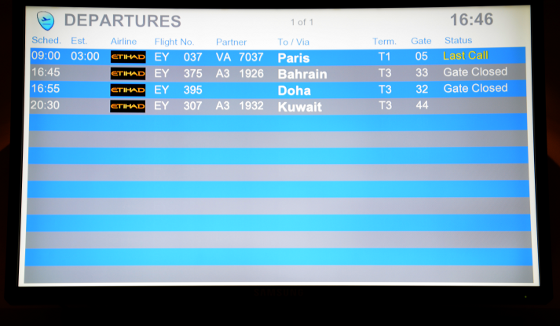
This is the first time we've flown out to Australia with Etihad and it may also be the last. We were due to fly back into Europe at CDG and head down to Lyon for the mini-DebConf this weekend. departure board, 18 hour delay for Paris Lets look at how our Etihad experience has worked out: 21:00 UTC Tuesday - waking up on Wednesday morning in Melbourne (UTC+10) 13:00 UTC Wednesday - leaving Melbourne about 11pm Wednesday night, a 12-13 hour flight to Abu Dhabi. We had heard about the air traffic control strikes in France (where we are going) and asked the airline if we should fly and they told us everything would be OK. 02:30 UTC Thursday - touchdown in Abu Dhabi, 6:30 am local time. Go to the transfer counter to ask for our boarding passes to CDG. At this stage, we were told that the connecting flight to CDG had been delayed 20 hours due to French strikes. As we are trying to reach Lyon for the mini-DebConf this weekend, we asked if we could leave Abu Dhabi on a 09:00 flight to Geneva. The Etihad staff told us to contact our travel agent (the flight was booked through Expedia) and for the next hour everybody's time was wasted making calls to Expedia who kept telling us to speak to Etihad. Whenever the Etihad customer service staff tried to speak to Expedia, the Expedia call center would hang up. Eventually, the Etihad staff told us that the deadline for putting us on the Geneva flight had passed and we would be stuck in Abu Dhabi for at least 20 hours. For flights to and from Europe, airlines have a responsibility to arrange hotels for passengers if there is a lengthy delay. If the airline is at fault, they must also pay some extra cash compensation but for a strike situation that is not applicable. Etihad has repeatedly fobbed us off. Initially we were given vouchers for Burger King or a pizza slice and told to hang around the transfer counter. By about 12:00 UTC (4pm local time, nine hours of waiting around the transfer counter) there was still no solution. One passenger was so upset that the airport security were called to speak to him and he was taken away. The airline staff kept giving excuses. Some passengers had been sent to a hotel but others left behind. I asked them again about our hotel and they kept trying to fob me off. Faced with the possibility that I would miss two nights of sleep and eight hours time difference coming into Europe, I continued asking the Etihad staff to own up to their responsibilities and they eventually offered us access to their airport lounge. We discovered some other passengers in the lounge too, including the passenger who had earlier been escorted away by security. This is unlike anything we've experienced with any other airline. At every opportunity (the check-in at Melbourne, or when the Geneva flight was boarding), the airline has failed to make arrangements that would have avoided cost and inconvenience. Assuming the flight goes ahead with a 20 hour delay, we will arrive in CDG some time Friday morning and not really sleep in a proper bed again until Friday night, about 70 hours after getting up in Melbourne on Wednesday morning. Thanks Etihad, you are a waking nightmare. The airline has been evasive about how they will deal with our onward travel from CDG to Lyon. We had booked a TGV train ticket already but it is not valid after such a long delay and it seems quite possible that trains will be busier than usual thanks to the air traffic control strike. So we don't even know if we will be loitering around a Paris airport or railway station for hours on Friday and nobody from the airline or Expedia really seems to care. Conclusion The only conclusion I can reach from this experience is that Etihad can't be trusted, certainly not for long journies such as Australia to Europe. Having flown through Singapore, Kuala Lumpur and Hong Kong, I know that air passengers have plenty of options available and there are many airlines that do go the extra mile to look after passengers especially on such long journeys. The airline missed opportunities to re-route us at every opportunity. It looks like they help some passengers (like those who did get to hotels) but leave many others high and dry just to stay within their budget.

6 April 2015

Daniel Pocock: Dandenongs

The final part of our latest Australia trip took us to the Dandenong Ranges. To borrow a term from the Germans and Swiss, Mount Dandenong could be considered Melbourne's Hausberg or local mountain. On the south side of the mountain, tourists and children are impressed by the Puffing Billy railway at Belgrave: Keen runners can race the train in about May each year in a 13km course through the mountains. You need to stay at least thirty seconds ahead of the train to avoid being stuck at the level crossings. My own fastest time was about two minutes faster than the train. Leaving Belgrave, there is a short but steep drive up to the Mount Dandenong summit following the road towards Monbulk and Olinda. From the top, you can view the whole city, Port Philip Bay and various other mountain ranges in other directions:

Jonathan Carter: Squashfs Performance Testing

Experiments Last week I discovered The Fan Club s Experiments page. It reminds me of the Debian Experiments community on Google+. I like the concept of trying out all kinds of different things and reporting back to the community on how it works. I ve been meaning to do more of that myself so this is me jumping in and reporting back on something I ve been poking at this weekend. Introducing Squashfs Squashfs is a read-only compressed filesystem commonly used on embedded devices, Linux installation media and remote file systems (as is done in LTSP). Typically, a system like tmpfs, unionfs or aufs is mounted over this read-only system to make it usable as a root filesystem. It has plenty of other use cases too but for the purposes of this entry we ll stick with those use cases in mind. It supports gzip, lzo and xz(lzma) as compression back-ends. It also supports block sizes from 4K up to 1M. Compression technique as well as block size can have major effects on both performance and file size. In most cases the defaults will probably be sufficient, but if you want to find a good balance between performance and space saving, then you ll need some more insight. My Experiment: Test effects of squashfs compression methods and block sizes I m not the first person to have done some tests on squashfs performance and reported on it. Bernhard Wiedemann and the Squashfs LZMA project have posted some results before, and while very useful I want more information (especially compress/uncompress times). I was surprised to not find a more complete table elsewhere either. Even if such a table existed, I probably wouldn t be satisfied with it. Each squashfs is different and it makes a big difference whether it contains already compressed information or largely uncompressed information like clear text. I d rather be able to gather compression ratio/times for a specific image rather than for one that was used for testing purposes once-off. So, I put together a quick script that takes a squashfs image, extracts it to tmpfs, and then re-compressing it using it all the specified compression techniques and block sizes and then uncompressing those same images for their read speeds. My Testing Environment For this post, I will try out my script on the Ubuntu Desktop 14.04.2 LTS squashfs image. It s a complex image that contains a large mix of different kinds of files. I m extracting it to RAM since I want to avoid having disk performance as a significant factor. I m compressing the data back to SSD and extracting from there for read speed tests. The SSD seems fast enough not to have any significant effect on the tests. If you have a slow storage, the results of the larger images (with smaller block sizes) may be skewed unfavourably. As Bernhard mentioned on his post, testing the speed of your memory can also be useful, especially when testing on different kinds of systems and comparing the results:
# dd if=/dev/zero of=/dev/null bs=1M count=100000
104857600000 bytes (105 GB) copied, 4.90059 s, 21.4 GB/s
CPU is likely to be your biggest bottleneck by far when compressing. mksquashfs is SMP aware and will use all available cores by default. I m testing this on a dual core Core i7 laptop with hyper-threading (so squashfs will use 4 threads) and with 16GB RAM apparently transferring around 21GB/s. The results of the squashfs testing script will differ greatly based on the CPU cores, core speed, memory speed and storage speed of the computer you re running it on, so it shouldn t come as a surprise if you get different results than I did. If you don t have any significant bottleneck (like slow disks, slow CPU, running out of RAM, etc) then your results should more or less correspond in scale to mine for the same image. How to Run It Create a directory and place the filesystem you d like to test as filesystem.squashfs, then:
$ apt-get install squashfs-tools 
$ wget https://raw.githubusercontent.com/highvoltage/squashfs-experiments/master/test-mksquashfs.sh
$ bash test-mksquashfs.sh
With the default values in that file, you ll end up with 18 squashfs images taking up about 18GB of disk space. I keep all the results for inspection, but I ll probably adapt/fix the script to be more friendly to disk space usage some time. You should see output that look something like this, with all the resulting data in the ./results directory.
* Setting up...
- Testing gzip
  * Running a squashfs using compression gzip, blocksize 4096
  * Running a squashfs using compression gzip, blocksize 8192
  * Running a squashfs using compression gzip, blocksize 16384
  ...
- Testing lzo
  * Running a squashfs using compression lzo, blocksize 4096
  * Running a squashfs using compression lzo, blocksize 8192
  * Running a squashfs using compression lzo, blocksize 16384
  ...
- Testing xz
  * Running a squashfs using compression xz, blocksize 4096
  * Running a squashfs using compression xz, blocksize 8192
  * Running a squashfs using compression xz, blocksize 16384
  ...
* Testing uncompressing times...
  * Reading results/squashfs-gzip-131072.squashfs...
  * Reading results/squashfs-gzip-16384.squashfs...
  * Reading results/squashfs-gzip-32768.squashfs...
  ...
* Cleaning up...
On to the Results The report script will output the results into CSV. Here s the table with my results. Ratio is percentage of the size of the original uncompressed data, CTIME and UTIME is compression time and uncompress time for the entire image.
Filename Size Ratio CTIME UTIME
squashfs-gzip-4096.squashfs 1137016 39.66% 0m46.167s 0m37.220s
squashfs-gzip-8192.squashfs 1079596 37.67% 0m53.155s 0m35.508s
squashfs-gzip-16384.squashfs 1039076 36.27% 1m9.558s 0m26.988s
squashfs-gzip-32768.squashfs 1008268 35.20% 1m30.056s 0m30.599s
squashfs-gzip-65536.squashfs 987024 34.46% 1m51.281s 0m35.223s
squashfs-gzip-131072.squashfs 975708 34.07% 1m59.663s 0m22.878s
squashfs-gzip-262144.squashfs 970280 33.88% 2m13.246s 0m23.321s
squashfs-gzip-524288.squashfs 967704 33.79% 2m11.515s 0m24.865s
squashfs-gzip-1048576.squashfs 966580 33.75% 2m14.558s 0m28.029s
squashfs-lzo-4096.squashfs 1286776 44.88% 1m36.025s 0m22.179s
squashfs-lzo-8192.squashfs 1221920 42.64% 1m49.862s 0m21.690s
squashfs-lzo-16384.squashfs 1170636 40.86% 2m5.008s 0m20.831s
squashfs-lzo-32768.squashfs 1127432 39.36% 2m23.616s 0m20.597s
squashfs-lzo-65536.squashfs 1092788 38.15% 2m48.817s 0m21.164s
squashfs-lzo-131072.squashfs 1072208 37.43% 3m4.990s 0m20.563s
squashfs-lzo-262144.squashfs 1062544 37.10% 3m26.816s 0m15.708s
squashfs-lzo-524288.squashfs 1057780 36.93% 3m32.189s 0m16.166s
squashfs-lzo-1048576.squashfs 1055532 36.85% 3m42.566s 0m17.507s
squashfs-xz-4096.squashfs 1094880 38.19% 5m28.104s 2m21.373s
squashfs-xz-8192.squashfs 1002876 34.99% 5m15.148s 2m1.780s
squashfs-xz-16384.squashfs 937748 32.73% 5m11.683s 1m47.878s
squashfs-xz-32768.squashfs 888908 31.03% 5m17.207s 1m43.399s
squashfs-xz-65536.squashfs 852048 29.75% 5m27.819s 1m38.211s
squashfs-xz-131072.squashfs 823216 28.74% 5m42.993s 1m29.708s
squashfs-xz-262144.squashfs 799336 27.91% 6m30.575s 1m16.502s
squashfs-xz-524288.squashfs 778140 27.17% 6m58.455s 1m20.234s
squashfs-xz-1048576.squashfs 759244 26.51% 7m19.205s 1m28.721s
Some notes:

5 April 2015

Ingo Juergensmann: It has been 30 years now...

Sometimes you happen to realize how old you are when listening to the radio where they announce hits from your days of youth as "oldies". Or when todays youth asking you what a music casette or a 5.25" floppy disk is. You're even older than that when you still know 8" disks. We have one of those on our pin board. Or you may realize your age when your favorite computer of your youth will celebrate its 30th anniversary this year! In 1985 the Amiga was introduced to the public - and 30 years later Amigas around the world are still running! Some are still operated under AmigaOS, some are running maybe NetBSD, but some are running the Debian m68k port - even though the port was expelled from Debian years ago! But some people still take care of this port and it is keeping up with building packages, although mostly due to emulators doing the most work. But anyway, the Amiga is turning 30 this year! And what a great machine this was! It brought multitasking, colorful graphics and multi-channel audio to the masses. It was years ahead of its competitors, but it was doomed to fail because of management failures by the producing company Commodore, which went bankrupt in 1994. The "30th Anniversary Event" will take place on July 25th at the Computer History Museum in Mountain View, California, USA - if the kickstarting the event will be successful during the next two weeks. So, when you earned your first merits in computing on an Amiga as well, you might want to give your Amiga history another kickstart! Not the Kickstart floppy as the A1000 needed to boot up, but fundraising the event on kickstart.org! I think this event is not only important to old Amiga users from the good old days, but for the rememberance of computing history in general. Without doubt the Amiga set new standards in computer history and is an important part of industrial heritage.
Kategorie:

Daniel Pocock: Australian wildlife

Here are some of the animals we have seen so far during our trip to Australia. Kookaburra Some kookaburras flying into the trees around a friend's beach house at Kennett River on the Great Ocean Road. Koala's in the wild It is easy to find koala bears in many of the trees around Kennett River: Python At the Moonlit Sanctuary, we were introduced to a python: BBQ My cousin Hagen prepares the BBQ for lunch at the sanctuary: More koala bears It was also possible to get up close to one of the koala bears at the sanctuary. Be careful not to get so close to them in the wild. Wallaby The wallaby is like a small kangaroo: Kangaroo Carla was able to get up close to a family of kangaroos and feed them some snacks: Tasmanian Devil Saving the best for last, the Tasmanian devil is not just a cartoon character. His jaw is strong enough to crush your finger as if you had been run over by a train and he can run faster than just about anybody except for a trained sprinter. Consequently, we didn't jump in the enclosure to pose with him for this photo:

Next.

Previous.