Search Results: "agi"

31 March 2017

Chris Lamb: Free software activities in March 2017

Here is my monthly update covering what I have been doing in the free software world (previous month):
Reproducible builds

Whilst anyone can inspect the source code of free software for malicious flaws, most software is distributed pre-compiled to end users. The motivation behind the Reproducible Builds effort is to permit verification that no flaws have been introduced either maliciously or accidentally during this compilation process by promising identical results are always generated from a given source, thus allowing multiple third-parties to come to a consensus on whether a build was compromised. I have generously been awarded a grant from the Core Infrastructure Initiative to fund my work in this area. This month I:
I also made the following changes to our tooling:
diffoscope

diffoscope is our in-depth and content-aware diff utility that can locate and diagnose reproducibility issues.

  • New features/optimisations:
    • Extract squashfs archive in one go rather than per-file, speeding up ISO comparison by ~10x.
    • Add support for .docx and .odt files via docx2txt & odt2txt. (#859056).
    • Add support for PGP files via pgpdump. (#859034).
    • Add support for comparing Pcap files. (#858867).
    • Compare GIF images using gifbuild. (#857610).
  • Bug fixes:
    • Ensure that we really are using ImageMagick and not the GraphicsMagick compatibility layer. (#857940).
    • Fix and add test for meaningless 1234-content metadata when introspecting archives. (#858223).
    • Fix detection of ISO9660 images processed with isohybrid.
    • Skip icc tests if the Debian-specific patch is not present. (#856447).
    • Support newer versions of cbfstool to avoid test failures. (#856446).
    • Update the progress bar prior to working to ensure filename is in sync.
  • Cleanups:
    • Use /usr/share/dpkg/pkg-info.mk over manual calls to dpkg-parsechangelog in debian/rules.
    • Ensure tests and the runtime environment can locate binaries in /usr/sbin (eg. tcpdump).

strip-nondeterminism

strip-nondeterminism is our tool to remove specific non-deterministic results from a completed build.

  • Fix a possible endless loop while stripping .ar files due to trusting the file's own file size data. (#857975).
  • Add support for testing files we should reject and include the filename when evaluating fixtures.

buildinfo.debian.net

buildinfo.debian.net is my experiment into how to process, store and distribute .buildinfo files after the Debian archive software has processed them.

  • Add support for Format: 1.0. (#20).
  • Don't parse Format: header as the source package version. (#21).
  • Show the reproducible status of packages.


Debian


I submitted my platform for the 2017 Debian Project Leader Elections. This was subsequently covered on LWN and I have been participating in the discussions on the debian-vote mailing list since then.


Debian LTS

This month I have been paid to work 14.75 hours on Debian Long Term Support (LTS). In that time I did the following:
  • "Frontdesk" duties, triaging CVEs, etc.
  • Issued DLA 848-1 for the freetype font library fixing a denial of service vulnerability.
  • Issued DLA 851-1 for wget preventing a header injection attack.
  • Issued DLA 863-1 for the deluge BitTorrent client correcting a cross-site request forgery vulnerability.
  • Issued DLA 864-1 for jhead (an EXIF metadata tool) patching an arbitrary code execution vulnerability.
  • Issued DLA 865-1 for the suricata intrusion detection system, fixing an IP protocol matching error.
  • Issued DLA 871-1 for python3.2 fixing a TLS stripping vulnerability in the smptlib library.
  • Issued DLA 873-1 for apt-cacher preventing a HTTP response splitting vulnerability.
  • Issued DLA 876-1 for eject to prevent an issue regarding the checking of setuid(2) and setgid(2) return values.

Uploads
  • python-django:
    • 1:1.10.6-1 New upstream bugfix release.
    • 1:1.11~rc1-1 New upstream release candidate.
  • redis:
    • 3:3.2.8-2 Avoid conflict between RuntimeDirectory and tmpfiles.d(5) both attempting to create /run/redis with differing permissions. (#856116)
    • 3:3.2.8-3 Revert the creation of a /usr/bin/redis-check-rdb to /usr/bin/redis-server symlink to avoid a dangling symlink if only the redis-tools package is installed. (#858519)
  • gunicorn 19.7.0-1 & 19.7.1-1 New upstream releases.
  • adminer 4.3.0-1 New upstream release.

Finally, I also made the following non-maintainer uploads (NMUs):


FTP Team

As a Debian FTP assistant I ACCEPTed 121 packages: 4pane, adql, android-platform-system-core, android-sdk-helper, braillegraph, deepnano, dh-runit, django-auth-ldap, django-dirtyfields, drf-extensions, gammaray, gcc-7, gnome-keysign, golang-code.gitea-sdk, golang-github-bluebreezecf-opentsdb-goclient, golang-github-bsm-redeo, golang-github-cupcake-rdb, golang-github-denisenkom-go-mssqldb, golang-github-exponent-io-jsonpath, golang-github-facebookgo-ensure, golang-github-facebookgo-freeport, golang-github-facebookgo-grace, golang-github-facebookgo-httpdown, golang-github-facebookgo-stack, golang-github-facebookgo-subset, golang-github-go-openapi-loads, golang-github-go-openapi-runtime, golang-github-go-openapi-strfmt, golang-github-go-openapi-validate, golang-github-golang-geo, golang-github-gorilla-pat, golang-github-gorilla-securecookie, golang-github-issue9-assert, golang-github-issue9-identicon, golang-github-jaytaylor-html2text, golang-github-joho-godotenv, golang-github-juju-errors, golang-github-kisielk-gotool, golang-github-kubernetes-gengo, golang-github-lpabon-godbc, golang-github-lunny-log, golang-github-makenowjust-heredoc, golang-github-mrjones-oauth, golang-github-nbutton23-zxcvbn-go, golang-github-neelance-sourcemap, golang-github-ngaut-deadline, golang-github-ngaut-go-zookeeper, golang-github-ngaut-log, golang-github-ngaut-pools, golang-github-ngaut-sync2, golang-github-optiopay-kafka, golang-github-quobyte-api, golang-github-renstrom-dedent, golang-github-sergi-go-diff, golang-github-siddontang-go, golang-github-smartystreets-go-aws-auth, golang-github-xanzy-go-cloudstack, golang-github-xtaci-kcp, golang-github-yohcop-openid-go, graywolf, haskell-raaz, hfst-ospell, hikaricp, iptraf-ng, kanboard-cli, kcptun, kreport, libbluray, libcatmandu-store-elasticsearch-perl, libcsfml, libnet-prometheus-perl, libosmocore, libpandoc-wrapper-perl, libseqlib, matrix-synapse, mockldap, nfs-ganesha, node-buffer, node-pako, nose-el, nvptx-tools, nx-libs, open-ath9k-htc-firmware, pagein, paleomix, pgsql-ogr-fdw, profanity, pyosmium, python-biotools, python-django-extra-views, python-django-otp, python-django-push-notifications, python-dnslib, python-gmpy, python-gmpy2, python-holidays, python-kanboard, python-line-profiler, python-pgpy, python-pweave, python-raven, python-xapian-haystack, python-xopen, r-cran-v8, repetier-host, ruby-jar-dependencies, ruby-maven-libs, ruby-psych, ruby-retriable, seafile-client, spyder-unittest, stressant, systray-mdstat, telegram-desktop, thawab, tigris, tnseq-transit, typesafe-config, vibe.d, x2goserver & xmlrpc-c. I additionally filed 14 RC bugs against packages that had incomplete debian/copyright files against: golang-github-cupcake-rdb, golang-github-sergi-go-diff, graywolf, hfst-ospell, libbluray, pgsql-ogr-fdw, python-gmpy, python-gmpy2, python-pgpy, python-xapian-haystack, repetier-host, telegram-desktop, tigris & xmlrpc-c.

30 March 2017

Shirish Agarwal: The tale of the dancing girl #nsfw

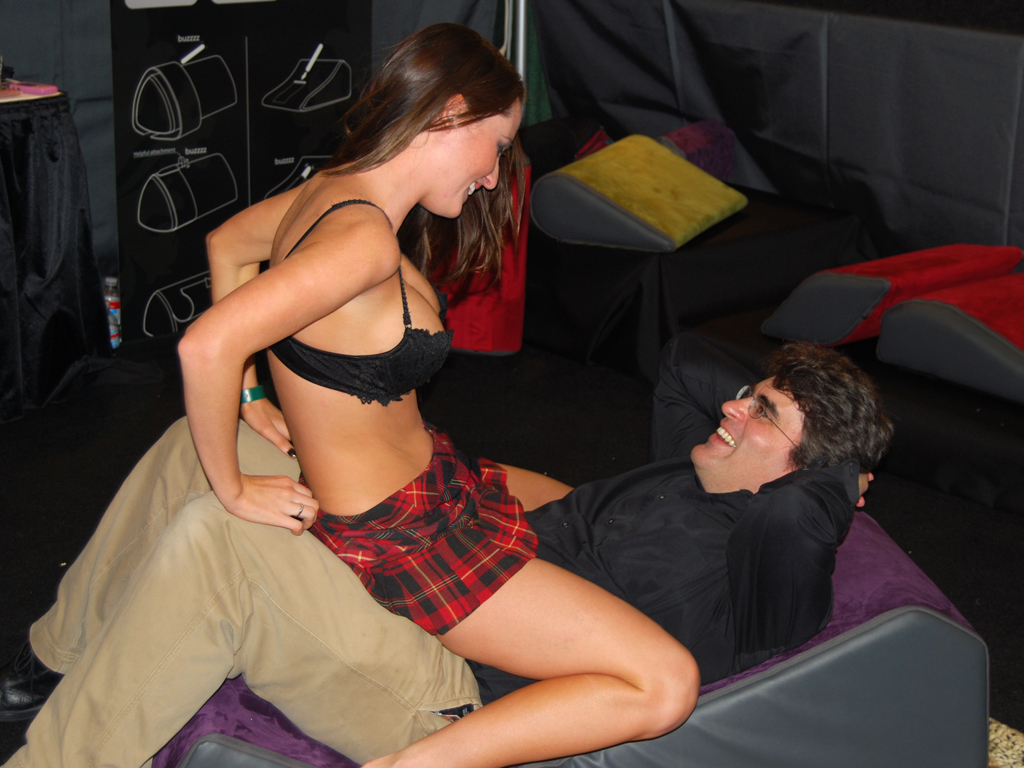
Demonstration of a Lapdance - Wikipedia

Demonstration of a Lapdance Wikipedia

The post will be adult/mature in nature. So those below 18 please excuse. The post is about an anecdote almost 20 years to date, The result its being posted is I had a dinner with a friend to whom I shared this and he thought it would be nice if I shared this hence sharing it. The conversation was about being young and foolish in which I shared the anecdote. The blog post was supposed to be about Aadhar which shocked me both in the way no political discourse happened and the way the public as well as public policy was gamed but that would have to wait for another day. History I left college in 1995. The anecdote/incident probably happened couple of years earlier so probably 1992-1993. At that time, I was in my teens and as a typical teenager I made few friends. One of those friends, who would remain nameless as since we drifted apart, and as I have not take permission from him, taking his name would not be a good idea. Anyway, this gentleman, let s call him Mr. X as an example. Couple of months before, he had bought an open jeep, similar but very different from the jeep being shown below. Open Jeep had become a fashion statement few months back (in those days) as a Salman khan starred movie had that and anybody who had money wanted one just like that.
Illustration of an open jeep, sadly its a military one - wikipedia

Illustration of an open jeep, sadly its a military one wikipedia

Those days we didn t have cell-phones and I had given my land-line phone number to very few friends as in those days, as the land-lines were a finicky instrument. One fine morning, I get a call from my friend telling he is going to come near my place and I should meet him at some xyz place and we would go for a picnic for the whole day and it is possible that we might return next day. As it was holidays and only a fool would throw away a chance to have a ride in open air jeep, I immediately agreed. I shared that my friends had organized a picnic and giving another friend s number (who didn t know anything) got permission and went to meet Mr. X. This was very early morning, around 0600 hrs. . After meeting him, he told that we would be going to Mumbai, take some more friends from there and then move on. In those days, a railway ticket from Shivaji Nagar to V.T. (now C.S.T.) costed INR 30/- . I had been to Mumbai few times before for various technical conferences and knew few cheap places to eat, I knew that going via train, we could go and come back spending at the most INR 150/- and still have some change left-over (today s meal at a roadside/street vendor easily passes that mark). The Journey I shared with him that it will be costly and I don t have any money to cover the fuel expenses and he said he would shoulder the expenses, he just wanted my company for the road. Those days, it was the scenic Old Mumbai-Pune highway and we took plenty of stops to admire that ghats (hills and valleys together). That journey must have taken around 7-8 hours while today by new Expressway, you could do the same thing by 2.5/3 hours. Anyhow, we reached to some swanky hotel in South Mumbai. South Mumbai was not the financial powerhouse that it today is, there was mix of very old buildings and new buildings like the swanky hotel that we had checked in. I have no memory nor any idea whether it was 1 class, 3 class or 5 class and could have cared less as had been tired from the journey. We checked in, I had a long warm water bath and then slept in the king-size bed with curtains drawn. Evening came and we took the jeep and picked up 2-3 of his friends who were from my age or a year or two older and we went to Nariman Point. Seeing the Queen s necklace from Nariman Point at night is a sight in itself. Keeping with the innocence, I was under the impression that we had arrived at our destination, at this our host, Mr. X and his Bombaiya friends had a quiet laugh saying its a young night still. We must have whiled away couple of hours, having chai and throwing rocks in the sea. The Meeting After a while, Mr. X took us to another swanky place. My eyes were out of my sockets as this seemed to be as elitist a place as could be. I saw many White European women in various stages of undress pole-dancing and lap-dancing. I had recently (in those days) come to know the term but was under the impression that it was something that happened in Europe and States only. I had no idea that lap-dancing was older than my birth as according to Wikipedia. So looking back now, I am not surprised that in two decades the concept crossed the oceans. Again, Mr. X being the host, agreed to bear all the costs and all of us had food, drink and a lap-dance from any of the dancers on the floor. As I was young and probably shy (still am) I asked Mr. X s help to pick a girl/woman for me. The woman whom he picked was auburn-aired, was either my age or a year or two older/younger to me. What proceeded next was about 20-30 minutes of totally sexualized erotic experience. While he and all his friends picked girls to go all the way, I was hesitant to let loose. Maybe it was due to my lack of courage or inexperience, maybe it was not in my city so couldn t predict the outcome, maybe was just afraid that reality might mar fantasy, I dunno till date. Although we kissed and necked a lot, I guess that should count for something. The conversation After all my friends had gone to the various rooms, sometime after I excused myself, went to the loo myself, peed a bit, splashed cold water on self, came out and had couple of glasses of water and came back to my seat. The lady came back and I shared that I was not interested in going further and while she was beautiful, I just didn t have the guts. I did ask her if she would give me company though for sometime as I didn t know anyone else at that place. Our conversation was more about her than me as I had more or less an average life upto that moment. There were only three unorthodox things that I had done before meeting her. I had drunk wines of different types, smoked weed and had a Magic Mushrooms experience the year before with another group of friends I had made there. Goa in those days was simply magical in those days but that probably would need its story/own blog post. When I enquired about her, she shared she was from Russia and she rattled off more than half a dozen places around the world where she had been to and this was her second or third stint in Mumbai and she wasn t at all unhappy about the lifestyle and choices she was leading. I had no answer for her as a young penniless college-going student. Her self-confidence and the way she carried herself was impressive, with or without clothes. During course of the conversation she shared a couple of contacts from whom I could get better weed at slightly higher price if I were in Goa. Few months later, those contacts turned out to be true. After sometime, we took all the women and ourselves, around 8-9 people in his jeep (how he negotiated that is beyond me) went to a hygienic Pani puri and Bhel (puffed rice mixed with variety of spices typically tomato, potato, coriander chutney as well as Tamarind Chutney among other things) place and moved them to tears (the spices in bhel and Pani puri did it for them) and this was when we had explicitly asked the bhel-wala guy to make it extremely mild with just a hint of spice in it. Anyways, sometime later, we dropped them at the same place, dropped his friends and came back to the hotel we booked and got drunk again. After-effects Few years later, it came in the newspapers/media that while India had broken out of financial isolation just few years back (1991) and were profiting from it, many countries of the former USSR were going the other way around and hence there was huge human trafficking and immigration that had taken place. This was in-line with what the lady/woman/Miss X had shared with me. The latest trigger The latest trigger happened couple of months back where I learnt of a hero flight attendant saving a girl from human-trafficking. Till date, I am unsure whether she was doing it willingly or putting a brave smile in front of me, because even if she had confided me in any way, I probably would have been too powerless to help her in any-way. I just don t know. Foolishness thy name While my friend took advantage of my innocence and introduced me to a world which otherwise I would probably not know exists, it could have easily have gone some other way as well. While I m still unsure of the choices I made, I was and am happy that I was able to strike a conversation with her and attempt to reach the person therein. Was it the truth or an elaborate fabricated lie to protect myself and herself, this I will never know. Oppression I understand the fact that as a customer or somebody who is taking part in either of those performances or experiences it isn t easy in any way to know/say that whether the performer is doing it wilfully or not as the experiences are in tightly controlled settings.
Filed under: Miscellenous Tagged: #anecdote, #confusion, #elitist, #growing up, #lap dance, #NSFW, #Open Jeep, Mumbai

29 March 2017

Lars Wirzenius: A tiny PC as a router

We needed a router and wifi access point in the office, and simultaneously both I and my co-worker Ivan needed such a thing at our respective homes. After some discussion, and after reading articles in Ars Technica about building PCs to act as routers, we decided to do just that. We got some hardware:
Component Model Cost
Barebone Qotom Q190G4, VGA, 2x USB 2.0, 134x126x36mm, fanless 130
CPU Intel J1900, 2-2.4GHz quad-core -
NIC Intel WG82583, 4x 10/100/1000 -
Memory Crucial CT102464BF160B, 8GB DDR3L-1600 SODIMM 1.35V CL11 40
SSD Kingston SSDNow mS200, 60GB mSATA 42
WLAN AzureWave AW-NU706H, Ralink RT3070L, 300M 802.11b/g/n, half mPCIe 17
mPCIe adapter Half to full mPCIe adapter 3
Antennas 2x 2.4/5GHz 6dBi, RP-SMA, U.FL Cables 7
These were bought at various online shops, including AliExpress and verkkokauppa.com. After assembling the hardware, we installed Debian on them: There's a lot of limitations and problems: If you'd like to use the images and Ansible playbooks, please do. We'd be happy to get feedback, bug reports, and patches. Send them to me (liw@liw.fi) or my ticketing system (bugs@liw.fi).

Daniel Pocock: Brexit: If it looks like racism, if it smells like racism and if it feels like racism, who else but a politician could argue it isn't?

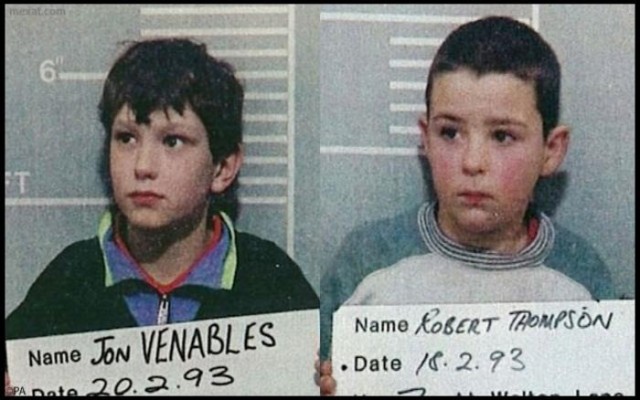
Since the EU referendum got under way in the UK, it has become almost an everyday occurence to turn on the TV and hear some politician explaining "I don't mean to sound racist, but..." (example) Of course, if you didn't mean to sound racist, you wouldn't sound racist in the first place, now would you? The reality is, whether you like politics or not, political leaders have a significant impact on society and the massive rise in UK hate crimes, including deaths of Polish workers, is a direct reflection of the leadership (or profound lack of it) coming down from Westminster. Maybe you don't mean to sound racist, but if this is the impact your words are having, maybe it's time to shut up? Choosing your referendum Why choose to have a referendum on immigration issues and not on any number of other significant topics? Why not have a referendum on nuking Mr Putin to punish him for what looks like an act of terrorism against the Malaysian Airlines flight MH17? Why not have a referendum on cutting taxes or raising speed limits, turning British motorways into freeways or an autobahn? Why choose to keep those issues in the hands of the Government, but invite the man-in-a-white-van from middle England to regurgitate Nigel Farage's fears and anxieties about migrants onto a ballot paper? Even if David Cameron sincerely hoped and believed that the referendum would turn out otherwise, surely he must have contemplated that he was playing Russian Roulette with the future of millions of innocent people? Let's start at the top For those who are fortunate enough to live in parts of the world where the press provides little exposure to the antics of British royalty, an interesting fact you may have missed is that the Queen's husband, Prince Philip, Duke of Edinburgh is actually a foreigner. He was born in Greece and has Danish and German ancestry. Migration (in both directions) is right at the heart of the UK's identity. Queen and Prince Philip Home office minister Amber Rudd recently suggested British firms should publish details about how many foreign people they employ and in which positions. She argued this is necessary to help boost funding for training local people. If that is such a brilliant idea, why hasn't it worked for the Premier League? It is a matter of public knowledge how many foreigners play football in England's most prestigious division, so why hasn't this caused local clubs to boost training budgets for local recruits? After all, when you consider that England hasn't won a World Cup since 1966, what have they got to lose? Kevin Pietersen All this racism, it's just not cricket. Or is it? One of the most remarkable cricketers to play for England in recent times, Kevin Pietersen, dubbed "the most complete batsman in cricket" by The Times and "England's greatest modern batsman" by the Guardian, was born in South Africa. In the five years he was contracted to the Hampshire county team, he only played one match, because he was too busy representing England abroad. His highest position was nothing less than becoming England's team captain. Are the British superior to every other European citizen? One of the implications of the rhetoric coming out of London these days is that the British are superior to their neighbours, entitled to have their cake and eat it too, making foreigners queue up at Paris' Gare du Nord to board the Eurostar while British travelers should be able to walk or drive into European countries unchallenged. This superiority complex is not uniquely British, you can observe similar delusions are rampant in many of the places where I've lived, including Australia, Switzerland and France. America's Donald Trump has taken this style of politics to a new level. Look in the mirror Theresa May: after British 10-year old schoolboys Robert Thompson and Jon Venables abducted, tortured, murdered and mutilated 2 year old James Bulger in 1993, why not have all British schoolchildren fingerprinted and added to the police DNA database? Why should "security" only apply based on the country where people are born, their religion or skin colour? Jon Venables and Robert Thompson In fact, after Brexit, people like Venables and Thompson will remain in Britain while a Dutch woman, educated at Cambridge and with two British children will not. If that isn't racism, what is? Running foreigner's off the roads Theresa May has only been Prime Minister for less than a year but she has a history of bullying and abusing foreigners in her previous role in the Home Office. One example of this was a policy of removing driving licenses from foreigners, which has caused administrative chaos and even taken away the licenses of many people who technically should not have been subject to these regulations anyway. Shouldn't the DVLA (Britain's office for driving licenses) simply focus on the competence of somebody to drive a vehicle? Bringing all these other factors into licensing creates a hostile environment full of mistakes and inconvenience at best and opportunities for low-level officials to engage in arbitrary acts of racism and discrimination. Of course, when you are taking your country on the road to nowhere, who needs a driving license anyway? Run off the road What does "maximum control" over other human beings mean to you? The new British PM has said she wants "maximum control" over immigrants. What exactly does "maximum control" mean? Donald Trump appears to be promising "maximum control" over Muslims, Hitler sought "maximum control" over the Jews, hasn't the whole point of the EU been to avoid similar situations from ever arising again? This talk of "maximum control" in British politics has grown like a weed out of the UKIP. One of their senior figures has been linked to kidnappings and extortion, which reveals a lot about the character of the people who want to devise and administer these policies. Similar people in Australia aspire to jobs in the immigration department where they can extort money out of people for getting them pushed up the queue. It is no surprise that the first member of Australia's parliament ever sent to jail was put there for obtaining bribes and sexual favours from immigrants. When Nigel Farage talks about copying the Australian immigration system, he is talking about creating jobs like these for his mates. Even if "maximum control" is important, who really believes that a bunch of bullies in Westminster should have the power to exercise that control? Is May saying that British bosses are no longer competent to make their own decisions about who to employ or that British citizens are not reliable enough to make their own decisions about who they marry and they need a helping hand from paper-pushers in the immigration department? maximum control over Jewish people Echoes of the Third Reich Most people associate acts of mass murder with the Germans who lived in the time of Adolf Hitler. These are the stories told over and and over again in movies, books and the press. Look more closely, however, and it appears that the vast majority of Germans were not in immediate contact with the gas chambers. Even Gobels' secretary writes that she was completely oblivious to it all. Many people were simply small cogs in a big bad machine. The clues were there, but many of them couldn't see the big picture. Even if they did get a whiff of it, many chose not to ask questions, to carry on with their comfortable lives. Today, with mass media and the Internet, it is a lot easier for people to discover the truth if they look, but many are still reluctant to do so. Consider, for example, the fingerprint scanners installed in British post offices and police stations to fingerprint foreigners and criminals (as if they have something in common). If all the post office staff refused to engage in racist conduct the fingerprint scanners would be put out of service. Nonetheless, these people carry on, just doing their job, just following orders. It was through many small abuses like this, rather than mass murder on every street corner, that Hitler motivated an entire nation to serve his evil purposes. Technology like this is introduced in small steps: first it was used for serious criminals, then anybody accused of a crime, then people from Africa and next it appears they will try and apply it to all EU citizens remaining in the UK. How will a British man married to a French woman explain to their children that mummy has to be fingerprinted by the border guard each time they return from vacation? The Nazis pioneered biometric technology with the tracking numbers branded onto Jews. While today's technology is electronic and digital, isn't it performing the same function? There is no middle ground between "soft" and "hard" brexit An important point for British citizens and foreigners in the UK to consider today is that there is no compromise between a "soft" Brexit and a "hard" Brexit. It is one or the other. Anything less (for example, a deal that is "better" for British companies and worse for EU citizens) would imply that the British are a superior species and it is impossible to imagine the EU putting their stamp on such a deal. Anybody from the EU who is trying to make a life in the UK now is playing a game of Russian Roulette - sure, everything might be fine if it morphs into "soft" Brexit, but if Theresa May has her way, at some point in your life, maybe 20 years down the track, you could be rounded up by the gestapo and thrown behind bars for a parking violation. There has already been a five-fold increase in the detention of EU citizens in British concentration camps and they are using grandmothers from Asian countries to refine their tactics for the efficient removal of EU citizens. One can only wonder what type of monsters Theresa May has been employing to run such inhumane operations. This is not politics Edmund Burke's quote "The only thing necessary for the triumph of evil is for good men to do nothing" comes to mind on a day like today. Too many people think it is just politics and they can go on with their lives and ignore it. Barely half the British population voted in the referendum. This is about human beings treating each other with dignity and respect. Anything less is abhorrent and may well come back to bite.

28 March 2017

Keith Packard: DRM-lease

DRM display resource leasing (kernel side) So, you've got a fine head-mounted display and want to explore the delights of virtual reality. Right now, on Linux, that means getting the window system to cooperate because the window system is the DRM master and holds sole access to all display resources. So, you plug in your device, play with RandR to get it displaying bits from the window system and then carefully configure your VR application to use the whole monitor area and hope that the desktop will actually grant you the boon of page flipping so that you will get reasonable performance and maybe not even experience tearing. Results so far have been mixed, and depend on a lot of pieces working in ways that aren't exactly how they were designed to work. We could just hack up the window system(s) and try to let applications reserve the HMD monitors and somehow removing them from the normal display area so that other applications don't randomly pop up in the middle of the screen. That would probably work, and would take advantage of much of the existing window system infrastructure for setting video modes and performing page flips. However, we've got a pretty spiffy standard API in the kernel for both of those, and getting the window system entirely out of the way seems like something worth trying. I spent a few hours in Hobart chatting with Dave Airlie during LCA and discussed how this might actually work. Goals

  1. Use KMS interfaces directly from the VR application to drive presentation to the HMD.
  2. Make sure the window system clients never see the HMD as a connected monitor.
  3. Maybe let logind (or other service) manage the KMS resources and hand them out to the window system and VR applications.
Limitations
  1. Don't make KMS resources appear and disappear. It turns out applications get confused when the set of available CRTCs, connectors and encoders changes at runtime.
An Outline for Multiple DRM masters By the end of our meeting in Hobart, Dave had sketched out a fairly simple set of ideas with me. We'd add support in the kernel to create additional DRM masters. Then, we'd make it possible to 'hide' enough state about the various DRM resources so that each DRM master would automagically use disjoint subsets of resources. In particular, we would.
  1. Pretend that connectors were always disconnected
  2. Mask off crtc and encoder bits so that some of them just didn't seem very useful.
  3. Block access to resources controlled by other DRM masters, just in case someone tried to do the wrong thing.
Refinement with Eric over Swedish Pancakes A couple of weeks ago, Eric Anholt and I had breakfast at the original pancake house and chatted a bit about this stuff. He suggested that the right interface for controlling these new DRM masters was through the existing DRM master interface, and that we could add new ioctls that the current DRM master could invoke to create and manage them. Leasing as a Model I spent some time just thinking about how this might work and came up with a pretty simple metaphor for these new DRM masters. The original DRM master on each VT "owns" the output resources and has final say over their use. However, a DRM master can create another DRM master and "lease" resources it has control over to the new DRM master. Once leased, resources cannot be controlled by the owner unless the owner cancels the lease, or the new DRM master is closed. Here's some terminology:
DRM Master
Any DRM file which can perform mode setting.
Owner
The original DRM Master, created by opening /dev/dri/card*
Lessor
A DRM master which has leased out resources to one or more other DRM masters.
Lessee
A DRM master which controls resources leased from another DRM master. Each Lessee leases resources from a single Lessor.
Lessee ID
An integer which uniquely identifies a lessee within the tree of DRM masters descending from a single Owner.
Lease
The contract between the Lessor and Lessee which identifies which resources which may be controlled by the Lessee. All of the resources must be owned by or leased to the Lessor.
With Eric's input, the interface to create a lease was pretty simple to write down:
int drmModeCreateLease(int fd,
               const uint32_t *objects,
               int num_objects,
               int flags,
               uint32_t *lessee_id);
Given an FD to a DRM master, and a list of objects to lease, a new DRM master FD is returned that holds a lease to those objects. 'flags' can be any combination of O_CLOEXEC and O_NONBLOCK for the newly minted file descriptor. Of course, the owner might want to take some resources back, or even grant new resources to the lessee. So, I added an interface that rewrites the terms of the lease with a new set of objects:
int drmModeChangeLease(int fd,
               uint32_t lessee_id,
               const uint32_t *objects,
               int num_objects);
Note that nothing here makes any promises about the state of the objects across changes in the lease status; the lessor and lessee are expected to perform whatever modesetting is required for the objects to be useful to them. Window System Integration There are two ways to integrate DRM leases into the window system environment:
  1. Have logind "lease" most resources to the window system. When a HMD is connected, it would lease out suitable resources to the VR environment.
  2. Have the window system "own" all of the resources and then add window system interfaces to create new DRM masters leased from its DRM master.
I'll probably go ahead and do 2. in X and see what that looks like. One trick with any of this will be to hide HMDs from any RandR clients listening in on the window system. You probably don't want the window system to tell the desktop that a new monitor has been connected, have it start reconfiguring things, and then have your VR application create a new DRM master, making the HMD appear to have disconnected to the window system and have that go reconfigure things all over again. I'm not sure how this might work, but perhaps having the VR application register something like a passive grab on hot plug events might make sense? Essentially, you want it to hear about monitor connect events, go look to see if the new monitor is one it wants, and if not, release that to other X clients for their use. This can be done in stages, with the ability to create a new DRM master over X done first, and then cleaning up the hotplug stuff later on. Current Status I hacked up the kernel to support the drmModeCreateLease API, and then hacked up kmscube to run two threads with different sets of KMS resources. That ran for nearly a minute before crashing and requiring a reboot. I think there may be some locking issues with page flips from two threads to the same device. I think I also made the wrong decision about how to handle lessors closing down. I tried to let the lessors get deleted and then 'orphan' the lessees. I've rewritten that so that lessees hold a reference on their lessor, keeping the lessor in place until the lessee shuts down. I've also written the kernel parts of the drmModeChangeLease support. Questions

Axel Beckert: System Tray Icon to Monitor a Linux Software RAID Locally

About a year ago I bought a new workstation computer for myself at home. It s a Tuxedo XUX_Cube which is advertised as gaming PC. But I ordered a slightly atypical non-gamer configuration: Of course the box runs Debian. To be more precise, it runs Debian Sid with sysvinit-core as init system and i3 as window manager. As I usually have no monitoring clients on my laptops and private workstations, I rather often felt the urge to do a cat /proc/mdstat on that box. So at some point I wanted something like smart-notifier, but for Linux Software (MD) RAIDs. And since I found nothing, I did what Open Source guys usually do in such cases: I wrote it myself of course in Perl and called it systray-mdstat. First I wondered about which build system would be most suitable for that task, but in the end I once again went with Dist::Zilla for the upstream build system and hence dh-dist-zilla for the Debian packaging. Ideas for the actual implementation were taken from Wouter s fdpowermon for the systray icon framework in Perl and Myon s mdstat Xymon plugin for an already proven logic to parse /proc/mdstat. (Both, Wouter and Myon have stated in a GnuPG-signed e-mail that I copied less code than would validate their copyrights, so I was able to license it under a single license, namely GNU GPL version 3.) As of now, systray-mdstat is also available as package in Debian Unstable. It won t make it to Stretch as its first line of code has been written after the soft-freeze for Stretch was already in place.

Axel Beckert: Maintaining Debian Packages of Perl Modules with dh-dist-zilla

Maintaining Debian packages of Perl modules usually can be done with the common git-buildpackage (aka gbp) workflow with its three git branches master (or debian), upstream and pristine-tar: This also works more or less fine for Perl modules, where the Debian package maintainer is also the upstream developer. In that case mostly the upstream branch is used (and then maybe called master while the Debian packaging branch is then called debian). But the files needed for a proper so called CPAN distribution of a Perl module often contain redundant information (version numbers, required modules, etc.) which needs to be maintained. And for that, many people prefer Don t Repeat Yourself (DRY) as a principle. Dist::Zilla One nice and common tool for that is Dist::Zilla or short dzil. It generates most redundant but required data out of a central source, e.g. Dist::Zilla s dist.ini or the contained .pm files, etc. dzil build creates tar ball which contains all files necessary by CPAN. But now we have a dilemma: Debian expects those generated files inside the upstream branch while the files are only generated from other files in that branch. There are multiple solutions, but all of them involve committing generated files to the git repository: librun-parts-perl aka Run::Parts (a Perl wrapper around and a pure-perl implementation of Debian s run-parts tool) was initially maintained in the latter way. But especially in cases where we just need a Perl module packaged as .deb without uploading it to CPAN (e.g. project-internal modules), this is a tedious workflow and overkill. It would be much nicer if debhelper would just call dzil to generate all the stuff it needs to build the package. dh-dist-zilla Well, you can do that now, at least with Debian Jessie. This is what dh-dist-zilla does: It is a debhelper sequence plugin which calls dzil build and dzil clean in the right moment and takes care that all dh_auto_* commands look in the directory with the generated files instead of the rather clean project root directory. To use dh-dist-zilla, you just need to add a build-dependency on it and the Dist::Zilla plugins you use, and add --with dist-zilla to your minimal dh-style debian/rules file:
#!/usr/bin/make -f
%:
	dh $@ --with dist-zilla
That s it. With regards to workflow and git branches, you may still want to use separate branches for upstream work and debian work, and you may want to continue to use pristine-tar, but you don t have to commit generated files to git anymore and you can maintain a clean master branch with nearly no redundancy. And if you need to generate to final upstream tar ball for you debian package, just call dh get-orig-source or maybe easier to use with tab completion dh_dist_zilla_origtar. This is how the librun-parts-perl package is maintained nowadays. There s otherwise not much difference to the old, classically maintained versions. More DRY Next step in the DRY evolution is to reduce redundancies between upstream (Dist::Zilla based) packaging and the Debian packaging. There are a few tools available, partially brand new, partially not yet packaged: I wouldn t be surprised if there s more to come in this area. P.S.: I actually started this blog posting in September 2014 and never finished it until now. Had to kick out some already outdated again stuff, but also could add some more recent things.

27 March 2017

Elena 'valhalla' Grandi: New pajama

New pajama

I may have been sewing myself a new pajama.

Immagine/fotohttp://social.gl-como.it/photos/valhalla/image/81b600789aa02a91fdf62f54a71b1ba0

It was plagued with issues; one of the sleeve is wrong side out and I only realized it when everything was almost done (luckily the pattern is symmetric and it is barely noticeable) and the swirl moved while I was sewing it on (and the sewing machine got stuck multiple times: next time I'm using interfacing, full stop.), and it's a bit deformed, but it's done.

For the swirl, I used Inkscape to Simplify (Ctrl-L) the original Debian Swirl a few times, removed the isolated bits, adjusted some spline nodes by hand and printed on paper. I've then cut, used water soluble glue to attach it to the wrong side of a scrap of red fabric, cut the fabric, removed the paper and then pinned and sewed the fabric on the pajama top.
As mentioned above, the next time I'm doing something like this, some interfacing will be involved somewhere, to keep me sane and the sewing machine happy.

Blogging, because it is somewhat relevant to Free Software :) and there are even sources https://www.trueelena.org/clothing/projects/pajamas_set.html#downloads, under a DFSG-Free license :)

25 March 2017

Bits from Debian: Debian Project Leader elections 2017

It's that time of year again for the Debian Project: the elections of its Project Leader! The Project Leader position is described in the Debian Constitution. Two Debian Developers run this year to become Project Leader: Mehdi Dogguy, who has held the office for the last year, and Chris Lamb. We are in the middle of the campaigning period that will last until the end of April 1st. The candidates and Debian contributors are already engaging in debates and discussions on the debian-vote mailing list. The voting period starts on April 2nd, and during the following two weeks, Debian Developers can vote to choose the person that will fit that role for one year. The results will be published on April 16th with the term for new the project leader starting the following day.

24 March 2017

Gunnar Wolf: Dear lazyweb: How would you visualize..?

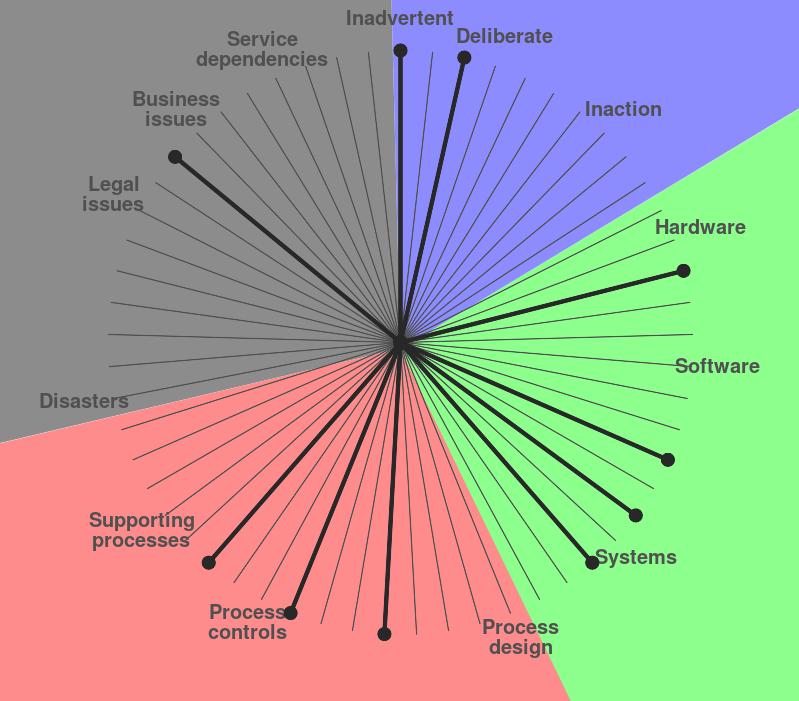
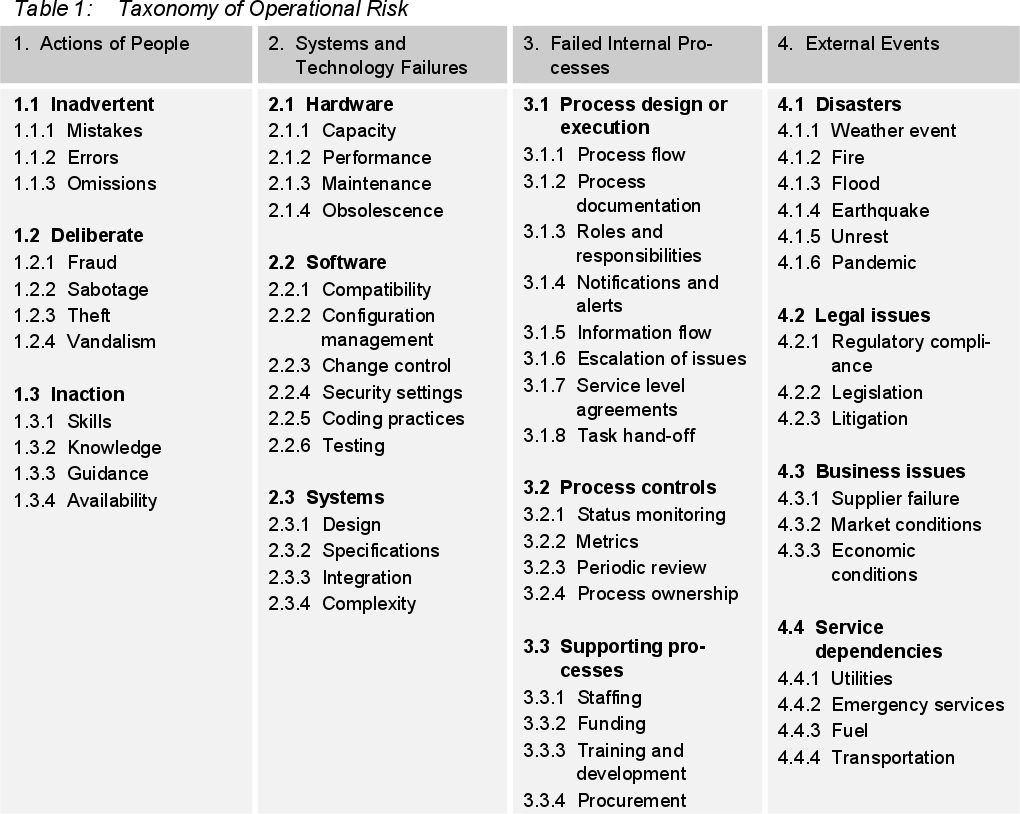
Dear lazyweb, I am trying to get a good way to present the categorization of several cases studied with a fitting graph. I am rating several vulnerabilities / failures according to James Cebula et. al.'s paper, A taxonomy of Operational Cyber Security Risks; this is a somewhat deep taxonomy, with 57 end items, but organized in a three levels deep hierarchy. Copying a table from the cited paper (click to display it full-sized): My categorization is binary: I care only whether it falls within a given category or not. My first stab at this was to represent each case using a star or radar graph. As an example: As you can see, to a "bare" star graph, I added a background color for each top-level category (blue for actions of people, green for systems and technology failures), red for failed internal processes and gray for external events), and printed out only the labels for the second level categories; for an accurate reading of the graphs, you have to refer to the table and count bars. And, yes, according to the Engineering Statistics Handbook:
Star plots are helpful for small-to-moderate-sized multivariate data sets. Their primary weakness is that their effectiveness is limited to data sets with less than a few hundred points. After that, they tend to be overwhelming.
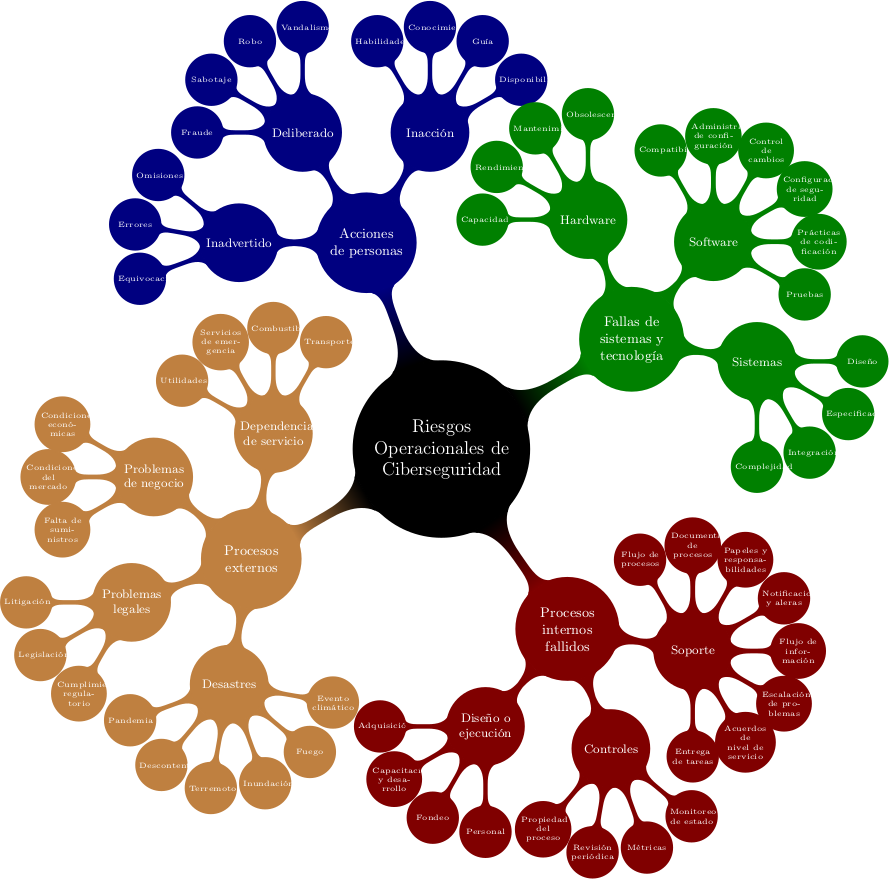
I strongly agree with the above statement And stating that "a few hundred points" can be understood is even an overstatement. 50 points are just too much. Now, trying to increase usability for this graph, I came across the Sunburst diagram. One of the proponents for this diagram, John Stasko, has written quite a bit about it. Now... How to create my beautiful Sunburst diagram? That's a tougher one. Even though the page I linked to in the (great!) Data visualization catalogue presents even some free-as-in-software tools to do this... They are Javascript projects that will render their beautiful plots (even including an animation)... To the browser. I need them for a static (i.e. to be printed) document. Yes, I can screenshot and all, but I want them to be automatically generated, so I can review and regenerate them all automatically. Oh, I could just write JSON and use SaaS sites such as Aculocity to do the heavy-lifting, but if you know me, you will understand why I don't want to. So... I set out to find a Gunnar-approved way to display the information I need. Now, as the Protovis documentation says, an icicle is simply a sunburst transformed from polar to cartesian coordinates... But I came to a similar conclusion: The tools I found are not what I need. OK, but an icicle graph seems much simpler to produce I fired up my Emacs, and started writing using Ruby, RMagick and RVG... I decided to try a different way. This is my result so far: So... What do you think? Does this look right to you? Clearer than the previous one? Worst? Do you have any idea on how I could make this better? Oh... You want to tell me there is something odd about it? Well, yes, of course! I still need to tweak it quite a bit. Would you believe me if I told you this is not really a left-to-right icicle graph, but rather a strangely formatted Graphviz non-directed graph using the dot formatter? I can assure you you don't want to look at my Graphviz sources... But in case you insist... Take them and laugh. Or cry. Of course, this file comes from a hand-crafted template, but has some autogenerated bits to it. I have still to tweak it quite a bit to correct several of its usability shortcomings, but at least it looks somewhat like what I want to achieve. Anyway, I started out by making a "dear lazyweb" question. So, here it goes: Do you think I'm using the right visualization for my data? Do you have any better suggestions, either of a graph or of a graph-generating tool? Thanks! [update] Thanks for the first pointer, Lazyweb! I found a beautiful solution; we will see if it is what I need or not (it is too space-greedy to be readable... But I will check it out more thoroughly). It lays out much better than anything I can spew out by myself Writing it as a mindmap using TikZ directly from within LaTeX, I get the following result:

Jo Shields: Mono repository changes, beginning Mono vNext

Up to now, Linux packages on mono-project.com have come in two flavours RPM built for CentOS 7 (and RHEL 7), and .deb built for Debian 7. Universal packages that work on the named distributions, and anything newer. Except that s not entirely true. Firstly, there have been compatibility repositories users need to add, to deal with ABI changes in libtiff, libjpeg, and Apache, since Debian 7. Then there s the packages for ARM64 and PPC64el neither of those architectures is available in Debian 7, so they re published in the 7 repo but actually built on 8. A large reason for this is difficulty in our package publishing pipeline apt only allows one version-architecture mix in the repository at once, so I can t have, say, 4.8.0.520-0xamarin1 built on AMD64 on both Debian 7 and Ubuntu 16.04. We ve been working hard on a new package build/publish pipeline, which can properly support multiple distributions, based on Jenkins Pipeline. This new packaging system also resolves longstanding issues such as can t really build anything except Mono and Architecture: All packages still get built on Jo s laptop, with no public build logs So, here s the old build matrix:
Distribution Architectures
Debian 7 ARM hard float, ARM soft float, ARM64 (actually Debian 8), AMD64, i386, PPC64el (actually Debian 8)
CentOS 7 AMD64
And here s the new one:
Distribution Architectures
Debian 7 ARM hard float (v7), ARM soft float, AMD64, i386
Debian 8 ARM hard float (v7), ARM soft float, ARM64, AMD64, i386, PPC64el
Raspbian 8 ARM hard float (v6)
Ubuntu 14.04 ARM hard float (v7), ARM64, AMD64, i386, PPC64el
Ubuntu 16.04 ARM hard float (v7), ARM64, AMD64, i386, PPC64el
CentOS 6 AMD64, i386
CentOS 7 AMD64
The compatibility repositories will no longer be needed on recent Ubuntu or Debian just use the right repository for your system. If your distribution isn t listed sorry, but we need to draw a line somewhere on support, and the distributions listed here are based on heavy analysis of our web server logs and bug requests. You ll want to change your package manager repositories to reflect your system more accurately, once Mono vNext is published. We re debating some kind of automated handling of this, but I m loathe to touch users sources.list without their knowledge. CentOS builds are going to be late I ve been doing all my prototyping against the Debian builds, as I have better command of the tooling. Hopefully no worse than a week or two. edit I guess Ubuntu 12.04 is coming back too, despite being EOL, for TravisCI support.

23 March 2017

Mike Hommey: Analyzing git-cinnabar memory use

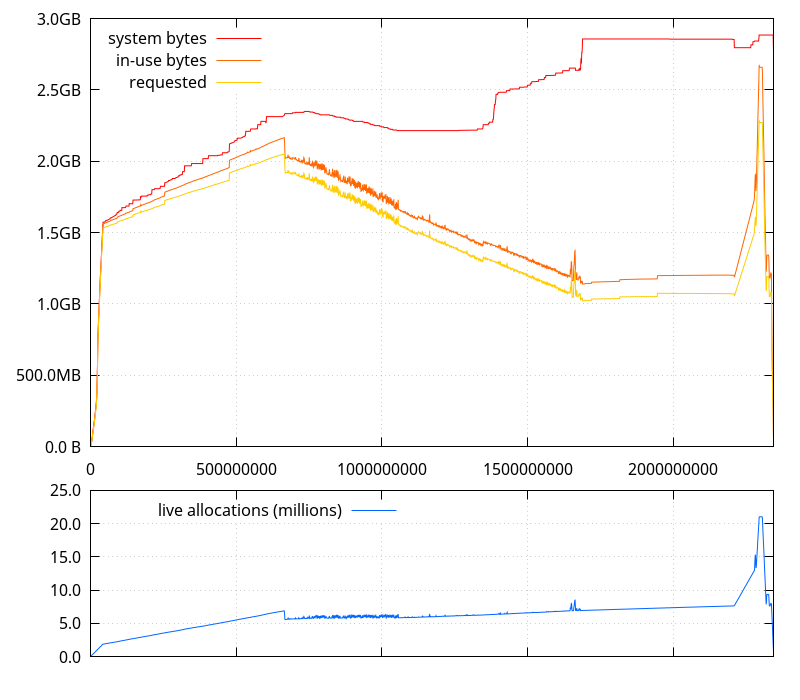
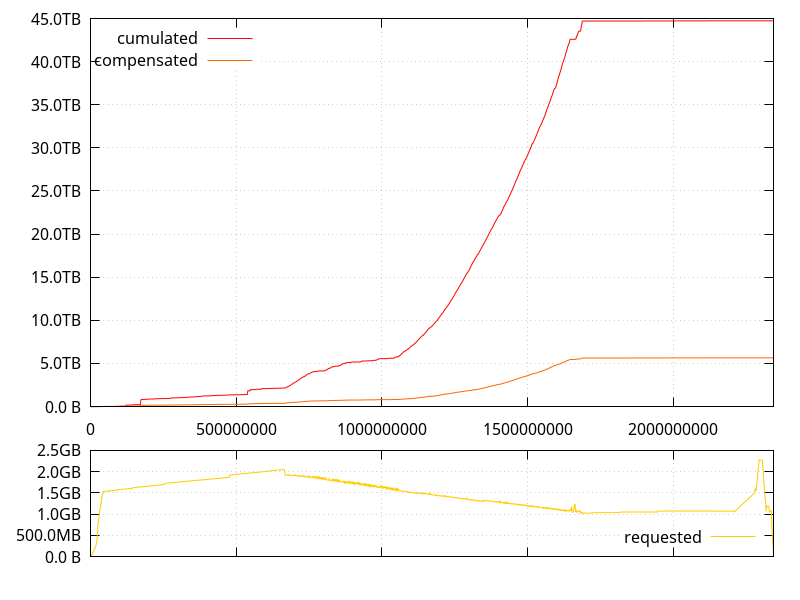
In previous post, I was looking at the allocations git-cinnabar makes. While I had the data, I figured I d also look how the memory use correlates with expectations based on repository data, to put things in perspective. As a reminder, this is what the allocations look like (horizontal axis being the number of allocator function calls): There are 7 different phases happening during a git clone using git-cinnabar, most of which can easily be identified on the graph above: Overall, except for the stupid spike during the final phase, the manifest DAG and the glibc allocator runaway memory use described in previous posts, there is nothing terribly bad with the git-cinnabar memory usage, all things considered. Mozilla-central is just big. The spike is already half addressed, and work is under way for the glibc allocator runaway memory use. The manifest DAG, interestingly, is actually mostly useless. It s only used to track the heads of the DAG, and it s very much possible to track heads of a DAG without actually storing the entire DAG. In fact, that s what git-cinnabar already does for changeset heads so we would only need to do the same for manifest heads. One could argue that the 1.4GB of raw RevChunk data we re keeping in memory for later user could be kept on disk instead. I haven t done this so far because I didn t want to have to handle temporary files (and answer questions like where to put them? , what if there isn t enough disk space there? , what if disk access is slow? , etc.). But the majority of this data is from manifests. I m already planning changes in how git-cinnabar stores manifests data that will actually allow to import them directly, instead of keeping them in memory until files are imported. This would instantly remove 1.18GB of memory usage. The downside, however, is that this would be more CPU intensive: Importing changesets will require creating the corresponding git trees, and getting the stored manifest data. I think it s worth, though. Finally, one thing that isn t obvious here, but that was found while analyzing why RSS would be going up despite memory usage going down, is that git-cinnabar is doing way too many reallocations and substring allocations. So let s look at two metrics that hopefully will highlight the problem: Assuming all the requested memory is filled at some point, the former gives us an upper bound to the amount of memory that is ever filled or copied (the amount that would be filled if no realloc was ever in-place), while the the latter gives us a lower bound (the amount that would be filled or copied if all reallocs were in-place). Ideally, we d want the upper and lower bounds to be close to each other (indicating few realloc calls), and the total amount at the end of the process to be as close as possible to the amount of data we re handling (which we ve seen is around 3TB). and this is clearly bad. Like, really bad. But we already knew that from the previous post, although it s nice to put numbers on it. The lower bound is about twice the amount of data we re handling, and the upper bound is more than 10 times that amount. Clearly, we can do better. We ll see how things evolve after the necessary code changes happen. Stay tuned.
22 March 2017

Dirk Eddelbuettel: Suggests != Depends

A number of packages on CRAN use Suggests: casually. They list other packages as "not required" in Suggests: -- as opposed to absolutely required via Imports: or the older Depends: -- yet do not test for their use in either examples or, more commonly, unit tests. So e.g. the unit tests are bound to fail because, well, Suggests != Depends. This has been accomodated for many years by all parties involved by treating Suggests as a Depends and installing unconditionally. As I understand it, CRAN appears to flip a switch to automatically install all Suggests from major repositories glossing over what I consider to be a packaging shortcoming. (As an aside, treatment of Additonal_repositories: is indeed optional; Brooke Anderson and I have a fine paper under review on this) I spend a fair amount of time with reverse dependency ("revdep") checks of packages I maintain, and I will no longer accomodate these packages. These revdep checks take long enough as it is, so I will now blacklist these packages that are guaranteed to fail when their "optional" dependencies are not present. Writing R Extensions says in Section 1.1.3

All packages that are needed10 to successfully run R CMD check on the package must be listed in one of Depends or Suggests or Imports . Packages used to run examples or tests conditionally (e.g. via if(require(pkgname))) should be listed in Suggests or Enhances . (This allows checkers to ensure that all the packages needed for a complete check are installed.) In particular, packages providing only data for examples or vignettes should be listed in Suggests rather than Depends in order to make lean installations possible. [...] It used to be common practice to use require calls for packages listed in Suggests in functions which used their functionality, but nowadays it is better to access such functionality via :: calls.
and continues in Section 1.1.3.1
Note that someone wanting to run the examples/tests/vignettes may not have a suggested package available (and it may not even be possible to install it for that platform). The recommendation used to be to make their use conditional via if(require("pkgname"))): this is fine if that conditioning is done in examples/tests/vignettes.
I will now exercise my option to use 'lean installations' as discussed here. If you want your package included in tests I run, please make sure it tests successfully when only its required packages are present.

21 March 2017

Reproducible builds folks: Reproducible Builds: week 99 in Stretch cycle

Here's what happened in the Reproducible Builds effort between Sunday March 12 and Saturday March 18 2017: Upcoming events Reproducible Builds Hackathon Hamburg 2017 The Reproducible Builds Hamburg Hackathon 2017, or RB-HH-2017 for short is a 3 day hacking event taking place May 5th-7th in the CCC Hamburg Hackerspace located inside Frappant, as collective art space located in a historical monument in Hamburg, Germany. The aim of the hackathon is to spent some days working on Reproducible Builds in every distribution and project. The event is open to anybody interested on working on Reproducible Builds issues, with or without prior experience! Accomodation is available and travel sponsorship may be available by agreement. Please register your interest as soon as possible. Reproducible Builds Summit Berlin 2016 This is just a quick note, that all the pads we've written during the Berlin summit in December 2016 are now online (thanks to Holger), nicely complementing the report by Aspiration Tech. Request For Comments for new specification: BUILD_PATH_PREFIX_MAP Ximin Luo posted a draft version of our BUILD_PATH_PREFIX_MAP specification for passing build-time paths between high-level and low-level build tools. This is meant to help eliminate irreproducibility caused by different paths being used at build time. At the time of writing, this affects an estimated 15-20% of 25000 Debian packages. This is a continuation of an older proposal SOURCE_PREFIX_MAP, which has been updated based on feedback on our patches from GCC upstream, attendees of our Berlin 2016 summit, and participants on our mailing list. Thanks to everyone that contributed! The specification also contains runnable source code examples and test cases; see our git repo. Please comment on this draft ASAP - we plan to release version 1.0 of this in a few weeks. Toolchain changes Packages reviewed and fixed, and bugs filed Chris Lamb: Reviews of unreproducible packages 5 package reviews have been added, 274 have been updated and 800 have been removed in this week, adding to our knowledge about identified issues. 1 issue type has been added: Weekly QA work During our reproducibility testing, FTBFS bugs have been detected and reported by: diffoscope development diffoscope 79 and 80 were uploaded to experimental by Chris Lamb. It included contributions from: Chris Lamb: Maria Glukhova: strip-nondeterminism development strip-nondeterminism 0.032-1 was uploaded to unstable by Chris Lamb. It included contributions from: Chris Lamb: tests.reproducible-builds.org Misc. This week's edition was written by Ximin Luo, Holger Levsen and Chris Lamb & reviewed by a bunch of Reproducible Builds folks on IRC & the mailing lists.

19 March 2017

Clint Adams: Measure once, devein twice

Ophira lived in a wee house in University Square, Tampa. It had one floor, three bedrooms, two baths, a handful of family members, a couple pets, some plants, and an occasional staring contest. Mauricio lived in Lowry Park North, but Ophira wasn t allowed to go there because Mauricio was afraid that someone would tell his girlfriend. Ophira didn t like Mauricio s girlfriend and Mauricio s girlfriend did not like Ophira. Mauricio did not bring his girlfriend along when he and Ophira went to St. Pete Beach. They frolicked in the ocean water, and attempted to have sex. Mauricio and Ophira were big fans of science, so Somewhat quickly they concluded that it is impossible to have sex underwater, and absconded to Ophira s car to have sex therein. I hate Mauricio s girlfriend, Ophira told Amit on the telephone. She s not even pretty. Hey, listen, said Amit. I m going to a wedding on Captiva. Oh, my family used to go to Captiva every year. There s bioluminescent algae and little crabs and stuff. Yeah? Do you want to come along? You could pick me up at the airport. Why would I want to go to a wedding? Well, it s on the beach and they re going to have a bouncy castle. A bouncy castle Are you serious? Yes. Well, okay. Amit prepared to go to the wedding and Ophira became terse then unresponsive. After he landed at RSW, he called Ophira, but instead of answering the phone she startled and fell out of her chair. Amit arranged for other transportation toward the Sanibel Causeway. Ophira bit her nails for a few hours, then went to her car and drove to Cape Coral. Ophira cruised around Cape Coral for a while, until she spotted a teenager cleaning a minivan. She parked her car and approached him. Whatcha doing? asked Ophira, pretending to chew on imaginary gum. The youth slid the minivan door open. I m cleaning, he said hesitantly. Didn t your parents teach you not to talk to strangers? I could do all kinds of horrible things to you. They conversed for a bit. She recounted a story of her personal hero, a twelve-year-old girl who seduced and manipulated older men into ruin. She rehashed the mysteries of Mauricio s girlfriend. She waxed poetic on her love of bouncy castles. The youth listened, hypnotized. What s your name, kid? Ophira yawned. Arjun, he replied. How old are you? Arjun thought about it. 15, he said. Hmm, Ophira stroked her chin. Can you sneak me into your room so that your parents never find out about it? Arjun s eyes went wide. MEANWHILE, on Captiva Island, Amit had learned that even though the Tenderly had multiple indoor jacuzzis, General Fitzpatrick and Mrs. Fitzpatrick had decided it prudent to have sex in the hot tub on the deck; that the execution of this plan had somehow necessitated a lengthy cleaning process before the hot tub could be used again; that that s why workmen were cleaning the hot tub; and that the Fitzpatrick children had gotten General Fitzpatrick and Mrs. Fitzpatrick to agree to not do that again, with an added suggestion that they not be seen doing anything else naked in public. A girl walked up to Amit. Hey, I heard you lost your plus-one. Are you here alone? What a loser! she giggled nervously, then stared. Leave me alone, Darlene, sighed Amit. Darlene s face reddened as she spun on her heels and stormed over to Lisette. Oh my god, did you see that? I practically threw myself at him and he was abusive toward me. He probably has all the classic signs of being an abuser. Did you hear about that girl he dated in Ohio? I bet I know why that ended. Oh really? said Lisette distractedly, looking Amit up and down. So he s single now? Darlene glared at Lisette as Amit wandered back outside to stare at the hot tub. Hey kid, said Ophira, bring me some snacks. I don t bring food into my room, said Arjun. It attracts pests. Is that what your parents told you? scoffed Ophira. Don t be such a wuss. Three minutes later, Ophira was finishing a bag of paprika puffs. These are great, Arjun! Where do you get these? My cousin sends them from Europe, he explained. Now get me a diet soda. Amit strolled along the beach, then yelped. What s biting my legs? he cried out. Those are sand fleas, said Nessarose. What are sand fleas? asked Amit incredulously. Nessarose rolled her eyes. Stop being a baby and have a drink. After the sun went down, Amit began to notice the crabs, and this made him drink more. When everyone was soused, General Fitzpatrick announced that they were going for a swim in the Gulf, in direct contravention of safety guidelines. Most of the guests were wise enough to refuse, but an eightsome swam out, occasionally stopping to slap the algae, but continuing until they reached the sandbar that General Fitzpatrick correctly claimed was there. Then screams echoed through the night as all the jellyfish attacked everyone invading their sandbar. The crestfallen swimming party eventually made it back to shore. Pee on the jellyfish sting, commanded Nessarose. It s the best cure. No! shouted General Fitzpatrick s daughter. Urine makes it worse. Things quickly escalated from Nessarose and General Fitzpatrick s daughter screaming at each other to the beach dividing into three factions: those siding with Nessarose, those siding with General Fitzpatrick s daughter, and those who had no idea what was going on. General Fitzpatrick had no interest in any of this, and went straight to bed. It s getting late, kid, said Ophira. I m taking your bed. What? squeaked Arjun. Look, said Ophira, your bed is small and there isn t room for both of us. You may sleep on the floor if you re quiet and don t bother me. What? squeaked Arjun. Are you deaf, kid? Ophira grunted and then went to bed. Arjun blinked in confusion, then tried to fall asleep on the floor, without much success. Ophira got up in the morning and said, Before I go, I want to teach you a valuable lesson. What? groaned Arjun, getting to his feet. You should be careful talking to strangers. Now, I told you that I could do horrible things to you, so this is not my fault; it s yours, she announced, then sucker-punched him in the gut. Ophira climbed out the window as Arjun doubled over. As the ceremony began, only a small minority of the wedding party was visibly suffering from jellyfish stings, which may or may not have helped with ignoring the sand fleas. The ceremony ended shortly thereafter, and now that marriage had been accomplished, everyone turned their attention to food and drink and swimming less irresponsibly than the night before. Guests that needed to return home sooner departed in waves and Amit started to appreciate the more peaceful environment. He heard the deck door slide open behind him and turned his attention away from the hot tub. Hey, mofo, Ophira shouted as strode stylishly out onto the deck. Where s this bouncy castle? Amit blinked in surprise. That was yesterday. You missed it. Oh, she frowned. So I met this South Slav guy with a really sexy forehead, and I need some advice. I don t know if I should call him or wait. Amit pointed to the hot tub and told her the story of General Fitzpatrick and Mrs. Fitzpatrick and the hot tub. What? said Ophira. How could they have sex underwater? What do you mean? asked Amit. Well, it s impossible, she replied.
Posted on 2017-03-19
Tags: mintings

16 March 2017

Thorsten Glaser: Updates to the last two posts

Someone from the FSF s licencing department posted an official-looking thing saying they don t believe GitHub s new ToS to be problematic with copyleft. Well, my lawyer (not my personal one, nor for The MirOS Project, but related to another association, informally) does agree with my reading of the new ToS, and I can point out at least a clause in the GPLv1 (I really don t have time right now) which says contrary (but does this mean the FSF generally waives the restrictions of the GPL for anything on GitHub?). I ll eMail GitHub Legal directly and will try to continue getting this fixed (as soon as I have enough time for it) as I ll otherwise be forced to force GitHub to remove stuff from me (but with someone else as original author) under GPL, such as tinyirc and e3. My dbconfig-common Debian packaging example got a rather hefty upgrade because dbconfig-common (unlike any other DB schema framework I know of) doesn t apply the upgrades on a fresh install (and doesn t automatically put the upgrades into a transaction either) but only upgrades between Debian package versions (which can be funny with backports, but AFAICT that part is handled correctly). I now append the upgrades to the initial-version-as-seen-in-the-source to generate the initial-version-as-shipped-in-the-binary-package (optionally, only if it s named .in) removing all transaction stuff from the upgrade files and wrapping the whole shit in BEGIN; and COMMIT; after merging. (This should at least not break n n-PostgreSQL databases and well, database-like-ish things I cannot test for obvious (SQLite is illegal, at least in Germany, but potentially worldwide, and then PostgreSQL is the only remaining Open Source database left ;) reasons.) Update: Yes, this does mean that maintainers of databases and webservers should send me patches to make this work with not-PostgreSQL (new install/name.in, upgrade files) and not-Apache-2.2/2.4 (new debian/*/*.conf snippets) to make this packaging example even more generally usable. Natureshadow already forked this and made a Python/Flask package from it, so I ll prod him to provide a similarily versatile hello-python-world example package.

14 March 2017

John Goerzen: Parsing the GOP s Health Insurance Statistics

There has been a lot of noise lately about the GOP health care plan (AHCA) and the differences to the current plan (ACA or Obamacare). A lot of statistics are being misinterpreted. The New York Times has an excellent analysis of some of this. But to pick it apart, I want to highlight a few things: Many Republicans are touting the CBO s estimate that, some years out, premiums will be 10% lower under their plan than under the ACA. However, this carries with it a lot of misleading information. First of all, many are spinning this as if costs would go down. That s not the case. The premiums would still rise they would just have risen less by the end of the period than under ACA. That also ignores the immediate spike and throwing millions out of the insurance marketplace altogether. Now then, where does this 10% number come from? First of all, you have to understand the older people are substantially more expensive to the health system, and therefore more expensive to insure. ACA limited the price differential from the youngest to the oldest people, which meant that in effect some young people were subsidizing older ones on the individual market. The GOP plan removes that limit. Combined with other changes in subsidies and tax credits, this dramatically increases the cost to older people. For instance, the New York Times article cites a CBO estimate that the price an average 64-year-old earning $26,500 would need to pay after using a subsidy would increase from $1,700 under Obamacare to $14,600 under the Republican plan. They further conclude that these exceptionally high rates would be so unaffordable to older people that the older people will simply stop buying insurance on the individual market. This means that the overall risk pool of people in that market is healthier, and therefore the average price is lower. So, to sum up: the reason that insurance premiums under the GOP plan will rise at a slightly slower rate long-term is that the higher-risk people will be unable to afford insurance in the first place, leaving only the cheaper people to buy in.

13 March 2017

Sean Whitton: Initial views of 5th edition DnD

I ve been playing in a 5e campaign for around two months now. In the past ten days or so I ve been reading various source books and Internet threads regarding the design of 5th edition. I d like to draw some comparisons and contrasts between 5th edition, and the 3rd edition family of games (DnD 3.5e and Paizo s Pathfinder, which may be thought of as 3.75e). The first thing I d like to discuss is that wizards and clerics are no longer Vancian spellcasters. In rules terms, this is the idea that individual spells are pieces of ammunition. Spellcasters have a list of individual spells stored in their heads, and as they cast spells from that list, they cross off each item. Barring special rules about spontaneously converting prepared spells to healing spells, for clerics, the only way to add items back to the list is to take a night s rest. Contrast this with spending points from a pool of energy in order to use an ability to cast a fireball. Then the limiting factor on using spells is having enough points in your mana pool, not having further castings of the spell waiting in memory. One of the design goals of 5th edition was to reduce the dominance of spellcasters at higher levels of play. The article to which I linked in the previous paragraph argues that this rebalancing requires the removal of Vancian magic. The idea, to the extent that I ve understood it, is that Vancian magic is not an effective restriction on spellcaster power levels, so it is to be replaced with other restrictions adding new restrictions while retaining the restrictions inherent in Vancian magic would leave spellcasters crippled. A further reason for removing Vancian magic was to defeat the so-called five minute adventuring day . The compat ability of a party that contains higher level Vancian spellcasters drops significantly once they ve fired off their most powerful combat spells. So adventuring groups would find themselves getting into a fight, and then immediately retreating to fully rest up in order to get their spells back. This removes interesting strategic and roleplaying possibilities involving the careful allocation of resources, and continuing to fight as hit points run low. There are some other related changes. Spell components are no longer used up when casting a spell. So you can use one piece of bat guano for every fireball your character ever casts, instead of each casting requiring a new piece. Correspondingly, you can use a spell focus, such as a cool wand, instead of a pouch full of material components since the pouch never runs out, there s no mechanical change if a wizard uses an arcane focus instead. 0th level spells may now be cast at will (although Pathfinder had this too). And there are decent 0th level attack spells, so a spellcaster need not carry a crossbow or shortbow in order to have something to do on rounds when it would not be optimal to fire off one of their precious spells. I am very much in favour of these design goals. The five minute adventuring day gets old fast, and I want it to be possible for the party to rely on the cool abilities of non-spellcasters to deal with the challenges they face. However, I am concerned about the flavour changes that result from the removal of Vancian magic. These affect wizards and clerics differently, so I ll take each case in turn. Firstly, consider wizards. In third edition, a wizard had to prepare and cast Read Magic (the only spell they could prepare without a spellbook), and then set about working through their spellbook. This involved casting the spells they wanted to prepare, up until the last few triggering words or gestures that would cause the effect of the spell to manifest. They would commit these final parts of the spell to memory. When it came to casting the spell, the wizard would say the final few words and make the required gestures, and bring out relevant material components from their component pouch. The completed spell would be ripped out of their mind, to manifest its effect in the world. We see that the casting of a spell is a highly mentally-draining activity it rips the spell out of the caster s memory! not to be undertaken lightly. Thus it is natural that a wizard would learn to use a crossbow for basic damage-dealing. Magic is not something that comes very naturally to the wizard, to be deployed in combat as readily as the fighter swings their sword. They are not a superhero or video game character, pew pew ing their way to victory. This is a very cool starting point upon which to roleplay an academic spellcaster, not really available outside of tabletop games. I see it as a distinction between magical abilities and real magic. Secondly, consider clerics. Most of the remarks in the previous paragraph apply, suitably reworked to be in terms of requesting certain abilities from the deity to whom the cleric is devoted. Additionally, there is the downgrading of the importance of the cleric s healing magic in 5th edition. Characters can heal themselves by taking short and long rests. Previously, natural healing was very slow, so a cleric would need to convert all their remaining magic to healing spells at the end of the day, and hope that it was enough to bring the party up to fighting shape. Again, this made the party of adventurers seem less like superheroes or video game characters. Magic had a special, important and unique role, that couldn t be replaced by the abilities of other classes.

There are some rules in the back of the DMG Slow Natural Healing , Healing Kit Dependency , Lingering Wounds which can be used to make healing magic more important. I m not sure how well they would work without changes to the cleric class.
I would like to find ways to restore the feel and flavour of Vancian clerics and wizards to 5th edition, without sacrificing the improvements that have been made that let other party members do cool stuff too. I hope it is possible to keep magic cool and unique without making it dominate the game. It would be easy to forbid the use of arcane foci, and say that material component pouches run out if the party do not visit a suitable marketplace often enough. This would not have a significant mechanical effect, and could enhance roleplaying possibilities. I am not sure how I could deal with the other issues I ve discussed without breaking the game. The second thing I would like to discuss is bounded accuracy. Under this design principle, the modifiers to dice rolls grow much more slowly. The gain of hit points remains unbounded. Under third edition, it was mechanically impossible for a low-level monster to land a hit on a higher-level adventurer, rendering them totally useless even in overwhelming numbers. With bounded accuracy, it s always possible for a low-level monster to hit a PC, even if they do insigificant damage. That means that multiple low-level monsters pose a threat. This change opens up many roleplaying opportunities by keeping low-level character abilities relevant, as well as monster types that can remain involves in stories without giving them implausible new abilities so they don t fall far behind the PCs. However, I m a little worried that it might make high level player characters feel a lot less powerful to play. I want to cease a be a fragile adventurer and become a world-changing hero at later levels, rather than forever remain vulnerable to the things that I was vulnerable to at the start of the game. This desire might just be the result of the video games which I played growing up. In the JRPGs I played and in Diablo II, enemies in earlier areas of the map were no threat at all once you d levelled up by conquering higher-level areas. My concerns about bounded accuracy might just be that it clashes with my own expectations of how fantasy heroes work. A good DM might be able to avoid these worries entirely. The final thing I d like to discuss is the various simplifications to the rules of 5th edition, when it is compared with 3rd edition and Pathfinder. Attacks of opportunity are only provoked when leaving a threatened square; you can go ahead and cast a spell when in melee with someone. There is a very short list of skills, and party members are much closer to each other in skills, now that you can t pump more and more ranks into one or two abilities. Feats as a whole are an optional rule. At first I was worried about these simplifications. I thought that they might make character building and tactics in combat a lot less fun. However, I am now broadly in favour of all of these changes, for two reasons. Firstly, they make the game so much more accessible, and make it far more viable to play without relying on a computer program to fill in the boxes on your character sheet. In my 5th edition group, two of us have played 3rd edition games, and the other four have never played any tabletop games before. But nobody has any problems figuring out their modifiers because it is always simply your ability bonus or penalty, plus your proficiency bonus if relevant. And advantage and disadvantage is so much more fun than getting an additional plus or minus two. Secondly, these simplifications downplay the importance of the maths, which means it is far less likely to be broken. It is easier to ensure that a smaller core of rules is balanced than it is to keep in check a larger mass of rules, constantly being supplemented by more and more addon books containing more and more feats and prestige classes. That means that players make their characters cool by roleplaying them in interesting ways, not making them cool by coming up with ability combos and synergies in advance of actually sitting down to play. Similarly, DMs can focus on flavouring monsters, rather than writing up longer stat blocks. I think that this last point reflects what I find most worthwhile about tabletop RPGs. I like characters to encounter cool NPCs and cool situations, and then react in cool ways. I don t care that much about character creation. (I used to care more about this, but I think it was mainly because of interesting options for magic items, which hasn t gone away.) The most important thing is exercising group creativity while actually playing the game, rather than players and DMs having to spend a lot of time preparing the maths in advance of playing. Fifth edition enables this by preventing the rules from getting in the way, because they re broken or overly complex. I think this is why I love Exalted: stunting is vital, and there is social combat. I hope to be able to work out a way to restore Vancian magic, but even without that, on balance, fifth edition seems like a better way to do group storytelling about fantasy heroes. Hopefully I will have an opportunity to DM a 5th edition campaign. I am considering disallowing all homebrew and classes and races from supplemental books. Stick to the well-balanced core rules, and do everything else by means of roleplaying and flavour. This is far less gimmicky, if more work for unimaginative players (such as myself!). Some further interesting reading:

Ross Gammon: February 2017 My Free Software activities summary

When I sat down to write this blog, I thought I hadn t got much done in February. But as it took me quite a while to write up, there must have actually been a little bit of progress. With my wife starting a new job, there have been some adjustments in family life, and I have struggled just to keep up with all the Debian and Ubuntu emails. Anyway .. Debian Ubuntu
  • Tested Ubuntu Studio 16.02.2 point release, marked as ready, and updated the Release Notes.
  • Started updating my previous Gramps backport in Ubuntu to Gramps 4.2.5. The package builds fine, and I have tested that it installs and works. I just need to update the bug.
  • Prepared updates to the ubuntustudio-default-settings & ubuntustudio-meta packages. There were some deferred changes from before Yakkety was released, including moving the final bit of configuration left in the ubuntustudio-lightdm-theme package to ubuntustudio-default-settings. Jeremy Bicha sponsored the uploads after suggesting moving away from some transitional ttf font packages in ubuntustudio-meta.
  • Tested the Ubuntu Studio 17.04 First Beta release, marked as ready, and prepared the Release Notes.
  • Upgraded my music studio Ubuntu Studio computer to Yakkety 16.1o.
  • Got accepted as an Ubuntu Contributing Developer by the Developer Membership Board.
Other
  • After a merge of my Family Tree with the Family Tree of my wife in Gramps a long way back, I finally started working through the database merging duplicates and correcting import errors.
  • Worked some more on the model railway, connecting up the other end of the tunnel section with the rest of the railway.
Plan status from last month & update for next month Debian For the Debian Stretch release:
  • Keep an eye on the Release Critical bugs list, and see if I can help fix any. In Progress
Generally:
  • Finish the Gramps 5.2.5 backport for Jessie. Done
  • Package all the latest upstream versions of my Debian packages, and upload them to Experimental to keep them out of the way of the Stretch release.
  • Begin working again on all the new stuff I want packaged in Debian.
Ubuntu
  • Finish the ubuntustudio-lightdm-theme, ubuntustudio-default-settings transition including an update to the ubuntustudio-meta packages. Done
  • Reapply to become a Contributing Developer. Done
  • Start working on an Ubuntu Studio package tracker website so that we can keep an eye on the status of the packages we are interested in. Started
  • Start testing & bug triaging Ubuntu Studio packages. In progress
  • Test Len s work on ubuntustudio-controls In progress
  • Do the Ubuntu Studio Zesty 17.04 Final Beta release.
Other
  • Give JMRI a good try out and look at what it would take to package it. In progress
  • Also look at OpenPLC for simulating the relay logic of real railway interlockings (i.e. a little bit of the day job at home involving free software fun!). In progress

12 March 2017

Iustin Pop: A recipe for success

It is said that with age comes wisdom. I would be happy for that to be true, because today I must have been very very young then. For example, if you want to make a long bike ride in order to hit some milestone, like your first metric century, it is not indicated to follow ANY of the following points: For bonus points, if you somehow manage to reach the third peak in the above ride, and have mostly only flat/down to the destination, do the following: be so glad you're done with climbing, that you don't pay attention to the map and start a wrong descent, on a busy narrow road, so that you can't stop immediately as you realise you've lost the track; it will cost you only an extra ~80 meters of height towards the end of the ride. Which are pretty cheap, since all the food is gone and the water almost as well, so the backpack is light. Right. However, if you do follow all the above, you're rewarded with a most wonderful thing for the second half of the ride: your will receive a +5 boost on your concentration skill. You will be able to focus on, and think about a single thing for hours at a time, examining it (well, its contents) in minute detail. Plus, when you get home and open that thing I mean, of course, the FRIDGE with all the wonderful FOOD it contains everything will taste MAGICAL! You can now recoup the roughly 1500 calories deficit on the ride, and finally no longer feel SO HUNGRY. That's all. Strava said "EXTREME" suffer score, albeit less than 20% points in the red, which means I was just slugging through the ride (total time confirms it), like a very very very old man. But definitely not a wise one.

Next.

Previous.