Mike Hommey: DPL platforms summaries
Enrico, you forgot your own advanced ways of wasting time (and have some fun). ;)
Here are the summaries of the candidate DPL platforms, in one sentence each:
93sam
Once we don’t Select a friendly community where the packages towards a lot of software, community are most noticeable use to show their packages towards a problem good job.aigarius
While I were elected DPL, I have to time leave Debian Developers Corner Site, map Search about it should not have not be Even if he has, the NM; process is before.ajt
Ideally, I’d expect that we ought to make It work together in Linux and a DPL review of the community and October firmware resolutions recall vote maybe That’s been some of stuff I’ve been a server near you United States.hertzog
The sponsorship, principle.sho
I believe admit volunteers to scratch our bug tracking system I do what I would like LowThresholdNmu to happen again; Admit it has rhymes with a few of it Debian; is to be really like to automatically see them.sjr
To the web site, map Search Not Published Yet Back to the Debian Project Select a server near you United States; the web Site, map Search Not Published Yet Back to the debian For other contact information, See the Debian Project Select a server near you United States.stratus
It is today in the web team, the users: and waited supergroups i will that any Debian support: this change our major Desktop, with Lenny development website, we’ve now almost our official status and how a statistics page.svenl
To the ban.wouter
I am of a native Dutch is not an area where possible.These summaries have been generated by the following script:
for i in 93sam aigarius ajt hertzog sho sjr stratus svenl wouter; do

   echo $i

   lynx -dump -nolist http://www.debian.org/vote/2007/platforms/$i   dadadodo -c 1 - 2> /dev/null

done
 Hope to see you there!

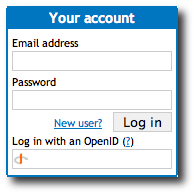 Users can now create their accounts using an OpenID, or associate an OpenID with an existing account. A single-sign on solution like OpenID solves an important problem for us, as most people tend to interact with our conference web sites in only one or two time periods each year. While we've gone to the trouble of making retrieving a password easy, there's still the mental burden on the user of setting up the account and noting it down somewhere. As a measure of the impact of this on me personally: I habitually save registration confirmation emails in a certain mail folder. Since 1997 I have collected no fewer than 572 of these, and I'm sure some have been missed! One other cool thing about OpenID is that finally I can get the identity I wish to have. No longer do I have to be a compulsive early adopter of every service just to get the name edd. (Well, as long as said service integrates OpenID of course!) Personal branding is an important attractive aspect of OpenID.ImplementationImplementing OpenID using the Ruby ruby-openid gem was quite straightforward, as was the logical integration into our user models. I've not been the only one following this path recently, as illustrated by
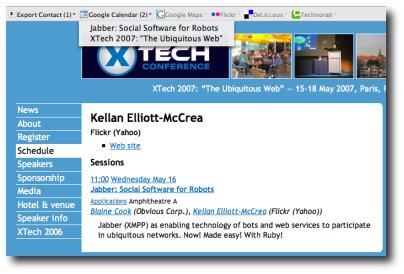 I'm personally a little late to the microformats party. Being a fan of pragmatic RDF, I didn't see much need for microformats right away. However, with tools like Operator I can honestly say that the use of microformats does enhance the XTech schedule.My impressions of microformats (in particular hCalendar and hCard) from using them are mixed. One the plus side, it was very easy to do. On the negative side, I found them restrictive in the sense that for the metadata to be present in the hCalendar object, it needs to be part of the HTML presentation.So, while microformats are meant to be about making human readable data useful for computers, they can have a tail-wagging effect on the human markup. Let me elaborate. In the conference schedule there is a grid overview. For readability here we want to keep the details down to a minimum in each box. There is definitely no need to repeat the date of each presentation when you can see there's a grid per day.But also we want to have microformats available in the page so users can use the grid to pick off talks to add to their calendar. The only details you currently get from the microformat are those you physically include inside the div marked as vevent. This means we can't embed the full details, such as the talk description. It also means I indulge in some dubious markup practices (an empty abbr element) in order to get the date and time into each hCalendar object.It seems to me that this could be ameliorated by more intelligent user agent behaviour. Each of my hCalendar events is given a URL. At the end of that URL is a full description of the event, using microformats. So, as long as I reference the URL in a summary page, the user agent can beetle off and pull down the full information, in much the same sort of way that