Christian Perrier: [life] Radio Bemba
 There's nothing better than listening Manu Chao's "Radio
Bemba Sound System" during a family meal at home.
And, later on, while working on a new font package for Uyghur language.
And, I say, Piwet.
There's nothing better than listening Manu Chao's "Radio
Bemba Sound System" during a family meal at home.
And, later on, while working on a new font package for Uyghur language.
And, I say, Piwet.
 Since I m soliciting donations to support my Debian work, the least I can do is explain what I do. You can thus expect to see an article like this one every month.
Multi-Arch work
I updated the code to use another layout for the control files stored in
/var/lib/dpkg/info/. Instead of using a sub-directory per architecture (arch/package.type), we decided to use package:arch.type but only for packages which are Multi-Arch: same. dpkg is taking care to rename the files the first time it is executed with write rights and then updates /var/lib/dpkg/info/format to remember that the upgrade has been done and that we can rely on the new structure.
I filed a few bugs on packages that are improperly accessing those internal files instead of using the appropriate dpkg-query interface. I sent a heads-up mail on -devel to make other people aware of those problems in the hope to discover most of them as early as possible.
After that, the work stalled because Guillem went away for 2 weeks and thus stopped his review of my work. I hope he will quickly resume the review and that we will get something final this month.
With the arrival of dpkg 1.16.0, it s now possible to start converting libraries to multi-arch even if full multi-arch support has not yet landed in dpkg proper. See http://wiki.debian.org/Multiarch/Bootstrapping for the detailed plan.
If you re curious about Multi-Arch, you might want to read this article of Steve Langasek as well.
Bug triage for dpkg in launchpad
At the start of the month, there was close to 500 bugs reported against the dpkg package in Launchpad. Unfortunately most of it is noise many of the reported bugs are misfiled, they show an upgrade problem of a random package and that upgrade problem confuses update-manager which tries to configure an already configured package. This generates a second error that apport attributes to dpkg and the resulting bug report is thus filed on dpkg. There are literally hundreds of those that have to be reclassified.
Michael Vogt and Brian Murray did some triaging, and I also spend quite some hours on this task. It s a bit frustrating as I tend to mark many reports Incomplete because there s no way they can be acted upon and many of them are so old that the reporter is unlikely to be able to provide supplementary information.
But in the middle of this noise, there are some useful bug reports, like LP#739179 which enabled me to fix a regression even before it reached Debian Unstable (because Ubuntu runs a snapshot of dpkg with multiarch support).
I subscribed to the Launchpad bugs for dpkg via the Debian Package Tracking System (thanks to the derivatives-bugs keyword) and will try to keep up with the incoming reports.
Misc dpkg work
The ftpmasters came up with a request for a new field (see 619131) in source packages. After a quick discussion and a round of review on debian-policy@l.d.o, I implemented the new Package-List field. This should allow the ftpmasters to save some time in NEW processing, but we deferred the change for the next dpkg version (1.16.1) to ponder a bit more on the design of the field.
I also fixed a bunch of bugs (#619541, #605719, #598922, #616096) and merged a patch of Mark Hymers to recognize the new Built-Using field.
Developers-reference work
The review process for changes to the developers-reference is not working as it should. And I suffered from it while trying to integrate the patch I wrote for the Developer duties chapter (see #548867).
We purposely changed the maintainer field from debian-doc to debian-policy in the hope to have more reviews of suggested changes and to seek some sort of consensus before committing anything. But we don t get more reviews and deciding to commit a patch is now even harder than it was (except for trivial stuff where personal opinions can t interfere).
In my case, I only got the feedback of Charles Plessy which was very mixed to say the least. I tried to improve my patch based on what he expressed but I also clearly disagreed with some of his assertions and was convinced that my wording was in line with the dominant point of view within Debian.
We tried to involve the release team in the discussion because most of what I documented was about helping making stable release happen, but nobody of the team answered.
Instead of letting the situation (and my patch) rot, I solicited feedback from the DPL and from another developers-reference editor to see whether my patch was an improvement or not. After some more time, I went ahead and committed it.
It was not pleasant for anyone.
I don t know how we can improve this. Contrary to the policy, the developers-reference is a document that is not normative, I believe the result is better when we put some soul into it. But it s a real challenge when you seek a consensus and that the interest in reviewing changes is so low.
DVD shop listed on debian.org
In February, I launched a DVD shop whose benefits are used to fund my Debian work. Shortly after the launch I used the official form to be added to the official listing of Debian CD vendors and offered a few suggestions to deal with vendors who are selling unofficial images (with firmware in my case).
A few weeks later, I got no answers: neither for my request nor for my suggestions, I mailed the cdvendors@debian.org team directly asking for a status update and quickly got an answer suggesting that Simon Paillard usually does the work and can t process the backlog due to some injury. At this point no concerns had been raised about adding me to the list. To save some time and some work for the team, I added myself to the list since I had commit rights and I informed them that I did it, so that they can review it.
Shortly after I did that, Martin Zobel Helas objected to my addition. I cleared some misunderstandings but the discussion also lead to some changes to please everybody: the listing now indicates that some images are unofficial and I have prepared a special landing page for people coming from the Debian website through this listing.
Debian column on OMG! Ubuntu
I have always been a firm believer that it s important for Debian to reach out to the widest public with its message of freedom. Thus when Benjamin Humphrey contacted the debian-publicity team to find volunteers to write a Debian column on OMG! Ubuntu, I immediately jumped in.
I wrote 4 articles over there. The tone is very different from my articles on my blog and I like that duality. Check out Debian is dying! Oh my word!, Debian or Ubuntu, which is the best place to contribute?, Are you contributing your share? and Ubuntu s CTO reveals DEX: an effort to close the gap with Debian.
It s a great win-win situation, OMG! Ubuntu benefits from my articles, Debian s values are relayed further, and OMG! Ubuntu s large audience also helps me develop my own blog.
Work on my book
I had lots of paperwork to do this month (annual accounting stuff for my company) and I did not have as much time as I hoped for my book. Still I have a updated a few more chapters of my French book and I certainly hope to complete the update during April.
This means that the work on the English translation could start in may.
Work on my blog
Just like for my book, it has been relatively difficult for me to cope with my policy of two articles every week. But I still managed to get quite some good stuff out.
I interviewed Christian Perrier (Debian s translation coordinator) and also Bdale Garbee (chair of Debian s technical committee).
I finished my series of Debian Cleanup Tips with 2 supplementary articles:
The removal of firmware is causing troubles to quite some users so I wrote an article explaining how to deal with the problem. A regular reader also asked me to write an article about Jigdo, I executed myself because it was a good idea and that he has been very nice with me: Download ISO images of Debian CD/DVD at light speed with Jigdo.
Last but not least, I shared my package maintainer pledge which inspired my developers-reference patch (see discussion above).
Thanks
Many thanks to all the people who showed their appreciation of my work. The 324.37 EUR that you gave me in February represented 2 days and a half of my time that I have spent working on the above projects.
See you next month for a new summary of my activities.
2 comments Liked this article? Click here. My blog is Flattr-enabled.
 ... to the degree that you may get unsolicited e-mails from Canonical
flunkies, asking about your project timeline and status on an Ubuntu
bug that is so crucial that it needs its very own project
manager, but which isn't important enough to forward to the Debian bug tracker.
At the time I got the e-mail, I had already decided to give up on d-i
development, so I had a brief gape at the sheer chutzpah of the thing and
deleted it. In retrospect, I shouldn't have done that. I've needed a
good laugh a few times since then, and re-reading that e-mail would have
done nicely.
Anyone got one of these e-mails that they kept, so I can keep the
lulz going 4eva? E-mail me.
 Inspired by World Backup Day, I decided to take a backup of my laptop. Thanks to using a free operating system I don't have to backup any of my software, just configuration and data files, which fit on a single DVD.
and setup two encrypted mount points in /etc/cryptmount/cmtab:apt-get install cryptmount
backup
  dev=/backup.dat
  dir=/backup
  fstype=ext2    fsoptions=defaults     cipher=aes

  keyfile=/backup.key
  keyhash=sha1    keycipher=des3


testbackup
  dev=/cdrom/backup.dat
  dir=/backup
  fstype=ext2    fsoptions=defaults    cipher=aes

  keyfile=/cdrom/backup.key
  keyhash=sha1    keycipher=des3
mkdir /backup
dd if=/dev/zero of=/backup.dat bs=1M count=4096
cryptmount --generate-key 32 backup
cryptmount --prepare backup
mkfs.ext2 -m 0 /dev/mapper/backup
cryptmount --release backup
and then copy the files you want to /backup/ before unmounting that partition:cryptmount backup
Finally, use your favourite DVD-burning program to burn these two files:cryptmount -u backup
and looking at a random sampling of the files contained in /backup.mount /cdrom
cryptmount testbackup
and remove the temporary files:cryptmount -u testbackup
umount /cdrom
rm /backup.dat /backup.key

yaboot bootloader consists of, among other things, one binary that is
understandable by OpenFirmware. That binary is a file called yaboot, after
the name of the booloader.
As an aside, you have to indicate to OF what is the file that you want it to
load during the boot process, so that it knows what to do. The way to
indicate this is to "bless" the file (and the folder that contains it).
Some ways to bless a file are to, for example, use the bless command in
MacOS X or the hattrib -b command from hfsutils.
Files in an HFS filesystem have two attributes that many other filesystems
don't: a creator ID (the "application" that created the file) and the type
ID (which determines what kind of file it is).
OpenFirmware, in particular, looks for files with the type tbxi for the
bootstrap process.
The yaboot binary is loaded by OF into memory and, then, control is passed
to the yaboot program, which then reads its configuration file
(yaboot.conf) from the same folder where the binary was in. The file
yaboot.conf contains instructions for yaboot to do its job. The file
yaboot.conf is very similar in construction to configurations of an older
bootloader for x86 computers, lilo.conf.
Also, in a way similar to what LILO requires, after you install some new
kernel, change some parameter in the configuration file, etc., you have to
run a program that will set up everything so that the boot process can know
of your new configuration. With LILO, this command was called lilo, while
with yaboot the command is called ybin (which, essentially, takes care of
putting yaboot.conf in the bootstrap/HFS partition and blesses the
yaboot binary).
ybin.
GRUB2 (and its older sibling, GRUB legacy) do away with that: during
boot-time, it can understand the filesystems that you have in your computer
and interactively load whatever you want from there, also from a
command-line like OF, before any (regular) operating system has even been
started.
But how do you start GRUB2? Well, the way that this is performed is
copying a binary to that special HFS partition. Here things start to be
hairy, because GRUB2 has a lot of functionality, but it comes at the price
of it consuming a lot of space (especially if you are using encrypted
partitions or some kind of logical volume managements with some journalling
filesystem that allows files to be compressed etc. on top of it). The list
goes on.
Usually, that special HFS partition only has 800KB, which, BTW, is the size
of an old 3.5" floppy used with older Macs (note: due to some contraints on
partitions and aligments of such partitions on cylinders, it is not uncommon
for disk partitioning software to create partitions slighly larger than
800KB, but not much larger than that).
A full-featured binary of GRUB2 to be placed on that HFS partition can have
much more than those 800KB. But how do you get that binary, in the first
place? And how do you fit that in the HFS partition?
grub-ieee1275 package (I'm assuming here that you are using Debian or
Ubuntu, but similar instructions may apply to other distributions). Then, a
first step would be to create such binary with:
 mkdir /tmp/foo
 cd /tmp/foo
 cp -a /usr/lib/grub/powerpc-ieee1275/* .
 grub-mkimage -O powerpc-ieee1275 -o ../grub.img *.mod
grub.img that is
callable from OF and which contains every module from grub-ieee1275. This
executable that I call here grub.img is called, in GRUB2 parlance,
the core image and it it seems to be named core.img in many systems.
On my system, with those commands, the binary grub.img is about 1208KB,
which is 50% larger than that 800KB partition. And you would like it to be
much smaller, becase you want to still have your yaboot bootloader by
default while you are evaluating your bootloaders (or using it as a backup
plan).
As GRUB2 follow a modular design, you can mix and match the features that
you want. This already hints you to the way we can fit it in the HFS
partition, and it is always the same story: just trim the fat.
/dev/hda2 here);/ filesystem resides (denoted by /dev/hda3
here);/boot (I don't have one of these, but let's say
that it is /dev/hda7 for our discussion purposes), usually containing
your kernels and initial ramdisks./dev/hda3 (as is the case of this author), and optionally a
partition where your Linux kernel resides (people usually use it to store
the /boot subtree of a Linux filesystem). Let's say that this last one is
/dev/hda7.
Then, you would compose something like the following as a configuration file
for GRUB2 (named grub.cfg):
insmod part_apple
insmod ext2
set root='(hd,apple7)'
menuentry "Linux"
    linux /vmlinux root=/dev/hda3
    initrd /initrd
root, we have
(hd,apple7), while in a "common PC" we would have the (hd part
replaced with (hd0.
That's something that you should make your distribution aware of, if they
aren't yet.
As an addendum, I don't know how it works with systems with more than one
HD, as I only have (PowerPC) Macs that are notebooks. If you can share any
experiences, please do.root is not necessarily the
root of your filesystem (i.e., the partition that holds /), but the
device that everything that is "not fully qualified" is interpreted as
being relative to.
The "not fully qualified" above means anything that is not prefixed with
GRUB's device notation.
As an example, (hd,apple2)/boot/vmlinux if fully qualified for GRUB's
purpose, while /boot/vmlinux is not.grub.img and grub.cfg to the
special HFS partition. You can do that using hmount, hcopy, and
humount or you can use the regular Linux hfs module to copy to that
partition.
Then, boot your system, get into the OF prompt and execute:
boot hd:2,grub.img
2 above is a reference to my HFS partition. Substitute that with
yours, appropriately. You will then see the common (familiar?) GRUB prompt
and, from there, everything else that you know will (hopefully) work.
grub-ieee1275 to create my grub.img binary. Here is the list of modules
that I use and that gives me a reasonably sized bootloader:
bitmap.mod        datehook.mod  gzio.mod         lsmmap.mod      reboot.mod          terminal.mod
bitmap_scale.mod  datetime.mod  halt.mod         memdisk.mod     regexp.mod          test.mod
blocklist.mod     echo.mod      help.mod         memrw.mod       relocator.mod       trig.mod
boot.mod          elf.mod       hexdump.mod      minicmd.mod     scsi.mod            true.mod
bufio.mod         ext2.mod      hfs.mod          msdospart.mod   search.mod          video.mod
cat.mod           fat.mod       hfsplus.mod      normal.mod      search_fs_file.mod  video_fb.mod
cmp.mod           font.mod      ieee1275_fb.mod  part_apple.mod  search_fs_uuid.mod  videoinfo.mod
configfile.mod    fshelp.mod    linux.mod        part_msdos.mod  search_label.mod
cpio.mod          gettext.mod   loadenv.mod      parttool.mod    setjmp.mod
crypto.mod        gfxmenu.mod   loopback.mod     probe.mod       sleep.mod
date.mod          gfxterm.mod   ls.mod           read.mod        suspend.mod
grub.img file has 624KB, and that can certainly be
shrunk.
grub.img file, because I'm lazy and I don't want to type the .img
extension. I also embed my configuration file in the binary that I create
with GRUB2, so that I don't have two files to copy to my HFS partition, but
only one. I do that with:
grub-mkimage -c grub.cfg -o ../grub -O powerpc-ieee1275 -d . *.mod
/boot/grub/grub.cfg file (which is usually performed when you
install a new kernel, at least with Debian) and you're ready to go.
The good way to do that is to use a minimal configuration file embedded in
your grub binary in your HFS partition that will hook into the system's
/boot/grub/grub.cfg to read newer kernels and leave the HFS partition (and
your system's NVRAM) alone.
Here is what I am using right now:
search --no-floppy --fs-uuid --set=root 35d26869-f7c9-4852-a9b8-100314560c34
set prefix=($root)/boot/grub
configfile /boot/grub/grub.cfg
 This is the eighth Debian XSF News issue. For a change, I m going to
use a numbered list, which should help telling people which item to
look for when pointing to a given URL. Feel free to let me know if
that seems like a nice idea or whether that hurts readability.
Also, it was prepared several days ago already, so I m publishing it
(with the needed bits of polishing it still needed) without mentioning
what happened in the last few days (see you in the next DXN issue!).
XFS) issue as
reported upstream in
FDO#31501
or in Debian as #616578. The
easy fix is to get rid of FontPath in xorg.conf, or to remove
the xfs package. It s deprecated anyway.libxt to find
the
guilty commit
was quite easy. After a quick upload with this commit reverted, a
real fix
was pushed upstream; a new upstream was released, packaged, and
uploaded right after that.upowerd s polling every 30 seconds:
#613745.6.0.1 squeeze point release, leading to cursor
issues with Intel graphics:
#618665.CurrentProblemsInUnstable page on the wiki, which is long
unmaintained (and that s why I m not linking to it). I m not
exactly sure what to do at this point, but I think having a similar
page on http://pkg-xorg.alioth.debian.org/, linked from the
how to report bugs
page would make sense. Common issues as well as their solutions or
workarounds for stable should probably go to the FAQ
instead.wheezy. The 2.6.38 upstream release was
quickly
pushed to unstable,
which is great news, even if it s not really ready yet (since it s
still failing to build on armel and mips).lenny-backports was quickly installed and the website should
look fine.wkhtmltopdf (WebKit-based HTML
to PDF converter), since the table of contents gets pixelated in
the generated PDF documents. We could use a2x to generate
documents through the DocBook way, but that means dealing with
XSL stylesheets as far as I can tell; that looks time-consuming
and a rather low-priority task. But of course, contributions are
welcome.squeeze, I didn t
notice the 1.9 packages were forked right before that, so were
affected too. I fixed it in sid since then (and in git for
experimental). I noticed that when
Ian reported a crash with large
timeouts in xauth calls, which I couldn t reproduce since
untrusted cookies without XSecurity don t trigger this issue. I
reported that upstream as
FDO#35066,
which got marked as a duplicate of (currently restricted)
FDO#27134. My patch
is currently still waiting for a review.experimental, unless 7.10 migrates to testing first, in
which case that update will target unstable..so symlinks
for a while, and I finally gave it a quick look. It seems one is
supposed to put e.g. libI810XvMC.so.1 in
/etc/X11/XvMCConfig to use that library, so the symlinks are
indeed not needed at all, and I removed them.libxt: to unstable, as mentioned above, with a hot fix,
then with a real fix.synaptics input driver: to unstable and experimental,
fixing the FTBFS on GNU/kFreeBSD.xterm: new upstream, to unstable.libdrm: new upstream, to experimental. A few patches to
hide private symbols were sent upstream, but I ve seen no
reactions yet (and that apparently happened in the past already).xorg-server 1.9.5rc1 then 1.9.5, to unstable.xutils-dev to unstable: the
bootstrap issue goes away,
thanks to Steve s report.libxp to unstable, nothing fancy, that s libxp keyboard input driver: mostly documentation update, to
unstable and experimental.mouse input driver: fixes BSD issues, to unstable and
experimental.intel video driver: to experimental, but the
debian-unstable branch can be used to build the driver against
unstable s server.xfixes: protocol to unstable, and library to experimental
(just in case); this brings support for pointer barriers.openchrome video driver: Julien introduced a debugging
package, and got rid of the (old!) via transitional package. He
also performed his first upload as
a Debian Maintainer. Yay!siliconmotion video driver: to unstable.pixman: new upstream release candidate, to experimentalcompiz packages to experimental. For the past couple years I had been reading very little, two or three books a year.

# [...] (the sort is to make sure that source packages are

# before the corresponding binary packages--this has the advantage that binary

# can use information from the source packages if these are unpacked)


 I managed to play 3 pranks on myself today.
 Today we gathered the representatives of different distributions that are present at GNOME.Asia to discuss what GNOME could do to improve its support for distributions that distribute it, especially in matters of long-term support.
It is kind of sad that there weren t any representatives from Canonical nor Red Hat, but the discussion turned out really interesting and we learned a lot about the packaging habits of each other. Furthermore, there were several concrete leads that were explored, which will lead to proposals from the GNOME foundation to all distributions.
Helping with long-term support
The most widespread GNOME version in the LTS releases that happened recently is 2.30, which is used by Debian squeeze, Ubuntu LTS 10.04, RHEL 6, and Solaris 11. It looks like an accident, but on the other hand:
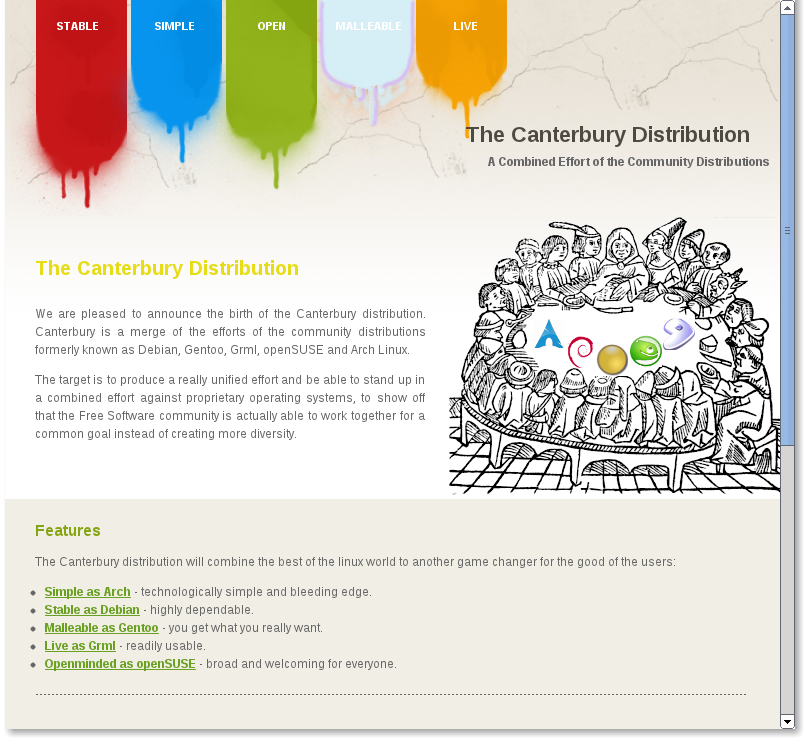
 I'm sure you already heard the news about the new
joined
Canterbury
Distribution,
and are eager about details.
While our teams are struggling to integrate all the existing
infrastructure, it's my pleasure to announce that the first pieces of the
collaboration are already available for our users.
As a first measurement, a common Canterbury Package Manager, called
cant will be made available in all distributions. It is already
available for the distribution formerly known as Archlinux, and
with the next mirror push will also be available for those used to run
Debian.
You'll be pleased to know, that the command line syntax isn't much of a
change, you can still run cant search, cant install or
cant remove, but future version will also introduce all the
features known from the other distributions.
Stay tuned for further updates of Canterbury Linux!
For the whole week, I ve been in Bangalore for the GNOME.Asia 2011 hackfest. I ve been delegated by Stefano to represent Debian here, and my employer EDF has agreed to cover for travel costs since they are very interested in first-hand information the future of the Linux desktop and sharing our work on scientific computing.
It s been a really exciting week; I ve spent quite some time packaging missing pieces of GNOME 3.0 (well, the release candidate versions of course) in experimental, together with Fred Peters. I think it s reaching a usable state now, so we ll probably soon provide metapackages to make it easily installable.
The latest developments of the Shell make it a very exciting piece of software, with a strong focus on usability. Many things were written about it, but in the end my main criticism would be that it lacks some functionality - for example, the combined clock/weather/locations applet will be greatly missed. The good news is that it is extremely customizable, and with all the libraries being made accessible through GObject introspection, there are many features that are accessible from it. If you know how to write JavaScript, now is the time to write your favorite extension.
On the good news front, Vincent Untz also spent a lot of time improving the so-called legacy mode , which is more and more starting to look like the Shell without special effects, and with all the features from gnome-panel 2.x that are still here. We will try in Debian to cover all uses cases that there were for GNOME 2 with GNOME 3 technology, so that panel lovers are not left behind.
I ve also proposed an update to the dh_gsettings proposal, which will provide the same functionality as dh_gconf and allow to easily set distribution-specific overrides. It is still missing a way to set mandatory settings, which might come as a problem for some corporate users, but this is planned for a future version of GSettings.
Today, we re having a business track where I and representatives of other companies (Oracle, Lanedo, Dexxa) are sharing experiences about making money with free software. Unfortunately the local organizers didn t manage to gather many people, despite our being in a city with an incredible number of IT industries.
Tomorrow, the public conference starts, and this should be the opposite: we re expecting around 1000 people, which is a great achievement for a free software conference.
For an unrelated topic, being around so many GNOME hackers has some interesting side effects; I ve been added to Planet GNOME. So, hey, hello Planet GNOME readers!
 The student application period for applying to GSoC opened last Monday and we already have a couple of very good applications from students. We are still missing yours!
The list of Debian projects includes a nice variety of projects:
 In one of the corners of what is now know as Europa, there was a rich,
prosperous and beautiful kingdom known as Trist nia. In the past, not
that long ago, it had been a number of smaller kingdoms and
caliphates, all with their own cultures, religions and ways of life. Wars,
and series of marriages of convenience eventually configured what ended up
being the united kingdom of Trist nia. Throughout the years, some of the
unified cultures grew and flourished, while others struggled to survive in
their ever-shrinking areas of influence.
A required introduction
Sometimes, the minor cultures would suffer due to oppression coming
from the delegates of the King, who would ban any expression of these
cultures, as they were seen as a potential threat to the kingdom's
stability and unity. For example, just a few decades before the main
subject of this tale, the predecessor of the incumbent King took power by
force, after crushing everyone who opposed his uprise during a bloody and
hard civil war. His reign was ruthless and he imposed draconian laws
uppon his people: usage and teaching of the minor languages was banned,
and everyone was forced to use the language of the Centr lia region, in
public or private.
After four decades, the majority of the Tristanian people were sick enough
of the situation to consider standing against their fear of the regime and
demand freedom, but repression prevailed until the old general died. His
place was taken by the King's grandson even if the people had expressed,
just before the Great War, that they had had enough kings and demanded a
ruler they could choose directly. Of course, the new King seemed a lot
nicer than who they had been suffering for ages, so when asked if they
accepted the new situation, an overwhelming majority said yes .
However, there was a region, Verd lia, where the majority said no .
Things were actually more complicated. Verdalians formed a traditional,
proud society, and while the years of oppression had undoubtedly weakened
it, they had managed to preserve their very unique culture, language and
traditions healthy. The Verdal language was really weird to the
ears of Centr lians and even other minor cultures of the Kingdom, and
erudites struggled to find its real origins, not being able to reach
plausible conclusions.
Verdanians, as we already know, were a traditional society, living in a
land of deep and poorly connected valleys. Little they knew or cared about
the complicated matters of Centr lia and other regions. What made them
happy was to take care their sheep and cows, keep a good fire in their
living room and, every now and then, enjoy one of their log cutting
contests. The impositions of the former dictator were too much for them,
and some of them started sabotaging, assaulting and killing some of the
dictator's soldiers, agents and officers. This was a huge risk at the
time; getting caught meant death penalty for sure, and at first, even
people from other regions were in favour of these actions. However, this
popular support greatly diminished when the new King took the throne, as
these minority continued with the killings, while most of the people saw
it was no longer justified.
The Royal Ball
One of the very first measures the young King introduced was to organise
the Royal Ball of Trist nia , a major event through which the people of the
different regions would be able to elect their delegates to the Crown.
Every four years, a Great Ball contest would happen in Centr lia, and the
winners would be able to decide by their own on some of the matters that
affected their region. Verdanians would send a few teams of dancers, each
of which came from different towns or areas. Some Verdanian teams were
happy about the King and the new political situation, but other teams
weren't so much. And some others, while being simple non-violent dancers,
were known to be supporters of the violent minority who kept on harassing,
assaulting and even killing in their struggle for freedom of Verd nia .
The Verdanian groups aligned with the different culture of Verd nia
(including those who were said to support the violent) tended to get a lot
more points in the dancing contest, and a majority of the elected delegates
were appointed by them, making it easier to pass laws and edicts that
favoured protection of their ways, traditions and language.
No matter how hard they tried, the dancing groups closer to Centr lia
kept losing to the majority. After many years of dance contests, these
groups used their closeness to the King's court to pass the Ball Law of
Tristanian, that would ban any dancing group which didn't condemn the assaults
and killings that kept happening in Verd nia. The unsurprising result was
that, with less dancing groups participating in the following Royal Ball, the
Verdanian majority was broken and new delegates, friendly of the
Centralian officers, were elected.
Many people who had been in favour of assaults and killings began to
question this strategy, and this political movement's unity started to
break. In the end, the dancers decided to part ways with the violent; they
wanted to dance in the next ball, and to do so, they wrote a letter to the
King, in which they explicitly expressed their rejection of violent ways,
and their embracing of dancing as the only means to drive their political
agenda. An objective reading of the new Ball Law clearly showed that this
was enough: the text only said the requisite for a dancing group was to
disavow all kinds of violence.
This wasn't really expected in Centr lia, so they started to add new
requirements in an attempt to keep this group from the contest: their
decisive majority in Verd nia was at stake.
The Royal Ball was nearing and registrations for the contest would soon
close. The Centralian government first argued that the dancing group
should reject the violence coming from the Verdanian extremists in
particular. The dancers did it. Then they argued that the dancers were the
same people who had been supporting violence in Verd nia for years, and
obviously their violence rejection statement was a lie. The dancers
struggled to find new dancers who had not been involved in past dances.
But it was not enough. They then claimed that this dance group should be
quarantined for four years, until they could prove they really were
serious about their new non-violent ideas.
The dance group made a plea to the Trist nian Supreme Counsel, a group
of sixteen experts in law of the Kingdom, and argued that all of these
draconian requirements were not part of the law that was being enforced by
the King. Their appeal to the elder counselors was in vain, though. They
ruled this dancing group was as criminal as the violent minority they had
once supported, and should by no means take part in the Royal Ball.
As a last, desperate measure, the dancing group reached an agreement
with other Verdanian dancers to join forces. They would adopt a new name
and new dancing costume colours. Many feared this would only end up in the
ban of the other dancing group.
Unfortunately, the end of this story has not been written yet, but it
will be completed very soon. Only time will tell if things continue being very
sad and unfair in Trist nia, or if the dance contest will once again be
impartial, with legitimate results.
 Este post tambi n est escrito en espa ol.
 If you follow me on Twitter/Facebook, you probably know that I went to Gothenburg, Sweden, during my last trip to Europe. But you probably don t know what I did in such remote city.
Few months ago, I applied to a PhD student position at Chalmers. I was lucky enough to be shortlisted, so I went to some in-situ interviews. And, incredibly, I have been accepted! :-)
Chalmers is a TOP 100 university. Most of the papers I read during the last months has been written by Chalmers researchers and for me is a great honor to be part of an academic institution with such prestige.
I m going to move to the nice Gothenburg city in August. And I m happy :)
 At work, I'm dealing with lots of different database setups, luckily mostly
PostgreSQL running on Debian. At the same time, a fair amount of the tools in
the PostgreSQL ecosystem (not the PostgreSQL server packages itself) are not in
the best shape in the Debian archive.
I'm trying to change that by adopting some of the packages. So far, I have
fixed a few RC bugs where packages where suddenly trying to build against
PostgreSQL 9.0 while expecting 8.4. To my surprise, there are no packages yet
in the archive that support multiple PostgreSQL versions in parallel. There is
even a package ready to help doing this -
postgresql-server-dev-all,
but apparently nobody has used it yet. It turned out that after working around
a few trivial problems and adding just a few lines of sh code, it was pretty
straightforward
to port skytools and
postgresql-pllua
to 9.0 while keeping 8.4 support. The latter has no version-specific code left
in debian/ except for a list of supported versions in debian/pgversions, so a
future port to 9.1 will be trivial. (Fun fact: the old postgresql-pllua version
0.8.1 was actually a typoed 0.3.1 version.)
Most PostgreSQL tools use a common
subversion repository on Alioth,
but there is no common mailing list address that is put into the Uploaders
fields, so it is hard to get an overview over the state of all packages. I've
compiled a list of all packages in svn, git, bzr (the server packages), and a
few others
in DDPO
to fix that for now.
Other packages I've updated so far are
pgtune,
pgbouncer, and
pgpool2.
Next.