Search Results: "ed"

24 January 2012

James Morrison: Appengine backends and task queues

To get appengine to send queued tasks to a backend, you need to set the host header when queuing the task. E.g.
    deferred.defer(
batch.DoStuff, arg1, arg2, arg3,
_headers= 'Host': backends.get_hostname(backend='backend_name') )

James Morrison: CMYK images in PDFs

For the few of you out there that are parsing PDFs manually in python, JPEG images (including CMYK images) can be extracted with the following code fragment.
  # reader is a PDFReader object from pyPdf, value is the operand to a Do operator. 
from PIL import Image, ImageChops

xobject = reader.getObject(value)
if xobject['/Filter'] == '/DCTDecode':
raw_data = xobject.getRawData()
if xobject['/ColorSpace'] == '/DeviceRGB':
_CreateFile('image/jpeg', filename, raw_data))
else:
f = cStringIO.StringIO(raw_data)
of = cStringIO.StringIO()
i = Image.open(f)
if xobject['/ColorSpace'] == '/DeviceCMYK':
i = ImageChops.invert(i)
i.convert('RGB').save(of, 'JPEG')
_CreateFile('image/jpeg', filename, of.getvalue())

The CMYK images I found in the PDFs needed to inverted. PIL versions before 1.1.7 would do that for you, but version 1.1.7 removed in the ImageChops.invert() call.

Tim Retout: Lenovo X121e 3G with ModemManager

Recently, I tried to get 3G working on my Lenovo ThinkPad X121e - it has an Ericsson F5521gw mobile broadband card. This is supported by ModemManager, but all I got were unknown errors (276 and 272). Searching online, there were very few results (hence this short note) - just previous unrelated Linux kernel issues. I found someone with the same problem on Fedora, but no solution, so I started off by filing a bug report with Debian. Of course, then I found the Arch user who had filed the same bug on Launchpad, and had discovered that resetting the BIOS to its default settings fixes the issue. If only that page mentioned the keywords "Ericsson", or "Lenovo"... So after all that, it was just some weird BIOS issue. I hate hardware.

Sylvain Beucler: OpenGL ES 2.0 using Android NDK

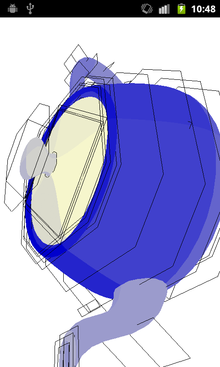
Teapot on Android I got myself a second-hand Samsung Galaxy S at last, and started hacking on it! The very first thing I wanted to try was porting the OpenGL wikibook C++ samples, that we wrote with OpenGL ES 2 in mind. I started writing a minimal GLUT-compatible wrapper to run the samples as-is, using the Android NDK, and I'm making progress :) The Android NDK is getting nicer with Android 2.3, though it still feels less supported than Java apps (e.g. the resize events seem buggy and the keycodes header is incomplete...). Nonetheless, it's nice to be able to write C++ portable apps. You can see how to use the wrapper, and how it works internally, at: http://en.wikibooks.org/wiki/OpenGL_Programming/Installation/Android One of the limitations is that GLES2 is not a true subset of OpenGL 2.1, in particular: I needed to pre-process these differences away, checking on GL_ES_VERSION_2_0 in the C++ source code to define a GLES2 macro in the shaders:
#ifdef GLES2
varying lowp vec4 f_color;
# else
varying vec4 f_color;
#endif
Is there a better way?

Stefano Zacchiroli: hardware sponsorship for Debian Developers

A few days ago Yves-Alexis Perez asked me how many hardware sponsorship request I usually get from Debian Developers, that is how many people ask me to use Debian money to buy material that can improve their work on Debian and indirectly Debian itself. The answer is "too few".
Making it easier for our developers to improve Debian is a worthwhile investment of money donated to Debian. Of course such a use of money should be motivated (i.e. you should be able to justify how the material you're asking for would improve Debian and why it should be Debian paying for it) and transparent (i.e. you should periodically report about what you're doing with material that Debian has bought for you to use). The above two principles are what I've tried to convey in a new section of the sponsoring guidelines wiki page I've been maintaining for a while. Comments and improvements highly welcome! Equally welcome are advocacy messages for hardware sponsoring to other fellow Developers, as suggested by Corsac.

Michal Čihař: It's too early for GSoC 2012

It looks like with start of the new year, people started to ask for phpMyAdmin's projects for GSoC 2012. Given that we have no information whether there will be Google Summer of Code this year and whether we will be chosen to participate, these questions look quite premature. On the other side you can start contributing any time and if you are already known in the community, you might have better chance being accepted. So forget speaking about hypothetical GSoC projects for now and start fixing some bugs, which is something much more needed right now (given that 3.5 is in alpha state). If you are looking for more information, we have basic facts for developers on our website, there is also a wiki page mentioning some tasks for junior developers.

Filed under: English Phpmyadmin 0 comments Flattr this!

Charles Plessy: Strange Megumi

It is since two days that all my emails, @debian.org included, are in parked somewhere between the sender and my MX, as my server broke at a moment where I strictly had no time (dealine for a grant application). It is an OpenRD Ultimate with a second hand SSD. I was quite happy to have an ARM system available to test some packages like T-COFFEE, but it looks like I will have to do without. Apparently, the machine permanently reboots. I did not manage to access to the USB serial port; there are no 10 seconds where the USB port is not disconnected / reconnected. Both ethernet port LEDs blink together synchronously with the disconnections. Removing the drive did not solve the problem. The SSD itself is fine, and I did not find in the logs hints for software problems. Strange coincidence, the last log file that was modified is daemon.log, which indicates the connection of so-called megumi-PC to our unprotected, but to my knowledge never visited, wireless network. After this, nothing.

Gunnar Wolf: BugCon friends, are you trying to scare away 50%+ of the target audience?

You are scaring away much more than that. I just came across an invitation for BugCon 2012. BugCon is a Mexican conference devoted to computer security I cannot comment on its level or value because, although it's a topic that has long interested me, I must recognize each day I feel less of an expert, nowadays finding myself at the level of a "sysadmin who tries not to be too dumb for his own job security". Oh, and also because it would be completely off-topic for this post. If you look at Vendetta's (the main organizer) blog post, it will probably give you the impression that the conference is just an excuse for the afterparty: Lets go see some b00bs! Do you think your fellow female hackers will have any interest in joining a bunch of sex-starved, hormone-infested teenagers who only want to pwn a website and grab more pr0n? Do you think females will feel welcome (or even mildly safe) between you? I would not think so. And I also think you are alienating any professional who might have any interest in joining your community, be it as a member, as a mentor, or whatnot. I cannot right now do a coherent post on this topic, but I can reference you to what I have seen (and read) over the last almost 10 years, when the issue was first brought up to our attention. I am very glad to see that, at least in the Free Software area, there has been a real change of mindset. I hope you are in time to think about it and rectify. Oh, and not the description of an incident, but a very interesting and thoughtful take on this: [pdf] Interesting analysis by Hannah Wallach on the numbers and motivations of women in Free Software groups. I don't know if Hannah has published this in article form, but many interesting points can be understood by looking at the presentation. My good friend Vendetta: I don't mean this post (longer than what I originally intended) as a way to say you and the conference you are organizing for the third year (IIRC) already is unprofessional or targetted to pimply teenagers. I know the work you have put in it. I hope you see the points I'm trying to drive You are of course free to have whatever afterparty you have. But, if as the main organizer, you are giving the images of nice chicks at Hooters more weight and relevance than to the conference itself... you are doing yourself a disservice. I hope you can rectify it, and make BugCon attractive to hacker women as well.

Julian Andres Klode: Managing system package selections using custom meta packages

Over the last years, I have developed a variety of metapackages for managing the package selections of the systems I administrate. The meta packages are organized like this:
jak-standard
Standard packages for all systems
jak-desktop
Standard packages for all desktop systems (GNOME 3 if possible, otherwise GNOME 2)
jak-printing
Print support
jak-devel
Development packages
jak-machine-<X>
The meta package defining the computer X
Each computer has a jak-machine-X package installed. This package is marked as manually installed, all other packages are marked as automatically installed. The machine packages have the attribute XB-Important: yes set in debian/control. This creates an Important: yes field. This field is not official, but APT recognizes it and does not remove those packages (the same field is set for the APT package by APT when building the cache, as APT should not be removed either by APT). It seems to work a bit like Essential, with the exception that non-installed packages are not installed automatically on dist-upgrade. The meta packages are created using seed files similar to Ubuntu. In contrast to Ubuntu, I m not using germinate to create the packages from the seeds, but a custom dh_germinate_lite that simply takes a seed file and creates the correct substvars. It s faster than germinate and really simplistic. It also does not handle Recommends currently. The whole result can be seen on http://anonscm.debian.org/gitweb/?p=users/jak/jak-meta.git. Maybe that s useful for some people. And if you happen to find some packages in the seeds that are deprecated, please let me know. Oh, and yes, some packages (such as the letterman one) are internal software not publically available yet [letterman is a simple GUI for creating letters using LaTeX]. While I m at it, I also built Ubuntu s version of wine1.2 for i386 squeeze. It can be found in
deb http://people.debian.org/~jak/debian/ squeeze main (it still needs a few changes to be correct though, I ll upload a jak2 build soon). I also built updated sun-java6 packages for my parents (mostly needed due to the plugin, some websites do not work with the IcedTea one), but can t share the binaries due to licensing requirements. I may push out a source repository, though, so others can build those packages themselves. I ll let you know once that s done.
Filed under: Debian, General

Rapha&#235;l Hertzog: Answering questions of Debian users on various support channels

When you start your journey with Debian, you tend to have lots of questions. You ll find some answers in various documentations but there always are remaining questions. Those can be asked on various support channels: Those are the places where you can also start your journey as a Debian contributor instead of asking questions, you just have to answer questions of other users! Let me share some advice if you want to do some user support. User support is difficult It s not always an easy task. Some users are more skilled than others and there might be difficulties related to the language, English is not always the native language of a user who asks a question in English. Be respectful and courteous when you answer user questions, even if they made mistakes. You re effectively representing Debian and you should give out a good image of the project. If you don t have the patience or the time needed to do a good answer, don t reply and let someone else take care of this user. I invite you to read (and follow!) the Debian Community Guidelines. Avoid RTFM answers, instead you should show the users how they could have found (alone) the solution to their problem. We don t want to scare people away, we want to grow our community. But it s also rewarding In some cases, the problem reported by the user will be a real problem and you ll have an opportunity to file a good bug report, thus helping to improve Debian for everybody. Often, you don t even have the answer to the user s question. But you re more skilled than him/her to do researches on the web, or you know of a good documentation that might contain the relevant bits of information, in any case you re doing further research to help this user. In this process, you also grow your own skills since you re learning stuff that you didn t know yet. At least that s how I learned many things during my first year in the Debian community there s no reason why you couldn t learn lots of stuff that way, in particular if you also read the answers of other skilled people on those channels (it takes a bit of training to learn who are the skilled people though). I still believe that doing user support is one of the best ways to join the Debian community and to start contributing. It helps you to grow your skills, and to slowly progress from average user to advanced user .
If you want to start contributing to Debian, click here to subscribe to my newsletter and get future updates for new contributors. You can also follow me on Identi.ca, Google+, Twitter and Facebook.

5 comments Liked this article? Click here. My blog is Flattr-enabled.

C.J. Adams-Collier: SOPA response from Representative Rick Larsen, WA 2nd District

Below is an email I received from Representative Rick Larsen s office. I don t recall ever having identifying myself as PVT Adams-Collier in any communications with his office, though I could have done so at some point. Maybe. I also don t recall contacting his office directly concerning SOPA. I blogged a few things and mentioned him on facebook a couple of times, though. It is good to know that I don t always have to go directly to my representative to have my voice heard. For those playing along at home, I think the best course of action would be for producers to perform searches for their work on peer-to-peer file sharing search engines such as http://thepiratebay.org/ and http://scrapetorrent.com/. If producers find that their work is being distributed in a way which is contrary to their wishes, I advise the producer or their agent to contact the individuals operating seeds with high share ratio in order to ensure that they perform AAA before accepting new peers into the swarm. Those seed operators who refuse to negotiate reasonable AAA terms should be issued C&D orders, and legal action should be taken, should they fail to comply with the request. [edit 2012-01-24T05:27:44] It would probably be wise to impose a minimum fee of $5 for seed operators per content package they distribute. This will encourage them to pass this fee on to their subscribers in a legal and responsible manner. I recommend that it be distributed in the same fair and concise way in which the tickets are distributed for toll violations on the Tacoma Narrows Bridge. Ask me how I know. This will provide content producers a valuable distribution channel which is closely in touch with the consumers of the producers media. I believe that if the producer puts forth effort in good faith to develop and maintain relationships with key distribution points, we will see a situation where both content producers and consumers get what they want. The authorization phase of the AAA system could charge a Payment Card Industry or bitcoin account a reasonable fee. My employer produces content delivery appliances which would serve quite well the role of AAA gateway. For an example of this use case in action (sans account billing), I recommend contacting seeding participants of the Debian CD/DVD swarms. I will proxy such requests if there is interest. An alternative might be a tool developed for the online gaming community with a strange name: http://www.evenbalance.com/

Dear Pvt. Adams-Collier: Thank you for contacting me about the Stop Online Piracy Act (SOPA) and the Protect IP Act (PIPA). I wanted to update you on my views on this important issue. I am opposed to SOPA and PIPA in their current forms. I believe that these bills create unacceptable threats to free speech and free access to the internet. I have heard from many of you in Northwest Washington who are deeply concerned about the potential impacts of SOPA and PIPA. Online piracy is a serious problem that costs U.S. businesses billions of dollars. Government agencies must be empowered to stop and prosecute intellectual property thieves. But in doing so we cannot undermine freedom of speech or jeopardize the free flow of information on the internet. I will work with my colleagues to see that any final anti-online piracy legislation protects the internet and does not encroach on free speech rights. Please be assured that I will keep your thoughts in mind should I have the opportunity to vote on any legislation that would impact online piracy and internet freedom on the House floor. Again, thank you for contacting me. I encourage you to contact me in the future about this or any other issue of importance to you. Sincerely, Rick Larsen
United States Representative
Washington State, 2nd District
[edit 2012-01-24T05:28:09] Sincerely, C.J. Adams-Collier
San Juan County Democratic Central Committee (*whew*) PCO
San Juan County, Washington State, Orcas 3 District

Lior Kaplan: RTL status for Libre Office 3.5.0

As LibreOffice is approaching its final 3.5.0 release, I d like to sum up the RTL status for RC1. So far, 6 RTL related bugs were resolved in the 3.5 cycle (#32530, #34222, #40950, #43790, #43793, #44078), and a few minor issues reported directly to the developer s mailing list got quick responses. Most importantly, the new features of page break and header/footer not only support RTL but actually looks good. During the LibreOffice conference I was suggested to help with these features, providing feedback, and I m glade the needed attention was given to it. Besides that, a few l10n and translation issues were solved in the process of doing the Hebrew translation (which also reflects on other RTL languages). At a few cases, these issue because a general l10n issues which affects all the languages. In general, I found the core developers responsive to mails about RTL support. I m sure the talk about RTL problems during the conference helped, as well as being more active in the project and having more personal acquaintance with the developers. That s being said, RTL support for LibreOffice still has problems, which I hope will be pushed during the 3.5.x cycles (full list at Bug 43808, the rtl meta bug). As to get some focus regarding was is to be done, I m listing the top problems:
  1. #44657 RTL UI: Horizontal scrollbar in calc main window is broken
  2. #33302 brackets inverted in rtl text (mac only)
  3. #37692 RTL list numbering reverses its direction
  4. #42070 - RTL support in broken in presenter Console extension
  5. #32531 - Incorrect cursor key movement between table cells of different directionality
  6. #104515 - RTL UI: moving active embedded object to the left moves it to the right (reported for OO.org, but verified in LibO)
  7. #37128 - Writer saves text alignment of RTL paragraph not according to the ODF specification
I hoped to have the first two done for 3.5.0, but didn t succeed in getting them fixed. Will keep trying
Filed under: i18n & l10n, Israeli Community, LibreOffice

23 January 2012

Neil Williams: Emdebian Grip automated dependency resolution

The script isn't fully automated yet, I'm running it manually and watching for errors, but I do now have a simple script (~100 lines of perl) which runs edos-debcheck against each of the supported Emdebian architectures for unstable-grip and picks out those packages which are missing from the subset of packages which Emdebian monitors for Grip.

I was hoping to make these scripts into a normal Debian package but there are some limitations in that the scripts need to assume various pieces of Debian infrastructure. e.g. I started off using rsync to pull in the Packages files (along with Release and Sources) because apt has annoying behaviours with multiple architectures. (Emdebian Grip processes 7 architectures simultaneously on blavet.debian.org). Peter Palfrader kindly arranged for a local mirror to be available and now the entire Packages processing can be done using symlinks. Much, much better.

Actual package movement data comes directly from dak via projectb - something else which makes packaging these scripts for use on non debian.org boxes a bit hard.

Once again, I am indebted to the EDOS team (please, please keep working on edos-debcheck - it hasn't had uploads recently) because I tried to get this working with germinate but failed. (Colin - I'll be looking to borrow some of your time to work out what was going wrong.)

The dependency resolution script now means that I can meet release team requirements that when foo is updated in sid to depend on libbar2 but Emdebian Grip only has libbar1, the scripts will automatically pick up libbar2 and add it to Emdebian Grip. The current sid version gets pulled in and (the theory goes) will migrate into testing-grip as an almost automatically valid candidate. Processing of the dependency can happen within hours of the updated version of foo arriving in Emdebian Grip but as long as it happens within a few days I think everyone will be fine with it.

I've got a sync script too which can periodically run across the entire suite and check for packages which have slipped the net. I'll have to see how often that needs to run but once a week doesn't sound too painful.

Processing for Emdebian Grip is very fast. Most of the time is taken uploading:

2012-01-23 22:24:42 add sid-grip deb main armhf libfltk-images1.3 1.3.0-5em1
2012-01-23 22:24:52 add sid-grip deb main i386 libfltk-images1.3 1.3.0-5em1
2012-01-23 22:25:07 add sid-grip deb main mips libfltk-images1.3 1.3.0-5em1
2012-01-23 22:25:25 add sid-grip deb main powerpc libfltk-images1.3 1.3.0-5em1
2012-01-23 22:26:00 add sid-grip deb main amd64 libstdc++6-4.5-dev 4.5.3-12em1
2012-01-23 22:26:34 add sid-grip deb main armel libstdc++6-4.5-dev 4.5.3-12em1


(It was a lot longer, comparatively, when I was having to rsync and then dget instead of just read from the local filesystem.)

I've also been working on an init script which will gradually work through the subset of packages by order of Priority - approximately what a new architecture (like armhf) would do. Note that Emdebian Grip supports armhf already. The only slight concern is whether the init script needs to be throttled back to not flood the queues with hundreds of uploads an hour (which it could end up doing, at least for the first 24 hours).

Logs of package movements are available: http://www.emdebian.org/grip/logs.php

Packages can be searched too: http://www.emdebian.org/grip/search.php

More on Emdebian Integration on the Debian wiki: http://wiki.debian.org/EmdebianIntegration

Now all I need is a fix for #655919 :-) FTP team?

Christian Perrier: 2012 update 6 for Debian Installer localization

When you shake the tree, things happen..:-). I sent targeted update requests for level 2 (mostly espeakup and grub2). Status for D-I level 1 (core D-I files): Status for D-I level 2 (packages that have localized material that may appear during default installs, such as iso-codes, tasksel, etc.): Status for D-I level 3 (packages that have localized material that may appear during non-default installs, such as win32-loader) Full 100% completeness (hall of fame) for 14 languages: Bulgarian, Czech, German, Esperanto, Spanish, French, Italian, Japanese, Kazakh, Dutch, Portuguese, Russian, Slovak, Simplified Chinese

Matthew Garrett: UEFI and bugs

I gave a presentation on UEFI at LCA 2012 - you can watch it here, with the bonus repeat (and different jokes) here. It's a gentle introduction to UEFI, followed by some discussion of the problems we've faced in dealing with implementation bugs.

The fundamental problem is that UEFI is a lot of code. And I really do mean a lot of code. Ignoring drivers, the x86 Linux kernel is around 30MB of code. A comparable subset of the UEFI tree is around 35MB. UEFI is of a comparable degree of complexity to the Linux kernel. There's no reason to assume that the people who've actually written this code are significantly more or less competent than an average Linux developer, so all else being equal we'd probably expect somewhere around the same number of bugs per line. Of course, not all else is equal.

Even today, basically all hardware is shipping with BIOS by default. The only people to enable UEFI are enthusiasts. Various machines will pop up all kinds of dire warnings if you try to turn it on. UEFI has had very little real world testing. And it really does show. In the few months I've been working on UEFI I've discovered machines where SetVirtualAddressMap() calls code that has already been (per spec) discarded. I've seen cases where it was possible to create variables, but not to delete them. I've seen a machine that would irreparably corrupt its firmware when you tried to set a variable. I've tripped over code that fails to parse invalid boot variables, bricking the hardware. Many vendors independently fail to report the correct framebuffer stride. And those are just the ones that have ended up on hardware which crosses my desk, which means I haven't even tested the majority of consumer-grade hardware with UEFI.

The problems with UEFI have very little to do with its design or the ability of the people implementing it. After a few years of iterative improvements it stands a good chance of being more reliable and useful than BIOS. Increased commonality of code between vendors is a blessing and a curse - in the long term it means that these bugs can be shaken out, but in the short term it means that at least one hardware-destroying bug has ended up carried by multiple vendors. Right now we're still in the short term and it's likely that we'll find yet more UEFI bugs that cause all sorts of problems. The next few years will probably be a bumpy ride.

comment count unavailable comments

Philipp Kern: Call for testing: Upcoming Squeeze point release 6.0.4

Adam sent a new call for testing for the next point release of Debian Squeeze. Please test the packages in squeeze-proposed-updates on some machines running squeeze if possible, so that we don't screw up your production machines with bad updates in a week. The point release is scheduled for January 28th, i.e. next Saturday. Don't forget to copy the debian-release mailing list when you encounter regressions. Thanks for your efforts.

If you want to receive these notices by mail, please subscribe to the debian-stable-announce mailing list.

22 January 2012

Jonathan McDowell: I want you to see my storage automagically

For my day job I build storage systems. A lot of what I do at present involves caring a lot about how different OSes deal with things like new LUNs being presented from a SCSI target, or errors along a subset of the available paths to a device. It will come as no surprise to you to discover that they all suck (for values of all equal to Linux, Solaris, Windows and VMWare). New LUNs are particularly annoying. I'm in the situation that creation and removal of a LUN is exceptionally easy. Hmmm. Maybe I need to back up here a bit first. SCSI has the concept of a target (think, device, eg hard drive). Each target can present multiple logical units. Each of these is assigned a number - a Logical Unit Number. Most devices (a hard drive, or a CDROM drive) will present a single LUN. A storage array will tend to present multiple LUNs; one for each volume that is exported to the host. At the host level each LUN really just looks like a separate device (for Linux /dev/sda and /dev/sdb may well be separate LUNs on the same array, rather than 2 separate arrays/hard drives, for example. At the block device level you don't care about the difference usually). Anyway. For various reasons I end up adding and removing LUNs quite often. And there are ways for the array to indicate that this has happened to the host (the UNIT ATTENTION/REPORT LUNS DATA CHANGED check condition seems to be favoured these days, as a complete Fibre Channel LIP can be disruptive). What I'd like to happen in that case is the host to pick up the check condition and drop and/or add the devices that have changed. Instead everything wants a manual rescan. rescan-scsi-bus tends to be simplest for Linux. Windows wants a manual refresh in Disk Administrator. VMWare a "Rescan HBAs" from vSphere. Solaris a "devfsadm -C" and possibly a "cfgadm -al" first. And all of these can be temperamental about picking up the changes. We've done a lot about hotplug for the desktop user experience, without doing the same level for the server experience. I appreciate that there are situations that you don't want your server to reconfigure things without being told to, but the current situation can be detrimental (for example Linux multipathing will hold a device open even after it's disappeared and is returning an "INVALID LUN" response; it would be much better if it could cleanly close that device and wait for it to return). Storage is capable of being much more than just a single block device these days, and it's a shame that nothing seems to deal fully with that fact. (Yes, yes, I should write and submit patches, but I appreciate that there's not always a simple answer, nor necessarily an answer that works for all situations automatically. Plus, y'know, not enough hours in the day and I hope you all appreciate I've taken a break from watching BSG to write this.)

Kees Cook: fixing vulnerabilities with systemtap

Recently the upstream Linux kernel released a fix for a serious security vulnerability (CVE-2012-0056) without coordinating with Linux distributions, leaving a window of vulnerability open for end users. Luckily: Still, it s a cross-architecture local root escalation on most common installations. Don t stop reading just because you don t have a local user base attackers can use this to elevate privileges from your user, or from the web server s user, etc. Since there is now a nearly-complete walk-through, the urgency for fixing this is higher. While you re waiting for your distribution s kernel update, you can use systemtap to change your kernel s running behavior. RedHat suggested this, and here s how to do it in Debian and Ubuntu: In this case, the systemtap script is changing the argument containing the size of the write to zero bytes ($count = 0), which effectively closes this vulnerability. UPDATE: here s a systemtap script from Soren that doesn t require the full debug symbols. Sneaky, put can be rather slow since it hooks all writes in the system. :)

2012, Kees Cook. This work is licensed under a Creative Commons Attribution-ShareAlike 3.0 License.
Creative Commons License

Jonathan McDowell: Totally divorced

I got divorced earlier this month; the decree absolute arrived in the post last weekend. I'm hoping this isn't news to anyone who knows me well, and I only really mention it here as an endpoint given that I blogged about the wedding itself.

Gregor Herrmann: RC bugs 2012/03

here's the list of RC bugs I've worked on during the last week:

Next.

Previous.