Search Results: "zed"

15 September 2014

Keith Packard: xserver-pending-fixes

A Forest of X Server Changes We've got about another month left in the X server merge window for 1.17 and I've written a small set of fixes which haven't been reviewed yet for merging. I thought I'd advertise them a bit and see if I couldn't encourage a few of you to take a look and see if they're useful, correct and complete. All of these are in my personal X server repository:
git://people.freedesktop.org/~keithp/xserver.git
Cleaning up the X Registry Branch: registry-fixes I'll bet most of you don't even know about this code. It serves as a database mapping various X enumerations to strings to aid in diagnostics. For the security extensions, SECURITY and XSELinux, it holds names for all of the request, event and errors in the core protocol and all registered extensions. For X-Resource, it has the names of the registered resource types. The X registry gets the request, event and error data from a file, "protocol.txt", which is installed in /usr/lib/xorg/protocol.txt on my machine. It gets the resource names as a part of resource type allocation. So, what's wrong with this? Three basic things:
  1. A simple bug -- protocol.txt is left open while the server runs. This consumes a file descriptor for no good reason.
  2. protocol.txt is read and parsed even if the security extensions aren't available. This wastes time and memory.
  3. The resource names are kept even if X-Resource isn't in use.
The fixes remove the configure options for including the registry code; these functions are only used by the above extensions, so we can tell whether to include the code based solely on whether the extensions are being built. Getting rid of the TCP listener by default Branch: listen-fixes We've had the '-nolisten' option for a while now to disable inbound TCP connections. It's useful for security reasons, but we've never enabled this by default. This patch sequence provides configure options for each of the listen sockets (tcp, unix and local), leaves unix and local enabled by default and disables tcp by default. A new option, '-listen', is added which allows the user to override the -nolisten defaults in case they actually want to use TCP connections to X. Glamor bug fixes branch: glamor-fixes This branch fixes two bugs:
  1. Scale a large pixmap down to a small pixmap. This happens when you display enormous images in a web page. Iceweasel sends the whole huge image to X and uses Render to scale it to the screen. If the image is larger than a single texture, the X server splits it up into tiles, but the code which tries to perform the merged scale is just broken. Five patches fix this.
  2. Shader-based trapezoids. This code uses area coverage to compute trapezoids. That violates the Render spec, which requires point sampling. Further, the performance of these trapezoids is lower than software (by a lot). This one patch removes the code.
Present bug fixes branch: present-fixes A selection of small bug fixes:
  1. Clear pending flips at CloseScreen. This removes a reference to any pending flip pixmap, allowing it to be freed. Otherwise, we'll leak memory across server reset.
  2. Add support for PresentOptionCopy. This has been in the protocol spec for a while, and was completely trivial to implement. However, it never got done. One tiny little patch.
  3. Expose the Present API to drivers via sdksyms.sh. Until now, the present extension APIs have only been available inside the X server. This exposes them to drivers. This took a few cleanup patches first.
Use Present for Glamor XV branch: glamor-present-xv Painting XV to the screen should be done at vblank time to avoid tearing. Present offers vblank synchronized operations. Hooking those two together required a few new present APIs to expose the vblank functionality outside of the present code, then a bit of glamor code to hook up that new API to the XV bits. Switching Glamor to a GL core profile context branch: glamor-core-profile This patch set is still in progress, but demonstrates how close we are. We'll be requiring OpenGL 3.3 for this so that we get texture swizzling, which is required for our single channel objects. The changes present on the branch are:
  1. Switch single channel surfaces from GL_ALPHA to GL_RED.
  2. Use vertex array objects.
  3. Switch ephyr over to using a core 3.3 profile.
Still left to do is
  1. Switch Render code to VBOs
The core code uses VBOs everywhere, but the Render code doesn't. This means that all Render drawing fails, which makes the resulting server not very useful. My main objective for getting this done is to reduce memory usage by about 16MB, which is the space allocated for software rendering in Mesa in case someone does something which the hardware doesn't handle, and that can only with some legacy OpenGL APIs. Please help out! All of these friendly little patches are looking for a bit of review so that they can get merged before the 1.17 window closes.

Julien Danjou: Python bad practice, a concrete case

A lot of people read up on good Python practice, and there's plenty of information about that on the Internet. Many tips are included in the book I wrote this year, The Hacker's Guide to Python. Today I'd like to show a concrete case of code that I don't consider being the state of the art. In my last article where I talked about my new project Gnocchi, I wrote about how I tested, hacked and then ditched whisper out. Here I'm going to explain part of my thought process and a few things that raised my eyebrows when hacking this code. Before I start, please don't get the spirit of this article wrong. It's in no way a personal attack to the authors and contributors (who I don't know). Furthermore, whisper is a piece of code that is in production in thousands of installation, storing metrics for years. While I can argue that I consider the code not to be following best practice, it definitely works well enough and is worthy to a lot of people. Tests The first thing that I noticed when trying to hack on whisper, is the lack of test. There's only one file containing tests, named test_whisper.py, and the coverage it provides is pretty low. One can check that using the coverage tool.
$ coverage run test_whisper.py
...........
----------------------------------------------------------------------
Ran 11 tests in 0.014s

OK
$ coverage report
Name Stmts Miss Cover
----------------------------------
test_whisper 134 4 97%
whisper 584 227 61%
----------------------------------
TOTAL 718 231 67%

While one would think that 61% is "not so bad", taking a quick peak at the actual test code shows that the tests are incomplete. Why I mean by incomplete is that they for example use the library to store values into a database, but they never check if the results can be fetched and if the fetched results are accurate. Here's a good reason one should never blindly trust the test cover percentage as a quality metric. When I tried to modify whisper, as the tests do not check the entire cycle of the values fed into the database, I ended up doing wrong changes but had the tests still pass. No PEP 8, no Python 3 The code doesn't respect PEP 8 . A run of flake8 + hacking shows 732 errors While it does not impact the code itself, it's more painful to hack on it than it is on most Python projects. The hacking tool also shows that the code is not Python 3 ready as there is usage of Python 2 only syntax. A good way to fix that would be to set up tox and adds a few targets for PEP 8 checks and Python 3 tests. Even if the test suite is not complete, starting by having flake8 run without errors and the few unit tests working with Python 3 should put the project in a better light. Not using idiomatic Python A lot of the code could be simplified by using idiomatic Python. Let's take a simple example:
def fetch(path,fromTime,untilTime=None,now=None):
fh = None
try:
fh = open(path,'rb')
return file_fetch(fh, fromTime, untilTime, now)
finally:
if fh:
fh.close()

That piece of code could be easily rewritten as:
def fetch(path,fromTime,untilTime=None,now=None):
with open(path, 'rb') as fh:
return file_fetch(fh, fromTime, untilTime, now)

This way, the function looks actually so simple that one can even wonder why it should exists but why not. Usage of loops could also be made more Pythonic:
for i,archive in enumerate(archiveList):
if i == len(archiveList) - 1:
break

could be actually:
for i, archive in itertools.islice(archiveList, len(archiveList) - 1):

That reduce the code size and makes it easier to read through the code. Wrong abstraction level Also, one thing that I noticed in whisper, is that it abstracts its features at the wrong level. Take the create() function, it's pretty obvious:
def create(path,archiveList,xFilesFactor=None,aggregationMethod=None,sparse=False,useFallocate=False):
# Set default params
if xFilesFactor is None:
xFilesFactor = 0.5
if aggregationMethod is None:
aggregationMethod = 'average'

#Validate archive configurations...
validateArchiveList(archiveList)

#Looks good, now we create the file and write the header
if os.path.exists(path):
raise InvalidConfiguration("File %s already exists!" % path)
fh = None
try:
fh = open(path,'wb')
if LOCK:
fcntl.flock( fh.fileno(), fcntl.LOCK_EX )

aggregationType = struct.pack( longFormat, aggregationMethodToType.get(aggregationMethod, 1) )
oldest = max([secondsPerPoint * points for secondsPerPoint,points in archiveList])
maxRetention = struct.pack( longFormat, oldest )
xFilesFactor = struct.pack( floatFormat, float(xFilesFactor) )
archiveCount = struct.pack(longFormat, len(archiveList))
packedMetadata = aggregationType + maxRetention + xFilesFactor + archiveCount
fh.write(packedMetadata)
headerSize = metadataSize + (archiveInfoSize * len(archiveList))
archiveOffsetPointer = headerSize

for secondsPerPoint,points in archiveList:
archiveInfo = struct.pack(archiveInfoFormat, archiveOffsetPointer, secondsPerPoint, points)
fh.write(archiveInfo)
archiveOffsetPointer += (points * pointSize)

#If configured to use fallocate and capable of fallocate use that, else
#attempt sparse if configure or zero pre-allocate if sparse isn't configured.
if CAN_FALLOCATE and useFallocate:
remaining = archiveOffsetPointer - headerSize
fallocate(fh, headerSize, remaining)
elif sparse:
fh.seek(archiveOffsetPointer - 1)
fh.write('\x00')
else:
remaining = archiveOffsetPointer - headerSize
chunksize = 16384
zeroes = '\x00' * chunksize
while remaining > chunksize:
fh.write(zeroes)
remaining -= chunksize
fh.write(zeroes[:remaining])

if AUTOFLUSH:
fh.flush()
os.fsync(fh.fileno())
finally:
if fh:
fh.close()

The function is doing everything: checking if the file doesn't exist already, opening it, building the structured data, writing this, building more structure, then writing that, etc. That means that the caller has to give a file path, even if it just wants a whipser data structure to store itself elsewhere. StringIO() could be used to fake a file handler, but it will fail if the call to fcntl.flock() is not disabled and it is inefficient anyway. There's a lot of other functions in the code, such as for example setAggregationMethod(), that mixes the handling of the files even doing things like os.fsync() while manipulating structured data. This is definitely not a good design, especially for a library, as it turns out reusing the function in different context is near impossible. Race conditions There are race conditions, for example in create() (see added comment):
if os.path.exists(path):
raise InvalidConfiguration("File %s already exists!" % path)
fh = None
try:
# TOO LATE I ALREADY CREATED THE FILE IN ANOTHER PROCESS YOU ARE GOING TO
# FAIL WITHOUT GIVING ANY USEFUL INFORMATION TO THE CALLER :-(
fh = open(path,'wb')

That code should be:
try:
fh = os.fdopen(os.open(path, os.O_WRONLY os.O_CREAT os.O_EXCL), 'wb')
except OSError as e:
if e.errno = errno.EEXIST:
raise InvalidConfiguration("File %s already exists!" % path)

to avoid any race condition. Unwanted optimization We saw earlier the fetch() function that is barely useful, so let's take a look at the file_fetch() function that it's calling.
def file_fetch(fh, fromTime, untilTime, now = None):
header = __readHeader(fh)
[...]

The first thing the function does is to read the header from the file handler. Let's take a look at that function:
def __readHeader(fh):
info = __headerCache.get(fh.name)
if info:
return info

originalOffset = fh.tell()
fh.seek(0)
packedMetadata = fh.read(metadataSize)

try:
(aggregationType,maxRetention,xff,archiveCount) = struct.unpack(metadataFormat,packedMetadata)
except:
raise CorruptWhisperFile("Unable to read header", fh.name)
[...]

The first thing the function does is to look into a cache. Why is there a cache? It actually caches the header based with an index based on the file path (fh.name). Except that if one for example decide not to use file and cheat using StringIO, then it does not have any name attribute. So this code path will raise an AttributeError. One has to set a fake name manually on the StringIO instance, and it must be unique so nobody messes with the cache
import StringIO

packedMetadata = <some source>
fh = StringIO.StringIO(packedMetadata)
fh.name = "myfakename"
header = __readHeader(fh)

The cache may actually be useful when accessing files, but it's definitely useless when not using files. But it's not necessarily true that the complexity (even if small) that the cache adds is worth it. I doubt most of whisper based tools are long run processes, so the cache that is really used when accessing the files is the one handled by the operating system kernel, and this one is going to be much more efficient anyway, and shared between processed. There's also no expiry of that cache, which could end up of tons of memory used and wasted. Docstrings None of the docstrings are written in a a parsable syntax like Sphinx. This means you cannot generate any documentation in a nice format that a developer using the library could read easily. The documentation is also not up to date:
def fetch(path,fromTime,untilTime=None,now=None):
"""fetch(path,fromTime,untilTime=None)
[...]
"""

def create(path,archiveList,xFilesFactor=None,aggregationMethod=None,sparse=False,useFallocate=False):
"""create(path,archiveList,xFilesFactor=0.5,aggregationMethod='average')
[...]
"""

This is something that could be avoided if a proper format was picked to write the docstring. A tool cool be used to be noticed when there's a diversion between the actual function signature and the documented one, like missing an argument. Duplicated code Last but not least, there's a lot of code that is duplicated around in the scripts provided by whisper in its bin directory. Theses scripts should be very lightweight and be using the console_scripts facility of setuptools, but they actually contains a lot of (untested) code. Furthermore, some of that code is partially duplicated from the whisper.py library which is against DRY. Conclusion There are a few more things that made me stop considering whisper, but these are part of the whisper features, not necessarily code quality. One can also point out that the code is very condensed and hard to read, and that's a more general problem about how it is organized and abstracted. A lot of these defects are actually points that made me start writing The Hacker's Guide to Python a year ago. Running into this kind of code makes me think it was a really good idea to write a book on advice to write better Python code!
The Hacker's Guide to Python
A book I wrote talking about designing Python applications, state of the art, advice to apply when building your application, various Python tips, etc. Interested? Check it out.

Cyril Brulebois: Freelance Debian consultant

I m not used to talking about my day job but here s an exception. Over the past few years I worked in two startups (3 years each). It was nice to spend time in different areas: one job was mostly about research and development in a Linux cluster environment; the other one was about maintaining a highly-customized, Linux-based operating system, managing a small support team, and performing technological surveillance in IT security. In the meanwhile I ve reached a milestone: 10 years with Debian. I had been wondering for a few months whether I could try my luck going freelance, becoming a Debian consultant. I finally decided to go ahead and started in August! The idea is to lend a hand for various Debian-related things like systems administration, development/debugging, packaging/repository maintenance, or Debian Installer support, be it one-shot or on a regular basis. I didn t think about trainings/workshops at first but sharing knowledge is something I ve always liked, even if I didn t become a teacher. For those interested, details can be found on my website: https://mraw.org/. Of course this doesn t mean I m going to put an end to my volunteer activities within Debian, especially as a Debian Installer release manager. Quite the contrary in fact! See the August and September debian-boot@ archives, which have been busy months. :)
11 September 2014

Sylvestre Ledru: Rebuild of Debian using Clang 3.5.0

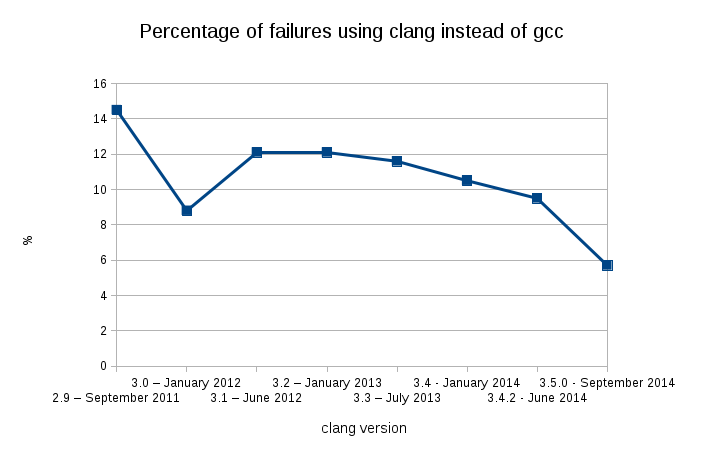
Clang 3.5.0 has just been released. A new rebuild has been done highlight the progress to get Debian built with clang. tl;dr: Great progress. We decreased from 9.5% to 5.7% of failures. Full results are available on http://clang.debian.net At time of the rebuild with 3.4.2, we had 2040 packages failing to build with clang. With 3.5.0, this dropped to 1261 packages. Fixes With Arthur Marble and Alexander Ovchinnikov, both GSoC students, we worked on various ways to decrease the number of errors. Upstream fixes First, the most obvious way, we fixed programming bugs/mistakes in upstream sources. Basically, we took categories of failure and fixed issues one after the other. We started with simple bugs like 'Wrong main declaration', 'non-void function should return a value' or 'Void function should not return a value'.

They are trivial to fix. We continued with harder fixes like ' Undefined reference' or 'Variable length array for a non POD (plain old data) element'.

So, besides these one, we worked on:
In total, we reported 295 bugs with patches. 85 of them have been fixed (meaning that the Debian maintainer uploaded a new version with the fix).

In parallel, I think that the switch by FreeBSD and Mac OS X to Clang also helped to fix various issues by upstreams. Hacking in clang As a parallel approach, we started to implement a suggestion from Linus Torvalds and a few others. Instead of trying to fix all upstream, where we can, we tried to update clang to improve the gcc compatibility.

gcc has many flags to disable or enable optimizations. Some of them are legacy, others have no sense in clang, etc. Instead of failing in clang with an error, we create a new category of warnings (showing optimization flag '%0' is not supported) and moved all relevant flags into it. Some examples, r212805, r213365, r214906 or r214907

We also updated clang to silent some useless arguments like -finput_charset=UTF-8 (r212110), clang being UTF-8 compliant.

Finally, we worked on the forwarding of linker flags. Clang and gcc have a very different behavior: when gcc does not know an argument, it is going to forward the argument to the linker. Clang, in this case, is going to reject the argument and fail with an error. In clang, we have to explicitly declare which arguments are going to be transfer to the linker. Of course, the correct way to pass arguments to the linker is to use -Xlinker or -Wl but the Debian rebuild proved that these shortcuts are used. Two of these arguments are now forwarded: New errors Just like in other releases, new warnings are added in clang. With (bad) usage of -Werror by upstream software, this causes new build failures: I also took the opportunity to add some further categorizations in the list of errors. Some examples: Next steps The Debile project being close to ready with Cl ment Schreiner's GSoC, we will now have an automatic and transparent way to rebuild packages using clang. Conclusion As stated, we can see a huge drop in term of number of failures over time:
Hopefully, Clang getting better and better, more and more projects adopting it as the default compiler or as a base for plugin/extension developments, this percentage will continue to decrease.
Having some kind of release goal with clang for Jessie+1 can now be considered as potentially reachable. Want to help? There are several things which can be done to help: Acknowledgments Thanks to David Suarez for the rebuilds of the archive, Arthur Marble and Alexander Ovchinnikov for their GSoC works and Nicolas S velin-Radiguet for the few fixes.

10 September 2014

Steve Kemp: kvm-hosting will be ceasing, soon.

Seven years ago I wanted to move on from the small virtual machine I had to a larger one. Looking at the the options available it seemed the best approach was to rent a big host, and divide it up into virtual machines myself. Renting a machine with 8Gb of RAM and 500Gb of disk-space, then dividing that into eights would give a decent spec and assuming that I found enough users to pay for the other slots/shares it would be economically viable too. After a few weeks I took the plunge, advertised here, and found users. I had six users: There were some niggles, one user seemed to suffer from connectivity problems more than the others, but on the whole the experiment worked out well. These days, thanks to BigV, Digital Ocean, and all the new-comers there is less need for this kind of thing so last December I announced that the service would cease - and gave all current users 1 year of free service to give them time to migrate away. The service was due to terminate in December, but triggered by some upcoming downtime where our host would have been moved, in the back of a van, from Manchester to York, I've taken the decision to stop it early. It was a fun experiment, it provided me with low cost hosting (subsidized by the other paying users), and provided some other people with hosting of their own that was setup nicely. The only outstanding question is what to do with the domain-names? I could let them expire, I could try to sell them, or I could donate them to other people running hosting setups. If anybody reading this has a use for kvm-hosting.org, kvm-hosting.net, or kvm-hosting.com, then do feel free to get in touch. No promises, obviously, but it'd be a shame for them to end up hosting adverts in a year or twos time..

6 September 2014

Jonathan McDowell: Breaking up with America

Back in January I changed jobs. This took me longer to decide to do than it should have. My US visa (an L-1B) was tied to the old job, and not transferable, so leaving the old job also meant leaving the US. That was hard to do; I'd had a mostly fun 3 and a half years in the SF Bay Area. The new job had an office in Belfast, and HQ in the Bay Area. I went to work in Belfast, and got sent out to the US to meet coworkers and generally get up to speed. During that visit the company applied for an H-1B visa for me. This would have let me return to the US in October 2014 and start working in the US office; up until that point I'd have continued to work from Belfast. Unfortunately there were 172,500 applications for 85,000 available visas and mine was not selected for processing. I'm disappointed by this. I've enjoyed my time in the US. I had a green card application in process, but after nearly 2 years it still hadn't completed the initial hurdle of the labor certification stage (a combination of a number of factors, human, organizational and governmental). However the effort of returning to live here seems too great for the benefits gained. I can work for a US company with a non-US office and return on an L-1B after a year. And once again have to leave should I grow out of the job, or the job change in some way that doesn't suit me, or the company hit problems and have to lay me off. Or I can try again for an H-1B next year, aiming for an October 2015 return, and hope that this time my application gets selected for processing. Neither really appeals. Both involve putting things on hold in the hope longer terms pans out as I hope. And to be honest I'm bored of that. I've loved living in America, but I ended up spending at least 6 months longer in the job I left in January than I'd have done if I'd been freely able to change employer without having to change continent. So it seems the time has come to accept that America and I must part ways, sad as that is. Which is why I'm currently sitting in SFO waiting for a flight back to Belfast and for the first time in 5 years not having any idea when I might be back in the US.

Russ Allbery: Accumulated hauls

I haven't made one of these in a long time, so I have some catching from random purchases to do, which includes a (repurposed) nice parting gift from my previous employer and a trip to Powell's since I was in the area for DebConf14. This also includes the contents of the Hugo voter's packet, which contained a wide variety of random stuff even if some of the novels were represented only by excerpts. John Joseph Adams (ed.) The Mad Scientist's Guide to World Domination (sff anthology)
Roger McBride Allen The Ring of Charon (sff)
Roger McBride Allen The Shattered Sphere (sff)
Iain M. Banks The Hydrogen Sonata (sff)
Julian Barnes The Sense of an Ending (mainstream)
M. David Blake (ed.) 2014 Campbellian Anthology (sff anthology)
Algis Budrys Benchmarks Continued (non-fiction)
Algis Budrys Benchmarks Revisited (non-fiction)
Algis Budrys Benchmarks Concluded (non-fiction)
Edgar Rice Burroughs Carson of Venus (sff)
Wesley Chu The Lives of Tao (sff)
Ernest Cline Ready Player One (sff)
Larry Correia Hard Magic (sff)
Larry Correia Spellbound (sff)
Larry Correia Warbound (sff)
Sigrid Ellis & Michael Damien Thomas (ed.) Queer Chicks Dig Time Lords (non-fiction)
Neil Gaiman The Ocean at the End of the Lane (sff)
Max Gladstone Three Parts Dead (sff)
Max Gladstone Two Serpents Rise (sff)
S.L. Huang Zero Sum Game (sff)
Robert Jordan & Brandon Sanderson The Wheel of Time (sff)
Drew Karpyshyn Mass Effect: Revelation (sff)
Justin Landon & Jared Shurin (ed.) Speculative Fiction 2012 (non-fiction)
John J. Lumpkin Through Struggle, the Stars (sff)
L. David Marquet Turn the Ship Around! (non-fiction)
George R.R. Martin & Raya Golden Meathouse Man (graphic novel)
Ramez Naam Nexus (sff)
Eiichiro Oda One Piece Volume 1 (manga)
Eiichiro Oda One Piece Volume 2 (manga)
Eiichiro Oda One Piece Volume 3 (manga)
Eiichiro Oda One Piece Volume 4 (manga)
Alexei Panshin New Celebrations (sff)
K.J. Parker Devices and Desires (sff)
K.J. Parker Evil for Evil (sff)
Sofia Samatar A Stranger in Olondria (sff)
John Scalzi The Human Division (sff)
Jonathan Straham (ed.) Fearsome Journeys (sff anthology)
Vernor Vinge The Children of the Sky (sff)
Brian Wood & Becky Cloonan Demo (graphic novel)
Charles Yu How to Live Safely in a Science Fictional Universe (sff) A whole bunch of this is from the Hugo voter's packet, and since the Hugos are over, much of that probably won't get prioritized. (I was very happy with the results of the voting, though.) Other than that, it's a very random collection of stuff, including a few things that I picked up based on James Nicoll's reviews. Now that I have a daily train commute, I should pick up the pace of reading, and as long as I can find enough time in my schedule to also write reviews, hopefully there will be more content in this blog shortly.

1 September 2014

Juliana Louback: Debconf 2014 and How I Became a Debian Contributor

Part 1 - Debconf 2014 This year I went to my first Debconf, which took place in Portland, OR during the last week of August 2014. All in all I have to rate my experience as very enlightening and in the end quite fun. First of all, it was a little daunting to go to a conference in 1 - A city I d never been to before; 2 - A conference with 300+ people, only 3 of which I knew and even then I only knew them virtually. Not to mention I was in the presence of some extremely brilliant and known contirbutors in the Debian community which was somewhat intimidating. Just to give you an idea, Linus Torvalds showed up for a Q&A session last Friday morning! Jealous? Actually I missed that too. It was kind of a last minute thing, booked for coincidentally the exact time I d be flying out of Portland. I found out about it much too late. But luckily for me and maybe you, the session was filmed and can be seen here. Isn t that a treat? Point made, there are lots of really talented people there, both techies and non-techies. It s easy to feel you re out of league, at least I did. But I d highly encourage you to ignore such feelings if you re ever in the same situation. Debian has been built on for a long time now, but although a lot has been done, a lot still needs to be done. The Debian community is very welcoming of new contributors and users, regardless of the level of expertise. So far I haven t been snubbed by anyone. To the contrary, all my interactions with the Debian community members has been extremely positive. So go ahead and attend the meetings and presentations, even if you think it s not your area of expertise. Debconf was organized (or at least this one was) as a series of talks, meet ups and ad hoc sessions, some of which occured simultaneously. The sessions were all about different components of the Debian universe, from presenting new features to overviews of accomplishments to discussing issues and how to fix them. A schedule with the location and description of each session was posted on the Debconf wiki. Sometimes none of the sessions at a certain time was on a topic I knew very much about. But I d sit in anyways. There s no rule to attending the sessions, no minimum qualifications required. You ll likely learn something new and you just might find out there is something you can do to contribute. There are also hackathons that are quite the thing or so I heard. Or you could walk about and meet new people, do some networking. I have to say networking was the highlight of the Debconf for me. Remember I said I knew about 3 people who were at the conference? Well, I had actually just corresponded with those people. I didn t really know them. So on my first day I spent quite some time shyly peeking at people s name tags, trying to recognize someone I had met over email or IRC. But with 300 or so people at the conference, I was unsuccessful. So I finally gave up on that strategy and walked up to a random person, stuck out my hand and said, Hi. My name is Juliana. This is my first Debconf. What s your name and what do you do for Debian? This may not be according to protocol, but it worked for me. I got to meet lots of people that way, met some Debian contributos from my home country (Brazil), some from my current city (NYC), and yet others that had similar interests as I do who I might work with in the near future. For example, I love Machine Learning, I m currently beginning my graduate studies on that track. Several Debian contributors offered to introduce me to a well known Machine Learning researcher and Debian contributor who is in NYC. Others had tried out JSCommunicator and had lots of suggestions for new features and fixes, or wanted to know more about the project and WebRTC in general. Also, not everyone there is a super experienced Debian contributor or user. There are a lot of newbies like me. I got to do a quick 20-min presentation and demo of the work I had done on JSCommunicator during GSoC 2014. Oh my goodness that was nerve-wracking, but not half as painful as I expected. My mentor (Daniel Pocock) wisely suggested that when confronted with a question I didn t know how to answer, to redirect the question to to the audience. Chances are, there is someone there that knows the answer. If not, it will at least spark a good discussion. When meeting new people at Debian, a question almost everyone asked is How did you start working with/for Debian? . So I thought it would be a good topic to post about. Part 2 - How I Became a Debian Contributor Sometime in late October of 2013 (I think) I received an email from one of my professors at UNIRIO forwarding a description of the Outreach Program for Women. OPW is a program organized by the GNOME which endeavors to get more women involved in FOSS. OPW is similar to Google Summer of Code; you work remotely from home, guided by an assigned mentor. Debian was one of the 8 participating organizations that year. There was a list of project proposals which I perused, a few of them caught my eye and these projects were all Debian. I d already been a fan of FOSS before. I had used the Ubuntu and Debian OS, I d migrated to GIMP from Photoshop and to Open Office from Microsoft Office, for example. I d strongly advocated the use of some of my prefered open source apps and programs to my friends and family. But I hadn t ever contributed to a FOSS project. There s no time like the present, so I reached out the the mentor responsible for one of the projects I was interested in, Daniel Pocock. Daniel guided me through making a small contribution to a FOSS project, which serves as a token demonstration of my abilities and is part of the application process. I added a small feature to JMXetric and suggested a fix for an issue in the xTuple project. Actually, I had forgotten about this. Recently I made another contribution to xTuple, it s funny to see things come full circle. I also had to write a profile-ish description of my experience and how I intended on contributing during OPW on the Debian wiki, if you d like you can check it out here. I wouldn t follow my example to a T, because in the end I didn t make the OPW selection. Actually, I take that back. The fact I wasn t chosen for OPW that year doesn t mean I was incompetent or incapable of making a valuable contribution. OPW and GSoC do not have unlimited resources; they can t include everyone they d like to. They receive thousands of proposals from very talented engineers and not everyone can participate at a given moment. But even though I wasn t selected, like I said, I could still pitch in. It s good to keep in mind that people usually aren t paid to contribute to FOSS. It s usually volunteer based, which I think is one of the beauties of the FOSS community and in my opinion one of the causes of it s success and great quality. People contribute because they want to, not because they have to. I will say I was a little disappointed at not being chosen. But after being reassured that this rejection wasn t due to any lack on my part, I decided to continue contributing to the Debian project I d applied to. I was begining the final semester of my undergraduate studies which included writing a thesis. To be able to focus on my thesis and graduate on time, I d stopped working temporarily and was studying full time. But I didn t want to lose practice and contributing to a FOSS project is a great way to stay in coding shape while doing something useful. So continue contributing I did. It paid off. I gained experience, added value to a FOSS project and I think my previous contributions added weight to the application I later made for GSoC 2014. I passed this time. To be honest, I really wasn t counting on it. Actually, I was certain I wouldn t pass for some reason - insecure much? But with GSoC I wasn t too anxious about it as I was with the OPW application because by then, I was already hooked . I d learned about all the benefits of becoming a FOSS contributor and I wasn t stopping anytime soon. I had every intention of still working on my FOSS project with or without GSoC. GSoC 2014 ended a week ago (August 18th 2014). There s a list of things I still want to do with JSCommunicator and you can be sure I ll keep working on them. P.S. This is not to say that programs like OPW and GSoC aren t amazing programs. Try it out if you can, it s really a great experience.

30 August 2014

Francois Marier: Outsourcing your webapp maintenance to Debian

Modern web applications are much more complicated than the simple Perl CGI scripts or PHP pages of the past. They usually start with a framework and include lots of external components both on the front-end and on the back-end. Here's an example from the Node.js back-end of a real application:
$ npm list   wc -l
256
What if one of these 256 external components has a security vulnerability? How would you know and what would you do if of your direct dependencies had a hard-coded dependency on the vulnerable version? It's a real problem and of course one way to avoid this is to write everything yourself. But that's neither realistic nor desirable. However, it's not a new problem. It was solved years ago by Linux distributions for C and C++ applications. For some reason though, this learning has not propagated to the web where the standard approach seems to be to "statically link everything". What if we could build on the work done by Debian maintainers and the security team?

Case study - the Libravatar project As a way of discussing a different approach to the problem of dependency management in web applications, let me describe the decisions made by the Libravatar project.

Description Libravatar is a federated and free software alternative to the Gravatar profile photo hosting site. From a developer point of view, it's a fairly simple stack: The service is split between the master node, where you create an account and upload your avatar, and a few mirrors, which serve the photos to third-party sites. Like with Gravatar, sites wanting to display images don't have to worry about a complicated protocol. In a nutshell, all that a site needs to do is hash the user's email and add that hash to a base URL. Where the federation kicks in is that every email domain is able to specify a different base URL via an SRV record in DNS. For example, francois@debian.org hashes to 7cc352a2907216992f0f16d2af50b070 and so the full URL is:
http://cdn.libravatar.org/avatar/7cc352a2907216992f0f16d2af50b070
whereas francois@fmarier.org hashes to 0110e86fdb31486c22dd381326d99de9 and the full URL is:
http://fmarier.org/avatar/0110e86fdb31486c22dd381326d99de9
due to the presence of an SRV record on fmarier.org.

Ground rules The main rules that the project follows is to:
  1. only use Python libraries that are in Debian
  2. use the versions present in the latest stable release (including backports)

Deployment using packages In addition to these rules around dependencies, we decided to treat the application as if it were going to be uploaded to Debian:
  • It includes an "upstream" Makefile which minifies CSS and JavaScript, gzips them, and compiles PO files (i.e. a "build" step).
  • The Makefile includes a test target which runs the unit tests and some lint checks (pylint, pyflakes and pep8).
  • Debian packages are produced to encode the dependencies in the standard way as well as to run various setup commands in maintainer scripts and install cron jobs.
  • The project runs its own package repository using reprepro to easily distribute these custom packages.
  • In order to update the repository and the packages installed on servers that we control, we use fabric, which is basically a fancy way to run commands over ssh.
  • Mirrors can simply add our repository to their apt sources.list and upgrade Libravatar packages at the same time as their system packages.

Results Overall, this approach has been quite successful and Libravatar has been a very low-maintenance service to run. The ground rules have however limited our choice of libraries. For example, to talk to our queuing system, we had to use the raw Python bindings to the C Gearman library instead of being able to use a nice pythonic library which wasn't in Debian squeeze at the time. There is of course always the possibility of packaging a missing library for Debian and maintaining a backport of it until the next Debian release. This wouldn't be a lot of work considering the fact that responsible bundling of a library would normally force you to follow its releases closely and keep any dependencies up to date, so you may as well share the result of that effort. But in the end, it turns out that there is a lot of Python stuff already in Debian and we haven't had to package anything new yet. Another thing that was somewhat scary, due to the number of packages that were going to get bumped to a new major version, was the upgrade from squeeze to wheezy. It turned out however that it was surprisingly easy to upgrade to wheezy's version of Django, Apache and Postgres. It may be a problem next time, but all that means is that you have to set a day aside every 2 years to bring everything up to date.

Problems The main problem we ran into is that we optimized for sysadmins and unfortunately made it harder for new developers to setup their environment. That's not very good from the point of view of welcoming new contributors as there is quite a bit of friction in preparing and testing your first patch. That's why we're looking at encoding our setup instructions into a Vagrant script so that new contributors can get started quickly. Another problem we faced is that because we use the Debian version of jQuery and minify our own JavaScript files in the build step of the Makefile, we were affected by the removal from that package of the minified version of jQuery. In our setup, there is no way to minify JavaScript files that are provided by other packages and so the only way to fix this would be to fork the package in our repository or (preferably) to work with the Debian maintainer and get it fixed globally in Debian. One thing worth noting is that while the Django project is very good at issuing backwards-compatible fixes for security issues, sometimes there is no way around disabling broken features. In practice, this means that we cannot run unattended-upgrades on our main server in case something breaks. Instead, we make use of apticron to automatically receive email reminders for any outstanding package updates. On that topic, it can occasionally take a while for security updates to be released in Debian, but this usually falls into one of two cases:
  1. You either notice because you're already tracking releases pretty well and therefore could help Debian with backporting of fixes and/or testing;
  2. or you don't notice because it has slipped through the cracks or there simply are too many potential things to keep track of, in which case the fact that it eventually gets fixed without your intervention is a huge improvement.
Finally, relying too much on Debian packaging does prevent Fedora users (a project that also makes use of Libravatar) from easily contributing mirrors. Though if we had a concrete offer, we would certainly look into creating the appropriate RPMs.

Is it realistic? It turns out that I'm not the only one who thought about this approach, which has been named "debops". The same day that my talk was announced on the DebConf website, someone emailed me saying that he had instituted the exact same rules at his company, which operates a large Django-based web application in the US and Russia. It was pretty impressive to read about a real business coming to the same conclusions and using the same approach (i.e. system libraries, deployment packages) as Libravatar. Regardless of this though, I think there is a class of applications that are particularly well-suited for the approach we've just described. If a web application is not your full-time job and you want to minimize the amount of work required to keep it running, then it's a good investment to restrict your options and leverage the work of the Debian community to simplify your maintenance burden. The second criterion I would look at is framework maturity. Given the 2-3 year release cycle of stable distributions, this approach is more likely to work with a mature framework like Django. After all, you probably wouldn't compile Apache from source, but until recently building Node.js from source was the preferred option as it was changing so quickly. While it goes against conventional wisdom, relying on system libraries is a sustainable approach you should at least consider in your next project. After all, there is a real cost in bundling and keeping up with external dependencies. This blog post is based on a talk I gave at DebConf 14: slides, video.

29 August 2014

Daniel Pocock: Welcoming libphonenumber to Debian and Ubuntu

Google's libphonenumber is a universal library for parsing, validating, identifying and formatting phone numbers. It works quite well for numbers from just about anywhere. Here is a Java code sample (C++ and JavaScript also supported) from their web site:
String swissNumberStr = "044 668 18 00";
PhoneNumberUtil phoneUtil = PhoneNumberUtil.getInstance();
try
PhoneNumber swissNumberProto = phoneUtil.parse(swissNumberStr, "CH");
catch (NumberParseException e)
System.err.println("NumberParseException was thrown: " + e.toString());

boolean isValid = phoneUtil.isValidNumber(swissNumberProto); // returns true
// Produces "+41 44 668 18 00"
System.out.println(phoneUtil.format(swissNumberProto, PhoneNumberFormat.INTERNATIONAL));
// Produces "044 668 18 00"
System.out.println(phoneUtil.format(swissNumberProto, PhoneNumberFormat.NATIONAL));
// Produces "+41446681800"
System.out.println(phoneUtil.format(swissNumberProto, PhoneNumberFormat.E164));
This is particularly useful for anybody working with international phone numbers. This is a common requirement in the world of VoIP where people mix-and-match phones and hosted PBXes in different countries and all their numbers have to be normalized. About the packages The new libphonenumber package provides support for C++ and Java users. Upstream also supports JavaScript but that hasn't been packaged yet. Using libphonenumber from Evolution and other software Lumicall, the secure SIP/ZRTP client for Android, has had libphonenumber from the beginning. It is essential when converting dialed numbers into E.164 format to make ENUM queries and it is also helpful to normalize all the numbers before passing them to VoIP gateways. Debian includes the GNOME Evolution suite and it will use libphonenumber to improve handling of phone numbers in contact records if enabled at compile time. Fredrik has submitted a patch for that in Debian. Many more applications can potentially benefit from this too. libphonenumber is released under an Apache license so it is compatible with the Mozilla license and suitable for use in Thunderbird plugins. Improving libphonenumber It is hard to keep up with the changes in dialing codes around the world. Phone companies and sometimes even whole countries come and go from time to time. Numbering plans change to add extra digits. New prefixes are created for new mobile networks. libphonenumber contains metadata for all the countries and telephone numbers that the authors are aware of but they also welcome feedback through their mailing list for anything that is not quite right. Now that libphonenumber is available as a package, it may be helpful for somebody to try and find a way to split the metadata from the code so that metadata changes could be distributed through the stable updates catalog along with other volatile packages such as anti-virus patterns.

25 August 2014

Erich Schubert: Analyzing Twitter - beware of spam

This year I started to widen up my research; and one data source of interest was text because of the lack of structure in it, that makes it often challenging. One of the data sources that everybody seems to use is Twitter: it has a nice API, and few restrictions on using it (except on resharing data). By default, you can get a 1% random sample from all tweets, which is more than enough for many use cases.
We've had some exciting results which a colleague of mine will be presenting tomorrow (Tuesday, Research 22: Topic Modeling) at the KDD 2014 conference:
SigniTrend: Scalable Detection of Emerging Topics in Textual Streams by Hashed Significance Thresholds
Erich Schubert, Michael Weiler, Hans-Peter Kriegel
20th ACM SIGKDD Conference on Knowledge Discovery and Data Mining
You can also explore some (static!) results online at signi-trend.appspot.com

In our experiments, the "news" data set was more interesting. But after some work, we were able to get reasonable results out of Twitter as well. As you can see from the online demo, most of these fall into pop culture: celebrity deaths, sports, hip-hop. Not much that would change our live; and even less that wasn't before captured by traditional media.
The focus of this post is on the preprocessing needed for getting good results from Twitter. Because it is much easier to get bad results!
The first thing you need to realize about Twitter is that due to the media attention/hype it gets, it is full of spam. I'm pretty sure the engineers at Twitter already try to reduce spam; block hosts and fraud apps. But a lot of the trending topics we discovered were nothing but spam.
Retweets - the "like" of Twitter - are an easy source to see what is popular, but are not very interesting if you want to analyze text. They just reiterate the exact same text (except for a "RT " prefix) than earlier tweets. We found results to be more interesting if we removed retweets. Our theory is that retweeting requires much less effort than writing a real tweet; and things that are trending "with effort" are more interesting than those that were just liked.
Teenie spam. If you ever searched for a teenie idol on Twitter, say this guy I hadn't heard of before, but who has 3.88 million followers on Twitter, and search for Tweets addressed to him, you will get millions over millions of results. Many of these tweets look like this: Now if you look at this tweet, there is this odd "x804" at the end. This is to defeat a simple spam filter by Twitter. Because this user did not tweet this just once: instead it is common amongst teenie to spam their idols with follow requests by the dozen. Probably using some JavaScript hack, or third party Twitter client. Occassionally, you see hundreds of such tweets, each sent within a few seconds of the previous one. If you get a 1% sample of these, you still get a few then...
Even worse (for data analysis) than teenie spammers are commercial spammers and wannabe "hackers" that exercise their "sk1llz" by spamming Twitter. To get a sample of such spam, just search for weight loss on Twitter. There is plenty of fresh spam there, usually consisting of some text pretending to be news, and an anonymized link (there is no need to use an URL shortener such as bit.ly on Twitter, since Twitter has its own URL shortener t.co; and you'll end up with double-shortened URLs). And the hacker spam is even worse (e.g. #alvianbencifa) as he seems to have trojaned hundreds of users, and his advertisement seems to be a nonexistant hash tag, which he tries to get into Twitters "trending topics".
And then there are the bots. Plenty of bots spam Twitter with their analysis of trending topics, reinforcing the trending topics. In my opinion, bots such as trending topics indonesia are useless. No wonder there are only 280 followers. And of the trending topics reported, most of them seem to be spam topics...

Bottom line: if you plan on analyzing Twitter data, spend considerable time on preprocessing to filter out spam of various kind. For example, we remove singletons and digits, then feed the data through a duplicate detector. We end up discarding 20%-25% of Tweets. But we still get some of the spam, such as that hackers spam.
All in all, real data is just messy. People posting there have an agenda that might be opposite to yours. And if someone (or some company) promises you wonders from "Big data" and "Twitter", you better have them demonstrate their use first, before buying their services. Don't trust visions of what could be possible, because the first rule of data analysis is: Garbage in, garbage out.

24 August 2014

Lucas Nussbaum: on the Dark Ages of Free Software: a Free Service Definition ?

Stefano Zacchiroli opened DebConf 14 with an insightful talk titled Debian in the Dark Ages of Free Software (slides available, video available soon). He makes the point (quoting slide 16) that the Free Software community is winning a war that is becoming increasingly pointless: yes, users have 100% Free Software thin client at their fingertips [or are really a few steps from there]. But all their relevant computations happen elsewhere, on remote systems they do not control, in the Cloud. That give-up on control of computing is a huge and important problem, and probably the largest challenge for everybody caring about freedom, free speech, or privacy today. Stefano rightfully points out that we must do something about it. The big question is: how can we, as a community, address it? Towards a Free Service Definition? I believe that we all feel a bit lost with this issue because we are trying to attack it with our current tools & weapons. However, they are largely irrelevant here: the Free Software Definition is about software, and software is even to be understood strictly in it, as software programs. Applying it to services, or to computing in general, doesn t lead anywhere. In order to increase the general awareness about this issue, we should define more precisely what levels of control can be provided, to understand what services are not providing to users, and to make an informed decision about waiving a particular level of control when choosing to use a particular service. Benjamin Mako Hill pointed out yesterday during the post-talk chat that services are not black or white: there aren t impure and pure services. Instead, there s a graduation of possible levels of control for the computing we do. The Free Software Definition lists four freedoms how many freedoms, or types of control, should there be in a Free Service Definition, or a Controlled-Computing Definition? Again, this is not only about software: the platform on which a particular piece of software is executed has a huge impact on the available level of control: running your own instance of WordPress, or using an instance on wordpress.com, provides very different control (even if as Asheesh Laroia pointed out yesterday, WordPress does a pretty good job at providing export and import features to limit data lock-in). The creation of such a definition is an iterative process. I actually just realized today that (according to Wikipedia) the very first occurrence of an attempt at a Free Software Definition was published in 1986 (GNU s bulletin Vol 1 No.1, page 8) I thought it happened a couple of years earlier. Are there existing attempts at defining such freedoms or levels of controls, and at benchmarking such criteria against existing services? Such criteria would not only include control over software modifications and (re)distribution, but also likely include mentions of interoperability and open standards, both to enable the user to move to a compatible service, and to avoid forcing the user to use a particular implementation of a service. A better understanding of network effects is also needed: how much and what type of service lock-in is acceptable on social networks in exchange of functionality? I think that we should inspire from what was achieved during the last 30 years on Free Software. The tools that were produced are probably irrelevant to address this issue, but there s a lot to learn from the way they were designed. I really look forward to the day when we will have: Exciting times!

23 August 2014

Antti-Juhani Kaijanaho: A milestone toward a doctorate

Yesterday I received my official diploma for the degree of Licentiate of Philosophy. The degree lies between a Master s degree and a doctorate, and is not required; it consists of the coursework required for a doctorate, and a Licentiate Thesis, in which the student demonstrates good conversance with the field of research and the capability of independently and critically applying scientific research methods (official translation of the Government decree on university degrees 794/2004, Section 23 Paragraph 2). The title and abstract of my Licentiate Thesis follow:
Kaijanaho, Antti-Juhani
The extent of empirical evidence that could inform evidence-based design of programming languages. A systematic mapping study.
Jyv skyl : University of Jyv skyl , 2014, 243 p.
(Jyv skyl Licentiate Theses in Computing,
ISSN 1795-9713; 18)
ISBN 978-951-39-5790-2 (nid.)
ISBN 978-951-39-5791-9 (PDF)
Finnish summary Background: Programming language design is not usually informed by empirical studies. In other fields similar problems have inspired an evidence-based paradigm of practice. Central to it are secondary studies summarizing and consolidating the research literature. Aims: This systematic mapping study looks for empirical research that could inform evidence-based design of programming languages. Method: Manual and keyword-based searches were performed, as was a single round of snowballing. There were 2056 potentially relevant publications, of which 180 were selected for inclusion, because they reported empirical evidence on the efficacy of potential design decisions and were published on or before 2012. A thematic synthesis was created. Results: Included studies span four decades, but activity has been sparse until the last five years or so. The form of conditional statements and loops, as well as the choice between static and dynamic typing have all been studied empirically for efficacy in at least five studies each. Error proneness, programming comprehension, and human effort are the most common forms of efficacy studied. Experimenting with programmer participants is the most popular method. Conclusions: There clearly are language design decisions for which empirical evidence regarding efficacy exists; they may be of some use to language designers, and several of them may be ripe for systematic reviewing. There is concern that the lack of interest generated by studies in this topic area until the recent surge of activity may indicate serious issues in their research approach. Keywords: programming languages, programming language design, evidence-based paradigm, efficacy, research methods, systematic mapping study, thematic synthesis
A Licentiate Thesis is assessed by two examiners, usually drawn from outside of the home university; they write (either jointly or separately) a substantiated statement about the thesis, in which they suggest a grade. The final grade is almost always the one suggested by the examiners. I was very fortunate to have such prominent scientists as Dr. Stefan Hanenberg and Prof. Stein Krogdahl as the examiners of my thesis. They recommended, and I received, the grade very good (4 on a scale of 1 5). The thesis has been accepted for publication published in our faculty s licentiate thesis series and will in due course appear has appeared in our university s electronic database (along with a very small number of printed copies). In the mean time, if anyone wants an electronic preprint, send me email at antti-juhani.kaijanaho@jyu.fi.
Figure 1 of the thesis: an overview of the mapping processFigure 1 of the thesis: an overview of the mapping process
As you can imagine, the last couple of months in the spring were very stressful for me, as I pressed on to submit this thesis. After submission, it took me nearly two months to recover (which certain people who emailed me on Planet Haskell business during that period certainly noticed). It represents the fruit of almost four years of work (way more than normally is taken to complete a Licentiate Thesis, but never mind that), as I designed this study in Fall 2010.
Figure 8 of the thesis: Core studies per publication yearFigure 8 of the thesis: Core studies per publication year
Recently, I have been writing in my blog a series of posts in which I have been trying to clear my head about certain foundational issues that irritated me during the writing of the thesis. The thesis contains some of that, but that part of it is not very strong, as my examiners put it, for various reasons. The posts have been a deliberately non-academic attempt to shape the thoughts into words, to see what they look like fixed into a tangible form. (If you go read them, be warned: many of them are deliberately provocative, and many of them are intended as tentative in fact if not in phrasing; the series also is very incomplete at this time.) I closed my previous post, the latest post in that series, as follows:
In fact, the whole of 20th Century philosophy of science is a big pile of failed attempts to explain science; not one explanation is fully satisfactory. [...] Most scientists enjoy not pondering it, for it s a bit like being a cartoon character: so long as you don t look down, you can walk on air.
I wrote my Master s Thesis (PDF) in 2002. It was about the formal method called B ; but I took a lot of time and pages to examine the history and content of formal logic. My supervisor was, understandably, exasperated, but I did receive the highest possible grade for it (which I never have fully accepted I deserved). The main reason for that digression: I looked down, and I just had to go poke the bridge I was standing on to make sure I was not, in fact, walking on air. In the many years since, I ve taken a lot of time to study foundations, first of mathematics, and more recently of science. It is one reason it took me about eight years to come up with a doable doctoral project (and I am still amazed that my department kept employing me; but I suppose they like my teaching, as do I). The other reason was, it took me that long to realize how to study the design of programming languages without going where everyone has gone before. Debian people, if any are still reading, may find it interesting that I found significant use for the dctrl-tools toolset I have been writing for Debian for about fifteen years: I stored my data collection as a big pile of dctrl-format files. I ended up making some changes to the existing tools (I should upload the new version soon, I suppose), and I wrote another toolset (unfortunately one that is not general purpose, like the dctrl-tools are) in the process. For the Haskell people, I mainly have an apology for not attending to Planet Haskell duties in the summer; but I am back in business now. I also note, somewhat to my regret, that I found very few studies dealing with Haskell. I just checked; I mention Haskell several times in the background chapter, but it is not mentioned in the results chapter (because there were not studies worthy of special notice). I am already working on extending this work into a doctoral thesis. I expect, and hope, to complete that one faster.

Daniel Pocock: Want to be selected for Google Summer of Code 2015?

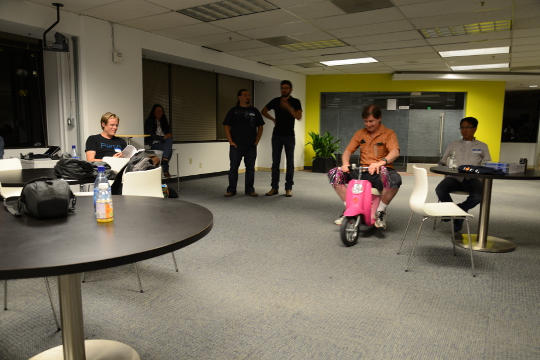
I've mentored a number of students in 2013 and 2014 for Debian and Ganglia and most of the companies I've worked with have run internships and graduate programs from time to time. GSoC 2014 has just finished and with all the excitement, many students are already asking what they can do to prepare and be selected in 2015. My own observation is that the more time the organization has to get to know the student, the more confident they can be selecting that student. Furthermore, the more time that the student has spent getting to know the free software community, the more easily they can complete GSoC. Here I present a list of things that students can do to maximize their chance of selection and career opportunities at the same time. These tips are useful for people applying for GSoC itself and related programs such as GNOME's Outreach Program for Women or graduate placements in companies. Disclaimers There is no guarantee that Google will run the program again in 2015 or any future year. There is no guarantee that any organization or mentor (including myself) will be involved until the official list of organizations is published by Google. Do not follow the advice of web sites that invite you to send pizza or anything else of value to prospective mentors. Following the steps in this page doesn't guarantee selection. That said, people who do follow these steps are much more likely to be considered and interviewed than somebody who hasn't done any of the things in this list. Understand what free software really is You may hear terms like free software and open source software used interchangeably. They don't mean exactly the same thing and many people use the term free software for the wrong things. Not all open source projects meet the definition of free software. Those that don't, usually as a result of deficiencies in their licenses, are fundamentally incompatible with the majority of software that does use genuinely free licenses. Google Summer of Code is about both writing and publishing your code and it is also about community. It is fundamental that you know the basics of licensing and how to choose a free license that empowers the community to collaborate on your code well after GSoC has finished. Please review the definition of free software early on and come back and review it from time to time. The The GNU Project / Free Software Foundation have excellent resources to help you understand what a free software license is and how it works to maximize community collaboration. Don't look for shortcuts There is no shortcut to GSoC selection and there is no shortcut to GSoC completion. The student stipend (USD $5,500 in 2014) is not paid to students unless they complete a minimum amount of valid code. This means that even if a student did find some shortcut to selection, it is unlikely they would be paid without completing meaningful work. If you are the right candidate for GSoC, you will not need a shortcut anyway. Are you the sort of person who can't leave a coding problem until you really feel it is fixed, even if you keep going all night? Have you ever woken up in the night with a dream about writing code still in your head? Do you become irritated by tedious or repetitive tasks and often think of ways to write code to eliminate such tasks? Does your family get cross with you because you take your laptop to Christmas dinner or some other significant occasion and start coding? If some of these statements summarize the way you think or feel you are probably a natural fit for GSoC. An opportunity money can't buy The GSoC stipend will not make you rich. It is intended to make sure you have enough money to survive through the summer and focus on your project. Professional developers make this much money in a week in leading business centers like New York, London and Singapore. When you get to that stage in 3-5 years, you will not even be thinking about exactly how much you made during internships. GSoC gives you an edge over other internships because it involves publicly promoting your work. Many companies still try to hide the potential of their best recruits for fear they will be poached or that they will be able to demand higher salaries. Everything you complete in GSoC is intended to be published and you get full credit for it. Imagine a young musician getting the opportunity to perform on the main stage at a rock festival. This is how the free software community works. It is a meritocracy and there is nobody to hold you back. Having a portfolio of free software that you have created or collaborated on and a wide network of professional contacts that you develop before, during and after GSoC will continue to pay you back for years to come. While other graduates are being screened through group interviews and testing days run by employers, people with a track record in a free software project often find they go straight to the final interview round. Register your domain name and make a permanent email address Free software is all about community and collaboration. Register your own domain name as this will become a focal point for your work and for people to get to know you as you become part of the community. This is sound advice for anybody working in IT, not just programmers. It gives the impression that you are confident and have a long term interest in a technology career. Choosing the provider: as a minimum, you want a provider that offers DNS management, static web site hosting, email forwarding and XMPP services all linked to your domain. You do not need to choose the provider that is linked to your internet connection at home and that is often not the best choice anyway. The XMPP foundation maintains a list of providers known to support XMPP. Create an email address within your domain name. The most basic domain hosting providers will let you forward the email address to a webmail or university email account of your choice. Configure your webmail to send replies using your personalized email address in the From header. Update your ~/.gitconfig file to use your personalized email address in your Git commits. Create a web site and blog Start writing a blog. Host it using your domain name. Some people blog every day, other people just blog once every two or three months. Create links from your web site to your other profiles, such as a Github profile page. This helps reinforce the pages/profiles that are genuinely related to you and avoid confusion with the pages of other developers. Many mentors are keen to see their students writing a weekly report on a blog during GSoC so starting a blog now gives you a head start. Mentors look at blogs during the selection process to try and gain insight into which topics a student is most suitable for. Create a profile on Github Github is one of the most widely used software development web sites. Github makes it quick and easy for you to publish your work and collaborate on the work of other people. Create an account today and get in the habbit of forking other projects, improving them, committing your changes and pushing the work back into your Github account. Github will quickly build a profile of your commits and this allows mentors to see and understand your interests and your strengths. In your Github profile, add a link to your web site/blog and make sure the email address you are using for Git commits (in the ~/.gitconfig file) is based on your personal domain. Start using PGP Pretty Good Privacy (PGP) is the industry standard in protecting your identity online. All serious free software projects use PGP to sign tags in Git, to sign official emails and to sign official release files. The most common way to start using PGP is with the GnuPG (GNU Privacy Guard) utility. It is installed by the package manager on most Linux systems. When you create your own PGP key, use the email address involving your domain name. This is the most permanent and stable solution. Print your key fingerprint using the gpg-key2ps command, it is in the signing-party package on most Linux systems. Keep copies of the fingerprint slips with you. This is what my own PGP fingerprint slip looks like. You can also print the key fingerprint on a business card for a more professional look. Using PGP, it is recommend that you sign any important messages you send but you do not have to encrypt the messages you send, especially if some of the people you send messages to (like family and friends) do not yet have the PGP software to decrypt them. If using the Thunderbird (Icedove) email client from Mozilla, you can easily send signed messages and validate the messages you receive using the Enigmail plugin. Get your PGP key signed Once you have a PGP key, you will need to find other developers to sign it. For people I mentor personally in GSoC, I'm keen to see that you try and find another Debian Developer in your area to sign your key as early as possible. Free software events Try and find all the free software events in your area in the months between now and the end of the next Google Summer of Code season. Aim to attend at least two of them before GSoC. Look closely at the schedules and find out about the individual speakers, the companies and the free software projects that are participating. For events that span more than one day, find out about the dinners, pub nights and other social parts of the event. Try and identify people who will attend the event who have been GSoC mentors or who intend to be. Contact them before the event, if you are keen to work on something in their domain they may be able to make time to discuss it with you in person. Take your PGP fingerprint slips. Even if you don't participate in a formal key-signing party at the event, you will still find some developers to sign your PGP key individually. You must take a photo ID document (such as your passport) for the other developer to check the name on your fingerprint but you do not give them a copy of the ID document. Events come in all shapes and sizes. FOSDEM is an example of one of the bigger events in Europe, linux.conf.au is a similarly large event in Australia. There are many, many more local events such as the Debian France mini-DebConf in Lyon, 2015. Many events are either free or free for students but please check carefully if there is a requirement to register before attending. On your blog, discuss which events you are attending and which sessions interest you. Write a blog during or after the event too, including photos. Quantcast generously hosted the Ganglia community meeting in San Francisco, October 2013. We had a wild time in their offices with mini-scooters, burgers, beers and the Ganglia book. That's me on the pink mini-scooter and Bernard Li, one of the other Ganglia GSoC 2014 admins is on the right. Install Linux GSoC is fundamentally about free software. Linux is to free software what a tree is to the forest. Using Linux every day on your personal computer dramatically increases your ability to interact with the free software community and increases the number of potential GSoC projects that you can participate in. This is not to say that people using Mac OS or Windows are unwelcome. I have worked with some great developers who were not Linux users. Linux gives you an edge though and the best time to gain that edge is now, while you are a student and well before you apply for GSoC. If you must run Windows for some applications used in your course, it will run just fine in a virtual machine using Virtual Box, a free software solution for desktop virtualization. Use Linux as the primary operating system. Here are links to download ISO DVD (and CD) images for some of the main Linux distributions: If you are nervous about getting started with Linux, install it on a spare PC or in a virtual machine before you install it on your main PC or laptop. Linux is much less demanding on the hardware than Windows so you can easily run it on a machine that is 5-10 years old. Having just 4GB of RAM and 20GB of hard disk is usually more than enough for a basic graphical desktop environment although having better hardware makes it faster. Your experiences installing and running Linux, especially if it requires some special effort to make it work with some of your hardware, make interesting topics for your blog. Decide which technologies you know best Personally, I have mentored students working with C, C++, Java, Python and JavaScript/HTML5. In a GSoC program, you will typically do most of your work in just one of these languages. From the outset, decide which language you will focus on and do everything you can to improve your competence with that language. For example, if you have already used Java in most of your course, plan on using Java in GSoC and make sure you read Effective Java (2nd Edition) by Joshua Bloch. Decide which themes appeal to you Find a topic that has long-term appeal for you. Maybe the topic relates to your course or maybe you already know what type of company you would like to work in. Here is a list of some topics and some of the relevant software projects:


  • System administration, servers and networking: consider projects involving monitoring, automation, packaging. Ganglia is a great community to get involved with and you will encounter the Ganglia software in many large companies and academic/research networks. Contributing to a Linux distribution like Debian or Fedora packaging is another great way to get into system administration.
  • Desktop and user interface: consider projects involving window managers and desktop tools or adding to the user interface of just about any other software.
  • Big data and data science: this can apply to just about any other theme. For example, data science techniques are frequently used now to improve system administration.
  • Business and accounting: consider accounting, CRM and ERP software.
  • Finance and trading: consider projects like R, market data software like OpenMAMA and connectivity software (Apache Camel)
  • Real-time communication (RTC), VoIP, webcam and chat: look at the JSCommunicator or the Jitsi project
  • Web (JavaScript, HTML5): look at the JSCommunicator
Before the GSoC application process begins, you should aim to learn as much as possible about the theme you prefer and also gain practical experience using the software relating to that theme. For example, if you are attracted to the business and accounting theme, install the PostBooks suite and get to know it. Maybe you know somebody who runs a small business: help them to upgrade to PostBooks and use it to prepare some reports. Make something Make some small project, less than two week's work, to demonstrate your skills. It is important to make something that somebody will use for a practical purpose, this will help you gain experience communicating with other users through Github. For an example, see the servlet Juliana Louback created for fixing phone numbers in December 2013. It has since been used as part of the Lumicall web site and Juliana was selected for a GSoC 2014 project with Debian. There is no better way to demonstrate to a prospective mentor that you are ready for GSoC than by completing and publishing some small project like this yourself. If you don't have any immediate project ideas, many developers will also be able to give you tips on small projects like this that you can attempt, just come and ask us on one of the mailing lists. Ideally, the project will be something that you would use anyway even if you do not end up participating in GSoC. Such projects are the most motivating and rewarding and usually end up becoming an example of your best work. To continue the example of somebody with a preference for business and accounting software, a small project you might create is a plugin or extension for PostBooks. Getting to know prospective mentors Many web sites provide useful information about the developers who contribute to free software projects. Some of these developers may be willing to be a GSoC mentor. For example, look through some of the following: Getting on the mentor's shortlist Once you have identified projects that are interesting to you and developers who work on those projects, it is important to get yourself on the developer's shortlist. Basically, the shortlist is a list of all students who the developer believes can complete the project. If I feel that a student is unlikely to complete a project or if I don't have enough information to judge a student's probability of success, that student will not be on my shortlist. If I don't have any student on my shortlist, then a project will not go ahead at all. If there are multiple students on the shortlist, then I will be looking more closely at each of them to try and work out who is the best match. One way to get a developer's attention is to look at bug reports they have created. Github makes it easy to see complaints or bug reports they have made about their own projects or other projects they depend on. Another way to do this is to search through their code for strings like FIXME and TODO. Projects with standalone bug trackers like the Debian bug tracker also provide an easy way to search for bug reports that a specific person has created or commented on. Once you find some relevant bug reports, email the developer. Ask if anybody else is working on those issues. Try and start with an issue that is particularly easy and where the solution is interesting for you. This will help you learn to compile and test the program before you try to fix any more complicated bugs. It may even be something you can work on as part of your academic program. Find successful projects from the previous year Contact organizations and ask them which GSoC projects were most successful. In many organizations, you can find the past students' project plans and their final reports published on the web. Read through the plans submitted by the students who were chosen. Then read through the final reports by the same students and see how they compare to the original plans. Start building your project proposal now Don't wait for the application period to begin. Start writing a project proposal now. When writing a proposal, it is important to include several things:
  • Think big: what is the goal at the end of the project? Does your work help the greater good in some way, such as increasing the market share of Linux on the desktop?
  • Details: what are specific challenges? What tools will you use?
  • Time management: what will you do each week? Are there weeks where you will not work on GSoC due to vacation or other events? These things are permitted but they must be in your plan if you know them in advance. If an accident or death in the family cut a week out of your GSoC project, which work would you skip and would your project still be useful without that? Having two weeks of flexible time in your plan makes it more resilient against interruptions.
  • Communication: are you on mailing lists, IRC and XMPP chat? Will you make a weekly report on your blog?
  • Users: who will benefit from your work?
  • Testing: who will test and validate your work throughout the project? Ideally, this should involve more than just the mentor.
If your project plan is good enough, could you put it on Kickstarter or another crowdfunding site? This is a good test of whether or not a project is going to be supported by a GSoC mentor. Learn about packaging and distributing software Packaging is a vital part of the free software lifecycle. It is very easy to upload a project to Github but it takes more effort to have it become an official package in systems like Debian, Fedora and Ubuntu. Packaging and the communities around Linux distributions help you reach out to users of your software and get valuable feedback and new contributors. This boosts the impact of your work. To start with, you may want to help the maintainer of an existing package. Debian packaging teams are existing communities that work in a team and welcome new contributors. The Debian Mentors initiative is another great starting place. In the Fedora world, the place to start may be in one of the Special Interest Groups (SIGs). Think from the mentor's perspective After the application deadline, mentors have just 2 or 3 weeks to choose the students. This is actually not a lot of time to be certain if a particular student is capable of completing a project. If the student has a published history of free software activity, the mentor feels a lot more confident about choosing the student. Some mentors have more than one good student while other mentors receive no applications from capable students. In this situation, it is very common for mentors to send each other details of students who may be suitable. Once again, if a student has a good Github profile and a blog, it is much easier for mentors to try and match that student with another project. GSoC logo generic Conclusion Getting into the world of software engineering is much like joining any other profession or even joining a new hobby or sporting activity. If you run, you probably have various types of shoe and a running watch and you may even spend a couple of nights at the track each week. If you enjoy playing a musical instrument, you probably have a collection of sheet music, accessories for your instrument and you may even aspire to build a recording studio in your garage (or you probably know somebody else who already did that). The things listed on this page will not just help you walk the walk and talk the talk of a software developer, they will put you on a track to being one of the leaders. If you look over the profiles of other software developers on the Internet, you will find they are doing most of the things on this page already. Even if you are not selected for GSoC at all or decide not to apply, working through the steps on this page will help you clarify your own ideas about your career and help you make new friends in the software engineering community.

Tim Retout: Packaging pump.io for Debian

I intend to intend to package pump.io for Debian. It's going to take a long time, but I don't know whether that's weeks or years yet. The world needs decentralized social networking. I discovered the tools that let me create this wiki summary of the progress in pump.io packaging. There are at least 35 dependencies that need uploading, so this would go a lot faster if it weren't a solo effort - if anyone else has some time, please let me know! But meanwhile I'm hoping to build some momentum. I think it's important to keep the quality of the packaging as high as possible, even while working through so many. It would cost a lot of time later if I had to go back and fix bugs in everything. I really want to be running the test suites in these builds, but it's not always easy. One of the milestones along the way might be packaging nodeunit. Nodeunit is a Nodejs unit testing framework (duh), used by node-bcrypt (and, unrelatedly, statsd, which would be pretty cool to have in Debian too). Last night I filed eight pull requests to try and fix up copyright/licensing issues in dependencies of nodeunit. Missing copyright statements are one of the few things I can't fix by myself as a packager. All I can do is wait, and package other dependencies in the meantime. Fortunately there are plenty of those. And I have not seen so many issues in direct dependencies of pump.io itself - or at least they've been fixed in git.

Steve Kemp: Updating Debian Administration, the code

So I previously talked about the setup behind Debian Administration, and my complaints about the slownes. The previous post talked about the logical setup, and the hardware. This post talks about the more interesting thing. The code. The code behind the site was originally written by Denny De La Haye. I found it and reworked it a lot, most obviously adding structure and test cases. Once I did that the early version of the site was born. Later my version became the official version, as when Denny setup Police State UK he used my codebase rather than his. So the code huh? Well as you might expect it is written in Perl. There used to be this layout:
]
yawns/cgi-bin/index.cgi
yawns/cgi-bin/Pages.pl
yawns/lib/...
yawns/htdocs/
Almost every request would hit the index.cgi script, which would parse the request and return the appropriate output via the standard CGI interface. How did it know what you wanted? Well sometimes there would be a paramater set which would be looked up in a dispatch-table:
/cgi-bin/index.cgi?article=40         - Show article 40
/cgi-bin/index.cgi?view_user=Steve    - Show the user Steve
/cgi-bin/index.cgi?recent_comments=10 - Show the most recent comments.
Over time the code became hard to update because there was no consistency, and over time the site became slow because this is not a quick setup. Spiders, bots, and just average users would cause a lot of perl processes to run. So? What did I do? I moved the thing to using FastCGI, which avoids the cost of forking Perl and loading (100k+) the code. Unfortunately this required a bit of work because all the parameter handling was messy and caused issues if I just renamed index.cgi -> index.fcgi. The most obvious solution was to use one parameter, globally, to specify the requested mode of operation. Hang on? One parameter to control the page requested? A persistant environment? What does that remind me of? Yes. CGI::Application. I started small, and pulled some of the code out of index.cgi + Pages.pl, and over into a dedicated CGI::Application class: So now every part of the site that is called by Ajax has one persistent handler, and every part of the site which returns RSS feeds has another. I had some fun setting up the sessions to match those created by the old stuff, but I quickly made it work, as this example shows: The final job was the biggest, moving all the other (non-feed, non-ajax) modes over to a similar CGI::Application structure. There were 53 modes that had to be ported, and I did them methodically, first porting all the Poll-related requests, then all the article-releated ones, & etc. I think I did about 15 a day for three days. Then the rest in a sudden rush. In conclusion the code is now fast because we don't use CGI, and instead use FastCGI. This allowed minor changes to be carried out, such as compiling the HTML::Template templates which determine the look and feel, etc. Those things don't make sense in the CGI environment, but with persistence they are essentially free. The site got a little more of a speed boost when I updated DNS, and a lot more when I blacklisted a bunch of IP-space. As I was wrapping this up I realized that the code had accidentally become closed - because the old repository no longer exists. That is not deliberate, or intentional, and will be rectified soon. The site would never have been started if I'd not seen Dennys original project, and although I don't think others would use the code it should be possible. I remember at the time I was searching for things like "Perl CMS" and finding Slashcode, and Scoop, which I knew were too heavyweight for my little toy blog. In conclusion Debian Administration website is 10 years old now. It might not have changed the world, it might have become less relevant, but I'm glad I tried, and I'm glad there were years when it really was the best place to be. These days there are HowtoForges, blogs, spam posts titled "How to install SSH on Trusty", "How to install SSH on Wheezy", "How to install SSH on Precise", and all that. No shortage of content, just finding the good from the bad is the challenge. Me? The single best resource I read these days is probably LWN.net. Starting to ramble now. Go look at my quick hack for remote command execution https://github.com/skx/nanoexec ?

21 August 2014

Dirk Eddelbuettel: RcppEigen 0.3.2.2.0

A new upstream release of the Eigen C++ template library for linear algebra was released a few days ago. And Yixuan Qiu did some really nice work rolling this into a new RcppEigen released and then sent me a nice pull requent. The new version is now on CRAN, and I will prepare a Debian in a moment too. Upstream changes for Eigen are summarized in their changelog. On the RcppEigen side, Yixuan also rolled in some more changes on as() and wrap() converters as noted below in the NEWS entry.
Changes in RcppEigen version 0.3.2.2.0 (2014-08-19)
  • Updated to version 3.2.2 of Eigen
  • Rcpp::as() now supports the conversion from R vector to row array , i.e., Eigen::Array<T, 1, Eigen::Dynamic>
  • Rcpp::as() now supports the conversion from dgRMatrix (row oriented sparse matrices, defined in Matrix package) to Eigen::MappedSparseMatrix<T, Eigen::RowMajor>
  • Conversion from R matrix to Eigen::MatrixXd and Eigen::ArrayXXd using Rcpp::as() no longer gives compilation errors
Courtesy of CRANberries, there are diffstat reports for the most recent release. Questions, comments etc about RcppEigen should go to the rcpp-devel mailing list off the R-Forge page.

This post by Dirk Eddelbuettel originated on his Thinking inside the box blog. Please report excessive re-aggregation in third-party for-profit settings.

20 August 2014

Olivier Berger: Building a lab VM based on Debian for a MOOC, using Vagrant + VirtualBox

We ve been busy setting up a Virtual Machine (VM) image to be used by participants of a MOOC that s opening in early september on Relational Databases at Telecom SudParis. We ve chosen to use Vagrant and VirtualBox which are used to build, distribute and run the box, providing scriptability (reproducibility) and making it portable on most operating systems. The VM itself contains a Debian (jessie) minimal system which runs (in the background) PostgreSQL, Apache + mod_php, phpPgAdmin, and a few applications of our own to play with example databases already populated in PostgreSQL.
As the MOOC s language will be french, we expect the box to be used mostly on machines with azerty keyboards. This and other context elements led us to add some customizations (locale, APT mirror) in provisioning scripts run during the box creation. At the moment, we generate 2 variants of the box, one for 32 bits kernel (i686) and one for 64 bits kernel (amd64) which (once compressed) represent betw. 300 and 350 Mb. The resulting boxes are uploaded to a self-hosting site, and distributed through vagrantcloud. Once the VM are created in VirtualBox, the typical VMDK drives file is around 1.3Gb. We use our own Debian base boxes containing a minimal Debian jessie/testing, instead of relying on someone else s, and recreate them using (the development branch version of) bootsrap-vz. This ensure we can put more trust in the content as it s a native Debian package installation without MITM intervention. The VM are meant to be run headless for the moment, keeping their size to the minimum, even though we also provide a script to install and configure a desktop environment based on XFCE4. The applications are either used through vagrant ssh, for instance for SQL command-line in psql, or in the Web browser, for our own Web based SQL exerciser, or phpPgAdmin (see a demo screencast (in french, w/ english subtitles)), which can then be used even off-line by the participants, which also means this requires no servers availability for our IT staff.
The MOOC includes a section on PHP + SQL programming, whose exercises can be performed using a shared sub-folder of /vagrant/ which allows editing on the host with the favourite native editor/IDE, while running PHP inside the VM s Apache + mod_php. The sources of our environment are available as free software, if you re interested to replicate a similar environment for another project. As we re still polishing the environment before the MOOC opening (on september 10th), I m not mentioning the box URLs but they shouldn t be too hard to find if you re investigating (refering to the fusionforge project s web site). We don t know yet how suitable this environment will be for learning SQL and database design and programming, and if Vagrant will bring more difficulties than benefits. Still we hope that the participants will find this practical, allowing them to work on the lab / exercises whenever and wherever they chose, removing the pain of installing and configuring a RDBMS on their machines, or the need to be connected to a cloud or to our overloaded servers. Of course, one limitation will be the requirements on the host machines, that will need to be reasonably modern, in order to run a virtualized Linux system. Another is access to high bandwidth for downloading the boxes, but this is kind of a requirement already for downloading/watching the videos of the MOOC classes ;-) Big thanks go to our intern St phane Germain, who joined us this summer to work on this virtualized environment.

19 August 2014

Joey Hess: using a debian package as the remote for a local config repo

Today I did something interesting with the Debian packaging for propellor, which seems like it could be a useful technique for other Debian packages as well. Propellor is configured by a directory, which is maintained as a local git repository. In propellor's case, it's ~/.propellor/. This contains a lot of haskell files, in fact the entire source code of propellor! That's really unusual, but I think this can be generalized to any package whose configuration is maintained in its own git repository on the user's system. For now on, I'll refer to this as the config repo. The config repo is set up the first time a user runs propellor. But, until now, I didn't provide an easy way to update the config repo when the propellor package was updated. Nothing would break, but the old version would be used until the user updated it themselves somehow (probably by pulling from a git repository over the network, bypassing apt's signature validation). So, what I wanted was a way to update the config repo, merging in any changes from the new version of the Debian package, while preserving the user's local modifications. Ideally, the user could just run git merge upstream/master, where the upstream repo was included in the Debian package. But, that can't work! The Debian package can't reasonably include the full git repository of propellor with all its history. So, any git repository included in the Debian binary package would need to be a synthetic one, that only contains probably one commit that is not connected to anything else. Which means that if the config repo was cloned from that repo in version 1.0, then when version 1.1 came around, git would see no common parent when merging 1.1 into the config repo, and the merge would fail horribly. To solve this, let's assume that the config repo's master branch has a parent commit that can be identified, somehow, as coming from a past version of the Debian package. It doesn't matter which version, although the last one merged with will be best. (The easy way to do this is to set refs/heads/upstream/master to point to it when creating the config repo.) Once we have that parent commit, we have three things:
  1. The current content of the config repo.
  2. The content from some old version of the Debian package.
  3. The new content of the Debian package.
Now git can be used to merge #3 onto #2, with -Xtheirs, so the result is a git commit with parents of #3 and #2, and content of #3. (This can be done using a temporary clone of the config repo to avoid touching its contents.) Such a git commit can be merged into the config repo, without any conflicts other than those the user might have caused with their own edits. So, propellor will tell the user when updates are available, and they can simply run git merge upstream/master to get them. The resulting history looks like this:
* Merge remote-tracking branch 'upstream/master'
 \  
  * merging upstream version
   \  
    * upstream version
*   user change
 /  
* upstream version
So, generalizing this, if a package has a lot of config files, and creates a git repository containing them when the user uses it (or automatically when it's installed), this method can be used to provide an easily mergable branch that tracks the files as distributed with the package. It would perhaps not be hard to get from here to a full git-backed version of ucf. Note that the Debian binary package doesn't have to ship a git repisitory, it can just as easily ship the current version of the config files somewhere in /usr, and check them into a new empty repository as part of the generation of the upstream/master branch.

Next.

Previous.