Search Results: "tg"

24 November 2006

Evan Prodromou: 3 Frimaire CCXV

I think there's a certain special sloth that Americans get to experience on the day after Thanksgiving that we don't get on other parts of the year. Something about the combination of gluttony and wholesomeness makes Black Friday a very mellow, enjoyable time. Maybe it's the fact that it's officially now The Holiday Season, but the stressful tasklist of December hasn't started yet. Or maybe just that it's a day off of work for no good reason except it just is. Maybe it's the fridge full of leftovers that still taste kind of good. I dunno. We had a good Thanksgiving dinner yesterday evening. Maj, Amita June and I had planned to go visit family in New Brunswick (New Jersey) for the holiday, which was really nice to do last year. But our visas are running out in December, and although we're (probably) not going to have a problem renewing them, our lawyer said it was a bad time to leave the country. So, we stayed in Montreal for Thanksgiving. Canadians have their own Thanksgiving, of course, on the 2nd Monday of October, but not having grown up with that day as Thanksgiving, and with most of our family celebrating in November, it's hard to get motivated around Canadian Thanksgiving. And it's just not that big a deal in Quebec, anyways. So we had a good dinner here; John Usher, Niko, Jeff Waye, Meg and Patti all came over and had a good time of it. I cooked my first Thanksgiving dinner -- a big salmon, potatoes and sweet potatoes, roasted broccoli and wax beans, a great big salad. Every family has a Thanksgiving dish tradition -- one of the Prodromous' is a big pot of macaroni and cheese. So I made that, too. We all ate pretty well, drank some wine, talked about the future of music and how fun it is to play hockey. Unfortunately, I managed to miss my Blinky Hockey practice last night -- I tried to put the (overtired) baby to bed at 10PM and ended up falling asleep myself. All in all a good TG, even though far from family. tags:

Speaking of home All of Canada is abuzz right now about a recently-proposed bill by the ruling Conservative Party in Parliament to declare the Quebecois to be a nation within Canada. Sovereignty of Quebec has been an extremely contentious issue in Canada over the last 50 years (two sovereignist parties are major players at the federal and provincial level), and this form of recognition is an interesting step. The whole thing began with Michael Ignatieff, a candidate for the leadership of the opposition Liberal Party. He has stated publicly that Quebec is indeed a nation, and his followers are pushing to have that be part of the Liberal Party platform. The sovereignist Bloc Quebecois tried to steal their thunder by introducing a bill in parliament to the same effect. Their thunder was in turn stolen by the Government with the latest bill, which now has the support of all the parties and will almost definitely pass. The wording of the bill is interesting. First, it calls the Quebecois a nation -- the people themselves, not Quebec qua territory or government. Although the government has stated that this includes all people in Quebec, it's still pretty obviously targeted towards recognition of an ethnic group, French-speaking Quebecois, more than everybody who's living inside the borders. Second, it recognizes this group as a nation within Canada -- deflating the suggestion that it may become an independent state. I have to admit that the ambiguous nature of Quebec's status is one of the things I find fascinating about living in Montreal. As far as I can tell, few sovereignists hope for anything like a total split with Canada, but instead are looking for some sort of autonomous status. On the other side, even the staunchest federalists have seemed comfortable with granting Quebec more of an international profile, such as giving Quebec a formal role in UNESCO. My guess is that the nature of Quebec's relationship with Canada will change gradually until it reaches some stable point where everyone's comfortable. I don't know where that stable point is, but I think it'll be interesting to find out. At the turn of the 20th century, if you had told people that the British, Austrian, Turkish and Russian Empires would be dissolved and almost forgotten within 100 years, they would have scoffed. But in that short span of time, the idea of empire, spheres of influence, and Great Powers has passed from the world stage. We simply don't think in terms of Empire any more, but in terms of nation-states. My guess is that the 21st century will see a similar change in the idea of nation-state. With pressure from supranational organizations like the UN, EU, GATT and the International Criminal Court, as well as pressure from unrecognized nations like Quebec and Catalunya and Wales, I think the firm borders of the nation-state are going to loosen up a lot. What it will mean is anyone's guess, but I think if we're lucky we'll have a richer tapestry of nations and people participating in global politics and culture. And I think Quebec will be an important part of those changes. tags:

Thanks, Biella! I'm glad to see that Biella is going to give us the goods on PR. Our Wikitravel 2007 Get-together is going to be on the island of Puerto Rico, and Biella's from there, so she's going to make up a list of good places to check out. Great news! tags:

15 November 2006

Russell Coker: economics of a computer store (why they don't stoc...


In some mailing list discussions recently some people demonstrated a lack of knowledge of the economics of a shop. Having run a shop for a few years (an Internet Cafe) I have some practical knowledge of this. I will focus on small businesses in this article, but the same economic principles apply to large corporations too.

When running a shop the main problem you have is in managing stock. There are two ways of getting stock, one is to have wholesalers give it to you for a period in which you can try to sell it and you pay for it when it's sold, this is probably quite rare (I don't know of an example of it being done - and probably no retailer wants to talk about it in case they lose it). Often retailers consider themselves to be privileged if they are permitted to pay for hardware one month after they receive it! The more common way of getting stock is simply to buy it and hope you can sell it in a reasonable period of time (often the wholesaler will offer to buy the stock back at a 10% discount if you can't sell it).

To buy stock you need money, this can come from money that has accrued in the business account (if things are going really well) or from a mortgage taken out by the business owner if things aren't going so well. For small businesses things usually don't go so well so the money used to buy stock is borrowed at an interest rate of about 7% or 8% (I'm using numbers based on the current economic conditions in Australia, different numbers apply to different countries and different times but the same principles apply). The ideal situation is when there is money in the company bank account to cover the purchase of all stock, this means that the cost of owning stock is that you miss out on the 5.5% interest that the money will get in a term deposit.

Almost all stock has a use-by date of some form. Some items have a very short expiry (EG milk used to make hot chocolate in an Internet cafe, some have a moderate expiry date (computer systems become almost unsellable in about 18 months and lose value steadily month after month), but in the computer industry nothing has a long expiry date.

Let's assume for the sake of discussion that you want to run a small computer store that is open to passing trade (this means that you must have stock for an immediate sale). Let's assume that all items of computer hardware lose half their value over the period of 20 months at a steady rate of 2.5% of the original price per month (I think that most computer hardware loses value faster than that, but it's just an assumption to illustrate the point).

The next major issue is the profit margin on each sale. If you can make a 20% profit on a sale then an item that has lost 10% of it's value while gathering dust in your store will still be profitable. However the profit margins on computer sales are very small due to having a small number of major manufacturers (Intel, AMD, nVidia, ATI, Seagate, and WD) that have almost cartel positions in their markets and there being little to differentiate the stores apart from price. I have been told that 3% profit is typical for retail computer hardware sales by the small companies nowadays! Now if the stock will lose 2.5% of it's value per month, you pay 0.5% interest per month and you make a 3% profit then if an item remains in stock for a month then you lose money. So on average (by value) you need to have stock spending significantly less than a month in your store. Cheap items such as low-quality cases and PSUs can stay in stock for a while. More expensive items such as new CPUs and the motherboards to house them must be moved quickly.

What's the first thing that you do to reduce stock? You can keep stocks low, but there is a limit to how low you can go without losing sales. The next thing to do is to not stock items that customers won't often buy or items where there is a similar item that you can stock as a substitute. The classic example of this is hard drives, a customer will want a certain capacity for a certain price - if their preferred brand is not in stock they will almost always take a different brand if it has the same capacity at the same price. Stores often advertise prices on multiple brands of hard drive in each capacity, but often only try to keep one brand in stock.

Of course this is a problem for the more fussy buyer. If you want to buy two identical parts from the same store on different days you might discover that they don't have the stock on the second day and that they instead offer you something equivalent. Not only do retailers have issues with managing their investment in stock but wholesalers have the same problem. So if a retailer runs out of WD drives and discovers that their preferred wholesaler has also run out of WD drives then they just buy a different brand - most customers don't care anyway.

There are some companies I deal with that have a business model based on services. One of them sells hardware to customers at cost, but charges them for the time spend assembling them, transporting them, etc. The potential for a 3% profit on the hardware isn't worth persuing, they prefer to just charge for work and also save themselves the sales effort. Another company I know operates almost exclusively on the basis of ordering parts when customers request them (but still make a small profit margin on the sales), this means that the customer can be invoiced as soon as the hardware arrives. The down-side to this is that wholesalers have the same stock issues and they sometimes have excessive delays before the wholesaler can deliver the hardware.

Dell is the real winner out of this. As they operate by mail-order they don't need to have the stock immediately available, they have a few days to deliver it which gets them time to arrange the supply. They can also have a central warehouse per region which reduces the stock requirements again. A 3% profit on items that rapidly decrease in value makes it almost impossible to sustain a small business. But an organization such as Dell can sustain a successful business at that level.

Of course the down-side for the end-user is that Dell doesn't want to have too many models as that just makes it more complex for the sales channel. Also they have deals with major suppliers which presumably give them deep discounts in exchange for not selling rival products (this is why some brands of parts are conspicuously absent from Dell systems).

10 years ago there used to be a small computer store in every shopping area. Now in Australia there are a few large stores (which often only have a small section devoted to computers) and mail-order. There seems to be much less choice in computer hardware than there was, but it is much cheaper.


PS I've attached a picture of day 39 of the beard.

11 November 2006

Anthony Towns: Can open source methodology make a movie?

Sometimes doing a Google News search for debian turns up some fascinating little gems. Today’s was this article:
Einfeldt says that the project also plans to sell copies of the film, or at least one of the versions of the film. Taking a cue from the Debian project, Einfeldt says that there will be several versions, starting with the edit codenamed “Buzz.” He says that there will be another version codenamed “Rex” that will be sold on DVD and through other avenues like Lulu.com that cater to self-distribution.
Some interesting quotes in the article from Postgresql hacker and SPI treasurer Josh Berkus, along with a link to the Digital Tipping Point wiki.

10 November 2006

Roland Mas: Geekish week-end

So I spent most of the (long) week-end hacking on various things, and behaving geekishly. Gforge 4.0 packaging goes along rather nicely. Packages built from current CVS won't use LDAP anymore (except for the old gforge-mta-exim, but you really should be using gforge-mta-exim4 or -mta-postfix by now). Shell accounts, e-mail redirection and mailing-list resolution now use direct PostgreSQL lookups. No more install-ldap.sh scripts running hourly and taking forever. No more nightmares setting up slapd and trying to clean after it when it explodes. Yay! Other news, on the video front: okay, I gave in, I finally accepted the next-best-thing that so many people have sent me. My raw1394 and dv1394/host0/PAL/out device nodes are now statically created by me, and symlinked by udevd via links.conf. Urgh. It means I can grab video from the camcorder, edit it, and export it back to the camcorder, all that in the same Kino session (and under a reasonably current 2.6 kernel). Editing video is nice, but it's not very useful if you have to carry your camcorder along at all times to show people, though. So I wanted/needed a free, working encoder for a nice codec that I could use. I wanted Theora. I whined for sometime, and I finally understood that Kino wouldn't have anything to do with it, and I had to use ffmpeg2theora. Blargh. Whatever, I grabbed it from upstream and packaged it (it's at http://roland.mas.free.fr/debian/ if you want it -- someone please ITP it, take it, write a manpage, and upload it to Debian). Now Kino can export to Theora, cool. Now I just have to find one media player able to play Theora correctly, and things will be fine. Xine only wants to play the Vorbis (audio) track, and shows me a visual representation of it. VLC is fine after like fifteen seconds, but it starts by playing audio too fast, then slows down, while video takes long before coming, then it comes up too fast and slows down to a normal speed too. As for totem-gstreamer... It starts by playing audio fine, but video is about 5-6 times too slow for as long as there is sound to play. When the end of the audio track is reached, all the video is played as fast as possible (and in total silence). Oh, and I also got my ass kicked at Freeciv. I used to play Civilisation for days in the good old Atari ST days, but I seem to have forgotten quite a lot. Or maybe I was no good to start with, who knows, the AIs never told me. So I need to practice against AIs, I suppose, before I next connect to a game server. Okay, so I spent the whole weekend on a computer. So what? It was raining anyway.

7 November 2006

Aigars Mahinovs: Im blue!

Me and a Blue Man
In the last day of Lastguru’s visit, I convinced him to go to The Blue Man group performance in the New London Theatre. The performance was just great - a combination of rhythmic music, dramatic light and a hilarious comedy show. Just wonderful!
There was a lot of classic Blue Man moments - weird looks, colour-splashing drums, rock concert movements, textual and emotional sketches with the audience and the great “You Are LATE!” intermission. It really was 100 minutes of pure fun.
And best of all, on the exit I was given a special ticket with which I can get back in again for free if I bring a friend - yay!

5 November 2006

Aigars Mahinovs: Game On!

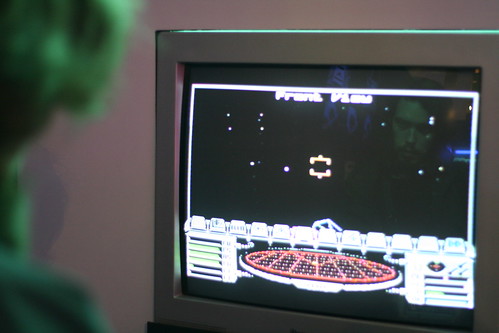
For the last couple weeks I have been concentrating on things related to my studies and on some events related to it. I posted pictures from these events on my Flickr photostream: a colleague from the institute finished his PhD and we had a goodbye dinner, my supervisor invited me to his son’s first birthday party. Also my friends Bunja and lastguru came to UK. With one I took photos of a night playground and squirrels and with other one some photos of the Eye and Babbage’s brain. However the main theme of this post is the Game On! exhibition in the London’s Science Museum. They have the best games playable there starting with the classic Pong, Lara Croft, Bomberman, Mortal Combat and up to Halo 2 on XBox 360. Even my non-gamer friend lastguru found a thing to drool upon - his childhood obsession: Elite. Elite! Update: Almost forgot to mention - the exhibition is great: it shows the evolution of gaming and allows to experience the most important games again and it also brings a huge amount of joy to anyone who has ever played these games before - the return to childhood is imminent. I never expected that something as simple as the original Pong can be so exciting in a good company. Very recommended!

4 November 2006

Erich Schubert: Turbogears performance

I've been trying some stuff with the Turbogears application I worked on a bit during the last two weeks. First thing was that I looked into using postgres as DB backend for Turbogears. Which turned up a bug in sqlalchemy (an ORM, mapping objects to database rows and back). I was passing a unicode string to the getBy function (to retrieve an object by it's primary key), and it went into the SQL statement without any quoting. Since my keys are all ascii, I could just cast them into regular string objects, and getBy worked then. Performance with postgres is worse than with sqlite; this is not too surprising. However this might change once I enable multithreading. Performance numbers: with SQLite: 8.30 trans/sec, with Postgres: 7.52 trans/sec These performance numbers are still very bad, and I guess we won't be keeping Turbogears on the long run, unless I find some documentation on improving the speed. One of the hints I got was to avoid py:match in kid, the templating engine used. I started by not using turbogears "sitetemplate" default template. This would automatically insert javascript and css files when needed. Since I don't use their widgets and such, I havn't been using this feature anyway. Not using the template - which contains one py:match for the 'head' tag and one for the 'body' tag - improved performance to 9.01 trans/sec (or 8.32 trans/sec) Now I can't explain why the improvements in the postgres run were better; both are a 10 minutes siege run. But 8.5% improvement is a start. I'll look into getting rid of the other py:match instances in our templates. (If I'd only find a good example with py:def - guess I'll instead "precompile" pre-templates into the actual templates or so instead with some self-written tool.) P.S. No, I'll probably not use turbogears for my next similar project. Rapid development is nice, ORMs are fancy and such, but sometimes good old plain SQL can be very easy to use, too. And more performant.

30 October 2006

Jeff Bailey: Condo Purchase!

It looks like the condo purchase has actually gone through, subject to the usual final signing in front of the notary and handing over of a silly sum of money!

It also means that now we have to get rid of our place for December to avoid paying rent and mortgage at the same time. So hey, Montr alers, want to move to the plateau? We've got a lovely 5 1/2, front and back balcony, 3rd floor (2i me tage), washer and dryer hookups, clothes line, decent neighbours, 1 1/2 blocks from m tro Mont-Royal, and 1 1/2 blocks from m tro Laurier. The place has a decent cable hookup (my Vid otron connection just got the binutils source package in 14 seconds, 906k/sec), iron clawfoot bathtub with a skylight and a decent amount of storage.

Any takers? =)

Axel Beckert: BarCamp Zurich -- Resume

The BarCamp Zurich 2006 is over. On the way there I thought about what I would do during time slots with no interesting talks. But when I tried to make up my personal schedule, I noticed that I rather would have the opposite problem: Too many interesting talks at the same time… Well, to many interesting talks at all, although I only went to tech talks and left out the biz talks. I first went to the Podcasting & Co. talk by Timo Hetzel, since I never heard or made a podcast, but was curious about podcasts in general. Besides statistics and rankings he spoke about where people listen to podcast (most listeners seem to do that during commuting), what people like in podcasts, why companies podcast, etc. And that a very big share of all podcast listeners use iTunes as podcast client and except juice (never heard of it before) all other podcast clients seem to be irrelevant. My conclusion: I haven’t missed anything not having listened to or made podcasts neither do I need to listen or make podcasts in the future. They’re irrelevant. To me. :-) Then I had to choose between the talks AJAX@localhost (PDF) by Harry Fuecks and Realtime Collaborative Text Editing and SubEthaEdit by the Coding Monkeys. I heard about realtime collaborative editing once know that it’s a challenging task for the developer. I also know what AJAX is (and that I would only use or recommend it for bells and whistles, but not for content in general), but “AJAX@localhost” sounded like writing normal applications using AJAX. It sounded interesting and evil at the same time. I had to go there! ;-) Others had similar expectations after reading the talk’s title, so I was quite surprised that it was about something completely different, namely about debugging AJAX on the localhost but under conditions usually only appearing if you’re running AJAX application not from localhost but from somewhere on the net: You may have different lags with every request, so some requests may reach the server before others, which may screw up the whole AJAX application, if the developers didn’t think about it and only tested it on localhost. (Hence the talk’s title…) My conlusion: I will use and recommend AJAX even more seldom, since there seem to be even more design misconceptions than I thought before. But I’ll once have a look at the Webtuesday meeting, he mentioned. For the third time-slot, I didn’t need long to decide where to go: I already knew a little bit about Microformats and I wanted to know more. Tag Trade also sounded interesting, but the second part of the talk’s title, Paid Learning sounded like business and so I had no scruples to cold-shoulder that talk. I probably didn’t learn anything really new in the microformats talk, but my knowledge about microformats is now more concrete, and after talking with Cédric Hüsler later during a break, I would even trust myself to start and define a new microformat. Then I went to the HG Caféteria together with Gürkan and two German guys. While waiting in the queue, we were talking about our jobs and our favourite Linux distributions. I got some rhubarb pie and a rum truffles, assuming that the Caféteria uses no alcohol in their products like all other SV restaurant I know. But this one seemed to have quite a lot of alcohol, since it felt like my breath was burning… Well, this resulted in my second SV feedback form submission… Next I went to Alex Schröder’s talk about multilingual websites, Oddmuse and the Emacs Wiki, although also the talk A-Life about simulating evolution sounded promising. Alex asked the listeners about their experiences with multilingual websites and showed what Oddmuse offers as partial solution to the general multilingualism problems. But regarding the comments from the auditorium, there probably won’t be a perfect solution until computers can translate perfectly… The next talk I visited was Gabor’s talk about his master thesis Organizing E-Mail which resulted in a soon to be released Mozilla Thunderbird extension called BuzzTrack. From the other concepts he showed, I found Microsoft’s SNARF (Social Network and Relationship Finder) and IBM’s Thread Arcs most interesting as well as the fact that there is no e-mail client seems to have a majority at all. Directly after Gabor I had my own talk about Understanding Shell Quoting, so I also couldn’t go to Adrian Heydecker’s talk about Learning with Hypertext and Search Engines. I had only about three and a half listeners of whom several to my surprise where here because they didn’t know what “shell quoting” is. I really didn’t expect that. But that seems to be one of the differences between a BarCamp and a Linux Conferences: People come here to see something new, something they haven’t heard about before. On Linux events most people come, because they already heard about some special topic and want to know more or learn something about it. On Linux event my shell talks usually were attracting many visitors while at a BarCamp, talks presenting an idea, a concept or a tool seem to much more interesting for the attendees. So for the next BarCamp I perhaps exhume my Website Meta Language talk which never seemed to hit the nerve of Linux event attendees, since it tried to “sell” a different concept of generating website than most were used to. At least one listener excepted the talk to be named “shell escaping”, but IMHO escaping is only one quoting technic and it’s not only used for quoting. But perhaps I should take the word “escaping” in the title though for the next time. Happily most of the listeners seem to have learned something new from the talk and Silvan Gebhardt was really happy about his new knowledge about ssh ~ escapes, although I mainly talked about how to quote them than how to use them. :-) During the last slot I visited the session about the upcoming BarCamp Alsace 2 and the yet to be planned BarCamp Rhine, a BarCamp to be held on a ship traveling from Basel in Switzerland down the Rhine, stopping in Strasbourg, Karlsruhe, Rhein-Main-Area and perhaps even Cologne and Amsterdam. Contrary to my initial thoughts, the day was over very fast and I had no single boring minute during the BarCamp. Wow! After we’ve been kicked out of the building by ETH janitors, we joined again at the Bar N-68. On the way there I met Urban M ller who attended BarCamp Zurich, too. We talked quite a lot and it was very interesting to see behind the scenes of e.g. map.search.ch. Later I joined the French speaking table, talking with Gregoire Japiot from WineCamp France and Alex Schröder. Around 9pm I left the N-68 as one of the last BarCampers, tired but with new knowledge, new ideas, new acquaintances and a new hobby: BarCamping. What a luck that BarCamps aren’t that often, otherwise I couldn’t afford this new hobby. ;-) As a relaxing end I met with Alex Schröder and Christophe Ducamp on Sunday morning for brunch in the restaurant Gloria in the Industriequartier. When we were leaving the Gloria I noticed their book board with a lots of BookCrossing books and I took “The Da Vinci Code” with me, since I saw the movie and people were telling me that the book is much better. I’ll see…

26 October 2006

Wouter Verhelst: US$ 6000

There's a bit of commotion around the amount of 6000 US dollars that's being paid to the RMs for a month of work; some people seem to think that this is a lot of money for one month of work. My guess is that these people have never had to run a business. Steve does run one; I don't know about aba. But let's just make some calculations here, shall we? I'd make them with the US system in mind, but as I have a business in Belgium, that's kinda hard to do. So I'll make them with the Belgian system in mind instead. And now if you want to pay yourself, you get to do the above dance all over again. You get to pay income taxes, insurance, rent or mortgage, Internet, phone, water, and whatnot. Plus food. In addition to all of the above, I don't know how much Steve has to drive around to talk to his customers, but if that's "quite a bit", then he may be leasing a car. I don't know whether he's got an ad running somewhere to attract more customers for the months after his paid Debian work, but if he is, he may have to pay a considerable amount of money to do so. And there can be any number of things that I've forgotten to include, but for which you still need to pay. In addition, if you want to run a business in a sane way, you need to ask a bit more than what your costs are, because there'll always be a few days that are not billable, and on which you need to live and pay expenses, too; but I could imagine that these were dropped for this particular month. Obviously the above numbers all involve some guesswork. I've been running a business for quite a while now, but it's only recently become profitable; many of these numbers will go up when your business is profitable for a long time. 6000 is nothing. I've had customers tell me you're cheap five seconds after I asked nearly twice as much. Trust me, that's no fun. It's one of the things I've had to learn while running a business: some amounts of money that seem hugely expensive in a private capacity are next to nothing in the business world. That's just the way it works... Finally, let me note that this is not meant to take any position one way or another in the matter. I did feel that experimenting with paying fellow developers was a good idea, but not at all costs; and certainly, I don't feel that going ahead with this by setting up something of the likes of dunc-tank is a very bright idea. I just thought it good to put some numbers into perspective. Update: Set the numbers straight. 6000 - 1200 is 4800, not 5800. Whoops. Yes, usually I do use a calculator :)

25 October 2006

Ben Hutchings: While Planet Debian is talking about money...

Julien Blache: "You ll be pleased to learn that a release manager needs $6000 USD to cover for living expenses for a month." Sounds high, right? But we're talking about contractors, not employees. Contractors have to cover certain expenses that are generally paid for by employers, such as (depending on jurisdiction): and in this case, their own equipment. (But they save on transport!) Besides which, you have little idea how much Steve or Andi might need to pay in mortgage repayments or rent, or how many dependents they have. Nor should we pry into these personal circumstances.

17 October 2006

Russell Coker: IT companies and toxic waste

Greenpeace has an interesting article about how IT companies rank in toxic waste problems.

Dell rates quite well, I feel happier about my recent purchase of a large Dell TFT monitor now. HP does reasonably well, that's fortunate as the Green party in Victoria has recently purchased a HP server. But next time we discuss such things I will suggest that more consideration be given to Dell servers because of this issue.

Lenovo does really badly, I'm surprised because I would have expected IBM to do reasonably well and I didn't think that Lenovo would make significant changes. From now on I will refrain from purchasing Lenovo products. I will still purchase second-hand IBM products, but nothing under the Lenovo brand until they clean up their act.

Also it's worth noting that computers manufactured with toxic chemicals will outgas some of the chemicals into the local environment (IE your server room, bedroom, or wherever else you have computers). Avoiding the computers manufactured with toxic chemicals is not only good for the environment, but also good for your health!

16 October 2006

James Morrison: Sadists

For those that don't know, Katelyn has become a sadist. Her idea of a slow 4 mile run.

Other recent events, I got learned about San Pablo. The fuzzy vodka party with some hot tub time was worth the confusion though. I wasn't as silly
cycling home
though.

I hiked up Half-dome the other weekend. It was an amazing night hike. Too bad I wussed out on the cables. I think the world may be telling me to get a car, because this is the second time I've gone camping where my ride has left a day early without room for me. The last time I split my stuff up and hitched a ride home, this time I split my stuff up again, and went in one vehicle until the first BART station, then took the BART home.

Kevin Rosenberg: New CLSQL version

I released CLSQL 3.7.7 which has Andrew Golding submission, a nice improvement to PostgreSQL error recording. Of note, Andrew is employed by Onshored, a company whose code in the (long orphaned) UncommonSQL package helped move CLSQL from 2.x versions to v3.0 which featured full CommonSQL spec compliance.

13 October 2006

Matthew Garrett

You know you've been spending too much time thinking about PhDs when it's 5AM in the morning and
CACTCGAAGCCGCCACGGCCACACTGCACCCTCAGTTTCGTGCAACTTTT
TGTACGCAAATAAGAAAAACATTAAATTTGCTCTCAGCAAATCGATAATT
GCAAACGCAGTGCCGTTTCAATTGCAGCACAAACCGCAACGAAAATGTTG
GCGACCGAGGCGAGACAGATCCTGAGCCGCGTGGGATCCCTGGTGGCCAG
GAACCAGATGCGCGCCATCAGCAATGGCACCGCCCAGCTGGAGCAGCAGG
CGCAGCCCAAGGAGGCCCAGGAGCCGCAGATCAAGAAGTTCGAGATCTAC
CGCTGGAACCCGGACAACGCCGGCGAGAAGCCGTACATGCAGACCTACGA
GGTGGACCTGCGCGAGTGCGGCCCCATGGTGCTGGACGCGCTGATCAAGA
TCAAGAACGAGATGGACCCCACGCTCACCTTTAGGCGCTCCTGTCGCGAG
GGCATCTGCGGCTCCTGCGCCATGAACATCGGCGGCACCAACACGCTGGC
CTGCATCAGCAAGATCGACATCAACACCTCCAAGTCGCTGAAGGTGTACC
CGCTGCCCCATATGTACGTGGTGCGCGACCTGGTCCCGGACATGAACAAC
TTCTACGAGCAGTACCGCAACATCCAGCCCTGGCTGCAGCGCAAGAACGA
AGCGGGCGAGAAGAAGGGCAAGGCCCAGTACCTGCAGTCCGTCGAGGATC
GCTCCAAGTTGGACGGCCTGTACGAGTGCATCCTGTGCGCCTGCTGCTCC
ACCTCGTGCCCCTCGTACTGGTGGAACGCCGAGAAGTACCTGGGCCCCGC
CGTGCTGATGCAGGCCTACCGCTGGATCATCGACTCGCGTGACGAGAACT
CCGCCGAGCGTCTGAACAAGTTGAAGGACCCCTTCAGCGTCTACCGGTGC
CACACGATCATGAACTGCACGCGCACCTGCCCCAAGGGGCTCAATCCCGG
CCGTGCCATCGCCGAGATCAAGAAGCTGCTCTCGGGCCTGGCCTCCAAGC
CGGCTCCGAAGCTGGAGACGGCGGCGCTGCACAAGTAGGGCCCAAGTCCT
CTACTCCCAGTTCGTCCCCTGCTGTCCTTAACCAGTGAGCTAAGCCTCCG
AAAATGTGTATTGGAGACTCCTCCAGCCAACATGCTTACTATGTTATAAT
TTATTTAAGCCTAAAGTATCCGACACTTGTTATTACAGTTTGTAAAGGGA
ACAAGACGCGAAAATAAATAATTGTGTATCCACCA
has become meaningful to the naked eye.

Jeff Bailey: Offer accepted!

And the call came in over dinner, offer accepted.

Now begins the mad rush of inspections, reviewing minutes, finalising mortgage...

12 October 2006

Andreas Barth: GR: Handling source-less firmware in the Linux kernel

The plain proposal allows us to ship with most of the firmware drivers (as they just require the *license* complies with the DFSG, which is e.g. ok with BSD-style licenses). Two drivers one might still include are still doubtfull with this decision: Typhoon and tg3. The Amendment has a similar effect - it will definitly allow us to ship with tg3, typhoon is unclear. It also supports a decision by the release team - but well, we can also live without supporting that decision (as long as nobody overwrites it). Summary: Any of the proposals allows us releaseing Etch soon. There is a "better" proposal upcoming, but that is not a reason to refuse the current one.

Gunnar Wolf: Bolivia

Ok, so I am going to be in Bolivia next week - or so I hope ;-)
I don't usually take care to do this, but being it Lloyd A reo Boliviano (more on this later), and having heard first-hand and even almost lived stories of ticketing errors, I decided to call the airline to confirm my flight details.
...Only that the airline does not have a web site any more - It was grabbed by an online casino. Or maybe... Am I getting a casino ticket? Holy crap, no, it's a casino evangelism blog, explaining you how fun and interesting it is to lose your money online, how fair are the online slot machines, and such crap... Unbelievable. Anyway, I found Lloyd's Mexican office phone number in some online directory, and called. My ticket was, yes, reserved - It was not paid, though. Or maybe yes - the clerk told me that sometimes tickets get paid in Bolivia and they don't know about that. That could explain why lvaro almost lost his flight. Ok, we got that point fixed in ~20 minutes (thanks to Dydier and Ramiro, in Sucre and Potos respectively). I called again Lloyd, and yes, I'm confirmed. Phew.
About Lloyd: I flied with them two years ago, when I went to the IV National Free Software conference in Sucre. The only problem I had was due to myself: I spent some days travelling around after the conference, and my plane back was set to depart from La Paz, change planes in Cochabamba, then change planes in Santa Cruz, then on to Mexico. As I was in Cochabamba already, I decided to skip the first hop - Well, that accounted for a couple of hours on the phone getting my ticket back to life once it had been cancelled as a no-show :) However, Lloyd has went through a serious financially troubled period, and its reliability seems to have gone seriously down. Even two years ago, when we both were in Bolivia (in the conference I just mentioned), lvaro had to spend over a week he didn't plan on in Bolivia, as Lloyd's transatlantic plane was being repaired (!!). I found a similar report about an Argentinian passenger stuck for a day in Mexico and three further days in Santa Cruz due to broken aircraft... I can only hope for the best ;-)
Anyway, in Bolivia I'll have quite a packed schedule. As I've told to Dydier, I don't care too much about the details on what will we do each day (my hosts are free to own 100% of my time), but I'll give at least five talks (three in CCBOL in Potos and two to diverse auditoriums in Sucre). Of course, this is prone to change somehow, but the plan is I'll have a tutorial on PostgreSQL, a set of talks regarding computer and network security, and a talk about Free Software as a model of knowledge production rather than as a technical or social movement. Of course, wherever I go I talk about Debian as well at every possible chance ;-)

9 October 2006

Matt Brown: Per Client VLANs with Madwifi

I’ve written a patch for the madwifi-ng driver to separate each associated client into a unique VLAN. The patch only makes sense for use when the driver is in master mode being controlled by hostapd. Using this patch with WPA2/RSN you can acheive complete layer 2 isolation between associated clients. The patch does not support placing multiple clients in the same VLAN. Full layer 2 isolation requires that there is no broadcast or multicast traffic transmitted from the access point. To enforce this the patch mangles outgoing broadcast / multicast packets to be directed only to the node associated with the VLAN that the packet was received from. Clients can still send/recieve broadcast and multicast traffic without problems if you bridge them onto another layer 2 network. You must fully understand the consequences of this before using the patch. In the worst case scenario if you bridged the VLANs for each client together onto a common L2 network you will cause every broadcast/multicast packet sent onto that L2 network to be transmitted by the access point as a unicast packet to each associated client. If you have a lot of broadcast/multicast packets this is going to significantly reduce the performance of your network. This is a somewhat contrived situation as there is no point creating the VLANs in the first place if you’re just planning to bridge them back together, but I use it to illustrate the risks this patch can introduce if you don’t understand it properly. At this stage I’m not convinced that the patch is actually useful, and I’m not going to be proposing it for inclusion in the driver. You’re welcome to use it if you find it useful. Please let me know how you are using it and any problems that you run into. I don’t guarantee that I can provide support or assistance though :P The Patch How the patch works
One of the primary constraints I had in writing this patch was that the clients using the access point are not required to do anything special. From their point of view they are simply associated to a standard AP running 802.1x with WPA2. There are no 802.1q packets “on the air”. All of the VLAN functionality is handled within the driver itself. Inside the driver there is a node table listing every node that is associated. The patch adds an entry to each node record specifying a VLAN id for that client. By default this id is automatically assigned when a node associates, but it can be modified by wriiting to the /proc/net/madwifi/<iface>/sta_vlan file. As packets are moved between the kernel and the actual physical card by the driver 802.1q tags are added and removed as appropriate to ensure that the kernel sees every node in it’s own VLAN. The VLAN tagging code in the driver ignores EAPOL frames so that they are always sent to the base device where hostapd is listening. Userspace Setup
By default per node VLANs are disabled and have to be explicitly enabled

echo 1 > /proc/sys/net/<iface>/per_node_vlan

And you almost certainly want to stop the driver from bridging packets between clients

iwpriv <iface> ap_bridge 0

Then it’s simply a matter of creating the appropriate VLANs on the base interface using the standard Linux VLAN tools, eg:

vconfig add <iface> 4
Final Comments
I’ve tested the code fairly extensive and it works fine for me. It’s not particularly clean and the mangling of broadcast/multicast packets is a messy hack. You can achieve a very similar situation using PPPoE from the client to the Access Point without having to patch the driver to support per node VLANs.

4 October 2006

Adam Rosi-Kessel: Strange Fruit

Via Jesse, this strangely beautiful commercial for some sort of beverage I’ve never heard of. Featuring fruit. Update: apparently I’m out of touch with the zeitgeist. The fruit video is apparently a somewhat authorized parody of this Sony Bravia ad. In fact, I didn’t even know what a Sony Bravia was until now. Update 2: I guess I’m really behind the times. Wikipedia has known all about this Tango ad business since at least June 14, 2006. Now there’s some effective advertising.

Next.

Previous.