Search Results: "dom"

11 January 2016

Norbert Preining: 10 years TeX Live in Debian

I recently dug through my history of involvement with TeX (Live), and found out that in January there are a lot of anniversaries I should celebrate: 14 years ago I started building binaries for TeX Live, 11 years ago I proposed the packaging TeX Live for Debian, 10 years ago the TeX Live packages entered Debian. There are other things to celebrate next year (2017), namely the 10 year anniversary of the (not so new anymore) infrastructure in short tlmgr of TeX Live packaging, but this will come later. In this blog post I want to concentrate on my involvement in TeX Live and Debian. TeX Live/Debian Those of you not interested in boring and melancholic look-back onto history can safely skip reading this one. For those a bit interested in the history of TeX in Debian, please read on. Debian releases and TeX systems The TeX system of choice has been for long years teTeX, curated by Thomas Esser. Digging through the Debian Archive and combining it with changelog entries as well as personal experiences since I joined Debian, here is a time line of TeX in Debian, all to my best knowledge.
Date Version Name teTeX/TeX Live Maintainers
1993-96 <1 ? ? Christoph Martin
6/1996 1.1 Buzz ?
12/1996 1.2 Rec ?
6/1997 1.3 Bo teTeX 0.4
7/1998 2.0 Ham teTeX 0.9
3/1999 2.1 Slink teTeX 0.9.9N
8/2000 2.2 Potato teTeX 1.0
7/2002 3.0 Woody teTeX 1.0
6/2005 3.1 Sarge teTeX 2.0 Atsuhito Kohda
4/2007 4.0 Etch teTeX 3.0, TeX Live 2005 Frank K ster, NP
2/2009 5.0 Lenny TeX Live 2007 NP
2/2011 6.0 Squeeze TeX Live 2009
5/2013 7.0 Whezzy TeX Live 2012
4/2015 8.0 Jessie TeX Live 2014
??? ??? Stretch TeX Live 2015
The history of TeX in Debian is thus split more or less in 10 years teTeX, and 10 years TeX Live. While I cannot check back to the origins, my guesses are that already in the very first releases (te)TeX was included. The first release I can confirm (via the Debian archive) shipping teTeX is the release Bo (June 1997). Maintainership during the first 10 years showed some fluctuation: The first years/releases (till about 2002) were dominated by Christoph Martin with Adrian Bunk and few others, who did most packaging work on teTeX version 1. After this Atsuhito Kohda with help from Hilmar Preusse and some people brought teTeX up to version 2, and from 2004 to 2007 Frank K ster, again with help of Hilmar Preusse and some other, took over most of the work on teTeX. Other names appearing throughout the changelog are (incomplete list) Julian Gilbey, Ralf Stubner, LaMont Jones, and C.M Connelly (and many more bug-reporters and fixers). Looking at the above table I have to mention the incredible amount of work that both Atsuhito Kohda and Frank K ster have put into the teTeX packages, and many of their contributions have been carried over into the TeX Live packages. While there haven t been many releases during their maintainership, their work has inspired and supported the packaging of TeX Live to a huge extend. Start of TeX Live I got involved in TeX Live back in 2002 when I started building binaries for the alpha-linux architecture. I can t remember when I first had the idea to package TeX Live for Debian, but here is a time line from my first email to the Debian Developers mailing list concerning TeX Live, to the first accepted upload:
Date Subject/Link Comment
2005-01-11 binaries for different architectures in debian packages The first question concerning packaging TeX Live, about including pre-built binaries
2005-01-25 Debian-TeXlive Proposal II A better proposal, but still including pre-built binaries
2005-05-17 Proposal for a tex-base package Proposal for tex-base, later tex-common, as basis for both teTeX and TeX live packages
2015-06-10 Bug#312897: ITP: texlive ITP bug for TeX Live
2005-09-17 Re: Take over of texinfo/info packages Taking over texinfo which was somehow orphaned started here
2005-11-28 Re: texlive-basic_2005-1_i386.changes REJECTED My answer to the rejection by ftp-master of the first upload. This email sparked a long discussion about packaging and helped improve the naming of packages (but not really the packaging itself).
2006-01-12 Upload of TeX Live 2005-1 to Debian The first successful upload
2006-01-22 Accepted texlive-base 2005-1 (source all) TeX Live packages accepted into Debian/experimental
One can see from the first emails that at that time I didn t have any idea about Debian packaging and proposed to ship the binaries built within the TeX Live system on Debian. What followed was first a long discussion about whether there is any need for just another TeX system. The then maintainer Frank K ster took a clear stance in favor of including TeX Live, and after several rounds of proposals, tests, rejections and improvements, the first successful upload of TeX Live packages to Debian/experimental happened on 12 January 2006, so exactly 10 years ago. Packaging Right from the beginning I used a meta-packaging approach. That is, instead of working directly with the source packages, I wrote (Perl) scripts that generated the source packages from a set of directives. There were several reasons why I choose to introduce this extra layer: Till now I am not 100% sure whether it was the best idea, but the scripts remain in place till now, only adapted to the new packaging paradigm in TeX Live (without xml) and adding new functionality. This allows me to just kick off one script that does do all the work, including building .orig.tar.gz, source packages, binary packages. For those interested to follow the frantic activity during the first years, there is a file CHANGES.packaging which for the years from 2005 to 2011 documents very extensively the changes I made in these years. I don t want to count the hours the went into all this  Development over the years TeX Live 2005 was just another TeX system but not the preferred one in Debian Etch and beyond. But then in May 2006, Thomas Esser announced the end of development of teTeX, which cleared the path for TeX Live as main TeX system in Debian (and the world!). The next release of Debian, Lenny (1/2009), already carried only TeX Live. Unfortunately it was only TeX Live 2007 and not 2008, mostly due to me having been involved in rewriting the upstream infrastructure based on Debian package files instead of the notorious xml files. This took quite a lot of attention and time from Debian away to upstream development, but this will be discussed in a different post. Similarly, the release of TeX Live included in Debian Squeeze (released 2/2011) was only TeX Live 2009 (instead of 2010), but since then (Wheezy and Jessie) the releases of TeX Live in Debian were always the latest released ones. Current status Since about 2013 I am trying to keep a regular schedule of new TeX Live packages every month. These helps me to keep up with the changes in upstream packaging and reduces the load of packaging a new release of TeX Live. It also bring to users of unstable and testing a very up-to-date TeX system, where packages at most lack 1 month of behind the TeX Live net updates. Future As most of the readers here know, besides caring for TeX (Live) and related packages in Debian, I am also responsible for the TeX Live Manager (tlmgr) and most of upstream s infrastructure including network distribution. Thus, my (spare, outside work) time needs to be distributed between all these projects (and some others) which leaves less and less time for Debian packaging. Fortunately the packaging is in a state that making regular updates once a month is less of a burden, since most steps are automatized. What is still a bit of a struggle is adapting the binary package (src:texlive-bin) to new releases. But also this has become simpler due to less invasive changes over the years. All in all, I don t have many plans for TeX Live in Debian besides keeping the current system running as it is. Search for and advise to future maintainers and collaborators I would be more than happy if new collaborators appear, with fresh ideas and some spare time. Unfortunately, my experience over these 10 years with people showing up and proposing changes (anyone remembers the guy proposing a complete rewrite in ML or so?) is that nobody really wants to invest time and energy, but search for quick solutions. This is not something that will work with a package like TeX Live, sized of several gigabyte (the biggest in the Debian archive), and complicated inner workings. I advise everyone being interested in helping to package TeX Live for Debian, to first install normal TeX Live from TUG, get used to what actions happen during updates (format rebuilds, hyphenation patters, map file updates). One does not need to have a perfect understanding of what exactly happens down there in the guts (I didn t have in the beginning, either), but if you want to help packaging and never heard about what format dumps or map files are, then this might be a slight obstacle. Conclusion TeX Live is the only TeX system in wide use across lots of architectures and operating systems, and the only comparable system, MikTeX, is Windows specific (also there are traces of ports to Unix). Backed by all the big user groups of TeX, TeX Live will remain the prime choice for the foreseeable future, and thus also TeX Live in Debian.

Thadeu Lima de Souza Cascardo: GNU on Smartphones (part II)

Some time ago, I wrote how to get GNU on a smartphone. This is going to be a long discussion on why and how we should work on more operating systems for more devices. On Android So, why should we bother if we already have Android, some might ask? If it's just because of some binary blobs, one could just use Replicant, right? Well, one of the problems is that Android development is done in hiding, and pushed downstream when a new version is launched. There is no community behind that anyone can join. Replicant ends up either following it or staying behind. It could do a fork and have its own innovations. And I am all for it. But the lack of manpower for supporting devices and keeping up with the latest versions and security fixes already takes most of the time for the one or two developers involved. Also, Android has a huge modularity problem, that I will discuss further below. But it's hard to replace many components in the system, unless you replace them all. And that also causes the problem that applications can hardly share extra components. I would rather see Debian running on my devices and supporting good environments and frameworks for all kinds of devices, like phones, tablets, TVs, cars, etc. It's developed by a community I can join, it allows a diverse set of frameworks and environments, and it's much easier to replace single components on such a system. On Copyleft Hardware I get it. Hardware is not free or libre. Its design is. I love the concept of copyleft hardware, where one applies the copyleft principles to a hardware design. Also, there is the concept of Hardware that Respects Your Freedom, that is, one that allows you to use it with only free software. Note that RYF hardware is not necessarily copyleft hardware. In fact, most of the time, the original vendor has not helped at all, and it required reverse engineering efforts by other people to be able to run free software on those systems. My point here is that we should not prevent people from running free software on hardware that does not RYF or that is not copyleft. We should continue the efforts of reverse engineering and of pushing hardware vendors to not only ship free software for their hardware, but also release their design under free licenses. But in the meantime, we need to make free software flourish in the plethora of devices on the hands of so many people around the world. On Diversity I won't go into details on this post about two things. One topic I love is retrocomputing and how Linux supported so many devices, and how many free or quasi-free operating systems ran on so many of them in the past. I could mention ucLinux, Familiar, PDAs, Palmtops, Motorolas, etc. But I will leave it to another time and go from Openmoko and Maemo forward. The other topic is application scalability. Even Debian with so many software available does not ship all free software there is available. And it doesn't support all third-party services out there. How can we solve that? It has to do with platforms, protocols, open protocols, etc. I will not go into that today. Because I believe that either way, it's healthy for our society to have diversity. I believe we should have other operating systems available for our devices. Even if application developers will not develop for all of them. That is already the case today. There are other ways to fix that, when that needs fixing. Sometimes, it's sufficient that you can have your own operating system on your device, that you can customize it, enhance it and share it with friends. And also, that would allow for innovation. It would make possible that some other operating system would have enough market share on some other niche. Other than Android and iOS, for example. But that requires that we can support that operating system on different devices. And that is the scalability that I want to talk about. How to support more devices with less effort. Options But before I go into that, let me write more about the alternatives we have out there. And some of the history around it. Openmoko Openmoko developed a set of devices that had some free design. And it has some free operating systems running on top. The community developed a lot of their own as well. Debian could (still can) run on it. There is SHR, which uses FSO, a mobile middleware based on D-Bus. It even spawned other devices to be developed, like GTA04, a successor board, that can be shipped inside a Neo Freerunner case. Maemo, Moblin, Meego and Tizen I remember the announcement of Nokia N770. During FISL in 2005, I even criticized a lot, because it shipped with proprietary drivers. And applications. But it was the first time we heard of Maemo. It was based on Debian and GNOME. The GNOME Mobile initiative was born from that, I believe, but died later on. But with the launch of N900, and later events, like the merge of Moblin with Maemo, to create Meego, we all had an operating system that was based on community developed components, that had some community participation, and was much more like the systems we were used to. You could run gcc on N900. You could install Das U-Boot and have other operating systems running there. But Nokia has gone a different path. Intel has started Tizen with Samsung. There is so much legacy there, that could still be developed upon. I am just sad that Jolla decided to put proprietary layers on top of that, to create SailfishOS. But we still have Mer, Nemo. But it looks like Cordia is gone. At least, (http://cordiahd.org) seems to have been registered by a domain seller. Not to forget, Neo900, a project to upgrade the board, in the same vein as GTA04. FirefoxOS and Ubuntu What can I say about FirefoxOS and Ubuntu Phone? In summary, I think we need more than Web, and Canonical has a history of not being too community oriented as we'd like. I won't go too much here in what I think about the Web as a platform. But I think we need a system that has more options for platforms. I haven't participated in projects directed by Mozilla either, so I can't say much about that. Ubuntu Phone should be a system more like what we are used to. But Canonical is going to set the directions to the project, it's not a community project. Nonetheless, I think they add to the diversity, and users should be able to try them, or their free parts or versions. But there are challenges there, that I think need to be discussed. So, both of these systems are based on Android. They don't use Dalvik or the application framework. But they use what is below that, which means device drivers in userspaces, like RIL, for the modem drivers, and EGL, for graphics drivers. The reason they do that is to build on top of all the existing vendor support for Android. If a SOC and phone vendor already supports Android, there should be not much needed to do to support FirefoxOS or Ubuntu Phone. In practice, this has not benefited the users or the projects. Porting should be as simple as getting a generic FirefoxOS or Ubuntu Phone image and run it on top of your Android or CyanogenMod port. Porting usually requires doing all the same work as porting Android. Even though one should be able to take advantage of existing ports, it still requires doing a lot of integration work and building an entire image, most of the time, including the upper layers, that should be equal in all devices. This process should require at most creating a new image based on other images and loading it on the device. I will discuss more about this below. I can't forget to mention the Matchstick TV project. It is based on FirefoxOS. I think it would have much more changes to succeed if it was easier for testers to have images available for all of their gadgets capable of running some form of Android. Replicant And then we have Replicant. It has a lot of the problems Android has. Even so, it's a tremendously important project. First, it offers a free version of Android, removing all proprietary pieces. This is very good for the community. But more than that, it tries to free the devices beyond that. What the project has been done is reverse engineer some of the pieces, mostly the modem drivers. That allows other projects to build upon that work, and support those modems. Without that, there is no telephony or celullar data available on any of these devices. Not without proprietary software, that is. They also have been working on free bootloaders, which is another important step for a completely free system. Next steps There are many challenges here, but I believe we should work on a set of steps that make it more palatable and produce intermediary results that can be used by users and other projects. One of the goals should be good modularity. The ability to replace some pieces with the least trouble necessary. The update of a single framework library should be just a package install, instead of building the entire framework again. If there is ABI breakage, users should still be able to have access to binaries (and accompanying source code) and only need to update the library and its reverse dependencies. If one layer does not have these properties, at least it should be possible to update this big chunk without interfering with the other layers. One example is FirefoxOS and Ubuntu Phone. Even if there is a big image with all system userspace and middleware, the porting, install and upgrade process should allow the user to keep the applications and to leverage porting already done by similar projects. Heck, these two projects should be able to share porting efforts without any trouble. So what follows is a quick discussion on Android builds, then suggestions on how to approach some of the challenges. On Android build The big problem with Android build is its non-modularity. You need to build the world and more to get a single image in the end. Instead of packages that could be built independently, that generated modular package images, that could be bundled in a single system image. Better yet would be the ability to pick only those components that matter. Certainly, portability would be just as interesting, being able to build certain components on top a GNU system with GNU libc. At times, it seems like this is done by design, to make it difficult for "fragmentation" and competition. Basically, making it difficult to exercise the freedom to modify the software and share your modifications with others. Imagine the possibilities of being able to: There are some dangers in promoting the use of Android like this. Since it promotes proprietary drivers, relying on such layers instead of better community oriented layers means giving an advantage to the first. So, the best plan would be to replace those layers, when they are used, for things like ofono and Wayland, for example. But, in the meantime, making it easier for users to experiment with FirefoxOS, Ubuntu Phone, Matchstick TV, Replicant on other devices, without resorting to building the entire Android system, would be a very nice thing. It is possible that there are some challenges with respect to API and ABI. That these layers are too intermingled that some changes present in one port would prevent FirefoxOS to run on top of it without changes in either of the layers. I can't confirm that is the case, but can't deny the possibility. Rooting One of the challenges we have that may have trouble in scaling is rooting devices. Unfortunately, most of the devices are owned by the vendor or carrier, not the user. The user is prevented from replacing software components in the system, by removing its permissions from replacing most of the files in the filesystem, or writing to block devices, or change boot parameters or write to the storage devices. Fortunately, there are many documents, guides, howtos, and whatnots out there instructing on how to root a lot of devices. In some cases, it depends on software bugs that can be patched by the users as instructed by vendors. Certainly, favoring devices that are built to allow rooting, hacking, etc, is a good thing. But we should still help those users out there who do not have such devices, and allow them to run free software on them. Booting Then, comes booting, which is a large discussion on its own, and also related to rooting, or how to allow users to replace their software. First, we have the topic of bootloaders, which are usually not free, and embedded in the chip, not on external storage. So, there are those pieces of the bootloader which we can replace more easily and those that we are not, because they would require changing a piece of ROM, for example. Das U-Boot would be one of the preferred options for a system. It supports a lot of hardware platforms out there, a lot of storage devices and filesystems, network booting, USB and serial booting, and a lot of other things. Porting is not an easy task, but it is possible. Meanwhile, using the bootloaders that ship with the system, when possible, would allow a path where other pieces of the system would be free. One of the challenges here is building single images that could boot everywhere. The lack of a single ARM boot environment is a curse and a blessing. It makes it hard to have this single boot image, but, on the other hand, it has allowed so much of the information for such systems to be free, to be embedded in copyleft software, instead of having blobs executed by our free systems, like ACPI encourages. Device trees have pushed this portability issue from the kernel to the bootloaders. Possibily encouraging vendors to now hide and copyright this information in the form of proprietary device trees. But it has made it easier for single images. In practice, we still need to see a lot of devices out there supporting this single kernel scenario. And this mechanism only brings us the possibility of a single kernel. We still need to ship bootable images that have pieces of bootloaders that are not as portable. This has caused lots of operating systems out there to be built for a single board. Or to support just a small set of boards. I struggle with the concept. Why are we not able to mix device-specific pieces with generic pieces and get a resulting image that will boot on our choice of board? Why does every project need to do all the porting work again, repeating the efforts? Or have one entier ISO image for every supported board? Check how Geexbox does it, for an example. Fortunately, I see Debian going in a good direction. Here, one can see how it instructs the user to combine a system-dependent part with a system-independent part. Installation Which brings us to the installation challenge. We should make this easy and also customizable by the user. Every project might have its own method, and that is part of the diversity that we should allow. The great challenge here is handling rooting and booting for the user. But it's also possible to leave that as separate efforts, as it would be nice to have good installers as we have in the desktop and server environments. Linux Linux is one of the most ported kernels out there. Of course, it would be healthy to the diversity I propose that other kernels and systems out there should work on those mobile devices. NetBSD, for example, has a reputation of being very portable and ported to many platforms. And GNU runs on many of them, either together with the original systems, or as the main system on top of other kernels, as proven by the Debian GNU/kFreeBSD port, which uses GNU libc. But, though I would love to see HURD running directly on those devices, Linux and its derivatives are already running on them. Easier to tackle is to get Linux-libre running on those systems. But though this looks like one of the easier tasks at hand, it is not. If you run a derivative version from Linux, provided by the vendor, things should go smooth. But most of the time, the vendor does not provide patches upstream, and leave their fork to rot, if you are lucky, in the earlier 3.x series. And some times, there is not even source code available. There are vendors out there who do not respect the GPL and that is one of the reasons why GPL enforcement is important. I take this opportunity to call attention to the work of Software Freedom Conservancy and its current efforts to raise funds to continue their work. Running an existing binary version of Linux on your device with a free userspace is part of the strategy of replacing pieces one at a time while allowing for good diversity and reaching more users. Drivers Then we have the matter of drivers. And in this case, it's not only Linux drivers, but drivers running in userspace. Though others exist, there are two important and common cases, which are modem and graphics drivers, both of which are usually provided by Android frameworks, and that other systems try to leverage, instead of using alternatives that are more community friendly. In the case of modem drivers, Android uses its RIL. Besides not using a Radio or Modem at all, there are two strategies for free versions. One is using free versions of the drivers for RIL. That's what Replicant does, because, well, it uses the other Android subsystems after all. The other one is using a system that is developed by the community. ofono is one that, even though it's an Intel iniative, looks more community governed or open to community participation than any Android subsystem ever was. As for Graphics, Canonical even built its Mir project with the goal of being able to use Android GPU drivers. Luckily, there has been a lot of reverse engineering efforts out there for a lot of those GPUs shipped with ARM SoCs. Then, we can use Mesa, Wayland and X.org. Other option, until then, is just using a framebuffer driver, possibly one that does not need any initialization, depending on one done by the bootloader, for example. Middleware and Shells Plasma Active, that I just found out now is Plasma Mobile, looks like a great system. Built by folks behind KDE, we can expect great freedom to come from it. Unfortunately, it suffers from what we have been discussing here, which is lack of good device support, or shipping images that run on top of single devices, without leveraging the porting that has come before of other systems. Fortunately, that is just what I want to accomplish with this effort. FSO, that I mentioned before, is a good middleware, that we should try to run on top of these devices. Running GNOME or Unity shell, and use rpm or deb based systems, that's all part of the plan on diversity. You could use systemd, or System V init systems, whatever gives you the kicks. It's not an easy task, since there are so many new things on these new kinds of devices. Besides touch, there is telephony, which as I mentioned, would be a good task for ofono. As for TV sets or dongles, I would love to see OpenFlint, created by the Matchstick TV guys, flourish out there and allow me to flint stuff from my mobile phone running Debian into my TV dongle running Debian. Project So, is there a project out there you can start contributing to? Well, I pointed out a lot of them. All of them make part of this plan. Contributing to reverse engineering GPUs, or to Plasma Mobile, ofono, GNOME, Linux-libre, bootloaders, Debian, and so many other projects. My plans are to contribute in the scope of Debian and make sure it works well on top of semi-liberated devices, and make sure there is a nice user interface and good applications when using either GNOME or Plasma. Integrating ofono is a good next step, but I am running ahead of myself. Right now, I don't think there is need for an integrated effort. If you think otherwise, please let me know. If you are doing something in this direction, I would love to know. Paul Wise reminded me to point out to the Debian Mobile, where I will probably contribute any documentation and other relevant results. Thanks There are some many people to thank, but I would like to remember Ian Murdock, who created Debian, one of the projects who inspires me the most. I think the best way to handle his passing is to celebrate what he has helped create, and move forward, taking more free software to more people in an easy and modular way. I have been wanting to write something like this for a long time, so I thank Chris Webber for inspiring me on doing it.

9 January 2016

Daniel Pocock: Comments about people with mental illness

A quote:
As the Buddha said 2500 years ago... we're all out of our fucking minds. (Albert Ellis)
There have been a few occasions over the last year where people suffering mental illnesses have been the subject of much discussion. In March 2015 there was the tragic loss of Germanwings flight 9525. It was discovered that the co-pilot, Andreas Lubitz, had been receiving treatment for mental illness. Under strict privacy laws, nobody at his employer, the airline, had received any information about the diagnosis or treatment. During the summer, the private mailing list for a large online community discussed the mental illness of a contributor to a project. Various people expressed opinions that appeared to be generalizations about all those with mental illness. Some people hinted the illness was a lie to avoid work while others speculated about options for treatment. Nobody involved mentioned having any medical expertise. It is ironic that on the one hand, we have the dramatic example of an aircraft crashing at the hands of somebody who is declared unfit to work but working anyway and on the other hand when somebody else couldn't do something, the diagnosis is being disputed by people who find it inconvenient or don't understand it. More recently, there has been openly public discussion about whether another developer may have had mental illness. Once again, there doesn't appear to be any evidence from people with any medical expertise or documentation whatsoever. Some of the comments appear to be in the context of a grudge or justifying some other opinion. What's worse, some comments appear to suggest that mental illness can be blamed for anything else that goes wrong in somebody's life. If somebody is shot and bleeds to death, do you say low blood pressure killed him or do you just say he was shot? Likewise, if somebody is subject to some kind of bullying and abused, does this have no interaction with mental illness? In fact, Google reveals an enormous number of papers from experts in this field suggesting that mental illness can arise or be exacerbated by bad experiences. Although it may not have been clear at that point in time, when we look back at Alan Turing's death today, suicide was not a valid verdict and persecution was a factor. Statistics tell us that 1 in 4 people experience a mental health problem in the UK each year. In the USA it is 26% of the adult population, each year. These may be long term conditions or they may be short term conditions. They may arise spontaneously or they may be arising from some kind of trauma, abuse or harassment in the home, workplace or some other context. For large online communities, these statistics imply it is inevitable that some participants will be suffering from mental illness and others will have spouses, parents or children suffering from such conditions. These people will be acutely aware of the comments being made publicly about other people in the community. Social interaction also relates to the experience of mental illness, people who are supported by their community and society are more likely to recover while those who feel they are not understood or discriminated against may feel more isolated, compounding their condition. As a developer, I wouldn't really like the idea of doctors meddling with my code, so why is it that some people in the IT and business community are so happy to meddle around in the domain of doctors, giving such strong opinions about something they have no expertise in? Despite the tragic loss of life in Germanwings 9525, observing some of these other discussions that have taken place reminds me why Germany and some other countries do have such strict privacy laws for people who seek medical treatment. (You can Follow or Tweet about this blog on Twitter)

Iain R. Learmonth: Trust

This is not a new world, this is simply an extension of the old one. I'm not going to write here about sweeping changes that are happening now, but changes that have been taking place in plain sight for many decades. No one has flipped a switch, only tweaked and tuned variables here and there to lead us down this path. I'd like to reflect on where we are now but there is no way I could describe how it is we got here, the journey was far too complex and filled with ommissions, half-truths and outright lies. It's likely we will never know what has brought us here. I live in Scotland, a country that is a part of the United Kingdom and a member of the European Union. We have a Scottish Government, although certain matters are still handled by the UK Government. The European Government also handles some matters and these can take effect across the entire European Union. I do not feel that I can hold trust in any of these bodies anymore. The European Convention on Human Rights was, for me at least, a beacon of hope. A series of fundamental rights guaranteed to be upheld for every person within the European Union. A series of fundamental rights that has been ignored by governments repeatedly: This is not an exhaustive list, just select cross-sections of our recent history. It is important to remember that in each of these cases, it took a citizen to take the case to the European Court of Human Rights. These rights were violated by the UK government until the actions were challenged, the legislation that allowed them was currently enacted into UK law without regard for the ECHR. It should also be noted that the ban on prisoners voting is still in effect in the UK. We've learnt that the ECHR is not an effective safeguard against the abuse of powers by government. The UK government also sees the Human Rights Act as a problem, although at least scrapping it has been delayed for now. Much of these breaches of human rights are justified by the government as in the interest of the runaway train known as "national security". I have recently had direct contact with one aspect of this during my journey home from 32c3. You can read about my experiences with airport security here and here. My experiences at these airports angered me for a number of reasons. The first of which was that I was asked to expose my genitals as part of the routine screening, which I do not believe to be proportionate at all. At Luton, I was at the point where I was intending to leave the airport and take the train instead before I was allowed to excercise my right to opt-out of the nude body scanner. Since these incidents, I have conducted some research into these scanners and started an article on the Open Rights Group wiki. While the security officer at Luton had tried to tell me that the radio waves used could not penetrate clothing, they in fact can and this is the entire purpose of them. While the security officer at Luton told me that the machines did not generate an image, they are in fact doing exactly that, even if that image is processed by computer vision algorithms as opposed to being viewed by a human reviewer. A leaflet by the Department for Transport, made available on the Aberdeen Airport website, also states that no image is created, and yet this is exactly how the scanners work. I have never seen this leaflet printed and available in the airport itself, although I admit I do not fly regularly and may have missed it. That said, it does not provide a true representation of the scan process and I would go as far to say it contains an outright lie. In a document published by the UK Government titled "Response to the consultation on the use of security scanners in an aviation security environment", they state:

"nearly all passengers, if they fully understand the procedures, would be unlikely to opt for [the alternative of a private search]"
Even with this display of confidence that they believe the public are happy with the invasion of privacy brought by the security scanners, they have still chosen to not fully inform the public in the way in which the scanner operates. It is the lies that anger me the most. We claim to live in a democracy and you cannot have a democracy without transparency. It is not too late for the Government to earn back my trust, but for now, they haven't given me good reason to believe anything they produce. If you have read this article and you would like to support efforts for change in the United Kingdom, please consider joining the Open Rights Group and perhaps getting involved in their work.

Jan Wagner: New blogging engine

Exactly 3 years after I moved on from Wordpress to Octopress I thought it's time for something new. Some of you might have noticed that I've not much blogged in the past. A new Octopress version was promised a year ago. While I've liked writing in Markdown, the deployment workflow was horribly broken and keeping Octopress up to date was impossible. I blogged so seldom that I needed to consult the documentation every time in the recent days. After looking into several projects, Ghost seems most promising. And the good news: it has a split-screen Markdown editor with integrated live preview. The Ghost Logo There are several migration scripts out there, but I only found one which was able to also export tags. The import into Ghost worked like a charm.

7 January 2016

Daniel Pocock: Do you own your phone or does it own you?

Have you started thinking about new year's resolutions for 2016? Back to the gym or giving up sugary drinks? Many new year's resolutions have a health theme. Unless you have a heroin addiction, there may not be anything else in your life that is more addictive and has potentially more impact on your health and quality of life than your mobile phone. Almost every week there is some new report about the negative impact of phone use on rest or leisure time. Children are particularly at risk and evidence strongly suggests their grades at school are tanking as a consequence. Can you imagine your life changing for the better if you switched off your mobile phone or left it at home for one day per week in 2016? If you have children, can you think of anything more powerful than the example you set yourself to help them stay in control of their phones? Children have a remarkable ability to emulate the bad habits they observe in their parents. Are you in control? Turning it off is a powerful act of showing who is in charge. If you feel you can't live without it, then you are putting your life in the hands of the people who expect an immediate answer of their calls, your phone company and the Silicon Valley executives who make all those apps you can't stop using. As security expert Jacob Appelbaum puts it, cell phones are tracking devices that also happen to make phone calls. Isn't that a chilling thought to reflect on the next time you give one as Christmas gift? For your health, your children and your bank balance Not so long ago we were having lunch in a pizza restaurant in Luzern, a picturesque lakeside town at the base of the Swiss Alps. Luzern is a popular first stop for tourists from all around the world. A Korean family came along and sat at the table next to us. After ordering their food, they all immediately took out their mobile devices and sat there in complete silence, the mother and father, a girl of eight and a boy of five, oblivious to the world around them and even each other, tapping and swiping for the next ten minutes until their food arrived. We wanted to say hello to them, I joked that I should beep first, initiating communication with the sound of a text message notification. Is this how all holidays will be in future? Is it how all families will spend time together? Can you imagine your grandchildren and their children sharing a meal like this in the year 2050 or beyond? Which gadgets does Bond bring to Switzerland? On Her Majesty's Secret Service is one of the more memorable Bond movies for its spectacular setting in the Swiss Alps, the location now transformed into a mountain-top revolving restaurant visited by thousands of tourists every day with a comfortable cable car service and hiking trails with breathtaking views that never become boring. Can you imagine Bond leaving behind his gun and his skis and visiting Switzerland with a smartphone instead? Eating a pizza with one hand while using the fingertips of the other to operate an app for making drone strikes on villains, swiping through Tinder for a new girl to replace the one who died (from boredom) in his previous "adventure" and letting his gelati melt while engrossed in a downhill ski or motorcycle game in all the glory of a 5.7" 24-bit colour display? Of course its absurd. Would you want to live like that yourself? We see more and more of it in people who are supposedly in Switzerland on the trip of a lifetime. Would you tolerate it in a movie? The mobile phone industry has paid big money to have their technology appear on the silver screen but audience feedback shows people are frustrated with movies that plaster the contents of text messages across the screen every few minutes; hopefully Bond movies will continue to plaster bullets and blood across the screen instead. Time for freedom How would you live for a day or a weekend or an entire holiday without your mobile phone? There are many small frustrations you may experience but the biggest one and the indirect cause of many other problems you will experience may be the inability to tell the time. Many people today have stopped wearing a watch, relying instead upon their mobile phone to tell the time. Without either a phone or a watch, frustration is not far away. If you feel apprehension just at the thought of leaving your phone at home, the lack of a watch may be a subconcious factor behind your hesitation. Trying is better than reading Many articles and blogs give opinions about how to buy a watch, how much to spend and what you can wear it with. Don't spend a lot of time reading any of it, if you don't know where to start, simply go down to the local high street or mall and try them. Start with the most glamorous and expensive models from Swiss manufacturers, as these are what everything else is compared to and then perhaps proceed to look more widely. While Swiss brands tend to sell through the stores, vendors on Amazon and eBay now distribute a range of watches from manufacturers in Japan, China and other locations, such as Orient and Invicta, at a fraction of the price of those in the stores. You still need to try a few first to identify your preferred style and case size though. Google can also turn up many options for different budgets.
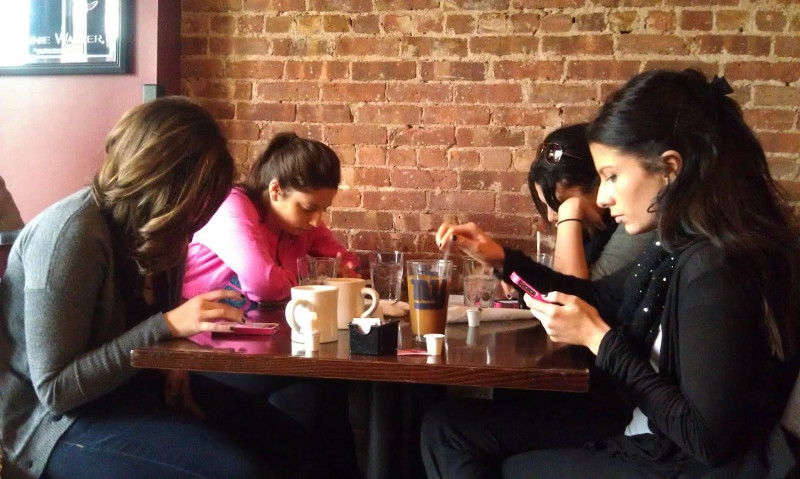

Copying or competition? Similarity of Invicta (from Amazon) and Rolex Submariner You may not know whether you want a watch that is manually wound, automatically wound or battery operated. Buying a low-cost automatic model online could be a good way to familiarize yourself before buying anything serious. Mechanical watches have a smoother and more elegant second-hand movement and will survive the next Carrington event but may come to grief around magnets - a brief encounter with a low-cost de-gausser fixes that. Is it smart to buy a smart watch? If you genuinely want to have the feeling of complete freedom and control over technology, you may want to think twice about buying a smart watch. While it may be interesting to own and experiment with it some of the time, being free from your phone means being free from other electronic technology too. If you do go for a smart watch (and there are many valid reasons for trying one some of the time), maybe make it a second (or third) watch. Smart watches are likely to be controversial for some time to come due to their impact in schools (where mobile phones are usually banned) and various privacy factors. Help those around you achieve phone freedom in 2016 There will be further blogs on this theme during 2016, each looking at the pressures people face when with or without the mobile phone. As a developer of communications technology myself, you may be surprised to see me encouraging people not to use it every waking minute. Working on this technology makes me more conscious of its impact on those around me and society in general. A powerful factor to consider when talking about any communications technology is the presence of peer pressure and the behavior of those around you. Going phone-free may involve helping them to consider taking control too. Helping them out with a new watch as a gift (be careful to seek advice on the style that they are likely to prefer or ensure the purchase can be exchanged) may be an interesting way to help them engage with the idea and every time they look at the time, they may also be reminded of your concern for their freedom.

6 January 2016

Ingo Juergensmann: Letsencrypt: challenging challenges

On December 3rd 2015 the Letsencrypt project went to public beta and this is a good thing! Having more and more websites running on good and valid SSL certificates for their HTTPS is a good thing, especially because Letsencrypt takes care of renewing the certs every now and then. But there are still some issues with Letsencrypt. Some people criticize the Python client needing root priviledges and such. Others complain that Letsencrypt currently only supports webservers. Well, I think for a public beta this is what we could have expected from the start: the Letsencrypt project focussed on a reference implementation and there are already other implementations being available. But one thing seems to a problem within the design of how Letsencrypt works as it uses a challenge response method to verify that the requesting user is controlling the domain for which the certificate shall be issued. This might work well in simple deployments, but what about a little more complex setups like multiple virtual machines and different protocols involved. For example: you're using domain A for your communication like user@example.net for your mail, XMPP and SIP. Your mailserver runs on one virtual machine, whereas the webserver is running on a different virtual machine. The same for XMPP and SIP: a seperate VM as well. Usually the Letsencrypt approach would be that you configure your webserver (by configure /.well-known/acme-challenge/* location or use a standalone server on port 443) to handle the challenge response requests. This would give you a SSL cert for your webserver example.net. Of course you could copy this cert to your mail-, XMPP- and SIP-server, but then again you have to do this everytime the SSL cert gets renewed. Another challenge is of course that you are not only have one or two domains, but a bunch of domains. In my case I host approximately >60 domains. Basically the mail for all domains are handled by my mailserver running on its own virtual machine. The webserver is located on a different VM. For some domains I offer XMPP accounts on a third VM. What is the best way to solve this problem? Moving everything to just one virtual machine? Naaah! Writing some scripts to copy the certs as needed? Not very smart as well. Using a network share for the certs between all VMs? Hmmm... would that work? And what about TLSA entries of your DNSSEC setup? When a SSL cert is renewed than the fingerprint might need an update in your DNS zone - for several protocols like mail, XMPP, SIP and HTTPS. At least the Bash implementation of Letsencrypt offers a "hook" which is called after the SSL cert has been issued. What are you ways to deal with this kind of handling the ACME protocol challenges and multi-domain, multi-VM setup?
Kategorie:

4 January 2016

Benjamin Mako Hill: The Boy Who Could Change the World: The Writings of Aaron Swartz

The New Press has published a new collection of Aaron Swartz s writing called The Boy Who Could Change the World: The Writings of Aaron Swartz. I worked with Seth Schoen to introduce and help edit the opening section of book that includes Aaron s writings on free culture, access to information and knowledge, and copyright. Seth and I have put our introduction online under an appropriately free license (CC BY-SA). aaronsw_book_coverOver the last week, I ve read the whole book again. I think the book really is a wonderful snapshot of Aaron s thought and personality. It s got bits that make me roll my eyes, bits that make me want to shout in support, and bits that continue to challenge me. It all makes me miss Aaron terribly. I strongly recommend the book. Because the publication is post-humous, it s meant that folks like me are doing media work for the book. In honor of naming the book their progressive pick of the week, Truthout has also published an interview with me about Aaron and the book. Other folks who introduced and/or edited topical sections in the book are David Auerbach (Computers), David Segal (Politics), Cory Doctorow (Media), James Grimmelmann (Books and Culture), and Astra Taylor (Unschool). The book is introduced by Larry Lessig.

3 January 2016

Benjamin Mako Hill: Access Without Empowerment (LibrePlanet 2015 Keynote)

At LibrePlanet 2015 (the FSF s annual conference), I gave a talk called Access Without Empowerment as one of the conference keynote addresses. As I did for my 2013 LibrePlanet talk, I ve edited together a version that includes the slides and I ve posted it online in WebM and on YouTube.
Here s the summary written up in the LibrePlanet program:
The free software movement has twin goals: promoting access to software through users freedom to share, and empowering users by giving them control over their technology. For all our movement s success, we have been much more successful at the former. I will use data from free software and from several related movements to explain why promoting empowerment is systematically more difficult than promoting access and I will explore how our movement might address the second challenge in the future.
In related news, registration is open for LibrePlanet 2016 and that it s free for FSF members. If you re not an FSF member, the FSF annual fundraiser is currently going on so now would be a great time to join.

2 January 2016

Daniel Pocock: The great life of Ian Murdock and police brutality in context

Tributes: (You can Follow or Tweet about this blog on Twitter) Over the last week, people have been saying a lot about the wonderful life of Ian Murdock and his contributions to Debian and the world of free software. According to one news site, a San Francisco police officer, Grace Gatpandan, has been doing the opposite, starting a PR spin operation, leaking snippets of information about what may have happened during Ian's final 24 hours. Sadly, these things are now starting to be regurgitated without proper scrutiny by the mainstream press (note the erroneous reference to SFGate with link to SFBay.ca, this is British tabloid media at its best). The report talks about somebody (no suggestion that it was even Ian) "trying to break into a residence". Let's translate that from the spin-doctor-speak back to English: it is the silly season, when many people have a couple of extra drinks and do silly things like losing their keys. "a residence", or just their own home perhaps? Maybe some AirBNB guest arriving late to the irritation of annoyed neighbours? Doesn't the choice of words make the motive sound so much more sinister? Nobody knows the full story and nobody knows if this was Ian, so snippets of information like this are inappropriate, especially when somebody is deceased. Did they really mean to leave people with the impression that one of the greatest visionaries of the Linux world was also a cat burglar? That somebody who spent his life giving selflessly and generously for the benefit of the whole world (his legacy is far greater than Steve Jobs, as Debian comes with no strings attached) spends the Christmas weekend taking things from other people's houses in the dark of the night? The report doesn't mention any evidence of a break-in or any charges for breaking-in. If having a few drinks and losing your keys in December is such a sorry state to be in, many of us could potentially be framed in the same terms at some point in our lives. That is one of the reasons I feel so compelled to write this: somebody else could be going through exactly the same experience at the moment you are reading this. Any of us could end up facing an assault as unpleasant as the tweets imply at some point in the future. At least I can console myself that as a privileged white male, the risk to myself is much lower than for those with mental illness, the homeless, transgender, Muslim or black people but as the tweets suggest, it could be any of us. The story reports that officers didn't actually come across Ian breaking in to anything, they encountered him at a nearby street corner. If he had weapons or drugs or he was known to police that would have almost certainly been emphasized. Is it right to rush in and deprive somebody of their liberties without first giving them an opportunity to identify themselves and possibly confirm if they had a reason to be there? The report goes on, "he was belligerent", "he became violent", "banging his head" all by himself. How often do you see intelligent and successful people like Ian Murdock spontaneously harming themselves in that way? Can you find anything like that in any of the 4,390 Ian Murdock videos on YouTube? How much more frequently do you see reports that somebody "banged their head", all by themselves of course, during some encounter with law enforcement? Do police never make mistakes like other human beings? If any person was genuinely trying to spontaneously inflict a head injury on himself, as the police have suggested, why wouldn't the police leave them in the hospital or other suitable care? Do they really think that when people are displaying signs of self-harm, rounding them up and taking them to jail will be in their best interests? Now, I'm not suggesting this started out with some sort of conspiracy. Police may have been at the end of a long shift (and it is a disgrace that many US police are not paid for their overtime) or just had a rough experience with somebody far more sinister. On the other hand, there may have been a mistake, gaps in police training or an inappropriate use of a procedure that is not always justified, like a strip search, that causes profound suffering for many victims. A select number of US police forces have been shamed around the world for a series of incidents of extreme violence in recent times, including the death of Michael Brown in Ferguson, shooting Walter Scott in the back, death of Freddie Gray in Baltimore and the attempts of Chicago's police to run an on-shore version of Guantanamo Bay. Beyond those highly violent incidents, the world has also seen the abuse of Ahmed Mohamed, the Muslim schoolboy arrested for his interest in electronics and in 2013, the suicide of Aaron Swartz which appears to be a direct consequence of the "Justice" department's obsession with him. What have the police learned from all this bad publicity? Are they changing their methods, or just hiring more spin doctors? If that is their response, then doesn't it leave them with a cruel advantage over those people who were deceased? Isn't it standard practice for some police to simply round up anybody who is a bit lost and write up a charge sheet for resisting arrest or assaulting an officer as insurance against questions about their own excessive use of force? When British police executed Jean Charles de Menezes on a crowded tube train and realized they had just done something incredibly outrageous, their PR office went to great lengths to try and protect their image, even photoshopping images of Menezes to make him look more like some other suspect in a wanted poster. To this day, they continue to refer to Menezes as a victim of the terrorists, could they be any more arrogant? While nobody believes the police woke up that morning thinking "let's kill some random guy on the tube", it is clear they made a mistake and like many people (not just police), they immediately prioritized protecting their reputation over protecting the truth. Nobody else knows exactly what Ian was doing and exactly what the police did to him. We may never know. However, any disparaging or irrelevant comments from the police should be viewed with some caution. The horrors of incarceration It would be hard for any of us to understand everything that an innocent person goes through when detained by the police. The recently released movie about The Stanford Prison Experiment may be an interesting place to start, a German version produced in 2001, Das Experiment, is also very highly respected. The United States has the largest prison population in the world and the second-highest per-capita incarceration rate. Many, including some on death row, are actually innocent, in the wrong place at the wrong time, without the funds to hire an attorney. The system, and the police and prison officers who operate it, treat these people as packages on a conveyor belt, without even the most basic human dignity. Whether their encounter lasts for just a few hours or decades, is it any surprise that something dies inside them when they discover this cruel side of American society? Worldwide, there is an increasing trend to make incarceration as degrading as possible. People may be innocent until proven guilty, but this hasn't stopped police in the UK from locking up and strip-searching over 4,500 children in a five year period, would these children go away feeling any different than if they had an encounter with Jimmy Saville or Rolf Harris? One can only wonder what they do to adults. What all this boils down to is that people shouldn't really be incarcerated unless it is clear the danger they pose to society is greater than the danger they may face in a prison. What can people do for Ian and for justice? Now that these unfortunate smears have appeared, it would be great to try and fill the Internet with stories of the great things Ian has done for the world. Write whatever you feel about Ian's work and your own experience of Debian. While the circumstances of the final tweets from his Twitter account are confusing, the tweets appear to be consistent with many other complaints about US law enforcement. Are there positive things that people can do in their community to help reduce the harm? Sending books to prisoners (the UK tried to ban this) can make a difference. Treat them like humans, even if the system doesn't. Recording incidents of police activities can also make a huge difference, such as the video of the shooting of Walter Scott or the UK police making a brutal unprovoked attack on a newspaper vendor. Don't just walk past a situation and assume everything is under control. People making recordings may find themselves in danger, it is recommended to use software that automatically duplicates each recording, preferably to the cloud, so that if the police ask you to delete such evidence, you can let them watch you delete it and still have a copy. Can anybody think of awards that Ian Murdock should be nominated for, either in free software, computing or engineering in general? Some, like the prestigious Queen Elizabeth Prize for Engineering can't be awarded posthumously but others may be within reach. Come and share your ideas on the debian-project mailing list, there are already some here. Best of all, Ian didn't just build software, he built an organization, Debian. Debian's principles have helped to unite many people from otherwise different backgrounds and carry on those principles even when Ian is no longer among us. Find out more, install it on your computer or even look for ways to participate in the project.

Niels Thykier: dput change-all-of-debian.changes

Lucas Nussbaum recently did a blog post called Debian is still changing . I found it a very welcome continuation of his previous blog post on the same topic. I find the graphs very interesting and was very happy to learn that he included relative graphs this time. Now I can with relatively ease say that 69% of all Debian packages are using a dh-style build (source). We have another 15% using classic debhelper, which means that at least 84% of all packages uses debhelper directly. Assuming all CDBS based packages rely on the debhelper class , we are at 99%! The latter is certainly an assumption, although I suspect it is probably pretty accurate[1]. Now, it is very cute to have world dominance , but that is not my primary interest in these numbers. Instead, we can use these numbers to determine that: Such as automatic dbgsym packages, indexable build-id from dbg(sym) packages via Packages files[2], and replacing maintscripts with ldconfig triggers. All of these changes happen to be changes that could be trivially deployed with very little risk and very high efficiency[3]. Notably, none of them required a compat bump (or a new debhelper tool). Of course, I do not intend to say that every change can (or should) be deployed via debhelper and much less into an existing dh_cmd -tool. Notably, dh_strip is reaching its breaking point for content. And if we were to require a compat bump for your change, we can now at least see the adoption rate via lintian. :) Nevertheless, it is nice to know that (politics aside) there is some agility in the Debian build system! :) [1] I would very much love to see numbers to (dis)prove my assumption about CDBS + debhelper. In fact, an absolute number of packages not using debhelper (indirectly) in Debian would be very intriguing. [2] New fields by default end up the Packages file. See e.g. the Packages.xz file on the debug mirror or your apt-cache via:
apt-cache show mscgen-dbgsym   grep ^Build-Ids
The latter assumes that you have the debug mirror in your sources list. [3] Efficiency here being features people rarely override/disable.
Filed under: Debhelper, Debian

1 January 2016

Thorsten Alteholz: My Debian Activities in December 2015

FTP assistant Due to Christmas, I only marked 254 packages for accept and rejected 17 of them. I had to send 14 emails to maintainers. Squeeze LTS This was my eighteenth month that I did some work for the Squeeze LTS initiative, started by Raphael Hertzog at Freexian. As other members of the LTS team had to give back some hours of their workload, this month my initial workload of 18.25h had been increased to 21.25h. Altogether I uploaded those DLAs: I also started to work on CVEs for packages t-coffee and pitivi, only to recognize that the versions in Squeeze are not affected. Further I prepared patches for passenger and srtp but I could not test them yet, so an upload will be in January. This month I also experienced something strange. Due to the upload of the new version of mysql, I had to process a package for squeeze-lts in NEW. I seldom see a package, that creates so much red output from lintian. I assume this always happens when an old package will be checked by the latest lintian and is a good sign for all the development within Debian. I also tested Raphaels patch for #796784 and could confirm that everything works as expected. Unfortunately the php5 upload must be delayed until Januar. This month I also had another week of frontdesk duties. Other stuff The Advent season is over and the Debian Med Advent Calendar is full to bursting. The incredible number of 150 bugs have been closed this year! Due to the GSL transition a new upload of all meep packages had to be done and all in all I could close #748822, #807210, #807212, #807213, #807214, #807215 and #807747.

Russ Allbery: Review: One Salt Sea

Review: One Salt Sea, by Seanan McGuire
Series: October Daye #5
Publisher: DAW
Copyright: September 2011
ISBN: 1-101-54760-X
Format: Kindle
Pages: 368
This is the fifth book of the October Daye series. It's the best book of the series to date, at least in my opinion, but this is a series with a substantial cast and political complications. You could probably start here and work out things on the fly, since each story is largely self-contained, but much of the emotional resonance would be lost. As expected for this series, Toby's life doesn't have much time to stabilize after the events of Late Eclipses. This time, though, the initial threat is less personal and more political. The children of the rulers of the Duchy of Saltmist have been kidnapped, and war between Saltmist and the Kingdom of the Mists (Toby's home) is very near. All that stands in the way of horrible casualties, of fae that can scarce afford more death, is Toby's desperate detective work. Toby's confidence and belief in her own abilities has been growing steadily throughout this series. One of my favorite themes in fiction is someone who doesn't really believe in themselves but tries anyway, because they couldn't live with themselves if they didn't, and discovers they're more capable than they thought. In this series, I think that works best when Toby is less scared and more angry, which is very true in One Salt Sea. That's one reason why I liked this book better than either An Artificial Night or Late Eclipses. Another is that I love the politics and the depth of world-building and lore that McGuire brings to this series, and One Salt Sea is a showcase of both. We get the Undersea Duchy of Saltmist, which comes from both different traditions and different fae than the series so far. We get a plot that combines political maneuvering with a more traditional detective story than the last few books. We get more hidden traditions, past alliances and enmity that Toby didn't know about, and further development of Toby's own abilities. She has to tug hard on some threads, move between levels of the fae world, and draw on her network for uniquely fae forms of forensic analysis. I thoroughly enjoyed it, particularly the rocks. (You'll know what I mean when you get to that part.) But the best thing about this book, by far, is the Luidaeg. I've mentioned in reviews of previous books that the Luidaeg is my favorite character of the series. One Salt Sea just cements that. This is the deepest that the Luidaeg has been involved in a story: she gives Toby her mission at the start, substantial help along the way, and is deeply involved in the ending. We even learn some of her own background, and some of her own worries and pain. (And foreshadowing that there's more of this to come, which I'm eagerly looking forward to.) She's moved from a strange ally through a cautious friend to some combination of aunt and mother to Toby, while always staying her irascible and occasionally painful self. The bits with her in this book are the best so far, and there are a lot of them. It's a delightful reading experience. McGuire also uses this story to clear up a plot element that's been lingering since the first book of the series, but that never worked emotionally for me. (I'm talking about this indirectly since it's a significant spoiler.) It's a great resolution, one with heft and emotion and hard choices and pain, and largely makes up for the showing rather than telling that we've gotten in the previous books, while also (at least I suspect) graciously shuffling that plot out of the way in future books. It's a good bit of series work and personal growth for Toby, and I think frees the series to focus on the bits I enjoy the most. The ending of One Salt Sea hurts, but it's a good hurt, full of hard choices made well, bravery, and sacrifice. The best moments of this series have always had that, but I think this book is the most successful delivery of the whole package to date. This has always been a solid urban fantasy series, but I think it's getting better as it goes along. One major reason is that McGuire doesn't seem to be running out of world-building oomph. In a lot of urban fantasy, particularly the werewolf and vampire sort, I feel like the lore gets thinner, more rehashed, and more mundane as the series ages. But McGuire is still introducing new elements, showing existing elements from new directions and in new light, and has been slowly building major puzzles around Toby's life and abilities that intrigue me. And, even more rare, the eventual revelations usually live up to the preceding tension. It's certainly a recipe to keep me reading. Followed by Ashes of Honor. Rating: 9 out of 10

Matthew Garrett: The current state of boot security

I gave a presentation at 32C3 this week. One of the things I said was "If any of you are doing seriously confidential work on Apple laptops, stop. For the love of god, please stop." I didn't really have time to go into the details of that at the time, but right now I'm sitting on a plane with a ridiculous sinus headache and the pseudoephedrine hasn't kicked in yet so here we go.

The basic premise of my presentation was that it's very difficult to determine whether your system is in a trustworthy state before you start typing your secrets (such as your disk decryption passphrase) into it. If it's easy for an attacker to modify your system such that it's not trustworthy at the point where you type in a password, it's easy for an attacker to obtain your password. So, if you actually care about your disk encryption being resistant to anybody who can get temporary physical possession of your laptop, you care about it being difficult for someone to compromise your early boot process without you noticing.

There's two approaches to this. The first is UEFI Secure Boot. If you cryptographically verify each component of the boot process, it's not possible for a user to compromise the boot process. The second is a measured boot. If you measure each component of the boot process into the TPM, and if you use these measurements to control access to a secret that allows the laptop to prove that it's trustworthy (such as Joanna Rutkowska's Anti Evil Maid or my variant on the theme), an attacker can compromise the boot process but you'll know that they've done so before you start typing.

So, how do current operating systems stack up here?

Windows: Supports UEFI Secure Boot in a meaningful way. Supports measured boot, but provides no mechanism for the system to attest that it hasn't been compromised. Good, but not perfect.

Linux: Supports UEFI Secure Boot[1], but doesn't verify signatures on the initrd[2]. This means that attacks such as Evil Abigail are still possible. Measured boot isn't in a good state, but it's possible to incorporate with a bunch of manual work. Vulnerable out of the box, but can be configured to be better than Windows.

Apple: Ha. Snare talked about attacking the Apple boot process in 2012 - basically everything he described then is still possible. Apple recently hired the people behind Legbacore, so there's hope - but right now all shipping Apple hardware has no firmware support for UEFI Secure Boot and no TPM. This makes it impossible to provide any kind of boot attestation, and there's no real way you can verify that your system hasn't been compromised.

Now, to be fair, there's attacks that even Windows and properly configured Linux will still be vulnerable to. Firmware defects that permit modification of System Management Mode code can still be used to circumvent these protections, and the Management Engine is in a position to just do whatever it wants and fuck all of you. But that's really not an excuse to just ignore everything else. Improving the current state of boot security makes it more difficult for adversaries to compromise a system, and if we ever do get to the point of systems which aren't running any hidden proprietary code we'll still need this functionality. It's worth doing, and it's worth doing now.

[1] Well, except Ubuntu's signed bootloader will happily boot unsigned kernels which kind of defeats the entire point of the exercise
[2] Initrds are built on the local machine, so we can't just ship signed images

comment count unavailable comments

30 December 2015

Bits from Debian: Debian mourns the passing of Ian Murdock

Ian Murdock With a heavy heart Debian mourns the passing of Ian Murdock, stalwart proponent of Free Open Source Software, Father, Son, and the 'ian' in Debian. Ian started the Debian project in August of 1993, releasing the first versions of Debian later that same year. Debian would go on to become the world's Universal Operating System, running on everything from embedded devices to the space station. Ian's sharp focus was on creating a Distribution and community culture that did the right thing, be it ethically, or technically. Releases went out when they were ready, and the project's staunch stance on Software Freedom are the gold standards in the Free and Open Source world. Ian's devotion to the right thing guided his work, both in Debian and in the subsequent years, always working towards the best possible future. Ian's dream has lived on, the Debian community remains incredibly active, with thousands of developers working untold hours to bring the world a reliable and secure operating system. The thoughts of the Debian Community are with Ian's family in this hard time. His family has asked for privacy during this difficult time and we very much wish to respect that. Within our Debian and the larger Linux community condolences may be sent to in-memoriam-ian@debian.org where they will be kept and archived.


28 December 2015

Alessio Treglia: Pallinux: Olly Olly Oxen Free!

Pallinux: Artwork by Fabio "Pixel" Colinelli

Pallinux: Artwork by Fabio Pixel Colinelli

In a world far away, in the dark Land of Digitos only populated by machines and computers, the evil Mister Woo was ruling over all. Over time, this terrible dictator was becoming a horrendous fire-eyed giant, walking the whole day by vibrating the heavy steps into his Kingdom, leaving behind him a trail of smoke and terror. Mr. Woo always wore a long, shabby and dirty top hat that had once been white, so old and ragged that he could not even keep it up straight on his head. Throughout the Land of Digitos, the inhabitants computers were scattered, each <Read more >

21 December 2015

Matthew Garrett: GPL enforcement is a social good

The Software Freedom Conservancy is currently running a fundraising program in an attempt to raise enough money to continue funding GPL compliance work. If they don't gain enough supporters, the majority of their compliance work will cease. And, since SFC are one of the only groups currently actively involved in performing GPL compliance work, that basically means that there will be nobody working to ensure that users have the rights that copyright holders chose to give them.

Why does this matter? More people are using GPLed software than at any point in history. Hundreds of millions of Android devices were sold this year, all including GPLed code. An unknowably vast number of IoT devices run Linux. Cameras, Blu Ray players, TVs, light switches, coffee machines. Software running in places that we would never have previously imagined. And much of it abandoned immediately after shipping, gently rotting, exposing an increasingly large number of widely known security vulnerabilities to an increasingly hostile internet. Devices that become useless because of protocol updates. Toys that have a "Guaranteed to work until" date, and then suddenly Barbie goes dead and you're forced to have an unexpected conversation about API mortality with your 5-year old child.

We can't fix all of these things. Many of these devices have important functionality locked inside proprietary components, released under licenses that grant no permission for people to examine or improve them. But there are many that we can. Millions of devices are running modern and secure versions of Android despite being abandoned by their manufacturers, purely because the vendor released appropriate source code and a community grew up to maintain it. But this can only happen when the vendor plays by the rules.

Vendors who don't release their code remove that freedom from their users, and the weapons users have to fight against that are limited. Most users hold no copyright over the software in the device and are unable to take direct action themselves. A vendor's failure to comply dooms them to having to choose between buying a new device in 12 months or no longer receiving security updates. When yet more examples of vendor-supplied malware are discovered, it's more difficult to produce new builds without them. The utility of the devices that the user purchased is curtailed significantly.

The Software Freedom Conservancy is one of the only organisations actively fighting against this, and if they're forced to give up their enforcement work the pressure on vendors to comply with the GPL will be reduced even further. If we want users to control their devices, to be able to obtain security updates even after the vendor has given up, we need to keep that pressure up. Supporting the SFC's work has a real impact on the security of the internet and people's lives. Please consider giving them money.

comment count unavailable comments

20 December 2015

Lunar: Reproducible builds: week 34 in Stretch cycle

What happened in the reproducible builds effort between December 13th to December 19th: Infrastructure Niels Thykier started implementing support for .buildinfo files in dak. A very preliminary commit was made by Ansgar Burchardt to prevent .buildinfo files from being removed from the upload queue. Toolchain fixes Mattia Rizzolo rebased our experimental debhelper with the changes from the latest upload. New fixes have been merged by OCaml upstream. Packages fixed The following 39 packages have become reproducible due to changes in their build dependencies: apache-mime4j, avahi-sharp, blam, bless, cecil-flowanalysis, cecil, coco-cs, cowbell, cppformat, dbus-sharp-glib, dbus-sharp, gdcm, gnome-keyring-sharp, gudev-sharp-1.0, jackson-annotations, jackson-core, jboss-classfilewriter, jboss-jdeparser2, jetty8, json-spirit, lat, leveldb-sharp, libdecentxml-java, libjavaewah-java, libkarma, mono.reflection, monobristol, nuget, pinta, snakeyaml, taglib-sharp, tangerine, themonospot, tomboy-latex, widemargin, wordpress, xsddiagram, xsp, zeitgeist-sharp. The following packages became reproducible after getting fixed: Some uploads fixed some reproducibility issues, but not all of them: Patches submitted which have not made their way to the archive yet: reproducible.debian.net Packages in experimental are now tested on armhf. (h01ger) Arch Linux packages in the multilib and community repositories (4,000 more source packages) are also being tested. All of these test results are better analyzed and nicely displayed together with each package. (h01ger) For Fedora, build jobs can now run in parallel. Two are currently running, now testing reproducibility of 785 source packages from Fedora 23. mock/1.2.3-1.1 has been uploaded to experimental to better build RPMs. (h01ger) Work has started on having automatic build node pools to maximize use of armhf build nodes. (Vagrant Cascadian) diffoscope development Version 43 has been released on December 15th. It has been dubbed as epic! as it contains many contributions that were written around the summit in Athens. Baptiste Daroussin found that running diffoscope on some Tar archives could overwrite arbitrary files. This has been fixed by using libarchive instead of Python internal Tar library and adding a sanity check for destination paths. In any cases, until proper sandboxing is implemented, don't run diffosope on unstrusted inputs outside an isolated, throw-away system. Mike Hommey identified that the CBFS comparator would needlessly waste time scanning big files. It will now not consider any files bigger than 24 MiB 8 MiB more than the largest ROM created by coreboot at this time. An encoding issue related to Zip files has also been fixed. (Lunar) New comparators have been added: Android dex files (Reiner Herrmann), filesystem images using libguestfs (Reiner Herrmann), icons and JPEG images using libcaca (Chris Lamb), and OS X binaries (Clemens Lang). The comparator for Free Pascal Compilation Unit will now only be used when the unit version matches the compiler one. (Levente Polyak) A new multi-file HTML output with on-demand loading of long diffs is available through the --html-dir option. On-demand loading requires jQuery which path can be specified through the --jquery option. The diffs can also be simply browsed for non-JavaScript users or when jQuery is not available. (Joachim Breitner) Example of on-demand loading in diffosope Portability toward other systems has been improved: old versions of GNU diff are now supported (Mike McQuaid), suggestion of the appropriate locale is now the more generic en_US.UTF-8 (Ed Maste), the --list-tools option can now support multiple systems (Mattia Rizzolo, Levente Polyak, Lunar). Many internal changes and code clean-ups have been made, paving the way for parallel processing. (Lunar) Version 44 was released on December 18th fixing an issue affecting .deb lacking a md5sums file introduced in a previous refactoring (Lunar). Support has been added for Mozilla optimized Zip files. (Mike Hommey). The HTML output has been optimized in size (Mike Hommey, Esa Peuha, Lunar), speed (Lunar), and will now properly number lines (Mike Hommey). A message will always be displayed when lines are ignored at the end of a diff (Lunar). For portability and consistency, Python os.walk() function is now used instead of find to perform directory listing. (Lunar) Documentation update Package reviews 143 reviews have been removed, 69 added and 22 updated in the previous week. Chris Lamb reported 12 new FTBFS issues. News issues identified this week: random_order_in_init_py_generated_by_python-genpy, timestamps_in_copyright_added_by_perl_dist_zilla, random_contents_in_dat_files_generated_by_chasen-dictutils_makemat, timestamps_in_documentation_generated_by_pandoc. Chris West did some improvements on the scripts used to manage notes in the misc repository. Misc. Accounts of the reproducible builds summit in Athens were written by Thomas Klausner from NetBSD and Hans-Christoph Steiner from The Guardian Project. Some openSUSE developers are working on a hackweek on reproducible builds which was discussed on the opensuse-packaging mailing-list.

Lars Wirzenius: Software Freedom Conservancy donation

I just donated to Software Freedom Conservancy as a supporter. They do great, important work in GPL enforcement, and they need some money to continue it. You can help, too: https://sfconservancy.org/supporter/. See also, https://bits.debian.org/2015/12/conservancy-fundraising-campaign.html.
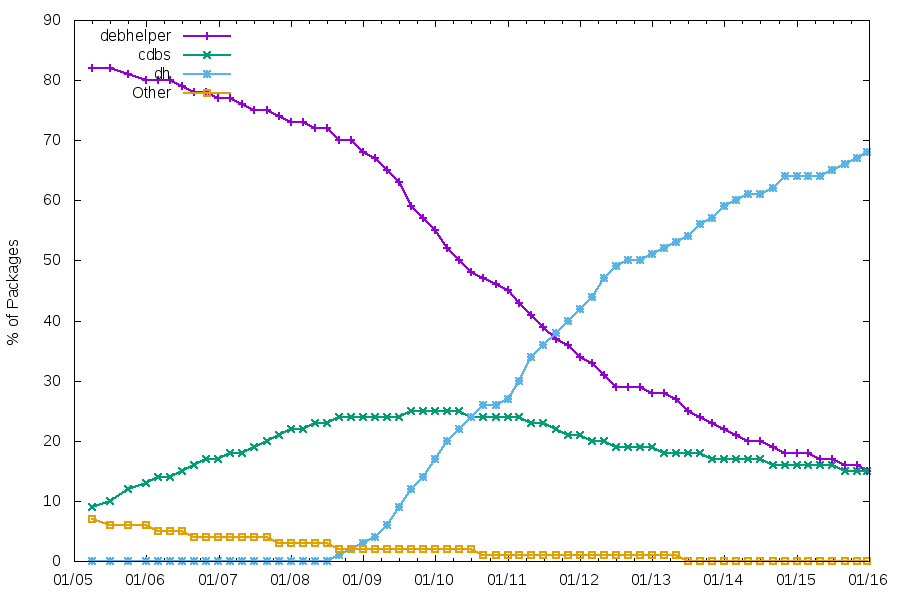
Lars Wirzenius: FUUG grant for Obnam development: what happened then

In September, The FUUG Foundation gave me a grant to buy some hardware for Obnam development. I used this money to buy a new desktop-ish machine, see below for details. It's sat in a corner, and I use it as a server: it's not normally connected to a monitor or keyboard. It runs Obnam benchmarks. Before this, I ran Obnam benchmarks and experiments on my laptop, or on BigV virtual servers donated by Bytemark. The hardware The parts: Not to brag, but it's a nice machine. Much more power than my 2012 era laptop. The SSD is the system drive, the HDDs are for running Obnam benchmarks on. The HDDs are not RAIDed. Each drive is a PV for LVM2. All the data on those drives is scratch data: it's not valuable, and I do not care if it is lost. In fact, most of the data gets created and deleted during a benchmark run, and usually the disks are empty. The SSD contains the host operating system, and the virtual disks for all the virtual machines. I assembled the machine myself, with the help of a friend, and installed Debian jessie on it. The Debian installation is pretty bare bones, just enough to run and manage a bunch of virtual machines using libvirt and ansible. All the actual work, including benchmarks, are run in virtual machines. The benchmarks The benchmarks are run by a kludge, called obbench, and the results are published at http://benchmark.obnam.org/. Here's a snapshot of the results so far:
date many files one big file
2015-09-28 2165.0 1381.9
2015-12-06 1461.6 384.0
In a bit over two months, I've made some significant progress, I think. The two benchmarks that I currently run are: These are two extreme cases of what a backup needs to deal with: either the file metadata, or its content. They incur different costs for a backup program. Thus, two benchmarks. In both cases, the benchmark consists of an initial backup, a restore, and a second backup, without changes to the live data. The second backup is an extreme case of what backups usually do: most data usually doesn't change, so keeping that in mind for optimisation is important. The above benchmarks are synthetic: they use data that's generated by a program (genbackupdata), so that they can be reproduced. Synthetic benchmarks are useful, especially for looking at particular aspects of a program's operation for optimisation. However, they do not necessarily reflect how a program behaves in actual use. I also run, by hand, experiments with real data. I have a snapshot of our home file server and my laptop on the benchmark machine. The snapshots are static, and do not get updated. I experiment by running Obnam backups manually, the initial full backup and a no-change incremental one. In early October, I couldn't finish the initial full backups. They took too long, more than a week. Now I can finish them in about a day. This remarkable change is not evident from the synthetic benchmarks. In numbers: 572986 files in the live data, containing 4.5 TiB. Initial backup, about 18.5 hours. Incremental backup, 4m13s. This is from a local disk to a local disk. In addition to these, I've run numerous experiments on the new machine. These would have been much less easy to run on my laptop, and so I probably wouldn't have. Running benchmarks was always painful on my laptop, since it does not have the necessary disk space, and I'd really rather like to use it for other things. The results Thanks to the benchmarks and experiments I've been able to take the in-development version of Obnam from being quite impractical for real use to being in experimental use for real data. I now use the new version as my primary backup of my laptop, with two secondary backups (with the old Obnam version, and rsync) in parallel. This would not have happened this year without the extra hardware. In addition to the Obnam work, I've used the new machine to develop a test suite for vmdebootstrap. My actual development still happens on my laptop, except for things that are heavy enough to be slow on the laptop. I've made sure I can do most development purely on my laptop, while offline, including running a CI system, and testing things on two architecture and three releases of Debian. I do not want my development to be dependent on incidental things such as network access, unless I'm doing things that by their nature depend on the network, such as publishing changes or releases.

Next.

Previous.