Search Results: "bab"

20 June 2016

Keerthana Krishnan: 10 Git commands every developer should know

Git is a version control system which is very common among developers. I m not going to explain how git works, because there are plenty of great introductory tutorials on the internet for that. However, I would like to documment the commands I frequently use 1. First, we initialize a git repo. Take care to ensure that you initialise the repo in the folder where all the files you want to commit exists. git init 2. To see all the branches in the current repo along with the current branch : git branch To create a new branch : git branch <branch_name> 3. To change branches : git checkout <branch_name> If the branch doesn t exist, it can be created by using : git checkout -b <branch_name> 4. To see the status of the files, ie. if there are uncommitted changes, files to save etc.. use : git status 5. To stage the changes in the directory for the next commit, use : git add <filename> To stage all files in a directory git add . 6. To commit the staged changes in the directory, use : git commit -m "<commit_message>" 7. To create a new connection to a remote repo, especially to push existing code to a Github repo : git remote add <connection_name> <connection_url> 8. To push the code into the remote repo git push -u <connection_name> <branch_name> 9. To get the contents of a repo git clone <path> 10. To merge another branch to the current (Example: a side branch to the master) git merge <branch_name> For a more detailed list of git commands for easy access check out this nifty cheat sheet. Happy coding!

19 June 2016

Iustin Pop: Short trip to Seattle area

After last week's bike ride, I had to pack my bags, and get on Monday morning on a plane to Seattle. The time was so short that I even left the bike mounted on the car. So 8:15, plane to Frankfurt, and then plane to Seattle. To my big surprise, the Lufthansa "extended leg room" seats were overly generous; I could actually extend my foot completely and put it on the back of the seat in front of me. Very good value when travelling in economy The only downside was that these were "standard" not "premium" economy, so the seat had leg room but was very narrow. And with normal sized adults on either side of me, it was somewhat difficult. The leg space allowed me to work on my laptop without fearing the person in front of me will recline their seat and break my screen (almost happened once). The funniest thing when travelling is that food is always tricky: even familiar food can be not what you expect. Case in point, me at the salad buffet, seeing slices of green vegetables, and asking myself: Are those jalapeno slices, or bell pepper slices? Hmm, I'm sure they're bell pepper , which resulted in my first vegetable salad with jalapeno. Would definitely recommend if you like spicy things! Otherwise the trip was as usual, but shorter and more densely packed with meetings with a one day exception: had the opportunity to experience for the first time Whirlyball, which was more fun and more difficult than it first looked. Also spent an afternoon on Whidbey Island, which fortunately was also the nicest day, weather-wise, of the week (all phone pictures, not colour corrected, straight-out-of-phone): from the ferry at the end of Hobbit Trail before dinner A few more pictures here. I keep being amazed by the nature in this area, definitely my preferred place in US from the relatively few I visited. Had a nice dinner as well at Cafe Langley, which surprisingly had reasonably-authentic Mediterranean food; the Baba Ganoush was excellent. Other than that outing, nothing worth describing, except that I really missed my Zwift or outdoor rides. The experience of using the stationary bikes in the hotel does not compare, so I resorted more to running on the treadmill (hmm, Zwift for running, hmm ); if the foot pod calibration is to be trusted, I continued to slightly improve my 1K, 1mi, and 5K times. Not bad, I might want to join some running races as well this summer, but I need to take it easy though and make sure to not get injured again. And finally, week over, flew back home, slept a bit mid-day (which will ruin my jet lag recovery program), unloaded my bike from the car (and checked it still works), and and and got on the trainer and did a Zwift ride. Jet lagged, but managed to beat my Watopia sprint record by a tiny bit, and complete a new workout ( The Gorby ), which was interesting. I can stop any time I want, definitely (I just need to take a trip away from home ).

Keerthana Krishnan: What are Debian Backports?

I came across Debian Backports recently after a kind soul suggested it in my Jessie Installation article. Backports provide the bridge between two stable releases of Debian. Say you are running Jessie stable in your system now. While it runs great, Jessie stable will be a bit outdated compared to the testing release. This is solved by Backports which recompiles and adjusts these testing packages for the stable environment. Backports can be included into the source file next to the stable sources unlike the testing sources which can misbehave and have a significant risk, Backports are much more compatible and lower risk. However, Backports cannot be tested as extensively as Debian stable, and backports are provided on an as-is basis, with risk of incompatibilities with other components in Debian stable. Use with care! It is therefore recommended to only select single backported packages that fit your needs, and not use all available backports. To add Backports to your system, Open the sources.list file :
sudo nano /etc/apt/sources.list For jessie add the line :
deb http://ftp.debian.org/debian jessie-backports main For wheezy add the line :
deb http://ftp.debian.org/debian wheezy-backports main After any change be sure to run
sudo apt-get update To know more about Backports and to contribute consult the main page here and the wiki here. Happy hacking!

Elena 'valhalla' Grandi: StickerConstructorSpec compliant swirl

StickerConstructorSpec compliant swirl

This evening I've played around a bit with the Sticker Constructor Specification https://github.com/terinjokes/StickerConstructorSpec and its https://github.com/terinjokes/StickerConstructorSpec/blob/master/assets/hexagonal-sticker_template.svg, and this is the result:

Immagine/fotohttp://social.gl-como.it/photos/valhalla/image/e8ee069635b2823e168c358d2a753f14


Now I just have to:

* find somebody in Europe who prints good stickers and doesn't require illustrator (or other proprietary software) to submit files for non-rectangular shapes
* find out which Debian team I should contact to submit the files so that they can be used by everybody interested.

But neither will happen today, nor probably tomorrow, because lazy O:-)

Edit: now that I'm awake I realized I forgot to thank @Enrico Zini Zini and MadameZou for their help in combining my two proposals in a better design.

Source svg http://social.gl-como.it/attach/3

18 June 2016

Manuel A. Fernandez Montecelo: More work on aptitude

The last few months have been a bit of a crazy period of ups and downs, with a tempest of events beneath the apparent and deceivingly calm surface waters of being unemployed (still at it). The daily grind Chief activities are, of course, those related to the daily grind of job-hunting, sending applications, and preparing and attending interviews. It is demoralising when one searches for many days or weeks without seeing anything suitable for one's skills or interests, or other more general life expectations. And it takes a lot of time and effort to put one's best in the applications for positions that one is really, really, interested in. And even for the ones which are meh, for a variety of reasons (e.g. one is not very suitable for what the offer demands). After that, not being invited to interviews (or doing very badly at them) is bad, of course, but quick and not very painful. A swift, merciful end to the process. But it's all the more draining when waiting for many weeks when not a few months with the uncertainty of not knowing if one is going to be lucky enough to be summoned for an interview; harbouring some hope one has to appear enthusiastic in the interviews, after all , while trying to keep it contained lest it grows too much ; then in the interview hearing good words and some praises, and feeling the impression that one will fit in, that one did nicely and that chances are good letting the hope grow again ; start to think about life changes that the job will require to make a quick decision should the offer finally arrives ; perhaps make some choices and compromises based on the uncertain result; then wait for a week or two after the interview to know the result... ... only to end up being unsuccessful. All the effort and hopes finally get squashed with a cold, short email or automatic response, or more often than not, complete radio silence from prospective employers, as an end to a multi-month-long process. An emotional roller coaster [1], which happened to me several times in the last few months. All in a day's work The months of preparing and waiting for a new job often imply an impasse that puts many other things that one cares about on hold, and one makes plans that will never come to pass. All in a day's (half-year's?) work of an unemployed poor soul. But not all is bad. This period was also a busy time doing some plans about life, mid- and long-term; the usual and some really unusual! family events; visits to and from friends, old and new; attending nice little local Debian gatherings or the bigger gathering of Debian SunCamp2016, and other work for side projects or for other events that will happen soon... And amidst all that, I managed to get some work done on aptitude. Two pictures worth (less than) a thousand bugs To be precise, worth 709 bugs 488 bugs in the first graph, plus 221 in the second. In 2015-11-15 (link to the post Work on aptitude): aptitude BTS Graph, 2015-11-15 In 2016-06-18: aptitude BTS Graph, 2016-06-18 Numbers The BTS numbers for aptitude right now are: Highlights Beyond graphs and stats, I am specially happy about two achievements in the last year:
  1. To have aptitude working today, first and foremost Apart from the abandon that suffered in previous years, I mean specifically the critical step of getting it through the troubles of the last summer, with the GCC-5/C++11 transition in parallel with a transition of the Boost library (explained in more detail in Work on aptitude). Without that, possibly aptitude would not have survived until today.
  2. Improvements to the suggestions of the resolver In the version 0.8, there were a lot of changes related with improving the order of the suggestions from the resolver, when it finds conflicts or other problems with the planned actions. Historically, but specially in the last few years, there have been many complaints about the nonsensical or dangerous suggestions from the resolver. The first solution offered by the resolver was very often regarded as highly undesirable (for example, removal of many packages), and preferable solutions like upgrades of one or only a handful of packages being offered only after many removals; and keeps only offered as last resort.
Perhaps these changes don't get a lot of attention, given that in the first case it's just to keep working (with few people realising that it could have collapsed on the spot, if left unattended), and the second can probably go unnoticed because it just works or it started to work more smoothly doesn't get as much immediate attention as it suddenly broke! . Still, I wanted to mention them, because I am quite proud of those. Thanks Even if I put a lot of work on aptitude in the last year, the results of the graph and numbers have not been solely achieved by me. Special thanks go to Axel Beckert (abe / XTaran) and the apt team, David Kalnischkies and Julian Andres Klode who, despite the claim in that page, does not mostly work python-apt anymore... but also in the main tools. They help with fixing some of the issues directly, or changing things in apt that benefit aptitude, testing changes, triaging bugs or commenting on them, patiently explaining to me why something in libapt doesn't do what I think it does, and good company in general. Not the least, for holding impromptu BTS group therapy / support meetings, for those cases when prolonged exposure to BTS activity starts to induce very bad feelings. Thanks also to people who sent their translation updates, notified about corrections, sent or tested patches, submitted bugs, or tried to help in other ways. Change logs for details. Notes [1] ^ It's even an example in the Cambridge Dictionaries Online website, for the entry of roller coaster:
He was on an emotional roller coaster for a while when he lost his job.

17 June 2016

Shirish Agarwal: Medical awareness, terrorism, racism and Debconf

Hi to all the souls on planet.debian.org:) . I hope to meet many of you in Debconf16 which is being held at UCT (University of Cape Town), Rhondenbosch, South Africa and am excited to be part of it. I pushed a blog post about my journey to debconf till date. I express my sympathy and condolences to all the people who died in the cowardly shooting spree done by a madman in Orlando . I have been upset about this development but as what s done is done, it s best to just keep moving. Closer to my own reality, I was shocked to discover during my whole visa experience that nowhere there is any knowledge about vaccinations that people should have when they are traveling internationally. I was kinda rudely awakened by this mail which prompted me to take Hep A shot and also start a thread on the mailing list. The more comprehensive info. I got was at the CDC site . It seems to be a go-to site to find about what is recommended. While I will not be taking any shots now as it s nearing to the date of travel, if I had known before, it would have been a valuable resource in itself. Definitely something to be bookmarked if you are going overseas and are worried or have health concerns. On another note, About few days back, there was a discussion as recently, travel advisories have been issued about possible terror action in South Africa by various embassies due to the holy month of Ramadan.
And the recent attack just proves that it takes just one twisted personality with a perverse sense of justice or whatever s/he/ thinks as just to do what s/he did and guns and more security and not the answer.
My take on it some would describe as simplistic, there are things which you can control, there are things beyond your control. No security agency, no country can guarantee it. By being either home or away, you can t wish you will not get bitten. Got images of Final Destination invoked when I was sharing that, for as an Indian, do believe a bit on fate and karma. Also, me being single also plays a part, perhaps I would have been more cautious or have different motivations if I had a family so I do understand some of the concerns which have been raised by people in that thread. At the end of it, it really is a non-choice in my book. If you don t take part due to fear,uncertainty of a possible attack, you have already given in to fear and uncertainty and I believe this goes against the very philosophy of what Debian stands for, being bold, taking chances and having trust in your fellow men. If we haven t allowed proprietary, commercial software to win over us, how can we allow less than 0.1% radically motivated people to scare us ? And the recent attack just proves that it takes just one twisted personality with a perverse sense of justice or whatever s/he/ thinks as just to do what s/he did. More guns and more security are certainly not the answer here. A more troubling part is not terrorism but caste-ism and racism which have been also making news (not in a good way) in India. Now while I cannot claim to have any knowledge about Africans apart from 2-3 conversations which didn t go anywhere, two-three preconceived notions about them can easily be countered. As far as drugs are concerned, IF some Africans are doing drugs smuggling, it would be wrong to pin all of it onto them. India has been fighting drugs smuggling from the 70 s itself. From what we know and have learnt over the years from consuming media, India shares porous borders with almost all our neighbors. Of those, Pakistan is supposed to be the largest grower and supplier and then Nepal where young boys are used as Traffickers. The recent film Rocky Handsome and the recent upcoming controversial movie Udta Punjab are trying to explore these issues. As far as drinking in open is concerned, I have seen and been part of Punjabi parties where both men and women drink without abandon in farm parties. Russians, Germans and Israelis can also out-drink a person on their day/mood. As far as sexuality is concerned, we are the second most populous country in the world, so the less said the better:) . I believe though that underneath this racism is money, greed, phobia, language barriers and just maybe some lifestyle choices as well. I have seen North-Eastern, Chinese, Buddhist people being colored with the same brush. The more interesting case is with the Buddhist as can be seen in Himachal Pradesh, where locals feel they are deprived as Europeans come and indulge Buddhists for their monasteries and their way of life while locals don t get much money from them. This is partly true, but also due to our own short-comings in dealing with westerners. I have never seen my own countrymen going out of their way to make westerners or any tourists for that matter feel welcome in a genuine way. More often, the behavior is between hostility, jealousy and a perverted sense of hero-worship due to the color of skin. As far as being racist and bigoted are concerned, it seems we are not alone, just day before came across this news from Malaysia which is interesting in the sense that how people from different communities frame their own history and people around them, forget that is false and misleading to what we in India know to be the truth, it probably is/would be interesting for somebody who does comparative history, myth and folklore analysis. I was actually planning to talk about some of the talks I am looking forward to hearing and seeing on Debconf but guess that will have to wait for few more days. Hope to publish one more before actually flying to Debconf. Till later.
Filed under: Miscellenous Tagged: #Debconf16, #racism, #terrorism, #vaccinations

15 June 2016

Steve Kemp: So I should document the purple server a little more

I should probably document the purple server I hacked together in Perl and mentioned in my last post. In short it allows you to centralise notifications. Send "alerts" to it, and when they are triggered they will be routed from that central location. There is only a primitive notifier included, which sends data to the console, but there are sample stubs for sending by email/pushover, and escalation. In brief you create alerts by sending a JSON object via HTTP-POST. These objects contain a bunch of fields, but the two most important are: When an update is received any existing alert has its values updated, which makes heartbeat alerts trivial. Send a message with: "id": "heartbeat", "raise": "+5m", .. The existing alert will be updated each time such a new event is submitted, which means that the time at which that alert will raise will be pushed back by five minutes. If you send this every 60 seconds then you'll get informed of an outage five minutes after your server explodes (because the "+5m" will have been turned into an absolute time, and that time will eventually become in the past - triggering a notification). Alerts are keyed on the source IP which sent the submission and the id field, meaning you can send the same update from multiple hosts without causing any problems. Notifications can be viewed in a reasonably pretty Web UI, so you can clear raised-alerts, see the pending ones, and suppress further notifications on something that has been raised. (By default notifications are issued every sixty seconds, until the alert is cleared. There is support for only raising an alert once, which is useful for services you might deliver events via, such as pushover which will repeat themselves.) Anyway this is a fun project, which is a significantly simplified and less scalable version of a project which is open-sourced already and used at Bytemark.

Andrew Shadura: Migrate to systemd without a reboot

Yesterday I was fixing an issue with one of the servers behind kallithea-scm.org: the hook intended to propagage pushes from Our Own Kallithea to Bitbucket stopped working. Until yesterday, that server was using Debian s flavour of System V init and djb s d montools to keep things running. To make the hook asynchronous, I wrote a service to be managed to d montools, so that concurrency issued would be solved by it. However, I didn t implement any timeouts, so when last week wget froze while pulling Weblate s hook, there was nothing to interrupt it, so the hook stopped working since d montools thought it s already running and wouldn t re-trigger it. Killing wget helped, but I decided I need to do something with it to prevent the situation from happening in the future. I ve been using systemd at work for the last year, so I am now confident I m happier with systemd than with d montools, so I decided to switch the server to systemd. Not surprisingly, I prepared unit files in about 5 minutes without having to look into the manuals again, while with d montools I had to check things every time I needed to change something. The tricky thing was the switch itself. It is a virtual server, presumably running in Xen, and I don t have access to the console, so if I bork break something, I need to summon Bradley Kuhn or someone from Conservancy, who s kindly donated the server to the project. In any case, I decided to attempt to upgrade without a reboot, so that I have more options to roll back my changes in the case things go wrong. After studying the manpages of both systemd s init and sysvinit s init, I realised I can install systemd as /sbin/init and ask already running System V init to re-exec. However, systemd s init can t talk to System V init, so before installing systemd I made a backup on it. It s also important to stop all running services (except probably ssh) to make sure systemd doesn t start second instances of each. And then: /tmp/init u and we re running systemd! A couple of additional checks, and it s safe to reboot. Only when I did all that I realised that in the case of systemd not working I d probably not be able to undo my changes if my connection interrupted. So, even though at the end it worked, probably it s not a good idea to perform such manipulations when you don t have an alternative way to connect to the server :)

Enrico Zini: On discomfort and new groups

I recenyly wrote:
When you get involved in a new community, such as Debian, find out early where, if that happens, you can find support, understanding, and help to make it stop.
Last night I asked a group of friends what do they do if they start feeling uncomfortable when they are alone in a group of people they don't know. Here are the replies: I think a lot of these point are good food for thought about barriers of entry, and about safety nets that a group has or might want to have.

Russ Allbery: Review: Matter

Review: Matter, by Iain M. Banks
Publisher: Orbit
Copyright: February 2008
ISBN: 0-316-00536-3
Format: Hardcover
Pages: 593
Sursamen is an Arithmetic, Mottled, Disputed, Multiply Inhabited, Multi-million Year Safe, and Godded Shellworld. It's a constructed world with multiple inhabitable levels, each lit by thermonuclear "suns" on tracks, each level supported above the last by giant pillars. Before the recorded history of the current Involved Species, a culture called the Veil created the shellworlds with still-obscure technology for some unknown purpose, and then disappeared. Now, they're inhabited by various transplants and watched over by a hierarchy of mentor and client species. In the case of Sursamen, both the Aultridia and the Oct claim jurisdiction (hence "Disputed"), and are forced into an uneasy truce by the Nariscene, a more sophisticated species that oversees them both. On Sursamen, on level eight to be precise, are the Sarl, a culture with an early industrial level of technology in the middle of a war of conquest to unite their level (and, they hope, the next level down). Their mentors are the Oct, who claim descendance from the mysterious Veil. The Deldeyn, the next level down, are mentored by the Aultridia, a species that evolved from a parasite on Xinthian Tensile Aranothaurs. Since a Xinthian, treated by the Sarl as a god, lives in the heart of Sursamen (hence "Godded"), tensions between the Sarl and the Aultridians run understandably high. The ruler of the Sarl had three sons and a daughter. The oldest was killed by the people he is conquering as Matter starts. The middle son is a womanizer and a fop who, as the book opens, watches a betrayal that he's entirely unprepared to deal with. The youngest is a thoughtful, bookish youth pressed into a position that he also is not well-prepared for. His daughter left the Sarl, and Sursamen itself, fifteen years previously. Now, she's a Special Circumstances agent for the Culture. Matter is the eighth Culture novel, although (like most of the series) there's little need to read the books in any particular order. The introduction to the Culture here is a bit scanty, so you'll have more background and understanding if you've read the previous novels, but it doesn't matter a great deal for the story. Sharp differences in technology levels have turned up in previous Culture novels (although the most notable example is a minor spoiler), but this is the first Culture novel I recall where those technological differences were given a structure. Usually, Culture novels have Special Circumstances meddling in, from their perspective, "inferior" cultures. But Sursamen is not in Culture space or directly the Culture's business. The Involved Species that governs Sursamen space is the Morthanveld: an aquatic species roughly on a technology level with the Culture themselves. The Nariscene are their client species; the Oct and Aultridia are, in turn, client species (well, mostly) of the Nariscene, while meddling with the Sarl and Deldeyn. That part of this book reminded me of Brin's Uplift universe. Banks's Involved Species aren't the obnoxious tyrants of Brin's universe, and mentoring doesn't involve the slavery of the Uplift universe. But some of the politics are a bit similar. And, as with Uplift, all the characters are aware, at least vaguely, of the larger shape of galactic politics. Even the Sarl, who themselves have no more than early industrial technology. When Ferbin flees the betrayal to try to get help, he ascends out of the shellworld to try to get assistance from an Involved species, or perhaps his sister (which turns out to be the same thing). Banks spends some time here, mostly through Ferbin and his servant (who is one of the better characters in this book), trying to imagine what it would be like to live in a society that just invented railroads while being aware of interstellar powers that can do practically anything. The plot, like the world on which it's set, proceeds on multiple levels. There is court intrigue within the Sarl, war on their level and the level below, and Ferbin's search for support and then justice. But the Sarl live in an artifact with some very mysterious places, including the best set piece in the book: an enormous waterfall that's gradually uncovering a lost city on the level below the Sarl, and an archaeological dig that proceeds under the Deldeyn and Sarl alike. Djan Seriy decides to return home when she learns of events in Sarl, originally for reasons of family loyalty and obligation, but she's a bit more in touch with the broader affairs of the galaxy, including the fact that the Oct are acting very strangely. There's something much greater at stake on Sursamen than tedious infighting between non-Involved cultures. As always with Banks, the set pieces and world building are amazing, the scenery is jaw-dropping, and I have some trouble warming to the characters. Dramatic flights across tower-studded landscapes seeking access to forbidden world-spanning towers largely, but don't entirely, make up for not caring about most of the characters for most of the book. This did change, though: although I never particularly warmed to Ferbin, I started to like his younger brother, and I really liked his sister and his servant by the end of the book. Unfortunately, the end of Matter is, if not awful, at least exceedingly abrupt. As is typical of Banks, we get a lot of sense of wonder but not much actual explanation, and the denouement is essentially nonexistent. (There is a coy epilogue hiding after the appendices, but it mostly annoyed me and provides only material for extrapolation about the characters.) Another SF author would have written a book about the Xinthian, the Veil, the purpose of the shellworlds, and the deep history of the galaxy. I should have known going in that Banks isn't that sort of SF author, but it was still frustrating. Still, Banks is an excellent writer and this is a meaty, complex, enjoyable story with some amazing moments of wonder and awe. If you like Culture novels in general, you will like this. If you like set-piece-heavy SF on a grand scale, such as Alastair Reynolds or Kim Stanley Robinson, you probably like this. Recommended. Rating: 8 out of 10

14 June 2016

Joey Hess: second system

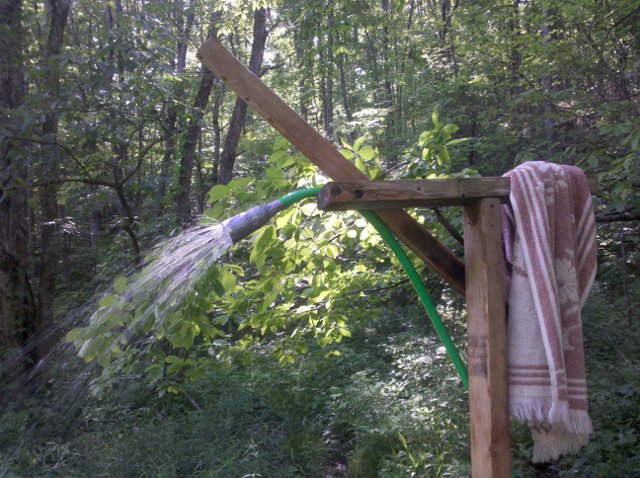
Five years ago I built this, and it's worked well, but is old and falling down now.
mark I outdoor shower
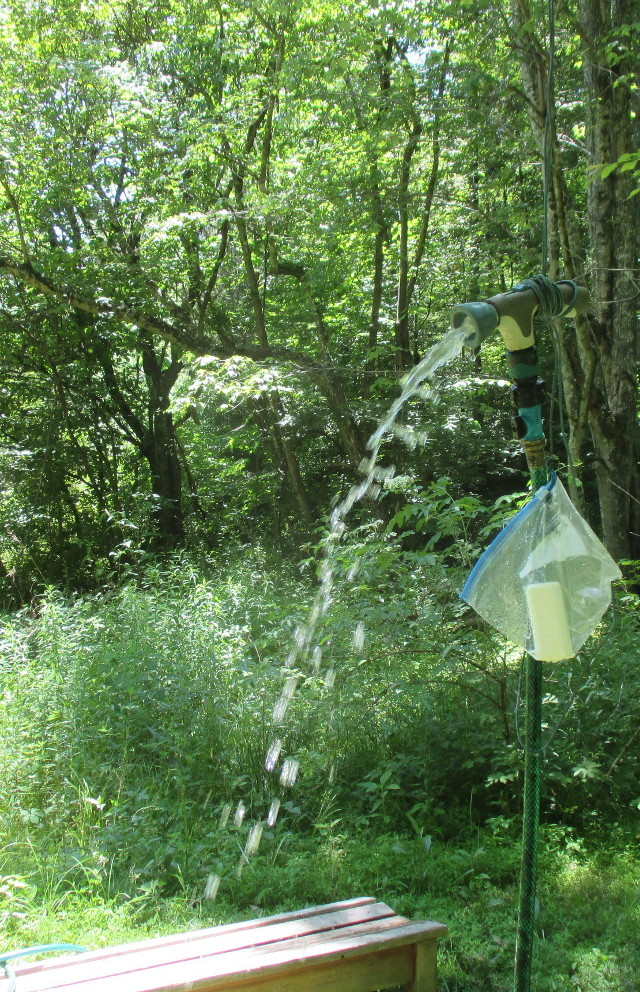
The replacement is more minimalist and like any second system tries to improve on the design of the first. No wood to rot away, fully adjustable height. It's basically a shower swing, suspended from a tree branch.
mark II outdoor shower
Probably will turn out to have its own new problems, as second systems do.

Simon McVittie: GTK versioning and distributions

Allison Lortie has provoked a lot of comment with her blog post on a new proposal for how GTK is versioned. Here's some more context from the discussion at the GTK hackfest that prompted that proposal: there's actually quite a close analogy in how new Debian versions are developed. The problem we're trying to address here is the two sides of a trade-off: Historically, GTK has aimed to keep compatible within a major version, where major versions are rather far apart (GTK 1 in 1998, GTK 2 in 2002, GTK 3 in 2011, GTK 4 somewhere in the future). Meanwhile, fixing bugs, improving performance and introducing new features sometimes results in major changes behind the scenes. In an ideal world, these behind-the-scenes changes would never break applications; however, the world isn't ideal. (The Debian analogy here is that as much as we aspire to having the upgrade from one stable release to the next not break anything at all, I don't think we've ever achieved that in practice - we still ask users to read the release notes, even though ideally that wouldn't be necessary.) In particular, the perceived cost of doing a proper ABI break (a fully parallel-installable GTK 4) means there's a strong temptation to make changes that don't actually remove or change C symbols, but are clearly an ABI break, in the sense that an application that previously worked and was considered correct no longer works. A prominent recent example is the theming changes in GTK 3.20: the ABI in terms of functions available didn't change, but what happens when you call those functions changed in an incompatible way. This makes GTK hard to rely on for applications outside the GNOME release cycle, which is a problem that needs to be fixed (without stopping development from continuing). The goal of the plan we discussed today is to decouple the latest branch of development, which moves fast and sometimes breaks API, from the API-stable branches, which only get bug fixes. This model should look quite familiar to Debian contributors, because it's a lot like the way we release Debian and Ubuntu. In Debian, at any given time we have a development branch (testing/unstable) - currently "stretch", the future Debian 9. We also have some stable branches, of which the most recent are Debian 8 "jessie" and Debian 7 "wheezy". Different users of Debian have different trade-offs that lead them to choose one or the other of these. Users who value stability and want to avoid unexpected changes, even at a cost in terms of features and fixes for non-critical bugs, choose to use a stable release, preferably the most recent; they only need to change what they run on top of Debian for OS API changes (for instance webapps, local scripts, or the way they interact with the GUI) approximately every 2 years, or perhaps less often than that with the Debian-LTS project supporting non-current stable releases. Meanwhile, users who value the latest versions and are willing to work with a "moving target" as a result choose to use testing/unstable. The GTK analogy here is really quite close. In the new versioning model, library users who value stability over new things would prefer to use a stable-branch, ideally the latest; library users who want the latest features, the latest bug-fixes and the latest new bugs would use the branch that's the current focus of development. In practice we expect that the latter would be mostly GNOME projects. There's been some discussion at the hackfest about how often we'd have a new stable-branch: the fastest rate that's been considered is a stable-branch every 2 years, similar to Ubuntu LTS and Debian, but there's no consensus yet on whether they will be that frequent in practice. How many stable versions of GTK would end up shipped in Debian depends on how rapidly projects move from "old-stable" to "new-stable" upstream, how much those projects' Debian maintainers are willing to patch them to move between branches, and how many versions the release team will tolerate. Once we reach a steady state, I'd hope that we might have 1 or 2 stable-branched versions active at a time, packaged as separate parallel-installable source packages (a lot like how we handle Qt). GTK 2 might well stay around as an additional active version just from historical inertia. The stable versions are intended to be fully parallel-installable, just like the situation with GTK 1.2, GTK 2 and GTK 3 or with the major versions of Qt. For the "current development" version, I'd anticipate that we'd probably only ship one source package, and do ABI transitions for one version active at a time, a lot like how we deal with libgnome-desktop and the evolution-data-server family of libraries. Those versions would have parallel-installable runtime libraries but non-parallel-installable development files, again similar to libgnome-desktop. At the risk of stretching the Debian/Ubuntu analogy too far, the intermediate "current development" GTK releases that would accompany a GNOME release are like Ubuntu's non-LTS suites: they're more up to date than the fully stable releases (Ubuntu LTS, which has a release schedule similar to Debian stable), but less stable and not supported for as long. Hopefully this plan can meet both of its goals: minimize breakage for applications, while not holding back the development of new APIs.

13 June 2016

Reproducible builds folks: First alpha release of reprotest

Author: ceridwen The first, very-alpha release of reprotest is now out at PyPi. It should hit Debian experimental later this week. While it only builds on an existing system (as I'm still working on support for virtualization), it can now check its own reproducibility, which it does in its own tests, both using setuptools and debuild. Unfortunately, setuptools seems to generate file-order-dependent binaries, meaning python setup.py bdist creates unreproducible binaries. With debuild, reprotest probably would be reproducible with the modified packages from the Reproducible Builds project, though I haven't tested that yet. It tests 'captures_environment', 'fileordering' (renamed from 'filesystem'), 'home', 'kernel', 'locales', 'path', 'time', 'timezone', and 'umask'. The other variations require superuser privileges and modifications that would be unsafe to make to a running system, so they will only be enabled in the containers. The next major part of the project is integrating autopkgtests's container management system into reprotest. For the curious, autopkgtest is composed of a main program, adt-run, which then calls other command-line programs, adt-virt-chroot, adt-virt-lxd, adt-virt-schroot, adt-virt-null, adt-virt-schroot, and adt-virt-qemu, that communicate with the containers. (The autopkgtest maintainer has since renamed the programs, but the underlying structure remains the same.) I think this is a bit of an odd design but it works well for my purposes since the container programs already have existing CLIs that reprotest can use.

Rapha&#235;l Hertzog: Freexian s report about Debian Long Term Support, May 2016

A Debian LTS logoLike each month, here comes a report about the work of paid contributors to Debian LTS. Individual reports In May, 166 work hours have been dispatched among 9 paid contributors. Their reports are available: Evolution of the situation The number of sponsored hours stayed the same over May but will likely increase a little bit the next month as we have two new Bronze sponsors being processed. The security tracker currently lists 36 packages with a known CVE and the dla-needed.txt file lists 36 packages awaiting an update. Despite the higher than usual number of work hours dispatched in May, we still have more open CVE than we used to have at the end of the squeeze LTS period. So more support is always needed Thanks to our sponsors New sponsors are in bold.

No comment Liked this article? Click here. My blog is Flattr-enabled.

Keerthana Krishnan: Installing reSIProcate with apt-get source package

I had earlier tried to install telepathy according to the instructions I found here. But that gave me a an unexplainable error. So after a few unsuccessful attempts, I decided to install it from the apt-get source. First, install telepathy-qt. This is the part that gave me all the errors and this is where I had made changes from the source I had been using.
  1. Check and make sure you have the proper dependencies installed for the package.
    $ sudo apt-get build-dep telepathy-qt
  2. If you are installing the package in the home folder, you can skip this step, but usually, it s better to have a dedicated file/file structure. If you do have one, cd into that folder
    $ mkdir ~/telepathy-qt-stuff
    $ cd ~/telepathy-qt-stuff
  3. Next, get telepathy-qt from the source :
    $ apt-get source telepathy-qt
    $ apt-get source -b telepathy-qt
  4. Check and make sure that there are a list of libtelepathy-qt* and telepathy-qt* .deb packages. You just have to install a few more packages:
    $ ls *.deb
  5. Next, you have to install a few more packages:
    $ dpkg -i libtelepathy-qt4-2_0.9.6.1-?_amd64.deb libtelepathy-qt4-dev_0.9.6.1-?_amd64.deb libtelepathy-qt4-farstream2_0.9.6.1-?_amd64.deb

    Obviously, we have to replace the ? with the version number of the .deb package.
  6. After that you have the necessary packages to install reSIProcate:
    $ dpkg -l grep telepathy-qt
    This should return something like :
    ii libtelepathy-qt4-2:amd64 0.9.6.1-2 amd64 Telepathy framework Qt 4 library
    ii libtelepathy-qt4-dev 0.9.6.1-2 amd64 Qt 4 Telepathy library (headers and static library)
    ii libtelepathy-qt4-farstream2:amd64 0.9.6.1-2 amd64 Telepathy/Farsight integration Qt 4 library
The next part is to install and configure reSIProcate.
  1. Include the proper backport line in the /etc/apt/sources.list file. Be sure to run sudo apt-get update after any changes to the source file
  2. Clone the code from the git repo :
    $ git clone https://github.com/resiprocate/resiprocate
    $ cd resiprocate
  3. Check the build dependencies and install what s required:
    $ apt-get install libpq-dev dh-autoreconf
    $ apt-get build-dep resiprocate
    $ apt-get install -t jessie-backports libradcli-dev
  4. Build the packages:
    $ ./build/debian.sh
    $ sudo make
  5. Finally, ensure all your packages are built right by running sudo make check
And then you re done!

Keerthana Krishnan: A beginner s guide to Debian Source Packages

Source packages have a very different process of installation and handling while compared to the traditional executable packages which are handled by the sudo apt-get install command. Source packages provide source for a software. These are used to build other packages. Source code can be studied or errors can be fixed in this by downloading these to your system. To access these you have to add deb-src lines sources.list in /etc/apt/sources.list If you had followed my earlier article on setting up Jessie, this means you have to remove the # in front of the deb-src lines. First, find the required source package online in the debian packages list here. Be sure to select the Source Package Names option while searching. When you find a package it will have a list of binary packages that are built from this source package. Make sure you have all the dependencies to build the package by running:
     $ apt-get build-dep packagename
Then, download the source package, using the following command:
     $ apt-get source packagename
This will download three files: a .orig.tar.gz, a .dsc and a .diff.gz. In the case of packages made specifically for Debian, the last of these is not downloaded and the first usually won t have orig in the name. The .dsc file is used by dpkg-source for unpacking the source package into the directory packagename-version. Within each downloaded source package there is a debian/ directory that contains the files needed for creating the .deb package. To auto-build the package when it s been downloaded, just add -b to the command line, like this:
     $ apt-get -b source packagename
If you decide not to create the .deb at the time of the download, you can create it later by running:
     $ dpkg-buildpackage -rfakeroot -uc -b
from within the directory that was created for the package after downloading. To install the package built by the commands above one must use the package manager directly, like this:
     # dpkg -i file.deb
There s a difference between apt-get s source method and its other methods. The source method can be used by normal users, without needing special root powers. The files are downloaded to the directory from which the apt-get source package command was called. Tip : If you are a developer testing software, you may need to run the make command after this. Be sure to run make check as well later to make sure there are no errors and everything is alright. Most of the commands I ve used here was by following the APT How To documentation which is marked as obsolete for some reason but turned out to be pretty useful. Hope it works for you too!

12 June 2016

Mario Lang: A Raspberry Pi Zero in a Handy Tech Active Star 40 Braille Display

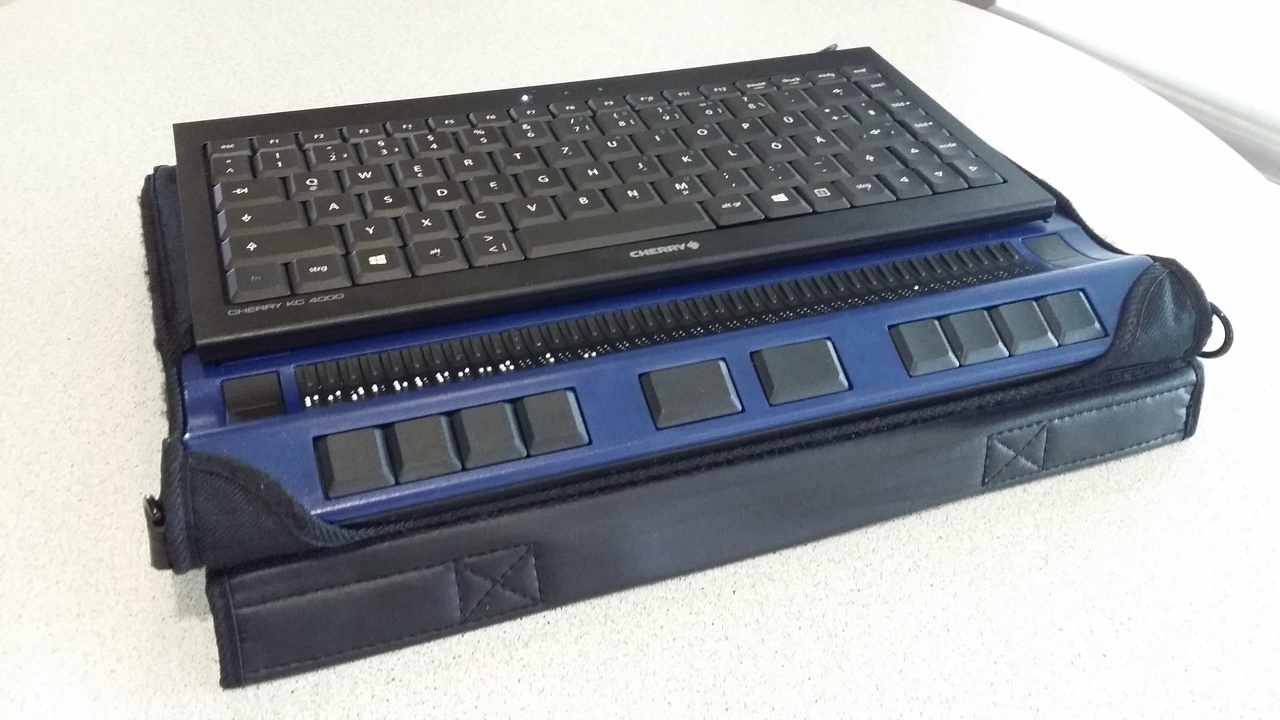
TL;DR: I put a $5 Raspberry Pi Zero, a Bluetooth USB dongle, and the required adapter cable into my new Handy Tech Active Star 40 braille display. An internal USB port provides the power. This has transformed my braille display into an ARM-based, monitorless, Linux laptop that has a keyboard and a braille display. It can be charged/powered via USB so it can also be run from a power bank or a solar charger, thus potentially being able to run for days, rather than just hours, without needing a standard wall-jack. [picture: a Raspberry Pi Zero embedded within an Active Star 40] [picture: a braille display with a keyboard on top and a Raspberry Pi Zero inside]
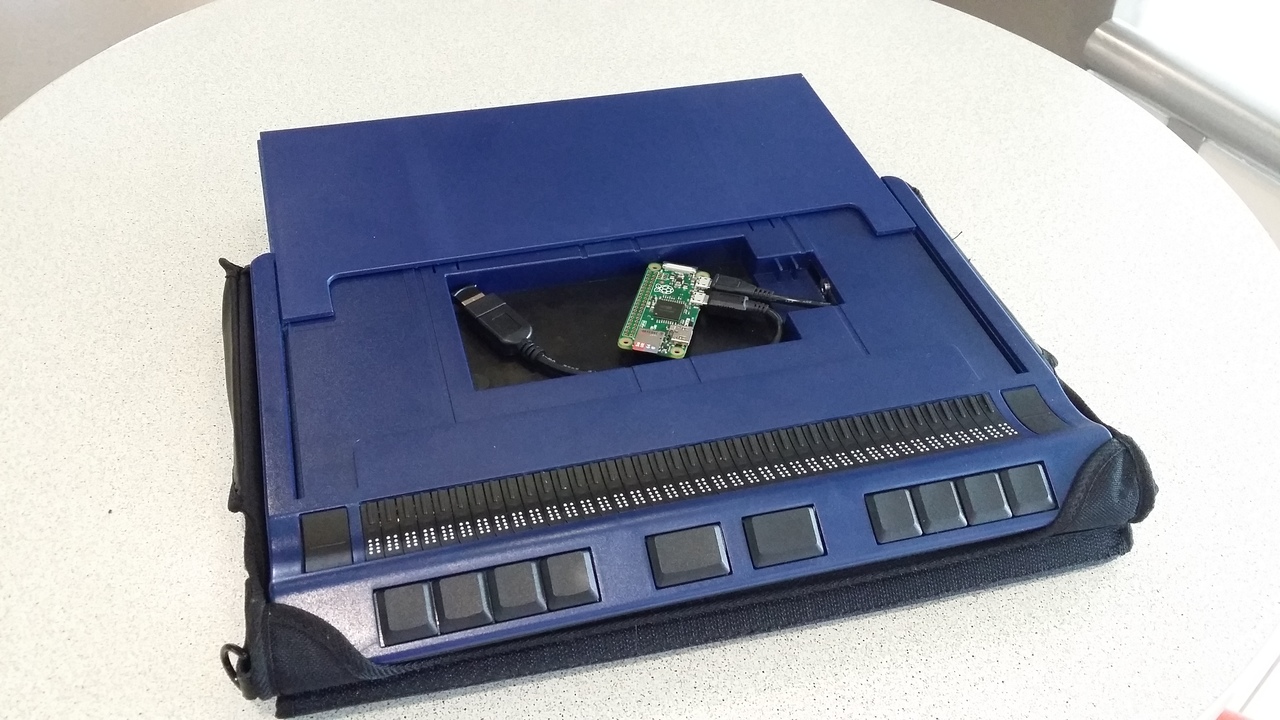
Some Background on Braille Display Form Factors Braille displays come in various sizes. There are models tailored for desktop use (with 60 cells or more), models tailored for portable use with a laptop (usually with 40 cells), and, nowadays, there are even models tailored for on-the-go use with a smartphone or similar (with something like 14 or 18 cells). Back in the old days, braille displays were rather massive. A 40-cell braille display was typically about the size of a 13" laptop. In modern times, manufacturers have managed to reduce the size of the internals such that a 40-cell display can be placed in front of a laptop or keyboard instead of placing the laptop on top of the braille display. While this is a nice achievement, I personally haven't found it to be very convenient because you now have to place two physically separate devices on your lap. It's OK if you have a real desk, but, at least in my opinion, if you try to use your laptop as its name suggests, it's actually inconvenient to use a small form factor, 40-cell display. For this reason, I've been waiting for a long-promised new model in the Handy Tech Star series. In 2002, they released the Handy Tech Braille Star 40, which is a 40-cell braille display with enough space to put a laptop directly on top of it. To accommodate larger laptop models, they even built in a little platform at the back that can be pulled out to effectively enlarge the top surface. Handy Tech has now released a new model, the Active Star 40, that has essentially the same layout but modernized internals. [picture: a plain Active Star 40] You can still pull out the little platform to increase the space that can be used to put something on top. [picture: an Active Star 40 with extended platform and a laptop on top] But, most conveniently, they've designed in an empty compartment, roughly the size of a modern smartphone, beneath the platform. The original idea was to actually put a smartphone inside, but this has turned out (at least to me) to not be very feasible. Fortunately, they thought about the need for electricity and added a Micro USB cable terminating within the newly created, empty compartment. My first idea was to put a conventional Raspberry Pi inside. When I received the braille display, however, we immediately noticed that a standard-sized rpi is roughly 3mm too high to fit into the empty compartment. Fortunately, though, a co-worker noticed that the Raspberry Pi Zero was available for order. The Raspberry Pi Zero is a lot thinner, and fits perfectly inside (actually, I think there's enough space for two, or even three, of them). So we ordered one, along with some accessories like a 64GB SDHC card, a Bluetooth dongle, and a Micro USB adapter cable. The hardware arrived a few days later, and was immediately bootstrapped with the assistance of very helpful friends. It works like a charm!
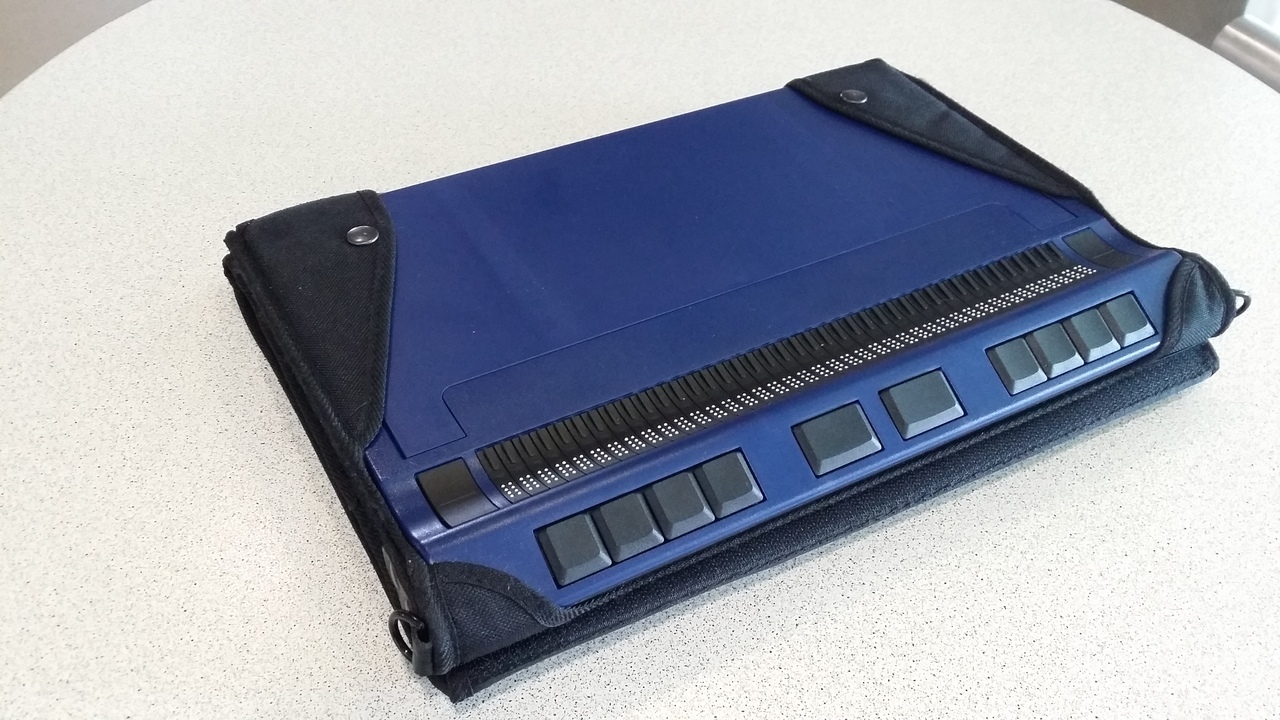

Technical Details The backside of the Handy Tech Active Star 40 features two USB host ports that can be used to connect devices such as a keyboard. A small form-factor, USB keyboard with a magnetic clip-on is included. When a USB keyboard is connected, and when the display is used via Bluetooth, the braille display firmware additionally offers the Bluetooth HID profile, and key press/release events received via the USB port are passed through to it. I use the Bluetooth dongle for all my communication needs. Most importantly, BRLTTY is used as a console screen reader. It talks to the braille display via Bluetooth (more precisely, via an RFCOMM channel). The keyboard connects through to Linux via the Bluetooth HID profile. Now, all that is left is network connectivity. To keep the energy consumption as low as possible, I decided to go for Bluetooth PAN. It appears that the tethering mode of my mobile phone works (albeit with a quirk), so I can actually access the internet as long as I have cell phone reception. Additionally, I configured a Bluetooth PAN access point on my desktop machines at home and at work, so I can easily (and somewhat more reliably) get IP connectivity for the rpi when I'm near one of these machines. I plan to configure a classic Raspberry Pi as a mobile Bluetooth access point. It would essentially function as a Bluetooth to ethernet adapter, and should allow me to have network connectivity in places where I don't want to use my phone.
BlueZ 5 and PAN It was a bit challenging to figure out how to actually configure Bluetooth PAN with BlueZ 5. I found the bt-pan python script (see below) to be the only way so far to configure PAN without a GUI. It handles both ends of a PAN network, configuring a server and a client. Once instructed to do so (via D-Bus) in client mode, BlueZ will create a new network device - bnep0 - once a connection to a server has been established. Typically, DHCP is used to assign IP addresses for these interfaces. In server mode, BlueZ needs to know the name of a bridge device to which it can add a slave device for each incoming client connection. Configuring an address for the bridge device, as well as running a DHCP server + IP Masquerading on the bridge, is usually all you need to do.
A Bluetooth PAN Access Point with Systemd I'm using systemd-networkd to configure the bridge device. /etc/systemd/network/pan.netdev:
[NetDev]
Name=pan
Kind=bridge
ForwardDelaySec=0
/etc/systemd/network/pan.network:
[Match]
Name=pan
[Network]
Address=0.0.0.0/24
DHCPServer=yes
IPMasquerade=yes
Now, BlueZ needs to be told to configure a NAP profile. To my surprise, there seems to be no way to do this with stock BlueZ 5.36 utilities. Please correct me if I'm wrong. Luckily, I found a very nice blog post, as well as an accommodating Python script that performs the required D-Bus calls. For convenience, I use a Systemd service to invoke the script and to ensure that its dependencies are met. /etc/systemd/system/pan.service:
[Unit]
Description=Bluetooth Personal Area Network
After=bluetooth.service systemd-networkd.service
Requires=systemd-networkd.service
PartOf=bluetooth.service
[Service]
Type=notify
ExecStart=/usr/local/sbin/pan
[Install]
WantedBy=bluetooth.target
/usr/local/sbin/pan:
#!/bin/sh
# Ugly hack to work around #787480
iptables -F
iptables -t nat -F
iptables -t mangle -F
iptables -t nat -A POSTROUTING -o eth0 -j MASQUERADE
exec /usr/local/sbin/bt-pan --systemd --debug server pan
This last file wouldn't be necessary if IPMasquerade= were supported in Debian right now (see #787480). After the obligatory systemctl daemon-reload and systemctl restart systemd-networkd, you can start your Bluetooth Personal Area Network with systemctl start pan.
Bluetooth PAN Client with Systemd Configuring the client is also quite easy to do with Systemd. /etc/systemd/network/pan-client.network:
[Match]
Name=bnep*
[Network]
DHCP=yes
/etc/systemd/system/pan@.service:
[Unit]
Description=Bluetooth Personal Area Network client
[Service]
Type=notify
ExecStart=/usr/local/sbin/bt-pan --debug --systemd client %I --wait
Now, after the usual configuration reloading, you should be able to connect to a specific Bluetooth access point with:
systemctl start pan@00:11:22:33:44:55
Pairing via the Command Line Of course, the server and client-side service configuration require a pre-existing pairing between the server and each of its clients. On the server, start bluetoothctl and issue the following commands:
power on
agent on
default-agent
scan on
scan off
pair XX:XX:XX:XX:XX:XX
trust XX:XX:XX:XX:XX:XX
Once you've set scan mode to on, wait a few seconds until you see the device you're looking for scroll by. Note its device address, and use it for the pair and (optional) trust commands. On the client, the sequence is essentially the same except that you don't need to issue the trust command. The server needs to trust a client in order to accept NAP profile connections from it without waiting for manual confirmation by the user. I'm actually not sure if this is the optimal sequence of commands. It might be enough to just pair the client with the server and issue the trust command on the server, but I haven't tried this yet.
Enabling Use of the Bluetooth HID Profile Essentially the same as above also needs to be done in order to use the Bluetooth HID profile of the Active Star 40 on Linux. However, instead of agent on, you need to issue the command agent KeyboardOnly. This explicitly tells bluetoothctl that you're specifically looking for a HID profile.
Configuring Bluetooth via the Command Line Feels Vague While I'm very happy that I actually managed to set all of this up, I must admit that the command-line interface to BlueZ feels a bit incomplete and confusing. I initially thought that agents were only for PIN code entry. Now that I've discovered that "agent KeyboardOnly" is used to enable the HID profile, I'm not sure anymore. I'm surprised that I needed to grab a script from a random git repository in order to be able to set up PAN. I remember, with earlier version of BlueZ, that there was a tool called pand that you could use to do all of this from the command-line. I don't seem to see anything like that for BlueZ 5 anymore. Maybe I'm missing something obvious?
Performance The data rate is roughly 120kB/s, which I consider acceptable for such a low power solution. The 1GHz ARM CPU actually feels sufficiently fast for a console/text-mode person like me. I'll rarely be using much more than ssh and emacs on it anyway.
Console fonts and screen dimensions The default dimensions of the framebuffer on the Raspberry Pi Zero are a bit unexpectedly strange. fbset reports that the screen dimension is 656x416 pixels (of course, no monitor connected). With a typical console font of 8x16, I got 82 columns and 26 lines. With a 40 cell braille display, the 82 columns are very inconvenient. Additionally, as a braille user, I would like to be able to view Unicode braille characters in addition to the normal charset on the console. Fortunately, Linux supports 512 glyphs, while most console fonts do only provide 256. console-setup can load and combine two 256-glyph fonts at once. So I added the following to /etc/default/console-setup to make the text console a lot more friendly to braille users:
SCREEN_WIDTH=80
SCREEN_HEIGHT=25
FONT="Lat15-Terminus16.psf.gz brl-16x8.psf"

Note

You need console-braille installed for brl-16x8.psf to be available.

Further Projects There's a 3.5mm audio jack inside the braille display as well. Unfortunately, there are no converters from Mini-HDMI to 3.5mm audio that I know of. It would be very nice to be able to use the sound card that is already built into the Raspberry Pi Zero, but, unfortunately, this doesn't seem possible at the moment. Alternatively, I'm looking at using a Micro USB OTG hub and an additional USB audio adapter to get sound from the Raspberry Pi Zero to the braille display's speakers. Unfortunately, the two USB audio adapters I've tried so far have run hot for some unknown reason. So I have to find some other chipset to see if the problem goes away. A little nuisance, currently, is that you need to manually power off the Raspberry, wait a few seconds, and then power down the braille display. Turning the braille display off cuts power delivery via the internal USB port. If this is accidentally done too soon then the Raspberry Pi Zero is shut down ungracefully (which is probably not the best way to do it). We're looking into connecting a small, buffering battery to the GPIO pins of the rpi, and into notifying the rpi when external power has dropped. A graceful, software-initiated shutdown can then be performed. You can think of it as being like a mini UPS for Micro USB.
The image If you are a happy owner of a Handy Tech Active Star 40 and would like to do something similar, I am happy to share my current (Raspbian Stretch based) image. In fact, if there is enough interest by other blind users, we might even consider putting a kit together that makes it as easy as possible for you to get started. Let me know if this could be of interest to you.
Thanks Thanks to Dave Mielke for reviewing the text of this posting. Thanks to Simon Kainz for making the photos for this article. And I owe a big thank you to my co-workers at Graz University of Technology who have helped me a lot to bootstrap really quickly into the rpi world.
P.S. My first tweet about this topic is just five days ago, and apart from the soundcard not working yet, I feel like the project is already almost complete! By the way, I am editing the final version of this blog posting from my newly created monitorless ARM-based Linux laptop via an ssh connection to my home machine.

11 June 2016

Shirish Agarwal: The road to debconf 2016, tourism and arts.

A longish blog post, please bear, a second part of the blog post would be published in few days from now. My fixed visa finally arrived, yeah:) But this story doesn t start here, it starts about a year back. While I have been contributing to Debian in my free time over the years, and sometimes paid time as well, I had never thought of going overseas as the experiences I knew from friends and relatives, it isn t easy to get all the permissions and paperwork done to say the least (bureaucracy @ work). But last year, when Debconf 15 was being launched, there are/were 2-3 friends of mine who are studying, doing their Ph.D. in some computer/web stuff, living in Germany currently that they goaded me to apply. The first few times I gave some standard excuses, but when they kept on for a while, just to shut them up I applied to the debconf team applying for food, accommodation and travel sponsorship. I didn t have high hopes as there obviously are many more talented peers around me who understand FOSS and Debian at a much more fundamental, philosophical as well as technical level than me. Much to my surprise though, about a month (and around two or three weeks just before the event was about to take place) I got the bursary/sponsorships for food, accommodation as well as travel. I was unsure that the remaining time was enough to get a visa hence declined that time around. That whole episode gave me the confidence that perhaps my application would be accepted if I applied again. Using my previous years understanding, decided to give it a shot again as this would also enable me to get a feel of visa bureaucracy as well as gain a bit of novice understanding about what factors go in choosing a flight and believe me the latter part proved to be pretty confusing. While the visa business seems easy, the form at least is easy and what they ask, it can be troublesome as far as visa-processing process is concerned. It took a better part of the month to get the visa which I needed. The in-between time is and can be a bit stressful as you have committed funds for travel i.e. the airline tickets and are in a limbo as you didn t know that if the visa is cancelled for some reason, your tickets would be refunded or not. A little history is needed and hopefully is helpful for anybody who s applying for a short-stay Visa in South Africa. Exactly, A month and day back I had applied for visa. The visa I had applied for is 17 days as the flights within my budget was for those days only. The visa I got was for 10 days only which was ending in the middle of the conference. I tried many avenues to get information and was told that I needed to write a correction letter telling/sharing the information about the correct time period and dates in BOLD with a heavier weight/point which is what I did and gave to VFS office without any further payment on my part. It took a bit more time than the first time around but the consulate co-operated. While I can understand the oversight as they probably get more visas requests along with special and urgent requests so such occurrences can happen. I am and was happy that there was a recourse rather than starting from scratch which probably would have made me more anxious due to the first experience . Apparently I was lucky that I had done with Qatar Airways as later came to know that there are other airways which don t refund money even after visa rejection . This information I got to know pretty late in the game otherwise I wouldn t have been much stressed. As had committed knew had to go the whole hog and whatever barriers are there, have overcome at least as far as the visa part/process is concerned. Now after few days, will probably start to worry about the actual travel, part nervousness, part excitement, nervousness as it will be an alien land, am obese so traveling economy on 787-8 and 777-300 ER will be tricky. The 787-8 will probably be a rough ride as it s a 9 hr. journey and the seat are a mere 18 , the cattle class as shared by one of our esteemed politicians. This blame has to do with Boeing 787 rather than anybody else. Hopefully, if there is a next time, would make better choices. Anyways,have selected an aisle seat so that will be able to walk every hr. or so to get the circulation in legs going as leg room in economy is not much from my domestic air travel experiences. If I do survive the travel, then will see South Africa and try to get some free time and explore South Africa and try to figure out how are they able to get one and half time tourists while we get around half figure for a whole year even though we are bigger (area-wise) to South Africa. I did find something positive for us as well, it s not all doldrums all around. Now, I had been thinking about if I know any South African music and movies. I had explored djembe while growing up in teens but other than that, not much. The only music I have heard is Harry Belafonte . So I hope to bring some Indian movies and music with me so that people if they have not explored Bollywood as well as Indian classical music could explore some of it, of course it will be pale imitation of what Sawai Gandharva Music Festival for instance gives. I also hope to hear and get some music and movies to learn more about South Africa.
Filed under: Miscellenous Tagged: #bollywood, #Debconf Germany 2015, #Debconf South Africa 2016, #Debconf15, #Debconf16, #djembe, #South-African consulate, music, tourism, visa

10 June 2016

Valerie Young: Week 1 on Reproducible Builds

In this post I m reviewing what I ve done the last 6 days of Outreachy-funded reproducible builds work, outline what I plan to do the next two weeks, and speculate on long term goals. For those of you involved in the Debian reproducible builds project, please provide feedback about future plans and work! Week One review One week of Outreachy completed! What have I done? The change that broke everything was the addition of a directory: tests.reproducible-builds.org/debian The directory was added to contain all Debian-specific pages, in line with the other project s reproducible builds status pages: arch linux, fedora, coreboot, etcs. Previously, all Debian pages we simply served directly out of the DocumentRoot. To fix all the broken things, I m pretty sure I had to find, inspect, and add /debian or change global variables within every file pointer in the entire tests website. Sometime tedious, but chasing down bugs and complaints was mostly fun  I also learned (everything I now know) about Apache websites, redirects, the website/navigation/directory structure of tests.reproducible-builds.org, and the roles of many of the reproducible scripts in jenkins.debian.net/bin. Week Two plan What will or should I do next? In the short term, over the next two weeks, I hope to make useful improvements to the tests website and backend while continuing to get up to speed (as well as learn Python). Have other thoughts about minor improvements to tests.reproducible-builds.org? Please let me know! The above list is not internally prioritized, feel free to ask for things to be bubbled up. Longer-term goals My long term summer goal is to make the Debian test code more easily extensible to show the reproducible results from other projects. This will lower the barrier for new projects to keep track of the reproducibility of their code, for great good. This starts with the reproducible.db database, which presently only tracks reproducible testing results for the Debian project. The reproducible builds project s needs have outgrown the original SQLight database, so this redesigning includes a migration to Postgre. Goals of the redesign include ease of querying/comparing packages across distributions, as well as generalization to include results from projects other than Debian. I ll start on this work in two weeks, when I get to DebCamp!  Redesigning the database will also lead to updating the python script which use that data to produce the Debian tests website. Other project scripts (like Fedora, RedHat and Coreboot) can then be updated to track results in the database as well, instead simply directly producing their own test websites. update: as an intermediate step before redesigned the reproducible.db database to handle multiple projects h01ger recommended I help the FreeBSD project recorded tests to a FreeBSD specific database.

8 June 2016

Lucas Nussbaum: Re: Sysadmin Skills and University Degrees

Russell Coker wrote about Sysadmin Skills and University Degrees. I couldn t agree more that a major deficiency in Computer Science degrees is the lack of sysadmin training. It seems like most sysadmins learned most of what they know from experience. It s very hard to recruit young engineers (freshly out of university) for sysadmin jobs, and the job interviews are often a bit depressing. Sysadmins jobs are also not very popular with this public, probably because university curriculums fail to emphasize what s exciting about those jobs. However, I think I disagree rather deeply with Russell s detailed analysis. First, Version Control. Well, I think that it s pretty well covered in university curriculums nowadays. From my point of view, teaching CS in Universit de Lorraine (France), mostly in Licence Professionnelle Administration de Syst mes, R seaux et Applications base de Logiciels Libres (warning: french), a BSc degree focusing on Linux systems administration, it s not usual to see student projects with a mandatory use of Git. And it doesn t seem to be a major problem for students (which always surprises me). However, I wouldn t rate Version Control as the most important thing that is required for a sysadmin. Similarly Dependencies and Backups are things that should be covered, but probably not as first class citizens. I think that there are several pillars in the typical sysadmin knowledge. First and foremost, sysadmins need a good understanding of the inner workings of an operating system. I sometimes feel that many Operating Systems Design courses are a bit too much focused on the Design side of things. Yes, it s useful to understand the low-level mechanisms, and be able to (mentally) recreate an OS from scratch. But it s also interesting to know how real systems are actually built, and what are the trade-off involved. I very much enjoyed reading Branden Gregg s Systems Performance: Enterprise and the Cloud because each chapter starts with a great overview of how things are in the real world, with a very good level of detail. Also, addressing OS design from the point of view of performance could be a way to turn those courses into something more attractive for students: many people like to measure, benchmark, optimize things, and it s quite easy to demonstrate how different designs, or different configurations, make a big difference in terms of performance in the context of OS design. It s possible to be a sysadmin and ignore, say, the existence of the VFS, but there s a large class of problems that you will never be able to solve. It can be a good trade-off for a curriculum (e.g. at the BSc level) to decide to ignore most of the low-level stuff, but it s important to be aware of it. Students also need to learn how to design a proper infrastructure (that meets requirements in terms of scalability, availability, security, and maybe elasticity). Yes, backups are important. But monitoring is, too. As well as high availability. In order to scale, it s important to be able to automatize stuff. Russell writes that Sysadmins need some programming skills, but that s mostly scripting and basic debugging. Well, when you design an infrastructure, or when you use configuration management tools such as Puppet, in some sense, you are programming, and in terms of needs to abstract things, it s actually similar to doing object-oriented programming, with similar choices (should I use that off-the-shelf puppet module, or re-develop my own? How should everything fit together?). Also, when debugging, it s often useful to be able to dig into code, understand what the developer was trying to do, and if the expected behavior actually matches what you are seeing. It often results in spending a lot of time to create a one-line fix, and it requires very advanced programming skills. Again, it s possible to be a sysadmin with only limited software development knowledge, but there s a large class of things that you are unlikely to address properly. I think that what makes sysadmins jobs both very interesting and very challenging is that they require a very wide range of knowledge. There s often the ability to learn about new stuff (much more than in software development jobs). Of course, the difficult question is where to draw the line. What is the sysadmin knowledge that every CS graduate should have, even in curriculums not targeting sysadmin jobs? What is the sysadmin knowledge for a sysadmin BSc degree? for a sysadmin MSc degree?

Next.

Previous.