Search Results: "will"

20 March 2007

Wouter Verhelst: known unknown_hosts

OpenSSH maintains a file called "~/.ssh/known_hosts", where it stores the SSH keys of the hosts it's visited before in an attempt to avoid MITM-attacks. This is good. However, I have a range of IP addresses on this network here that are used for ever-changing hosts; customer's machines that are at my office, and which I need to temporarily give a network connection in order to allow them to download stuff (and because typing in an xterm on my laptop rather than on a different keyboard and to a different monitor is just so much more convenient). Therefore, I know that these IP addresses will change from time to time. At this point, known_hosts is an annoyance. And since I never connect to those hosts except from machines that I trust and/or through routers that I trust, there's no advantage to be gained in having the protection that known_hosts offers, anyway. So, dear lazyweb: is there a way to tell OpenSSH that when it tries to connect to host A, B, or C, that it does not need to store stuff in known_hosts, and that it should just assume the key is valid? Update:StrictHostKeyChecking no and UserKnownHostsFile /dev/null will do what I want. Obviously I do want to set these options in a specific Host stanza—i.e., not Host *. Thanks, madduck!

Eddy Petrișor: commit mails, made simple OR integration of services

Collab-maint never ceases to amaze me. And Subversion, too (all dvcs fans, stop now! I know, I use darcs, is cool). I always find more and more interesting this about Subversion.

And, no, this is not about Subversion or some VCS, is about integration of services. We need more of that. generally speaking. I am also thinking about look and feel of different services (BTW, I have found a nice pretext to motivate my halt on the work for the Debian wiki theme :-D - see current state of work, if you care).


Why did I wrote this? I had this conversation (trimmed for the sake of brevity):
goneri wrote:
> On Tue, Mar 20, 2007 at 03:42:56AM +0200, Eddy Petri or wrote:
>> goneri-guest@users.alioth.debian.org wrote:
>>> -use lib "/usr/share/svn-buildpackage";
>>> +#use lib "/usr/share/svn-buildpackage";
> Yes, you're right.
>
> How do you have the commit messages?

I subscribed in PTS - see "Subscription - Package Tracking System" and choose "Adanced Mode"
instead of "Subscribe", check the corresponding check boxes ;-) .

/me will blog about this.

Erich Schubert: Microsoft Linux sales strategy

Microsofts view of Linux users, and how to convince them of Windows. I don't like linking to Microsoft stuff, and especially not to Microsoft FUD (the flash presentation of theirs will in turn try to bring you to their "get the facts" wrong site...) However, for Linux evangelists it's a good opportunity to see Microsofts strategy at attacking Linux, and where we should improve to counter their claims (e.g. with respect to mangeability). It's also nice to see that they actually feel oblieged to counter SAMBA and other Linux technology, and that especially in the networking part they have little to claim to be superior. And also for Samba all they claim is "higher value because of better integration and manageability". And I definitely have to agree that management of a larger Linux network isn't easy, and we could do with some better tools. (And especially tools to do tools for network management; we have different requirements, and there are good tools, but they are either hard to roll out and customize - cfengine -, or too primitive to be of use to many - webmin etc.) Still the average Linux administrator does manage a significantly higher number of servers than a Windows admin, so their claim actually is incorrect. And it's totally absurd they claim to be better in security with Exchange. Maybe better than their older crap, but I still would never ever trust a Microsoft system for Email... just remember all those bad email vacation notices etc. Microsoft delivers... So: know your "enemy"s tactics.

Erich Schubert: Flash memory and wear leveling

Uwe and Gunnar have been talking about using flash aka. solid state disks. So far, every USB memory stick I had has died after a fairly low number of write cycles... sometimes doing a low level format helped, but the errors resurfaced again later on. Interestingly enough, I never had such problems with digial camera media, just with USB thumb drives. The wikipedia article on Flash RAM is also rather vague:
Another limitation is that flash memory has a finite number of erase-write cycles (most commercially available flash products are guaranteed to withstand 1 million programming cycles). This effect is partially offset by some chip firmware or file system drivers by counting the writes and dynamically remapping the blocks in order to spread the write operations between the sectors.
And where do they store the write count without doing extra writes? :-) (Note: you can do some simple counting with programming cycles only, i.e. by doing only NOR/NAND operations and no resets) Note that there are also filesystems designed for flash, e.g. JFFS2, that have built-in wear leveling at the filesystem level. It might also make sense to not use a media with wear leveling, but instead do it yourself in software. However you most likely won't have a choice here unless you build your own hardware and want to skip the extra controller. You should however try to keep the number of writes low, so e.g. disable atime for ext2/3 (I guess JFFS2 doesn't support atime by design), reduce the frequency of flushing buffers to disk ('laptop mode') and use RAM filesystems where possible (e.g. /tmp). Anyway, go and read above Wikipedia article, it has some good information on it. And in half a year, many laptops will sell with hybrid drives, because of Microsoft pushing that technology. (I remember having read that in fall, having a hybrid drive will be a requirement for Vista gold compability or so?) It would be interesting to work out how Linux can benefit most from such a hybrid system. I can imagine using a USB thumb drive with my laptop both as access key and for rapid boot (my harddisk is encrypted anyway, and it would make sense to not have an unencrypted bootloader on the disk, but only on the flash drive. The flash drive would not contain the key, but the kernel, decryption software, i.e. cryptsetup etc., and maybe some services to be loaded on boot for fast startup)...

MJ Ray: Environment: A blog test (3)

More feedback on the water heating. Rafael Villar Burke wrote:
"Most regulations already mandate that. This requirement conflicts with how performant are low temperature heating systems, as most solar ones... so, to be safe, they're less efficient."
Joe Buck commented:
"If you have small children, and set your hot water heater at 60C, expect to take them to the hospital with second-degree burns on a regular basis."
Even if it was 60C at a tap, it will still take 6 seconds to burn, according to Burn Safety: Hot Water Temperature, but I was talking about storage tanks, not a water heater. Sorry if that was unclear. After running around the house floors and walls to get to a tap from the storage tanks, it's never going to be at 60C unless your pipes are super-insulated or your water flow is very fast (unlikely, as most tank-fed systems won't have much head).

19 March 2007

Neil Williams: network-manager failures

In response to a couple of comments about my post about pesky binary firmware, I can only say that after removing the last entrails of network-manager and network-manager-gnome, everything appears fine. Command-line configuration wins over GUI eye candy, again. ;-)

At no point did network-manager[-gnome] cope with my setup, principally due to WPA difficulties, it did connect once when WPA was disabled at my Access Point at home but that simply isn't an option in the real world. (And it's not a problem with my home setup because network-manager also failed (comprehensively) with a completely different wifi setup - the one I'm using here on hols.)

Oh and by the by, if anyone has a problem with the template I've chosen for my blog, there is always the option to select a different template via the drop-down box. I happen to like the current one and it's my blog so, umm, that's how it will stay. :-)

David Nusinow: Much Like The Internet, Your Mom Is A Series Of Tubes

This article got me thinking about some new ways we could dramatically improve Debian. We had a lot of success in the past because good packaging helps people get over the fearful hump of installing and setting up new software in order to learn it. We're great at that, and the battle is pretty much over there.

Afterwards though, I don't think we're so good at helping our users through the scary parts. We include a lot of documentation, but that's not really cutting it any more. I set out to work on X because the scariest thing for a lot of users is getting X up and running, and I wanted to help them (and myself!) do it. We still don't have that nailed, but it's in the pipeline, so I think the next stage will be to help people do cool things with X that they wouldn't have done before. In the past, this would have involved doing things like setting xrdb settings, but these days such things aren't really useful. I'm going to continue brainstorming this, but to this end I've started a page on the wiki that's expressly for helping users get over some of the more difficult and interesting things that people might want to do with, or to, X.

Currently the only tip is on building packages using upstream's git HEAD and our own packaging, but I'm looking to put more stuff up in the nearish future. While we haven't been maintaining it so well, the XSF FAQ has a lot of these sorts of tips too.

I think we can push harder and be more clever about giving our users and ourselves cool things to do with Debian beyond packaging. The XSF move to git opened up the opportunity to easily track the X.org HEAD with the Debian packaging, and I think that sort of thing is indicative that we can be clever about enabling people at all stages of the development process, not just through the packaging itself. If you guys have any ideas for more X tips you'd like to see documented, please edit that wiki page or at least drop me or debian-x a mail so we can write it up for you. I want to see how far we can push this.

Ian Murdock: Re Debian missing a big opportunity

The timing could have been better (since some will no doubt connect my words to today’s other news), but an interview I did with Linux Format at last month’s LinuxWorld Open Solutions Summit was published today, and quickly found its way to Slashdot, where I figured it would end up (read the interview—it’s right in there :-). I knew midway through that I was about to step in it, but these are things that needed to be said, and I’m pleased with how it ended up. Before you throw me to the wolves, read it all the way through, and think about it.

Thom May: Ian Murdock and Sun

This is what I just wrote on Mark’s blog about Ian’s move to Sun:
“To some extent I m quite excited by what this might mean for OpenSolaris going forward, but Nexenta have been pushing the OS/Debian (or Ubuntu, more accurately) integration kick for some while without actually seeming to get any (public) traction within Sun
I ve also been disappointed by how little Ian seems to be in touch with how linux development works these days, but that s mostly from what he s been writing in public, rather than any particularly interaction with him, so hopefully that s not a fair summary.
I really hope that Sun can actually make this work.”
I thought I’d expand on this a bit, especially in light of my past moaning about Solaris and the installer and package management in the installer specifically.
What I really, really want, is a modern OS, which has an easily extensible and controllable installer, with good visibility and debugging infrastructure, which is very easy to manage on a grand scale - by which I mean hundreds or thousands of machines up to date, secure and consistent. At present, Ubuntu comes closest: However, there are some definite areas where Ubuntu or Debian (or Linux in general) struggle compared to Solaris – the sheer engineering resources that Sun can throw at a problem, and the talent they have available to them do result in fantastic results when they correctly identify a problem space. They also “own” Solaris – there’s no need for them to try and build awareness of a problem, and the correct solution, over a number of disparate communities.
ZFS and DTrace are the hackneyed and obvious projects here, but from a sysadmin perspective I think FMA, while far less sexy, is one of the best things Solaris10 has. And this is what I mean when I say operating system visibility.
The integration of Zones is also far better than Zen on Linux can offer currently, although both Red Hat and skx are working hard to fix this.
I’m really looking forward to the day when I get an OS that solves all these problems…

Evan Prodromou: 28 Vent se CCXV

We're spending the week in Surfside, TX enjoying a bit of post-SXSW de-connectivity before plunging back into the fray. I'm catching up on some software projects for Wikitravel and some other projects as well. It's pretty fun. Surfside is really beautiful -- fine white sand, gentle waves from the Gulf, flocks of brown pelicans passing by our deck in the morning. There's been some damage to the village due to Hurricane Rita and long-term erosion, but it's still really fun. And not particularly over-run, even during Spring Break this weekend. We've got a few hundred yards of beautiful beach in front of our house practically to ourselves. The downside has been that the vacation home we rented doesn't have the WiFi coverage we'd hoped for. We had the Mayor of Surfside (!) over at our house yesterday trying to set up a directional antenna so we could get a bitstream from the volunteer fire department, but no luck. So I'm doing updates at the restobar on the main street, and then editing offline at home. It's been great playing in the sand and waves with Amita June. This is her first time really playing on the beach, and she's having a great time. tags:

Montreal Gazette article A few weeks ago I met with local reporter Steve Faguy about Wikitravel, living in Montreal, and wikis and technology in general. He wrote a great profile of me and Wikitravel, a sidebar about my blog (!), a description of wiki and a list of good wikis. I like the story; it's well-written, and Steve knows enough about technology to write a good article while still making it accessible for non-professionals. I also like the image of me; that's a pretty good shot of me. The one omission I am kicking myself for was failing to note that Montreal will be the location of not one but two Wiki conferences this year. RoCoCoCamp is 18-20 May, and WikiSym is in October. Ray King calls Portland (Oregon) "Wiki City, USA", but I think Montreal is giving it a run for its money on the international scene. tags:

Twitter 2007 == Friendster 2003 So, I'm really concerned about Twitter's performance and stability problems since SXSW. Remember Friendster, the social networking platform of 2003? The site failed to support a surge of traffic in mid-2003, about a year into the service. The deluge of users meant that pages wouldn't serve, images timed out, and edits were impossible. Consequently, the social networking market was fractured as users went to smaller services like Tribe.net, MySpace, Orkut and LinkedIn. The other services might not have all your friends on them, but at least they worked. It was a phenomenal fumble by Friendster that was entirely attributable to failure to scale. Would other social networks have come up anyways? Probably. But there's a network effect to social networking, and people would probably have stuck with Friendster a lot more than they actually did. I think Obvious Corp. has got to get on the ball if they're going to capitalize on the success of Twitter. There's a similar network effect advantage for Twitter-like services, and if they can execute well, they're going to Pwn. But the software and interface are pretty easy to replicate, and there are other services like Twitter out there already. Better keep an eye on your lunch, fellas. tags:

Lucas Nussbaum: Condorcet method and the french presidential election

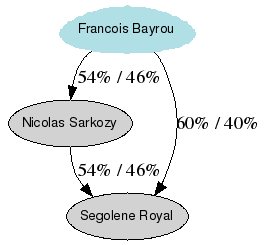
The french presidential election (in april/may 2007) will use plurality voting with two rounds (voters will choose 1 amongst 11 or 12 candidates during the first round. The two candidates with the most votes will be qualified for the second round). The latest polls clearly show how this election method fails to satisfy the Condorcet criterion. Using the second round results from this poll (only considering the 3 main candidates, since the other don’t have any chance to win the presidential election), we get this: 2007 elect results So Francois Bayrou is the Condorcet winner, and should win the election. However, the first round results, according to the same poll, could be:
  1. Sarkozy 31%
  2. Royal 24%
  3. Bayrou 22%
  4. Le Pen 12%
Since only the two first candidates are qualified to second round, Bayrou wouldn’t be elected. It will be interesting to see how those scores evolves until the first round (April 22nd).

Erich Schubert: Swing rules the world

Roger Cicero will be going for germany to the Eurovision song contest. With his song "Frauen regier'n die Welt" ("Women rule the world"), which he sings with the impression of being able to himself rule any woman. :-) His mix is very uncommon: it's swing, but with german lyrics, about love and life, flirting and with a well-dosed amount of macho in it, but not serious but always joking and cool. YouTube has some video clips with his music. Note that I don't think "Frauen regier'n die Welt" is his best song. Scroll down at least to "Murphys Gesetz" ("Murphys Law", and congrats for not incorrectly adding an apostrophe, it's correct this way...) Last.FM has some excerpts from songs I like better. I don't know if 'we' have any chance with him (last years' winner was Lordi, some 'schocker' hard-rock-heavy-metal band dressing up like halloween monsters), but he won't come out last for sure. Demographics of the Eurovision contest aren't too favourable for germany, nor are are European relations. But being a swing dancer, this is just really cool, because it gives my hobby a wider audience. :-) P.S. If you want to learn Swing dancing in Munich: the Lindy Hop course at Boogie-Bären starts again this tuesday, and I can also recommend the classes of Swing and the city (thats Cat and Chris); there is a beginners and intermediate workshop next weekend with world champions Markus & Bärbel together with Cat and Chris. And of course every monday there is a teaser class at Cord. P.P.S. I'd really love to see Roger Cicero perform together with some good Lindy dancers as show act. Probably a different song then, though.

18 March 2007

Erich Schubert: Enhanced network monitoring

So far, all network monitoring solutions I've tested suck. What I'm looking for is a network monitoring solutions, which Pretty much every monitoring solution I've seen so far is great at collecting tons of data, but doesn't help me with actually handling this amount of data. Anyone has a recommendation for a good network monitoring tool? I'd be really interested in doing the last point - a real statistical analysis for network monitoring. This would be so useful... predicting peaks in network usage, predicting when a system will be overloaded or a disk full... but I'm phasing out of network administration; so my interest here is mostly in being able to give advice to others. [Update: no, you don't need to point me to Cacti. It's just another grapher and data collector that doesn't actually do what I would call 'monitoring'. It also seems to not have a smart scheduler, and is written in PHP (which is bad!) I was also told a non-success story with OpenNMS which just crashed when adding a host to be monitored with a totally unhelpful stack trace. I had a look at their online demo, but it felt very complex and not very useful to me...]

Julien Valroff: Playing with Linux-Vserver

I have set up my first vserver to play with. I am very impressed how easy the process is! The performance on my Dell Inspiron 1300 seems very good as well. I have almost no experience with virtualization techniques, and was stuck to User-Mode Linux until today. According to the Wikipedia article, Linux-Vserver has many advantages compared to other tools due to the fact the virtual servers share the same system call interface and do not have any emulation overhead (I do obviously agree this can also be a drawback). I haven’t yet had the chance to study the security part in depth, this will be my main task this week, I will then be able to make the choice between UML and Linux-Vserver - I’m not yet ready for Xen. (more…)

Jan Wagner: MySQL5 support in php5 packages on backport.org

I’m stuck of the requests linking php5 on backports.org against “MySQL5″.
You need support of MySQL5 or the mysqli extention for your php5 packages for sarge? So the packages on backports.org are not what you want. The packages are compiled against libmysqlclient12 (mysql 4.0) cause all apache modules (on backports.org) are compiled against this version. Linking php5 against an other version will lead you in trouble when using these apache modules and php5 together, cause sarge doesn’t support “versioned symbols”. For more information see the threads on php-maint or
backports-users
! If you install packages from backports.org, you should read the latter one anyways. , , , ,

Erich Schubert: Debian and SELinux in the Summer of Code

Debian is participating in the Google Summer of Code again. Russell Coker offers to mentor SELinux projects, and so do I. I'm available for mentoring SELinux and Debtags related projects in particular. This years idea pool in the Debian Wiki. Make sure to also check last years idea pool (some of which will no longer be open, though). And of course your idea doesn't need to be on these pages already; we're of course interested in anything that goes beyond that. One thing with SELinux I'm particularly interested in is install scripts. That is quite some work to do, and you might want to automate it somewhat. Debian install scripts can be quite complex. Some things are obvious such as restarting services on upgrade. But some scripts do much more. SELinux uses a deny by default approach (which is the only sane security approach, btw.); in particular this means that many Debian install scripts will be failing. Right now, package postinst scripts are being run with the full permissions of the apt-get domain. It would be good to reduce that to a "postinst" domain. It would be a possible GSoC project to analyze which permissions package postinst scripts need, and if we can e.g. add a "postinst extended" domain for just a few postinst scripts that really need extended permissions. An example for extended postinst tasks in Debian (I don't think Redhat, Fedora or Gentoo does that yet): precompiling all python modules for all installed python versions (and to avoid having programs try to precompile them on demand, which will result in audit errors and such). I wrote a module for that called python-support. It adds a restricted domain which can exactly do this task of precompiling Python. But there is other such stuff, such as updating the menus, managing alternatives etc. But feel free to suggest your own ideas.

Neil Williams: pesky binary firmware

Aaarrgh! Trying to post the last blog entry revealed that my wireless connection had simply died. Various restart options failed (ifdown/ifup, dbus restart etc) so the realisation dawned that the binary blob that gets the Airport Extreme card working is not always coming out of suspend correctly. This time, I did a full restart (shutdown -r now) but I hope this isn't necessary every time. Next time, I'm going to see if a quick suspend / unsuspend is sufficient - watch this space....

Neil Williams: roaming SMTP in sylpheed

After finally getting wireless connectivity whilst on hols, the only thing left was email. I'd already configured fetchmail by copying the fetchmailrc from my email server before I left but I'd forgotten to do procmail maildrop. Some reason, can't seem to get maildrop to work with maildir (which is what sylpheed uses for 'local' email accounts) so I'm filtering messages manually for now. Adding a custom action to sylpheed to run 'fetchmail -s' is nice but it would be even better is sylpheed could call that action when checking for email. (I feel a wishlist bug coming on.)

SMTP was initially more of a problem - SMTP AUTH was available via the excellent ukfsn so creating a new Roaming account in sylpheed allows the configuration of SMTP AUTH just for that account. Problems with forwarded email addresses (like codehelp at d.o) and mailing list subscriptions meant that I'm now using a private server but ukfsn were perfectly usable for non-mailing list usage of 'normal' email accounts. It's only my own, overly complicated, forwarding and greylisting systems that made mailing list submissions into a problem.

The remaining problem is power consumption - the wireless connection on this iBook (Airport Extreme internal) seems very power hungry. All the testing and configuring that was needed for the above cut my battery life in half. I can normally get 4hrs plus of 'average workload'. This will have implications for using wireless at DebConf etc. Even if sylpheed could call a custom Action (like fetchmail) automatically, it wouldn't be wise to keep the original 10minute checks without AC power.

17 March 2007

Uwe Hermann: Silent, fast, long-living USB storage devices for use as hard drive?

As I recently bought a NSLU2 ("slug") for 24/7 server usage and random ARM-based development (more on that later), I'm looking for a suitable storage device to use as the root filesystem for a complete Debian system. The requirements are: The last item is the most important. The obvious choice is a USB memory stick, but unfortunately those are flash-based and only survive a certain number of write cycles. Thus I'm looking for something which at least survives enough write cycles to make it usable for a few years... I do know several ways to reduce the number of writes via software, that's not what I'm currently interested in. I'd like to know which storage types will survive the longest amount of time (because of their hardware properties). Some options: Has somebody else done something like this before and can share some experiences as to which storage type is best suited for such a scenario? I suspect my slug will be mostly idle, but there might also be phases where it runs on 100% CPU and heavy disk I/O for multiple days in a row...

Russell Coker: presentations and background color

In response to my last post about using laptops for presentations it has been suggested to me that using white (or a very bright color) as the background color can help some displays synchronise with the signal. I haven't had an opportunity to test this but it seems likely that as most computers are configured with a white background nowadays the display hardware is optimised for this case.

Another benefit of a light background is that it provides more ambient lighting to the room where the presentation is held. If all the lights are turned off (sometimes there is no dimmer switch) then the radiant light from the screen is the only form of illumination for the room.

Finally with the way the current generation of beamers work there is less heat trapped in the beamer if there is mostly white on the screen. This will hopefully decrease the incidence of hardware failures during lectures (which unfortunately are not uncommon in my observation).

Update:

Based on a comment on this blog entry I did a quick survey of the color scemes, black on white, yellow on blue, and white on green. Black on white got the most votes with some people saying that yellow on blue was most aesthetic while black on white was easiest to read ("clear and boring" was one comment).

One person pointed out that the light diverges slightly so black on white makes the letters look smaller while white on black makes them look bigger. My response to this is to use a slightly larger font.

Next.

Previous.