Search Results: "uli"

12 July 2007

Julien Valroff: New mobile phone: Sony Ericsson K750i

K750i I have just received my new mobile phone: a Sony Ericsson K750i which I have chosen mainly for its price and multimedia features, but also because it has an internal modem, accessible via both bluetooth and irda. So far, I was already able to connect to the internet in GSM, will try GPRS tomorrow as I need to change my SIM card. libbtctl and gnome-bluetooth 0.9.0 were also released today. Updated packages have been uploaded to my unofficial repository (please read carefully the release announcement which explains these packages have been deprecated). I have also tried wammu for the first time, it will help me update my address book.

Erich Schubert: Shaping your traffic for improved performance

Sometimes, putting up an arbitrary limit for your network connection can actually improve the performance.A typical setup will look like this: your computer is connected via 54-100 mBit to a router, which has a DSL line of let's say 2 mBit downstream and 192 kBit upstream (and then tons of other links).When you overload one of these connections, performance can go down a lot.The simples case how this can happen is when you upload data. 192 kBit are the weakest link here, and rather easy to fill up.What happens then is that your computer will start sending out data at his full link speed, until the buffers at the router are full and it starts dropping packets. TCP/IP will then adopt and - lacking 'ACK' packets - slow down sending data. It will likely still keep the send-buffer of the router full.Now if the router isn't very smart, it just keeps a first-in-first-out buffer. As long as you have just this single upload, you don't need to care. But if you have other connections, like a download, you do care.For your download to run at full speed, the sender needs to get those ACK packets from you. They're basically a "got your data, send more" kind of message. Really tiny packets, but essential for signaling.A simple trick you can use now is to limit your bandwith at the sending computer already. Since you're going to limit it just to the next link anyway it doesn't mean it will actually be getting much slower. But your network stack is smarter than the router's (probably). It can send out these ACK packets at a higher priority, so you end up with a better download-and-upload performance.If you know your network connection speed, just use it. Otherwise you can still measure it or guess it. I'm always going for 95% of the speed I see. You might want to limit it a bit more if you are sharing the connection with others.Now enough theory, here's what I use:
IFACE=wifi0
# setup ingress filtering
/sbin/tc qdisc add dev $IFACE handle ffff: ingress
# local network is unrestricted
/sbin/tc filter add dev $IFACE parent ffff: protocol ip \
  prio 10 u32 match ip src 192.168.2.0/24 \
  police conform-exceed ok/ok flowid :1
# incoming internet traffic is limited.
/sbin/tc filter add dev $IFACE parent ffff: protocol ip \
  prio 50 u32 match ip src 0.0.0.0/0 police \
  rate 1500kbit  burst 10k drop flowid :2
# outgoing traffic
/sbin/tc qdisc add dev $IFACE root handle 1: htb default 30
# local network is unrestricted
/sbin/tc class add dev $IFACE parent 1: classid 1:10 htb \
  rate 54mbit burst 15k
/sbin/tc qdisc add dev $IFACE parent 1:10 handle 10: sfq perturb 10
/sbin/tc filter add dev $IFACE parent 1:0 protocol ip \
  prio 10 u32 match ip dst 192.168.2.0/24 flowid 1:10
# internet traffic is limited.
/sbin/tc class add dev $IFACE parent 1: classid 1:20 htb \
  rate 160kbit ceil 196kbit burst 15k
/sbin/tc qdisc add dev $IFACE parent 1:20 handle 20: sfq perturb 10
/sbin/tc filter add dev $IFACE parent 1:0 protocol ip \
  prio 50 u32 match ip src 0.0.0.0/0 flowid 1:20
Long example, I know. The main reason is that I'm not limiting traffic to local computers. Furthermore, I'm also limiting my incoming traffic to use up at most 1.5 mbit of the 2 mbit connection, so my housemates will be able to use the internet as well (Debian mirrors send data fast - fast enough to kick them out of any online game they might be playing...).There is one important detail hidden in there: sfq. This stands for "stochastic fair queueing". It tells the network stack to basically send "one packet for each connection in turn". This way, the small packets needed for download or interactive SSH sessions will get out quickly even when doing a larger upload.It works great for me - I'm having a good download rate, using the 160 kBit upload limit completely (I don't want to completely fill up the 192k upload link either) and I'm actually writing this blog entry remotely via SSH. The lag when writing is okay, probably around 300ms. Without shaping, this wouldn't work this well.(And no: just using 'sfq' for your outgoing traffic is not enough, since the key scheduling is happening at the weakest link. So you have to limit your traffic shaping setup to be just below the actual weakest link.)

10 July 2007

Annabelle Tully: Adventures

So the journey of David Noble and I began. (Actually a few days ago I just couldn’t be arsed to write anything before now).
After driving to Cambridge and staying in Norwich for a whole dreadful week, we went back to Cambrige for a couple of nights, where I ended up playing Zelda on the wii for a good 11 hours. On our way to the airport, at 4am, the bus was late due to someone leaving a bag at the busstop, so they ofcourse took this as a bombthreat and closed down the entire road leaving the bus 45 minutes late.
We then arrived at Stansted, which was surprisingly non-hell-like this time as opposed to last time where I was treated as a terrorist for bringing vaseline.
An interesting planeride with paper IRC in the google notebook (Which will never be spoken of again) later, we arrived Stockholm, or, atleast what Ryanair calls Stockholm. It was two hours away from the actual Stockholm so we had to take the bus. I saw the sun for the first time in three weeks and it was the happiest day of my life, until the event that followed..
Our boat tickets for Turku were the only things we hadn’t printed out, so we ofcourse went to the wrong side of the shore in the city. They said they couldn’t find us in the system and assumed it was because our boat wasn’t arriving for another six hours. We locked our bags in the lockers and ran off into the city and had wonderful wonderful sushi and sun.
A few hours later when we returned, about an hour before our boat was to leave, they still could not find us in the system. Upon where we thought ’shit’.
Struggling to get online, we found out our actual boat terminal was on the other side of the city.
We rushed down, and actually DID make it to the boat in time. The boats had sauna ohmygod.
However, Dave had booked us a nightboat with no room or beds, so we had to spend the night on a cold floor. After not sleeping for two days already that is not very pleasent.
We eventually arrived Turku, took the train to Helsinki, and went to Teemus place and passed out on the grass in the sun. This ended in sunburns for my sunintolerant useless norwegian-english skin. Totally worth it though.
The day after we left for the festival Konemetsa with Hanna/Tulitar. The weather was nice uptil the middle of it where a huge rainstorm covered the area. It was literally bucketing down with rain, which resulted in a wild crowd, tons of mud, and us jumping and dancing around in it being very much into the music (I’ve never been so happy to have a shower my entire life once we got home). I can’t believe none of us are sick after that actually, one would think it would result in a heavy cold doing this for three days.
Tomorrow we will head for Copenhagen by plane, followed by train to Amsterdam. New adventures await us!

9 July 2007

Julien Danjou: Big update for rebuildd

During the last five days, I made a bunch of updates to rebuildd:
35 files changed, 709 insertions(+), 190 deletions(-)
That's mainly small enhancements, and a brand new Debian packaging. It's now very usable from my point of view. Moreover, the repository is now on Alioth. There's still some code improvement to do and some features to add, but I'm quite happy with it. Consequently, I just released the first version, numbered 0.1.0.

Martín Ferrari: DebConf, travelling, pictures, SoC... Oh my!

I'm still lacking the obligatory post-DebConf7 post... These weeks had been intense... So, first of all, thanks to all the DC-team for another wonderful conference. Next year I'll feel how it's done one of the two things that everybody likes but nobody wants to know how it's done. Hint: not sausages. This is the first time I've also attended DebCamp, and it was very useful. Not that I could do any real work, as very few people are able to do that during DebConf, but I managed to do what I planned, that is talk with many people who are working on debian-cd, debian-installer and custom-cdds. I've already uploaded my pictures to a temporary place, whitout captions, until I decide how I will replace the stinko called gallery. And there you can see that I was one of the few that actually wore a kilt during the event —not a proper Debian kilt, but hey... After DebConf, and after a year of hard work, I took a seven days vacation in the UK. So I was able to know Edinburgh (I prefer to hang out with Debian people that doing tourism during the conference, so I only knew the way to the supermarket). I also went to the Arthur's Seat HIll, which was very beautiful, and was only a 1-hour walk from the hostel to the top. Then I did a small visit to Stirling and concluded that castles in Scotland are not that interesting (but go to the Smith Museum!). Then, I went to London for a couple of days (dang, that was expensive!!), visited Marx's tomb, rided near the car bombs, got to know all the nice stuff that the british stole from around the world in the British Museum (it's really great, and free), and went to Cambridge to spend a day (and punting, I even did the punting myself!). Finally I spent my last day walking around that beatiful city, in the Soho and South Bank areas. I don't want to forget to say thanks to Nattie, Kai and Ben for hosting me, you guys rock!! This last week has been very productive. I was working GSoC project, trying to recover from lateness, and staying until late. It was worth it, I have finished settling down the architecture and overall design, and wrote the main program which will coordinate all the tests to be run. It includes from the begining dependency-based scheduling and paralellism, so I hope it will scale well in SMP computers. I also wrote a draft specification for the plugins and description of the running plan in the wiki page. I've also asked for the creation of a Alioth's project, so I can start publishing the code, and get feedback from the people that will use it.

Martín Ferrari: DebConf, travelling, pictures, SoC... Oh my!

I'm still lacking the obligatory post-DebConf7 post... These weeks had been intense... So, first of all, thanks to all the DC-team for another wonderful conference. Next year I'll feel how it's done one of the two things that everybody likes but nobody wants to know how it's done. Hint: not sausages. This is the first time I've also attended DebCamp, and it was very useful. Not that I could do any real work, as very few people are able to do that during DebConf, but I managed to do what I planned, that is talk with many people who are working on debian-cd, debian-installer and custom-cdds. I've already uploaded my pictures to a temporary place, whitout captions, until I decide how I will replace the stinko called gallery. And there you can see that I was one of the few that actually wore a kilt during the event —not a proper Debian kilt, but hey... After DebConf, and after a year of hard work, I took a seven days vacation in the UK. So I was able to know Edinburgh (I prefer to hang out with Debian people that doing tourism during the conference, so I only knew the way to the supermarket). I also went to the Arthur's Seat HIll, which was very beautiful, and was only a 1-hour walk from the hostel to the top. Then I did a small visit to Stirling and concluded that castles in Scotland are not that interesting (but go to the Smith Museum!). Then, I went to London for a couple of days (dang, that was expensive!!), visited Marx's tomb, rided near the car bombs, got to know all the nice stuff that the british stole from around the world in the British Museum (it's really great, and free), and went to Cambridge to spend a day (and punting, I even did the punting myself!). Finally I spent my last day walking around that beatiful city, in the Soho and South Bank areas. I don't want to forget to say thanks to Nattie, Kai and Ben for hosting me, you guys rock!! This last week has been very productive. I was working GSoC project, trying to recover from lateness, and staying until late. It was worth it, I have finished settling down the architecture and overall design, and wrote the main program which will coordinate all the tests to be run. It includes from the begining dependency-based scheduling and paralellism, so I hope it will scale well in SMP computers. I also wrote a draft specification for the plugins and description of the running plan in the wiki page. I've also asked for the creation of a Alioth's project, so I can start publishing the code, and get feedback from the people that will use it. PS: do MIND THE GAP, please. :-)

6 July 2007

Michael Janssen: :

Well, the last day in Greece went swimmingly. It was mostly just relaxing, playing on the Internet, chatting with lovely Di, and working out logistics of taking a long flight back to the United States. The only strange thing about it is that I haven't slept since the last post, which is away from the norm. It's a kind of forced all-nighter caused by the bad scheduling that I made for myself. The flight from to Athens happened at 10:20pm in the evening. This was the latest flight that I could get and assure that I could get to the Athens airport in time for my 7:20 flight to Madrid, which connects through Chicago and back to Minneapolis at last.

I've spent a total of 10 days outside of the United States now, the longest time since I have been alive, according to my knowledge. It has caused some interesting results. I realized that I am inextricably connected to the people who I am familiar with in my life, and being without them decreases my mood significantly, and without contact to them decreases my mood sharply.

I am not alone in this fact. There are many studies that show that people who have more social connections lead happier lives. I am lucky in that I am technologically ept and can connect to my near and dear in a number of ways, and be resourceful in finding other ways to contact them if necessary. I feel that I am lucky to live in a time which it is possible for me to spend so much time apart and still be in connection with people. I am also lucky that I was born in a geological area which enables me to be as such.

At the same time, I am sad to leave this place. It is a nice area, with good food and a very long history. As Nikos reminded me the other day, it is the birthplace of Democracy, which I hold to a fairly high regard. It is also the birthplace of modern medicine, and a significant portion of many early sciences. The wealth of the nation as a whole and as parts is clear to me, and I wish to return.

I've learned part of the language while I am here, and it has made me more cognizant of communication with other cultures. People in Athens seemed put off when I tried to talk in Greek, but in Kos they were at the worst amused at my attempts. The language may not be as romantic to learn as French or Italian, and may not be as useful in the long term as Latin, but it would be interesting to speak nonetheless. I am tempted to start working on some of the i18n Greek QA issues in Debian -- It would help me learn the language more, and also keep me aware of the issues in software when you start working with other countries' characters. I have been lucky to be using a MacBook this entire time with decent Greek support, allowing me to type at least some greek while I was here. It helped me understand even more of the language - I now know mostly the numbers 1-9 at least.

The trip has highlighted for me something which is highly lacking in airports: power. Every airport that I have been to has prominently displayed the signs of wireless access, and has people using their laptops in almost every direction you can look (I am one of those), but they are sorely without power points for people who are using those laptops. This may be a designed flaw in order to save energy, but I don't really believe that 50 or even 5,000 laptops at 65-150W will put a significant dent in the power grid at somewhere as large as an airport, where LCD screens are running 24/7 with ads and bright lights illuminate every corner for all to be seen. I won't even start talking about the airplanes themselves.

All in all, the trip has been a happy one, and I would very much repeat it. I will make different decisions on lodging at some places and probably plan a shorter trip. I however wholly endorse Greece as a vacation spot, and even would consider moving here if offered a position (that would depend highly on Diana as well, obviously). I find it entirely favorable. I hope that this small series on the site has caused you, the reader some pleasure at least, even if it was at my expense.

Now begins the long trip home, on three planes and with 14.5 hours in the airplane and 18 hours in total. It'll be only 10 hours counting local time, unfortunately -- the jet lag will, I'm sure, be horrible.

Comments: (0) Trackbacks: (0)

Comments
  1. No comments
Trackbacks
  1. No Trackbacks

5 July 2007

Lucas Nussbaum: How do archive rebuilds and piuparts tests on Grid 5000 work?

With the development of rebuildd and the fact that several people are interested in re-using my scripts, I feel the need to explain how this stuff works. Grid’5000 First, Grid’5000 is a research platform used to study computer grids. It’s not really a grid (it doesn’t use all the classic grid middleware such as Globus). Grid’5000 is composed of 9 sites, each hosting from 1 to 3 clusters. Inside clusters, nodes are usually connected using gigabit ethernet, and sometimes another high speed network (Myrinet, Infiniband, etc). Clusters are connected using a dedicated 1OG ethernet network. Grid’5000 is in a big private network (you access it through special gateways), and one can access each node from any other node directly (no need for complex tunnelling). Using Grid’5000 nodes When you want to use some nodes on Grid’5000, you have to use a resource manager to say “I’d like to use 50 nodes for 10 hours”. Then your job starts. At that point, you can use a tool called KaDeploy to install your own system on all the nodes (think of it as “FAI for large clusters”). When KaDeploy finishes, the nodes are rebooted in your environment, and you can connect as root. At that point, you can basically break the nodes the way you want, since they will be restored at the end of your job. Running Debian QA tasks on Grid’5000 None of that was Debian-specific. I will now try to explain how QA tasks are run on Grid’5000. The scripts mentioned below are in the debcluster directory of the collab-qa SVN repository. When the nodes are ready, the first node is chosen to play a special role (it’s called the master node from now on). A script is run on the master node to prepare it. This consists in mounting a shared NFS directory, and run another script located on this shared NFS directory to install a few packages, configure some stuff, and start a script (masternode.rb) that will schedule the tasks on all the other nodes. masternode.rb is also responsible for preparing the other nodes. Which consists in mounting the same shared NFS directory, and executing a script (preparenode.rb) that installs a few packages and configures some stuff. After the nodes have been prepared, they are ready to execute tasks. To execute a task, masternode.rb connects to the node using ssh and executes a script in the shared directory. Those scripts are basically wrappers around lower-level tools. Examples are buildpackage.rb, and piuparts.rb. Now, some specific details: Comments and questions welcomed :)

4 July 2007

Julien Danjou: rebuildd online preview

I just set up a small rebuildd test daemon on a dev box. You can see it here.

3 July 2007

Julien Valroff: New router - livebox!

I decided to buy a Livebox on Saturday. The livebox is a modem-router used by my French ISP Orange. It allows me to profit from Orange VoIP service (and thus stop my standard phone line), as well as from the TV over ADSL (which I haven’t tried yet). My only issue is that I can’t disable to router mode of the Livebox (which is a Sagem F@st 3202 router) - I would have liked to keep my current configuration with a simple modem, in bridge mode. However, I have managed to re-configure shorewall on my internal router and redirect everything from the livebox to this router. This setup means double NAT, but it seems to work like a charm.

Julien Danjou: Five days of coding: rebuildd

Last week I decided to begin a new project, whose name is now rebuildd. If the name is not explicit to you, let me explain: it's like buildd, but its first purpose is to rebuild packages. If you want to know more, you can take a look on the Web page I just set up.

2 July 2007

Edd Dumbill: Nokia N800, the second time around

Nokia's N800 internet tablet is an intriguing device. When I originally got one a few months back I tried to treat it purely as a consumer object, just using the installed apps and things available through the obvious point-and-click channels.As a consequence it served mainly as a portable (and expensive) internet radio, streaming me the cricket commentary from the BBC. And when I upgraded my wireless network I somehow managed to make it WPA2 only, knocking the N800 offline. An offline N800 is an almost thoroughly useless device, so it went into the drawer and I forgot about it.Ultimately you can't leave something that expensive unused, so I dragged it out again, fiddled the wi-fi router into compliance, and decided not to deny my hacker nature this time. The N800 is Linux underneath, so who could resist?
The result is two-edged, really: I'm a lot happier with the device, but on the other hand must conclude that the N800 is still a bit far from being consumer-ready.Must-have softwareSo, what things did I install this time around that made the device happier?Claws Mail is a nice email client that works well with my IMAP accounts, which all use SSL and TLS, have lots of messages and a deep folder hierarchy. I don't really want to write much mail on the N800, but an easy reading interface is a bonus.The FM radio is something I can't believe I missed before. I had no idea this was in there, but plug some headphones into the N800 and they act as the antenna for an FM receiver. Desperately cute and old-world, a bit like when laptops still used to have parallel printer ports.I had previously ignored Maemo Mapper, thinking it was useless without a GPS, but it turns out to work very nicely as a dedicated client for Google Maps, as well as several other mapping sources. Must-do geeky bitsTry as I might to like the touch screen, the first thing I had to do with the device was find a way of not using the stylus to do sysadmin type tasks on it.So, first stop is to get a terminal up, figure out how to use the root account, install a SSH client and server, and get my pubkey onto the N800. Now I could shell into it and use a decent keyboard.On my local network I hate maintaining DNS if I don't have to, so the next thing I wanted was Zeroconf support in the shape of avahi. One of the quickest ways to get this going is to install the Canola media application, which uses Zeroconf to find shared music.With these basics in place, the N800 supports APT package repositories familiar to Debian and Ubuntu users, so the device becomes a lot less weird and much more manageable. I felt the same pleasant familiarity as I did with the NSLU2. Things to look forward toThe N800's video camera is neat, but nobody I know uses Google Talk for conferencing. Fortunately it seems that Skype for the N800 is just around the corner. Initially, video support is unlikely, but I imagine that if Skype on the N800 proves popular, it won't be far off.The N800 is something I don't mind having kicking around the kitchen or nursery, so staying in touch with my family while I'm travelling will become a lot more fun.
Also, I'd like to get NFS running on the N800, but that requires the installation of a new kernel, which I've not quite yet had the time to do. Once that's done, all my media, photos and storage will be handily available. 

29 June 2007

David Nusinow: Post Debconf Spewage

I've been back from Edinburgh for a few days, but this is the first real chance I've had to sit down and write a little bit about it. I'll preface this blog post by saying that my first Debconf was probably the best single week of my entire life. Yeah, it was that awesome.

I won't talk about all the stuff that happened, because that would just take too long. The most important thing was that I got to see a number of old friends again and spend more time with them in one run than ever before. That alone was really enormous for me. On top of that was the pleasure of finally meeting so many people in person. I met a few XSF members finally, including Julien Cristau, my partner in crime. There's no way I could possibly list everyone that I'm so thankful to have finally met. There was one very memorable evening in the night venue where it was largely the same crowd who's usually in #debian-devel when I'm on, and we all just couldn't stop cracking jokes and laughing (not to mention ITP'ing absurd programs). There was another night when Old World Cambridge collided with New World Cambridge, and much Pimm's was had by (almost) all. There was staying up until 5 in the morning and stumbling back to the hostel in the dawn to try and get some sleep before running back to the conference. The most delightful thing about all this was that so many people I already knew and loved were there, and everyone who I hadn't met in person before turned out to be even better in real life. It was like a week of the purest joy.

I also got the privilege of giving my talk and BoF to fairly full audiences, particularly the former. The BoF was on maintaining packages with git. I didn't expect more than 10 people to show, but more than 5 times that did express interest, so many that they moved it to the main lecture hall instead of the small discussion room that it was going to be in originally. I hadn't really planned out how to handle an audience like that, and while I managed to get other people in the audience talking (thanks in particular to Madduck, MadCoder, and keithp for adding so much to the discussion) I felt like I had to fumble through a lot of it. That's the nature of a BoF I guess. I also gave a talk on my plans for the XSF for the Lenny release. I'll talk about that stuff in future blog posts (some of which are overdue) but I will say that it was surprisingly well attended given that it was scheduled for 9:45 am after one of the usual nights of drinking and hacking until dawn.

I have to echo others and give a big thank you to the organizers. You guys did a great job, and persevered in the face of adversity (read: cowgate) and really made a great conference out of it. I learned a lot, laughed even more, and drank even more than that and I can't wait to do it again.

27 June 2007

Julien Blache: pommed v1.7: MacBookPro3,1 support

I’ve just released pommed v1.7, adding partial support for the new MacBook Pro (MacBookPro3,1, Core2 Duo, 15″ & 17″, June 2007). The LCD backlight is not supported at the moment. If you have a piece of (GPL) code for the backlight support, please let me know. The new MacBook Pro use a new nVidia chip.

24 June 2007

Julien Valroff: Iceweasel is not Firefox!

capture-virginmega-iceweasel.pngVirginMega.fr is a one of the French music download service which offers MP3 files (without DRM). They previously prevented all the browsers except MS Internet Explorer on MS Windows platform from accessing their website. I (we) used to change the browser id thanks to the FF User Agent Switcher plugin.
It now seems they have changed their mind under the pressure of Linux users. However, it seems there is still a problem for me (us) to access their website as they do not use the engine (Gecko in our case), but the user agent name… No, Iceweasel is not Firefox! Nor is Galeon! But why blocking access to a website which works perfectly with these browsers which share the same engine?

22 June 2007

Edd Dumbill: Collecting minimal user information

Web applications are in constant competition for a user's attention. Unlike shrink-wrap software, there's often no captive audience, and web apps must gently guide and woo users to help them to the best experience of the software. This is particularly true when considering the problem of collecting personal details from a user. Collect too little information, and your app might not be able to function effectively. Collect too much information, and you raise the barrier for participation with your application. Users may either not be bothered, be alarmed at the apparent intrusion into their privacy, or fill out bogus information.  One size doesn't fit all
I originally stumbled on the issue in the development of Expectnation. The amount of information a conference speaker needs to give the organizers is significantly more than that of, say, a reviewer. An organizer will often want postal and phone details for a speaker, which are largely irrelevant to the review process. All conferences and events rely on the willingess of participants, so the path to participation needs to be as frictionless as possible.
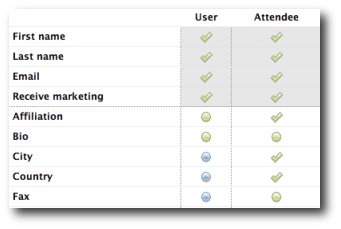
Thus, a one-size-fits-all personal details form didn't make sense for us. At best, we could have simply made more fields optional, but that would result in missing information that we really did need. Another solution would be to provide a dedicated personal details form per user type, e.g. different forms for speakers and reviewers. This is a non-starter, however, as users can take on many roles within a conference. So, we had a problem on our hands: different levels of interaction with our application requires different levels of personal information. We also had a second problem, which is that not all events and organizers want the same level of information. For example, a user group event is unlikely to need the same amount of information from speakers as an academic conference. Thus we have two axes on which the amount of information required varies: by role, and by event.  Our solution: progressive disclosure We concluded that we wanted to adhere to two principles in the collection of user information for Expectnation: The first objective was achieved by constructing a matrix of information items against user role, with the possible values of required, optional, unused for each item. We then achieved the second objective by allowing this matrix to be varied over each event. We've named this concept "progressive disclosure." What this means in practice is that a user is only ever asked for the information required to fulfil the roles they have within Expectnation. If they take on another role, they are asked for the additional information at that point, and not before. Implementation concerns Expectnation user disclosure editing
Extract from disclosure level editing UI It would be untrue to say that progressive disclosure is simple to implement. A user in our system will have disclosure requirements that are the union of all of their roles in all of the events they attend. Within Ruby on Rails, this means the conventional validation logic is useless to us, as it only deals with static requirements. Secondly, disclosure requirements are expensive to compute, so we need to cache them, with the inevitable addition of issues such as cache invalidation. Beyond the data model issues, the user interface issues are, if anything, more troublesome. From an end-user's point of view, the difficulty arises when we need extra information from them, and presenting this in a way that makes sense. From the event organizer's point of view, we have the challenge of presenting a controlling user interface for rather a complex concept. Organizers must be able to change the level of required information either globally, or per-event. We opted for a grid presentation, an extract from which is shown in the screenshot in this article. Over time we'll be able to see how effective this interface is, and what we can do to improve it. Finally, we have chosen sensible defaults for all disclosure levels, as the best result would be that organizers have little need to reconfigure the settings in the first place. Making it look easy Because Expectnation is a general application for organizing events, rather than targetting one specific one, we've had to construct a framework for minimizing user information collection, as opposed to simple implementation of known scenarios. At the end of the day we have added a fairly complicated subsystem and an extra degree of complexity to our codebase. However, the result from the user's point of view is increased simplicity and a streamlined experience. Every time you embark on something that wide-reaching and complex, you have to ask yourself whether the feature is really worth it. In this case, though, the answer is a resounding "yes". The user is the most important factor in our software, and making their life easier in an unobtrusive manner is a priority.

21 June 2007

Edd Dumbill: Jeni Tennison on women in computing

For a long time I've been vexed by the gender bias of computing towards men. It's clear that computing has multiple issues, ranging from its perception to the nature of its society. As organizer of computing conferences, I care about ensuring that participation is meritocratic and inclusive.
As various debates have taken place over blogs in the past on women in computing, I have stayed silent. Not because I don't care, but because I really didn't know what to say. I try to understand, but at the end of the day I'm a man, I tend to misunderstand important points, and I suspect my contributions would come across as at best naïve, and more likely, patronising. So many conversations between men and women on this topic end up in mutual uncomprehension. Better to stay silent than be a fool.
This is why I'm very grateful for Jeni Tennison's analysis of women in computing. It is the most helpful blog post I have read recently on the topic. Perhaps it's because Jeni's British, and we share some of the same cultural assumptions and constraints. But more importantly, it's because her article builds bridges to my experience and understanding.
An argument of femininity Rather than simply appealing to tribes of men and women, Jeni places the discussion in terms of feminine and masculine traits. Like many men, I identify with certain attitudes and preferences more closely allied to my feminine side. By not excluding me, her wording helped me view the points she unfolded in terms that my own experience, however poor, could identify with. I've often found contemporary computing communities to be suffocatingly macho. There's a strong pressure to succeed in terms of attention from the chattering bloggers, privileged inner circles and the capacity for vicious excoriation of those who fall from grace.As I grew up through school and university, I held these sorts of social forms in contempt, as well as occasionally suffering at their hands. Yet now, bafflingly, I find myself under the impression I need to belong and compete in these spheres.Self-efficacy One of Jeni's central points is concern about one's own self-efficacy. This was the real revelation to me. I tend to assume most capable people I meet are aware of their own capability. Jeni turned this on its head for me when she wrote
... look at how Ruby on Rails is marketed. A big play is made of how easy it is. But if a language or framework is easy then people with low self-efficacy can’t win: if they manage to do something with it then they haven’t really achieved very much because anyone can do it; if they don’t manage to do something with it then they’re complete idiots. I’m not saying that we should advertise languages or frameworks as being hard, because obviously that can put people off as well, but a recognition of the barriers that people might face may, in a strange way, make them more approachable.
As Jeni brings her article to a close, it's with some shock and shame that I get the punchline loud and clear: "this isn't about you."It's about empathy, inclusivity and selflessness. Human qualities that are unrestricted to either gender.

20 June 2007

Edd Dumbill: Why Bazaar rocks, and the highs and lows of its use with Rails

While Subversion is for many the source code revision system of choice, I've never stopped long with it myself. Why? Because it's mostly a fixed-up CVS, and doesn't fix the really gnarly problem with revision control: merging.Mark Shuttleworth has written an insightful little article on the key aspects of merging source code. Some of the points he makes underpin my choice of revision control system.For several years now I've been a very contented user of Bazaar, in its first arch-based incarnation, and now in its latter form. The key reason has been ease of merging.While most articles praising Bazaar are reports of open source development, I've also found it very handy for small in-house teams working on web applications.There are very often multiple arcs of development going on at once, and the ease of merging makes it easy to ensure that long-running development arcs don't get ridiculously far from the main trunk of development. Bazaar's merging also makes it easier for lead developers to police the merging of the code base.Using Bazaar with Rails and other toolsWorking mostly with Rails, one repeatedly runs up against the assumption that Subversion is the golden path for revision control. This is perhaps a little telling about the level of participation most Rails-based projects have reached.The tools story for a Bazaar user is both good and bad.The goodThe bad

19 June 2007

Russell Coker: Who Benefits when Cheap Electricity is used?

In a comment on my previous blog post a question was asked as to who benefits when customers are able to use cheap electricity. The answer is that the electricity company benefits the most! When electricity sources such as wind and solar power which can vary in capacity are used the electricity would be cheaper when there is adequate or excess supply. The electricity would be cheaper then to encourage customers to use power hungry devices at those times rather than when the electricity supply is reduced. The larger the capacity of back-up power plants such as gas-fired plants the larger the overall cost of the system (having extra peak-load capacity that is unused most of the time is a waste of money). However the company that I once worked for on a project related to this was not an electricity company. I can’t name the company due to the confidentiality agreement but if the project ever goes into production I’ll blog about it. Recently some of the major investment banks have been focussing on how climate change affects business. I think that with these developments there will be a lot of new investment in environment related technologies. Probably if a few people started work on an embedded Linux box for scheduling power use they could have a good chance of getting some investment. The ideal feature list would include control and monitoring over the Internet, the ability to schedule operations based on power price (received from the grid via a technology similar to X10) and local conditions (how charged the batteries are in your photo-voltaic system). It would control devices via standard X10 modules (which can control the power to the device) as well as directly interfacing with machines that need to be turned on all the time. I would be happy to offer more suggestions via private email to anyone who is interested in implementing this.

Next.

Previous.