Search Results: "tin"

24 August 2024

Russell Coker: Wifi 6E Mesh

I am looking into getting a Wifi mesh network. The aim is to use it for providing access to devices through my home especially for devices on the congested 2.4GHz frequency. Ideally I want 6GHz Wifi6E for the communication between mesh nodes as well as for talking to the few devices that are new enough to support it (I like buying cheap second hand devices). 2.5Gbit ethernet connections on all mesh nodes would be good too. Wifi 7 is semi-released, you can buy devices even though the specs aren t entirely finalised. I expect that next year when Wifi 7 devices are more common the second hand prices of Wifi 6E will drop. Currently Wifi 6E devices are somewhat expensive. One major problem at the moment is cloud configuration . Here is a 41 page forum thread of TP-Link customers asking in vain for non-cloud configuration [1]. The problems with cloud configuration are that it doesn t allow configuration without Internet access (so no fixing things when internet breaks and no use for a private network without Internet), it relies on a proprietary phone app (so a problem with your phone breaks everything), and it adds a dependency on an unpaid service that TP-Link might decide to turn off at some future time. The TP -Link Deco X55 AX3000 looks like a good set of devices, it currently costs $328 for a set of three Wifi 6 (not 6E) devices is a good deal, pity that the poor software options let it down. TP-Link also seems to be scanning web traffic and sending the analysis to an external site [2], it seems to be operating as malware. The TP-Link software seems to be most accurately described as malware. There is the OpenWrt project for open firmware on Wifi APs which is a great project [3] but it doesn t seem to support any Wifi 6 mesh systems yet. If most Wifi hardware requires malware for operation it seems that running a VPN over Wifi is the way to go. A hostile party being able to sniff your home network is much worse than a hostile party sniffing public Internet traffic. The Google Nest mesh devices have good specs and price, $359 for a three node Wifi 6E mesh that has 2.5Gbit ethernet. But they can only be configured with a Google app for Android or iOS and require a Gmail account. Giving Google the ability to shut down all my stuff by deleting my gmail account is not acceptable. Also Google is well known for cancelling services [4]. A mitigating factor is that there should be enough of those devices sold to make them a good target for an OpenWRT port. As an aside it looks like the TailScale mesh VPN system could be a solution to the security issues related to malware on Wifi APs problem [5]. There is also HeadScale which is the fully open source variant of that [6]. Even when the vendor isn t overtly hostile they can make mistakes so encryption is good. Kogan is selling an own-brand Wifi 6 mesh network package that comes with 1/2/3 devices for $70/$120/$140. It doesn t do Wifi 6E but supports the better encoding methods of Wifi 6 over Wifi 5 and will be good for bridging a LAN in one part of a house to a Wifi 2.4GHz or Ethernet connected device in another part. They also support up to 7 nodes so you could buy two of the 3 device packages and run one network with 2 and another with 4. The pricing is very competitive and they support web based administration! I ve just ordered the $140 Wifi 6 pack from Kogan. If it doesn t do what I want then I can find someone else who will be happy with whatever functionality it gives and $140 is an amount I can risk without concern. If it works well then I might upgrade to Wifi 6E or Wifi 7 next year and deploy the Wifi 6 one for a relative. It seems that for my needs a cheap and OK Wifi 6 device is better than an expensive Wifi 6E device.

Russell Coker: Is Secure Boot Worth Using?

With news like this one cited by Bruce Schneier [1] people are asking whether it s worth using Secure Boot. Regarding the specific news article, this is always a risk with distributed public key encryption systems. Lose control of one private key and attackers can do bad things. That doesn t make it bad it just makes it less valuable. If you want to setup a system for a government agency, bank, or other high value target then it s quite reasonable to expect an adversary to purchase systems of the same make and model to verify that their attacks will work. If you want to make your home PC a little harder to attack then you can expect that the likely adversaries won t bother with such things. You don t need security to be perfect, making a particular attack slightly more difficult than other potential attacks gives a large part of the benefit. The purpose of Secure Boot is to verify the boot loader with a public key signature and then have the boot loader verify the kernel. Microsoft signs the shim that is used by each Linux distribution to load GRUB (or another boot loader). So when I configure a Debian system with Secure Boot enabled that doesn t stop anyone from booting Ubuntu. From the signatures on the boot loader etc there is no difference from my Debian installation and a rescue image from Debian, Ubuntu, or another distribution booted by a hostile party to do things against my interests. The difference between the legitimate OS image and malware is a matter of who boots it and the reason for booting it. It is possible to deconfigure Microsoft keys from UEFI to only boot from your own key, this document describes what is necessary to do that [2]. Basically if you boot without using any option ROMs (which among other things means the ROM from your video card) then you can disable the MS keys. If it s impossible to disable the MS keys that doesn t make it impossible to gain a benefit from the Secure Boot process. You can use a block device decryption process that involves a signature of the kernel and the BIOS being used as part of the decryption for the device. So if a system is booted with the wrong kernel and the user doesn t recognise it then they will find that they can t unlock the device with the password. I think it s possible on some systems to run the Secure Boot functionality in a non-enforcing mode such that it will use a bootloader without a valid signature but still use the hash for TPM calculations, that appears impossible on my Thinkpad Yoga Gen3 which only has enabled and disabled as options but should work on Dell laptops which have an option to run Secure Boot in permissive mode. I believe that the way of the future is to use something like EFIStub [3] to create unified kernel images with a signed kernel, initrd, and command-line parameters in a single bundle which can be loaded directly by the UEFI BIOS. From the perspective of a distribution developer it s good to have many people using the current standard functionality of shim and GRUB for EFI as a step towards that goal. CloudFlare has a good blog post about Linux kernel hardening [4]. In that post they cover the benefits of a full secure boot setup (which is difficult at the current time) and the way that secure boot enables the lockdown module for kernel integrity. When Secure Boot is detected by the kernel it automatically enables lockdown=integrity functionality (see this blog post for an explanation of lockdown [5]). It is possible to enable this by putting lockdown=integrity on the kernel command line or lockdown=confidentiality if you want even more protection, but it happens by default with Secure Boot. Secure Boot is something you can set to get a selection of security features enabled and get a known minimum level of integrity even if the signatures aren t used for anything useful, restricting a system to only boot kernels from MS, Debian, Ubuntu, Red Hat, etc is not useful. For most users I think that Secure Boot is a small increase in security but testing it on a large number of systems allows increasing the overall security of operating systems which benefits the world. Also I think that having features like EFIStub usable for a large portion of the users (possibly the majority of users) is something that can be expected to happen in the lifetime of hardware being purchased now. So ensuring that Secure Boot works with GRUB now will facilitate using EFIStub etc in future years. The Secure Boot page on the Debian wiki is worth reading, and also worth updating for people who want to contribute [6].

22 August 2024

Jonathan McDowell: Thoughts on Advent of Code + Rust

Diego wrote about his dislike for Advent of Code and that reminded me I hadn t written up my experience from 2023. Mostly because, spoiler, I never actually completed it and always intended to do so and then write it up. I think it s time to accept I m not going to do that, and write down some thoughts before I forget all of them. These are somewhat vague, given the time that s elapsed, but I think still relevant. You might also find Roger s problem write up interesting. I ve tried AoC a couple of times before; I think I had a very brief attempt back in 2021, and I got 4 days in for 2022. For Advent of Code 2023 I tried much harder to actually complete the challenges, and got most of the way there. I didn t allow myself to move on to the next day until fully completing the previous day, and didn t end up doing the second half of December 24th, or any of December 25th.

Rust First I want to talk about Rust, which is the language I chose to use for the problems. I ve dabbled a little in it, but I d like more familiarity with the basic language, and some programming problems seemed like a good way to get that. It s a language I want to like; I ve spent a lot of my career writing C, do more in Go these days, and generally think Rust promises a low level, run-time light environment like C but with the rough edges taken off. I set myself the challenge of using just bare Rust; no external crates, no use of cargo. I was accused of playing on hard mode by doing this, but it really wasn t the intention - I figured that I should be able to do what I needed without recourse to anything outside the core language, and didn t want what seemed like the extra complexity of dealing with cargo. That caused problems, however. I m used to by-default generic error handling in Go through the error type, but Rust seems to have much more tightly typed errors. I was pointed at anyhow as the right way to do this in Rust. I still find this surprising; I ended up using unwrap() a lot when I think with more generic error handling I could have used ?. The other thing I discovered is that by default rustc is heavy on the debug output. I got significantly better results on some of the solutions with rustc -O -C target-cpu=native source.rs. I probably shouldn t be surprised by this, but worth noting. Rust, to me, has a syntax only a C++ programmer could love. I am not a C++ programmer. Coming from C I found Go to be a nice, simple syntax to learn. Rust has not been the same. There s a lot more punctuation, and it s not always clear to me what it s doing. This applies more when reading other people s code than when writing it myself, obviously, but I see a lot of Rust code that could give Perl a run for its money in terms of looking like line noise. The borrow checker didn t bug me too much, but did add overhead to my thinking. The Rust compiler is generally very good at outputting helpful error messages when the programmer is an idiot. I ended up having to use a RefCell for one solution, and using .iter() for loops rather than explicit iterators (why, why is this different?). I also kept forgetting to explicitly mark variables as mutable when declaring them. Things I liked? There s a rich set of first class data types. Look, I m a C programmer, I m easily pleased. You give me some sort of hash array and I ll be happy. Rust manages that, tuples, strings, all the standard bits any modern language can provide. The whole impl thing for adding methods to structures I like as a way of providing some abstraction, though I think Go has a nicer syntax for it. The compiler, as mentioned, is great at spitting out useful errors for the most part. Also although I wasn t using external crates for AoC I do appreciate there s a decent ecosystem there now (though that brings up another gripe: rust seems to still be a fairly fast moving target, to the extent I can no longer rely on the compiler in Debian stable to be able to compile random projects I find).

Advent of Code Let s talk about the advent of code bit now. Hopefully it s long enough since it came out that this won t be spoilers for anyone, but if you haven t attempted the 2023 AoC and might, you might want to stop reading here. First, a refresher on the format for those who might not be aware of it. Problems are posted daily from December 1st until the 25th. Each is in 2 parts; the second part is not viewable until you have provided the correct answer for the first part. There s a whole leaderboard thing going on, but the puzzle opens at midnight UTC-5 so generally by the time I wake up and have time to look the problem has been solved many times over; no chance of getting listed. Credit to AoC creator, Eric Wastl, for writing up the set of problems in an entertaining fashion. I quite enjoyed seeing how the puzzle would be phrased each day, and the whole thing obviously brings a lot of joy to folk I know. I always start AoC thinking it ll be a fun set of puzzles to solve. Then something happens and I miss a day or two, and all of a sudden I ve a bunch of catching up to do and it s all a bit more of a chore. I hit that at some points this time, but made a concerted effort to try and power through it. That perseverance was required up front, because I found the second part of Day 1 to be ill specified, and had to iterate a few times to actually calculate the desired solution (IIRC, issues about whether sevenone at the end of a line ended up as 7 or 1 really tripped me up). I don t recall any other problems that bit me as hard on the specification as this one, but it happening up front was unfortunate. The short example input doesn t always help with this either; either it s not enough to be able to extrapolate patterns, or it doesn t show all the variations you need to account for (that aren t fully specified in the text), or in a few cases it turned out I needed to understand the shape of the actual data to produce a solution that could actually complete in a reasonable time. Which brings me to another matter, sometimes brute force doesn t actually work. This is fine, but the second part of the day s problem can change the approach you d take. So sometimes I got lucky in the way I handled the first half, and doing the second half was a simple 5 minute tweak, and sometimes I had to entirely change the way I was storing data. You might claim that if I was a better programmer I d have always produced a first half solution that was amenable to extension for the second half. First, I dispute that; I think there are always situations where the problem domain can change in enough directions that you can t handle all of them without a lot of effort. Secondly, I didn t find AoC an environment that encouraged me to optimise for generic solutions. Maybe some of the puzzles in isolation would allow for that, but a month of daily problems to solve while still engaging in regular life meant I hacked things up, took short cuts based on the knowledge I had of the input data, etc, etc. Overall I can see the appeal, but the sheer quantity and the fact I write code as part of my day job just made it feel too much like a chore, rather than a fun mental exercise. I did wonder how they d look as a set of interview puzzles (obviously a subset, rather than all of them), but I m not sure how you d actually use them for that - I wouldn t want anyone to have to solve them in a live interview. So, in case it s not obvious, I m not planning to engage in AoC again this yet. But I m continuing to persevere with Rust (though most of my work stuff is thankfully still Go).

Debian Brasil: Debian Day 2024 em Natal/RN - Brasil

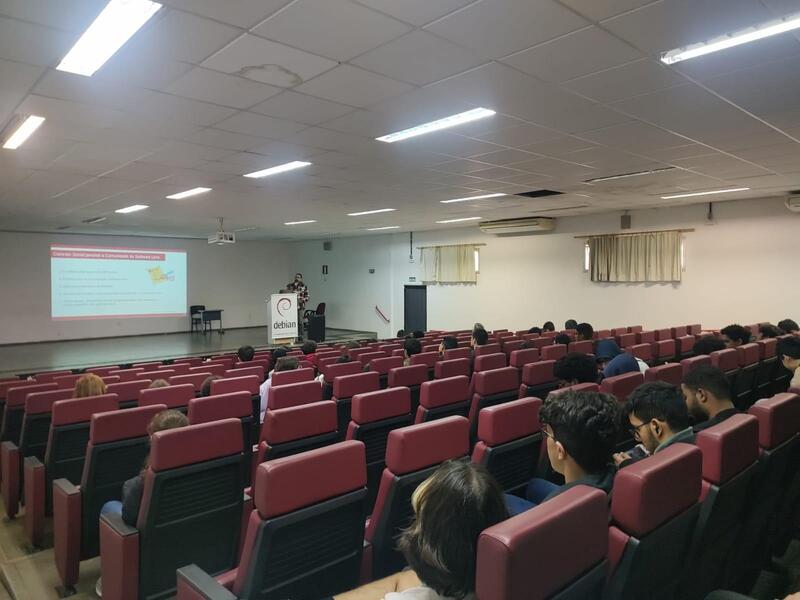
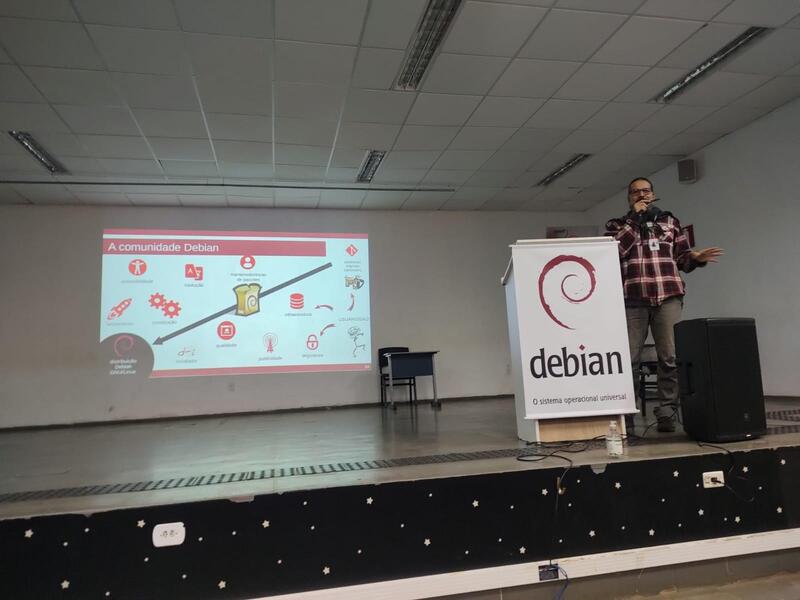
por Allythy O Debian Day um evento anual que celebra o anivers rio do Debian, uma das distribui es GNU/Linux mais importante do Software Livre, criada em 16 de Agosto de 1993, por Ian Murdock. No ltimo s bado (17/08/2024) no Sebrae-RN comemoramos os 31 anos Debian em Natal, no Rio Grande do Norte. A celebra o, foi organizada pela PotiLivre(Comunidade Potiguar de Software Livre), destacou os 31 anos de hist ria do Debian. O evento contou com algumas palestras e muitas discuss es sobre Software Livre. Tivemos 70 inscri es, 40 estiverem presentes. O Debian Day em Natal foi uma ocasi o para celebrar a trajet ria do Debian e refor ar a import ncia do Software Livre. Palestrantes Agradecemos imensamente a Isaque Barbosa Martins, Eduardo de Souza Paix o, Fernando Guisso,que palestraram nessa edi o! Obrigado por compartilhar tanto conhecimento com a comunidade. Esperamos ver voc s novamente em futuros encontros! foto da palestra conhecendo projeto Debian Link dos slides do Debian Day Participantes Um grande obrigado tamb m a todos os participantes, n s fazemos isso por voc s! Esperamos que tenham aprendido, se divertido e feito novas conex es entre a comunidade Participantes do Debian Day Natal-RN Essa edi o do Debina Day Natal foi organizada por: Allythy, Clara Nobre, Gabriel Damazio e Marcel Ribeiro.

Matthew Garrett: What the fuck is an SBAT and why does everyone suddenly care

Short version: Secure Boot Advanced Targeting and if that's enough for you you can skip the rest you're welcome.

Long version: When UEFI Secure Boot was specified, everyone involved was, well, a touch naive. The basic security model of Secure Boot is that all the code that ends up running in a kernel-level privileged environment should be validated before execution - the firmware verifies the bootloader, the bootloader verifies the kernel, the kernel verifies any additional runtime loaded kernel code, and now we have a trusted environment to impose any other security policy we want. Obviously people might screw up, but the spec included a way to revoke any signed components that turned out not to be trustworthy: simply add the hash of the untrustworthy code to a variable, and then refuse to load anything with that hash even if it's signed with a trusted key.

Unfortunately, as it turns out, scale. Every Linux distribution that works in the Secure Boot ecosystem generates their own bootloader binaries, and each of them has a different hash. If there's a vulnerability identified in the source code for said bootloader, there's a large number of different binaries that need to be revoked. And, well, the storage available to store the variable containing all these hashes is limited. There's simply not enough space to add a new set of hashes every time it turns out that grub (a bootloader initially written for a simpler time when there was no boot security and which has several separate image parsers and also a font parser and look you know where this is going) has another mechanism for a hostile actor to cause it to execute arbitrary code, so another solution was needed.

And that solution is SBAT. The general concept behind SBAT is pretty straightforward. Every important component in the boot chain declares a security generation that's incorporated into the signed binary. When a vulnerability is identified and fixed, that generation is incremented. An update can then be pushed that defines a minimum generation - boot components will look at the next item in the chain, compare its name and generation number to the ones stored in a firmware variable, and decide whether or not to execute it based on that. Instead of having to revoke a large number of individual hashes, it becomes possible to push one update that simply says "Any version of grub with a security generation below this number is considered untrustworthy".

So why is this suddenly relevant? SBAT was developed collaboratively between the Linux community and Microsoft, and Microsoft chose to push a Windows update that told systems not to trust versions of grub with a security generation below a certain level. This was because those versions of grub had genuine security vulnerabilities that would allow an attacker to compromise the Windows secure boot chain, and we've seen real world examples of malware wanting to do that (Black Lotus did so using a vulnerability in the Windows bootloader, but a vulnerability in grub would be just as viable for this). Viewed purely from a security perspective, this was a legitimate thing to want to do.

(An aside: the "Something has gone seriously wrong" message that's associated with people having a bad time as a result of this update? That's a message from shim, not any Microsoft code. Shim pays attention to SBAT updates in order to avoid violating the security assumptions made by other bootloaders on the system, so even though it was Microsoft that pushed the SBAT update, it's the Linux bootloader that refuses to run old versions of grub as a result. This is absolutely working as intended)

The problem we've ended up in is that several Linux distributions had not shipped versions of grub with a newer security generation, and so those versions of grub are assumed to be insecure (it's worth noting that grub is signed by individual distributions, not Microsoft, so there's no externally introduced lag here). Microsoft's stated intention was that Windows Update would only apply the SBAT update to systems that were Windows-only, and any dual-boot setups would instead be left vulnerable to attack until the installed distro updated its grub and shipped an SBAT update itself. Unfortunately, as is now obvious, that didn't work as intended and at least some dual-boot setups applied the update and that distribution's Shim refused to boot that distribution's grub.

What's the summary? Microsoft (understandably) didn't want it to be possible to attack Windows by using a vulnerable version of grub that could be tricked into executing arbitrary code and then introduce a bootkit into the Windows kernel during boot. Microsoft did this by pushing a Windows Update that updated the SBAT variable to indicate that known-vulnerable versions of grub shouldn't be allowed to boot on those systems. The distribution-provided Shim first-stage bootloader read this variable, read the SBAT section from the installed copy of grub, realised these conflicted, and refused to boot grub with the "Something has gone seriously wrong" message. This update was not supposed to apply to dual-boot systems, but did anyway. Basically:

1) Microsoft applied an update to systems where that update shouldn't have been applied
2) Some Linux distros failed to update their grub code and SBAT security generation when exploitable security vulnerabilities were identified in grub

The outcome is that some people can't boot their systems. I think there's plenty of blame here. Microsoft should have done more testing to ensure that dual-boot setups could be identified accurately. But also distributions shipping signed bootloaders should make sure that they're updating those and updating the security generation to match, because otherwise they're shipping a vector that can be used to attack other operating systems and that's kind of a violation of the social contract around all of this.

It's unfortunate that the victims here are largely end users faced with a system that suddenly refuses to boot the OS they want to boot. That should never happen. I don't think asking arbitrary end users whether they want secure boot updates is likely to result in good outcomes, and while I vaguely tend towards UEFI Secure Boot not being something that benefits most end users it's also a thing you really don't want to discover you want after the fact so I have sympathy for it being default on, so I do sympathise with Microsoft's choices here, other than the failed attempt to avoid the update on dual boot systems.

Anyway. I was extremely involved in the implementation of this for Linux back in 2012 and wrote the first prototype of Shim (which is now a massively better bootloader maintained by a wider set of people and that I haven't touched in years), so if you want to blame an individual please do feel free to blame me. This is something that shouldn't have happened, and unless you're either Microsoft or a Linux distribution it's not your fault. I'm sorry.

comment count unavailable comments

21 August 2024

Russ Allbery: Review: These Burning Stars

Review: These Burning Stars, by Bethany Jacobs
Series: Kindom Trilogy #1
Publisher: Orbit
Copyright: October 2023
ISBN: 0-316-46342-6
Format: Kindle
Pages: 430
These Burning Stars is a science fiction thriller with cyberpunk vibes. It is Bethany Jacobs's first novel and the first of an expected trilogy, and won the 2024 Philip K. Dick Award for the best SF paperback original published in the US. Generation starships brought humanity to the three star systems of the Treble, where they've built a new and thriving culture of billions. The Treble is ruled by the Kindom, a tripartite government structure built around the worship of six gods and the aristocratic power of the First Families. The Clerisy handle religion, the Secretaries run the bureaucracy, and the Cloaksaan enforce the decisions of the other branches. The Nightfoots are one of the First Families. They control sevite, the propellant required to move between the systems of the Treble now that the moon Jeve and the sole source of natural jevite has been destroyed. Esek Nightfoot is a cleric, theoretically following the rules of the Clerisy, but she has made a career of training cloaksaan. She is is mercurial, powerful, ruthless, ambitious, politically well-connected, and greatly feared. She is also obsessed with a person named Six: an orphan she first encountered at a training school who was too young to have a gender or a name but who was already one of the best fighters in the school. In the sort of manipulative challenge typical of Esek, she dangled the offer of a place as a student and challenged the child to learn enough to do something impressive. The subsequent twenty years of elusive taunts and mysterious gifts from the impossible-to-locate Six have driven Esek wild. Cleric Chono was beside Esek for much of that time. One of Six's classmates and another of Esek's rescues, Chono is the rare student who became a cleric rather than a cloaksaan. She is pious, cautious, and careful, the opposite of Esek's mercurial rage, but it's impossible to spend that much time around the woman and not be affected and manipulated by her. As this story opens, Chono is summoned by the First Cleric to join Esek on an assignment: recover a data coin that was stolen from a pirate raid on the Nightfoot compound. He refuses to tell them what data is on it, only saying that he believes it could be used to undermine public trust in the Nightfoot family. Jun is a hacker with considerably fewer connections to power or government and no desire to meet any of these people. She and her partner Liis make a dubiously legal living from smaller, quieter jobs. Buying a collection of stolen data coins for an archivist consortium is riskier than she prefers, but she's been tracking down rumors of this coin for months. The deal is worth a lot of money, enough to make a huge difference for her family. This is the second book I've read recently with strong cyberpunk vibes, although These Burning Stars mixes them with political thriller. This is a messy world with complicated political and religious systems, a lot of contentious history, and vast inequality. The story is told in two interleaved time sequences: the present-day fight over the data coin and the information that it contains, and a sequence of flashbacks telling the history of Esek's relationship with Six and Chono. Jun's story is the most cyberpunk and the one I found the most enjoyable to read, but Chono is a good viewpoint character for Esek's vicious energy and abusive charisma. Six is not a viewpoint character. For most of the book, they're present mostly in shadows, glimpses, and consequences, but they're the strongest character of the book. Both Esek and Six are larger than life, creatures of legend stuffed into mundane politics but too full of strong emotions, both good and bad, to play by any of the rules. Esek has the power base and access to the levers of government, but Six's quiet competence and mercilessly targeted morality may make them the more dangerous of the pair. I found the twisty political thriller part of this book engrossing and very difficult to put down, but it was also a bit too much drama for me in places. Jacobs has some surprises in store, one of which I did not expect at all, and they're set up beautifully and well-done within the story, but Esek and Six become an emotional star that the other characters orbit around and are in danger of getting pulled into. Chono is an accomplished and powerful character in her own right, but she's also an abuse victim, and while those parts are realistic, I didn't entirely enjoy reading them. There is quiet competence here alongside the drama, but I think I wanted the balance of emotion to tip a bit more towards the competence. There is one thing that Jacobs does with the end of the book that greatly impressed me. Unfortunately I can't even hint at it for fear of spoilers, but the ending is unsettling in a way that I found surprising and thought-provoking. I think what I can say is that this book respects the intelligence and skill of secondary characters in a way that I think is rare in a story with such overwhelming protagonists. I'm still thinking about that, and it's going to pull me right into the sequel. This is not going to be to everyone's taste. Esek is a viewpoint character and she can be very nasty. There's a lot of violence and abuse, including one rather graphic fight scene that I thought dragged on much longer than it needed to. But it's a satisfying, complex story with a true variety of characters and some real surprises. I'm glad I read it. Followed by On Vicious Worlds, not yet published as I write this. Content warnings: emotional and physical abuse, graphic violence, off-screen rape and sexual abuse of minors. Rating: 7 out of 10

Dirk Eddelbuettel: RcppMagicEnum 0.0.1 on CRAN: New Package!

Happy to announce a new package: RcppMagicEnum. It arrived on CRAN yesterday following the resumption of normal service following the CRAN summer break. RcppMagicEnum brings the magicenum library by Daniil Goncharov to R. Modern C++ is powerful, but still lacks reflection. This may change with C++26 but until then this library can help. A simple example, also shown on the README is as follows (and can be called from R via Rcpp::sourceCpp() if the RcppMagicEnum package is installed):
// [[Rcpp::depends(RcppMagicEnum)]]

#include <RcppMagicEnum>

// define a simple enum class, it uses optional typing as well as optional assigned values
enum class Color : int   RED = -10, BLUE = 0, GREEN = 10  ;

// [[Rcpp::export]]
void example()  
    // instantiate an enum value in variable 'val'
    auto val = Color::RED;

    // show the current value on stdout
    Rcpp::Rcout << "Name of enum: " << magic_enum::enum_name(val) << std::endl;
    Rcpp::Rcout << "Integer value of enum: " << magic_enum::enum_integer(val) << std::endl;
 

/*** R
example()
*/
It produces the following output (where the meta-comment at the end ensure the included and created-by-sourcing function example() is also called):
> Rcpp::sourceCpp("miniex.cpp")

> example()
Name of enum: RED
Integer value of enum: -10
>
The plan to experiment some more with this and then see if we could possible make factor variables map to such enums and vice versa. Help and discussion input is always welcome, and could be submitted either on the rcpp-devel list or as an issue at the repo. The short NEWS entry follows.

Changes in version 0.0.1 (2024-07-31)
  • Initial version and CRAN upload

If you like this or other open-source work I do, you can sponsor me at GitHub.

This post by Dirk Eddelbuettel originated on his Thinking inside the box blog. Please report excessive re-aggregation in third-party for-profit settings.

20 August 2024

Dirk Eddelbuettel: digest 0.6.37 on CRAN: Maintenance

Release 0.6.37 of the digest package arrived at CRAN today and has also been uploaded to Debian. digest creates hash digests of arbitrary R objects. It can use a number different hashing algorithms (md5, sha-1, sha-256, sha-512, crc32, xxhash32, xxhash64, murmur32, spookyhash, blake3,crc32c, xxh3_64 and xxh3_128), and enables easy comparison of (potentially large and nested) R language objects as it relies on the native serialization in R. It is a mature and widely-used package (with 70.8 million downloads just on the partial cloud mirrors of CRAN which keep logs) as many tasks may involve caching of objects for which it provides convenient general-purpose hash key generation to quickly identify the various objects. This release updates one of the different hashing source functions which, to remain close to their upstream, used Free() and Calloc() (uppercased to use the R allocator) but not the prefixed stricter versions R_Free() and R_Calloc(). R will switch to enforcing these in the next release next year. Kevin had noticed (while doing some other testing) that this now fails under R-devel (with a switch set), and prepares a very nice and clean PR to take care of it. As of today, CRAN is now sending please fix, or else notes so it was a good time to send this to CRAN. We also updated some remaining http URLs in the README.md to https, and switched to Author/Maintainer field to the now also mandatory Authors@R. My CRANberries provides a summary of changes to the previous version. For questions or comments use the issue tracker off the GitHub repo. For documentation (including the changelog) see the documentation site. If you like this or other open-source work I do, you can now sponsor me at GitHub.

This post by Dirk Eddelbuettel originated on his Thinking inside the box blog. Please report excessive re-aggregation in third-party for-profit settings.

19 August 2024

Matthew Garrett: Client-side filtering of private data is a bad idea

(The issues described in this post have been fixed, I have not exhaustively researched whether any other issues exist)

Feeld is a dating app aimed largely at alternative relationship communities (think "classier Fetlife" for the most part), so unsurprisingly it's fairly popular in San Francisco. Their website makes the claim:

Can people see what or who I'm looking for?
No. You're the only person who can see which genders or sexualities you're looking for. Your curiosity and privacy are always protected.


which is based on you being able to restrict searches to people of specific genders, sexualities, or relationship situations. This sort of claim is one of those things that just sits in the back of my head worrying me, so I checked it out.

First step was to grab a copy of the Android APK (there are multiple sites that scrape them from the Play Store) and run it through apk-mitm - Android apps by default don't trust any additional certificates in the device certificate store, and also frequently implement certificate pinning. apk-mitm pulls apart the apk, looks for known http libraries, disables pinning, and sets the appropriate manifest options for the app to trust additional certificates. Then I set up mitmproxy, installed the cert on a test phone, and installed the app. Now I was ready to start.

What became immediately clear was that the app was using graphql to query. What was a little more surprising is that it appears to have been implemented such that there's no server state - when browsing profiles, the client requests a batch of profiles along with a list of profiles that the client has already seen. This has the advantage that the server doesn't need to keep track of a session, but also means that queries just keep getting larger and larger the more you swipe. I'm not a web developer, I have absolutely no idea what the tradeoffs are here, so I point this out as a point of interest rather than anything else.

Anyway. For people unfamiliar with graphql, it's basically a way to query a database and define the set of fields you want returned. Let's take the example of requesting a user's profile. You'd provide the profile ID in question, and request their bio, age, rough distance, status, photos, and other bits of data that the client should show. So far so good. But what happens if we request other data?

graphql supports introspection to request a copy of the database schema, but this feature is optional and was disabled in this case. Could I find this data anywhere else? Pulling apart the apk revealed that it's a React Native app, so effectively a framework for allowing writing of native apps in Javascript. Sometimes you'll be lucky and find the actual Javascript source there, but these days it's more common to find Hermes blobs. Fortunately hermes-dec exists and does a decent job of recovering something that approximates the original input, and from this I was able to find various lists of database fields.

So, remember that original FAQ statement, that your desires would never be shown to anyone else? One of the fields mentioned in the app was "lookingFor", a field that wasn't present in the default profile query. What happens if we perform the incredibly complicated hack of exporting a profile query as a curl statement, add "lookingFor" into the set of requested fields, and run it?

Oops.

So, point 1 is that you can't simply protect data by having your client not ask for it - private data must never be released. But there was a whole separate class of issue that was an even more obvious issue.

Looking more closely at the profile data returned, I noticed that there were fields there that weren't being displayed in the UI. Those included things like "ageRange", the range of ages that the profile owner was interested in, and also whether the profile owner had already "liked" or "disliked" your profile (which means a bunch of the profiles you see may already have turned you down, but the app simply didn't show that). This isn't ideal, but what was more concerning was that profiles that were flagged as hidden were still being sent to the app and then just not displayed to the user. Another example of this is that the app supports associating your profile with profiles belonging to partners - if one of those profiles was then hidden, the app would stop showing the partnership, but was still providing the profile ID in the query response and querying that ID would still show the hidden profile contents.

Reporting this was inconvenient. There was no security contact listed on the website or in the app. I ended up finding Feeld's head of trust and safety on Linkedin, paying for a month of Linkedin Pro, and messaging them that way. I was then directed towards a HackerOne program with a link to terms and conditions that 404ed, and it took a while to convince them I was uninterested in signing up to a program without explicit terms and conditions. Finally I was just asked to email security@, and successfully got in touch. I heard nothing back, but after prompting was told that the issues were fixed - I then looked some more, found another example of the same sort of issue, and eventually that was fixed as well. I've now been informed that work has been done to ensure that this entire class of issue has been dealt with, but I haven't done any significant amount of work to ensure that that's the case.

You can't trust clients. You can't give them information and assume they'll never show it to anyone. You can't put private data in a database with no additional acls and just rely on nobody ever asking for it. You also can't find a single instance of this sort of issue and fix it without verifying that there aren't other examples of the same class. I'm glad that Feeld engaged with me earnestly and fixed these issues, and I really do hope that this has altered their development model such that it's not something that comes up again in future.

(Edit to add: as far as I can tell, pictures tagged as "private" which are only supposed to be visible if there's a match were appropriately protected, and while there is a "location" field that contains latitude and longitude this appears to only return 0 rather than leaking precise location. I also saw no evidence that email addresses, real names, or any billing data was leaked in any way)

comment count unavailable comments

18 August 2024

Gunnar Wolf: The social media my blog as well as some other sites I publish in is pushed to will soon stop receiving updates

For many years, I have been using the dlvr.it service to echo my online activity to where more people can follow it. Namely, I write in the following sources: Via dlvr.it s services, all those posts are echoed to Gwolfwolf in X (Twitter) and to the Gunnarwolfi page in Facebook. I use neither platform as a human (that is, I never log in there). Anyway, dlvr.it sent me a mail stating they would be soon (as in, the next few weeks) cutting their free tier. And, although I value their services and am thankfulfor their value so far, I am not going to pay for my personal stuff to be reposted to social media. So, this post s mission is twofold:
  1. If you follow me via any of those media, you will soon not be following me anymore
  2. If you know of any service that would fill the space left by dlvr.it, I will be very grateful. Extra gratefulness points if the option you suggest is able to post to accounts in less-propietary media (i.e. the Fediverse). Please tell me by mail (gwolf@gwolf.org).
Oh! Forgot to mention: Of course, my blog will continue to be appear in Planet Debian, Blograf a, and any decent aggregator that consumes my RSS.

Debian Brasil: Debian Day 2024 em Pouso Alegre/MG - Brasil

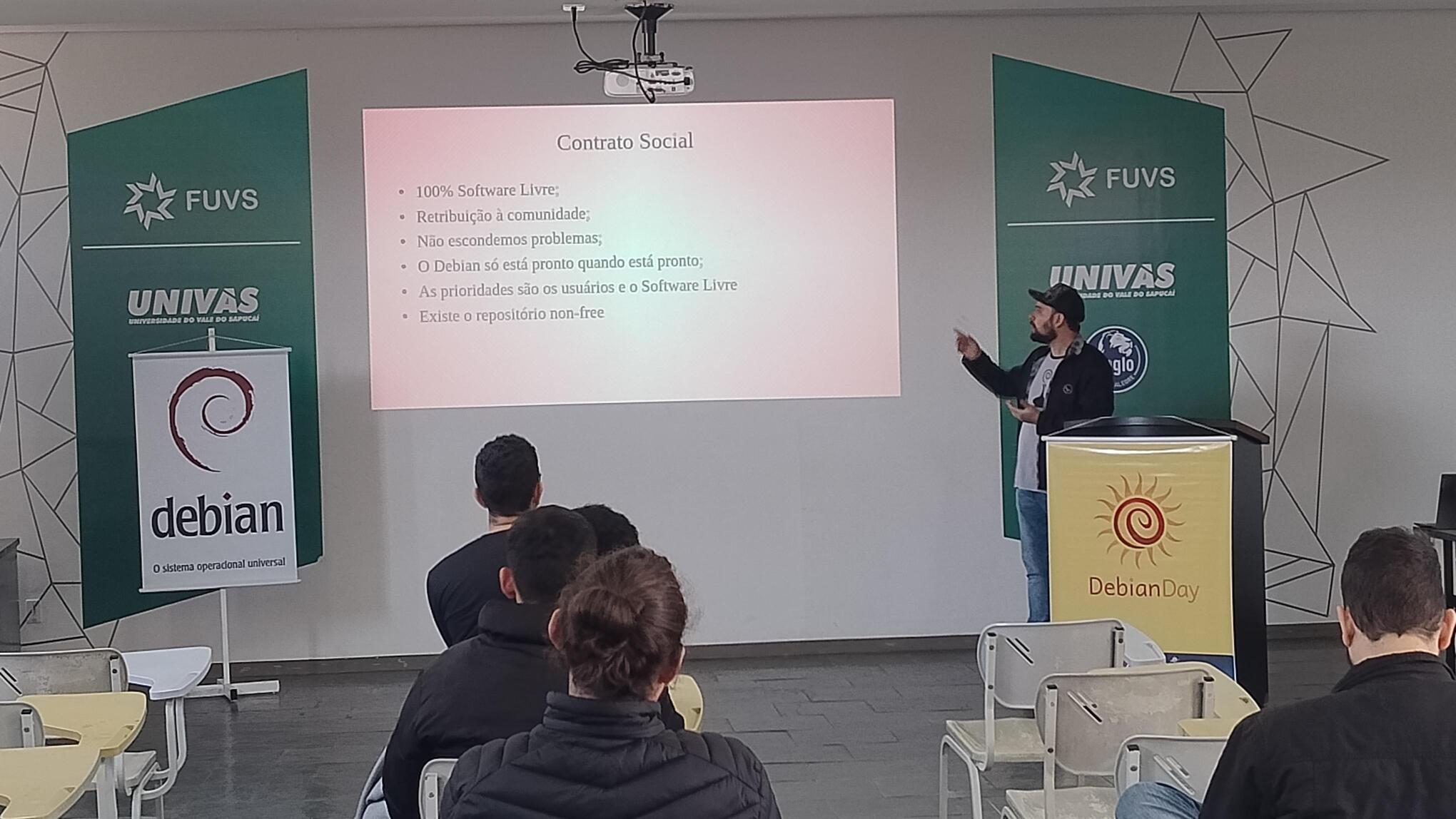
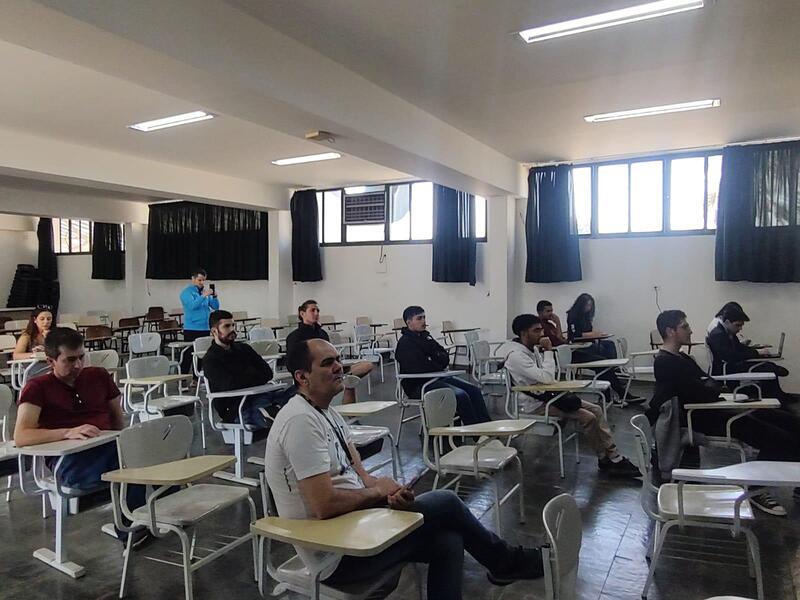
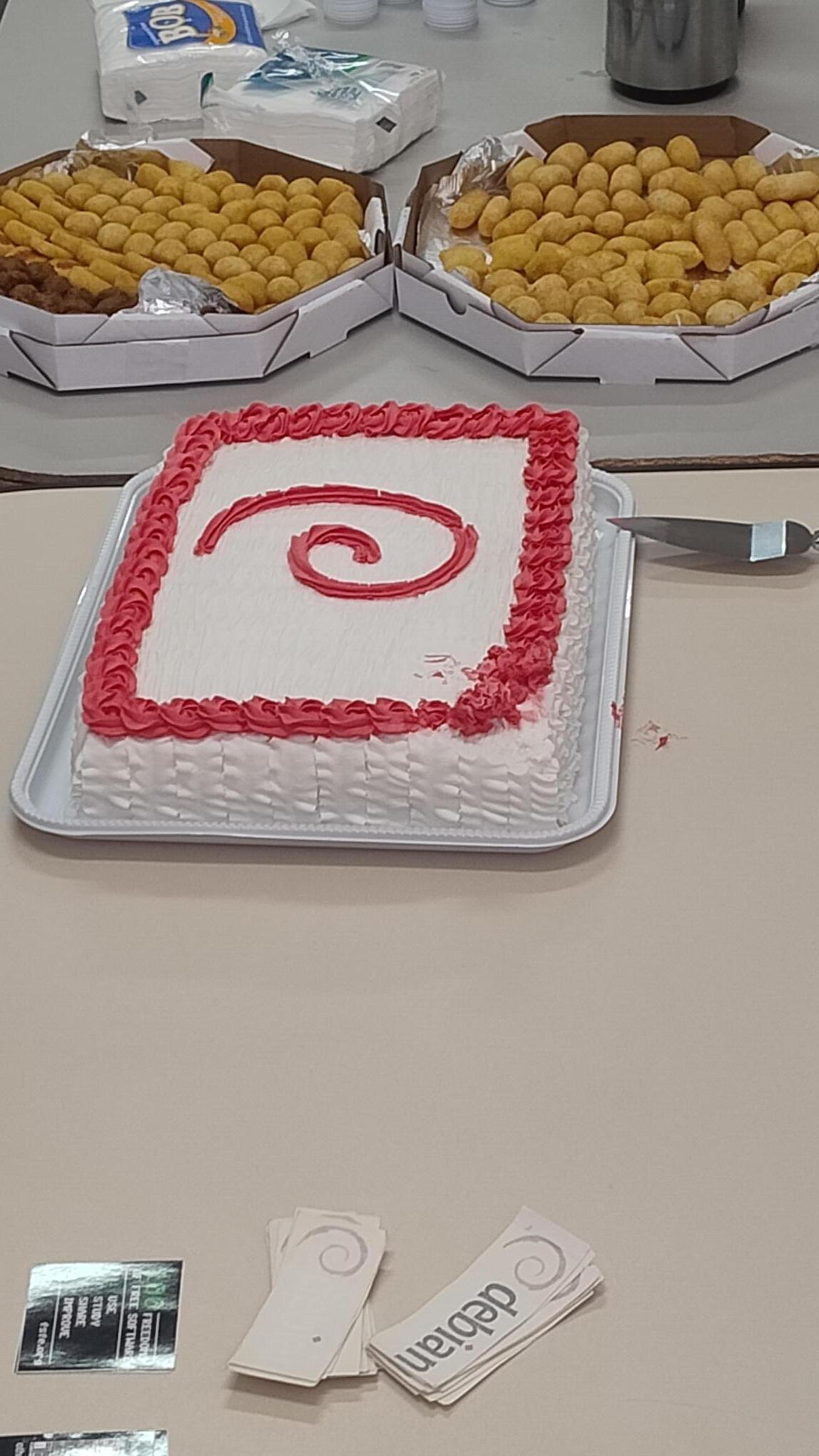
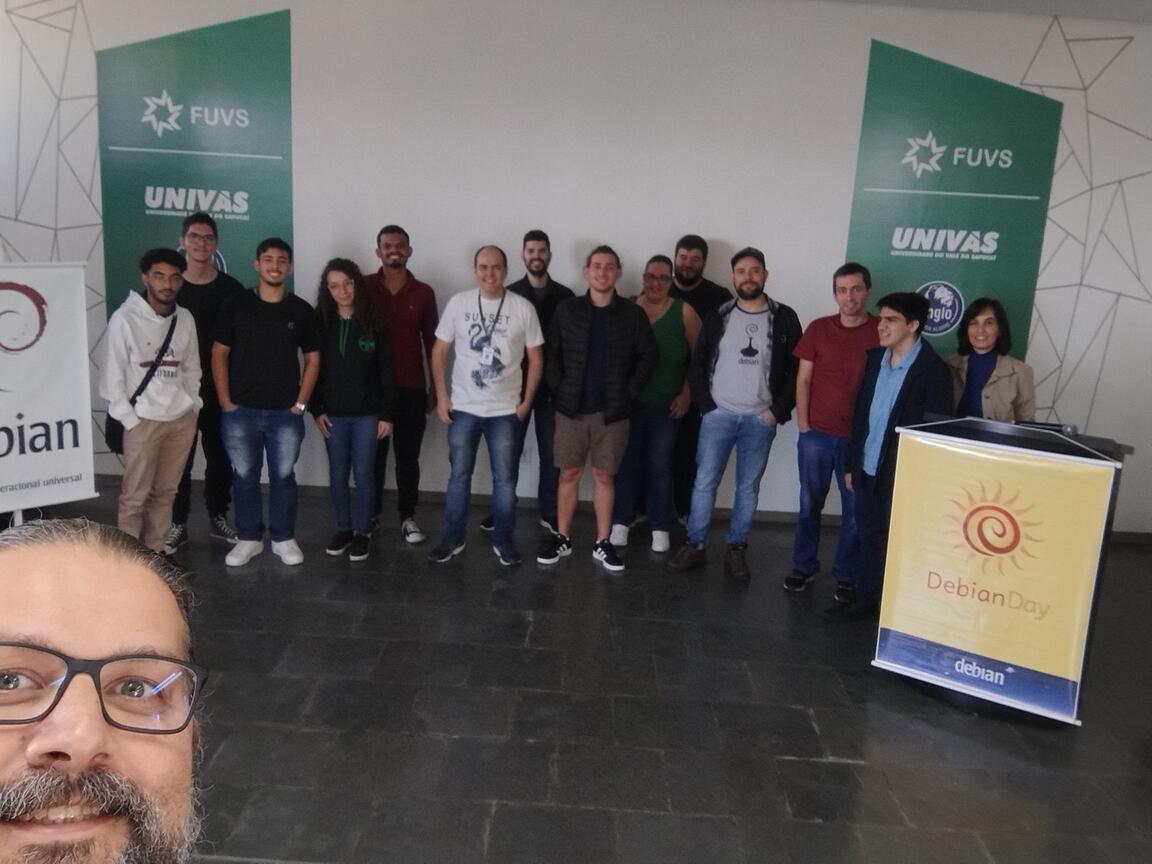
por Thiago Pezzo e Giovani Ferreira As celebra es locais do Dia do Debian 2024 tamb m aconteceram em Pouso Alegre, MG, Brasil. Neste ano conseguimos organizar dois dias de palestras! No dia 14 de agosto de 2024, quarta-feira pela manh , estivemos no campus Pouso Alegre do Instituto Federal de Educa o, Ci ncia e Tecnologia do Sul de Minas Gerais (IFSULDEMINAS). Fizemos a apresenta o introdut ria do Projeto Debian, sistema operacional e comunidade, para os tr s anos do Curso T cnico de Ensino M dio em Inform tica. O evento foi fechado para o IFSULDEMINAS e estiveram presentes por volta de 60 estudantes. J no dia 17 de agosto de 2024, um s bado pela manh , realizamos o evento aberto comunidade na Universidade do Vale do Sapuca (Univ s), com apoio institucional do Curso de Sistemas de Informa o. Falamos sobre o Projeto Debian com Giovani Ferreira (Debian Developer); sobre a equipe de tradu o Debian pt_BR com Thiago Pezzo; sobre experi ncias no dia a dia com uso de softwares livres com Virg nia Cardoso; e sobre como configurar um ambiente de desenvolvimento pronto para produ o usando Debian e Docker com Marcos Ant nio dos Santos. Encerradas as palestras, foram servidos salgadinhos, caf e bolo, enquanto os/as participantes conversavam, tiravam d vidas e partilhavam experi ncias. Gostar amos de agradecer a todas as pessoas que nos ajudaram: Algumas fotos: Apresenta o no campus Pouso Alegre do IFSULDEMINAS 1 Apresenta o no campus Pouso Alegre do IFSULDEMINAS 2 Apresenta o no campus F tica da UNIV S 1 Apresenta o no campus F tica da UNIV S 2 Apresenta o no campus F tica da UNIV S 3 Apresenta o no campus F tica da UNIV S 4

Reproducible Builds (diffoscope): diffoscope 276 released

The diffoscope maintainers are pleased to announce the release of diffoscope version 276. This version includes the following changes:
[ Chris Lamb ]
* Also catch RuntimeError when importing PyPDF so that PyPDF or, crucially,
  its transitive dependencies do not cause diffoscope to traceback at runtime
  and build time. (Closes: #1078944, reproducible-builds/diffoscope#389)
* Factor out a method for stripping ANSI escapes.
* Strip ANSI escapes from the output of Procyon. Thanks, Aman Sharma!
* Update copyright years.
You find out more by visiting the project homepage.

16 August 2024

Dirk Eddelbuettel: RcppEigen 0.3.4.0.1 on CRAN: Minor Maintenance

A new maintenance release of RcppEigen is now on CRAN, and will go to Debian shortly as usual. Eigen is a C++ template library for linear algebra: matrices, vectors, numerical solvers, and related algorithms. A very recent change in the development version of R (aka r-devel ) expanded the set of declared BLAS and LAPACK functions (and I tooted approvingly about it as well). It turns out that the xerbla() declaration there (which, as usual for R and as discussed in Writing R Extensions, defines the new optional character length entry for a char vector) conflicts with one in the blas.h header in Eigen upsetting the compilation of just one reverse-dependency. So CRAN, as they so often (and quietly) do in these cases, gave us a friendly and concise heads-up and asked for a change so we complied, did the usual reverse-dependency check of the other 400+ packages using RcppEigen and produced the new release which was injected into the repository during the current summer break. The complete NEWS file entry follows.

Changes in RcppEigen version 0.3.4.0.1 (2024-08-14)
  • Conditionally comment-out xerbla in blas.h as it is now providedd by R-devel albeit with FC_LEN_T (per a CRAN request)
  • Minor package updates (continuous integration, badges)

Courtesy of CRANberries, there is also a diffstat report for the most recent release. If you like this or other open-source work I do, you can sponsor me at GitHub.

This post by Dirk Eddelbuettel originated on his Thinking inside the box blog. Please report excessive re-aggregation in third-party for-profit settings.

Bits from Debian: Debian Celebrates 31 years!

Debian 31 years by Daniel Lenharo As the expression goes, "Time flies when you are having fun", meaning you do not normally account for the passage of time when you are distracted and enjoying yourself. The expression is a well established English idiom, though today for a moment the Debian Project pauses to reflect on that expression. It has been 31 years now that we have been around. It has been 31 amazing years of fun and amazement in watching the world around us grow and ourselves grow into the world. Let us tell you, we have had a great time in doing so. We have been invited to nearly every continent and country for over 25 Debian Developer Conferences, we have contributed to the sciences with our Debian Pure Blends; we have not given up on or discounted aged hardware with Long Term Support (LTS); we have encouraged and sponsored diversity with our Outreach Programs. We have contributed to exploration of this lovely planet and the vast vacuum of space (where no one hears Developers scream). There is more to what we have done but from a cursory glance, we seem to have done it all. But we never noticed it. Time does fly or "escape irretrievably" when having a good time and making progress, though our pause at this moment is that we have also had a few moments of honest self-evaluation and reflection. Over the years the project has lost some significant loved ones who were dear to us - you may have called them Developers while we called them Friends, we called them Mentors, we hurt, we grieved, and in their memories we keep moving forward. The course of the project has seen a few tragedies, has seen heated discourse in the public domain, has addressed and weathered concerns, and has still continually grown. And we did that in the public sphere, because at the core this is an open project. Our code is public, our bugs and failings are public, our communications are public, our meetings are public, and our love of FLOSS is most definitely public. And now more than ever the Debian Project realizes that the "we" that is sprinkled throughout this letter is just another way of saying: "you". You, the user, contributor, sponsor, developer, maintainer, bug squasher; all of you make the WE that is Debian. So what are WE waiting for? Lets celebrate! Join the worldwide celebration or find an event local to you by visiting our DebianDay events page - see you there!

Antoine Beaupr : Why I should be running Debian unstable right now

So a common theme on the Internet about Debian is so old. And right, I am getting close to the stage that I feel a little laggy: I am using a bunch of backports for packages I need, and I'm missing a bunch of other packages that just landed in unstable and didn't make it to backports for various reasons. I disagree that "old" is a bad thing: we definitely run Debian stable on a fleet of about 100 servers and can barely keep up, I would make it older. And "old" is a good thing: (port) wine and (any) beer needs time to age properly, and so do humans, although some humans never seem to grow old enough to find wisdom. But at this point, on my laptop, I am feeling like I'm missing out. This page, therefore, is an evolving document that is a twist on the classic NewIn game. Last time I played seems to be #newinwheezy (2013!), so really, I'm due for an update. (To be fair to myself, I do keep tabs on upgrades quite well at home and work, which do have their share of "new in", just after the fact.)

New packages to explore Those tools are shiny new things available in unstable or perhaps Trixie (testing) already that I am not using yet, but I find interesting enough to list here.
  • backdown: clever file deduplicator
  • codesearch: search all of Debian's source code (tens of thousands of packages) from the commandline! (see also dcs-cli, not in Debian)
  • dasel: JSON/YML/XML/CSV parser, similar to jq, but different syntax, not sure I'd grow into it, but often need to parse YML like JSON and failing
  • fyi: notify-send replacement
  • git-subrepo: git-submodule replacement I am considering
  • gtklock: swaylock replacement with bells and whistles, particularly interested in showing time, battery and so on
  • hyprland: possible Sway replacement, but there are rumors of a toxic community (rebuttal, I haven't reviewed either in detail), so approach carefully)
  • kooha: simple screen recorder with audio support, currently using wf-recorder which is a more.. minimalist option
  • linescroll: rate graphs on live logs, mostly useful on servers though
  • ruff: faster Python formatter and linter, flake8/black/isort replacement, alas not mypy/LSP unfortunately, designed to be ran alongside such a tool, which is not possible in Emacs eglot right now, but is possible in lsp-mode
  • sfwbar: pretty status bar, may replace waybar, which i am somewhat unhappy with (my UTC clock disappears randomly)
  • spytrap-adb: cool spy gear

New packages I won't use Those are packages that I have tested because I found them interesting, but ended up not using, but I think people could find interesting anyways.
  • kew: surprisingly fast music player, parsed my entire library (which is huge) instantaneously and just started playing (I still use Supersonic, for which I maintain a flatpak on my Navidrome server)
  • mdformat: good markdown formatter, think black or gofmt but for markdown), but it didn't actually do what I needed, and it's not quite as opinionated as it should (or could) be)

Backports already in use Those are packages I already use regularly, which have backports or that can just be installed from unstable:
  • asn: IP address forensics
  • markdownlint: markdown linter, I use that a lot
  • poweralertd: pops up "your battery is almost empty" messages
  • sway-notification-center: used as part of my status bar, yet another status bar basically, a little noisy, stuck in a libc dep update
  • tailspin: used to color logs

Out of date packages Those are packages that are in Debian stable (Bookworm) already, but that are somewhat lacking and could benefit from an upgrade.

Last words If you know of cool things I'm missing out of, then by all means let me know! That said, overall, this is a pretty short list! I have most of what I need in stable right now, and if I wasn't a Debian developer, I don't think I'd be doing the jump now. But considering how easier it is to develop Debian (and how important it is to test the next release!), I'll probably upgrade soon. Previously, I was running Debian testing (which why the slug on that article is why-trixie), but now I'm actually considering just running unstable on my laptop directly anyways. It's been a long time since we had any significant instability there, and I can typically deal with whatever happens, except maybe when I'm traveling, and then it's easy to prepare for that (just pin testing).

Reproducible Builds (diffoscope): diffoscope 275 released

The diffoscope maintainers are pleased to announce the release of diffoscope version 275. This version includes the following changes:
[ Chris Lamb ]
* Update the test_zip.py text fixtures and definitions to support new changes
  to IO::Compress. (Closes: #1078050)
* Do not call marshal.loads(...) of precompiled Python bytecode as it is
  inherently unsafe. Replace, at least for now, with a brief summary of the
  code section of .pyc files. (Re: reproducible-builds/diffoscope#371)
* Don't bother to check the Python version number in test_python.py: the
  fixture for this test is deterministic/fixed.
* Update copyright years.
You find out more by visiting the project homepage.

15 August 2024

Joerg Jaspert: Electric Car, Vacation trip

Electric Car A while ago I got my hands on an electric car - after not having owned a car for most of my life (there really is not much need here). It wasn t planned nor a goal of mine, but it kind of came out of talks with my boss , so now it s there. Due to some special rules in the german tax system it turns out really cheap for me - it comes from the company, which allows personal use. So I have to pay taxes on the value of it plus whichever amount of kilometers I have to drive to work. And the latter is what is good for me - I have homeoffice in my contract, so no drive to work, except maybe once a year for something. So no regular trip to calculate, only if I ever really have to do a trip to the office. And it being an electric car, running costs are also cheap. Way below the outdated tech that needs gas to run, is annoyingly loud and stinks.

The car In the past I used either car sharing or renting a car when I needed one, depending on what I actually needed. Last times renting I already tried electric variants, so I could compare this with. What I have now is a Citroen e-Berlingo XL from 2023 (so not the latest change from 2024), which is on the huge size for space, but small for battery. It has 7 seats (though I have the last 2 currently taken out, no daily need) and more storage space than I need even on a vacation trip. The engine (or well, it s battery) is on the small side - a capacity of 50 kWh means it only has 278km reach according to WLTP. That actually is a good bit less - as usual, those numbers are lying for the producer. Turns out that on highways in a more realistic mode than WLTP (read: real driving) it s somewhat around 120km before one wants a charger again. But, looking around, at least in Germany that is not a big problem, there are more than enough chargers available.

Driving Actually driving experience is good. It sure is a huge car (4.7m long, 1.85m high/wide) and feels more like driving a (small) bus, but it is easy to handle. Maximum speed is limited (or the small battery would suck even more) to 135km/h, but that is more than enough. Even on german highways. Did my vacation trip with cruise control set to 115km/h and very few times only went above that manually. Real relaxed driving that was.

Vacation trip So we had a vacation just recently, and instead of renting a car for the trip we, of course, wanted to take the e-Berlingo. Distance was about double what the car can (realistically!) do, so one charging stop in the middle somewhere was a must. Not having had to charge on highways yet - and entirely new with this car - that made for a bit of nervousness, but it all turned out really good. There are really nice tools like ABRP to plan your trip including charging, which can take live data of availability of charging points into the planning. And it turned out nice - we reached our planned charging point and found a long queue of cars waiting. But turns out it was all those poor folks that need actual gasoline for their outdated combustion engines. The charging points for EV cars still had enough free space, so we could bypass the queue and directly start charging. We also did not need to repark the car after just a few minutes, we could directly start our break. With a charging time of approx. 30 minutes using the fast charger, such a break is long enough to get enough energy for the next part of the trip and short enough to not be annoying.

Charging prices At home it depends. If one has some photovoltaic system to get power, charging is basically free. If not it depends on whichever contract one has, costs will be somewhat between 0 and ~30cent per kWh. Not much, and way below gasoline costs. Outside, using a fast charger, prices vary depending on where you charge - and with what charging card. Prices between 40 and 70cent / kWh, and the same charging point can vary, just from the card one uses. That is a thing that the EU could actually go and better regulate, similar to the phone regulations it took. Still, the costs are still way below gasoline.

Charging cards There is a huge amount of different providers available, and all do their own things in pricing and how one can use them. They do have standards (say, the plugs are standardized, by now the way to start charging also), and that enables roaming (use a charging card of one provider at a charging point of another), but other than that, it seems to be random. That is - if you use card A on a charging point of Provider B you may pay 0.49cents, if you use card C on the same point, it may charge you 0.79cents. And card D isn t taken at all. Some (the newer ones) you can pay directly by credit card, many you can t. Some may allow paypal or Google/Apple Pay. So in the end you need more than just one charging card - I collected 8 free ones by now - just to be sure you can find a combination that isn t hugely overpriced.

14 August 2024

Lukas M rdian: Netplan v1.1 released

I m happy to announce that Netplan version 1.1 is now available on GitHub and is soon to be deployed into a Debian and/or Ubuntu installation near you! Six months and 120 commits after the previous version (including one patch release v1.0.1), this release is brought to you by 17 free software contributors from around the globe.  Kudos to everybody involved!

Highlights
  • Custom systemd-networkd-wait-online logic override to wait for link-local and routable interfaces. (#456, #482)
  • Modification of the embedded-switch-mode setting without virtual-function (VF) definitions on SR-IOV devices (#454)
  • Parser flag to ignore individual, broken configurations, instead of not generating any backend configuration (#412)
  • Fixes for @ProtonVPN (#495) and @microsoft Azure Linux (#445), contributed by those companies

Releasing v1.1

Documentation

Bug fixes

New Contributors Full Changelog: 1.0 1.1

12 August 2024

Scarlett Gately Moore: KDE, Kubuntu, Debian Qt6 updates plus Kubuntu Noble .1 updates.

Another loss last week of a friend. I am staying strong and working through it. A big thank you to all of you that have donated to my car fund, I still have a long way to go. I am not above getting a cheap old car, but we live in sand dunes so it must be a cheap old car with 4 4 to get to my property. A vehicle is necessary as we are 50 miles away from staples such as food and water. We also have 2 funerals to attend. Please consider a donation if my work is useful to you. https://gofund.me/1e784e74 All of my work is currently unpaid work, as I am between contracts. Thank you for your consideration. Now onto the good stuff, last weeks work. It was another very busy week with Qt6 packaging in Debian/Kubuntu and KDE snaps. I also have many SRUs for Kubuntu Noble .1 release that needs their verification done. Kubuntu: Debian: Starting the salvage process for kdsoap which is blocking a long line of packages, notably kio-extras. KDE Snaps: Please note: Please help test the edge snaps so I can promote them to stable. WIP Snaps or MR s made Thanks for stopping by.

Freexian Collaborators: Monthly report about Debian Long Term Support, July 2024 (by Roberto C. S nchez)

Like each month, have a look at the work funded by Freexian s Debian LTS offering.

Debian LTS contributors In July, 13 contributors have been paid to work on Debian LTS, their reports are available:
  • Bastien Roucari s did 20.0h (out of 20.0h assigned).
  • Chris Lamb did 18.0h (out of 18.0h assigned).
  • Daniel Leidert did 5.0h (out of 4.0h assigned and 6.0h from previous period), thus carrying over 5.0h to the next month.
  • Guilhem Moulin did 8.75h (out of 4.5h assigned and 15.5h from previous period), thus carrying over 11.25h to the next month.
  • Lee Garrett did 51.5h (out of 10.5h assigned and 43.0h from previous period), thus carrying over 2.0h to the next month.
  • Lucas Kanashiro did 5.0h (out of 5.0h assigned and 15.0h from previous period), thus carrying over 15.0h to the next month.
  • Markus Koschany did 40.0h (out of 40.0h assigned).
  • Ola Lundqvist did 4.0h (out of 10.0h assigned and 14.0h from previous period), thus carrying over 20.0h to the next month.
  • Roberto C. S nchez did 5.0h (out of 5.25h assigned and 6.75h from previous period), thus carrying over 7.0h to the next month.
  • Santiago Ruano Rinc n did 6.0h (out of 16.0h assigned), thus carrying over 10.0h to the next month.
  • Sean Whitton did 2.25h (out of 6.0h assigned), thus carrying over 3.75h to the next month.
  • Sylvain Beucler did 39.5h (out of 2.5h assigned and 51.0h from previous period), thus carrying over 14.0h to the next month.
  • Thorsten Alteholz did 11.0h (out of 11.0h assigned).

Evolution of the situation In July, we have released 1 DLA. August will be the month that Debian 11 makes the transition to LTS. Our contributors have already been hard at work with preparatorty tasks and also with making contributions to packages in Debian 11 in close collaboration with the Debian security team and package maintainers. As a result, users and sponsors should not observe any especially notable differences as the transition occurs. While only one DLA was released in July (as a result of the transitional state of Debian 11 bullseye ), there were some notable highlights. LTS contributor Guilhem Moulin prepared an update of libvirt for Debian 11 (in collaboration with the Old-Stable Release Managers and the Debian Security Team) to fix a number of outstanding CVEs which did not rise to the level of a DSA by the Debian Security Team. The update prepared by Guilhem will be included in Debian 11 as part of the final point release at the end of August, one of the final transition steps by the Release Managers as Debian 11 moves entirely to the LTS Team s responsibility. Notable work was also undertaken by contributors Lee Garrett (fixes on the ansible test suite and a bullseye update), Lucas Kanashiro (Rust toolchain, utilized by the clamav, firefox-esr, and thunderbird packages), and Sylvain Beucler (fixes on the ruby2.5/2.7 test suites and CI infrastructure), which will help improve the quality of updates produced during the next LTS cycle. June was the final month of LTS for Debian 10 (as announced on the debian-lts-announce mailing list). No additional Debian 10 security updates will be made available on security.debian.org. However, Freexian and its team of paid Debian contributors will continue to maintain Debian 10 going forward for customers of the Extended LTS offer. Subscribe right away if you still have Debian 10 systems which must be kept secure (and which cannot yet be upgraded).

Thanks to our sponsors Sponsors that joined recently are in bold.

Next.

Previous.