
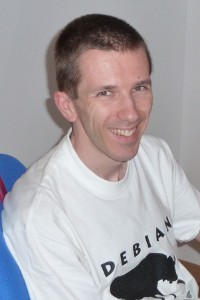
It's about time that Rapha l is interviewed in the "People behind
Debian" series he initiated
on his
blog.
Indeed, when he interviews people, Rapha l asks about other people
they could suggest for next interviews. So, during mine, I suggested
him to be a next "victim". As he couldn't interview himself, I
volunteered for this.
As you'll see below, Rapha l (who's a friend of mine as I'm a friend
of his) likes to speak and that shows in the length of his answers
:-) but you always know more about Debian when reading his blog posts,
books, mails, etc. I personnally think that he is among the best
promoters of the project for years and it was a pleasure for me to
conduct this interview.
My questions are in bold, the rest is by Rapha l.
Who are you?
Hi, Rapha l Hertzog, I'm a 32 years old French Debian developer who is
married and who has a 2-year old son. I'm running my own company (
Freexian) since 2005, I started
it 3 years after the end of my computer science studies. I'm also a very
proud author of the
Cahier de
l'Admin Debian, a French book about Debian.
You often wrote about your attempts to make your living partly, if
not completely, out of your Debian work. Can you describe the way
you're trying to do this?
My first try has been with Freexian. I always advertised this company
as being specialized in Debian GNU/Linux. While Freexian is successful
enough to provide me a decent income, I'm not really satisfied with the
result because very few of my contracts are about improving Debian. I
use Debian daily for the benefit of my customers, writing new customer
specific (embedded) software, deploying a service on Debian servers, etc.
But except for the occasional bugfix, all this work does not improve
Debian (the only exception has been the dpkg multiarch implementation
work sponsored by Linaro).
The positive side is that I don't need to fill my entire schedule to earn
enough money to live. So I'm regularly taking some days off work to be
able to contribute to Debian. This is a freedom that I enjoy...
My French book has also been a bestseller and depending on the years
the royalties represented between 1 and 2 months of supplementary time
that I can spend on Debian (that is between 2000 and 4000 EUR of income).
Now since last year, I decided to actively work towards my goal of making
a living out of my Debian work. I want to build on what has been most
successful for me up to now, that is my book. My strategy has been to
build an audience around my blog: with a direct contact with my readers I
have the opportunity to sell e-books, and without any intermediary taking
the biggest part of the price, I don't need a very large audience to be
successful.
I have also been experiencing micro-donations with Flattr, people who are
enjoying my articles on my blog can use it to give a few cents for each
article they find useful. With a large enough userbase, this could fund
free documentation and would avoid the need for commercial e-books but
we're not there currently and I don't know if it will ever reach the
critical mass.
Last but not least, I'm soliciting donations for my Debian work on the
sidebar of my blog, and I have the chance to a have a
few (regular) donators.
You're a proud father since last year. How do you manage your
commitment to the project with your family life?
There are few things that I put above Debian in my life, but my family
certainly is. I try to handle most of my Debian duties during work
hours so that I can spend time with my family on evenings and during
week-ends but in truth I never really disconnect from Debian. It happens
quite often that I say to my wife I'll come in a few minutes, let me
finish this and then I end up responding to a Debian mail, or an IRC
query and take 30 minutes instead of the 5 expected ones. I try hard to
avoid this but it's difficult. Luckily for me, my wife is very supportive
of my Debian involvement and knows me well...
By the way my wife is using Debian on her computer, and my son has already played
with
DoudouLinux (a Debian derivative!).
Have you already been accused of self-promotion in your writings? If
that would ever happen, what would you answer to that?
Yes, more than once. I am proud of what I do for Debian, I enjoy sharing
the result of my work. Because of this, some people believe that I'm
selfish and egocentric. And this has somewhat increased since I have been
soliciting donations: for me it's important to be transparent towards
donators so that they see what I really do for Debian. But some people
have the feeling that I'm getting undeserved attention and that I bring
everything towards my own person. On the other side, as an author, I'm a
public figure who is definitely seeking some attention...
I don't have any miraculous answer, we are a large and diverse community,
it's next to impossible to please everybody. I listen to all the concerns
that people bring forward, I take them into account as much as possible,
in particular when I believe they are reasonable/well justified, or when
they come from people that I highly respect. But sometimes I have to plainly
ignore them too... in particular when they are trying to impose their
own political view on a topic that's not directly related to the only
value that we all share: the social contract.
Contributing to Debian is a challenge, we all have to make efforts to
put aside our differences and to concentrate on the work that brings
us closer to the best free software operating system ever built.
You recently launched a campaign to free out the soon-to-be-published
"Debian Administrator Handbook", an English version of your
well-known book about Debian in French. Can you tell us more about
this project?
My French book has been very successful at helping people to get started
with Debian, and like I already explained, it was also effective to fund a
part of my Debian work. So I wanted to make it available world-wide by
publishing an English translation of it. I tried to find an
English-speaking editor willing to take on the challenge but I found none
interested.
Not put off by a setback, Roland (my co-author) and I decided to negotiate
with our French editor Eyrolles to recuperate the necessary rights to
translate the book into English. Handling everything ourselves represents
a lot of work, but it also means that we have the freedom required to decide
of the license of the resulting book. We would love to see it under
a license compatible with the Debian Free Software Guidelines.
But at the same time we firmly believe that we deserve a reasonable
monetary compensation for the work on the book, so we conditioned its
liberation to a predefined amount of money (25 K ) in what we call the
"liberation fund". And since we wanted to be sure that we would have the
required means to complete the translation, we used a crowfunding platform
to seek support of people interested by the book. With such a platform
you're only debited if the minimal requested amount is reached. Anyone
can participate, pre-order the book and/or put some money in the
liberation fund.
As of today, we already reached the minimal funding goal (15 K ) so the
book translation will happen. But the liberation target has not yet been
reached so we don't know yet if the book will be free from the start...
you can follow the progress right on the
fundraising page or
on the
website dedicated to the
book.
PS: If you want to contribute to this project and also make a donation
to Debian at the same time, you should check out
this page.
You're one of the main developers of dpkg, a critical tool for
Debian systems. Can you tell us more about the current development
challenges it is facing? What will be the new dpkg features for
wheezy?
The current challenges are not really technical. dpkg is a relatively
mature piece of software and it will continue to work for the foreseeable
future without needing much maintenance work.
The real challenge is trying to setup a healthy developement community
around it so that we can keep tackling new interesting problems (there are
many listed in the
roadmap and in
the
225 wishlist bugs).
There is a real problem of leadership and communication in the current
team. We used to be three, and we're only two nowadays. Guillem is the
legitimate leader since he's involved in dpkg's developement since early
2006 while I joined only in
late 2007. But in the last 4 years, we did not manage to recruit anyone
else on the team. Some persons tried to contribute significant new
features (like Sean Finney with a rework of the way we handle
configuration files) but they gave up frustrated after a while because we
did not manage to review their work (and discuss the design) in any
reasonable timeframe. Another famous case is Ian Jackson with his trigger
work. His work got merged, but so late that in the mean time he blew up
while trying to
hijack
the maintenance of dpkg.
For a long time I was concentrating my work on the Perl part of dpkg (aka
dpkg-dev mainly), so I did not feel qualified to review and merge work
related to the C part and I was just a worried observator of this
situation. I tried to improve it by setting up some basic
review
infrastructure, it should have brought some lisibility to the status
of each change left to be reviewed... but it has not been used
and it changed nothing.
Over the years, I became much more interested in the C part. My first big
contribution in C has been the
rewrite of update-alternatives (from Perl
to C). I made other small changes in between, but at the start of this
year I had this great opportunity to work on the multiarch implementation
(FYI,
multiarch is the
possibility to mix packages from several architectures on a single
system). This really forced me to jump into the C codebase and learn a lot about
how dpkg is implemented. Thanks to this I have been able to tackle other
small projects (like the
improved triggers).
This would be all great if my multiarch work was already merged, but
it's not. It's a large work, I do not mind waiting a bit in particular
since Guillem is a highly skilled C programmer. His sharp analysis of new
designs are invaluable, when he reviews code he always finds something to
improve. I learnt a lot just by reviewing the code he wrote over the
years.
That said I have been waiting since April without almost no updates from
him. With the release team
asking us
to hurry up, the situation is getting somewhat strained as I really
want to see multiarch in Wheezy and I do not really want to short-circuit
Guillem.
Hum, I may have drifted a bit from your original question... what great
new features can people expect? Well multiarch is supposed to be the big
new feature, apart from that there aren't many things that matter to the
end users. But there are already quite a few
changes
that are of interest to package maintainers (like hardened build
flags, source package improvements, improved triggers, ).
What's the biggest problem of Debian?
Manicheism and a tendency to quickly polarize the discussions. In reality,
there are very few situations where everything is all good or all bad.
Ever since I have read
The 7
Habits of Highly Effective People I try hard to put into practice the
habits of interdependence . Instead of having only my point of view in
mind, I try to understand the motivations from the other party ( Seek
First to Understand, Then to be Understood ) in order to be able to put
forward solutions acceptable to both parties ( Think Win-Win ).
I highly recommend this book to anyone. And I invite everybody to
at least try to follow those simple advices.
Is there someone in Debian you admire for their contributions?
There are many and I can't give an exhaustive list... here are some
that I would like to highlight (in no particular order):
- Niels Thykier for the work he puts into Lintian,
and his recent work on a britney test-suite (the
software that creates testing out of unstable);
- Joachim Breitner for his britney reimplementation using a SAT
solver;
- Adam D. Barrat for his work on britney2;
- All the release team members who take care of an endless stream of
transitions;
- Christoph Berg for his continuous work over the years on various
QA infrastructure (DDPO, Mole, );
- Enrico Zini for the way he helped reform the New Member process
without any big disruption;
- Russ Allbery for his Debian Policy work and for being a model in
terms of how we should interact on Debian mailing lists;
- Stefano Zacchiroli for being the most active leader that I have ever
seen, and for the way he tries to steer important discussions
to a constructive conclusion.
- etc.
Most of those people are working on improving Debian's infrastructure
so that we can all be more effective and do an even better work. This kind
of work is not always very visible but it's crucial to Debian's future.
Thank you to Rapha l for the time spent answering my questions. I
hope you enjoyed reading his answers as I did. And, anyway, it was fun
to just play the game "the other way".

I was in Brazil last week and had the pleasure of participating in a teach-in at Occupy S o Paulo, a vibrant camp set up last week in the heart of the old down town. There are now under threat, please see below for details and spread the word.
***
On October 15, a group of nearly 300 activists began an occupation of S o Paulo in the Valley of Anhagabau, one of the sites of the first rallies for direct elections during the end of the Brazilian military dictatorship in the 1980s. After a week of peaceful encampment, educational and cultural programs, and creating a sustainable community for not just themselves but many homeless people in downtown S o Paulo, the Occupy S o Paulo movement is coming under increased police threat. Today, Monday October 24, the governor of the state of S o Paulo, Geraldo Alckmin is holding two special events. First, he is hosting Florida Governor Rick Scott (R). Second, Alckmin has decided to hold a parade of 3000 military police right next to the encampment (see photo above).
After a week of police harrassment and a pending court case for them to hold the right to pitch their tents, the Occupy S o Paulo movement sees this as an escalation of the harassment they have already faced by city police. Further, the presence of 3000 military police next to 300 occupiers is clearly meant to intimidate both occupiers and members of the public who have been coming up to the encampment and learning about the movement. Please take the time to call or email the governor and the secretary of public security of the state of S o Paulo to condemn this action. You can also send messages of solidarity to the S o Paulo occupation at occupysampaenglish@googlegroups.com.
To contact Governor Geraldo Alckmin s office of citizen and organizational relations:
Fill out a comment form at: http://www.saopaulo.sp.gov.br/en/fale/fale.php
Phone: 55-11-2193-8463
To contact the Secretary of Public Security, Ant nio Ferreiro Pinto:
Email: seguranca@sp.gov.br
Phone: 55-11-3291-8500

Twenty-four hours ago I was in heaven. Or to more properly recapitulate and situate this, fourty-eight hours ago I was in hell.
Now this requires some context. Earlier in the year, I had tweeted briefly about
a Kurt Elling live concert still streaming on NPR,
and truth be told, I have listened to
Kurt Elling a whole lot ever since.
The most recent album
The Gate is fantastic,
the Grammy-winner
Dedicated to
You (which retakes the very famous
Coltrane/Hartman
album) is beyond words, and
The Messenger is
worth it just for 'Nature Boy' and the funkiest-ever 'April in Paris'. I also saw him
as part of a larger and otherwise rather neat tour. But I needed
to see the man himself. So following what one can see from
his touring calendar, I jotted down
two October dates.
Kurt Elling at the
Green Mill. Fine. That was
earlier in the summer.
Summer has a tendency of evaporating quickly, so here we were in October. And getting going late on Friday, so by the time we got the Green
Mill, a long line had formed and we ended up paying tribute to the line for fourty-five minutes with nothing to show. Sad. Home we went, and
no live music.
But somehow we mustered the energy to go again last night and
thought we were early, arriving about 20 minutes before the show was
to start. Ha! Others had appeared at 3pm, by 5pm all seats were gone. We were literally the last ones the get in after a short spell in a
shorter line, and standing room-only it was. Oh, but what a treat we got. The set for these two days was
Kurt Elling with the fourteen piece
Kl vers Big Band from Denmark. They played for three marvellous sets,
and well over four hours (with two 25 minute breaks). Pieces often alternated between big band arrangements and smaller pieces by Elling's
standard rhythm band, and covered standards as well as Elling's catalogue. As I
mentioned earlier on a short post (with pictures) on Google+, it
is essentially impossible to not fall for Elling's stage presence when being so close to the stage. The man is just
that good.
Elling and the Kl vers Big Band will now play for six nights at
Birdland in New York followed by
a night each in Washington, DC, and Boston. If you're around, do yourself a favour and go out to see them.
I have a lot of digital data to store, like most people I have photos, music, home movies, email and lots of other random data. Being a programmer I also tend to have huge piles of source code and builds lying about. If all that was not enough I work from home so I have copious mountains of work data too.
Many years ago I decided I wanted a single robust, backed up, file server for all of this. So I slapped together a machine from leftovers stuffed some drives in a software RAID array, served over NFS and CIFS and never looked back.
Over time the hardware has changed and the system upgraded but the basic approach of a custom built server has remained. When I needed a build engine to churn out hundreds of kernels a day for the ARM Linux autobuilder the system was expanded to cope and mid 2009 the current instantiation was created.

The current system is a huge tower case (courtesy of Mark Hymers) containing a Core 2 Quad 2.33GHz (8 threads) with 8Gigabytes of memory and 13 drives across four SATA controllers split into several RAID arrays. Despite buying new drives at higher capacities I have tended to keep the old drives around for extra storage resulting in what you see here.
I recently looked at the power usage of this monster and realised I was paying a lot of money to spin rust which was simply uneconomic. Seriously, why did I have six sub 200Gigabyte drives running when a single 2T to replace them would pay for itself in power saved in under a month! In addition I no longer required the compute power available either, most definitely time for a downsize!
Several friends suggested a HP micro server might be just the thing. After examining and evaluating some other options (Thecus and QNAP NAS) I decided the HP route was most definitely the best value for money.
The HP Proliant micro server is a dual core Athlon II 1.3GHz system with a Gigabyte of memory, space for four SATA hard drives and a single 5 inch bay for an optical drive. All this in a roughly 250mm on a side cube.

I went out and bought the server from ebuyer for 235 with free shipping and 100 cashback. I Immediately sent off the cash back paperwork so I would not forget(what an odd way to get discount) so total cost for the unit was 135. I then used Crucial to select a suitable memory upgrade to take the total to 2 Gigabytes of RAM for 14
The final piece of the solution was the drives for the storage. I decided the best capacity to cost ratio could be had from 2 TB drives and with four bays available would give a raw capacity of 8 TB or more usefully for this discussion 7.8 TiB
I did an experiment with 3x1 TB 7200 RPM drives from the existing server and determined that The overall system would not really benefit enough to justify the 50% price premium of 7200 RPM drives over 5400 RPM devices. I ended up getting four Samsung Spinpoint F4EG 2 TB drives for 230.
I also bought a black LG DVD-RW drive for 16 I would have also required a SATA data cable and a molex to SATA power cable if I had not already got them.
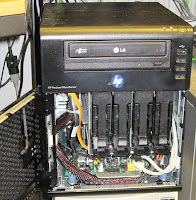
Putting the components together was really simple. The internal layout and design of the enclosure mean it is easy to work with and has the feel of build quality I usually associate with HP and IBM server kit not something this small and inexpensive.
The provided documentation is good but unnecessary as most operations are obvious. They even provide the bolts to attach all the drives along with a wrench in the lockable front door, how thoughtful is that!
I then installed the system with Debian squeeze from the optical drive. Principally because I happened to have a network installer CD to hand although the BIOS does have network boot capability.
I used the installer to put the whole initial system together and did not have to resort to the command line even once, very impressed with how far D-I has come.
After asking several people for advice the general consensus was that I should create two partitions on each drive one for a RAID 1 /boot and one for a RAID 5 LVM area.
I did have to perform the entire install a second time because there is a gotcha with GUID Partition Table, RAID 1 boot drives and GRUB. You must have a small "BIOS" partition on the front of the drive or GRUB cannot install in the MBR and your system will not boot!
The partition layout I ended up with looks like:
Model: ATA SAMSUNG HD204UI (scsi)
Disk /dev/sda: 2000GB
Sector size (logical/physical): 512B/512B
Partition Table: gpt

Number  Start   End     Size    File system  Name  Flags
1      17.4kB  32.0MB  32.0MB                     bios_grub
3      32.0MB  1000MB  968MB                      raid
2      1000MB  2000GB  1999GB                     raid
The small Gigabyte partition was configured as a RAID 1 across all four drives and formatted with ext2 and mount point of /boot. The large space was configured as RAID 5 across all four drives with LVM on top. Logical volumes were allocated formatted ext3 (on advice from seevral people about ext4 instability they had observed) for 50 GiB root, 4 GiB swap and 1 TiB home space.
The normal Debian install proceeded and after the post install reboot I was presented with a login prompt. Absolutely no surprises at all no additional drivers required and a correctly running system.
Over the next few days I did the usual sysadmin stuff, rsynced data from the old fileserver including creating logical volumes for the various arrays from the old server none of which presented much of a problem. The 5.5TiB Raid 5 did however take a day or so to sync!
I used the microservers eSATA port to attach external drives I use for backup purposes which has also not been an issue so far.
I am currently running both the new and old systems for a few days and rsyncing data to the microserver until I am sure of it. Actually I will make the switch this weekend and shut the old system down and leave it till next weekend before I scrub the old drives.
Before I made it live I decided to run some benchmarks and gather some data just for interest.
Bonnie (Version 1.96) was run in the root logical volume (I repeated the tests in other volumes, there is sub 1% variation) the test used a 4GiB size and 16 files
| Sequential Output | Sequential Input | Random Seeks | Sequential Create | Random Create |
|---|
| Per Chr | Block | Rewrite | Per Chr | Block | | Create | Read | Delete | Create | Read | Delete |
|---|
| /sec | 378K | 41M | 37M | 2216K | 330M | 412.8 | 11697 | +++++ | 18330 | 14246 | +++++ | 14371 |
|---|
| %CPU | 97 | 11 | 8 | 91 | 30 | 15 | 24 | +++ | 28 | 29 | +++ | 22 |
|---|
| Latency | 109ms | 681ms | 324ms | 116ms | 93389 s | 250ms | 29021 s | 814 s | 842 s | 362 s | 51 s | 61 s |
|---|
Does not seem to be any notable issues there, the write speeds are a little lower than I might like but that is the cost of RAID 5 and 5400 RPM drives.
The rsync operations used to sync up the live data seem to manage just short of 20MiB/s for the home partition comprising of 250GiB in two and a half million files with the expected mix of file sizes. The video partition managed 33MiB/s on 1TiB of data in nine thousand files.
The bonnie tests were performed accessing the server over NFS with 24GiB size and 16 files.
| Sequential Output | Sequential Input | Random Seeks | Sequential Create | Random Create |
|---|
| Per Chr | Block | Rewrite | Per Chr | Block | | Create | Read | Delete | Create | Read | Delete |
|---|
| /sec | 1733K | 29M | 19M | 4608K | 106M | 358.3 | 1465 | 3714 | 2402 | 1576 | 4082 | 1529 |
|---|
| %CPU | 98 | 2 | 4 | 93 | 10 | 10 | 8 | 10 | 9 | 9 | 9 | 7 |
|---|
| Latency | 10894 s | 23242ms | 69159ms | 49772 s | 224ms | 250ms | 148ms | 24821 s | 157ms | 108ms | 2074 s | 719ms |
|---|
or alternatively as percentages against the previous direct access values
| Sequential Output | Sequential Input | Random Seeks | Sequential Create | Random Create |
|---|
| Per Chr | Block | Rewrite | Per Chr | Block | | Create | Read | Delete | Create | Read | Delete |
|---|
| /sec | 464 | 68 | 51 | 213 | 32 | 87 | 12 | +++ | 13 | 11 | +++ | 10 |
|---|
| CPU | 101 | 18 | 50 | 104 | 34 | 71 | 33 | +++ | 32 | 31 | +++ | 31 |
|---|
| Latency | 9 | 2512 | 13248 | 93 | 227 | 79 | 509 | 3049 | 18646 | 29834 | 4066 | 1178688 |
|---|
Not that that tells us much aside from that write is a bit slower over the network, read is gigabit network bandwidth limited and latency of disc over the network is generally poorer than direct.
In summary the total cost was 395 for a complete ready to use system with 5.5TiB of RAID 5 storage which can be NFS served at nearly 900Mbit/s. Overall I am happy with the result, my only real issue is the write performance is a little disappointing but it is good enough for what I need.

Even though some three months have passed since
DebConf11 has successfully ended, I still wanted to give you just a glimpse on how some parts were played through the eyes of a lunatic (read: organizer). Of course, blog post can t come close near of explaining anything but at least it should give some insight and hopefully some pointers to the future DebConf organizers.
If you don t feel like reading this much text you can listen to
last episode of
This Week In Debian podcast and after it just head to Beginning of the end part.
DebConf11
First of all I d like to apologize if I offended or hurt anyone in this whole process as it wasn t my intention and during DebConf organization this is nothing irregular, for you to get hurt or you hurting somebody else. One thing that got stuck with me this whole time is when Mart n Ferrari approached me after I did
bid proposal of Bosnia/Herzegovina for DebConf11 back on DebConf9 and told me
you have no idea what you just got yourself into I played cool and said something along the line
of coure I do and boy did I lie.
During DebConf organization you re bound to make some of your decisions instantaneously in which you ll lose something, the most you can do is assess what s the thing you can cut the cord on, even though if that thing or a person for that matter might have meant something to you. You ll lose things, relationships, friendships, contacts at the times sense of humor and maybe even common logic. Some of it comes back to you, some the very next day and for some it may take longer. Some of it was lost irreversibly, but even in that case it wasn t lost and could even be traced to some other cause.
One thing that I m thankful for is that I didn t
lose, not lose but even get distanced from those close to me, and that I didn t lose guy who was with me in this from very first day, my right hand, my partner in crime Velimir ( aroundthfur ). It s not even losing I m talking about here, because even by losing you re gaining something and this is part of your everyday life, it s just that your life frame kinda gets stuck on fast forward button. So once the ride s over you may feel bit dizzy asking yourself what just happened.
During this time I was also contacted by Google recruiter regrading software engineer internship but to make a long story short I didn t make it due to my heavy involvement and my lack of time (read: fail). But I don t find this as losing either, first time I was contacted by
them, next time they ll be contacted by
me maybe even for different position this time (project manager?

. Even this DebConf wasn t our first bid we lost DebConf7 bid to Edinburgh, but it is perseverance that got us here. The moral I m trying to tell here is if you have a goal never back down from it.
What I found to be our biggest problem and what I personally found as most painstaking in all of this was having and reporting to so many different sides and different groups while trying to keep them in same communication channel. Even my right hand (Velimir) was apart from me (Vienna), then place where two of us are coming from is not the place where DebConf is getting organized in. As in the end we ended up having
all the parties separated and pulling to their own side, from Government of Republika Srpska to NGO to Debian to local team and to those who remained as undeclared . Option of cutting the cord in this case was missing as these were the components that DebCon11 was made of.
Of course this meant you ll be missing workforce and there were days you d wake up driving >= 200 km/h (literally) with one hand on the wheel, other on the phone and your other right hand (Velimir) holding your RedBull. But you wouldn t do this just because you had to and there was no one else to do it, you d do it because you re responsible for the sake of the project and won t be just sitting there because by some unwritten hierarchy rules you re supposed to sit and supervise things. I d advise you do the same thing when you see there s no one else to do something, even if it means making coffee for one of the teams.
I m not trying to scare you away from organizing your own DebConf, on the contrary after all I ve been through in past two years if someone asked me would I do it if I knew it was like this, without a doubt my answer would still be fsck yea . All the previous DebConf organizers told me about all of this, but why didn t I give up? For the same reason you won t give up and for the same reason why we believe in the same goal.
If anything this is one of the stories you ll want to tell your kids about so
When I was your age I used to sleep naked in the snow would turn to
When I was your age I organized DebConf11 in Maybe this blog post wasn t even necessary and some things weren t supposed to be said, I guess sometimes I just can t shut up

For those who were on DebConf11 I hope you enjoyed and had a great time, otherwise I m saying all of this in vein. As organizer all you see is problems and you miss most of the confrence, but by what I know there are 11 candidate bids for DebConf13 and for me hearing that tells me the results of our efforts.
DebConf11 after effects
I could write a whole novel about this, but to keep it as short as possible, for last two years as a side project I was working on an idea of Government or some of its institutions migrating to Linux. At first I was somewhat loud about it, then after Microsoft heard about it and after they tried stopping the idea by trying to scare me by trying to interfere with my private life; as that didn t work its lobbyist came even near of obstructing the whole conference within the Government. For the sake of the conference, I convinced the Government that by supporting DebConf it doesn t mean they need to move to Linux and publicly stopped talking about it. I also convinced them that our only goal was to have successful conference and promote alternative options and open ideas. I wasn t lying as I saw this as new opportunity of them concluding on their own why they should or shouldn t not move, the better conference was the more chances of success we had.
That s why I tried pushing as many representatives from various companies as in this case we would use reverse psychology where basically no one or few know what Linux or Debian for that matter is, but everybody knows who Google is, so if you have participants from i.e: Google or Austrian E-Health care system talking about how they are using your technology is better way to explain what s it all about really. Eventually Microsoft even had their first ever conference in Bosnia/Herzegovina and you wanna take a wild guess where it was held?
In the end we had a great conference, after the conference we were the ones that were approached by some big local companies interested in future co-operation and in the end a meeting with Mark Shuttleworth and President along with the core of Government was scheduled.
Topic? Migration to Linux. For me personally this meeting went better then I could possibly even picture it, many topics were discussed and basically it was up to us/me to make a draft of the project plan and submit request for proposal to the Government. There was still some lobbying but it seemed as it all disappeared, runway was clear and open for the lift off.
Necessary contacts with potential future partners were made and before any meetings were scheduled I announced I ll be taking a short break. I missed this years vacation, for matter of a fact I missed going to a vacation for last two years. I decided going to Dubrovnik for few days, just to recollect my thoughts, recompile my kernel and switch to lower gear as I was stuck in 6th gear for way too long.
Beginning of the end
Being on this vacation , even if it was only for few days this gave me an opportunity to look at it all from a different prospective, different angle and that s when it came to me. I realized that even before I was finished with one project without even realizing I was already involved with another one, one that would take much more time and one that might leave me wondering ~5 years later with question what if? After all if get involved with something I m not going to back out, it s either failure is not an option or I won t start doing it at all. Even if it brought me everything I wanted, how would you know if that s what you wanted if you haven t thought about it first?
Having DebConf for the first time in this region already showed some (positive) results, but for seeing the actual results it may take a bit longer. We sowed the seeds now the best thing we can do is leave them as it is and see if anything grows out. Of course I could lean over them and protect them from any natural or any other type of hazards, this would also mean when I m not around
it wouldn t know how to protect itself on its own. Besides all, interfering with natures way of doing things is rarely a good option. I consider myself to still be relatively young and threatening my well being over safe keeping some seeds and watching over if they grow into something or not doesn t really seem that attractive to me. Maybe one day I ll decide to leave the land, maybe I won t even get to see if anything grows out after all. Maybe some day someone will find this fruit, recognize its worth and claim it as it s own, maybe over time everybody forgets everything and even that this land once was a fertile ground. Maybe, maybe not.
I m still a student, I was supposed to graduate last year but I took less classes last year so I wouldn t snap under all the pressure. That s why this year I have less classes and am supposed to graduate in May, that s less then a year until then and I just want to devote some time to myself, figure out what I want with me life, learn the things I want to learn, do the things I want to do. I want to turn back to working on Eclipse, I have some good plans for Eclipse and Android developers, lately I ve been slacking off way too much but I think I have a good excuse
In the end, all I know is that I still want to change the world, whether it s doing that inside of Google or in my own company, or some third place; or I ll just be laughing at this statement only time will show.
I m hoping that now with all of this out of me I can finally finish the DebConf11 chapter of my life.

I've been wanting to sponsor a child in Africa for many, many years. I
remember seeing a photo of a sponsored child on a couple of sets of friends'
mantelpieces in Canberra, and saying to myself how I should really do that
too.
Of course, for no really good reason, fast-forwarding to 6+ years later, I
still hadn't gotten around to it. Until last month. I was walking out
of the Apple Store in Palo Alto. I was accosted by one of those people on
the street, with the clipboard and all that.
I usually manage to brush these sorts of people off. I really hate solicited
donations. I'd rather consciously make a donation to a charity, than do it
because someone on the street was paid to ask me to, or knocked on my door,
or whatever. But I was distracted, or in a good mood, or something, and so I
missed the initial opportunity to deflect her.
I'm really glad I did, because as I said, this is something that I've wanted
to do for years, so I barely hesitated, and signed up on the spot.
I received the welcome kit in the mail a couple of days ago. I've been
allocated a 6 year old boy named Armando, from Mozambique. I'm looking
forward to corresponding with him.
Our friends, and former neighbours, the Harvetts have moved back to South
Africa, and I hope one day to be able to visit them. Since we'll be in the
vicinity, I hope one day to be able to visit Armando as well.
I'm pleased to see that
Save the
Children gets a good rap in
Charity Navigator. I was worried
that I'd get home and find out I'd signed up with one of those charities
that blows half their money on overhead, but that's not the case.

A couple of times I have written code which basically does this:
- accept() an incoming connection
- do some magic to get another socket
- start passing bit between the two sockets
- perform a correct close down sequence
An example use case of this is a proxy implementing the HTTP CONNECT method, but in for some known hostnames it will log a message and mangle the hostname before proceeding. This has been used as a legacy fall back solution while changing a network setup. But my uses are not restricted to HTTP proxies I have done the same for a few legacy protocols where the magic has been of different complexities.
The two final steps are quite general and it would be nice to have a module doing just that. Take two sockets and make it easy (or even automatic) to pass bytes between them.
The na ve non-blocking solution would use a scalar string buffer for each direction and perform a select loop while maintaining the write vector depending on which buffers contain data. I have written this code multiple times. In development this is usually quite successful, in production less so. While Perl might be quite suited for the magic in step 2, the na ve way of passing bytes have quite an overhead for the buffer management.
A less na ve way would use a array of strings for buffers, but I m not quite sure if this would be a win in all cases. You might be able to get away with some string operations on the read side of the buffer, but it might be more expensive on the write side. I have not benchmarked this.
Most of the time I don t care about Perl level IO handles. I know that there is a real C level file descriptor beneath. So an even better POSIX compliant solution might be to use XS to have plain C strings and use readv()/writev() and a iovec structure as buffer.
Can we do even better? At least on Linux we can. With the Linux splice() specific system call it is possible to us a pipe as buffer and never to have to copy data from and to user space.
I have not been able to find any off the shelf solution on CPAN. So I think I need to write it myself, but what would the nice and general API be? I guess the basic interface would be something like:
    my $chain = IO::Splice->new($fh1, $fh2);
    $chain->pump(); # read and write from both handles if possible and needed
    $chain->read($fh1);  # read to buffer from one specific handle
    $chain->write($fh2); # write from buffer to one specific handle
    $chain->can_write(); # returns the handles it needs to write to
but it might be simpler to have two callbacks for setting a file handle in write or no-write state:
    my $readset  = IO::Select->new( $fh1, $fh2);
    my $writeset = IO::Select->new();
    my $chain = IO::Splice->new( $fh1, $fh2,
        writable => sub    $writeset->add( shift )  ,
        unwritable => sub   $writeset->remove( shift )
    );
    while ( ... select ... )
        $chain->pump();
As said, I think I have plenty of implementations of the na ve way but before releasing some code it would be nice to get some input on the API. But the best feedback would be a module that already have a usable API but might not implement the Linux specific way. That would allow me to steal the interface
I was expecting to write more about the 7th Rugby World Cup, but real
life, Debian work and running activities prevented me to do so..
Still, I watched several games and I can share my feelings now.
First of all, this is a tremendous organization from New Zealand. It
seems that about the entire country is working on making this even a
great success and I really appreciate to see a place I certainly have
to visit some day receiving such wordlwide attention (OK, admitedly,
mostly in the part of the world that understands rugby).
First round already gave several surprises even if the 1/4 finals were
after all kinda expected (at least, the list of countries).
- New Zealand All Blacks is by far the most shiny team. They crushed
all their opponents, including our French team, and were indeed
brilliant. So, really, the challenge is: who can beat them?
- Australia and South Africa were about the same. Australia has been
surprised by Ireland (one of the most exciting games of first round)
and is apparently no longer the incredible team that scored over 60
points in France back in November 2010. South Africa has been strong
and powerful during 1st round... but, indeed, not that impressive (I'm
not fond of south-african game, anyway).
- Argentina was again great. They had to qualify in a quite hard
pool and made it well. Funny to see that, at many moments, the 15
players on the field were players....that usually play in French club
teams. They were even sometimes talking in French with some referees
(either the excellent Romain Poite, from France, and the also
excellent M. Rolland, the most french Irish referee)
- Wales has been serious and strong enough to qualify in a not so
easy pool. Their rear lines are the most dangerous among qualified
teams, along with NZ
- Ireland made an excellent pool game. Their win against Australia
was really a surprise and a nice illustration of what "Irish fighting
spirit is". I'm not always fond of Irish rugby organisation (provinces
only playing4 to 5 really serious games in a season), but it gives
results
- Scotland is really reviving. OK, they didn't qualify, but this
team is now far from the very bad team they had during the 2000
years. Rear players as well as their 2m-tall front player (whose name
I can't remember now) are excellent
- England. Ah, England..:-). Seeing our "best enemy" in rugby being
not so good was kinda a pleasure for me..:-). I just feel sad to see
Mister Johnny Wilkinson in not so good shape, because that player is
really someone I have respect for. Others...I have less respect,
sometimes, I admit (particularly this Ashton guy who I expect to crash
in the grass, some day, when arrogantly diving when scoring a
try). OK, that's England. Always running love and hate story..:-)
- Fiji, Tonga and Samoa weren't as decisive and challenging as they
used to be. Out of these three "Pacific Islands" countries, the Tonga
team was IMHO the best and their match against France was a monument
of courage. They would even have deserved to qualify and we have to
thank Canada for beating them..:-)
- Italy was a deception for me. Their key players are aging and they
have hard times renewing the team. And now, definitely, having a good
scrum is not enough.
- Among the "have no chance to qualify" teams, I have a good
impression of Canada. With so few players in the country, it is
amazing to see that they can build a team able to beat Tonga and to
play a great game against France. Japan also made at least one
excellent game against France. I haven't seen many others, sorry for
that.
- And how about France? I have to say they have been very
French..:-). The pool round was nearly a disaster with very few good
spirit in this team, not even a good scrum and way too many
imprecisions and approximations. Still, they qualified.
Which lead us to the following 1/4 finals (in parenthesis are my
bets):
-
Wales-Ireland (Ireland)
-
England-France (England)
-
Australia-South Africa (South Africa)
-
New Zealand-Argentina (New Zealand)
If you know about the results, you know I screwed it nearly
completely..:-)
The Welsh team played a great game against an uninspired Irish
team. It has certainly been the best 1/4 final and they certainly
deserve their win. Even though I usually tend to be supprotive of
Ireland, I was very balanced here, and finally turned out to be in
favor of the Welsh. We really have to fear them in semi-finals.
Australia-South Africa was theoretically the most exciting 1/4 final
but finally turned out to be quite boring. Both teams insisted on
playing mostly to occupy their opponents part of the field, more than
trying to score, then relying on penalties to score. That was
apparently the good tactics for Australia ad they also deserve their
win against a South-African team where forward players were not as
decisive as they sometimes are.
Argentina was again there and really there. It has been the only team
up to now who lead score against New Zealand. And that was
deserved. What a wonderful 1st halftime! Obviously, it was impossible
for them to resist during second halftime and it slowly became obvious
that the Blacks (saved during 1st half by the kicks of a very inspired
Kiri Weepu) would finally manage to score tries. But, still, our
argentinian friends, for instance the inoxydable "Super Mario"
Ledesma, or the tireless Felipe Contepomi, were not here as a
sacrificial victim.
What to say about England-France? First half was astonishing for us,
of course. This is what we love (and hate) with our beloved French
team. Definitely the team that can make surprises and, imho, the only
one that can beat New Zealand if that has to happen (but also the only
one that can be entirely crushed by them). The defeat against Tonga
and the week that followed completely transformed them. A stunning 3rd
row, defending each and every single bit of England trying to invade
"la patrie en danger". Rear lanes with the magicians of Toulouse
(Clerc and M dard) as the ideal finishers of magic play by Parra,
Trinh Duc, Mermoz, Palisson (the good surprise of this world cup,
Alexis). And, during second half, a trilling resistance to assaults of
the British White Knights, concluded by this delivering drop-goal by
Trinh Duc. For sure, with games like this, they can beat everybody and
by everybody, I mean everybody. Remember Millenium Stadium in
2007..:-)
So, well. Australia-New Zealand and France-Wales. I know where my
heart is balancing for both games. The Blacks and Les Bleus in final,
thi is what we hope (and fear...), but both teams, particularly
France, will have to first climb a quite big wall before reaching
this.
Our friends Andrew and Janice finally tied the knot last Sunday, in
Langkawi, Malaysia.
They're Aussies currently living in New York, and Janice is of Malaysian
descent, so I think part of the reason was to accommodate some Malaysian
relatives that wouldn't be able to travel, and the other reason was that it
was going to mean a bunch of people had to travel anyway, so why not travel
somewhere a bit exotic?
As my sister is getting married later this month in Brisbane, we decided to
spare Zoe two massive international flights in close succession, and Sarah
and Zoe flew out a few days ahead of me, and went to Brisbane, and then Zoe,
Sarah and her mum flew to Langkawi from there, and I flew there from San
Francisco, with the plan being for Sarah and Zoe to hang out in Brisbane for
the 4 weeks in between weddings.
It was the longest amount of travel I think I've ever done. I hadn't sat
down and calculated what the travel time was beforehand, and when I got on
the flight from San Francisco to Hong Kong, and they said it was going to be
nearly 14 hours
just to Hong Kong, I nearly wept. The only good
thing about it was I didn't have to wrangle a toddler as well.
From there, I had to get to Singapore, with a several hour layover, and then
another flight from Singapore to Langkawi. I left SFO at 1:20am on Monday
morning, and finally arrived at about 7am (San Francisco time) the following
day.
I didn't even bother getting off the plane in Hong Kong, it was only an hour
and a half layover. I think the layover in Singapore was 5 hours, and it was
a separate flight. Singapore airport at least was pretty good to kill time
in.
It was funny, I was reading Wired while I was killing time in Singapore, and
they had an article, which included a side bar on
10 Best
Airports to Get Stuck In, and I observed that getting to Langkawi and
back involved using 4 of them.
The flight into Langkawi was more eventful than usual. I was dozing a bit as
we were coming in to land, and I woke up to the sensation of taking off
again. I wondered if we'd had an aborted landing? Sure enough, soon after,
the captain got on the public address and said that they'd had to abort the
landing due to bad weather in Langkawi. He had pretty bad Engrish, thanking
us for our frustration and saying something about fuel, so I didn't get a
lot of the details. We proceeded to circle for a while before finally
landing. I think the flight ended up landing something like an hour or more
later than scheduled. So that was mildly exciting. Langkawi airport was one
of those little "walk across the tarmac" places. I think I stood the closest
to an operating jet engine that I ever have, as another aeroplane taxied in
to a stop between my plane and the terminal while I was walking to it. Loud.
Anyway, that was all just me getting there. Sarah had a bit of fun getting
to Brisbane on her own with Zoe. She's now too long to sleep in an in-flight
bassinet, and doesn't seem to like sleeping vertically in the Ergo Baby
Carrier (possibly she was too hot in it). I think she got a bit of sleep
lying across Sarah's lap, but Sarah didn't get much sleep. I think there was
similar fun for the Brisbane to Kuala Lumpur flight, but at least she had
two laps to lie across for that one. Sarah, Zoe and Sarah's mum arrived in
Langkawi earlier in the day on Tuesday, and I made it to the resort at about
10pm (local time) and pretty much immediately crashed for the night.
The
Westin
Langkawi was just fabulous. I don't think we've stayed at a resort since
our honeymoon, and this resort was a whole other level compared to
Heron Island.
The rooms were very comfortable, and the resort was very accommodating of a
toddler. Their Kids Club menu was excellent. The breakfast buffet (included
in our room rate) was the most comprehensive breakfast buffet I have ever
seen in a hotel. The only thing missing was bacon, being a Muslim country,
but I can live without that. It was pretty easy to just fill up on
breakfast, skip lunch and just have a light dinner. The on-resort dining
prices were also very reasonable. The off-resort prices were even cheaper.
The resort facilities in general were very comprehensive. Three pools. A
children's play room. A well equipped gym and recreational area including
squash courts. An extremely nice day spa.
The thing I liked best about the whole destination wedding thing was all of
the activities leading up to the actual wedding. The wedding was on the
Sunday, and we had the Hen's and Buck's parties on Friday. Apparently
Australia is the only place that calls it a Buck's party. The rest of the
world calls it a Stag party, how about that? There was some last-minute
changes to the Buck's party, and we ended up chartering this huge $2 million
yacht for 4 hours and going for a cruise and doing some jetskiing and water
sports. The captain was Aussie, so we all had a good chat with him.
Apparently it's a corporate vessel, with an exclusive chartering arrangement
with the Westin.
On Friday night, we all went out to a seafood buffet dinner at the Yellow
Cafe over at Cenang Beach. Most of the guys and girls already knew each
other courtesy of the day's activities, so dinner involved a lot of meeting
the other halves.
What I really liked about all of the pre-wedding stuff was that by the time
the wedding rolled around, you really felt like you knew a bunch of Andrew
and Janice's family and friends, which I think made the whole thing feel a
lot more intimate.
Saturday was a recovery day. Sarah's aunties Glenda (who was in Singapore on
business) and Vicki (who lives in Thailand) had joined us at the resort by
this stage, so we were all knocking around together checking out the island.
We took the
cable car to
the top, but unfortunately the sky bridge was closed due to the inclement
weather.
There was a lot of touristy stuff at the bottom of where the cable car was,
and Zoe got to have an encounter with a very large python. She even tried to
give it a kiss.
One of the things that was surprising was how popular Zoe was with all of
the locals and other Asian tourists. We could probably have charged for
photographs. There was a little girl, who I thought was possibly a similar
age to Zoe (turned out she was two and a half) and I asked her parents if I
could take a photo of the two girls together, and no sooner had they sat
down together and a virtual paparazzi materialised out of nowhere taking
photographs. Similarly, all of the staff at the Westin were totally taken by
Zoe, and wanted to touch her. To her credit, Zoe handled all of the extra
attention pretty well.
The wedding wasn't until 6pm on Sunday, so we did a 4 hour island hopping
boat tour in the morning. That was a bit of an experience. It was nothing
short of sheer bedlam trying to board the right boat at the wharf (I use the
term lightly) and then the boat's captain had to arrange the passengers
appropriately so as to keep the boat on an even keel. It was a narrow motor
boat with a canopy cover over the back two thirds of it.
First stop was Dayang Bunting Island, home of Pregnant Maiden Lake, where we
stopped for 45 minutes. More bedlam ensued getting off the boat at the wharf
there (there was veritable flotilla of tour boats all trying to load and
unload at the same time). Monkeys abounded. They seemed incredibly tame. We
were practically tripping over them. Zoe didn't seem to be as taken by the
monkeys as I thought she would. It was a short walk up a reasonable flight
of stairs to get to the lake, though some incredibly humid jungle, and once
we got there, there wasn't a huge amount to do in the time we had available.
So we dunked Zoe's feet in the lake a few times and then made our way back
to the chaos at the wharf and got back on our boat.
We stopped for a similar amount of time at another island with a pretty nice
beach, and Zoe had enough time to a quick swim in the ocean with Sarah, and
then we made our way back to the boat again to another spot where we watched
sea eagle feeding. Heaps of eagles circling overhead would take turns to
swoop down and grab fish and fly off again. It was impressive. I think I
managed to snap some good action shots with the long lens.
Then we had the wedding itself. It was on the beach out the front of the
Heavenly Spa on the resort. Let me say, the Westin knows how to put a
wedding together. The ceremony was as lovely as the location.
For the reception, the one 5 bedroom villa on the resort was booked for the
night. Dinner was a buffet on the lawn out the front (briefly delayed thanks
to a rain shower) and then speeches and general partying happened around the
terrace out the back of the villa. There were some beautiful speeches.
Janice's brought a tear to my eye. Part of the whole package included
something like a 10 person video crew that were running around capturing
everything. It felt a bit surreal. It was definitely the most high-end
wedding I've ever been to (sorry Scott and Julie, your "Wedding of the
Century" has been eclipsed by the "Wedding of the Millennium").
Monday was a wind down day. Zoe mercifully gave us a sleep in until 8am.
Our flights didn't leave until the evening on Tuesday, so after we checked
out we went for a drive around the island to try and get Zoe to take a nap
in the car. We ended up at the
fruit
farm, which to the best of my understanding is run by the government.
Zoe had fallen asleep by this stage, and Sarah said she'd stay behind in the
car and have a nap too. So her mum and I went on the tour. It was a fun
little tour. There were only four of us on it. They drive you around the
farm on the back of a truck and show you the various crops they have. They
stop at a few places and give you a bunch of fruit samples, attempt to
answer your questions, and take funny pictures of you. The favourite seemed
to be to dangle a fruit on a knife up close in front of the camera while
having the subject(s) in the background look like they're carrying an
enormous fruit.
We got back to the car to an upset Sarah and small group of locals milling
around. Sarah had managed to lock Zoe in the car for about 30 minutes when
she got out to make her a sandwich after Zoe had woken up from her nap.
Fortunately the engine was running and the air conditioning was on, so there
was no risk of Zoe overheating (on the contrary, she was a bit on the cool
side). Some kind locals had somehow figured out which car rental company to
call (it's possible there's only one) and someone came out with a spare key,
so the crisis was averted just before we got back to the car. It's the first
time Zoe's been locked in the car (it's pretty much impossible in the Prius)
and it was just our luck that it'd happen in a foreign country!
One of the saddest things about Langkawi was the amount of garbage floating
around in the ocean, and washing up on the beaches. I was swimming in the
ocean off the yacht while we were out on the Buck's party, and it was
disgusting. The jetski was temporarily disabled due to sucking in something.
We visited Black Sand Beach, which was supposed to be something of a tourist
attraction. Covered in trash.
Ian Kiernan would be
sad. The captain of the yacht we were on for the Buck's party said it was
all from Thailand and got flushed out of all the rivers and streams by the
recent rain. Just goes to show how connected everything is.
The house is very quiet without Sarah and Zoe, but my friend Liam is
visiting from Zurich for a couple of weeks, so that's helping break the
silence. I'm using the time to get a heap of things done that I don't
otherwise get time to get done.
Unfortunately the photos from the trip are only available on Facebook at the
moment, but they'll eventually get uploaded
here.

We use SugarCRM at work and I've complained about its not-very-RESTy
REST interface. John Mertic a (the?) SugarCRM Community Manager asked
me about what problems I'd had (apart from its lack of RESTfulness)
and I said I'd write a blog post about it.
In our case, the REST interface is used to integrate Sugar and RT so
we get a link in both interfaces to jump from opportunities to the
corresponding RT ticket (and back again). This should be a fairly
trivial exercise or so you would think.
The problems, as I see it are:
- Not REST-y.
- Exposes the database tables all the way through the REST interface
- Lack of useful documentation forcing the developer to cargo cult and
guess
- Annoying data structures
- Forced pagination
My first gripe is the complete lack of REST in the URLs. Everything
is just sent to
https://sugar/service/v2/rest.php. Usually a POST,
but sometimes a GET. It's not documented what to use where.
The POST parameters we send when logging in are:
method=>"login"
input_type=>"JSON"
response_type=>"JSON"
rest_data=>json($params)
$params is a hash as follows:
user_auth =>
            user_name => $USERNAME,
            password => $PW,
            version => "1.2",
 ,
application => "foo",
Nothing seems to actually care about the value of
application, nor
about the
user_auth.version value. The password is the md5 of the
actual password, hex encoded. I'm not sure why it is, as this adds
absolutely no security, but it is. This is also not properly
documented.
This gives us a JSON object back with a somewhat haphazard selection
of attributes (reformatted here for readability):
     "id":"<hex session id>,
     "module_name":"Users",
     "name_value_list":
             "user_id":
                     "name":"user_id",
                     "value":"1"
              ,
             "user_name":
                     "name":"user_name",
                     "value":"<username>"
              ,
             "user_language":
                     "name":"user_language",
                     "value":"en_us"
              ,
             "user_currency_id":
                     "name":"user_currency_id",
                 "value":"-99"
              ,
             "user_currency_name":
                     "name":"user_currency_name",
                     "value":"Euro"
What is the
module_name? No real idea. In general, when you get
back an
id and a
module_name field, it tells you that the id
exists is an object that exists in the context of the given module.
Not here, since the session id is not a user.
The worst here is the
name_value_list concept which is used all over
the REST interface. First, it's not a list, it's a hash. Secondly, I
have no idea what would be wrong by just using keys directly in the
top level object, so the object would have looked somewhat like:
     "id":"<hex session id>,
     "user_id": 1,
     "user_name": "<username>,
     "user_language":"en_us",
     "user_currency_id": "-99",
     "user_currency_name": "Euro"
Some people might argue that since you can have custom field names
this can cause clashes. Except, it can't, since they're all suffixed
with
_c.
So we're now logged in and can fetch all opportunities. This we do by
posting:
method=>"get_entry_list",
input_type=>"JSON",
response_type=>"JSON",
rest_data=>to_json([
            $sid,
            $module,
            $where,
            "",
            $next,
            $fields,
            $links,
            1000
])
$sid is our session id from the login$module is "Opportunities"$where is opportunities_cstm.rt_id_c IS NOT NULL. Yes, that's
right. An SQL fragment right there and you have to know that you'll
join the opportunities_cstm and opportunities tables because we
are using a custom field. I find this completely crazy.$next starts out at 0 and we're limited to 1000 entries at a time.
There is, apparently, no way to say "just give me all you have".$fields is an array, in our case consisting of id, name,
description, rt_id_c and rt_status_c. To find out the field
names, look at the database schema or poke around in the SugarCRM
studio.$links is to link records together. I still haven't been able to
make this work properly and just do multiple queries.- 1000 is the maximum number of records. No, you can't say -1 and get
everything.
Why this is a list rather than a hash? Again, I don't know. A hash
would make more sense to me.
The resulting JSON looks like:
    "result_count" : 16,
    "relationship_list" : [],
    "entry_list" : [

          "name_value_list" :
             "rt_status_c" :
                "value" : "resolved",
                "name" : "rt_status_c"
              ,
             [ ]
           ,
          "module_name" : "Opportunities",
          "id" : "<entry_uuid>"
        ,
       [ ]
    ],
    "next_offset" : 16
Now,
entry_list actually is a list here, which is good and all, but
there's still the annoying
name_value_list concept.
Last, we want to update the record in Sugar, to do this we do:
method=>"set_entry",
input_type=>"JSON",
response_type=>"JSON",
rest_data=>to_json([
    $sid,
    "Opportunities",
    $fields
])
$fields is not a
name_value_list, but instead is:
    "rt_status_c" : "resolved",
    "id" : "<status text>"
Why this works and my attempts at using a proper
name_value_list
didn't work? I have no idea.
I think that pretty much sums it up. I'm sure there are other
problems in there (such as the over 100 lines of support code for the
about 20 lines of actual code that does useful work), though.
Some years ago I came across a really peculiar newsgroup post. It was not about technicalities of any sort. It was about history. A beautifully written history of computers. From the Turing machine to the Free Software world, the original author managed to capture all the important events of the computer revolution with a great deal of humor. Re-posting it here, it is just brilliant.
The Gospel of Tux (v1.0)
In the beginning Turing created the Machine.
And the Machine was crufty and bodacious, existing in theory only. And von Neumann looked upon the Machine, and saw that it was crufty. He divided the Machine into two Abstractions, the Data and the Code, and yet the two were one Architecture. This is a great Mystery, and the beginning of wisdom.
And von Neumann spoke unto the Architecture, and blessed it, saying, Go forth and replicate, freely exchanging data and code, and bring forth all manner of devices unto the earth. And it was so, and it was cool. The Architecture prospered and was implemented in hardware and software. And it brought forth many Systems unto the earth.
The first Systems were mighty giants; many great works of renown did they accomplish. Among them were Colossus, the codebreaker; ENIAC, the targeter; EDSAC and MULTIVAC and all manner of froody creatures ending in AC, the experimenters; and SAGE, the defender of the sky and father of all networks. These were the mighty giants of old, the first children of Turing, and their works are written in the Books of the Ancients. This was the First Age, the age of Lore.
Now the sons of Marketing looked upon the children of Turing, and saw that they were swift of mind and terse of name and had many great and baleful attributes. And they said unto themselves, Let us go now and make us Corporations, to bind the Systems to our own use that they may bring us great fortune. With sweet words did they lure their customers, and with many chains did they bind the Systems, to fashion them after their own image. And the sons of Marketing fashioned themselves Suits to wear, the better to lure their customers, and wrote grave and perilous Licenses, the better to bind the Systems. And the sons of Marketing thus became known as Suits, despising and being despised by the true Engineers, the children of von Neumann.
And the Systems and their Corporations replicated and grew numerous upon the earth. In those days there were IBM and Digital, Burroughs and Honeywell, Unisys and Rand, and many others. And they each kept to their own System, hardware and software, and did not interchange, for their Licences forbade it. This was the Second Age, the age of Mainframes.
Now it came to pass that the spirits of Turing and von Neumann looked upon the earth and were displeased. The Systems and their Corporations had grown large and bulky, and Suits ruled over true Engineers. And the Customers groaned and cried loudly unto heaven, saying, Oh that there would be created a System mighty in power, yet small in size, able to reach into the very home! And the Engineers groaned and cried likewise, saying, Oh, that a deliverer would arise to grant us freedom from these oppressing Suits and their grave and perilous Licences, and send us a System of our own, that we may hack therein! And the spirits of Turing and von Neumann heard the cries and were moved, and said unto each other, Let us go down and fabricate a Breakthrough, that these cries may be stilled.
And that day the spirits of Turing and von Neumann spake unto Moore of Intel, granting him insight and wisdom to understand the future. And Moore was with chip, and he brought forth the chip and named it 4004. And Moore did bless the Chip, saying, Thou art a Breakthrough; with my own Corporation have I fabricated thee. Thou thou art yet as small as a dust mote, yet shall thou grow and replicate unto the size of a mountain, and conquer all before thee. This blessing I give unto thee: every eighteen months shall thou double in capacity, until the end of the age. This is Moore s Law, which endures unto this day.
And the birth of 4004 was the beginning of the Third Age, the age of Microchips. And as the Mainframes and their Systems and Corporations had flourished, so did the Microchips and their Systems and Corporations. And their lineage was on this wise:
Moore begat Intel. Intel begat Mostech, Zilog and Atari. Mostech begat 6502, and Zilog begat Z80. Intel also begat 8800, who begat Altair; and 8086, mother of all PCs. 6502 begat Commodore, who begat PET and 64; and Apple, who begat 2. (Apple is the great Mystery, the Fruit that was devoured, yet bloomed again.) Atari begat 800 and 1200, masters of the game, who were destroyed by Sega and Nintendo. Xerox begat PARC. Commodore and PARC begat Amiga, creator of fine arts; Apple and PARC begat Lisa, who begat Macintosh, who begat iMac. Atari and PARC begat ST, the music maker, who died and was no more. Z80 begat Sinclair the dwarf, TRS-80 and CP/M, who begat many machines, but soon passed from this world. Altair, Apple and Commodore together begat Microsoft, the Great Darkness which is called Abomination, Destroyer of the Earth, the Gates of Hell.
Now it came to pass in the Age of Microchips that IBM, the greatest of the Mainframe Corporations, looked upon the young Microchip Systems and was greatly vexed. And in their vexation and wrath they smote the earth and created the IBM PC. The PC was without sound and colour, crufty and bodacious in great measure, and its likeness was a tramp, yet the Customers were greatly moved and did purchase the PC in great numbers. And IBM sought about for an Operating System Provider, for in their haste they had not created one, nor had they forged a suitably grave and perilous License, saying, First we will build the market, then we will create a new System, one in our own image, and bound by our Licence. But they reasoned thus out of pride and not wisdom, not forseeing the wrath which was to come.
And IBM came unto Microsoft, who licensed unto them QDOS, the child of CP/M and 8086. (8086 was the daughter of Intel, the child of Moore). And QDOS grew, and was named MS-DOS. And MS-DOS and the PC together waxed mighty, and conquered all markets, replicating and taking possession thereof, in accordance with Moore s Law. And Intel grew terrible and devoured all her children, such that no chip could stand before her. And Microsoft grew proud and devoured IBM, and this was a great marvel in the land. All these things are written in the Books of the Deeds of Microsoft.
In the fullness of time MS-DOS begat Windows. And this is the lineage of Windows: CP/M begat QDOS. QDOS begat DOS 1.0. DOS 1.0 begat DOS 2.0 by way of Unix. DOS 2.0 begat Windows 3.11 by way of PARC and Macintosh. IBM and Microsoft begat OS/2, who begat Windows NT and Warp, the lost OS of lore. Windows 3.11 begat Windows 95 after triumphing over Macintosh in a mighty Battle of Licences. Windows NT begat NT 4.0 by way of Windows 95. NT 4.0 begat NT 5.0, the OS also called Windows 2000, The Millenium Bug, Doomsday, Armageddon, The End Of All Things.
Now it came to pass that Microsoft had waxed great and mighty among the Microchip Corporations; mighter than any of the Mainframe Corporations before it had it waxed. And Gates heart was hardened, and he swore unto his Customers and their Engineers the words of this curse:
Children of von Neumann, hear me. IBM and the Mainframe Corporations bound thy forefathers with grave and perilous Licences, such that ye cried unto the spirits of Turing and von Neumann for deliverance. Now I say unto ye: I am greater than any Corporation before me. Will I loosen your Licences? Nay, I will bind thee with Licences twice as grave and ten times more perilous than my forefathers. I will engrave my Licence on thy heart and write my Serial Number upon thy frontal lobes. I will bind thee to the Windows Platform with cunning artifices and with devious schemes. I will bind thee to the Intel Chipset with crufty code and with gnarly APIs. I will capture and enslave thee as no generation has been enslaved before. And wherefore will ye cry then unto the spirits of Turing, and von Neumann, and Moore? They cannot hear ye. I am become a greater Power than they. Ye shall cry only unto me, and shall live by my mercy and my wrath. I am the Gates of Hell; I hold the portal to MSNBC and the keys to the Blue Screen of Death. Be ye afraid; be ye greatly afraid; serve only me, and live.
And the people were cowed in terror and gave homage to Microsoft, and endured the many grave and perilous trials which the Windows platform and its greatly bodacious Licence forced upon them. And once again did they cry to Turing and von Neumann and Moore for a deliverer, but none was found equal to the task until the birth of Linux.
These are the generations of Linux:
SAGE begat ARPA, which begat TCP/IP, and Aloha, which begat Ethernet. Bell begat Multics, which begat C, which begat Unix. Unix and TCP/IP begat Internet, which begat the World Wide Web. Unix begat RMS, father of the great GNU, which begat the Libraries and Emacs, chief of the Utilities. In the days of the Web, Internet and Ethernet begat the Intranet LAN, which rose to renown among all Corporations and prepared the way for the Penguin.
And Linus and the Web begat the Kernel through Unix. The Kernel, the Libraries and the Utilities together are the Distribution, the one Penguin in many forms, forever and ever praised.
Now in those days there was in the land of Helsinki a young scholar named Linus the Torvald. Linus was a devout man, a disciple of RMS and mighty in the spirit of Turing, von Neumann and Moore. One day as he was meditating on the Architecture, Linus fell into a trance and was granted a vision. And in the vision he saw a great Penguin, serene and well-favoured, sitting upon an ice floe eating fish. And at the sight of the Penguin Linus was deeply afraid, and he cried unto the spirits of Turing, von Neumann and Moore for an interpretation of the dream.
And in the dream the spirits of Turing, von Neumann and Moore answered and spoke unto him, saying, Fear not, Linus, most beloved hacker. You are exceedingly cool and froody. The great Penguin which you see is an Operating System which you shall create and deploy unto the earth. The ice-floe is the earth and all the systems thereof, upon which the Penguin shall rest and rejoice at the completion of its task. And the fish on which the Penguin feeds are the crufty Licensed codebases which swim beneath all the earth s systems. The Penguin shall hunt and devour all that is crufty, gnarly and bodacious; all code which wriggles like spaghetti, or is infested with blighting creatures, or is bound by grave and perilous Licences shall it capture. And in capturing shall it replicate, and in replicating shall it document, and in documentation shall it bring freedom, serenity and most cool froodiness to the earth and all who code therein.
Linus rose from meditation and created a tiny Operating System Kernel as the dream had foreshewn him; in the manner of RMS, he released the Kernel unto the World Wide Web for all to take and behold. And in the fulness of Internet Time the Kernel grew and replicated, becoming most cool and exceedingly froody, until at last it was recognised as indeed a great and mighty Penguin, whose name was Tux. And the followers of Linus took refuge in the Kernel, the Libraries and the Utilities; they installed Distribution after Distribution, and made sacrifice unto the GNU and the Penguin, and gave thanks to the spirits of Turing, von Neumann and Moore, for their deliverance from the hand of Microsoft. And this was the beginning of the Fourth Age, the age of Open Source.
Now there is much more to be said about the exceeding strange and wonderful events of those days; how some Suits of Microsoft plotted war upon the Penguin, but were discovered on a Halloween Eve; how Gates fell among lawyers and was betrayed and crucified by his former friends, the apostles of Media; how the mercenary Knights of the Red Hat brought the gospel of the Penguin into the halls of the Corporations; and even of the dispute between the brethren of Gnome and KDE over a trollish Licence. But all these things are recorded elsewhere, in the Books of the Deeds of the Penguin and the Chronicles of the Fourth Age, and I suppose if they were all narrated they would fill a stack of DVDs as deep and perilous as a Usenet Newsgroup.
Now may you code in the power of the Source; may the Kernel, the Libraries and the Utilities be with you, throughout all Distributions, until the end of the Epoch. Amen.

The MeeGo community is frustrated with the news of the MeeGo brand being abandoned. Some are understandably angry or otherwise not happy about how Linux Foundation, Intel handled the
Tizen announcement and community in general - or more like how they didn't handle it at all.Last week
Openmind 2011 happened to be arranged in Tampere on the very same day as Tizen announcement came alive. It was good in the way that it lead to the fact that
Nomovok's CEO Pasi Nieminen was able to initiate the "
Reigniting MeeGo" session not just by talking vague things about future, but actually about the process which led to Tizen and the unfortunately brief initial PR about it. Pasi is intense on emphasizing the quality and role of
Qt in Tizen as well, even though officially Tizen is all about HTML5 and apparently from Samsung's part at least EFL is provided as a native toolkit. However, the promise of Tizen compared to MeeGo is reportedly that the toolkit is not specified in compliancy documents, so HTML5 with WAC is the main/only "3rd party apps" layer whereas others can be offered case-by-case. This means that unlike before, the underlying system can be built on top of practically any distribution (theoretically) and using whatever toolkits and other techniques wanted. Obviously the "
Nordic System Integrators" are probably all very keen of using Qt to produce more of
Nokia N9 quality user experiences in various products.
Taking the corporate hat off, I as a community member am also puzzled. The only reason I was not completely blown by the news was that I didn't yet manage to get involved in MeeGo community on a daily basis, since I'm involved with a dozen communities already. Instead I've been more like scratching the surface with MeeGo Network Finland meetings, IRC activity, OBS usage for building a few apps for MeeGo Harmattan and MeeGo proper etc. But I can somewhat understand how people like Jarkko Moilanen from meego-fi feel. They have given a _lot_ to the MeeGo community and brand, all taken away without hearing or pre-notice.
So where to now for MeeGo community? Tizen is one obvious choice. However, for all the talks that even I started this post with, Tizen is still vaporware today, and the dislike of how community is being treated might make it easy to consider other options. Also, if Tizen's reference implementation has lesser meaning, it might also mean less to actually be "in" the Tizen community than in MeeGo. I met Jos Poortvliet at Openmind, and he
invited people to openSUSE. There is a lot of common ground with MeeGo and openSUSE - strong OBS usage, RPM packaging, community side focused on KDE and therefore Qt.
I would like to now point similarly to
Debian! If one is tired about corporate interests and not listening to community, there is no match for Debian's 15+ years history, purely volunteer based, trust based organization, and first of all scope. While openSUSE has traditionally focused on desktop (even though like Jos pointed out they are open to all new contributions and projects), Debian has always had the "universal" scope, ie. no boundaries besides producing free software operating system for various purposes. There are over 10 architectures maintained at the moment, including the ARM (different ports for ARMv4 and hard-float ARMv7) and x86 from MeeGo world. There are even alternative kernels to Linux, mainly the GNU/kFreeBSD port. There are multiple relevant plans and projects like the
Smartphones wiki area, most noticeably
Debian on Neo FreeRunner. I have run
Debian on my primary mobile phone for over 2.5 years, although now in the recent months I've had dual-SIM in my Nokia N950 as well (Debian not yet running on Nokia N950 or Nokia N9 - but it can and will be done!).
What Debian may lack in both good and bad is corporate funding, if you don't count the still quite respectful contributions from Ubuntu to Debian (it's in Ubuntu's interests to contribute as much possible back to Debian, so that the delta remains small). For each and every aspect, it needs a volunteer - there are a thousand volunteer Debian Developers, and at least a double of that of people without the official DD status but who still maintain a package or two among the 25000+ packages in Debian. That means also that one my find it more lucrative to join a project that has paid people to do some of the "boring parts", more of fancy web tools, including for bug handling and build systems like the OBS (which I do love by the way). On the other hand, there is no other project in my opinion where what you do really matters as much.
To find out more about Debian from MeeGo perspective, please see the recent mailing list post
Mobile UXes - From the DebConf11 BoF to the stars where I wrote most of the MeeGo (CE) part when I was asked to and known of my MeeGo involvement.
Last but not certainly least, there is the
Mer project - originally "maemo reconstructed", ie. making Nokia's "not really distro" into a real distro by filling in the void places. Now it's obviously MeeGo reconstructed, and they aim to be
the MeeGo they always wanted MeeGo to be! Read the post for details from Carsten Munk and other key Mer people. They share the love for Qt, and want the core to be as lean as possible. They also aim to incorporate the most community like aspect from MeeGo -
MeeGo CE - as the reference vendor in Mer. They also aim to be Tizen compliant - and when Tizen comes alive, I wouldn't see why the Tizen reference implementation couldn't be used for saving resources. Maybe Nomovok and/or others could offer the Qt maintaining part.
So, it might be that Tizen itself is enough for most people's needs. The key point however in this post is not to fall in agony if one corporate based project takes big turns - it has happened before, it will happen in the future. There are always enough political and business reasons from some points of view to do Big Changes. But the wider community is out there, always, and it's bigger than you think. You should consider where you want to contribute by asking yourself why you are/were part of for example the MeeGo community. Aaron Seigo from KDE asked us all this question in the Openmind MeeGo Reignited session, and I think it's good to repeat.

A continuation of my
intermittent series on Emdebian and prompted by a query from
Paul Wise, I thought I'd cover some of the uses to which a device running Emdebian can be put. It is a bit long this one...
So, yes, there are general purpose computers which could run Emdebian but there are common features amongst general purpose computers:
- Lots of different tasks must be supported - lots of different packages installed, each user could quite easily use a distinct set of packages from another user.
- Multi-user support - even if any one machine is only used by one person, a general purpose computer must have support for adding another user - not just a system user, a real user with a login, shell, possibly bookmarks and browser history etc.
- Connectivity - general purpose computers (and that includes mobile phones) must connect to a variety of other computers to be at all useful.
- Multi-modal data input - there needs to be support for a mouse and a keyboard or touchscreen and just as likely, software support for accessibility interfaces like an on screen keyboard and switch inputs.
- Storage for user data - the system admin can't know how much data users are going to add and if it is general purpose, it's probably going to support media players, image viewers, even office software. The data files managed and written by such software tend to be large and tend to accumulate into large collections. This means that a general purpose machine cannot anticipate the full storage requirements, so has to allow plenty of room for user data storage. If there's so much storage space available, why use an OS which is primarily designed to take up less space? Just use the full version, Debian.
Now compare with the common features of special purpose or single-purpose computers:
- Single task only - a splash screen (without support for removal) covers all the boot information, the single task starts as a daemon and if the user quits the task, the task initiates a shutdown, not quit. Every effort is made to prevent the task from exposing the underlying OS, including auto-restarts if it does crash.
- Single-user support - indeed, user is not the typical user. user in this case is a non-login user without a shell, created by the postinst of the task package purely to support running the task without root privileges (because if the task doesn't need privileges, it shouldn't retain privileges).
- Single mode input - don't expect these machines to support 105 key keyboards. You'll be lucky to have 5 keys which are really just buttons. The button won't just enter 'J' into the machine, it will fire off a command to charge your bank or start a drill or shutdown a malfunctioning service. (Each button will often be multi-functional as well, depending on context). Some devices will replace the mouse with a touchscreen but many are fitted in places where touchscreens simply won't survive, where keys have to be able to withstand being submerged in water (or oil) for hours. Many machines simply won't have mouse support at all. Many will not have any typical external connectors. Indeed, units which go into dirty or wet environments certainly won't have standard external connectors of any kind. Think boats and factories. Internal battery packs with custom hot-fit replacements, buttons encased in 4mm of clear plastic, screens viewable only through protective mesh / filters.
- Restricted connectivity - if the task doesn't need networking, no networking hardware is fitted. If the task doesn't need USB, no USB hardware is fitted. If the task doesn't need serial connections, there will probably be an internal serial connector but also a Warranty void if removed sticker. Don't expect an RS232 inside the case either, this will be a flat cable connector which you'll need to attach to a breakout board which correctly connects the cable wires to the RS232 port pins. That mapping is not standardised (why would it? only service engineers are approved to use it.)
- Constrained user data - the task is in complete control and determines what the user can view, store and access. Storage can be expensive and a power drain, so if the task doesn't need Gb of storage, don't fit the machine with Gb of storage. Profit.
So what are these mysterious single-use computers running Emdebian? It's hard to tell because the task has no particular reason to tell the user anything about the OS. Perhaps a different way to phrase the same question would be: Why use a general purpose OS for a special purpose computer?.
- Single task does not mean single process - doing one thing can involve doing a couple of different things behind the scenes, so a multi-tasking kernel and userspace is extremely useful in providing a responsive machine without wasting money on unnecessarily powerful hardware. Multithreading support is also valuable.
- Software reuse makes good business sense - why write a single-usage operating system when the device needs a multi-tasking OS anyway and suitable ones already exist?
- Minimal software - no point packaging Xorg or GNOME when the user interface is a tiny QVGA framebuffer and the device only has 128Mb of RAM. By all means get the core system (cairo, pango, Qt, gettext, dpkg) from Emdebian but the actual code which performs the task of the device will generally be bespoke and, yes, that generally means proprietary, closed source, utterly non-free. This is where GNU/Linux wins over iOS and Windows - the graphical software is trivially separated from the core software and tested as such. If your device has only monochrome text output (and plenty of those still exist), what possible reason is there to use a graphical toolkit? Use the multi-tasking support of the OS to handle inter-process communication and understand the licensing - job done. Again, these devices have deliberately limited storage capacity, the smaller the OS, the lower the cost of the device, within certain constraints.
- Debugging compatibility - this is the big one. It's hard debugging the task software on device with the differences in architecture and connectivity. Why not use the same packages on the same OS on the development machines as on the devices? All the power and all the screen resources to properly investigate bugs, simple way to provide an emulator for translation support and other activities (like user interface training). There will always be bugs which have to be debugged on device - timing issues, hardware issues - but why not make at least a proportion of the likely bugs easier to fix by using binary compatible libraries on both the big desktop machines and the small devices?
This is why Emdebian Grip is popular for these machines - because Emdebian Grip is binary compatible with the equivalent Debian suite and when a bug appears in the high level user interface, it is much easier to debug that on the desktop than on device. Debian stable is a fantastic OS for commercial development - the stability of the OS makes detection of interface bugs much easier. It is rare that developers have to investigate whether bugs in their UI come down to a bug in the underlying OS. That saves time.
The machines themselves? I'm sure others can come up with other examples but these are some which come to my mind (no particular order):
- Control interfaces - solar power controllers, robot controllers - anywhere that a low power board can monitor responses from other machines and do something intelligent about reported errors. Temperature limit responses, pressure limit responses, encoding all of those in assembly or VHDL is hard, so use a system which provides for more creative result handling.
- Electric car charging points - very simple user interface, single task which doesn't complicate things by expecting the user to tap on something to start the main application - just process the card details, charge the customer and provide power.
- Similarlyelectronic point of sale devices - EPOS. The staff on the shop floor don't want to be waiting for an X server to start up and then using a menu. The device starts up and runs one task (checking barcodes, printing labels, counting stock), if the task is shutdown, the machine shuts down.
- Communication aids - my area, a machine which presents a simple UI on non-standard framebuffer hardware, lots of audio output but little other connectivity. Resilience is very important, so solid state is vital but why provide more solid state storage than the device can actually needs?
Anywhere where the device simply needs to DoTheRightThing in a variety of unpredictable circumstances, you're going to need a general purpose OS to gather the data and produce the right result. Anywhere where the device has only a single task, you're going to want to not provide access to the rest of the system. There's no point providing "general purpose access" when the device doesn't have "general purpose hardware". There's no point fitting general purpose hardware if the device does not use it. That is a waste of money, a waste of resources and causes unnecessary delays if one component or other becomes unobtainable or changes behaviour. Limit your exposure to hardware bugs and get the product out to the user more quickly and more reliably, everyone is happy. Fit non-standard hardware and you can fit custom hardware which better matches the profile of the device usage - why use standard speakers capable of CD quality across a vast frequency range when the device only makes very very loud alert noises which can be done at lower sample rates and with narrow range, high amplitude, speakers.
There are all sorts of estimates for the number of computers now in the average Western home. It's worth noting that the vast majority of those computers are not PCs or laptops or even game consoles and routers - all instances of general purpose machines with general purpose access / connectivity. A lot of the computers in your home are embedded in machines like white goods, media controllers (set top boxes and the like). Some of these will still use low level firmware written entirely in assembly or COBOL. More complex ones already have a general purpose OS inside yet constrain that OS with a simple, user-friendly interface which is tailored to the hardware actually fitted. It might be cool to connect to your set top box over Bluetooth but really, is that actually going to sell more units? Only if there are other high-end services written for the device which the average customer won't want to see pushing up the price of the base unit. Some machines (particularly in automotive uses) will need to be using Real Time operating systems and Safety Critical operating systems but even some of those are based on general purpose systems - just old versions which have been thoroughly tested.
Finally, consider that for a lot of these devices, the customer is not you. The customer is another business who then put the device into something else which is installed into a factory production line which produces something which goes into creating a consumer product you find in Tesco or on Amazon or bundled in with another service like your TV/broadband contract. There is absolutely no reason for these devices to provide general purpose computing to you, even if the device itself is part of something else which can provide such services.

There's something brewing, moving in Jalisco (a state in Mexico's West, where our second largest city, Guadalajara, is located). And it seems we have an opportunity to participate, hopefully to be taken into account for the future.
Ten days ago, I was contacted by phone by the staff of
UDG Noticias, for an interview on the Universidad de Guadalajara radio station. The topic? Electronic voting. If you are interested in what I said there, you can
get the interview from my webpage.
I held some e-mail contact with the interviewer, and during the past few days, he sent me some links to notes in the
La Jornada de Jalisco newspaper, and asked for my opinion on them: On September 23,
a fellow UNAM researcher, C sar Astudillo, claims the experience in three municipalities in Jalisco prove that e-voting is viable in the state, and today (September 26),
third generation of an electronic booth is appearingly invulnerable.
Of course, I don't agree with the arguments presented (and I'll reproduce the mails I sent to UDG Noticias about it before my second interview just below They are in Spanish, though). However, what I liked here is that it
does feel like a dialogue. Their successive texts seem to answer to my questioning.
So, even though I cannot yet claim this is a real dialogue (it would be much better to be able to sit down face to face and have a fluid conversation), it feels very nice to actually be listened to from the other side!
My answer to the first note:
El tema de las urnas electr nicas sigue dando de qu hablar por ac en Jalisco... nosotros en Medios UDG hemos presentado distintas voces como la del Dr. Gabriel Corona Armenta, que est a favor del voto electr nico, del Dr. Luis Antonio Sobrado, magistrado presidente del tribunal supremo de elecciones de Costa Rica, quien nos habl sobre los 20 MDD que les cuesta implementar el sistema por lo que no lo han logrado hasta el momento, pudimos hablar hasta argentina con Federico Heinz y su rotunda oposici n al voto electr nico y por supuesto la entrevista que le realizamos a usted.
Sin embargo este d a La Jornada Jalisco publica la siguiente nota
http://www.lajornadajalisco.com.mx/2011/09/23/index.php?section=politica...
nos gustar a saber cu l es su punto de vista al respecto,
quedo a la espera de su respuesta
Hola,
Pues... Bueno, s que el IFE hizo un desarrollo muy interesante y bien hecho hace un par de a os, dise ando desde cero las urnas que propon an emplear, pero no se instrumentaron fuera de pilotos (por cuesti n de costos, hasta donde entiendo). Se me hace triste y peligroso que el IEPC de Jalisco est proponiendo, teniendo ese antecedente, la compra de tecnolog a prefabricada, y confiando en lo que les ofrece un proveedor.
Se me hace bastante iluso, directamente, lo que propone el t tulo: comicios en tres municipios prueban la viabilidad del voto electr nico en todo el estado . Pong moslo en estos t rminos: El que no se caiga una choza de l mina con estructura de madera demuestra que podemos construir rascacielos de l mina con estructura de madera?
Ahora, un par de p rrafos que me llaman la atenci n de lo que publica esta nota de La Jornada:
la propuesta de realizar la elecci n en todo el estado con urnas electr nicas que desea llevar a cabo el Instituto Electoral y de Participaci n Ciudadana (IEPC) es viable, pues los comicios realizados en tres municipios son pruebas suficientes para demostrar que la urna es fiable
y algunos p rrafos m s adelante,
Cu ntas experiencias m s se necesitan para saber si es confiable, 20, 30, no lo s (...) Pero cuando se tiene un diagn stico real, efectivo y serio de cu ndo t cnicamente procede, se puede tomar la decisi n
Como lo menciono en mi art culo... No podemos confundir a la ausencia de evidencia con la evidencia de ausencia. Esto es, que en un despliegue menor no haya habido irregulares no significa que no pueda haberlas. Que haya pa ses que operan 100% con urnas electr nicas no significa que sea el camino a seguir. Hay algunas -y no pocas- experiencias de fallas en diversos sentidos de urnas electr nicas, y eso demuestra que no puede haber confianza en las implementaciones. Aunque el equipo nos saliera gratis (que no es el caso), hay que invertir recursos en su resguardo y mantenimiento. Aunque se generara un rastro impreso verificado por el votante (que s lo ha sido el caso en una peque a fracci n de las estacione de votaci n), nada asegura que los resultados reportados por el equipo sean siempre consistentes con la realidad. El potencial para mal uso que ofrecen es demasiado.
Saludos,
And to September 26th:
Disculpe que lo molestemos otra vez, pero este d a fue publicada otra nota m s sobre el tema de las Urnas electr nicas en Jalisco donde se asegura que la urna es invulnerable.
http://www.lajornadajalisco.com.mx/2011/09/26/index.php?section=politica...
nos podr a conceder unos minutos para hablar con usted, como la vez pasada, v a telef nica sobre el caso espec fico de Jalisco, en referencia a estas notas publicadas recientemente? si es posible podr a llamarle este d a a las 2 pm?
Quedo a la espera de su respuesta agradeci ndole su ayuda, apreciamos mucho esta colaboraci n que est haciendo con nosotros
Hola,
( )
Respecto a esta nota: Nuevamente, ausencia de evidencia no es evidencia de ausencia. Se le permite a un peque o segmento de personas jugar con una m quina. Significa eso que fue una prueba completa, exhaustiva? No, s lo que ante un jugueteo casual no pudieron encontrar fallos obvios y graves.
Un verdadero proceso que brindara confianza consistir a en (como lo hicieron en Brasil - Y resultaron vulnerables) convocar a la comunidad de expertos en seguridad en c mputo a hacer las pruebas que juzguen necesarias teniendo un nivel razonable de acceso al equipo.
Adem s, la seguridad va m s all de modificar los resultados guardados. Un par de ejemplos que se me ocurren sin darle muchas vueltas:
- Qu pasa si meto un chicle a la ranura lectora de tarjeta magn tica?
- Qu pasa si golpeo alguna de las teclas lo suficiente para hacerla un poquito menos sensible sin destruirla por completo? (o, ya entrados en gastos, si la destruyo)
La negaci n de servicio es otro tipo de ataque con el cual tenemos que estar familiarizados. No s lo es posible modificar el sentido de la votaci n, sino que es muy f cil impedir que la poblaci n ejerza su derecho. Qu har an en este caso? Bueno, podr an caer de vuelta a votaci n sobre papel - Sobre hojas de un block, probablemente firmadas por cada uno de los funcionarios, por ejemplo. Pero si un atacante bloque la lectura de la tarjeta magn tica, que es necesaria para que el presidente de casilla la marque como cerrada, despoj de su voto a los usuarios.
S , se tienen los votos impresos (que, francamente, me da mucho gusto ver que esta urna los maneja de esta manera). El conteo es posible, aunque un poco m s inc modo que en una votaci n tradicional (porque hay que revisar cu les son los que est n marcados como invalidados - no me queda muy claro c mo es el escenario del elector que vot por una opci n, se imprimi otra, y el resultado fue corregido y marcado como tal)... Pero es posible.
Sin embargo, y para cerrar con esta respuesta: Si hacemos una corrida de prueba, en circunstancias controladas, obviamente no se notar n los much simos fallos que una urna electr nica puede introducir cuando los "chicos malos" son sus programadores. Podemos estar seguro que este marcador Atlas-Chivas-Cruz Azul tenga el mismo ndice de fiabilidad como una elecci n de candidatos reales, uno de los cuales puede haberle pagado a la empresa desarrolladora para manipular la elecci n?
Y a n si el proceso fuera perfecto, indican aqu que est n _intentando_ licitar estas urnas (y nuevamente, si lo que menciona esta nota es cierto, son de las mejores urnas disponibles, y han atendido a muchos de los se alamientos - Qu bueno!)... Para qu ? Qu nos van a dar estas urnas, qu va a ganar la sociedad? Mayor rapidez? Despreciable - Media hora de ganancia. A cambio de cu nto dinero? Mayor confiabilidad? Me queda claro que no, siendo que no s lo somos cuatro trasnochados los que ponemos su sistema en duda, sino que sus mismos proponentes apuntan a la duda generalizada.
La frase con la que cierra la nota se me hace digna para colgar un ep logo: "en ese futuro quiz no tan distante la corrupci n tambi n ocurre y sta se debe siempre al factor humano". Y el factor humano sigue ah . Las urnas electr nicas son programadas por personas, por personas falibles. Sin importar del lado que est n, recordar n la pol mica cuando se hizo p blico que la agregaci n de votos en el 2006 fue supervisada por la empresa Hildebrando, propiedad del cu ado del entonces candidato a la presidencia Felipe Calder n. Qu evita que caigamos en un escenario similar, pero ampliamente distribu do? Y aqu hay que referirnos a la sentencia de la Suprema Corte de Alemania: En dicho pa s, las votaciones electr nicas fueron declaradas anticonstitucionales porque s lo un grupo de especialistas podr an auditarlas. Una caja llena de papeles con la evidencia clara del sentido del voto de cada participante puede ser comprendida por cualquier ciudadano. El c digo que controla a las urnas electr nicas, s lo por un peque o porcentaje de la poblaci n.
Recently I decided to invest in another harddisk for my atom system. That system, I built up almost two years ago, has become the central system in my home network, serving as a fileserver to host my personal data, some git repositories etc., streaming server and since I switched to a cable internet connection it also serves as a router/firewall. Originally, I bought that disk to backup some data, of the systems in the network, but I realized that all data on this system were hosted on a single 320GB 2,5" disk and it became clear to me, that, in absense of a proper backup strategy, I at least should provide some redundancy.
So I decided, once the disk was in place, that the whole system should move to a RAID1 over the two disks. Basically this is not that hard as it may seem at a first glance, but I had some problems due to a new sector size in some recent harddisks, which is called
Advanced Format.
But lets begin from the start. The basic idea of such a migration is:
- Install mdadm with apt-get. Make sure to answer 'all' to the question which devices need to be activated in order to boot the system.
Partition the new disk (almost) identical.
Because the new drive is somewhat bigger that wouldn't make sense, but at least the two partitions which should be mirrored on the second disk, need to be identical.
Usually this is achieved easily by using
sfdisk -d /dev/sda sfdisk /dev/second/sdb
In this case, it wasn't that easy. But I will come to that in a minute.
- Change the type of the partitions to 'FD' (Linux RAID autodetect) with fdisk
Erase evidence of an eventual old RAID from the partitions, which is probably pointless on a brand-new disk, but we want to be sure:
mdadm --zero-superblock /dev/sdb1
mdadm --zero-superblock /dev/sdb2
Create two DEGRADED raid1 arrays from the partitions:
mdadm --create /dev/md0 --level=1 --raid-devices=2 /dev/sdb1 missing
mdadm --create /dev/md1 --level=1 --raid-devices=2 /dev/sdb2 missing
- Create filesystem on the first raid device, which will become /boot.
Mount that filesystem somewhere temporary and move the contents of /boot to it:
mount /dev/md0 /mnt/somewhere
- Unmount /boot, edit fstab to mount /boot from /dev/md0 and re-mount /boot (from md0)
Create mdadm configuration with mdadm and append it to /etc/mdadm/mdadm.conf:
mdadm --examine --scan >> /etc/mdadm/mdadm.conf
Update the initramfs and grub (no manual modification needed with grub2 on my system)
and install grub into the MBR of the second disk.
update-initramfs -u
update-grub
grub-install /dev/sdb
- The first point to pray: Reboot the system to verify it can boot from the new /boot.
Create a physical volume on /dev/md1:
pvcreate /dev/md1
Extend the volume group to contain that device:
vgextend <volgroup_name> /dev/md1
Move the whole volume group physically from the first disk to the degraded RAID:
vgmove <volgroup_name> /dev/md1
(Wait for it to complete... takes some time ;)
Reduce first disk from the VG:
vgreduce <volgroup_name> /dev/sda2
Prepare it for addition to the RAID (see step 3 and 4) and add it:
mdadm --add /dev/md0 /dev/sda1
mdadm --add /dev/md1 /dev/sda2
- Hooray! Watch into /proc/mdstat. You should see that the RAID is recovering.
- When recovery is finished pray another time and hope that system is still booting with it running from the RAID entirely. If it does: Finished :-)
Now to the problem with the advanced format:
There is some action taking place with the hardware vendors to move to a new sector size. Physically my new device has a size of 4096 bytes per sector. Somewhat different to the 512 bytes disks used to have the last decade.
Logically it still has 512 bytes per sector. As far as I understand this is achieved by placing 8 logical sectors into one physical sector, so when partitioning a new disk the alignment of the disk has to be so that partitions start in a sector which is a multiple of 8.
That, obviously, wasn't the case with the old partitioning on my first disk. So I had to manually create partitions by specifying start points manually and making sure they are dividable by 8.
Otherwise fdisk would complain about the layout on the disk.
This does not work with cfdisk, because it does not accept manual alignment parameters and unfortunately the partitions it creates do have a wrong alignment. So good old fdisk and some calculations how many sectors are needed and where to start, to the rescue.
So the layout is now:
Device Boot Start End Blocks Id System
/dev/sdb1 2048 291154 144553+ fd Linux raid autodetect
/dev/sdb2 291160 625139334 312424087+ fd Linux raid autodetect
The fourth in a series; see also parts
1,
2, and
3.
This post is going to be more a photolog than a narrative, and I apologize in advance for it being a bit disjointed.
I ve already touched on these themes a bit in the other post, but now it s time to focus on them. Immediately after leaving the airport, it s quite clear that things are a little different. Trees are square. People ride around in the backs of pickups sometimes on top of piles of debris. Left turns are made in front of other lanes of traffic going the same way. But those are just the things obvious from the road. It s a lot of fun to enjoy the differences. First, the ubiquitous square trees.
They look pretty, and are found all over. I also found carefully-manicured trees in cone shapes, more cylindrical shapes, etc. It seems that tree care is taken seriously in Mexico. It was also not uncommon to see the bottom few feet of a tree painted white. A park in Guanajuato had a whole bunch of trees carefully trimmed.
And from up on the mountain, it still looked impressive (the green area behind the dome).
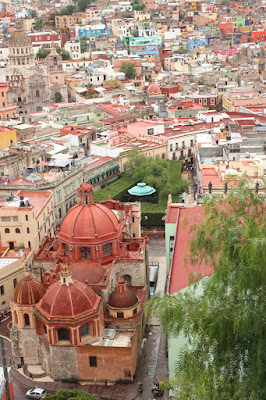
Driving in Mexico was interesting for a lot of reasons. The highways there aren t quite as limited access as the freeways in the USA. It was quite common to see bicyclists, walkers, a mule, or some cattle ambling along the side of the road. Roadside taco stands don t require taking an exit. You just pull off the road because it s right there.
Some sights were a bit surprising. Cattle in a pickup, with rope, for instance.
Or cattle crossing the highway on the overpass.
Street vendors were everywhere. Stop at a red light and someone might spring from the side of the road and suddenly start washing your windshield (expecting a tip); try to sell you flowers, juice, or bug zappers; or even throw business card-sized advertisements for adult websites into any open windows they can find. One night we saw an incredible fire juggler. I would have tipped him well but he was too far away to do so before the light turned green.
Mexico s history stretches back into prehistoric times, and we saw the Teuchitlan
ruins at Guachimontones one day. It was truly a remarkable feeling to be able to walk down the middle of the ancient ball court, or to climb up one pyramid and see the other from it.
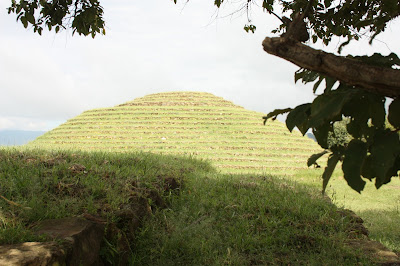
It s not exactly architecture, but Jacob and Oliver sure enjoyed visiting the hot springs at Bosque de la Primavera. Jacob still remembers that where the steam is, the water is 200 degrees, and we CAN T TOUCH IT THERE!
Back in Guadalajara, here s a photo from the inside of the grand old cathedral.

Compared to the cathedrals we saw in Europe, this was of a similar general size and design, and perhaps only slightly newer. But one big difference: worshipers outnumbered tourists at every Mexican cathedral I saw, whether in the center of Guadalajara or at a rainy intersection in Guanajuato or a plaza in Tlaquepaque. It made them feel more alive, and perhaps more sacred as well.
One surprise was seeing people sitting on the steps of the cathedral in downtown Guadalajara selling trinkets such as beads. I think the only other place I had seen something like that was in New Orleans.
All of Guadalajara s Centro was beautiful. Much of it survives from colonial days; I think a person could spend days exploring its museums and buildings. Way too many of my 900 photos were taken in Centro to post on the blog, but just for flavor, here s one of the less than historic scenes.
Yes, that is a bus shaped like a tequila bottle.
Fountains were beautiful and common across Mexico. A few of them were easily reachable by boys, and ours sure loved those.
There was a lot of public art, including this interesting chair/skeleton/I m not sure what it is:
And, just for good measure while walking around Centro, they tossed in an apparent Redundant Array of Inexpensive Typewriters.
I don t know what they were doing, but there were about a dozen guys sitting out in the sun typing on their manual typewriters on their identical tables.
And who can leave Guadalajara without seeing one of North America s most impressive traffic circles. I ve got to hand it to the Mexicans for making something that is normally really boring into an interesting work of art.
Over in Guanajuato, a lot of driving takes place in the city s vast underground tunnel system. Here s a scene emerging from one of them.
Guanajuato was already getting decorated for Mexican independence day festivities (Sept. 15-16) while we were there.
Here s a typical Guanajuato street scene.
Many of the streets were closed to traffic and perhaps not wide enough to handle vehicles anyway. Those streets had a wonderful peaceful and slow feel to them.
I feel that I ve barely done the trip justice with this post. The feelings of walking down a beautiful Guanajuato street, or stepping into a Spanish cathedral, or even seeing a bunch of guys with typewriters, just can t be replicated. It s brimming with history and character, and shouldn t be missed.
 a bit late & short (I was travelling the last days) but here it is: the
recent update of my RC bug acitivities:


 OpenXenManager cleared the NEW queue and is now available in the archive. What it is:

