Search Results: "edd"

12 July 2014

Dirk Eddelbuettel: RcppArmadillo 0.4.320.0

While I was out at the (immensely impressive and equally enjoyable) useR! 2014 conference at UCLA, Conrad provided a bug-fix release 4.320 of Armadillo, the nifty templated C++ library for linear algebra. I quickly rolled that into RcppArmadillo release 0.4.320.0 which has been on CRAN and in Debian for a good week now. This release fixes some minor things with sparse and dense Eigen solvers (as well as one RNG issue probably of lesser interest to R users deploying the RNGs from R) as shown in the NEWS entry below.
Changes in RcppArmadillo version 0.4.320.0 (2014-07-03)
  • Upgraded to Armadillo release Version 4.320 (Daintree Tea Raider)
    • expanded eigs_sym() and eigs_gen() to use an optional tolerance parameter
    • expanded eig_sym() to automatically fall back to standard decomposition method if divide-and-conquer fails
    • automatic installer enables use of C++11 random number generator when using gcc 4.8.3+ in C++11 mode
Courtesy of CRANberries, there is also a diffstat report for the most recent release. As always, more detailed information is on the RcppArmadillo page. Questions, comments etc should go to the rcpp-devel mailing list off the R-Forge page.

This post by Dirk Eddelbuettel originated on his Thinking inside the box blog. Please report excessive re-aggregation in third-party for-profit settings.

1 July 2014

Russ Allbery: Review: Ancillary Justice

Review: Ancillary Justice, by Ann Leckie
Series: Imperial Radch #1
Publisher: Orbit
Copyright: 2013
ISBN: 0-316-24662-X
Format: Trade paperback
Pages: 416
As Ancillary Justice opens, Breq is on an icy planet trying to track down a person who has gone rather thoroughly to ground. As her search continues, the reader slowly learns the context of that search, which is only the latest step of a long and quixotic exercise in private determination. She was set on her path by events twenty years previous, told in interleaved flashbacks, that have left her greatly diminished and thrust outside of any of the context of her over thousand years of life. Breq was Justice of Toren, a starship and AI that possessed thousands of ancillaries, human bodies slaved to her mind. Now only this one remains, and nothing exists of her former life other than this goal. It's always hard to write a review of a book that I loved this much. I want to find some way to grab the reader and shake them and say "you have to read this!" without giving away any of the delicious details. That's particularly difficult with Ancillary Justice, since one of the delights of this book is the slow unfolding of not only the plot but the background and motivations behind the plot. There is so much beneath the surface of Breq's methodical intent, and discovering all the nuances is utterly delightful. This is also a book that is very deeply concerned with identity, and which does one of the best jobs I've seen in science fiction of showing a non-human first-person protagonist: close enough to human to permit identification and comprehension, but far enough away for delightful sparks of unexpected insight or thought-provoking difference. Breq is a ship, and AIs are central to this story, so the comparison that comes immediately to mind is with Iain M. Banks. Leckie's role for ship AIs is much different than the structure of Banks's Culture, but I think this is still an apt comparison. Like Banks, Leckie is writing large-scale space opera dominated by a meddling empire that follows some familiar human patterns but not others. Banks's Culture takes a less direct approach with its meddling; the Radch has a more Roman attitude towards preventative conquest and citizenship. But both deal with large-scale issues of politics, culture, and conquest. Both also write excellent AIs, but I think Leckie is more successful than Banks at giving her AIs inhuman properties and creating a sense of eerie alienness that sometimes fades almost entirely and sometimes comes sharply to the surface. The first-person perspective helps considerably there. But where Ancillary Justice truly shined for me is in the interpersonal relationships, and in the insight they provided into character and motive. At the start of the book, Breq finds a drug addict dying in the cold and rescues her, bringing her along on her search for lack of a better option. Breq's relationship with Seivarden is complex, difficult for both of them, badly asymmetric at the start, and develops into something brilliant. At the start of the book, Seivarden is easy to dislike, and Breq's tone is refreshingly bracing and forthright. But through the course of the book Seivarden grows into something much more, in a way that I found both believable and incredibly compelling. And Leckie does this without falling into any of the typical relationship patterns, without introducing artificial romance (or, indeed, any romance at all, which is an excellent choice here), and without compromising the personalities of either character. It's masterfully done. One of the most amazing things about this book to me is that it's a first novel. I never would have guessed that from reading it. It's beautifully paced, the characterization is deep and compelling, and Leckie avoids any sign of the typical first-novel problem of stuffing the book with too much Stuff. Ancillary Justice is a capable and confident novel that builds a compelling world and even more compelling characters. I liked it more than I like most of the Culture novels, which is saying quite a lot, but Leckie offers much of the same scope with deeper and more personal characterization and a tighter plot. I haven't yet remarked on one aspect of this book that every other review seems to remark on: its treatment of gender. The Radch do not recognize or care about gender distinctions, and therefore Breq struggles throughout the book with proper gender labeling in much the same way that a native English speaker tends to struggle with grammatical gender when learning a Romance language, except with more social consequences. Leckie has chosen to represent this in the novel by having Breq refer to everyone uniformly as "she." This has its pluses and minuses: it still supports a binary gender concept where a gender-neutral pronoun might not, but given all the negative reaction this book got just for using "she," a gender-neutral pronoun might be a bridge too far for a lot of readers. I thought it created a nice bit of alienation, a way of forcing the reader to look at gender markers from the outside and a way to point out how arbitrary many of them are. It was also interesting to see how surprised I was at various points in the book when it became obvious that some person Breq had been calling "she" in the first-person narration turned out, from story context, to probably be male. That said, I think this part of the book is overblown in reviews. It's often the first thing people mention, but while it was a nice side bit of world-building, I don't think it's that central to the story. I'm particularly baffled by the handful of people who complained about it, since it's not intrusive and it quickly fades into the background apart from occasional necessary shifts of mental image. (It does create the impression of a world containing only women, but I found that a nice change from the more common impression in space opera of a world containing only men.) Ancillary Justice has already won the Nebula and Arthur C. Clarke awards and tied for the BSFA award for best novel, and I'm happy to report that it deserves all of those. I haven't yet read all of the other Hugo nominees, but it's hard to imagine a world in which it won't top my ballot. This is a fantastic novel, by far the best thing I've read so far this year. I'm delighted that it's the first book of a trilogy, since I'm not done with either the world or the characters yet, but it stands well on its own and reaches a satisfying conclusion. I recommend it to everyone, but particularly to anyone who likes Banks, intelligent ships, or who is looking for thoughtful and complex space opera. Followed by Ancillary Sword. Rating: 10 out of 10

29 June 2014

Russ Allbery: Review: The Wilding

Review: The Wilding, by C.S. Friedman
Series: In Conquest Born #2
Publisher: DAW
Copyright: 2004
Printing: July 2005
ISBN: 0-7564-0202-6
Format: Mass market
Pages: 551
In Conquest Born is a rather odd space opera, featuring an interstellar war between two great empires that culminates in an intensely personal struggle between leaders of the two sides. It has one of the most intensely misogynistic societies in science fiction (the villains, yes, but weirdly ambiguous villains), genetic breeding programs for telepaths, and a host of unlikable but oddly fascinating characters. I thought it was weaker on re-read than I remembered it being originally, but it's still singular enough in memory that I wanted to read the sequel. The Wilding picks up in the same universe a century and a half later. I expected more of a direct connection to the plot of In Conquest Born, but I think this book could be read on its own. (This is good, given how the plot of In Conquest Born tends to slip out of my memory, despite how unique the book is.) The Azeans and the Braxins are, of course, still at war, an on-again, off-again affair that neither side seems likely to ever win. But the Azeans have forbidden psychic powers and driven all psychics underground, if they still exist at all. They are supposedly too unstable to be allowed in the carefully constructed Azean society. Tathas is Braxin, but not from the ruling Braxan tribe. He is caught practicing old rituals of his native tribe and escapes sentence of death by going on the Wilding, an ancient practice of leaving Braxin culture to find new genetic material and bring it back to strengthen their species. Or, put in less euphemistic terms, to find and rape a woman and bring back the resulting child, although apparently retrieving a genetic sample would also work. Did I mention the misogynistic society part? Still there. Zara, the other primary protagonist, is an Azean mediator who, as the book is opening, starts developing psychic powers. This is a rather serious problem that gets her suspended from her job. Her check of her own genetic records (the old-school SF obsession with eugenics is also still there) leads to the discovery that she's an identical twin, whose sister was kidnapped as an infant under mysterious circumstances and apparently by underground psychics. Zara decides to go in search of her. As with In Conquest Born, this book is full of deeply unpleasant societies and world views. Also as with In Conquest Born, I don't think Friedman intends any of them to be held up as examples of correct politics or behavior. What makes both of these books unusual is that neither she nor the characters seem to be making any attempt to construct a third alternative that would be better. The secret society of psychics has a different appeal, but it's not clear the characters would want to be part of it either, and it's quite possible that they're still responsible for a lot of the crap that's going on in the galaxy. The book feels like it ought to be political, as these societies are clearly broken and deeply abusive (the Braxins more obviously than the Azeans, but they're both creepy), but it mostly isn't. Instead, The Wilding is focused on individual people trying to make their way in this world. Those people come from varying strata of these societies. Zara and Tathas are there throughout; other characters crop up briefly with their own viewpoints and then often go away again or are killed. I think Friedman is going for a story of raw emotion and a tight focus on individual actions, with little in the way of clean morality or broader morals. And yet... the final act of the protagonists in the book is a political act that seems aimed at making the universe a better place. In a way, this is a very cynical book: there is a tremendous amount of manipulation and political maneuvering, and it's hard to see any cause here that one can fully support. This is all rather similar to In Conquest Born, but what held the previous book together was its backbone of obsessive vengeance and the spectacle of two intelligent people from utterly different societies locked in all-out emotional and physical combat. The Wilding doesn't have that. It has characters with strong motives and strong emotions, but none of them are the sort of epic, transcendent emotions that propel mythic heroes at each other. This is a more prosaic and personal book, which means the drama isn't strong and sweeping enough to make the reader forget the deep unpleasantness that's going on around them. The Wilding feels less like a clash of titans and more like personal quests for identity against a universe full of awful people and worse systems. It also retains, in the Braxin, aggressive male-dominant sexuality just this side of a Gor novel, but here that feels seedier and even more squirm-inducing than it did in In Conquest Born. The Wilding is even more ambiguous about the ethics of that sexual and misogynistic abusiveness; Tathas partly gives it up, but this is presented more as an accommodation to another culture than as a real engagement with the inherent abusiveness of Braxin society. I still have no idea whether and to whom I would recommend In Conquest Born. I'm less torn about The Wilding: don't bother. It's a lesser work in all respects, it shares some of the problems with too many characters and an occasionally incoherent plot, and I had even more trouble with the horrible societies Friedman creates than I did in the previous book. And it doesn't have the same counterbalance of epic, uncontrolled emotions and characters who seem to transcend the story they're in. Instead, it feels more like a story of damaged people in an awful universe who are meddling through as best they can while being manipulated by the people with real power. It got more depressing the more I thought about it, and the ending doesn't salvage the story. Rating: 4 out of 10

27 June 2014

Russ Allbery: Review: Due Diligence

Review: Due Diligence, by David Roodman
Publisher: Center for Global Development
Copyright: 2012
ISBN: 1-933286-48-2
Format: Trade paperback
Pages: 335
Due Diligence: An Impertinent Inquiry into Microfinance is a detailed analysis of the effects, philosophy, approaches, and merits of microfinance as an institution and as, increasingly, a charitable focus of the developed world. The author, David Roodman, was a senior fellow at the Center for Global Development at the time of writing this book, and is an expert in microfinance and economic development. This book starts as an overview and a history of the spectrum of microfinance institutions (something I found very valuable, since I knew very little about microfinance prior to Kiva's popularity), and then attempts a critical, data-driven analysis of whether, to what extent, and by which measures microfinance is successful. The most common aspect of microfinance, made popular and prominent by Kiva among others, is microcredit: small loans to people in developing countries. The underlying theory of microcredit is that lack of financial services handicaps prospective entrepreneurs and business owners in the third world, preventing them from growing businesses, funding expansion, and moving out of poverty. By extending relatively small amounts of credit to these people, or so the theory goes, they can better smooth out the uncertainties of day-to-day life and get the necessary capital to expand small local business. Microcredit is not the only type of microfinance, though, and Roodman's careful discussion of that point was one of the most informative parts of this book for me. It can also come in the form of microsavings tiny bank accounts or small-scale savings plans or microinsurance. Roodman makes a very interesting argument that these three forms of microfinance form two opposing continuums. Microcredit is the easiest to provide and microinsurance is the hardest, for many reasons he discusses including some that were surprising to me, but microinsurance is arguably the most helpful and beneficial to the individual poor and microcredit is the least. The opening history and survey does an excellent job showing the range of techniques and approaches used in microfinance, and showing the challenges of providing it. I had some vague understanding of the logistical challenges in serving areas far away from traditional infrastructure. I had much less understanding of the fascinating array of techniques in use, both inside and outside what's become the microfinance industry. Some of these techniques are brilliant examples of human economic creativity and skill at balancing incentives with risk protection. There are a much wider variety of approaches and instruments available than the individual or group loans that one typically sees on a site like Kiva, all with different trade-offs in group size, flexibility, rigidity, risk, and complexity. This book is well worth reading just to get a feel for the huge array of financial arrangements possible outside of the traditional banking structures that most readers of this review are used to. Another question Roodman answers thoroughly is why microfinance is so focused on microcredit. My vague unease with that was strengthened by reading David Graeber's Debt, which among many other things makes clear some of the social perils and power imbalances in lending. Due Diligence both crystallized that discomfort and explained why alternatives are difficult. Both microsavings and microinsurance necessarily involve considerably more regulation (which has both advantages and complexity), since they involve taking and safeguarding people's money and promising service in the future. Lenders require less trust; lenders instead extend trust and assume that risk themselves, and are in a position to do so. Microinsurance is also harder to explain and harder to target, although it is potentially the most helpful financial instrument when well-targeted. And microcredit can absorb huge influxes of capital from the outside, lending it out in a region, while both microsavings and microinsurance are necessarily built on the money already in the local economy and are inherently more resistant to external involvement. (I'm of the opinion this is a significant feature, but it makes it far harder for them to catch on as a charitable trend.) The heart of the book is a hard look at whether microfinance, and particularly microcredit, works. Roodman attempts this analysis for three different definitions of working: lifting people out of poverty (the most commonly claimed success), giving people more freedom and control over their lives even if their poverty level does not change in absolute terms, and developing the local economy. Sadly for charities like Kiva, microcredit does surprisingly poorly on the first two metrics. There is still little clear data, and the degree to which data from one region is applicable to a different region is highly debatable, but what evidence we have does not support the theory that microcredit lifts people out of poverty. In fact, the more intense the microcredit, the more likely it appears to be that credit pathologies common in the developed world, such as taking out loans from one organization to pay off loans from another, spirals of debt that is unlikely to ever be repaid, and aggressive debt collection methods, turn up in microcredit as well. The vision of the entrepreneur who succeeds through new-found access to capital is largely a myth. Indeed, the current packaging and presentation of loans to distant charities in developed countries means that even the supposed purpose of the loans is dubious. Loans are almost always presented as being for some sort of business activity, since that's what external charities want to fund, but money is fungible and the funds are more often used for all the things people normally need to use funds for: weddings, funerals, food for the family in hard times, paying off other loans to relatives, and other daily expenses. On the empowerment front, microcredit fairs little better, and here I particularly appreciated Roodman's clear-eyed and honest portrayal of common microcredit practices and their benefits for the creditors. For example, microcredit makes much of loaning to women, and presents this as a story of female empowerment. Roodman argues that there is some reality behind that, but it's also clear that microcredit organizations loan to women because women are more likely to repay not due to any inherent gender trait, but because women are easier to intimidate and shame into repaying. Similarly, the much-vaunted group loans, usually presented as a way for the community to support each other and teach each other financial skills, are most common in the poorest regions because they represent an outsourcing of costs. The main risk to the lender is that poor people have no such thing as credit histories, and detailed investigations of someone's trustworthiness is expensive. Groups are jointly liable and therefore will police themselves and check each other's reliability at no cost to the lender. Groups will also use intimidation tactics and even violence against members who don't or can't repay their share, without the lender having to get involved or have any responsibility for those tactics. Roodman takes a philosophical tone on this topic, noting several times that services for the very poor are generally of low quality and finance is no exception. I'm less inclined to be philosophical; after reading this book, I find it very hard to support group loans. This leaves economic development as the most compelling argument left for microcredit. This is weak tea for people like myself who wanted to believe in the transformative power of microcredit, but Roodman does a solid job explaining why it's still important. There is a great deal to be said for the perspective that only industrialization actually lifts people out of poverty on any substantial scale, and therefore the most useful type of aid is aid that somehow contributes towards industrialization. Building a native financial industry could arguably be such a step. And there seems to be some real merit and lasting effect to having a richer and more capable set of local financial institutions. However, here, it's not at all clear that external money helps. In fact, there's quite a bit of evidence that external money hurts, since it pushes microfinance institutions to find ways of using that money and pleasing external donors instead of building their infrastructure and capabilities as financial institutions. The earlier institutions, such as the Grameen Bank, seem to have done a better job at being local institutions woven into the local economy than have the later organizations that are largely supported by western donors. Roodman makes a good case for the usefulness of microfinance as a part of economic development, but it comes with a strong argument against too much external funding, and particularly against the practice of developed world donors funding specific loans. I came away from this book feeling like I had a much better understanding of the core problems and techniques of financial services for the poor, and with a strong desire to see more microsavings than microcredit. The two are closer in nature than I had expected, and Roodman's analysis of the similarities was fascinating, but microsavings seems less vulnerable to some of the credit pathologies. There is also some statistical evidence that microsavings does provide some modest reductions in poverty, while the evidence for microcredit is much less compelling. Sadly, from the perspective of a resident of the developed world such as myself who would very much like to help, neither microsavings nor effective microcredit seems likely to benefit from my contributions, and particularly not in the form of a site like Kiva. The end of this book is a long appendix that reprints multiple blog posts on related topics, including additional discussion of the problems with the Kiva model. Effectively, Kiva is a way for people like myself to subsidize microcredit organizations. It's not at all clear that subsidies are needed, and there's some reason to believe that they encourage negative and destructive behavior. The way they are marketed involves a certain amount of lying, or at least distortion, on the part of multiple actors in the microcredit picture. And they're a distraction from microsavings, and from microcredit based on loaning out savings from within the same local economy, both of which seem to have considerably more positive properties. Due Diligence is a book with a somewhat narrow target audience. It will appeal primarily to people with an interest in economics, particularly development economics, or who are evaluating microfinance charities or analyzing their support of groups like Kiva. But within that context, this is an excellent book, and I recommend it to your attention. Roodman is clear, thorough, and fair within my ability to measure that, and while no one book can be the final word on a topic, he adds considerable data and thoughtful analysis. If you are a supporter of Kiva, like I was, I fear you'll find this book rather discouraging. But it's better to have the information than not, and I found it a good reminder of the inherent drawbacks of loans and debt. There is, sadly, nothing magical about microcredit that removes those problems. Rating: 9 out of 10

18 June 2014

Aurelien Jarno: Debian is switching (back) to GLIBC

Five years ago Debian and most derivatives switched from the standard GNU C Library (GLIBC) to the Embedded GLIBC (EGLIBC). Debian is now about to take the reverse way switching back to GLIBC, as EGLIBC is now a dead project, the last release being the 2.19 one. At the time of writing the glibc package has been uploaded to experimental and sits in the NEW queue. EGLIBC is dead for a good reason: the GLIBC development has changed a lot in the recent years, due to two major events: Ulrich Drepper leaving Red Hat and the GLIBC development, and the GLIBC steering committe self-dissolving. This has resulted in a much more friendly development based on team work with good cooperation. The development is now based on peer review, which results in less buggy code (humans do make mistakes). It has also resulted in things that were clearly impossible before, like using the same repository for all architectures, and even getting rid of the ports/ directory. Before we used to have two sets of architectures, the main ones in the glibc repository with architectures like x86, SuperH or SPARC, and the secondary ones in the glibc-ports repository with architectures like ARM or MIPS. As you can see the separation was quite arbitrary, and often leaded to missing changes on the secondary architectures. We also got real stable branches, with regular fixes. The most important EGLIBC features have been merged to GLIBC, including for example the use of non-bash but POSIX shell, or the renaming of reserved keywords. The notable exception is the support for configurable components, which we originally planned to use for Debian-Installer, by building a smaller flavor using -Os and without NIS and RPC support. At the end we never worked on that, and it seems that the hardware targeted by Debian has grown faster than the GLIBC size, so that is not really a big loss. At the end, we ended up with only 5 missing patches from the EGLIBC tree: The package names are unchanged (except the source package and the binary package containing the sources) so the transition is fully transparent for the users. I would like to thank all the CodeSourcery employees who worked on EGLIBC, with a special thank to Joseph Myers who spent countless hours to merge the most important EGLIBC changes back to GLIBC, and sent regular emails about the merge status. I would also like to thanks all the people on the GLIBC side that made the change to happen, and all persons participating in the GLIBC development.

13 June 2014

Dirk Eddelbuettel: Introducing pkgKitten: Creating R Packages that purr

A new package pkgKitten is now on CRAN in its infant version 0.1.0. It does only one thing: create R packages that do not suck. Or at least not as much as those created by the (R default) function package.skeleton() which creates files which the very standard, and very recommended, R CMD check then complains about. That is silly. Because each time R CMD check complains, something bad happens to a kitten somewhere. So pkgKitten offers a wrapper function kitten() which creates neat little packages which do not upset R CMD check. A complete little demo is on the pkgKitten webpage which also has pointers to the pkgKitten GitHub repo.

This post by Dirk Eddelbuettel originated on his Thinking inside the box blog. Please report excessive re-aggregation in third-party for-profit settings.

10 June 2014

Steve Kemp: I did get a job

In my previous blog-post I mentioned, briefly, that I'd posted a couple of adverts on Reddit looking for work. To give more detail I did three things: The advertisement was set to be shown in /r/edinburgh (where I live), and /r/sysadmin (where I thought some people might look if they were struggling for help). The advertising on Reddit was painless to setup, and the traffic stats were interesting, but even though this worked out well I'm a little loathe to repeat the process - since the "non-sterling transaction fee" from my bank effectively doubled my budget. I received a few (private) emails and comments, along with the expected grammar corrections. The end result was that I received contact from an American company founder who seemed interested. He allowed me to write some code to solve a fun problem, appeared to enjoy the code I sent (Ruby code for dealing with (exim) email spam, that's as specific as I will be). The end result was a three month contract, which we obviously hope will lead to more permanent work. Anyway I thought this was an atypical route to find a work, and was about a million times nicer than working with recruiters, so .. consider this documentation! In other news it is now 10pm and I need to go to the gym and pub, in that order.

Steve Kemp: I'm still not a developer, but ..

Some coding updates: My templer static site generator has now been uploaded to CPAN, and is available as App::Templer. I've converted most of my Dockerfiles to work with docker 1.0.0, which is nice. I also hacked up a fun DNS-server for sharing JSON-encoded data, within a LAN or other environment: Finally I updated the blogspam-detecting site a little, on the back-end. The code is now running inside Docker containers which means I can redeploy more easily in the future. My blog post about looking for a job received some attention via a Reddit advert I posted to /r/edinburgh + /r/sysadmin, but thus far has mostly resulted in people wanting me to write code for them .. which is frustrating. For the moment I'm working on a fun challenge involving (email) spam-detection. That takes me back.

Dirk Eddelbuettel: Introducing RcppRedis

RcppRedis, another new package of mine, appeared on CRAN a few weeks ago just in time for our annual R/Finance conference. And as of today, we also have Windows binaries thanks to generous help from John Buonagurio who help building the required 32- and 64-bit libraries for Windows, and Uwe Ligges who now installed them for the CRAN and win-builder machiness. Binaries for release 0.1.1 should be available within a day. To describe the package, I also just set up a page about RcppRedis so rather than repeating everything here I invite you to follow the link. The ever-so-brief NEWS entry for the two first uploads follows.
Changes in version 0.1.1 (2014-06-09)
  • Now with Windows support thanks to the installation of builds of the hiredis library (created by John Buonagurio) at CRAN / win-builder (thanks to Uwe Ligges)
  • Added support for new command zcount
Changes in version 0.1.0 (2014-05-10)
  • Initial CRAN upload

This post by Dirk Eddelbuettel originated on his Thinking inside the box blog. Please report excessive re-aggregation in third-party for-profit settings.

9 June 2014

Dirk Eddelbuettel: Rcpp 0.11.2

A new minor release 0.11.2 of Rcpp is now on the CRAN network for GNU R, and binaries for Debian have also been uploaded. The release smoothes a few edges on both the Rcpp side itself, as well as on the interaction between Rcpp and R which since release 3.1.0 offers a few new features related to C++11. Kevin added a couple of neat extensions related to vectors, a new ListOf templated list class, as well as a new option to warn on implicit casts. We decided not to make this option the default as it may be too common in some packages. JJ took care of a few buglets related to the wonderful Rcpp Attributes. See the NEWS file section below for details, or the ChangeLog file in the package and on the Rcpp Changelog page. Note that the diffstat reported by CRANberries is very large as Kevin also committed a whitespace cleanup which touched almost all files. As before, we tested this release by building against all CRAN packages which depend upon Rcpp. In fact we did three such runs leading up to the release. Only one package was blacklisted (as I currently don't have CUDA set-up), two had what may be internal errors or tests which were too restrictive, sixteen suffered from missing packages or RGL devices --- but the remaining 202 packages all built and tested cleanly. Detailed results of those tests (and the scripts for it) are in the rcpp-logs repo GitHub. There are a number of other fixes, upgrades and other extensions detailed in NEWS file extract below, in the ChangeLog file in the package and on the Rcpp Changelog page.
Changes in Rcpp version 0.11.2 (2014-06-06
  • Changes in Rcpp API:
    • Implicit conversions, e.g. between NumericVector and IntegerVector, will now give warnings if you use #define RCPP_WARN_ON_COERCE before including the Rcpp headers.
    • Templated List containers, ListOf<T>, have been introduced. When subsetting such containers, the return is assumed to be of type T, allowing code such as ListOf<NumericVector> x; NumericVector y = x[0] + x[1] + x[2].
    • In a number of instances, returned results are protected and/or cast more carefully.
  • Changes in Rcpp Attributes
    • Trailing line comments are now stripped by the attributes parser. This allows the parser to handle C++ source files containing comments inline with function arguments.
    • The USE_CXX1X environment variable is now defined by the cpp11 plugin when R >= 3.1. Two additional plugins have been added for use with C++0x (eg when using g++ 4.6.* as on Windows) as well as C++1y for compilers beginning to support the next revision of the standard; additional fallback is provided for Windows.
    • compileAttributes() now also considers Imports: which may suppress a warning when running Rcpp.package.skeleton().
Thanks to CRANberries, you can also look at a diff to the previous release. As always, even fuller details are on the Rcpp Changelog page and the Rcpp page which also leads to the downloads, the browseable doxygen docs and zip files of doxygen output for the standard formats. A local directory has source and documentation too. Questions, comments etc should go to the rcpp-devel mailing list off the R-Forge page

This post by Dirk Eddelbuettel originated on his Thinking inside the box blog. Please report excessive re-aggregation in third-party for-profit settings.

5 June 2014

Dirk Eddelbuettel: RcppArmadillo 0.4.300.8.0

A new minor / bug fix release 4.300.8 of Armadillo, the templated C++ library for linear algebra, was tagged by Conrad in his SVN repo a few days ago, following earlier snapshots in the 4.300.* series. We had prepared two earlier releases for GitHub but not CRAN in order to accomodate the CRAN maintainer's desire of "a release every one to two months" expressed in the CRAN Repo Policy. However, two actual bugs in the interaction between MinGW and C++11 were reported on the rcpp-devel mailing list, and this releases addresses these. Hence time for new release 0.4.300.8.0 of RcppArmadillo which is now on CRAN and in Debian. This release brings a few upstream changes detailed below such as nice new upstream changes such as more robust norm() (and related) functions, and fixes related to matrix and cube interactions. From our end, we added a better detection of Windows via both _WIN32 and WIN32 (as the former apparently gets undefined by MinGW in C++11 mode). We also added the ability to turn on C++11 support from R (possible since R 3.1.0) yet also turn it off for Armadillo. This is needed as the prescribed compiler on Windows is g++ 4.6.2 -- which offers a subset of C++11 which is good enough for a number of things from the C++11 standard, but not advanced enough for everything which Armadillo uses when C++11 support is turned on. As Armadillo continues to offer a choice of C++ standards, we can use the ability to deploy C++11 only outside of its internals. It is worth repeating that this issue should only affect Windows users wishing to use C++11; other platforms are fine as they generally have more modern compilers.
Changes in RcppArmadillo version 0.4.300.8.0 (2014-05-31)
  • Upgraded to Armadillo release Version 4.300.8 (Medieval Cornea Scraper)
    • More robust norm-related functions
    • Fixes between interactions between cube and vector types.
  • Adds a #define ARMA_DONT_USE_CXX11 to provide an option to turn C++11 off for Armadillo (but client packages may still use it)
  • More robust Windows detection by using _WIN32 as well as WIN32 as the latter gets diabled by MinGW with C++11
  • On Windows, C++11 can be turned off as the Armadillo code base uses more features of C++11 than g++ 4.6.2 version in Rtools implements
Changes in RcppArmadillo version 0.4.300.5.0 (2014-05-19)
  • Upgraded to Armadillo release Version 4.300.5 (Medieval Cornea Scraper)
    • Handle possible underflows and overflows in norm(), normalise(), norm_dot()
    • Fix for handling of null vectors by norm_dot()
Changes in RcppArmadillo version 0.4.300.2.0 (2014-05-13)
  • Upgraded to Armadillo release Version 4.300.2 (Medieval Cornea Scraper)
    • faster find()
Courtesy of CRANberries, there is also a diffstat report for the most recent release As always, more detailed information is on the RcppArmadillo page. Questions, comments etc should go to the rcpp-devel mailing list off the R-Forge page.

This post by Dirk Eddelbuettel originated on his Thinking inside the box blog. Please report excessive re-aggregation in third-party for-profit settings.

4 June 2014

Dirk Eddelbuettel: Introducing RPushbullet

A new package of mine appeared on CRAN today: RPushbullet. A few days ago, I had tweeted about a first version available via its GitHub repo. The package is now on CRAN which will make it easier to install for many. You still need an API key (free, after registration at Pushbullet) and one or more target devices to message to: an modern smartphone (Android, iPhone, ...) or a Chrome browser provided you also installed the corresponding app. I also set up a short web page on my server with some more information and an example. So pushbullet away...

This post by Dirk Eddelbuettel originated on his Thinking inside the box blog. Please report excessive re-aggregation in third-party for-profit settings.

31 May 2014

Dirk Eddelbuettel: RcppGSL 0.2.1 and 0.2.2

A few days ago, version 0.2.1 of RcppGSL---our interface package between R and the GNU GSL using our Rcpp package for seamless R and C++ integration---appeared on CRAN making it the first release in some time. And it turned that this version tickled an obscure and long-dormant bug under clang which was found on OS X Mavericks---which Kevin Ushey consequently squashed. So this is now reflected in version 0.2.2 which just arrived on CRAN. Besides the bugfix, a few things were modernized to reflect capabilities of Rcpp 0.11.0 and later. The releases also contain a few changes that had accumulated since the previous release in 2012 such as an additional example using B-splines, and use of updated vignette build options provided by R. The NEWS file entries follows below:
Changes in version 0.2.2 (2014-05-31)
  • A subtle bug (tickled only by clang on some OS versions) in vector and matrix view initialization was corrected by Kevin Ushey
Changes in version 0.2.1 (2014-05-26)
  • Added new example based on B-splines example in GSL manual illustrating simple GSL use via Rcpp attributes
  • Vignette compilation has been reverted to using highlight since version 0.4.2 or greater can be used as a vignette engine (with R 3.0.* or later).
  • Vignette compilation is now being done by R CMD build as R 3.0.0 supports different vignette engines, so the vignette build process has been simplified. A convenience helper script has also been added for command-line builds.
  • Unit tests now use sourceCpp() instead of cxxfunction() from the inline package
  • The DESCRIPTION file now uses Suggests: Rcpp (instead of Depends: Rcpp) to permit building of the vignette
  • The package now takes advantage of the simplified build process available with Rcpp (>= 0.11.0)
  • Similar updates to the build process were made for the example package included with RcppGSL
And courtesy of CRANberries, a summaries of changes to release 0.2.0 and this week's release 0.2.1 are available. More information is on the RcppGSL page. Questions, comments etc should go to the rcpp-devel mailing list off the R-Forge page.

This post by Dirk Eddelbuettel originated on his Thinking inside the box blog. Please report excessive re-aggregation in third-party for-profit settings.

29 May 2014

Enrico Zini: wheezy-for-industrial-development

Wheezy for industrial software development I'm helping with setting up a wheezy-based toolchain for industrial automation. The basic requirements are: live-build, C++11, Qt 5.3, and a frozen internal wheezy mirror. debmirror A good part of a day's work was lost because of #749734 and possibly #628779. Mirror rebuild is still ongoing, and fingers crossed. This is Italy, and you can't simply download 21Gb of debs just to see how it goes. C++11 Stable toolchains for C++11 now exist and have gained fast adoption. It makes sense, since given what is in C++11 it is unthinkable to start a new C++ project with the old standard nowadays. C++11 is supported by g++ 4.8+ or clang 3.3+. None of them is available on wheezy or wheezy-backports. Backports exist of g++ 4.8 only for Ubuntu 12.04, but they are uninstallable on wheezy due at least to a different libc6. I tried rebuilding g++4.8 on wheezy but quickly gave up. clang 3.3 has a build dependency on g++ 4.8. LOL. However, LLVM provides an APT repository with their most recent compiler, and it works, too. C++11 problem solved! Qt 5.3 Qt 5.3 is needed because of the range of platforms it can target. There is no wheezy backport that I can find. I cannot simply get it from Qt's Download page and install it, since we need it packaged, to build live ISOs with it. I'm attempting to backport the packages from experimental to wheezy. Here are its build dependencies: libxcb-1.10 (needed by qt5) Building this is reasonably straightforward. libxkbcommon 0.4.0 (needed by qt5) The version from jessie builds fine on wheezy, provided you remove --fail-missing from the dh_install invocation. libicu 52.1 (needed by harfbuzz) The jessie packages build on wheezy, provided that mentions of clang are deleted from source/configure.ac, since it fails to build with clang 3.5 (the one currently available for wheezy on llvm.org). libharfbuzz-dev Backporting this is a bloodbath: the Debian packages from jessie depend on a forest of gobject hipsterisms of doom, all unavailable on wheezy. I gave up. qt 5.3 qtbase-opensource-src-5.3.0+dfsg can be made to build with an embedded version of harfbuzz, with just this change:
diff -Naur a/debian/control a/debian/control
--- a/debian/control    2014-05-20 18:48:27.000000000 +0200
+++ b/debian/control    2014-05-29 17:45:31.037215786 +0200
@@ -28,7 +28,6 @@
                libgstreamer-plugins-base0.10-dev,
                libgstreamer0.10-dev,
                libgtk2.0-dev,
-               libharfbuzz-dev,
                libicu-dev,
                libjpeg-dev,
                libmysqlclient-dev,
diff -Naur a/debian/rules b/debian/rules
--- a/debian/rules  2014-05-18 01:56:37.000000000 +0200
+++ b/debian/rules  2014-05-29 17:45:25.738634371 +0200
@@ -108,7 +108,6 @@
                -plugin-sql-tds \
                -system-sqlite \
                -platform $(platform_arg) \
-               -system-harfbuzz \
                -system-zlib \
                -system-libpng \
                -system-libjpeg \
(thanks Lisandro Dami n Nicanor P rez Meyer for helping me there!) There are probably going to be further steps in the Qt5 toolchain. Actually, let's try prebuilt binaries The next day with a fresh mind we realised that it is preferable to reduce our tampering with the original wheezy to a minimum. Our current plan is to use wheezy's original Qt and Qt-using packages, and use Qt's prebuilt binaries in /opt for all our custom software. We run Qt's installer, tarred the result, and wrapped it in a Debian package like this:
$ cat debian/rules
#!/usr/bin/make -f
QT_VERSION = 5.3
%:
    dh $@
override_dh_auto_build:
    dh_auto_build
    sed -re 's/@QT_VERSION@/$(QT_VERSION)/g' debian-rules.inc.in > debian-rules.inc
override_dh_auto_install:
    dh_auto_install
    # Download and untar the prebuild Qt5 binaries
    install -d -o root -g root -m 0755 debian/our-qt5-sdk/opt/Qt
    curl http://localserver/Qt$(QT_VERSION).tar.xz   xz -d   tar -C debian/our-qt5-sdk/opt -xf -
    # Move the runtime part to our-qt5
    install -d -o root -g root -m 0755 debian/our-qt5/opt/Qt
    mv debian/our-qt5-sdk/opt/Qt/$(QT_VERSION) debian/our-qt5/opt/Qt/
    # Makes dpkg-shlibdeps work on packages built with Qt from /opt
    # Hack. Don't try this at home. Don't ever do this unless you
    # know what you are doing. This voids your warranty. If you
    # know what you are doing, you won't do this.
    find debian/our-qt5/opt/Qt/$(QT_VERSION)/gcc_64/lib -maxdepth 1 -type f -name "lib*.so*" \
          sed -re 's,^.+/(lib[^.]+)\.so.+$$,\1 5 our-qt5 (>= $(QT_VERSION)),' > debian/our-qt5.shlibs
$ cat debian-rules.inc.in
export PATH := /opt/Qt/@QT_VERSION@/gcc_64/bin:$(PATH)
export QMAKESPEC=/opt/Qt/@QT_VERSION@/gcc_64/mkspecs/linux-clang/
To build one of our packages using Qt5.3 and clang, we just add this to its debian/rules:
include /usr/share/our-qt5/debian-rules.inc
Wrap up We got the dependencies sorted. Hopefully the mirror will rebuild itself tonight and tomorrow we can resume working on our custom live system.

23 May 2014

Mike Gabriel: X2Go on FLOSS Weekly

On May 21st 2014, the two Mikes (Gabriel DePaulo) from the X2Go core developer team were interviewed about X2Go by the famous Randal L. Schwartz (merlyn) and equally famous Randi Harper (freebsdgirl) on the FLOSS Weekly Netcast [1]. If you're having trouble watching the embedded video on that page, try one of the below alternatives: HD Video [2]
SD Video, large [3]
SD Video, small [4]
Audio only [5] light+love,
Mike [1] http://twit.tv/floss295 read more

13 May 2014

Dirk Eddelbuettel: Updated list of upcoming Rcpp talks and workshops

This is an updated version of an earlier post in March. A number of talks about Rcpp are scheduled over the next couple of months: So the month of June remains pretty open. If someone wants me to talk somewhere else, preferably on a Saturday, feel free to get in touch.

This post by Dirk Eddelbuettel originated on his Thinking inside the box blog. Please report excessive re-aggregation in third-party for-profit settings.

8 May 2014

Riku Voipio: Arm builder updates

Debian has recently received a donation of 8 build machines from Marvell. The new machines come with Quad core MV78460 Armada XP CPU's, DDR3 DIMM slot so we can plug in more memory, and speedy sata ports. They replace the well served Marvell MV78200 based builders - ones that have been building debian armel since 2009. We are planning a more detailed announcement, but I'll provide a quick summary: The speed increase provided by MV78460 can viewed by comparing build times on selected builds since early april: Qemu build times. We can now build Qemu in 2h instead of 16h -8x faster than before! Certainly a substantial improvement, so impressive kit from Marvell! But not all packages gain this amount of speedup: webkitgtk build times. This example, webkitgtk, builds barely 3x faster. The explanation is found from debian/rules of webkitgkt:

# Parallel builds are unstable, see #714072 and #722520
# ifneq (,$(filter parallel=%,$(DEB_BUILD_OPTIONS)))
# NUMJOBS = $(patsubst parallel=%,%,$(filter parallel=%,$(DEB_BUILD_OPTIONS)))
# MAKEARGUMENTS += -j$(NUMJOBS)
# endif
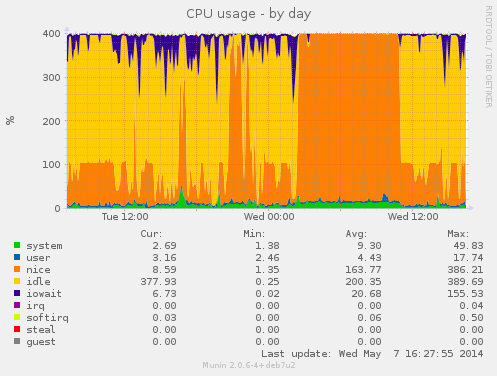
The old builders are single-core[1], so the regardless of parallel building, you can easily max out the cpu. New builders will use only 1 of 4 cores without parallel build support in debian/rules. During this buildd cpu usage graph, we see most time only one CPU is consumed. So for fast package build times.. make sure your packages supports parallel building. For developers, abel.debian.org is porter machine with Armada XP. It has schroot's for both armel and armhf. set "DEB_BUILD_OPTIONS=parallel=4" and off you go. Finally I'd like to thank Thomas Petazzoni, Maen Suleiman, Hector Oron, Steve McIntyre, Adam Conrad and Jon Ward for making the upgrade happen. Meanwhile, we have unrelated trouble - a bunch of disks have broken within a few days apart. I take the warranty just run out... [1] only from Linux's point of view. - mv78200 has actually 2 cores, just not SMP or coherent. You could run an RTOS on the other core while you run Linux on the other.

7 May 2014

Mario Lang: Planet bug: empty alt tags for hackergotchis

There is a strange bug in Planet Debian I am seeing since I joined. It is rather minor, but since it is an accessibility bug, I'd like to mention it here. I have written to the Planet Debian maintainers, and was told to figure it out myself. This is a pattern, accessibility is considered wishlist, apparently. And the affected people are supposed to fix it on their own. It is better if I don't say anything more about that attitude.
The Bug On Planet Debian, only some people have an alt tag for their hackergotchi, while all the configured entries look similar. There is no obvious difference in the configuration, but still, only some users here have a proper alt tag for their hackergotchi. Here is a list:
  • Dirk Eddelbuettel
  • Steve Kemp
  • Wouter Verhelst
  • Mehdi (noreply@blogger.com)
  • Andrew Pollock
  • DebConf Organizers
  • Francois Marier
  • The MirOS Project (tg@mirbsd.org)
  • Paul Tagliamonte
  • Lisandro Dami n Nicanor P rez Meyer (noreply@blogger.com)
  • Joey Hess
  • Chris Lamb
  • Mirco Bauer
  • Christine Spang
  • Guido G nther
These people/organisations currently displayed on Planet Debian have a proper alt tag for their hackergotchi. All the other members have none. In Lynx, it looks like the following:
hackergotchi for
And for those where it works, it looks like:
hackergotchi for Dirk Eddelbuettel
Strange, isn't it? If you have any idea why this might be happening, let me know, or even better, tell Planet Debian maintainers how to fix it. P.S.: Package planet-venus says it is a rewrite of Planet, and Planet can be found in Debian as well. I don't see it in unstable, maybe I am blind? Or has it been removed recently? If so, the package description of planet-venus is wrong.

Dirk Eddelbuettel: RcppEigen 0.3.2.1.2

A bug-fix release 0.3.2.1.2 is of RcppEigen is now on CRAN and in Debian. It contains a short upstream patch by Gaek Guennebaud for the UBSAN warnings that were flagged at CRAN (from a rather harmless cpu-id comparison). The NEWS entry follows.
Changes in RcppEigen version 0.3.2.1.2 (2014-05-05)
  • Applied upstream patch to not trigger g++ UBSAN warning on the cpu id comparison, with thanks to Gael Guennebaud for the patch
Courtesy of CRANberries, there are diffstat reports for the most recent release. Questions, comments etc about RcppEigen should go to the rcpp-devel mailing list off the R-Forge page.

This post by Dirk Eddelbuettel originated on his Thinking inside the box blog. Please report excessive re-aggregation in third-party for-profit settings.

5 May 2014

Dirk Eddelbuettel: RcppArmadillo 0.4.300.0

A new release 4.300 of Armadillo, the templated C++ library for linear algebra, was released by Conrad a few days ago. As usual, this was rolled up in a new RcppArmadillo release 0.4.300.0 which is now on CRAN and in Debian. This release brings nice new upstream changes such as faster find() as well as corresponding functions to find elements which are either finite or non-finite, based on a suggestion we made. This may need an RcppArmadillo specific extension as R extends the IEEE logic to supported NA, NaN and Inf on floating point variables whereas standard C++ (and hence Armadillo) only supports the latter two. We hope to work on this shortly. Kevin also put in some code to make sure unsigned int vectors and matrices are converted correctly, and I updated the short configure script checking for complete LAPACK support to account for the R 3.0.3 or later case.
Changes in RcppArmadillo version 0.4.300.0 (2014-05-04)
  • Upgraded to Armadillo release Version 4.300 (Medieval Cornea Scraper)
    • faster find()
    • added find_finite() and find_nonfinite() for finding indices of finite and non-finite elements
    • expressions X=inv(A)*B*C and X=A.i()*B*C are automatically converted to X=solve(A,B*C)
  • Corrected conversion to unsigned int vectors and matrices
  • Configure script now checks for R version 3.0.3 or newer to enable complex divide-and-conquer SVD in case of R-supplied LAPACK
Courtesy of CRANberries, there is also a diffstat report for the most recent release As always, more detailed information is on the RcppArmadillo page. Questions, comments etc should go to the rcpp-devel mailing list off the R-Forge page.

This post by Dirk Eddelbuettel originated on his Thinking inside the box blog. Please report excessive re-aggregation in third-party for-profit settings.

Next.

Previous.