Search Results: "cts"

23 December 2020

Russ Allbery: Review: Anti-Social

Review: Anti-Social, by Nick Pettigrew
Publisher: Century
Copyright: 2020
ISBN: 1-4735-7639-3
Format: Kindle
Pages: 375
Nick Pettigrew was an anti-social behavior officer for council housing for over a decade. This book is a diary of one year in the life of that job. According to the author, the dates, names, and some of the identifying details have been changed but not exaggerated. While it's hard to verify that, and I'm sure a few of the stories have been tweaked to make better narratives, it has a messiness and chaos of half-resolved drama mixed with mundane office tedium that makes it ring true. The subject matter requires some explanation for US readers. Council housing is the UK's version of what the US would call public housing or "the projects," although it's a far larger percentage of the housing stock in the UK than it is in the US. These are buildings built by the government and run by local governments or non-profits to provide housing to working class and poor people at reduced cost compared to the private market. As in the US, new council housing construction has dropped off dramatically; as in the US, a bunch of it has been privatized, although in the UK the Right to Buy law at least sells the housing to the people living in it, as opposed to slumlords. The 1998 UK Crime and Disorder Act collects under anti-social behavior a bunch of low-grade irritations that in the US would fall under public nuisance laws, noise ordinances, and other vague misdemeanors like "creating a public disturbance": essentially, all the irritating and obnoxious things that people subject their neighbors to, but which fall short of obvious criminal behavior like theft or assault. As Pettigrew puts it:
"I just don't want to hear the word 'cunt' shouted repeatedly at 3am every night any more. I don't think that's unreasonable."
That law required the organizations managing council estates to have a procedure to deal with anti-social behavior, and thus the job of an anti-social behavior officer was created. In the US, these sorts of problems are dealt with by the local police, which is a little like trying to get rid of a raccoon by running it over with a balky, thirty-year-old car. The best outcome is that the raccoon gets freaked out by your efforts to get the car to start and leaves. The worst outcome is that you accidentally run over your neighbor's kid while aiming for the raccoon. Either way, neither you nor the car nor your neighbors are going to be happy about the process. An anti-social behavior officer is someone with some authority to do things like install cameras, tell people who don't live somewhere that they need to stop coming there, and start eviction proceedings, but who doesn't carry guns, can't arrest people, and enforces those rules when necessary via court proceedings or calling the police. In other words, it's one of the types of alternative responders whose job is to solve problems rather than stop crimes that we've been talking about in the United States. And although Pettigrew is quite grumpy and cynical about his job (for very understandable reasons explained in this book), my takeaway from another country with even worse problems is that the system sort of works. It's underfunded and poorly managed and nebulous and sometimes very sad, but it also achieves some of what it sets out to do, and you can see the outlines of a better system beneath it. My favorite thing about this book is that it forces the reader to grapple with the actual job in all its messiness, rather than our ideals of what we want the job to be. For example, if you're going to hire a bunch of people to do this job, you need some way to figure out whether they're any good at it, but it's not obvious how to measure success.
One infuriating KPI we're measured on is the final question a resident is asked once their case is closed: "Are you happy with the outcome of your case?" Because unless you evict the problem neighbor within a fortnight, erect a security wall around the complainant's house manned by armed guards, and bake them a cake, the answer will almost certainly be no.
Pettigrew has a background in comedy so he's sarcastically funny rather than strident or didactic, which for me was just the tone I needed to enjoy reading this enough to think deeply about it. The thing that most surprised me, even though it probably shouldn't, was just how many of the problems Pettigrew had to deal with stemmed from drugs. My guess is that a good 75% of the issues he described were a direct result of someone dealing drugs, growing drugs, stealing things to buy drugs, throwing parties with druggie friends, doing bizarre and dangerous things because they were on drugs, not taking care of their property because they were too busy doing drugs, or letting their property be taken over by other people doing or selling drugs. It's just never-ending. The case load is clearly made worse by chronic understaffing and underfunding, and spending more money on giving people more assistance is part of any reasonable solution, but so is reducing the demand. If the pattern of complaints in the US is at all similar (and I bet it is), it's no wonder that the police perceive drugs as central to their job. Pettigrew talks about this at some length in the epilogue, and I think one of his conclusions is worth quoting here:
Years of interacting with class A drug users has shown me that they really don't want to be out hustling to make enough money for their next score of diluted heroin. They want to sit at home, take drugs and when those drugs wear off, take some more. You may view this as a wasted life, and you may well be right, but here's the thing: they are going to do this anyway, whether we decide to criminalize them or not. If, after a lengthy period of honest, mature drug education across the country via schools, further education, government advertising and so on, class A drugs were made legally available on prescription to adults via pharmacies, the vast majority of users would pick up their prescriptions, go home, take their drugs and leave everyone else alone. They couldn't be arsed to break into your car if they didn't have to.
The decriminalization argument is a lot larger than the space of this book review, so I won't get into it further, except to say that if you think that conclusion sounds unreasonable or dangerous or destructive to society, consider reading this book. One of the things that becomes obvious from Pettigrew's diary of incidents is that most people just want to feel safe, and a truly stunning amount of crime and anti-social behavior that makes them feel not safe is a direct or indirect result of people trying to get drugs or to get money to get drugs. The other pattern that's obvious from this book (and obvious from most writing by anyone involved in the justice system) is that the system doesn't really work.
The best way to describe going to court is that it's like paying a visit to a run-down hospital where nobody gets better.
Some of that is because it's not set up to solve problems, and a lot of that is because solving problems is a lot more expensive than we want to admit and we don't want to pony up the resources. I'm probably making this book sound hopelessly depressing, but it's not. It's angry and cynical, but it's also very funny (particularly if you like sarcasm), extremely quotable, insightful, and deeply empathetic. There are people trying their best to help other people despite a system that doesn't reward them for doing so, and surprisingly often they manage to do so. The path to helping more people isn't even that difficult to find. The epilogue of this book is full of solid and straightforward ideas that don't require some novel insight into humanity, just a bunch of hard work. And, while reading about the work of helping people and being exasperated by people, you'll also get to laugh at the bits of office nonsense that are universal.
The old form for monthly one-to-ones used to have two questions "What did you do over the last month?" and "What do you plan to do in the next month?" and my line manager at the time seemed unimpressed when I answered "my job" to both.
I loved this book. It was one of my favorite random finds of the year, and, at least judging from how difficult it is to find in Amazon search results, it's not gotten enough attention in the United States. Highly recommended. Rating: 9 out of 10

22 December 2020

Julien Danjou: I am a Software Engineer and I am in Charge

I am a Software Engineer and I am in ChargeFifteen years have passed since I started my career in IT which is quite some time. I've been playing with computers for 25 years now, which makes me quite knowledgeable about the field, for sure.However, while I was fully prepared to bargain with computers, I was not prepared to do so with humans. The whole career management thing was unknown to me. I had no useful skills to navigate within the enterprise organization. I had to learn the ropes the hard way, failing along the way. It hurt.Almost ten years ago, I had the chance to meet a new colleague Alexis Monville. Alexis was a team facilitator, and I started to work with him on many non-technical levels. He taught me a lot about agility and team organization. Working on this set of new skills changed how I envisioned my work and how I fit into the company.
I am a Software Engineer and I am in ChargeAlexis Monville
I worked on those aspects of my job because I decided to be in charge of my career rather than keeping things boring. That was one of the best decisions I ever made. Growing the social aspect of my profession allowed me to develop and find aspiring jobs and missions.Getting to that point takes a lot of time and effort, and it's pretty hard to do it alone. My friend Alexis wrote an excellent book titled I am a Software Engineer and I am in Charge. I'm proud to have been the first reviewer the book before it was released a few weeks ago.Many developers out there are stuck in a place where they are not excited by their colleagues' work and whose managers do not appropriately recognize their achievement. It would be best for them if they did something about that.
I am a Software Engineer and I am in ChargeThe book!
This book is an excellent piece for engineers who wants to break the cycle of frustration. It covers many situations I encountered across my professional life those last years, giving good insights into how to solve them.To paraphrase Alexis, the answers to your career management problems are not on StackOverflow they're not technical issues. However, you can still solve them with the right tools. That's where I am a Software Engineer and I am in Charge shines. It gives you leads, solutions, and exercise to get out of this kind of situation. It helps increase your impact and satisfaction at work.I love this book, and I wish I had access to it years ago. Developing technical leadership is not easy and requires a mindset shift. Having a way to bootstrap yourself with this is a luxury.If you're a software engineer at the beginning of your career or struggling with your current professional situation, I profoundly recommend reading this book! You'll get a fast track on your career, for sure.
I am a Software Engineer and I am in Charge

20 December 2020

Russell Coker: SMART and SSDs

The Hetzner server that hosts my blog among other things has 2*256G SSDs for the root filesystem. The smartctl and smartd programs report both SSDs as in FAILING_NOW state for the Wear_Leveling_Count attribute. I don t have a lot of faith in SMART. I run it because it would be stupid not to consider data about possible drive problems, but don t feel obliged to immediately replace disks with SMART errors when not convenient (if I ordered a new server and got those results I would demand replacement before going live). Doing any sort of SMART scan will cause service outage. Replacing devices means 2 outages, 1 for each device. I noticed the SMART errors 2 weeks ago, so I guess that the SMART claims that both of the drives are likely to fail within 24 hours have been disproved. The system is running BTRFS so I know there aren t any unseen data corruption issues and it uses BTRFS RAID-1 so if one disk has an unreadable sector that won t cause data loss. Currently Hetzner Server Bidding has ridiculous offerings for systems with SSD storage. Search for a server with 16G of RAM and SSD storage and the minimum prices are only 2E cheaper than a new server with 64G of RAM and 2*512G NVMe. In the past Server Bidding has had servers with specs not much smaller than the newest systems going for rates well below the costs of the newer systems. The current Hetzner server is under a contract from Server Bidding which is significantly cheaper than the current Server Bidding offerings, so financially it wouldn t be a good plan to replace the server now. Monitoring I have just released a new version of etbe-mon [1] which has a new monitor for SMART data (smartctl). It also has a change to the sslcert check to search all IPv6 and IPv4 addresses for each hostname, makes freespace check look for filesystem mountpoint, and makes the smtpswaks check use latest swaks command-line. For the new smartctl check there is an option to treat Marginal alert status from smartctl as errors and there is an option to name attributes that will be treated as marginal even if smartctl thinks they are significant. So now I have my monitoring system checking the SMART data on the servers of mine which have real hard drives (not VMs) and aren t using RAID hardware that obscures such things. Also it s not alerting me about the Wear_Leveling_Count on that particular Hetzner server.

Russ Allbery: Review: Can't Even

Review: Can't Even, by Anne Helen Petersen
Publisher: Houghton Mifflin
Copyright: 2020
ISBN: 0-358-31659-6
Format: Kindle
Pages: 230
Like many other people, I first became aware of Anne Helen Petersen's journalism when her Buzzfeed article "How Millennials Became the Burnout Generation" went viral. Can't Even is the much-awaited (at least by me) book-length expansion of that thesis: The United States is, as a society, burning out, and that burnout is falling on millennials the hardest. We're not recognizing the symptoms because we think burnout looks like something dramatic and flashy. But for most people burnout looks less like a nervous breakdown and more like constant background anxiety and lack of energy.
Laura, who lives in Chicago and works as a special ed teacher, never wants to see her friends, or date, or cook she's so tired, she just wants to melt into the couch. "But then I can't focus on what I'm watching, and end up unfocused again, and not completely relaxing," she explained. "Here I am telling you I don't even relax right! I feel bad about feeling bad! But by the time I have leisure time, I just want to be alone!"
Petersen explores this idea across childhood, education, work, family, and parenting, but the core of her thesis is the precise opposite of the pervasive myth that millennials are entitled and lazy (a persistent generational critique that Petersen points out was also leveled at their Baby Boomer parents in the 1960s and 1970s). Millennials aren't slackers; they're workaholics from childhood, for whom everything has become a hustle and a second (or third or fourth) job. The struggle with "adulting" is a symptom of the burnout on the other side of exhaustion, the mental failures that happen when you've forced yourself to keep going on empty so many times that it's left lingering damage. Petersen is a synthesizing writer who draws together the threads of other books rather than going deep on a novel concept, so if you've been reading about work, psychology, stress, and productivity, many of the ideas here will be familiar. But she's been reading the same authors that I've been reading (Tressie McMillan Cottom, Emily Guendelsberger, Brigid Schulte, and even Cal Newport), and this was the book that helped me pull those analyses together into a coherent picture. That picture starts with the shift of risk in the 1970s and 1980s from previously stable corporations with long-lasting jobs and retirement pensions onto individual employees. The corresponding rise in precarity and therefore fear led to a concerted effort to re-establish a feeling of control. Baby Boomers doubled down on personal responsibility and personal capability, replacing unstructured childhood for their kids with planned activities and academic achievement. That generation, in turn, internalized the need for constant improvement, constant grading, and constant achievement, accepting an implied bargain that if they worked very hard, got good grades, got into good schools, and got a good degree, it would pay off in a good life and financial security. They were betrayed. The payoff never happened; many millennials graduated into the Great Recession and the worst economy since World War II. In response, millennials doubled down on the only path to success they were taught. They took on more debt, got more education, moved back in with their parents to cut expenses, and tried even harder.
Even after watching our parents get shut out, fall from, or simply struggle anxiously to maintain the American Dream, we didn't reject it. We tried to work harder, and better, more efficiently, with more credentials, to achieve it.
Once one has this framework in mind, it's startling how pervasive the "just try harder" message is and how deeply we've internalized it. It is at the center of the time management literature: Getting Things Done focuses almost entirely on individual efficiency. Later time management work has become more aware of the importance of pruning the to-do list and doing fewer things, but addresses that through techniques for individual prioritization. Cal Newport is more aware than most that constant busyness and multitasking interacts poorly with the human brain, and has taken a few tentative steps towards treating the problem as systemic rather than individual, but his focus is still primarily on individual choices. Even when tackling a problem that is clearly societal, such as the monetization of fear and outrage on social media, the solutions are all individual: recognize that those platforms are bad for you, make an individual determination that your attention is being exploited, and quit social media through your personal force of will. And this isn't just productivity systems. Most of public discussion of environmentalism in the United States is about personal energy consumption, your individual carbon footprint, household recycling, and whether you personally should eat meat. Discussions of monopoly and monopsony become debates over whether you personally should buy from Amazon. Concerns about personal privacy turn into advocacy for using an ad blocker or shaming people for using Google products. Articles about the growth of right-wing extremism become exhortations to take responsibility for the right-wing extremist in your life and argue them out of their beliefs over the dinner table. Every major systemic issue facing society becomes yet another personal obligation, another place we are failing as individuals, something else that requires trying harder, learning more, caring more, doing more. This advice is well-meaning (mostly; sometimes it is an intentional and cynical diversion), and can even be effective with specific problems. But it's also a trap. If you're feeling miserable, you just haven't found the right combination of time-block scheduling, kanban, and bullet journaling yet. If you're upset at corporate greed and the destruction of the environment, the change starts with you and your household. The solution is in your personal hands; you just have try a little harder, work a little harder, make better decisions, and spend money more ethically (generally by buying more expensive products). And therefore, when we're already burned out, every topic becomes another failure, increasing our already excessive guilt and anxiety. Believing that we're in control, even when we're not, does have psychological value. That's part of what makes it such a beguiling trap. While drafting this review, I listened to Ezra Klein's interview with Robert Sapolsky on poverty and stress, and one of the points he made is that, when mildly or moderately bad things happen, believing you have control is empowering. It lets you recast the setback as a larger disaster that you were able to prevent and avoid a sense of futility. But when something major goes wrong, believing you have control is actively harmful to your mental health. The tragedy is now also a personal failure, leading to guilt and internal recrimination on top of the effects of the tragedy itself. This is why often the most comforting thing we can say to someone else after a personal disaster is "there's nothing you could have done." Believing we can improve our lives if we just try a little harder does work, until it doesn't. And because it does work for smaller things, it's hard to abandon; in the short term, believing we're at the mercy of forces outside our control feels even worse. So we double down on self-improvement, giving ourselves even more things to attempt to do and thus burning out even more. Petersen is having none of this, and her anger is both satisfying and clarifying.
In writing that article, and this book, I haven't cured anyone's burnout, including my own. But one thing did become incredibly clear. This isn't a personal problem. It's a societal one and it will not be cured by productivity apps, or a bullet journal, or face mask skin treatments, or overnight fucking oats. We gravitate toward those personal cures because they seem tenable, and promise that our lives can be recentered, and regrounded, with just a bit more discipline, a new app, a better email organization strategy, or a new approach to meal planning. But these are all merely Band-Aids on an open wound. They might temporarily stop the bleeding, but when they fall off, and we fail at our new-found discipline, we just feel worse.
Structurally, Can't Even is half summaries of other books and essays put into this overall structure and half short profiles and quotes from millennials that illustrate her point. This is Petersen's typical journalistic style if you're familiar with her other work. It gains a lot from the voices of individuals, but it can also feel like argument from anecdote. If there's a epistemic flaw in this book, it's that Petersen defends her arguments more with examples than with scientific study. I've read enough of the other books she cites, many of which do go into the underlying studies and statistics, to know that her argument is well-grounded, but I think Can't Even works better as a roadmap and synthesis than as a primary source of convincing data. The other flaw that I'll mention is that although Petersen tries very hard to incorporate poorer and non-white millennials, I don't think the effort was successful, and I'm not sure it was possible within the structure of this book. She frequently makes a statement that's accurate and insightful for millennials from white, middle-class families, acknowledges that it doesn't entirely apply to, for example, racial minorities, and then moves on without truly reconciling those two perspectives. I think this is a deep structural problem: One's experience of American life is very different depending on race and class, and the phenomenon that Petersen is speaking to is to an extent specific to those social classes who had a more comfortable and relaxing life and are losing it. One way to see the story of the modern economy is that white people are becoming as precarious as everyone else already was, and are reacting by making the lives of non-white people yet more miserable. Petersen is accurately pointing to significant changes in relationships with employers, productivity, family, and the ideology of individualism, but experiencing that as a change is more applicable to white people than non-white people. That means there are, in a way, two books here: one about the slow collapse of the white middle class into constant burnout, and a different book about the much longer-standing burnout of being non-white in the United States and our systemic failure to address the causes of it. Petersen tries to gesture at the second book, but she's not the person to write it and those two books cannot comfortably live between the same covers. The gestures therefore feel awkward and forced, and while the discomfort itself serves some purpose, it lacks the insight that Petersen brings to the rest of the book. Those critiques aside, I found Can't Even immensely clarifying. It's the first book that explained to me in a way I understood what's so demoralizing and harmful about Instagram and its allure of cosplaying as a successful person. It helped me understand how productivity and individual political choices fit into a system that emphasizes individual action as an excuse to not address collective problems. And it also gave me a strange form of hope, because if something can't go on forever, it will, at some point, stop.
Millennials have been denigrated and mischaracterized, blamed for struggling in situations that set us up to fail. But if we have the endurance and aptitude and wherewithal to work ourselves this deeply into the ground, we also have the strength to fight. We have little savings and less stability. Our anger is barely contained. We're a pile of ashes smoldering, a bad memory of our best selves. Underestimate us at your peril: We have so little left to lose.
Nothing will change without individual people making different decisions and taking different actions than they are today. But we have gone much too far down the path of individual, atomized actions that may produce feelings of personal virtue but that are a path to ineffectiveness and burnout when faced with systemic problems. We need to make different choices, yes, but choices towards solidarity and movement politics rather than personal optimization. There is a backlash coming. If we let it ground itself in personal grievance, it could turn ugly and take a racist and nationalist direction. But that's not, by in large, what millennials have done, and that makes me optimistic. If we embrace the energy of that backlash and help shape it to be more inclusive, just, and fair, we can rediscover the effectiveness of collective solutions for collective problems. Rating: 8 out of 10

18 December 2020

Raphaël Hertzog: Freexian s report about Debian Long Term Support, November 2020

A Debian LTS logo Like each month, here comes a report about the work of paid contributors to Debian LTS. Individual reports In November, 239.25 work hours have been dispatched among 13 paid contributors. Their reports are available: Evolution of the situation In November we held the last LTS team meeting for 2020 on IRC, with the next one coming up at the end of January.
We announced a new formalized initiative for Funding Debian projects with money from Freexian s LTS service.
Finally, we would like to remark once again that we are constantly looking for new contributors. Please contact Holger if you are interested! We re also glad to welcome two new sponsors, Moxa, a device manufacturer, and a French research lab (Institut des Sciences Cognitives Marc Jeannerod). The security tracker currently lists 37 packages with a known CVE and the dla-needed.txt file has 40 packages needing an update. Thanks to our sponsors Sponsors that joined recently are in bold.

One comment Liked this article? Click here. My blog is Flattr-enabled.

16 December 2020

John Goerzen: Non-Creepy Technology Purchasing & Gifting Guides

This time of year, a lot of people are thinking of buying gadgets and phones as gifts. But there are a lot of tech companies that have unethical practices, from terrible working conditions in their factories to spying on their users. Here are some buying guides to help you find gadgets that are fun and not creepy. The Free Software Foundation s Ethical Tech Giving Guide is a fantastic resource from what s probably the pickiest organization out there when it comes to tech. Not only do they highlight good devices, they also explain why and why you should, for instance, avoid the iPhone (their history of silencing political activists and spying on users). The FSF also has a Guide to DRM-Free Living talks about books, video, audio, and software that respects your freedom by letting you make your own backups, move it to other devices, and continue to use your purchases even if you have no Internet or the company you bought them from goes bankrupt. This is a fantastic and HUGE resource; there are hundreds of organizations out there that provide content in a way that respects your rights and many of them do it for free, legally, as well. PrivacyTools has a fantastic series of guides on everything from email providers to operating systems, as well as links to a number of other guides. The DeGoogle wiki on Reddit (as well as the sidebar) has a lot of fantastic alternatives to things like Chromebooks, Chrome, Gmail, etc. Related resources Here are some resources for education (what the issues are) and information about what companies and products to avoid. In addition to the FSF s other fantastic resources above, they also have a list of proprietary malware. It lists things, practices, and companies to avoid, and talks about the reasons why. Their addictions page is particularly good and relevant to my recent post on the problems of the attention economy. The Surveillance Self-Defense site from the Electronic Frontier Foundation is a fantastic introduction into how corporate surveillance works and how to defend against it. Use with a grain of salt: Mozilla, the people behind Firefox, have a site called Privacy Not Included that rates products by how creepy they are. They focus more narrowly on privacy than the more expansive set of freedoms the FSF considers (privacy is one of a number of things the FSF looks at), and in some cases I would say Mozilla is too generous (eg, with the Amazon Kindle, a number of their data points are just incorrect.)

Jonathan McDowell: DeskPi Pro + 8GB Pi 4

DeskPi Pro Raspberry Pi case Despite having worked on a number of ARM platforms I ve never actually had an ARM based development box at home. I have a Raspberry Pi B Classic (the original 256MB rev 0002 variant) a coworker gave me some years ago, but it s not what you d choose for a build machine and generally gets used as a self contained TFTP/console server for hooking up to devices under test. Mostly I ve been able to do kernel development with the cross compilers already built as part of Debian, and either use pre-built images or Debian directly when I need userland pieces. At a previous job I had a Marvell MACCHIATObin available to me, which works out as a nice platform - quad core A72 @ 2GHz with 16GB RAM, proper SATA and a PCIe slot. However they re still a bit pricey for a casual home machine. I really like the look of the HoneyComb LX2 - 16 A72 cores, up to 64GB RAM - but it s even more expensive. So when I saw the existence of the 8GB Raspberry Pi 4 I was interested. Firstly, the Pi 4 is a proper 64 bit device (my existing Pi B is ARMv6 which means it needs to run Raspbian instead of native Debian armhf), capable of running an upstream kernel and unmodified Debian userspace. Secondly the Pi 4 has a USB 3 controller sitting on a PCIe bus rather than just the limited SoC USB 2 controller. It s not SATA, but it s still a fairly decent method of attaching some storage that s faster/more reliable than an SD card. Finally 8GB RAM is starting to get to a decent amount - for a headless build box 4GB is probably generally enough, but I wanted some headroom. The Pi comes as a bare board, so I needed a case. Ideally I wanted something self contained that could take the Pi, provide a USB/SATA adaptor and take the drive too. I came across the pre-order for the DeskPi Pro, decided it was the sort of thing I was after, and ordered one towards the end of September. It finally arrived at the start of December, at which point I got round to ordering a Pi 4 from CPC. Total cost ~ 120 for the case + Pi.

The Bad First, let s get the bad parts out of the way. Broken USB port (right) I managed to break a USB port on the Desk Pi. It has a pair of forward facing ports, I plugged my wireless keyboard dongle into it and when trying to remove it the solid spacer bit in the socket broke off. I ve never had this happen to me before and I ve been using USB devices for 20 years, so I m putting the blame on a shoddy socket. The first drive I tried was an old Crucial M500 mSATA device. I have an adaptor that makes it look like a normal 2.5 drive so I used that. Unfortunately it resulted in a boot loop; the Pi would boot its initial firmware, try to talk to the drive and then reboot before even loading Linux. The DeskPi Pro comes with an m2 adaptor and I had a spare m2 drive, so I tried that and it all worked fine. This might just be power issues, but it was an unfortunate experience especially after the USB port had broken off. (Given I ended up using an M.2 drive another case option would have been the Argon ONE M.2, which is a bit more compact.)
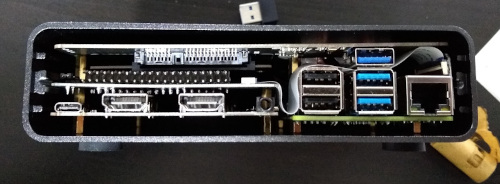
The Annoying DeskPi Pro without rear bezel The case is a little snug; I was worried I was going to damage things as I slid it in. Additionally the construction process is a little involved. There s a good set of instructions, but there are a lot of pieces and screws involved. This includes a couple of FFC cables to join things up. I think this is because they ve attempted to make a compact case rather than allowing a little extra room, and it does have the advantage that once assembled it feels robust without anything loose in it. DeskPi Pro with rear bezel and USB3 dongle I hate the need for an external USB3 dongle to bridge from the Pi to the USB/SATA adaptor. All the cases I ve seen with an internal drive bay have to do this, because the USB3 isn t brought out internally by the Pi, but it just looks ugly to me. It s hidden at the back, but meh. Fan control is via a USB/serial device, which is fine, but it attaches to the USB C power port which defaults to being a USB peripheral. Raspbian based kernels support device tree overlays which allows easy reconfiguration to host mode, but for a Debian based system I ended up rolling my own dtb file. I changed


#include "bcm283x-rpi-usb-peripheral.dtsi"
to
#include "bcm283x-rpi-usb-host.dtsi"
in arch/arm/boot/dts/bcm2711-rpi-4-b.dts and then I did:
cpp -nostdinc -I include -I arch -undef -x assembler-with-cpp \
    arch/arm/boot/dts/bcm2711-rpi-4-b.dts > rpi4.preprocessed
dtc -I dts -O dtb rpi4.preprocessed -o bcm2711-rpi-4-b.dtb
and the resulting bcm2711-rpi-4-b.dtb file replaced the one in /boot/firmware. This isn t a necessary step if you don t want to use the cooling fan in the case, or the front USB ports, and it s not really anyone s fault, but it was an annoying extra step to have to figure out. The DeskPi came with a microSD card that was supposed to have RaspiOS already on it. It didn t, it was blank. In my case that was fine, because I wanted to use Debian, but it was a minor niggle.

The Good I used Gunnar s pre-built Pi Debian image and it Just Worked; I dd d it to the microSD as instructed and the Pi 4 came up with working wifi, video and USB enabling me to get it configured for my network. I did an apt upgrade and got updated to the Buster 10.7 release, as well as the latest 5.9 backport kernel, and everything came back without effort after a reboot. It s lovely to be able to run Debian on this device without having to futz around with self-compiled kernels. The DeskPi makes a lot of effort to route things externally. The SD slot is brought out to the front, making it easy to fiddle with the card contents without having to open the case to replace it. All the important ports are brought out to the back either through orientation of the Pi, or extenders in the case. That means the built in Pi USB ports, the HDMI sockets (conveniently converted to full size internally), an audio jack and a USB-C power port. The aforementioned USB3 dongle for the bridge to the drive is the only external thing that s annoying. Thermally things seem good too. I haven t done a full torture test yet, but with the fan off the system is sitting at about 40 C while fairly idle. Some loops in bash that push load up to above 2 get the temperature up to 46 C or so, and turning the fan on brings it down to 40 C again. It s audible, but quieter than my laptop and not annoying. I liked the way the case came with everything I needed other than the Pi 4 and a suitable disk drive. There was an included PSU (a proper USB-C PD device, UK plug), the heatsink/fan is there, the USB/SATA converter is there and even an SD card is provided (though that s just because I had a pre-order). Speaking of the SD, I only needed it for initial setup. Recent Pi 4 bootloaders are capable of booting directly from USB mass storage devices. So I upgraded using the RPi EEPROM Recovery image (which just needs extracted to the SD FAT partition, no need for anything complicated - boot with it and the screen goes all green and you know it s ok), then created a FAT partition at the start of the drive for the kernel / bootloader config and a regular EXT4 partition for root. Copies everything over, updated paths, took out the SD and it all just works happily.

Summary My main complaint is the broken USB port, which feels like the result of a cheap connector. For a front facing port expected to see more use than the rear ports I think there s a reasonable expectation of robustness. However I m an early adopter and maybe future runs will be better. Other than that I m pretty happy. The case is exactly the sort of thing I wanted; I was looking for something that would turn the Pi into a box that can sit on my desk on the network and that I don t have to worry about knocking wires out of or lots of cables hooking bits up. Everything being included made it very convenient to get up and running. I still haven t poked the Pi that hard, but first impressions are looking good for it being a trouble free ARM64 dev box in the corner, until I can justify a HoneyComb.

14 December 2020

Raphaël Hertzog: Funding Debian development projects with Freexian, first project received!

After an unexpectedly short discussion on debian-project, we re moving forward with this new initiative. The Debian security team submitted a project proposal requesting some improvements to tracker.debian.org, and since nobody of the security team wants to be paid to implement the project, we have opened a request for bids to find someone to implement this on a contractor basis. If you can code in Python following test-driven development and know the Django framework, feel free to submit a bid! Ideally you have some experience with the security tracker too but that s not a strong requirement. About the project If you haven t read the discussion on debian-project, Freexian is putting aside part of the money collected for Debian LTS to use it to fund generic Debian development projects. The goal is two-fold:
  1. First, the LTS work necessarily had an impact on other Debian teams that made the project possible (security team, DSA, buildd, ftpmasters, debian-www mainly) and we wanted to be able to give back to those teams by funding improvements to their infrastructure.
  2. We have always allowed paid contributors to go beyond just preparing security updates for the LTS release. They can pick tasks that improve the LTS project at large (we try to collect such tasks here: https://salsa.debian.org/lts-team/lts-extra-tasks/-/issues) but they should not go over 25% of their allocated monthly hours so this limits their ability to tackle bigger projects and we would like to be able to tackle bigger projects that can have a meaningful impact on the LTS project and/or Debian in general.
We have tried to formalize a process to follow from project submission up to its implementation in this salsa project:
https://salsa.debian.org/freexian-team/project-funding
https://salsa.debian.org/freexian-team/project-funding/-/blob/master/Rules-LTS.md We highly encourage the above-mentioned Debian teams to make proposals. A member of those teams can implement the project and be paid for it. Or they can decide to let someone else implement it (we expect some of the paid LTS contributors to be willing to implement such projects), and just play the reviewer role driving the person doing the work in the right direction. Contrary to Google s Summer of code and other similar projects, we put the focus on the results (and not in recruiting new volunteers), so we expect to work with experienced persons to implement the project. But if the reviewer is happy to be a mentor and spend more time, then it s OK for us too. The reviewer is (usually) not a paid position. If you re not among those teams, but if you have a project that can have a positive impact on Debian LTS (even if only indirectly in the distant future), feel free to try your chance and to submit a proposal.

No comment Liked this article? Click here. My blog is Flattr-enabled.

Vincent Fourmond: Version 3.0 of QSoas is out

After almost two years of development, version 3.0 of QSoas is finally out ! It brings in a number of new features. An expert mode for fitting Undoubtedly the most important feature in the new version is a complete upgrade of the fit system, which now features an expert mode, turned on by using the /expert=true option with the fit commands. The expert mode features a command prompt that looks like the normal command prompt, in which it is possible: The latter feature is very important when running fits with many parameters. In that case, there are a number of local minima, and it is necessary to try a number of different starting parameters to really find the best parameters. The new parameter space exploration feature makes it much easier than before, with an interface that allows easily finding the best parameters tried so far and reuse them.
A new documentation system Another very important update is the inclusion of a new, offline, documentation system. The documentation features browsing via table of contents, a command index and text search. It also features the possibility to copy commands from the help to the command prompt, or even run them directly. To top it all, it comes with a series of startup tips that might teach you a thing or two about QSoas (try hitting Show random to learn new tricks !).
Many other features For the full list of changes, please see the changelog. Apart from the changes described above, these are my favorites:
To get the new version, you can just download the source code from the downloads page, where you can also purchase precompiled versions for Windows and MacOS. You can also clone the source from the GitHub repository. About QSoasQSoas is a powerful open source data analysis program that focuses on flexibility and powerful fitting capacities. It is released under the GNU General Public License. It is described in Fourmond, Anal. Chem., 2016, 88 (10), pp 5050 5052. Current version is 3.0. You can download its source code there (or clone from the GitHub repository) and compile it yourself, or buy precompiled versions for MacOS and Windows there.

13 December 2020

Russ Allbery: Review: Because Internet

Review: Because Internet, by Gretchen McCulloch
Publisher: Riverhead Books
Copyright: 2019
ISBN: 0-7352-1095-0
Format: Kindle
Pages: 276
If you're familiar with linguistics as a field of scientific study (as opposed to the tool-based fields of grammar or writing advice), you'll be familiar with the dichotomy between written and spoken language. We may spend more time thinking about written language since it is central to most types of education and carries much of the intellectual and social weight of society. Linguists, however, see spoken language as more fundamental, since speech is wired into our brains and universal in human societies. Written language is a recent and somewhat artificial invention. One also learns from linguistics that spoken language does not follow many of the rules of written language that we painstakingly memorized in school. In casual speech, people split infinitives, speak in partial and run-on sentences, ignore nit-picking pronoun case rules, and rarely notice or care about the difference between less and fewer. Spoken language does have rules, but they're more subtle and nuanced than the grammar rules we learn in school. (I think the real fun of linguistics is separating the rules that native speakers follow effortlessly from the artificial rules used as education markers.) This is, in part, because nearly all spoken language is informal, whereas nearly all written language is formal. Enter the Internet, and enter this book. For the first time in human history we have both an explosion of informal writing and easy availability of that writing to linguists for study. Informal writing is not entirely new, of course. We've had personal letters for nearly as long as we've had writing, not to mention private notes, diaries, and other writing intended for tiny audiences. But consider who wrote private letters and, on top of that historical filter, whose private letters were preserved for linguistic research. Until relatively recently, only the upper classes were literate and had access to the infrastructure to write and send letters. Someone's letters or private notes were unlikely to be preserved unless they were someone famous and important, and thus often well-educated and more likely to take a more formal tone in writing. If you compare this to the Internet-driven blizzard of work and personal email, SMS conversations, chatrooms, and social media posts, the difference is obvious in both volume and level of informality. We're all on the Internet, we all read and write with a frequency that would be staggering to the average person from even fifty years ago, and while one may take a bit of additional care with a tricky email to one's manager, the SMS message to one's friend is as informal of a use of language as a conversation over coffee. Gretchen McCulloch is a professional linguist and Because Internet is about exactly this phenomenon: the new conventions of informal writing, how it has changed and evolved, and the new subtleties and shortcuts we've invented to make written communication easier. That goes beyond words and grammar to encompass punctuation, emoji and emoticons, memes and reaction gifs, and even the subtleties of timing, whitespace, and the construction of virtual places via our choices in how and where we write. This topic is my catnip, so it's not surprising I love this book. I've been heavily involved with online communities that communicate in writing since 1993 (making me, in McCulloch's classification, an Old Internet Person; each wave of introduction to the Internet has its own conventions that can be in conflict with later waves). I've now spent more than half my life carrying out most of my social activity and most of my closest friendships primarily in writing, so I found a lot of satisfaction in a linguistic study that takes that seriously rather than treating it as a curiosity. But, even better, I was amazed at how much I didn't know, in part because I am from a specific wave. I have a deep intuition for the Usenet conventions, but not as good of an understanding of the ones from AIM and LiveJournal one wave later (the Full Internet People). And I had a lot to learn about the conventions of the Instagram and Snapchat cluster (the Post Internet People, who have never known life without the Internet). One of the things that struck me while reading this book is how most of the language innovations that McCulloch describes are addressing the old complaint that written communication is inferior to face-to-face conversation because it lacks emotional nuance. My knee-jerk reply is that, no, written communication is full of emotional nuance and the complainer is just bad at reading it, but that's somewhat unfair. A better statement of the problem is that there is not a standardized language for emotional nuance in written communication, in part because it's so new in human history. Most humans are extremely good at reading facial expressions and body language for emotional cues, and those physical expressions are largely subconscious, reliable, and similar among different people (particularly within a culture; one can get in trouble with body language variations across cultures). This is not true of writing. With friends I've talked to over chat for twenty-five years, I can read volumes about their emotional state in a couple of short lines of text. But with strangers, despite decades of Internet communications, I will still misread cues and misinterpret simple intentions. The other standard response to this complaint is that it is possible to put extensive emotional nuance into formal writing. Just get better at writing! This is true, but unhelpful. There's a reason why we give book contracts to people who are very good at investing formal writing with emotional nuance. It's difficult, time-consuming, and requires a great deal of practice. That may be appropriate for formal, paid writing, but it won't do for informal writing, which by definition needs to be as effortless as possible. It's therefore unsurprising that once millions of people were using the Internet regularly for informal writing, they started adding new mechanisms, shortcuts, and conventions for emotional nuance. The standardization is growing, but conventions still vary widely between waves of Internet users. One of the most fascinating parts of this book for me was McCulloch's explanation of why periods (and, to a lesser extent, capital letters) in short chat messages are perceived by younger users as harsh or passive-aggressive. I still have the formal writing mindset of treating proper capitalization and punctuation as a point of pride, but McCulloch makes an excellent argument for letting go of my biases and understanding how and why language is changing. The realization I had while reading this is that many of the changes that look like sloppiness or laziness to someone trained in formal writing have the effect of giving language greater dynamic range. If one always uses periods uniformly, the period becomes meaningless except as a sentence boundary (which is redundant with newlines in most short informal chat messages). If one normally doesn't use it, and then suddenly starts using it, the period can carry semantic weight. It can convey a snippy tone of voice, a note of annoyance, or other subtle shades of meaning. I still use periods in most of my Slack messages because habits are hard to break, but I'm remembering to leave them off some of the time and paying more attention to what emotional weight they're carrying when present. Because Internet is therefore the rare book that meets the bar of changing my day-to-day behavior. "lol" is another excellent example that McCulloch spends some time on. It started life as LOL, an abbreviation for "laughing out loud," and that's still how it's stuck in my head. But, as McCulloch explains, it no longer means that to newer waves of Internet users. It now carries a far more complicated and nuanced meaning that has very little to do with physical laughter and that doesn't easily translate to a single word or sentence. I went from being mildly irritated by and mildly superior towards the ubiquitous "lol" to realizing that it's a fascinating new word that carries primarily emotional nuance and that I don't understand well enough to read or use properly (yet). One more example of the type of analysis McCulloch brings to this book: emoji. The tendency when talking about emoji is to treat them as rebuses (pictures that stand in for a word, or at least a specific concept). They are sometimes used that way, but McCulloch argues that they more often function in the same role that gestures play in informal speech, including the gestures that have no simple name and no independent meaning outside of the context of the words being said at the same time. This seems obvious in retrospect, but before reading Because Internet I had never thought about what a gesture is, what function it plays in speech, and how that could be translated into informal written communication. If you're as interested in this area as I am, this is great stuff. I'd seen several mentions of this book go past on Twitter and kept holding off because I had lots of things to read and was worried it would only cover the superficial things I already knew as a long-time Internet user who has listened to a few lectures on linguistics. That was not the case at all. I learned so much from this book and had a delightful time reading it. If you're also interested in these topics, recommended. Rating: 9 out of 10

11 December 2020

Evgeni Golov: systemd + SELinux =

Okay, getting a title that will ensure clicks for this post was easy. Now comes the hard part: content! When you deploy The Foreman, you want a secure setup by default. That's why we ship (and enable) a SELinux policy which allows you to run the involved daemons in confined mode. We have recently switched our default Ruby application server from Passenger (running via mod_passenger inside Apache httpd) to Puma (running standalone and Apache just being a reverse proxy). While doing so, we initially deployed Puma listening on localhost:3000 and while localhost is pretty safe, a local user could still turn out evil and talk directly to Puma, pretending to be authenticated by Apache (think Kerberos or X.509 cert auth). Obviously, this is not optimal, so the next task was to switch Puma to listen on an UNIX socket and only allow Apache to talk to said socket. This doesn't sound overly complicated, and indeed it wasn't. The most time/thought was spent on doing that in a way that doesn't break existing setups and still allows binding to a TCP socket for setups where users explicitly want that. We also made a change to the SELinux policy to properly label the newly created socket and allow httpd to access it. The whole change was carefully tested on CentOS 7 and worked like a charm. So we merged it, and it broke. Only on CentOS 8, but broken is broken, right? This is the start of my Thanksgiving story "learn how to debug SELinux issues" ;) From the logs of our integration test I knew the issue was Apache not being able to talk to that new socket (we archive sos reports as part of the tests, and those clearly had it in the auditd logs). But I also knew we did prepare our policy for that change, so either our preparation was not sufficient or the policy wasn't properly loaded. The same sos report also contained the output of semanage fcontext --list which stated that all regular files called /run/foreman.sock would get the foreman_var_run_t type assigned. Wait a moment, all regular files?! A socket is not a regular file! Let's quickly make that truly all files. That clearly changed the semanage fcontext --list output, but the socket was still created as var_run_t?! It was time to actually boot a CentOS 8 VM and try more things out. Interestingly, you actually can't add a rule for /run/something, as /run is an alias (equivalency in SELinux speak) for /var/run:
# semanage fcontext --add -t foreman_var_run_t /run/foreman.sock
ValueError: File spec /run/foreman.sock conflicts with equivalency rule '/run /var/run'; Try adding '/var/run/foreman.sock' instead
I have no idea how the list output in the report got that /run rule, but okay, let's match /var/run/foreman.sock. Did that solve the issue? Of course not! And you knew it, as I didn't get to the juciest part of the headline yet: systemd! We use systemd to create the socket, as it is both convenient and useful (no more clients connecting before Rails has finished booting). But why is it wrongly labeling our freshly created socket?! A quick check with touch shows that the policy is correct now, the touched file gets the right type assigned. So it must be something with systemd A bit of poking (and good guesswork based on prior experience with a similar issue in Puppet: PUP-2169 and PUP-10548) led to the realization that a systemctl daemon-reexec after adding the file context rule "fixes" the issue. Moving the poking to Google, you quickly end up at systemd issue #9997 which is fixed in v245, but that's in no EL release yet. And indeed, the issue seems fixed on my Fedora 33 with systemd 246, but I still need it to work on CentOS 7 and 8 Well, maybe that reexec isn't that bad after all? At least the socket is now properly labeled and httpd can connect to it on CentOS 8. Btw, no idea why the connection worked on CentOS 7, as there the socket was also wrongly labeled, but SELinux didn't deny httpd to open it. Big shout out to lzap and ewoud for helping me with this beast!

10 December 2020

John Goerzen: How the Attention Economy Hurts You via Social Media Sites like Facebook

There is a whole science to manipulating our attention. And because there is a lot of money to be made by doing this well, it means we all encounter attempts to manipulate what we pay attention to each day. What is this, and how is it harmful? This post will be the first on a series on the topic. Why is attention so important? When people use Facebook, they use it for free. Facebook generally doesn t even try to sell them anything, yet has billions in revenues. What, then, is Facebook s product? Well, really, it s you. Or, more specifically, your attention. Facebook sells your attention to advertisers. Everything they do is in service to that. They want you to spend more time on the site so they can show you more ads. (I should say here that I m using Facebook as an example, but this applies to other social media companies too.) Seeking to maximize attention So if your attention is so important to their profit, it follows naturally that they would seek ways to get people to spend more time on their site. And they do. They track all sorts of metrics, including engagement (if you click like , comment, share, or otherwise interact with content). They know which sorts of things are likely to capture your (and I mean you in specific!) attention and show you that. Your neighbor may have different interests and Facebook judges different things are likely to capture their attention. Manipulating your attention Attention turning into money isn t unique for social media. In fact, in the article If It Bleeds, It Leads: Understanding Fear-Based Media, Psychology Today writes:
In previous decades, the journalistic mission was to report the news as it actually happened, with fairness, balance, and integrity. However, capitalistic motives associated with journalism have forced much of today s television news to look to the spectacular, the stirring, and the controversial as news stories. It s no longer a race to break the story first or get the facts right. Instead, it s to acquire good ratings in order to get advertisers, so that profits soar. News programming uses a hierarchy of if it bleeds, it leads. Fear-based news programming has two aims. The first is to grab the viewer s attention. In the news media, this is called the teaser. The second aim is to persuade the viewer that the solution for reducing the identified fear will be in the news story. If a teaser asks, What s in your tap water that YOU need to know about? a viewer will likely tune in to get the up-to-date information to ensure safety.
You ve probably seen fear-based messages a lot on Facebook. They will highlight messages to liberals about being afraid of what Trump is doing, and to conservatives about being afraid of what Biden is doing. They may or may not even intentionally be doing this; it is their algorithm predicts that those would maximize time and engagement for certain people, so that s what they see. Fear leads to controversy It s not just fear, though. Social media also loves controversy. There s nothing that makes people really want to stay on Facebook like anger. See something controversial and you ll see hundreds or thousands of people are there arguing about it and in the process, giving Facebook their attention. A quick Internet search will show you numerous articles on how marketing companes can leverage controvery to get attention and engagement with their campaigns. Consequences of maximizing fear and controversy What does it mean to society at large and to you personally that large companies make a lot of money by maximizing fear and controversy? The most obvious way is it leads to less common ground. If the posts and reactions that show common ground are never seen because they don t drive engagement, it poisons the well; left and right hate each other with ever more vigor a profitable outcome to Facebook, but a poisonous one to all of us. I have had several friendships lost because I a liberal in agreement with these friends on political matters still talk to Trump voters. On the other side, we ve seen people storm the Michigan statehouse with weapons. How did that level of disagreement and even fear behind it get so firmly embedded in our society? Surely the fact that social media shows us things designed to stimulate fear and anger must play a role. What does it do to our ability to have empathy for, and understand, others? The Facebook groups I ve been in for like-minded people have largely been flooded with memes calling the President rump and other things clearly designed to make people angry or fearful. It s a worthless experience, and not just that, but it s a harmful experience. When our major media TV and social networks all are optimizing for fear, anger, and controvesry, we have a society beholden to fear, anger, and controvesy. In my next installment, I m going to talk about what to do about this, including the decentralized social networks of the Fediverse that are specifically designed to put you back in charge of your attention. Update 2020-12-16: There are two followup articles for this: how to join the Fediverse and non-creepy technology purchasing and gifting guides. The latter references the FSF s page on software manipulation towards addiction, which is particularly relevant to this topic.

Jonathan Carter: CentOS Stream, or Debian?

It s the end of CentOS as we know it Earlier this week, the CentOS project announced the shift to CentOS stream. In a nutshell, this means that they will discontinue being a close clone of RHEL along with security updates, and instead it will serve as a development branch of RHEL. As you can probably imagine (or gleam from the comments in that post I referenced), a lot of people are unhappy about this. One particular quote got my attention this morning while catching up on this week s edition of Linux Weekly News, under the distributions quotes section:

I have been doing this for 17 years and CentOS is basically my life s work. This was (for me personally) a heart wrenching decision. However, i see no other decision as a possibility. If there was, it would have been made.Johnny Hughes
I feel really sorry for this person and can empathize, I ve been in similar situations in my life before where I ve poured all my love and energy into something and then due to some corporate or organisational decisions (and usually poor ones), the project got discontinued and all that work that went into it vanishes into the ether. Also, 17 years is really long to be contributing to any one project so I can imagine that this must have been especially gutting.

Throw me a freakin bone here I m also somewhat skeptical of how successful CentOS Stream will really be in any form of a community project. It seems that Red Hat is expecting that volunteers should contribute to their product development for free, and then when these contributors actually want to use that resulting product, they re expected to pay a corporate subscription fee to do so. This seems like a very lop-sided relationship to me, and I m not sure it will be sustainable in the long term. In Red Hat s announcement of CentOS Stream, they kind of throw the community a bone by saying In the first half of 2021, we plan to introduce low- or no-cost programs for a variety of use cases - it seems likely that this will just be for experimental purposes similar to the Windows Insider program and won t be of much use for production users at all. Red Hat does point out that their Universal Base Image (UBI) is free to use and that users could just use that on any system in a container, but this doesn t add much comfort to the individuals and organisations who have contributed huge amounts of time and effort to CentOS over the years who rely on a stable, general-purpose Linux system that can be installed on bare metal.

Way forward for CentOS users Where to from here? I suppose CentOS users could start coughing up for RHEL subscriptions. For many CentOS use cases that won t make much sense. They could move to another distribution, or fork/restart CentOS. The latter is already happening. One of the original founders of the CentOS project, Gregory Kurtzer, is now working on Rocky Linux, which aims to be a new free system built from the RHEL sources. Some people from Red Hat and Canonical are often a bit surprised or skeptical when I point out to them that binary licenses are also important. This whole saga is yet another data point, but it proves that yet again. If Red Hat had from the beginning released RHEL with free sources and unobfuscated patches, then none of this would ve been necessary in the first place. And while I wish Rocky Linux all the success it aims to achieve, I do not think that working for free on a system that ultimately supports Red Hat s selfish eco-system is really productive or helpful. The fact is, Debian is already a free enterprise-scale system already used by huge organisations like Google and many others, which has stable releases, LTS support and ELTS offerings from external organisations if someone really needs it. And while RHEL clones have come and gone through the years, Debian s mission and contract to its users is something that stays consistent and I believe Debian and its ideals will be around for as long as people need Unixy operating systems to run anywhere (i.e. a very long time). While we sometimes fall short of some of our technical goals in Debian, and while we don t always agree on everything, we do tend to make great long-term progress, and usually in the right direction. We ve proved that our method of building a system together is sustainable, that we can do so reliably and timely and that we can collectively support it. From there on it can only get even better when we join forces and work together, because when either individuals or organisations contribute to Debian, they can use the end result for both private or commercial purposes without having to pay any fee or be encumbered by legal gotchas. Don t get caught by greedy corporate motivations that will result in you losing years of your life s work for absolutely no good reason. Make your time and effort count and either contribute to Debian or give your employees time to do so on company time. Many already do and reap the rewards of this, and don t look back. While Debian is a very container and virtualization friendly system, we ve managed to remain a good general-purpose operating system that manages to span use cases so vast that I d have to use a blog post longer than this one just to cover them. And while learning a whole new set of package build chain, package manager and new organisational culture and so on can be uhm, really rocky at the start, I d say that it s a good investment with Debian and unlikely to be time that you ll ever felt was wasted. As Debian project leader, I m personally available to help answer any questions that someone might have if they are interested in coming over to Debian. Feel free to mail leader_AT_debian.org (replace _AT_ with @) or find me on the oftc IRC network with the nick highvoltage. I believe that together, we can make Debian the de facto free enterprise system, and that it would be to the benefit of all its corporate users, instead of tilting all the benefit to just one or two corporations who certainly don t have your best interests in mind.

9 December 2020

Shirish Agarwal: Farm Laws and Too much Democracy

Issues with Farm Laws While I have written about the farm laws a bit sometime back. The issue is still in the nation s eye and that is due to the policies which have been done. I have been reading up on it quite a bit and also have been seeing what has been happening in here and now. The problems are with the three bills themselves which I have shared as below Click to access farmers-produce-trade-and-commerce-promotion-and-facilation-bill.pdf Click to access farmers-empowerment-and-protection-bill.pdf Click to access essential-commodities-bill-2020.pdf Biggest issue with the laws While there are many issues with the laws themselves but for me the biggest issue is that the fundamental right of the farmer to get justice via civil courts has been railroaded. From the laws itself. Standard disclaimer not a lawyer, please consult one for any issues per-se.

Farmers-produce-trade-and-commerce (promotion and facilitation-bill) 2020 Page 4 Chapter 3 Section 8 (1)8. (1) In case of any dispute arising out of a transaction between the farmer and a trader under section 4, the parties may seek a mutually acceptable solution through conciliation by filing an application to the Sub-Divisional Magistrate who shall refer such dispute to a Conciliation Board to be appointed by him for facilitating the binding settlement of the dispute. (2) Every Board of Conciliation appointed by the Sub-Divisional Magistrate under sub-section (1), shall consist of a chairperson and such members not less than two and not more than four, as the Sub-Divisional Magistrate may deem fit.10 (5) If the parties to the transaction under sub-section (1) are unable to resolve the dispute within thirty days in the manner set out under this section, they may approach the Sub-Divisional Magistrate concerned who shall be the Sub-Divisional Authority for settlement of such dispute. (8) Any party aggrieved by the order of the Sub-Divisional Authority may prefer an appeal before the Appellate Authority (Collector or Additional Collector nominated by the Collector) within thirty days of such order who shall dispose of the appeal within thirty days from the date of filing of such appeal. 10. (1) Any person aggrieved by an order under section 9 may, prefer an appeal within sixty days from the date of such order, to an officer not below the rank of Joint Secretary to the Government of India to be nominated by the Central Government for this purpose: Page 6 of the bill. 13. No suit, prosecution or other legal proceedings shall lie against the Central Government or the State Government, or any officer of the Central Government or the State Government or any other person in respect of anything which is in good faith done or intended to be done under this Act or of any rules or orders made thereunder. Page 7 of the bill, 15. No civil court shall have jurisdiction to entertain any suit or proceedings in respect of any matter, the cognizance of which can be taken and disposed of by any authority empowered by or under this Act or the rules made thereunder. Now the same laws have been reiterated for the farmers (Empowerment and Protection) Agreement on Price Assurance and Farm Services Bill, 2020. The problem is that too much power is being put into the hands of the executive. All the three, whether it is SDM (Sub-Divisional Magistrate) , the Appellate Authority or the Government Secretary directly are subservient to the whims and fancies of the Central Govt. They after all get their salaries from the Govt. itself. So there will be no independent oversight to any injustices done to the farmer. The third bill i.e. the Essential Commodities Bill, 2020 does away with stock limits on traders and big players like Adani and Ambani. This means that both these players can take and keep produce at their end thereby forcing consumers like you and me who at the retail end would have to pay higher prices for fruits and vegetables while from the producer they will take at the lowest price possible. While I have shared is just one of the points. That is the reason why even the Supreme Court bar association which almost never takes part in politics has been forced to take sides with the farmers. In many ways, one is forced to remember the Emergency  Update 11/12/20 Came across this article on the wire which tells how everybody s rights, not just the farmer s rights are being shod over. I think it depicts correctly the signs of time to come. While arguing on SM, also came to know about Article 300 (1), thanks to Sachin Kumar which shows multiple instances where Government was sued because somebody was working in official capacity and did mistakes, malafide or otherwise and it was the state who was made to pay. FWIW, today farmers from Maharashtra, my state arrived at Delhi border where they were also kept at bay. I did come across an infographic which shows how the various states have fared. Most tellingly, is the state of Bihar. It was in 2006 (one of the most backward states) where APMC was taken off. While others have tried to paint a flattering picture of Bihar, they have failed to share that in the interim 15 odd years, there hasn t been any sort of infrastructure created for farmers which is the reason it is still the lowest earner. These are the last available figures we have about the farmer s income. From 2014 to 2020 there hasn t been any update.
Situation Assessment Survey of Agricultural Household 2013 Copyright GOI,
This concludes just one portion of the bill. I will take other parts of the bill. I may dwell on some other parts as and when I have the time. A cartoon which depicts the current issue
I stand with farmers Copyright Sanitary Panels
Too much democracy Amitabh Kant Yesterday, the Niti Aayog chief Amitabh Kant remarked that we are too much of a democracy at an event called for Atmanirbhar Bharat which is basically a coinage for import substitution. Whether this is desirable or not I have argued and if needed will re-argue the same later as well. What is and was interesting were the gentleman s context, the media reactions and our overall Democracy Index which has been going downhill for quite some years. Now the gentleman who is the Niti Aayog chief and who is supposed to have the ear of the Prime Minister had opined it in an event organized by Swarajya Magazine (a far-right magazine) known to be Islamophobic and all things undemocratic. It has been a target of defundthehate campaign and with good reason. But that s a different story altogether. His full statement was as below

Tough reforms are very difficult in the Indian context, as we are too much of a democracy but the government has shown courage and determination in pushing such reforms across sectors, including mining, coal, labour and agriculture. Niti Aayog chief. The upper quotation remarks and the statement has been from the article in Indian Express which I have linked to. I have archived it as a pdf just in case the link goes dead. Yesterday, after the statement became viraled, tweets of media houses which shared the tweet suddenly become unavailable. Seems too much democracy, became too little democracy all of a sudden. I think Mr. Amitabh Kant didn t visualize as the opposition as well as most people who are on Twitter to share their opinion on the same. Few examples
Too much Democracy copyright Satish Acharya
Too much democracy Illustration and Copyright Alok
Sterlite protest 13 dead, 100 injured Copyright Business Standard too much democracy
Erosion of Democracy V-dem institute Copyright The Hindu Web Team
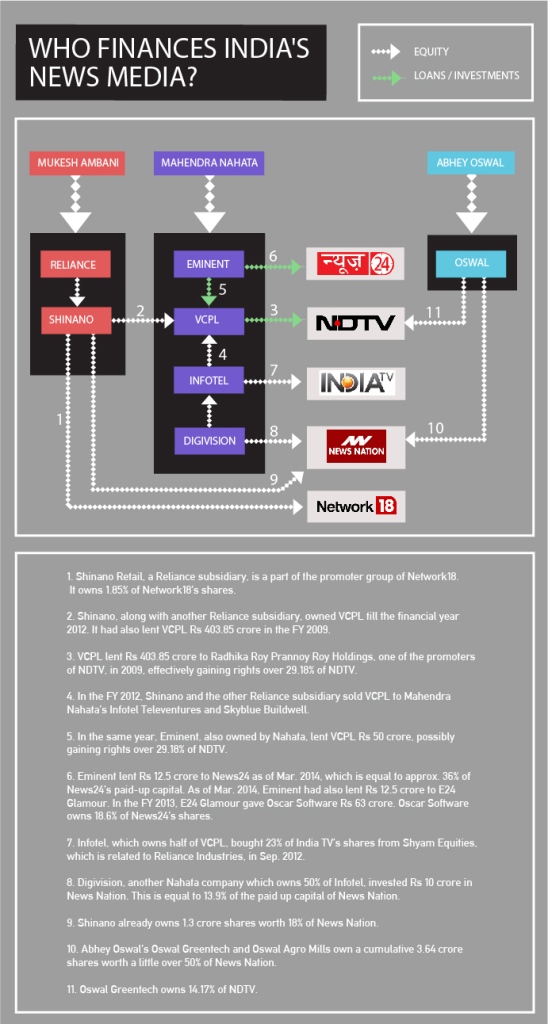
The last one requires a bit more information. This comes from V-Dem Institute which is an independent research institute based out of Department of Political Science, University of Gothenburg, Sweden. I am gonna leave the methods they use for another day as the blog post itself has become rather big/large. Apart from that is the Economists own Democracy Index -2019 Click to access democracy-index-2019.pdf Now for many people, both the V-Dem report and the Economist Index are some sort of attack against India. Doesn t matter that in V-Dem 200+ countries have been taken a variety of indicators and data or the Economist which has data from 150+- countries. Somehow India is supposed to be bigger than all these countries, they do think that other countries data specifically our neighbor China or any other neighbor, those are all accurate. How the dissonance is, has to be gauged from statements of various people. Update 11/12/20 Sadly, the newest V-Dem report marks India as getting into authoritarianism. Gag on Press and Media owners I had shared about the gag on the press especially with respect to western media or reports or anything. This news made its way to straitstimes which normally covers a wide-range of stories covering East Asia vis-a-vis India/South-East Asia. What has also been a big worry that most of the media has been in the hands of a few people. Caravan ran a story on the same in 2016, it has been four years, god only knows what the current situation might be. Any wonder that there is dearth of investigative journalism in India.
India media ownership 2016 Copyright Caravan
Incidentally, a reporter called Akarshan Uppal, who is a reporter on a channel called IBN24 had showecased just few days back how Adani has got land which was shot down for land change use in 2017 to 2020 around 100 acres. There seem to be very less details as to how the land was acquired, whose land it was etc. etc. The reporter was supposedly following a story on drugs on which he was attacked and is now lying in hospital.
Akarshan Uppal Reporter, IBN24 Copyright IBN24
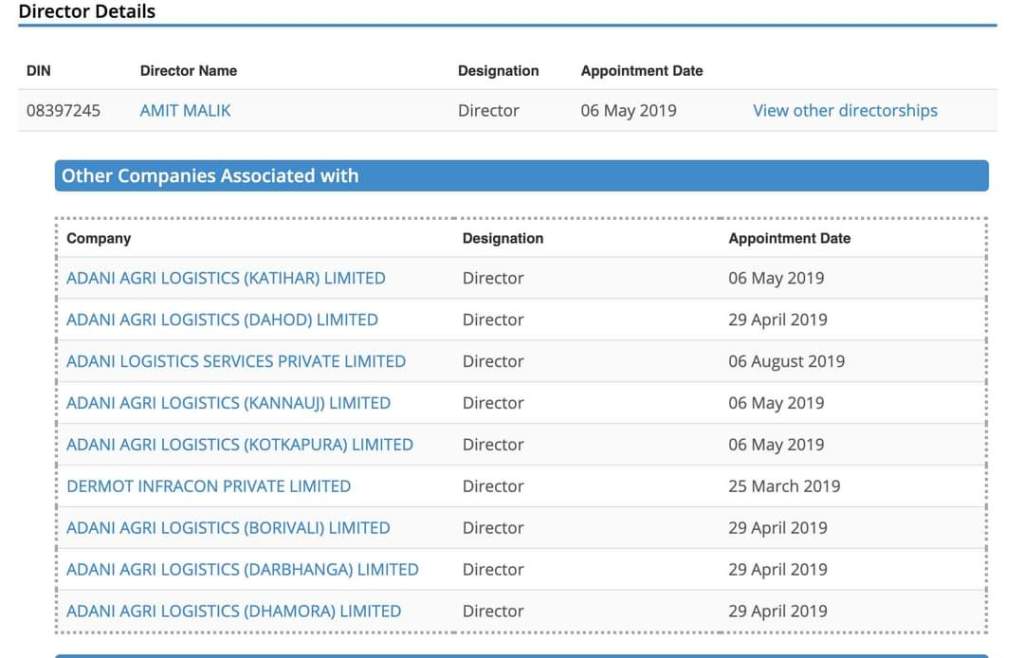
While it would take a whole article/blog post to talk about either Adani or Ambani, in the recent case, the land that has been taken over by Adani is 100 acres and there are private rail lines. And all of this was secret till few days back. The place where these massive godowns/silos have been made are Panipat s Jondhan Kalan and Naultha villages in Haryana. This is Adani AgiLogistics. Almost 7 odd companies have registered and come up in the last couple of years. As can be seen, almost all have come up within the last 2-3 years. Seems to be a lot of coincidence, isn t it?
Personal Anecdote on Data Collection and child marriages in India.

Around 1995 -96 when Internet had started to become a thing in India, there had been quite a few non-profits which were working on various issues. One of those which I initially came in contact with and which I found to be a bit absurd was non-profit which was working in the field of women against Violence. Now it is and was not the concept or the idea which was absurd to me, it was what these women were doing. Instead of the traditional ways in which you counsel women and try and figure out issues, these women were collecting data points from newspapers and magazines. This was way way before data science became a thing in India. They had their own structure where a story about violence against women which would be above the fold would be 5 points, the one below 2.5 points, in inner pages, it would be less and less. Patriarchy at that time was so strong, even today is but at that time it was such, that it felt a waste of time. I did consult them but never said that but did privately feel the above. In hindsight, they were doing the right thing and yet even today crimes against women goes unreported and is suppressed by both State and Central Governments as well as NCRB (National Crime Records Bureau). Interestingly, just few days back, the case against M.J. Akbar by Priya Ramani had taken a back seat and the defamation case by M.J. Akbar was taken forward. Even then, Priya Ramani s counsel s arguments were such that the court wound up in half an hour when they were expecting to do a whole day hearing. The next hearing would be happening today which I will look at in few hours from now. Why Priya Ramani was singled out rather than other tweets may probably be because she is an NRI and most NRI s usually do not want to be part of the bureaucratic Indian court system. This is also the reason that most companies from outside India especially those who are into startups prefer to change ownership, IPR etc. to their own or any country outside India which does make a loss to the exchequer. But this again is a story for another day. At the end, while I did not want to end on a negative note, it seems in many ways status-quo remains. For e.g. 2 years back, a BJP candidate (part of the ruling dispensation) had made a controversy saying that if they win the police won t interfere in child marriages. This is and was in Rajasthan where they have been trying to eradicate it forever. Till date, neither the NHRC (National Human Rights Commission) nor NCW (National Commission for Women) has taken cognizance of the statement. This is our state of democracy.

8 December 2020

Russell Coker: Links December 2020

Business Insider has an informative article about the way that Google users can get locked out with no apparent reason and no recourse [1]. Something to share with clients when they consider putting everything in the cloud . Vice has an interestoing article about people jailbreaking used Teslas after Tesla has stolen software licenses that were bought with the car [2]. The Atlantic has an interesting article titled This Article Won t Change Your Mind [3]. It s one of many on the topic of echo chambers but has some interesting points that others don t seem to cover, such as regarding the benefits of groups when not everyone agrees. Inequality.org has lots of useful information about global inequality [4]. Jeffrey Goldberg has an insightful interview with Barack Obama for the Atlantic about the future course of American politics and a retrospective on his term in office [5]. A Game Designer s Analysis Of QAnon is an insightful Medium article comparing QAnon to an augmented reality game [6]. This is one of the best analysis of QAnon operations that I ve seen. Decrypting Rita is one of the most interesting web comics I ve read [7]. It makes good use of side scrolling and different layers to tell multiple stories at once. PC Mag has an article about the new features in Chrome 87 to reduce CPU use [8]. On my laptop I have 1/3 of all CPU time being used when it is idle, the majority of which is from Chrome. As the CPU has 2 cores this means the equivalent of 1 core running about 66% of the time just for background tabs. I have over 100 tabs open which I admit is a lot. But it means that the active tabs (as opposed to the plain HTML or PDF ones) are averaging more than 1% CPU time on an i7 which seems obviously unreasonable. So Chrome 87 doesn t seem to live up to Google s claims. The movie Bad President starring Stormy Daniels as herself is out [9]. Poe s Law is passe. Interesting summary of Parler, seems that it was designed by the Russians [10]. Wired has an interesting article about Indistinguishability Obfuscation, how to encrypt the operation of a program [11]. Joerg Jaspert wrote an interesting blog post about the difficulties packagine Rust and Go for Debian [12]. I think that the problem is many modern languages aren t designed well for library updates. This isn t just a problem for Debian, it s a problem for any long term support of software that doesn t involve transferring a complete archive of everything and it s a problem for any disconnected development (remote sites and sites dealing with serious security. Having an automatic system for downloading libraries is fine. But there should be an easy way of getting the same source via an archive format (zip will do as any archive can be converted to any other easily enough) and with version numbers.

4 December 2020

Dirk Eddelbuettel: #31: Test your R package against bleeding-edge gcc

Welcome to the 31th post in the rapturously rampant R recommendations series, or R4 for short. This post will once again feature Docker for use with R. Earlier this week, I received a note from CRAN about how my RcppTOML package was no longer building with the (as of right now of course unreleased) version 11 of the GNU C++ compiler, i.e. g++-11. And very kindly even included a hint about the likely fix (which was of course correct). CRAN, and one of its maintainers in particular, is extremely forward-looking in terms of toolchain changes. A year ago we were asked to updated possible use of global variables in C code as gcc-10 tightened the rules. This changes is a C++ one, and a fairly simple one of simply being more explicit with include headers. Previous g++ release had done the same. The question now was about the least painful way to get g++-11 onto my machine, with the least amount of side-effects. Regular readers of this blog will know where this is headed, but even use of Docker requires binaries. A look at g++-11 within packages.debian.org comes up empty. No Debian means no Ubuntu. But there is a PPA for Ubuntu with toolchain builds we have used before. And voil there we have it: within the PPA for Ubuntu Toolchain repository is the volatile packages PPA with both g++-10 and g++-11. Here Ubuntu 20.10 works with g++-10, but g++-11 requires Ubuntu 21.04. Docker containers are there for either. So with the preliminaries sorted out, the key steps are fairly straightforward: And that is it! RcppTOML is fairly minimal and could be a member of the tinyverse so no other dependencies are needed if your package has any you could just use the standard steps to install from source, or binary (including using RSPM or bspm). You can see the resulting Dockerfile which contains a minimal amount of extra stuff to deal with some environment variables and related settings. Nothing critical, but it smoothes the experience somewhat. This container is now built (under label rocker/r-edge with tags latest and gcc-11), and you can download it from Docker Hub. With that the proof of the (now fixed and uploaded) package building becomes as easy as

edd@rob:~/git/rcpptoml(master)$ docker run --rm -ti -v $PWD:/mnt -w /mnt rocker/r-edge:gcc-11 g++ --version
g++ (Ubuntu 11-20201128-0ubuntu2) 11.0.0 20201128 (experimental) [master revision fb6b29c85c4:a331ca6194a:e87559d202d90e614315203f38f9aa2f5881d36e]
Copyright (C) 2020 Free Software Foundation, Inc.
This is free software; see the source for copying conditions.  There is NO
warranty; not even for MERCHANTABILITY or FITNESS FOR A PARTICULAR PURPOSE.

edd@rob:~/git/rcpptoml(master)$ 
edd@rob:~/git/rcpptoml(master)$ docker run --rm -ti -v $PWD:/mnt -w /mnt rocker/r-edge:gcc-11 R CMD INSTALL RcppTOML_0.1.7.tar.gz
* installing to library  /usr/local/lib/R/site-library 
* installing *source* package  RcppTOML  ...
** using staged installation
** libs
g++ -std=gnu++11 -I"/usr/share/R/include" -DNDEBUG -I../inst/include/ -DCPPTOML_USE_MAP -I'/usr/lib/R/site-library/Rcpp/include'    -fpic  -g -O2 -fdebug-prefix-map=/build/r-base-Fuvi9C/r-base-4.0.3=. -fstack-protector-strong -Wformat -Werror=format-security -Wdate-time -D_FORTIFY_SOURCE=2 -g  -c RcppExports.cpp -o RcppExports.o
g++ -std=gnu++11 -I"/usr/share/R/include" -DNDEBUG -I../inst/include/ -DCPPTOML_USE_MAP -I'/usr/lib/R/site-library/Rcpp/include'    -fpic  -g -O2 -fdebug-prefix-map=/build/r-base-Fuvi9C/r-base-4.0.3=. -fstack-protector-strong -Wformat -Werror=format-security -Wdate-time -D_FORTIFY_SOURCE=2 -g  -c parse.cpp -o parse.o
g++ -std=gnu++11 -shared -L/usr/lib/R/lib -Wl,-Bsymbolic-functions -Wl,-z,relro -o RcppTOML.so RcppExports.o parse.o -L/usr/lib/R/lib -lR
installing to /usr/local/lib/R/site-library/00LOCK-RcppTOML/00new/RcppTOML/libs
** R
** inst
** byte-compile and prepare package for lazy loading
** help
*** installing help indices
** building package indices
** testing if installed package can be loaded from temporary location
** checking absolute paths in shared objects and dynamic libraries
** testing if installed package can be loaded from final location
** testing if installed package keeps a record of temporary installation path
* DONE (RcppTOML)
edd@rob:~/git/rcpptoml(master)$ 
I hope both the availability of such a base container with gcc-11 (and g++-11 and gfortran-11) as well as a recipe for building similar containers with newer clang version will help other developers. If you like this or other open-source work I do, you can sponsor me at GitHub.

This post by Dirk Eddelbuettel originated on his Thinking inside the box blog. Please report excessive re-aggregation in third-party for-profit settings.

3 December 2020

Alberto Garc a: Subcluster allocation for qcow2 images

In previous blog posts I talked about QEMU s qcow2 file format and how to make it faster. This post gives an overview of how the data is structured inside the image and how that affects performance, and this presentation at KVM Forum 2017 goes further into the topic. This time I will talk about a new extension to the qcow2 format that seeks to improve its performance and reduce its memory requirements. Let s start by describing the problem. Limitations of qcow2 One of the most important parameters when creating a new qcow2 image is the cluster size. Much like a filesystem s block size, the qcow2 cluster size indicates the minimum unit of allocation. One difference however is that while filesystems tend to use small blocks (4 KB is a common size in ext4, ntfs or hfs+) the standard qcow2 cluster size is 64 KB. This adds some overhead because QEMU always needs to write complete clusters so it often ends up doing copy-on-write and writing to the qcow2 image more data than what the virtual machine requested. This gets worse if the image has a backing file because then QEMU needs to copy data from there, so a write request not only becomes larger but it also involves additional read requests from the backing file(s). Because of that qcow2 images with larger cluster sizes tend to: Unfortunately, reducing the cluster size is in general not an option because it also has an impact on the amount of metadata used internally by qcow2 (reference counts, guest-to-host cluster mapping). Decreasing the cluster size increases the number of clusters and the amount of necessary metadata. This has direct negative impact on I/O performance, which can be mitigated by caching it in RAM, therefore increasing the memory requirements (the aforementioned post covers this in more detail). Subcluster allocation The problems described in the previous section are well-known consequences of the design of the qcow2 format and they have been discussed over the years. I have been working on a way to improve the situation and the work is now finished and available in QEMU 5.2 as a new extension to the qcow2 format called extended L2 entries. The so-called L2 tables are used to map guest addresses to data clusters. With extended L2 entries we can store more information about the status of each data cluster, and this allows us to have allocation at the subcluster level. The basic idea is that data clusters are now divided into 32 subclusters of the same size, and each one of them can be allocated separately. This allows combining the benefits of larger cluster sizes (less metadata and RAM requirements) with the benefits of smaller units of allocation (less copy-on-write, smaller images). If the subcluster size matches the block size of the filesystem used inside the virtual machine then we can eliminate the need for copy-on-write entirely. So with subcluster allocation we get: This figure shows the average number of I/O operations per second that I get with 4KB random write requests to an empty 40GB image with a fully populated backing file.
I/O performance comparison between traditional and extended qcow2 images
Things to take into account: How to use this? Extended L2 entries are available starting from QEMU 5.2. Due to the nature of the changes it is unlikely that this feature will be backported to an earlier version of QEMU. In order to test this you simply need to create an image with extended_l2=on, and you also probably want to use a larger cluster size (the default is 64 KB, remember that every cluster has 32 subclusters). Here is an example:
$ qemu-img create -f qcow2 -o extended_l2=on,cluster_size=128k img.qcow2 1T
And that s all you need to do. Once the image is created all allocations will happen at the subcluster level. More information This work was presented at the 2020 edition of the KVM Forum. Here is the video recording of the presentation, where I cover all this in more detail: You can also find the slides here. Acknowledgments This work has been possible thanks to Outscale, who have been sponsoring Igalia and my work in QEMU.
Igalia and Outscale
And thanks of course to the rest of the QEMU development team for their feedback and help with this!

Dirk Eddelbuettel: RcppTOML 0.1.7: Support for g++-11, Minor Updates

A new RcppTOML release arrived on CRAN earlier today evening. RcppTOML brings TOML to R. TOML is a file format that is most suitable for configurations, as it is meant to be edited by humans but read by computers. It emphasizes strong readability for humans while at the same time supporting strong typing as well as immediate and clear error reports. On small typos you get parse errors, rather than silently corrupted garbage. Much preferable to any and all of XML, JSON or YAML though sadly these may be too ubiquitous now. TOML has been making inroads with projects such as the Hugo static blog compiler, or the Cargo system of Crates (aka packages ) for the Rust language. CRAN had sent us a note that the package no longer compiled under the [unreleased, of course, never change, BDR ;-) ] g++-11 compiler, but were kind enough to hint that it was only lacking an #include <limits>. These things happen: newer compilers are generally more strict, and that is generally a good things. (Last year this time we prepped code for the more stringent view on global variables under gcc-10. Earlier g++ version had similar demands to clarify include headers.) I set up a simple Docker contain with on Ubuntu 21.04 with g++-11, R, and Rcpp to build the package and make this change (which was of course also PR ed upstream at cpptoml), plus some other small ones that update the package since the last release roughly 18 months ago. We also switched CI use to the r-ci setup I should blog about a little more, removed a bashism and updated a few URLs. The bulleted list of changes in this version follows.

Changes in version 0.1.7 (2020-12-01)
  • Add #include <limits> to header file, also contributed upstream, to permit compilation under the (unreleased) g++-11.
  • Switch the simple cleanup script to sh.
  • Switch CI use to r-ci for focal and bspm.
  • Update several TOML URLs to https://toml.io/en/.

Courtesy of my CRANberries, there is a diffstat report for this release. More information is on the RcppTOML page page. Please use the GitHub issue tracker for issues and bugreports. If you like this or other open-source work I do, you can sponsor me at GitHub.

This post by Dirk Eddelbuettel originated on his Thinking inside the box blog. Please report excessive re-aggregation in third-party for-profit settings.

2 December 2020

Jonathan Dowland: OpenJDK Author

I have recently become an OpenJDK Author. Practically this means I can query the Java Bug Database directly, and I can author Mercurial for committing to the relevant OpenJDK project myself, rather than needing sponsors in both cases. A small milestone but one I'm proud of! Thanks to my team members who have encouraged me and helped me by sponsoring and reviewing my work so far. Next step, Committer!

1 December 2020

Shirish Agarwal: The Constitution of Knowledge

Truth, Untruths and Education in India. I read this somewhat disturbing and yet pretty raw truth from foreign affairs. It took me quite a few days to not only digest but also say yes and see the same situation playing out in India. I have been seeing the discourse on Twitter and while a part of it is the equivalent of road rage, a huge part is a disconnect to not acknowledge and be civil. We may come to different conclusions from the same data but being civil seems to be difficult for a lot of people. One part is of course ego, where nobody wants to lose, but more than that are the plain comprehension issues. Most of the literature, good literature is unfortunately based in English.

And while we can have differing opinions of what constitutes good literature, for me it s books like Battle of Belonging,The:On Nationalism, Patriotism, and What it Means Shashi Tharoor. From what little I have understood, the book makes the case of civic nationalism which is far more inclusive than the narrow confines of patriotism. Now this begs the question when you have such books and many books which do tell you about different aspects of social, political and knowledge, why are so many people prone to disinformation in India similar to U.S. and probably other countries as well. One of the biggest reasons per-se is lack of education and quality education. When the number of graduates is less than five percent how do you expect that population to be able to take decisions in their economic self-interest? So sadly the understanding is ingrained from WhatsApp and there is no need to check from alternate sources. And just like Mr. Trump followers, they believe those versions to be the unvarnished truth. I do understand that no truth is immutable except for life and death. All others are imperfect unless it is validated by some sort of scientific validation behind it. At the same time, these truths may themselves be invalidated if a stronger scientific evidence establishes itself. This is the reason why hypothesis and facts themselves are challenged again and again. Sharing couple of examples below.

Nationalization of Banking, RERA and RCEP Most of the people want freedom of the banks i.e. private banking don t really know that private banking existed at a time in free India before they were nationalized and these banks failed at surprisingly regular intervals. Now it isn t as if this fact is hidden but it is not as popular as maybe some other facts or ideas. Now the Government in the center obviously doesn t want to share these facts as they want corporates in banking. And if that fact is known by many people it will be a huge setback to their plans. RBI failures have been to many to count. Even recent legislations like RERA and others which were supposed to bring relief to millions of potential homeowners has become a pawn in the hands of builders and this has been known. One of the interesting points of RCEP which is not so much in public domain is that RCEP would have a mere 4.5% duty on most products which will go down to 1.5% over a 20 year period. Now with India staying out of it, we have done two things. We have said that we will not be competitive even after 20 years of this which is the more damning part. And we will not take part in the growth that other countries will have due to this. Contempt Proceedings against Comic Artist because she has an opinion on SC The fall in SC and constitutional values grows day by day. The AG today consented to have contempt proceedings against a comic artist saying she insulted the SC. Gone are the days when an artist made fun of the PM, and she gave him a Padam Shri (one of the highest civilian honors) for his contributions. Then, even dissent or being cynical was looked as being a contribution to the national effort rather than today. This is the reason why India has been continuously falling in the Global Freedom of Expression Index. I have seen censoring many a time here. I, myself has been locked out of Wikipedia many times. Can you imagine, being locked out of Wikipedia which is perhaps one of the more neutral sites on the web. And then there was this wikibio thing, such a sad thing to happen. Guessing this is the future of the Indian interweb.
Stick figure by Sanitary Panels on SC

Next.

Previous.