After my last post on Portal, there was a sale of The Talos Principle, so I got it and started playing. And soon I got stuck at these kind of puzzles where one has to fit in pieces into a frame. As a logician I hate to solve something by trial and error, so I decided I write a solver for these kind of puzzles, based on a propositional logic encoding and satisfiability solver. Sometimes it is good to be logician!
In the Talos Principle, access to new worlds and specific items is often blocked by gates that open by putting Sigils into the frame. Of course, collecting the sigils is the most challenging part, but that is often solvable by logical thinking. On the other hand, solving these fitting puzzles drove me crazy, so let us solve them with a SAT solver.
Encoding
I used a propositional encoding that for each combination of cells and sigils assigns a propositional variable, which is true if the specific sigil rests in on that cell in the final solution. That is, we have variable (encoded as x_i_j_n) where runs over the cells of the frame, and over the (numbered) sigils.
Setup
I have written a perl program that for a definition of a puzzle (see later), outputs SMT2 code, which then is checked for satisfiability and generation of model with the z3 solver (which is available in Debian).
Necessary assertions
We have to state relations between these propositional variables to obtain a proper solution, in particular we have added the following statements:
every field has at least one sigil on it
every field has at most one sigil on it
every sigil is used at least once
defining equations for the sigil s form
Let us go through them one by one:
Every field has at least on sigil on it
That is an easy part by asserting
In the SMT2 code it would look like
(assert (or x_i_j_1 x_i_j_2 ... x_i_j_n))
Every field has at most one sigil on it
This can be achieved by asserting for each tile and each pair of different sigil (numbers), that not both of the two hold:
Every sigil is used at least once
This was a bit a tricky one. First I thought I want to express that every sigil is used exactly once by excluding that for one sigil there are more fields assigned to it then the sigil contains parts. So if a sigil occupies 4 tiles, then every combination of 5 tiles needs to evaluate to false. But with 8 8 or so frames, the number of combinations simply explodes to above several million, which brings my harddrive size and z3 to an end.
The better idea was to say that every sigil was used at least once. Since all sigils together exactly fill the frame, this is enough. This can be done easily by assuming that for each sigil, at least one of the tiles is assigned to it:
or in SMT code for a 6 6 frame and the first sigil:
(assert (or x_1_1_n x_1_2_n ... x_6_6_1))
Defining equations for the sigil s form
Of course the most important part are the defining equations for the various sigils. Here I choose the following path:
choose for each sigil form an anchor point
for each tile in the frame and each sigil, put the anchor of the sigil on the tile, and express the 4 directions of rotation
So for example for the top-most sigil in the above photo, I choose the anchor point to be the center, and if that was in , I need to assume that for the upright position
holds. In the same way, when rotated right, we need
All these options have to be disjunctively connected, in SMT code for the case where the anchor lies at (4,2).
When generating these equations one has to be careful not to include rotated sigils that stick out of the frame, though.
Although the above might not be the optimal encoding, the given assertions suffice to check for SAT and produce a model, which allows me to solve the riddles.
Implementation in Perl
To generate the SMT2 code, I used a Perl script, which is very quickly hacked together. The principle function is (already coded for the above riddle):
where the first two arguments define the size of the frame, and the rest are codes for sigil types:
a podest, the first sigil in the above screen shot
b stick, the third sigil above, the long stick
cl club left, the forth sigil above, a club facing left
cr club right, the sixth sigil above, a club facing right
q square, the ninth sigil above
sl step left, the last sigil in the above image
sr step right, mirror of step left (not used above)
This function first sets up the header of the smt2 file, followed by shipping out all the necessary variable definitions, in SMT these are defined as Boolean functions, and the other assertions (please see the Perl code linked below for details). The most interesting part are the definitions of the sigils:
# for each piece, call the defining assertionsformy$n(1..$nn)my$p=$pieces[$n-1];print"(assert (or\n";formy$i(1..$xx)formy$j(1..$yy)if($peq'q')
type_square($xx,$yy,$i,$j,$n);elsif($peq'a')
type_potest($xx,$yy,$i,$j,$n);....
Every sigil type has its own definiton, in case of the a podest, the type_podest function:
sub type_potest my($xx,$yy,$i,$j,$n)=@_;my($il,$jl,$ir,$jr,$iu,$ju);$il=$i-1;$ir=$i+1;$iu=$i;$jl=$jr=$j;$ju=$j+1;
do_rotate_shipout($xx,$yy,$i,$j,$n,$il,$jl,$ir,$jr,$iu,$ju);
This function is prototypical, one defines the tiles a sigil occupies if the anchor is placed on (i,j) for an arbitrary orientation of the sigil, and then calls do_rotate_shipout on the list of occupied tiles. This function in turn is very simple:
sub do_rotate_shipout my($xx,$yy,$i,$j,$n,@pairs)=@_;formy$g(0..3)@pairs= rotate90($i,$j,@pairs);
check_and_shipout($xx,$yy,$n,$i,$j,@pairs);
as it only rotates four times by 90 degrees, and then checks whether the rotated sigil is completely within the frame, and if yes ships out the assertion code. The rotation is done by multiplying the vector from (i,j) to the tile position with the (0 -1 1 0) matrix and adding it again to (i,j):
sub rotate90 my($i,$j,@pairs)=@_;my@ret;while(@pairs)my$ii=shift@pairs;my$jj=shift@pairs;my$ni=$i-($jj-$j);my$nj=$j+($ii-$i);push@ret,$ni,$nj;return@ret;
There are a few more functions, for those interested, the full Perl code is here: tangram.pl. There is no user interface or any config file reading done, I just edit the source code if I need to solve a riddle.
Massaging the output
Last but not least, the output of the z3 solver is a bit noisy, so I run the output through a few Unix commands to get only the true assignments, which gives me the location of the tiles. That is, I run the following pipeline:
TeX Live 2015 has been released, and normal operation with daily updates has started. During the freeze time and afterwards I have made a few changes to the TeX Live Manager (tlmgr) that I want to highlight here.
The main changes are better error and return code handling (which should be hardly visible for the users), and more more informative output of the tlmgr info action, incorporating more data from the TeX Catalogue.
Error handling
With a program that started as an experiment that has grown into the central configuration and management program, there are lots of old code pieces that did not do proper error signaling via return values. That meant that the return value of a tlmgr run didn t have any meaning, mostly because it was 0 (success) most of the times.
I have now tried to do proper return code handling throughout the tlmgr code base, that is the tlmgr.pl and the necessary Perl modules.
While this should not be a user visible changes, it turned out that the MacOS TeX Live Utility by Adam Maxwell (btw, a great program, it would be nice to have something similar written for Unix replacing the bit clumsy tlmgr gui), got broken for paper configuration, due to forgotten return value fixes in the TLPaper.pm module. That is fixed now in our repository.
All in all we do hope that the return value of a tlmgr run now gives proper information about success or error. I might add a bit more semantics by returning bit-values in case of errors, but this is in early stages of thinking.
TeX Catalogue data in tlmgr info
Since more or less the very beginning we incorporated information from the TeX Catalogue into our database. In particular did we carry over the license information, version, CTAN directory, and date of last change of information in the Catalogue.
Recently (or not so recently, I actually don t know), CTAN has enriched their package view with more information, in particular a list of topics, and a list of related packages. Take for example the Asana-math package. It s CTAN page now displays besides the previously available information also a list of topics and a list of related packages. The topic index can also be browsed directly when searching for a specific package.
I have now added functionality in the TeX Live Manager that tlmgr info also prints out the topic names and related packages. In the case of Asana Math fonts, that would look like:
$ tlmgr info Asana-Math
package:     Asana-Math
category:    Package
shortdesc:   A font to typeset maths in Xe(La)TeX and Lua(La)TeX.
longdesc:    The Asana-Math font is an OpenType font that includes almost all mathematical Unicode symbols and it can be used to typeset mathematical text with any software that can understand the MATH OpenType table (e.g., XeTeX 0.997 and Microsoft Word 2007). The font is beta software. Typesetting support for use with LaTeX is provided by the fontspec and unicode-math packages.
installed:   Yes
revision:    37556
sizes:       doc: 9k, run: 1177k
relocatable: No
cat-version: 000.955
cat-date:    2015-06-02 20:04:19 +0200
cat-license: ofl
cat-topics:  font font-maths font-otf font-ttf
cat-related: stix xits
collection:  collection-fontsextra
GUIs could use the topic names and related packages to link directly to the CTAN page.
At the moment the related packages are named according to CTAN standards, which are a bit different from what we use in TeX Live. I am not sure whether I will change that, or ship out both names. We will see.
The changes are currently in testing, see section about Test version here, and will be pushed out in due time, probably in the next week.
As usual, in case of any problems or bugs, please contact us at the TeX Live mailing list.
Enjoy.
The first 4 weeks have been really great. I had the chance to work on the new webapp, the copyright tracker. Here are my first 4 reports for the weeks:
Summary
During these weeks i completed the navigation (by prefix, list of versions etc) for the copyright tracker, the license rendering and the API for searching by checksum and by package/version/filename.
Still under review the batch API (request many files at once) and the the respective views for the API.
In the following weeks I ll work on the database and the plugins to mine license information on update time.
Experience
The experience i accumulate every week is immense. During the review process of my code i receive great feedback from zack, matthieu, and jpleau. It is a great chance for everyone to improve his/hers coding skills. At the university we barely get any feedback on our code, let alone communicate directly with professors to find the best solution for a given problem.
I think it gets development in another level. For example at the university we use git/mercurial for our projects, although we don't really pay attention at commit messages and we marginally make use of these tools besides 'commit pull push'. During the last weeks i had the chance to use far more commands in order to squash amend rebase commits to have a beautiful and useful log history! And this is just a minor example. All in all I think it is a great introduction to the free/open source community for somebody, like me, who has been for years only a user and couldn't find the opportunity to contribute!
And don't get me wrong, gsoc is not only about coding skills. At least for myself having the chance to get just a small taste of how the Debian community works, gets organised, get things done (!) is somehow priceless!
TDD
I have finally understood why test driven development is so powerful. As i am advancing in the project i am sometimes obliged to retouch some areas, refactor pieces of code. Having a great test suite that keeps you on track about the changes, and possible outages in advance is pretty powerful.
What is coming
I feel the project is on the right path. Both clemux (fellow gsoc student working on debsources) and me are advancing in a productive pace. I hope that soon enough the copyright Blueprint will be completed (most notable pending functionalities are the plugins-hooks to mine the licenses at update time, introduction of at least another license oracle possible ninka, statistics) so that everyone can take profit of the new tools provided by DebSources.
Although we haven't talked much about it the patch tracker should also come into the play sooner rather than later.
Stay tuned!
Recently I've been experimenting with camlistore, which is yet another object storage system.
Camlistore gains immediate points because it is written in Go, and is a project initiated by Brad Fitzpatrick, the creator of Perlbal, memcached, and Livejournal of course.
Camlistore is designed exactly how I'd like to see an object storage-system - each server allows you to:
Upload a chunk of data, getting an ID in return.
Download a chunk of data, by ID.
Iterate over all available IDs.
It should be noted more is possible, there's a pretty web UI for example, but I'm simplifying. Do your own homework :)
With those primitives you can allow a client-library to upload a file once, then in the background a bunch of dumb servers can decide amongst themselves "Hey I have data with ID:33333 - Do you?". If nobody else does they can upload a second copy.
In short this kind of system allows the replication to be decoupled from the storage. The obvious risk is obvious though: if you upload a file the chunks might live on a host that dies 20 minutes later, just before the content was replicated. That risk is minimal, but valid.
There is also the risk that sudden rashes of uploads leave the system consuming all the internal-bandwith constantly comparing chunk-IDs, trying to see if data is replaced that has been copied numerous times in the past, or trying to play "catch-up" if the new-content is larger than the replica-bandwidth. I guess it should possible to detect those conditions, but they're things to be concerned about.
Anyway the biggest downside with camlistore is documentation about rebalancing, replication, or anything other than simple single-server setups. Some people have blogged about it, and I got it working between two nodes, but I didn't feel confident it was as robust as I wanted it to be.
I have a strong belief that Camlistore will become a project of joy and wonder, but it isn't quite there yet. I certainly don't want to stop watching it :)
On to the more personal .. I'm all about the object storage these days. Right now most of my objects are packed in a collection of boxes. On the 6th of next month a shipping container will come pick them up and take them to Finland.
For pretty much 20 days in a row we've been taking things to the skip, or the local charity-shops. I expect that by the time we've relocated the amount of possesions we'll maintain will be at least a fifth of our current levels.
We're working on the general rule of thumb: "If it is possible to replace an item we will not take it". That means chess-sets, mirrors, etc, will not be carried. DVDs, for example, have been slashed brutally such that we're only transferring 40 out of a starting collection of 500+.
Only personal, one-off, unique, or "significant" items will be transported. This includes things like personal photographs, family items, and similar. Clothes? Well I need to take one jacket, but more can be bought. The only place I put my foot down was books. Yes I'm a kindle-user these days, but I spent many years tracking down some rare volumes, and though it would be possible to repeat that effort I just don't want to.
I've also decided that I'm carrying my complete toolbox. Some of the tools I took with me when I left home at 18 have stayed with me for the past 20+ years. I don't need this specific crowbar, or axe, but I'm damned if I'm going to lose them now. So they stay. Object storage - some objects are more important than they should be!
The version of btrfs-tools in Debian/Jessie is incapable of creating a filesystem that can be mounted by the kernel in Debian/Wheezy. If you want to use a BTRFS filesystem on Jessie and Wheezy (which isn t uncommon with removable devices) the only options are to use the Wheezy version of mkfs.btrfs or to use a Jessie kernel on Wheezy. I recently got bitten by this issue when I created a BTRFS filesystem on a removable device with a lot of important data (which is why I wanted metadata duplication and checksums) and had to read it on a server running Wheezy. Fortunately KVM in Wheezy works really well so I created a virtual machine to read the disk. Setting up a new KVM isn t that difficult, but it s not something I want to do while a client is anxiously waiting for their data.
BTRFS has been working well for me apart from the Jessie/Wheezy compatability issue (which was an annoyance but didn t stop me doing what I wanted). I haven t written a BTRFS status report for a while because everything has been OK and there has been nothing exciting to report.
I regularly get errors from the cron jobs that run a balance supposedly running out of free space. I have the cron jobs due to past problems with BTRFS running out of metadata space. In spite of the jobs often failing the systems keep working so I m not too worried at the moment. I think this is a bug, but there are many more important bugs.
Linux kernel version 3.19 was the first version to have working support for RAID-5 recovery. This means version 3.19 was the first version to have usable RAID-5 (I think there is no point even having RAID-5 without recovery). It wouldn t be prudent to trust your important data to a new feature in a filesystem. So at this stage if I needed a very large scratch space then BTRFS RAID-5 might be a viable option but for anything else I wouldn t use it. BTRFS still has had little performance optimisation, while this doesn t matter much for SSD and for single-disk filesystems for a RAID-5 of hard drives that would probably hurt a lot. Maybe BTRFS RAID-5 would be good for a scratch array of SSDs. The reports of problems with RAID-5 don t surprise me at all.
I have a BTRFS RAID-1 filesystem on 2*4TB disks which is giving poor performance on metadata, simple operations like ls -l on a directory with ~200 subdirectories takes many seconds to run. I suspect that part of the problem is due to the filesystem being written by cron jobs with files accumulating over more than a year. The btrfs filesystem command (see btrfs-filesystem(8)) allows defragmenting files and directory trees, but unfortunately it doesn t support recursively defragmenting directories but not files. I really wish there was a way to get BTRFS to put all metadata on SSD and all data on hard drives. Sander suggested the following command to defragment directories on the BTRFS mailing list:
find / -xdev -type d -execdir btrfs filesystem defrag -c +
Below is the output of zfs list -t snapshot on a server I run, it s often handy to know how much space is used by snapshots, but unfortunately BTRFS has no support for this.
NAME
USED
AVAIL
REFER
MOUNTPOINT
hetz0/be0-mail@2015-03-10
2.88G
387G
hetz0/be0-mail@2015-03-11
1.12G
388G
hetz0/be0-mail@2015-03-12
1.11G
388G
hetz0/be0-mail@2015-03-13
1.19G
388G
Hugo pointed out on the BTRFS mailing list that the following command will give the amount of space used for snapshots. $SNAPSHOT is the name of a snapshot and $LASTGEN is the generation number of the previous snapshot you want to compare with.
btrfs subvolume find-new $SNAPSHOT $LASTGEN awk ' total = total + $7 END print total '
One upside of the BTRFS implementation in this regard is that the above btrfs command without being piped through awk shows you the names of files that are being written and the amounts of data written to them. Through casually examining this output I discovered that the most written files in my home directory were under the .cache directory (which wasn t exactly a surprise).
Now I am configuring workstations with a separate subvolume for ~/.cache for the main user. This means that ~/.cache changes don t get stored in the hourly snapshots and less disk space is used for snapshots.
Conclusion
My observation is that things are going quite well with BTRFS. It s more than 6 months since I had a noteworthy problem which is pretty good for a filesystem that s still under active development. But there are still many systems I run which could benefit from the data integrity features of ZFS and BTRFS that don t have the resources to run ZFS and need more reliability than I can expect from an unattended BTRFS system.
At this time the only servers I run with BTRFS are located within a reasonable drive from my home (not the servers in Germany and the US) and are easily accessible (not the embedded systems). ZFS is working well for some of the servers in Germany. Eventually I ll probably run ZFS on all the hosted servers in Germany and the US, I expect that will happen before I m comfortable running BTRFS on such systems. For the embedded systems I will just take the risk of data loss/corruption for the next few years.
There are many translation plugins available for WordPress, and most of them deal with translations of articles. This might be of interest for others, but not for me. If you have a blog with visitors from various language background, because you are living abroad, or writing in several languages, you might feel tempted to provide visitors with a localized environment , meaning that as much as possible is translated into the native language of the visitor, without actually translating content but allowing to.
In my case I am writing mostly in English and Japanese, but sometimes (in former times) in Italian and now and then in my mother tongue, German. Visitors from my site are from all over the world, but at least for Japanese visitors I wanted to provide a localized environment. This blog describes how to get as much as possible translated of your blog, and here I mean not the actual articles, because this is the easy part and most translation plugins handle that fine, but the things around the articles (categories, tags, headers, ).
Starting point and aims
My starting point was a blog where I already had language added as extra taxonomy, and have tagged all articles with a language. But I didn t have any other translation plugin installed or used. Furthermore, I am using a child theme of the main theme in use (that is always a good idea anyway!). And of course, the theme you are using should be prepared for translation, that is that most literal strings in the theme source code are wrapped in __( ... ) or _e( ... ) calls. And by the way, if you don t have the language taxonomy, don t worry, that will come in automatically.
One more thing: The following descriptions are not for the very beginner. I expect certain fluency with WordPress, where for example themese and plugins keep their files, as well as PHP programming experience is needed for some of the steps.
With this starting point my aims were quite clear:
allow for translation of articles
translate as much as possible of the surroundings
auto-selection of language either depending on article or on browser language of visitor
by default show all articles independent of selected language
if possible, keep database clean as far as possible
Translation plugins
There is a huge bunch of translation plugins, localization plugins, or internationalization plugins out there, and it is hard to select one. I don t say that what I propose here is the optimal solution, just one that I was pointed at by a colleague, namely utilizing the xili-language plugin.
Installation and initial setup
Not much to say here, just follow the usual procedure (search, install, activate), followed by the initial setup of xili-language. If you haven t had a language taxonomy by now, you can add languages from the preference page of xili-language, first tab. After having added some languages you should have something similar to the above screen shot. Having defined your languages, you can assign a language to your articles, but for now nothing has actually changed on the blog pages.
As I already mentioned, I assume that you are using a child theme. In this case you should consult the fourth tab of the xili-language settings page, called Managing language files, where on the right you should see / set up things in a way that translations in the child theme override the ones in the main theme, see screen shot on the right. I just mention here that there is another xili plugin, xili-dictionary, that can do a lot of things for you when it comes to translation but I couldn t figure out its operation mode, so I switched back (i.e., uninstalled that plugin) and used normal .po/.mo files as described in the next section.
Adding translations po and mo files
Translations are handled in normal (at least for the Unix world) gettext format. Matthias wrote about this in this blog. In principle you have to:
create a directory languages in your child theme folder
create there .po file named local-LL.po or local-LL_DD.po, where LL and LL_DD are the same as the values in the field ISO Names in the list of defined languages (see above)
convert the .po files to .mo files using
msgfmt local-LL.po -o local-LL.mo
The contents of the po files are described in Matthias blog, and in the following when I say add a translation, then I mean: adding a stanza
msgid "some string"
msgstr "translation of some string"
to the po file, and not forgetting to recompile it to mo file.
So let us go through a list of changes I made to translate various pieces of the blog appearance:
Translation of categories
This is the easiest part, simply throw in the names of your categories into the respective local-DD_LL.po file, and be ready. In my case I used local-ja.po which besides other categories contains stanzas like:
msgid "Travel"
msgstr " "
Translation of widget titles
In most cases the widget titles are already automatically translated, if the plugin/widget author cared for it, meaning that he called the widget_title filter on the title. If this does not happen, please report this to the widget/plugin author. I have done this for example for the simple links plugin, which I use for various elements of the side-bar. The author was extremely responsive and the fix will be in the next release is already in the latest release big thanks!
Translation of tags
This is a bit a problem, as the tags appear in various places on my blog: next to the title line and the footer of each blog, as well as in the tag cloud in the side bar.
Furthermore, I want to translate tags instead of having related tag groups as provided by xili tidy tags plugin, so we have to deal with the various appearances of tags one by one:
Tags on the main page shown by the theme
This is the easier part in my case I had already a customized content.php and content-single.php in my child theme folder. If not, you need to copy the one from the parent theme and change the appearance of it to translate tags. Since this is something that depends on the specific theme, I cannot give detailed advice, but if you see something like:
(there are for sure simpler ways ) This code loops over the tags and translates them using the __ function. Note that the second parameter must be the text domain of the parent theme.
If you have done this right and the web site is still running (I recommend testing it on a test installation I had white pages many times due to php programming errors), and of course you have actual translations available and are looking at a localized version of the web site, then the list of tags as shown by your theme should be translated.
Tag cloud widget
This one is a tricky one: The tag cloud widget comes by default with WordPress, but doesn t translate the tags. I tried a few variants (e.g. creating a new widget as extension of the original tag cloud widget, and only changing the respective functions), but that didn t work out at all. I finally resorted to a trick: Reading the code of the original widget, I saw that it applies the tag-sort-filter filter on the array of tags. That allows us to hook into the tag cloud creating and translate the tags.
You have to add the following code to your child theme s functions.php:
function translate_instead_of_sort($tags)foreach((array)$tagsas$tag)$tag->name= __($tag->name,'mistylake');return$tags;
add_action('tag_cloud_sort','translate_instead_of_sort');
(again, don t forget to change the text domain in the __(.., ..) call!) There might be some more things one could do, like changing the priority to be used after the sorting, or sort directly, but I haven t played around with that. Using the above code and translating several of the tags, the tag cloud now looks like the screenshot on the right I know, it could use some tweaking. Also, now the untranslated tags are sorted all before the translated, things one probably can address with the priority of the filter.
Having done the above things, my blog page when Japanese is selected is now mostly in Japanese, with of course the exception the actual articles, which are in a variety of languages.
Open problems
There are a few things I haven t managed till now to translate, and they are mostly related to the Jetpack plugin, but not only:
translation of the calendar it is strange that although this is a standard widget of WordPress, the translation somehow does not work out there
transalation of the meta text entries (Log in, RSS feed, ) interestingly, even adding the translation of these strings did not help get them translated
translation of simple links text fields here I haven t invested by now
translation of (Jetpack) subscribe to this blog widget
I have a few ideas how to tackle this problem: With Jetpack the biggest problem seems that all the strings are translated in a different text domain. So one should be able to add some code to the functions.php to override/add translations to the jetpack text domain. But somehow it didn t work out in my case. The same goes for things that are in the WordPress core and use the translation functions without a text domain so I guess the translation function will use the main WordPress translation files/text domain.
Conclusion
The good thing of the xili-language plugin is that it does not change the actual posts (some plugins save the translations in the the post text), and is otherwise not too intrusive IMHO. Still, it falls short of allowing to translate various parts of the blog, including the widget areas.
I am not sure whether there are better plugins for this usage scenario, I would be surprised if not, but all the plugins I have seen were doing a bit too much on the article translation side and not enough on the translation of the surroundings side.
In any case, I would like to see more separation between the functionality of localization (translating the interface) and translation (translating the content). But at the moment I don t have enough impetus to write my own plugin for this.
If you have any suggestions for improvement, please let me know!
Enjoy.
Dear Debian Users,
I met last night with a friend from many years ago and a number of students of cryptography. I was disappointed to see the prevalence of black hat, anti-government hackers at the event. I was hoping that civilized humanity had come to agree that using cryptography for deception, harm to others and plausible deniability is bad, m kay? When one speaks of the government as they, nobody s going to get anywhere really quick. Let s take responsibility for the upkeep of the environment in which we find ourselves, please.
Despite what I perceived as a negative focus of the presentation, it was good to meet with peers in the Seattle area. I was very pleasantly surprised to find that better than half of the attendees were not male, that many of the socioeconomic classes of the city were represented, as were those of various ethnic backgrounds. I am really quite proud of the progress of our State University, even if I m not always in agreement with the content that they re polluting our kids brains with. I guess I should roll up my sleeves and get busy, eh?
V/R,
C.J.
Some people are very bad at responding to e-mails. Or they don t check
their mailbox as often as I do, who knows. Anyway, sometimes I want to
ping somebody about an e-mail that I sent some time ago. Till now, I
did it by going through a list of my sent e-mails and resending
messages that were unreplied. However, that was somewhat inefficient.
As a solution, I coded a post-new hook for
notmuch that tags all unreplied
messages. The implementation is rather short and straightforward (see
GitHub repo). It marks
all replied messages with response and everything else with
noresponse. The precise definition of replied message is: a
message whose ID is mentioned in at least one In-Reply-To header in
your mailbox.
To solve my initial problem, I also tag my sent, but unreplied
messages with noack so that I can easily obtain the list of people
to ping eventually. I also have the backlog tag which groups
e-mails sent to me and which I haven t replied yet.
Feel free to use it if you find it useful.
I know very little about hardware.
I think I have a good understanding on many aspects of what happens inside a computer, but my knowledge is clearly firmer on what happens once an operating system is already running. And even then, my understanding of the lower parts of reality is shaky at most At least according to my self-evaluation, of course, comparing to people I'm honored to call "my peers".
During the last ~18 months, my knowledge of this part of reality, while still far from complete, has increased quite a bit Maybe mostly showing that I'm basically very cheap: As I have come across very cheap (or even free for me!) hardware, I have tried to understand and shape what happens in levels below those where I dwell.
I have been meaning to do a writeup on the MIPS Creator CI20, which was shipped to me for free (thanks++!) by Imagination Technologies; I still want to get more familiar with the board and have better knowledge before reporting on it. Just as a small advance, as this has been keeping me somewhat busy: I got this board after their offer to Debian Developers, and prompted because I'll be teaching some modules on the Embedded Linux diploma course dictated by Facultad de Ingenier a, UNAM Again, I'll blog about that later.
My post today follows Riku's, titled Dystopia of things, where he very clearly finds holes in the Internet of Things offering of one specific product and one specific company, but allows for generalizations on what we will surely see as the model. Riku says:
Today, the GPL sources for hub are available - at least the kernel and a patch for busybox. The proper GPL release is still only through written offer. The sources appeared online April this year while Hub has been sold for two years already. Even if I ordered the GPL CD, it's unlikely I could build a modified system with it - too many proprietary bits. The whole GPL was invented by someone who couldn't make a printer do what he wanted. The dystopian today where I have to rewrite the whole stack running on a Linux-based system if I'm not happy what's running there as provided by OEM.
This is not exactly the situation on the boards/products (it's a disservice to call the cute CuBox-i just a board!) I mention I'm using, but it's neither too far. Being used to the easy x86 world, I am used to bitching on specific hardware that does not get promptly recognized by the Linux kernel But even with the extra work UEFI+SecureBoot introduces, getting the kernel to boot is something we just take for granted. In the MIPS and ARM worlds, this is not so much of a given; I'm still treating the whole SPL and DeviceTree world as a black box, but that's where a lot of the work happens.
The boards I am working on try to make a point they are Open Hardware. The CI20 is quite impressive in this regard, as not only it has a much more complete set of on-board peripherials than any other, but a wealth of schematics, datasheets and specifications for the different parts of its components. And, of course, the mere availability of the MIPSfpga program to universities worldwide is noteworthy Completely outside of my skillset, but looks most interesting.
However... Despite being so much almost-Free-with-a-capital-F, all those boards fail our definitions of freedom in several ways. And yes, they lead us to a situation similar to what Riku describes, to what Stallman feared... To a situation not really better to where we stand on openly closed-source, commodity x86 hardware: Relying on binary blobs and on non-free portions of code to just use our hardware, or at least to use many of the features that would be available to us otherwise.
As an example, both the CI20 and the CuBox-i vendors provide system images able to boot what they describe as a Debian 7 system, based on a 3.0 Linux kernel (which Debian never used; IIRC the CuBox-i site said it was derived from a known-good Android kernel)... Only that it's an image resulting of somebody else installing and configuring it. Why should we trust their image to be sane? Yes, the resulting installation is quite impressive (i.e. the CI20's 3D demos are quite impressive for a system that feels otherwise sluggish, and out of my ARM experience, I'd wager it feels sluggish mostly because of a slow SSD)...
I have managed to do clean Debian installs on most of my ARM machines (the CuBox-i as described in my previous blog post; this post from Elena of Valhalla'' prompted me into trying the already well documented way of running the official Debian Installer, which worked like a charm and gave me a very nice and responsive Debian 8 install Modulo yes, the Banana's non-free video interface, which AFAICT uses the non-free Mail binary driver... And which I haven't had the time to play with yet. Of course, my CuBox is in a similar situation, where it works like a charm as a personal server, but is completely worthless as a set-top box.
So, with those beautiful, small, cheap SoC systems, we are close to where we stood twenty years ago with x86 Linux: Good support for a small set of peripherials, but a far cry from having a functional system with exclusively free software. ,
Still... Playing with these boards has taught me a lot, and has clearly taught me I'm still standing on the first steps of the n00b level. I have a lot to learn to be able to responsibly teach my part of the diploma course, and I'm very thankful for the differences in hardware (and, of course, for the hardware manufacturers, specially for the MIPS Creator CI20 and the Lemaker Banana Pi for giving me boards to work on!)
I shall keep posting on this topic.
The recent AWS introduction of the Elastic File System gives you an automatic grow-and-shrink capability as an NFS mount, an exciting option that takes away the previous overhead in creating shared block file systems for EC2 instances.
However it should be noted that the same auto-management of capacity is not true in the EC2 instance s Elastic Block Store (EBS) block storage disks; sizing (and resizing) is left to the customer. With current 2015 EBS, one cannot simply increase the size of an EBS Volume as the storage becomes full; (as at June 2015) an EBS volume, once created, has fixed size. For many applications, that lack of resize function on its local EBS disks is not a problem; many server instances come into existence for a brief period, process some data and then get Terminated, so long term managment is not needed.
However for a long term data store on an instance (instead of S3, which I would recommend looking closely at from a durability and pricing fit), and where I want to harness the capacity to grow (or shrink) disk for my data, then I will need to leverage some slightly more advanced disk management. And just to make life interesting, I wish to do all this while the data is live and in-use, if possible.
Enter: Logical Volume Management, or LVM. It s been around for a long, long time: LVM 2 made a debut around 2002-2003 (2.00.09 was Mar 2004) and LVM 1 was many years before that so it s pretty mature now. It s a powerful layer that sits between your raw storage block devices (as seen by the operating system), and the partitions and file systems you would normally put on them.
In this post, I ll walk through the process of getting set up with LVM on Debian in the AWS EC2 environment, and how you d do some basic maintenance to add and remove (where possible) storage with minimal interruption.
Getting Started
First a little prep work for a new Debian instance with LVM.
As I d like to give the instance its own ability to manage its storage, I ll want to provision an IAM Role for EC2 Instances for this host. In the AWS console, visit IAM, Roles, and I ll create a new Role I ll name EC2-MyServer (or similar), and at this point I ll skip giving it any actual privileges (later we ll update this). As at this date, we can only associate an instance role/profile at instance launch time.
Now I launch a base image Debian EC2 instance launched with this IAM Role/Profile; the root file system is an EBS Volume. I am going to put data that I ll be managing on a separate disk from the root file system.
First, I need to get the LVM utilities installed. It s a simple package to install: the lvm2 package. From my EC2 instance I need to get root privileges (sudo -i) and run:
apt update && apt install lvm2
After a few moments, the package is installed. I ll choose a location that I want my data to live in, such as /opt/. I want a separate disk for this task for a number of reasons:
Root EBS volumes cannot currently be encrypted using Amazon s Encrypted EBS Volumes at this point in time. If I want to also use AWS encryption option, it ll have to be on a non-root disk. Note that instance-size restrictions also exist for EBS Encrypted Volumes.
It s possibly not worth make a snapshot of the Operating System at the same time as the user content data I am saving. The OS install (except the /etc/ folder) can almost entirely be recreated from a fresh install. so why snapshot that as well (unless that s your strategy for preserving /etc, /home, etc).
The type of EBS volume that you require may be different for different data: today (Apr 2015) there is a choice of Magnetic, General Purpose 2 (GP2) SSD, and Provisioned IO/s (PIOPS) SSD, each with different costs; and depending on our volume, we may want to select one for our root volume (operating system), and something else for our data storage.
I may want to use EBS snapshots to clone the disk to another host, without the base OS bundled in with the data I am cloning.
I will create this extra volume in the AWS console and present it to this host. I ll start by using a web browser (we ll use CLI later) with the EC2 console.
The first piece of information we need to know is where my EC2 instance is running. Specifically, the AWS Region and Availability Zone (AZ). EBS Volumes only exist within the one designated AZ. If I accidentally make the volume(s) in the wrong AZ, then I won t be able to connect them to my instance. It s not a huge issue, as I would just delete the volume and try again.
I navigate to the Instances panel of the EC2 Console, and find my instance in the list:
A (redacted) list of instance from the EC2 console.
Here I can see I have located an instance and it s running in US-East-1A: that s AZ A in Region US-East-1. I can also grab this with a wget from my running Debian instance by asking the MetaData server:
The returned text is simply: us-east-1a .
Time to navigate to Elastic Block Store , choose Volumes and click Create :
Creating a volume in AWS EC2: ensure the AZ is the same as your instance
You ll see I selected that I wanted AWS to encrypt this and as noted above, at this time that doesn t include the t2 family. However, you have an option of using encryption with LVM where the customer looks after the encryption key see LUKS.
What s nice is that I can do both have AWS Encrypted Volumes, and then use encryption on top of this, but I have to manage my own keys with LUKS, and should I lose them, then I can keep all the cyphertext!
I deselected this for my example (with a t2.micro), and continue; I could see the new volume in the list as creating , and then shortly afterwards as available . Time to attach it: select the disk, and either right-click and choose Attach , or from the menu at the top of the list, chose Actions -> Attach (both do the same thing).
Attaching a volume to an instance: you ll be prompted for the compatible instances in the same AZ.
At this point in time your EC2 instance will now notice a new disk; you can confirm this with dmesg tail , and you ll see something like:
[1994151.231815] xvdg: unknown partition table
(Note the time-stamp in square brackets will be different).
Previously at this juncture you would format the entire disk with your favourite file system, mount it in the desired location, and be done. But we re adding in LVM here between this raw device, and the filesystem we are yet to make .
Marking the block device for LVM
Our first operation with LVM is to put a marker on the volume to indicate it s being use for LVM so that when we scan the block device, we know what it s for. It s a really simple command:
pvcreate /dev/xvdg
The device name above (/dev/xvdg) should correspond to the one we saw from the dmesg output above. The output of the above is rather straight forward:
Physical volume "/dev/xvdg" successfully created
Checking our EBS Volume
We can check on the EBS volume which LVM sees as a Physical Volume using the pvs command.
Here we see the entire disk is currently unused.
Creating our First Volume Group
Next step, we need to make an initial LVM Volume Group which will use our Physical volume (xvdg). The Volume Group will then contain one (or more) Logical Volumes that we ll format and use. Again, a simple command to create a volume group by giving it its first physical device that it will use:
# vgcreate  OptVG /dev/xvdg
  Volume group "OptVG" successfully created
And likewise we can check our set of Volume Groups with vgs :
The Attribute flags here indicate this is writable, resizable, and allocating extents in normal mode. Lets proceed to make our (first) Logical Volume in this Volume Group:
# lvcreate -n OptLV -L 4.9G OptVG
  Rounding up size to full physical extent 4.90 GiB
  Logical volume "OptLV" created
You ll note that I have created our Logical Volume as almost the same size as the entire Volume Group (which is currently one disk) but I left some space unused: the reason for this comes down to keeping some space available for any jobs that LVM may want to use on the disk and this will be used later when we want to move data between raw disk devices.
If I wanted to use LVM for Snapshots, then I d want to leave more space free (unallocated) again.
We can check on our Logical Volume:
The attribytes indicating that the Logical Volume is writeable, is allocating its data to the disk in inherit mode (ie, as the Volume Group is doing), and that it is active. At this stage you may also discover we have a device /dev/OptVG/OptLV, and this is what we re going to format and mount. But before we do, we should review what file system we ll use.
Filesystems
Popular Linux file systems
Name
Shrink
Grow
Journal
Max File Sz
Max Vol Sz
btrfs
Y
Y
N
16 EB
16 EB
ext3
Y off-line
Y
Y
2 TB
32 TB
ext4
Y off-line
Y
Y
16 TB
1 EB
xfs
N
Y
Y
8 EB
8 EB
zfs*
N
Y
Y
16 EB
256 ZB
For more details see Wikipedia comparison. Note that ZFS requires 3rd party kernel module of FUSE layer, so I ll discount that here. BTRFS only went stable with Linux kernel 3.10, so with Debian Jessie that s a possibility; but for tried and trusted, I ll use ext4.
The selection of ext4 also means that I ll only be able to shrink this file system off-line (unmounted).
I ll make the filesystem:
# mkfs.ext4 /dev/OptVG/OptLV
mke2fs 1.42.12 (29-Aug-2014)
Creating filesystem with 1285120 4k blocks and 321280 inodes
Filesystem UUID: 4f831d17-2b80-495f-8113-580bd74389dd
Superblock backups stored on blocks:
  32768, 98304, 163840, 229376, 294912, 819200, 884736
Allocating group tables: done
Writing inode tables: done
Creating journal (32768 blocks): done
Writing superblocks and filesystem accounting information: done
And now mount this volume and check it out:
# mount /dev/OptVG/OptLV /opt/
# df -HT /opt
Filesystem  Type  Size  Used Avail Use% Mounted on
/dev/mapper/OptVG-OptLV ext4  5.1G  11M  4.8G  1% /opt
Lastly, we want this to be mounted next time we reboot, so edit /etc/fstab and add the line:
/dev/OptVG/OptLV /opt ext4 noatime,nodiratime 0 0
With this in place, we can now start using this disk. I selected here not to update the filesystem every time I access a file or folder updates get logged as normal but access time is just ignored.
Time to expand
After some time, our 5 GB /opt/ disk is rather full, and we need to make it bigger, but we wish to do so without any downtime. Amazon EBS doesn t support resizing volumes, so our strategy is to add a new larger volume, and remove the older one that no longer suits us; LVM and ext4 s online resize ability will allow us to do this transparently.
For this example, we ll decide that we want a 10 GB volume. It can be a different type of EBS volume to our original we re going to online-migrate all our data from one to the other.
As when we created the original 5 GB EBS volume above, create a new one in the same AZ and attach it to the host (perhaps a /dev/xvdh this time). We can check the new volume is visible with dmesg again:
[1999786.341602] xvdh: unknown partition table
And now we initalise this as a Physical volume for LVM:
# pvcreate /dev/xvdh
  Physical volume "/dev/xvdh" successfully created
And then add this disk to our existing OptVG Volume Group:
# vgextend OptVG /dev/xvdh
  Volume group "OptVG" successfully extended
We can now review our Volume group with vgs, and see our physical volumes with pvs:
There are now 2 Physical Volumes we have a 4.9 GB filesystem taking up space, so 10.09 GB of unallocated space in the VG.
Now its time to stop using the /dev/xvgd volume for any new requests:
# pvchange -x n /dev/xvdg
  Physical volume "/dev/xvdg" changed
  1 physical volume changed / 0 physical volumes not changed
At this time, our existing data is on the old disk, and our new data is on the new one. Its now that I d recommend running GNU screen (or similar) so you can detach from this shell session and reconnect, as the process of migrating the existing data can take some time (hours for large volumes):
During the move, checking the Monitoring tab in the AWS EC2 Console for the two volumes should show one with a large data Read metric, and one with a large data Write metric clearly data should be flowing off the old disk, and on to the new.
A note on disk throughput
The above move was a pretty small, and empty volume. Larger disks will take longer, naturally, so getting some speed out of the process maybe key. There s a few things we can do to tweak this:
EBS Optimised: a launch-time option that reserves network throughput from certain instance types back to the EBS service within the AZ. Depending on the size of the instance this is 500 MB/sec up to 4GB/sec. Note that for the c4 family of instances, EBS Optimised is on by default.
Size of GP2 disk: the larger the disk, the longer it can sustain high IO throughput but read this for details.
Size and speed of PIOPs disk: if consistent high IO is required, then moving to Provisioned IO disk may be useful. Looking at the (2 weeks) history of Cloudwatch logs for the old volume will give me some idea of the duty cycle of the disk IO.
Back to the move
Upon completion I can see that the disk in use is the new disk and not the old one, using pvs again:
So all 5 GB is now unused (compare to above, where only 96 MB was PFree). With that disk not containing data, I can tell LVM to remove the disk from the Volume Group:
# vgreduce OptVG /dev/xvdg
  Removed "/dev/xvdg" from volume group "OptVG"
Then I cleanly wipe the labels from the volume:
# pvremove /dev/xvdg
  Labels on physical volume "/dev/xvdg" successfully wiped
If I really want to clean the disk, I could choose to use shred(1) on the disk to overwrite with random data. This can take a lng time
Now the disk is completely unused and disassociated from the VG, I can return to the AWS EC2 Console, and detach the disk:
Detach an EBS volume from an EC2 instance
Wait for a few seconds, and the disk is then shown as available ; I then chose to delete the disk in the EC2 console (and stop paying for it).
Back to the Logical Volume it s still 4.9 GB, so I add 4.5 GB to it:
# lvresize -L +4.5G /dev/OptVG/OptLV
  Size of logical volume OptVG/OptLV changed from 4.90 GiB (1255 extents) to 9.40 GiB (2407 extents).
  Logical volume OptLV successfully resized
We now have 0.6GB free space on the physical volume (pvs confirms this).
Finally, its time to expand out ext4 file system:
# resize2fs /dev/OptVG/OptLV
resize2fs 1.42.12 (29-Aug-2014)
Filesystem at /dev/OptVG/OptLV is mounted on /opt; on-line resizing required
old_desc_blocks = 1, new_desc_blocks = 1
The filesystem on /dev/OptVG/OptLV is now 2464768 (4k) blocks long.
And with df we can now see:
# df -HT /opt/
Filesystem  Type  Size  Used Avail Use% Mounted on
/dev/mapper/OptVG-OptLV ext4  9.9G  12M  9.4G  1% /opt
Automating this
The IAM Role I made at the beginning of this post is now going to be useful. I ll start by adding an IAM Policy to the Role to permit me to List Volumes, Create Volumes, Attach Volumes and Detach Volumes to my instance-id. Lets start with creating a volume, with a policy like this:
This policy puts some restrictions on the volumes that this instance can create: only within the given Availability Zone (matching our instance), only GP2 SSD (no PIOPs volumes), and size no more than 250 GB. I ll add another policy to permit this instance role to tag volumes in this AZ that don t yet have a tag called InstanceId:
Now that I can create (and then tag) volumes, this becomes a simple procedure as to what else I can do to this volume. Deleting and creating snapshots of this volume are two obvious options, and the corresponding policy:
Of course it would be lovely if I could use a variable inside the policy condition instead of the literal string of the instance ID, but that s not currently possible.
Clearly some of the more important actions I want to take are to attach and detach a volume to my instance:
Now with this in place, we can start to fire up the AWS CLI we spoke of. We ll let the CLI inherit its credentials form the IAM Instance Role and the polices we just defined.
and at this stage, the above manipulation of the raw block device with LVM can begin. Likewise you can then use the CLI to detach and destroy any unwanted volumes if you are migrating off old block devices.
Long ago, in days of yore, we assumed that any software worth having would be
packaged by the operating system we used. Debian with its enormous pile of
software (over 20,000 sources last time I looked) looked to basically contain
every piece of free software ever. However as more and more people have come
to Linux-based and BSD-based systems, and the proliferation of *NIX-based
systems has become even more diverse, it has become harder and harder to ensure
that everyone has access to all of the software they might choose to use.
Couple that with the rapid development of new projects, who clearly want to get
users involved well before the next release cycle of a Linux-based distribution
such as Debian, and you end up with this recommendation to bypass the operating
system's packaging system and simply curl sudo bash -.
We, the OS-development literati, have come out in droves to say "eww, nasty,
don't do that please" and yet we have brought this upon ourselves. Our
tendency to invent, and reinvent, at the very basic levels of distributions has
resulted in so many operating systems and so many ways to package software (if
not in underlying package format then in policy and process) that third party
application authors simply cannot keep up. Couple that with the desire of the
consumers to not have their chosen platform discounted, and if you provide
Debian packages, you end up needing to provide for Fedora, RHEL, SuSE, SLES,
CentOS, Mint, Gentoo, Arch, etc.etc; let alone supporting all the various BSDs.
This leads to the simple expedience of curl sudo bash -.
Nobody, not even those who are most vehemently against this mechanism of
installing software, can claim that it is not quick, simple for users, easy to
copy/paste out of a web-page, and leaves all the icky complexity of sorting
things out up to a script which the computer can run, rather than the nascent
user of the software in question. As a result, many varieties of software have
ended up using this as a simple installation mechanism, from games to
orchestration frameworks - everyone can acknowledge how easy it is to use.
Now, some providers are wising up a little and ensuring that the url you are
curling is at least an https:// one. Some even omit the sudo from the
copy/paste space and have it in the script, allowing them to display some basic
information and prompting the user that this will occur as root before going
ahead and elevating. All of these myriad little tweaks to the fundamental idea
improve matters but are ultimately just putting lipstick on a fairly sad
looking pig.
So, what can be done? Well we (again the OS-development literati) got
ourselves into this horrendous mess, so it's up to us to get ourselves back
out. We're all too entrenched in our chosen packaging methodologies,
processes, and policies, to back out of those; yet we're clearly not properly
servicing a non-trivial segment of our userbase. We need to do better.
Not everyone who currently honours a curl sudo bash - is capable of
understanding why it's such a bad idea to do so. Some education may reduce
that number but it will never eliminate it.
For a long time I advocated a switch to wget && review && sudo ./script
approach instead, but the above comment, about people who don't understand why
it might be a bad idea, really applies to show how few of those users would
even be capable of starting to review a script they downloaded, let alone able
to usefully judge for themselves if it is really safe to run. Instead we need
something better, something collaborative, something capable of solving the
accessibility issues which led to the curl sudo bash - revolt in the first
place.
I don't pretend to know what that solution might be, and I don't pretend to
think I might be the one to come up with it, but I can hilight a few things I
think we'll need to solve to get there:
Any solution to this problem must be as easy as curl sudo bash - or
easier. This might mean a particular URI format which can have os-specific
ways to handle standardised inputs, or it might mean a pervasive tool which
does something like that.
Any solution must do its best to securely acquire the content the user
actually wanted. This means things like validating SSL certificates,
presenting information to the user which a layman stands a chance of
evaluating to decide if the content is likely to be what they wanted,
and then acting smoothly and cleanly to get that content onto the user's
system.
Any solution should not introduce complex file formats or reliance on any
particular implementation of a tool. Ideally it would be as easy to
implement the solution on FreeBSD in shell, or on Ubuntu as whizzy 3D GUIs
written in Haskell. (modulo the pain of working in shell of course)
The solution must be arrived at in a multi-partisan way. For such a
mechanism to be as usefully pervasive as curl sudo bash - as many platforms
as possible need to get involved. This means not only Debian, Ubuntu,
Fedora and SuSE; but also Arch, FreeBSD, NetBSD, CentOS etc. Maybe even
the OpenSolaris/Illumos people need to get involved.
Given the above, no solution can be "just get all the apps developers to learn
how to package software for all the OS distributions they want their app to run
on" since that way madness lies.
I'm sure there are other minor, and major, requirements on any useful solution
but the simple fact of the matter is that until and unless we have something
which at least meets the above, we will never be rid of curl sudo bash - :-
just like we can never seem to be rid of that one odd person at the party,
noone knows who invited them, and noone wants to tell them to leave because
they do fill a needed role, but noone really seems to like.
Until then, let's suck it up and while we might not like it, let's just let
people keep on curl sudo bash -ing until someone gets hurt.
P.S. I hate curl sudo bash - for the record.
I've had some 8GB USB keys made, with the Debian swirl and text. By
buying a reasonable number, I've got what I think is a good price for
nice high-quality keys (metal body with a solid loop for attaching to
a keyring). I'm now selling these for 7 pounds each, and I'm planning
on bringing some to DebConf 15 too, where they'll be 10 EUR.
They're selling faster than I expected - if you're interested in
buying one (or several!), please let
me know. If there's enough demand, I may order more.
While updating the TeX Live package for Debian for the upcoming 2015 release, one of my aims was to convert as much as possible of the TeX configuration infrastructure to use dpkg triggers. We used the trigger mechanism already for the update of the font map configuration file (calls to updmap-sys), but till now neither for files installed into texmf trees, nor for format generation. In this blog I will describe the new management of all TeX related configuration files, while in the following one I will describe how things have been implemented with dpkg triggers. In due time this information will also be codified in the Debian TeX sub-policy.
Let us start with recalling the different actions that have to be taken when TeX packages are installed, removed, or updated.
Required actions for TeX packages
Filename database
The simplest case are packages that only include files ment to be loaded while running TeX or Metafont or similar programs. In this case the file name database of TeX (and the one of ConTeXt) needs to be updated. Usually this is done by calling mktexlsr on the changed trees, plus, if ConTeXt is installed, running mtxrun --generate.
Font map activation
More complicated are font packages that provide PostScript fonts. These packages need to ship a so called map file which maps TeX font names to PostScript fonts names. Examples are lm.map which defines this mapping for the Latin Modern fonts. All these map files have to be collected in one or more updmap.cfg files, and then a call to updmap(-sys) is necessary to generate configuration files for dvips, pdftex, and some other programs.
Format and hyphenation definitions
Even more complicated is the case of additional hyphenation patterns and additional format definitions. At the moment, hyphenation patterns are only shipped from the TeX Live packages itself, but additional format definitions are already provided by other packages than the TeX Live ones. Again, in both cases all the different format and hyphenation pattern definitions must be combined, into configuration files fmtutil.cnf and several language.* files, respectively. After this some incantation of fmtutil(-sys) is necessary to update the format dumps of TeX.
Status up to Debian/TeX Live 2014
Up to now most of these actions are done in the postinstall script of the providing packages, generated by dh_installtex. The tex-common package shipped besides the program dh_installtex also postinstall and postrm snippets that took care of all the necessary steps, and ensuring that configuration succeeds even if some of the programs were missing.
While this worked quite nicely for many years, I saw several disadvantages:
The postinstall script of many packages got bloated with a lot of complicated code. While this is not bad by itself, it is bad when a bug is found in this generated code because it requires a rebuild of all packages using dh_installtex.
As before, fixes or improvements in tex-common are not picked up automatically, due to separate code.
Package authors might forget to call dh_installtex and only install the files, which would result in unusable (for TeX) files.
Furthermore, /etc/texmf/ was filled with snippet-configuration directories, e.g., /etc/texmf/hyphen.d/ and /etc/texmf/fmt.d/ where the standard configuration of TeX was saved, and system administrators could change the necessary settings.
While this is a good thing, i.e., to give system administrators the chance to change their configuration, it carries a big risk: most system administrators, most users, have not the blankest idea how to write a proper format definition for TeX, nor a proper entry for a hyphenation pattern. And the TeX engines are not forgiving in this respect and will bail out immediately.
Finally, having so many configuration files hanging around in /etc/texmf/ makes it complicated to update between releases, where these files might have changed completely, files might have been added or removed.
New layout for Debian/TeX Live 2015 and onward
Thanks to a rewrite of fmtutil in Perl (also one of my endeavors), and adding the capability to read multiple fmtutil.cnf files in the same way updmap can read multiple updmap.cfg files, starting with Debian/TeX Live 2015 we can finally do the following:
switch to completely trigger based activation;
moving all format and hyphen related configuration files out of /etc/texmf/.
So let us dive into the details, following the above order:
Filename database
Update of the filename databases is now done automatically via a trigger on the two directories that are searched by kpathsea and used by Debian packages: /usr/share/texlive/texmf-dist/ (for TeX Live packages) and /usr/share/texmf/ (for all other packages).
Thus, if a Debian package installs files into one of these directories, automatically mktexlsr (and, if ConTeXt is installed also mtxrun) is run from the tex-common trigger action.
As a consequence for package maintainers of TeX related packages, if you are not adding font maps, formats, or hyphens, there is no need anymore to call dh_installtex or do anything TeX specific besides installing the files into the proper locations.
Font map activation
Here nothing has changed from the previous status, I just repeat that map snippets should be installed into /var/lib/tex-common/fontmap-cfg/texlive/ (for TeX Live packages) and /var/lib/tex-common/fontmap-cfg/texmf/ (for all other packages).
One snippet can contain arbitrary many Map or MixedMap lines. Example: /var/lib/tex-common/fontmap-cfg/texmf/tex-gyre.cfg:
There is a necessary action to be taken in postinst and postrm, which is calling update-texmf-conf map (but take care when writing your own code in postrm, as update-texmf-conf might not be available!).
Format and hyphenation definitions
Format definitions and hyphenations are now treated in the very same way as font maps. That is:
Format and hyphenation definitions need to be installed into the relevant sub-directories of /var/lib/tex-common/fmtutil-cnf/ and /var/lib/tex-common/hyphen-cnf, respectively. Relevant sub-directories here refers to either texlive (for TeX Live packages) or texmf (for all other packages), similar to the font map case.
Maintainer scripts need to call update-texmf-conf format and update-texmf-conf hyphen, respectively.
Package maintainers are advised to use dh_installtex as it also caters for the removal of format dumps under /var/lib/texmf/web2c.
Format of the configuration files
Files under /var/lib/tex-common/fmtutil-cnf/ must consist of syntactically correct lines for fmtutil.cnf, that is white-space separated entries where the first word is the name of the format, the second the name of the engine, the third the respective hyphenation configuration file or a literal if none, and the rest of the line are additional arguments to the respective initex program, where the last entry is the ini-file. A typical example would be /var/lib/tex-common/fmtutil-cnf/texlive/texlive-omega.cnf:
Files under /var/lib/tex-common/hyphen-cnf have a slightly changed syntax from the ones we used to have back in /etc/texmf/hyphen.d. The new syntax is taken directly from the TeX Live database, execute statement AddHyphen. That is one line of key=value pairs, where the following keys are allowed: name, synonyms, lefthyphenmin, righthyphenmin, file, file_patterns, file_exceptions, and luaspecial. A typical example would be /var/lib/tex-common/hyphen-cnf/texlive/texlive-lang-polish.cnf:
In addition, package maintainers that have shipped files in /etc/texmf/fmt.d or /etc/texmf/hyphen.d are advised to remove them on package upgrade, using PACKAGE.maintscript and the proper rm_conffile directive (see the musixtex package for an example.
Overriding system settings
In case an administrator wants to override any of the default setting, it has become much easier in case of font maps and formats, due to the multi-feature of the respective programs. For hyphenations a separate configuration file needs to be provided.
Overriding font maps and formats
This can be handled by dropping a updmap.cfg or fmtutil.cnf file, respectively, into either /etc/texmf/web2c/ or /usr/local/share/texmf/web2c/ (both will work). The new files will be evaluated by the respective programs (updmap(-sys) and fmtutil(-sys), respectively), and allow by default to override entries in other files. Please see the manual page of the two programs for details, or this entry for updmap and this entry for fmtutil.
Overriding hyphenation patterns
When generating the various language.* files, update-language evaluates last the file /etc/texmf/web2c/local-hyphen.cnf, which should contain hyphenation patterns in the very same format as described above. Using this entry one can add additional patterns, or override given ones.
Current status of uploads
Several packages have already been uploaded to experimental: tex-common, musixtex, context, texinfo. What remains are the TeX Live packages itself, but here we are facing two problems:
texlive-bin has been in NEW queue for over a month, and now has been rejected due to new complains on the since years unchanged copyright file. Well, I had already a new version in the upload queue, which extends the copyright file. So I had to build a new -1 version and re-upload it to the NEW queue. Let us see whether this one will go through. (now accepted and in experimental!)
There is an un-overridable lintian error which will create an auto-reject when uploading my packages. This lintian error is bogus, as reported both to the lintian maintainers and to ftp-masters. Unfortunately no reaction from ftp-masters for now, so I don t waste anyones time uploading the packages for now.
So, in case you cannot wait for the next century to happen (or, that all the packages are accepted), and still want to give it a shot, here are the apt-get lines:
deb http://people.debian.org/~preining/TeX/ exp/
deb-src http://people.debian.org/~preining/TeX/ exp/
but be warned, there might be more changes coming in.
Warnings: First, in case you have already texlive-binaries 2015.20150524.37493-2 installed, please downgrade to the new version -1 which is now on the server. They are the same packages, only the version number has changed. Yes, and if you test it, don t be surprised if suddenly you are left with a not-working TeX system. Don t tell me I didn t warn you
Anyway, I hope to hear some feedback and installation reports.
Conclusion
While packaging has become easier for maintainers, and there is less clutter in /etc/texmf/, we now are depending on dpkg to call the tex-common triggers. Thus, if this happens rather often, then especially fmtutil-sys --all will be called several times. This is a slight regression from the previous setup, but paid off (IMNSHO) by the arguments given in the beginning.
That said, there will be of course a certain time of transition until the new setup has proven its merits, and bugs are ironed out. But having bugs that need to be mostly fixed only in one package, namely tex-common, seems like an easier task to me.
Enjoy.
I recently obtained the newest Dell's Ubuntu developer offering, XPS 13 (2015, model 9343). I opted in for FullHD non-touch display, mostly because of better battery life, the actual no need for higher resolution, and matte screen which is great outside. Touch would have been "nice-to-have", but in my work I don't really need it.
The other specifications include i7-5600U CPU, 8GB RAM, 256GB SSD [edit: lshw], and of course Ubuntu 14.04 LTS pre-installed as OEM specific installation. It was not possible to directly order it from Dell site, as Finland is reportedly not online market for Dell... The wholesale company however managed to get two models on their lists and so it's now possible to order via retailers. [edit: here are some country specific direct web order links however US, DE, FR, SE, NL]
In this blog post I give a quick look on how I started up using it, and do a few observations on the pre-installed Ubuntu included. I personally was interested in using the pre-installed Ubuntu like a non-Debian/Ubuntu developer would use it, but Dell has also provided instructions for Ubuntu 15.04, Debian 7.0 and Debian 8.0 advanced users among else. Even if not using the pre-installed Ubuntu, the benefit from buying an Ubuntu laptop is obviously smaller cost and on the other hand contributing to free software (by paying for the hardware enablement engineering done by or purchased by Dell). Unboxing
The Black Box. (and white cat)
Opened box.
First time lid opened, no dust here yet!
First time boot up, transitioning from the boot logo to a first time Ubuntu video.
A small clip from the end of the welcoming video.
First time setup. Language, Dell EULA, connecting to WiFi, location, keyboard, user+password.
Creating recovery media. I opted not to do this as I had happened to read that it's highly recommended to install upgrades first, including to this tool.
Finalizing setup.
Ready to log in!
It's alive!
Not so recent 14.04 LTS image... lots of updates.
Problems in the First BatchUnfortunately the first batch of XPS 13:s with Ubuntu are going to ship with some problems. They're easy to fix if you know how to, but it's sad that they're there to begin with in the factory image. There is no knowledge when a fixed batch will start shipping - July maybe?
First of all, installing software upgrades stops. You need to run the following command via Dash Terminal once: sudo apt-get install -f (it suggests upgrading libc-dev-bin, libc6-dbg, libc6-dev and udev). After that you can continue running Software Updater as usual, maybe rebooting in between.
Secondly, the fixed touchpad driver is included but not enabled by default. You need to enable the only non-enabled Additional Driver as seen in the picture below or instructed in Youtube.
Dialog enabling the touchpad driver.
Clarification: you can safely ignore the two paragraphs below, they're just for advanced users like me who want to play with upgraded driver stacks.
Optionally, since I'm interested in the latest graphics drivers especially in case of a brand new hardware like Intel Broadwell, I upgraded my Ubuntu to use the 14.04.2 Hardware Enablement stack (matches 14.10 hardware support): sudo apt install --install-recommends libgles2-mesa-lts-utopic libglapi-mesa-lts-utopic linux-generic-lts-utopic xserver-xorg-lts-utopic libgl1-mesa-dri-lts-utopic libegl1-mesa-drivers-lts-utopic libgl1-mesa-glx-lts-utopic:i386
Even though it's much better than a normal Ubuntu 14.10 would be since many of the Dell fixes continue to be in use, some functionality might become worse compared to the pre-installed stack. The only thing I have noticed though is the internal microphone not working anymore out-of-the-box, requiring a kernel patch as mentioned in Dell's notes. This is not a surprise since the real eventual upstream support involves switching from HDA to I2S and during 14.10 kernel work that was not nearly done. If you're excited about new drivers, I'd recommend waiting until August when the 15.04 based 14.04.3 stack is available (same package names, but 'vivid' instead of 'utopic'). [edit: I couldn't resist myself when I saw linux-generic-lts-vivid (3.19 kernel) is already in the archives. 14.04.2 + that gives me working microphone again!] ConclusionDell XPS 13 Developer Edition with Ubuntu 14.04 LTS is an extremely capable laptop + OS combination nearing perfection, but not quite there because of the software problems in the launch pre-install image. The laptop looks great, feels like a quality product should and is very compact for the screen size.
I've moved over all my work onto it and everything so far is working smoothly in my day-to-day tasks. I'm staying at Ubuntu 14.04 LTS and using my previous LXC configuration to run the latest Ubuntu and Debian development versions. I've also done some interesting changes already like LUKS In-Place Conversion, converting the pre-installed Ubuntu into whole disk encrypted one (not recommended for the faint hearted, GRUB reconfiguration is a bit of a pain).
I look happily forward to working a few productive years with this one!
Late Eclipses is the fourth book the October Daye series, and
relies heavily on characters introduced in the previous books. I
recommend reading this series from the start; jumping into the middle
would miss a lot of nuance. Thankfully, though, enough is explained that
you don't have to have read the previous books recently. (I wish more
series would do that.)
Unsurprisingly, the book opens with Toby's life getting more complicated.
Also unsurprisingly, that means getting more entangled in the affairs of
the fae court, as Toby gets pushed farther out of her comfort zone. But
that quickly takes a back seat to much worse news: Toby's close friend
Lily is deathly ill. That isn't supposed to be possible for an undine.
And Lily isn't the last person to get deathly ill in this book.
I should note up-front that this book contains one of my least favorite
tropes in fiction of this sort: a protagonist who falls under the
influence of something mind-altering and has to keep second-guessing her
own perceptions. I have this problem with most books about drugs or some
equivalent. There was enough of that here to irritate me, but this is
just a personal quirk and I'm used to other people liking those books
better, so you may need to adjust my rating accordingly.
That said, I liked Late Eclipses better than
An Artificial Night, even with that
drawback. It's less dark, less bleak, and returns to some of the mystery
feel of the first two books of the series. A lot of urban fantasy mixes
in a bit of a detective element, usually from the noir tradition, and I
think that provides a useful plot driver. There's a lot at stake in this
story, but Toby also gets a lot of agency. She's out doing things, making
guesses and following up on them, rather than trying to endure vast
horror. And she has more trust in her instincts and abilities, and is
gathering more allies and respect. There was a bit too much of "abuse the
protagonist" for my tastes, but some of the court maneuvering is quite
satisfying.
There's always a risk with power curves taking away the risk in stories
like this, or of having to constantly invent a bigger bad than the
previous one, but McGuire is doing a good job keeping control of that.
Toby is getting stronger, and it's obvious that she's more than she
appears or realizes. Coming to terms with the edges of that is part of
this story. But the dangers in these stories have been very different in
kind rather than escalating degree. The complex political machinations of
the fae court help here considerably, creating problems that Toby has to
navigate through with allies and careful thought.
One of my favorite parts of this series continues to be the supporting
cast. We don't get as much of the Luidaeg here, but we get lots of May
(who is becoming one of my favorite characters of the series) and several
other excellent supporting characters. It's rare that I like the
supporting cast of an urban fantasy series this well without feeling like
they're overshadowing the protagonist.
Some parts of this story bugged me for idiosyncratic reasons, but I still
thought it was a step up from the previous installment. McGuire's world
doesn't seem to be running out of steam. I'll definitely keep reading.
Followed by One Salt Sea.
Rating: 7 out of 10
I've recently found myself explaining polkit (formerly PolicyKit) to one of
Collabora's clients, and thought that
blogging about the same topic might be useful for
other people who are confused by it;
so, here is why udisks2 and polkit are the way they are.
As always, opinions in this blog are my own, not Collabora's.
Privileged actions
Broadly, there are two ways a process can do something: it can do it
directly (i.e. ask the kernel directly), or it can use inter-process
communication to ask a service to do that operation on its behalf.
If it does it directly, the components that say whether it can succeed
are the Linux kernel's normal permissions checks
(DAC),
and if configured, AppArmor, SELinux or a similar
MAC layer.
All very simple so far.
Unfortunately, the kernel's relatively coarse-grained checks are not sufficient
to express the sorts of policies that exist on a desktop/laptop/mobile
system. My favourite example for this sort of thing is mounting filesystems.
If I plug in a USB stick with a FAT filesystem, it's reasonable to expect
my chosen user interface to either mount it automatically, or
let me press a button to mount it. Similarly, to avoid data loss, I
should be able to unmount it when I'm finished with it.
However, mounting and unmounting a USB stick is fundamentally the same
system call as mounting and unmounting any other filesystem - and if
ordinary users can do arbitrary mount system calls, they can cause all
sorts of chaos, for instance by mounting a filesystem that contains setuid
executables (privilege escalation), or umounting a critical OS filesystem
like /usr (denial of service). Something needs to arbitrate: you can mount
filesystems, but only under certain conditions .
The kernel developer motto for this sort of thing is mechanism, not policy :
they are very keen to avoid encoding particular environments' policies
(the sort of thing you could think of as business rules ) in the kernel,
because that makes it non-generic and hard to maintain. As a result,
direct mount/unmount actions are only allowed by privileged processes,
and it's up to user-space processes to arrange for a privileged process
to make the desired mount syscall.
Here are some other privileged actions which laptop/desktop users can
reasonably expect to just work , with or without requiring a sysadmin-like
(root-equivalent) user:
reconfiguring networking (privileged because, in the general case, it's an
availability and potentially integrity issue)
installing, upgrading or removing packages (privileged because, in the
general case, it can result in arbitrary root code execution)
suspending or shutting down the system (privileged because you wouldn't
want random people doing this on your server, but should normally be
allowed on e.g. laptops for people with physical access, because they could
just disconnect the power anyway)
In environments that use a MAC framework like AppArmor, actions that
would normally be allowed can become privileged: for instance, in a
framework for sandboxed applications, most apps shouldn't be allowed to
record audio. This prevents carrying out these actions directly,
again resulting in the only way to achieve them being to ask a service
to carry out the action.
Ask a system service to do it
On to the next design, then: I can submit a request to a privileged process,
which does some checks to make sure I'm not trying to break the system
(or alternatively, that I have enough sysadmin rights that I'm allowed
to break the system if I want to), and then does the privileged
action for me.
You might think I'm about to start discussing D-Bus and daemons, but
actually, a prominent earlier implementation of this was mount(8), which
is normally setuid root:
% ls -l /bin/mount
-rwsr-xr-x 1 root root 40000 May 22 11:37 /bin/mount
If you look at it from an odd angle, this is inter-process communication
across a privilege boundary: I run the setuid executable, creating a
process. Because the executable has the setuid bit set, the kernel makes
the process highly privileged: its effective uid is root, and it has
all the necessary capabilities to mount filesystems. I submit the request
by passing it in the command-line arguments. mount does some checks -
specifically, it looks in /etc/fstab to see whether the filesystem I'm
trying to mount has the user or users flag - then carries out the
mount system call.
There are a few obvious problems with this:
When machines had
a static set of hardware devices
(and a sysadmin who knew how to configure them), it might have
made sense to list them all in /etc/fstab; but this is not a useful
solution if you can plug in any number of USB drives, or if you are
a non-expert user with Linux on your laptop. The decision
ought to be based on general attributes of devices, such as is removable? ,
and on the role of the machine.
One fact that a reasonable security policy might include is users who
are logged in remotely should have less control over physically present
devices than those who are physically present - but that sort of thing
can't be checked by mount(8) without specifically teaching the
mount binary about it.
Ask a system service to do it, via D-Bus or other IPC
To avoid the issues of setuid, we could use inter-process communication in
the traditional sense: run a privileged daemon (on boot or on-demand),
make it listen for requests, and use the IPC channel as our privilege boundary.
udisks2 is one such privileged daemon, which uses D-Bus as its IPC channel.
D-Bus is a commonly-used inter-process system; one of its
intended/designed uses is to let user processes and system services
communicate, especially this sort of communication between a privileged
daemon and its less-privileged clients.
People sometimes criticize D-Bus as not doing anything you couldn't do yourself
with some AF_UNIX sockets. Well, no, of course it doesn't - the important
bit of the reference implementation and the various interoperable
reimplementations consists of a daemon and some AF_UNIX sockets, and the
rest is
a simple matter of programming.
However, it's sufficient for most uses in its problem space, and is usually better than inventing your
own.
The advantage of D-Bus over doing your own thing is precisely that you
are not doing your own thing: good IPC design is hard, and D-Bus makes
some structural decisions so that fewer application
authors have to think about them. For instance, it has a central hub daemon
(the dbus-daemon, or message bus ) so that n communicating applications
don't need O(n ) sockets; it uses the dbus-daemon to provide a
total message ordering
so you don't have to think about message reordering; it has a distributed
naming model (which can also be used as a distributed mutex) so you don't
have to design that; it has a serialization format and a type system so you
don't have to design one of those; it has a framework for activating"
run-on-demand daemons so they don't have to use resources initially,
implemented using a setuid helper and/or systemd; and so on.
If you have religious objections to D-Bus, you can mentally replace
D-Bus with AF_UNIX or something and most of this article will
still be true.
Is this OK?
In either case - exec'ing a privileged helper, or submitting a request to a
privileged daemon via IPC - the privileged process has two questions that
it needs to answer before it does its work:
what am I being asked to do?
should I do it?
It needs to make some sort of decision on the latter based on the
information available to it. However, before we even get there, there is
another layer:
did the request get there at all?
In the setuid model, there is a simple security check that you can
apply: you can make /bin/mount only executable by a particular group,
or only executable by certain AppArmor profiles, or similar. That works
up to a point, but cannot distinguish between physically-present and
not-physically-present users, or other facts that might be interesting
to your local security policy.
Similarly, in the IPC model, you can make certain communication channels
impossible, for instance by using dbus-daemon's ability to decide which
messages to deliver, or AF_UNIX sockets' filesystem permissions,
or a MAC framework like AppArmor.
Both of these are quite coarse-grained checks which don't really
understand the finer details of what is going on. If the answer to
"is this safe? is something of the form maybe, it depends on... ,
then they can't do the right thing: they must either let it through
and let the domain-specific privileged process do the check, or deny it
and lose potentially useful functionality.
For instance, in an AppArmor environment, some applications have absolutely no
legitimate reason to talk to udisks2, so the AppArmor policy can just
block it altogether. However, once again, this is a coarse-grained
check: the kernel has mechanism, not policy, and it doesn't know what
the service does or why. If the application does need to be able to talk
to the service at all, then finer-grained access control
(obeying some, but not all, requests) has to be the service's job.
dbus-daemon does have the ability to match messages in a relatively
fine-grained way, based on the object path, interface and member in
the message, as well as the routing information that it uses itself
(i.e. the source and destination). However, it is not clear that this
makes a great deal of sense conceptually: these are facts about the
mechanics of the IPC, not facts about the domain-specific request
(because the mechanics of the IPC are all that dbus-daemon understands).
For instance, taking the udisks2 example again, dbus-daemon can't
distinguish between an attempt to adjust mount options for a USB stick
(probably fine) and an attempt to adjust mount options for /usr (not good).
To have a domain-specific security policy, we need a domain-specific
component, for instance udisks2, to get involved. Unlike dbus-daemon,
udisks2 knows that not all disks are equal, knows which
categories make sense to distinguish, and can identify which categories
a particular disk is in. So udisks2 can make a more informed decision.
So, a naive approach might be to write a function in udisks2 that looks
something like this pseudocode:
may_i_mount_this_disk (user, disk, mount options)   boolean

    if (user is root   user is root-equivalent)
        return true;
    if (disk is not removable)
       return false;
    if (mount options are scary)
       return false;
    if (user is in  manipulate non-local disks  group)
        return true;
    if (user is not logged-in locally)
       return false;
    # https://en.wikipedia.org/wiki/Multiseat_configuration
    if (user is not logged-in on the same seat where the disk is
            plugged in)
       return false;
    return true;
Delegating the security policy to something central
The pseudocode security policy outlined above is reasonably
complicated already, and doesn't necessarily cover everything that you
might want to consider.
Meanwhile, not every system is the same. A general-purpose Linux
distribution like Debian might run on server/mainframe systems with only
remote users, personal laptops/desktops with one root-equivalent user,
locked-down corporate laptops/desktops, mobile devices and so on; these
systems should not necessarily all have the same security policy.
Another interesting factor is that for some privileged operations, you
might want to carry out interactive authorization: ask the requesting user
to confirm that the action (which might have come from a background
process) should take place (like Windows'
UAC),
or to prove that the person currently at the keyboard is the same as
the person who logged in by giving their password
(like sudo).
We could in principle write code for all of this in udisks2, and in
NetworkManager, and in systemd, ... - but that clearly doesn't scale,
particularly if you want the security policy to be configurable.
Enter polkit
(formerly PolicyKit), a system service for applying security policies
to actions.
The way polkit works is that the application does its domain-specific
analysis of the request - in the case of udisks2, whether the device to
be mounted is removable, whether the mount options are reasonable, etc. -
and converts it into an action. The action gives polkit a way to
distinguish between things that are conceptually different, without
needing to know the specifics. For instance, udisks2 currently divides
up filesystem-mounting into org.freedesktop.udisks2.filesystem-mount,
org.freedesktop.udisks2.filesystem-mount-fstab,
org.freedesktop.udisks2.filesystem-mount-system and
org.freedesktop.udisks2.filesystem-mount-other-seat.
The application also finds the identity of the user making the request.
Next, the application sends the action, the identity of the requesting
user, and any other interesting facts to polkit. As currently implemented,
polkit is a D-Bus service, so this is an IPC request via D-Bus.
polkit consults its database of policies in order to choose one of several
results:
yes, allow it
no, do not allow it
ask the user to either authenticate as themselves or as a privileged
(sysadmin) user to allow it, or cancel authentication to not allow it
ask the user to authenticate the first time, but if they do, remember
that for a while and don't ask again
So how does polkit decide this? The first thing is that it reads the
machine-readable description of the actions, in /usr/share/polkit-1/actions,
which specifies a default policy. Next, it evaluates a local security policy
to see what that says. In the current version of polkit, the local security
policy is configured by writing JavaScript in /etc/polkit-1/rules.d
(local policy) and /usr/share/polkit-1/rules.d (OS-vendor defaults).
In older versions such as the one currently shipped in Debian unstable,
there was a plugin architecture; but in practice
nobody wrote plugins for it, and instead everyone used the
example local authority shipped with polkit, which was configured
via files in /etc/polkit-1/localauthority and
/etc/polkit-1/localauthority.d.
These policies can take into account useful facts like:
what is the action we're talking about?
is the user logged-in locally? are they active, i.e. they are not just on a
non-current virtual console?
is the user in particular groups?
For instance, gnome-control-center on Debian installs this snippet:
which is reasonably close to being pseudocode for active local users in the
sudo group may set the system locale, keyboard layout, hostname and time,
without needing to authenticate . A system administrator could of course
override that by dropping a higher-priority policy for some or all of these
actions into /etc/polkit-1/rules.d.
Summary
Kernel-based permission checks are not sufficiently fine-grained to be able
to express some quite reasonable security policies
Fine-grained access control needs domain-specific understanding
The kernel doesn't have that information (and neither does dbus-daemon)
The privileged service that does the domain-specific thing can provide the
domain-specific understanding to turn the request into an action
polkit evaluates a configurable policy to determine whether privileged
services should carry out requested actions
FTP assistant
This month I marked 235 packages for accept and rejected 44 of them. I know, the NEW-queue is rather large, but the numbers are showing a downward trend again.
In the light of recent events I would like to cite two things. The US Copyright Office Circular 14 says about derivative work:
A typical example of a derivative work received for registration in the Copyright Office is one that is primarily a new work but incorporates some previously published material. This previously published material makes the work a derivative work under the copyright law. To be copyrightable, a derivative work must be different enough from the original to be regarded as a new work or must contain a substantial amount of new material. Making minor changes or additions of little substance to a preexisting work will not qualify the work as a new version for copyright purposes. The new material must be original and copyrightable in itself. Titles, short phrases, and format, for example, are not copyrightable.
The copyright in a compilation or derivative work extends only to the material contributed by the author of such work, as distinguished from the preexisting material employed in the work, and does not imply any exclusive right in the preexisting material. The copyright in such work is independent of, and does not affect or enlarge the scope, duration, ownership, or subsistence of, any copyright protection in the preexisting material.
Squeeze LTS
This was my eleventh month that I did some work for the Squeeze LTS initiative, started by Raphael Hertzog at Freexian.
This month I got assigned a workload of only 10.25h and I spent most of it to prepare a new upload of ruby1.9.1. The other stuff I uploaded was
[DLA 222-1] commons-httpclient security update
[DLA 226-1] ntfs-3g security update
[DLA 226-2] ntfs-3g regression update
[DLA 235-1] ruby1.9.1 security update
[DLA 222-1 has been only a sponsored upload, where Markus Koschany prepared the patches. [DLA-226] needed two uploads as the first patch turned out to be incomplete. I also marked CVEs in the security tracker as for Squeeze or added notes for future processing.
The next big adventure in June will be another upload of PHP5.
Other stuff
This month I also uploaded feynmf to take care of the new TDS tree (#766287).
Donations
Again, thanks alot to all donors. I really appreciate this and hope that everybody is pleased with my commitment. Don t hesitate to make suggestions for improvements.
Hild was born in seventh-century Britain, daughter of Hereric (would-be
king of Daria) and Breguswith. Born, her mother said, to be a light to
the land. This much is documented by the Venerable Bede, in The
Ecclesiastical History of the English Nation, along with Hild's later
rise to become one of the most powerful abbesses in British history. But
nearly all of Hild's early life is a cipher.
Hild fills in some of that gap with fiction. Specifically, it
takes Hild from a child of three, learning her father has been killed, to
a young woman, an advisor of Edwin king. It's a coming of age story in
part, following her maturation both physically and mentally, her training
in when to speak and how, and the dangers of being close to royalty in a
fractious, political, and war-torn land. It's also the story of endless
maneuvering and care, initially by her mother Breguswith and then by Hild
herself sometimes in opposition to her mother, sometimes in alliance
as her mother attempts to make a safe place for her daughter and herself
in a treacherous court of shifting dangers.
But Hild is also a story about Britain. It's a novel about how it
felt and how it sounded. How it was organized, primarily among the
high-born but with snippets of perspective from the lower classes. And
it's a story about women: about weaving, about medicine, about friendships
and partnerships and alliances among women, about the politics of marriage
and childbirth, but also about the places women held and made in a time
when surviving official history is all about the men. Hild is a
painstakingly-researched, sprawling, lush, and sensual immersion in a part
of history that gets little formal attention: after the Romans, before
what we think of as medieval, before England as a country.
I've been waiting for a new Nicola Griffith novel for quite a while, since
Always in 2007. Hild doesn't
disappoint, but it's also different than Griffith's previous writing. It
has less of the strong narrative drive and clarity of either her SF or Aud
Torvingen stories. Instead, the goal of Hild is to immerse and
transport you, to help you feel the shape of Hild's world, to understand
her days and tasks, her dreams and dangers.
Like all of Griffith's work, it's beautifully written. Griffith puts
description at the fore, in the sharp eyes of an observant girl who loves
the outdoors, and who has been taught to watch for signs of weather and
tools of healing. From early on, Hild's mother sets her up as a seer and
prophetess as a way of establishing her value to war leaders and kings,
and while some of it is drama and cryptic words, so much of it is careful
observation, networks of information-gathering, and sharp deduction about
the motives and politics of surrounding kings. Hild is very good at what
she does because she has a sharp, quick mind that has been carefully
trained, and because she has the aid of her mother's networks and then aid
in building her own. Griffith does a wonderful job showing the reader
what Hild sees, how she appreciates the world both for its own beauty and
for the information she can gather from it, and how to build influence by
navigating tense and dangerous moments: waiting for just the right moment
and the right word, and taking sudden, impulsive risks and accepting their
consequences.
Unfortunately for me, this setting is also rich in complex politics and
numerous actors, with older and unfamiliar names, and I got lost.
Constantly. That's the drawback to immersion: Griffith doesn't hold the
reader's hand. We get Hild's thoughts and analysis, and the reader has to
keep up. Sometimes I did; sometimes I didn't. There's a dizzying flurry
of names here, both personal and place, and while there is a map and a
single family tree, neither helped me as much as I wanted them to. At
several points, I found myself skimming through the latest shift in the
balance between various petty kings because, while I knew I'd seen all the
names before, they had come adrift from their context in the story.
That was my major frustration with this book. It was all interesting
enough that I would have kept thumbing back to a detailed dramatis
personae, and indeed I kept checking the family tree, but there just
wasn't enough detail there. Even better would have been a brief factual
history of the political and military conflicts Hild was living through,
keyed by chapter. Hild is startlingly intelligent, leaping from insight
to insight, which is wonderful for building character, but which
occasionally leaves the reader scrambling to catch up with the connections
between her thoughts. I felt like, had I the broader context, I could
have understood her insight more readily. All this information is likely
available, since Griffith is playing off of documented history, but I'm
not the sort of reader who likes doing Internet research while engrossed
in a book.
So, that's the downside, at least for me. But this book has many
strengths, even if you're lost much of the time. Hild as written by
Griffith is a fascinating character, full of sharp edges and difficult
moods and a powerful belief in what she feels is right. Griffith is at
the height of her writing ability when describing Hild making hard choices
and taking on burdens that seem too large for her to bear. There are two
sections of the book, where Hild is forced by circumstances to lead men in
violence, that I think are two of the best bits of writing Griffith has
ever published not just because of those scenes themselves, but because
of the aftermath, the lingering echos, the way that they shape and inform
everything Hild does afterwards. The mingling of reward and loss,
maturation and trauma, the sense that the world has shifted both inside
and out and it's nearly impossible to say whether the change is for the
better or worse.
Griffith also knows when not to say too much, and while I found that
frustrating for the politics, it does wonders for the characters. Hild's
complex and fraught relationship with Gwaldus is the best example. We
never know exactly what Gwaldus is thinking; Hild can only guess, and at
times one is fairly sure that she guesses wrong. But that doesn't lead to
sudden revelations, where the characters finally understand each other.
Instead, they both adjust, they maneuver around each other, they find
space and understanding where they can, and sometimes they just close off.
This book is full of relationships like this: loves that are too
complicated for words, bonds that are too dangerous to acknowledge, and
characters who can't relax even though they wish the best for each other.
At times, it's exhausting reading, but it gives Hild a tension that
one wouldn't expect from a sprawling novel full of description and
scene-building.
Hild is clearly the first book of a series, and leaves quite a lot
unresolved. If you want closure in relationships and in politics, there's
a lot here that you may find frustrating. And if, like me, you struggle
to keep names and politics straight, you're probably going to get lost.
But it's well worth the effort for the description, for Hild's thought
processes, and for a few haunting scenes that I will be replaying in my
head for a very long time. Expect to take your time with this, and wait
until you're in the mood for immersion and puzzling out context as you go,
but recommended. I suspect it would be even better on a second reading.
Rating: 8 out of 10
In the previous post on the multi-boot usb stick, Debian had to be dropped, due to missing support of iso-loading in the Debian installer iso images. Thanks to helpful comments from Jonathan McDowell and private emails, we found a way around this. In addition to having again an installable Debian image, I also added GRML support.
There are a few tricks necessary to get this going, though. Let us start with the easy part, grml:
Grml
Quoting from the home page of Grml
Grml provides an excellent selection of software packages for installation, deployment and system rescue. You ll get sysadmin s favourite tools. Choose between a x86 and an amd64 version depending on your needs or just grab the multiboot ISO grml96, providing 64bit and 32bit ISOs in one single place.
I went for the 64bit version Version 2014.11 (named Gschistigschasti , a typical Austrian expression for fuss ), as most computers nowadays are anyway 64bit capable, downloaded the image file grml64-full_2014.11.iso, and saved it into my USB stick s boot/iso/ directory, where there are already the other iso images.
Then, with the help of the Grml web page which provides guidance how to boot from ISO, I added the following entry to my grub.cfg:
Note that if you add the ssh=SOME_PASSWORD_HERE part, an ssh server is started and the root login password will be set to SOME_PASSWORD_HERE, so choose it wisely (and different from your normal passwords!). If you don t want a running ssh server, simply remove the ssh parameter.
That s it, booting into Grml takes quite some time, but worked out nicely.
Debian Jessie installation
As mentioned in the previous post, booting Debian/Jessie installation images via any method didn t work, since the iso images is never found. It turned out that the current installer iso images do not contain the iso-scan package, which is responsible for searching and loading of iso images.
But with a small trick one can overcome this: One needs to replace the initrd that is on the ISO image with one that contains the iso-scan package. And we do not need to create these initrd by ourselves, but simply use the ones from hd-media type installer. I downloaded the following four gzipped initrds from one of the Debian mirrors: i386/initrd text mode, i386/initrd gui mode, amd64/initrd text mode, amd64/initrd gui mode, and put them into the USB stick s boot/debian/install.386, boot/debian/install.386/gtk, boot/debian/install.amd, boot/debian/install.amd/gtk, respectively. Finally, I added entries similar to this one (rest see the grub.cfg file):
submenu "Debian 8.0 Jessie NetInstall ---> "
    set isofile="/boot/iso/firmware-8.0.0-amd64-i386-netinst.iso"
    menuentry '64 bit Install'
        set background_color=black
        loopback loop (hd0,1)$isofile
        linux    (loop)/install.amd/vmlinuz iso-scan/ask_second_pass=true iso-scan/filename=$isofile vga=788 -- quiet
        initrd   /boot/debian/install.amd/initrd.gz

    ...
Again an important point, don t forget the two kernel command line options: iso-scan/ask_second_pass=true iso-scan/filename=$isofile, otherwise you probably will have to make the installer scan all disks and drives completely, which might take ages.
With that in place, the stick now is back to full working, plus an added Grml. Thanks everyone for the suggestions.
 After my last post on Portal, there was a sale of The Talos Principle, so I got it and started playing. And soon I got stuck at these kind of puzzles where one has to fit in pieces into a frame. As a logician I hate to solve something by trial and error, so I decided I write a solver for these kind of puzzles, based on a propositional logic encoding and satisfiability solver. Sometimes it is good to be logician!
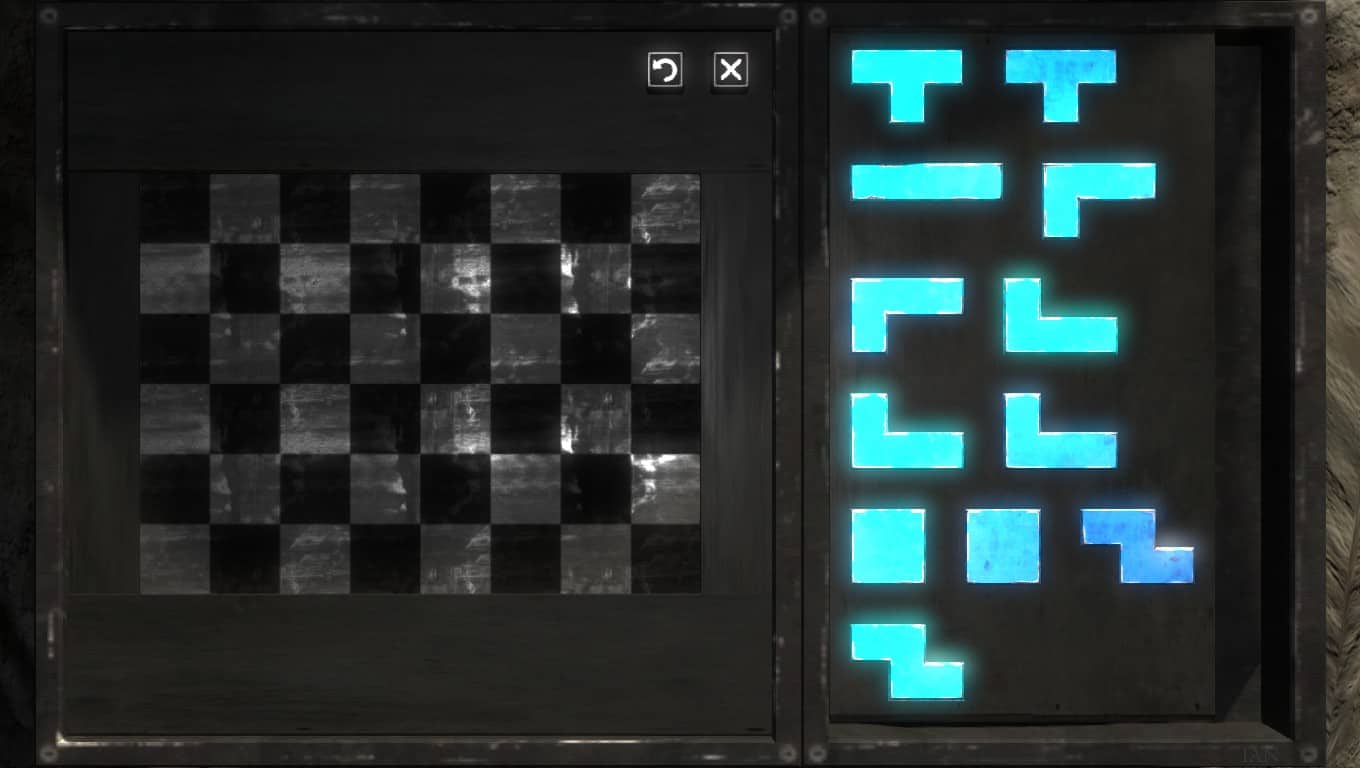 In the Talos Principle, access to new worlds and specific items is often blocked by gates that open by putting Sigils into the frame. Of course, collecting the sigils is the most challenging part, but that is often solvable by logical thinking. On the other hand, solving these fitting puzzles drove me crazy, so let us solve them with a SAT solver.
Encoding
I used a propositional encoding that for each combination of cells and sigils assigns a propositional variable, which is true if the specific sigil rests in on that cell in the final solution. That is, we have variable (encoded as x_i_j_n) where runs over the cells of the frame, and over the (numbered) sigils.
Setup
I have written a perl program that for a definition of a puzzle (see later), outputs SMT2 code, which then is checked for satisfiability and generation of model with the z3 solver (which is available in Debian).
Necessary assertions
We have to state relations between these propositional variables to obtain a proper solution, in particular we have added the following statements:

 The main changes are better error and return code handling (which should be hardly visible for the users), and more more informative output of the tlmgr info action, incorporating more data from the

 TDD
I have finally understood why test driven development is so powerful. As i am advancing in the project i am sometimes obliged to retouch some areas, refactor pieces of code. Having a great test suite that keeps you on track about the changes, and possible outages in advance is pretty powerful.
What is coming
I feel the project is on the right path. Both clemux (fellow gsoc student working on debsources) and me are advancing in a productive pace. I hope that soon enough the copyright Blueprint will be completed (most notable pending functionalities are the plugins-hooks to mine the licenses at update time, introduction of at least another license oracle possible ninka, statistics) so that everyone can take profit of the new tools provided by DebSources.
Although we haven't talked much about it the patch tracker should also come into the play sooner rather than later.
Stay tuned!
 Recently I've been experimenting with

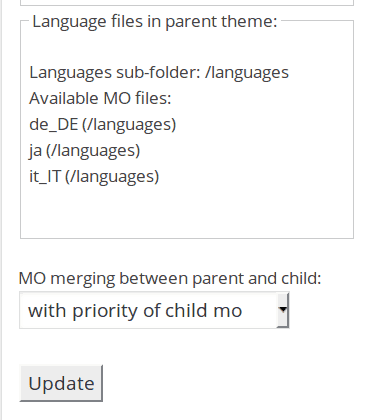

 Dear Debian Users,
I met last night with
 I know very little about hardware.
I think I have a good understanding on many aspects of what happens inside a computer, but my knowledge is clearly firmer on what happens once an operating system is already running. And even then, my understanding of the lower parts of reality is shaky at most At least according to my self-evaluation, of course, comparing to people I'm honored to call "my peers".
During the last ~18 months, my knowledge of this part of reality, while still far from complete, has increased quite a bit Maybe mostly showing that I'm basically very cheap: As I have come across very cheap (or even free for me!) hardware, I have tried to understand and shape what happens in levels below those where I dwell.
I have been meaning to do a writeup on the
 The recent
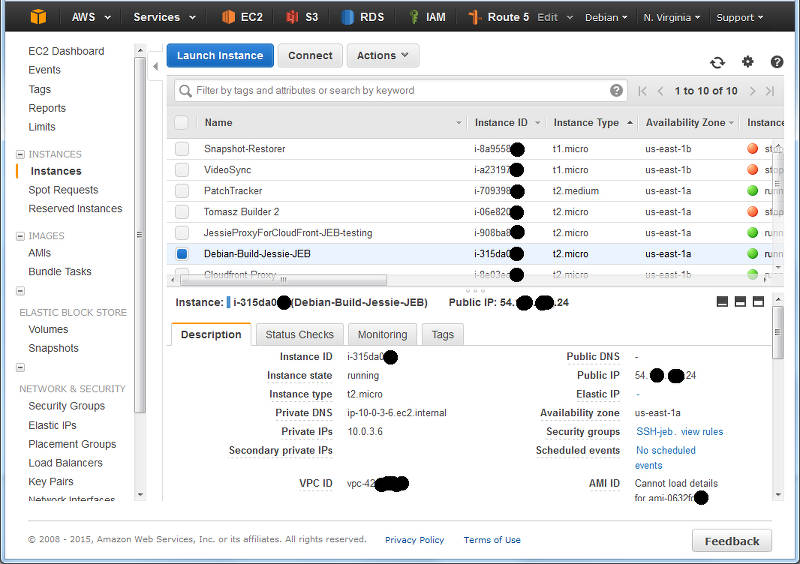
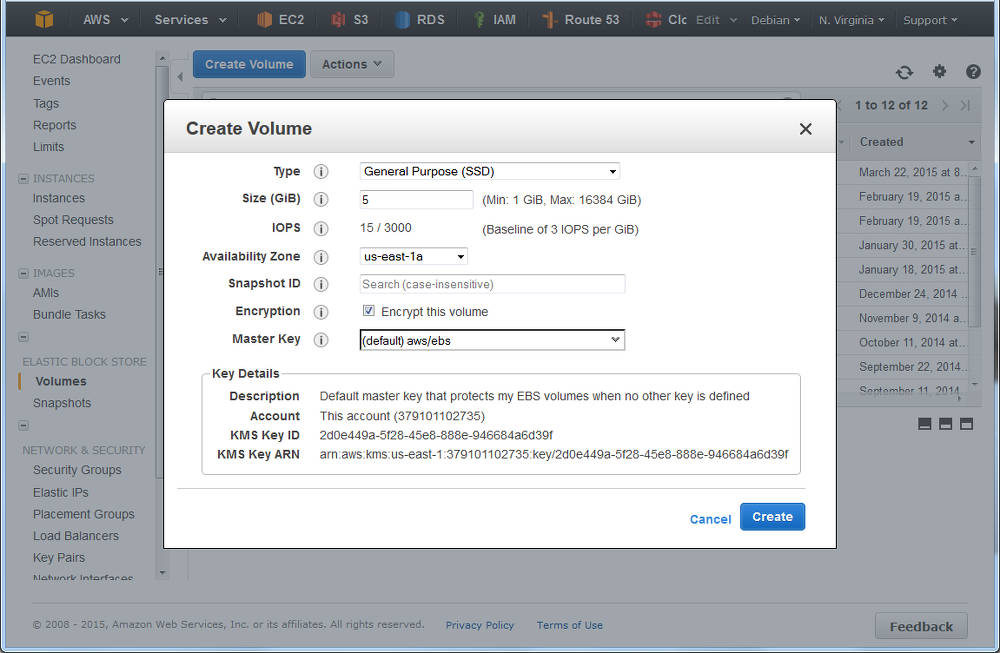
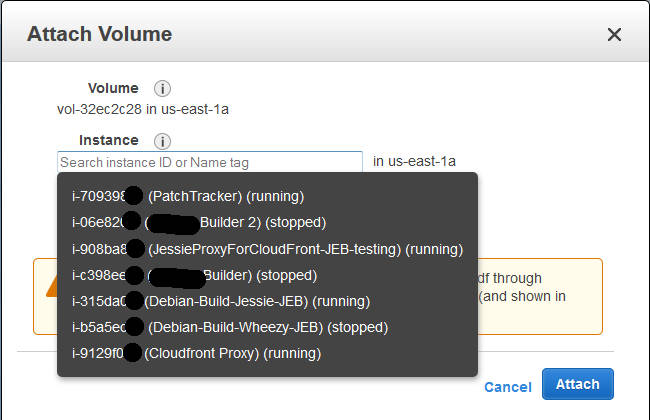
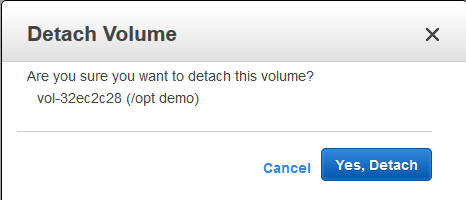
 Long ago, in days of yore, we assumed that any software worth having would be
packaged by the operating system we used. Debian with its enormous pile of
software (over 20,000 sources last time I looked) looked to basically contain
every piece of free software ever. However as more and more people have come
to Linux-based and BSD-based systems, and the proliferation of *NIX-based
systems has become even more diverse, it has become harder and harder to ensure
that everyone has access to all of the software they might choose to use.
Couple that with the rapid development of new projects, who clearly want to get
users involved well before the next release cycle of a Linux-based distribution
such as Debian, and you end up with this recommendation to bypass the operating
system's packaging system and simply
 I've had some 8GB USB keys made, with the Debian swirl and text. By
buying a reasonable number, I've got what I think is a good price for
nice high-quality keys (metal body with a solid loop for attaching to
a keyring). I'm now selling these for 7 pounds each, and I'm planning
on bringing some to DebConf 15 too, where they'll be 10 EUR.
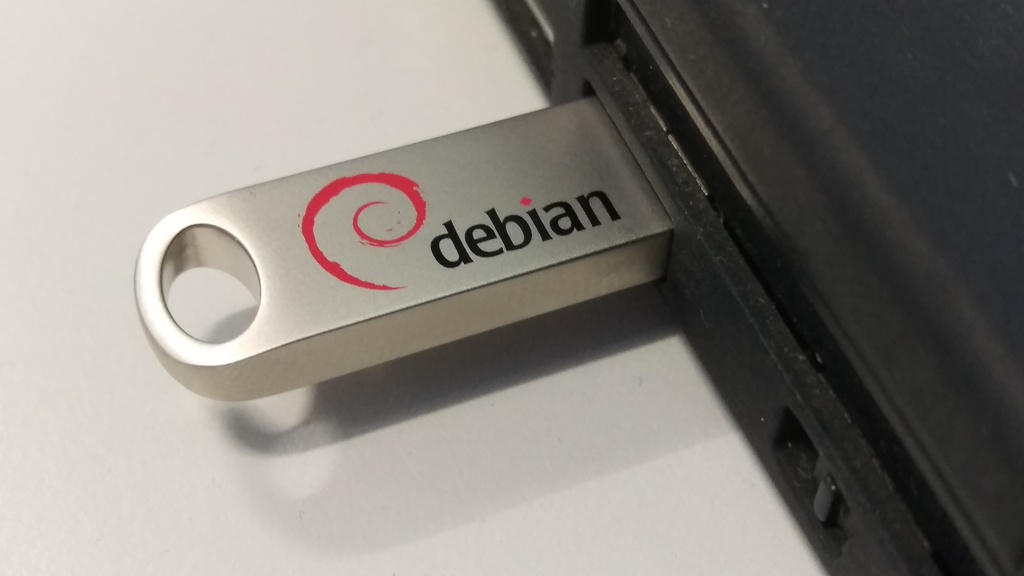
 Let us start with recalling the different actions that have to be taken when TeX packages are installed, removed, or updated.
Required actions for TeX packages
Filename database
The simplest case are packages that only include files ment to be loaded while running TeX or Metafont or similar programs. In this case the file name database of TeX (and the one of ConTeXt) needs to be updated. Usually this is done by calling mktexlsr on the changed trees, plus, if ConTeXt is installed, running mtxrun --generate.
Font map activation
More complicated are font packages that provide PostScript fonts. These packages need to ship a so called map file which maps TeX font names to PostScript fonts names. Examples are lm.map which defines this mapping for the Latin Modern fonts. All these map files have to be collected in one or more updmap.cfg files, and then a call to updmap(-sys) is necessary to generate configuration files for dvips, pdftex, and some other programs.
Format and hyphenation definitions
Even more complicated is the case of additional hyphenation patterns and additional format definitions. At the moment, hyphenation patterns are only shipped from the TeX Live packages itself, but additional format definitions are already provided by other packages than the TeX Live ones. Again, in both cases all the different format and hyphenation pattern definitions must be combined, into configuration files fmtutil.cnf and several language.* files, respectively. After this some incantation of fmtutil(-sys) is necessary to update the format dumps of TeX.
Status up to Debian/TeX Live 2014
Up to now most of these actions are done in the postinstall script of the providing packages, generated by dh_installtex. The
 Anyway, I hope to hear some feedback and installation reports.
Conclusion
While packaging has become easier for maintainers, and there is less clutter in /etc/texmf/, we now are depending on dpkg to call the tex-common triggers. Thus, if this happens rather often, then especially fmtutil-sys --all will be called several times. This is a slight regression from the previous setup, but paid off (IMNSHO) by the arguments given in the beginning.
That said, there will be of course a certain time of transition until the new setup has proven its merits, and bugs are ironed out. But having bugs that need to be mostly fixed only in one package, namely tex-common, seems like an easier task to me.
Enjoy.
 I recently obtained the newest Dell's Ubuntu developer offering, XPS 13 (2015, model 9343). I opted in for FullHD non-touch display, mostly because of better battery life, the actual no need for higher resolution, and matte screen which is great outside. Touch would have been "nice-to-have", but in my work I don't really need it.


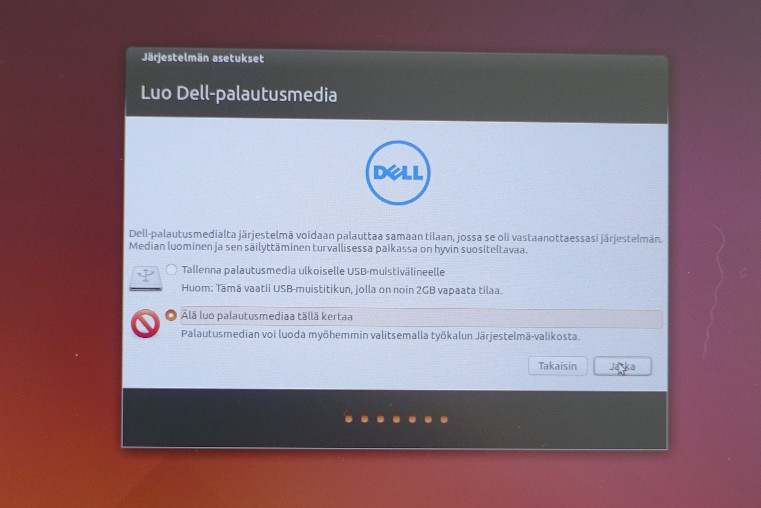
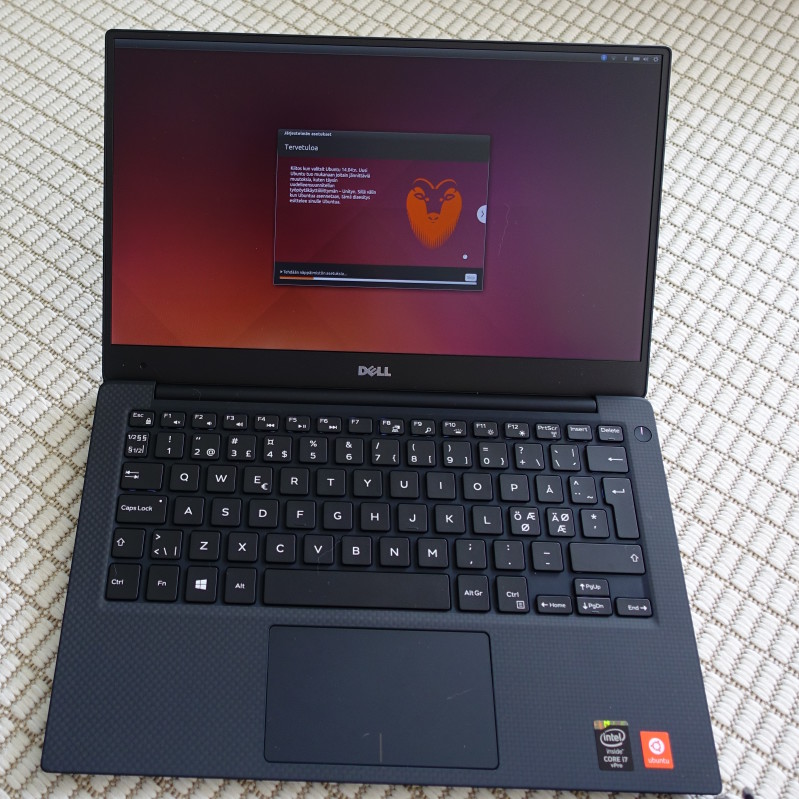
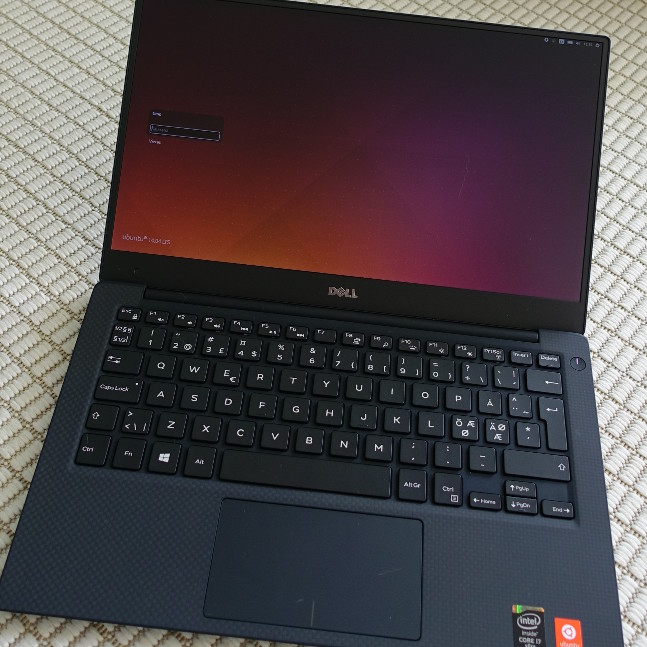

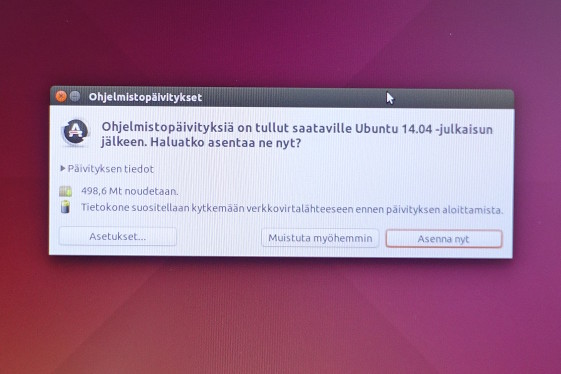


 I've recently found myself explaining
 There are a few tricks necessary to get this going, though. Let us start with the easy part, grml:
Grml
Quoting from the