Search Results: "agi"

16 May 2017

Foteini Tsiami: Outreachy internship!

Hello everyone! I am very happy that I have been accepted as an intern in the Outreachy 2017 round. My project task is to adapt sch-scripts into a new project ltsp-manager , primarily through internationalization and localization as well as documentation.

Sch-scripts is a graphical tool that assists with management of a classroom computer lab, managing users and network booted computers with LTSP, and is used in more than 1000 schools in Greece along with the epoptes user monitoring software.

Traditionally, maintaining an LTSP environment requires comfort with a commandline interface, but sch-scripts provides a graphical tool that simplifies the installation, configuration and management of an LTSP classroom.

Epoptes allows the teacher to monitor or assist users in the computer lab, as well as send messages, boot and shut down computers.

Both LTSP and Epoptes are present in Debian, and internationalizing sch-scripts is an important step towards making the same interface used successfully in Greek schools available to all Debian and Ubuntu users.

12 May 2017

Steve McIntyre: Fonts and presentations

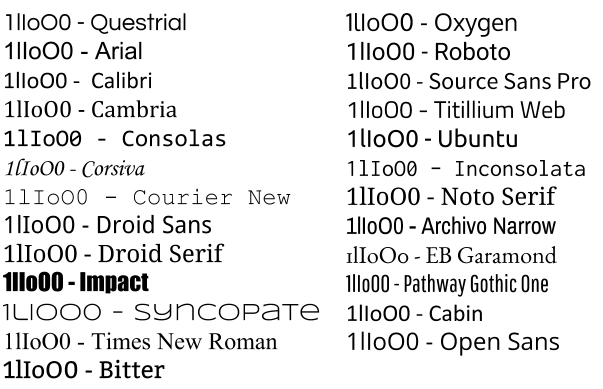
When you're giving a presentation, the choice of font can matter a lot. Not just in terms of how pretty your slides look, but also in terms of whether the data you're presenting is actually properly legible. Unfortunately, far too many fonts are appallingly bad if you're trying to tell certain characters apart. Imagine if you're at the back of a room, trying to read information on a slide that's (typically) too small and (if you're unlucky) the presenter's speech is also unclear to you (noisy room, bad audio, different language). A good clear font is really important here. To illustrate the problem, I've picked a few fonts available in Google Slides. I've written the characters "1lIoO0" (that's one, lower case L, upper case I, lower case o, upper case O, zero) in each of those fonts. Some of the sans-serif fonts in particular are comically bad for trying to distinguish between these characters. font examples It may not matter in all cases if your audience can read all the characters on your slides and tell them apart, put if you're trying to present scientific or numeric results it's critical. Please consider that before looking for a pretty font.

11 May 2017

Norbert Preining: BachoTeX 2017

A week of typesetting, typography, bookbinding, bibliophily, not to forget long chats with good friends and loads of beer. That is BachoTeX, the best series of conferences I have ever been. This year BachoTeX was held for the 25th time, and was merged with the TUG Meeting for a firework of excellent presentations and long hours of brain storming, hacking, music making, dancing, and simply enjoying life!
Symphony of Green
And while it was a bit less relaxing for me than in the last years, mostly due to the presence of my little daughter who requested presence quite often, it is still the place to be during the Golden Week! Of course I also gave a talk at BachoTeX about our latest changes in the upcoming TeX Live 2017 release: fmtutil and updmap past & future changes (or: cleaning up the mess). Big thanks to my company Accelia Inc. for allowing me to attend the conference. We arrived after a long trip, first via train and plane to Vienna, then two days break (including research with a colleague), followed by a night train ride to Warsaw and another train ride to Torun and a taxi ride to Bachotek. All in all far too long to be done with a 14 month old girl. Finally arrived we went directly to our hut and found it freezing. Fortunately we could organize a heater so that the rest of the week we didn t have to live in 5-10 degrees
Our log house in Bachotek
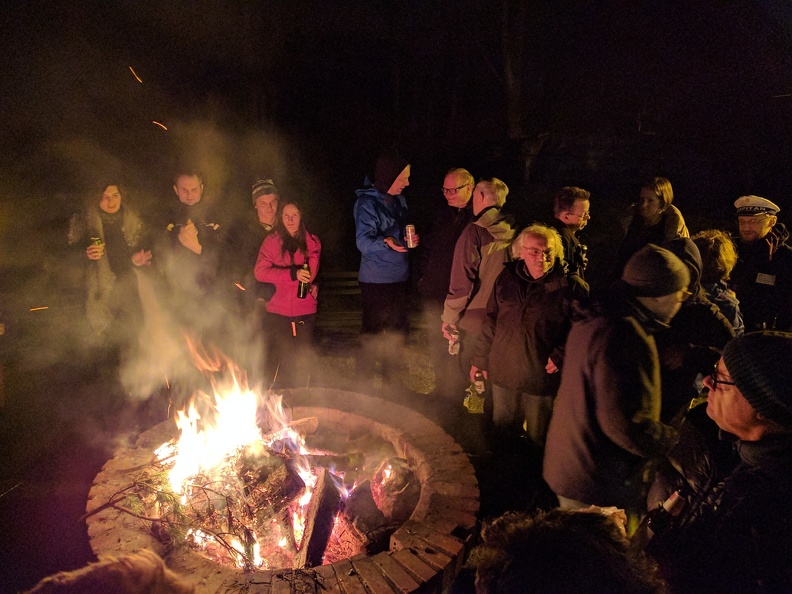
The second day brought already the traditional bonfire. After a small (for Polish standard) dinner we ignored the rain and met at the fireplace for BBQ, beer, and lots of live music.
Bonfire on the second evening
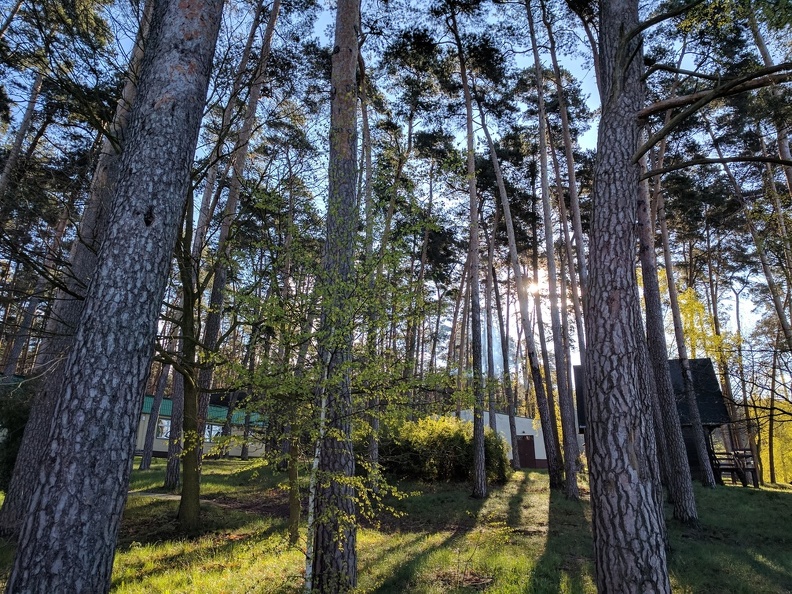
The rain stopped during the bonfire, probably due to my horrible singing, and the following days we were blessed with sunshine and warmer temperatures. The forest sparked in all kinds of greens.
Sunny days in Bachotek
For our daughter the trip was a great experience lots of wild play grounds, many other kids, and a lake she really wanted to go swimming in. Normally I go swimming there, but this year I had a bad cold so I refrained from it, and with me also our daughter, to her great disappointment.
Ready to go swimming
Another day has passed, and the sunset lights up the beautiful lake Bachotek. I cannot imagine a better place for concentrated work paired with great relaxation!
Sunset along the lake
During the days the temperatures were really nice, but the mornings were cold, and our morning walk to the breakfast place was quite chilly.
Enjoying a fresh morning on the lake
Ample coffee breaks and lunch breaks left us enough time to discuss new developments. But the single most important thing that brought people to talk a lot was the horrible internet connection, a big plus in BachoTeX (but as far as rumors go it might have been the last time with that advantage!).
Beautiful and peaceful lake Bachotek
The last evening we had a banquet honoring 25 years of BachoTeX, one of the oldest TeX conference. Live music and dancing, lots of good food and drinks, and outside the perfect evening atmosphere.
Sunset around the lake
Too fast the time has passed and we had to return to Vienna, retracing the long trip. How far it may be, taking the burden to come from Japan is worth every drop of sweat, the time at BachoTeX is probably one of the most productive, and at the same time most relaxing for me. Big thanks to all our Polish friends for organizing the event.
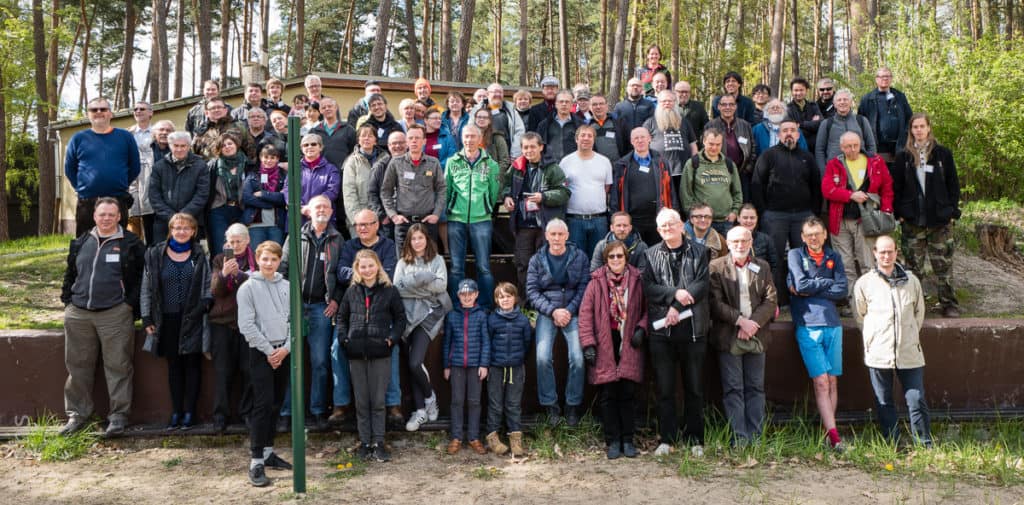
BachoTeX conference photo

(photo by Frans Goddijn)


9 May 2017

Reproducible builds folks: Reproducible Builds: week 106 in Stretch cycle

Here's what happened in the Reproducible Builds effort between Sunday April 30 and Saturday May 6 2017: Past and upcoming events Between May 5th-7th the Reproducible Builds Hackathon 2017 took place in Hamburg, Germany. On May 6th Mattia Rizzolo gave a talk on Reproducible Builds at DUCC-IT 17 in Vicenza, Italy. On May 13th Chris Lamb will give a talk on Reproducible Builds at OSCAL 2017 in Tirana, Albania. Media coverage Toolchain development and fixes Packages reviewed and fixed, and bugs filed Chris Lamb: Reviews of unreproducible packages 93 package reviews have been added, 12 have been updated and 98 have been removed in this week, adding to our knowledge about identified issues. The following issues have been added: 2 issue types have been updated: The following issues have been removed: Weekly QA work During our reproducibility testing, FTBFS bugs have been detected and reported by: diffoscope development strip-nondeterminism development
This week's edition was written by Chris Lamb, Holger Levsen and Ximin Luo & reviewed by a bunch of Reproducible Builds folks on IRC & the mailing lists.

8 May 2017

Lars Wirzenius: Ick2 design discussion

Recently, Daniel visited us in Helsinki. In addition to enjoying local food and scenerey, we spent some time together in front of a whiteboard to sketch out designs for Ick2. Ick is my continuous integration system, and it's all Daniel's fault for suggesting the name. Ahem. I am currently using the first generation of Ick and it is a rigid, cumbersome, and fragile thing. It works well enough that I don't miss Jenkins, but I would like something better. That's the second generation of Ick, or Ick2, and that's what we discussed with Daniel. Where pretty much everything in Ick1 is hardcoded, everything in Ick2 will be user-configurable. It's my last, best chance to go completely overboard in the second system syndrome manner. Where Ick1 was written in a feverish two-week hacking session, rushed because my Jenkins install at the time had broken one time too many, we're taking our time with Ick2. Slow and careful is the tune this time around. Our "minimum viable product" or MVP for Ick2 is defined like this:
Ick2 builds static websites from source in a git repository, using ikiwiki, and published to a web server using rsync. A change to the git repository triggers a new build. It can handle many separate websites, and if given enough worker machines, can build many of them concurrently.
This is a real task, and something we already do with Ick1 at work. It's a reasonable first step for the new program. Some decisions we made: The initial pipelines will be basically like this, but expressed in some way by the user:
  1. Clone the source repoistory.
  2. Run ikiwiki --build to build the website.
  3. Run rsync to publish the website on a server.
Assumptions: Actions the Ick2 controller API needs to support: A sketch API: Sequence: The next step will probably be to sketch a yarn test suite of the API and implement a rudimentary one.

6 May 2017

Dirk Eddelbuettel: x13binary 1.1.39-1

The US Census Bureau released a new build 1.1.39 of their X-13ARIMA-SEATS program, released as binary and source. So Christoph and went to work and updated our x13binary package on CRAN. The x13binary package takes the pain out of installing X-13ARIMA-SEATS by making it a fully resolved CRAN dependency. For example, if you install the excellent seasonal package by Christoph, then X-13ARIMA-SEATS will get pulled in via the x13binary package and things just work: Depend on x13binary and on all relevant OSs supported by R, you should have an X-13ARIMA-SEATS binary installed which will be called seamlessly by the higher-level packages such as seasonal or gunsales. So now the full power of the what is likely the world's most sophisticated deseasonalization and forecasting package is now at your fingertips and the R prompt, just like any other of the 10,500+ CRAN packages. Not many packaging changes in this release besides updating the underlying builds, but we switched our versioning scheme to reflect that our releases are driven by the US Census Bureau releases. But thanks to an initial contribution by David Schaub we now support the 'armhf' architecture common on Chromebooks running Linux. Courtesy of CRANberries, there is also a diffstat report for this release.

This post by Dirk Eddelbuettel originated on his Thinking inside the box blog. Please report excessive re-aggregation in third-party for-profit settings.

Vasudev Kamath: Magic: Attach a HTML file to mail and get different on other side

It's been a long time I did not write any new blog posts, and finally I got something which is interesting enough for a new post and so here it is. I actually wanted some bills from my ISP for some work and I could not find mail from the ISP which had bills for some specific months in my mailbox. Problem with my ISP is bills are accessible in their account which can be only accessed from their own network. They do have a mobile app and that does not seem to work especially for the billing section. I used mobile app and selected month for which I did not have bill and clicked Send Mail button. App happily showed message saying it sent the bill to my registered mail address but that was a fancy lie. After trying several time I gave up and decided I will do it once I get back home. Fast forward few hours, I'm back home from office and then I sat in front of my laptop and connected to ISP site, promptly downloaded the bills, then used notmuch-emacs and fire up a mail composer, attach those HTML file (yeah they produce bill in HTML file :-/) send it to my gmail and forget about it. Fast forward few more days, I just remember I need those bills. I got hold of mail I sent earlier in gmail inbox and clicked on attachment and when browser opened the attachment I was shocked/surprised . Did you ask why?. See what I saw when I opened attachment. Well I was confused for moment on what happened, I tried downloading the file and opened it an editor, and I see Chinese characters here also. After reaching home I checked the Sent folder in my laptop where I keep copy of mails sent using notmuch-emacs's notmuch-fcc-dirs variable. I open the file and open the attachement and I see same character as I saw in browser!. I open the original bills I downloaded and it looks fine. To check if I really attached the correct files I again drafted a mail this time to my personal email and sent it. Now I open the file from Sent folder and voila again there is different content inside my attachment!. Same happens when I receive the mail and open the attachment everything inside is Chinese characters!. Totally lost I finally opened the original file using emacs, since I use spacemacs it asked me for downloading of html layer and after which I was surprised because everything inside the editor is in Chinese!. OK finally I've something now so I opened same file at same time in nano from terminal and there it looks fine!. OK that is weird again I read carefully content and saw this line in beginning of file
<?xml version="1.0" encoding="UTF-16" ?>
<html xmlns="http://www.w3.org/1999/xhtml>....
OK that is new XML tag had encoding declared as UTF-16, really?. And just for checking I changed it to UTF-8 and voila file is back to normal in Emacs window!. To confirm this behavior I created a sample file with following content
<?xml version="1.0" encoding="utf-8"?><html xmlns="http://www.w3.org/1999/xhtml"><head><meta http-equiv="Content-Type" content="text/html; charset=iso-8859-1" /><title> Something weird </title><body>blablablablablalabkabakba</body></html>
Yeah with long line because ISP had similar case and now I opened the same file in nano using terminal and changed encoding="UTF-8" to encoding="UTF-16" and the behavior repeated I see Chinese character in the emacs buffer which has also opened the same file. Below is the small gif showing this happening in real time, see what happens in emacs buffer when I change the encoding in terminal below. Fun right?. I made following observation from above experiments.
  1. When I open original file in browser or my sample file with encoding="UTF-16" its normal, no Chinese characters.
  2. When I attach the mail and send it out the attachment some how gets converted into HTML file with Chinese characters and viewing source from browser shows header containing xml declarations and original <html> declarations get ripped off and new tags show up which I've pasted below.
  3. If I download the same file and open in editor only Chinese characters are present and no HTML tags inside it. So definitely the new tags which I saw by viewing source in browser is added by Firefox.
  4. I create similar HTML file and change encoding I can see the characters changing back and forth in emacs web-mode when I change encoding of the file.
<!DOCTYPE HTML PUBLIC "-//W3C//DTD HTML 4.01 Transitional//EN">
<html>
  <head><META http-equiv="Content-Type"  content="text/html; charset=utf-8">
So if I'm understanding this correctly, Emacs due to encoding declaration interprets the actual contents differently. To see how Emacs really interpreted the content I opened the sent mail I had in raw format and saw following header lines for attachment.
Content-Type: text/html; charset=utf-8
Content-Disposition: attachment;
             filename=SOA-102012059675-FEBRUARY-2017.html
Content-Transfer-Encoding: base64
This was followed with base64 encoded data. So does this mean emacs interpreted the content as UTF-16 and encoded the content using UTF-8?. Again I've no clue, so I changed the encoding in both the files to be as UTF-8 and sent the mail by attaching these files again to see what happens. And my guess was right I could get the attachment as is on the receiving side. And inspecting raw mail the attachment headers now different than before.
Content-Type: text/html
Content-Disposition: attachment;
             filename=SOA-102012059675-DECEMBER-2016.html
Content-Transfer-Encoding: quoted-printable
See how Content-Type its different now also see the Content-Transfer-Encoding its now quoted-printable as opposed to base64 earlier. Additionally I can see HTML content below the header. When I opened the attachment from mail I get the actual bill. As far as I understand base64 encoding is used when the data to be attached is base64. So I guess basically due to wrong encoding declared inside the file Emacs interpreted the content as a binary data and encoded it differently than what it really should be. Phew that was a lot of investigation to understand the magic but it was worth it. Do let me know your thoughts on this.

Jelmer Vernooij: Xandikos, a new Git-backed CalDAV/CardDAV server

For the last couple of years, I have self-hosted my calendar and address book data. Originally I just kept local calendars and address books in Evolution, but later I moved to a self-hosted CalDAV/CardDAV server and a plethora of clients.
CalDAV/CardDAV CalDAV and CardDAV are standards for accessing, managing, and sharing calendaring and addressbook information based on the iCalendar format that are built atop the WebDAV standard, and WebDAV itself is a set of extensions to HTTP. CalDAV and CardDAV essentially store iCalendar (.ics) and vCard (.vcf) files using WebDAV, but they provide some extra guarantees (e.g. files must be well-formed) and some additional methods for querying the data. For example, it is possible to retrieve all events between two dates with a single HTTP query, rather than the client having to check all the calendar files in a directory. CalDAV and CardDAV are (unnecessarily) complex, in large part because they are built on top of WebDAV. Being able to use regular HTTP and WebDAV clients is quite neat, but results in extra complexity. In addition, because the standards are so large, clients and servers end up only implementing parts of it. However, CalDAV and CardDAV have one big redeeming quality: they are the dominant standards for synchronising calendar events and addressbooks, and are supported by a wide variety of free and non-free applications. They're the status quo, until something better comes along. (and hey, at least there is a standard to begin with)
Calypso I have tried a number of servers over the years. In the end, I settled for calypso. Calypso started out as friendly fork of Radicale, with some additional improvements. I like Calypso because it is:
  • quite simple, understandable, and small (sloccount reports 1700 LOC)
  • it stores plain .vcf and .ics files
  • stores history in git
  • easy to set up, e.g. no database dependencies
  • written in Python
Its use of regular files and keeping history in Git is useful, because this means that whenever it breaks it is much easier to see what is happening. If something were to go wrong (i.e. a client decides to remove all server-side entries) it's easy to recover by rolling back history using git. However, there are some downsides to Calypso as well. It doesn't have good test coverage, making it harder to change (especially in a way that doesn't break some clients), though there are some recent efforts to make e.g. external spec compliance tests like caldavtester work with it. Calypso's CalDAV/CardDAV/WebDAV implementation is a bit ad-hoc. The only WebDAV REPORTs it implements are calendar-multiget and addressbook-multiget. Support for properties has been added as new clients request them. The logic for replying to DAV requests is mixed with the actual data store implementation. Because of this, it can be hard to get going with some clients and sometimes tricky to debug.
Xandikos After attempting to fix a number of issues in Calypso, I kept running into issues with the way its code is structured. This is only fixable by rewriting sigifnicant chunks of it, so I opted to instead write a new server. The goals of Xandikos are along the same lines as those of Calypso, to be a simple CalDAV/CardDAV server for personal use:
  • easy to set up; at the moment, just running xandikos -d $HOME/dav --defaults is enough to start a new server
  • use of plain .ics/.ivf files for storage
  • history stored in Git
But additionally:
  • clear separation between protocol implementation and storage
  • be well tested
  • standards complete
  • standards compliant
Current status The CalDAV/CardDAV implementation of Xandikos is mostly complete, but there still a number of outstanding issues. In particular:
  • lack of authentication support; setting up authentication support in uwsgi or a reverse proxy is one way of working around this
  • there is no useful UI for users accessing the DAV resources via a web browser
  • test coverage
Xandikos has been tested with the following clients:
Trying it To run Xandikos, follow the instructions on the homepage:
./bin/xandikos --defaults -d $HOME/dav
A server should now be listening on localhost:8080 that you can access with your favorite client.

4 May 2017

Guido G nther: Debian Fun in April 2017

Debian LTS April marked the 24th month I contributed to Debian LTS under the Freexian umbrella. I had 8 hours allocated plus 4 hours left from March which I used by: Other Debian stuff git-buildpackage Released versions 0.8.14 and 0.8.15. Notable changes besides bug fixes: The versions are also available on pypi.

3 May 2017

Vincent Bernat: VXLAN & Linux

VXLAN is an overlay network to carry Ethernet traffic over an existing (highly available and scalable) IP network while accommodating a very large number of tenants. It is defined in RFC 7348. Starting from Linux 3.12, the VXLAN implementation is quite complete as both multicast and unicast are supported as well as IPv6 and IPv4. Let s explore the various methods to configure it. VXLAN setup To illustrate our examples, we use the following setup: A VXLAN tunnel extends the individual Ethernet segments accross the three bridges, providing a unique (virtual) Ethernet segment. From one host (e.g. H1), we can reach directly all the other hosts in the virtual segment:
$ ping -c10 -w1 -t1 ff02::1%eth0
PING ff02::1%eth0(ff02::1%eth0) 56 data bytes
64 bytes from fe80::5254:33ff:fe00:8%eth0: icmp_seq=1 ttl=64 time=0.016 ms
64 bytes from fe80::5254:33ff:fe00:b%eth0: icmp_seq=1 ttl=64 time=4.98 ms (DUP!)
64 bytes from fe80::5254:33ff:fe00:9%eth0: icmp_seq=1 ttl=64 time=4.99 ms (DUP!)
64 bytes from fe80::5254:33ff:fe00:a%eth0: icmp_seq=1 ttl=64 time=4.99 ms (DUP!)
--- ff02::1%eth0 ping statistics ---
1 packets transmitted, 1 received, +3 duplicates, 0% packet loss, time 0ms
rtt min/avg/max/mdev = 0.016/3.745/4.991/2.152 ms

Basic usage The reference deployment for VXLAN is to use an IP multicast group to join the other VTEPs:
# ip -6 link add vxlan100 type vxlan \
>   id 100 \
>   dstport 4789 \
>   local 2001:db8:1::1 \
>   group ff05::100 \
>   dev eth0 \
>   ttl 5
# brctl addbr br100
# brctl addif br100 vxlan100
# brctl addif br100 vnet22
# brctl addif br100 vnet25
# brctl stp br100 off
# ip link set up dev br100
# ip link set up dev vxlan100
The above commands create a new interface acting as a VXLAN tunnel endpoint, named vxlan100 and put it in a bridge with some regular interfaces1. Each VXLAN segment is associated to a 24-bit segment ID, the VXLAN Network Identifier (VNI). In our example, the default VNI is specified with id 100. When VXLAN was first implemented in Linux 3.7, the UDP port to use was not defined. Several vendors were using 8472 and Linux took the same value. To avoid breaking existing deployments, this is still the default value. Therefore, if you want to use the IANA-assigned port, you need to explicitely set it with dstport 4789. As we want to use multicast, we have to specify a multicast group to join (group ff05::100), as well as a physical device (dev eth0). With multicast, the default TTL is 1. If your multicast network leverages some routing, you ll have to increase the value a bit, like here with ttl 5. The vxlan100 device acts as a bridge device with remote VTEPs as virtual ports:
  • it sends broadcast, unknown unicast and multicast (BUM) frames to all VTEPs using the multicast group, and
  • it discovers the association from Ethernet MAC addresses to VTEP IP addresses using source-address learning.
The following figure summarizes the configuration, with the FDB of the Linux bridge (learning local MAC addresses) and the FDB of the VXLAN device (learning distant MAC addresses): Bridged VXLAN device The FDB of the VXLAN device can be observed with the bridge command. If the destination MAC is present, the frame is sent to the associated VTEP (unicast). The all-zero address is only used when a lookup for the destination MAC fails.
# bridge fdb show dev vxlan100   grep dst
00:00:00:00:00:00 dst ff05::100 via eth0 self permanent
50:54:33:00:00:0b dst 2001:db8:3::1 self
50:54:33:00:00:08 dst 2001:db8:1::1 self
If you are interested to get more details on how to setup a multicast network and build VXLAN segments on top of it, see my Network virtualization with VXLAN article.

Without multicast Using VXLAN over a multicast IP network has several benefits:
  • automatic discovery of other VTEPs sharing the same multicast group,
  • good bandwidth usage (packets are replicated as late as possible),
  • decentralized and controller-less design2.
However, multicast is not available everywhere and managing it at scale can be difficult. In Linux 3.8, the DOVE extensions have been added to the VXLAN implementation, removing the dependency on multicast.

Unicast with static flooding We can replace multicast by head-end replication of BUM frames to a statically configured lists of remote VTEPs3:
# ip -6 link add vxlan100 type vxlan \
>   id 100 \
>   dstport 4789 \
>   local 2001:db8:1::1
# bridge fdb append 00:00:00:00:00:00 dev vxlan100 dst 2001:db8:2::1
# bridge fdb append 00:00:00:00:00:00 dev vxlan100 dst 2001:db8:3::1
The VXLAN is defined without a remote multicast group. Instead, all the remote VTEPs are associated with the all-zero address: a BUM frame will be duplicated to all those destinations. The VXLAN device will still learn remote addresses automatically using source-address learning. It is a very simple solution. With a bit of automation, you can keep the default FDB entries up-to-date easily. However, the host will have to duplicate each BUM frame (head-end replication) as many times as there are remote VTEPs. This is quite reasonable if you have a dozen of them. This may become out-of-hand if you have thousands of them. Cumulus vxfld daemon is an example of use of this strategy (in the head-end replication mode).

Unicast with static L2 entries When the associations of MAC addresses and VTEPs are known, it is possible to pre-populate the FDB and disable learning:
# ip -6 link add vxlan100 type vxlan \
>   id 100 \
>   dstport 4789 \
>   local 2001:db8:1::1 \
>   nolearning
# bridge fdb append 00:00:00:00:00:00 dev vxlan100 dst 2001:db8:2::1
# bridge fdb append 00:00:00:00:00:00 dev vxlan100 dst 2001:db8:3::1
# bridge fdb append 50:54:33:00:00:09 dev vxlan100 dst 2001:db8:2::1
# bridge fdb append 50:54:33:00:00:0a dev vxlan100 dst 2001:db8:2::1
# bridge fdb append 50:54:33:00:00:0b dev vxlan100 dst 2001:db8:3::1
Thanks to the nolearning flag, source-address learning is disabled. Therefore, if a MAC is missing, the frame will always be sent using the all-zero entries. The all-zero entries are still needed for broadcast and multicast traffic (e.g. ARP and IPv6 neighbor discovery). This kind of setup works well to provide virtual L2 networks to virtual machines (no L3 information available). You need some glue to update the FDB entries. BGP EVPN with Cumulus Quagga is an example of use of this strategy (see VXLAN: BGP EVPN with Cumulus Quagga for additional information).

Unicast with static L3 entries In the previous example, we had to keep the all-zero entries for ARP and IPv6 neighbor discovery to work correctly. However, Linux can answer to neighbor requests on behalf of the remote nodes4. When this feature is enabled, the default entries are not needed anymore (but you could keep them):
# ip -6 link add vxlan100 type vxlan \
>   id 100 \
>   dstport 4789 \
>   local 2001:db8:1::1 \
>   nolearning \
>   proxy
# ip -6 neigh add 2001:db8:ff::11 lladdr 50:54:33:00:00:09 dev vxlan100
# ip -6 neigh add 2001:db8:ff::12 lladdr 50:54:33:00:00:0a dev vxlan100
# ip -6 neigh add 2001:db8:ff::13 lladdr 50:54:33:00:00:0b dev vxlan100
# bridge fdb append 50:54:33:00:00:09 dev vxlan100 dst 2001:db8:2::1
# bridge fdb append 50:54:33:00:00:0a dev vxlan100 dst 2001:db8:2::1
# bridge fdb append 50:54:33:00:00:0b dev vxlan100 dst 2001:db8:3::1
This setup totally eliminates head-end replication. However, protocols relying on multicast won t work either. With some automation, this is a setup that should work well with containers: if there is a registry keeping a list of all IP and MAC addresses in use, a program could listen to it and adjust the FDB and the neighbor tables. The VXLAN backend of Docker s libnetwork is an example of use of this strategy (but it also uses the next method).

Unicast with dynamic L3 entries Linux can also notify a program an (L2 or L3) entry is missing. The program queries some central registry and dynamically adds the requested entry. However, for L2 entries, notifications are issued only if:
  • the destination MAC address is not known,
  • there is no all-zero entry in the FDB, and
  • the destination MAC address is not a multicast or broadcast one.
Those limitations prevent us to do a unicast with dynamic L2 entries scenario. First, let s create the VXLAN device with the l2miss and l3miss options5:
ip -6 link add vxlan100 type vxlan \
   id 100 \
   dstport 4789 \
   local 2001:db8:1::1 \
   nolearning \
   l2miss \
   l3miss \
   proxy
Notifications are sent to programs listening to an AF_NETLINK socket using the NETLINK_ROUTE protocol. This socket needs to be bound to the RTNLGRP_NEIGH group. The following is doing exactly that and decodes the received notifications:
# ip monitor neigh dev vxlan100
miss 2001:db8:ff::12 STALE
miss lladdr 50:54:33:00:00:0a STALE
The first notification is about a missing neighbor entry for the requested IP address. We can add it with the following command:
ip -6 neigh replace 2001:db8:ff::12 \
    lladdr 50:54:33:00:00:0a \
    dev vxlan100 \
    nud reachable
The entry is not permanent so that we don t need to delete it when it expires. If the address becomes stale, we will get another notification to refresh it. Once the host receives our proxy answer for the neighbor discovery request, it can send a frame with the MAC we gave as destination. The second notification is about the missing FDB entry for this MAC address. We add the appropriate entry with the following command6:
bridge fdb replace 50:54:33:00:00:0a \
    dst 2001:db8:2::1 \
    dev vxlan100 dynamic
The entry is not permanent either as it would prevent the MAC to migrate to the local VTEP (a dynamic entry cannot override a permanent entry). This setup works well with containers and a global registry. However, there is small latency penalty for the first connections. Moreover, multicast and broadcast won t be available in the underlay network. The VXLAN backend for flannel, a network fabric for Kubernetes, is an example of this strategy.

Decision There is no one-size-fits-all solution. You should consider the multicast solution if:
  • you are in an environment where multicast is available,
  • you are ready to operate (and scale) a multicast network,
  • you need multicast and broadcast inside the virtual segments,
  • you don t have L2/L3 addresses available beforehand.
The scalability of such a solution is pretty good if you take care of not putting all VXLAN interfaces into the same multicast group (e.g. use the last byte of the VNI as the last byte of the multicast group). When multicast is not available, another generic solution is BGP EVPN: BGP is used as a controller to ensure distribution of the list of VTEPs and their respective FDBs. As mentioned earlier, an implementation of this solution is Cumulus Quagga. I explore this option in a separate post: VXLAN: BGP EVPN with Cumulus Quagga. If you operate in a container-like environment where L2/L3 addresses are known beforehand, a solution using static and/or dynamic L2 and L3 entries based on a central registry and no source-address learning would also fit the bill. This provides a more security-tight solution (bound resources, MiTM attacks dampened down, inability to amplify bandwidth usage through excessive broadcast). Various environment-specific solutions are available7 or you can build your own.

Other considerations Independently of the chosen strategy, here are a few important points to keep in mind when implementing a VXLAN overlay.

Isolation While you may expect VXLAN interfaces to only carry L2 traffic, Linux doesn t disable IP processing. If the destination MAC is a local one, Linux will route or deliver the encapsulated IP packet. Check my post about the proper isolation of a Linux bridge.

Encryption VXLAN enforces isolation between tenants, but the traffic is totally unencrypted. The most direct solution to provide encryption is to use IPsec. Some container-based solutions may come with IPsec support out-of-the box (notably Docker s libnetwork, but flannel has plan for it too). This is quite important for a deployment over a public cloud.

Overhead The format of a VXLAN-encapsulated frame is the following: VXLAN encapsulation VXLAN adds a fixed overhead of 50 bytes. If you also use IPsec, the overhead depends on many factors. In transport mode, with AES and SHA256, the overhead is 56 bytes. With NAT traversal, this is 64 bytes (additional UDP header). In tunnel mode, this is 72 bytes. See Cisco IPsec Overhead Calculator Tool. Some users will expect to be able to use an Ethernet MTU of 1500 for the overlay network. Therefore, the underlay MTU should be increased. If it is not possible, ensure the inner MTU (inside the containers or the virtual machines) is correctly decreased8.

IPv6 While all the examples above are using IPv6, the ecosystem is not quite ready yet. The multicast L2-only strategy works fine with IPv6 but every other scenario currently needs some patches (1, 2, 3). On top of that, IPv6 may not have been implemented in VXLAN-related tools:

Multicast Linux VXLAN implementation doesn t support IGMP snooping. Multicast traffic will be broadcasted to all VTEPs unless multicast MAC addresses are inserted into the FDB.

  1. This is one possible implementation. The bridge is only needed if you require some form of source-address learning for local interfaces. Another strategy is to use MACVLAN interfaces.
  2. The underlay multicast network may still need some central components, like rendez-vous points for PIM-SM protocol. Fortunately, it s possible to make them highly available and scalable (e.g. with Anycast-RP, RFC 4610).
  3. For this example and the following ones, a patch is needed for the ip command (to be included in 4.11) to use IPv6 for transport. In the meantime, here is a quick workaround:
    # ip -6 link add vxlan100 type vxlan \
    >   id 100 \
    >   dstport 4789 \
    >   local 2001:db8:1::1 \
    >   remote 2001:db8:2::1
    # bridge fdb append 00:00:00:00:00:00 \
    >   dev vxlan100 dst 2001:db8:3::1
    
  4. You may have to apply an IPv6-related patch to the kernel (to be included in 4.12).
  5. You have to apply an IPv6-related patch to the kernel (to be included in 4.12) to get appropriate notifications for missing IPv6 addresses.
  6. Directly adding the entry after the first notification would have been smarter to avoid unnecessary retransmissions.
  7. flannel and Docker s libnetwork were already mentioned as they both feature a VXLAN backend. There are also some interesting experiments like BaGPipe BGP for Kubernetes which leverages BGP EVPN and is therefore interoperable with other vendors.
  8. There is no such thing as MTU discovery on an Ethernet segment.

Evgeni Golov: tuned for Debian

For quite some time I wanted to have tuned in Debian, but somehow never motivated myself to do the packaging. Two weeks ago I then finally decided to pick it up (esp. as mika and a few others were asking about it). There was an old RFP/ITP 789592, without much progress, so I did the packing from scratch (heavy based on the Fedora package). gustavo (the owner of the ITP) also joined the effort, and shortly after the upstream release of 2.8.0 we had tuned in Debian (with a very short time in NEW, thanks ftp-masters!). I am quite sure that the package is far from perfect yet, especially as the software is primary built for and tested on Fedora/CentOS/RHEL. So keep the bugs, suggestions and patches comming (thanks mika!).

2 May 2017

Markus Koschany: My Free Software Activities in April 2017

Welcome to gambaru.de. Here is my monthly report that covers what I have been doing for Debian. If you re interested in Java, Games and LTS topics, this might be interesting for you. Debian Games Debian Java Debian LTS This was my fourteenth month as a paid contributor and I have been paid to work 23,75 hours on Debian LTS, a project started by Rapha l Hertzog. In that time I did the following: Misc Thanks for reading and see you next time.

Russ Allbery: Review: Ninefox Gambit

Review: Ninefox Gambit, by Yoon Ha Lee
Series: The Machineries of Empire #1
Publisher: Solaris
Copyright: 2016
ISBN: 1-84997-992-8
Format: Kindle
Pages: 384
Charis is a Kel, which means that she's a soldier of the Hexarchate. A captain, to be precise: Captain Kel Charis of Heron Company, commanding infantry forces to stamp out heresy. The heresy she's stamping out at the start of the book are the Eels, or the Society of the Flourish as they call themselves, and they're strong enough that they can also command heretical technology. Charis manages to win through, but only because she has enough flexibility and quick thinking to adjust to the presence of a heresy and reach beyond the Lexicon Primary, improvising formations on the spot to adjust for the affects of the rebel calendar. Military victory is prized among the Kel, but stepping outside the bounds of Doctrine to achieve it is not. Charis is not particularly surprised when her company is disbanded for re-education after the battle. She is very surprised when she personally is tapped to offer a solution to a far greater attack on the Hexarchate. I first encountered Yoon Ha Lee's fiction in the short story "The Unstrung Zither", was blown away by the creativity and delightfully weird twist on science fiction war, and have been following his writing ever since. Most of it is short fiction, though, and I'm not much of a short fiction reader, so there haven't been many reviews. Ninefox Gambit is his first, and much-anticipated, full-length novel. It's probably not too surprising for someone from the generation that grew up with Star Wars, but I have a soft spot in my heart for magitech. Hard science fiction has its merits, as does the softer sort that takes standard, if impossible, genre tropes for granted. But something about a far-future, space-faring society based on magic that straddles the rules of technology, physics, affinities, and beliefs calls to that part of me that spent hours thinking about the nature of the Force. It has to be good magitech, though: something odd and different but well-thought-out, full of implications and twisty consequences that reshape society and that inspire a whole new type of engineering and science. Magic that's not physics as we know it, but that's knowable, researchable, and something that a society can reshape itself around. This is the good magitech. In the world of the Hexarchate, calendrical systems are more than just a mutual agreement for conveying time. They order and structure the laws of the universe as much as they structure society. What technological devices, and what weapons, are possible is influenced by the calendar in observance, which in turn is based on what calendar people believe in and follow. Close adherence to a calendrical regime enables exotics: weapons with incredibly powerful and often horrific effects, such as the threshold winnower that plays a repeated, nightmarish role in this story. Invariant weapons, ones that will work in any calendar system, are much weaker. The Hexarchate is called that because it is a society formed by six factions, who divide the work of ruling its scattered planets according to the expertise and tendencies of each faction. Together, they impose the high calendar, and maintain it against heresies with an iron fist lest their power be undermined or transformed and their exotics fail to function. The Kel is their military faction, a key component of that fist, and their specialty is formations: specific arrangements of humans or ships that channel the power of the calendar to defend against or attack with exotics. Formations have to be held exactly to hold their power and yet have to be flexible enough to change based on fast-changing battlefield conditions. To assist in this, Kel are programmed with formation instinct: psychological conditioning that helps them obediently take and hold formations. And, not coincidentally, offer nearly absolute obedience to their chain of command. I just finished reading another book that attempted to use math as a key component of its world-building. I think Lee was far more successful. The math here is realistic for its purpose, obviously necessary given the formation structures built into the world's physics, and a lovely nod to the importance of calendars. A single calendar might involve only simple arithmetic, but the formation and technological implications of a calendar, let alone the fuzzy boundaries between two calendars each partially in force, would naturally require tricky advanced mathematics to work out. For someone in Charis's position, mathematical training is a rare but vitally important tactical advantage. As you might have guessed from the amount that I'm talking about combat, Ninefox Gambit is military SF. Charis is a military officer, and a comfortable majority of this book is combat of one kind or another. That's not normally my thing, and I did wish there was a bit more non-military social development. But my normal problem with military SF is that I lack the interest in battlefield tactics and strategy to stay fully engaged by description of battle after battle. Ninefox Gambit is the story of Charis attempting to retake a stronghold of the Hexarchate that's fallen to heretical forces, but Lee adds an important twist that does keep me engaged: Jedao. General Shuos Jedao was the greatest general the Hexarchate had ever seen. He never lost a battle. The only catch is that, in the middle of a highly successful campaign against heretics, he went mad, slaughtering both the heretics and his own troops with a horrific weapon while simultaneously murdering all of his command staff. He's much too dangerous and insane to leave alive, but he was also much too valuable and skillful to lose as a weapon, so for the subsequent centuries he's been kept in a threshold state, an undead ghost. A ghost that the Hexarchate can put into Charis's head, a constant advisor as she's placed in charge of the swarm sent to retake the Fortress of Scattered Needles. A brilliant tactician, sociopath, and mass murderer whose advice can never be trusted. The heart of Ninefox Gambit isn't the combat. It's the interplay of power, analysis, and guesswork under the combat, as Charis attempts to use Jedao's brilliance while not losing her own sense of identity or letting him mess too badly with her head. At the start, she's way out of her depth. But she's thoughtful, careful, has a strong internal sense of identity, and learns fast. And the story of Jedao's past is accurate, but incomplete. For those who are familiar with the often-ornate language and prose style of Yoon Ha Lee's short fiction and who are worried it wouldn't hold up at longer length, note that his style here is much different. There are a few touches of ornate description, but most of the book is written in a straightforward and easily-understandable narrative style. Thankfully, because the layers of tactical thrust and counter-thrust are complicated enough that I would have lost them entirely beneath too-complex prose. There's a lot of brutal death in this book. I got a bit tired of both that and the tactical maneuvering, although that's less the fault of the book and more my own mild antipathy towards military SF. But the unique universe background held my interest long enough to become intrigued by Charis's slow but determined probing at Jedao's secrets and the politics of the Hexarchate. I still would have preferred the story to have a somewhat lower body count, but as long as one can read past some gore, there's plenty here to appeal to someone who normally gives military SF a pass. I think its biggest drawback is that, although it has a narrative arc that comes to a clear conclusion, Ninefox Gambit raises a lot of important questions about its world and mostly doesn't answer them. There are more books coming, and I hope they contain more definitive answers. Followed by Raven Stratagem. Rating: 7 out of 10

1 May 2017

Russ Allbery: Review: Survival

Review: Survival, by Julie E. Czerneda
Series: Species Imperative #1
Publisher: DAW
Copyright: May 2004
ISBN: 0-7564-0180-1
Format: Hardcover
Pages: 401
Dr. Mackenzie Connor, Mac to everyone she works with, is a biodiversity researcher specializing in salmon. In her future United States, humanity seems to have caught on to the importance of preserving wild places and learning about them, and is willing to invest in good equipment and a semi-permanent research installation. This comes with some occasional drawbacks, since she has to fight to get access to the salmon runs inside a nature preserve, but she wouldn't have it any other way. She wins enough of those fights, won the latest, and is now in position to monitor a run in a way that she's never been able to before. She was not expecting an alien to go diving in the middle of her salmon run. She was certainly not expecting that alien to be accompanied by a bureaucrat insisting that this alien's curiosity is more important than her research (hah). But the accompanying letter she receives is scarily persuasive, if maddeningly unhelpful. Much like the apparently jovial, earnest, eager, and very odd alien. Mac's continued hopes that she can quickly put this bizarre intrusion to rest and go back to her salmon are dashed by an impossible power outage, an alien visitor, and a violent kidnapping. Now her best friend and colleague is missing, the bureaucrat is not who he appears to be, and Mac is getting caught up in something that feels way over her head. SF novels feature a lot of science, but not a lot of scientific research. The research that does appear is often impulsive, wildly compressed, or far too focused on the breakthroughs of single people. The SF novel that everyone points to for accurate portrayal of real scientific research is Benford's Timescape, which I found deeply unexciting. Now I have a new novel to point to for a better treatment, although (somewhat disappointingly) Mac's research gets sidelined relatively early in the story and left behind for the conclusion. Czerneda gives us not just a few scientists and an imaginary research project, but an entire operational field station with a history. The Norcoast Salmon Research Facility is located just off-shore in carefully-designed domes to provide easy access to the sea with minimal intrusion into the local ecology. It's a bustling mix of research scientists, engineers, and the ever-present seasonal grad students, who come and go in all their immature enthusiasm and are viewed with a motherly bemusement that I immediately recognized from years of working at a university. Mac splits administrative duties with another scientist in an arrangement that will be familiar to academics everywhere, and the book opens with a mutually suspicious but mostly scripted turf fight with the guardian of the neighboring wildlife trust, the same fight they've been having every six months for years. I know Czerneda is herself a biologist by training; I'm not sure what her other academic background is, but if she hasn't spent years around academics and field studies, she's at least done some excellent research. A lot of novels have a quotidian background that's interrupted by the arrival of the plot. At the start of the story, the characters often care more about their day-to-day lives than the plot, and are dragged into it reluctantly. But one sign of an excellent writer is their ability to get the reader to care about that quotidian background alongside the character, and to sympathize with the character's reluctance to get pulled into the promised (and generally more exciting) novel plot. Czerneda succeeds in this about as well as any writer I've read since Robin McKinley's Sunshine, and that's high praise. I cared about Mac's salmon, I was nearly as irritated as she was when her research was interrupted, and I still want to go back and see more of the experiments and studies she was hoping to run. Interstellar drama and threats to multiple species are all well and good, but the salmon are running! The actual plot is a mysterious threat that turns into a combination of a biological and cultural puzzle and a sort of first-contact story. Mac is not truly the first human to encounter the Dhryn, but she's certainly the first person they've explained anything to, and the first human to go where she goes. Sadly, it also shares some of the characteristics that sour me a bit on biological SF for personal reasons: a bit too much description of food, eating habits, squishy body parts, digestive processes, and biological discomfort. This is mostly a personal gripe, and won't bother other people as much as it does me, but I could have done without bits like the descriptions of Mac's attempts to figure out how to survive on alien cuisine. I'm also dubious of some of the biology of the Dhryn; given the startling bizarreness of Earth biology, maybe I shouldn't be, but I still think there are a few problems with the square-cube law here. But Mac's irrepressible grumpy curiosity makes this story, even in the bits that made me squeamish. I think I'd read any book in which she's the main character. I will warn that the ending is surprisingly dark and wasn't what I was expecting, and Survival doesn't resolve its central mysteries. This is clearly the first book of a trilogy and should be read with that expectation. But I thoroughly enjoyed it, and hopefully the next book will have more salmon. Followed by Migration. Rating: 8 out of 10

30 April 2017

Paul Wise: FLOSS Activities April 2017

Changes

Issues

Review

Administration
  • Debian systems: quiet a logrotate warning, investigate issue with DNSSEC and alioth, deploy fix on our first stretch buildd, restore alioth git repo after history rewrite, investigate iptables segfaults on buildd and investigate time issues on a NAS
  • Debian derivatives census: delete patches over 5 MiB, re-enable the service
  • Debian wiki: investigate some 403 errors, fix alioth KGB config, deploy theme changes, close a bogus bug report, ping 1 user with bouncing email, whitelist 9 email addresses and whitelist 2 domains
  • Debian QA: deploy my changes
  • Debian mentors: security upgrades and service restarts
  • Openmoko: debug mailing list issue, security upgrades and reboots

Communication
  • Invite Wazo to the Debian derivatives census
  • Welcome ubilinux, Wazo and Roopa Prabhu (of Cumulus Linux) to the Debian derivatives census
  • Discuss HP/ProLiant wiki page with HPE folks
  • Inform git history rewriter about the git mailmap feature

Sponsors The libconfig-crontab-perl backports and pyvmomi issue were sponsored by my employer. All other work was done on a volunteer basis.

Chris Lamb: Free software activities in April 2017

Here is my monthly update covering what I have been doing in the free software world (previous month):
Reproducible builds

Whilst anyone can inspect the source code of free software for malicious flaws, most software is distributed pre-compiled to end users. The motivation behind the Reproducible Builds effort is to permit verification that no flaws have been introduced either maliciously or accidentally during this compilation process by promising identical results are always generated from a given source, thus allowing multiple third-parties to come to a consensus on whether a build was compromised. I have generously been awarded a grant from the Core Infrastructure Initiative to fund my work in this area. This month I:
I also made the following changes to diffoscope, our recursive and content-aware diff utility used to locate and diagnose reproducibility issues:
  • New features:
    • Add support for comparing Ogg Vorbis files. (0436f9b)
  • Bug fixes:
    • Prevent a traceback when using --new-file with containers. (#861286)
    • Don't crash on invalid archives; print a useful error instead. (#833697).
    • Don't print error output from bzip2 call. (21180c4)
  • Cleanups:
    • Prevent abstraction-level violations by defining visual diff support on Presenter classes. (7b68309)
    • Show Debian packages installed in test output. (c86a9e1)


Debian
Debian LTS

This month I have been paid to work 18 hours on Debian Long Term Support (LTS). In that time I did the following:
  • "Frontdesk" duties, triaging CVEs, etc.
  • Issued DLA 882-1 for the tryton-server general application platform to fix a path suffix injection attack.
  • Issued DLA 883-1 for curl preventing a buffer read overrun vulnerability.
  • Issued DLA 884-1 for collectd (a statistics collection daemon) to close a potential infinite loop vulnerability.
  • Issued DLA 885-1 for the python-django web development framework patching two open redirect & XSS attack issues.
  • Issued DLA 890-1 for ming, a library to create Flash files, closing multiple heap-based buffer overflows.
  • Issued DLA 892-1 and DLA 891-1 for the libnl3/libnl Netlink protocol libraries, fixing integer overflow issues which could have allowed arbitrary code execution.

Uploads
  • redis (4:4.0-rc3-1) New upstream RC release.
  • adminer:
    • 4.3.0-2 Fix debian/watch file.
    • 4.3.1-1 New upstream release.
  • bfs:
    • 1.0-1 Initial release.
    • 1.0-2 Drop fstype tests as they rely on /etc/mtab being available. (#861471)
  • python-django:
    • 1:1.10.7-1 New upstream security release.
    • 1:1.11-1 New upstream stable release to experimental.

I sponsored the following uploads: I also performed the following QA uploads:
  • gtkglext (1.2.0-7) Correct installation location of gdkglext-config.h after "Multi-Archification" in 1.2.0-5. (#860007)
Finally, I made the following non-maintainer uploads (NMUs):
  • python-formencode (1.3.0-2) Don't ship files in /usr/lib/python 2.7,3 /dist-packages/docs. (#860146)
  • django-assets (0.12-2) Patch pytest plugin to check whether we are running in a Django context, otherwise we can break unrelated testsuites. (#859916)


FTP Team

As a Debian FTP assistant I ACCEPTed 155 packages: aiohttp-cors, bear, colorize, erlang-p1-xmpp, fenrir, firejail, fizmo-console, flask-ldapconn, flask-socketio, fontmanager.app, fonts-blankenburg, fortune-zh, fw4spl, fzy, gajim-antispam, gdal, getdns, gfal2, gmime, golang-github-go-macaron-captcha, golang-github-go-macaron-i18n, golang-github-gogits-chardet, golang-github-gopherjs-gopherjs, golang-github-jroimartin-gocui, golang-github-lunny-nodb, golang-github-markbates-goth, golang-github-neowaylabs-wabbit, golang-github-pkg-xattr, golang-github-siddontang-goredis, golang-github-unknwon-cae, golang-github-unknwon-i18n, golang-github-unknwon-paginater, grpc, grr-client-templates, gst-omx, hddemux, highwayhash, icedove, indexed-gzip, jawn, khal, kytos-utils, libbloom, libdrilbo, libhtml-gumbo-perl, libmonospaceif, libpsortb, libundead, llvm-toolchain-4.0, minetest-mod-homedecor, mini-buildd, mrboom, mumps, nnn, node-anymatch, node-asn1.js, node-assert-plus, node-binary-extensions, node-bn.js, node-boom, node-brfs, node-browser-resolve, node-browserify-des, node-browserify-zlib, node-cipher-base, node-console-browserify, node-constants-browserify, node-delegates, node-diffie-hellman, node-errno, node-falafel, node-hash-base, node-hash-test-vectors, node-hash.js, node-hmac-drbg, node-https-browserify, node-jsbn, node-json-loader, node-json-schema, node-loader-runner, node-miller-rabin, node-minimalistic-crypto-utils, node-p-limit, node-prr, node-sha.js, node-sntp, node-static-module, node-tapable, node-tough-cookie, node-tunein, node-umd, open-infrastructure-storage-tools, opensvc, openvas, pgaudit, php-cassandra, protracker, pygame, pypng, python-ase, python-bip32utils, python-ltfatpy, python-pyqrcode, python-rpaths, python-statistics, python-xarray, qtcharts-opensource-src, r-cran-cellranger, r-cran-lexrankr, r-cran-pwt9, r-cran-rematch, r-cran-shinyjs, r-cran-snowballc, ruby-ddplugin, ruby-google-protobuf, ruby-rack-proxy, ruby-rails-assets-underscore, rustc, sbt, sbt-launcher-interface, sbt-serialization, sbt-template-resolver, scopt, seqsero, shim-signed, sniproxy, sortedcollections, starjava-array, starjava-connect, starjava-datanode, starjava-fits, starjava-registry, starjava-table, starjava-task, starjava-topcat, starjava-ttools, starjava-util, starjava-vo, starjava-votable, switcheroo-control, systemd, tilix, tslib, tt-rss-notifier-chrome, u-boot, unittest++, vc, vim-ledger, vis, wesnoth-1.13, wolfssl, wuzz, xandikos, xtensor-python & xwallpaper. I additionally filed 14 RC bugs against packages that had incomplete debian/copyright files against getdns, gfal2, grpc, mrboom, mumps, opensvc, python-ase, sniproxy, starjava-topcat, starjava-ttools, unittest++, wolfssl, xandikos & xtensor-python.

29 April 2017

Shirish Agarwal: India and the Agricultural Economy

Indian farmer ploughing a field in traditional style - Wikimedia commons I was in two minds when I read Ritesh s blog post about the Indian Economy. I was angry with Ritesh as he seemed to selectively take facts and present it rather than taking it whole. Even if he had searched even a little bit, he would have got much more better material and everybody would have been the gainer. I have to also admit, I feel very much like a hypocrite as I have never slaved in a farm so my understanding and conclusions are a mix of media and limited interaction with farmers some years ago. There is also lots of local customs and politics that come into the picture and it s not as straight-forward as Ritesh thinks. What he has failed to share/account for is the far worse bad and stressed debts for the industry so just saying farm loan waivers are bad without sharing any of the context makes it seem much more worse. This is when our Current Chief Economic Adviser states about loan waivers to corporates You need to be able to forgive those debts because this is how capitalism works. People make mistakes, those have to be forgiven to some extent Let me start though with words from a book I read sometime back On a peasant uprising erupted in . The farmers were angry with high interest rates, high taxes, high inflation and low-government prices for their crops. The system had let them into debt, and debt had meant foreclosure and loss of their fields to the land barons. I intentionally have made a fill in the blanks as both the dates and places was true in India 100 years back and even today, the only difference between the two is the absence of taxes. Many people would think I m talking about Champaran whose tale while well-known in India is sadly a stub-class article in wikipedia  with quite a few citation needed tags as well  but is also true today as will be seen below. Interestingly, there is/was a remark by some unknown person who said gora sahab gays, bhura sahab aaya meaning the white officer has gone, in his place the brown officer has come. The evidence of this is very much in the Telegraph Act and the story about its usage and its place in Indian politics Surprisingly, sadly and coincidentally, the quote minus the dates and place didn t happen in India but also in Cambodia. The above quote has been taken from for the sake of all living things by John M. Del Vecchio. The quote itself appears in the first 10 odd pages (historical summation) of the somewhat 1200 odd pages book. I actually got an old edition which tops out at 900 pages so probably some more updated input/news isn t available but it still packs a powerful wallop. I want to dedicate a separate blog post for the book itself so will not say more on that book and what it shares. Sadly and coincidentally, there were news reports yesterday itself of farmers agitating for better prices just yesterday. Some of the interesting work if you want to understand the farmer s indebtedness is to study the Income, Expenditure, Productive Assets and Indebtedness of Agricultural Households in India done by NSSO. Again, one does not need to read the whole report, there were some of the analysis shared by the Hindu here and here. This was also echoed by Logical Indian It really boggles the mind to know than an average farming household earns around INR 200 per day. Even if you take a family of four people that comes to INR 50/- per person. Most rural joint families at the very least have 3-4 kids at the very least. Sadly Agricultural incomes do not keep sync even with the inflation index as there is no fair minimum age and wage for the Indian farmer, the concept does not exist for her(im)  . Just me and mum going onto a restaurant and having one dish each easily can run anywhere between INR 200~250 easily . Cooking in the house is the same if you add/input the labor (which is usually not calculated) used to make lunch/dinner. There was the idea that contract farming might be a solution but even that was corrupted by Multi-national companies such as Pepsi and others that the Government is showing movement to have a model contracting law . There are loads of stories on downtoearth magazine which deals with the above and all sorts of issues the farmer faces. I should talk about Maharashtra and even here there was/has been an irrigation scam with figures given from 35k to 70k crores or 350 to 700 billion INR . The latest finding by the PAC has been shared here. I will cut the blog post short as I find the whole thing personally very depressing. As far as local customs go this was from one of the farmers interaction some years ago where me and some other friends had gone across a village and came to know that all of them grew the same crop with some minor variances. When asked why is it so, while many said its fate, one of the elderly gentleman shared an experience where a farmer had planted some other thing. The gentleman prospered while the other villagers were suffering from glut of whatever they produced. Knowing he prospered, the other villagers damaged his crops and all sorts of unlucky things started happening for the farmer. In the end he realized his best bet is to follow the ways of the other villagers, at least they would be in peace. What I have shared isn t either unique or even unknown, even Toronto Star of Canada reported on the issue some years ago. At the end of it all, the story is one of no education and limited skill-set and I don t see it changing any time soon. There are some who are earning big figures, but majority of the farmers will always be in the red
Filed under: Miscellenous Tagged: #Agricultal Economy, #Champaran, #Contract farming, #Corruption, #farmer suicide, #irrigation scam, #Loan waivers, #planet-debian, poverty

Antoine Beaupr : My free software activities, April 2017

Debian Long Term Support (LTS) This is my monthly Debian LTS report. My time this month was spent working on various hairy security issues, most notably XBMC (now known as Kodi) and yaml-cpp.

Kodi directory transversal I started by looking in CVE-2017-5982, a "directory traversal" vulnerability in XBMC (now known as Kodi) which is a technical term for "allow attackers to read any world-readable file on your computer from the network". It's a serious vulnerability which has no known fix. When you enable the "remote control" interface in Kodi, it allows anyone with the password (which is disabled by default) to download any files Kodi has read access to on the machine it's running. Considering Kodi is often connected to multiple services, this may mean elevated compromise and more nasty stuff. I furthered the investigation done with my own analysis which showed the problem is difficult to solve: Kodi internally uses the facility to show thumbnails and media to the user, and there are no clear way of restricting which paths Kodi should have access to. Indeed, Kodi is designed to access mounted file systems and paths in arbitrary locations. In Debian bug #855225, I further confirmed confirmed wheezy and jessie-backports as vulnerable and therefore showed with good certainty that stretch and sid are vulnerable as well. I also suggested possible workaround, but at this point, it's in upstream's hands, as the changes will be intrusive. The file transfer mechanism need to be revamped all over Kodi, or authentication (with a proper password policy), need to be enforced.

Squirrelmail Next I looked at that old webmail software, Squirrelmail, which suffers from a remote code execution vulnerability (CVE-2017-7692) when sending mails with sendmail on the commandline. This is arguably an edge case, but considering the patch was simple, I figured I would provide an update to the LTS community. I tried to get a coordinated release for jessie, since the code is the same, but this wasn't completed at the time of writing. A patch is available and will hopefully be picked up by another LTS worker soon.

Fop and Batik Those issues (CVE-2017-5661 and CVE-2017-5662) were more difficult. The patches weren't clearly documented and there were no upstream references other than security advisories for the first release in years (in the case of batik) or months (in the case of fop), which made it hard to track down the issues. Fortunately, I was able to track down the upstream issues (FOP-2668 and BATIK-1139) where I got confirmation on what the proper fixes were. I could then release DLA-927-1 and DLA-926-1 with the backported patches. I do not use fop or batik. In fact, even after reading the homepage of both products, I couldn't quite figure out what use people could possibly have for that thing. Before uploading the packages, I therefore made packages available for testing for fop and batik.

libsndfile Next up was libsndfile which a bunch of overflows when parsing various audio files. I backported a patch for CVE-2017-7585 CVE-2017-7586 and CVE-2017-7741 which all seemed to be fixed by a single patch usptream. CVE-2017-7742 was also fixed, although with a separate patch. In all of those, i could only test CVE-2017-7741 and CVE-2017-7742, as the others were missing test cases. I provided a test package for a few days then I also figured it would be best to incorporate the security fixes done in stable, which brought in fixes for CVE-2015-7805, CVE-2014-9756 and CVE-2014-9496. So in the end, I ported patches from wheezy to jessie and uploaded the jessie version (reverting certain build changes) into wheezy and uploaded DLA-928-1 with the results.

yaml-cpp I then turned to yaml-cpp, a C++ parser for YAML. This one didn't have a known upstream fix, but I figured I would give it a shot anyways. I ended up writing my first C++ code in years which is still pending review and merge upstream. It's not an easy problem to fix: this is basically an excessive recursion problem that can be used to smash the stack. I figured I could introduce a recursion limit, but as the discussion showed, this is a limited approach: stack size varies on different platforms and it's not easy to find the right limit. The real solution is to rewrite the code to avoid recursion but that's a major code refactoring I didn't feel belong in a LTS update. Besides, this could be better handled by upstream, so I will leave things at that for now. It does make you wonder how much code out there is recursing on untrusted data structures...

kedpm Finally, a friend over at Koumbit.org reported Debian bug #860817, as information leak in kedpm, a password manager I previously maintained. I requested and got assigned CVE-2017-8296 and provided a fix for wheezy and jessie. For unstable and the coming stretch release, I have requested kedpm to be completely removed from Debian (Debian bug #860817) which involved a release notes update (Debian bug #861277). It's unfortunate to see software go, but kedpm wasn't maintained. I wasn't the original author: I just gave a few patches and ended up maintaining that software and not using it. It's a bad situation to be in, as you don't really know what's working and not with the tools you are supposed to be responsible for. There are more modern alternatives available now and I encourage everyone to switch.

Triage Looking for more work, I peeked a bit in the secretary tasks to triage some pending issues. I found that trafficserver could be crashed with simple requests (CVE-2017-5659) so I looked into that issue. My analysis showed that the patch is long and complex and could be difficult to backport to the old version available in wheezy. I also couldn't reproduce the issue in wheezy, so it may be a bug introduced only later, although I couldn't confirm that directly. I also triaged wireshark, where I just noted the maintainer expressed concern that we were taking up issues too fast and will probably take care of this one. I also postponed various issues in GnuTLS (marked "no-dsa") as they affect only a (unfortunately) rarely used part of GnuTLS that has been removed in later version: OpenPGP support.

Other free software work

Debiman I finally got around contributing to the debiman project. I worked on ensuring that there is a dman compatibility in debiman, by shipping dman in the debian-goodies package (Debian bug #860920). I also submitted a pull request to fix the fix about page title, document the custom assets repository, fix a stray bracket and link to the link to venerable man7.org project After a discussion on IRC, I also filed a few more issues: I'm happy to be able to contribute to this important service and I hope the new FAQ I created will be online soon!

XMonad and Emacs I started using writeroom-mode again as part of my work on LWN. As it turns out, my setup was not exactly working: I had to port my config to the new version and windows weren't "sticky" as they should be, a known issue with Xmonad. Indeed, Xmonad doesn't obey the "static" or "all desktops" standard directives. Writeroom is a "distraction-free writing" mode for Emacs, so the irony of working on such a deep distraction in establishing a distraction free environment is not lost on me. Needing to scratch that particular itch, and with the help of clever people from the IRC channel, I was able to make Emacs tell Xmonad to show its window (or "frame" as Emacs likes to call it) on all desktops. This involved creating a new function which I think could be useful in the CopyWindow library:
--   Toggle between "copyToAll" or "killAllOtherCopies". Copies to all
-- workspaces, or remove from all other workspaces, depending on
-- previous state (checked with "wsContainingCopies").
copyToAllToggle :: X ()
copyToAllToggle = do
    -- check which workspaces have copies
    copies <- wsContainingCopies
    if null copies
      then windows copyToAll -- no workspaces, make sticky
      else killAllOtherCopies -- already other workspaces, unstick
There are probably better ways of implementing this directly in the CopyWindow code - wsContainingCopies, in particular, is probably overkill. But it's all I can use directly from my xmonad.hs, so that's what I did. The other bit I needed was something to trigger that function from the outside. I rejected the ServerMode hook because it looked a bit too complicated and there is a built-in facility within X that works without this, which, from Emacs' point of view, is the x-send-client-message function. So I made up a new message identifier and wrote a event hook handler to process it:
--   handle X client messages that tell Xmonad to make a window appear
-- on all workspaces
--
-- this should really be using _NET_WM_STATE and
-- _NET_WM_STATE_STICKY. but that's more complicated: then we'd need
-- to inspect a window and figure out the current state and act
-- accordingly. I am not good enough with Xmonad to figure out that
-- part yet.
--
-- Instead, just check for the relevant message and check if the
-- focused window is already on all workspaces and toggle based on
-- that.
--
-- this is designed to interoperate with Emacs's writeroom-mode module
-- and called be called from elisp with:
--
-- (x-send-client-message nil 0 nil "XMONAD_COPY_ALL_SELF" 8 '(0))
myClientMessageEventHook :: Event -> X All
myClientMessageEventHook (ClientMessageEvent  ev_message_type = mt, ev_data = dt ) = do
  dpy <- asks display
  -- the client message we're expecting
  copyAllMsg <- io $ internAtom dpy "XMONAD_COPY_ALL_SELF" False
  -- if the event matches the message we expect, toggle sticky state
  when (mt == copyAllMsg && dt /= []) $ do
    copyToAllToggle
  -- we processed the event completely
  return $ All True
All that was left was to hook that into Emacs, and I was done! Whoohoo! Full screen total domination, distraction free work! :) I would love to hear from others what they think of that approach, if they have improvements or if the above copyToAllToggle function could be merged in. Ideally, Xmonad would just parse the STICKY client messages and do the right thing - maybe even directly in CopyWindow - but I have found this enough Haskell for one day. You can see the diff on my home directory to see exactly the changes involved to make this configuration work.

Emacs packaging Speaking of Emacs, after complaining in the noisy #emacs IRC channel about the poor TLS configuration of marmelade.org -- and filing a bug (Debian bug #861106) regarding the use of SHA-1 in certificate pinning -- I was told we shouldn't expect trust from third-party ELPA repositories. Marmelade seems to be dead, as the maintainer is "behind the great firewall of China" and MELPA still hasn't figured out how to sign packages. In the end, it seems like there are tons of elpa packages in Debian and that if your favorite one is missing, that's a bug that can be filed and fixed. I first discovered that 6 of the packages I used were already packaged: And so I went ahead and filed a ton more bugs for the packages I am using but that aren't in Debian just yet: Of those, I can't recommend multiple-cursors (MC) enough: I used it at least 4 times just writing this text. It's just awesome. The other ones are also all great in their own right of course, but I feel they are more specific to my workflow whereas MC is just amazing.

ikiwiki I did some more work on ikiwiki the software driving this blog. I created a new plugin to, at least, fix anchors in the table of contents to be human readable. This is something I had done on the MoinMoin wiki almost a decade ago -- which I called then NicerHeadingIds and that I have always found frustrating with Ikiwiki. It turns out the problem was both easier and hairier than I thought. Right from the start, something weird was happening: something was already adding nice headings, but they were somewhat broken. It turns out that multimarkdown already inserts those headers, but I wasn't satisfied with the way they were generated. But even worse, I had the headinganchors plugin enabled, but that plugin wasn't taking effect, because of multimarkdown. And even if it would take effect, it doesn't behave well with non-ASCII characters, which gets turned in their numeric presentation. So I also wrote the i18nheadinganchors plugin that creates better headings and patched the toc plugin so that it can reuse existing anchors if they exist, while keeping backwards compatibility. I hope this gets merged in a future ikiwiki release so I do not have to carry this patch locally too long... In other news, I have upgraded the ikiwiki-hosting package to the latest version and sent a patch upstream to provide HSTS support.

Other stuff I have migrated all my public repos hosted on my home server to either Gitlab.com or Github. I also have repositories on 0xacab and it seemed ludicrous to have 4 different, canonical, places where my code was hosted. I have now about 40 different projects on Gitlab and about 60 on Github, although most of the latter are forks of existing projects. I also made a manpage for stressant and moved the documentation to RTFD which makes it neatly accessible. I also made small incremental improvements (like --directory support). I installed Rainloop on this server to give a nice, mobile-friendly webmail. Instructions to replicate this setup are in mail. In the constant git-annex documentation effort, I tried to draft a user guide that could be a basis for restructuring the documentation to be more easily accessible. I also helped a friend put his documentation on the wiki in splitting a repository. Finally, I also looked into Android stuff a little more. I wrote a usability review of the F-Droid privileged extension that will bring good changes, I hope. I also opened the discussion regarding reproducible builds to try and clarify exactly how those worked to help the Wallabag people ship consistently signed alphas. So far, it seems that it will remain a standard practice on F-Droid to ship packages that are not signed by the official upstream signature, unfortunately, unless upstream provides a reproducible build that is publicly available... Switching to such build is also a hairy issue, as, obviously, the signature changes, which raises the alarm we are trying to avoid in the first place.

Russ Allbery: Review: Neverness

Review: Neverness, by David Zindell
Publisher: Bantam Spectra
Copyright: May 1988
Printing: July 1989
ISBN: 0-553-27903-3
Format: Mass market
Pages: 552
Mallory Ringess is a Pilot, one of the people who can guide a lightship through interstellar space from inside the dark cocoon and biotech interface that allows visualization of the mathematics of interstellar travel. At the start of the book, he's young, arrogant, impulsive, and has a deeply unhealthy relationship with Leopold Soli, the Lord Pilot and supposedly his uncle by marriage (although they share a remarkable physical resemblance). An encounter with his uncle in a bar provokes a rash promise, and Ringess finds himself promising to attempt to map the Solid State Entity in search of the Elder Eddas, a secret of life from the mythical Ieldra that might lead to mankind's immortality. The opening of Neverness is Ringess's initial voyage and brash search, in which he proves to be a capable mathematician who can navigate a region of space twisted and deformed by becoming part of a transcendent machine intelligence. The knowledge he comes away with, though, is scarcely more coherent than the hints Soli relates at the start of the story: the secret of mankind is somehow hidden in its deepest past. That, in turn, provokes a deeply bizarre trip into the ice surrounding his home city of Neverness to attempt to steal biological material from people who have recreated themselves as Neanderthals. Beyond that point, I would say that things get even weirder, but weird still implies some emotional connection with the story. I think a more accurate description is that the book gets more incoherently mystical, more hopelessly pretentious, and more depressingly enthralled by childish drama. It's the sort of thing that one writes if one is convinced that the Oedipal complex is the height of subtle characterization. I loathed this book. I started loathing this book partway through Ringess's trip through the Solid State Entity, when Zindell's prose reached for transcendent complexity, tripped over its own shoelaces, and fell headlong into overwrought babbling. I continued reading every page because there's a perverse pleasure in hate-reading a book one dislikes this intensely, and because I wanted to write a review on the firm foundation of having endured the entire experience. The paperback edition I have has a pull quote from Orson Scott Card on the cover, which includes the phrase "excellent hard science fiction." I'm not sure what book Card read, because if this is hard science fiction, Lord of the Rings is paranormal romance. Even putting aside the idea that one travels through interstellar space by proving mathematical theorems in artificially dilated time (I don't think Zindell really understands what a proof is or why you write one), there's the whole business with stopping time with one's mind, reading other people's minds, and remembering one's own DNA. The technology, such as it is, makes considerably less sense than Star Wars. The hard SF requirement to keep technology consistent with extrapolated science is nowhere to be found here. The back-cover quote from the St. Louis Post-Dispatch is a bit more on-target: "Reminiscent of Gene Wolfe's New Sun novels... really comes to life among the intrigues of Neverness." This is indeed reminiscent of Gene Wolfe, in that it wouldn't surprise me at all if Zindell fell in love with the sense of antiquity, strangeness, and hints of understood technology that Wolfe successfully creates and attempted to emulate Wolfe in his first novel. Sadly, Zindell isn't Wolfe. Almost no one is, which is why attempting to emulate the extremely difficult feat Wolfe pulls off in the Book of the New Sun in your first novel is not a good idea. The results aren't pretty. There is something to be said for resplendent descriptions, rich with detail and ornamental prose. That something is "please use sparingly and with an eye to the emotional swings of the novel." Wolfe does not try to write most of a novel that way, which is what makes those moments of description so effective. Wolfe is also much better at making his mysteries and allusions subtle and unobtrusive, rather than having the first-person protagonist beat the reader over the head with them for pages at a time. This is a case where showing is probably better than telling. Let me quote a bit of description from the start of the book:
She shimmers, my city, she shimmers. She is said to be the most beautiful of all the cities of the Civilized Worlds, more beautiful even than Parpallaix or the cathedral cities of Vesper. To the west, pushing into the green sea like a huge, jewel-studded sleeve of city, the fragile obsidian cloisters and hospices of the Farsider's Quarter gleamed like black glass mirrors. Straight ahead as we skated, I saw the frothy churn of the Sound and their whitecaps of breakers crashing against the cliffs of North Beach and above the entire city, veined with purple and glazed with snow and ice, Waaskel and Attakel rose up like vast pyramids against the sky. Beneath the half-ring of extinct volcanoes (Urkel, I should mention, is the southernmost peak, and though less magnificent than the others, it has a conical symmetry that some find pleasing) the towers and spires of the Academy scattered the dazzling false winter light so that the whole of the Old City sparkled.
That's less than half of that paragraph, and the entire book is written like that, even in the middle of conversations. Endless, constant words piled on words about absolutely everything, whether important or not, whether emotionally significant or not. And much of it isn't even description, but philosophical ponderings that are desperately trying to seem profound. Here's another bit:
Although I knew I had never seen her before, I felt as if I had known her all my life. I was instantly in love with her, not, of course, as one loves another human being, but as a wanderer might love a new ocean or a gorgeous snowy peak he has glimpsed for the first time. I was practically struck dumb by her calmness and her beauty, so I said the first stupid thing which came to mind. "Welcome to Neverness," I told her.
Now, I should be fair: some people like this kind of description, or at least have more tolerance for it than I do. But that brings me to the second problem: there isn't a single truly likable character in this entire novel. Ringess, the person telling us this whole story, is a spoiled man-child, the sort of deeply immature and insecure person who attempts to compensate through bluster, impetuousness, and refusing to ever admit that he made a mistake or needed to learn something. He spends a good portion of the book, particularly the deeply bizarre and off-putting sections with the fake Neanderthals, attempting to act out some sort of stereotyped toxic masculinity and wallowing in negative emotions. Soli is an arrogant, abusive asshole from start to finish. Katherine, Ringess's love interest, is a seer who has had her eyes removed to see the future (I cannot express how disturbing I found Zindell's descriptions of this), has bizarre and weirdly sexualized reactions to the future she never explains, and leaves off the ends of all of her sentences, which might be be the most pointlessly irritating dialogue quirk I've seen in a novel. And Ringess's mother is a man-hating feminist from a separatist culture who turns into a master manipulator (I'm starting to see why Card liked this book). I at least really wanted to like Bardo, Ringess's closest friend, who has a sort of crude loyalty and unwillingness to get pulled too deep into the philosophical quicksand lurking underneath everything in this novel. Alas, Zindell insists on constantly describing Bardo's odious eating, belching, and sexual habits every time he's on the page, thus reducing him to the disgusting buffoon who gets drunk a lot and has irritating verbal ticks. About the only person I could stand by the end of the book was Justine, who at least seems vaguely sensible (and who leaves the person who abuses her), but she's too much of a non-entity to carry sustained interest. (There is potential here for a deeply scathing and vicious retelling of this story from Justine's point of view, focusing on the ways she was belittled, abused, and ignored, but I think Zindell was entirely unaware of why that would be so effective.) Oh, and there's lots of gore and horrific injury and lovingly-described torture, because of course there is. And that brings me back to the second half of that St. Louis Post-Dispatch review quote: "... really comes to life among the intrigues of Neverness." I would love to know what was hiding behind the ellipses in this pull quote, because this half-sentence is not wrong. Insofar as Neverness has any real appeal, it's in the intrigues of the city of Neverness and in the political structure that rules it. What this quote omits is that these intrigues start around page 317, more than halfway through the novel. That's about the point where faux-Wolfe starts mixing with late-career Frank Herbert and we get poet-assassins, some revelations about the leader of the Pilot culture, and some more concrete explanations of what this mess of a book is about. Unfortunately, you have to read through the huge and essentially meaningless Neanderthal scenes to get there, scenes that have essentially nothing to do with the interesting content of this book. (Everything that motivates them turns out to be completely irrelevant to the plot and useless for the characters.) The last 40% of the book is almost passable, and characters I cared about might have even made it enjoyable. Still, a couple of remaining problems detract heavily, chief among them the lack of connection of the great revelation of the story to, well, anything in the story. We learn at the very start of the novel that the stars of the Vild are mysteriously exploding, and much of the novel is driven by uncovering an explanation and solution. The characters do find an explanation, but not through any investigation. Ringess is simply told what is happening, in a wad of exposition, as a reward for something else entirely. It's weirdly disconnected from and irrelevant to everything else in the story. (There are some faint connections to the odd technological rules that the Pilot society lives under, but Zindell doesn't even draw attention to those.) The political intrigue in Neverness is similar: it appears out of nowhere more than halfway through the book, with no dramatic foundation for the motives of the person who has been keeping most of the secrets. And the final climax of the political machinations involves a bunch of mystical nonsense masquerading as science, and more of the Neanderthal bullshit that ruins the first half of the book. This is a thoroughly bad book: poorly plotted, poorly written, clotted and pretentious in style, and full of sociopaths and emotionally stunted children. I read the whole thing because I'm immensely stubborn and make poor life choices, but I was saying the eight deadly words ("I don't care what happens to these people") by a hundred pages in. Don't emulate my bad decisions. (Somehow, this novel was shortlisted for the Arthur C. Clarke award in 1990. What on earth could they possibly have been thinking?) Neverness is a stand-alone novel, but the ending sets up a subsequent trilogy that I have no intention of reading. Followed by The Broken God. Rating: 2 out of 10

24 April 2017

Mike Gabriel: Making Debian experimental's X2Go Server Packages available on Ubuntu, Mint and alike

Often I get asked: How can I test the latest nx-libs packages [1] with a stable version of X2Go Server [2] on non-Debian, but Debian-like systems (e.g. Ubuntu, Mint, etc.)? This is quite easy, if you are not scared of building binary Debian packages from Debian source packages. Until X2Go Server (and NXv3) will be made available in Debian unstable, the brave testers should follow the below installation recipe. Step 1: Add Debian experimental as Source Package Source Add Debian experimental as source package provider (and immediately install the Debian Archive Keyring package):
$ echo "deb-src http://httpredir.debian.org/debian experimental main"   sudo tee /etc/apt/sources.list.d/debian-experimental.list
$ sudo apt-get update
$ sudo apt-get install debian-archive-keyring
$ sudo apt-get update
Step 2: Obtain Build Tools and Build Dependencies When building software, you need to have some extra packages. Those packages will not be needed at runtime of the built piece of software, so you may want to take some notes on what extra packages get installed with the below step. If you plan rebuilding X2Go Server and NXv3 several times, then simply leave the build dependencies installed:
$ sudo apt-get build-dep nx-libs
$ sudo apt-get build-dep x2goserver
Step 3: Build NXv3 and X2Go Server from Source Building NXv3 (aka nx-libs) takes a while, so it may be time to get some coffee now... The build process should not run as superuser root. Stay with your normal user account.
$ mkdir Development/ && cd Development/
$ apt-get source -b nx-libs
[... enjoy your coffee, there'll be much output on your screen... ]
$ apt-get source -b x2goserver
In your working directoy, you should now find various new files ending with .deb. Step 4: Install the built packages These .deb files we will now install. It does not hurt to simply install all of them:
sudo dpkg -i *.deb
The above command might result in some error messages. Ignore them, you can easily fix them by installing the missing runtime dependencies:
sudo apt-get install -f
Play it again, Sam If you want to re-do the above with some new nx-libs or x2goserver source package version, simply create an empty folder and repeat those steps above. The dpkg command will install the .deb files over the currently installed package versions and update your system with your latest build. The disadvantage of this build-from-source approach is (it is a temporary recommendation until X2Go Server & co. have landed in Debian unstable), that you have to check for updates manually from time to time. All X2Go compoments are packaged by the still quite fresh Debian Remote Packaging Maintainers team, you may want to visit the DDPO page of our team: https://qa.debian.org/developer.php?login=pkg-remote-team%40lists.alioth... Recommended versions For X2Go Server, the 4.0.1.x release series is considerably stable. The version shipped with Debian has been patched to work with the upcoming nx-libs 3.6.x series, but also tolerates the older 3.5.0.x series as shipped with X2Go's upstream packages. For NXv3 (aka nx-libs) we recommend using (thus, waiting for) the 3.5.99.6 release. The package has been uploaded to Debian experimental already, but waits in Debian NEW for some minor ftp-master ACK (we added one binary package with the recent upload). Updates References

Next.

Previous.