Search Results: "tin"

1 September 2024

Colin Watson: Free software activity in August 2024

All but about four hours of my Debian contributions this month were sponsored by Freexian. (I ended up going a bit over my 20% billing limit this month.) You can also support my work directly via Liberapay. man-db and friends I released libpipeline 1.5.8 and man-db 2.13.0. Since autopkgtests are great for making sure we spot regressions caused by changes in dependencies, I added one to man-db that runs the upstream tests against the installed package. This required some preparatory work upstream, but otherwise was surprisingly easy to do. OpenSSH I fixed the various 9.8 regressions I mentioned last month: socket activation, libssh2, and Twisted. There were a few other regressions reported too: TCP wrappers support, openssh-server-udeb, and xinetd were all broken by changes related to the listener/per-session binary split, and I fixed all of those. Once all that had made it through to testing, I finally uploaded the first stage of my plan to split out GSS-API support: there are now openssh-client-gssapi and openssh-server-gssapi packages in unstable, and if you use either GSS-API authentication or key exchange then you should install the corresponding package in order for upgrades to trixie+1 to work correctly. I ll write a release note once this has reached testing. Multiple identical results from getaddrinfo I expect this is really a bug in a chroot creation script somewhere, but I haven t been able to track down what s causing it yet. My sbuild chroots, and apparently Lucas Nussbaum s as well, have an /etc/hosts that looks like this:
$ cat /var/lib/schroot/chroots/sid-amd64/etc/hosts
127.0.0.1       localhost
127.0.1.1       [...]
127.0.0.1       localhost ip6-localhost ip6-loopback
The last line clearly ought to be ::1 rather than 127.0.0.1; but things mostly work anyway, since most code doesn t really care which protocol it uses to talk to localhost. However, a few things try to set up test listeners by calling getaddrinfo("localhost", ...) and binding a socket for each result. This goes wrong if there are duplicates in the resulting list, and the test output is typically very confusing: it looks just like what you d see if a test isn t tearing down its resources correctly, which is a much more common thing for a test suite to get wrong, so it took me a while to spot the problem. I ran into this in both python-asyncssh (#1052788, upstream PR) and Ruby (ruby3.1/#1069399, ruby3.2/#1064685, ruby3.3/#1077462, upstream PR). The latter took a while since Ruby isn t one of my languages, but hey, I ve tackled much harder side quests. I NMUed ruby3.1 for this since it was showing up as a blocker for openssl testing migration, but haven t done the other active versions (yet, anyway). OpenSSL vs. cryptography I tend to care about openssl migrating to testing promptly, since openssh uploads have a habit of getting stuck on it otherwise. Debian s OpenSSL packaging recently split out some legacy code (cryptography that s no longer considered a good idea to use, but that s sometimes needed for compatibility) to an openssl-legacy-provider package, and added a Recommends on it. Most users install Recommends, but package build processes don t; and the Python cryptography package requires this code unless you set the CRYPTOGRAPHY_OPENSSL_NO_LEGACY=1 environment variable, which caused a bunch of packages that build-depend on it to fail to build. After playing whack-a-mole setting that environment variable in a few packages build process, I decided I didn t want to be caught in the middle here and filed an upstream issue to see if I could get Debian s OpenSSL team and cryptography s upstream talking to each other directly. There was some moderately spirited discussion and the issue remains open, but for the time being the OpenSSL team has effectively reverted the change so it s no longer a pressing problem. GCC 14 regressions Continuing from last month, I fixed build failures in pccts (NMU) and trn4. Python team I upgraded alembic, automat, gunicorn, incremental, referencing, pympler (fixing compatibility with Python >= 3.10), python-aiohttp, python-asyncssh (fixing CVE-2023-46445, CVE-2023-46446, and CVE-2023-48795), python-avro, python-multidict (fixing a build failure with GCC 14), python-tokenize-rt, python-zipp, pyupgrade, twisted (fixing CVE-2024-41671 and CVE-2024-41810), zope.exceptions, zope.interface, zope.proxy, zope.security, and zope.testrunner to new upstream versions. In the process, I added myself to Uploaders for zope.interface; I m reasonably comfortable with the Zope Toolkit and I seem to be gradually picking up much of its maintenance in Debian. A few of these required their own bits of yak-shaving: I improved some Multi-Arch: foreign tagging (python-importlib-metadata, python-typing-extensions, python-zipp). I fixed build failures in pipenv, python-stdlib-list, psycopg3, and sen, and fixed autopkgtest failures in autoimport (upstream PR), python-semantic-release and rstcheck. Upstream for zope.file (not in Debian) filed an issue about a test failure with Python 3.12, which I tracked down to a Python 3.12 compatibility PR in zope.security. I made python-nacl build reproducibly (upstream PR). I moved aliased files from / to /usr in timekpr-next (#1073722). Installer team I applied a patch from Ubuntu to make os-prober support building with the noudeb profile (#983325).

Guido G nther: Free Software Activities August 2024

Another short status update of what happened on my side last month. Quite a bit of time went into helping organize the FrOSCon FOSS on Mobile dev room (day 1, day 2, summary) but that was all worth it and fun - so was releasing Phosh 0.41.0 (which incidetally happened right before FrOScon). A three years old MR to xdg-spec to add call categories landed (thanks Matthias) allowing us to finally provide proper feedback for e.g. IM calls too. The rest was some OSK improvements (around Indic language support via varnam and layout configuration), some Cell Broadcast advancements (thanks to NGI0 for supporting this) but also some fixes. Here's the details: Phosh Phoc phosh-mobile-settings libphosh-rs phosh-osk-stub phosh-wallpapers meta-phosh phosh-recipes Debian Mobian ModemManager Calls gnome-bluetooth gnome-settings-daemon feedbackd Chatty Libcmatrix Eigenvalue kunifiedpush gir-rustdoc python-dbusmock matrix spec sound-theme spec varname-schemes FroSCon Help Development If you want to support my work see donations. This includes a list of hardware we want to improve support for. Thanks a lot to all current and past donors.

Russ Allbery: Review: Reasons Not to Worry

Review: Reasons Not to Worry, by Brigid Delaney
Publisher: Harper
Copyright: 2022
Printing: October 2023
ISBN: 0-06-331484-3
Format: Kindle
Pages: 295
Reasons Not to Worry is a self-help non-fiction book about stoicism, focusing specifically on quotes from Seneca, Epictetus, and Marcus Aurelius. Brigid Delaney is a long-time Guardian columnist who has written on a huge variety of topics, including (somewhat relevantly to this book) her personal experiences trying weird fads. Stoicism is having a moment among the sort of men who give people life advice in podcast form. Ryan Holiday, a former marketing executive, has made a career out of being the face of stoicism in everyone's podcast feed (and, of course, hosting his own). He is far from alone. If you pay attention to anyone in the male self-help space right now (Cal Newport, in my case), you have probably heard something vague about the "wisdom of the stoics." Given that the core of stoicism is easily interpreted as a strategy for overcoming your emotions with logic, this isn't surprising. Philosophies that lean heavily on college dorm room logic, discount emotion, and argue that society is full of obvious flaws that can be analyzed and debunked by one dude with some blog software and a free afternoon have been very popular in tech circles for the past ten to fifteen years, and have spread to some extent into popular culture. Intriguingly, though, stoicism is a system of virtue ethics, which means it is historically in opposition to consequentialist philosophies like utilitarianism, the ethical philosophy behind effective altruism and other related Silicon Valley fads. I am pretty exhausted with the whole genre of men talking to each other about how to live a better life Cal Newport by himself more than satisfies the amount of that I want to absorb but I was still mildly curious about stoicism. My education didn't provide me with a satisfying grounding in major historical philosophical movements, so I occasionally look around for good introductions. Stoicism also has some reputation as an anxiety-reduction technique, and I could use more of those. When I saw a Discord recommendation for Reasons Not to Worry that specifically mentioned its lack of bro perspective, I figured I'd give it a shot. Reasons Not to Worry is indeed not a bro book, although I would have preferred fewer appearances of the author's friend Andrew, whose opinions on stoicism I could not possibly care less about. What it is, though, is a shallow and credulous book that falls squarely in the middle of the lightweight self-help genre. Delaney is here to explain why stoicism is awesome and to convince you that a school of Greek and Roman philosophers knew exactly how you should think about your life today. If this sounds quasi-religious, well, I'll get to that. Delaney does provide a solid introduction to stoicism that I think is a bit more approachable than reading the relevant Wikipedia article. In her presentation, the core of stoicism is the practice of four virtues: wisdom, courage, moderation, and justice. The modern definition of "stoic" as someone who is impassive in the presence of pleasure or pain is somewhat misleading, but Delaney does emphasize a goal of ataraxia, or tranquility of mind. By making that the goal rather than joy or pleasure, stoicism tries to avoid the trap of the hedonic treadmill in favor of a more achievable persistent contentment. As an aside, some quick Internet research makes me doubt Delaney's summary here. Other material about stoicism I found focuses on apatheia and associates ataraxia with Epicureanism instead. But I won't start quibbling with Delaney's definitions; I'm not qualified and this review is already too long. The key to ataraxia, in Delaney's summary of stoicism, is to focus only on those parts of life we can control. She summarizes those as our character, how we treat others, and our actions and reactions. Everything else wealth, the esteem of our colleagues, good health, good fortune is at least partly outside of our control, and therefore we should enjoy it when we have it but try to be indifferent to whether it will last. Attempting to control things that are outside of our control is doomed to failure and will disturb our tranquility. Essentially all of this book is elaborations and variations on this theme, specialized to some specific area of life like social media, anxiety, or grief and written in the style of a breezy memoir. If you're familiar with modern psychological treatment frameworks like cognitive behavioral therapy or acceptance and commitment therapy, this summary of stoicism may sound familiar. (Apparently this is not an accident; the predecessor to CBT used stoicism as a philosophical basis.) Stoicism, like those treatment approaches, tries to refocus your attention on the things that you can improve and de-emphasizes the things outside of your control. This is a lot of the appeal, at least to me (and I think to Delaney as well). Hearing that definition, you may have some questions. Why those virtues specifically? They sound good, but all virtues sound good almost by definition. Is there any measure of your success in following those virtues outside your subjective feeling of ataraxia? Does the focus on only things you can control lead to ignoring problems only mostly outside of your control, where your actions would matter but only to a small degree? Doesn't this whole philosophy sound a little self-centered? What do non-stoic virtue ethics look like, and why do they differ from stoicism? What is the consequentialist critique of stoicism? This is where the shortcomings of this book become clear: Delaney is not very interested in questions like this. There are sections on some of those topics, particularly the relationship between stoicism and social justice, but her treatment is highly unsatisfying. She raises the question, talks about her doubts about stoicism's applicability, and then says that, after further thought, she decided stoicism is entirely consistent with social justice and the stoics were right after all. There is a little bit more explanation than that, but not much. Stoicism can apparently never be wrong; it can only be incompletely understood. Self-help books often fall short here, and I suspect this may be what the audience wants. Part of the appeal of the self-help genre is artificial certainty. Becoming a better manager, starting a business, becoming more productive, or working out an entire life philosophy are not problems amenable to a highly approachable and undemanding book. We all know that at some level, but the seductive allure of the self-help genre is the promise of simplifying complex problems down to a few approachable bullet points. Here is a life philosophy in a neatly packaged form, and if you just think deeply about its core principles, you will find they can be applied to any situation and any doubts you were harboring will turn out to be incorrect. I am all too familiar with this pattern because it's also how fundamentalist Christianity works. The second time Delaney talked about her doubts about the applicability of stoicism and then claimed a few pages later that those doubts disappeared with additional thought and discussion, my radar went off. This book was sounding less like a thoughtful examination of one specific philosophy out of many and more like the soothing adoption of religious certainty by a convert. I was therefore entirely unsurprised when Delaney all but says outright in the epilogue that she's adopted stoicism as her religion and approaches it with the same dedicated practice that she used to bring to Catholicism. I think this is where a lot of self-help books end up, although most of them don't admit it. There's nothing wrong with this, to be clear. It sounds like she was looking for a non-theistic religion, found one that she liked, and is excited to tell other people about it. But it's a profound mismatch with what I was looking for in an introduction to stoicism. I wanted context, history, and a frank discussion of the problems with adopting philosophy to everyday issues. I also wanted some acknowledgment that it is highly unlikely that a few men who lived 2000 years ago in a wildly different social context, and with drastically limited information about cultures other than their own, figured out a foolproof recipe for how to approach life. The subsequent two millennia of philosophical debates prove that stoicism didn't end the argument, and that a lot of other philosophers thought that stoicism got a few things wrong. You would never know that from this book. What I wanted is outside the scope of this sort of undemanding self-help book, though, and this is the problem that I keep having with philosophy. The books I happen across are either nigh-incomprehensibly dense and academic, or they're simplified into catechism. This was the latter. That's probably more the fault of my reading selection than it is the fault of the book, but it was still annoying. What I will say for this book, and what I suspect may be the most useful property of self-help books in general, is that it prompts you to think about basic stoic principles without getting in the way of your thoughts. It's like background music for the brain: nothing Delaney wrote was very thorny or engaging, but she kept quietly and persistently repeating the basic stoic formula and turning my thoughts back to it. Some of those thoughts may have been useful? As a source of prompts for me to ponder, Reasons Not to Worry was therefore somewhat successful. The concept of not trying to control things outside of my control is simple but valid, and it probably didn't hurt me to spend a week thinking about it. "It kind of works as an undemanding meditation aid" is not a good enough reason for me to recommend this book, but maybe that's what someone else is looking for. Rating: 5 out of 10

31 August 2024

Andrew Cater: Debian release weekend - media team update 202408311900 UTC

We're doing fairly well: Debian release team have been working really hard on a double point release today. Final release for Bullseye as 11.11 as it moves to LTS.

12.7 Bookworm install media finishing tests - it's been quite a long day so far.For 11.11 we're part way through media tests.

We've been joined by a lot of enthusiastic folk from Cape Town who've been a great help. Always nice to see old friends and new people join us on IRC - and they've just joined us for a short video call.

This has gone well: two release day media checking and bug-squashing groups on two continents is excellent.

Dear Cape Town - feel free to join us for the next time and we'll hold the video call open for longer. If we don't see any of you here in Cambridge for mini-Debconf, we'll meet up in Brest for Debconf 25.


Russell Coker: Links August 2024

Bruce Schneier and Kim C rdova wrote an insightful article about the changes that corporations make to culture as technical debt [1]. We need anti-trust laws to be enforced before it s too late! Bruce Schneier posted the transcript of an insightful lecture he gave on rethinking democracy for the age of AI [2]. Cory Doctorow wrote an insightful blog post about companies that are too big to care [3]. We need to break up those monopolies. Science Alert has an interesting article on plans to get renewable energy by drilling into the magma chamber of an active volcano [4]. What I want to know is whether using the energy could reduce the power of an eruption or even prevent it from happening. Bruce Schneier wrote an interesting article about Crowdstrike and the market incentives for brittle systems [5]. Also we need to have more formally proven software and more use of systems like seL4. Dave s Garage on YouTube has an interesting video about modern Mainframes [6]. Their IO capacity dwarfs the memory bandwidth of most PC servers. Framework has an interesting YouTube video about the process of developing a RISC-V motherboard for their laptops [7]. The documentary series Who Broke Britain by ABC news gives a good insight into the harm caused by austerity policies [8]. Rolling Stone has an interesting story about the consequences of being a CIA agent in al Quaeda [9].

Vincent Bernat: Fixing layout shifts caused by web fonts

In 2020, Google introduced Core Web Vitals metrics to measure some aspects of real-world user experience on the web. This blog has consistently achieved good scores for two of these metrics: Largest Contentful Paint and Interaction to Next Paint. However, optimizing the third metric, Cumulative Layout Shift, which measures unexpected layout changes, has been more challenging. Let s face it: optimizing for this metric is not really useful for a site like this one. But getting a better score is always a good distraction. To prevent the flash of invisible text when using web fonts, developers should set the font-display property to swap in @font-face rules. This method allows browsers to initially render text using a fallback font, then replace it with the web font after loading. While this improves the LCP score, it causes content reflow and layout shifts if the fallback and web fonts are not metrically compatible. These shifts negatively affect the CLS score. CSS provides properties to address this issue by overriding font metrics when using fallback fonts: size-adjust, ascent-override, descent-override, and line-gap-override. Two comprehensive articles explain each property and their computation methods in detail: Creating Perfect Font Fallbacks in CSS and Improved font fallbacks.

Interactive tuning tool Instead of computing each property from font average metrics, I put together a tool for interactively tuning fallback fonts.1

Instructions
  1. Load your custom font.
  2. Select a fallback font to tune.
  3. Adjust the size-adjust property to match the width of your custom font with the fallback font. With a proportional font, it is not possible to achieve a perfect match.
  4. Fine-tune the ascent-override property. Aim to align the final dot of the last paragraph while monitoring the font s baseline. For more precise adjustment, disable the option.
  5. Modify the descent-override property. The goal is to make the two boxes match. You may need to alternate between this and the previous property for optimal results.
  6. If necessary, adjust the line-gap-override property. This step is typically not required.
The process needs to be repeated for each fallback font. Some platforms may not include certain fonts. Notably, Android lacks most fonts found in other operating systems. It replaces Georgia with Noto Serif, which is not metrically-compatible.

Tool

This tool is not available from the Atom feed.

Results For the body text of this blog, I get the following CSS definition:
@font-face  
  font-family: Merriweather;
  font-style: normal;
  font-weight: 400;
  src: url("../fonts/merriweather.woff2") format("woff2");
  font-display: swap;
 
@font-face  
  font-family: "Fallback for Merriweather";
  src: local("Noto Serif"), local("Droid Serif");
  size-adjust: 98.3%;
  ascent-override: 99%;
  descent-override: 27%;
 
@font-face  
  font-family: "Fallback for Merriweather";
  src: local("Georgia");
  size-adjust: 106%;
  ascent-override: 90.4%;
  descent-override: 27.3%;
 
font-family: Merriweather, "Fallback for Merriweather", serif;
After a month, the CLS metric improved to 0:
Core Web Vitals scores for vincent.bernat.ch showing all 6 metrics as green. Notably the Cumulative Layout Shift is 0.
Recent Core Web Vitals scores for vincent.bernat.ch

About custom fonts Using safe web fonts or a modern font stack is often simpler. However, I prefer custom web fonts. Merriweather and Iosevka, which are used in this blog, enhance the reading experience. An alternative approach could be to use Georgia as a serif option. Unfortunately, most default monospace fonts are ugly. Furthermore, paragraphs that combine proportional and monospace fonts can create visual disruption. This occurs due to mismatched vertical metrics or weights. To address this issue, I adjust Iosevka s metrics and weight to align with Merriweather s characteristics.

  1. Similar tools already exist, like the Fallback Font Generator, but they were missing a few features, such as the ability to load the fallback font or to have decimals for the CSS properties. And no source code.

Russ Allbery: Review: The Shepherd's Crown

Review: The Shepherd's Crown, by Terry Pratchett
Series: Discworld #41
Publisher: Harper
Copyright: 2015
Printing: 2016
ISBN: 0-06-242998-1
Format: Trade paperback
Pages: 276
The Shepherd's Crown is the 41st and final Discworld novel and the 5th and final Tiffany Aching novel. You should not start here. There is a pretty major character event in the second chapter of this book. I'm not going to say directly what it is, but you will likely be able to guess from the rest of the review. If you're particularly adverse to spoilers, you may want to skip reading this until you've read the book. Tiffany Aching is extremely busy. Witches are responsible for all the little tasks that fall between the cracks, and there are a lot of cracks. The better she gets at her job, the more of the job there seems to be.
"Well," said Tiffany, "there's too much to be done and not enough people to do it." The smile that the kelda gave her was a strange one. The little woman said, "Do ye let them try? Ye mustn't be afraid to ask for help. Pride is a good thing, my girl, but it will kill you in time."
And that's before an earth-shattering change in the world of witches, one that leaves Tiffany shuttling between Lancre and the Chalk trying to be too many things to too many people. Plus the kelda is worried some deeper trouble is brewing. And then Tiffany gets an exiled elven queen who has never understood the worth of other people dumped on her, and has to figure out what to do with her. The starting idea is great. I continue to be impressed with how well Pratchett handles Tiffany's coming-of-age story. Finding one's place in the world isn't one lesson or event; it's layers of them, with each new growth in responsibility uncovering new things to learn that are often quite different from the previous problems. Tiffany has worked through child problems, adolescent problems, and new adulthood problems. Now she's on a course towards burnout, which is exactly the kind of problem Tiffany would have given her personality. Even better, the writing at the start of The Shepherd's Crown is tight and controlled and sounds like Pratchett, which was a relief after the mess of Raising Steam. The contrast is so sharp that I found myself wondering if parts of this book had been written earlier, or if Pratchett found a new writing or editing method. The characters all sound like themselves, and although some of the turns of phrase are not quite as sharp as in earlier books, they're at least at the level of Snuff. Unfortunately, it doesn't last. There are some great moments and some good quotes, but the writing starts to slip at about the two-thirds point, the sentences began to meander, the characters start repeating the name of the person they're talking to, and the narration becomes increasingly strained. It felt like Pratchett knew the emotional tone he wanted to evoke but couldn't find a subtle way to express it, so the story and the characters start to bludgeon the reader with Grand Statements. It's never as bad as Raising Steam, but it doesn't slip smoothly off the page to rewrite your brain the way that Pratchett could at his best. What makes this worse is that the plot is not very interesting. I wanted to read a book about Tiffany understanding burnout, asking for help, and possibly also about mental load and how difficult delegation is. There is some movement in that direction: she takes on some apprentices, although we don't see as much of her interactions with them as I'd like, and there's an intriguing new male character who wants to be a witch. I wish Pratchett had been able to give Geoffrey his own book. He and his goat were the best part of the story, but it felt rushed and I think he would have had more impact if the reader got to see him develop his skills over time the way that we did with Tiffany. But, alas, all of that is side story to the main plot, which is about elves. As you may know from previous reviews, I do not get along with Pratchett's conception of elves. I find them boring and too obviously evil, and have since Lords and Ladies. Villains have never been one of Pratchett's strengths, and I think his elves are my least favorite. One of the goals of this book is to try to make them less one-note by having Tiffany try to teach one of them empathy, but I didn't find any of the queen's story arc convincing. If Pratchett had pulled those threads together with something more subtle, emotional, and subversive, I think it could have worked, but instead we got another battle royale, and Lords and Ladies did that better.
"Granny never said as she was better than others. She just got on with it and showed 'em and people worked it out for themselves."
And so we come to the end. I wish I could say that the quality held up through the whole series, and it nearly did, but alas it fell apart a bit at the end. Raising Steam I would skip entirely. The Shepherd's Crown is not that bad, but it's minor Pratchett that's worth reading mainly because it's the send-off (and there are a lot of reasons within the story to think Pratchett knew that when writing it). There are a few great lines, some catharsis, and a pretty solid ending for Tiffany, but it's probably not a book that I'll re-read. Content warning: major character death. Special thanks to Emmet Asher-Perrin, whose Tor.com/Reactor re-read of all of Discworld got me to pick the series up again and finally commit to reading all of it. I'm very glad I did. Rating: 6 out of 10

30 August 2024

Dirk Eddelbuettel: pkgKitten 0.2.4 on CRAN: Updates

kitten A shiny new release 0.2.4 of pkgKitten arrived on CRAN earlier, and has also been been uploaded to Debian. pkgKitten makes it simple to create new R packages via a simple function invocation. A wrapper kitten.r exists in the littler package to make it even easier. This release contains several improvements to the (optional) setup of the (wonderful) tinytest package, now supports the (now mandatory) Authors@R and polished a few aspect around the package repository and continuous integrations. The set of changes follows.

Changes in version 0.2.4 (2024-08-30)
  • The .Rbuildignore stanza now includes .github
  • The support of and usage illustrations of tinytest are much enhanced (Paul Hudor in #18 adressing #19 and #20)
  • The .gitignore file now includes C++ related files
  • Improvements and polish to badges and continuous integration
  • The DESCRIPTION file now contains an Authors@R entry

More details about the package are at the pkgKitten webpage, the pkgKitten docs site, and the pkgKitten GitHub repo. Courtesy of CRANberries, there is also a diffstat report for the most recent release. If you like this or other open-source work I do, you can sponsor me at GitHub.

This post by Dirk Eddelbuettel originated on his Thinking inside the box blog. Please report excessive re-aggregation in third-party for-profit settings.

Steve McIntyre: Party like it's 2024

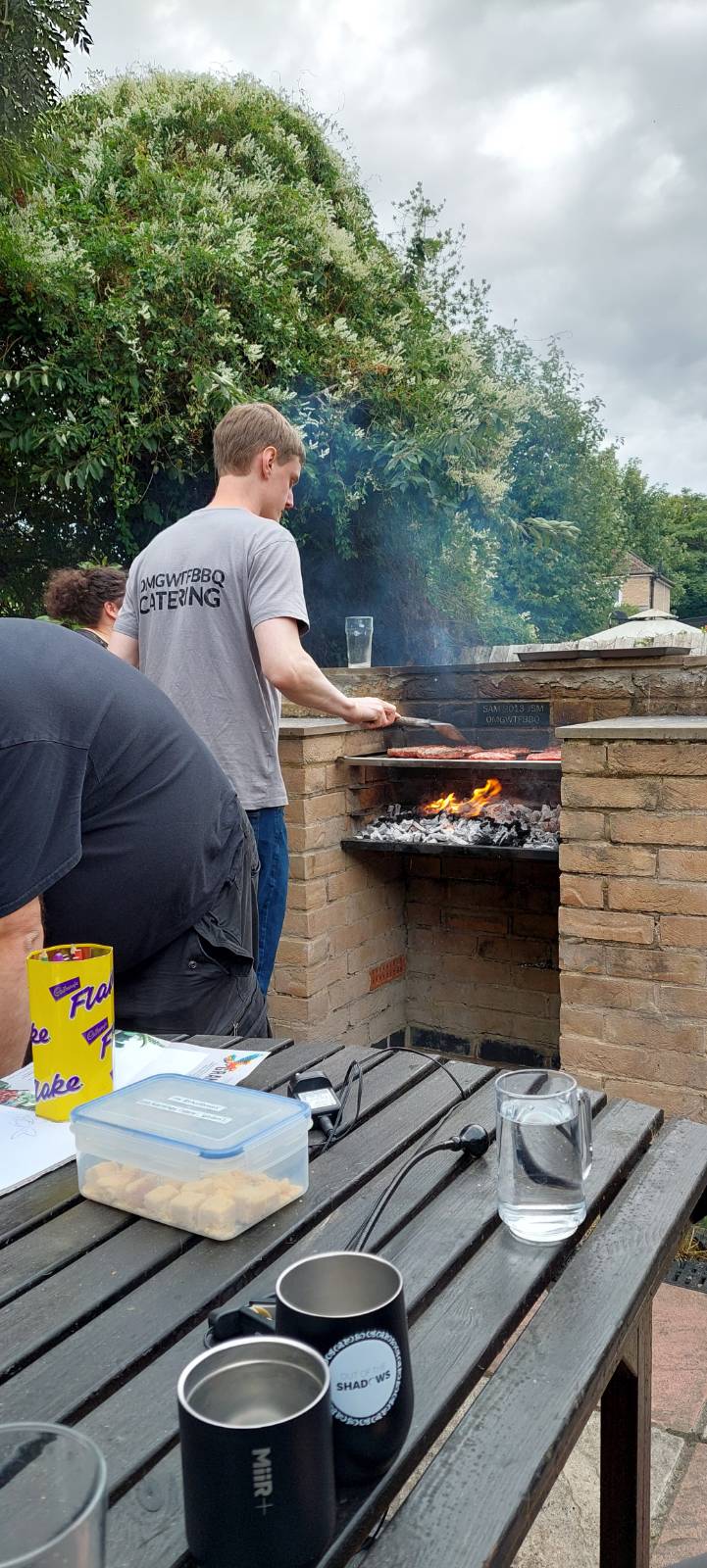
It (was) that time of year again - last weekend we hosted a bunch of nice people at our place in Cambridge for the annual Debian UK OMGWTFBBQ! can you BBQ gin?? Lots of friends, lots of good food and drink. Of course lots of geeky discussions about Debian, networking, random computer languages and... screws? And of course some card games to keep us laughing into each night! beer anyone? Many thanks to a number of awesome friendly people for again sponsoring the important refreshments for the weekend. It's hungry/thirsty work celebrating like this!

Sahil Dhiman: Debconf24 Busan

DebConf24 was held in Busan, South Korea, from July 28th to August 4th 2024 and preceded by DebCamp from July 21st to July 27th. This was my second IRL DebConf (DC) and fourth one in total. I started in Debian with a DebConf, so its always an occasion when one happens. This year again, I worked in fundraising team, working to raise funds from International sponsors. We did manage to raise good enough funding, albeit less than budgeted. Though, the local Korean team was able to connect and gather many Governmental sponsors, which was quite surprising for me. I wasn t seriously considering attending DebConf until I discussed this with Nilesh. More or less, his efforts helped push me through the whole process. Thanks, Nilesh, for this. In March, I got my passport and started preparing documents for South Korean visa. It did require quite a lot of paper work but seeing South Korea s s fresh passport visa rejection rate, I had doubts about visa acceptance. The visa finally got approved, which could be attributed to great documentation and help from DebConf visa team. This was also my first trip outside India, and this being to DebConf made many things easy. Most stuff were documented on DebConf website and wiki. Asking some query got immediate responses from someone in the DebConf channels. We then booked a direct flight from Delhi, reaching Seoul in the morning. With good directions from Sourab TK who had reached Seoul a few hours earlier, we quickly got Korean Won, local SIM and T Money card (transportation card) and headed towards Seoul by AREX, airport metro. We spent the next two days exploring Seoul, which is huge. It probably has the highest number of skyscrapers I have ever seen. The city has a good mix of modern and ancient culture. We explored various places in Seoul including Gyeongbokgung Palace, Statue of King Sejong, Bukchon Hanok village, N Seoul Tower and various food markets which were amazing. A Street in Seoul
A Street in Seoul
Next, we headed to Busan for DebConf using KTX (Korean high speed rail). (Fun fact, slogan for City of Busan is Busan is Good .) South Korea has a good network of frequently running high speed trains. We had pre-booked our tickets because, despite the frequency, trains were sold out most of the time. KTX ride was quite smooth, despite travelling at 300 Kmph at times through Korean countryside and long mountain tunnels. View from Dorm Room
PKNU Entrance
The venue for DebConf was Pukyong National University (PKNU), Daeyeon Campus. PKNU had two campuses in the Busan and some folks ended up in wrong campus too. With good help and guidance from the front desk, we got our dormitory rooms assigned. Dorms here were quite different, ie: View from Dorm Room
View from Dorm Room
Settling in was easy. We started meeting familiar folks after almost a year. The long conversations started again. Everyone was excited for DebConf. Like everytime, the first day was full of action (and chaos). Meet and greet, volunteers check in, video team running around and fixing stuff and things working (or not). There were some interesting talks and sponsors stalls. After day one, things more or less settled down. I again volunteered for video team stuff and helped in camera operations and talk directions, which is always fun. As the tradition applies, saw few talks live on stream too sitting in the dorm room during the conf, which is always fun, when too tired to get ready and go out. From Talk Director's chair
From Talk Director's chair
DebConf takes care of food needs for vegan/vegetarianism folks well, of which I m one. I got to try different food items, which was quite an experience. Tried using chopsticks again which didn t work, which I later figured that handling metal ones were more difficult. We had late night ramens and wooden chopsticks worked perfectly. One of the days, we even went out to an Indian restaurant to have some desi aloo paratha, paneer dishes, samosas and chai (milk tea). I wasn t particularly craving desi food but wasn t able to get something according to my taste so went there. As usual Bits from DPL talk was packed
As usual Bits from DPL talk was packed
For day trip, I went to Ulsan. San means mountains in Korean. Ulsan is a port city with many industries including Hyundai car factory, petrochemical industry, paint industry, ship building etc. We saw bamboo forest, Ulsan tower (quite a view towards Ulsan port), whale village, Ulsan Onggi Museum and the sea (which was beautiful). The beautiful sea
The beautiful sea

View from Ulsan Bridge Observatory
Amongst the sponsors, I was most interested in our network sponsors, folks who were National research and education networks (NREN) here. We had two network sponsors, KOREN and KREONET, thanks to efforts by local team. Initially it was discussed that they ll provide 20G uplink each, so 40G in total, which was whopping but by the time the closing talk happened, we got to know we had 200G uplink to the Internet. This was a massive update to last year when we had 1G main and 100M backup link. 200G wasn t what is required, but it was massive capacity and IIRC from the talk, we peaked at around 500M in usage, but it s always fun to have astronomical amount of bandwidth for bragging rights ;) Various mascots in attendance
Various mascots in attendance

Video and Network stats. Screengrab from closing ceremony
Now let s talk about things I found interesting about South Korea in general: Gyeongbokgung Palace Entrance Gyeongbokgung Palace Entrance Gyeongbokgung Palace Entrance
Grand Gyeongbokgung Palace, Seoul

Starfield Library
Starfield Library, Seoul
If one has to get the whole DebConf experience, it s better to attend DebCamp as well because that s when you can sit and interact with everyone better. As DebConf starts, everyone gets busy in various talks and events and things take a pace. DebConf days literally fly. This year, attending DebConf in person was a different experience. Attending DebConf without any organizational work/stress so was better, and I was able to understand working of different Debian team and workflows better while also identified a few where I would like to join and help. A general conclusion was that almost all Debian teams needs more folks to help out. So if someone want to join, they can probably reach out to the team, and would be able to onboard new folks. Though this would require some patience. Kudos to the Korean team who were able to pull off this event under this tight timeline and thanks for all the hospitality. DebConf24 Group Photo
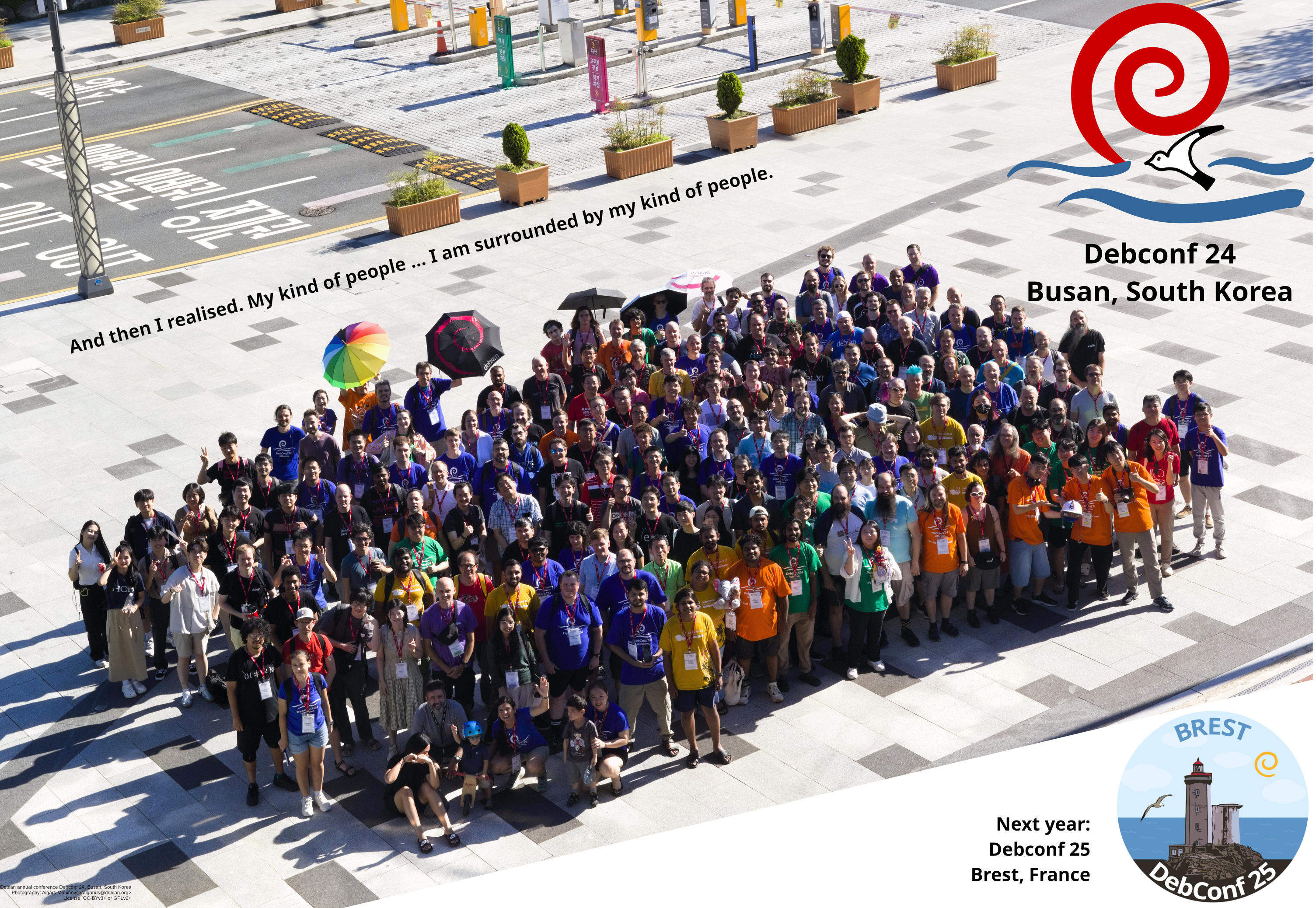
DebConf24 Group Photo. Click to enlarge.
Credits - Aigars Mahinovs
This whole experience expanded my world view. There s so much to see and explore and understand. Looking forward to DebConf25 in Brest, France. PS - Shoutout to abbyck (aka hamCK)!

Russ Allbery: Review: Thornhedge

Review: Thornhedge, by T. Kingfisher
Publisher: Tor
Copyright: 2023
ISBN: 1-250-24410-2
Format: Kindle
Pages: 116
Thornhedge is a fantasy novella by T. Kingfisher, the pen name that Ursula Vernon uses for her adult writing. It won the 2024 Hugo Award for best novella. No matter how much my brain wants to misspell the title, it is a story about a hedge, not a Neolithic earthwork.
The fairy was the greenish-tan color of mushroom stems and her skin bruised blue-black, like mushroom flesh. She had a broad, frog-like face and waterweed hair. She was neither beautiful nor made of malice, as many of the Fair Folk are said to be.
There is a princess asleep in a tower, surrounded by a wall of thorns. Toadling's job is to keep anyone from foolishly breaking in. At first, it was a constant struggle and all that she could manage, but with time, the flood of princes slowed to a trickle. A road was built and abandoned. People fled. There was a plague. With any luck, the tower was finally forgotten. Then a knight shows up. Not a very rich knight, nor a very successful knight. Just a polite and very persistent knight who wants to get into the tower that Toadling does not want him to get into. As you might have guessed, this is a Sleeping Beauty retelling. As you may have also guessed from the author, or from the cover text that says "not all curses should be broken," this version is a bit different. How and why it departs from the original is a surprise that slowly unfolds over the course of the story, in parallel to a delicate, cautious, and delightfully kind-hearted conversation between the knight and the fairy. If you have read a T. Kingfisher story before, particularly one of her fractured fairy tales, you know what to expect. Toadling is one of her typical well-meaning, earnest, slightly awkward protagonists who is just trying to do the right thing in a confusing world full of problems and dangers. She's constantly overwhelmed and yet she keeps going, because what else is there to do. Like a lot of Kingfisher's writing, it's a story about quiet courage from someone who doesn't consider herself courageous. One of the twists this time is that the knight is a character from a similar vein: doggedly unwilling to leave any problem alone, but equally determined to try to be kind. The two of them together make for a story with a gentle and rather melancholy tone. We do, eventually, learn the whole backstory of the tower, the wall of thorns, and Toadling. There is a god, a rather memorable one, who is frustratingly cryptic in the way that gods are. There are monsters who are more loving than most humans. There are humans who turn out to be surprisingly decent when it matters. And, like most of Kingfisher's writing, there is a constant awareness of how complicated the world is, how full it is of people who are just trying to get through each day, and how heavy of burdens people can shoulder when they don't see another way. This story pulled me right in. It is not horror, although there are a few odd bits like there always are in Kingfisher stories. Your largest risk as a reader is that it might make you cry if stories about earnest people doing their best in overwhelming situations hit you that way. My primary complaint is that there was nowhere near enough ending for me. After everything I learned about the characters, I wanted to spend some time with them outside of the bounds of the story. Kingfisher points the reader in a direction and then leaves the rest to your imagination, and I can see why she chose that story construction, but I wanted more catharsis than I got. That complaint aside, this is quintessential T. Kingfisher, and I am unsurprised that it won a Hugo. If you've read any of her other fractured fairy tales, or the 2023 Hugo winner for best novel, you know the sort of stories she tells, and you probably know whether you will like this. I am one of the people who like this. Rating: 8 out of 10

Steve McIntyre: A birthday gift to remember!

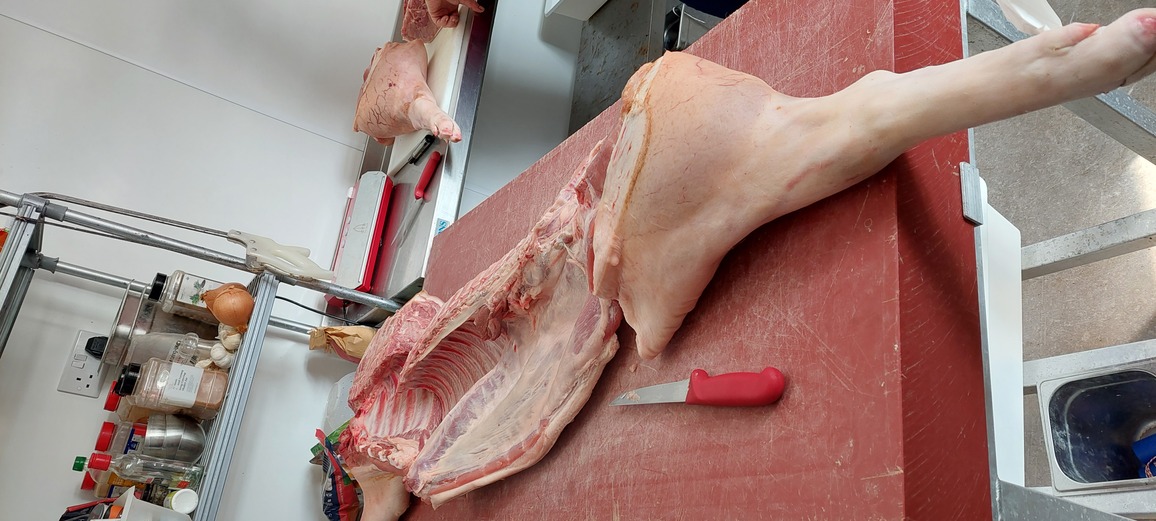
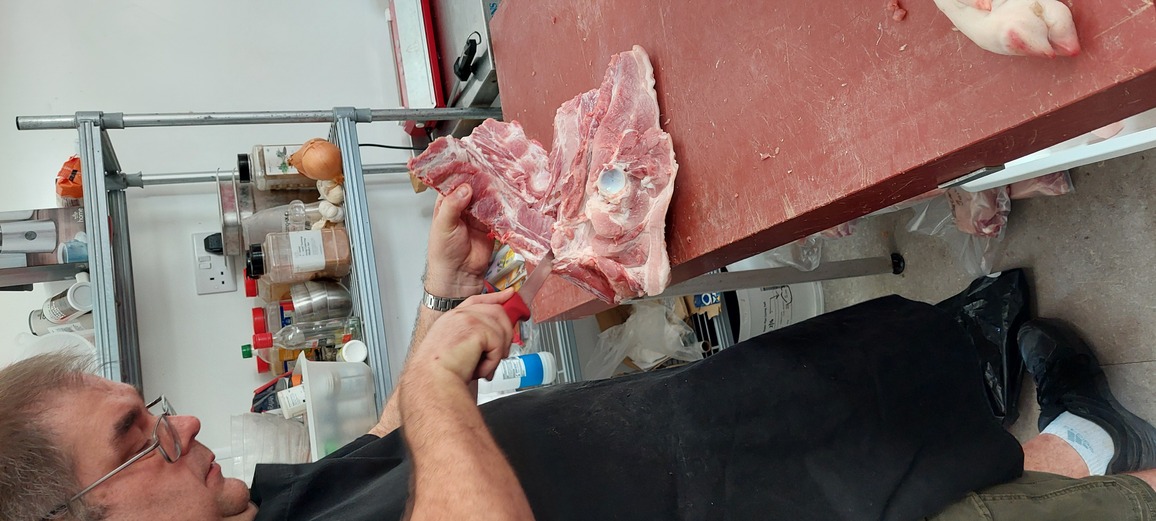
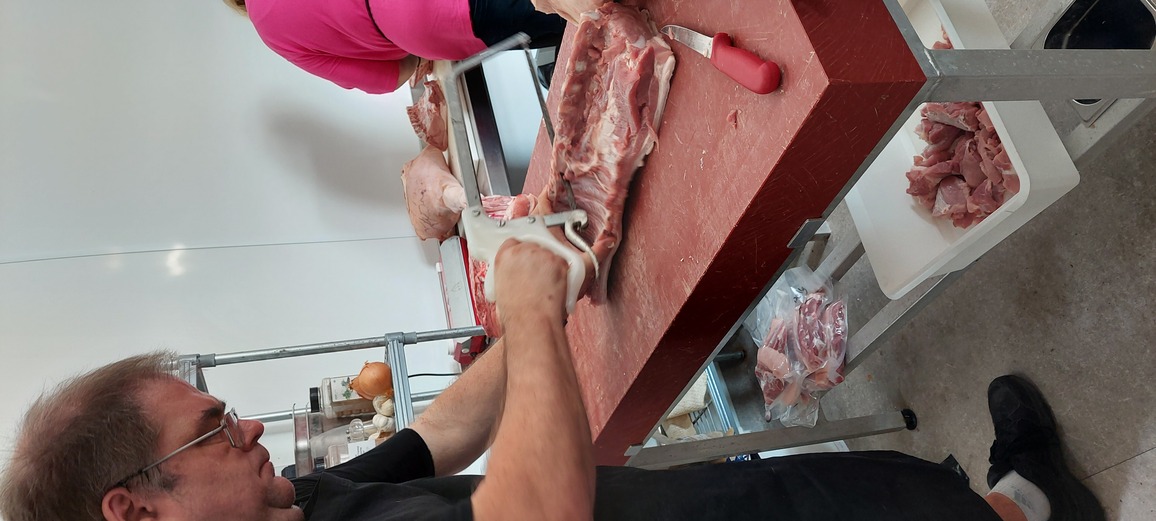
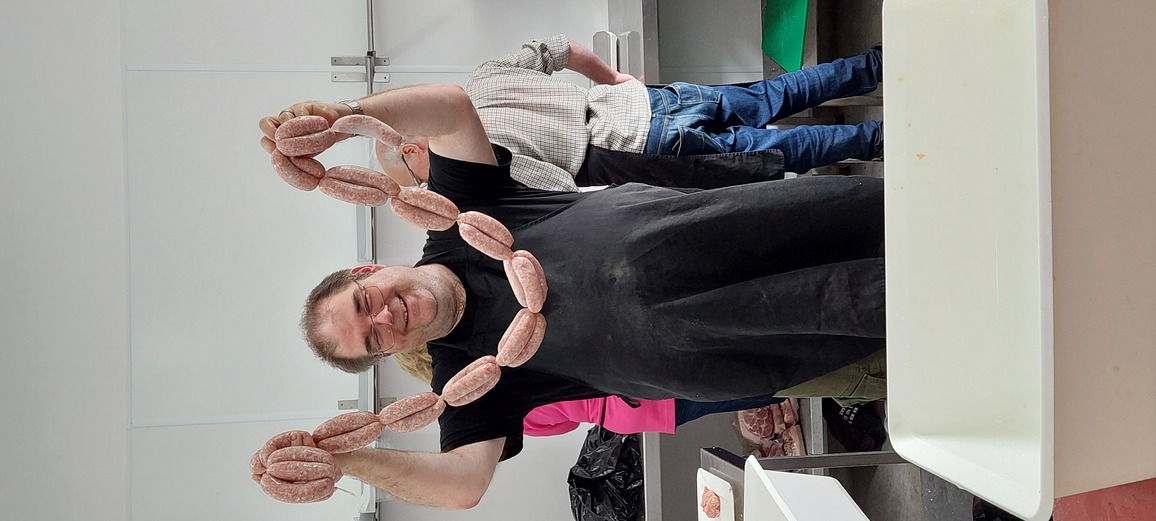
Warning: If you're not into meat, you might want to skip the rest of this... This year, I turned 50. Wow. Lots of friends and family turned up to help me celebrate, with a BBQ (of course!). I was very grateful for a lovely set of gifts from those awesome people, and I have a number of driving experiences to book in the next year or so. I'm going to have so much fun driving silly cars on and off road! However, the most surprising gift was something totally different - a full-day course of hands-on pork butchery. I was utterly bemused - I've never considered doing anything like this at all, and I'd certainly never talked to friends about anything like it either. I was shocked, but in a good way! So, two weekends back Jo and I went over to Empire Farm in Somerset. We stayed nearby so we could be ready on-site early on Sunday morning, and then we joined three other people doing the course. Jo was there to observe, i.e. to watch and take (lots of!) pictures. I can genuinely say that this was the most fun surprise gift I've ever received! David Coldman, the master butcher working with us, has been in the industry for many years. He was an excellent teacher, showing us everything we needed to know and being very patient with us when we needed it. It was great to hear his philosophy too - he only uses the very best locally-sourced meat and focuses on quality over quantity. He showed us all the different cuts of pork that a butcher will make, and we were encouraged to take everything home - no waste here! half a pig At the beginning of the day, we each started with half a pig. Over the next several hours, we steadily worked our way through a series of cuts with knife and saw, making the remaining pig smaller and smaller as we went. saw knife We finished the day with three sets of meat. First, a stack of vacuum-packed joints, chops and steaks ready for cooking and eating at home. Second: a box of off-cuts that we minced and made into sausages at the end of the day. Finally: a bag of skin and bones. Our friend's dog got some of the bones, and Jo turned a lot of the skin into crackling that we shared with friends at the OMGWTFBBQ the next weekend. sausages This was an amazing day. Massive thanks to my good friend Chris Walker for suggesting this gift. As I told David on the day: this was the most fun surprise gift I've ever received. Good hands-on teaching in a new craft is an incredible thing to experience, and I can't recommend this course highly enough.

Reproducible Builds (diffoscope): diffoscope 277 released

The diffoscope maintainers are pleased to announce the release of diffoscope version 277. This version includes the following changes:
[ Sergei Trofimovich ]
* Don't crash when attempting to hashing symlinks with targets that point to
  a directory.
You find out more by visiting the project homepage.

29 August 2024

Jonathan Carter: Orphaning bcachefs-tools in Debian

Around a decade ago, I was happy to learn about bcache a Linux block cache system that implements tiered storage (like a pool of hard disks with SSDs for cache) on Linux. At that stage, ZFS on Linux was nowhere close to where it is today, so any progress on gaining more ZFS features in general Linux systems was very welcome. These days we care a bit less about tiered storage, since any cost benefit in using anything else than nvme tends to quickly evaporate compared to time you eventually lose on it. In 2015, it was announced that bcache would grow into its own filesystem. This was particularly exciting and it caused quite a buzz in the Linux community, because it brought along with it more features that compare with ZFS (and also btrfs), including built-in compression, built-in encryption, check-summing and RAID implementations. Unlike ZFS, it didn t have a dkms module, so if you wanted to test bcachefs back then, you d have to pull the entire upstream bcachefs kernel source tree and compile it. Not ideal, but for a promise of a new, shiny, full-featured filesystem, it was worth it. In 2019, it seemed that the time has come for bcachefs to be merged into Linux, so I thought that it s about time we have the userspace tools (bcachefs-tools) packaged in Debian. Even if the Debian kernel wouldn t have it yet by the time the bullseye (Debian 11) release happened, it might still have been useful for a future backported kernel or users who roll their own. By total coincidence, the first git snapshot that I got into Debian (version 0.1+git20190829.aa2a42b) was committed exactly 5 years ago today. It was quite easy to package it, since it was written in C and shipped with a makefile that just worked, and it made it past NEW into unstable in 19 January 2020, just as I was about to head off to FOSDEM as the pandemic started, but that s of course a whole other story. Fast-forwarding towards the end of 2023, version 1.2 shipped with some utilities written in Rust, this caused a little delay, since I wasn t at all familiar with Rust packaging yet, so I shipped an update that didn t yet include those utilities, and saw this as an opportunity to learn more about how the Rust eco-system worked and Rust in Debian. So, back in April the Rust dependencies for bcachefs-tools in Debian didn t at all match the build requirements. I got some help from the Rust team who says that the common practice is to relax the dependencies of Rust software so that it builds in Debian. So errno, which needed the exact version 0.2, was relaxed so that it could build with version 0.4 in Debian, udev 0.7 was relaxed for 0.8 in Debian, memoffset from 0.8.5 to 0.6.5, paste from 1.0.11 to 1.08 and bindgen from 0.69.9 to 0.66. I found this a bit disturbing, but it seems that some Rust people have lots of confidence that if something builds, it will run fine. And at least it did build, and the resulting binaries did work, although I m personally still not very comfortable or confident about this approach (perhaps that might change as I learn more about Rust). With that in mind, at this point you may wonder how any distribution could sanely package this. The problem is that they can t. Fedora and other distributions with stable releases take a similar approach to what we ve done in Debian, while distributions with much more relaxed policies (like Arch) include all the dependencies as they are vendored upstream. As it stands now, bcachefs-tools is impossible to maintain in Debian stable. While my primary concerns when packaging, are for Debian unstable and the next stable release, I also keep in mind people who have to support these packages long after I stopped caring about them (like Freexian who does LTS support for Debian or Canonical who has long-term Ubuntu support, and probably other organisations that I ve never even heard of yet). And of course, if bcachfs-tools don t have any usable stable releases, it doesn t have any LTS releases either, so anyone who needs to support bcachefs-tools long-term has to carry the support burden on their own, and if they bundle it s dependencies, then those as well. I ll admit that I don t have any solution for fixing this. I suppose if I were upstream I might look into the possibility of at least supporting a larger range of recent dependencies (usually easy enough if you don t hop onto the newest features right away) so that distributions with stable releases only need to concern themselves with providing some minimum recent versions, but even if that could work, the upstream author is 100% against any solution other than vendoring all its dependencies with the utility and insisting that it must only be built using these bundled dependencies. I ve made 6 uploads for this package so far this year, but still I constantly get complaints that it s out of date and that it s ancient. If a piece of software is considered so old that it s useless by the time it s been published for two or three months, then there s no way it can survive even a usual stable release cycle, nevermind any kind of long-term support. With this in mind (not even considering some hostile emails that I recently received from the upstream developer or his public rants on lkml and reddit), I decided to remove bcachefs-tools from Debian completely. Although after discussing this with another DD, I was convinced to orphan it instead, which I have now done. I made an upload to experimental so that it s still available if someone wants to work on it (without having to go through NEW again), it s been removed from unstable so that it doesn t migrate to testing, and the ancient (especially by bcachefs-tools standards) versions that are in stable and oldstable will be removed too, since they are very likely to cause damage with any recent kernel versions that support bcachefs. And so, my adventure with bcachefs-tools comes to an end. I d advise that if you consider using bcachefs for any kind of production use in the near future, you first consider how supportable it is long-term, and whether there s really anyone at all that is succeeding in providing stable support for it.

Michael Ablassmeier: proxmox backup S3 proxy

A few weeks ago Tiziano Bacocco started a small project to implement a (golang) proxy that allows to store proxmox backups on S3 compatible storage: pmoxs3backuproxy, a feature which the current backup server does not have. I wanted to have a look at the Proxmox Backup Server implementation for a while, so i jumped on the wagon and helped with adding most of the API endpoints required to seamlessly use it as drop-in replacement in PVE. The current version can be configured as storage backend in PVE. You can then schedule your backups to the S3 storage likewise. It now supports both the Fixed index format required to create virtual machine backups and the Dynamic index format, used by the regular proxmox-backup-client for file and container backups. (full and incremental) The other endpoints like adding notes, removing or protecting backups, mounting images using the PVE frontend (or proxmox-backup-client) work too. It comes with a garbage collector that does prune the backup storage if snapshots expire and runs integrity checks on the data. You can also configure it as so called remote storage in the Proxmox Backup server itself and pull back complete buckets using proxmox-backup-manager pull , if your local datastore crashes. I think it will become more interesting if future proxmox versions will allow to push backups to other stores, too.

27 August 2024

Russ Allbery: Review: Dark Horse

Review: Dark Horse, by Michelle Diener
Series: Class 5 #1
Publisher: Eclipse
Copyright: June 2015
ISBN: 0-9924559-3-6
Format: Kindle
Pages: 366
Dark Horse is a science fiction romance novel, the first of a five book series as of this writing. It is self-published, although it is sufficiently well-edited and packaged that I had to do some searching to confirm that. Rose was abducted by aliens. The Tecrans picked her up along with a selection of Earth animals, kept her in a cell in their starship, and experimented on her. As the book opens, she has managed to make her escape with the aid of an AI named Sazo who was also imprisoned on the Tecran ship. Sazo dealt with the Tecrans, dropped the ship in the middle of Grih territory, and then got Rose and most of the animals on shuttles to a nearby planet. Dav Jallan is the commander of the ship the Grih sent to investigate the unexplained appearance of a Class 5 Tecran warship in the middle of their territory. The Grih and the Tecran, along with three other species, are members of the United Council, which means in theory they're all at peace. With the Tecran, that theory is often strained. Dav is not going to turn down one of their highly-advanced Class 5 warships delivered to him on a silver platter. There is only the matter of the unexpected cargo, the first orange dots (indicating unknown life forms) that most of the Grih have ever seen. There is a romance. That romance did not work for me. I thought it was highly unprofessional on Dav's part and a bit too obviously constructed on the author's part. It also leans on the subgenre convention that aliens can be remarkably physically similar and sexually compatible, which always causes problems for my suspension of disbelief even though I know it's no less plausible than faster-than-light travel. Despite that, I had so much fun with this book! It was absolutely delightful and weirdly grabby in a way that caught me by surprise. I was skimming some parts of it to write this review and found myself re-reading multiple pages before I dragged myself back on task. I think the most charming part of this book is that the United Council has a law called the Sentient Beings Agreement that makes what the Tecran were doing extremely illegal, and the Grih and the other non-Tecran aliens take this very seriously and with a refreshing lack of cynicism. Rose has a typical human reaction to ending up in a place where she doesn't know the rules and isn't entirely an expected guest. She almost reflexively smoothes over miscommunications and tensions, trying to adapt to their expectations. And then, repeatedly, the Grih realize how much work she's doing to adapt to them, feel enraged at the Tecran and upset that they didn't understand or properly explain something, and find some way to make Rose feel more comfortable. It's surprisingly soothing and comforting to read. It occurred to me in several places that Dark Horse could be read as a wish-fulfillment fantasy of what life as a woman could be like if men took their fair share of the mental load. (This concept is usually applied to housework, but I think it generalizes to other social and communication contexts.) I suspect this was not an accident. There is a lot of wish fulfillment in this book. The Grih are very human-like but hunky, which is convenient for the romance subplot. They struggle to sing, value music exceptionally highly, and consider Rose's speaking voice beautifully musical. Her typical human habit of singing to herself is a source of immediate and almost overwhelming fascination. The supplies Rose takes from the Tecran ship when she flees just happen to be absurdly expensive scented shampoo and equally expensive luxury adaptable clothing. The world she lands on, and the Grih ship, are low-gravity compared to Earth, so Rose is unusually strong for her size. Grih military camouflage has no effect on her human vision. The book is set up to make Rose special. If that type of wish fulfillment is going to grate, wait on this book until you're more in the mood for it. But I like wish fulfillment books when they're done well. Part of why I like to read is to imagine a better world. And Rose isn't doted on; despite their hospitality, she's constantly underestimated by the Grih. Even with their deep belief in the Sentient Beings Agreement, they find it hard to believe that an unknown sentient, even an advanced sentient, is really their equal. Their concern at the start is somewhat patronizing, so watching Rose constantly surprise them delighted the part of my brain that likes both competence porn and deserved reversals, even though the competence here is often due to accidents of biology. It helps that Diener tells the story in alternating perspectives, so the reader first watches Rose do something practical and straightforward from her perspective and then gets to enjoy the profound surprise and chagrin of the aliens. There is a plot beneath this first contact story, and beyond the political problem of figuring out what to do with Rose and the Tecran. Sazo, Rose's AI friend, does not want the Grih to know he exists. He has a history that Rose does not know about and may not be entirely safe. As the political situation with the Tecran escalates, Sazo is pursuing goals of his own, and Rose has a firm opinion about where her loyalties should lie. The resolution is nothing ground-breaking as far as SF goes, but I thought it was satisfyingly tense and complex. Dark Horse leaves obvious room for a sequel, but it comes to a satisfying conclusion. The writing is serviceable, particularly once you get into the story. I would not call it great, and it's not going to win any literary awards, but it didn't interfere with my enjoyment of the story. This is not the sort of book that will make anyone's award list, but it is easily in the top five of books I had the most fun reading this year. Maybe save it for when you're looking for something light and wholesome and don't mind some rather obvious tropes, but if you're in the mood for imagining people who take laws seriously and sincerely try to help other people, I found this an utterly delightful way to pass the time. I immediately bought the sequel. Recommended. Followed by Dark Deeds. Rating: 8 out of 10

25 August 2024

Thomas Lange: Custom Live Media, also for Newer Hardware

At this years Debian conference in South Korea I've presented1 the new feature of the FAIme web service. You can now build your own Debian live media/ISO. The web interface provides various settings, for e.g. adding a user name and its password, selecting the Debian release (stable or testing), the desktop environment and the language. Additionally you can add your own list of packages, that will be installed into the live environment. It's possible to define a custom script that gets executed during the boot process. For remote access to the live system, you can easily sepcify a github, gitlab or salsa account, whose public ssh key will be used for passwordless root access. If your hardware needs special grub settings, you may also add those. I'm thinking about adding an autologin checkbox, so the live media could be used for a kiosk system. And finally newer hardware is supported with the help of the backports kernel for the Debian stable release (aka bookworm). This combination is not available from the official Debian live images or the netinst media because the later has some complicated dependencies which are not that easy to resolve2. At DebConf24 I've talked to Alper who has some ideas3 how to improve the Debian installer environment which then may support a backports kernel. The FAI web service for live ISO is available at https://fai-project.org/FAIme/live

24 August 2024

Kalyani Kenekar: Join Us: Contribute to Open Source as Marathi speaking person!

Logo GNOME Logo MARATHI GNOME is one of the most widely used free and open-source desktop environments! Your native language is Marathi and you are using GNOME as your desktop environment? Then me as the coordinator for the Marathi translation team in GNOME is excited to invite you to become part of the team who is working on translating the GNOME Desktop into Marathi! By this and contributing to the translation of GNOME into Marathi you would be a member of an important project and you can help to make it more accessible to Marathi speakers worldwide and help also to keep our language alive in the open source world.

Why Should You Contribute?
  • Promote Your Language By translating GNOME into Marathi, you help to preserve and promote our beautiful language in the digital world.
  • Learn and Grow Contributing to open-source projects like GNOME is a great way to improve your language and technical skills, network with like-minded individuals, and gain recognition in the global open-source community.
  • Give Back to the Community This is an opportunity to contribute to a project that has a significant impact on users around the world. Your work will enable Marathi speakers to use technology in their native language.

Who Can Contribute? You don t need to be a professional translator to join us! If you are fluent in Marathi and have a basic understanding of English, your contributions will be invaluable. Whether you re a student, a professional, or just someone passionate about your language, your help is needed and really appreciated!

How To Start Translating? Once you re familiar with the tools, you can easily begin translating. We have a list of untranslated strings waiting for your contribution!

How To Join The Team? Follow these steps to join the Marathi translation team for GNOME and start contributing:
  • Step 1: Visit our GNOME Translation Team Page.
  • Step 2: If you re a new user, click on the Create Account option to sign up.
  • Step 3: Once you ve created your account, log in with your credentials.
  • Step 4: After logging in, click the Join button to become a translator for the Marathi team.
  • Step 5: You ll now see a list of different modules that need translation. Choose one of the files that interests you and download it to your computer.
  • Step 6: Translate the content locally on your computer. Once you re done, return to the website, click Browse, and submit your translated file.

Get Familiar with the Additional Tools

Varnam If you re not used to typing in Marathi, you can still contribute using the Varnam website, a free and open-source tool that converts English text into Marathi. Here s how you can get started:
  • Step 1: Visit the Varnam website.
  • Step 2: Click on the Try Now button on the website.
  • Step 3: In the language selection menu, choose Marathi as your desired language.
  • Step 4: Now you can start typing in English, and Varnam will automatically convert your text into Marathi. If you need more guidance, there s a help window available on the site that you can explore for additional support.

Need Help Or You Have Questions? If you have any doubts or need further assistance how you get started with translating GNOME into Marathi, don t hesitate to reach out. I m here to help you on every step of the way! You can connect with me directly at kalyaniknkr@gmail.com Whether you need technical support, guidance on using the tools, or just want to discuss the project, feel free to get in touch. Let s work together to make GNOME accessible to Marathi speakers around the world. Your contributions are always invaluable, and I look forward to welcoming you to our team! Thank you for your interest and support!

Jonathan Dowland: Fediverse and feeds

It's clear that Twitter has been circling the drain for years, but things have been especially bad in recent times. I haven't quit (I have some sympathy with the viewpoint don't cede territory to fascists) but I try to read it much less, and I certainly post much less. Especially at the moment, I really appreciate distractions. Last time I wrote about Mastodon (by which I meant the Fediverse1), I was looking for a new instance to try. I settled on Debian's social instance2. I'm now trying to put any energy I might spend engaging on Twitter, into engaging in the Fediverse instead. (You can follow me via the handle @jon@dow.land, I think, which should repoint to my actual handle, @jmtd@pleroma.debian.social.) There are other potential successors to Twitter: two big ones are Bluesky and Facebook-owned Threads. They are effectively cookie-cutter copies of the Twitter model, and so, we will repeat the same mistakes there. Sadly I see the majority of communities and sub-cultures I follow are migrating to one or the other of these. The Fediverse (or the Mastodon-ish bits of it) should avoid the fate of Twitter. JWZ puts it better and more succinctly than I can. The Fedi experience is, sadly, pretty clunky. So I want to try and write a bit from time to time with tips and tricks that might improve people's experiences. First up, something I discovered only today about Mastodon instances. As JWZ noted, If you are worried about picking the "right" Mastodon instance, don't. Just spin the wheel.. You can spend too much time trying to guess a good answer to this. Better to just get started. At the same time, individual instances are supposed to cater to specific niches. So it could be useful to sample the public posts from an entire instance. For example, to find people to follow, or decide to hop over to that instance yourself. You can't (I think) follow an entire instance from within yours, but, they usually have a public page which shows you the latest traffic. For example, the infosec-themed instance infosec.exchange has one here: https://infosec.exchange/public/local These pages don't provide RSS or Atom feeds3, sadly. I hope that's on the software's roadmap, and hasn't been spurned for ideological reasons. For now at least, OpenRSS provide RSS/Atom feeds for many Mastodon instances. For example, an RSS/Atom feed of the above: https://openrss.org/infosec.exchange/public/local One can add these feeds to your Feed reader and over time get a flavour for the kind of discourse that takes place on given instances. I think the OpenRSS have to manually add Mastodon instances to their service. I tried three instances and only one (infosec.exchange) worked. I'm not sure but I think trying an instance that doesn't work automatically puts it on OpenRSS's backlog.

  1. the Fediverse-versus-Mastodon nomenclature problem is just the the tip of the iceberg, in terms of adoption problems. Mastodon provides a twitter-like service that participates in the Fediverse. But it isn't correct to call the twitter-like service "Mastodon" because other softwares also participate in/provide that service. And it's not correct to call it "Fediverse" because that describes a bigger thing, with e.g. youtube clones also taking part. I'm not sure what the right term should be for "the twitter-like thing". Also, everything I wrote here is probably subtly wrong.
  2. Debian's instance actually runs Pleroma, an alternative to Mastodon. Why should it matter? I think it's healthy for there to be more than one implementation in an open ecosystem. However the experience can be janky, as the features don't perfectly align, some Mastodon features/APIs are not documented/standardised/etc.
  3. I have to remind myself that the concept of RSS/Atom feeds and Feedreaders might need explaining to a modern audience too. Perhaps in another blog post.

Dirk Eddelbuettel: RcppEigen 0.3.4.0.2 on CRAN: Micro Maintenance

A new maintenance release of RcppEigen is now on CRAN, and will go to Debian shortly as usual. Eigen is a C++ template library for linear algebra: matrices, vectors, numerical solvers, and related algorithms. RcppEigen is used by 460 other CRAN packages, and has been downloaded 31.9 million times just off the mirrors of CRAN keeping logs for counting. The recent change switing to Authors@R (now that CRAN mandates it) contained in dual typo in ORCID tags, this releases fixes it. The complete NEWS file entry follows.

Changes in RcppEigen version 0.3.4.0.2 (2024-08-23)
  • Correct two typos in the ORCID tag

Courtesy of CRANberries, there is also a diffstat report for the most recent release. If you like this or other open-source work I do, you can sponsor me at GitHub.

This post by Dirk Eddelbuettel originated on his Thinking inside the box blog. Please report excessive re-aggregation in third-party for-profit settings.

Next.

Previous.