Search Results: "pm"

6 July 2016

Mike Gabriel: [Arctica Project] Release of nx-libs (version 3.5.99.0)

Introduction NX is a software suite which implements very efficient compression of the X11 protocol. This increases performance when using X applications over a network, especially a slow one. NX (v3) has been originally developed by NoMachine and has been Free Software ever since. Since NoMachine obsoleted NX (v3) some time back in 2013/2014, the maintenance has been continued by a versatile group of developers. The work on NX (v3) is being continued under the project name "nx-libs". History Until January 2015, nx-libs was more mainly a redistribution approach of the original NX (v3) software. We (we as in mainly a group of X2Go developers) kept changes applied to the original NoMachine sources as minimal as possible. We also kept the original files and folders structure. Patches had been maintained via the quilt utility on top of a Git repository, the patches had always been kept separate. That was the 3.5.0.x series of nx-libs. In January 2015, the characteristics of nx-libs as maintained by the X2Go project between 2011 and 2015 changed. A decision was reached: This effort is now about to be released as "nx-libs 3.6.0.0". Contributors Since 2011, the nx-libs code base has to a great extent been maintained in the context of the X2Go Project [1]. Qindel Group joining in... In 2014, developers from the Qindel Group [2] joined the nx-libs maintenance. They found X2Go's work on nx-libs and suggested joining forces as best as possible on hacking nx-libs. The Arctica Project comming up... Starting in January 2015, the development on the 3.6.x branch of the project was moved into a new project called the Arctica Project [3]. Development Funding by Qindel In September 2015, a funding project was set up at Qindel. Since then, the Qindel group greatly supports the development of nx-libs 3.6.x monetarily and with provided man power. The funding project officially is a cooperation between Qindel and DAS-NETZWERKTEAM (business run by Mike Gabriel, long term maintainer of nx-libs). The funding is split into two subprojects and lasts until August 2017: The current nx-libs development effort is coordinated in the context of the Arctica Project (by Mike Gabriel), with use cases in Arctica, X2Go and TheQVD (VDI product worked on at Qindel) in mind. People involved There are various people involved in nx-libs 3.6.x maintenance and development, some of them shall be explicitly named here (in alphabetical order of surnames): Some other people have contributed, but have left the project already. Thanks for your work on nx-libs: A big thanks to everyone involved!!! Special thanks go to Stefan Baur for employing Mihai Moldovan and handling all the bureaucracy, so that Mihai can work on this project and get funded for his work. Achievements of nx-libs 3.5.99.0 We are very close to our self-defined release goal 3.6.0. The below tasks have already been (+/-) completed for version 3.5.99.0: In a previous blog post [4], the code reduction in nx-libs has already been discussed. With this announcement, we want to give a status update about our effort of shrinking the nx-libs code base:
    [mike@minobo nx-libs (3.6.x)]$ cloc --match-f '.*\.(c cpp h)' .
        1896 text files.
        1896 unique files.                                          
        7430 files ignored.
    http://cloc.sourceforge.net v 1.60  T=5.88 s (307.3 files/s, 143310.5 lines/s)
    -------------------------------------------------------------------------------
    Language                     files          blank        comment           code
    -------------------------------------------------------------------------------
    C                              958          68574          74891         419638
    C/C++ Header                   730          25683          33957         130418
    C++                            120          17007          11721          61292
    -------------------------------------------------------------------------------
    SUM:                          1808         111264         120569         611348
    -------------------------------------------------------------------------------
The previous statistics had these sums in the last line. First the nx-libs 3.5.0.x code tree (where we came from):
    -------------------------------------------------------------------------------
    SUM:                          5614         329279         382337        1757743
    -------------------------------------------------------------------------------
Then the nx-libs 3.6.x status as it was on May 9th 2016:
    -------------------------------------------------------------------------------
    SUM:                          1922         118581         126783         662635
    -------------------------------------------------------------------------------
Another 50.000 lines of code have been removed over the past two months. Work pending for the final 3.6.0 release goal Known Issues There are several open issues on the nx-libs Github project space, see https://github.com/ArcticaProject/nx-libs/issues. Testing the nx-libs 3.5.99.0 We are currently working on provisioning release builds and nightly builds of nx-libs for various recent Linux distributions. Please stay tuned and watch Mike Gabriel's blog [5]. We already have nightly builds of nx-libs for Debian and Ubuntu [6], but there are more to come soon. Until now, please use the build recipes provided in the README.md file of the nx-libs source tree [7]. References

4 July 2016

Gunnar Wolf: Got the C.H.I.P.s for DebConf!

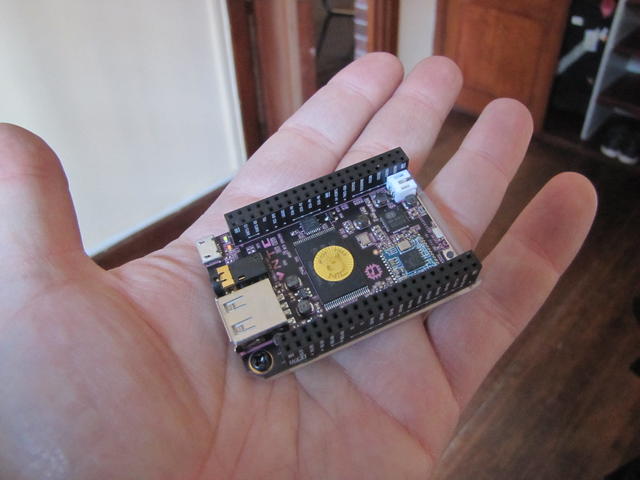
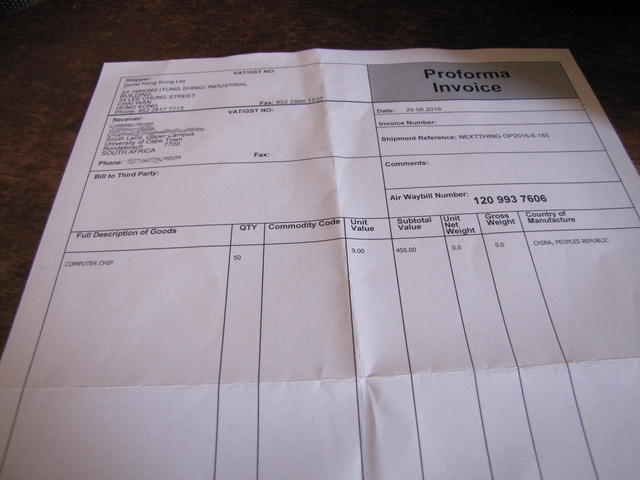
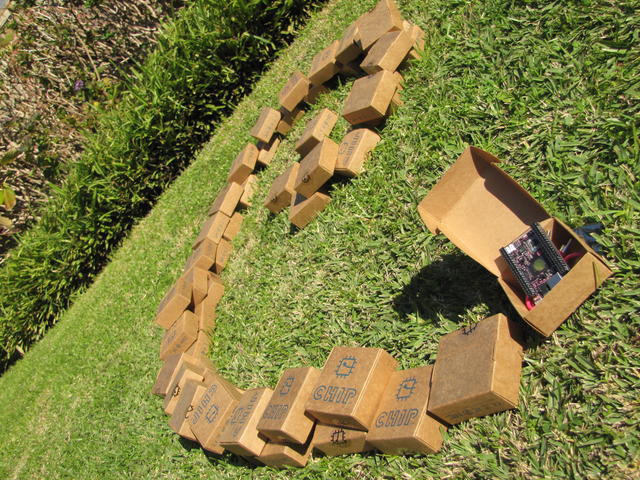
I had my strong doubts as to whether the shipment would be allowed through customs, and was happily surprised by a smiling Graham today before noon. He handed me a smallish box that arrived to his office, containing... Our fifty C.H.I.P. computers, those I offered to give away at DebConf! The little machines are quite neat. They are beautiful little devices, including even a plastic back (so you can safely work with it over a conductive surface or things like that). Quite smaller than the usual Raspberry-like format. It has more than enough GPIO to make several of my friends around here drool about the possibilities. So, what's to this machine besides a nice small ARM CPU, 512MB RAM, wireless connectivity (Wifi and bluetooth)? Although I have not yet looked into them (but intend to do so very soon!), it promises to have the freest available hardware around, and is meant for high hackability! And not that it matters But we managed to import them all, legally and completely hassle-free, into South Africa! That's right We are all used to the declaring commercial value as one dollar mindset. But... The C.H.I.P.s are actually priced at US$9 a piece. The declared commercial value is US$450. South Africans said all their customs are very hard to clear But we were able receive 50 legally shipped computers, declared at their commercial value, without any hassles! (yes, we might have been extremely lucky as well) Anyway, stay tuned By Thursday I will announce the list of people that get to take one home. I still have some left, so feel free to mail me at gwolf+chip@gwolf.org.
3 July 2016

Daniel Stender: My work for Debian in June

At least a little much more time lst month for helping to improve the operating system we're working on. I've worked on a couple of package updates, mostly they are for PAPT, DPMT, Debian Science, or pkg-go (in order of completion): New packages: Sponsored Uploads: Again some further ahead with these ones. My "new package of the month" is going to be Theano. I'm still working on the introduction, it'll come hereafter very soon.

Reproducible builds folks: Reproducible builds: week 61 in Stretch cycle

What happened in the Reproducible Builds effort between June 19th and June 25th 2016. Media coverage GSoC and Outreachy updates Toolchain fixes Other upstream fixes Emil Velikov searched on IRC for hints on how to guarantee unique values during build to invalidate shader caches in Mesa, when also no VCS information is available. A possible solution is a timestamp, which is unique enough for local builds, but can still be reproducible by allowing it to be overwritten with SOURCE_DATE_EPOCH. Packages fixed The following 9 packages have become reproducible due to changes in their build dependencies: cclib librun-parts-perl llvm-toolchain-snapshot python-crypto python-openid r-bioc-shortread r-bioc-variantannotation ruby-hdfeos5 sqlparse The following packages have become reproducible after being fixed: Some uploads have fixed some reproducibility issues, but not all of them: Patches submitted that have not made their way to the archive yet: Package reviews 139 reviews have been added, 20 have been updated and 21 have been removed in this week. New issues found: 53 FTBFS bugs have been reported by Chris Lamb, Santiago Vila and Mateusz ukasik. diffoscope development Quote of the week "My builds are so reproducible, they fail exactly every second time." Johannes Ziemke (@discordianfish) Misc. This week's edition was written by Chris Lamb (lamby), Reiner Herrmann and Holger Levsen and reviewed by a bunch of Reproducible builds folks on IRC.

Thadeu Lima de Souza Cascardo: Debian on old Linux versions

On recent posts, I mentioned that I have a Chromebook, and that I would like to run Debian on devices that ship with old Linux versions. The Samsung ARM Chromebook is such a device, it has Linux 3.4, and that's still what I am running on it most of the time. After an upgrade of Debian, systemd stopped working, and it took me some time before I could look into it. In order to boot, I had to temporarily use System V init. The bug involves the use of new interfaces, bugs in such interfaces, and how versioning would not be a solution to such cases. Cases like this are not common, so it's no excuse to doing the right thing when developing software, like considering portability, API and ABI maintenance and not bundle. But they expose some of the challenges when trying to support different OSes on top of old versions of Linux, or maybe even new versions. The new version of systemd included in Debian Jessie uses a feature of Linux of checking the mount ID of a file by inspecting the mnt_id line in the fdinfo files. fdinfo files are not that new, they have been present since 2007, Linux 2.6.22. The mnt_id line, however, is from Linux 3.15, from 2014. So, a fairly new feature. But systemd falls back to other methods if the feature is not present. However, during the last few weeks of development of Linux 3.4, a bug was introduced to fdinfo handling, which will cause its access to fail in a way that will cause systemd to halt. It simply will refuse to mount the most basic filesystems and not proceed. The bug was fixed not much longer than two weeks after that, but that window of time was enough to have it on a shipped product, one that was not using systemd, let alone one that required a feature not yet present on Linux. But now I wanted to run this new systemd on this old Linux version. Being too early in the boot process, systemd even ignored some of the debug options and I had to resort to other methods of debugging. As I am running a kernel I built by myself, it wasn't hard for me to have a fixed kernel up and running after I found out the problem. Unfortunately, not everyone will be able to do it by themselves. And the point of getting different OSes working on these many varied devices is scaling. If every device needs to be tested, we lose this scalability. The other problem I found was that this old Linux version didn't load firmware files by itself, and requested help from userspace, which used to be the job of udev. Well, udev now does not support loading firmware, and the kernel must do it by itself. I managed to backport that feature too. But now, it sounds like I should get upstream support for this device. Unfortunately, this means not working on the scalability problem, but going back to get upstream support for a lot of devices out there, which is very hard to scale without the necessary people to do the work. I am certainly going to do that, because it's the right thing to do. But not as many people will benefit from that. But I think it has been interesting to look into the possible problems we might find when trying to make Debian and other OSes working on old Linux versions. I know even older Debian versions won't boot fine on Linux 2.6.32, one of the LTS versions of Linux. I have one other device which runs on it, and I am also working on getting better upstream support for it. Let's see if I can get some news on that soon.

Lisandro Dami n Nicanor P rez Meyer: Upcoming KDEPIM changes in unstable (KMail, Kontact, KOrganizer, etc)

For those who care about kdepim (kmail, kontact, korganizer, etc)

Currently the latest version of kdepim is available in experimental. According to our limited tests it's working way better than kdepim 4.14 (more stable, more performant, less bugs). However migrating from one to the other is not a trivial process (distribution wise, hopefully not for our users).

Among the drawbacks in the new kdepim: knode, ktimetracker and kjots were dropped from the official kdepim components. kjots is now an independent project, not tied to the kdepim release cycle. But more importantly, knode and ktimetracker are not maintained upstream any more, we are temporarily still shipping the old KDE 4 versions, but we will drop them after stretch unless they get new upstream maintainers.

To iron out the wrinkles that are surely still there, we are now planning to start a transition for kdepim, effectively blocking all kdepim related packages in unstable until the transition is complete. This will allow us to keep the current kdepim in testing unchanged until kdepim 16.04 is ready to migrate fully to testing.

If you want to test the new kdepim versions right now, please use the version in experimental, as uploading all the packages to unstable will take some time until there is a working kdepim in unstable (mixing experimental and the unstable uploads should be fine).

If you depend on having a working kdepim, please avoid installing the new kdepim packages that will be landing in unstable in the following days, until all the components are available. We expect this will take a couple of weeks, we will post another entry when the packages are ready in unstable.

A list of the binary packages involved in the transition can be found [here].

If you find issues in the new packages, please let us know either via irc in #debian-kde, the kde mailing list debian-kde@lists.debian.org, or send us a bug report (please make sure that it wasn't reported before).

We'll send an updated note when kdepim is fully uploaded to unstable.

Happy hacking,

The Debian Qt/KDE Team.

2 July 2016

Lior Kaplan: Implementing NATO s standards (STANAG)

I recently joined Linnovate, and while working on one of the open source projects the company produces, we needed to process video content according to NATO s standard agreement (STANAG) 4609: NATO Digital Motion Imagery Standard. Obviously we started with trying to find code already done, but we only found some implementation in Java, while our project is written in JavaScript. We decided to just implement the standard in the way most convenient to us, and later refactoring the project when more standards (STANAGs) will get implemented. So I m happy to introduce our new project: STANAG at https://github.com/linnovate/stanag , also available with NPM (see https://www.npmjs.com/package/stanag).
Filed under: Linnovate

30 June 2016

Chris Lamb: Free software activities in June 2016

Here is my monthly update covering a large part of what I have been doing in the free software world (previously):
Debian My work in the Reproducible Builds project was covered in our weekly reports. (#58, #59 & #60)
Debian LTS

This month I have been paid to work 18 hours on Debian Long Term Support (LTS). In that time I did the following:
  • "Frontdesk" duties, triaging CVEs, etc.
  • Extended the lts-cve-triage.py script to ignore packages that are not subject to Long Term Support.

  • Issued DLA 512-1 for mantis fixing an XSS vulnerability.
  • Issued DLA 513-1 for nspr correcting a buffer overflow in a sprintf utility.
  • Issued DLA 515-1 for libav patching a memory corruption issue.
  • Issued DLA 524-1 for squidguard fixing a reflected cross-site scripting vulnerability.
  • Issued DLA 525-1 for gimp correcting a use-after-free vulnerability in the channel and layer properties parsing process.

Uploads
  • redis (2:3.2.1-1) New upstream bugfix release, plus subsequent upload to the backports repository.
  • python-django (1.10~beta1-1) New upstream experimental release.
  • libfiu (0.94-5) Misc packaging updates.


RC bugs

I also filed 170 FTBFS bugs against a7xpg, acepack, android-platform-dalvik, android-platform-frameworks-base, android-platform-system-extras, android-platform-tools-base, apache-directory-api, aplpy, appstream-generator, arc-gui-clients, assertj-core, astroml, bamf, breathe, buildbot, cached-property, calf, celery-haystack, charmtimetracker, clapack, cmake, commons-javaflow, dataquay, dbi, django-celery, django-celery-transactions, django-classy-tags, django-compat, django-countries, django-floppyforms, django-hijack, django-localflavor, django-markupfield, django-model-utils, django-nose, django-pipeline, django-polymorphic, django-recurrence, django-sekizai, django-sitetree, django-stronghold, django-taggit, dune-functions, elementtidy, epic4-help, fcopulae, fextremes, fnonlinear, foreign, fort77, fregression, gap-alnuth, gcin, gdb-avr, ggcov, git-repair, glance, gnome-twitch, gnustep-gui, golang-github-audriusbutkevicius-go-nat-pmp, golang-github-gosimple-slug, gprbuild, grafana, grantlee5, graphite-api, guacamole-server, ido, jless, jodreports, jreen, kdeedu-data, kdewebdev, kwalify, libarray-refelem-perl, libdbusmenu, libdebian-package-html-perl, libdevice-modem-perl, libindicator, liblrdf, libmail-milter-perl, libopenraw, libvisca, linuxdcpp, lme4, marble, mgcv, mini-buildd, mu-cade, mvtnorm, nose, octave-epstk, onioncircuits, opencolorio, parsec47, phantomjs, php-guzzlehttp-ringphp, pjproject, pokerth, prayer, pyevolve, pyinfra, python-asdf, python-ceilometermiddleware, python-django-bootstrap-form, python-django-compressor, python-django-contact-form, python-django-debug-toolbar, python-django-extensions, python-django-feincms, python-django-formtools, python-django-jsonfield, python-django-mptt, python-django-openstack-auth, python-django-pyscss, python-django-registration, python-django-tagging, python-django-treebeard, python-geopandas, python-hdf5storage, python-hypothesis, python-jingo, python-libarchive-c, python-mhash, python-oauth2client, python-proliantutils, python-pytc, python-restless, python-tidylib, python-websockets, pyvows, qct, qgo, qmidinet, quodlibet, r-cran-gss, r-cran-runit, r-cran-sn, r-cran-stabledist, r-cran-xml, rgl, rglpk, rkt, rodbc, ruby-devise-two-factor, ruby-json-schema, ruby-puppet-syntax, ruby-rspec-puppet, ruby-state-machine, ruby-xmlparser, ryu, sbd, scanlogd, signond, slpvm, sogo, sphinx-argparse, squirrel3, sugar-jukebox-activity, sugar-log-activity, systemd, tiles, tkrplot, twill, ucommon, urca, v4l-utils, view3dscene, xqilla, youtube-dl & zope.interface.

FTP Team

As a Debian FTP assistant I ACCEPTed 186 packages: akonadi4, alljoyn-core-1509, alljoyn-core-1604, alljoyn-gateway-1504, alljoyn-services-1504, alljoyn-services-1509, alljoyn-thin-client-1504, alljoyn-thin-client-1509, alljoyn-thin-client-1604, apertium-arg, apertium-arg-cat, apertium-eo-fr, apertium-es-it, apertium-eu-en, apertium-hbs, apertium-hin, apertium-isl, apertium-kaz, apertium-spa, apertium-spa-arg, apertium-tat, apertium-urd, arc-theme, argus-clients, ariba, beast-mcmc, binwalk, bottleneck, colorfultabs, dh-runit, django-modeltranslation, dq, dublin-traceroute, duktape, edk2, emacs-pdf-tools, eris, erlang-p1-oauth2, erlang-p1-sqlite3, erlang-p1-xmlrpc, faba-icon-theme, firefox-branding-iceweasel, golang-1.6, golang-defaults, golang-github-aelsabbahy-gonetstat, golang-github-howeyc-gopass, golang-github-oleiade-reflections, golang-websocket, google-android-m2repository-installer, googler, goto-chg-el, gr-radar, growl-for-linux, guvcview, haskell-open-browser, ipe, labplot, libalt-alien-ffi-system-perl, libanyevent-fcgi-perl, libcds-savot-java, libclass-ehierarchy-perl, libconfig-properties-perl, libffi-checklib-perl, libffi-platypus-perl, libhtml-element-library-perl, liblwp-authen-oauth2-perl, libmediawiki-dumpfile-perl, libmessage-passing-zeromq-perl, libmoosex-types-portnumber-perl, libmpack, libnet-ip-xs-perl, libperl-osnames-perl, libpodofo, libprogress-any-perl, libqtpas, librdkafka, libreoffice, libretro-beetle-pce-fast, libretro-beetle-psx, libretro-beetle-vb, libretro-beetle-wswan, libretro-bsnes-mercury, libretro-mupen64plus, libservicelog, libtemplate-plugin-datetime-perl, libtext-metaphone-perl, libtins, libzmq-ffi-perl, licensecheck, link-grammar, linux, linux-signed, lua-busted, magics++, mkalias, moka-icon-theme, neutron-vpnaas, newlisp, node-absolute-path, node-ejs, node-errs, node-has-flag, node-lodash-compat, node-strip-ansi, numba, numix-icon-theme, nvidia-graphics-drivers, nvidia-graphics-drivers-legacy-304xx, nvidia-graphics-drivers-legacy-340xx, obs-studio, opencv, pacapt, pgbackrest, postgis, powermock, primer3, profile-sync-daemon, pyeapi, pypandoc, pyssim, python-cutadapt, python-cymruwhois, python-fisx, python-formencode, python-hkdf, python-model-mommy, python-nanomsg, python-offtrac, python-social-auth, python-twiggy, python-vagrant, python-watcherclient, python-xkcd, pywps, r-bioc-deseq2, r-bioc-dnacopy, r-bioc-ensembldb, r-bioc-geneplotter, r-cran-adegenet, r-cran-adephylo, r-cran-distory, r-cran-fields, r-cran-future, r-cran-globals, r-cran-htmlwidgets, r-cran-listenv, r-cran-mlbench, r-cran-mlmrev, r-cran-pheatmap, r-cran-pscbs, r-cran-r.cache, refind, relatorio, reprotest, ring, ros-ros-comm, ruby-acts-as-tree, ruby-chronic-duration, ruby-flot-rails, ruby-numerizer, ruby-u2f, selenium-firefoxdriver, simgrid, skiboot, smtpping, snap-confine, snapd, sniffles, sollya, spin, subuser, superlu, swauth, swift-plugin-s3, syncthing, systemd-bootchart, tdiary-theme, texttable, tidy-html5, toxiproxy, twinkle, vmtk, wait-for-it, watcher, wcslib & xapian-core.

Russell Coker: Coalitions

In Australia we are about to have a federal election, so we inevitably have a lot of stupid commentary and propaganda about politics. One thing that always annoys me is the claim that we shouldn t have small parties. We have two large parties, Liberal (right-wing, somewhat between the Democrats and Republicans in the US) and Labor which is somewhat similar to Democrats in the US. In the US the first past the post voting system means that votes for smaller parties usually don t affect the outcome. In Australia we have Instant Runoff Voting (sometimes known as The Australian Ballot ) which has the side effect of encouraging votes for small parties. The Liberal party almost never wins enough seats to make government on it s own, it forms a coalition with the National party. Election campaigns are often based on the term The Coalition being used to describe a Liberal-National coalition and the expected result if The Coalition wins the election is that the leader of the Liberal party will be Prime Minister and the leader of the National party will be the Deputy Prime Minister. Liberal party representatives and supporters often try to convince people that they shouldn t vote for small parties and that small parties are somehow undemocratic , seemingly unaware of the irony of advocating for The Coalition but opposing the idea of a coalition. If the Liberal and Labor parties wanted to form a coalition they could do so in any election where no party has a clear majority, and do it without even needing the National party. Some people claim that it s best to have the major parties take turns in having full control of the government without having to make a deal with smaller parties and independent candidates but that s obviously a bogus claim. The reason we have Labor allying with the Greens and independents is that the Liberal party opposes them at every turn and the Liberal party has a lot of unpalatable policies that make alliances difficult. One thing that would be a good development in Australian politics is to have the National party actually represent rural voters rather than big corporations. Liberal policies on mining are always opposed to the best interests of farmers and the Liberal policies on trade aren t much better. If The Coalition wins the election then the National party could insist on a better deal for farmers in exchange for their continued support of Liberal policies. If Labor wins more seats than The Coalition but not enough to win government directly then a National-Labor coalition is something that could work. I think that the traditional interest of Labor in representing workers and the National party in representing farmers have significant overlap. The people who whinge about a possible Green-Labor alliance should explain why they aren t advocating a National-Labor alliance. I think that the Labor party would rather make a deal with the National party, it s just a question of whether the National party is going to do what it takes to help farmers. They could make the position of Deputy Prime Minister part of the deal so the leader of the National party won t miss out.

29 June 2016

Gunnar Wolf: Batch of the Next Thing Co.'s C.H.I.P. computers on its way to DebConf!)

Hello world! I'm very happy to inform that the Next Thing Co. has shipped us a pack of 50 C.H.I.P. computers to be given away at DebConf! What is the C.H.I.P.? As their tagline says, it's the world's first US$9 computer. Further details:
https://nextthing.co/pages/chip
All in all, it's a nice small ARM single-board computer; I won't bore you on this mail with tons of specs; suffice to say they are probably the most open ARM system I've seen to date. So, I agreed with Richard, our contact at the company, I would distribute the machines among the DebConf speakers interested in one. Of course, not every DebConf speaker wants to fiddle with an adorable tiny piece of beautiful engineering, so I'm sure I'll have some spare computers to give out to other interested DebConf attendees. We are supposed to receive the C.H.I.P.s by Monday 4; if you want to track the package shipment, the DHL tracking number is 1209937606. Don't DDoS them too hard! So, please do mail me telling why do you want one, what your projects are with it. My conditions for this giveaway are: To sign up for yours, please mail gwolf+chip@gwolf.org - I will capture mail sent to that alias ONLY.

Michal Čihař: PHP shapefile library

Since quite a long time phpMyAdmin had embedded the bfShapeFiles library for import of geospatial data. Over the time we had to apply fixes to it to stay compatible with newer PHP versions, but there was really no development. Unfortunately, as it seems to be only usable PHP library which can read and write ESRI shapefiles. With recent switch of phpMyAdmin to dependency handling using Composer I wondered if we should get rid of the last embedded PHP library, which was this one - bfShapeFiles. As I couldn't find alive library which would work well for us, I resisted that for quite long, until pull request to improve it came in. At that point I've realized that it's probably better to separate it and start to improve it outside our codebase. That's when phpmyadmin/shapefile was started. The code is based on bfShapeFiles, applies all fixes which were used in phpMyAdmin and adds improvements from the pull request. On top of that it has brand new testsuite (the coverage is still much lower than I'd like to have) and while writing the tests several parsing issues have been discovered and fixed. Anyway you can now get the source from GitHub or install using Composer from Packagist. PS: While fixing parser bugs I've looked at other parsers as well to see how they handle some situations unclear in the specs and I had to fix Python pyshp on the way as well :-).

Filed under: Debian English phpMyAdmin 0 comments

27 June 2016

Alessio Treglia: A not exactly United Kingdom

Island of Ventotene Roman harbour

There once was a Kingdom strongly United, built on the honours of the people of Wessex, of Mercia, Northumbria and East Anglia who knew how to deal with the invasion of the Vikings from the east and of Normans from the south, to come to unify the territory under an umbrella of common intents. Today, however, 48% of them, while keeping solid traditions, still know how to look forward to the future, joining horizons and commercial developments along with the rest of Europe. The remaining 52%, however, look back and can not see anything in front of them if not a desire of isolation, breaking the European dream born on the shores of Ventotene island in 1944 by Altiero Spinelli, Ernesto Rossi and Ursula Hirschmann through the Manifesto for a free and united Europe . An incurable fracture in the country was born in a referendum on 23 June, in which just over half of the population asked to terminate his marriage to the great European family, bringing the UK back by 43 years of history. <Read More [by Fabio Marzocca]>

Bits from Debian: DebConf16 schedule available

DebConf16 will be held this and next week in Cape Town, South Africa, and we're happy to announce that the schedule is already available. Of course, it is still possible for some minor changes to happen! The DebCamp Sprints already started on 23 June 2016. DebConf will open on Saturday, 2 July 2016 with the Open Festival, where events of interest to a wider audience are offered, ranging from topics specific to Debian to a wider appreciation of the open and maker movements (and not just IT-related). Hackers, makers, hobbyists and other interested parties are invited to share their activities with DebConf attendees and the public at the University of Cape Town, whether in form of workshops, lightning talks, install parties, art exhibition or posters. Additionally, a Job Fair will take place on Saturday, and its job wall will be available throughout DebConf. The full schedule of the Debian Conference thorough the week is published. After the Open Festival, the conference will continue with more than 85 talks and BoFs (informal gatherings and discussions within Debian teams), including not only software development and packaging but also areas like translation, documentation, artwork, testing, specialized derivatives, maintenance of the community infrastructure, and other. There will also be also a plethora of social events, such as our traditional cheese and wine party, our group photo and our day trip. DebConf talks will be broadcast live on the Internet when possible, and videos of the talks will be published on the web along with the presentation slides. DebConf is committed to a safe and welcome environment for all participants. See the DebConf Code of Conduct and the Debian Code of Conduct for more details on this. Debian thanks the commitment of numerous sponsors to support DebConf16, particularly our Platinum Sponsor Hewlett Packard Enterprise. About Hewlett Packard Enterprise Hewlett Packard Enterprise actively participates in open source. Thousands of developers across the company are focused on open source projects, and HPE sponsors and supports the open source community in a number of ways, including: contributing code, sponsoring foundations and projects, providing active leadership, and participating in various committees.

25 June 2016

Dimitri John Ledkov: Post-Brexit - The What Now?

Out of 46,500,001 electorate 17,410,742 voted to leave, which is a mere 37.4% or just over a third. [source]. On my books this is not a clear expression of the UK wishes.

The reaction that the results have caused are devastating. The Scottish First Minister has announced plans for 2nd Scottish Independence referendum [source]. Londoners are filing petitions calling for Independent London [source, source]. The Prime Minister announced his resignation [source]. Things are not stable.

I do not believe that super majority of the electorate are in favor of leaving the EU. I don't even believe that those who voted to leave have considered the break up of the UK as the inevitable outcome of the leave vote. There are numerous videos on the internet about that, impossible to quantify or reliably cite, but for example this [source]

So What Now?

P R O T E S T

I urge everyone to start protesting the outcome of the mistake that happened last Thursday. 4th of July is a good symbolic date to show your discontent with the UK governemnt and a tiny minority who are about to cause the country to fall apart with no other benefits. Please stand up and make yourself heard.
  • General Strikes 4th & 5th of July
There are 64,100,000 people living in the UK according to the World Bank, maybe the government should fear and listen to the unheard third. The current "majority" parliament was only elected by 24% of electorate.

It is time for people to actually take control, we can fix our parliament, we can stop austerity, we can prevent the break up of the UK, and we can stay in the EU. Over to you.

ps. How to elect next PM?

Electing next PM will be done within the Conservative Party, and that's kind of a bummer, given that the desperate state the country currently is in. It is not that hard to predict that Boris Johnson is a front-runner. If you wish to elect a different PM, I urge you to splash out 25 quid and register to be a member of the Conservative Party just for one year =) this way you will get a chance to directly elect the new Leader of the Conservative Party and thus the new Prime Minister. You can backdoor the Conservative election here.

21 June 2016

Ian Wienand: Zuul and Ansible in OpenStack CI

In a prior post, I gave an overview of the OpenStack CI system and how jobs were started. In that I said
(It is a gross oversimplification, but for the purposes of OpenStack CI, Jenkins is pretty much used as a glorified ssh/scp wrapper. Zuul Version 3, under development, is working to remove the need for Jenkins to be involved at all).
Well some recent security issues with Jenkins and other changes has led to a roll-out of what is being called Zuul 2.5, which has indeed removed Jenkins and makes extensive use of Ansible as the basis for running CI tests in OpenStack. Since I already had the diagram, it seems worth updating it for the new reality.
OpenStack CI Overview While previous post was really focused on the image-building components of the OpenStack CI system, overview is the same but more focused on the launchers that run the tests. Overview of OpenStack CI with Zuul and Ansible
  1. The process starts when a developer uploads their code to gerrit via the git-review tool. There is no further action required on their behalf and the developer simply waits for results of their jobs.

  2. Gerrit provides a JSON-encoded "fire-hose" output of everything happening to it. New reviews, votes, updates and more all get sent out over this pipe. Zuul is the overall scheduler that subscribes itself to this information and is responsible for managing the CI jobs appropriate for each change.

  3. Zuul has a configuration that tells it what jobs to run for what projects. Zuul can do lots of interesting things, but for the purposes of this discussion we just consider that it puts the jobs it wants run into gearman for a launcher to consume. gearman is a job-server; as they explain it "[gearman] provides a generic application framework to farm out work to other machines or processes that are better suited to do the work". Zuul puts into gearman basically a tuple (job-name, node-type) for each job it wants run, specifying the unique job name to run and what type of node it should be run on.

  4. A group of Zuul launchers are subscribed to gearman as workers. It is these Zuul launchers that will consume the job requests from the queue and actually get the tests running. However, a launcher needs two things to be able to run a job a job definition (what to actually do) and a worker node (somewhere to do it). The first part what to do is provided by job-definitions stored in external YAML files. The Zuul launcher knows how to process these files (with some help from Jenkins Job Builder, which despite the name is not outputting XML files for Jenkins to consume, but is being used to help parse templates and macros within the generically defined job definitions). Each Zuul launcher gets these definitions pushed to it constantly by Puppet, thus each launcher knows about all the jobs it can run automatically. Of course Zuul also knows about these same job definitions; this is the job-name part of the tuple we said it put into gearman. The second part somewhere to run the test takes some more explaining. To the next point...

  5. Several cloud companies donate capacity in their clouds for OpenStack to run CI tests. Overall, this capacity is managed by a customized management tool called nodepool (you can see the details of this capacity at any given time by checking the nodepool configuration). Nodepool watches the gearman queue and sees what requests are coming out of Zuul. It looks at node-type of jobs in the queue (i.e. what platform the job has requested to run on) and decides what types of nodes need to start and which cloud providers have capacity to satisfy demand. Nodepool will start fresh virtual machines (from images built daily as described in the prior post), monitor their start-up and, when they're ready, put a new "assignment job" back into gearman with the details of the fresh node. One of the active Zuul launchers will pick up this assignment job and register the new node to itself.

  6. At this point, the Zuul launcher has what it needs to actually get jobs started. With an fresh node registered to it and waiting for something to do, the Zuul launcher can advertise its ability to consume one of the waiting jobs from the gearman queue. For example, if a ubuntu-trusty node is provided to the Zuul launcher, the launcher can now consume from gearman any job it knows about that is intended to run on an ubuntu-trusty node type. If you're looking at the launcher code this is driven by the NodeWorker class you can see this being created in response to an assignment via LaunchServer.assignNode. To actually run the job where the "job hits the metal" as it were the Zuul launcher will dynamically construct an Ansible playbook to run. This playbook is a concatenation of common setup and teardown operations along with the actual test scripts the jobs wants to run. Using Ansible to run the job means all the flexibility an orchestration tool provides is now available to the launcher. For example, there is a custom console streamer library that allows us to live-stream the console output for the job over a plain TCP connection, and there is the possibility to use projects like ARA for visualisation of CI runs. In the future, Ansible will allow for better coordination when running multiple-node testing jobs after all, this is what orchestration tools such as Ansible are made for! While the Ansible run can be fairly heavyweight (especially when you're talking about launching thousands of jobs an hour), the system scales horizontally with more launchers able to consume more work easily. When checking your job results on logs.openstack.org you will see a _zuul_ansible directory now which contains copies of the inventory, playbooks and other related files that the launcher used to do the test run.

  7. Eventually, the test will finish. The Zuul launcher will put the result back into gearman, which Zuul will consume (log copying is interesting but a topic for another day). The testing node will be released back to nodepool, which destroys it and starts all over again nodes are not reused and also have no sensitive details on them, as they are essentially publicly accessible. Zuul will wait for the results of all jobs for the change and post the result back to Gerrit; it either gives a positive vote or the dreaded negative vote if required jobs failed (it also handles merges to git, but that is also a topic for another day).

Work will continue within OpenStack Infrastructure to further enhance Zuul; including better support for multi-node jobs and "in-project" job definitions (similar to the https://travis-ci.org/ model); for full details see the spec.

Reproducible builds folks: Reproducible builds: week 60 in Stretch cycle

What happened in the Reproducible Builds effort between June 12th and June 18th 2016: Media coverage GSoC and Outreachy updates Weekly reports by our participants: Toolchain fixes With this upload of texlive-bin we decided to stop keeping our patched fork of as most of the patches for SOURCE_DATE_EPOCH support had been integrated upstream already, and the last one (making FORCE_SOURCE_DATE default to 1) had been refused. So, we are now going to let the archive be rebuilt against unstable's texlive-bin and see how many packages will become unreproducible with this change; once enough data will be collected we will ponder whether FORCE_SOURCE_DATE should be exported by helper tools (such as debhelper) or manually exported by every package that needs it. (For those wondering: we still recommend to follow SOURCE_DATE_EPOCH always and don't recommend other projects to implement FORCE_SOURCE_DATE ) With the drop of texlive-bin we now have only three modified packages in our experimental repository. Reproducible work in other projects Packages fixed The following 12 packages have become reproducible due to changes in their build dependencies: django-floppyforms flask-restful hy jets3t kombu llvm-toolchain-3.8 moap python-bottle python-debtcollector python-django-debug-toolbar python-osprofiler stevedore The following packages have become reproducible after being fixed: Some uploads have fixed some reproducibility issues, but not all of them: Uploads with reproducibility fixes that currently fail to build: Patches submitted that have not made their way to the archive yet: Package reviews 36 reviews have been added, 12 have been updated and 31 have been removed in this week. 17 FTBFS bugs have been reported by Chris Lamb, Santiago Vila and Dominic Hargreaves. diffoscope development Satyam worked on argument completion (#826711) for diffoscope. strip-nondeterminism development Mattia Rizzolo uploaded strip-nondeterminism 0.019-1~bpo8+1 to jessie-backports. reprotest development Ceridwen filed an Intent To Package (ITP) bug for reprotest as #827293. tests.reproducible-builds.org Misc. This week's edition was written by Mattia Rizzolo, Reiner Herrmann, Ed Maste and Holger Levsen and reviewed by a bunch of Reproducible builds folks on IRC.

Hideki Yamane: Debian developers reference update (3.4.18)

Thanks to our lovely translators, Debian developers reference has now added Russian and Italian version. Hope people who use those languages can look into Debian development more deeply.

And also added fancy CSS for pages, hope you like it...

We have looong queue in BTS, so please help us to make it better with patch (or just article), not just post your opinion. I cannot squash those since I'm not good at English... ;-), so please give your hands.

And maybe it'd be better to use date for versioning, IMHO (not 3.4.18 but 20160621).

20 June 2016

Simon McVittie: GTK Hackfest 2016

I'm back from the GTK hackfest in Toronto, Canada and mostly recovered from jetlag, so it's time to write up my notes on what we discussed there. Despite the hackfest's title, I was mainly there to talk about non-GUI parts of the stack, and technologies that fit more closely in what could be seen as the freedesktop.org platform than they do in GNOME. In particular, I'm interested in Flatpak as a way to deploy self-contained "apps" in a freedesktop-based, sandboxed runtime environment layered over the Universal Operating System and its many derivatives, with both binary and source compatibility with other GNU/Linux distributions. I'm mainly only writing about discussions I was directly involved in: lots of what sounded like good discussion about the actual graphics toolkit went over my head completely :-) More notes, mostly from Matthias Clasen, are available on the GNOME wiki. In no particular order: Thinking with portals We spent some time discussing Flatpak's portals, mostly on Tuesday. These are the components that expose a subset of desktop functionality as D-Bus services that can be used by contained applications: they are part of the security boundary between a contained app and the rest of the desktop session. Android's intents are a similar concept seen elsewhere. While the portals are primarily designed for Flatpak, there's no real reason why they couldn't be used by other app-containment solutions such as Canonical's Snap. One major topic of discussion was their overall design and layout. Most portals will consist of a UX-independent part in Flatpak itself, together with a UX-specific implementation of any user interaction the portal needs. For example, the portal for file selection has a D-Bus service in Flatpak, which interacts with some UX-specific service that will pop up a standard UX-specific "Open" dialog for GNOME and probably other GTK environments, that dialog is in (a branch of) GTK. A design principle that was reiterated in this discussion is that the UX-independent part should do as much as possible, with the UX-specific part only carrying out the user interactions that need to comply with a particular UX design (in the GTK case, GNOME's design). This minimizes the amount of work that needs to be redone for other desktop or embedded environments, while still ensuring that the other environments can have their chosen UX design. In particular, it's important that, as much as possible, the security- and performance-sensitive work (such as data transport and authentication) is shared between all environments. The aim is for portals to get the user's permission to carry out actions, while keeping it as implicit as possible, avoiding an "are you sure?" step where feasible. For example, if an application asks to open a file, the user's permission is implicitly given by them selecting the file in the file-chooser dialog and pressing OK: if they do not want this application to open a file at all, they can deny permission by cancelling. Similarly, if an application asks to stream webcam data, the UX we expect is for GNOME's Cheese app (or a similar non-GNOME app) to appear, open the webcam to provide a preview window so they can see what they are about to send, but not actually start sending the stream to the requesting app until the user has pressed a "Start" button. When defining the API "contracts" to be provided by applications in that situation, we will need to be clear about whether the provider is expected to obtain confirmation like this: in most cases I would anticipate that it is. One security trade-off here is that we have to have a small amount of trust in the providing app. For example, continuing the example of Cheese as a webcam provider, Cheese could (and perhaps should) be a contained app itself, whether via something like Flatpak, an LSM like AppArmor or both. If Cheese is compromised somehow, then whenever it is running, it would be technically possible for it to open the webcam, stream video and send it to a hostile third-party application. We concluded that this is an acceptable trade-off: each application needs to be trusted with the privileges that it needs to do its job, and we should not put up barriers that are easy to circumvent or otherwise serve no purpose. The main (only?) portal so far is the file chooser, in which the contained application asks the wider system to show an "Open..." dialog, and if the user selects a file, it is returned to the contained application through a FUSE filesystem, the document portal. The reference implementation of the UX for this is in GTK, and is basically a GtkFileChooserDialog. The intention is that other environments such as KDE will substitute their own equivalent. Other planned portals include: Environment variables GNOME on Wayland currently has a problem with environment variables: there are some traditional ways to set environment variables for X11 sessions or login shells using shell script fragments (/etc/X11/Xsession.d, /etc/X11/xinit/xinitrc.d, /etc/profile.d), but these do not apply to Wayland, or to noninteractive login environments like cron and systemd --user. We are also keen to avoid requiring a Turing-complete shell language during session startup, because it's difficult to reason about and potentially rather inefficient. Some uses of environment variables can be dismissed as unnecessary or even unwanted, similar to the statement in Debian Policy 9.9: "A program must not depend on environment variables to get reasonable defaults." However, there are two common situations where environment variables can be necessary for proper OS integration: search-paths like $PATH, $XDG_DATA_DIRS and $PYTHONPATH (particularly necessary for things like Flatpak), and optionally-loaded modules like $GTK_MODULES and $QT_ACCESSIBILITY where a package influences the configuration of another package. There is a stopgap solution in GNOME's gdm display manager, /usr/share/gdm/env.d, but this is gdm-specific and insufficiently expressive to provide the functionality needed by Flatpak: "set XDG_DATA_DIRS to its specified default value if unset, then add a couple of extra paths". pam_env comes closer PAM is run at every transition from "no user logged in" to "user can execute arbitrary code as themselves" but it doesn't support .d fragments, which are required if we want distribution packages to be able to extend search paths. pam_env also turns off per-user configuration by default, citing security concerns. I'll write more about this when I have a concrete proposal for how to solve it. I think the best solution is probably a PAM module similar to pam_env but supporting .d directories, either by modifying pam_env directly or out-of-tree, combined with clarifying what the security concerns for per-user configuration are and how they can be avoided. Relocatable binary packages On Windows and OS X, various GLib APIs automatically discover where the application binary is located and use search paths relative to that; for example, if C:\myprefix\bin\app.exe is running, GLib might put C:\myprefix\share into the result of g_get_system_data_dirs(), so that the application can ask to load app/data.xml from the data directories and get C:\myprefix\share\app\data.xml. We would like to be able to do the same on Linux, for example so that the apps in a Flatpak or Snap package can be constructed from RPM or dpkg packages without needing to be recompiled for a different --prefix, and so that other third-party software packages like the games on Steam and gog.com can easily locate their own resources. Relatedly, there are currently no well-defined semantics for what happens when a .desktop file or a D-Bus .service file has Exec=./bin/foo. The meaning of Exec=foo is well-defined (it searches $PATH) and the meaning of Exec=/opt/whatever/bin/foo is obvious. When this came up in D-Bus previously, my assertion was that the meaning should be the same as in .desktop files, whatever that is. We agreed to propose that the meaning of a non-absolute path in a .desktop or .service file should be interpreted relative to the directory where the .desktop or .service file was found: for example, if /opt/whatever/share/applications/foo.desktop says Exec=../../bin/foo, then /opt/whatever/bin/foo would be the right thing to execute. While preparing a mail to the freedesktop and D-Bus mailing lists proposing this, I found that I had proposed the same thing almost 2 years ago... this time I hope I can actually make it happen! Flatpak and OSTree bug fixing On the way to the hackfest, and while the discussion moved to topics that I didn't have useful input on, I spent some time fixing up the Debian packaging for Flatpak and its dependencies. In particular, I did my first upload as a co-maintainer of bubblewrap, uploaded ostree to unstable (with the known limitation that the grub, dracut and systemd integration is missing for now since I haven't been able to test it yet), got most of the way through packaging Flatpak 0.6.5 (which I'll upload soon), cherry-picked the right patches to make ostree compile on Debian 8 in an effort to make backports trivial, and spent some time disentangling a flatpak test failure which was breaking the Debian package's installed-tests. I'm still looking into ostree test failures on little-endian MIPS, which I was able to reproduce on a Debian porterbox just before the end of the hackfest. OSTree + Debian I also had some useful conversations with developers from Endless, who recently opened up a version of their OSTree build scripts for public access. Hopefully that information brings me a bit closer to being able to publish a walkthrough for how to deploy a simple Debian derivative using OSTree (help with that is very welcome of course!). GTK life-cycle and versioning The life-cycle of GTK releases has already been mentioned here and elsewhere, and there are some interesting responses in the comments on my earlier blog post. It's important to note that what we discussed at the hackfest is only a proposal: a hackfest discussion between a subset of the GTK maintainers and a small number of other GTK users (I am in the latter category) doesn't, and shouldn't, set policy for all of GTK or for all of GNOME. I believe the intention is that the GTK maintainers will discuss the proposals further at GUADEC, and make a decision after that. As I said before, I hope that being more realistic about API and ABI guarantees can avoid GTK going too far towards either of the possible extremes: either becoming unable to advance because it's too constrained by compatibility, or breaking applications because it isn't constrained enough. The current situation, where it is meant to be compatible within the GTK 3 branch but in practice applications still sometimes break, doesn't seem ideal for anyone, and I hope we can do better in future. Acknowledgements Thanks to everyone involved, particularly:

Daniel Pocock: WebRTC and communications projects in GSoC 2016

This year a significant number of students are working on RTC-related projects as part of Google Summer of Code, under the umbrella of the Debian Project. You may have already encountered some of them blogging on Planet or participating in mailing lists and IRC. WebRTC plugins for popular CMS and web frameworks There are already a range of pseudo-WebRTC plugins available for CMS and blogging platforms like WordPress, unfortunately, many of them are either not releasing all their source code, locking users into their own servers or requiring the users to download potentially untrustworthy browser plugins (also without any source code) to use them. Mesut is making plugins for genuinely free WebRTC with open standards like SIP. He has recently created the WPCall plugin for WordPress, based on the highly successful DruCall plugin for WebRTC in Drupal. Keerthana has started creating a similar plugin for MediaWiki. What is great about these plugins is that they don't require any browser plugins and they work with any server-side SIP infrastructure that you choose. Whether you are routing calls into a call center or simply using them on a personal blog, they are quick and convenient to install. Hopefully they will be made available as packages, like the DruCall packages for Debian and Ubuntu, enabling even faster installation with all dependencies. Would you like to try running these plugins yourself and provide feedback to the students? Would you like to help deploy them for online communities using Drupal, WordPress or MediaWiki to power their web sites? Please come and discuss them with us in the Free-RTC mailing list. You can read more about how to run your own SIP proxy for WebRTC in the RTC Quick Start Guide. Finding all the phone numbers and ham radio callsigns in old emails Do you have phone numbers and other contact details such as ham radio callsigns in old emails? Would you like a quick way to data-mine your inbox to find them and help migrate them to your address book? Jaminy is working on Python scripts to do just that. Her project takes some inspiration from the Telify plugin for Firefox, which detects phone numbers in web pages and converts them to hyperlinks for click-to-dial. The popular libphonenumber from Google, used to format numbers on Android phones, is being used to help normalize any numbers found. If you would like to test the code against your own mailbox and address book, please make contact in the #debian-data channel on IRC. A truly peer-to-peer alternative to SIP, XMPP and WebRTC The team at Savoir Faire Linux has been busy building the Ring softphone, a truly peer-to-peer solution based on the OpenDHT distribution hash table technology. Several students (Simon, Olivier, Nicolas and Alok) are actively collaborating on this project, some of them have been fortunate enough to participate at SFL's offices in Montreal, Canada. These GSoC projects have also provided a great opportunity to raise Debian's profile in Montreal ahead of DebConf17 next year. Linux Desktop Telepathy framework and reSIProcate Another group of students, Mateus, Udit and Balram have been busy working on C++ projects involving the Telepathy framework and the reSIProcate SIP stack. Telepathy is the framework behind popular softphones such as GNOME Empathy that are installed by default on the GNU/Linux desktop. I previously wrote about starting a new SIP-based connection manager for Telepathy based on reSIProcate. Using reSIProcate means more comprehensive support for all the features of SIP, better NAT traversal, IPv6 support, NAPTR support and TLS support. The combined impact of all these features is much greater connectivity and much greater convenience. The students are extending that work, completing the buddy list functionality, improving error handling and looking at interaction with XMPP. Streamlining provisioning of SIP accounts Currently there is some manual effort for each user to take the SIP account settings from their Internet Telephony Service Provider (ITSP) and transpose these into the account settings required by their softphone. Pranav has been working to close that gap, creating a JAR that can be embedded in Java softphones such as Jitsi, Lumicall and CSipSimple to automate as much of the provisioning process as possible. ITSPs are encouraged to test this client against their services and will be able to add details specific to their service through Github pull requests. The project also hopes to provide streamlined provisioning mechanisms for privately operated SIP PBXes, such as the Asterisk and FreeSWITCH servers used in small businesses. Improving SIP support in Apache Camel and the Jitsi softphone Apache Camel's SIP component and the widely known Jitsi softphone both use the JAIN SIP library for Java. Nik has been looking at issues faced by SIP users in both projects, adding support for the MESSAGE method in camel-sip and looking at why users sometimes see multiple password prompts for SIP accounts in Jitsi. If you are trying either of these projects, you are very welcome to come and discuss them on the mailing lists, Camel users and Jitsi users. GSoC students at DebConf16 and DebConf17 and other events Many of us have been lucky to meet GSoC students attending DebConf, FOSDEM and other events in the past. From this year, Google now expects the students to complete GSoC before they become eligible for any travel assistance. Some of the students will still be at DebConf16 next month, assisted by the regular travel budget and the diversity funding initiative. Nik and Mesut were already able to travel to Vienna for the recent MiniDebConf / LinuxWochen.at As mentioned earlier, several of the students and the mentors at Savoir Faire Linux are based in Montreal, Canada, the destination for DebConf17 next year and it is great to see the momentum already building for an event that promises to be very big. Explore the world of Free Real-Time Communications (RTC) If you are interesting in knowing more about the Free RTC topic, you may find the following resources helpful: RTC mentoring team 2016 We have been very fortunate to build a large team of mentors around the RTC-themed projects for 2016. Many of them are first time GSoC mentors and/or new to the Debian community. Some have successfully completed GSoC as students in the past. Each of them brings unique experience and leadership in their domain. Helping GSoC projects in 2016 and beyond Not everybody wants to commit to being a dedicated mentor for a GSoC student. In fact, there are many ways to help without being a mentor and many benefits of doing so. Simply looking out for potential applicants for future rounds of GSoC and referring them to the debian-outreach mailing list or an existing mentor helps ensure we can identify talented students early and design projects around their capabilities and interests. Testing the projects on an ad-hoc basis, greeting the students at DebConf and reading over the student wikis to find out where they are and introduce them to other developers in their area are all possible ways to help the projects succeed and foster long term engagement. Google gives Debian a USD $500 grant for each student who completes a project successfully this year. If all 2016 students pass, that is over $10,000 to support Debian's mission.

18 June 2016

Debian Java Packaging Team: Wheezy LTS and the switch to OpenJDK 7

Wheezy's LTS period started a few weeks ago and the LTS team had to make an early support decision concerning the Java eco-system since Wheezy ships two Java runtime environments OpenJDK 6 and OpenJDK 7. (To be fair, there are actually three but gcj has been superseded by OpenJDK a long time ago and the latter should be preferred whenever possible.) OpenJDK 6 is currently maintained by Red Hat and we mostly rely on their upstream work as well as on package updates from Debian's maintainer Matthias Klose and Tiago St rmer Daitx from Ubuntu. We already knew that both intend to support OpenJDK 6 until April 2017 when Ubuntu 12.04 will reach its end-of-life. Thus we had basically two options, supporting OpenJDK 6 for another twelve months or dropping support right from the start. One of my first steps was to ask for feedback and advice on debian-java since supporting only one JDK seemed to be the more reasonable solution. We agreed on warning users via various channels about the intended change, especially about possible incompatibilities with OpenJDK 7. Even Andrew Haley, OpenJDK 6 project lead, participated in the discussion and confirmed that, while still supported, OpenJDK 6 security releases are "always the last in the queue when there is urgent work to be done". I informed debian-lts about my findings and issued a call for tests later. Eventually we decided to concentrate our efforts on OpenJDK 7 because we are confident that for the majority of our users one Java implementation is sufficient during a stable release cycle. An immediate positive effect in making OpenJDK 7 the default is that resources can be relocated to more pressing issues. On the other hand we were also forced to make compromises. The switch to a newer default implementation usually triggers a major transition with dozens of FTBFS bugs and the OpenJDK 7 transition was no exception. I pondered about the usefulness of fixing all these bugs for Wheezy LTS again and focussing on runtime issues instead and finally decided that the latter was both more reasonable and more economic. Different from regular default Java changes, users will still be able to use OpenJDK 6 to compile their packages and the security impact for development systems is in general neglectable. More important was to avoid runtime installations of OpenJDK 6. I identified eighteen packages that strictly depended on the now obsolete JRE and fixed those issues on 4 May 2016 together with an update of java-common and announced the switch to OpenJDK 7 with a Debian NEWS file. If you are not a regular reader of Debian news and also not subscribed to debian-lts, debian-lts-announce or debian-java, remember 26 June 2016 is the day when OpenJDK 7 will be made the default Java implementation in Wheezy LTS. Of course there is no need to wait. You can switch right now:
sudo update-alternatives --config java

Next.

Previous.