Search Results: "nate"

7 July 2020

Noah Meyerhans: Setting environment variables for gnome-session

Am I missing something obvious? When did this get so hard? In the old days, you configured your desktop session on a Linux system by editing the .xsession file in your home directory. The display manager (login screen) would invoke the system-wide xsession script, which would either defer to your personal .xsession script or set up a standard desktop environment. You could put whatever you want in the .xsession script, and it would be executed. If you wanted a specific window manager, you d run it from .xsession. Start emacs or a browser or an xterm or two? .xsession. It was pretty easy, and super flexible. For the past 25 years or so, I ve used X with an environment started via .xsession. Early on it was fvwm with some programs, then I replaced fvwm with Window Maker (before that was even its name!), then switched to KDE. More recently (OK, like 10 years ago) I gradually replaced KDE with awesome and various custom widgets. Pretty much everything was based on a .xsession script, and that was fine. One particularly nice thing about it was that I could keep .xsession and any related helper programs in a git repository and manage changes over time. More recently I decided to give Wayland and GNOME an honest look. This has mostly been fine, but everything I ve been doing in .xsession is suddenly useless. OK, fine, progress is good. I ll just use whatever new mechanisms exist. How hard can it be? OK, so here we go. I am running GNOME. This isn t so bad. Alt+F2 brings up the Run Command dialog. It s a different keystroke than what I m used to, but I can adapt. (Obviously I can reconfigure the key binding, and maybe someday I will, but that s not the point here.) I have some executables in ~/bin. Oops, the run command dialog can t find them. No problem, I just need to update the PATH variable that it sees. Hmmm So how does one do that, anyway? GNOME has a help system, but searching that doesn t doesn t reveal anything. But that s fine, maybe it s inherited from the parent process. But there s no xsession script equivalent, since this isn t X anymore at all. The familiar stuff in /etc/X11/Xsession is no longer used. What s the equivalent in Wayland? Turns out, there isn t a shell script at all anymore, at least not in how Wayland and GNOME interact in Debian s configuration, which seems fairly similar to how anybody else would set this up. The GNOME session runs from a systemd-managed user session. Digging in to some web search results suggests that systemd provides a mechanism for setting some environment variables for services started by the user instance of the system. OK, so let s create some files in ~/.config/environment.d and we should be good. Except no, this isn t working. I can set some variables, but something is overriding PATH. I can create this file:
$ cat ~/.config/environment.d/01_path.conf
USER_INITIAL_PATH=$ PATH 
PATH=$ HOME /bin:$ HOME /go/bin:/usr/local/sbin:/usr/local/bin:/usr/sbin:/usr/bin:/sbin:/bin
USER_CUSTOM_PATH=$ PATH 
After logging in, the Run a command dialog still doesn t see my PATH. So I use Alt+F2 and sh -c "env > /tmp/env" to capture the environment, and this is what I see:
USER_INITIAL_PATH=/usr/local/sbin:/usr/local/bin:/usr/sbin:/usr/bin:/sbin:/bin
PATH=/usr/local/bin:/usr/bin:/bin:/usr/games
USER_CUSTOM_PATH=/home/noahm/bin:/home/noahm/go/bin:/usr/local/sbin:/usr/local/bin:/usr/sbin:/usr/bin:/sbin:/bin
So, my environment.d file is there, and it s getting looked at, but something else is clobbering my PATH later in the startup process. But what? Where? Why? The systemd docs don t indicate that there s anything special about PATH, and nothing in /lib/systemd/user-environment-generators/ seems to treat it specially. The string PATH doesn t appear in /lib/systemd/user/ either. Looking for the specific value that s getting assigned to PATH in /etc shows the only occurrence of it being in /etc/zsh/zshenv, so maybe that s where it s coming from? But that should only get set there if it s otherwise unset or otherwise very minimally set. So I still have no idea where it s coming from. OK, so ignoring where my custom value is getting overridden, maybe what s configured in /lib/systemd/user will point me in the right direction. systemd --user status suggests that the interesting part of my session is coming from gnome-shell-wayland.service. Can we use a standard systemd drop-in as documented in systemd.unit(5)? It turns out that we can. This file sets things up the way I want:
$ cat .config/systemd/user/gnome-shell-wayland.service.d/path.conf
[Service]
Environment=PATH=%h/bin:%h/go/bin:/usr/local/sbin:/usr/local/bin:/usr/sbin:/usr/bin:/sbin:/bin
Is that right? It really doesn t feel ideal to me. Systemd s Environment directive can t reference existing environment variables, and I can t use conditionals to do things like add a directory to the PATH only if it exists, so it s still a functional regression from what we had before. But at least it s a text file, edited by hand, trackable in git, so that s not too bad. There are some people out there who hate systemd, and will cite this as an illustration of why. However, I m not one of those people, and I very much like systemd as an init system. I d be happy to throw away sysvinit scripts forever, but I m not quite so happy with the state of .xsession s replacements. Despite the similarities, I don t think .xsession is entirely the same as SysV-style init scripts. The services running on a system are vastly more important than my personal .xsession, and systemd is far better at managing them than the pile of shell scripts used to set things up under sysvinit. Further, systemd the init system maintains compatibility with init scripts, so if you really want to keep using them, you can. As far as I can tell, though, systemd the user session manager does not seem to maintain compatibility with .xsession scripts, and that s unfortunate. I still haven t figured out what was overriding the ~/.config/environment.d/ setting. Any ideas?

Dirk Eddelbuettel: RcppSimdJson 0.1.0: Now on Windows, With Parsers and Faster Still!

A smashing new RcppSimdJson release 0.1.0 containing several small updates to upstream simdjson (now at 0.4.6) in part triggered by very excisting work by Brendan who added actual parser from file and string and together with Daniel upstream worked really hard to make Windows builds as well as complete upstream tests on our beloved (ahem) MinGW platform possible. So this version will, once the builders have caught up, give everybody on Windows a binary with a JSON parser running circles around the (arguably more feature-rich and possibly easier-to-use) alternatives. Dave just tweeted a benchmark snippet by Brendan, the full set is at the bottom our issue ticket for this release. RcppSimdJson wraps the fantastic and genuinely impressive simdjson library by Daniel Lemire and collaborators, which in its upstream release 0.4.0 improved once more (also see the following point releases). Via very clever algorithmic engineering to obtain largely branch-free code, coupled with modern C++ and newer compiler instructions, it results in parsing gigabytes of JSON parsed per second which is quite mindboggling. The best-case performance is faster than CPU speed as use of parallel SIMD instructions and careful branch avoidance can lead to less than one cpu cycle use per byte parsed; see the video of the recent talk by Daniel Lemire at QCon (which was also voted best talk). As mentioned, this release expands the reach of the package to Windows, and adds new user-facing functions. A big thanks for most of this is owed to Brendan, so buy him a drink if you run across him. The full NEWS entry follows.

Changes in version 0.1.0 (2020-07-07)
  • Upgraded to simdjson 0.4.1 which adds upstream Windows support (Dirk in #27 closing #26 and #14, plus extensive work by Brendan helping upstream with mingw tests).
  • Upgraded to simdjson 0.4.6 with further upstream improvements (Dirk in #30).
  • Change Travis CI to build matrix over g++ 7, 8, 9, and 10 (Dirk in #31; and also Brendan in #32).
  • New JSON functions fparse and fload (Brendan in #32) closing #18 and #10).

Courtesy of CRANberries, there is also a diffstat report for this release. For questions, suggestions, or issues please use the issue tracker at the GitHub repo. If you like this or other open-source work I do, you can now sponsor me at GitHub. For the first year, GitHub will match your contributions.

This post by Dirk Eddelbuettel originated on his Thinking inside the box blog. Please report excessive re-aggregation in third-party for-profit settings.

Dirk Eddelbuettel: AsioHeaders 1.16.1-1 on CRAN

An updated version of the AsioHeaders package arrived on CRAN today (after a we days of rest in the incoming directory of CRAN). Asio provides a cross-platform C++ library for network and low-level I/O programming. It is also included in Boost but requires linking when used as part of Boost. This standalone version of Asio is a header-only C++ library which can be used without linking (just like our BH package with parts of Boost). This release brings a new upstream version. Its changes required a corresponding change in one of (only) three reverse depends which delayed the CRAN admisstion by a few days.

Changes in version 1.16.1-1 (2020-06-28)
  • Upgraded to Asio 1.16.1 (Dirk in #5).
  • Updated README.md with standard set of badges

Via CRANberries, there is a diffstat report relative to the previous release. Comments and suggestions about AsioHeaders are welcome via the issue tracker at the GitHub GitHub repo. If you like this or other open-source work I do, you can now sponsor me at GitHub. For the first year, GitHub will match your contributions.

This post by Dirk Eddelbuettel originated on his Thinking inside the box blog. Please report excessive re-aggregation in third-party for-profit settings.

6 July 2020

Dirk Eddelbuettel: Rcpp 1.0.5: Several Updates

rcpp logo Right on the heels of the news of 2000 CRAN packages using Rcpp (and also hitting 12.5 of CRAN package, or one in eight), we are happy to announce release 1.0.5 of Rcpp. Since the ten-year anniversary and the 1.0.0 release release in November 2018, we have been sticking to a four-month release cycle. The last release has, however, left us with a particularly bad taste due to some rather peculiar interactions with a very small (but ever so vocal) portion of the user base. So going forward, we will change two things. First off, we reiterate that we have already made rolling releases. Each minor snapshot of the main git branch gets a point releases. Between release 1.0.4 and this 1.0.5 release, there were in fact twelve of those. Each and every one of these was made available via the drat repo, and we will continue to do so going forward. Releases to CRAN, however, are real work. If they then end up with as much nonsense as the last release 1.0.4, we think it is appropriate to slow things down some more so we intend to now switch to a six-months cycle. As mentioned, interim releases are always just one install.packages() call with a properly set repos argument away. Rcpp has become the most popular way of enhancing R with C or C++ code. As of today, 2002 packages on CRAN depend on Rcpp for making analytical code go faster and further, along with 203 in BioConductor. And per the (partial) logs of CRAN downloads, we are running steady at around one millions downloads per month. This release features again a number of different pull requests by different contributors covering the full range of API improvements, attributes enhancements, changes to Sugar and helper functions, extended documentation as well as continuous integration deplayment. See the list below for details.

Changes in Rcpp patch release version 1.0.5 (2020-07-01)
  • Changes in Rcpp API:
    • The exception handler code in #1043 was updated to ensure proper include behavior (Kevin in #1047 fixing #1046).
    • A missing Rcpp_list6 definition was added to support R 3.3.* builds (Davis Vaughan in #1049 fixing #1048).
    • Missing Rcpp_list 2,3,4,5 definition were added to the Rcpp namespace (Dirk in #1054 fixing #1053).
    • A further updated corrected the header include and provided a missing else branch (Mattias Ellert in #1055).
    • Two more assignments are protected with Rcpp::Shield (Dirk in #1059).
    • One call to abs is now properly namespaced with std:: (Uwe Korn in #1069).
    • String object memory preservation was corrected/simplified (Kevin in #1082).
  • Changes in Rcpp Attributes:
    • Empty strings are not passed to R CMD SHLIB which was seen with R 4.0.0 on Windows (Kevin in #1062 fixing #1061).
    • The short_file_name() helper function is safer with respect to temporaries (Kevin in #1067 fixing #1066, and #1071 fixing #1070).
  • Changes in Rcpp Sugar:
    • Two sample() objects are now standard vectors and not R_alloc created (Dirk in #1075 fixing #1074).
  • Changes in Rcpp support functions:
    • Rcpp.package.skeleton() adjusts for a (documented) change in R 4.0.0 (Dirk in #1088 fixing #1087).
  • Changes in Rcpp Documentation:
    • The pdf file of the earlier introduction is again typeset with bibliographic information (Dirk).
    • A new vignette describing how to package C++ libraries has been added (Dirk in #1078 fixing #1077).
  • Changes in Rcpp Deployment:
    • Travis CI unit tests now run a matrix over the versions of R also tested at CRAN (rel/dev/oldrel/oldoldrel), and coverage runs in parallel for a net speed-up (Dirk in #1056 and #1057).
    • The exceptions test is now partially skipped on Solaris as it already is on Windows (Dirk in #1065).
    • The default CI runner was upgraded to R 4.0.0 (Dirk).
    • The CI matrix spans R 3.5, 3.6, r-release and r-devel (Dirk).

Thanks to CRANberries, you can also look at a diff to the previous release. Questions, comments etc should go to the rcpp-devel mailing list off the R-Forge page. Bugs reports are welcome at the GitHub issue tracker as well (where one can also search among open or closed issues); questions are also welcome under rcpp tag at StackOverflow which also allows searching among the (currently) 2455 previous questions. If you like this or other open-source work I do, you can now sponsor me at GitHub. For the first year, GitHub will match your contributions.

This post by Dirk Eddelbuettel originated on his Thinking inside the box blog. Please report excessive re-aggregation in third-party for-profit settings.

5 July 2020

Thorsten Alteholz: My Debian Activities in June 2020

FTP master This month I accepted 377 packages and rejected 30. The overall number of packages that got accepted was 411. Debian LTS This was my seventy-second month that I did some work for the Debian LTS initiative, started by Raphael Hertzog at Freexian. This month my all in all workload has been 30h. During that time I did LTS uploads of: I started to work on curl as well but did not upload a fixed version, so this has to go to ELTS now. Last but not least I did some days of frontdesk duties. Debian ELTS This month was the twenty fourth ELTS month. Unfortunately in the last month of Wheezy ELTS even I did not find any package to fix a CVE, so during my small allocated time I didn t uploaded anything. But at least I did some days of frontdesk duties und updated my working environment for the new ELTS Jessie. Other stuff I uploaded a new upstream version of

4 July 2020

Dirk Eddelbuettel: Rcpp now used by 2000 CRAN packages and one in eight!

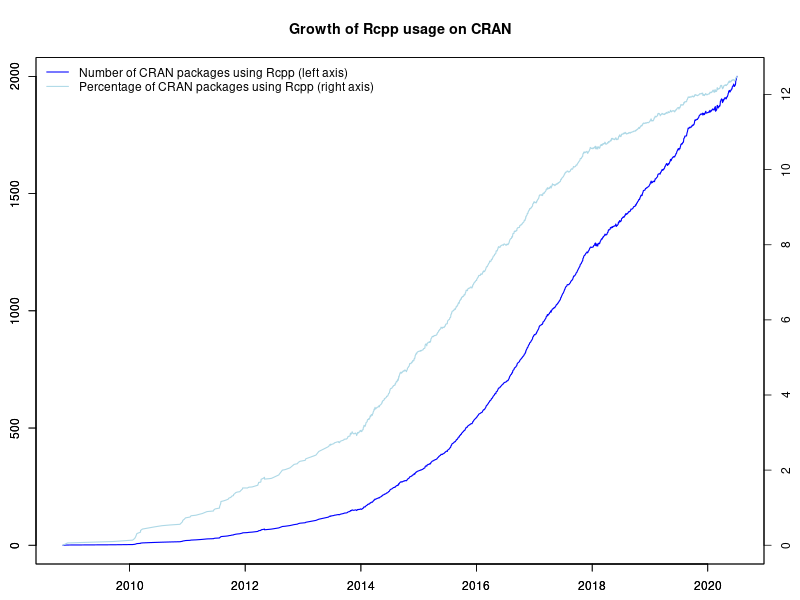
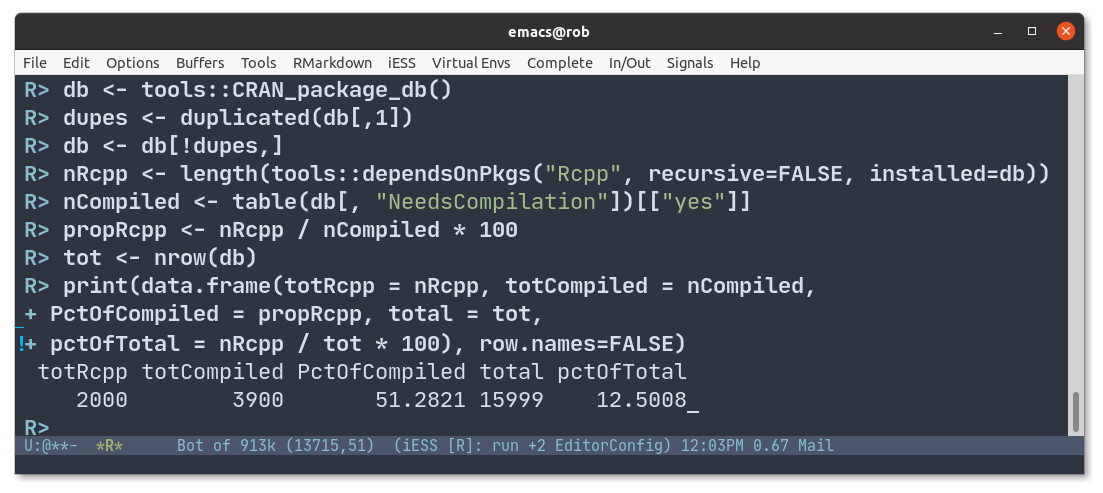
2000 Rcpp packages As of yesterday, Rcpp stands at exactly 2000 reverse-dependencies on CRAN. The graph on the left depicts the growth of Rcpp usage (as measured by Depends, Imports and LinkingTo, but excluding Suggests) over time. Rcpp was first released in November 2008. It probably cleared 50 packages around three years later in December 2011, 100 packages in January 2013, 200 packages in April 2014, and 300 packages in November 2014. It passed 400 packages in June 2015 (when I tweeted about it), 500 packages in late October 2015, 600 packages in March 2016, 700 packages last July 2016, 800 packages last October 2016, 900 packages early January 2017, 1000 packages in April 2017, 1250 packages in November 2017, 1500 packages in November 2018 and then 1750 packages last August. The chart extends to the very beginning via manually compiled data from CRANberries and checked with crandb. The next part uses manually saved entries. The core (and by far largest) part of the data set was generated semi-automatically via a short script appending updates to a small file-based backend. A list of packages using Rcpp is available too. Also displayed in the graph is the relative proportion of CRAN packages using Rcpp. The four per-cent hurdle was cleared just before useR! 2014 where I showed a similar graph (as two distinct graphs) in my invited talk. We passed five percent in December of 2014, six percent July of 2015, seven percent just before Christmas 2015, eight percent in the summer of 2016, nine percent mid-December 2016, cracked ten percent in the summer of 2017 and eleven percent in 2018. We now passed 12.5 percent so one in every eight CRAN packages dependens on Rcpp. Stunning. There is more detail in the chart: how CRAN seems to be pushing back more and removing more aggressively (which my CRANberries tracks but not in as much detail as it could), how the growth of Rcpp seems to be slowing somewhat outright and even more so as a proportion of CRAN as one would expect a growth curve to. To mark the occassion, I sent out two tweets yesterday: first a shorter one with just the numbers , followed by a second one also containing the few calculation steps. The screenshot from the second one is below. 2000 Rcpp packages 2000 user packages is pretty mind-boggling. We can use the progression of CRAN itself compiled by Henrik in a series of posts and emails to the main development mailing list. Not that long ago CRAN itself did have only 1000 packages, then 5000, 10000, and here we are at just over 16000 with Rcpp at 12.5% and still growing (though maybe more slowly). Amazeballs. The Rcpp team continues to aim for keeping Rcpp as performant and reliable as it has been. A really big shoutout and Thank You! to all users and contributors of Rcpp for help, suggestions, bug reports, documentation or, of course, code. If you like this or other open-source work I do, you can now sponsor me at GitHub. For the first year, GitHub will match your contributions.

This post by Dirk Eddelbuettel originated on his Thinking inside the box blog. Please report excessive re-aggregation in third-party for-profit settings.

Russ Allbery: Review: The Light Brigade

Review: The Light Brigade, by Kameron Hurley
Publisher: Saga
Copyright: 2019
ISBN: 1-4814-4798-X
Format: Kindle
Pages: 355
In the wake of the Blink, which left a giant crater where S o Paulo was, Dietz signed up for the military. To be a hero. To satisfy an oath of vengeance. To kill aliens. Corporations have consumed the governments that used to run Earth and have divided the world between them. Dietz's family, before the Blink, were ghouls in Tene-Silva territory, non-citizens who scavenged a precarious life on the margins. Citizenship is a reward for loyalty and a mechanism of control. The only people who don't fit into the corporate framework are the Martians, former colonists who went dark for ten years and re-emerged as a splinter group offering to use their superior technology to repair environmental damage to the northern hemisphere caused by corporate wars. When the Blink happens, apparently done with technology far beyond what the corporations have, corporate war with the Martians is the unsurprising result. Long-time SF readers will immediately recognize The Light Brigade as a response to Starship Troopers with far more cynical world-building. For the first few chapters, the parallelism is very strong, down to the destruction of a large South American city (S o Paulo instead of Buenos Aires), a naive military volunteer, and horrific basic training. But, rather than dropships, the soldiers in Dietz's world are sent into battle via, essentially, Star Trek transporters. These still very experimental transporters send Dietz to a different mission than the one in the briefing. Advance warning that I'm going to talk about what's happening with Dietz's drops below. It's a spoiler, but you would find out not far into the book and I don't think it ruins anything important. (On the contrary, it may give you an incentive to stick through the slow and unappealing first few chapters.) I had so many suspension of disbelief problems with this book. So many. This starts with the technology. The core piece of world-building is Star Trek transporters, so fine, we're not talking about hard physics. Every SF story gets one or two free bits of impossible technology, and Hurley does a good job showing the transporters through a jaundiced military eye. But, late in the book, this technology devolves into one of my least-favorite bits of SF hand-waving that, for me, destroyed that gritty edge. Technology problems go beyond the transporters. One of the bits of horror in basic training is, essentially, torture simulators, whose goal is apparently to teach soldiers to dissociate (not that the book calls it that). One problem is that I never understood why a military would want to teach dissociation to so many people, but a deeper problem is that the mechanics of this simulation made no sense. Dietz's training in this simulator is a significant ongoing plot point, and it kept feeling like it was cribbed from The Matrix rather than something translatable into how computers work. Technology was the more minor suspension of disbelief problem, though. The larger problem was the political and social world-building. Hurley constructs a grim, totalitarian future, which is a fine world-building choice although I think it robs some nuance from the story she is telling about how militaries lie to soldiers. But the totalitarian model she uses is one of near-total information control. People believe what the corporations tell them to believe, or at least are indifferent to it. Huge world events (with major plot significance) are distorted or outright lies, and those lies are apparently believed by everyone. The skepticism that exists is limited to grumbling about leadership competence and cynicism about motives, not disagreement with the provided history. This is critical to the story; it's a driver behind Dietz's character growth and is required to set up the story's conclusion. This is a model of totalitarianism that's familiar from Orwell's Nineteen Eighty-Four. The problem: The Internet broke this model. You now need North Korean levels of isolation to pull off total message control, which is incompatible with the social structure or technology level that Hurley shows. You may be objecting that the modern world is full of people who believe outrageous propaganda against all evidence. But the world-building problem is not that some people believe the corporate propaganda. It's that everyone does. Modern totalitarians have stopped trying to achieve uniformity (because it stopped working) and instead make the disagreement part of the appeal. You no longer get half a country to believe a lie by ensuring they never hear the truth. Instead, you equate belief in the lie with loyalty to a social or political group, and belief in the truth with affiliation with some enemy. This goes hand in hand with "flooding the zone" with disinformation and fakes and wild stories until people's belief in the accessibility of objective truth is worn down and all facts become ideological statements. This does work, all too well, but it relies on more information, not less. (See Zeynep Tufekci's excellent Twitter and Tear Gas if you're unfamiliar with this analysis.) In that world, Dietz would have heard the official history, the true history, and all sorts of wild alternative histories, making correct belief a matter of political loyalty. There is no sign of that. Hurley does gesture towards some technology to try to explain this surprising corporate effectiveness. All the soldiers have implants, and military censors can supposedly listen in at any time. But, in the story, this censorship is primarily aimed at grumbling and local disloyalty. There is no sign that it's being used to keep knowledge of significant facts from spreading, nor is there any sign of the same control among the general population. It's stated in the story that the censors can't even keep up with soldiers; one would have to get unlucky to be caught. And yet the corporation maintains preternatural information control. The place this bugged me the most is around knowledge of the current date. For reasons that will be obvious in a moment, Dietz has reasons to badly want to know what month and year it is and is unable to find this information anywhere. This appears to be intentional; Tene-Silva has a good (albeit not that urgent) reason to keep soldiers from knowing the date. But I don't think Hurley realizes just how hard that is. Take a look around the computer you're using to read this and think about how many places the date shows up. Apart from the ubiquitous clock and calendar app, there are dates on every file, dates on every news story, dates on search results, dates in instant messages, dates on email messages and voice mail... they're everywhere. And it's not just the computer. The soldiers can easily smuggle prohibited outside goods into the base; knowledge of the date would be much easier. And even if Dietz doesn't want to ask anyone, there are opportunities to go off base during missions. Somehow every newspaper and every news bulletin has its dates suppressed? It's not credible, and it threw me straight out of the story. These world-building problems are unfortunate, since at the heart of The Light Brigade is a (spoiler alert) well-constructed time travel story that I would have otherwise enjoyed. Dietz is being tossed around in time with each jump. And, unlike some of these stories, Hurley does not take the escape hatch of alternate worlds or possible futures. There is a single coherent timeline that Dietz and the reader experience in one order and the rest of the world experiences in a different order. The construction of this timeline is incredibly well-done. Time can only disconnect at jump and return points, and Hurley maintains tight control over the number of unresolved connections. At every point in the story, I could list all of the unresolved discontinuities and enjoy their complexity and implications without feeling overwhelmed by them. Dietz gains some foreknowledge, but in a way that's wildly erratic and hard to piece together fast enough for a single soldier to do anything about the plot. The world spins out of control with foreshadowing of grimmer and grimmer events, and then Hurley pulls it back together in a thoroughly satisfying interweaving of long-anticipated scenes and major surprises. I'm not usually a fan of time travel stories, but this is one of the best I've read. It also has a satisfying emotional conclusion (albeit marred for me by some unbelievable mystical technobabble), which is impressive given how awful and nasty Hurley makes this world. Dietz is a great first-person narrator, believably naive and cynical by turns, and piecing together the story structure alongside the protagonist built my emotional attachment to Dietz's character arc. Hurley writes the emotional dynamics of soldiers thoughtfully and well: shit-talking, fights, sudden moments of connection, shared cynicism over degenerating conditions, and the underlying growth of squad loyalty that takes over other motivations and becomes the reason to keep on fighting. Hurley also pulled off a neat homage to (and improvement on) Starship Troopers that caught me entirely by surprise and that I've hopefully not spoiled. This is a solid science fiction novel if you can handle the world-building. I couldn't, but I understand why it was nominated for the Hugo and Clarke awards. Recommended if you're less picky about technological and social believability than I am, although content warning for a lot of bloody violence and death (including against children) and a horrifically depressing world. Rating: 6 out of 10

3 July 2020

Dirk Eddelbuettel: #28: Welcome RSPM and test-drive with Bionic and Focal

Welcome to the 28th post in the relatively random R recommendations series, or R4 for short. Our last post was a double entry in this R4 series and the newer T4 video series and covered a topic touched upon in this R4 series multiple times: easy binary install, especially on Ubuntu. That post already previewed the newest kid on the block: RStudio s RSPM, now formally announced. In the post we were only able to show Ubuntu 18.04 aka bionic. With the formal release of RSPM support has been added for Ubuntu 20.04 aka focal and we are happy to announce that of course we added a corresponding Rocker r-rspm container. So you can now take full advantage of RSPM either via docker pull rocker/r-rspm:18.04 or via docker pull rocker/r-rspm:20.04 covering the two most recent LTS releases. RSPM is a nice accomplishment. Covering multiple Linux distributions is an excellent achievement. Allowing users to reason in terms of the CRAN packages (i.e. installing xml2, not r-cran-xml2) eases use. Doing it from via the standard R command install.packages() (or wrapper around it like our install.r from littler package) is very good too and an excellent technical achievement. There is, as best as I can tell, only one shortcoming, along with one small bit of false advertising. The shortcoming is technical. By bringing the package installation into the user application domain, it is separated from the system and lacks integration with system libraries. What do I mean here? If you were to add R to a plain Ubuntu container, say 18.04 or 20.04, then added the few lines to support RSPM and install xml2 it would install. And fail. Why? Because the system library libxml2 does not get installed with the RSPM package whereas the .deb from the distribution or PPAs does. So to help with some popular packages I added libxml2, libunits and a few more for geospatial work to the rocker/r-rspm containers. Being already present ensures packages xml2 and units can run immediately. Please file issue tickets at the Rocker repo if you come across other missing libraries we could preload. (A related minor nag is incomplete coverage. At least one of my CRAN packages does not (yet?) come as a RSPM binary. Then again, CRAN has 16k packages, and the RSPM coverage is much wider than the PPA one. But completeness would be neat. The final nag is lack of Debian support which seems, well, odd.) So what about the small bit of false advertising? Well it is claimed that RSPM makes installation so much faster on Linux . True, faster than the slowest possible installation from source. Also easier. But we had numerous posts on this blog showing other speed gains: Using ccache. And, of course, using binaries. And as the initial video mentioned above showed, installing from the PPAs is also faster than via RSPM. That is easy to replicate. Just set up the rocker/r-ubuntu:20.04 (or 18.04) container alongside the rocker/r-rspm:20.04 (or also 18.04) container. And then time install.r rstan (or install.r tinyverse) in the RSPM one against apt -y update; apt install -y r-cran-rstan (or ... r-cran-tinyverse). In every case I tried, the installation using binaries from the PPA was still faster by a few seconds. Not that it matters greatly: both are very, very quick compared to source installation (as e.g. shown here in 2017 (!!)) but the standard Ubuntu .deb installation is simply faster than using RSPM. (Likely due to better CDN usage so this may change over time. Neither method appears to do downloads in parallel so there is scope for both for doing better.) So in sum: Welcome to RSPM, and nice new tool and feel free to drive it using rocker/r-rspm:18.04 or rocker/r-rspm:20.04. If you like this or other open-source work I do, you can now sponsor me at GitHub. For the first year, GitHub will match your contributions.

This post by Dirk Eddelbuettel originated on his Thinking inside the box blog. Please report excessive re-aggregation in third-party for-profit settings.

1 July 2020

Joachim Breitner: Template Haskell recompilation

I was wondering: What happens if I have a Haskell module with Template Haskell that embeds some information from the environment (time, environment variables). Will such a module be reliable recompiled? And what if it gets recompiled, but the source code produced by Template Haskell is actually unchanged (e.g., because the environment variable has not changed), will all depending modules be recompiled (which would be bad)? Here is a quick experiment, using GHC-8.8:

/tmp/th-recom-test $ cat Foo.hs
 -# LANGUAGE TemplateHaskell #- 
 -# OPTIONS_GHC -fforce-recomp #- 
module Foo where
import Language.Haskell.TH
import Language.Haskell.TH.Syntax
import System.Process
theMinute :: String
theMinute = $(runIO (readProcess "date" ["+%M"] "") >>= stringE)
[jojo@kirk:2] Mi, der 01.07.2020 um 17:18 Uhr  
/tmp/th-recom-test $ cat Main.hs
import Foo
main = putStrLn theMinute
Note that I had to set -# OPTIONS_GHC -fforce-recomp #- by default, GHC will not recompile a module, even if it uses Template Haskell and runIO. If you are reading from a file you can use addDependentFile to tell the compiler about that depenency, but that does not help with reading from the environment. So here is the test, and we get the desired behaviour: The Foo module is recompiled every time, but unless the minute has changed (see my prompt), Main is not recomipled:
/tmp/th-recom-test $ ghc --make -O2 Main.hs -o test
[1 of 2] Compiling Foo              ( Foo.hs, Foo.o )
[2 of 2] Compiling Main             ( Main.hs, Main.o )
Linking test ...
[jojo@kirk:2] Mi, der 01.07.2020 um 17:20 Uhr  
/tmp/th-recom-test $ ghc --make -O2 Main.hs -o test
[1 of 2] Compiling Foo              ( Foo.hs, Foo.o )
Linking test ...
[jojo@kirk:2] Mi, der 01.07.2020 um 17:20 Uhr  
/tmp/th-recom-test $ ghc --make -O2 Main.hs -o test
[1 of 2] Compiling Foo              ( Foo.hs, Foo.o )
[2 of 2] Compiling Main             ( Main.hs, Main.o ) [Foo changed]
Linking test ...
So all well! Update: It seems that while this works with ghc --make, the -fforce-recomp does not cause cabal build to rebuild the module. That s unfortunate.

Sylvain Beucler: Debian LTS and ELTS - June 2020

Debian LTS Logo Here is my transparent report for my work on the Debian Long Term Support (LTS) and Debian Extended Long Term Support (ELTS), which extend the security support for past Debian releases, as a paid contributor. In June, the monthly sponsored hours were split evenly among contributors depending on their max availability - I was assigned 30h for LTS (out of 30 max; all done) and 5.25h for ELTS (out of 20 max; all done). While LTS is part of the Debian project, fellow contributors sometimes surprise me: suggestion to vote for sponsors-funded projects with concorcet was only met with overhead concerns, and there were requests for executive / business owner decisions (we're currently heading towards consultative vote); I heard concerns about discussing non-technical issues publicly (IRC team meetings are public though); the private mail infrastructure was moved from self-hosting straight to Google; when some got an issue with Debian Social for our first video conference, there were immediate suggestions to move to Zoom...
Well, we do need some people to make those LTS firmware updates in non-free :) Also this was the last month before shifting suites: goodbye to Jessie LTS and Wheezy ELTS, welcome Stretch LTS and Jessie ELTS. ELTS - Wheezy LTS - Jessie Documentation/Scripts

26 June 2020

Dirk Eddelbuettel: littler 0.3.11: docopt updates

max-heap image The twelveth release of littler as a CRAN package is now available, following in the fourteen-ish year history as a package started by Jeff in 2006, and joined by me a few weeks later. littler is the first command-line interface for R as it predates Rscript. It allows for piping as well for shebang scripting via #!, uses command-line arguments more consistently and still starts faster. It also always loaded the methods package which Rscript only started to do in recent years. littler lives on Linux and Unix, has its difficulties on macOS due to yet-another-braindeadedness there (who ever thought case-insensitive filesystems as a default where a good idea?) and simply does not exist on Windows (yet the build system could be extended see RInside for an existence proof, and volunteers are welcome!). See the FAQ vignette on how to add it to your PATH. A few examples are highlighted at the Github repo, as well as in the examples vignette. This release mostly responds to the recent docopt release 0.7.0 which brought a breaking change for quoted arguments. In short, it is for the better because an option --as-cran is now available parsed as opt$as_cran which is easier than the earlier form where we needed to back-tick protect as-cran containing an underscore. We also added a new portmanteau-ish option to roxy.r. The NEWS file entry is below.

Changes in littler version 0.3.11 (2020-06-26)
  • Changes in examples
    • Scripts check.r and rcc.r updated to reflect updated docopt 0.7.0 behaviour of quoted arguments
    • The roxy.r script has a new ease-of-use option -f --full regrouping two other options.

CRANberries provides a comparison to the previous release. Full details for the littler release are provided as usual at the ChangeLog page. The code is available via the GitHub repo, from tarballs and now of course also from its CRAN page and via install.packages("littler"). Binary packages are available directly in Debian as well as soon via Ubuntu binaries at CRAN thanks to the tireless Michael Rutter. Comments and suggestions are welcome at the GitHub repo. If you like this or other open-source work I do, you can now sponsor me at GitHub. For the first year, GitHub will match your contributions.

This post by Dirk Eddelbuettel originated on his Thinking inside the box blog. Please report excessive re-aggregation in third-party for-profit settings.

Chris Lamb: On the pleasure of hating

People love to tell you that they "don't watch sports" but the story of Lance Armstrong provides a fascinating lens through which to observe our culture at large. For example, even granting all that he did and all the context in which he did it, why do sports cheats act like a lightning rod for such an instinctive hatred? After all, the sheer level of distaste directed at people such as Lance eludes countless other criminals in our society, many of whom have taken a lot more with far fewer scruples. The question is not one of logic or rationality, but of proportionality. In some ways it should be unsurprising. In all areas of life, we instinctively prefer binary judgements to moral ambiguities and the sports cheat is a clich of moral bankruptcy cheating at something so seemingly trivial as a sport actually makes it more, not less, offensive to us. But we then find ourselves strangely enthralled by them, drawn together in admiration of their outlaw-like tenacity, placing them strangely close to criminal folk heroes. Clearly, sport is not as unimportant as we like to claim it is. In Lance's case in particular though, there is undeniably a Shakespearean quality to the story and we are forced to let go of our strict ideas of right and wrong and appreciate all the nuance.

There is a lot of this nuance in Marina Zenovich's new documentary. In fact, there's a lot of everything. At just under four hours, ESPN's Lance combines the duration of a Tour de France stage with the depth of the peloton an endurance event compared to the bite-sized hagiography of Michael Jordan's The Last Dance. Even for those who follow Armstrong's story like a mini-sport in itself, Lance reveals new sides to this man for all seasons. For me, not only was this captured in his clumsy approximations at being a father figure but also in him being asked something I had not read in countless tell-all books: did his earlier experiments in drug-taking contribute to his cancer? But even in 2020 there are questions that remain unanswered. By needlessly returning to the sport in 2009, did Lance subconsciously want to get caught? Why does he not admit he confessed to Betsy Andreu back in 1999 but will happily apologise to her today for slurring her publicly on this very point? And why does he remain so vindictive towards former-teammate Floyd Landis? In all of Armstrong's evasions and masterful control of the narrative, there is the gnawing feeling that we don't even know what questions we should be even asking. As ever, the questions are more interesting than the answers.

Lance also reminded me of how professional cycling's obsession with national identity. Although I was intuitively aware of it to some degree, I had not fully grasped how much this kind of stereotyping runs through the veins of the sport itself, just like the drugs themselves. Journalist Daniel Friebe first offers us the portrait of:
Spaniards tend to be modest, very humble. Very unpretentious. And the Italians are loud, vain and outrageous showmen.
Former directeur sportif Johan Bruyneel then asserts that "Belgians are hard workers... they are ambitious to a certain point, but not overly ambitious", and cyclist J rg Jaksche concludes with:
The Germans are very organised and very structured. And then the French, now I have to be very careful because I am German, but the French are slightly superior.
This kind of lazy caricature is nothing new, especially for those brought up on a solid diet of Tintin and Asterix, but although all these examples are seemingly harmless, why does the underlying idea of ascribing moral, social or political significance to genetic lineage remain so durable in today's age of anti-racism? To be sure, culture is not quite the same thing as race, but being judged by the character of one's ancestors rather than the actions of an individual is, at its core, one of the many conflations at the heart of racism. There is certainly a large amount of cognitive dissonance at work, especially when Friebe elaborates:
East German athletes were like incredible robotic figures, fallen off a production line somewhere behind the Iron Curtain...
... but then bermensch Jan Ullrich is immediately described as "emotional" and "struggled to live the life of a professional cyclist 365 days a year". We see the habit to stereotype is so ingrained that even in the face of this obvious contradiction, Friebe unironically excuses Ullrich's failure to live up his German roots due to him actually being "Mediterranean".

I mention all this as I am known within my circles for remarking on these national characters, even collecting stereotypical examples of Italians 'being Italian' and the French 'being French' at times. Contrary to evidence, I don't believe in this kind of innate quality but what I do suspect is that people generally behave how they think they ought to behave, perhaps out of sheer imitation or the simple pleasure of conformity. As the novelist Will Self put it:
It's quite a complicated collective imposture, people pretending to be British and people pretending to be French, and then they get really angry with each other over what they're pretending to be.
The really remarkable thing about this tendency is that even if we consciously notice it there is no seemingly no escape even I could not smirk when I considered that a brash Texan winning the Tour de France actually combines two of America's cherished obsessions: winning... and annoying the French.

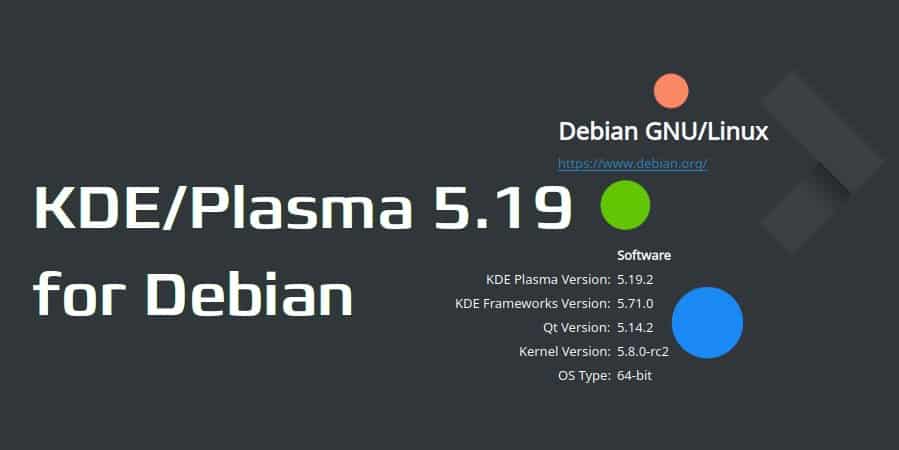
Norbert Preining: KDE/Plasma 5.19.2 for Debian

After the long wait (or should I say The Long Dark) finally Qt 5.14 has arrived in Debian/unstable, and thus the doors for KDE/Plasma 5.19 are finally open.
I have been preparing this release for quite some time, but due to Qt 5.12 I could only test it in a virtual machine using Debian/experimental. But now, finally, a full upgrade to Plasma 5.19(.2) has arrived. Unfortunately, it turned out that the OBS build servers are either overloaded, incapable, or broken, but they do not properly build the necessary packages. Thus, I make the Plasma 5.19.2 (and framework) packages available via my server, for amd64. Please use the following apt line:

deb https://www.preining.info/debian/ unstable kde
(The source packages are also there, just in case you want to rebuild them for i386). Not that this requires my GPG key to be imported, best is to put it into /etc/apt/trusted.gpg.d/preining-norbert.asc. For KDE Applications please still use
deb https://download.opensuse.org/repositories/home:/npreining:/debian-kde:/apps/Debian_Unstable/ ./
but I might sooner or later move that to my server, too. OBS servers are too broken with respect to considerable big rebuild groups it seems. So, enjoy your shiny new KDE/Plasma desktop on Debian, too!

25 June 2020

Dirk Eddelbuettel: RcppSimdJson 0.0.6: New Upstream, New Features!

A very exciting RcppSimdJson release with the updated upstream simdjson release 0.4.0 as well as a first set of new JSON parsing functions just hit CRAN. RcppSimdJson wraps the fantastic and genuinely impressive simdjson library by Daniel Lemire and collaborators. Via very clever algorithmic engineering to obtain largely branch-free code, coupled with modern C++ and newer compiler instructions, it results in parsing gigabytes of JSON parsed per second which is quite mindboggling. The best-case performance is faster than CPU speed as use of parallel SIMD instructions and careful branch avoidance can lead to less than one cpu cycle use per byte parsed; see the video of the recent talk by Daniel Lemire at QCon (which was also voted best talk). The very recent 0.4.0 release further improves the already impressive speed. And this release brings a first set of actually user-facing functions thanks to Brendan which put in a series of PRs! The full NEWS entry follows.

Changes in version 0.0.6 (2020-06-25)
  • Created C++ integer-handling utilities for safe downcasting and integer return (Brendan in #16 closing #13).
  • New JSON functions .deserialize_json and .load_json (Brendan in #16, #17, #20, #21).
  • Upgrade Travis CI to 'bionic', extract package and version from DESCRIPTION (Dirk in #23).
  • Upgraded to simdjson 0.4.0 (Dirk in #25 closing #24).

Courtesy of CRANberries, there is also a diffstat report for this release. For questions, suggestions, or issues please use the issue tracker at the GitHub repo. If you like this or other open-source work I do, you can now sponsor me at GitHub. For the first year, GitHub will match your contributions.

This post by Dirk Eddelbuettel originated on his Thinking inside the box blog. Please report excessive re-aggregation in third-party for-profit settings.

Russell Coker: How Will the Pandemic Change Things?

The Bulwark has an interesting article on why they can t Reopen America [1]. I wonder how many changes will be long term. According to the Wikipedia List of Epidemics [2] Covid-19 so far hasn t had a high death toll when compared to other pandemics of the last 100 years. People s reactions to this vary from doing nothing to significant isolation, the question is what changes in attitudes will be significant enough to change society. Transport One thing that has been happening recently is a transition in transport. It s obvious that we need to reduce CO2 and while electric cars will address the transport part of the problem in the long term changing to electric public transport is the cheaper and faster way to do it in the short term. Before Covid-19 the peak hour public transport in my city was ridiculously overcrowded, having people unable to board trams due to overcrowding was really common. If the economy returns to it s previous state then I predict less people on public transport, more traffic jams, and many more cars idling and polluting the atmosphere. Can we have mass public transport that doesn t give a significant disease risk? Maybe if we had significantly more trains and trams and better ventilation with more airflow designed to suck contaminated air out. But that would require significant engineering work to design new trams, trains, and buses as well as expense in refitting or replacing old ones. Uber and similar companies have been taking over from taxi companies, one major feature of those companies is that the vehicles are not dedicated as taxis. Dedicated taxis could easily be designed to reduce the spread of disease, the famed Black Cab AKA Hackney Carriage [3] design in the UK has a separate compartment for passengers with little air flow to/from the driver compartment. It would be easy to design such taxis to have entirely separate airflow and if setup to only take EFTPOS and credit card payment could avoid all contact between the driver and passengers. I would prefer to have a Hackney Carriage design of vehicle instead of a regular taxi or Uber. Autonomous cars have been shown to basically work. There are some concerns about safety issues as there are currently corner cases that car computers don t handle as well as people, but of course there are also things computers do better than people. Having an autonomous taxi would be a benefit for anyone who wants to avoid other people. Maybe approval could be rushed through for autonomous cars that are limited to 40Km/h (the maximum collision speed at which a pedestrian is unlikely to die), in central city areas and inner suburbs you aren t likely to drive much faster than that anyway. Car share services have been becoming popular, for many people they are significantly cheaper than owning a car due to the costs of regular maintenance, insurance, and depreciation. As the full costs of car ownership aren t obvious people may focus on the disease risk and keep buying cars. Passenger jets are ridiculously cheap. But this relies on the airline companies being able to consistently fill the planes. If they were to add measures to reduce cross contamination between passengers which slightly reduces the capacity of planes then they need to increase ticket prices accordingly which then reduces demand. If passengers are just scared of flying in close proximity and they can t fill planes then they will have to increase prices which again reduces demand and could lead to a death spiral. If in the long term there aren t enough passengers to sustain the current number of planes in service then airline companies will have significant financial problems, planes are expensive assets that are expected to last for a long time, if they can t use them all and can t sell them then airline companies will go bankrupt. It s not reasonable to expect that the same number of people will be travelling internationally for years (if ever). Due to relying on economies of scale to provide low prices I don t think it s possible to keep prices the same no matter what they do. A new economic balance of flights costing 2-3 times more than we are used to while having significantly less passengers seems likely. Governments need to spend significant amounts of money to improve trains to take over from flights that are cancelled or too expensive. Entertainment The article on The Bulwark mentions Las Vegas as a city that will be hurt a lot by reductions in travel and crowds, the same thing will happen to tourist regions all around the world. Australia has a significant tourist industry that will be hurt a lot. But the mention of Las Vegas makes me wonder what will happen to the gambling in general. Will people avoid casinos and play poker with friends and relatives at home? It seems that small stakes poker games among friends will be much less socially damaging than casinos, will this be good for society? The article also mentions cinemas which have been on the way out since the video rental stores all closed down. There s lots of prime real estate used for cinemas and little potential for them to make enough money to cover the rent. Should we just assume that most uses of cinemas will be replaced by Netflix and other streaming services? What about teenage dates, will kissing in the back rows of cinemas be replaced by Netflix and chill ? What will happen to all the prime real estate used by cinemas? Professional sporting matches have been played for a TV-only audience during the pandemic. There s no reason that they couldn t make a return to live stadium audiences when there is a vaccine for the disease or the disease has been extinguished by social distancing. But I wonder if some fans will start to appreciate the merits of small groups watching large TVs and not want to go back to stadiums, can this change the typical behaviour of groups? Restaurants and cafes are going to do really badly. I previously wrote about my experience running an Internet Cafe and why reopening businesses soon is a bad idea [4]. The question is how long this will go for and whether social norms about personal space will change things. If in the long term people expect 25% more space in a cafe or restaurant that s enough to make a significant impact on profitability for many small businesses. When I was young the standard thing was for people to have dinner at friends homes. Meeting friends for dinner at a restaurant was uncommon. Recently it seemed to be the most common practice for people to meet friends at a restaurant. There are real benefits to meeting at a restaurant in terms of effort and location. Maybe meeting friends at their home for a delivered dinner will become a common compromise, avoiding the effort of cooking while avoiding the extra expense and disease risk of eating out. Food delivery services will do well in the long term, it s one of the few industry segments which might do better after the pandemic than before. Work Many companies are discovering the benefits of teleworking, getting it going effectively has required investing in faster Internet connections and hardware for employees. When we have a vaccine the equipment needed for teleworking will still be there and we will have a discussion about whether it should be used on a more routine basis. When employees spend more than 2 hours per day travelling to and from work (which is very common for people who work in major cities) that will obviously limit the amount of time per day that they can spend working. For the more enthusiastic permanent employees there seems to be a benefit to the employer to allow working from home. It s obvious that some portion of the companies that were forced to try teleworking will find it effective enough to continue in some degree. One company that I work for has quit their coworking space in part because they were concerned that the coworking company might go bankrupt due to the pandemic. They seem to have become a 100% work from home company for the office part of the work (only on site installation and stock management is done at corporate locations). Companies running coworking spaces and other shared offices will suffer first as their clients have short term leases. But all companies renting out office space in major cities will suffer due to teleworking. I wonder how this will affect the companies providing services to the office workers, the cafes and restaurants etc. Will there end up being so much unused space in central city areas that it s not worth converting the city cinemas into useful space? There s been a lot of news about Zoom and similar technologies. Lots of other companies are trying to get into that business. One thing that isn t getting much notice is remote access technologies for desktop support. If the IT people can t visit your desk because you are working from home then they need to be able to remotely access it to fix things. When people make working from home a large part of their work time the issue of who owns peripherals and how they are tracked will get interesting. In a previous blog post I suggested that keyboards and mice not be treated as assets [5]. But what about monitors, 4G/Wifi access points, etc? Some people have suggested that there will be business sectors benefiting from the pandemic, such as telecoms and e-commerce. If you have a bunch of people forced to stay home who aren t broke (IE a large portion of the middle class in Australia) they will probably order delivery of stuff for entertainment. But in the long term e-commerce seems unlikely to change much, people will spend less due to economic uncertainty so while they may shift some purchasing to e-commerce apart from home delivery of groceries e-commerce probably won t go up overall. Generally telecoms won t gain anything from teleworking, the Internet access you need for good Netflix viewing is generally greater than that needed for good video-conferencing. Money I previously wrote about a Basic Income for Australia [6]. One of the most cited reasons for a Basic Income is to deal with robots replacing people. Now we are at the start of what could be a long term economic contraction caused by the pandemic which could reduce the scale of the economy by a similar degree while also improving the economic case for a robotic workforce. We should implement a Universal Basic Income now. I previously wrote about the make-work jobs and how we could optimise society to achieve the worthwhile things with less work [7]. My ideas about optimising public transport and using more car share services may not work so well after the pandemic, but the rest should work well. Business There are a number of big companies that are not aiming for profitability in the short term. WeWork and Uber are well documented examples. Some of those companies will hopefully go bankrupt and make room for more responsible companies. The co-working thing was always a precarious business. The companies renting out office space usually did so on a monthly basis as flexibility was one of their selling points, but they presumably rented buildings on an annual basis. As the profit margins weren t particularly high having to pay rent on mostly empty buildings for a few months will hurt them badly. The long term trend in co-working spaces might be some sort of collaborative arrangement between the people who run them and the landlords similar to the way some of the hotel chains have profit sharing agreements with land owners to avoid both the capital outlay for buying land and the risk involved in renting. Also city hotels are very well equipped to run office space, they have the staff and the procedures for running such a business, most hotels also make significant profits from conventions and conferences. The way the economy has been working in first world countries has been about being as competitive as possible. Just in time delivery to avoid using storage space and machines to package things in exactly the way that customers need and no more machines than needed for regular capacity. This means that there s no spare capacity when things go wrong. A few years ago a company making bolts for the car industry went bankrupt because the car companies forced the prices down, then car manufacture stopped due to lack of bolts this could have been a wake up call but was ignored. Now we have had problems with toilet paper shortages due to it being packaged in wholesale quantities for offices and schools not retail quantities for home use. Food was destroyed because it was created for restaurant packaging and couldn t be packaged for home use in a reasonable amount of time. Farmer s markets alleviate some of the problems with packaging food etc. But they aren t a good option when there s a pandemic as disease risk makes them less appealing to customers and therefore less profitable for vendors. Religion Many religious groups have supported social distancing. Could this be the start of more decentralised religion? Maybe have people read the holy book of their religion and pray at home instead of being programmed at church? We can always hope.

24 June 2020

Matthew Garrett: Making my doorbell work

I recently moved house, and the new building has a Doorbird to act as a doorbell and open the entrance gate for people. There's a documented local control API (no cloud dependency!) and a Home Assistant integration, so this seemed pretty straightforward.

Unfortunately not. The Doorbird is on separate network that's shared across the building, provided by Monkeybrains. We're also a Monkeybrains customer, so our network connection is plugged into the same router and antenna as the Doorbird one. And, as is common, there's port isolation between the networks in order to avoid leakage of information between customers. Rather perversely, we are the only people with an internet connection who are unable to ping my doorbell.

I spent most of the past few weeks digging myself out from under a pile of boxes, but we'd finally reached the point where spending some time figuring out a solution to this seemed reasonable. I spent a while playing with port forwarding, but that wasn't ideal - the only server I run is in the UK, and having packets round trip almost 11,000 miles so I could speak to something a few metres away seemed like a bad plan. Then I tried tethering an old Android device with a data-only SIM, which worked fine but only in one direction (I could see what the doorbell could see, but I couldn't get notifications that someone had pushed a button, which was kind of the point here).

So I went with the obvious solution - I added a wifi access point to the doorbell network, and my home automation machine now exists on two networks simultaneously (nmcli device modify wlan0 ipv4.never-default true is the magic for "ignore the gateway that the DHCP server gives you" if you want to avoid this), and I could now do link local service discovery to find the doorbell if it changed addresses after a power cut or anything. And then, like magic, everything worked - I got notifications from the doorbell when someone hit our button.

But knowing that an event occurred without actually doing something in response seems fairly unhelpful. I have a bunch of Chromecast targets around the house (a mixture of Google Home devices and Chromecast Audios), so just pushing a message to them seemed like the easiest approach. Home Assistant has a text to speech integration that can call out to various services to turn some text into a sample, and then push that to a media player on the local network. You can group multiple Chromecast audio sinks into a group that then presents as a separate device on the network, so I could then write an automation to push audio to the speaker group in response to the button being pressed.

That's nice, but it'd also be nice to do something in response. The Doorbird exposes API control of the gate latch, and Home Assistant exposes that as a switch. I'm using Home Assistant's Google Assistant integration to expose devices Home Assistant knows about to voice control. Which means when I get a house-wide notification that someone's at the door I can just ask Google to open the door for them.

So. Someone pushes the doorbell. That sends a signal to a machine that's bridged onto that network via an access point. That machine then sends a protobuf command to speakers on a separate network, asking them to stream a sample it's providing. Those speakers call back to that machine, grab the sample and play it. At this point, multiple speakers in the house say "Someone is at the door". I then say "Hey Google, activate the front gate" - the device I'm closest to picks this up and sends it to Google, where something turns my speech back into text. It then looks at my home structure data and realises that the "Front Gate" device is associated with my Home Assistant integration. It then calls out to the home automation machine that received the notification in the first place, asking it to trigger the front gate relay. That device calls out to the Doorbird and asks it to open the gate. And now I have functionality equivalent to a doorbell that completes a circuit and rings a bell inside my home, and a button inside my home that completes a circuit and opens the gate, except it involves two networks inside my building, callouts to the cloud, at least 7 devices inside my home that are running Linux and I really don't want to know how many computational cycles.

The future is wonderful.

(I work for Google. I do not work on any of the products described in this post. Please god do not ask me how to integrate your IoT into any of this)

comment count unavailable comments

22 June 2020

Dirk Eddelbuettel: #27: R and CRAN Binaries for Ubuntu

Welcome to the 27th post in the rationally regularized R revelations series, or R4 for short. This is a edited / updated version of yesterday s T^4 post #7 as it really fits the R4 series as well as it fits the T4 series. A new video in both our T^4 series of video lightning talks with tips, tricks, tools, and toys is also a video in the R^4 series as it revisits a topic previously covered in the latter: how to (more easily) get (binary) packages onto your Ubuntu system. In fact, we show it in three different ways.

The slides are here. This repo at GitHub support the series: use it to open issues for comments, criticism, suggestions, or feedback. Thanks to I aki Ucar who followed up on twitter with a Fedora version. We exchanged some more message, and concluded that complete comparison (from an empty Ubuntu or Fedora container) to a full system takes about the same time on either system. If you like this or other open-source work I do, you can now sponsor me at GitHub. For the first year, GitHub will match your contributions.

This post by Dirk Eddelbuettel originated on his Thinking inside the box blog. Please report excessive re-aggregation in third-party for-profit settings.

21 June 2020

Enrico Zini: Forced italianisation of S dtirol

Italianization (Italian: Italianizzazione; Croatian: talijanizacija; Slovene: poitaljan evanje; German: Italianisierung; Greek: ) is the spread of Italian culture and language, either by integration or assimilation.[1][2]
In 1919, at the time of its annexation, the middle part of the County of Tyrol which is today called South Tyrol (in Italian Alto Adige) was inhabited by almost 90% German speakers.[1] Under the 1939 South Tyrol Option Agreement, Adolf Hitler and Benito Mussolini determined the status of the German and Ladin (Rhaeto-Romanic) ethnic groups living in the region. They could emigrate to Germany, or stay in Italy and accept their complete Italianization. As a consequence of this, the society of South Tyrol was deeply riven. Those who wanted to stay, the so-called Dableiber, were condemned as traitors while those who left (Optanten) were defamed as Nazis. Because of the outbreak of World War II, this agreement was never fully implemented. Illegal Katakombenschulen ("Catacomb schools") were set up to teach children the German language.
The Prontuario dei nomi locali dell'Alto Adige (Italian for Reference Work of Place Names of Alto Adige) is a list of Italianized toponyms for mostly German place names in South Tyrol (Alto Adige in Italian) which was published in 1916 by the Royal Italian Geographic Society (Reale Societ Geografica Italiana). The list was called the Prontuario in short and later formed an important part of the Italianization campaign initiated by the fascist regime, as it became the basis for the official place and district names in the Italian-annexed southern part of the County of Tyrol.
Ettore Tolomei (16 August 1865, in Rovereto 25 May 1952, in Rome) was an Italian nationalist and fascist. He was designated a Member of the Italian Senate in 1923, and ennobled as Conte della Vetta in 1937.
The South Tyrol Option Agreement (German: Option in S dtirol; Italian: Opzioni in Alto Adige) was an agreement in effect between 1939 and 1943, when the native German speaking people in South Tyrol and three communes in the province of Belluno were given the option of either emigrating to neighboring Nazi Germany (of which Austria was a part after the 1938 Anschluss) or remaining in Fascist Italy and being forcibly integrated into the mainstream Italian culture, losing their language and cultural heritage. Over 80% opted to move to Germany.

Dirk Eddelbuettel: T^4 #7 and R^4 #5: R and CRAN Binaries for Ubuntu

A new video in both our T^4 series of video lightning talks with tips, tricks, tools, and toys is also a video in the R^4 series as it revisits a topic previously covered in the latter: how to (more easily) get (binary) packages onto your Ubuntu system. In fact, we show it in three different ways.

The slides are here. This repo at GitHub support the series: use it to open issues for comments, criticism, suggestions, or feedback. If you like this or other open-source work I do, you can now sponsor me at GitHub. For the first year, GitHub will match your contributions.

This post by Dirk Eddelbuettel originated on his Thinking inside the box blog. Please report excessive re-aggregation in third-party for-profit settings.

Daniel Lange: Upgrading Limesurvey with (near) zero downtime

Limesurvey is an online survey tool. It is very powerful and commonly used in academic environments because it is Free Software (GPLv2+), allows for local installations protecting the data of participants and allowing to comply with data protection regulations. This also means there are typically no load-balanced multi-server szenarios with HA databases. But simple VMs where Limesurvey runs and needs upgrading in place. There's an LTS branch (currently 3.x) and a stable branch (currently 4.x). There's also a 2.06 LTS branch that is restricted to paying customers. The main developers behind Limesurvey offer many services from template design to custom development to support to hosting ("Cloud", "Limesurvey Pro"). Unfortunately they also charge for easy updates called "ComfortUpdate" (currently 39 for three months) and the manual process is made a bit cumbersome to make the "ComfortUpdate" offer more attractive. Due to Limesurvey being an old code base and UI elements not being clearly separated, most serious use cases will end up patching files and symlinking logos around template directories. That conflicts a bit with the opaque "ComfortUpdate" process where you push a button and then magic happens. Or you have downtime and a recovery case while surveys are running. If you do not intend to use the "ComfortUpdate" offering, you can prevent Limesurvey from connecting to http://comfortupdate.limesurvey.org daily by adding the updatable stanza as in line 14 to limesurvey/application/config/config.php:
  1. return array(
  2. [...]
  3. // Use the following config variable to set modified optional settings copied from config-defaults.php
  4. 'config'=>array(
  5. // debug: Set this to 1 if you are looking for errors. If you still get no errors after enabling this
  6. // then please check your error-logs - either in your hosting provider admin panel or in some /logs directory
  7. // on your webspace.
  8. // LimeSurvey developers: Set this to 2 to additionally display STRICT PHP error messages and get full access to standard templates
  9. 'debug'=>0,
  10. 'debugsql'=>0, // Set this to 1 to enanble sql logging, only active when debug = 2
  11. // Mysql database engine (INNODB MYISAM):
  12. 'mysqlEngine' => 'MYISAM'
  13. , // Update default LimeSurvey config here
  14. 'updatable' => false,
  15. )
  16. );
The comma on line 13 is placed like that in the current default limesurvey config.php, don't let yourself get confused. Every item in a php array must end with a comma. It can be on the next line. The basic principle of low risk, near-zero downtime, in-place upgrades is:
  1. Create a diff between the current release and the target release
  2. Inspect the diff
  3. Make backups of the application webroot
  4. Patch a copy of the application in-place
  5. (optional) stop the web server
  6. Make a backup of the production database
  7. Move the patched application to the production webroot
  8. (if 5) Start the webserver
  9. Upgrade the database (if needed)
  10. Check the application
So, in detail: Continue reading "Upgrading Limesurvey with (near) zero downtime"

Next.

Previous.