Search Results: "jan"

11 August 2008

Antti-Juhani Kaijanaho: Velisurmaaja The Brother Slayer

Velisurmaaja was published in Elias L nnrot’s collection of traditional Finnish poems, the Kanteletar in 1840. It bears some similarity to the British ballad Edward. What follows is the original text, lifted from the tenth Gutenberg edition of Kanteletar juxtaposed with my English translation (which is more concerned with getting the message across than being good poetry). However, I am assured the translation is not beyond redemption, so here it is: (more…)

31 July 2008

Antti-Juhani Kaijanaho: Making it official

I just wrote this in my user page in the English wikipedia:
Antti-Juhani Kaijanaho is no longer actively working on Wikipedia. While I approve, in principle, all the new and stricted editor policies, it is emotionally very demanding to be challenged under new policies for edits that were made in good faith under older policies. There just aren’t enough positive aspects to doing Wikipedia to offset that very big negative aspect.
Some of the challenges toward my edits have happened in the English Wikipedia, and some in the Finnish Wikipedia. I have felt like this for about a year now – it’s probably time to make it official. I may make minor edits, or write in talk pages occasionally, but any substantial edits I won’t bother with any more.

30 July 2008

Jeff Bailey: Oi ...

... , I'm sore.

But this is a good thing. Yesterday, I got to carry around my son for the first time since mid-January.

So happy! =) (No Snoopy Dances yet, per physical therapist's orders...)

28 July 2008

Jan Wagner: [vacation] off until the weekend

After a hard week at work I’m just off for vacation until the weekend without network access. If there are urgent steps needed with my packages, just feel free for a 0day NMU.

Russell Coker: Biba and BLP for Network Services

Michael Janke has written an interesting article about data flows in networks [1], he describes how data from the Internet should be considered to have low integrity (he refers to it as “untrusted”) and that as you get closer to the more important parts of the system it needs to be of higher integrity. It seems to me that his ideas are very similar in concept to the Biba Integrity Model [2]. The Biba model is based around the idea that a process can only write data to a resource that is of equal or lower integrity and only read data from a resource that is of equal or higher integrity, this is often summarised as “no read-down and no write-up“. In a full implementation of Biba the OS would label all data (including network data) as to it’s integrity level and prevent any communication that violates the model (except of course for certain privileged programs - for example the file or database that stores user passwords must have high integrity but any user can run the program to change their password). A full Biba implementation would not work for a typical Internet service, but considering some of the concepts of Biba while designing an Internet service should lead to a much better design (as demonstrated in Michael’s post). While considering the application of Biba to network design it makes sense to also consider consider the Bell LaPadula model (BLP) [3]. In computer systems designed for military use a combination of Biba and BLP is not uncommon, while a strict combination of those technologies would be an almost insurmountable obstacle to development of Internet services I think it’s worth considering the concepts. BLP is a system that is primarily designed around the goal of protecting data confidentiality. Every process (subject) has a sensitivity label (often called a “clearance”) which is comprised of a sensitivity level and a set of categories and every resource that a process might access (object) also has a sensitivity label (often called a “classification”). If the clearance of the subject dominates the classification of the object (IE the level is equal or greater and the set of categories is a super-set) then read access is permitted, if the clearance of the subject is dominated by the classification of the object then write access is permitted, and the clearance and classification have to be equal for read/write access to be permitted. This is often summarised as “no write-down and no read-up“. SGI has published a lot of documentation for their Trusted Irix (TRIX) product on the net, the section about mandatory access control covers Biba and BBLP [4]. I recommend that most people who read my blog not read the description of how Biba and BLP works, it will just give you nightmares. The complexity of either Biba or BLP (including categories) is probably too great for consideration when designing network services which have much lower confidentiality requirements (even the loss of a few million credit card numbers is trivial compared to some of the potential results of leaks of confidential military data). But a simpler case of BLP with only levels is worth considering. You might have credit card numbers stored in a database classified as “Top Secret” and not allow less privileged processes to read from it. The data about customers addresses and phone numbers might be classified as “Secret” and all the other data might merely be “Classified”. One way of using the concepts of Biba and BLP in the design of a complex system would be to label every process and data store in the system according to it’s integrity and classification/clearance. Then for the situations where data flows to processes with lower clearance the code could be well designed and audited to ensure that it does not leak data. For situations where data of low integrity (EG data from a web browser) is received by a process of high integrity (EG the login screen) the code would have to be designed and audited to ensure that it correctly parsed the data and didn’t allow SQL injection or other potential attacks. I expect that many people who have experience with Biba and BLP will be rolling their eyes while reading this. The situation that we are dealing with in regard to PHP and SQL attacks over the Internet is quite different to the environments where proper implementations of Biba and BLP are deployed. We need to do what we can to try and improve things, and I think that the best way of improving things in terms of web application security would involve thinking about clearance and integrity as separate issues in the design phase.

26 July 2008

Philipp Kern: Stable Point Release: Etch 4.0r4 (aka etchnhalf)

Another point release for Etch has been done; now it's the time for the CD team to roll out new images after the next mirror pulse. The official announcements (prepared by Alexander Reichle-Schmehl, thanks!) will follow shortly afterwards. FTP master of the day was Joerg Jaspert, who did his first point release since Woody, as he told us on IRC. We appreciate your work and you spending your time that shortly before going to Argentina. This point release includes the etchnhalf update introducing a new kernel image (based on 2.6.24) and some driver updates. Additionally the infamous openssl hole will be fixed for good, even for new installs. Again I want to present you a list of people who contributed to this release. It cannot be complete as I got the information out of the Changed-by fields of the uploads. From the Release Team we had dann frazier (who drove the important kernel part of etchnhalf), Luk Claes, Neil McGovern, Andreas Barth, Martin Zobel-Helas and me working on it. ;-)

24 July 2008

Lior Kaplan: August Penguin 2008


In the last two months I’ve been less active regarding free software as life keep me busy with other stuff. Nerver the less I’ve been able to help with orginizing August Penguin - the annual Israeli free software conference (happening the 7th time in a row). The conference takes half a day and occurs on the first Friday of August. This year we’re back to a two track conference with a tehcnical and non-technical tracks. Each track has 5 lectures, 30 min. each. Non technical track: Technical Track: This year with also have ISOC-IL, Microsoft (yes, you’re reading correctly) and Sun as sponsors (and a few smaller companies). Cool to have the “big boys” helping. As I found out more and more open source people from around the world in Israel, I thought it will be a good idea to write about the conference and invite them. Please be aware that the lectures are in Hebrew. But you can also come to meet the community and talk with the people or take part in our GPG signing party. More info (in Hebrew) at http://august.penguin.org.il and in Facebook’s event info.

22 July 2008

Jan Wagner: Alien 2.0 released

In case you missed it, alien 2.0 was final released (5 weeks ago).
alien alien2

MJ Ray: LugRadio Live Event Review


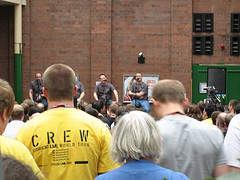
LUGRadioLive 2008 by sheilaellen (cc-by-2.0) This weekend, I learnt lots of things while at LugRadio Live in Wolverhampton. One thing was the surprising delay between posting something on this site and it actually appearing in the feed on my mobile phone. Another is that I can’t post to my new blog hosting from my mobile phone, which I’ll debug Real Soon Now. So, this is a bit later than when I first wrote it and it’s now one post instead of seven or so… Thanks to some unexplained delay travelling through Birmingham, I walked into LugRadio Live during the Introduction. The venue was generally pretty good, but the stage obstructed the entrance the acoustics in the atrium only seemed to work for the four gents. No idea what they said: I got past the stage into the audience and it finished almost immediately. For the first talk session, I went to see Rufus Pollock of Open Knowledge Foundation introduce a plan for the Comprehensive Knowledge Archive Network. Seems like a good idea. I’ve tons of questions, but I can’t quite get them into words, I don’t know when I’ll have time for this and I’m not sure they really matter anyway. I think I’ll mention CKAN to some librarians anyway and see what they make of it. I expected Emma Jane Hogbin’s “Form an orderly queue, ladies” to start an argument with the usual chix silliness but I was pleasantly surprised by how reasonable the advice was. In fact, the speaker also criticised the “chix” movements, although it appeared she participates in some women-only clubs, so not a 100% win for equality there. Sadly, much of the talk has been overshadowed in my mind by the memory of a giant furry racoon walking in unexpectedly, so I’ll probably grab the video of the LRL-USA version sometime soon. James Hooker’s talk titled “Taming the dragons — entrepreneurship and VCs” launched venturex as described on his own site already (along with more talk descriptions). It was an interesting demo, but it requires hackers to sell some votes in their companies to Venture Capitalists, which I believe is a bad thing for free software developers to do. We need to look more at a form of social entrepreneurism.</soapbox> I tried to ask a question, but the terrible atrium acoustics did funny things with my not-so-good hearing and I lost my way somewhat. At the end of that talk, I got chatting to an interesting web developer from Leicester who also forsook The Gong-a-Thong Lightbulb Talk Extravaganza and headed up to the Lightning Stage for Robert Collins and the Bzr talk. As well as some glimpses of how it’s changed since forking from tla, it was interesting to see a real (imperfect) demo and a non-Emacs version control GUI. The web interface for casual users to submit patches sounded very interesting and I also learned that some people pronounce “svn” like “Sven”. Most things that Robert thought were benefits sounded like drawbacks to me, so I’ll stay with git for now. Steve Lamb’s Green IT talk was the last presentation I saw. This talk really disappointed me because it seemed to be skewed towards the corporate governance nonsense instead of seeing Green IT as a vital pragmatic step, mentioning points I’d seen put more clearly elsewhere, as well as advertising Vista virtualisation and some panoramic webcam from Microsoft (who employ him) that doesn’t work with any free software, according to a deserved verbal shoe-ing in the Q+A. Only thing I remember that seems useful: charging from USB is more efficient than using wallwarts. Is that right? Finally, the main event: LugRadio Live and Unleashed. It opened with the shock announcement that LRL will continue into 2009, as announced elsewhere already. The rest of the madness will presumably appear online shortly and I don’t remember it well enough to do it justice… A tech conference crossed with a rocking gig by the strangest boyband ever, with a cheerleading racoon and some very cool people. I’ll try to be at LRL 2009. Will you be there? Were you at LRL this last weekend?

21 July 2008

Matthew Garrett: The fallacy of the completely inclusive community

Emma Jane Hogbin gave a presentation on the gender gap in free software at Lugradio Live this weekend. One of the central messages was that a great deal of how to avoid putting women off computing can be distilled down to "Don't be a dick". This ties in well with Mako's restatement of the Ubuntu code of conduct as "Be excellent to each other" (a wonderful phrasing which demonstrates that Bill and Ted's Excellent Adventure is the most philosophically worthwhile film that Keanu Reeves has ever appeared in, and certainly not The fucking Matrix) and led to my 5 minute rant on why I hate the Linux community slightly later in the day, but does leave a certain problem. What standards are used to define whether given behaviour is dickish or not? The comments here show that there's disagreement even within a single sub-community of the larger free software world. Ben suggests that the reaction to perceived inappropriate behaviour is perhaps even more discouraging than the original behaviour, suggesting that bitching about things that offend you is dickish behaviour in and of itself. How do we decide whether someone is being a dick or helping the community? Is lack of tolerance a form of exclusionary behaviour?

This topic is actually one of the issues discussed in the Geek Social Fallacies, but here's a nice easy example. Would tolerating planet posts encouraging the eradication of the Jewish population be inclusive or exclusive? I suspect that most people would agree that it wouldn't be acceptable behaviour, which leads us to the next question. Why? There's two obvious arguments here. The first is that at a community level we have some form of rough moral consensus that advocating genocide is Just Wrong, and so criticising Nazis is obviously the right thing to do. The second argument is more pragmatic than philosophical - alienating millions of people in order to avoid alienating hate groups could be considered to reduce our potential contributor base in an unfortunate way.

I'm a fan of the second argument. The example I gave is emotive and relatively recent history has resulted in people tending to be pretty uniform in considering genocide to be a bad thing, but many other cases aren't clear cut. What I consider to be objectification of women is seen by others as appreciation of natural beauty. What I think of as sexist jokes are perceived by others as acceptable humour. When I advocate intolerance of certain behaviour, people are going to see me not having enough tolerance. So we end up in a situation where people make the "We should all just get along and be tolerant of each other" argument, which sounds fine but is fundamentally flawed in one significant way.

Advocating tolerance excludes the intolerant.

The reason people fail to see this is that it doesn't sound like a flaw. If you ask people whether we need to support intolerance, the immediate answer is probably no. But by advocating exclusion of intolerance, you're excluding all those who have good reasons to be intolerant. You're excluding the women who don't want to feel that the community sees them as a pair of breasts attached to some legs. You're excluding the ethnic groups who would prefer to avoid racist slurs or ethnic stereotyping. Telling anti-fascism protestors that they're being intolerant isn't likely to endear you to them. Advocating tolerance is telling the intolerant that they're wrong and should just deal with whatever it is that makes them unhappy.

So, ironically, tolerating certain types of intolerance is probably required in order to avoid alienating many potential contributors. That means some way of deciding what kinds of behaviour are acceptable and which are unacceptable. In the absence of either pre-existing community consensus or some philosophical breakthrough that allows unambiguous determination of the "rightness" of a given action, I'm going to suggest that we look at it from a pragmatic viewpoint. How many potential contributors do we discourage by criticising a certain type of behaviour? How many do we discourage by tolerating it?

The fallacy of the completely inclusive community is the idea that it includes everyone. The reality is that a certain level of social exclusion is required in order to include a wider range of people. So don't criticise people purely for criticising someone else's behaviour - make an argument for why that behaviour benefits the community. And when you see behaviour that you think discourages others, call people on it. Even if nobody's behaviour changes as a result, you're sending a signal that not everyone in the community agrees. Sometimes all people want is to know that there'll be some people on their side.

But, above all, try not to be a dick.

11 July 2008

Adam Jensen: 11 Jul 2008

Yesterday, 10 July, was the due date for the second milestone of my work on DebGraph. I am happy to report that we are roughly two weeks ahead of schedule, so meeting this milestone was not a cause for worry. We now have support for the following graph operators: The next milestone includes the development of a high-level language (or integration with an existing extension language) that streamlines the construction of complex queries using the operators listed above. We can build arbitrarily complex queries using the C++ operators, but dealing with the static typing and compiler toolchain can be very clunky. As such, I have spent the past week working on Lua bindings for DebGraph, which will enable us to query the graph of Debian packages from a clean, dynamically typed language. Lua has a powerful C API that exposes the Lua stack and lets us move DebGraph information to and from the Lua interpreter. I'm writing documentation that outlines how to use DebGraph from both C++ and Lua in order to make this work accessible to more folks. Sneak peak
As an example, we can utilize the FindCycles operator in Lua as follows:
libdg = package.loadlib("./libdebgraph.so",
"luaopen_libdebgraph")
libdg()
LoadPackages('cache')
-- 'g' is the main graph of unstable binary-arm packages
cycles = FindCycles(g)
print("Found " .. #fc .. " cycles")
for comp_key,comp in pairs(cycles) do
    comp_nodes = ""
    for node_key,node in pairs(comp) do
        prop = GetProperty(node, "Package")
        comp_nodes = comp_nodes .. prop .. " "
    end
    print("* " .. comp_nodes)
end
The above Lua script produces the following result:
reading cache/unstable/main/binary-arm/Packages
Found 61 cycles
* debconf-english debconf-i18n debconf
* perl-modules perl 
* cdebconf fontconfig-config fontconfig gsfonts-x11
libcairo2 libfontconfig1 libgtk2.0-0 libpango1.0-0
libpango1.0-common libxft2 ucf x11-utils xutils
[...]
These are the package names in the strongly connected components, shown in alphabetical order. There is still a lot of work to do before the Lua binding will achieve feature parity with the core library, but we have now laid the foundation (and a brick or two).

3 July 2008

Antti-Juhani Kaijanaho: SF encyclopedic wiki?

I sometime wish I had access to an encyclopedia, written in wiki style so that it could be updated by anybody, that had an article about every SF story and novel ever written, and every fictional concept (like ansible, hyperspace etc) ever used in an SF story, and which crosslinked these in a useful manner. Often, once I’ve had a worldbuilding idea, I want to go read some of the key stories that use the same or a similar idea, so that I could see what others have already done with the idea. Only it turns out there are no indexes that tell me “antigravity has been used in these ways in SF stories, and it is a central concept in these stories” etc. Anybody know of something like this?

2 July 2008

Antti-Juhani Kaijanaho: A reader s meme

From Tuesday thingers, via Jules Jones:
Here is the Top 100 Most Popular Books on LibraryThing. Bold what you own, italicize what you’ve read. Star what you liked. Star multiple times what you loved!
(more…)

Jan Wagner: Bayreuth Festival - Online streaming of Die Meistersinger von N rnberg

Actual I’m involved into a project which maybe of interest for you if you like opera particular when you are a Richard Wagner enthusiast.
Since long time, the waiting period for obtaining tickets increases a lot. At the moment I think you have to wait around 8 years, which is a worse.
Time changes also at Bayreuth Festival, they seems to refocus their audience. Looks like the aspects of huge waiting list and new medias influenced that process. This year the opera “Die Meistersinger” is broadcasted online under the slogan “live dabei” (live there) via the great thing called “Internet” and to a public viewing area in Bayreuth, which is a premiere in both cases. So if you don’t have a ticket for the Festspielhaus and not in a position to make use of the public viewing but interested to have a look at the opera, you may want to check if your system matches the technical requirements and give it a try.

27 June 2008

Jan L&uuml;bbe: Debian and the Beagle Board

After having read about the board a bit and getting courious, at LinuxTag 2008 i could try the real hardware for the first time. They had a demo running which showed a full Enlightenment desktop and everything seemed quite fast. I would guess the performance is similar to a P3 1GHz. The demo was based on OpenEmbedded, but with a system that is as fast as a few year old desktop system, i would of course prefer to run Debian. read more

26 June 2008

Russell Coker: Kernel Security vs Uptime

For best system security you want to apply kernel security patches ASAP. For an attacker gaining root access to a machine is often a two step process, the first step is to exploit a weakness in a non-root daemon or take over a user account, the second step is to compromise the kernel to gain root access. So even if a machine is not used for providing public shell access or any other task which involves giving user access to potential hostile people, having the kernel be secure is an important part of system security. One thing that gets little consideration is the overall effect of applying security updates on overall uptime. Over the last year there have been 14 security related updates (I count a silent data loss along with security issues) to the main Debian Etch kernel package. Of those 14, it seems that if you don’t use DCCP, NAT for CIFS or SNMP, IA64, the dialout group, then you will only need to patch for issues 2, 3 (for SMP machines), 4, 5, 7 (sound drivers get loaded on all machines by default), 9, 10, 11, 12, 13, and 14. This means 11 reboots a year for SMP machines and 10 a year for uni-processor machines. If a reboot takes three minutes (which is an optimistic assumption) then that would be 30 or 33 minutes of downtime a year due to kernel upgrades. In terms of uptime we talk about the number of “nines”, where the ideal is generally regarded as “five nines” or 99.999% uptime. 33 minutes of downtime a year for kernel upgrades means that you get 99.993% uptime (which is “four nines”). If a reboot takes six minutes (which is not uncommon for servers) then it’s 99.987% uptime (”thee nines”). While it doesn’t seem likely to affect the number of “nines” you get, not using SMP has the potential to avoid future security issues. So it seems that when using a Xen (or other virtualisation technology) assigning only one CPU to the DomUs that don’t need any more could improve uptime for them. For Xen Dom0’s which don’t have local users or daemons, don’t use DCCP, NAT for CIFS or SNMP, wireless, CIFS, JFFS2, PPPoE, bluetooth, H.323 or SCTP connection tracking, then only issue 11 applies. However for “five nines” you need to have 5 minutes of downtime a year or less. It seems unlikely that a busy Xen server can be rebooted in 5 minutes as all the DomUs need to have their memory saved to disk (writing out the data to disk and reading it back in after a reboot will probably take at least a couple of minutes) or they need to be shutdown and booted again after the Dom0 is rebooted (which is a good procedure if the security fix affects both Dom0 and DomU use), and such shutdowns and reboots of DomU’s will take a lot of time. Based on the past year, it seems that a system running as a basic server might get “four nines” if configured for a fast boot (it’s surprising that no-one seems to be talking about recent improvements to the speed of booting as high-availability features) and if the boot is slower then you are looking at “three nines”. For a Xen server unless you have some sort of cluster it seems that “five nines” is unattainable due to reboot times if there is one issue a year, but “four nines” should be easy to get. Now while the 14 issues over the last year for the kernel seems likely to be a pattern that will continue, the one issue which affects Xen may not be representative (small numbers are not statistically significant). I feel confident in predicting a need for between 5 and 20 kernel updates next year due to kernel security issues, but I would not be prepared to bet on whether the number of issues affecting Xen will be 0, 1, or 4 (it seems unlikely that there would be 5 or more). I will write a future post about some strategies for mitigating these issues. Here is my summary of the Debian kernel linux-image-2.6.18-6-686 (Etch kernel) security updates according to it’s changelog, they are not in chronological order, it’s the order of the changelog file:


  1. 05 Jun 2008: CVE-2008-2358 for DCCP and CVE-2008-1673 for ASN.1 (NAT for CIFS and SNMP).

  2. 23 May 2008: CVE-2008-2136 memory leak in IPv6 over IPv4 tunnels, CVE-2007-6712 timer related bugs, CVE-2008-1615 ptrace on AMD64 architecture, and CVE-2008-2137 “Validate address ranges regardless of MAP_FIXED”.

  3. 07 May 2008: CVE-2008-1669 SMP race

  4. 11 Apr 2008: CVE-2007-6694 PPC only, CVE-2008-0007 Add VM_DONTEXPAND to vm_flags in drivers that register a fault handler but do not bounds check the offset argument, CVE-2008-1294 prevent user escape from RLIMIT_CPU, and CVE-2008-1375 fix dnotify race.

  5. 10 Feb 2008: CVE-2008-0010 and CVE-2008-0600 Fix missing access check in vmsplice.

  6. 25 Jan 2008: Not a security issue, but silent data loss on IA64.

  7. 22 Jan 2008: CVE-2007-6151 ISDN memory overrun, CVE-2008-0001 something related to checking the access to a directory, CVE-2007-2878 FAT filesystem related, CVE-2007-4571 ALSA bug that allows user to read kernel memory.

  8. 17 Sep 2007: Fix minor DOS attack for slightly privileged users (EG members of dialout group).

  9. 18 Dec 2007: CVE-2007-6063 overflows in ISDN subsystem, CVE-2007-6206 core dumping over an existing file can get the wrong ownership (should be possible to use kernel.core_pattern to work around this [1]), CVE-2007-5966 timer issue, CVE-2006-6058 Minix fs DOS attack via corrupted fs, and CVE-2007-6417 tmpfs memory leak.

  10. 29 Nov 2007: CVE-2007-3104 local kernel DOS attack (Oops), CVE-2007-4997 malicious frame on wireless interface crashes system, CVE-2007-5500 potential system hang, and CVE-2007-5904 CIFS overflows from server sending corrupt data.

  11. 02 Oct 2007: CVE-2007-4573 Xen 64bit with 32bit DomU, CVE-2006-5755 Xen, CVE-2007-4133 memory management DOS, and CVE-2007-5093 DOS when unplugging a webcam that is in use.

  12. 25 Sep 2007: CVE-2007-3731 ptrace causing Oops, CVE-2007-3739 memory management Oops, CVE-2007-3740 CIFS not honoring umask, CVE-2007-4573 ptrace of 32bit process on AMD64 bug, and CVE-2007-4849 JFFS2 (flash media) filesystem bug.

  13. 27 Aug 2007: CVE-2007-2172 IPv4 memory related issue (local DOS or compromise?), CVE-2007-2875 local user can read kernel memory if cpuset filesystem is mounted, CVE-2007-3105 buffer overflow in random number generator, CVE-2007-3843 CIFS, and CVE-2007-4308 AAC RAID.

  14. 11 Aug 2007: CVE-2007-1353 bluetooth, CVE-2007-3513 usblcd, CVE-2007-2525 PPPoE, CVE-2007-3642 H.323 connection tracking, CVE-2007-2172 IPv4 local exploit, CVE-2007-2453 slightly less random numbers, CVE-2007-2876 SCTP connection tracking, CVE-2007-3851 i965 batch buffer usage, and CVE-2007-3848 potential privilege escalation.

18 June 2008

Gunnar Wolf: eSATA, USB and friends

Andrew asks about Linux-friendly eSATA controllers. A long time ago, I also looked for some - but basically no one seems to know about that, or will try to rip your eyes for it.
In January, however, I looked for (and bought) an external USB enclosure for SATA disks. As portability was more important than speed, I only asked for USB. Good, got the kit, paid for it.
The external enclosure had an external eSATA port. Not only that, it shipped with a standard PC expansion slot bracket and adaptor - Yes, it connects to your internal SATA port, and provides an external eSATA port. And, of course, it will work with your current kernel painlessly. And, of course, it is even cheaper than a SATA controller with an external port.

14 June 2008

Jan Wagner: postfwd 1.10pre7c-1 in experimental

postfwd 1.10pre7c-1 has been accepted and did hit experimental yesterday.
If you using policyd-weight you might want to give it a try, since its active development stoped. If you are annoyed by too much spam, it maybe a good idea as well.
Please have a look on postfwd.cf, there is no default config provided, since the configuration depends heavily on your environment. But maybe you have a look at /usr/share/doc/postfwd/examples, there is what you expect.
If you have any comments, send a mail to the maintainer or if there are bugs I didn’t spotted yet, please fill one!
In case I don’t respond quit fast, maybe I’m in the delivery room or anywhere else in the hospital or something like that, so please give me some extra time.
In case there are no big issues, I plan to upload the package to unstable in a reasonable time.

12 June 2008

Jeff Bailey

Dear recruiters #2: There are now *two* standards to follow: not only can you not send me posts from a noreply address, you should also try to convince me that your founders are insane ;)

I seem to have quite accidentally set a new standard in what it takes to hire me. According to Slashdot, Google co-founder Sergey Brin is planning to go to the ISS. The founder of Ubuntu, Mark Shuttleworth did the same.

" You know we're sitting on four million pounds of fuel, one nuclear weapon and a thing that has 270,000 moving parts built by the lowest bidder. Makes you feel good, doesn't it?"

Actually, looking back at almost all the jobs I've ever had, the founders or key management folks were almost *always* insane. I remember a fun conversation with Jane, the COO of Canonical about how I wanted the senior management of any place I work to have such a big vision and to drive relentlessly towards it.

I think she thought *I* was insane. Probably still does ;)

Thinking of which, I'm so happy to be back at work. I'd forgotten what the pace here was like, or maybe it's just coming off of heavy drugs and spinning up to this pace. I feel a bit like a Smart Car on the New Jersey Turnpike. I'll make freeway speeds, but I need a few more days. =)

I reduced the drugs quite rapidly in the last week, and am now down to one Ultram per day, with extra-strength Tylenol supplementing. I also got my second HIV test results back, and it's non-reactive. So it's 99% probable that the blood transfusions were clean. Yay!

7 June 2008

David Nusinow: The Cognitive Load Of Web Development

The most dynamic segment of the software industry that I'm aware of is web programming. Flamewars rage about frameworks and browsers and standards and whatnot, and the openness of the whole thing feels like some of the things that made me fall in love with computing as a whole and Free Software in particular. The problem with all that openness is that it's rather difficult to navigate. Aside from the obvious issues with browser incompatibilities, there's an enormous amount of software solutions on the server side, spanning languages, libraries, and frameworks. Each one is an ecosystem to itself, often being large and complicated.

This makes it rather difficult to do certain aspects of web programming well. You are constantly switching between tools and languages, as well as coding paradigms, in order to build a web app in full. You'll be writing HTML, CSS, and Javascript on the client side, each with its own peculiarities. On the server side you'll probably have settled on one language with its own very different varieties of coding style and patterns. Some, like Ruby on Rails, are their own unique brand of language that makes you work both in the DSL (Rails in this case) and the parent language (Ruby here). Template engines often will do the same thing, such as in the case of Django.

It's pretty obvious that having to juggle all these tools places a fairly large burden on the coder. Much to their credit, it's not difficult to work in any of these languages, but to work in them at a high level becomes more difficult the deeper and wider the software stack reaches. You get this a bit in systems programming, juggling C/C++ with a build system and a scripting language, but that's usually it. You can get that number of moving parts just on the client side of the web with HTML, CSS, and Javascript.

Something interesting that seems to be happening is that people are moving to decrease this cognitive burden. One good example is the Google Web Toolkit which lets you write all your AJAXy client-side stuff in Java, and let it get compiled in to Javascript. That way you cut the languages you have to work in. A similar concept is behind Microsoft allowing Ruby (and Python, if I've heard correctly) in Silverlight. Alternately, you can bring Javascript (back) to the server side, which is the motivation behind Helma and Rhino on Rails (the latter of which I hope sees the light of day).

Personally, I'm rooting for Javascript to not become an assembly language, but to take over the server side again. It's a capable and powerful language (much better than Java in my opinion), and we're collectively leveraging it very poorly. Rhino is interesting and has enormous potential, but it needs library binds in the worst way. Currently it's basically using Javascript to write Java, which is rather atrocious (COBOL in any language, etc) but with some Javascript-style wrappers around the Java classes it could be phenomenal. Alternately, there's Spidermonkey, which could be wrapped in a more capable shell with a good FFI, and we could easily have wrappers to our favorite Free Software libraries. This project seems far along here, but it's currently very windows-centric.

There's a lot of potential here though. Unifying the development language for both web and system apps would benefit the Free Software desktop, and give us the ability to better integrate our stuff with the web. One of the best things about Free Software is that it dropped the barrier to entry in software development. I think we can repeat that success again here.

Next.

Previous.