Search Results: "gt"

23 December 2024

Joey Hess: the twenty-fifth year of my free software career

I've been lucky to be able to spend twenty! five! years! developing free software and making a living on it, and this was a banner year for that career. To start with, there was the Distribits conference. There's a big ecosystem of tools and projects that are based on git-annex, especially in scientific data management, and this was the first conference focused on that. Basically every talk involved git-annex in some way. It's been a while since I was at a conference where my software was in the center like that -- reminded me of Debconf days. I gave a talk on how git-annex was probably basically feature complete. I have been very busy ever since adding new features to it, because in mapping out git-annex's feature set, I discovered new possibilities. Meeting people and getting a better feel for the shape of that ecosytem, both technically and funding wise, led to several big developments in funding later in the year. Going into the year, I had an ongoing source of funding from several projects at Dartmouth that use git-annex, but after 10 years, some of that was winding up. That all came together in my essentially writing a grant proposal to the OpenNeuro project at Stanford, to spend 6 months building out a whole constellation of features. The summer became a sprint to get it all done. Signficant amounts of very productive design work were done while swimming in the river. That was great. (Somehow in there, I ended up onstage at FOSSY in Portland, in a keynote panel on Open Source and AI. This required developing a nuanced understanding of the mess of the OSI's Open Source AI definition, but I was mostly on the panel as the unqualified guy.) Capping off the year, I have a new maintenance contract with Forschungszentrum J lich. This covers the typical daily grind kind of tasks, like bug triage, keeping on top of security, release preparation, and updating dependencies, which is the kind of thing I've never been able to find dedicated funding for before. A career in free software is a succession of hurdles. How to do something new and worthwhile? How to make any income while developing it at all? How to maintain your independant vision when working on it for hire? How to deal with burn-out? How to grow a project to be more than a one developer affair? And on and on. How does a free software project keep paying the bills once it's feature complete? Maybe I am starting to get a glimpse of an answer.

Thomas Lange: Happy Birthday FAI!

A Brief History of FAI, Which Began 25 Years Ago On Dec 21st, 1999 version 1.0 of FAI (Fully Automatic Installation) was announced. That was 25 years ago. Some months before, the computer science department of the University of Cologne bought a small HPC cluster with 16 nodes (each with dual CPU Pentium II 400Mhz, 256 MB RAM) and I was too lazy to install those nodes manually. That's why I started the FAI project. With FAI you can install computers in a few minutes from scratch to a machine with a custom configuration that is ready to go for their users. At that time Debian 2.1 aka slink was using kernel 2.0.36 and it was the first release using apt. Many things have happened since then. In the beginning we wrote the first technical report about FAI and a lot of documentation were added afterwards. I gave more than 45 talks about FAI all over the world. Over the past 25 years, there has been an average of more than one commit per day to the FAI software repository. Several top500.org HPC clusters were built using FAI and many companies are using FAI for their IT infrastructure or deploying Linux on their products using FAI. An overview of users can be found here. Some major milestones of FAI are listed in the blog post of the 20th anniversary. What Happended in the Last 5 Years? Currently, I'm preparing for the next FAI release and I still have ideas for new features. Thanks for all the feedback from you, which helped a lot in making FAI a successful project. About FAI FAI is a tool for unattended mass deployment of Linux. It's a system to install and configure Linux systems and software packages on computers as well as virtual machines, from small labs to large-scale infrastructures like clusters and cloud environments. You can take one or more virgin PC's, turn on the power, and after a few minutes, the systems are installed, and completely configured to your exact needs, without any interaction necessary.

Russ Allbery: Review: The House That Walked Between Worlds

Review: The House That Walked Between Worlds, by Jenny Schwartz
Series: Uncertain Sanctuary #1
Publisher: Jenny Schwartz
Copyright: June 2020
Printing: September 2024
ASIN: B0DBX6GP8Z
Format: Kindle
Pages: 215
The House That Walked Between Worlds is the first book of a self-published trilogy of... hm. Space fantasy? Pure fantasy with a bit of science fiction thrown in for flavor? Something like that. I read it as part of the Uncertain Sanctuary omnibus, which is reflected in the sidebar metadata. Kira Aist is a doctor. She's also a witch and a direct descendant of Baba Yaga. Her Russian grandmother warned her to never use magic and never reveal who she was because people would hunt her and her family if she did. She broke the rule to try to save a child, her grandmother was right, and now multiple people are dead, including her parents. As the story opens, she's deep in the wilds of New Zealand in a valley with buried moa bones, summoning her House so that she can flee Earth. Kira's first surprise is that her House is not the small hut that she was expecting from childhood visits to Baba Yaga. It's larger. A lot larger: an obsidian castle with nine towers and legs that resemble dragons rather than the moas whose magic she drew on. Her magic apparently had a much different idea of what she needs than she did. Her second surprise is that her magical education is highly incomplete, and she is not the witch that she thought she was. Her ability to create a House means that she's a sorcerer, the top tier of magical power in a hierarchy about which she knows essentially nothing. Thankfully the House has a library, but Kira has a lot to learn about the universe and her place in it. I picked this up because the premise sounded a little like the Innkeeper novels, and since another novel in that series does not appear to be immediately forthcoming, I went looking elsewhere for my cozy sentient building fix. The House That Walked Between Worlds is nowhere near as well-written (or, frankly, coherent) as the Innkeeper books, but it did deliver some of the same vibes. You should know going in that there isn't much in the way of a plot. Schwartz invented an elaborate setting involving archetype worlds inhabited by classes of mythological creatures that in some mystical sense surround a central system called Qaysar. These archetype worlds spawn derived worlds, each of which seems to be its own dimension, although the details are a bit murky to me. The world Kira thinks of as Earth is just one of the universes branched off of an archetypal Earth, and is the only one of those branchings where the main population is human. The other Earth-derived worlds are populated by the Dinosaurians and the Neanderthals. Similarly, there is a Fae world that branches into Elves and Goblins, an Epic world that branches into Shifters, Trolls, and Kobolds, and so forth. Travel between these worlds is normally by slow World Walker Caravans, but Houses break the rules of interdimensional travel in ways that no one entirely understands. If your eyes are already starting to glaze over, be warned there's a lot of this. The House That Walked Between Worlds is infodumping mixed with vibes, and I think you have to enjoy the setting, or at least the sheer enthusiasm of Schwartz's presentation of it, to get along with this book. The rest of the story is essentially Kira picking up strays: first a dangerous-looking elf cyborg, then a juvenile giant cat (because of course there's a pet fantasy space cat; it's that sort of book), and then a charming martial artist who I'm fairly sure is up to no good. Kira is entirely out of her depth and acting on instinct, which luckily plays into stereotypes of sorcerers as mysterious and unpredictable. It also helps that her magic is roughly "anything she wants to happen, happens." This is, in other words, not a tightly-crafted story with coherent rules and a sense of risk and danger. It's a book that succeeds or fails almost entirely on how much you like the main characters and enjoy the world-building. Thankfully, I thought the characters were fun, if not (so far) all that deep. Kira deals with her trauma without being excessively angsty and leans into her new situation with a chaotic decisiveness that I found charming. The cyborg elf is taciturn and a bit inscrutable at first, but he grew on me, and thankfully this book does not go immediately to romance. Late in the book, Kira picks up a publicity expert, which was not at all the type of character that I was expecting and which I found delightful. Most importantly, the House was exactly what I was looking for: impish, protective, mysterious, inhuman, and absurdly overpowered. I adore cozy sentient building stories, so I'm an easy audience for this sort of thing, but I'm already eager to read more about the House. This is not great writing by any stretch, and you will be unsurprised that it's self-published. If you're expecting the polish and plot coherence of the Innkeeper stories, you'll be disappointed. But if you just want to spend some time with a giant sentient space-traveling mansion inhabited by unlikely misfits, and you don't mind large amounts of space fantasy infodumping, consider giving this a shot. I had fun with it and plan on reading the rest of the omnibus. Followed by House in Hiding. Rating: 6 out of 10

Simon Josefsson: OpenSSH and Git on a Post-Quantum SPHINCS+

Are you aware that Git commits and tags may be signed using OpenSSH? Git signatures may be used to improve integrity and authentication of our software supply-chain. Popular signature algorithms include Ed25519, ECDSA and RSA. Did you consider that these algorithms may not be safe if someone builds a post-quantum computer? As you may recall, I have earlier blogged about the efficient post-quantum key agreement mechanism called Streamlined NTRU Prime and its use in SSH and I have attempted to promote the conservatively designed Classic McEliece in a similar way, although it remains to be adopted. What post-quantum signature algorithms are available? There is an effort by NIST to standardize post-quantum algorithms, and they have a category for signature algorithms. According to wikipedia, after round three the selected algorithms are CRYSTALS-Dilithium, FALCON and SPHINCS+. Of these, SPHINCS+ appears to be a conservative choice suitable for long-term digital signatures. Can we get this to work? Recall that Git uses the ssh-keygen tool from OpenSSH to perform signing and verification. To refresh your memory, let s study the commands that Git uses under the hood for Ed25519. First generate a Ed25519 private key:
jas@kaka:~$ ssh-keygen -t ed25519 -f my_ed25519_key -P ""
Generating public/private ed25519 key pair.
Your identification has been saved in my_ed25519_key
Your public key has been saved in my_ed25519_key.pub
The key fingerprint is:
SHA256:fDa5+jmC2+/aiLhWeWA3IV8Wj6yMNTSuRzqUZlIGlXQ jas@kaka
The key's randomart image is:
+--[ED25519 256]--+
     .+=.E ..      
      oo=.ooo      
     . =o=+o .     
      =oO+o .      
      .=+S.=       
       oo.o o      
      . o  .       
     ...o.+..      
    .o.o.=**.      
+----[SHA256]-----+
jas@kaka:~$ cat my_ed25519_key
-----BEGIN OPENSSH PRIVATE KEY-----
b3BlbnNzaC1rZXktdjEAAAAABG5vbmUAAAAEbm9uZQAAAAAAAAABAAAAMwAAAAtzc2gtZW
QyNTUxOQAAACAWP/aZ8hzN0WNRMSpjzbgW1tJXNd2v6/dnbKaQt7iIBQAAAJCeDotOng6L
TgAAAAtzc2gtZWQyNTUxOQAAACAWP/aZ8hzN0WNRMSpjzbgW1tJXNd2v6/dnbKaQt7iIBQ
AAAEBFRvzgcD3YItl9AMmVK4xDKj8NTg4h2Sluj0/x7aSPlhY/9pnyHM3RY1ExKmPNuBbW
0lc13a/r92dsppC3uIgFAAAACGphc0BrYWthAQIDBAU=
-----END OPENSSH PRIVATE KEY-----
jas@kaka:~$ cat my_ed25519_key.pub 
ssh-ed25519 AAAAC3NzaC1lZDI1NTE5AAAAIBY/9pnyHM3RY1ExKmPNuBbW0lc13a/r92dsppC3uIgF jas@kaka
jas@kaka:~$ 
Then let s sign something with this key:
jas@kaka:~$ echo "Hello world!" > msg
jas@kaka:~$ ssh-keygen -Y sign -f my_ed25519_key -n my-namespace msg
Signing file msg
Write signature to msg.sig
jas@kaka:~$ cat msg.sig 
-----BEGIN SSH SIGNATURE-----
U1NIU0lHAAAAAQAAADMAAAALc3NoLWVkMjU1MTkAAAAgFj/2mfIczdFjUTEqY824FtbSVz
Xdr+v3Z2ymkLe4iAUAAAAMbXktbmFtZXNwYWNlAAAAAAAAAAZzaGE1MTIAAABTAAAAC3Nz
aC1lZDI1NTE5AAAAQLmWsq05tqOOZIJqjxy5ZP/YRFoaX30lfIllmfyoeM5lpVnxJ3ZxU8
SF0KodDr8Rtukg2N3Xo80NGvZOzbG/9Aw=
-----END SSH SIGNATURE-----
jas@kaka:~$
Now let s create a list of trusted public-keys and associated identities:
jas@kaka:~$ echo 'my.name@example.org ssh-ed25519 AAAAC3NzaC1lZDI1NTE5AAAAIBY/9pnyHM3RY1ExKmPNuBbW0lc13a/r92dsppC3uIgF' > allowed-signers
jas@kaka:~$ 
Then let s verify the message we just signed:
jas@kaka:~$ cat msg   ssh-keygen -Y verify -f allowed-signers -I my.name@example.org -n my-namespace -s msg.sig
Good "my-namespace" signature for my.name@example.org with ED25519 key SHA256:fDa5+jmC2+/aiLhWeWA3IV8Wj6yMNTSuRzqUZlIGlXQ
jas@kaka:~$ 
I have implemented support for SPHINCS+ in OpenSSH. This is early work, but I wanted to announce it to get discussion of some of the details going and to make people aware of it. What would a better way to demonstrate SPHINCS+ support in OpenSSH than by validating the Git commit that implements it using itself? Here is how to proceed, first get a suitable development environment up and running. I m using a Debian container launched in a protected environment using podman.
jas@kaka:~$ podman run -it --rm debian:stable
Then install the necessary build dependencies for OpenSSH.
# apt-get update 
# apt-get install git build-essential autoconf libz-dev libssl-dev
Now clone my OpenSSH branch with the SPHINCS+ implentation and build it. You may browse the commit on GitHub first if you are curious.
# cd
# git clone https://github.com/jas4711/openssh-portable.git -b sphincsp
# cd openssh-portable
# autoreconf -fvi
# ./configure
# make
Configure a Git allowed signers list with my SPHINCS+ public key (make sure to keep the public key on one line with the whitespace being one ASCII SPC character):
# mkdir -pv ~/.ssh
# echo 'simon@josefsson.org ssh-sphincsplus@openssh.com AAAAG3NzaC1zcGhpbmNzcGx1c0BvcGVuc3NoLmNvbQAAAECI6eacTxjB36xcPtP0ZyxJNIGCN350GluLD5h0KjKDsZLNmNaPSFH2ynWyKZKOF5eRPIMMKSCIV75y+KP9d6w3' > ~/.ssh/allowed_signers
# git config gpg.ssh.allowedSignersFile ~/.ssh/allowed_signers
Then verify the commit using the newly built ssh-keygen binary:
# PATH=$PWD:$PATH
# git log -1 --show-signature
commit ce0b590071e2dc845373734655192241a4ace94b (HEAD -> sphincsp, origin/sphincsp)
Good "git" signature for simon@josefsson.org with SPHINCSPLUS key SHA256:rkAa0fX0lQf/7V7QmuJHSI44L/PAPPsdWpis4nML7EQ
Author: Simon Josefsson <simon@josefsson.org>
Date:   Tue Dec 3 18:44:25 2024 +0100
    Add SPHINCS+.
# git verify-commit ce0b590071e2dc845373734655192241a4ace94b
Good "git" signature for simon@josefsson.org with SPHINCSPLUS key SHA256:rkAa0fX0lQf/7V7QmuJHSI44L/PAPPsdWpis4nML7EQ
# 
Yay! So what are some considerations? SPHINCS+ comes in many different variants. First it comes with three security levels approximately matching 128/192/256 bit symmetric key strengths. Second choice is between the SHA2-256, SHAKE256 (SHA-3) and Haraka hash algorithms. Final choice is between a robust and a simple variant with different security and performance characteristics. To get going, I picked the sphincss256sha256robust SPHINCS+ implementation from SUPERCOP 20241022. There is a good size comparison table in the sphincsplus implementation, if you want to consider alternative variants. SPHINCS+ public-keys are really small, as you can see in the allowed signers file. This is really good because they are handled by humans and often by cut n paste. What about private keys? They are slightly longer than Ed25519 private keys but shorter than typical RSA private keys.
# ssh-keygen -t sphincsplus -f my_sphincsplus_key -P ""
Generating public/private sphincsplus key pair.
Your identification has been saved in my_sphincsplus_key
Your public key has been saved in my_sphincsplus_key.pub
The key fingerprint is:
SHA256:4rNfXdmLo/ySQiWYzsBhZIvgLu9sQQz7upG8clKziBg root@ad600ff56253
The key's randomart image is:
+[SPHINCSPLUS 256-+
  .  .o            
 o . oo.           
  = .o.. o         
 o o  o o . .   o  
 .+    = S o   o . 
 Eo=  . + . . .. . 
 =*.+  o . . oo .  
 B+=    o o.o. .   
 o*o   ... .oo.    
+----[SHA256]-----+
# cat my_sphincsplus_key.pub 
ssh-sphincsplus@openssh.com AAAAG3NzaC1zcGhpbmNzcGx1c0BvcGVuc3NoLmNvbQAAAEAltAX1VhZ8pdW9FgC+NdM6QfLxVXVaf1v2yW4v+tk2Oj5lxmVgZftfT37GOMOlK9iBm9SQHZZVYZddkEJ9F1D7 root@ad600ff56253
# cat my_sphincsplus_key 
-----BEGIN OPENSSH PRIVATE KEY-----
b3BlbnNzaC1rZXktdjEAAAAABG5vbmUAAAAEbm9uZQAAAAAAAAABAAAAYwAAABtzc2gtc3
BoaW5jc3BsdXNAb3BlbnNzaC5jb20AAABAJbQF9VYWfKXVvRYAvjXTOkHy8VV1Wn9b9slu
L/rZNjo+ZcZlYGX7X09+xjjDpSvYgZvUkB2WVWGXXZBCfRdQ+wAAAQidiIwanYiMGgAAAB
tzc2gtc3BoaW5jc3BsdXNAb3BlbnNzaC5jb20AAABAJbQF9VYWfKXVvRYAvjXTOkHy8VV1
Wn9b9sluL/rZNjo+ZcZlYGX7X09+xjjDpSvYgZvUkB2WVWGXXZBCfRdQ+wAAAIAbwBxEhA
NYzITN6VeCMqUyvw/59JM+WOLXBlRbu3R8qS7ljc4qFVWUtmhy8B3t9e4jrhdO6w0n5I4l
mnLnBi2hJbQF9VYWfKXVvRYAvjXTOkHy8VV1Wn9b9sluL/rZNjo+ZcZlYGX7X09+xjjDpS
vYgZvUkB2WVWGXXZBCfRdQ+wAAABFyb290QGFkNjAwZmY1NjI1MwECAwQ=
-----END OPENSSH PRIVATE KEY-----
# 
Signature size? Now here is the challenge, for this variant the size is around 29kb or close to 600 lines of base64 data:
# git cat-file -p ce0b590071e2dc845373734655192241a4ace94b   head -10
tree ede42093e7d5acd37fde02065a4a19ac1f418703
parent 826483d51a9fee60703298bbf839d9ce37943474
author Simon Josefsson <simon@josefsson.org> 1733247865 +0100
committer Simon Josefsson <simon@josefsson.org> 1734907869 +0100
gpgsig -----BEGIN SSH SIGNATURE-----
 U1NIU0lHAAAAAQAAAGMAAAAbc3NoLXNwaGluY3NwbHVzQG9wZW5zc2guY29tAAAAQIjp5p
 xPGMHfrFw+0/RnLEk0gYI3fnQaW4sPmHQqMoOxks2Y1o9IUfbKdbIpko4Xl5E8gwwpIIhX
 vnL4o/13rDcAAAADZ2l0AAAAAAAAAAZzaGE1MTIAAHSDAAAAG3NzaC1zcGhpbmNzcGx1c0
 BvcGVuc3NoLmNvbQAAdGDHlobgfgkKKQBo3UHmnEnNXczCMNdzJmeYJau67QM6xZcAU+d+
 2mvhbksm5D34m75DWEngzBb3usJTqWJeeDdplHHRe3BKVCQ05LHqRYzcSdN6eoeZqoOBvR
# git cat-file -p ce0b590071e2dc845373734655192241a4ace94b   tail -5 
 ChvXUk4jfiNp85RDZ1kljVecfdB2/6CHFRtxrKHJRDiIavYjucgHF1bjz0fqaOSGa90UYL
 RZjZ0OhdHOQjNP5QErlIOcZeqcnwi0+RtCJ1D1wH2psuXIQEyr1mCA==
 -----END SSH SIGNATURE-----
Add SPHINCS+.
# git cat-file -p ce0b590071e2dc845373734655192241a4ace94b   wc -l
579
# 
What about performance? Verification is really fast:
# time git verify-commit ce0b590071e2dc845373734655192241a4ace94b
Good "git" signature for simon@josefsson.org with SPHINCSPLUS key SHA256:rkAa0fX0lQf/7V7QmuJHSI44L/PAPPsdWpis4nML7EQ
real	0m0.010s
user	0m0.005s
sys	0m0.005s
# 
On this machine, verifying an Ed25519 signature is a couple of times slower, and needs around 0.07 seconds. Signing is slower, it takes a bit over 2 seconds on my laptop.
# echo "Hello world!" > msg
# time ssh-keygen -Y sign -f my_sphincsplus_key -n my-namespace msg
Signing file msg
Write signature to msg.sig
real	0m2.226s
user	0m2.226s
sys	0m0.000s
# echo 'my.name@example.org ssh-sphincsplus@openssh.com AAAAG3NzaC1zcGhpbmNzcGx1c0BvcGVuc3NoLmNvbQAAAEAltAX1VhZ8pdW9FgC+NdM6QfLxVXVaf1v2yW4v+tk2Oj5lxmVgZftfT37GOMOlK9iBm9SQHZZVYZddkEJ9F1D7' > allowed-signers
# cat msg   ssh-keygen -Y verify -f allowed-signers -I my.name@example.org -n my-namespace -s msg.sig
Good "my-namespace" signature for my.name@example.org with SPHINCSPLUS key SHA256:4rNfXdmLo/ySQiWYzsBhZIvgLu9sQQz7upG8clKziBg
# 
Welcome to our new world of Post-Quantum safe digital signatures of Git commits, and Happy Hacking!

22 December 2024

Junichi Uekawa: Looking at my private repositories for what language I wrote.

Looking at my private repositories for what language I wrote. I'm counting the number of days I wrote a certain file with specific file extension. Markdown was at the top, because I usually have a doc, that's fine. C++ is my top language. Then lilypond and then js. Rust came much lower. Lilypond was for my band scores it seems.

Russ Allbery: Review: Beyond the Fringe

Review: Beyond the Fringe, by Miles Cameron
Series: Arcana Imperii #1.5
Publisher: Gollancz
Copyright: 2023
ISBN: 1-3996-1537-8
Format: Kindle
Pages: 173
Beyond the Fringe is a military science fiction short story collection set in the same universe as Artifact Space. It is intended as a bridge between that novel and its sequel, Deep Black. Originally I picked this up for exactly the reason it was published: I was eagerly awaiting Deep Black and thought I'd pass the time with some filler short fiction. Then, somewhat predictably, I didn't get around to reading it until after Deep Black was already out. I still read this collection first, partly because I'm stubborn about reading things in publication order but mostly to remind myself of what was going on in Artifact Space before jumping into the sequel. My stubbornness was satisfied. My memory was not; there's little to no background information here, and I had to refresh my memory of the previous book anyway to figure out the connections between these stories and the novel. My own poor decisions aside, these stories are... fine, I guess? They're competent military SF short fiction, mostly more explicitly military than Artifact Space. All of them were reasonably engaging. None of them were that memorable or would have gotten me to read the series on their own. They're series filler, in other words, offering a bit of setup for the next novel but not much in the way of memorable writing or plot. If you really want more in this universe, this exists, but my guess (not having read Deep Black) is that it's entirely skippable. "Getting Even": A DHC paratrooper lands on New Shenzen, a planet that New Texas is trying to absorb into the empire it is attempting to build. He gets captured by one group of irregulars and then runs into another force with an odd way of counting battle objectives. I think this exists because Cameron wanted to tell a version of a World War II story he'd heard, but it's basically a vignette about a weird military unit with no real conclusion, and I am at a loss as to the point of the story. There isn't even much in the way of world-building. I'm probably missing something, but I thought it was a waste of time. (4) "Partners": The DHC send a planetary exobiologist to New Texas as a negotiator. New Texas is aggressively, abusively capitalist and is breaking DHC regulations on fair treatment of labor. Why send a planetary exobiologist is unclear (although probably ties into the theme of this collection that the reader slowly pieces together); maybe it's because he's originally from New Texas, but more likely it's because of his partner. Regardless, the New Texas government are exploitative assholes with delusions of grandeur, so the negotiations don't go very smoothly. This was my favorite story of the collection just because I enjoy people returning rudeness and arrogance to sender, but like a lot of stories in this collection it doesn't have much of an ending. I suspect it's mostly setup for Deep Black. (7) "Dead Reckoning": This is the direct fallout of the previous story and probably has the least characterization of this collection. It covers a few hours of a merchant ship having to make some fast decisions in a changing political situation. The story is framed around a veteran spacer and his new apprentice, although even that frame is mostly dropped once the action starts. It was suspenseful and enjoyable enough while I was reading it, but it's the sort of story that you forget entirely after it's over. (6) "Trade Craft": Back on a planet for this story, which follows an intelligence agent on a world near but not inside New Texas's area of influence. I thought this was one of the better stories of the collection even though it's mostly action. There are some good snippets of characterization, an interesting mix of characters, and some well-written tense scenes. Unfortunately, I did not enjoy the ending for reasons that would be spoilers. Otherwise, this was good but forgettable. (6) "One Hour": This is the first story with a protagonist outside of the DHC and its associates. It instead follows a PTX officer (PTX is a competing civilization that features in Artifact Space) who has suspicions about what his captain is planning and recruits his superior officer to help him do something about it. This is probably the best story in the collection, although I personally enjoyed "Partners" a smidgen more. Shunfu, the first astrogator who is recruited by the protagonist, is a thoroughly enjoyable character, and the story is tense and exciting all the way through. For series readers, it also adds some depth to events in Artifact Space (if the reader remembers them), and I suspect will lead directly into Deep Black. (7) "The Gifts of the Magi": A kid and his mother, struggling asteroid miners with ancient and malfunctioning equipment, stumble across a DHC ship lurking in the New Texas system for a secret mission. This is a stroke of luck for the miners, since the DHC is happy to treat the serious medical problems of the mother without charging unaffordable fees the way that the hyper-capitalist New Texas doctors would. It also gives the reader a view into DHC's covert monitoring of the activities of New Texas that all the stories in this collection have traced. As you can tell from the title, this is a Christmas story. The crew of the DHC ship is getting ready to celebrate Alliday, which they claim rolls all of the winter holidays into one. Just like every other effort to do this, no, it does not, it just subsumes them all into Christmas with some lip service to other related holidays. I am begging people to realize that other religions often do not have major holidays in December, and therefore you cannot include everyone by just declaring December to be religious holiday time and thinking that will cover it. There is the bones of an interesting story here. The covert mission setup has potential, the kid and his mother are charming if cliched, there's a bit of world-building around xenoglas (the magical alien material at the center of the larger series plot), and there's a lot of foreshadowing for Deep Black. Unfortunately, this is too obviously a side story and a setup story: none of this goes anywhere satisfying, and along the way the reader has to endure endless rather gratuitous Christmas references, such as the captain working on a Nutcracker ballet performance for the ship talent show. This isn't bad, exactly, but it rubbed me the wrong way. If you love Christmas stories, you may find it more agreeable. (5) Rating: 6 out of 10

21 December 2024

Benjamin Mako Hill: Thug Life

My current playlist is this diorama of Lulu the Piggy channeling Tupac Shakur in a toy vending machine in the basement of New World Mall in Flushing Chinatown.

Dirk Eddelbuettel: anytime 0.3.11 on CRAN: Maintenance

A follow-up release 0.3.11 to the recent 0.3.10 release release of the anytime package arrived on CRAN two days ago. The package is fairly feature-complete, and code and functionality remain mature and stable, of course. anytime is a very focused package aiming to do just one thing really well: to convert anything in integer, numeric, character, factor, ordered, input format to either POSIXct (when called as anytime) or Date objects (when called as anydate) and to do so without requiring a format string as well as accomodating different formats in one input vector. See the anytime page, or the GitHub repo for a few examples, and the beautiful documentation site for all documentation. This release simply skips one test file. CRAN labeled an error M1mac yet it did not reproduce on any of the other M1 macOS I can access (macbuilder, GitHub Actions) as this appeared related to a local setting of timezone values I could not reproduce anywwhere. So the only way to get rid of the fail is to not to run the test. Needless to say the upload process was a little tedious as I got the passive-aggressive not responding treatment on a first upload and the required email answer it lead to. Anyway, after a few days, and even more deep breaths, it is taken care of and now the package result standing is (at least currently) pristinely clean. The short list of changes follows.
Changes in anytime version 0.3.11 (2024-12-18)
  • Skip a test file

Courtesy of my CRANberries, there is also a diffstat report of changes relative to the previous release. The issue tracker tracker off the GitHub repo can be use for questions and comments. More information about the package is at the package page, the GitHub repo and the documentation site.

This post by Dirk Eddelbuettel originated on his Thinking inside the box blog. If you like this or other open-source work I do, you can now sponsor me at GitHub.

Joey Hess: aiming at December

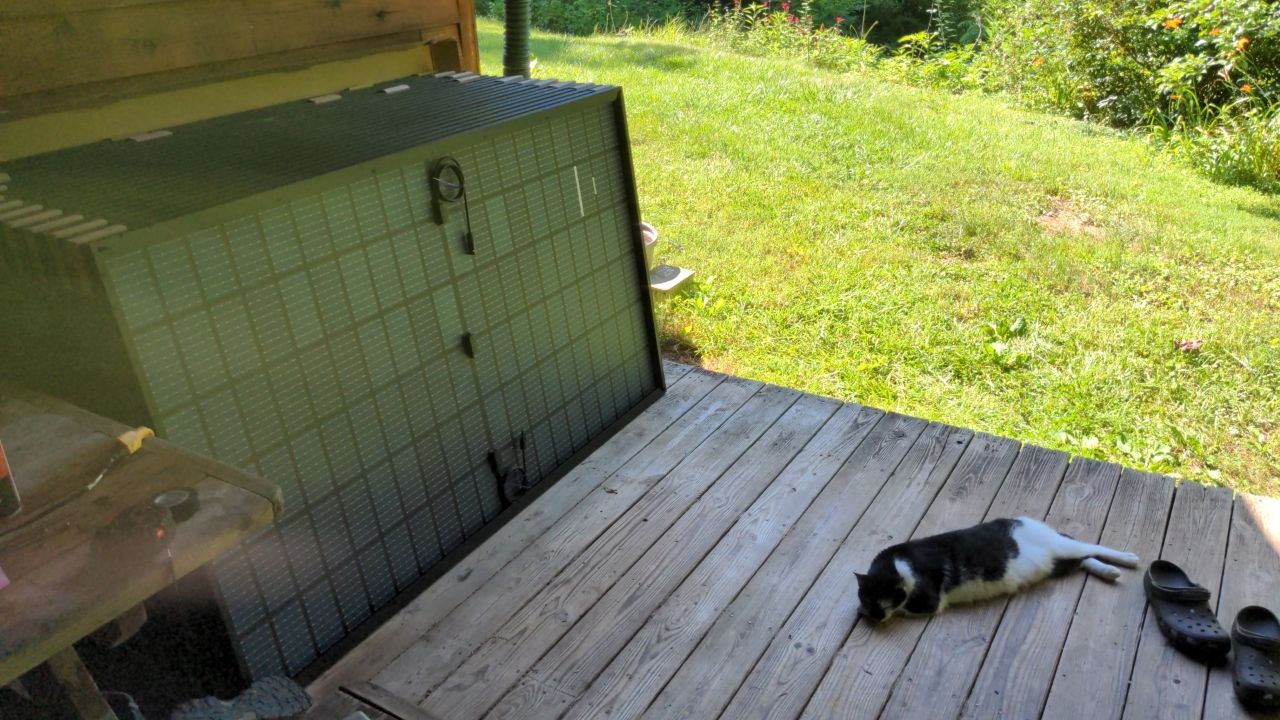
I have been working all year on a solar upgrade aimed at December. Now here it is, midwinter, and my electric car is charging on a cloudy day from my offgrid solar fence. I lived happily enough with 1 kilowatt of solar that I installed in 2017. Meanwhile, solar panel prices came down massively, incentives increased and everything came together: This was the year. In the spring I started clearing forest trees that were leaning over the house, making both a firebreak and a solar field. In June I picked up a pallet of panels in a box truck.
a porch with a a bunch of solar panels, stacked on edge leaning up against the wall. A black and white cat is sprawled in front of them.
In August I bought the EV and was able to charge it offgrid from my old solar system... a few miles per day on the most sunny days. In September and October I built a solar fence, of my own design.
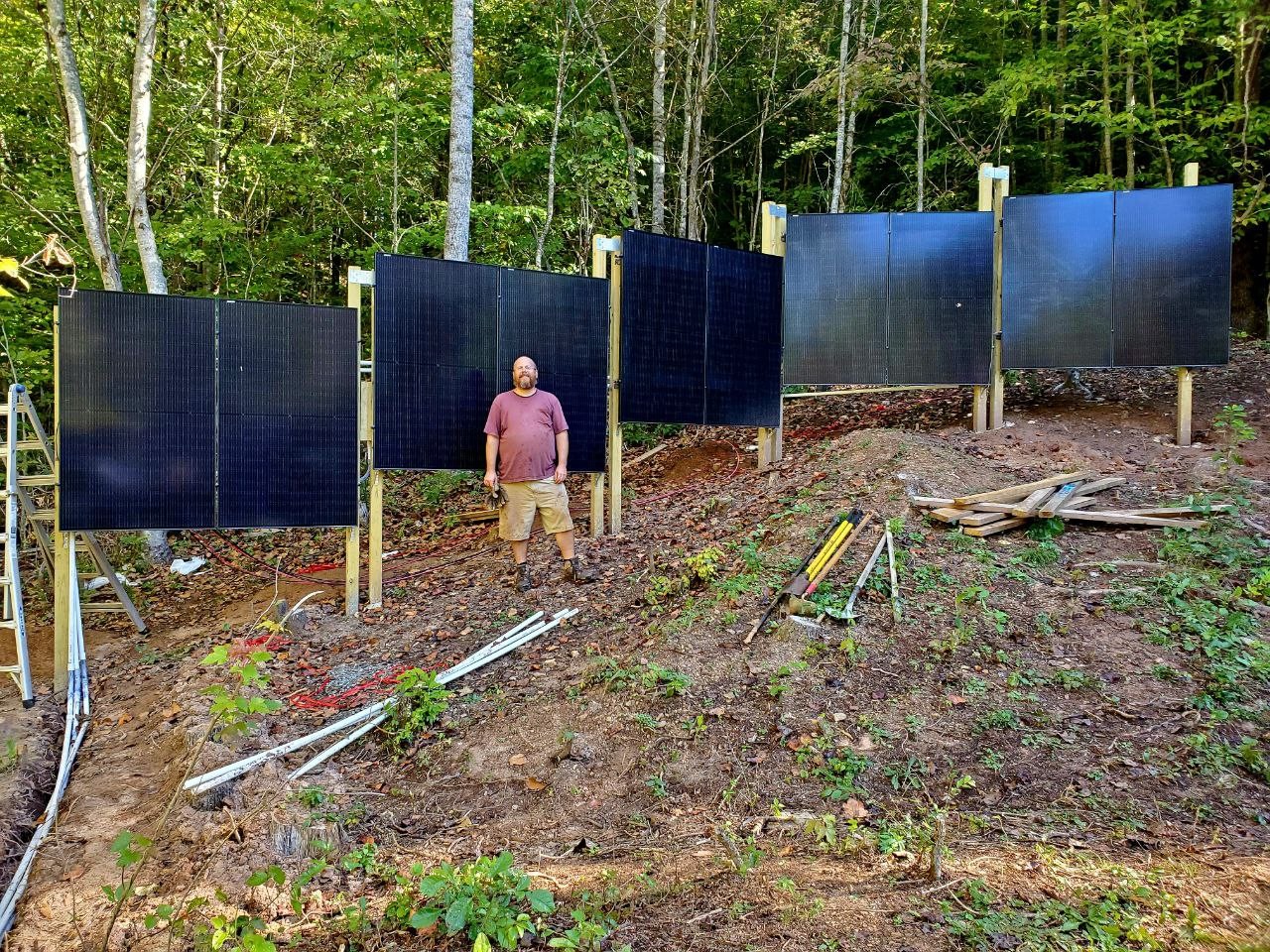
Me standing in front of the solar fence, which is 10 panels long
For the past several weeks I have been installing additional solar panels on ballasted ground mounts full of gravel. At this point I'm half way through installing my 30 panel upgrade. The design goal of my 12 kilowatt system is to produce 1 kilowatt of power all day on a cloudy day in midwinter, which allows swapping between major loads (EV charger, hot water heater, etc) on a cloudy day and running everything on a sunny day. So the size of the battery bank doesn't matter much. Batteries are getting cheaper fast too, but they are a wear item, so it's better to oversize the solar system and minimize the battery. A lot of this is nonstandard and experimental. And that makes sense with the price of solar panels. It costs more to mount solar panels now than the panels are worth. And non-ideal panel orientation isn't a problem when the system is massively overpaneled. I'm hoping to finish up the install before the end of winter. I have more trees to clear, more ballasted ground mounts to install, and need to come up with something even more experimental for a half dozen or so panels. Using solar panels as mounts for solar panels? Hanging them from trees? Soon the wan light will fade, time to head off to the solstice party to enjoy the long night, and a bonfire.
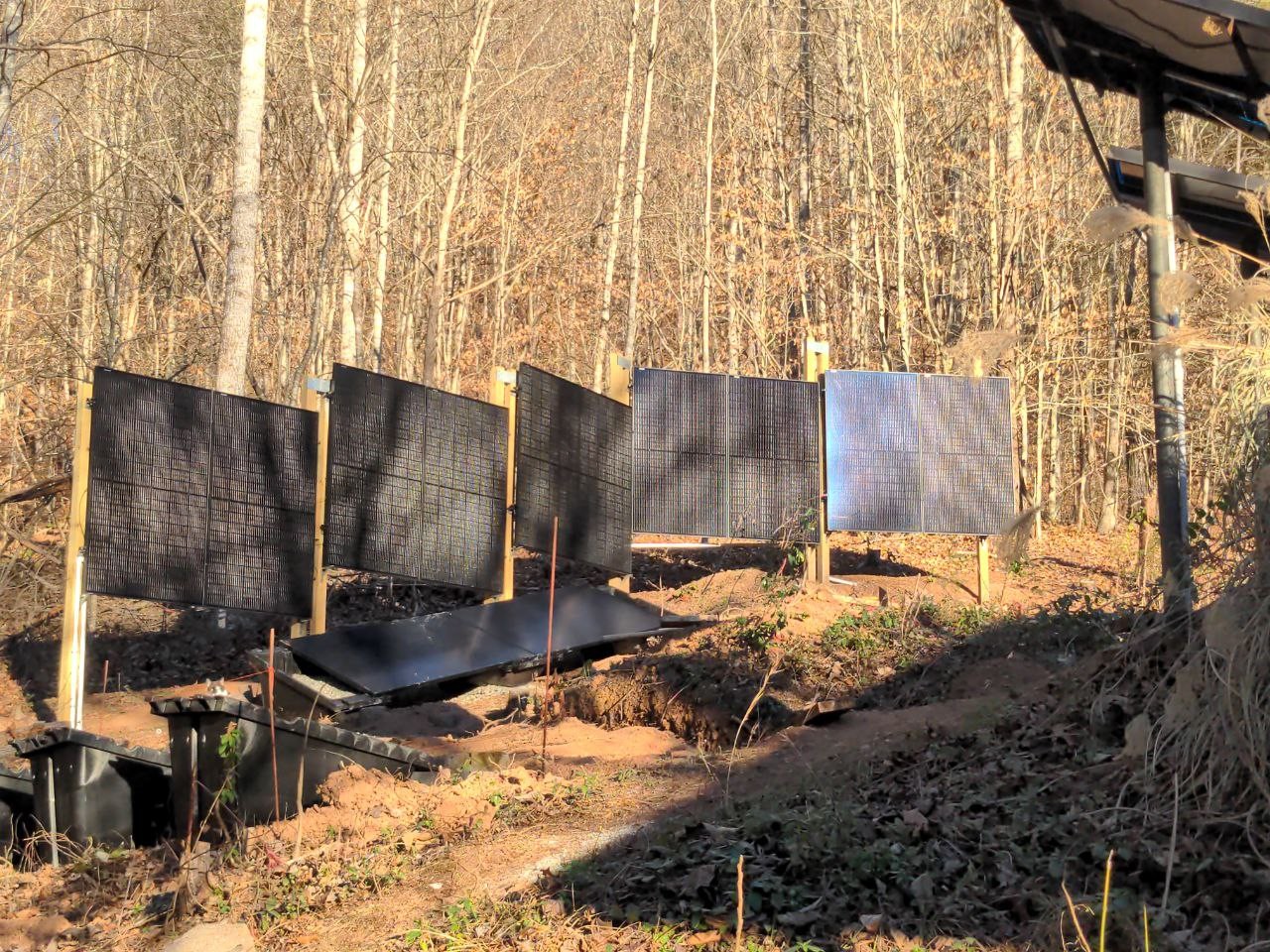
Solar fence with some ballasted ground mounts in front of it, late evening light. Old pole mounted solar panels in the foreground are from the 90's.

20 December 2024

Steve Kemp: The CP/M emulator runs on Windows?

Today I made a new release of my CP/M emulator and I think that maybe now it will run on Microsoft Windows. Unfortunately I cannot test it! A working CP/M implementation needs to provide facilities for reading input from the console, both reading a complete line of text and individual keystrokes. These input functions need to handle several different types of input: In the past we used a Unix-specific approach to handle the enabling and disabling of keyboard echoing (specifically we executed the stty binary to enable/disable echos), but this release adds a more portable solution, based around termbox-go which is the new default, and should allow our emulator to work on Microsoft Windows systems. We always had the ability to select between a number of different output drivers, and as of this release we can now select between multiple input drivers too - with the new portable option being the default. This has been tested on MacOS X systems, as well as GNU/Linux, but sadly I don't have access to Windows to test that. Fingers crossed it's all good now though, happy new year!

Michael Prokop: Grml 2024.12 codename Adventgrenze

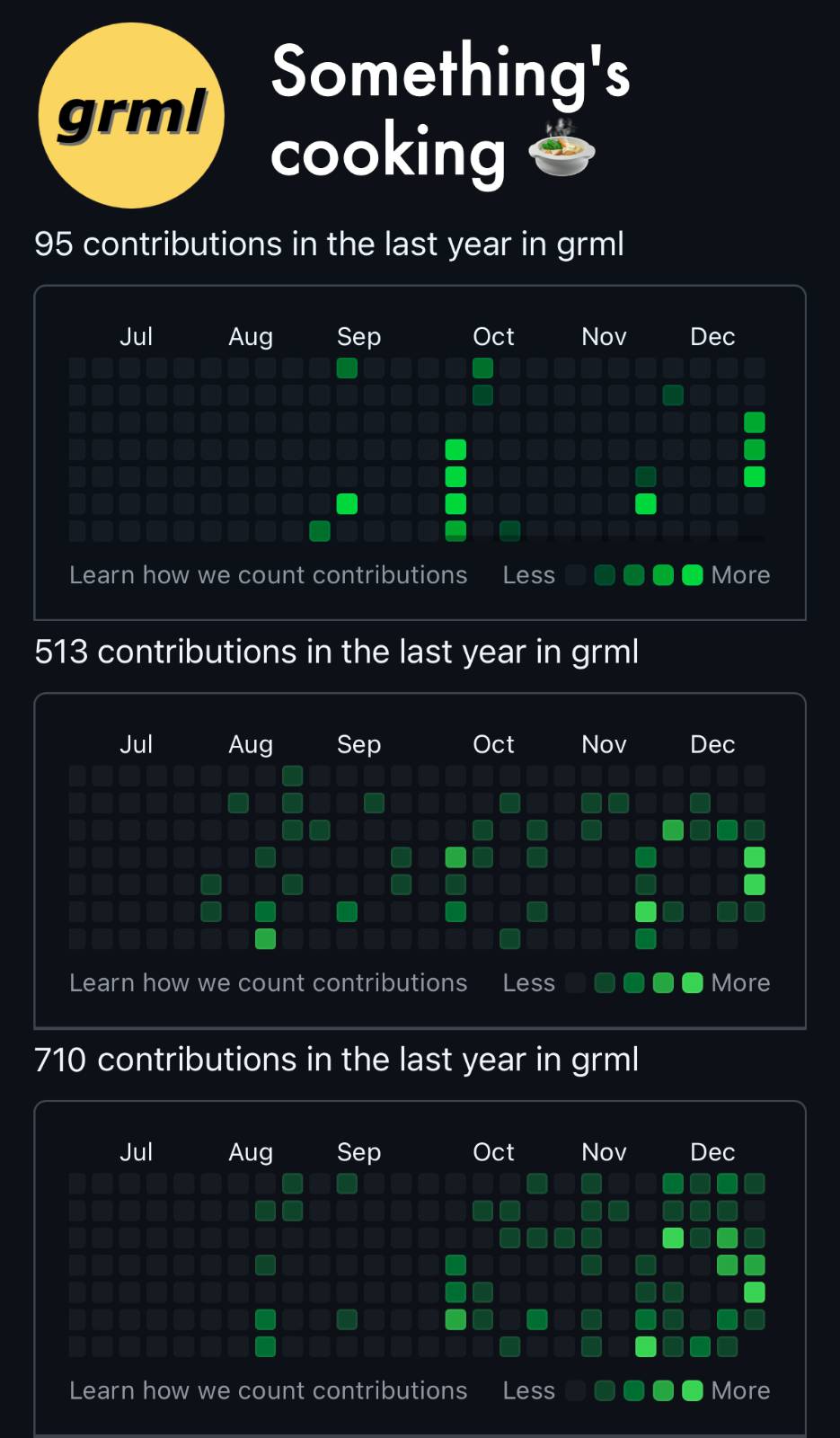
Picture with metrics of three user profiles on GitHub.com, with many contributions especially in the last quarter of the year We did it again ! Just in time, we re excited to announce the release of Grml stable version 2024.12, code-named Adventgrenze ! (If you re not familiar with Grml, it s a Debian-based live system tailored for system administrators.) This new release is built on Debian trixie, and for the first time, we re introducing support for 64-bit ARM CPUs (arm64 architecture)! I m incredibly proud of the hard work that went into this release. A significant amount of behind-the-scenes effort went into reworking our infrastructure and redesigning the build process. Special thanks to Chris and Darsha our Grml developer days in November and December were a blast! For a detailed overview of the changes between releases 2024.02 and 2024.12, check out our official release announcement. And, as always, after a release comes the next one exciting improvements are already in the works! BTW: recently we also celebrated 20(!) years of Grml Releases. If you re a Grml and or grml-zsh user, please join us in celebrating and send us a postcard!

Noah Meyerhans: Local Development VM Management

A coworker asked recently about how people use VMs locally for dev work, so I figured I d take a few minutes to write up a bit about what I do. There are many use cases for local virtual machines in software development and testing. They re self-contained, meaning you can make a mess of them without impacting your day-to-day computing environment. They can run different distributions, kernels, and even entirely different operating systems from the one you use regularly. Etc. They re also cheaper than cloud services and provide finer grained control over the resources. I figured I d share a little bit about how I manage different virtual machines in case anybody finds this useful. This is what works for me, but it won t necessarily work for you, or maybe you ve already got something better. I ve found it to be easy to work with, light weight, and is easy to evolve my needs change.

Use short-lived VMs Rather than keep a long-lived development VM around that you customize over time, I recommend automating the common customizations and provisioning new VMs regularly. If I m working on reproducing a bug or testing a change prior to submitting it upstream, I ll do this work in a VM and delete the VM when when I m done. When provisioning VMs this frequently, though, walking through the installation process for every new VM is tedious and a waste of time. Since most of my work is done in Debian, so I start with images generated daily by the cloud team. These images are available for multiple releases and architectures. The nocloud variant boots to a root prompt and can be useful directly, or the generic images can be used for cloud-init based customization.

Automating image preparation This makefile lets me do something like make image and get a new qcow2 image with the latest build of a given Debian release (sid by default, with others available by specifying DIST).
DATESTAMP=$(shell date +"%Y-%m-%d")
FLAVOR?=generic
ARCH?=$(shell dpkg --print-architecture)
DIST?=sid
RELEASE=$(DIST)
URL_PATH=https://cloud.debian.org/images/cloud/$(DIST)/daily/latest/
ifeq ($(DIST),trixie)
RELEASE=13
endif
ifeq ($(DIST),bookworm)
RELEASE=12
endif
ifeq ($(DIST),bullseye)
RELEASE=11
endif
debian-$(DIST)-$(FLAVOR)-$(ARCH)-daily.tar.xz:
curl --fail --connect-timeout 20 -LO \
$(URL_PATH)/debian-$(RELEASE)-$(FLAVOR)-$(ARCH)-daily.tar.xz
$(DIST)-$(FLAVOR)-$(DATESTAMP).qcow2: debian-$(RELEASE)-$(FLAVOR)-$(ARCH)-daily.tar.xz
tar xvf debian-$(RELEASE)-$(FLAVOR)-$(ARCH)-daily.tar.xz
qemu-img convert -O qcow2 disk.raw $@
rm -f disk.raw
qemu-img resize $@ 20g
qemu-img snapshot -c untouched $@
image: $(DIST)-$(FLAVOR)-$(DATESTAMP).qcow2
.PHONY: image

Customize the VM environment with cloud-init While the nocloud images can be useful, I typically find that I want to apply the same modifications to each new VM I launch, and they don t provide facilities for automating this. The generic images, on the other hand, run cloud-init by default. Using cloud-init, I can create my user account, point apt at local mirrors, install my preferred tools, ensure the root filesystem is resized to make full use of the backing storage, etc. The cloud-init configuration on the generic images will read from a local config drive, which can contain an ISO9660 (cdrom) filesystem image. This image can be generated from a subdirectory containing the various cloud-init input files using the following make syntax:
IMDS_FILES=$(shell find seedconfig -path '*/.git/*' \
-prune -o -type f -name '*.in.json' -print) \
seedconfig/openstack/latest/user_data
seed.iso: $(IMDS_FILES)
genisoimage -V config-2 -o $@ -J -R -m '*~' -m '.git' seedconfig
With the image in place, the VM can be created with
 qemu-system-x86_64 -machine q35,accel=kvm
-cpu host -m 4g -drive file=$ img ,index=0,if=virtio,media=disk
-drive file=seed.iso,media=cdrom,format=raw,index=2,if=virtio
-nic user -nographic
This invokes qemu with the root volume and ISO image attached as disks, uses an emulated q35 machine with the host s CPU and KVM acceleration, the userspace network stack, and a serial console. The first time the VM boots, cloud-init will apply the configuration from the cloud-config available in the ISO9660 filesystem.

Alternatives to cloud-init virt-customize is another tool accomplishing the same type of customization. I use cloud-init because it works directly with cloud providers in addition to local VM images. You could also use something like ansible.

Variations I have a variant of this that uses a bridged network, which I ll write more about later. The bridge is nice because it s more featureful, with full support for IPv6, etc, but it needs a bit more infrastructure in place. It also can be helpful to use 9p or virtfs to share filesystem state between the host the VM. I don t tend to rely on these, and will instead use rsync or TRAMP for moving files around. Containers are also useful, of course, and there are plenty of times when the full isolation of a VM is not worth the overhead.

19 December 2024

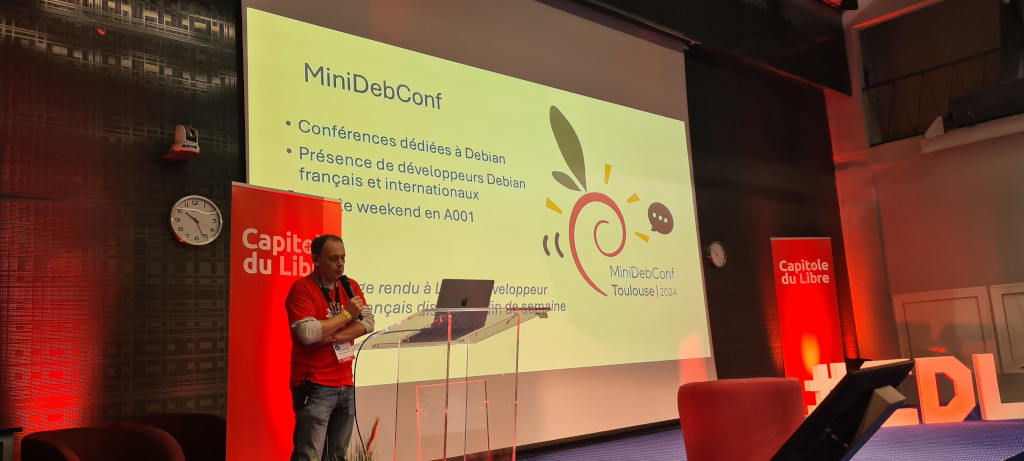
Gregory Colpart: MiniDebConf Toulouse 2024

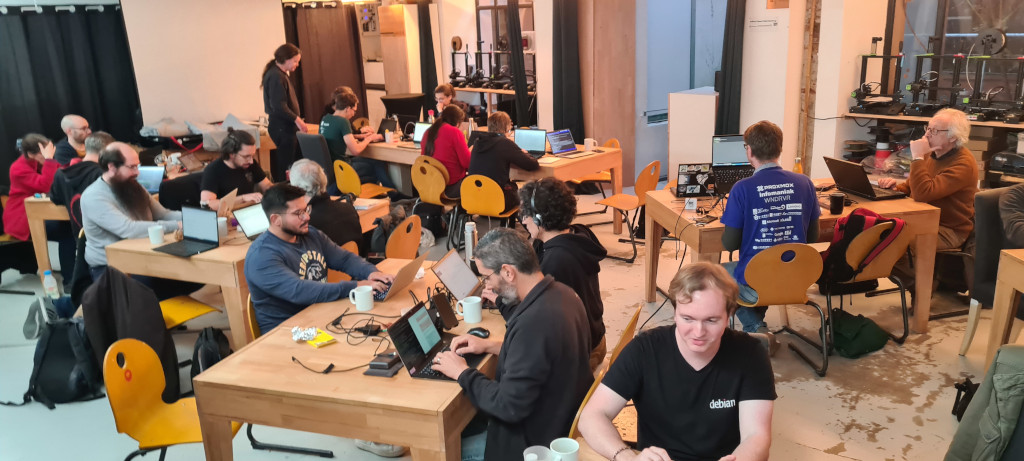
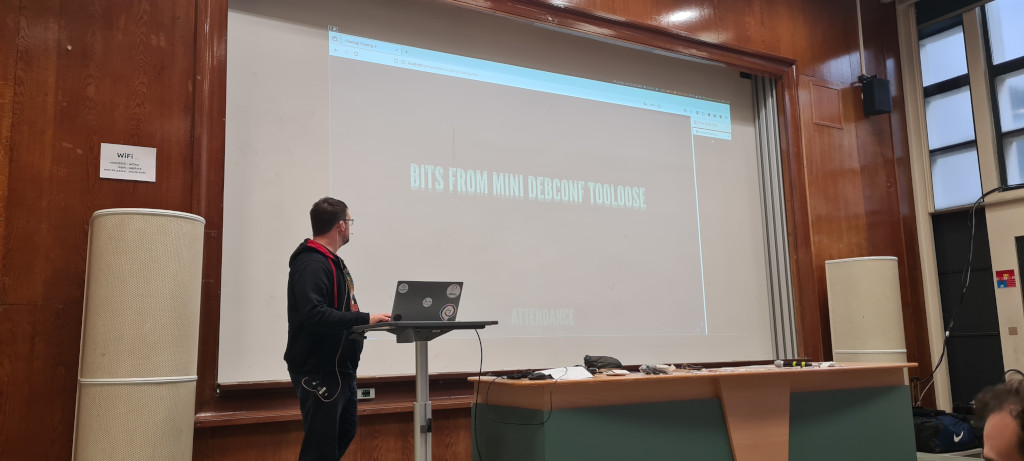
After the MiniDebConf Marseille 2019, COVID-19 made it impossible or difficult to organize new MiniDebConfs for a few years. With the gradual resumption of in-person events (like FOSDEM, DebConf, etc.), the idea emerged to host another MiniDebConf in France, but with a lighter organizational load. In 2023, we decided to reach out to the organizers of Capitole du Libre to repeat the experience of 2017: hosting a MiniDebConf alongside their annual event in Toulouse in November. However, our request came too late for 2023. After discussions with Capitole du Libre in November 2023 in Toulouse and again in February 2024 in Brussels, we confirmed that a MiniDebConf Toulouse would take place in November 2024! We then assembled a small organizing team and got to work: a Call for Papers in May 2024, adding a two-day MiniDebCamp, coordinating with the DebConf video team, securing sponsors, creating a logo, ordering T-shirts and stickers, planning the schedule, and managing registrations. Even with lighter logistics (conference rooms, badges, and catering during the weekend were handled by Capitole du Libre), there was still quite a bit of preparation to do. On Thursday, November 14, and Friday, November 15, 2024, about forty developers arrived from around the world (France, Spain, Italy, Switzerland, Germany, England, Brazil, Uruguay, India, Brest, Marseille ) to spend two days at the MiniDebCamp in the beautiful collaborative spaces of Artilect in Toulouse city center.
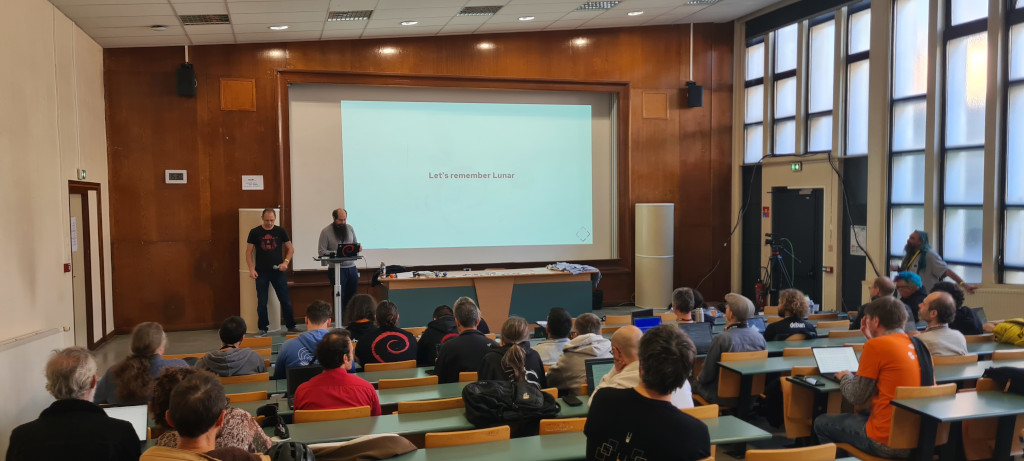
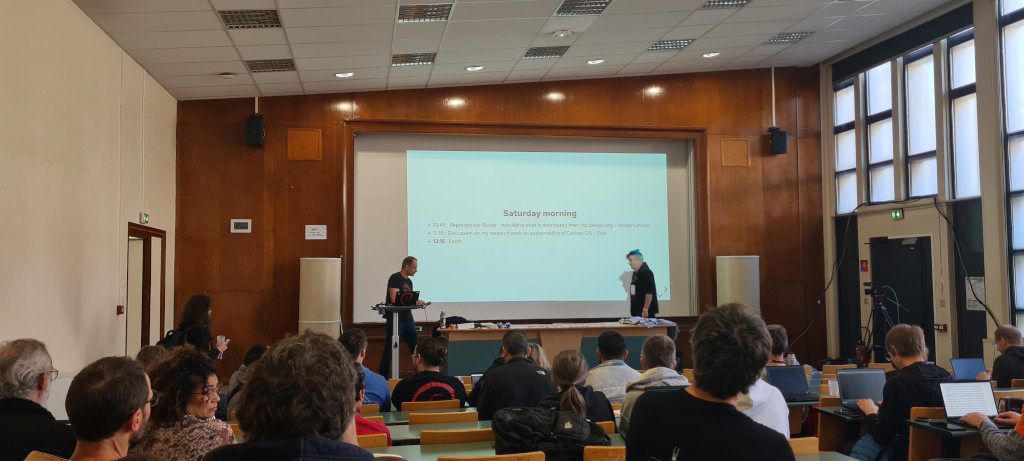
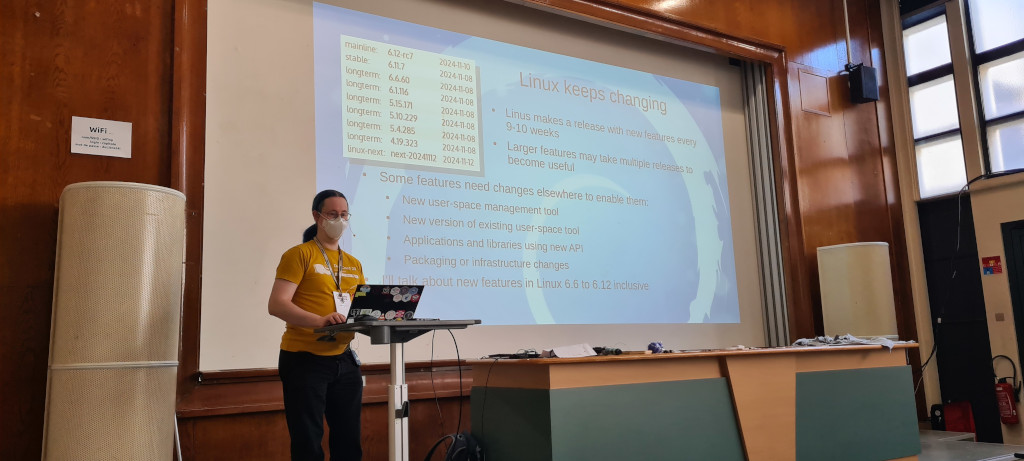
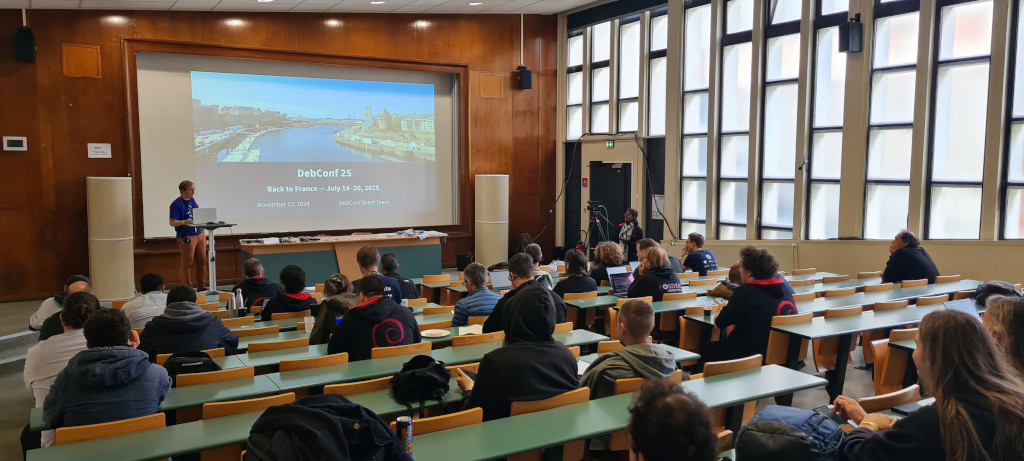
Then, on Saturday, November 16, and Sunday, November 17, 2024, the MiniDebConf took place at ENSEEIHT as part of the Capitole du Libre event. The conference kicked off on Saturday morning with an opening session by J r my Lecour, which included a tribute to Lunar (Nicolas Dandrimont). This was followed by Reproducible Builds Rebuilding What is Distributed from ftp.debian.org (Holger Levsen) and Discussion on My Research Work on Sustainability of Debian OS (Eda). After lunch at the Capitole du Libre food trucks, the intense afternoon schedule began: What s New in the Linux Kernel (and What s Missing in Debian) (Ben Hutchings), Linux Live Patching in Debian (Santiago Ruano Rinc n), Trixie on Mobile: Are We There Yet? (Arnaud Ferraris), PostgreSQL Container Groups, aka cgroups Down the Road (C dric Villemain), Upgrading a Thousand Debian Hosts in Less Than an Hour (J r my Lecour and myself), and Using Debusine to Automate Your QA (Stefano Rivera & co). Sunday marked the second day, starting with a presentation on DebConf 25 (Benjamin Somers), which will be held in Brest in July 2025. The morning continued with talks: How LTS Goes Beyond LTS (Santiago Ruano Rinc n & Roberto C. S nchez), Cross-Building (Helmut Grohne), and State of JavaScript (Bastien Roucari s). In the afternoon, there were Lightning Talks, PyPI Security: Past, Present & Future (Salvo LtWorf Tomaselli), and the classic Bits from DPL (Andreas Tille), before closing with the final session led by Pierre-Elliott B cue. All talks are available on video (a huge thanks to the amazing DebConf video team), and many thanks to our sponsors (Viridien, Freexian, Evolix, Collabora, and Data Bene). A big thank-you as well to the entire Capitole du Libre team for hosting and supporting us see you in Brest in July 2025! Articles about (or mentioning) MiniDebConf Toulouse:

Benjamin Mako Hill: Being a bread torus

A concerned nutritional epidemiologist in Tokyo realizes that if you are what you eat, that means
It s a similar situation in Seoul, albeit with less oil and more confidence.

18 December 2024

Simon Josefsson: Guix Container Images for GitLab CI/CD

I am using GitLab CI/CD pipelines for several upstream projects (libidn, libidn2, gsasl, inetutils, libtasn1, libntlm, ) and a long-time concern for these have been that there is too little testing on GNU Guix. Several attempts have been made, and earlier this year Ludo came really close to finish this. My earlier effort to idempotently rebuild Debian recently led me to think about re-bootstrapping Debian. Since Debian is a binary distribution, it re-use earlier binary packages when building new packages. The prospect of re-bootstrapping Debian in a reproducible way by rebuilding all of those packages going back to the beginning of time does not appeal to me. Instead, wouldn t it be easier to build Debian trixie (or some future release of Debian) from Guix, by creating a small bootstrap sandbox that can start to build Debian packages, and then make sure that the particular Debian release can idempotently rebuild itself in a reproducible way? Then you will eventually end up with a reproducible and re-bootstrapped Debian, which pave the way for a trustworthy release of Trisquel. Fortunately, such an endeavour appears to offer many rabbit holes. Preparing Guix container images for use in GitLab pipelines is one that I jumped into in the last few days, and just came out of. Let s go directly to the point of this article: here is a GitLab pipeline job that runs in a native Guix container image that builds libksba after installing the libgpg-error dependency from Guix using the pre-built substitutes.
test-amd64-latest-wget-configure-make-libksba:
  image: registry.gitlab.com/debdistutils/guix/container:latest
  before_script:
  - lndir /gnu/store/*profile/etc/ /etc
  - rm -f /etc/group
  - groupadd --system guixbuild
  - for i in $(seq -w 1 10); do useradd -g guixbuild -G guixbuild -d /var/empty -s $(command -v nologin) -c "Guix build user $i" --system guixbuilder$i; done
  - export HOME=/
  - export LANG=C.UTF-8
  - guix-daemon --disable-chroot --build-users-group=guixbuild &
  - guix archive --authorize < /share/guix/ci.guix.gnu.org.pub
  - guix archive --authorize < /share/guix/bordeaux.guix.gnu.org.pub
  - guix describe
  - guix package -i libgpg-error
  - GUIX_PROFILE="//.guix-profile"
  - . "$GUIX_PROFILE/etc/profile"
  script:
  - wget https://www.gnupg.org/ftp/gcrypt/libksba/libksba-1.6.7.tar.bz2
  - tar xfa libksba-1.6.7.tar.bz2
  - cd libksba-1.6.7
  - ./configure
  - make V=1
  - make check VERBOSE=t V=1
You can put that in a .gitlab-ci.yml and push it to GitLab and you will end up with a nice pipeline job output. As you may imagine, there are several things that are sub-optimal in the before_script above that ought to be taken care of by the Guix container image, and I hope to be able to remove as much of the ugliness as possible. However that doesn t change that these images are useful now, and I wanted to announce this work to allow others to start testing them and possibly offer help. I have started to make use of these images in some projects, see for example the libntlm commit for that. You are welcome to join me in the Guix container images for GitLab CI/CD project! Issues and merge requests are welcome happy hacking folks!

17 December 2024

Dirk Eddelbuettel: BH 1.87.0-1 on CRAN: New Upstream

Boost Boost is a very large and comprehensive set of (peer-reviewed) libraries for the C++ programming language, containing well over one hundred individual libraries. The BH package provides a sizeable subset of header-only libraries for (easier, no linking required) use by R. It is fairly widely used: the (partial) CRAN mirror logs (aggregated from the cloud mirrors) show over 38.5 million package downloads. Version 1.87.0 of Boost was released last week following the regular Boost release schedule of April, August and December releases. As before, we packaged it almost immediately and started testing following our annual update cycle which strives to balance being close enough to upstream and not stressing CRAN and the user base too much. The reverse depends check revealed six packages requiring changes or adjustments. We opened issue #103 to coordinate the issue (just as we did in previous years). Our sincere thanks to Matt Fidler who fixed two packages pretty much immediately. As I had not heard back from the other maintainers since filing the issue, I uploaded the package to CRAN suggesting that the coming winter break may be a good opportunity for the four other packages to catch up. CRAN concurred, and 1.87.0-1 is now available there. There are no other changes apart from cosmetics in the DESCRIPTION file. For once, we did not add any new Boost libraries. The short NEWS entry follows.

Changes in version 1.87.0-1 (2024-12-17)
  • Upgrade to Boost 1.87.0, patched as usual to comment-out diagnostic suppression messages per the request of CRAN
  • Switched to Authors@R

Via my CRANberries, there is a diffstat report relative to the previous release. Comments and suggestions about BH are welcome via the issue tracker at the GitHub repo.

This post by Dirk Eddelbuettel originated on his Thinking inside the box blog. If you like this or other open-source work I do, you can now sponsor me at GitHub.

Gunnar Wolf: The science of detecting LLM-generated text

This post is a review for Computing Reviews for The science of detecting LLM-generated text , a article published in Communications of the ACM
While artificial intelligence (AI) applications for natural language processing (NLP) are no longer something new or unexpected, nobody can deny the revolution and hype that started, in late 2022, with the announcement of the first public version of ChatGPT. By then, synthetic translation was well established and regularly used, many chatbots had started attending users requests on different websites, voice recognition personal assistants such as Alexa and Siri had been widely deployed, and complaints of news sites filling their space with AI-generated articles were already commonplace. However, the ease of prompting ChatGPT or other large language models (LLMs) and getting extensive answers its text generation quality is so high that it is often hard to discern whether a given text was written by an LLM or by a human has sparked significant concern in many different fields. This article was written to present and compare the current approaches to detecting human- or LLM-authorship in texts. The article presents several different ways LLM-generated text can be detected. The first, and main, taxonomy followed by the authors is whether the detection can be done aided by the LLM s own functions ( white-box detection ) or only by evaluating the generated text via a public application programming interface (API) ( black-box detection ). For black-box detection, the authors suggest training a classifier to discern the origin of a given text. Although this works at first, this task is doomed from its onset to be highly vulnerable to new LLMs generating text that will not follow the same patterns, and thus will probably evade recognition. The authors report that human evaluators find human-authored text to be more emotional and less objective, and use grammar to indicate the tone of the sentiment that should be used when reading the text a trait that has not been picked up by LLMs yet. Human-authored text also tends to have higher sentence-level coherence, with less term repetition in a given paragraph. The frequency distribution for more and less common words is much more homogeneous in LLM-generated texts than in human-written ones. White-box detection includes strategies whereby the LLMs will cooperate in identifying themselves in ways that are not obvious to the casual reader. This can include watermarking, be it rule based or neural based; in this case, both processes become a case of steganography, as the involvement of a LLM is explicitly hidden and spread through the full generated text, aiming at having a low detectability and high recoverability even when parts of the text are edited. The article closes by listing the authors concerns about all of the above-mentioned technologies. Detecting an LLM, be it with or without the collaboration of the LLM s designers, is more of an art than a science, and methods deemed as robust today will not last forever. We also cannot assume that LLMs will continue to be dominated by the same core players; LLM technology has been deeply studied, and good LLM engines are available as free/open-source software, so users needing to do so can readily modify their behavior. This article presents itself as merely a survey of methods available today, while also acknowledging the rapid progress in the field. It is timely and interesting, and easy to follow for the informed reader coming from a different subfield.

Russ Allbery: Review: Iris Kelly Doesn't Date

Review: Iris Kelly Doesn't Date, by Ashley Herring Blake
Series: Bright Falls #3
Publisher: Berkley Romance
Copyright: October 2023
ISBN: 0-593-55058-7
Format: Kindle
Pages: 381
Iris Kelly Doesn't Date is a sapphic romance novel (probably a romantic comedy, although I'm bad at romance subgenres). It is the third book in the Bright Falls series. In the romance style, it has a new set of protagonists, but the protagonists of the previous books appear as supporting characters and reading this will spoil the previous books. Among the friend group we were introduced to in Delilah Green Doesn't Care, Iris was the irrepressible loudmouth. She's bad at secrets, good at saying whatever is on her mind, and has zero desire to either get married or have children. After one of the side plots of Astrid Parker Doesn't Fail, she has sworn off dating entirely. Iris is also now a romance novelist. Her paper store didn't get enough foot traffic to justify staying open, so she switched her planner business to online only and wrote a romance novel that was good enough to get a two-book deal. Now she needs to write a second book and she has absolutely nothing. Her own avoidance of romantic situations is not helping, but neither is her meddling family who are convinced her choices about marriage and family can be overturned with sufficient pestering. She desperately needs to shake up her life, get out of her creative rut, and do something new. Failing that, she'll settle for meeting someone in a bar and having some fun. Stevie is a barista and actress living in Portland. Six months ago, she broke up with Adri, her creative partner, girlfriend of six years, and the first person with whom she had a serious relationship. More precisely, Adri broke up with her. They're still friends, truly, even though that friendship is being seriously strained by Adri dating Vanessa, another member of their small and close-knit friend group. Stevie has occasionally-crippling anxiety, not much luck in finding real acting roles in Portland, and a desperate desire to not make waves. Ren, the fourth member of their friend group, thinks Stevie needs a new relationship, or at least a fling. That's how Stevie, with Ren as backup and encouragement, ends up at the same bar with Iris. The resulting dance and conversation was rather fun for both Stevie and Iris. The attempted one-night stand afterwards was a disaster due to Stevie's anxiety, and neither of them expected to see the other again. Stevie therefore felt safe pretending they'd hit it off to get her friends off her back. When Iris's continued restlessness lands her in an audition for Adri's fundraiser play that she also talked Stevie into performing in, this turns into a full-blown fake dating trope. These books continue to be impossible to put down. I'm not sure what Blake is doing to make the pacing so perfect, but as with the previous books of the series I found this utterly compulsive reading. I started it in the afternoon, took a break in the evening for a few hours, and then finished it at 2am. I wasn't sure if a book focused on Iris would work as well, but I need not have worried. Iris Kelly Doesn't Date is both more dramatic and more trope-centered than the earlier books, but Blake handles that in a way that fits Iris's personality and wasn't annoying even to a reader like me, who has an aversion to many types of relationship drama. The secret is Stevie, and specifically having the other protagonist be someone with severe anxiety.
No was never a very easy word for Stevie when it came to Adri, when it came to anyone, really. She could handle the little stuff do you want a soda, have you seen this movie, do you like onions on your pizza but the big stuff, the stuff that caused disappointed expressions and down-turned mouths... yeah, she sucked at that part. Her anxiety would flare, and she'd spend the next week convinced her friends hated her, she'd die alone and miserable, and wasn't worth a damn to anyone. Then, when said friend or family member eventually got ahold of her to tell her that, no, of course they didn't hate her, why in the world would she think that, her anxiety would crest once again, convincing her that she was terrible at understanding people and could never trust her own brain to make heads or tails of any social situation.
This is a spot-on description of a particular type of anxiety, but also this is the perfect protagonist to pair with Iris. Throughout the series, Iris has always been the ride-or-die friend, the person who may have no idea how to help but who will show up anyway and at least try to distract you. Stevie's anxiety makes Iris feel protective, which reveals one of the best sides of Iris's personality, and then the protectiveness plays off against Iris's own relationship issues and tendency to avoid taking anything too seriously. It's one of those relationships that starts a bit one-sided and then becomes mutually supporting once Stevie gets her feet under her. That's a relationship pattern I really enjoy reading about. As with the rest of the series, the friendship dynamics are great. Here we get to see two friend groups at work: Iris's, which we've seen in the previous two volumes and which expanded interestingly in Astrid Parker Doesn't Fail, and Stevie's, which is new. I liked all of these people, even Adri in her own way (although she's the hardest to like). The previous happily-ever-afters do get a bit awkward here, but Blake tries to make that part of the plot and also avoids most of the problem of somewhat-boring romantic bliss by spreading the friendship connections a bit wider. Stevie's friend group formed at orientation at Reed College, and that let me put my finger on another property of this series: essentially all of the characters are from a very specific social class. They're nearly all arts people (bookstore owner, photographer, interior decorator, actress, writer, director), they've mostly gone to college, and while most of them don't have lots of money, there's always at least one person in each friend group with significant wealth. Jordan, from the previous book, is a bit of an exception since she works in a trade (a carpenter), but she still acts like someone from that same social class. It's a bit like reading Jane Austen novels and realizing that the protagonists are drawn from a very specific and very narrow portion of society. This is not a complaint, to be clear; I have no objections to reading about a very specific social class. But if one has already read lots of books about this class of people, I could see that diminishing the appeal of this series a bit. There are a lot of assumptions baked into the story that aren't really questioned, such as the ubiquity of therapists. (I don't know how Stevie affords one on a barista salary.) There are also some small things in the terminology (therapy speak, for example) and in the specific type of earnestness with which the books attempt to be diverse on most axes other than social class that I suspect may grate a bit for some readers. If that's you, this is your warning. There is a third-act breakup here, just like the previous volumes. There is also a defense of the emotional punch of third-act breakups in romance novels in the book itself, put into Iris's internal monologue, so I suspect that's the author's answer to critics like myself who don't like the trope. I was less frustrated by this one because it fit the drama level of the protagonists, but I'll also know to expect a third-act breakup in any Blake novel I read in the future. But, all that said, the summary once again is that I loved this book and could not put it down. Iris is dramatic and occasionally self-destructive but has a core of earnest empathy that makes her easy to like. She's exactly the sort of extrovert who is soothing to introverts rather than draining because she carries the extrovert load of social situations. Stevie is adorably earnest and thoughtful beneath her anxiety. They two of them are wildly different and yet remarkably good together, and I loved reading their story. Highly recommended, along with the whole series. Start with Delilah Green Doesn't Care; if you like that, you're in for a treat. Content note: This book is also rather sex-forward and pretty explicit in the sex scenes, maybe a touch more than Astrid Parker Doesn't Fail. If that is or is not your thing in romance novels, be aware going in. Rating: 9 out of 10

16 December 2024

Dirk Eddelbuettel: #45: Some r-ci Updates

market monitor Welcome to post 45 in the $R^4 series! We introduced r-ci here in post #32 here nearly four years ago. It has found pretty widespread use and adoption, and we received a few kind words then (in the linked issue) and also more recently (in a follow-up comment) from which we merrily quote:
[ ] almost 3 years later on and I have had zero problems with this CI setup. For people who want reliable R software, resources like these are invaluable.
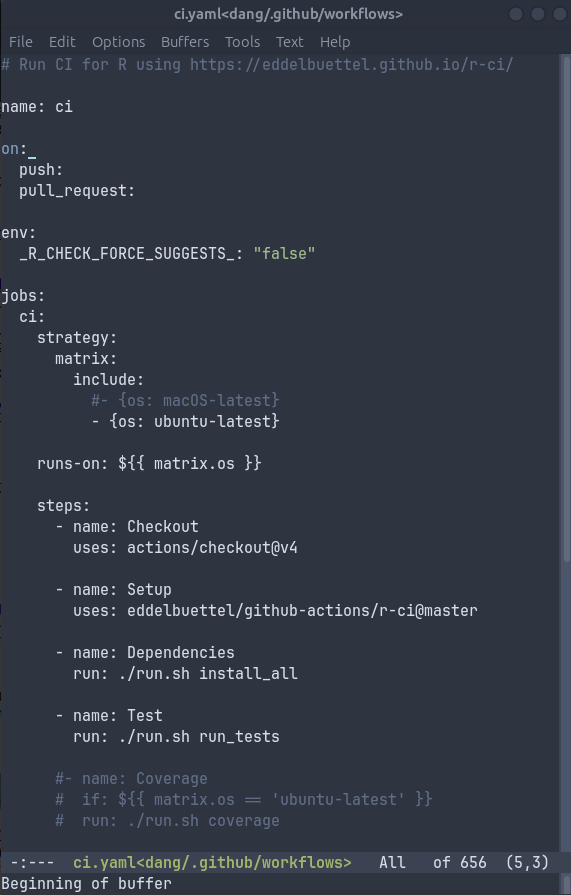
And while we followed up with post #41 about r2u for simple continuous integration, we may not have posted when we based r-ci on r2u (for the obvious Linux usage case). So let s make time now for a (comparitively smaller) update, and an update usage examples. We made two changes in the last few days. One is a (obvious in hindsight) simplification. Given that the bootstrap step was always executed, and needed no parameters, we pulled it into a new aggregated setup simply called r-ci that includes it so that it can be omitted as a step in the yaml file. Second, we recently needed Fortran on macOS too, and realized it was not installed by default so we just added that too. With that a real and used example is now as simple as the screenshot to the left (and hence one paragraph shorter). The trained eye will no doubt observe that there is nothing specific to a given repo. And that is basically the key feature: we can simply copy this file around and get fast and easy and reliable CI by taking advantage of the underlying robustness of r2u solving all dependency automagically and reliably. The option to enable macOS is also solid and compelling as the GitHub runners are fast (but more expensive in how the count against the limit of minutes so again a tradeoff to make), as is the option to run coverage if one so desires. Some of my repos do too. Take a look at the r-ci website which has more examples for the other supported CI servics it can used with, and feel free to ask questions as issue in the repo.

This post by Dirk Eddelbuettel originated on his Thinking inside the box blog. If you like this or other open-source work I do, you can now sponsor me at GitHub. Please report excessive re-aggregation in third-party for-profit settings.

Russ Allbery: Review: Finders

Review: Finders, by Melissa Scott
Series: Firstborn, Lastborn #1
Publisher: Candlemark & Gleam
Copyright: 2018
ISBN: 1-936460-87-4
Format: Kindle
Pages: 409
Finders is a far future science fiction novel with cyberpunk vibes. It is the first of a series, but the second (and, so far, only other) book of the series is a prequel. It stands alone reasonably well (more on that later). Cassilde Sam is a salvor. That means she specializes in exploring ancient wrecks and ruins left behind by the Ancients and salvaging materials that can be reused. The most important of those are what are called Ancestral elements: BLUE, which can hold programming; GOLD, which which reacts to BLUE instructions; RED, which produces actions or output; and GREEN, the rarest and most valuable, which powers everything else. Cassilde and her partner Dai Winter file claims on newly-discovered or incompletely salvaged Ancestor sites and then extract elemental material and anything else of value in their small salvage ship. Cassilde is also dying. She has Lightman's, an incurable degenerative disease that can only be treated with ever-increasing quantities of GREEN. It's hard to sleep, hard to get warm, hard to breathe, and eventually she'll run out of money to pay for the GREEN and she'll die. To push that day off into the future, she and Dai need work. The good news is that the wreckage of a new Ancestor sky palace was discovered in a long orbit and will create enough salvage work for every experienced salvor in the system. The bad news is that they're not qualified to bid on it. They need a scholar with a class-one license to bid on the best sections, and they haven't had a reliable scholar since their former partner and lover Summerland Ashe picked the opposite side in the Troubles and left the Fringe for the Entente, the more densely settled and connected portion of human space. But, unexpectedly and suspiciously, Ashe may be back and offering to work with them again. So, first, I love this setting. This is far from the first SF novel that is set in the aftermath of a general collapse of human civilization and revolving around discovering lost mysteries. Most examples of that genre are post-apocalyptic novels limited to Earth or the local solar system, but Kate Elliott's Unconquerable Sun comes immediately to mind. It's also not the first space archaeology series I've read; Kristine Kathyrn Rusch's story series starting with "Diving into the Wreck" also came to mind. But I don't recall the last time I've seen the author sell the setting so effectively. This is a world with starships and spaceports and clearly advanced technology, but it feels like a post-collapse society that's built on ruins. It's not just that technology runs on half-understood Ancestral elements and states fight over control of debris fields. It's also that the society repurposes Ancestral remnants in ways that both they and the reader know weren't originally intended, and that sometimes are more ingenious or efficient than how the Ancestors probably used them. There's a creative grittiness here that reminds me of good cyberpunk. It's not just good atmospheric writing, though. Scott makes a world-building decision that is going to sound trivial when I say it, but that has brilliant implications for the rest of the setting. There was not just one collapse; there were two. The Ancestor civilization, presumed to be the first human civilization, has passed into myth, quite literally when it comes to the stories around its downfall in the aftermath of a war against AIs. After the Ancestors came the Successors, who followed a similar salvage and rebuild approach and got as far as inventing their own warp drive technology that was based on but different than the Ancestor technology. Then they also collapsed, leaving their adapted technology and salvage operations layered over Ancestor sites. Cassilde's civilization is the third human starfaring civilization, and it is very specifically the third, neither the second nor one of dozens. This has so many small but effective implications that improve this story. A fall happened twice, so it feels like a pattern that makes Cassilde's civilization paranoid, but it happened for two very different reasons, so there is room to argue against it being a pattern. Salvage is harder because of the layering of Ancestor and Successor activity. Successors had their own way of controlling technology that is not accessible to Cassilde and her crew but is also not how the technology was intended to be used, which sends small ripples of interesting complexity through the background. And salvors are competing not only against each other but also against Successor salvage operations for which they have fragmentary records. It's a beautifully effective touch. Melissa Scott has been publishing science fiction for forty years, and it shows in this book. The protagonists are older characters: established professionals with resource problems but also social connections and an earned reputation, people who are trying to do a job and live their lives, not change the world. The writing is competent, deft, and atmospheric, with the confidence of long practice, but it also has the feel of an earlier era of science fiction. I mentioned the cyberpunk influence, which shows in the grittiness of the descriptions, the marginality of the characters in society, and the background theme of repurposing and reusing technology in unintended ways. This is the sort of book that feels solidly in the center of science fiction, without the genre mixing into either fantasy or romance that has become somewhat more common, and also without the dramatics of space opera (although the reader discovers that the stakes of this novel may be higher than anyone realized). And yet, so much of this book is about navigating a complicated romantic relationship, and that's where the story structure felt a bit odd. Cassilde, Dai, and Ashe were a polyamorous triad (polyamory also shows up in Scott's excellent Roads of Heaven series), and much of the first third of the book deals with the fracturing of trust with Ashe and their renegotiation of that relationship given his return. This is refreshingly written as the thoughtful interaction of three adults who take issues of trust seriously, but that also means it's much less dramatic than it sounds, and that means this book starts exceptionally slow. Scott is going somewhere, and the slow build became engrossing around the midpoint of the book, but I had to fight to stick with it at the start. About 80% of the way through this book, I had no idea how Scott was going to wrap things up in the pages remaining and was bracing myself for some sort of series cliffhanger. This is not what happens; the plot is not fully resolved in every detail, but it reaches a conclusion of sorts that does not mandate a sequel. I did think the end was a little bit unsatisfying, though, and I want another book that explores the implications of the ending. I think it would have to be a much different book, and the tonal shift might be stark. I've had this book on my to-read list for a while and kept putting it off because I wasn't sure I was in the mood for something precarious and gritty. This turned out to be an accurate worry: this is literally a book about salvaging the pieces of something full of wonders inextricably connected to dangers. You have to be in a cyberpunk sort of mood. But I've never read a bad Melissa Scott book, and this is no exception. The simplicity and ALL-CAPSNESS of the Ancestral elements grated a bit, but apart from that, the world-building is exceptional and well worth the trip. Recommended, although be warned that, if you're like me, it may not grab you from the first page. Followed by Fallen, but that book is a prequel that does not share any protagonists. Content notes: disability and degenerative illness in a universe where magical cures are possible, so be warned if that specific thematic combination is not what you're looking for. Rating: 7 out of 10

Next.

Previous.