Search Results: "edd"

23 September 2014

Dirk Eddelbuettel: RcppArmadillo 0.4.450.1.0

Continuing with his standard pace of approximately one new version per month, Conrad released a new minor release of Armadillo a few days ago. As before, I had created a GitHub-only pre-release which was tested against all eighty-seven (!!) CRAN dependents of our RcppArmadillo package and then uploaded RcppArmadillo 0.4.450.0 to CRAN. The CRAN maintainers pointed out that under the R-development release, a NOTE was issued concerning the C-library's rand() call. This is a pretty new NOTE, but it means using the (sometimes poor quality) rand() generator is now a no-no. Now, Armadillo being as robustly engineered as it is offers a new random number generator based on C++11 as well as a fallback generator for those unfortunate enough to live with an older C++98 compiler. (I would like to note here that I find Conrad's continued support for both C++11, offering very useful modern language idioms, as well as the fallback code for continued deployment and usage by those constrained in their choice of compilers rather exemplary --- because contrary to what some people may claim, it is not a matter of one or the other. C++ always was, and continues to be, a multi-paradigm language which can be supported easily by several standard. But I digress...) In any event, one cannot argue with CRAN about their prescription of a C++98 compiler. So Conrad and I discussed this over email, and came up with a scheme where a user-package (such as RcppArmadillo) can provide an alternate generator which Armadillo then deploys. I implemented a first solution which was then altered / reflected by Conrad in a revised version 4.450.1 of Armadillo. I packaged, and now uploaded, that version as RcppArmadillo 0.4.450.1.0 to both CRAN and into Debian. Besides the RNG change already discussed, this release brings a few smaller changes from the Armadillo side. These are detailed below in the extract from the NEWS file. On the RcppArmadillo side, we now have support for pkgKitten which is both very exciting and likely the topic of another blog post with an example of creating an RcppArmadillo package that purrs. In the process, I overhauled and polished how new packages are created by RcppArmadillo.package.skeleton(). An upcoming blog post may provide an example.
Changes in RcppArmadillo version 0.4.450.1.0 (2014-09-21)
  • Upgraded to Armadillo release Version 4.450.1 (Spring Hill Fort)
    • faster handling of matrix transposes within compound expressions
    • expanded symmatu()/symmatl() to optionally disable taking the complex conjugate of elements
    • expanded sort_index() to handle complex vectors
    • expanded the gmm_diag class with functions to generate random samples
  • A new random-number implementation for Armadillo uses the RNG from R as a fallback (when C++11 is not selected so the C++11-based RNG is unavailable) which avoids using the older C++98-based std::rand
  • The RcppArmadillo.package.skeleton() function was updated to only set an "Imports:" for Rcpp, but not RcppArmadillo which (as a template library) needs only LinkingTo:
  • The RcppArmadillo.package.skeleton() function will now prefer pkgKitten::kitten() over package.skeleton() in order to create a working package which passes R CMD check.
  • The pkgKitten package is now a Suggests:
  • A manual page was added to provide documentation for the functions provided by the skeleton package.
  • A small update was made to the package manual page.
Courtesy of CRANberries, there is also a diffstat report for the most recent release. As always, more detailed information is on the RcppArmadillo page. Questions, comments etc should go to the rcpp-devel mailing list off the R-Forge page.

This post by Dirk Eddelbuettel originated on his Thinking inside the box blog. Please report excessive re-aggregation in third-party for-profit settings.

11 September 2014

Dirk Eddelbuettel: pkgKitten 0.1.2: Still creating R Packages that purr

A brown bag release 0.1.2 of pkgKitten is now on CRAN, following yesterday's 0.1.1 upload Next time I'll try to remember that when I have parameters name and path, it won't work so well to call them as path and name ...
Changes in version 0.1.2 (2014-09-11)
  • Brown-bag fix of calling the new helper function with then correct order of arguments.
More details about the package are at the pkgKitten webpage and the pkgKitten GitHub repo. Courtesy of CRANberries, there is also a diffstat report for this release

This post by Dirk Eddelbuettel originated on his Thinking inside the box blog. Please report excessive re-aggregation in third-party for-profit settings.
Dirk Eddelbuettel: pkgKitten 0.1.1: Still creating R Packages that purr

A maintenance release 0.1.1 of pkgKitten is now on CRAN. It has only one small change: the function playWithPerPackageHelpPage() was factored out of the main function kitten() as I happened to be needing something just like playWithPerPackageHelpPage() to make packages created by the Rcpp function Rcpp.package.skeleton() a little nicer. We also added a NEWS.Rd file which restates major release features. As it is so short, we include it in its entirety.
Changes in version 0.1.1 (2014-09-09)
  • New (exported) function playWithPerPackageHelpPage() which lets other packages create a non-complaint-generating package help page
Changes in version 0.1.0 (2014-06-13)
  • Initial public version and CRAN upload
More details about the package are at the pkgKitten webpage and the pkgKitten GitHub repo. Courtesy of CRANberries, there is also a diffstat report for this release

This post by Dirk Eddelbuettel originated on his Thinking inside the box blog. Please report excessive re-aggregation in third-party for-profit settings.
3 September 2014

Dirk Eddelbuettel: littler is faster at doing nothing!

With yesterday's announcement of littler 0.2.0, I kept thinking about a few not-so-frequently-asked but recurring questions about littler. And an obvious one if of course the relationship to Rscript. As we have pointed out before, littler preceded Rscript. Now, with Rscript being present in every R installation, it is of course by now more widely known. But there is one important aspect which I stressed once or twice in the past and which bears repeating. Due to the lean and mean way in which littler is designed and set-up, it actually starts a lot faster than either Rscript or R. How, you ask? Well we actually query the environement at build time and hardcode a number of settings which R and Rscript re-acquire and learn each time they start. Which is more flexible. But slower. So consider the following, really simple example. In it, we create a simple worker function f which launches the given (and simplest possible) R command of just quitting 250 times (by launching a shell command which loops). We then let littler, Rscript and R (in its just execute this expression mode) run this, and time it via one of the common benchmarking packages.
R> library(rbenchmark)
R> f <- function(cmd)   system(paste0("bash -c \"for i in \\$(seq 1 250); do ", cmd, " -e 'q()'; done\""));  
R> res <- benchmark(f("r"), f("Rscript"), f("R --slave"), replications=5, order="relative")
R> res
            test replications elapsed relative user.self sys.self user.child sys.child
1         f("r")            5  32.256    1.000     0.001    0.004     26.538     5.706
2   f("Rscript")            5 180.154    5.585     0.001    0.004    152.751    28.522
3 f("R --slave")            5 302.714    9.385     0.001    0.004    270.569    33.098
R> 
So there: littler does "nothing" about five times as fast as Rscript, and about nine times as fast as R. Not that this matters greatly -- but when you design something for repeated (unsupervised) execution, say in a cronjob, it might as well be lightweight.

This post by Dirk Eddelbuettel originated on his Thinking inside the box blog. Please report excessive re-aggregation in third-party for-profit settings.
1 September 2014

Dirk Eddelbuettel: littler 0.2.0

We are happy to announce a new release of littler. A few minor things have changes since the last release: max-heap image Full details are provided at the ChangeLog The code is available via the GitHub repo, from tarballs off my littler page and the local directory here. A fresh package will got to Debian's incoming queue shortly as well. Comments and suggestions are welcome via the mailing list or issue tracker at the GitHub repo.

This post by Dirk Eddelbuettel originated on his Thinking inside the box blog. Please report excessive re-aggregation in third-party for-profit settings.

30 August 2014

John Goerzen: 2AM to Seattle

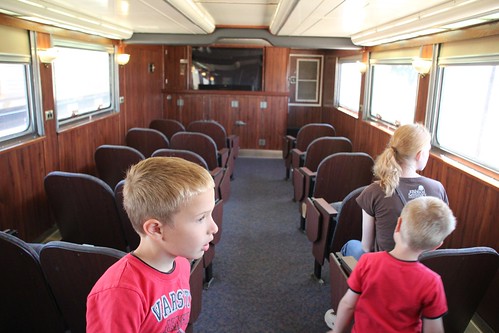
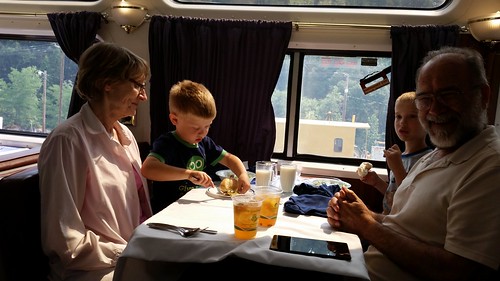
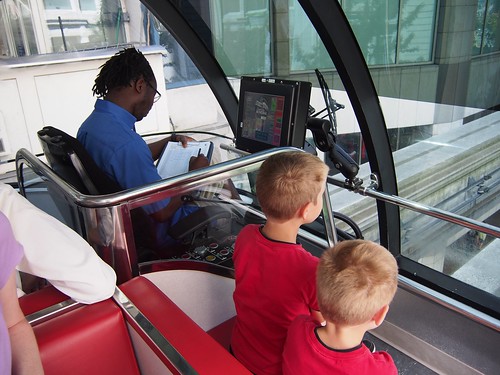
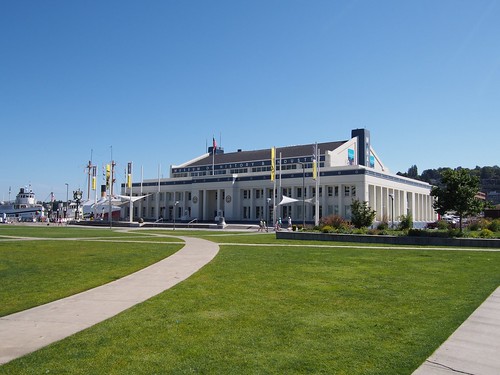
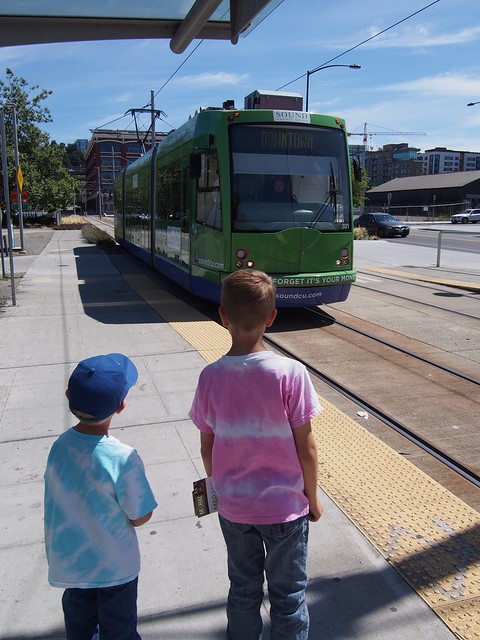
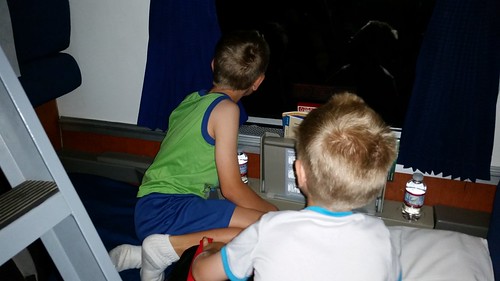
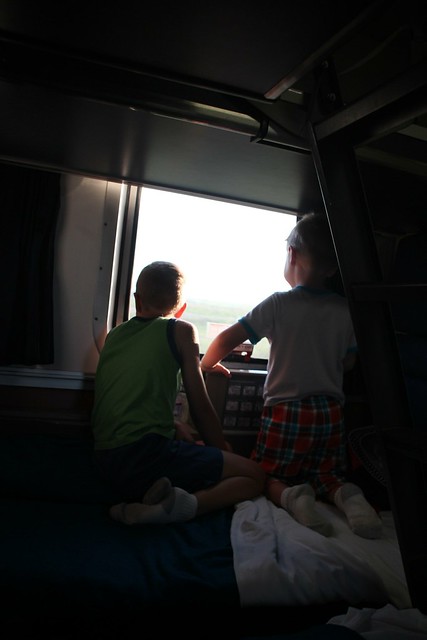
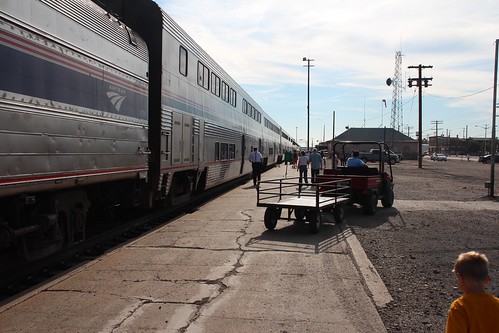
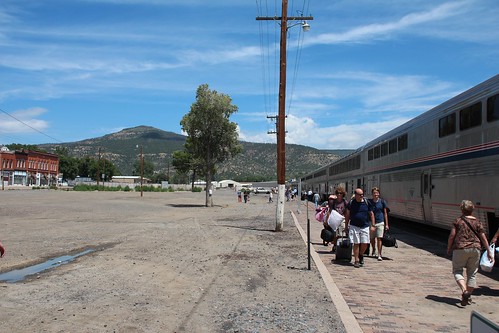
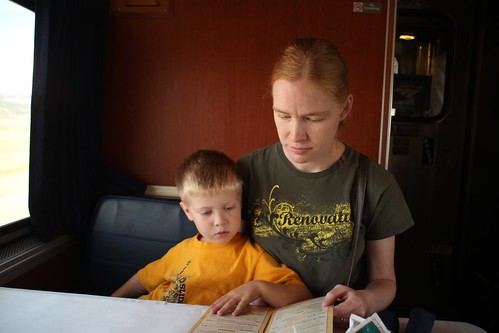
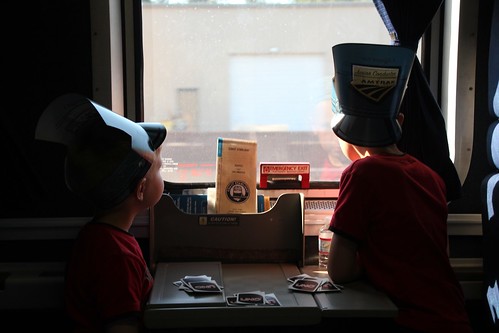
Monday morning, 1:45AM. Laura and I walk into the boys room. We turn on the light. Nothing happens. (They re sound sleepers.) Boys, it s time to get up to go get on the train! Four eyes pop open. Yay! Oh I m so excited! And then, Meow! (They enjoy playing with their stuffed cats that Laura got them for Christmas.) Before long, it was out the door to the train station. We even had time to stop at a donut shop along the way. We climbed into our family bedroom (a sleeping car room on Amtrak specifically designed for families of four), and as the train started to move, the excitement of what was going on crept in. Yes, it s 2:42AM, but these are two happy boys: 2014-08-04 02 Jacob and Oliver love trains, and this was the beginning of a 3-day train trip from Newton to Seattle that would take us through Kansas, Colorado, the Rocky Mountains of New Mexico, Arizona, Los Angeles, up the California coast, through the Cascades, and on to Seattle. Whew! Here we are later that morning before breakfast: IMG_3776 Here s our train at a station stop in La Junta, CO: IMG_3791 And at the beautiful small mountain town of Raton, NM: IMG_3805 Some of the passing scenery in New Mexico: IMG_3828 Through it all, we found many things to pass the time. I don t think anybody was bored. I took the boys exploring the train several times we d walk from one end to the other and see what all was there. There was always the dining car for our meals, the lounge car for watching the passing scenery, and on the Coast Starlight, the Pacific Parlor Car. Here we are getting ready for breakfast one morning. IMG_3830 Getting to select meals and order in the train restaurant was a big deal for the boys. IMG_3832 Laura brought one of her origami books, which even managed to pull the boys away from the passing scenery in the lounge car for quite some time. IMG_3848 Origami is serious business: IMG_3869 They had some fun wrapping themselves around my feet and challenging me to move. And were delighted when I could move even though they were trying to weight me down! IMG_3880 Several games of Uno were played, but even those sometimes couldn t compete with the passing scenery: IMG_3898 The Coast Starlight features the Pacific Parlor Car, which was built over 50 years ago for the Santa Fe Hi-Level trains. They ve been updated; the upper level is a lounge and small restaurant, and the lower level has been turned into a small theater. They show movies in there twice a day, but most of the time, the place is empty. A great place to go with little boys to run around and play games. IMG_3896 The boys and I sort of invented a new game: roadrunner and coyote, loosely based on the old Looney Tunes cartoons. Jacob and Oliver would be roadrunners, running around and yelling MEEP MEEP! Meanwhile, I was the coyote, who would try to catch them even briefly succeeding sometimes but ultimately fail in some hilarious way. It burned a lot of energy. And, of course, the parlor car was good for scenery-watching too: IMG_3908 We were right along the Pacific Ocean for several hours sometimes there would be a highway or a town between us and the beach, but usually there was nothing at all between us and the coast. It was beautiful to watch the jagged coastline go by, to gaze out onto the ocean, watching the birds apparently so beautiful that I didn t even think to take some photos. Laura s parents live in California, and took a connecting train. I had arranged for them to have a sleeping car room near ours, so for the last day of the trip, we had a group of 6. Here are the boys with their grandparents at lunch Wednesday: 2014-08-06 11 We stepped off the train in Seattle into beautiful King Street Station. P8100197 Our first day in Seattle was a quiet day of not too much. Laura s relatives live near Lake Washington, so we went out there to play. The boys enjoyed gathering black rocks along the shore. IMG_3956 We went blackberry picking after that filled up buckets for a cobbler. The next day, we rode the Seattle Monorail. The boys have been talking about this for months a kind of train they ve never been on. That was the biggest thing in their minds that they were waiting for. They got to ride in the very front, by the operator. P8080073 Nice view from up there. P8080078 We walked through the Pike Market I hadn t been in such a large and crowded place like that since I was in Guadalajara: P8080019 At the Seattle Aquarium, we all had a great time checking out all the exhibits. The please touch one was a particular hit. P8080038 Walking underneath the salmon tank was fun too. We spent a couple of days doing things closer to downtown. Laura s cousin works at MOHAI, the Museum of History and Industry, so we spent a morning there. The boys particularly enjoyed the old periscope mounted to the top of the building, and the exhibit on chocolate (of course!) P8100146 They love any kind of transportation, so of course we had to get a ride on the Seattle Streetcar that comes by MOHAI. P8090094 All weekend long, we had been noticing the seaplanes taking off from Lake Washington and Lake Union (near MOHAI). So finally I decided to investigate, and one morning while Laura was doing things with her cousin, the boys and I took a short seaplane ride from one lake to another, and then rode every method of transportation we could except for ferries (we did that the next day). Here is our Kenmore Air plane: P8100100 The view of Lake Washington from 1000 feet was beautiful: P8100109 I think we got a better view than the Space Needle, and it probably cost about the same anyhow. P8100117 After splashdown, we took the streetcar to a place where we could eat lunch right by the monorail tracks. Then we rode the monorail again. Then we caught a train (it went underground a bit so it was a subway to them!) and rode it a few blocks. There is even scenery underground, it seems. P8100151 We rode a bus back, and saved one last adventure for the next day: a ferry to Bainbridge Island. 2014-08-11 14 2014-08-11 16 Laura and I even got some time to ourselves to go have lunch at an amazing Greek restaurant to celebrate a year since we got engaged. It s amazing to think that, by now, it s only a few months until our wedding anniversary too! There are many special memories of the weekend I could mention visiting with Laura s family, watching the boys play with her uncle s pipe organ (it s in his house!), watching the boys play with their grandparents, having all six of us on the train for a day, flying paper airplanes off the balcony, enjoying the cool breeze on the ferry and the beautiful mountains behind the lake. One of my favorites is waking up to high-pitched Meow? Meow meow meow! Wake up, brother! sorts of sounds. There was so much cat-play on the trip, and it was cute to hear. I have the feeling we won t hear things like that much more. So many times on the trip I heard, Oh dad, I am so excited! I never get tired of hearing that. And, of course, I was excited, too.

Dirk Eddelbuettel: BH release 1.54.0-4

Another small new release of our BH package providing Boost headers for use by R is now on CRAN. This one brings a one-file change: the file any.hpp comprising the Boost.Any library --- as requested by a fellow package maintainer needing it for a pending upload to CRAN. No other changes were made.
Changes in version 1.54.0-4 (2014-08-29)
  • Added Boost Any requested by Greg Jeffries for his nabo package
Courtesy of CRANberries, there is also a diffstat report for the most recent release. Comments and suggestions are welcome via the mailing list or issue tracker at the GitHub repo.

This post by Dirk Eddelbuettel originated on his Thinking inside the box blog. Please report excessive re-aggregation in third-party for-profit settings.

21 August 2014

Dirk Eddelbuettel: RcppEigen 0.3.2.2.0

A new upstream release of the Eigen C++ template library for linear algebra was released a few days ago. And Yixuan Qiu did some really nice work rolling this into a new RcppEigen released and then sent me a nice pull requent. The new version is now on CRAN, and I will prepare a Debian in a moment too. Upstream changes for Eigen are summarized in their changelog. On the RcppEigen side, Yixuan also rolled in some more changes on as() and wrap() converters as noted below in the NEWS entry.
Changes in RcppEigen version 0.3.2.2.0 (2014-08-19)
  • Updated to version 3.2.2 of Eigen
  • Rcpp::as() now supports the conversion from R vector to row array , i.e., Eigen::Array<T, 1, Eigen::Dynamic>
  • Rcpp::as() now supports the conversion from dgRMatrix (row oriented sparse matrices, defined in Matrix package) to Eigen::MappedSparseMatrix<T, Eigen::RowMajor>
  • Conversion from R matrix to Eigen::MatrixXd and Eigen::ArrayXXd using Rcpp::as() no longer gives compilation errors
Courtesy of CRANberries, there are diffstat reports for the most recent release. Questions, comments etc about RcppEigen should go to the rcpp-devel mailing list off the R-Forge page.

This post by Dirk Eddelbuettel originated on his Thinking inside the box blog. Please report excessive re-aggregation in third-party for-profit settings.
20 August 2014

Dirk Eddelbuettel: RcppArmadillo 0.4.400.0

After two pre-releases in the last few days, Conrad finalised a new Armadillo version 4.400 today. I had kept up with the pre-releases, tested twice against all eighty (!!) CRAN dependents of RcppArmadillo and have hence uploaded RcppArmadillo 0.4.400.0 to CRAN and into Debian. This release brings a number of new upstream features which are detailed below. As included is s bugfix for sparse matrix creation at the RcppArmadillo end which was found by the ASAN tests at CRAN --- which are similar to the sanitizers tests I recently blogged. I was able to develop and test the fix in the very docker r-devel-san images I had written about which was nice. Special thanks also to Ryan Curtin for help with the fix.
Changes in RcppArmadillo version 0.4.400.0 (2014-08-19)
  • Upgraded to Armadillo release Version 4.400 (Winter Shark Alley)
    • added gmm_diag class for statistical modelling using Gaussian Mixture Models; includes multi-threaded implementation of k-means and Expectation-Maximisation for parameter estimation
    • added clamp() for clamping values to be between lower and upper limits
    • expanded batch insertion constructors for sparse matrices to add values at repeated locations
    • faster handling of subvectors by dot()
    • faster handling of aliasing by submatrix views
  • Corrected a bug (found by the g++ Address Sanitizer) in sparse matrix initialization where space for a sentinel was allocated, but the sentinel was not set; with extra thanks to Ryan Curtin for help
  • Added a few unit tests for sparse matrices
Courtesy of CRANberries, there is also a diffstat report for the most recent release. As always, more detailed information is on the RcppArmadillo page. Questions, comments etc should go to the rcpp-devel mailing list off the R-Forge page.

This post by Dirk Eddelbuettel originated on his Thinking inside the box blog. Please report excessive re-aggregation in third-party for-profit settings.

14 August 2014

Daniel Pocock: Bug tracker or trouble ticket system?

One of the issues that comes up from time to time in many organizations and projects (both community and commercial ventures) is the question of how to manage bug reports, feature requests and support requests. There are a number of open source solutions and proprietary solutions too. I've never seen a proprietary solution that offers any significant benefit over the free and open solutions, so this blog only looks at those that are free and open. Support request or bug? One common point of contention is the distinction between support requests and bugs. Users do not always know the difference. Some systems, like the Github issue tracker, gather all the requests together in a single list. Calling them "Issues" invites people to submit just about anything, such as "I forgot my password". At the other extreme, some organisations are so keen to keep support requests away from their developers that they operate two systems and a designated support team copies genuine bugs from the customer-facing trouble-ticket/CRM system to the bug tracker. This reduces the amount of spam that hits the development team but there is overhead in running multiple systems and having staff doing cut and paste. Will people use it? Another common problem is that a full bug report template is overkill for some issues. If a user is asking for help with some trivial task and if the tool asks them to answer twenty questions about their system, application version, submit log files and other requirements then they won't use it at all and may just revert to sending emails or making phone calls. Ideally, it should be possible to demand such details only when necessary. For example, if a support engineer routes a request to a queue for developers, then the system may guide the support engineer to make sure the ticket includes attributes that a ticket in the developers' queue should have. Beyond Perl Some of the most well known systems in this space are Bugzilla, Request Tracker and OTRS. All of these solutions are developed in Perl. These days, Python, JavaScript/Node.JS and Java have taken more market share and Perl is chosen less frequently for new projects. Perl skills are declining and younger developers have usually encountered Python as their main scripting language at university. My personal perspective is that this hinders the ability of Perl projects to attract new blood or leverage the benefits of new Python modules that don't exist in Perl at all. Bugzilla has fallen out of the Debian and Ubuntu distributions after squeeze due to its complexity. In contrast, Fedora carries the Bugzilla packages and also uses it as their main bug tracker. Evaluation I recently started having a look at the range of options in the Wikipedia list of bug tracking systems. Some of the trends that appear:
  • Many appear to be bug tracking systems rather than issue tracking / general-purpose support systems. How well do they accept non-development issues and keep them from spamming the developers while still providing a useful features for the subset of users who are doing development?
  • A number of them try to bundle other technologies, like wiki or FAQ systems: but how well do they work with existing wikis? This trend towards monolithic products is slightly dangerous. In my own view, a wiki embedded in some other product may not be as well supported as one of the leading purpose-built wikis.
  • Some of them also appear to offer various levels of project management. For development tasks, it is just about essential for dependencies and a roadmap to be tightly integrated with the bug/feature tracker but does it make the system more cumbersome for people dealing with support requests? Many support requests, like "I've lost my password", don't really have any relationship with project management or a project roadmap.
  • Not all appear to handle incoming requests by email. Bug tracking systems can be purely web/form-based, but email is useful for helpdesk systems.
Questions This leaves me with some of the following questions:
  • Which of these systems can be used as a general purpose help-desk / CRM / trouble-ticket system while also being a full bug and project management tool for developers?
  • For those systems that don't work well for both use cases, which combinations of trouble-ticket system + bug manager are most effective, preferably with some automated integration?
  • Which are more extendable with modern programming practices, such as Python scripting and using Git?
  • Which are more future proof, with choice of database backend, easy upgrades, packages in official distributions like Debian, Ubuntu and Fedora, scalability, IPv6 support?
  • Which of them are suitable for the public internet and which are only considered suitable for private access?

13 August 2014

Daniel Pocock: WebRTC in CRM/ERP solutions at xTupleCon 2014

In October this year I'll be visiting the US and Canada for some conferences and a wedding. The first event will be xTupleCon 2014 in Norfolk, Virginia. xTuple make the popular open source accounting and CRM suite PostBooks. The event kicks off with a keynote from Apple co-founder Steve Wozniak on the evening of October 14. On October 16 I'll be making a presentation about how JSCommunicator makes it easy to add click-to-call real-time communications (RTC) to any other web-based product without requiring any browser plugins or third party softphones. Juliana Louback has been busy extending JSCommunicator as part of her Google Summer of Code project. When finished, we hope to quickly roll out the latest version of JSCommunicator to other sites including rtc.debian.org, the WebRTC portal for the Debian Developer community. Juliana has also started working on wrapping JSCommunicator into a module for the new xTuple / PostBooks web-based CRM. Versatility is one of the main goals of the JSCommunicator project and it will be exciting to demonstrate this in action at xTupleCon. xTupleCon discounts for developers xTuple has advised that they will offer a discount to other open source developers and contributers who wish to attend any part of their event. For details, please contact xTuple directly through this form. Please note it is getting close to their deadline for registration and discounted hotel bookings. Potential WebRTC / JavaScript meet-up in Norfolk area For those who don't or can't attend xTupleCon there has been some informal discussion about a small WebRTC-hacking event at some time on 15 or 16 October. Please email me privately if you may be interested.

Riku Voipio: Booting Linaro ARMv8 OE images with Qemu

A quick update - Linaro ARMv8 OpenEmbbeded images work just fine with qemu 2.1 as well:

$ http://releases.linaro.org/14.07/openembedded/aarch64/Image
$ http://releases.linaro.org/14.07/openembedded/aarch64/vexpress64-openembedded_lamp-armv8-gcc-4.9_20140727-682.img.gz
$ qemu-system-aarch64 -m 1024 -cpu cortex-a57 -nographic -machine virt \
-kernel Image -append 'root=/dev/vda2 rw rootwait mem=1024M console=ttyAMA0,38400n8' \
-drive if=none,id=image,file=vexpress64-openembedded_lamp-armv8-gcc-4.9_20140727-682.img \
-netdev user,id=user0 -device virtio-net-device,netdev=user0 -device virtio-blk-device,drive=image
[ 0.000000] Linux version 3.16.0-1-linaro-vexpress64 (buildslave@x86-64-07) (gcc version 4.8.3 20140401 (prerelease) (crosstool-NG linaro-1.13.1-4.8-2014.04 - Linaro GCC 4.8-2014.04) ) #1ubuntu1~ci+140726114341 SMP PREEMPT Sat Jul 26 11:44:27 UTC 20
[ 0.000000] CPU: AArch64 Processor [411fd070] revision 0
...
root@genericarmv8:~#
Quick benchmarking with age-old ByteMark nbench:
Index Qemu Foundation Host
Memory 4.294 0.712 44.534
Integer 6.270 0.686 41.983
Float 1.463 1.065 59.528
Baseline (LINUX) : AMD K6/233*
Qemu is upto 8x faster than Foundation model on Integers, but only 50% faster on Math. Meanwhile, the Host pc spends 7-40x slower emulating ARMv8 than executing native instructions.

11 August 2014

Juliana Louback: JSCommunicator - Setup and Architecture

Preface During Google Summer of Code 2014, I got to work on the Debian WebRTC portal under the mentorship of Daniel Pocock. Now I had every intention of meticulously documenting my progress at each step of development in this blog, but I was a bit late in getting the blog up and running. I ll now be publishing a series of posts to recap all I ve done during GSoC. Better late than never. Intro JSCommunicator is a SIP communication tool developed in HTML and JavaScript. The code was designed to make integrating JSCommunicator with a website or web app as simple as possible. It s quite easy, really. However, I do think a more detailed explanation on how to set things up and a guide to the JSCommunicator architecture could be of use, particularly for those wanting to modify the code in any way. Setup To begin, please fork the JSCommunicator repo. If you are new to git, feel free to follow the steps in section Setup and Clone in this post. If you read the README file (which you always should), you ll see that JSCommunicator needs a SIP proxy that supports SIP over Websockets transport. Some options are: I didn t find a tutorial for Kamailio setup, I did find one for repro setup. And bonus, here you have a great tutorial on how to setup and configure your SIP proxy AND your TURN server. In your project s root directory, you ll see a file named config-sample.js. Make a copy of that file named config.js. The config-sample.js file has comments that are very instructive. In sum, the only thing you have to modify is the turn_servers property and the websocket property. In my case, debrtc.org was the domain registered for testing my project, so my config file has:
turn_servers: [
	  server:"turn:debrtc.org"       
],
Note that unlike the sample, I didn t set a username and password so SIP credentials will be used. Now fill in the websocket property here we use sip5060.net.
websocket:  
    servers: 'wss://ws.sip5060.net',
    connection_recovery_min_interval: 2,
    connection_recovery_max_interval: 30,
   ,
I m pretty sure you can set the connection_recovery properties to whatever you like. Everything else is optional. If you set the user property, specifically display_name and uri, that will be used to fill in the Login form and takes preference over any Remember me data. If you also set sip_auth_password, JSCommunicator will automatically log in. All the other properties are for other optional functionalities and are well explained. You ll need some third-party javascript that is not included in the JSCommunicator git repo. Namely jQuery version 1.4 or higher and ArbiterJS version 1.0. Download jQuery here and ArbiterJS here and place the .js files in your project s root directory. Do make sure that you are including the correct filename in your html file. For example, in phone-dev.shtml, a file named jquery.js is included. The file you downloaded will likely have version numbers in it s file name. So rename the downloaded file or change the content of src in your includes. This is uber trivial, but I ve made the mistake several times. You ll also need JsSIP.js which can be downloaded here. Same naming care must be taken as is the case for jQuery and ArbiterJS. The recently added Instant Messaging component and some of the new features need jQuery-UI - so far version 1.11.* is known to work. From the downloaded .zip all you need is the jquery-ui-...js file and the jquery-ui-...css file, also to be placed in the project s root directory. If you ll be using the internationalization support you ll also need jquery.i18n.properties.js. To try out JSCommunicator, deploy the website locally by copying your project directory to the apache document root directory (provided you are using apache, which is a good idea.). You ll likely have to restart your server before this works. Now the demo .shtml pages only have a header with all the necessary includes, then a Server Side Include for the body of the page, with all the JSCommunicator html. The html content is in the file jscommunicator.inc. You can enable SSI on apache, OR you can simply copy and paste the content of jscommunicator.inc into phone-dev.shmtl. Start up apache, open a browser and navigate to localhost/jscommunicator/phone-dev.shmtl and you should see: jscommunicatorRaw Actually, pending updates to JSCommunicator, you should see a brand new UI! But all the core stuff will be the same. Architecture Disclaimer: I m explaining my view of the JSCommunicator architecture, which currently may not be 100% correct. But so far it s been enough for me to make my modifications and additions to the code, so it could be of use. One I get a JSCommunicator Founding Father s stamp of approval, I ll be sure to confirm the accuracy. Now to explain how the JSCommunicator code interacts, the use of each code item is described, ignoring all the html and css which will vary according to how you choose to use JSCommunicator. I m also not going to explain jQuery which is a dependency but not specific to WebRTC. The core JSCommunicator code is the following: Each of these files will be presented in what I hope is an intuitive order. The next three files could be considered utils : These two are where the magic happens: Now for some extras: Third party code: Here s a diagram of sorts to help you visualize how the code interacts: jscommArch In sum, 1 - JSCommUI.js handles what is displayed in the UI and feeds data to JSCommManager.js; 2 - JSCommManager.js actually does stuff, feeding data to be displayed to JSCommUI.js; 3 - JSCommManager.js calls functions from the three utils , parseuri.js, webrtc-check.js and jssip-helpher.js which organizes the data from config.js; 4 - JSCommManager.js initializes a SIP User Agent based on the implementation in Arbiter.js. When making any changes to JSCommunicator, you will likely only be working with JSCommUI.js and JSCommManager.js.

7 August 2014

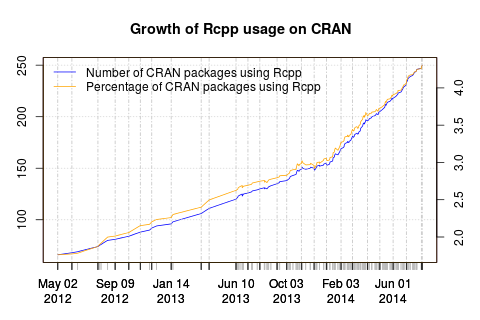
Dirk Eddelbuettel: Rcpp now used by 250 CRAN packages

Rcpp growth
Rcpp reached a nice round milestone yesterday: 250 packages on CRAN now depend on it (as measured by Depends, Imports and LinkingTo declarations). The graph is on the left depicts the growth of Rcpp over time. Or at least since I started to write down some usage numbers: first informally, then via a script. Also displayed is the relative proportion of CRAN packages using it. Rcpp cleared the four per-cent hurdle just before useR! 2014 where I showed a similar graph (as two distinct graphs) in my invited talk. 250 is a pretty impressive, and rather humbling, number. From everybody behind Rcpp, I would like to say a heartfelt Thank You! to all the users and of course contributors.

This post by Dirk Eddelbuettel originated on his Thinking inside the box blog. Please report excessive re-aggregation in third-party for-profit settings.

5 August 2014

Dirk Eddelbuettel: BH release 1.54.0-3

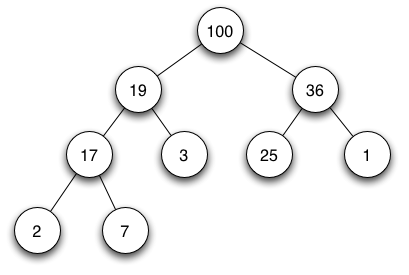
A new release of our BH package providing Boost headers for use by R is now on the CRAN mirrors. max-heap image This release is the third based on Boost 1.54.0. At the request of the maintainer of the recent added RcppMLPACK package, it adds the Boost.Heap library. Boost.Heap implements priority queues which extend beyond the corresponding (and somewhat simpler) class in the STL. Key features of the Boost.Heap priority queues are mutability, iterators, ability to merge, stable sort, and comparison. No other changes were made.
Changes in version 1.54.0-3 (2014-08-03)
  • Added Boost Heap library which will be needed by the next version of RcppMLPACK
Courtesy of CRANberries, there is also a diffstat report for the most recent release. Comments and suggestions are welcome via the mailing list or issue tracker at the GitHub repo.

This post by Dirk Eddelbuettel originated on his Thinking inside the box blog. Please report excessive re-aggregation in third-party for-profit settings.

3 August 2014

Dirk Eddelbuettel: Introducing sanitizers 0.1.0

A new package sanitizers is now on CRAN. It provides test cases for Address Sanitizers, and Undefined Behaviour Sanitizers. These are two recent features of both g++ and clang++, and described in the Checking Memory Access section of the Writing R Extension manual. I set up a new web page for the sanitizers package which illustrates their use case via pre-built Docker images, similar to what I presented at the end of my useR! 2014 keynote a few weeks ago. So instead of repeating this over here, I invite you to read the detailed discussion on the sanitizers page.

This post by Dirk Eddelbuettel originated on his Thinking inside the box blog. Please report excessive re-aggregation in third-party for-profit settings.
31 July 2014

Petter Reinholdtsen: Debian Edu interview: Bernd Zeitzen

The complete and free out of the box software solution for schools, Debian Edu / Skolelinux, is used quite a lot in Germany, and one of the people involved is Bernd Zeitzen, who show up on the project mailing lists from time to time with interesting questions and tips on how to adjust the setup. I managed to interview him this summer. Who are you, and how do you spend your days? My name is Bernd Zeitzen and I'm married with Hedda, a self employed physiotherapist. My former profession is tool maker, but I haven't worked for 30 years in this job. 30 years ago I started to support my wife and become her officeworker and a few years later the administrator for a small computer network, today based on Ubuntu Server (Samba, OpenVPN). For her daily work she has to use Windows Desktops because the software she needs to organize her business only works with Windows . :-( In 1988 we started with one PC and DOS, then I learned to use Windows 98, 2000, XP, , 8, Ubuntu, MacOSX. Today we are running a Linux server with 6 Windows clients and 10 persons (teacher of children with special needs, speech therapist, occupational therapist, psychologist and officeworkers) using our Samba shares via OpenVPN to work with the documentations of our patients. How did you get in contact with the Skolelinux / Debian Edu project? Two years ago a friend of mine asked me, if I want to get a job in his school (Gymnasium Harsewinkel). They started with Skolelinux / Debian Edu and they were looking for people to give support to the teachers using the software and the network and teaching the pupils increasing their computer skills in optional lessons. I'm spending 4-6 hours a week with this job. What do you see as the advantages of Skolelinux / Debian Edu? The independence. First: Every person is allowed to use, share and develop the software. Even if you are poor, you are allowed to use the software included in Skolelinux/Debian Edu and all the other Free Software. Second: The software runs on old machines and this gives us the possibility to recycle computers, weeded out from offices. The servers and desktops are running for more than two years and they are working reliable. We have two servers (one tjener and one terminal server), 45 workstations in three classrooms and seven laptops as a mobile solution for all classrooms. These machines are all booting from the terminal server. In the moment we are installing 30 laptops as mobile workstations. Then the pupils have the possibility to work with these machines in their classrooms. Internet access is realized by a WLAN router, connected to the schools network. This is all done without a dedicated system administrator or a computer science teacher. What do you see as the disadvantages of Skolelinux / Debian Edu? Teachers and pupils are Windows users. <Irony on> And Linux isn't cool. It's software for freaks using the command line. <Irony off> They don't realize the stability of the system. Which free software do you use daily? Firefox, Thunderbird, LibreOffice, Ubuntu Server 12.04 (Samba, Apache, MySQL, Joomla!, and Skolelinux / Debian Edu) Which strategy do you believe is the right one to use to get schools to use free software? In Germany we have the situation: every school is free to decide which software they want to use. This decision is influenced by teachers who learned to use Windows and MS Office. They buy a PC with Windows preinstalled and an additional testing version of MS Office. They don't know about the possibility to use Free Software instead. Another problem are the publisher of school books. They develop their software, added to the school books, for Windows.

16 July 2014

Steve Kemp: So what can I do for Debian?

So I recently announced my intention to rejoin the Debian project, having been a member between 2002 & 2011 (inclusive). In the past I resigned mostly due to lack of time, and what has changed is that these days I have more free time - primarily because my wife works in accident & emergency and has "funny shifts". This means we spend many days and evenings together, then she might work 8pm-8am for three nights in a row, which then becomes Steve-time, and can involve lots of time browsing reddit, coding obsessively, and watching bad TV (currently watching "Lost Girl". Shades of Buffy/Blood Ties/similar. Not bad, but not great.) My NM-progress can be tracked here, and once accepted I have a plan for my activities: I believe this will be useful, even though there will be limits - I've no patience for PHP and will just ignore it, along with its ecosystem, for example. As progress today I reported #754899 / CVE-2014-4978 against Rawstudio, and discussed some issues with ITP: tiptop (the program seems semi-expected to be installed setuid(0), but if it is then it will allow arbitrary files to be truncated/overwritten via "tiptop -W /path/to/file" (ObRandom still waiting for a CVE identifier for #749846/TS-2867..) And now sleep.

Dirk Eddelbuettel: Introducing RcppParallel: Getting R and C++ to work (some more) in parallel

A common theme over the last few decades was that we could afford to simply sit back and let computer (hardware) engineers take care of increases in computing speed thanks to Moore's law. That same line of thought now frequently points out that we are getting closer and closer to the physical limits of what Moore's law can do for us. So the new best hope is (and has been) parallel processing. Even our smartphones have multiple cores, and most if not all retail PCs now possess two, four or more cores. Real computers, aka somewhat decent servers, can be had with 24, 32 or more cores as well, and all that is before we even consider GPU coprocessors or other upcoming changes. And sometimes our tasks are embarassingly simple as is the case with many data-parallel jobs: we can use higher-level operations such as those offered by the base R package parallel to spawn multiple processing tasks and gather the results. I covered all this in some detail in previous talks on High Performance Computing with R (and you can also consult the Task View on High Performance Computing with R which I edit). But sometimes we can't use data-parallel approaches. Hence we have to redo our algorithms. Which is really hard. R itself has been relying on the (fairly mature) OpenMP standard for some of its operations. Luke Tierney's (awesome) keynote in May at our (sixth) R/Finance conference mentioned some of the issues related to OpenMP. One which matters is that OpenMP works really well on Linux, and either not so well (Windows) or not at all (OS X, due the usual issue with the gcc/clang switch enforced by Applem but the good news is that the OpenMP toolchain is expected to make it to OS X is some more performant form "soon"). R is still expected to make wider use of OpenMP in future versions. Another tool which has been around for a few years, and which can be considered to be equally mature is the Intel Threaded Building Blocks library, or TBB. JJ recently started to wrap this up for use by R. The first approach resulted in a (now superseded, see below) package TBB. But hardware and OS issues bite once again, as the Intel TBB is not really building that well for the Windows toolchain used by R (and based on MinGW). (And yes, there are two more options. But Boost Threads requires linking which precludes easy use as e.g. via our BH package. And C++11 with its threads library (based on Boost Threads) is not yet as widely available as R and Rcpp which means that it is not a real deployment option yet.) Now, JJ, being as awesome as he is, went back to the drawing board and integrated a second threading toolkit: TinyThread++, a small header-only library without further dependencies. Not as feature-rich as Intel Threaded Building Blocks, but at least available everywhere. So a new package RcppParallel, so far only on GitHub, wraps around both TinyThread++ and Intel Threaded Building Blocks and offers a consistent interface available on all platforms used by R. Better still, JJ also authored several pieces demonstrating this new package for the Rcpp Gallery: All four are interesting and demonstrate different aspects of parallel computing via RcppParallel. But the last article is key. Based on a question by Jim Bullard, and then written with Jim, it shows how a particular matrix distance metric (which is missing from R) can be implemented in a serial manner in both R, and also via Rcpp. The key implementation, however, uses both Rcpp and RcppParallel and thereby achieves a truly impressive speed gain as the gains from using compiled code (via Rcpp) and from using a parallel algorithm (via RcppParallel) are multiplicative! Between JJ's and my four-core machines the gain was between 200 and 300 fold---which is rather considerable. For kicks, I also used a much bigger machine at work which came in at an even larger speed gain (but gains become clearly sublinear as the number of cores increases; there are however some tuning parameters). So these are exciting times. I am sure there will be lots more to come. For now, head over to the RcppParallel package and start playing. Further contributions to the Rcpp Gallery are not only welcome but strongly encouraged.

Next.

Previous.