Search Results: "ana"

7 June 2021

Mike Gabriel: UBports: Packaging of Lomiri Operating Environment for Debian (part 05)

Before and during FOSDEM 2020, I agreed with the people (developers, supporters, managers) of the UBports Foundation to package the Unity8 Operating Environment for Debian. Since 27th Feb 2020, Unity8 has now become Lomiri. Recent Uploads to Debian related to Lomiri (Feb - May 2021) Over the past 4 months I attended 14 of the weekly scheduled UBports development sync sessions and worked on the following bits and pieces regarding Lomiri in Debian: The largest amount of work (and time) went into getting lomiri-ui-toolkit ready for upload. That code component is a absolutely massive beast and dearly intertwined with Qt5 (and unit tests fail with every new warning a new Qt5.x introduces). This bit of work I couldn't do alone (see below in "Credits" section). The next projects / packages ahead are some smaller packages (content-hub, gmenuharness, etc.) before we will finally come to lomiri (i.e. main bit of the Lomiri Operating Environment) itself. Credits Many big thanks go to everyone on the UBports project, but especially to Ratchanan Srirattanamet who lived inside of lomiri-ui-toolkit for more than two weeks, it seemed. Also, thanks to Florian Leeber for being my point of contact for topics regarding my cooperation with the UBports Foundation. Packaging Status The current packaging status of Lomiri related packages in Debian can be viewed at:
https://qa.debian.org/developer.php?login=team%2Bubports%40tracker.debia... light+love
Mike Gabriel (aka sunweaver)

Russell Coker: Dell PowerEdge T320 and Linux

I recently bought a couple of PowerEdge T320 servers, so now to learn about setting them up. They are a little newer than the R710 I recently setup (which had iDRAC version 6), they have iDRAC version 7. RAM Speed One system has a E5-2440 CPU with 2*16G DDR3 DIMMs and a Memtest86+ speed of 13,043MB/s, the other is essentially identical but with a E5-2430 CPU and 4*16G DDR3 DIMMs and a Memtest86+ speed of 8,270MB/s. I had expected that more DIMMs means better RAM performance but this isn t what happened. I firstly upgraded the BIOS, as I expected it didn t make a difference but it s a good thing to try first. On the E5-2430 I tried removing a DIMM after it was pointed out on Facebook that the CPU has 3 memory channels (here s a link to a great site with information on that CPU and many others [1]). When I did that I was prompted to disable advanced ECC (which treats pairs of DIMMs as a single unit for ECC allowing correcting more than 1 bit errors) and I had to move the 3 remaining DIMMS to different slots. That improved the performance to 13,497MB/s. I then put the spare DIMM into the E5-2440 system and the performance increased to 13,793MB/s, when I installed 4 DIMMs in the E5-2440 system the performance remained at 13,793MB/s and the E5-2430 went down to 12,643MB/s. This is a good result for me, I now have the most RAM and fastest RAM configuration in the system with the fastest CPU. I ll sell the other one to someone who doesn t need so much RAM or performance (it will be really good for a small office mail server and NAS). Firmware Update BIOS The first issue is updating the BIOS, unfortunately the first link I found to the Dell web site didn t have a link to download the Linux installer. It offered a Windows binary, an EFI program, and a DOS binary. I m not about to install Windows if there is any other option and EFI is somewhat annoying, so that leaves DOS. The first Google result for installing FreeDOS advised using unetbootin , that didn t work at all for me (created a USB image that the Dell BIOS didn t recognise as bootable) and even if it did it wouldn t have been a good solution. I went to the FreeDOS download page [2] and got the Lite USB zip file. That contained FD12LITE.img which I could just dd to a USB stick. I then used fdisk to create a second 32MB partition, used mkfs.fat to format it, and then copied the BIOS image file to it. I booted the USB stick and then ran the BIOS update program from drive D:. After the BIOS update this became the first system I ve seen get a totally green result from spectre-meltdown-checker ! I found the link to the Linux installer for the new Dell BIOS afterwards, but it was still good to play with FreeDOS. PERC Driver I probably didn t really need to update the PERC (PowerEdge Raid Controller) firmware as I m just going to run it in JBOD mode. But it was easy to do, a simple bash shell script to update it. Here are the perccli commands needed to access disks, it s all hot-plug so you can insert disks and do all this without a reboot:
# show overview
perccli show
# show controller 0 details
perccli /c0 show all
# show controller 0 info with less detail
perccli /c0 show
# clear all "foreign" RAID members
perccli /c0 /fall delete
# add a vd (RAID) of level RAID0 (r0) with the drive 32:0 (enclosure:slot from above command)
perccli /c0 add vd r0 drives=32:0
The perccli /c0 show command gives the following summary of disk ( PD in perccli terminology) information amongst other information. The EID is the enclosure, Slt is the slot (IE the bay you plug the disk into) and the DID is the disk identifier (not sure what happens if you have multiple enclosures). The allocation of device names (sda, sdb, etc) will be in order of EID:Slt or DID at boot time, and any drives added at run time will get the next letters available.
----------------------------------------------------------------------------------
EID:Slt DID State DG       Size Intf Med SED PI SeSz Model                     Sp 
----------------------------------------------------------------------------------
32:0      0 Onln   0  465.25 GB SATA SSD Y   N  512B Samsung SSD 850 EVO 500GB U  
32:1      1 Onln   1  465.25 GB SATA SSD Y   N  512B Samsung SSD 850 EVO 500GB U  
32:3      3 Onln   2   3.637 TB SATA HDD N   N  512B ST4000DM000-1F2168        U  
32:4      4 Onln   3   3.637 TB SATA HDD N   N  512B WDC WD40EURX-64WRWY0      U  
32:5      5 Onln   5 278.875 GB SAS  HDD Y   N  512B ST300MM0026               U  
32:6      6 Onln   6 558.375 GB SAS  HDD N   N  512B AL13SXL600N               U  
32:7      7 Onln   4   3.637 TB SATA HDD N   N  512B ST4000DM000-1F2168        U  
----------------------------------------------------------------------------------
The PERC controller is a MegaRAID with possibly some minor changes, there are reports of Linux MegaRAID management utilities working on it for similar functionality to perccli. The version of MegaRAID utilities I tried didn t work on my PERC hardware. The smartctl utility works on those disks if you tell it you have a MegaRAID controller (so obviously there s enough similarity that some MegaRAID utilities will work). Here are example smartctl commands for the first and last disks on my system. Note that the disk device node doesn t matter as all device nodes associated with the PERC/MegaRAID are equal for smartctl.
# get model number etc on DID 0 (Samsung SSD)
smartctl -d megaraid,0 -i /dev/sda
# get all the basic information on DID 0
smartctl -d megaraid,0 -a /dev/sda
# get model number etc on DID 7 (Seagate 4TB disk)
smartctl -d megaraid,7 -i /dev/sda
# exactly the same output as the previous command
smartctl -d megaraid,7 -i /dev/sdc
I have uploaded etbemon version 1.3.5-6 to Debian which has support for monitoring smartctl status of MegaRAID devices and NVMe devices. IDRAC To update IDRAC on Linux there s a bash script with the firmware in the same file (binary stuff at the end of a shell script). To make things a little more exciting the script insists that rpm be available (running apt install rpm fixes that for a Debian system). It also creates and runs other shell scripts which start with #!/bin/sh but depend on bash syntax. So I had to make /bin/sh a symlink to /bin/bash. You know you need this if you see errors like typeset: not found and [: -eq: unexpected operator and then the system reboots. Dell people, please test your scripts on dash (the Debian /bin/sh) or just specify #!/bin/bash. If the IDRAC update works it will take about 8 minutes. Lifecycle Controller The Lifecycle Controller is apparently for installing OS and firmware updates. I use Linux tools to update Linux and I generally don t plan to update the firmware after deployment (although I could do so from Linux if needed). So it doesn t seem to offer anything useful to me. Setting Up IDRAC For extra excitement I decided to try to setup IDRAC from the Linux command-line. To install the RAC setup tool you run apt install srvadmin-idracadm7 libargtable2-0 (because srvadmin-idracadm7 doesn t have the right dependencies).
# srvadmin-idracadm7 is missing a dependency
apt install srvadmin-idracadm7 libargtable2-0
# set the IP address, netmask, and gatewat for IDRAC
idracadm7 setniccfg -s 192.168.0.2 255.255.255.0 192.168.0.1
# put my name on the front panel LCD
idracadm7 set System.LCD.UserDefinedString "Russell Coker"
Conclusion This is a very nice deskside workstation/server. It s extremely quiet with hardly any fan noise and the case is strong enough to contain the noise of hard drives. When running with 3* 3.5 SATA disks and 2*10k 2.5 SAS disks on a wooden floor it wasn t annoyingly loud. Without the SAS disks it was as quiet as you can expect any PC to be, definitely not the volume you expect from a serious server! I bought the T320 systems loaded with SAS disks which made them quite loud, I immediately put the disks on ebay and installed SATA SSDs and hard drives which gives me more performance and more space than the SAS disks with less cost and almost no noise. 8*3.5 drive bays gives room for expansion. I currently have 2*SATA SSDs and 3*SATA disks, the SSDs are for the root filesystem (including /home) and the disks are for a separate filesystem for large files.

Russ Allbery: Review: Stoneskin

Review: Stoneskin, by K.B. Spangler
Series: Deep Witches #0
Publisher: A Girl and Her Fed Books
Copyright: September 2017
ASIN: B075PHK498
Format: Kindle
Pages: 226
Stoneskin is a prequel to the Deep Witches Trilogy, which is why I have it marked as book 0 of the series. Unlike most prequels, it was written and published before the series and there doesn't seem to be any reason not to read it first. Tembi Moon is an eight-year-old girl from the poor Marumaru area on the planet of Adhama. Humanity has spread to the stars and first terraformed the worlds and then bioformed themselves to live there. The differences are subtle, but Tembi's skin becomes thicker and less sensitive when damaged (either physically or emotionally) and she can close her ears against dust storms. One day, she wakes up in an unknown alley and finds herself on the world of Miha'ana, sixteen thousand light-years away, where she is rescued and brought home by a Witch named Matindi. In this science fiction future, nearly all interstellar travel is done through the Deep. The Deep is not like the typical hand-waved science fiction subspace, most notably in that it's alive. No one is entirely sure where it came from or what sort of creature it is. It sometimes manages to communicate in words, but abstract patterns with feelings attached are more common, and it only communicates with specific people. Those people are Witches, who are chosen by the Deep via some criteria no one understands. Witches can use the Deep to move themselves or anything else around the galaxy. All interstellar logistics rely on them. The basics of Tembi's story are not that unusual; she's been chosen by the Deep to be a Witch. What is remarkable is that she's young and she's poor, completely disconnected from the power structures of the galaxy. But, once chosen, her path as far as the rest of the galaxy is concerned is fixed: she will go to Lancaster to be trained as a Witch. Matindi is able to postpone this for a time by keeping an eye on her, but not forever. I bought this book because of the idea of the Deep, and that is indeed the best part of the book. There is a lot of mystery about its exact nature, most of which is not resolved in this book, but it mostly behaves like a giant and extremely strange dog, and it's awesome. Replacing the various pseudo-scientific explanations for faster than light travel with interactions with a dream-weird giant St. Bernard with too many paws that talks in swirls of colored bubbles and is very eager to please its friends is brilliant. This book covers a lot of years of Tembi's life and is, as advertised, a prelude to a story that is not resolved here. It's a coming of age story in which she does eventually end up at Lancaster, learns and chafes at the elaborate and very conservative structures humans have put in place to try to make interactions with the Deep predictable and reliable, and eventually gets drawn into the politics of war and the question of when people have a responsibility to intervene. Tembi, and the reader, also have many opportunities to get extremely upset at how the Deep is treated and how much entitlement the Witches have about their access and control, although how the Deep feels about it is left for a future book. Not all of this story is as good as the premise. There are some standard coming of age tropes that I'm not fond of, such as Tembi's predictable temporary falling out with the Deep (although the Deep's reaction is entertaining). It's also not at all a complete story, although that's clearly signaled by the subtitle. But as an introduction to the story universe and an extended bit of scene-setting, it accomplishes what it sets out to do. It's also satisfyingly thoughtful about the moral trade-offs around stability and the value of preserving institutions. I know which side I'm on within the universe, but I appreciated how much nuance and thoughtfulness Spangler puts into the contrary opinion. I'm hooked on the universe and want to learn more about the Deep, enough so that I've already bought the first book of the main trilogy. Followed by The Blackwing War. Rating: 7 out of 10

6 June 2021

Iustin Pop: Goodbye Travis, hello GitHub Actions

My very cyclical open-source work For some reason, I only manage to do coding at home every some months - mostly 6 months apart, so twice a year (even worse than my blogging frequency :P). As such, I missed the whole discussion about travis-ci (the .org version) going away, etc. So when I finally did some work on corydalis a few weeks ago, and had a travis build failure (restoring a large cache simply timed out, either travis or S3 has some hiccup - it cleared by itself a day later), I opened the travis-ci interface to see the scary banner ( travis-ci.org is shutting down ), and asked myself what s happening. The deadline was in less than a week even Long story short, Travis was a good home for many years, but they were bought and are doing significant changes to their OSS support, so it s time to move on. I anyway wanted to learn GitHub Actions for a while (ahem, free time intervened), so this was a good (forced) opportunity .

Proper composable CI The advantage of Travis infrastructure was that the build configuration was really simple. It had very few primitives: pre-steps (before_install), install steps, and the actual things to do to test, post-steps (after_sucess) and a few other small helpers (caching, apt packages, etc.) This made it really easy to just pick up and write a config, plus it had the advantage of allowing to test configs from the web UI without needing to push. This simplicity was unfortunately also its significant limiter: the way to do complex things in steps was simply to add more shell commands. GitHub actions, together with its marketplace, changes this entirely. There are no built-in actions, the language just defines the build/job/step hierarchy, and one glues together whatever steps they want. This has the disadvantage that even checking out the code needs to be explicitly written in all workflows (so boilerplate, if you don t need customisation), but it opens up a huge opportunity for composition, since it allows people to publish actions (steps) that you just import, encapsulating all the work. So, after learning how to write a moderately complicated workflow (complicated as in multiple Python version, some of them needing different OS version, and multi-OS), it was straightforward to port this to all my projects - just somewhat tedious. I ve now shutdown all builds on Travis, just can t find a way to delete my account

Better multi-OS, worse (missing) multi-arch In theory, Travis supports Linux, MacOS, FreeBSD and Windows, but I ve found that support for non-Linux is not quite as good. Maybe I missed things, but multi-version Python builds on MacOS were not as nicely supported as Linux; Windows is quite early, and very limited; and I haven t tested FreeBSD. GitHub is more restrictive - Linux, MacOS and Windows - but I found support for MacOS and Windows better for my use cases. If your use case is testing multiple MacOS versions, Travis wins, if it s more varied languages/etc. on the single available MacOS version, GitHub works better. On the multi-arch side, Travis wins hands-down. Four different native architectures, and enabling one more is just adding another key to the arch list. With GitHub, if I understand right, you either have to use docker+emulation, or use self-hosted runners. So here it really matters what is more important to you. Maybe in the future GitHub will support more arches, but right now, Travis wins for this use-case.

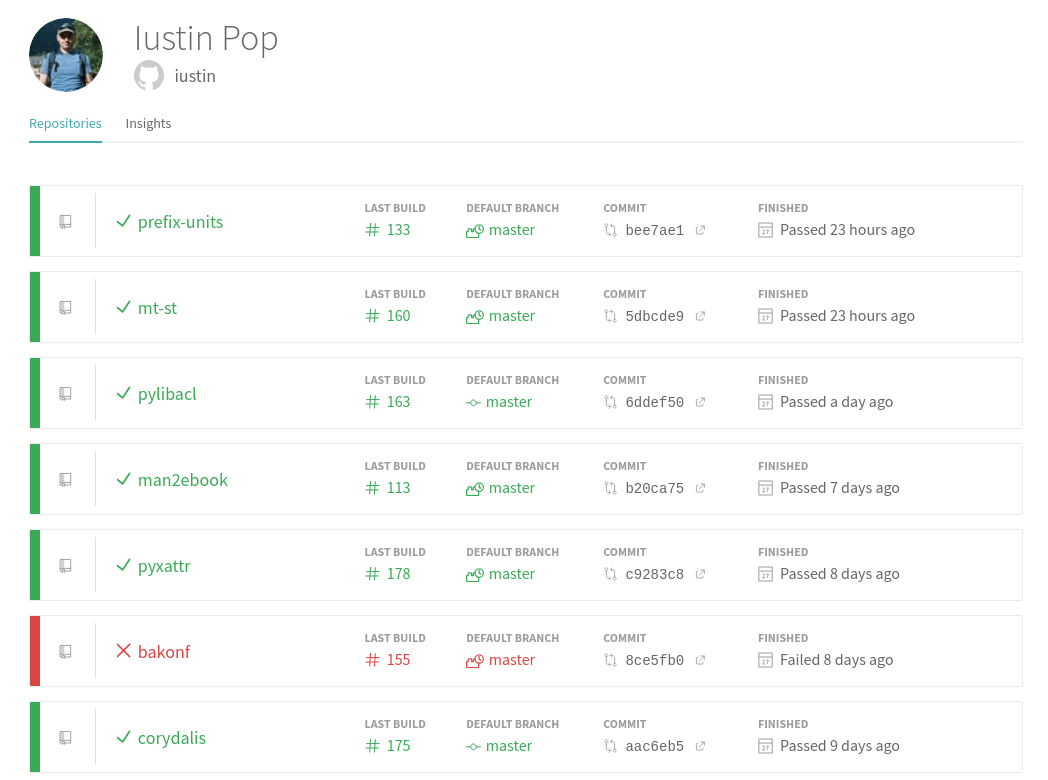
Summary For my specific use-case, GitHub Actions is a better fit right now. The marketplace has advantages (I ll explain better in a future post), the actions are a very nice way to encapsulate functionality, and it s still available/free (up to a limit) for open source projects. I don t know what the future of Travis for OSS will be, but all I heard so far is very concerning. However, I ll still miss a few things. For example, an overall dashboard for all my projects, like this one:
Travis dashboard Travis dashboard
I couldn t find any such thing on GitHub, so I just use my set of badges. Then cache management. Travis allows you to clear the cache, and it does auto-update the cache. GitHub caches are immutable once built, so you have to:
  • watch if changed dependencies/dependency chains result in things that are no longer cached;
  • if so, need to manually bump the cache key, resulting in a commit for purely administrative purposes.
For languages where you have a clean full chain of dependencies recorded (e.g. node s package-lock.json, stack s stack.yaml.lock), this is trivial to achieve, but gets complicated if you add OS dependencies, languages which don t record all this, etc. Hmm, maybe I should just embed the year/month in the cache name - cheating, but automated cheating. With all said and done, I think GHA is much less refined, but with more potential. Plus, the pace of innovation on Travis side was quite slow (likely money problems, hence them being bought, etc.) So one TODO done: learn GitHub Actions , even if a bit unplanned

Evgeni Golov: Controlling Somfy roller shutters using an ESP32 and ESPHome

Our house has solar powered, remote controllable roller shutters on the roof windows, built by the German company named HEIM & HAUS. However, when you look closely at the remote control or the shutter motor, you'll see another brand name: SIMU. As the shutters don't have any wiring inside the house, the only way to control them is via the remote interface. So let's go on the Internet and see how one can do that, shall we? ;) First thing we learn is that SIMU remote stuff is just re-branded Somfy. Great, another name! Looking further we find that Somfy uses some obscure protocol to prevent (replay) attacks (spoiler: it doesn't!) and there are tools for RTL-SDR and Arduino available. That's perfect! Always sniff with RTL-SDR first! Given the two re-brandings in the supply chain, I wasn't 100% sure our shutters really use the same protocol. So the first "hack" was to listen and decrypt the communication using RTL-SDR:
$ git clone https://github.com/dimhoff/radio_stuff
$ cd radio_stuff
$ make -C converters am_to_ook
$ make -C decoders decode_somfy
$ rtl_fm -M am -f 433.42M -s 270K   ./am_to_ook -d 10 -t 2000 -    ./decode_somfy
<press some buttons on the remote>
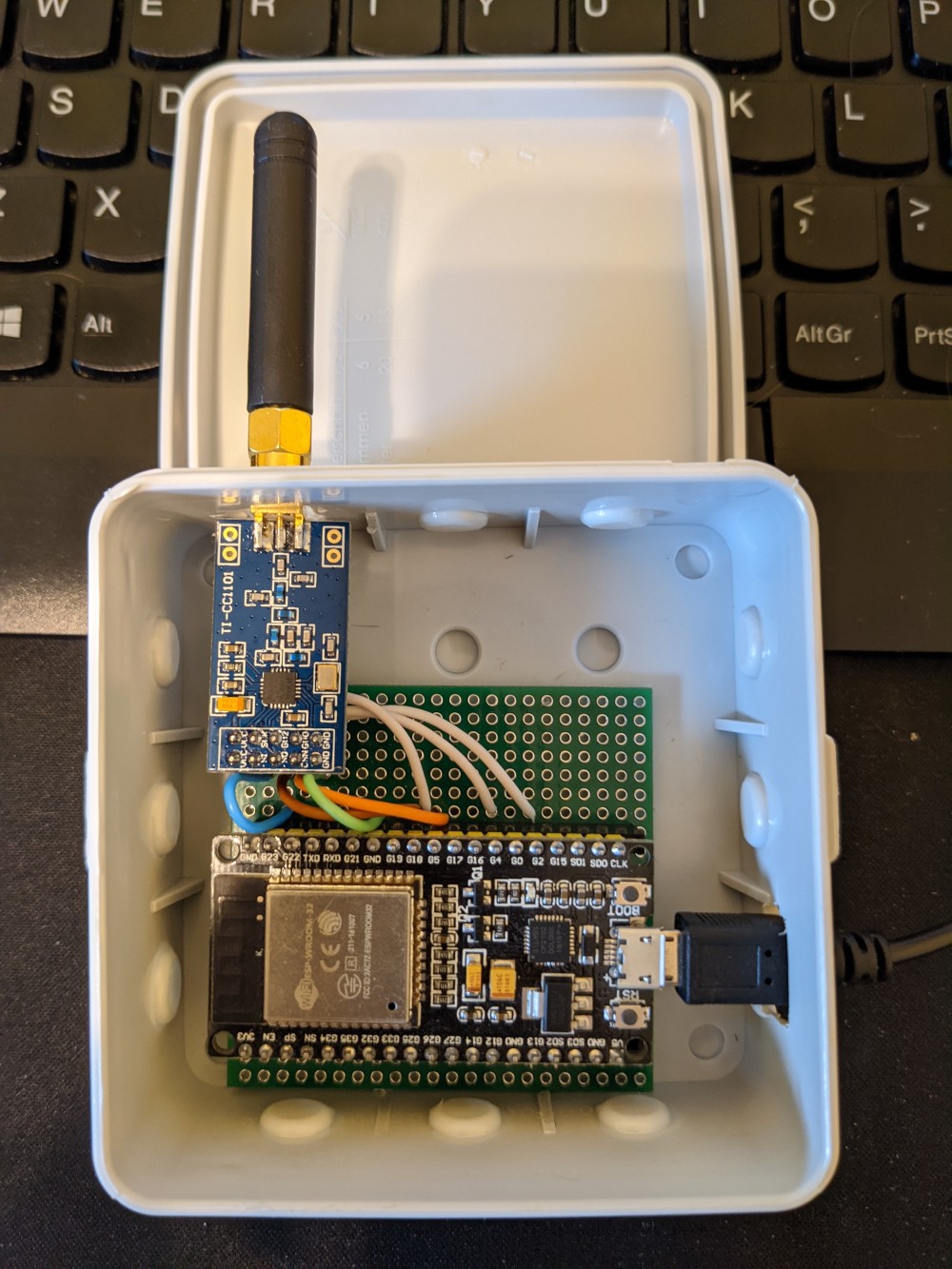
The output contains the buttons I pressed, but also the id of the remote and the command counter (which is supposed to prevent replay attacks). At this point I could just use the id and the counter to send own commands, but if I'd do that too often, the real remote would stop working, as its counter won't increase and the receiver will drop the commands when the counters differ too much. But that's good enough for now. I know I'm looking for the right protocol at the right frequency. As the end result should be an ESP32, let's move on! Acquiring the right hardware Contrary to an RTL-SDR, one usually does not have a spare ESP32 with 433MHz radio at home, so I went shopping: a NodeMCU-32S clone and a CC1101. The CC1101 is important as most 433MHz chips for Arduino/ESP only work at 433.92MHz, but Somfy uses 433.42MHz and using the wrong frequency would result in really bad reception. The CC1101 is essentially an SDR, as you can tune it to a huge spectrum of frequencies. Oh and we need some cables, a bread board, the usual stuff ;) The wiring is rather simple: ESP32 wiring for a CC1101 And the end result isn't too beautiful either, but it works: ESP32 and CC1101 in a simple case Acquiring the right software In my initial research I found an Arduino sketch and was totally prepared to port it to ESP32, but luckily somebody already did that for me! Even better, it's explicitly using the CC1101. Okay, okay, I cheated, I actually ordered the hardware after I found this port and the reference to CC1101. ;) As I am using ESPHome for my ESPs, the idea was to add a "Cover" that's controlling the shutters to it. Writing some C++, how hard can it be? Turns out, not that hard. You can see the code in my GitHub repo. It consists of two (relevant) files: somfy_cover.h and somfy.yaml. somfy_cover.h essentially wraps the communication with the Somfy_Remote_Lib library into an almost boilerplate Custom Cover for ESPHome. There is nothing too fancy in there. The only real difference to the "Custom Cover" example from the documentation is the split into SomfyESPRemote (which inherits from Component) and SomfyESPCover (which inherits from Cover) -- this is taken from the Custom Sensor documentation and allows me to define one "remote" that controls multiple "covers" using the add_cover function. The first two params of the function are the NVS name and key (think database table and row), and the third is the rolling code of the remote (stored in somfy_secrets.h, which is not in Git). In ESPHome a Cover shall define its properties as CoverTraits. Here we call set_is_assumed_state(true), as we don't know the state of the shutters - they could have been controlled using the other (real) remote - and setting this to true allows issuing open/close commands at all times. We also call set_supports_position(false) as we can't tell the shutters to move to a specific position. The one additional feature compared to a normal Cover interface is the program function, which allows to call the "program" command so that the shutters can learn a new remote. somfy.yaml is the ESPHome "configuration", which contains information about the used hardware, WiFi credentials etc. Again, mostly boilerplate. The interesting parts are the loading of the additional libraries and attaching the custom component with multiple covers and the additional PROG switches:
esphome:
  name: somfy
  platform: ESP32
  board: nodemcu-32s
  libraries:
    - SmartRC-CC1101-Driver-Lib@2.5.6
    - Somfy_Remote_Lib@0.4.0
    - EEPROM
  includes:
    - somfy_secrets.h
    - somfy_cover.h
 
cover:
  - platform: custom
    lambda:  -
      auto somfy_remote = new SomfyESPRemote();
      somfy_remote->add_cover("somfy", "badezimmer", SOMFY_REMOTE_BADEZIMMER);
      somfy_remote->add_cover("somfy", "kinderzimmer", SOMFY_REMOTE_KINDERZIMMER);
      App.register_component(somfy_remote);
      return somfy_remote->covers;
    covers:
      - id: "somfy"
        name: "Somfy Cover"
      - id: "somfy2"
        name: "Somfy Cover2"
switch:
  - platform: template
    name: "PROG"
    turn_on_action:
      - lambda:  -
          ((SomfyESPCover*)id(somfy))->program();
  - platform: template
    name: "PROG2"
    turn_on_action:
      - lambda:  -
          ((SomfyESPCover*)id(somfy2))->program();
The switch to trigger the program mode took me a bit. As the Cover interface of ESPHome does not offer any additional functions besides movement control, I first wrote code to trigger "program" when "stop" was pressed three times in a row, but that felt really cumbersome and also had the side effect that the remote would send more than needed, sometimes confusing the shutters. I then decided to have a separate button (well, switch) for that, but the compiler yelled at me I can't call program on a Cover as it does not have such a function. Turns out, you need to explicitly cast to SomfyESPCover and then it works, even if the code becomes really readable, NOT. Oh and as the switch does not have any code to actually change/report state, it effectively acts as a button that can be pressed. At this point we can just take an existing remote, press PROG for 5 seconds, see the blinds move shortly up and down a bit and press PROG on our new ESP32 remote and the shutters will learn the new remote. And thanks to the awesome integration of ESPHome into HomeAssistant, this instantly shows up as a new controllable cover there too. Future Additional Work I started writing this post about a year ago And the initial implementation had some room for improvement More than one remote The initial code only created one remote and one cover element. Sure, we could attach that to all shutters (there are 4 of them), but we really want to be able to control them separately. Thankfully I managed to read enough ESPHome docs, and learned how to operate std::vector to make the code dynamically accept new shutters. Using ESP32's NVS The ESP32 has a non-volatile key-value storage which is much nicer than throwing bits at an emulated EEPROM. The first library I used for that explicitly used EEPROM storage and it would have required quite some hacking to make it work with NVS. Thankfully the library I am using now has a plugable storage interface, and I could just write the NVS backend myself and upstream now supports that. Yay open-source! Remaining issues Real state is unknown As noted above, the ESP does not know the real state of the shutters: a command could have been lost in transmission (the Somfy protocol is send-only, there is no feedback) or the shutters might have been controlled by another remote. At least the second part could be solved by listening all the time and trying to decode commands heard over the air, but I don't think this is worth the time -- worst that can happen is that a closed (opened) shutter receives another close (open) command and that is harmless as they have integrated endstops and know that they should not move further. Can't program new remotes with ESP only To program new remotes, one has to press the "PROG" button for 5 seconds. This was not exposed in the old library, but the new one does support "long press", I just would need to add another ugly switch to the config and I currently don't plan to do so, as I do have working remotes for the case I need to learn a new one.

5 June 2021

Enrico Zini: Ansible blockinfile oddity

I was reading Ansible's blockinfile sources for, uhm, reasons, and the code flow looked a bit odd. So I checked what happens if a file has spurious block markers. Give this file:
$ cat /tmp/test.orig
line0
# BEGIN ANSIBLE MANAGED BLOCK
line1
# END ANSIBLE MANAGED BLOCK
line2
# END ANSIBLE MANAGED BLOCK
line3
# BEGIN ANSIBLE MANAGED BLOCK
line4
And this playbook:
$ cat test.yaml
---
- hosts: localhost
  tasks:
   - name: test blockinfile
     blockinfile:
        block: NEWLINE
        path: /tmp/test
You get this result:
$ cat /tmp/test
line0
# BEGIN ANSIBLE MANAGED BLOCK
line1
# END ANSIBLE MANAGED BLOCK
line2
# BEGIN ANSIBLE MANAGED BLOCK
NEWLINE
# END ANSIBLE MANAGED BLOCK
line4
I was hoping that I was reading the code incorrectly, but it turns out that Ansible's blockinfile matches the last pair of begin-end markers it finds, in whatever order it finds them.

4 June 2021

Matthew Garrett: Mike Lindell's Cyber "Evidence"

Mike Lindell, notable for absolutely nothing relevant in this field, today filed a lawsuit against a couple of voting machine manufacturers in response to them suing him for defamation after he claimed that they were covering up hacks that had altered the course of the US election. Paragraph 104 of his suit asserts that he has evidence of at least 20 documented hacks, including the number of votes that were changed. The citation is just a link to a video called Absolute 9-0, which claims to present sufficient evidence that the US supreme court will come to a 9-0 decision that the election was tampered with.

The claim is that Lindell was provided with a set of files on the 9th of January, and gave these to some cyber experts to verify. These experts identified them as packet captures. The video contains scrolling hex, and we are told that this is the raw encrypted data from the files. In reality, the hex values correspond very clearly to printable ASCII, and appear to just be the Pennsylvania voter roll. They're not encrypted, and they're not packet captures (they contain no packet headers).

20 of these packet captures were then selected and analysed, giving us the tables contained within Exhibit 12. The alleged source IPs appear to correspond to the networks the tables claim, and the latitude and longitude presumably just come from a geoip lookup of some sort (although clearly those values are far too precise to be accurate). But if we look at the target IPs, we find something interesting. Most of them resolve to the website for the county that was the nominal target (eg, 198.108.253.104 is www.deltacountymi.org). So, we're supposed to believe that in many cases, the county voting infrastructure was hosted on the county website.

Unfortunately we're not given the destination port, but 198.108.253.104 isn't listening on anything other than 80 and 443. We're told that the packet data is encrypted, so presumably it's over HTTPS. So, uh, how did they decrypt this to figure out how many votes were switched? If Mike's hackers have broken TLS, they really don't need to be dealing with this.

We're also given some background information on how it's impossible to reconstruct packet captures after the fact (untrue), or that modifying them would change their hashes (true, but in the absence of known good hash values that tells us nothing), but it's pretty clear that nothing we're shown actually demonstrates what we're told it does.

In summary: yes, any supreme court decision on this would be 9-0, just not the way he's hoping for.

Update: It was pointed out that this data appears to be part of a larger dataset. This one is even more dubious - it somehow has MAC addresses for both the source and destination (which is impossible), and almost none of these addresses are in actual issued ranges.

comment count unavailable comments

3 June 2021

Jonathan McDowell: Digging into Kubernetes containers

Having build a single node Kubernetes cluster and had a poke at what it s doing in terms of networking the next thing I want to do is figure out what it s doing in terms of containers. You might argue this should have come before networking, but to me the networking piece is more non-standard than the container piece, so I wanted to understand that first. Let s start with a process listing on the host. ps faxno user,stat,cmd There are a number of processes from the host kernel we don t care about:
kernel processes
    USER STAT CMD
       0 S    [kthreadd]
       0 I<    \_ [rcu_gp]
       0 I<    \_ [rcu_par_gp]
       0 I<    \_ [kworker/0:0H-events_highpri]
       0 I<    \_ [mm_percpu_wq]
       0 S     \_ [rcu_tasks_rude_]
       0 S     \_ [rcu_tasks_trace]
       0 S     \_ [ksoftirqd/0]
       0 I     \_ [rcu_sched]
       0 S     \_ [migration/0]
       0 S     \_ [cpuhp/0]
       0 S     \_ [cpuhp/1]
       0 S     \_ [migration/1]
       0 S     \_ [ksoftirqd/1]
       0 I<    \_ [kworker/1:0H-kblockd]
       0 S     \_ [cpuhp/2]
       0 S     \_ [migration/2]
       0 S     \_ [ksoftirqd/2]
       0 I<    \_ [kworker/2:0H-events_highpri]
       0 S     \_ [cpuhp/3]
       0 S     \_ [migration/3]
       0 S     \_ [ksoftirqd/3]
       0 I<    \_ [kworker/3:0H-kblockd]
       0 S     \_ [kdevtmpfs]
       0 I<    \_ [netns]
       0 S     \_ [kauditd]
       0 S     \_ [khungtaskd]
       0 S     \_ [oom_reaper]
       0 I<    \_ [writeback]
       0 S     \_ [kcompactd0]
       0 SN    \_ [ksmd]
       0 SN    \_ [khugepaged]
       0 I<    \_ [kintegrityd]
       0 I<    \_ [kblockd]
       0 I<    \_ [blkcg_punt_bio]
       0 I<    \_ [edac-poller]
       0 I<    \_ [devfreq_wq]
       0 I<    \_ [kworker/0:1H-kblockd]
       0 S     \_ [kswapd0]
       0 I<    \_ [kthrotld]
       0 I<    \_ [acpi_thermal_pm]
       0 I<    \_ [ipv6_addrconf]
       0 I<    \_ [kstrp]
       0 I<    \_ [zswap-shrink]
       0 I<    \_ [kworker/u9:0-hci0]
       0 I<    \_ [kworker/2:1H-kblockd]
       0 I<    \_ [ata_sff]
       0 I<    \_ [sdhci]
       0 S     \_ [irq/39-mmc0]
       0 I<    \_ [sdhci]
       0 S     \_ [irq/42-mmc1]
       0 S     \_ [scsi_eh_0]
       0 I<    \_ [scsi_tmf_0]
       0 S     \_ [scsi_eh_1]
       0 I<    \_ [scsi_tmf_1]
       0 I<    \_ [kworker/1:1H-kblockd]
       0 I<    \_ [kworker/3:1H-kblockd]
       0 S     \_ [jbd2/sda5-8]
       0 I<    \_ [ext4-rsv-conver]
       0 S     \_ [watchdogd]
       0 S     \_ [scsi_eh_2]
       0 I<    \_ [scsi_tmf_2]
       0 S     \_ [usb-storage]
       0 I<    \_ [cfg80211]
       0 S     \_ [irq/130-mei_me]
       0 I<    \_ [cryptd]
       0 I<    \_ [uas]
       0 S     \_ [irq/131-iwlwifi]
       0 S     \_ [card0-crtc0]
       0 S     \_ [card0-crtc1]
       0 S     \_ [card0-crtc2]
       0 I<    \_ [kworker/u9:2-hci0]
       0 I     \_ [kworker/3:0-events]
       0 I     \_ [kworker/2:0-events]
       0 I     \_ [kworker/1:0-events_power_efficient]
       0 I     \_ [kworker/3:2-events]
       0 I     \_ [kworker/1:1]
       0 I     \_ [kworker/u8:1-events_unbound]
       0 I     \_ [kworker/0:2-events]
       0 I     \_ [kworker/2:2]
       0 I     \_ [kworker/u8:0-events_unbound]
       0 I     \_ [kworker/0:1-events]
       0 I     \_ [kworker/0:0-events]
There are various basic host processes, including my SSH connections, and Docker. I note it s using containerd. We also see kubelet, the Kubernetes node agent.
host processes
    USER STAT CMD
       0 Ss   /sbin/init
       0 Ss   /lib/systemd/systemd-journald
       0 Ss   /lib/systemd/systemd-udevd
     101 Ssl  /lib/systemd/systemd-timesyncd
       0 Ssl  /sbin/dhclient -4 -v -i -pf /run/dhclient.enx00e04c6851de.pid -lf /var/lib/dhcp/dhclient.enx00e04c6851de.leases -I -df /var/lib/dhcp/dhclient6.enx00e04c6851de.leases enx00e04c6851de
       0 Ss   /usr/sbin/cron -f
     104 Ss   /usr/bin/dbus-daemon --system --address=systemd: --nofork --nopidfile --systemd-activation --syslog-only
       0 Ssl  /usr/sbin/dockerd -H fd://
       0 Ssl  /usr/sbin/rsyslogd -n -iNONE
       0 Ss   /usr/sbin/smartd -n
       0 Ss   /lib/systemd/systemd-logind
       0 Ssl  /usr/bin/containerd
       0 Ss+  /sbin/agetty -o -p -- \u --noclear tty1 linux
       0 Ss   sshd: /usr/sbin/sshd -D [listener] 0 of 10-100 startups
       0 Ss    \_ sshd: root@pts/1
       0 Ss        \_ -bash
       0 R+            \_ ps faxno user,stat,cmd
       0 Ss    \_ sshd: noodles [priv]
    1000 S         \_ sshd: noodles@pts/0
    1000 Ss+           \_ -bash
       0 Ss   /lib/systemd/systemd --user
       0 S     \_ (sd-pam)
    1000 Ss   /lib/systemd/systemd --user
    1000 S     \_ (sd-pam)
       0 Ssl  /usr/bin/kubelet --bootstrap-kubeconfig=/etc/kubernetes/bootstrap-kubelet.conf --kubeconfig=/etc/kubernetes/kubelet.conf --config=/var/lib/kubelet/config.yaml --network-plugin=cni --pod-infra-container-image=k8s.gcr.io/pause:3.4.1
And that just leaves a bunch of container related processes:
container processes
       0 Sl   /usr/bin/containerd-shim-runc-v2 -namespace moby -id fd95c597ff3171ff110b7bf440229e76c5108d5d93be75ffeab54869df734413 -address /run/containerd/containerd.sock
       0 Ss    \_ /pause
       0 Sl   /usr/bin/containerd-shim-runc-v2 -namespace moby -id c2ff2c50f0bc052feda2281741c4f37df7905e3b819294ec645148ae13c3fe1b -address /run/containerd/containerd.sock
       0 Ss    \_ /pause
       0 Sl   /usr/bin/containerd-shim-runc-v2 -namespace moby -id 589c1545d9e0cdf8ea391745c54c8f4db49f5f437b1a2e448e7744b2c12f8856 -address /run/containerd/containerd.sock
       0 Ss    \_ /pause
       0 Sl   /usr/bin/containerd-shim-runc-v2 -namespace moby -id 6f417fd8a8c573a2b8f792af08cdcd7ce663457f0f7218c8d55afa3732e6ee94 -address /run/containerd/containerd.sock
       0 Ss    \_ /pause
       0 Sl   /usr/bin/containerd-shim-runc-v2 -namespace moby -id afa9798c9f663b21df8f38d9634469e6b4db0984124547cd472a7789c61ef752 -address /run/containerd/containerd.sock
       0 Ssl   \_ kube-scheduler --authentication-kubeconfig=/etc/kubernetes/scheduler.conf --authorization-kubeconfig=/etc/kubernetes/scheduler.conf --bind-address=127.0.0.1 --kubeconfig=/etc/kubernetes/scheduler.conf --leader-elect=true --port=0
       0 Sl   /usr/bin/containerd-shim-runc-v2 -namespace moby -id 4b3708b62f4d427690f5979848c59fce522dab6c62a9c53b806ffbaef3f88e62 -address /run/containerd/containerd.sock
       0 Ssl   \_ kube-controller-manager --authentication-kubeconfig=/etc/kubernetes/controller-manager.conf --authorization-kubeconfig=/etc/kubernetes/controller-manager.conf --bind-address=127.0.0.1 --client-ca-file=/etc/kubernetes/pki/ca.crt --cluster-name=kubernetes --cluster-signing-cert-file=/etc/kubernetes/pki/ca.crt --cluster-signing-key-file=/etc/kubernetes/pki/ca.key --controllers=*,bootstrapsigner,tokencleaner --kubeconfig=/etc/kubernetes/controller-manager.conf --leader-elect=true --port=0 --requestheader-client-ca-file=/etc/kubernetes/pki/front-proxy-ca.crt --root-ca-file=/etc/kubernetes/pki/ca.crt --service-account-private-key-file=/etc/kubernetes/pki/sa.key --use-service-account-credentials=true
       0 Sl   /usr/bin/containerd-shim-runc-v2 -namespace moby -id 89f35bf7a825eb97db7035d29aa475a3a1c8aaccda0860a46388a3a923cd10bc -address /run/containerd/containerd.sock
       0 Ssl   \_ kube-apiserver --advertise-address=192.168.53.147 --allow-privileged=true --authorization-mode=Node,RBAC --client-ca-file=/etc/kubernetes/pki/ca.crt --enable-admission-plugins=NodeRestriction --enable-bootstrap-token-auth=true --etcd-cafile=/etc/kubernetes/pki/etcd/ca.crt --etcd-certfile=/etc/kubernetes/pki/apiserver-etcd-client.crt --etcd-keyfile=/etc/kubernetes/pki/apiserver-etcd-client.key --etcd-servers=https://127.0.0.1:2379 --insecure-port=0 --kubelet-client-certificate=/etc/kubernetes/pki/apiserver-kubelet-client.crt --kubelet-client-key=/etc/kubernetes/pki/apiserver-kubelet-client.key --kubelet-preferred-address-types=InternalIP,ExternalIP,Hostname --proxy-client-cert-file=/etc/kubernetes/pki/front-proxy-client.crt --proxy-client-key-file=/etc/kubernetes/pki/front-proxy-client.key --requestheader-allowed-names=front-proxy-client --requestheader-client-ca-file=/etc/kubernetes/pki/front-proxy-ca.crt --requestheader-extra-headers-prefix=X-Remote-Extra- --requestheader-group-headers=X-Remote-Group --requestheader-username-headers=X-Remote-User --secure-port=6443 --service-account-issuer=https://kubernetes.default.svc.cluster.local --service-account-key-file=/etc/kubernetes/pki/sa.pub --service-account-signing-key-file=/etc/kubernetes/pki/sa.key --service-cluster-ip-range=10.96.0.0/12 --tls-cert-file=/etc/kubernetes/pki/apiserver.crt --tls-private-key-file=/etc/kubernetes/pki/apiserver.key
       0 Sl   /usr/bin/containerd-shim-runc-v2 -namespace moby -id 2dabff6e4f59c96d931d95781d28314065b46d0e6f07f8c65dc52aa465f69456 -address /run/containerd/containerd.sock
       0 Ssl   \_ etcd --advertise-client-urls=https://192.168.53.147:2379 --cert-file=/etc/kubernetes/pki/etcd/server.crt --client-cert-auth=true --data-dir=/var/lib/etcd --initial-advertise-peer-urls=https://192.168.53.147:2380 --initial-cluster=udon=https://192.168.53.147:2380 --key-file=/etc/kubernetes/pki/etcd/server.key --listen-client-urls=https://127.0.0.1:2379,https://192.168.53.147:2379 --listen-metrics-urls=http://127.0.0.1:2381 --listen-peer-urls=https://192.168.53.147:2380 --name=udon --peer-cert-file=/etc/kubernetes/pki/etcd/peer.crt --peer-client-cert-auth=true --peer-key-file=/etc/kubernetes/pki/etcd/peer.key --peer-trusted-ca-file=/etc/kubernetes/pki/etcd/ca.crt --snapshot-count=10000 --trusted-ca-file=/etc/kubernetes/pki/etcd/ca.crt
       0 Sl   /usr/bin/containerd-shim-runc-v2 -namespace moby -id 73fae81715b670255b66419a7959798b287be7bbb41e96f8b711fa529aa02f0d -address /run/containerd/containerd.sock
       0 Ss    \_ /pause
       0 Sl   /usr/bin/containerd-shim-runc-v2 -namespace moby -id 26d92a720c560caaa5f8a0217bc98e486b1c032af6c7c5d75df508021d462878 -address /run/containerd/containerd.sock
       0 Ssl   \_ /usr/local/bin/kube-proxy --config=/var/lib/kube-proxy/config.conf --hostname-override=udon
       0 Sl   /usr/bin/containerd-shim-runc-v2 -namespace moby -id 7104f65b5d92a56a2df93514ed0a78cfd1090ca47b6ce4e0badc43be6c6c538e -address /run/containerd/containerd.sock
       0 Ss    \_ /pause
       0 Sl   /usr/bin/containerd-shim-runc-v2 -namespace moby -id 48d735f7f44e3944851563f03f32c60811f81409e7378641404035dffd8c1eb4 -address /run/containerd/containerd.sock
       0 Ssl   \_ /usr/bin/weave-npc
       0 S<        \_ /usr/sbin/ulogd -v
       0 Sl   /usr/bin/containerd-shim-runc-v2 -namespace moby -id 36b418e69ae7076fe5a44d16cef223d8908016474cb65910f2fd54cca470566b -address /run/containerd/containerd.sock
       0 Ss    \_ /bin/sh /home/weave/launch.sh
       0 Sl        \_ /home/weave/weaver --port=6783 --datapath=datapath --name=12:82:8f:ed:c7:bf --http-addr=127.0.0.1:6784 --metrics-addr=0.0.0.0:6782 --docker-api= --no-dns --db-prefix=/weavedb/weave-net --ipalloc-range=192.168.0.0/24 --nickname=udon --ipalloc-init consensus=0 --conn-limit=200 --expect-npc --no-masq-local
       0 Sl        \_ /home/weave/kube-utils -run-reclaim-daemon -node-name=udon -peer-name=12:82:8f:ed:c7:bf -log-level=debug
       0 Sl   /usr/bin/containerd-shim-runc-v2 -namespace moby -id 534c0a698478599277482d97a137fab8ef4d62db8a8a5cf011b4bead28246f70 -address /run/containerd/containerd.sock
       0 Ss    \_ /pause
       0 Sl   /usr/bin/containerd-shim-runc-v2 -namespace moby -id 9ffd6b668ddfbf3c64c6783bc6f4f6cc9e92bfb16c83fb214c2cbb4044993bf0 -address /run/containerd/containerd.sock
       0 Ss    \_ /pause
       0 Sl   /usr/bin/containerd-shim-runc-v2 -namespace moby -id 4a30785f91873a7e6a191e86928a789760a054e4fa6dcd7048a059b42cf19edf -address /run/containerd/containerd.sock
       0 Ssl   \_ /coredns -conf /etc/coredns/Corefile
       0 Sl   /usr/bin/containerd-shim-runc-v2 -namespace moby -id 649a507d45831aca1de5231b49afc8ff37d90add813e7ecd451d12eedd785b0c -address /run/containerd/containerd.sock
       0 Ssl   \_ /coredns -conf /etc/coredns/Corefile
       0 Sl   /usr/bin/containerd-shim-runc-v2 -namespace moby -id 62b369de8d8cece4d33ec9fda4d23a9718379a8df8b30173d68f20bff830fed2 -address /run/containerd/containerd.sock
       0 Ss    \_ /pause
       0 Sl   /usr/bin/containerd-shim-runc-v2 -namespace moby -id 7cbb177bee18dbdeed21fb90e74378e2081436ad5bf116b36ad5077fe382df30 -address /run/containerd/containerd.sock
       0 Ss    \_ /bin/bash /usr/local/bin/run.sh
       0 S         \_ nginx: master process nginx -g daemon off;
   65534 S             \_ nginx: worker process
       0 Ss   /lib/systemd/systemd --user
       0 S     \_ (sd-pam)
       0 Sl   /usr/bin/containerd-shim-runc-v2 -namespace moby -id 6669168db70db4e6c741e8a047942af06dd745fae4d594291d1d6e1077b05082 -address /run/containerd/containerd.sock
       0 Ss    \_ /pause
       0 Sl   /usr/bin/containerd-shim-runc-v2 -namespace moby -id d5fa78fa31f11a4c5fb9fd2e853a00f0e60e414a7bce2e0d8fcd1f6ab2b30074 -address /run/containerd/containerd.sock
     101 Ss    \_ /usr/bin/dumb-init -- /nginx-ingress-controller --publish-service=ingress-nginx/ingress-nginx-controller --election-id=ingress-controller-leader --ingress-class=nginx --configmap=ingress-nginx/ingress-nginx-controller --validating-webhook=:8443 --validating-webhook-certificate=/usr/local/certificates/cert --validating-webhook-key=/usr/local/certificates/key
     101 Ssl       \_ /nginx-ingress-controller --publish-service=ingress-nginx/ingress-nginx-controller --election-id=ingress-controller-leader --ingress-class=nginx --configmap=ingress-nginx/ingress-nginx-controller --validating-webhook=:8443 --validating-webhook-certificate=/usr/local/certificates/cert --validating-webhook-key=/usr/local/certificates/key
     101 S             \_ nginx: master process /usr/local/nginx/sbin/nginx -c /etc/nginx/nginx.conf
     101 Sl                \_ nginx: worker process
     101 Sl                \_ nginx: worker process
     101 Sl                \_ nginx: worker process
     101 Sl                \_ nginx: worker process
     101 S                 \_ nginx: cache manager process
There s a lot going on there. Some bits are obvious; we can see the nginx ingress controller, our echoserver (the other nginx process hanging off /usr/local/bin/run.sh), and some things that look related to weave. The rest appears to be Kubernete s related infrastructure. kube-scheduler, kube-controller-manager, kube-apiserver, kube-proxy all look like core Kubernetes bits. etcd is a distributed, reliable key-value store. coredns is a DNS server, with plugins for Kubernetes and etcd. What does Docker claim is happening?
docker ps
CONTAINER ID   IMAGE                                 COMMAND                  CREATED      STATUS      PORTS     NAMES
d5fa78fa31f1   k8s.gcr.io/ingress-nginx/controller   "/usr/bin/dumb-init  "   3 days ago   Up 3 days             k8s_controller_ingress-nginx-controller-5b74bc9868-bczdr_ingress-nginx_4d7d3d81-a769-4de9-a4fb-04763b7c1605_0
6669168db70d   k8s.gcr.io/pause:3.4.1                "/pause"                 3 days ago   Up 3 days             k8s_POD_ingress-nginx-controller-5b74bc9868-bczdr_ingress-nginx_4d7d3d81-a769-4de9-a4fb-04763b7c1605_0
7cbb177bee18   k8s.gcr.io/echoserver                 "/usr/local/bin/run. "   3 days ago   Up 3 days             k8s_echoserver_hello-node-59bffcc9fd-8hkgb_default_c7111c9e-7131-40e0-876d-be89d5ca1812_0
62b369de8d8c   k8s.gcr.io/pause:3.4.1                "/pause"                 3 days ago   Up 3 days             k8s_POD_hello-node-59bffcc9fd-8hkgb_default_c7111c9e-7131-40e0-876d-be89d5ca1812_0
649a507d4583   296a6d5035e2                          "/coredns -conf /etc "   4 days ago   Up 4 days             k8s_coredns_coredns-558bd4d5db-flrfq_kube-system_f8b2b52e-6673-4966-82b1-3fbe052a0297_0
4a30785f9187   296a6d5035e2                          "/coredns -conf /etc "   4 days ago   Up 4 days             k8s_coredns_coredns-558bd4d5db-4nvrg_kube-system_1976f4d6-647c-45ca-b268-95f071f064d5_0
9ffd6b668ddf   k8s.gcr.io/pause:3.4.1                "/pause"                 4 days ago   Up 4 days             k8s_POD_coredns-558bd4d5db-flrfq_kube-system_f8b2b52e-6673-4966-82b1-3fbe052a0297_0
534c0a698478   k8s.gcr.io/pause:3.4.1                "/pause"                 4 days ago   Up 4 days             k8s_POD_coredns-558bd4d5db-4nvrg_kube-system_1976f4d6-647c-45ca-b268-95f071f064d5_0
36b418e69ae7   df29c0a4002c                          "/home/weave/launch. "   4 days ago   Up 4 days             k8s_weave_weave-net-mchmg_kube-system_b9af9615-8cde-4a18-8555-6da1f51b7136_1
48d735f7f44e   weaveworks/weave-npc                  "/usr/bin/launch.sh"     4 days ago   Up 4 days             k8s_weave-npc_weave-net-mchmg_kube-system_b9af9615-8cde-4a18-8555-6da1f51b7136_0
7104f65b5d92   k8s.gcr.io/pause:3.4.1                "/pause"                 4 days ago   Up 4 days             k8s_POD_weave-net-mchmg_kube-system_b9af9615-8cde-4a18-8555-6da1f51b7136_0
26d92a720c56   4359e752b596                          "/usr/local/bin/kube "   4 days ago   Up 4 days             k8s_kube-proxy_kube-proxy-6d8kg_kube-system_8bf2d7ec-4850-427f-860f-465a9ff84841_0
73fae81715b6   k8s.gcr.io/pause:3.4.1                "/pause"                 4 days ago   Up 4 days             k8s_POD_kube-proxy-6d8kg_kube-system_8bf2d7ec-4850-427f-860f-465a9ff84841_0
89f35bf7a825   771ffcf9ca63                          "kube-apiserver --ad "   4 days ago   Up 4 days             k8s_kube-apiserver_kube-apiserver-udon_kube-system_1af8c5f362b7b02269f4d244cb0e6fbf_0
afa9798c9f66   a4183b88f6e6                          "kube-scheduler --au "   4 days ago   Up 4 days             k8s_kube-scheduler_kube-scheduler-udon_kube-system_629dc49dfd9f7446eb681f1dcffe6d74_0
2dabff6e4f59   0369cf4303ff                          "etcd --advertise-cl "   4 days ago   Up 4 days             k8s_etcd_etcd-udon_kube-system_c2a3008c1d9895f171cd394e38656ea0_0
4b3708b62f4d   e16544fd47b0                          "kube-controller-man "   4 days ago   Up 4 days             k8s_kube-controller-manager_kube-controller-manager-udon_kube-system_1d1b9018c3c6e7aa2e803c6e9ccd2eab_0
fd95c597ff31   k8s.gcr.io/pause:3.4.1                "/pause"                 4 days ago   Up 4 days             k8s_POD_kube-scheduler-udon_kube-system_629dc49dfd9f7446eb681f1dcffe6d74_0
589c1545d9e0   k8s.gcr.io/pause:3.4.1                "/pause"                 4 days ago   Up 4 days             k8s_POD_kube-controller-manager-udon_kube-system_1d1b9018c3c6e7aa2e803c6e9ccd2eab_0
6f417fd8a8c5   k8s.gcr.io/pause:3.4.1                "/pause"                 4 days ago   Up 4 days             k8s_POD_kube-apiserver-udon_kube-system_1af8c5f362b7b02269f4d244cb0e6fbf_0
c2ff2c50f0bc   k8s.gcr.io/pause:3.4.1                "/pause"                 4 days ago   Up 4 days             k8s_POD_etcd-udon_kube-system_c2a3008c1d9895f171cd394e38656ea0_0
Ok, that s interesting. Before we dig into it, what does Kubernetes say? (I ve trimmed the RESTARTS + AGE columns to make things fit a bit better here; they weren t interesting).
noodles@udon:~$ kubectl get pods --all-namespaces
NAMESPACE       NAME                                        READY   STATUS
default         hello-node-59bffcc9fd-8hkgb                 1/1     Running
ingress-nginx   ingress-nginx-admission-create-8jgkt        0/1     Completed
ingress-nginx   ingress-nginx-admission-patch-jdq4t         0/1     Completed
ingress-nginx   ingress-nginx-controller-5b74bc9868-bczdr   1/1     Running
kube-system     coredns-558bd4d5db-4nvrg                    1/1     Running
kube-system     coredns-558bd4d5db-flrfq                    1/1     Running
kube-system     etcd-udon                                   1/1     Running
kube-system     kube-apiserver-udon                         1/1     Running
kube-system     kube-controller-manager-udon                1/1     Running
kube-system     kube-proxy-6d8kg                            1/1     Running
kube-system     kube-scheduler-udon                         1/1     Running
kube-system     weave-net-mchmg                             2/2     Running
So there are a lot more Docker instances running than Kubernetes pods. What s happening there? Well, it turns out that Kubernetes builds pods from multiple different Docker instances. If you think of a traditional container as being comprised of a set of namespaces (process, network, hostname etc) and a cgroup then a pod is made up of the namespaces and then each docker instance within that pod has it s own cgroup. Ian Lewis has a much deeper discussion in What are Kubernetes Pods Anyway?, but my takeaway is that a pod is a set of sort-of containers that are coupled. We can see this more clearly if we ask systemd for the cgroup breakdown:
systemd-cgls
Control group /:
-.slice
 user.slice 
   user-0.slice 
     session-29.scope 
        515899 sshd: root@pts/1
        515913 -bash
       3519743 systemd-cgls
       3519744 cat
     user@0.service  
       init.scope 
         515902 /lib/systemd/systemd --user
         515903 (sd-pam)
   user-1000.slice 
     user@1000.service  
       init.scope 
         2564011 /lib/systemd/systemd --user
         2564012 (sd-pam)
     session-110.scope 
       2564007 sshd: noodles [priv]
       2564040 sshd: noodles@pts/0
       2564041 -bash
 init.scope 
   1 /sbin/init
 system.slice 
   containerd.service  
       21383 /usr/bin/containerd-shim-runc-v2 -namespace moby -id fd95c597ff31 
       21408 /usr/bin/containerd-shim-runc-v2 -namespace moby -id c2ff2c50f0bc 
       21432 /usr/bin/containerd-shim-runc-v2 -namespace moby -id 589c1545d9e0 
       21459 /usr/bin/containerd-shim-runc-v2 -namespace moby -id 6f417fd8a8c5 
       21582 /usr/bin/containerd-shim-runc-v2 -namespace moby -id afa9798c9f66 
       21607 /usr/bin/containerd-shim-runc-v2 -namespace moby -id 4b3708b62f4d 
       21640 /usr/bin/containerd-shim-runc-v2 -namespace moby -id 89f35bf7a825 
       21648 /usr/bin/containerd-shim-runc-v2 -namespace moby -id 2dabff6e4f59 
       22343 /usr/bin/containerd-shim-runc-v2 -namespace moby -id 73fae81715b6 
       22391 /usr/bin/containerd-shim-runc-v2 -namespace moby -id 26d92a720c56 
       26992 /usr/bin/containerd-shim-runc-v2 -namespace moby -id 7104f65b5d92 
       27405 /usr/bin/containerd-shim-runc-v2 -namespace moby -id 48d735f7f44e 
       27531 /usr/bin/containerd-shim-runc-v2 -namespace moby -id 36b418e69ae7 
       27941 /usr/bin/containerd-shim-runc-v2 -namespace moby -id 534c0a698478 
       27960 /usr/bin/containerd-shim-runc-v2 -namespace moby -id 9ffd6b668ddf 
       28131 /usr/bin/containerd-shim-runc-v2 -namespace moby -id 4a30785f9187 
       28159 /usr/bin/containerd-shim-runc-v2 -namespace moby -id 649a507d4583 
      514667 /usr/bin/containerd-shim-runc-v2 -namespace moby -id 62b369de8d8c 
      514976 /usr/bin/containerd-shim-runc-v2 -namespace moby -id 7cbb177bee18 
      698904 /usr/bin/containerd-shim-runc-v2 -namespace moby -id 6669168db70d 
      699284 /usr/bin/containerd-shim-runc-v2 -namespace moby -id d5fa78fa31f1 
     2805479 /usr/bin/containerd
   systemd-udevd.service 
     2805502 /lib/systemd/systemd-udevd
   cron.service 
     2805474 /usr/sbin/cron -f
   docker.service  
     528 /usr/sbin/dockerd -H fd://
   kubelet.service 
     2805501 /usr/bin/kubelet --bootstrap-kubeconfig=/etc/kubernetes/bootstrap 
   systemd-journald.service 
     2805505 /lib/systemd/systemd-journald
   ssh.service 
     2805500 sshd: /usr/sbin/sshd -D [listener] 0 of 10-100 startups
   ifup@enx00e04c6851de.service 
     2805675 /sbin/dhclient -4 -v -i -pf /run/dhclient.enx00e04c6851de.pid -lf 
   rsyslog.service 
     2805488 /usr/sbin/rsyslogd -n -iNONE
   smartmontools.service 
     2805499 /usr/sbin/smartd -n
   dbus.service 
     527 /usr/bin/dbus-daemon --system --address=systemd: --nofork --nopidfile 
   systemd-timesyncd.service 
     2805513 /lib/systemd/systemd-timesyncd
   system-getty.slice 
     getty@tty1.service 
       536 /sbin/agetty -o -p -- \u --noclear tty1 linux
   systemd-logind.service 
     533 /lib/systemd/systemd-logind
 kubepods.slice 
   kubepods-burstable.slice 
     kubepods-burstable-pod1af8c5f362b7b02269f4d244cb0e6fbf.slice 
       docker-6f417fd8a8c573a2b8f792af08cdcd7ce663457f0f7218c8d55afa3732e6ee94.scope  
         21493 /pause
       docker-89f35bf7a825eb97db7035d29aa475a3a1c8aaccda0860a46388a3a923cd10bc.scope  
         21699 kube-apiserver --advertise-address=192.168.33.147 --allow-privi 
     kubepods-burstable-podf8b2b52e_6673_4966_82b1_3fbe052a0297.slice 
       docker-649a507d45831aca1de5231b49afc8ff37d90add813e7ecd451d12eedd785b0c.scope  
         28187 /coredns -conf /etc/coredns/Corefile
       docker-9ffd6b668ddfbf3c64c6783bc6f4f6cc9e92bfb16c83fb214c2cbb4044993bf0.scope  
         27987 /pause
     kubepods-burstable-podc2a3008c1d9895f171cd394e38656ea0.slice 
       docker-c2ff2c50f0bc052feda2281741c4f37df7905e3b819294ec645148ae13c3fe1b.scope  
         21481 /pause
       docker-2dabff6e4f59c96d931d95781d28314065b46d0e6f07f8c65dc52aa465f69456.scope  
         21701 etcd --advertise-client-urls=https://192.168.33.147:2379 --cert 
     kubepods-burstable-pod629dc49dfd9f7446eb681f1dcffe6d74.slice 
       docker-fd95c597ff3171ff110b7bf440229e76c5108d5d93be75ffeab54869df734413.scope  
         21491 /pause
       docker-afa9798c9f663b21df8f38d9634469e6b4db0984124547cd472a7789c61ef752.scope  
         21680 kube-scheduler --authentication-kubeconfig=/etc/kubernetes/sche 
     kubepods-burstable-podb9af9615_8cde_4a18_8555_6da1f51b7136.slice 
       docker-48d735f7f44e3944851563f03f32c60811f81409e7378641404035dffd8c1eb4.scope  
         27424 /usr/bin/weave-npc
         27458 /usr/sbin/ulogd -v
       docker-36b418e69ae7076fe5a44d16cef223d8908016474cb65910f2fd54cca470566b.scope  
         27549 /bin/sh /home/weave/launch.sh
         27629 /home/weave/weaver --port=6783 --datapath=datapath --name=12:82 
         27825 /home/weave/kube-utils -run-reclaim-daemon -node-name=udon -pee 
       docker-7104f65b5d92a56a2df93514ed0a78cfd1090ca47b6ce4e0badc43be6c6c538e.scope  
         27011 /pause
     kubepods-burstable-pod4d7d3d81_a769_4de9_a4fb_04763b7c1605.slice 
       docker-6669168db70db4e6c741e8a047942af06dd745fae4d594291d1d6e1077b05082.scope  
         698925 /pause
       docker-d5fa78fa31f11a4c5fb9fd2e853a00f0e60e414a7bce2e0d8fcd1f6ab2b30074.scope  
          699303 /usr/bin/dumb-init -- /nginx-ingress-controller --publish-ser 
          699316 /nginx-ingress-controller --publish-service=ingress-nginx/ing 
          699405 nginx: master process /usr/local/nginx/sbin/nginx -c /etc/ngi 
         1075085 nginx: worker process
         1075086 nginx: worker process
         1075087 nginx: worker process
         1075088 nginx: worker process
         1075089 nginx: cache manager process
     kubepods-burstable-pod1976f4d6_647c_45ca_b268_95f071f064d5.slice 
       docker-4a30785f91873a7e6a191e86928a789760a054e4fa6dcd7048a059b42cf19edf.scope  
         28178 /coredns -conf /etc/coredns/Corefile
       docker-534c0a698478599277482d97a137fab8ef4d62db8a8a5cf011b4bead28246f70.scope  
         27995 /pause
     kubepods-burstable-pod1d1b9018c3c6e7aa2e803c6e9ccd2eab.slice 
       docker-589c1545d9e0cdf8ea391745c54c8f4db49f5f437b1a2e448e7744b2c12f8856.scope  
         21489 /pause
       docker-4b3708b62f4d427690f5979848c59fce522dab6c62a9c53b806ffbaef3f88e62.scope  
         21690 kube-controller-manager --authentication-kubeconfig=/etc/kubern 
   kubepods-besteffort.slice 
     kubepods-besteffort-podc7111c9e_7131_40e0_876d_be89d5ca1812.slice 
       docker-62b369de8d8cece4d33ec9fda4d23a9718379a8df8b30173d68f20bff830fed2.scope  
         514688 /pause
       docker-7cbb177bee18dbdeed21fb90e74378e2081436ad5bf116b36ad5077fe382df30.scope  
         514999 /bin/bash /usr/local/bin/run.sh
         515039 nginx: master process nginx -g daemon off;
         515040 nginx: worker process
     kubepods-besteffort-pod8bf2d7ec_4850_427f_860f_465a9ff84841.slice 
       docker-73fae81715b670255b66419a7959798b287be7bbb41e96f8b711fa529aa02f0d.scope  
         22364 /pause
       docker-26d92a720c560caaa5f8a0217bc98e486b1c032af6c7c5d75df508021d462878.scope  
         22412 /usr/local/bin/kube-proxy --config=/var/lib/kube-proxy/config.c 
Again, there s a lot going on here, but if you look for the kubepods.slice piece then you can see our pods are divided into two sets, kubepods-burstable.slice and kubepods-besteffort.slice. Under those you can see the individual pods, all of which have at least 2 separate cgroups, one of which is running /pause. Turns out this is a generic Kubernetes image which basically performs the process reaping that an init process would do on a normal system; it just sits and waits for processes to exit and cleans them up. Again, Ian Lewis has more details on the pause container. Finally let s dig into the actual containers. The pause container seems like a good place to start. We can examine the details of where the filesystem is (may differ if you re not using the overlay2 image thingy). The hex string is the container ID listed by docker ps.
# docker inspect --format=' .GraphDriver.Data.MergedDir ' 6669168db70d
/var/lib/docker/overlay2/5a2d76012476349e6b58eb6a279bac400968cefae8537082ea873b2e791ff3c6/merged
# cd /var/lib/docker/overlay2/5a2d76012476349e6b58eb6a279bac400968cefae8537082ea873b2e791ff3c6/merged
# find .   sed -e 's;^./;;'
pause
proc
.dockerenv
etc
etc/resolv.conf
etc/hostname
etc/mtab
etc/hosts
sys
dev
dev/shm
dev/pts
dev/console
# file pause
pause: ELF 64-bit LSB executable, x86-64, version 1 (GNU/Linux), statically linked, for GNU/Linux 3.2.0, BuildID[sha1]=d35dab7152881e37373d819f6864cd43c0124a65, stripped
This is a nice, minimal container. The pause binary is statically linked, so there are no extra libraries required and it s just a basic set of support devices and files. I doubt the pieces in /etc are even required. Let s try the echoserver next:
# docker inspect --format=' .GraphDriver.Data.MergedDir ' 7cbb177bee18
/var/lib/docker/overlay2/09042bc1aff16a9cba43f1a6a68f7786c4748e989a60833ec7417837c4bfaacb/merged
# cd /var/lib/docker/overlay2/09042bc1aff16a9cba43f1a6a68f7786c4748e989a60833ec7417837c4bfaacb/merged
# find .   wc -l
3358
Wow. That s a lot more stuff. Poking /etc/os-release shows why:
# grep PRETTY etc/os-release
PRETTY_NAME="Ubuntu 16.04.2 LTS"
Aha. It s an Ubuntu-based image. We can cut straight to the chase with the nginx ingress container:
# docker exec d5fa78fa31f1 grep PRETTY /etc/os-release
PRETTY_NAME="Alpine Linux v3.13"
That s a bit more reasonable an image for a container; Alpine Linux is a much smaller distro. I don t feel there s a lot more poking to do here. It s not something I d expect to do on a normal Kubernetes setup, but I wanted to dig under the hood to make sure it really was just a normal container situation. I think the next steps involve adding a bit more complexity - that means building a pod with more than a single node, and then running an application that s a bit more complicated. That should help explore two major advantages of running this sort of setup; resilency from a node dying, and the ability to scale out beyond what a single node can do.

2 June 2021

Sven Hoexter: pulseaudio/alsa and dynamic mic sensitivity in my browser

It's a gross hack but works for now. To prevent overly sensitive mic settings autotuned by the browser in web conferences, I currently edit as root /usr/share/pulseaudio/alsa-mixer/paths/analog-input-internal-mic.conf. Change in [Element Capture] the setting volume from merge to 80. The config block as a whole looks like this:
[Element Capture]
switch = mute
volume = 80
override-map.1 = all
override-map.2 = all-left,all-right
Solution found at https://askubuntu.com/a/761103.

Joachim Breitner: Verifying the code of the Internet Identity service

The following post was meant to be posted at https://forum.dfinity.org/, but that discourse instance didn t like it; maybe too much inline code, so I m posting it here instead. To my regular blog audience, please excuse the lack of context. Please comment at the forum post. The text was later also posted on the DFINITY medium blog You probably have used https://identity.ic0.app/ to log into various applications (the NNS UI, OpenChat etc.) before, and if you do that, you are trusting this service to take good care of your credentials. Furthermore, you might want to check that the Internet Identity is really not tracking you. So you want to know: Is this really running the code we claim it to run? Of course the following applies to other canisters as well, but I ll stick to the Internet Identity in this case. I ll walk you through the steps of verifying that:

Find out what is running A service on the Internet Computer, i.e. a canister, is a WebAssembly module. The Internet Computer does intentionally not allow you to just download the Wasm code of any canisters, because maybe some developer wants to keep their code private. But it does expose a hash of the Wasm module. The easiest way to get it is using dfx:
$ dfx canister --no-wallet --network ic info rdmx6-jaaaa-aaaaa-aaadq-cai
Controller: r7inp-6aaaa-aaaaa-aaabq-cai
Module hash: 0xd4af9277f3e8d26fd8cdc7874a9f47b6456587fbb2a64d61b6b6880d144d3c04
The controller here is the canister id of the governance canister. This tells you that the Internet Identity is controlled by the Network Nervous System (NNS), and its code can only be changed via proposals that are voted on. This is good; if the controller was just, say, me, I could just change the code of the Internet Identity and take over all your identities. The Module hash is the SHA-256 hash of the .wasm that was deployed. So let s follow that trace.

Finding the right commit Since upgrades to the Internet Identity are done via proposals to the NNS, we should find a description of such a proposal in the https://github.com/ic-association/nns-proposals repository, in the proposals/network_canister_management directory.
Github s list of recent NNS proposalsGithub s list of recent NNS proposals
We have to find the latest proposal upgrading the Internet Identity. The folder unfortunately contains proposals for many canisters, and the file naming isn t super helpful. I usually go through the list from bottom and look at the second column, which contains the title of the latest commit creating or modifying a file. In this case, the second to last is the one we care about: https://github.com/ic-association/nns-proposals/blob/main/proposals/network_canister_management/20210527T2203Z.md. This file lists rationales, gives an overview of changes and, most importantly, says that bd51eab is the commit we are upgrading to. The file also says that the wasm hash is d4a c04, which matches what we saw above. This is good: it seems we really found the youngest proposal upgrading the Internet Identity, and that the proposal actually went through. WARNING: If you are paranoid, don t trust this file. There is nothing preventing a proposal proposer to create a file pointing to one revision, but actually including other code in the proposal. That s why the next steps are needed.

Getting the source Now that we have the revision, we can get the source and check out revision bd51eab:
/tmp $ git clone https://github.com/dfinity/internet-identity
Klone nach 'internet-identity' ...
remote: Enumerating objects: 3959, done.
remote: Counting objects: 100% (344/344), done.
remote: Compressing objects: 100% (248/248), done.
remote: Total 3959 (delta 161), reused 207 (delta 92), pack-reused 3615
Empfange Objekte: 100% (3959/3959), 6.05 MiB   3.94 MiB/s, Fertig.
L se Unterschiede auf: 100% (2290/2290), Fertig.
/tmp $ cd internet-identity/
/tmp/internet-identity $ git checkout bd51eab
/tmp/internet-identity $ git log --oneline -n 1
bd51eab (HEAD, tag: mainnet-20210527T2203Z) Registers the seed phrase before showing it (#301)
In the last line you see that the Internet Identity team has tagged that revision with a tag name that contains the proposal description file name. Very tidy!

Reproducing the build The README.md has the following build instructions:

Official build The official build should ideally be reproducible, so that independent parties can validate that we really deploy what we claim to deploy. We try to achieve some level of reproducibility using a Dockerized build environment. The following steps should build the official Wasm image
docker build -t internet-identity-service .
docker run --rm --entrypoint cat internet-identity-service /internet_identity.wasm > internet_identity.wasm
sha256sum internet_identity.wasm
The resulting internet_identity.wasm is ready for deployment as rdmx6-jaaaa-aaaaa-aaadq-cai, which is the reserved principal for this service.

It actually suffices to run the first command, as it also prints the hash (we don t need to copy the .wasm out of the Docker canister):
/tmp/internet-identity $ docker build -t internet-identity-service .
 
Step 26/26 : RUN sha256sum internet_identity.wasm
 ---> Running in 1a04644b544c
d4af9277f3e8d26fd8cdc7874a9f47b6456587fbb2a64d61b6b6880d144d3c04  internet_identity.wasm
Removing intermediate container 1a04644b544c
 ---> bfe6a63a7980
Successfully built bfe6a63a7980
Successfully tagged internet-identity-service:latest
Success! The hashes match. You don t believe me? Try it yourself (and let us know if you get a different hash, maybe I got hacked). This may fail if you have too little RAM configured for Docker, 8GB should be enough. At this point you have a trust path from the code sitting in front of you to the Internet Identity running at https://identity.ic0.app, including the front-end code, and you can start auditing the source code.

What about the canister id? If you payed close attention you might have noticed that we got the module has for canister rdmx6-jaaaa-aaaaa-aaadq-cai, but we are accessing a web application at https://identity.ic0.app. So where is this connection? In the future, I expect some form of a DNS-like nice host name registry on the Internet Computer that stores a mapping from nice names to canister ids, and that you will be able to query that to for which canister serves rdmx6-jaaaa-aaaaa-aaadq-cai in a secure way (e.g. using certified variables). But since we don t have that yet, but still want you to be able to use a nice name for the Internet Identity (and not have to change the name later, which would cause headaches), we have hard-coded this mapping for now. The relevant code here is the Certifying Service Worker that your browser downloads when accessing any *.ic0.app URL. This piece of code will then intercept all requests to that domain, map it to an query call, and then use certified variables to validate the response. And indeed, the mapping is in the code there:
const hostnameCanisterIdMap: Record<string, [string, string]> =  
  'identity.ic0.app': ['rdmx6-jaaaa-aaaaa-aaadq-cai', 'ic0.app'],
  'nns.ic0.app': ['qoctq-giaaa-aaaaa-aaaea-cai', 'ic0.app'],
  'dscvr.ic0.app': ['h5aet-waaaa-aaaab-qaamq-cai', 'ic0.page'],
 ;

What about other canisters? In principle, the same approach works for other canisters, whether it s OpenChat, the NNS canisters etc. But the details will differ, as every canister developer might have their own way of
  • communicating the location and revision of the source for their canisters
  • building the canisters
In particular, without a reproducible way of building the canister, this will fail, and that s why projects like https://reproducible-builds.org/ are so important in general.

Matthew Garrett: Producing a trustworthy x86-based Linux appliance

Let's say you're building some form of appliance on top of general purpose x86 hardware. You want to be able to verify the software it's running hasn't been tampered with. What's the best approach with existing technology?

Let's split this into two separate problems. The first is to do as much as we can to ensure that the software can't be modified without our consent[1]. This requires that each component in the boot chain verify that the next component is legitimate. We call the first component in this chain the root of trust, and in the x86 world this is the system firmware[2]. This firmware is responsible for verifying the bootloader, and the easiest way to do this on x86 is to use UEFI Secure Boot. In this setup the firmware contains a set of trusted signing certificates and will only boot executables with a chain of trust to one of these certificates. Switching the system into setup mode from the firmware menu will allow you to remove the existing keys and install new ones.

(Note: You shouldn't use the trusted certificate directly for signing bootloaders - instead, the trusted certificate should be used to sign another certificate and the key for that certificate used to sign your bootloader. This way, if you ever need to revoke the signing certificate, you can simply sign a new one with the trusted parent and push out a revocation update instead of having to provision new keys)

But what do you want to sign? In the general purpose Linux world, we use an intermediate bootloader called Shim to bridge from the Microsoft signing authority to a distribution one. Shim then verifies the signature on grub, and grub in turn verifies the signature on the kernel. This is a large body of code that exists because of the use cases that general purpose distributions need to support - primarily, booting on arbitrary off the shelf hardware, and allowing arbitrary and complicated boot setups. This is unnecessary in the appliance case, where the hardware target can be well defined, where there's no need for interoperability with the Microsoft signing authority, and where the boot configuration can be extremely static.

We can skip all of this complexity using systemd-boot's unified Linux image support. This has the format described here, but the short version is that it's simply a kernel and initramfs linked into a small EFI executable that will run them. Instructions for generating such an image are here, and if you follow them you'll end up with a single static image that can be directly executed by the firmware. Signing this avoids dealing with a whole host of problems associated with relying on shim and grub, but note that you'll be embedding the initramfs as well. Again, this should be fine for appliance use-cases, but you'll need your build system to support building the initramfs at image creation time rather than relying on it being generated on the host.

At this point we have a single image that can be verified by the firmware and will get us to the point of a running kernel and initramfs. Unless you've got enough RAM that you can put your entire workload in the initramfs, you're going to want a filesystem as well, and you're going to want to verify that that filesystem hasn't been tampered with. The easiest approach to this is to use dm-verity, a device-mapper layer that uses a hash tree to verify that the filesystem contents haven't been modified. The kernel needs to know what the root hash is, so this can either be embedded into your initramfs image or into the kernel command line. Either way, it'll end up in the signed boot image, so nobody will be able to tamper with it.

It's important to note that a dm-verity partition is read-only - the kernel doesn't have the cryptographic secret that would be required to generate a new hash tree if the partition is modified. So if you require the ability to write data or logs anywhere, you'll need to add a new partition for that. If this partition is unencrypted, an attacker with access to the device will be able to put whatever they want on there. You should treat any data you read from there as untrusted, and ensure that it's validated before use (ie, don't just feed it to a random parser written in C and expect that everything's going to be ok). On the other hand, if it's encrypted, remember that you can't just put the encryption key in the boot image - an attacker with access to the device is going to be able to dump that and extract it. You'll probably want to use a TPM-sealed encryption secret, which will be discussed later on.

At this point everything in the boot process is cryptographically verified, and so should be difficult to tamper with. Unfortunately this isn't really sufficient - on x86 systems there's typically no verification of the integrity of the secure boot database. An attacker with physical access to the system could attach a programmer directly to the firmware flash and rewrite the secure boot database to include keys they control. They could then replace the boot image with one that they've signed, and the machine would happily boot code that the attacker controlled. We need to be able to demonstrate that the system booted using the correct secure boot keys, and the only way we can do that is to use the TPM.

I wrote an introduction to TPMs a while back. The important thing to know here is that the TPM contains a set of Platform Configuration Registers that are large enough to contain a cryptographic hash. During boot, each component of the boot process will generate a "measurement" of other security critical components, including the next component to be booted. These measurements are a representation of the data in question - they may simply be a hash of the object being measured, or the hash of a structure containing various pieces of metadata. Each measurement is passed to the TPM, along with the PCR it should be measured into. The TPM takes the new measurement, appends it to the existing value, and then stores the hash of this concatenated data in the PCR. This means that the final PCR value depends not only on the measurement, but also on every previous measurement. Without breaking the hash algorithm, there's no way to set the PCR to an arbitrary value. The hash values and some associated data are stored in a log that's kept in system RAM, which we'll come back to later.

Different PCRs store different pieces of information, but the one that's most interesting to us is PCR 7. Its use is documented in the TCG PC Client Platform Firmware Profile (section 3.3.4.8), but the short version is that the firmware will measure the secure boot keys that are used to boot the system. If the secure boot keys are altered (such as by an attacker flashing new ones), the PCR 7 value will change.

What can we do with this? There's a couple of choices. For devices that are online, we can perform remote attestation, a process where the device can provide a signed copy of the PCR values to another system. If the system also provides a copy of the TPM event log, the individual events in the log can be replayed in the same way that the TPM would use to calculate the PCR values, and then compared to the actual PCR values. If they match, that implies that the log values are correct, and we can then analyse individual log entries to make assumptions about system state. If a device has been tampered with, the PCR 7 values and associated log entries won't match the expected values, and we can detect the tampering.

If a device is offline, or if there's a need to permit local verification of the device state, we still have options. First, we can perform remote attestation to a local device. I demonstrated doing this over Bluetooth at LCA back in 2020. Alternatively, we can take advantage of other TPM features. TPMs can be configured to store secrets or keys in a way that renders them inaccessible unless a chosen set of PCRs have specific values. This is used in tpm2-totp, which uses a secret stored in the TPM to generate a TOTP value. If the same secret is enrolled in any standard TOTP app, the value generated by the machine can be compared to the value in the app. If they match, the PCR values the secret was sealed to are unmodified. If they don't, or if no numbers are generated at all, that demonstrates that PCR 7 is no longer the same value, and that the system has been tampered with.

Unfortunately, TOTP requires that both sides have possession of the same secret. This is fine when a user is making that association themselves, but works less well if you need some way to ship the secret on a machine and then separately ship the secret to a user. If the user can simply download the secret via some API, so can an attacker. If an attacker has the secret, they can modify the secure boot database and re-seal the secret to the new PCR 7 value. That means having to add some form of authentication, along with a strong binding of machine serial number to a user (in order to avoid someone with valid credentials simply downloading all the secrets).

Instead, we probably want some mechanism that uses asymmetric cryptography. A keypair can be generated on the TPM, which will refuse to release an unencrypted copy of the private key. The public key, however, can be exported and stored. If it's acceptable for a verification app to connect to the internet then the public key can simply be obtained that way - if not, a certificate can be issued to the key, and this exposed to the verifier via a QR code. The app then verifies that the certificate is signed by the vendor, and if so extracts the public key from that. The private key can have an associated policy that only permits its use when PCR 7 has an appropriate value, so the app then generates a nonce and asks the user to type that into the device. The device generates a signature over that nonce and displays that as a QR code. The app verifies the signature matches, and can then assert that PCR 7 has the expected value.

Once we can assert that PCR 7 has the expected value, we can assert that the system booted something signed by us and thus infer that the rest of the boot chain is also secure. But this is still dependent on the TPM obtaining trustworthy information, and unfortunately the bus that the TPM sits on isn't really terribly secure (TPM Genie is an example of an interposer for i2c-connected TPMs, but there's no reason an LPC one can't be constructed to attack the sort usually used on PCs). TPMs do support encrypted communication channels, but bootstrapping those isn't straightforward without firmware support. The easiest way around this is to make use of a firmware-based TPM, where the TPM is implemented in software running on an ancillary controller. Intel's solution is part of their Platform Trust Technology and runs on the Management Engine, AMD run it on the Platform Security Processor. In both cases it's not terribly feasible to intercept the communications, so we avoid this attack. The downside is that we're then placing more trust in components that are running much more code than a TPM would and which have a correspondingly larger attack surface. Which is preferable is going to depend on your threat model.

Most of this should be achievable using Yocto, which now has support for dm-verity built in. It's almost certainly going to be easier using this than trying to base on top of a general purpose distribution. I'd love to see this become a largely push button receive secure image process, so might take a go at that if I have some free time in the near future.

[1] Obviously technologies that can be used to ensure nobody other than me is able to modify the software on devices I own can also be used to ensure that nobody other than the manufacturer is able to modify the software on devices that they sell to third parties. There's no real technological solution to this problem, but we shouldn't allow the fact that a technology can be used in ways that are hostile to user freedom to cause us to reject that technology outright.
[2] This is slightly complicated due to the interactions with the Management Engine (on Intel) or the Platform Security Processor (on AMD). Here's a good writeup on the Intel side of things.

comment count unavailable comments

1 June 2021

David Bremner: Baby steps towards schroot and slurm cooperation.

Unfortunately schroot does not maintain CPU affinity 1. This means in particular that parallel builds have the tendency to take over an entire slurm managed server, which is kindof rude. I haven't had time to automate this yet, but following demonstrates a simple workaround for interactive building.
  simplex:~
 % schroot --preserve-environment -r -c polymake
(unstable-amd64-sbuild)bremner@simplex:~$ echo $SLURM_CPU_BIND_LIST
0x55555555555555555555
(unstable-amd64-sbuild)bremner@simplex:~$ grep Cpus /proc/self/status
Cpus_allowed:   ffff,ffffffff,ffffffff
Cpus_allowed_list:      0-79
(unstable-amd64-sbuild)bremner@simplex:~$ taskset $SLURM_CPU_BIND_LIST bash
(unstable-amd64-sbuild)bremner@simplex:~$ grep Cpus /proc/self/status
Cpus_allowed:   5555,55555555,55555555
Cpus_allowed_list:      0,2,4,6,8,10,12,14,16,18,20,22,24,26,28,30,32,34,36,38,40,42,44,46,48,50,52,54,56,58,60,62,64,66,68,70,72,74,76,78

Next steps In principle the schroot configuration parameter can be used to run taskset before every command. In practice it's a bit fiddly because you need a shell script shim (because the environment variable) and you need to e.g. goof around with bind mounts to make sure that your script is available in the chroot. And then there's combining with ccache and eatmydata...

31 May 2021

Russ Allbery: Mostly preorder haul

Some books that I had preordered, plus various other things that I failed to resist. There was a whole wave of new book releases this spring, most of which I have not yet read (in part because of the detour to re-read and review the Chronicles of Narnia). Becky Chambers The Galaxy, and the Ground Within (sff)
Richard Ben Cramer What It Takes (nonfiction)
J.S. Dewes The Last Watch (sff)
Anand Giridharadas Winners Take All (nonfiction)
Lauren Hough Leaving Isn't the Hardest Thing (nonfiction)
S.L. Huang Burning Roses (sff)
Jane McAlevey A Collective Bargain (nonfiction)
K.B. Spangler Stoneskin (sff)
K.B. Spangler The Blackwing War (sff)
Natalie Zina Walschots Hench (sff)
Martha Wells Fugitive Telemetry (sff)

30 May 2021

Russell Coker: Wifi Performance on Linux

Wifi usually just works. In the past I haven t had to worry much about performance as for home use things have always been bearable and at work it s never been my job so I just file a bug report with the relevant people when things go wrong. But a few years ago I had some problems. For my home network I got a free Wifi AP which wasn t performing well. My AP supported 802.11 modes b/g or g/n (b, g, and n are slow, medium, and fast speeds). I initially had the AP running in b/g mode because I had an 802.11b USB wifi device that I used. When I replaced that with one that did 802.11g I tried changing the AP to g/n mode but performance was even worse on my laptop (although quite good on phones) so I switched back. For phones it appeared to work well giving 54Mb/s while on my laptop (a second hand Thinkpad X1 Carbon) it was giving 11Mb/s at best and often much less than that. The best demonstration of problems was to start transferring a large file while pinging a system on the LAN the AP was connected to. Usually it would give ping times of 1s or more, sometimes 5s+ ping times. While this was happening the Invalid misc count increased rapidly, often by more than 100 per second. The results of Google searches suggest that Invalid misc is due to interference and recommend changing the channel. My AP had been on channel 1 which had performed poorly, channels 2-8 were ok, and channel 9 seemed reasonably good. As an aside trying all channels manually is not a good idea, it takes a lot of time and gives little useful data. After changing to channel 9 it still only gave about 500KB/s when transferring large files with ping times of about 100ms, but that s a big improvement. I tried running iwlist scanning to scan the Wifi network for other APs, that showed that channel 1 was used a lot but didn t make it clear what I should do other than that. The next thing I tried was the Wifi Analyser app on Android [1] (which doesn t work on my latest phone, I don t know if it s still being actively maintained, it will definitely work on older phones). That has a nice graph mode that shows which channels are used and how the frequencies spread and interfere with other channels. One thing I hadn t realised before I looked at the graphs is that 802.11n uses 4 channels and interferes past that. If you have two 802.11n devices you don t have much space left out of the 14 channels available. To make more space I configured the Wifi AP in my ADSL modem to 802.11b/g mode and assigned it a channel away from the others making 4 channels available with no interference. After that iwconfig reported between 60 and 120Mb/s and I got consistent transfer rates over 1.5MB/s while ping times remained below 100ms. The 5GHz frequency range is less congested. But at the time I didn t feel like buying 5GHz equipment. Since that time I had signed up with an ISP that had a good deal on a Wifi AP that had 5GHz. Now I have all my devices configured to use 5GHz or 2.4GHz depending on which they think is best. So there s less devices on 2.4GHz and the AP is configured for 20MHz channel width in the 2.4GHz range (which means 802.11b/g). Conclusion 802.11n seems to be a bad idea unless you run the only AP in an area. In a suburban area you will have 3 other houses broadcasting in your area and 802.11n is bad for everyone. The worst case scenario would be one person using 802.11n and interfering with everyone else s 802.11g and then having everyone else turn on 802.11n to try and make things faster. 5GHz is less congested as most people run old hardware. It also has a shorter range which has the upside of getting less interference from other people. I m considering installing 5GHz APs at both ends of my house and configuring all my new devices to not use 2.4GHz. Wifi spectrum analysis software is much better than manual testing of channels or trying to deduce things from the output if iwlist scanning .

Vincent Fourmond: QSoas quiz #2: averaging several Y values for the same X value

This second quiz may sound like the first one, but in fact, the approach used is completely different. The point is to gather some elementary statistics from a series of experiments performed under different conditions, but with several repeats at the same conditions.
Quiz You are given a file (which you can download there) that contains a series of pH value data: the X column is the pH, the Y column the result of the experiment at the given pH (let's say the measure of the catalytic rate of an enzyme). Your task is to take this data and produce a single dataset which contains, for each pH value, the pH, the average of the results at that pH and the standard deviation. The result should be identical to the following file, and should look like that:
There are several ways to do this, but all ways must rely on stats, and the more natural way in QSoas is to take advantage of split-on-values, which is a very powerful command but somehow hard to master, which is the point of this Quiz.
By the way, the data file is purely synthetic, if you look in the GitHub repository, you'll see how it was generated.

About QSoas QSoas is a powerful open source data analysis program that focuses on flexibility and powerful fitting capacities. It is released under the GNU General Public License. It is described in Fourmond, Anal. Chem., 2016, 88 (10), pp 5050 5052. Current version is 3.0. You can download its source code there (or clone from the GitHub repository) and compile it yourself, or buy precompiled versions for MacOS and Windows there.

Russell Coker: HP ML110 Gen9

I ve just bought a HP ML110 Gen9 as a personal workstation, here are my notes about it and documentation on running Debian on it. Why a Server? I bought this is because the ML350p Gen8 turned out to be too noisy for my taste [1]. I ve just been editing my page about Memtest86+ RAM speeds [2], over the course of 10 years (high end laptop in 2001 to low end server in 2011) RAM speed increased by a factor of 100. RAM speed has been increasing at a lower rate than CPU speed and is becoming an increasing bottleneck on system performance. So while I could get a faster white-box system the cost of a second-hand server isn t that great and I m getting a system that s 100* faster than what was adequate for most tasks in 2001. HP makes some nice workstation class machines with ECC RAM (think server without remote management, hot-swap disks, or redundant PSU but with sound hardware). But they are significantly more expensive on the second hand market than servers. This server cost me $650 and came with 2*480G DC grade SSDs (Intel but with HPE stickers). I hope that more than half of the purchase price will be recovered from selling the SSDs (I will use NVMe). Also 64G of non-ECC RAM costs $370 from my local store. As I want lots of RAM for testing software on VMs it will probably turn out that the server cost me less than the cost of new RAM once I ve sold the SSDs! Monitoring
wget -O /usr/local/hpePublicKey2048_key1.pub https://downloads.linux.hpe.com/SDR/hpePublicKey2048_key1.pub
echo "# HP monitoring" >> /etc/apt/sources.list
echo "deb [signed-by=/usr/local/hpePublicKey2048_key1.pub] http://downloads.linux.hpe.com/SDR/downloads/MCP/Debian/ stretch/current-gen9 non-free" >> /etc/apt/sources.list
The above commands will make the management utilities installable on Debian/Buster. If using Bullseye (Testing at the moment) then you need to have Buster repositories in APT for dependencies, HP doesn t seem to have packaged all their utilities for Buster.
wget -r -np -A Contents-amd64.bz2 http://downloads.linux.hpe.com/SDR/repo/mcp/debian/dists
To find out which repositories had the programs I need I ran the above recursive wget and then uncompressed them for grep -R (as an aside it would be nice if bzgrep supported -R). I installed the hp-health package which has hpasmcli for viewing and setting many configuration options and hplog for viewing event log data and thermal data (among a few other things). I ve added a new monitor to etbemon hp-temp.monitor to monitor HP server temperatures, I haven t made a configuration option to change the thresholds for what is considered normal because I don t expect server class systems to be routinely running above the warning temperature. For the linux-temp.monitor script I added a command-line option for the percentage of the high temperature that is an error condition as well as an option for the number of CPU cores that need to be over-temperature, having one core permanently over the high temperature due to a web browser seems standard for white-box workstations nowadays. The hp-health package depends on libc6-i686 lib32gcc1 even though none of the programs it contains use lib32gcc1. Depending on lib32gcc1 instead of lib32gcc1 lib32gcc-s1 means that installing hp-health requires removing mesa-opencl-icd which probably means that BOINC can t use the GPU among other things. I solved this by editing /var/lib/dpkg/status and changing the package dependencies to what I desired. Note that this is not something for a novice to do, make a backup and make sure you know what you are doing! Issues The HPE Dynamic Smart Array B140i is a software RAID device. While it s convenient for some users that software RAID gets supported in the UEFI boot process, generally software RAID is a bad idea. Also my system has hot-swap drive caddies but the controller doesn t support hot-swap. So the first thing to do was to configure the array controller to run in AHCI mode and give up on using hot-swap drive caddies for hot-swap. I tested all the documented ways of scanning for new devices and nothing other than a reboot made the kernel recognise a new SATA disk. According to specs provided by Dell and HP the ML110 Gen9 makes less noise than the PowerEdge T320, according to my own observations the reverse is the case. I don t know if this is because of Dell being more conservative in their specs than HP or because of how dBA is measured vs my own personal annoyance thresholds for sounds. As the system makes more noise than I m comfortable with I plan to build a rubber enclosure for the rear of the system to reduce noise, that will be the subject of another post. For Australian readers Bunnings has some good deals on rubber floor mats that can be used to reduce server noise. The server doesn t have sound hardware, while one could argue that servers don t need sound there are some server uses for sound hardware such as using line input as a source of entropy. Also for a manufacturer it might be a benefit to use the same motherboard for workstations and servers. Fortunately a friend gave me a nice set of Logitech USB speakers a few years ago that I hadn t previously had a cause to use, so that will solve the problem for me (I don t need line-in on a workstation). UEFI and Memtest I decided to try UEFI boot for something new (in the past I d only used UEFI boot for a server that only had large disks). In the past I ve booted all my own systems with BIOS boot because I m familiar with it and they all have SSDs for booting which are less than 2TB in size (until recently 2TB SSDs weren t affordable for my personal use). The Debian UEFI wiki page is worth reading [3]. The Debian Wiki page about ProLiant servers [4] is worth reading too. Memtest86+ doesn t support EFI booting (just goes to a black screen) even though Debian/Buster puts in a GRUB entry for it (Debian bug #695246 was filed for this in 2012). Also on my ML110 Memtest86+ doesn t report the RAM speed (a known issue on Memtest86+). Comments on the net say that Memtest86+ hasn t been maintained for a long time and Memtest86 (the non-free version) has been updated more recently. So far I haven t seen a system with ECC RAM have a memory problem that could be detected by Memtest86+, the memory problems I ve seen on ECC systems have been things that prevent booting (RAM not being recognised correctly), that are detected by the BIOS as ECC errors before booting, or that are reported by the kernel as ECC errors at run time (happened years ago and I can t remember the details). Overall I m not a fan of EFI with the way it currently works in Debian. It seems to add some of the GRUB functionality into the BIOS and then use that to load GRUB. It seems that EFI can do everything you need and it would be better to just have a single boot loader not two of them chained. Power Supply There are a range of PSUs for the ML110, the one I have has the smallest available PSU (350W) and doesn t have a PCIe power cable (the one used for video cards). Here is the HP document which shows the cabling for the various ML110 Gen8 PSUs [5], I have the 350W PSU. One thing I ve considered is whether I could make an adaptor from the drive bay power to the PCIe connector. A quick web search indicates that 4 SAS disks when active can take up to 75W more power than a system with no disks. If that s the case then the 2 spare drive bay connectors which can each handle 4 disks should be able to supply 150W. As a 6 pin PCIe power cable (GPU power cable) is rated at 75W that should be fine in theory (here s a page with the pinouts for PCIe power connectors [6]). My video card is a Radeon R7 260X which apparently takes about 113W all up so should be taking less than 75W from the PCIe power cable. All I really want is YouTube, Netflix, and text editing at 4K resolution. So I don t need much in terms of 3D power. KDE uses some of the advanced features of modern video cards, but it doesn t compare to 3D gaming. According to the Wikipedia page for Radeon RX 500 series [7] the RX560 supports DisplayPort 1.4 and HDMI 2.0 (both of which do 4K@60Hz) and has a TDP of 75W. So a RX560 video card seems like a good option that will work in any system that doesn t have a spare PCIe power cable. I ve just ordered one of those for $246 so hopefully that will arrive in a week or so. PCI Fan The ML110 Gen9 has an optional PCIe fan and baffle to cool PCIe cards (part number 784580-B21). Extra cooling of PCIe cards is a good thing, but $400 list price (and about $50 ebay price) for the fan and baffle is unpleasant. When I boot the system with a PCIe dual-ethernet card and two PCIe NVMe cards it gives a BIOS warning on boot, when I add a video card it refuses to boot without the extra fan. It s nice that the system makes sure it doesn t get into a thermal overload situation, but it would be nicer if they just shipped all necessary fans with it instead of trying to get more money out of customers. I just bought a PCI fan and baffle kit for $60. Conclusion In spite of the unexpected expense of a new video card and PCI fan the overall cost of this system is still low, particularly when considering that I ll find another use for the video card which needs and extra power connector. It is disappointing that HP didn t supply a more capable PSU and fit all the fans to all models, the expectation of a server is that you can just do server stuff not have to buy extra bits before you can do server stuff. If you want to install Tesla GPUs or something then it s expected that you might need to do something unusual with a server, but the basic stuff should just work. A single processor tower server should be designed to function as a deskside workstation and be able to handle an average video card. Generally it s a nice computer, I look forward to getting the next deliveries of parts so I can make it work properly.

29 May 2021

Shirish Agarwal: Planes, Pandemic and Medical Devices I

The Great Electric Airplane Race It took me quite sometime to write as have been depressed about things. Then a few days back saw Nova s The Great Electric Airplane Race. While it was fabulous and a pleasure to see and know that there are more than 200 odd startups who are in the race of making an electric airplane which works and has FAA certification. I was disappointed though that there no coverage of any University projects. From what little I know, almost all advanced materials which U.S. had made has been first researched in mostly Universities and when it is close to fruition then either spin-off as a startup or give to some commercial organization/venture to make it scalable and profitable. If they had, I am sure more people could be convinced to join sciences and engineering in college. I actually do want to come to this as part of both general medicine and vaccine development in U.S. but will come later. The idea that industry works alone should be discouraged, but that perhaps may require another article to articulate why I believe so.

Medical Device Ventilators in India Before the pandemic, probably most didn t know what a ventilator is and was, at least I didn t, although I probably used it during my somewhat brief hospital stay a couple of years ago. It entered into the Indian twitter lexicon more so in the second wave as the number of people who got infected became more and more and the ventilators which were serving them became less and less just due to sheer mismatch of numbers and requirements. Rich countries donated/gifted ventilators to India on which GOI put GST of 28%. Apparently, they are a luxury item, just like my hearing aid. Last week Delhi High Court passed a judgement that imposition of GST should not be on a gift like ventilators or oxygenators. The order can be found here. Even without reading the judgement the shout from the right was judicial activism while after reading it is a good judgement which touches on several points. The first, in itself, stating the dichotomy that if a commercial organization wanted to import a ventilator or an oxygenator the IGST payable is nil while for an individual it is 12%. The State (here State refers to State Government in this case Gujarat Govt.) did reduce the IGST for state from 12% to NIL IGST for federal states but that to till only 30.06.2021. No relief to individuals on that account. The Court also made use of Mr. Arvind Datar, as Amicus Curiae or friend of court. The petitioner, an 85-year-old gentleman who has put it up has put broad assertions under Article 21 (right to live) and the court in its wisdom also added Article 14 which enshrines equality of everyone before law. The Amicus Curiae, as his duty, guided the court into how the IGST law works and shared a brief history of the law and the changes happening before and after it. During his submissions, he also shared the Mega Exemption Notification no. 50/2017 under which several items are there which are exempted from putting IGST. The Amicus Curiae did note that such exemptions were also there before Mega Exemption Notification had come into play. However, DGFT (Directorate General of Foreign Trade) on 30-04-2021 issued notification No. 4/2015-2020 through which oxygenators had been exempted from Custom Duty/BCD (Basic Customs Duty. In another notification on no. 30/2021 dated 01.05.2021 it reduced IGST from 28% to 12% for personal use. If however the oxygenator was procured by a canalizing agency (bodies such as State Trading Corporation of India (STC) or/and Metals and Minerals Corporation (MMTC) and such are defined as canalising agents) then it will be fully exempted from paying any sort of IGST, albeit subject to certain conditions. What the conditions are were not shared in the open court. The Amicus Curiae further observed that it is contrary to practice where both BCD and IGST has been exempted for canalising agents and others, some IGST has to be paid for personal use. To share within the narrow boundaries of the topic, he shared entry no. 607A of General Exemption no.190 where duty and IGST in case of life-saving drugs are zero provided the life-saving drugs imported have been provided by zero cost from an overseas supplier for personal use. He further shared that the oxygen generator would fall in the same entry of 607A as it fulfills all the criteria as shared for life-saving medicines and devices. He also used the help of Drugs and Cosmetics Act 1940 which provides such a relief. The Amicus Curiae further noted that GOI amended its foreign trade policy (2015-2020) via notification no.4/2015-2020, dated 30.04.2021, issued by DGFT where Rakhi and life-saving drugs for personal use has been exempted from BCD till 30-07-2021. No reason not to give the same exemption to oxygenators which fulfill the same thing. The Amicus Curiae, further observes that there are exceptional circumstances provisions as adverted to in sub-section (2) of Section 25 of the Customs Act, whereby Covid-19 which is known and labelled as a pandemic where the distinctions between the two classes of individuals or agencies do not make any sense. While he did make the observation that exemption from duty is not a right, in the light of the pandemic and Article 14, it does not make sense to have distinctions between the two classes of importers. He further shared from Circular no. 9/2014-Customs, dated 19.08.2014 by CBEC (Central Board of Excise and Customs) which gave broad exemptions under Section 25 (2) of the same act in respect of goods and services imported for safety and rehabilitation of people suffering and effected by natural disasters and epidemics. He further submits that the impugned notification is irrational as there is no intelligible differentia rule applied or observed in classifying the import of oxygen concentrators into two categories. One, by the State and its agencies; and the other, by an individual for personal use by way of gift. So there was an absence of adequate determining principle . To bolster his argument, he shared the judgements of

a) Union of India vs. N.S. Rathnam & Sons, (2015) 10 SCC 681 (N.S. Ratnams and Sons Case) b) Shayara Bano vs. Union of India, (2017) 9 SCC 1 (Shayara Bano Case) The Amicus Curiae also rightly observed that the right to life also encompasses within it, the right to health. You cannot have one without the other and within that is the right to have affordable treatment. He further stated that the state does not only have a duty but a positive obligation is cast upon it to ensure that the citizen s health is secured. He again cited Navtej Singh Johars vs Union of India (Navtej Singh Johar Case) in defence of right to life. Mr. Datar also shared that unlike in normal circumstances, it is and should be enough to show distinct and noticeable burdensomeness which is directly attributable to the impugned/questionable tax. The gentleman cited Indian Express Newspapers (Bombay) Private Limited vs. Union of India, (1985) 1 SCC 641 (Indian Express case) 1985 which shared both about Article 19 (1) (a) and Article 21. Bloggers note At this juncture, I should point out which I am sharing the judgement and I would be sharing only the Amicus Curiae POV and then the judge s final observations. While I was reading it, I was stuck by the fact that the Amicus Curiae had cited 4 cases till now, 3 of them are pretty well known both in the legal fraternity and even among public at large. Another 3 which have been shared below which are also of great significance. Hence, felt the need to share the whole judgement. The Amicus Curiae further observed that this tax would have to be disproportionately will have to be paid by the old and the infirm, and they might find it difficult to pay the amounts needed to pay the customs duty/IGST as well as find the agent to pay in this pandemic. Blogger Note The situation with the elderly is something like this. Now there are a few things to note, only Central Govt. employees and pensioners get pensions which has been freezed since last year. The rest of the elderly population does not. The rate of interest has fallen to record lows from 5-6% in savings interest rate to 2% and on Fixed Deposits at 4.9% while the nominal inflation rate has up by 6% while CPI and real inflation rates are and would be much more. And this is when there is absolutely no demand in the economy. To add to all this, RBI shared a couple of months ago that fraud of 5 trillion rupees has been committed between 2015 and 2019 in banks. And this is different from the number of record NPA s that have been both in Public and Private Sector banks. To get out of this, the banks have squeezed their customers and are squeezing as well as asking GOI for bailouts. How much GOI is responsible for the frauds as well as NPA s would probably require its own space. And even now, RBI and banks have made heavy provisions as lockdowns are still a facet and are supposed to remain a facet till the end of the year or even next year (all depending upon when we get the vaccine). The Amicus Curiae further argued that the ventilators which are available locally are of bad quality. The result of all this has resulted in a huge amount of unsurmountable pressure on hospitals which they are unable to overcome. Therefore, the levy of IGST on oxygenators has direct impact on health of the citizen. So the examination of the law should not be by what intention it was but how it is affecting citizen rights now. For this he shared R.C.Cooper vs Union of India (another famous case R.C. Cooper vs Union of India) especially paragraph 49 and Federation of Hotel & Restaurant Association of India vs. Union of India, (1989) at paragraph 46 (Federation of Hotel Case) Mr. Datar further shared the Supreme Court order dated 18.12.2020, passed in Suo Moto Writ Petition(Civil) No.7/2020, to buttress the plea that the right to health includes the right to affordable treatment. Blogger s Note For those, who don t know Suo Moto is when the Court, whether Supreme Court or the High Courts take up a matter for public good. It could be in anything, law and order, Banking, Finance, Public Health etc. etc. This was the norm before 2014. The excesses of the executive were curtailed by both the Higher and the lower Judiciary. That is and was the reason that Judiciary is and was known as the third pillar of Indian democracy. A good characterization of Suo Moto can be found here. Before ending his submission, the learned Amicus Curiae also shared Jeeja Ghosh vs. Union of India, (2016) (Jeeja Ghosh Case, an outstanding case as it deals with people with disabilities and their rights and the observations made by the Division Bench of Hon ble Mr. Justice A. K. Sikri as well as Hon ble Mr. Justice R. K. Agrawal.) After Amicus Curiae completed his submissions, it was the turn of Mr. Sudhir Nandrajog, and he adopted the arguments and submissions made by the Amicus Curiae. The gentleman reiterated the facts of the case and how the impugned notification was violative of both Article 14 and 21 of the Indian Constitution. Blogger s Note The High Court s judgement which shows all the above arguments by the Amicus Curiae and the petitioner s lawyer also shared the State s view. It is only on page 24, where the Delhi High Court starts to share its own observations on the arguments of both sides. Judgement continued The first observation that the Court makes is that while the petitioner demonstrated that the impugned tax imposition would have a distinct and noticeable burdensomeness while the State did not state or share in any way how much of a loss it would incur if such a tax were let go and how much additional work would have to be done in order to receive this specific tax. It didn t need to do something which is down the wire or mathematically precise, but it didn t even care to show even theoretically how many people will be affected by the above. The counter-affidavit by the State is silent on the whole issue. The Court also contended that the State failed to prove how collecting IGST from the concerned individuals would help in fighting coronavirus in any substantial manner for the public at large. The High Court shared observations from the Navtej Singh Johar case where it is observed that the State has both negative and positive obligations to ensure that its citizens are able to enjoy the right to health. The High Court further made the point that no respectable person does like to be turned into a charity case. If the State contends that those who obey the law should pay the taxes then it is also obligatory on the state s part to lessen exactions such as taxes at the very least in times of war, famine, floods, epidemics and pandemics. Such an approach would lead a person to live a life of dignity which is part of Article 21 of the Constitution. Another point that was made by the State that only the GST council is able to make any changes as regards to exemptions rather than the State were found to be false as the State had made some exemptions without going to the GST council using its own powers under Section 25 of the Customs Act. The Court also points out that it does send a discriminatory pattern when somebody like petitioner has to pay the tax for personal use while those who are buying it for commercial use do not have to pay the tax. The Court agreed of the view of the Amicus Curiae, Mr. Datar that oxygenator should be taxed at NIL rate at IGST as it is part of life-saving drugs and oxygenator fits the bill as medical equipment as it is used in the treatment, mitigation and prevention of spread of Coronavirus. Mr. Datar also did show that oxygenator is placed at the same level as other life-saving drugs. The Court felt further emboldened as the observations by Supreme Court in State of Andhra Pradesh vs. Linde India Limited, 2020 ( State of Andhra Pradesh vs Linde Ltd.) The Court further shared many subsequent notifications from the State and various press releases by the State itself which does make the Court s point that oxygenators indeed are drugs as defined in the court case above. The State should have it as part of notification 190. This would preserve the start of the notification date from 03.05.2021 and the state would not have to issue a new notification. The Court further went to postulate that any persons similar to the petitioner could avail of the same, if they furnish a letter of undertaking to an officer designated by the State that the medical equipment would not be put to commercial use. Till the state does not do that, in the interim the importer could give the same undertaking to Joint Secretary, Customs or their nominee can hand over the same to custom officer. The Court also shared that it does not disagree with the State s arguments but the challenges which have arisen are in a unique time period/circumstances, so they are basing their judgement based on how the situation is. The Court also mentioned an order given by Supreme Court Diary No. 10669/2020 passed on 20.03.2020 where SC has taken pains to understand the issues faced by the citizens. The court also mentioned the Small Scale Industrial Manufactures Association Case (both of these cases I don t know) . So in conclusion, the Court holds the imposition of IGST on oxygenator which are imported by individuals as gifts from their relatives as unconstitutional. They also shared that any taxes taken by GOI in above scenario have to be returned. The relief to the state is they will not have to pay interest cost on the same. To check misuse of the same, the petitioner or people who are in similar circumstances would have to give a letter of undertaking to an officer designated by the State within 7 days of the state notifying the patient or anybody authorized by him/her to act on their behalf to share the letter of undertaking with the State. And till the State doesn t provide an officer, the above will continue. Hence, both the writ petition and the pending application are disposed off. The Registry is directed to release any money deposited by the petitioner along with any interest occurred on it (if any) . At the end they record appreciation of Mr. Arvind Datar, Mr. Zoheb Hossain, Mr. Sudhir Nandrajog as well as Mr. Siddharth Bambha. It is only due to their assistance that the court could reach the conclusion it did. For Delhi High Court RAJIV SHAKDHER, J. TALWANT SINGH, J. May 21, 2020 Blogger s Observations Now, after the verdict GOI does have few choices, either accept the verdict or appeal in the SC. A third choice is to make a committee and come to the same conclusions via the committee. GOI has done something similar in the past. If that happens and the same conclusions are reached as before, then the aggrieved may have no choice but to appear in the highest court of law. And this will put the aggrieved at a much more vulnerable place than before as SC court fees, lawyer fees etc. are quite high compared to High Courts. So, there is a possibility that the petitioner may not even approach unless and until some non-profit (NGO) does decide to fight and put it up as common cause or something similar. There is another judgement that I will share, probably tomorrow. Thankfully, that one is pretty short compared to this one. So it should be far more easier to read. FWIW, I did learn about the whole freeenode stuff and many channels who have shifted from freenode to libera. I will share my own experience of the same but that probably will take a day or two.
Zeeshan of IYC (India Youth Congress) along with Salman Khan s non-profit Being Human getting oxygenators
The above picture of Zeeshan. There have been a whole team of Indian Youth Congress workers (main opposition party to the ruling party) who have doing lot of relief effort. They have been buying Oxygenators from abroad with help of Being Human Foundation started by Salman Khan, an actor who works in A-grade movies in Bollywood.

28 May 2021

Rapha&#235;l Hertzog: Freexian s report about Debian Long Term Support, April 2021

A Debian LTS logo
Like each month, have a look at the work funded by Freexian s Debian LTS offering. Debian project funding In April, we put aside 5775 EUR to fund Debian projects. There was no proposals for new projects received, thus we re looking forward to receive more projects from various Debian teams! Please do not hesitate to submit a proposal, if there is a project that could benefit from the funding! Debian LTS contributors In April, 11 contributors have been paid to work on Debian LTS, their reports are available: Evolution of the situation In April we released 33 DLAs and held a LTS team meeting using video conferencing. The security tracker currently lists 53 packages with a known CVE and the dla-needed.txt file has 26 packages needing an update. We are please to welcome VyOS as a new gold sponsor! Thanks to our sponsors Sponsors that joined recently are in bold.

Jonathan McDowell: Trying to understand Kubernetes networking

I previously built a single node Kubernetes cluster as a test environment to learn more about it. The first thing I want to try to understand is its networking. In particular the IP addresses that are listed are all 10.* and my host s network is a 192.168/24. I understand each pod gets its own virtual ethernet interface and associated IP address, and these are generally private within the cluster (and firewalled out other than for exposed services). What does that actually look like?
$ ip route
default via 192.168.53.1 dev enx00e04c6851de
172.17.0.0/16 dev docker0 proto kernel scope link src 172.17.0.1 linkdown
192.168.0.0/24 dev weave proto kernel scope link src 192.168.0.1
192.168.53.0/24 dev enx00e04c6851de proto kernel scope link src 192.168.53.147
Huh. No sign of any way to get to 10.107.66.138 (the IP my echoserver from the previous post is available on directly from the host). What about network interfaces? (under the cut because it s lengthy)
ip addr
1: lo: <LOOPBACK,UP,LOWER_UP> mtu 65536 qdisc noqueue state UNKNOWN group default qlen 1000
    link/loopback 00:00:00:00:00:00 brd 00:00:00:00:00:00
    inet 127.0.0.1/8 scope host lo
       valid_lft forever preferred_lft forever
2: enx00e04c6851de: <BROADCAST,MULTICAST,UP,LOWER_UP> mtu 1500 qdisc pfifo_fast state UP group default qlen 1000
    link/ether 00:e0:4c:68:51:de brd ff:ff:ff:ff:ff:ff
    inet 192.168.53.147/24 brd 192.168.53.255 scope global dynamic enx00e04c6851de
       valid_lft 41571sec preferred_lft 41571sec
3: wlp1s0: <BROADCAST,MULTICAST> mtu 1500 qdisc noop state DOWN group default qlen 1000
    link/ether 74:d8:3e:70:3b:18 brd ff:ff:ff:ff:ff:ff
4: docker0: <NO-CARRIER,BROADCAST,MULTICAST,UP> mtu 1500 qdisc noqueue state DOWN group default
    link/ether 02:42:18:04:9e:08 brd ff:ff:ff:ff:ff:ff
    inet 172.17.0.1/16 brd 172.17.255.255 scope global docker0
       valid_lft forever preferred_lft forever
5: datapath: <BROADCAST,MULTICAST,UP,LOWER_UP> mtu 1376 qdisc noqueue state UNKNOWN group default qlen 1000
    link/ether d2:5a:fd:c1:56:23 brd ff:ff:ff:ff:ff:ff
7: weave: <BROADCAST,MULTICAST,UP,LOWER_UP> mtu 1376 qdisc noqueue state UP group default qlen 1000
    link/ether 12:82:8f:ed:c7:bf brd ff:ff:ff:ff:ff:ff
    inet 192.168.0.1/24 brd 192.168.0.255 scope global weave
       valid_lft forever preferred_lft forever
9: vethwe-datapath@vethwe-bridge: <BROADCAST,MULTICAST,UP,LOWER_UP> mtu 1376 qdisc noqueue master datapath state UP group default
    link/ether b6:49:88:d6:6d:84 brd ff:ff:ff:ff:ff:ff
10: vethwe-bridge@vethwe-datapath: <BROADCAST,MULTICAST,UP,LOWER_UP> mtu 1376 qdisc noqueue master weave state UP group default
    link/ether 6e:6c:03:1d:e5:0e brd ff:ff:ff:ff:ff:ff
11: vxlan-6784: <BROADCAST,MULTICAST,UP,LOWER_UP> mtu 65535 qdisc noqueue master datapath state UNKNOWN group default qlen 1000
    link/ether 9a:af:c5:0a:b3:fd brd ff:ff:ff:ff:ff:ff
13: vethwepl534c0a6@if12: <BROADCAST,MULTICAST,UP,LOWER_UP> mtu 1376 qdisc noqueue master weave state UP group default
    link/ether 1e:ac:f1:85:61:9a brd ff:ff:ff:ff:ff:ff link-netnsid 0
15: vethwepl9ffd6b6@if14: <BROADCAST,MULTICAST,UP,LOWER_UP> mtu 1376 qdisc noqueue master weave state UP group default
    link/ether 56:ca:71:2a:ab:39 brd ff:ff:ff:ff:ff:ff link-netnsid 1
17: vethwepl62b369d@if16: <BROADCAST,MULTICAST,UP,LOWER_UP> mtu 1376 qdisc noqueue master weave state UP group default
    link/ether e2:a0:bb:ee:fc:73 brd ff:ff:ff:ff:ff:ff link-netnsid 2
23: vethwepl6669168@if22: <BROADCAST,MULTICAST,UP,LOWER_UP> mtu 1376 qdisc noqueue master weave state UP group default
    link/ether f2:e7:e6:95:e0:61 brd ff:ff:ff:ff:ff:ff link-netnsid 3
That looks like a collection of virtual ethernet devices that are being managed by the weave networking plugin, and presumably partnered inside each pod. They re bridged to the weave interface (the master weave bit). Still no clues about the 10.* range. What about ARP?
ip neigh
192.168.53.1 dev enx00e04c6851de lladdr e4:8d:8c:35:98:d5 DELAY
192.168.0.4 dev datapath lladdr da:22:06:96:50:cb STALE
192.168.0.2 dev weave lladdr 66:eb:ce:16:3c:62 REACHABLE
192.168.53.136 dev enx00e04c6851de lladdr 00:e0:4c:39:f2:54 REACHABLE
192.168.0.6 dev weave lladdr 56:a9:f0:d2:9e:f3 STALE
192.168.0.3 dev datapath lladdr f2:42:c9:c3:08:71 STALE
192.168.0.3 dev weave lladdr f2:42:c9:c3:08:71 REACHABLE
192.168.0.2 dev datapath lladdr 66:eb:ce:16:3c:62 STALE
192.168.0.6 dev datapath lladdr 56:a9:f0:d2:9e:f3 STALE
192.168.0.4 dev weave lladdr da:22:06:96:50:cb STALE
192.168.0.5 dev datapath lladdr fe:6f:1b:14:56:5a STALE
192.168.0.5 dev weave lladdr fe:6f:1b:14:56:5a REACHABLE
Nope. That just looks like addresses on the weave managed bridge. Alright. What about firewalling?
nft list ruleset
table ip nat  
	chain DOCKER  
		iifname "docker0" counter packets 0 bytes 0 return
	 
	chain POSTROUTING  
		type nat hook postrouting priority srcnat; policy accept;
		 counter packets 531750 bytes 31913539 jump KUBE-POSTROUTING
		oifname != "docker0" ip saddr 172.17.0.0/16 counter packets 1 bytes 84 masquerade 
		counter packets 525600 bytes 31544134 jump WEAVE
	 
	chain PREROUTING  
		type nat hook prerouting priority dstnat; policy accept;
		 counter packets 180 bytes 12525 jump KUBE-SERVICES
		fib daddr type local counter packets 23 bytes 1380 jump DOCKER
	 
	chain OUTPUT  
		type nat hook output priority -100; policy accept;
		 counter packets 527005 bytes 31628455 jump KUBE-SERVICES
		ip daddr != 127.0.0.0/8 fib daddr type local counter packets 285425 bytes 17125524 jump DOCKER
	 
	chain KUBE-MARK-DROP  
		counter packets 0 bytes 0 meta mark set mark or 0x8000 
	 
	chain KUBE-MARK-MASQ  
		counter packets 0 bytes 0 meta mark set mark or 0x4000 
	 
	chain KUBE-POSTROUTING  
		mark and 0x4000 != 0x4000 counter packets 4622 bytes 277720 return
		counter packets 0 bytes 0 meta mark set mark xor 0x4000 
		 counter packets 0 bytes 0 masquerade 
	 
	chain KUBE-KUBELET-CANARY  
	 
	chain INPUT  
		type nat hook input priority 100; policy accept;
	 
	chain KUBE-PROXY-CANARY  
	 
	chain KUBE-SERVICES  
		meta l4proto tcp ip daddr 10.96.0.10  tcp dport 9153 counter packets 0 bytes 0 jump KUBE-SVC-JD5MR3NA4I4DYORP
		meta l4proto tcp ip daddr 10.107.66.138  tcp dport 8080 counter packets 1 bytes 60 jump KUBE-SVC-666FUMINWJLRRQPD
		meta l4proto tcp ip daddr 10.111.16.129  tcp dport 443 counter packets 0 bytes 0 jump KUBE-SVC-EZYNCFY2F7N6OQA2
		meta l4proto tcp ip daddr 10.96.9.41  tcp dport 443 counter packets 0 bytes 0 jump KUBE-SVC-EDNDUDH2C75GIR6O
		meta l4proto tcp ip daddr 192.168.53.147  tcp dport 443 counter packets 0 bytes 0 jump KUBE-XLB-EDNDUDH2C75GIR6O
		meta l4proto tcp ip daddr 10.96.9.41  tcp dport 80 counter packets 0 bytes 0 jump KUBE-SVC-CG5I4G2RS3ZVWGLK
		meta l4proto tcp ip daddr 192.168.53.147  tcp dport 80 counter packets 0 bytes 0 jump KUBE-XLB-CG5I4G2RS3ZVWGLK
		meta l4proto tcp ip daddr 10.96.0.1  tcp dport 443 counter packets 0 bytes 0 jump KUBE-SVC-NPX46M4PTMTKRN6Y
		meta l4proto udp ip daddr 10.96.0.10  udp dport 53 counter packets 0 bytes 0 jump KUBE-SVC-TCOU7JCQXEZGVUNU
		meta l4proto tcp ip daddr 10.96.0.10  tcp dport 53 counter packets 0 bytes 0 jump KUBE-SVC-ERIFXISQEP7F7OF4
		 fib daddr type local counter packets 3312 bytes 198720 jump KUBE-NODEPORTS
	 
	chain KUBE-NODEPORTS  
		meta l4proto tcp  tcp dport 31529 counter packets 0 bytes 0 jump KUBE-MARK-MASQ
		meta l4proto tcp  tcp dport 31529 counter packets 0 bytes 0 jump KUBE-SVC-666FUMINWJLRRQPD
		meta l4proto tcp ip saddr 127.0.0.0/8  tcp dport 30894 counter packets 0 bytes 0 jump KUBE-MARK-MASQ
		meta l4proto tcp  tcp dport 30894 counter packets 0 bytes 0 jump KUBE-XLB-EDNDUDH2C75GIR6O
		meta l4proto tcp ip saddr 127.0.0.0/8  tcp dport 32740 counter packets 0 bytes 0 jump KUBE-MARK-MASQ
		meta l4proto tcp  tcp dport 32740 counter packets 0 bytes 0 jump KUBE-XLB-CG5I4G2RS3ZVWGLK
	 
	chain KUBE-SVC-NPX46M4PTMTKRN6Y  
		 counter packets 0 bytes 0 jump KUBE-SEP-Y6PHKONXBG3JINP2
	 
	chain KUBE-SEP-Y6PHKONXBG3JINP2  
		ip saddr 192.168.53.147  counter packets 0 bytes 0 jump KUBE-MARK-MASQ
		meta l4proto tcp   counter packets 0 bytes 0 dnat to 192.168.53.147:6443
	 
	chain WEAVE  
		# match-set weaver-no-masq-local dst  counter packets 135966 bytes 8160820 return
		ip saddr 192.168.0.0/24 ip daddr 224.0.0.0/4 counter packets 0 bytes 0 return
		ip saddr != 192.168.0.0/24 ip daddr 192.168.0.0/24 counter packets 0 bytes 0 masquerade 
		ip saddr 192.168.0.0/24 ip daddr != 192.168.0.0/24 counter packets 33 bytes 2941 masquerade 
	 
	chain WEAVE-CANARY  
	 
	chain KUBE-SVC-JD5MR3NA4I4DYORP  
		  counter packets 0 bytes 0 jump KUBE-SEP-6JI23ZDEH4VLR5EN
		 counter packets 0 bytes 0 jump KUBE-SEP-FATPLMAF37ZNQP5P
	 
	chain KUBE-SEP-6JI23ZDEH4VLR5EN  
		ip saddr 192.168.0.2  counter packets 0 bytes 0 jump KUBE-MARK-MASQ
		meta l4proto tcp   counter packets 0 bytes 0 dnat to 192.168.0.2:9153
	 
	chain KUBE-SVC-TCOU7JCQXEZGVUNU  
		  counter packets 0 bytes 0 jump KUBE-SEP-JTN4UBVS7OG5RONX
		 counter packets 0 bytes 0 jump KUBE-SEP-4TCKAEJ6POVEFPVW
	 
	chain KUBE-SEP-JTN4UBVS7OG5RONX  
		ip saddr 192.168.0.2  counter packets 0 bytes 0 jump KUBE-MARK-MASQ
		meta l4proto udp   counter packets 0 bytes 0 dnat to 192.168.0.2:53
	 
	chain KUBE-SVC-ERIFXISQEP7F7OF4  
		  counter packets 0 bytes 0 jump KUBE-SEP-UPZX2EM3TRFH2ASL
		 counter packets 0 bytes 0 jump KUBE-SEP-KPHYKKPVMB473Z76
	 
	chain KUBE-SEP-UPZX2EM3TRFH2ASL  
		ip saddr 192.168.0.2  counter packets 0 bytes 0 jump KUBE-MARK-MASQ
		meta l4proto tcp   counter packets 0 bytes 0 dnat to 192.168.0.2:53
	 
	chain KUBE-SEP-4TCKAEJ6POVEFPVW  
		ip saddr 192.168.0.3  counter packets 0 bytes 0 jump KUBE-MARK-MASQ
		meta l4proto udp   counter packets 0 bytes 0 dnat to 192.168.0.3:53
	 
	chain KUBE-SEP-KPHYKKPVMB473Z76  
		ip saddr 192.168.0.3  counter packets 0 bytes 0 jump KUBE-MARK-MASQ
		meta l4proto tcp   counter packets 0 bytes 0 dnat to 192.168.0.3:53
	 
	chain KUBE-SEP-FATPLMAF37ZNQP5P  
		ip saddr 192.168.0.3  counter packets 0 bytes 0 jump KUBE-MARK-MASQ
		meta l4proto tcp   counter packets 0 bytes 0 dnat to 192.168.0.3:9153
	 
	chain KUBE-SVC-666FUMINWJLRRQPD  
		 counter packets 1 bytes 60 jump KUBE-SEP-LYLDBZYLHY4MT3AQ
	 
	chain KUBE-SEP-LYLDBZYLHY4MT3AQ  
		ip saddr 192.168.0.4  counter packets 0 bytes 0 jump KUBE-MARK-MASQ
		meta l4proto tcp   counter packets 1 bytes 60 dnat to 192.168.0.4:8080
	 
	chain KUBE-XLB-EDNDUDH2C75GIR6O  
		 fib saddr type local counter packets 0 bytes 0 jump KUBE-MARK-MASQ
		 fib saddr type local counter packets 0 bytes 0 jump KUBE-SVC-EDNDUDH2C75GIR6O
		 counter packets 0 bytes 0 jump KUBE-SEP-BLQHCYCSXY3NRKLC
	 
	chain KUBE-XLB-CG5I4G2RS3ZVWGLK  
		 fib saddr type local counter packets 0 bytes 0 jump KUBE-MARK-MASQ
		 fib saddr type local counter packets 0 bytes 0 jump KUBE-SVC-CG5I4G2RS3ZVWGLK
		 counter packets 0 bytes 0 jump KUBE-SEP-5XVRKWM672JGTWXH
	 
	chain KUBE-SVC-EDNDUDH2C75GIR6O  
		 counter packets 0 bytes 0 jump KUBE-SEP-BLQHCYCSXY3NRKLC
	 
	chain KUBE-SEP-BLQHCYCSXY3NRKLC  
		ip saddr 192.168.0.5  counter packets 0 bytes 0 jump KUBE-MARK-MASQ
		meta l4proto tcp   counter packets 0 bytes 0 dnat to 192.168.0.5:443
	 
	chain KUBE-SVC-CG5I4G2RS3ZVWGLK  
		 counter packets 0 bytes 0 jump KUBE-SEP-5XVRKWM672JGTWXH
	 
	chain KUBE-SEP-5XVRKWM672JGTWXH  
		ip saddr 192.168.0.5  counter packets 0 bytes 0 jump KUBE-MARK-MASQ
		meta l4proto tcp   counter packets 0 bytes 0 dnat to 192.168.0.5:80
	 
	chain KUBE-SVC-EZYNCFY2F7N6OQA2  
		 counter packets 0 bytes 0 jump KUBE-SEP-JYW326XAJ4KK7QPG
	 
	chain KUBE-SEP-JYW326XAJ4KK7QPG  
		ip saddr 192.168.0.5  counter packets 0 bytes 0 jump KUBE-MARK-MASQ
		meta l4proto tcp   counter packets 0 bytes 0 dnat to 192.168.0.5:8443
	 
 
table ip filter  
	chain DOCKER  
	 
	chain DOCKER-ISOLATION-STAGE-1  
		iifname "docker0" oifname != "docker0" counter packets 0 bytes 0 jump DOCKER-ISOLATION-STAGE-2
		counter packets 0 bytes 0 return
	 
	chain DOCKER-ISOLATION-STAGE-2  
		oifname "docker0" counter packets 0 bytes 0 drop
		counter packets 0 bytes 0 return
	 
	chain FORWARD  
		type filter hook forward priority filter; policy drop;
		iifname "weave"  counter packets 213 bytes 54014 jump WEAVE-NPC-EGRESS
		oifname "weave"  counter packets 150 bytes 30038 jump WEAVE-NPC
		oifname "weave" ct state new counter packets 0 bytes 0 log group 86 
		oifname "weave" counter packets 0 bytes 0 drop
		iifname "weave" oifname != "weave" counter packets 33 bytes 2941 accept
		oifname "weave" ct state related,established counter packets 0 bytes 0 accept
		 counter packets 0 bytes 0 jump KUBE-FORWARD
		ct state new  counter packets 0 bytes 0 jump KUBE-SERVICES
		ct state new  counter packets 0 bytes 0 jump KUBE-EXTERNAL-SERVICES
		counter packets 0 bytes 0 jump DOCKER-USER
		counter packets 0 bytes 0 jump DOCKER-ISOLATION-STAGE-1
		oifname "docker0" ct state related,established counter packets 0 bytes 0 accept
		oifname "docker0" counter packets 0 bytes 0 jump DOCKER
		iifname "docker0" oifname != "docker0" counter packets 0 bytes 0 accept
		iifname "docker0" oifname "docker0" counter packets 0 bytes 0 accept
	 
	chain DOCKER-USER  
		counter packets 0 bytes 0 return
	 
	chain KUBE-FIREWALL  
		 mark and 0x8000 == 0x8000 counter packets 0 bytes 0 drop
		ip saddr != 127.0.0.0/8 ip daddr 127.0.0.0/8  ct status dnat counter packets 0 bytes 0 drop
	 
	chain OUTPUT  
		type filter hook output priority filter; policy accept;
		ct state new  counter packets 527014 bytes 31628984 jump KUBE-SERVICES
		counter packets 36324809 bytes 6021214027 jump KUBE-FIREWALL
		meta l4proto != esp  mark and 0x20000 == 0x20000 counter packets 0 bytes 0 drop
	 
	chain INPUT  
		type filter hook input priority filter; policy accept;
		 counter packets 35869492 bytes 5971008896 jump KUBE-NODEPORTS
		ct state new  counter packets 390938 bytes 23457377 jump KUBE-EXTERNAL-SERVICES
		counter packets 36249774 bytes 6030068622 jump KUBE-FIREWALL
		meta l4proto tcp ip daddr 127.0.0.1 tcp dport 6784 fib saddr type != local ct state != related,established  counter packets 0 bytes 0 drop
		iifname "weave" counter packets 907273 bytes 88697229 jump WEAVE-NPC-EGRESS
		counter packets 34809601 bytes 5818213726 jump WEAVE-IPSEC-IN
	 
	chain KUBE-KUBELET-CANARY  
	 
	chain KUBE-PROXY-CANARY  
	 
	chain KUBE-EXTERNAL-SERVICES  
	 
	chain KUBE-NODEPORTS  
		meta l4proto tcp  tcp dport 32196 counter packets 0 bytes 0 accept
		meta l4proto tcp  tcp dport 32196 counter packets 0 bytes 0 accept
	 
	chain KUBE-SERVICES  
	 
	chain KUBE-FORWARD  
		ct state invalid counter packets 0 bytes 0 drop
		 mark and 0x4000 == 0x4000 counter packets 0 bytes 0 accept
		 ct state related,established counter packets 0 bytes 0 accept
		 ct state related,established counter packets 0 bytes 0 accept
	 
	chain WEAVE-NPC-INGRESS  
	 
	chain WEAVE-NPC-DEFAULT  
		# match-set weave-;rGqyMIl1HN^cfDki~Z$3]6!N dst  counter packets 14 bytes 840 accept
		# match-set weave-P.B !ZhkAr5q=XZ?3 tMBA+0 dst  counter packets 0 bytes 0 accept
		# match-set weave-Rzff h:=]JaaJl/G;(XJpGjZ[ dst  counter packets 0 bytes 0 accept
		# match-set weave-]B*(W?)t*z5O17G044[gUo#$l dst  counter packets 0 bytes 0 accept
		# match-set weave-iLgO^ o=U/*%KE[@=W:l~ 9T dst  counter packets 9 bytes 540 accept
	 
	chain WEAVE-NPC  
		ct state related,established counter packets 124 bytes 28478 accept
		ip daddr 224.0.0.0/4 counter packets 0 bytes 0 accept
		# PHYSDEV match --physdev-out vethwe-bridge --physdev-is-bridged counter packets 3 bytes 180 accept
		ct state new counter packets 23 bytes 1380 jump WEAVE-NPC-DEFAULT
		ct state new counter packets 0 bytes 0 jump WEAVE-NPC-INGRESS
	 
	chain WEAVE-NPC-EGRESS-ACCEPT  
		counter packets 48 bytes 3769 meta mark set mark or 0x40000 
	 
	chain WEAVE-NPC-EGRESS-CUSTOM  
	 
	chain WEAVE-NPC-EGRESS-DEFAULT  
		# match-set weave-s_+ChJId4Uy_$ G;WdH ~TK)I src  counter packets 0 bytes 0 jump WEAVE-NPC-EGRESS-ACCEPT
		# match-set weave-s_+ChJId4Uy_$ G;WdH ~TK)I src  counter packets 0 bytes 0 return
		# match-set weave-E1ney4o[ojNrLk.6rOHi;7MPE src  counter packets 31 bytes 2749 jump WEAVE-NPC-EGRESS-ACCEPT
		# match-set weave-E1ney4o[ojNrLk.6rOHi;7MPE src  counter packets 31 bytes 2749 return
		# match-set weave-41s)5vQ^o/xWGz6a20N:~?# E src  counter packets 0 bytes 0 jump WEAVE-NPC-EGRESS-ACCEPT
		# match-set weave-41s)5vQ^o/xWGz6a20N:~?# E src  counter packets 0 bytes 0 return
		# match-set weave-sui%__gZ kX~oZgI_Ttqp=Dp src  counter packets 0 bytes 0 jump WEAVE-NPC-EGRESS-ACCEPT
		# match-set weave-sui%__gZ kX~oZgI_Ttqp=Dp src  counter packets 0 bytes 0 return
		# match-set weave-nmMUaDKV*YkQcP5s?Q[R54Ep3 src  counter packets 17 bytes 1020 jump WEAVE-NPC-EGRESS-ACCEPT
		# match-set weave-nmMUaDKV*YkQcP5s?Q[R54Ep3 src  counter packets 17 bytes 1020 return
	 
	chain WEAVE-NPC-EGRESS  
		ct state related,established counter packets 907425 bytes 88746642 accept
		# PHYSDEV match --physdev-in vethwe-bridge --physdev-is-bridged counter packets 0 bytes 0 return
		fib daddr type local counter packets 11 bytes 640 return
		ip daddr 224.0.0.0/4 counter packets 0 bytes 0 return
		ct state new counter packets 50 bytes 3961 jump WEAVE-NPC-EGRESS-DEFAULT
		ct state new mark and 0x40000 != 0x40000 counter packets 2 bytes 192 jump WEAVE-NPC-EGRESS-CUSTOM
	 
	chain WEAVE-IPSEC-IN  
	 
	chain WEAVE-CANARY  
	 
 
table ip mangle  
	chain KUBE-KUBELET-CANARY  
	 
	chain PREROUTING  
		type filter hook prerouting priority mangle; policy accept;
	 
	chain INPUT  
		type filter hook input priority mangle; policy accept;
		counter packets 35716863 bytes 5906910315 jump WEAVE-IPSEC-IN
	 
	chain FORWARD  
		type filter hook forward priority mangle; policy accept;
	 
	chain OUTPUT  
		type route hook output priority mangle; policy accept;
		counter packets 35804064 bytes 5938944956 jump WEAVE-IPSEC-OUT
	 
	chain POSTROUTING  
		type filter hook postrouting priority mangle; policy accept;
	 
	chain KUBE-PROXY-CANARY  
	 
	chain WEAVE-IPSEC-IN  
	 
	chain WEAVE-IPSEC-IN-MARK  
		counter packets 0 bytes 0 meta mark set mark or 0x20000
	 
	chain WEAVE-IPSEC-OUT  
	 
	chain WEAVE-IPSEC-OUT-MARK  
		counter packets 0 bytes 0 meta mark set mark or 0x20000
	 
	chain WEAVE-CANARY  
	 
 
Wow. That s a lot of nftables entries, but it explains what s going on. We have a nat entry for:
meta l4proto tcp ip daddr 10.107.66.138 tcp dport 8080 counter packets 1 bytes 60 jump KUBE-SVC-666FUMINWJLRRQPD
which ends up going to KUBE-SEP-LYLDBZYLHY4MT3AQ and:
meta l4proto tcp counter packets 1 bytes 60 dnat to 192.168.0.4:8080
So packets headed for our echoserver are eventually ending up in a container that has a local IP address of 192.168.0.4. Which we can see in our routing table via the weave interface. Mystery explained. We can see the ingress for the externally visible HTTP service as well:
meta l4proto tcp ip daddr 192.168.33.147 tcp dport 80 counter packets 0 bytes 0 jump KUBE-XLB-CG5I4G2RS3ZVWGLK
which ends up redirected to:
meta l4proto tcp counter packets 0 bytes 0 dnat to 192.168.0.5:80
So from that we d expect the IP inside the echoserver pod to be 192.168.0.4 and the IP address instead our nginx ingress pod to be 192.168.0.5. Let s look:
root@udon:/# docker ps   grep echoserver
7cbb177bee18   k8s.gcr.io/echoserver                 "/usr/local/bin/run. "   3 days ago   Up 3 days             k8s_echoserver_hello-node-59bffcc9fd-8hkgb_default_c7111c9e-7131-40e0-876d-be89d5ca1812_0
root@udon:/# docker exec -it 7cbb177bee18 /bin/bash
root@hello-node-59bffcc9fd-8hkgb:/# awk '/32 host/   print f    f=$2 ' <<< "$(</proc/net/fib_trie)"   sort -u
127.0.0.1
192.168.0.4
It s a slightly awkward method of determining the local IPs addresses due to the stripped down nature of the container, but it clearly shows the expected 192.168.0.4 address. I ve touched here upon the ability to actually enter a container and have a poke around its running environment by using docker directly. Next step is to use that to investigate what containers have actually been spun up and what they re doing. I ll also revisit networking when I get to the point of building a multi-node cluster, to examine how the bridging between different hosts is done.

27 May 2021

Wouter Verhelst: SReview and pandemics

The pandemic was a bit of a mess for most FLOSS conferences. The two conferences that I help organize -- FOSDEM and DebConf -- are no exception. In both conferences, I do essentially the same work: as a member of both video teams, I manage the postprocessing of the video recordings of all the talks that happened at the respective conference(s). I do this by way of SReview, the online video review and transcode system that I wrote, which essentially crowdsources the manual work that needs to be done, and automates as much as possible of the workflow. The original version of SReview consisted of a database, a (very basic) Mojolicious-based webinterface, and a bunch of perl scripts which would build and execute ffmpeg command lines using string interpolation. As a quick hack that I needed to get working while writing it in my spare time in half a year, that approach was workable and resulted in successful postprocessing after FOSDEM 2017, and a significant improvement in time from the previous years. However, I did not end development with that, and since then I've replaced the string interpolation by an object oriented API for generating ffmpeg command lines, as well as modularized the webinterface. Additionally, I've had help reworking the user interface into a system that is somewhat easier to use than my original interface, and have slowly but surely added more features to the system so as to make it more flexible, as well as support more types of environments for the system to run in. One of the major issues that still remains with SReview is that the administrator's interface is pretty terrible. I had been planning on revamping that for 2020, but then massive amounts of people got sick, travel was banned, and both the conferences that I work on were converted to an online-only conference. These have some very specific requirements; e.g., both conferences allowed people to upload a prerecorded version of their talk, rather than doing the talk live; since preprocessing a video is, technically, very similar to postprocessing it, I adapted SReview to allow people to upload a video file that it would then validate (in terms of length, codec, and apparent resolution). This seems like easy to do, but I decided to implement this functionality so that it would also allow future use for in-person conferences, where occasionally a speaker requests that modifications would be made to the video file in a way that SReview is unable to do. This made it marginally more involved, but at least will mean that a feature which I had planned to implement some years down the line is now already implemented. The new feature works quite well, and I'm happy I've implemented it in the way that I have. In order for the "upload" processing and the "post-event" processing to not be confused, however, I decided to import the conference schedules twice: once as the conference itself, and once as a shadow version of that conference for the prerecordings. That way, I could track the progress through the system of the prerecording completely separately from the progress of the postprocessing of the video (which adds opening/closing credits, and transcodes to multiple variants of the same video). Schedule parsing was something that had not been implemented in a generic way yet, however; since that made doubling the schedule in that way rather complex, I decided to bite the bullet and (finally) implement schedule parsing in a generic way. Currently, schedule parsers exist for two formats (Pentabarf XML and the Wafer variant of that same format which is almost, but not quite, entirely the same). The API for that is quite flexible, and I'm happy with the way things have been implemented there. I've also implemented a set of "virtual" parsers, which allow mangling the schedule in various ways (by either filtering out talks that we don't want, or by generating the shadow version of the schedule that I talked about earlier). While the SReview settings have reasonable defaults, occasionally the output of SReview is not entirely acceptable, due to more complicated matters that then result in encoding artifacts. As a result, the DebConf video team has been doing a final review step, completely outside of SReview, to ensure that such encoding artifacts don't exist. That seemed suboptimal, so recently I've been working on integrating that into SReview as well. First tests have been run, and seem to be acceptable, but there's still a few loose ends to be finalized. As part of this, I've also reworked the way comments could be entered into the system. Previously the presence of a comment would signal that the video has some problems that an administrator needed to look at. Unfortunately, that was causing some confusion, with some people even thinking it's a good place to enter a "thank you for your work" style of comment... which it obviously isn't. Turning it into a "comment log" system instead fixes that, and also allows for better two-way communication between administrators and reviewers. Hopefully that'll improve things in that area as well. Finally, the audio normalization in SReview -- for which I've long used bs1770gain -- is having problems. First of all, bs1770gain will sometimes alter the timing of the video or audio file that it's passed, which is very problematic if I want to process it further. There is an ffmpeg loudnorm filter which implements the same algorithm, so that should make things easier to use. Secondly, the author of bs1770gain is a strange character that I'd rather not be involved with. Before I knew about the loudnorm filter I didn't really have a choice, but now I can just rip bs1770gain out and replace it by the loudnorm filter. That will fix various other bugs in SReview, too, because SReview relies on behaviour that isn't actually there (but which I didn't know at the time when I wrote it). All in all, the past year-and-a-bit has seen a lot of development for SReview, with multiple features being added and a number of long-standing problems being fixed. Now if only the pandemic would subside, allowing the whole "let's do everything online only" wave to cool down a bit, so that I can finally make time to implement the admin interface...

Next.

Previous.