Search Results: "will"

21 May 2007

Eddy Petrișor: I lost a big chunk of my todo list...

I don't want to get into the details, but I lost a big chunk of my to do list due to an unexpected power problem. So, if I promised/told you that I will take care of an issue and I will not do it, please remind me.

What I didn't lost and concerns others:
- tdebs wiki page update (Hi Chealer)
- po-debconf translation compendium for Romanian
- some aspell-ro related stuff
- naughtysvn coding: adding update command
- apt-zip - update support merge
- ppp-udeb - integrate with netcfg
- d-i documentation addition: new language process: X layout selection (Hi bubulle)
- svn-bp: bug squashing party
- gnome-screensaver translation
- NM (Hi Christian)

Benjamin Mako Hill: National Free Culture Conference

Harvard Free Culture is helping to organize this years' National Free Culture Conference -- the meeting for North American Free Culture student groups. The whole shindig is planned for May 26, 2007 at Harvard University here in Cambridge, Massachusetts. The schedule is solidifying and I will presenting and arguing for adoption or support of the Free Cultural Works Definition within the FC student movement and probably also be talking about community building and advocacy in some free software groups I've worked with. Housing is available and the event is open to the public. If you d like to attend, speak, or help out with the conference, please email freeculture@hcs.harvard.edu or check out the Facebook event. If you're on the fence about attending, you can read this glowing endorsement of the conference by high protectionist James DeLong at IP Central.

20 May 2007

Daniel Burrows: System 76

I've got a new desktop system, after going two years without a desktop at all. My last desktop, which served me well for about five years, was one that I built myself from parts. This time, though, I was feeling a little lazy, and I decided to order a computer from System 76, one of the few companies that will assemble and ship a computer to you with Linux (in this case, Ubuntu) preinstalled.

DSC00497.JPG

The cats were curious about something new appearing in our apartment. They were even more excited when they found out it was full of cat toys! Sadly for them, though, I confiscated all the styrofoam peanuts and stuck them in a cat-proof trash can.

DSC00499.JPG

The usual box of random CDs still exists when you have preloaded Linux. I was surprised to discover that it did not include an Ubuntu CD or five, which seems to me like a no-brainer.

DSC00501.JPG

Of course, this post wouldn't be complete without a picture of the actual box. It looks just like it did on the system76 web site; no surprise there.

DSC00504.JPG DSC00505.JPG

I used the included Ubuntu install for a little while, and it looked like everything was configured reasonably well. The one piece of weirdness was that Ubuntu uses a program called network-manager to configure the network; while it has some nice features (like doing network discovery for wireless, letting programs easily get notifications when network devices go down or come up, etc), these are offset, at least for me, by the fact that it likes to randomly break the computer's network access. This isn't exclusively an Ubuntu problem, of course; etch also installs and configures network-manager by default, and I had the same problems on etch until I purged it. I assume that network-manager works for someone, so probably something to do with the network environment here breaks it.

The system is currently running Debian etch, with Xen domains booting testing and unstable that I use for development. Even without the NVidia graphics drivers and with one of the Xen domains running a computationally intensive job, it's quite snappy; a lot snappier than any other desktop system I've owned recently. And while it's doing this, it's one of the quietest computers I own.

So, in summary, I'm quite happy with this system and I'd suggest System 76 as an option for anyone who wants a Windows-free computer.

Erich Schubert: Updating address books and privacy

An often quoted feature of services such as OpenBC/Xing (and most of such 'pure social networking' sites) is that they basically allow you to keep an address book without having the need to update it yourself.Some people may even argue that this is the only real benefit these social networking sites do actually offer.There are of course services dedicated to helping you keep your address book up to date. These often offer plugins for Thunderbird and Outlook, so you can actually use the address book directly. (e.g. Plaxo) Some email providers even have a function to send out "please update my address book entry on you" emails to your receipients (e.g. web.de), but most people find these quite annoying.Now some people might argue that you could use the FOAF standard for this. But publishing your FOAF data on the web is a privacy problem. Most people won't be willing to publish much more than their email address there. Just like some people are not willing to entrust their information to services such as OpenBC.Using e.g. HTTP authentification to restrict access to your FOAF data is also not working very well: you'd need some user management to be able to revoke access or change the access credentials if the passwords are leaked somehow.OpenID would definitely be interesting, but how many of your friends have OpenID yet? And not everybody has access to deploy the server side needed for this.The easiest to deploy approach would be to just use public key encryption. You could then upload an encrypted copy of your data for each 'friend' to any web site. You could also upload different data (including work contact information only, for example) for different recipients.My idea is like this: Big benefits of this approach: Drawbacks:

Julien Blache: Fixing SANE s SCSI interface in 32/64bit mixed environments

I’ve just uploaded to unstable a new revision of SANE which fixes the longstanding SCSI interface problem in 32/64bit mixed environments. If you own a SCSI scanner, please read on and give it a go. For the past several years, it wasn’t possible to scan using a SCSI scanner if you were running a 64bit kernel and a 32bit userland. The sg_hdr struct, which is the base of the Linux SG3 interface, contains pointers (you see that coming, right?) so its size obviously differs in 32bit and 64bit mode; and a 32bit pointer is kind of useless as-is for a 64bit kernel. The SG3 asynchronous interface (read/write calls on /dev/sgX) does not handle the 32/64bit conversion and returns an error while sanity checking the sg_hdr struct passed to it. Hopefully, the SG_IO ioctl interface, also part of SG3 and now generalized to every SCSI device (not limited to /dev/sgX), uses the same sg_hdr struct with the added bonus that the ioctl 32bit compat layer built into the kernel converts the 32bit sg_hdr it gets from userland to a 64bit sg_hdr it passes on to the 64bit ioctl handler, and back again. Only difference, the SG_IO ioctl interface is synchronous, whereas the read/write interface is asynchronous and thus allows command queueing. So SANE (sanei_scsi) now has lost its command queueing feature but it looks like (after testing) it wasn’t making any difference anymore. This problem affects users on the following architectures, when running a 64bit kernel with a 32bit userland: i386/amd64, MIPS, MIPSel, SPARC, PowerPC, ia64. That makes for an important part of our supported architectures. If you own a SCSI scanner, here’s a test you can do: scan using the current version of SANE in unstable (1.0.19~cvs20070505-2), then with the new, patched version (1.0.19~cvs20070505-3) and report back if: If all goes well, this patch will make it into SANE upstream RSN.

Steve Kemp: I dont mind not knowing what lies down the track

I ve got my first real rails application working correctly a simple online bookmark system, which is scuttle-lookalike. (This is part of my master-plan to remove PHP utterly from the few remaining places where it exists upon my server(s), so it isn t as pointless a project as it appears to be!) It is pretty neat, and it handles most of the things you d expect. Fetch it from CVS and install it with the following recipe:
cvs -d :pserver:anonymous@cvsrepository.org:/home/cvs login
cvs -d :pserver:anonymous@cvsrepository.org:/home/cvs co bookmarks
cd bookmarks/
mysql --user=root -p -e "CREATE DATABASE Books_development" 
rake db:migrate
ruby script/server
Once that is done point a browser at http://localhost:3000/ and you should see something like this. (If there is no admin user setup it will display a signup link, once there is an admin defined this will go away. When you re an admin you can view/edit/modify all the bookmarks which are set to private .) I m new to rails, and ruby for that matter, so if this is packaged badly, or is missing something to make it work please do let me know. Updated: Changed from download to the CVS repository. I also have a collection of tools for exporting from Insipid & Scuttle if they are useful let me know.

Steve Kemp: Tell you, might not believe it, but

I would like to have a simple way of mirroring a webpage, including any referenced .css, .js, and images. owever to complicated matters I wish to mandate that the file will be saved as index.html regardless of what it was originally called. This appears to rule wget out, as the -output=index.html option trumps the -page-requisites flag (which is used to download images, etc which are referenced.) Is there a simple tool which will download a single webpage, save it to a user-defined local filename and also download referenced images/css files/javascript files? (Rewriting the file to make them work too) Using Perl I could pull down the page, and I guess I could parse the HTML manually but that seems non-trivial but I d imagine there is a tool out there to do the job. So far I ve looked at curl, httrack, and wget. If I m missing the obvious solution please point me at it .. (Yes, this is so that I can take snapshots of links added to my bookmark server.)

Steve Kemp: When the light begins to change

All being well I now have a blog working using Typo, instead of Wordpress 2 and no broken links! We ll see. Now to make sure that my server load doesn t rise through the roof this time. For future reference importing entries from Wordpress2 -> Typo will almost certainly give you this error:
1
2
3
4
5
const_missing': uninitialized constant TestRequest (NameError)
        from ./db/converters/../../config/../app/models/blog.rb
...
..
.
This can be fixed by changing:
1
2
3
4
5
def really_send_pings(serverurl = blog.server_url, articleurl = nil)
   return unless blog.send_outbound_pings
   ...
   ...
end
To this:
1
2
3
def really_send_pings(serverurl = blog.server_url, articleurl = nil) 
   return
end

Steve Kemp: Black celebration

My apt-get repository has moved- no longer:
deb     http://steve.org.uk/apt sarge ...
deb-src http://steve.org.uk/apt sarge ...
Instead you should now use:
#
#  Steve Kemp's repository:  Sarge
#
deb     http://apt.steve.org.uk/sarge sarge main non-free contrib
deb-src http://apt.steve.org.uk/sarge sarge main non-free contrib
Or :
#
#  Steve Kemp's repository:  Etch
#
deb     http://apt.steve.org.uk/etch etch main non-free contrib
deb-src http://apt.steve.org.uk/etch etch main non-free contrib
This scheme should be more extensible and will be easier for me to maintain. I ve setup symlinks so that clients who don t update will still have something working but I d really rather you switched if you re using these repositories. I ve imported the Sarge repository fully, for AMD64/i386. I ll go through the Etch one shortly I think most packages people care about are in the new release, the biggest package is xen-tools which has had several important/interesting/useful changes since the Etch freeze There are some custom packages that seem suprisingly popular, such as the steve-completion which will need to be imported for etch too but I ll do those by the end of the week all being well. BUG: if apt-get honoured HTTP redirects I d not have to post this here and hope for the best

Steve Kemp: Will you lead me to your armchair

Assume I m using mutt for my mailclient and that I have all my mail stored beneath ~/Maildir. Is there a simple way of limiting an index to only those folders containing New messages? I know that I can use the index_format to display something like N next to folders containing new messages but I cannot seem to limit the display to just those ones. (At any given time I ll have something like 30+ mailboxes with unread messages, if not more.) My current mutt looks something like this, which shows that I have 24 folders with unread messages but it doesnt make it easy to tell which they are:
..
269       4096 May 11 22:49   ~/Maildir/.spam/
270       4096 May 11 23:36   ~/Maildir/.spam.bayes/
271       4096 May 11 22:49 N ~/Maildir/.spam.image/
272       4096 May 11 22:49   ~/Maildir/.spam.pyzor/
273       4096 May 11 22:49   ~/Maildir/.spam.razor/
274       4096 May 11 22:49   ~/Maildir/.spam.request/
275       4096 May 11 23:27   ~/Maildir/.spam.unsure/
276       4096 May 11 22:54   ~/Maildir/.steve_org_uk/
277       4096 May 11 22:49   ~/Maildir/.syswear_com/
..
-- Mutt: Mailboxes [24]

Steve Kemp: Fed through the tube that sticks in me

Thanks to everybody who told me that there wasn t a simple way to persuade Mutt to work with mailboxes containing unread messages. I ve now discovered the mutt-ng project, packaged in Debian s experimental branch. This contains the infamous mutt sidebar patch which caters to my needs fully: Job done. Expect a more involved writeup shortly ..

Steve Kemp: He was in a bind 'cos he was way behind

My girlfriend who was returned from hospital on Friday learnt a couple of days later that she d managed to suffer a fractured skull. Apart from that shocking news I ve been doing little. Lots of travelling, lots of tidying up /bin, little else. One new toy is release which will allow me to easily release projects. The idea is you run /bin/release inside a project directory and it will: Very simple, almost trivially so, but it has a lot nicer than having to do all the bits manually. (sample .release file.) I had a piece of code for triggering new freshmeat announcements working a while back but it was a little too fragile when it came to reading the ChangeLog files I use so I ve killed it for the moment. (Probably $EDITOR fresmeat.tmp & would be a better idea anyway!) Connectivity is bad right now, since I m in the middle of changing home ISP, but hopefully that will be resolved in the next week or two. (Switching from Telewest/Virgin -> Sky for people in the UK who might care.)

Steve Kemp: A new and glorious moment

Puppet the system-administration tool, similar to CFengine is very nice. What is less-nice is the lack of decent examples. The wiki has lots of "recipes", however these give no real explaination of how to install them. I know that I need manifests/site.pp which will control which nodes get which actions applied to them, but beyond that I'm a little lost! I'm hoping to replicate my cfengine setup. Most of it is pretty simple "append line to file if missing", and copying files from the central server. (The latter I've got working nicely.) Hopefully somebody will now point me at a good tutorial that doesn't stop once it is installed (like this one.)

Christian Perrier: Samba week

Last week has been mostly dedicated to samba, again. After last week's hurry dealing with 3 security announcements, the announcements were published by the security team. This was a not-so-simple process as even sarge was affected by the security issues and, to make things less simple, only two of them. I also slightly messed up in uploads to the security upload queues which added more work to Noah Meyerhans to deal with them. Anyway, we still were pretty happy of the result. However, immediately after the packages hit unstable and etch, a few problem arised: Dealing with all these bugs was time consuming but finally convinced me to re-subscribe to a few upstream mailing lists...which is slowly taking samba out of the "maintenance mode" we adopted last years. I hope we'll be able to sustain the load. Anyway, we already succeeded during that week in helping upstream to investigate some issues in their recent release. More samba uploads will soon come, so if you use samba, please update your systems regularly.

Neil Williams: DD upstream

I've been wondering if it is worth packages.d.o indicating if the DD is also (one of) the
upstream developer(s) of their maintained (non-native?) packages. I'd expect that it may help bug reporters to know this, with regard to where to file certain bug reports or just be useful information generally. It could help by indicating whether a quick release is possible and whether patches will migrate upstream automatically.

debian/copyright isn't sufficient for this because there isn't necessarily a match between the upstream and Debian email addresses, but maybe it's yet another field for debian/control.

Just idle musings really.

19 May 2007

Julien Blache: pommed v1.5: fixes

A really minor release here, fixing keyboard backlight support on the PowerBook5,4 (at least) which apparently doesn’t have a type attribute for the LMU controller in the device tree and we are back to using eject(1) for the CD ejection feature. eject(1) unmounts the CD if it’s mounted at eject time, which is a nice feature to have if you use some sort of automounter. Hopefully the next release will have some new things and not only fixes. Still on the TODO list: video mode switch at least for the MacBook & MacBook Pro and a better automatic backlight algorithm. Oh, by the way, in the ATI-still-sucks-ass category: fglrx crashes when I enable crt2 on my x86_64 MBP, yet it works fine on an i386 MBP. When do I get the code for the fglrx X server ? I’d really like to fix this.

18 May 2007

Michael Prokop: grml 1.0, grml64 0.1 and grml-small 0.4

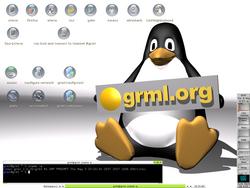
Screenshot of grml 1.0 It’s done. grml 1.0 is available. New features? Tons of them. 8-) Just check out the official release notes for grml 1.0. Need grml for a x86_64 system? No problem, grml64 0.1 is waiting for you. You are used to grml-small? Check out grml-small 0.4. You want to know what are my favourite features of the new release? Besides the updated kernel, libc, X.org and the 109 new packages? For example I love grml-debootstrap’s feature of installing a plain Debian with one single command (no further keypress!). I love playing with ZFS on Linux using zfs-fuse. I like the possibility to generate an OpenOffice document out of my existing asciidoc documentation using docbook2odf. I’ll present the new release at the grml booth of grazer linuxdays on 19th of may and will give a (german) talk about grml on the event as well. Hope to see you there. ;-)

Ross Burton: I'm Doomed

Srini mailed the list so it's official now: I've just joined the Evolution team as Addressbook Maintainer. I've a terrible feeling this will be the end of me, but I'm sure the journey will be fun! Thanks to Srini for asking me to join the team, it's a great pleasure to be invited to maintain such a high-profile component as Evolution. I've not really touched the code of Evolution itself, focusing more on Evolution Data Server, but that is good because Srini has been focusing more on Evolution so together we should make a good team. My primary goal is to merge and polish the DBus port of EDS. The current plan is to attempt to land the port in time for GNOME 2.20, although disabled by default. Hopefully enough developers will be foolish brave enough to enable it and report any bugs they find, so that we might even be able to enable it by default in GNOME 2.20. This is a tight plan but it might just be achievable. NP: Music City Soul, Beverley Knight

Eddy Petrișor: Debconf7, here I come

Since I never got managed to reemit my credit card, I was forced to reserve my plane ticket to DebConf7 via phone.

The good news is that, this time I was able to find e-car.ro which apparently has some better search engine since I still found some cheaper (not much) flights than I did in January (I have a printout of the flight I thought of initially).

The price now is NOT a lot bigger than the one I found in January. Back then it was about 400 , now I'll have to pay around 425 [*]. Is not the same set of flights, but I don't mind.

So, now I have these flights:
I would have liked to have a wider window at return, between the flights, but, although there was some flight that left from AMS at 13:00, it was not possible to couple with that flight and keep a low fare :-( . So, my visit to Amsterdam must wait for another occasion.

So,
  1. if anybody else will be on any of these flights, I would welcome company.
  2. Helooooo, DebConf
Now I'll just have to have the confirmation mail and go myself to do the payment at e-car. Fortunately e-car is somewhere in the center of Bucharest, in the Roman Plaza (Pia a Roman ).

[*] If this sounds like a contradiction with the previous, is not. Now I found some of the previousely found flights and some new cheaper ones (all "now" prices), but since the booking is done later, all "now" prices are bigger than "January" prices. So if I had done the same booking back in January, I would have payed less; but back then I didn't found the flights I booked now.

Russell Coker: SE Linux in Debian

I have now got a Debian Xen domU running the strict SE Linux policy that can boot in enforcing mode. I expect that tomorrow I will have it working with full functionality and that I will be able to run another SE Linux Play Machine in the near future. After getting the strict policy working I want to build a Debian kernel with CONFIG_AUDITSYSCALL and an audit package so that I can audit system calls that an application makes and also so that the auditd can collect the SE Linux log messages. Other people have talked about packaging audit for Debian, hopefully one of them will do it first and save me the effort, but it shouldn’t be too difficult to do if they don’t. Then I need to investigate some options for training people about SE Linux. As I don’t currently have the bandwidth for serving large files I’m thinking of basing some SE Linux training on Xen images from the jailtime.org repository. My rough plan at the moment is to have people download Xen images, run through them while consulting a web page, and ask questions on an IRC channel. I’m not sure what the demand will be for this but some web pages teaching people about SE Linux will be a useful resource even if the IRC based training doesn’t work out. Another thing I want to do is to get PolyInstantiated Directories working in Debian. The pam_namespace.so module needed for this is written for a more recent version of PAM, so I might just work on merging the Debian patches with the latest upstream PAM instead of back-porting the module to the ancient Debian PAM.

Next.

Previous.