Search Results: "will"

24 May 2007

John Goerzen: Debian Developers 7 Years Ago

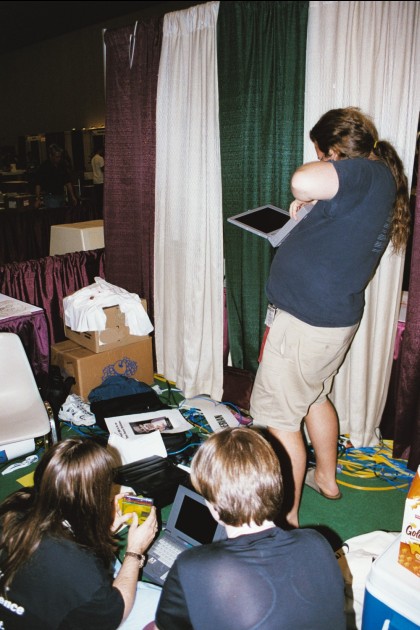
Today while looking for something else, I stumbled across a DVD with the "last archive" of my old personal website. On it were a number of photos from the 2000 Annual Linux Conference in Atlanta, and the Debian developers that were there. These were posted in public for several years.

I've now posted all of them on flickr, preserving the original captions.

Here's the obligatory sample:

20001018-01-06.jpg

That's Joey Hess, using what I think was his Vaio. Most acrobatic keyboardist ever. Probably the only person that could write Perl with one hand comfortably.

What else can you see? The best of show award that Debian won that is now in my basement due to a complicated series of events, the Debian machines that were being shown off at the show, Sean Perry and Manoj, the photo with long-term corrupted caption, and of course, numerous shots of Branden.

I know the size stinks. It was scanned at a web resolution for 2000. I do still have the negatives somewhere and will post the rest of them, in higher res, when I find them.

Click here to view the full set.

23 May 2007

Luk Claes: BSP l10n

Last weekend we organised a Bug Squashing Party where more than 70 packages got fixed. Personally I fixed more than half of these :-) I noticed two unexpected things. Some maintainers were not aware that in a BSP with uploads to DELAYED-0 they should mark bugs pending or comment in the BTS if they don't want people to work on these bugs. Next some NMUers only fixed RC bugs even if there could be translations included or updated. Anyway the BSP was very successfull though I hope even more people will be involved in the next one ;-)

Martin-Éric Racine: Bidding farewell to 32-bit computing

A number of recent events reminded me of how much time has passed since I started using Linux. Among these, the retirement of several 32-bit CPU architectures from the list of supported platforms on Debian and Ubuntu. The first architecture to fall was m68k. Release Managers at Debian proposed to drop support for m68k after Sarge, which indeed happened: Etch was released earlier this month and, for the very first time in Debian history, without m68k support. Granted, a number of dedicated developers are working on porting the GNU toolchain to Coldfire (an embedded platform that supports about 80% of the m68k instruction set) and good chances are that they will succeed but, let's not fool ourselves: m68k is gone. Around the same time, Ubuntu dropped support for PowerPC, just before releasing Feisty. Granted, there is still some PPC64 hardware being manufactured, but this is on the server side and thus getting farther away from the desktop market that constitutes Ubuntu's core business. Of course, given the plethora of 32-bit PPC hardware in circulation, in the form of second-hand Power Macs, the platform still has some lifespan left but, again, let's not fool ourselves: PowerPC is gone too. And now, a message sent to Debian mailing lists suggested that, as of Linux kernel 2.6.21, support for 32-bit SPARC was broken and, due to an insufficient developer interest for maintaining the GNU toolchain, 32-bit SPARC was likely to be dropped for the Lenny release. Yup, we really cannot fool ourselves: support for 32-bit architectures really is gone. Not surprisingly, my own computer collection has followed a similar trend: this morning, my beloved PA-RISC host left for the home of a happy computer hobbyist who had won the online auction on it. My Atari TT030 is likely to follow a similar route fairly soon. Ditto for the exotic Atari Stacy sitting besides it ...and let's not mention the huge stack of Pentium II and K6 desktop hardware sitting in the corner. Looking back, I'm glad to have shared so many brilliant years with 32-bit hardware. The variety of CPU architectures and hardware designs was quite a learning experience. This being said, life goes on and my current needs are fully covered by my Linutop and by my aging ThinkPad. Thank you for all those years, 32-bit computers. Enjoy a well-deserved rest in bit heaven.

David Welton: Domain names vs real estate

I was reading some of the debate regarding this guy and his business: The man who owns the Internet and got to thinking about the comparison between domain names and real estate. One of the things that irritates me about domain name squatters is that they can essentially sit on a good name forever, at very, very little cost. You can't do that in real estate, because you have to pay property taxes, which acts as an incentive to actually do something productive with the property, rather than simply let it sit there until someone comes and offers to buy it from you for even more than you paid. So you can't let the space go completely to waste - you have a big incentive to at the very least rent it out to someone who can make money with it. You can't really rent out a domain name, though. Since it's an integral part of your brand and identity, it would be insane to borrow one for a few years, whereas with a physical business renting space, people will still be able to find you if you move. Perhaps an annual tax based on the purchase price of domain names would encourage people to either do something valuable with them or pass them on to someone who could? I don't think anyone would be sad to see pure speculators gone, but on the other hand, I have a strong suspicion that all the extra taxes and red tape would make the idea a net negative, and taxes on 'real' domains like google or ebay, would simply be passed on to consumers, and so wouldn't be desireable. In any case, it's something interesting to think about.

Evan Prodromou: 3 Prairial CCXV

I just finished reading Ben Yoskowitz's Top 10 reasons to join a startup, and I feel like I have to say something. As an experienced programmer, I think of a startup as an abusive relationship. Most technology startups I've been in have been run by charismatic sociopaths with no actual management or technology experience. They make wild, ignorant, unfounded promises to employees, investors and potential customers, then get increasingly anxious and unpleasant as their unsupportable predictions of schedule and market share don't come through. Employees end up working 80-hour weeks, typically for low or no pay and worthless stock options that never pay out. Guilty that living the "startup lifestyle" (work from home, come in late, have fun) has caused schedule or feature slips, they push themselves too hard at work, to the detriment of their health and home life. It doesn't help you much get another job later. Most startups don't succeed, which means that you end up with 1, 2 or 3 years of space on your r sum consumed by a made-up company name that no one has ever heard of and whose phone line has been disconnected. If people have heard of the name, they'll associate it with failure ("Oh, yeah, wasn't that the company that spent all that money and went nowhere?"). On top of all that, the tech experience of working in a startup is usually pretty bad. The engineers are typically unexperienced -- just out of school, or close to it -- and they waste a lot of time and effort trying to reinvent the wheel. The idea that you're changing the world encourages this kind of bad engineering. You end up cutting a lot of corners and developing a lot of bad habits that you have to unlearn later on. Schedule pressures make you drop important engineering steps like analysis, design, unit tests, documentation. That is, if you even knew you were supposed to do them in the first place. It takes a lot of experience in this kind of pressure-cooker environment to come out of a startup sane, healthy, and wealthy. The vast majority of people end up with broken relationships, poor mental and physical health, and not much in the way of money to show for their efforts. tags:

Wikiclock in the news So, Niko, Hugh, Mike and Leoben Richardson all blogged about the Wikiclock. As far as I know, no MSM coverage yet, but it should be coming down the pipe any day. I talked to Niko tonight, and he said that he saw Hugh at La ka, and Hugh was updating the wikiclock. They traded off updating all afternoon. Sigh. It's actually quite addictive. tags:

Transit strike We've got a transit strike on in Montreal (see the CBC for deetz). It's a pretty heinous problem -- the maintenance workers are asking for X% pay increases over Y years with blah blah blah pension and fie fo fum and... Whatever. The city is refusing to budge, which makes our mayor, G rald Tremblay, officially a hypocritical idiot. Tremblay has been wagging fingers at provincial, federal and international figures for years about sticking to the Kyoto protocol, but when the hard decisions had to be made, he was willing to shut down Montr al's transit system... in summer... after one of the warmest winters in history. You can blame both sides on this issue, but when it comes down to it the union's job is to get the best deal it can for its workers, and Tremblay's job is to keep the Montreal M tro running. Someone's not doing his job. The city spends millions trying to get commuters out of their cars and into the public transit system. And all that work's out the window, now. Despite the public call for more people to rollerblade to work (riiiiiiiight), traffic is way up and auto use is way up. That means air quality is going to go down, and our city can go from being an environmental leader to an environmental mistake. I'm glad to hear that the Quebec government is stepping in to break up the fight, but I hope it doesn't take too long. tags:

Calling graphic designers: Universal edit button One of the interesting movements to come out of RoCoCoCamp this weekend is the idea of a universal wiki edit button. This would be an icon similar to the RSS radio-wave icon that's become ubiquitous for indicating an RSS feed. The UWEB would symbolize that the current page can be edited. Folks at AboutUs.org have taken the lead on this effort, which could be really interesting. Getting a universally-understood sign for "edit this page" would greatly help with acceptance of the wiki way by the general public. I don't think it'd have to be limited to wikis; any page that could be edited (e.g., on a CMS) could also have the UWEB. I highly encourage skilled graphic designers who want to take a crack at designing the Next Big Icon to look at the UWEB effort and give it a try. tags:

Joey Hess: new d-i lab machine

A while back I set up a d-i test lab, a kind of automated mechanical computer torture rack, which has been trying (and frequently failing) to automatically install Debian onto a half-dozen varied machines every day for a couple of years. Problem is that hardware sucks, even when it's tucked away in a friend's basement and so not blaring at you with its combined total of 100 fans and 50 disk drives. It has an annoying habit of dying, especially if it's oddball machines for different architectures. Cords have a habit of getting unplugged. It's hard to automate booting from installation media. And so on. A while ago I decided to go virtual. Now, thanks to Dann and Matt and HP, I've gone from this: big rack of stuff to this: top HP donated hydra, a maxed out 8-way Xeon with 4 (soon 8) disks. The idea is that it can run 7 or so virtual machines, all doing test installs, in parallel. Fast. I'm using kvm for the amd64 and i386 tests. Since Debian has mips and mipsel kernels specially built for running under qemu, I'm able to test the installer for both those arches. Hercules will cover s390, once the kernel gets fixed. This leaves some architectures still todo: I also still have to write enough installation test cases to keep this monster machine firing on all 8 cores all day long. It can probably handle around 300-400 installation tests per day. Since hydra has the disk space, and these emulators are generating lots of disk images with Debian pre-installed, I have also set it up to retain the disk images. I imagine that some of these disk images will eventually be useful for devleopment, since it's much easier to boot a disk image rather than sit through a slow qemu install on an arch like mips. I haven't worked out how to make these images publically available yet, but hydra is located on the name network as gluck.debian.org, if anyone wants to get access to them. Update: I also have qemu doing a 'savevm 1' before shutting down, so you can even restore the running system from the disk images. Especially useful if the install failed somewhere in d-i! :-) BTW, I can give out accounts on hydra to any Debian developers who need a fast machine to run kvm/qemu on, or to anyone who is interested in setting up their own installation tests.

22 May 2007

Eddy Petrișor: gettext: lesson 2

The first lesson was about wrong assumptions that people do when it comes to i18n. This article is mostly targeted at developers which want to support i18n properly, in particular, plural forms.

This is my second n?getetxt lesson.
This is about making your update-po target to include all the strings you want localized in the pot file.

Probably, at some point you, as a developer have written something like:

print("You won %d point%s", points, points>1?"s":"" ) ;


Well, is nice and dandy that you want to make the proper choice of words when you have more than one point. I appreciate that, but you are doing it wrong. There is a tool for that, as I explained before.

Now, lesson 2.

You have understood what you have to do, but you just hate typing ngettext/gettext all over the place, so you probably defined something like:

#define _(X) gettext(X)
#define _n(sg,pl,n) getext(sg,pl,num)

So now you can write trhis piece of code:

print(_n("You won %d point", "You won %d points", points), points ) ;

The problem: how to convince xgettext to add those strings to the pot file?

Nothing simpler... just add _n as an additional keyword when invoking xgettext... but you have to specify that this is a definition for ngetetxt, so, you will end up having in your update-po target something like this:

xgettext ../src/*.c --keyword=_ --keyword=_n:1,2


TADA!

Alastair McKinstry: Election 2007: Choices in Galway West ?

Has anyone seen a recent poll for Galway West? (In the Irish General Election, that is). The last poll was March 26th, which is way out-of-date : long prior to the election being called, before the Cryptosporidium Crisis, etc. The result is, I'm in the unusual position of having to make a decision. Ordinarily I'd vote Number 1 for Niall O'Brolch in (Green) and 2. Micheal D. Higgins (Labour). Ireland uses the unusual Single Transferable Vote system, with multi-member constituencies. Galway West is a 5-seat constituency, and Micheal D. is a long-sitting TD, who most would have expected to be automatically returned. Niall O'Brolch in is fairly new; he's a member of the City Council and current Mayor of Galway (thats a relatively powerless post in the Irish local council scheme of things, though). Unfortunately news from the Labour camp appears that too many people assume he will be automatically returned; the word they are getting on the street is "Yes, you'll be getting my no.2 ". But in the STV system, this could mean he wouldn't be in the running. Those votes for the Greens and others will perhaps stay with the Greens and won't transfer to him. So the choice, Vote 1. Greens, which is my natural preference, or 1. Labour, in the hope of getting both Micheal D. and Niall elected? a poll of the current situation would help. BTW, for voting geeks, following the link and reading about STV is worth it. It makes Irish election counts the most fun election counts in the World. One of the main arguments against electronic voting in Ireland has been that it would take all the fun out of the count, which would be over too soon ... Tags ,

Thijs Kinkhorst: Den en Rust revisited

Tomorrow I will be attending a cremation for the second time in two weeks - at the same crematorium even: Den en Rust in Bilthoven. (You won't believe how detailed Wikipedia treats the subject of cremation) Two weeks ago my friend and former flatmate BAAS (eng.: BOSS) died at the age of 34 after nine years of cancer. Still it came as a surprise to me: we've gotten a bit "used to" BAAS being subject to therapy every once in a while, recovering, and then starting the whole circle right over. It was a good service that highlighted the diverse social circles he was active in, and was concluded with a gathering that featured a lot of drinks and snacks. Tomorrow the service will be dedicated to my uncle Koert, who died last week at the age of 60, also from cancer. I surely didn't expect to return to "Den en Rust" that soon. I'm wondering what the service will be like, although it's in the same place, it will probably be quite different.

Holger Levsen: freedom is like health

You will probably only see its real value and scope, when you have lost it already.

Michal Čihař: Caching slows things down?

I've been using memcached for some time on phpMyAdmin wiki and it seemed to help. But recently the performance went down. I didn't have time to investigate it till today and it turns out to be caused by memcached. When I switch it off, page load time goes from 16 seconds to 0.25 seconds. I tried to search for some similar problems on the net, but I didn't succeed. So for now wiki runs without memcached and I will look at other possibilities of caching later.

Sune Vuorela: kde 3.5.7

kde 3.5.7 is now available in debian unstable on several architectures. Hopefully the rest will catch up when some bugs in other packages are fixed. Feel free to upgrade - but please please please - log out of kde and back in after you have upgraded and before you start filing any bugs.

Adam Rosi-Kessel: Mind Walker and Cookies

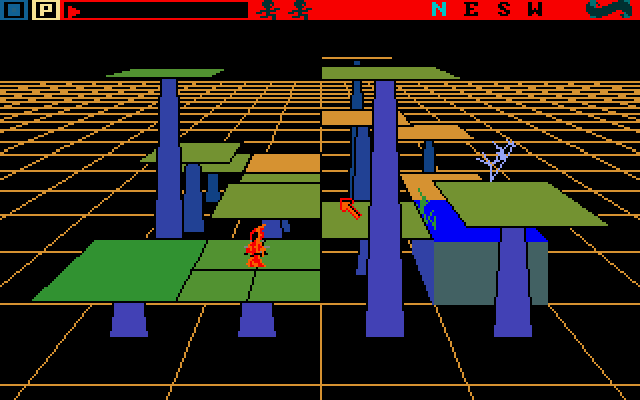
Pete, an old high school friend and biology-project partner, recently discovered my email address and we reconnected. It occurred to me that the next generation may never experience reunion with long-lost friends: they’re all on Facebook and Myspace from middle school on up, so how will they ever lose touch in the first place? Peter wrote to ask me the name of an Amiga game we used to play in the late 1980’s. I knew immediately which game he was asking about: Mind Walker. I remembered it as a fantastic surreal action/video game exploration of the human psyche. I think it was probably more Freudian than Jungian. Only a few games stuck with me at this level — another one was Weird Dreams. (The problem with Weird Dreams was that it was impossibly difficult to get past the level where you have to smack Dali-esque statues with flying fish. If anyone ever did, I’d like to know what happened next.) This review gives a good summary of Mind Walker:
You are a physics professor gone mad. Your course of action? Delve into your Mind, to inspire “Ideas” by tracing “Paths of Coherent Thought”, with the help of your split ego. Then through opened-up Tubes, enter your Brain, to retrieve “Shards of Sanity”. Finally, put them back together in Subconscious.
I remember Mind Walker as having amazingly spooky and captivating graphics. Then I found this screenshot: Mind Walker Screenshot Oh well. I’m sure it actually was impressive at the time. This discovery reminded of times when I’ve rediscovered a favorite food from childhood — for example, a certain type of cookie — only to find that it really isn’t very good at all. Just kind of sugary and low-quality chocolate. It’s also like going back to watch the original Jurassic Park again. The amazement is gone. Actually, even though the Mind Walker graphics aren’t as impressive as I remember them, I’m sure it was still a great game. Anyone have screenshots from Weird Dreams?

21 May 2007

Neil Williams: gpe-cash - double entry accounts on handhelds

subtitle: Break up GnuCash into lots of forks

With an ISP problem throttling my broadband to 4000B/s, I've switched to developing in C instead of building Emdebian packages - downloading Debian sources was taking an hour or more even for small packages.

This has made time for a long overdue project: gpe-cash - double entry accounting for handhelds. It's a spin-off from the stalled cashutil project and it just might provide the impetus to get cashutil into a releasable state.

gpe-cash uses QOF (Query Object Framework) which itself was spun out from GnuCash some years ago when it was described as "the gnucash engine without all the financial stuff". So gpe-cash is a happy reunion of the engine and the financial stuff along with Gtk+, only a lot smaller than GnuCash. Yes, it is a fork but a fork done for, IMHO, very good reasons. (Why write free software and then frown on forked projects?) There's little hope of getting GnuCash to run on any embedded hardware (it would probably end up as a laptop instead of a handheld in the process) so it has to be broken up: forked into a few smaller bits and simply dropping larger bits.

I've long wanted to break up the GnuCash behemoth and this is how this fork will work:

  1. Package the basic GnuCash objects as a shared library with -dev, -dbg and -doc

  2. Package the GnuCash business objects as another shared library, with ditto.

  3. Leave the commodity (stocks and shares) objects for a later date due to QOF compatibility issues with the GnuCash code.

  4. Use the pilot-qof Default Currency Table to create a tiny set of gnucash compatible currencies. (Also used by gpe-expenses already.)

  5. Share live expense data with gpe-expenses and gpe-cash (prevent duplication)

  6. Share contacts and live calendar data with gpe-invoice (calculate invoices)

  7. Drop direct file compatibility with GnuCash until GnuCash itself supports a sane backend, a suitable data import or cashutil is fixed, whichever comes soonest.

  8. Retain object compatibility with GnuCash at the QOF level - permits removing certain parts of GnuCash specific code from the objects whilst retaining functionality.

  9. Drop all reports, graphs, CSV import, QIF import, Scheme and other complexity of GnuCash.

  10. Use a simple SQLite backend via QOF.


Best laid plans . . . etc. It always ends up a bit different to the plan but you have to have a plan of some kind. (No?, well I do.) ;-)

The code is a combination of gpe-expenses and cashutil. It will (eventually) live within the cashutil SVN at SourceForge but I haven't committed the first changeset yet. The basic structures already work, it is tying the C objects to the Gtk that is the bulk of the remaining work.

If anyone is interested in upstream development, subscribe to the (very low volume) QOF-devel mailing list and let me know.

Stefano Zacchiroli: i had a dream

I'm Going to Play Some Number at the Lotto The Lotto Game is a really popular gambling game in Italy, run by the state itself. As in all good gambling game: you, the player, can win a lot of money while who is running the game (the Italian state in our case) will win a lot of money for sure, no matter what. Anyhow, to the facts, it's a well-known folklore that people win playing Lotto FOR SURE by playing numbers told while dreaming by parents, friends, kitties, whatever, ... As a scientist, I've no reason not to trust this folklore, why should I? As a strange coincidence (another fact that strongly hints I HAVE TO PLAY), this night I had a dream (well, it was more this morning while reading the planet, but it doesn't really matter..., folklore is folklore!). There were a lot, really a lot of people whispering this to my ears:
09 F9 11 02 9D 74 E3 5B D8 41 56 C5 63 56 88 C0

well, ok, they aren't in decimal notation, and they aren't even comprised between 1 and 90, ... but what would you expect from a bunch of geeks??? They are probably trying to exploit some overflow in the hands of the lotto extractor or something like that... But I won't desist, I'll play those number! Open questions: any proficient Lotto player to answer them around?

Evan Prodromou: 1 Prairial CCXV

I just got back from taking Zach Copley to the airport, and for the first time in a few days I'm sitting in front of my desktop computer again, trying to get back on track. I think it's probably a good idea to get my notes about RoCoCoCamp down on electronic paper while the experience is still fresh in my mind. (I wrote about the first day in Journal/29 Flor al CCXV). Saturday morning I got up considerably later than I had the day before, and I took my time getting to SAT. Which was OK, since things went much smoother in the morning. The only really annoying thing about Saturday was that I had to wash about 50 cups by hand -- we'd run out of clean cups, and I couldn't figure out how to run the dishwasher. It didn't take long, but it meant that I had my head down in the sink as people came in and didn't get to spend as much time talking to them. I was glad to hear that people had a good time going to L'Utopik on Friday night. Apparently a few people who'd flown in late on Friday got a chance to meet up with the experienced crew at L'Utopik, so they were well-prepped for Saturday. Probably the biggest buzz of the pre-sessions was SJ Klein's pair of functional OLPC laptops. They were cute and fun -- I got a few minutes to play with them, and I enjoyed the interface tremendously -- although it took me a few tries to open it. People were fiddling with them throughout the day -- including Amita June, who came late in the afternoon -- and Tristan P loquin even blogged about them. My first session was about wiki and other technologies, which I titled Wiki And.... (I borrowed the name from Last Exit to Brooklyn, in which it seems no-one eats anything but "coffee and".) My main point was that a) wiki people tend to overuse wiki where other software tools may be more appropriate and b) we need to be careful with impedance mismatches when using wiki with technologies with other cultures behind them. Wikis and blogs mismatch; wikis and forums mismatch. You need to work out ways to make them work culturally. As a proof-of-concept that there are ridiculous applications for wiki, I created in about 3 minutes before the session the wikiclock. It's a computer clock that runs on wiki technology: the time is kept up-to-date by human beings editing the page, rather than with software. I was so pleased with myself that I twittered about it, and from there it's taken on a life of its own. The clock is implemented on the amazing minimalist system pageoftext.com. I heard about p.o.t. from Liz Henry's April report from Palo Alto Wiki Wednesday, and I think it's totally great. It's a cross between a pastebin and a wiki -- like an open-edited ImageShack for text. Brilliant. The second session I did was a hyper-focused one on a particular Semantic Web problem. Both Wikitravel and Open Guides have tons of information on "places" in various cities. (That is, restaurants, bars, nightclubs, hotels, museums, parks, etc.). It would be good to export our data on these places to each other, so we could possibly keep them in sync. For example, if a restaurant changes its hours , that info could be updated on The Open Guide to London and automatically synched to the Wikitravel page on London. So we went over some ways to do this kind of interchange; we'd brainstormed before about it on the Open Guides' RDF Workshop, but it was good to sit down with Earle Martin and do some face-to-face hacking on the idea. We don't yet have a vocabulary for it, but we'll get something going on the new wikirdf.org site (which also emerged from this session). I had a great lunch with a lot of people from RoCoCo on the terrace at the Bar St. Sulpice, about 8 blocks away on rue St. Denis. The sun was out, it was cool, and we had a very nice time. It was especially nice to see Marcus Bornfreund and Tina Pipers of Creative Commons Canada, who'd come to talk about the PDwiki, a project to collaboratively document Canadian works in the public domain (see Canadian Public Domain Registry Announced). We talked quite a bit about the social challenges of getting a community excited about such a dry subject, but I think we got some good ideas about it. In the afternoon I led a session on MediaWiki. We were lucky enough to have Tim Starling sit in, and he told everyone about the new developments going on with MW. He's refactoring some very deep parts of the storage and rendering sections of the code, which will result in considerably better reliability, performance, and flexibility. I think it sounds great. I had to work the registration desk for the last session of the day, which was pretty great because I ended up baby-sitting Anoushka Jaroski-Biava for most of the time. But I missed Robin Millette's cool talk about BuzzyBee, which looks to be really fun to play with. We rounded out the evening with music, pizza, and beer at the SAT. tobias.dj played some great dance music, and we had some wiki-collaborative VJ-ing using the SAT's fancy screen systems. All the kids were there -- Mark and Allegra's daughter No ma as well as Amita June. Fun. Sunday morning I didn't have to start coffee until 9AM -- luxury! We had a great Open Space Technology convergence -- a way to turn the discussions of the previous few days into action items for going forward. I did a convergence session on the future of RecentChangesCamp. We had most of the interested parties available (except for the RCC Portland organizers, who had to fly out early that morning). We made some decisions about future RCCs, and we made some plans for next year's RCC -- in the Bay Area (California). Last night we brought back the Keiki gang to our house, since it was great to have them all in Montreal for the event. We did a big brainstorming session on next steps to launching the project, and we also did some graphic design review of potential logos. We have some great designs coming; I'm really happy we got Sarven Capadisli and Bridget to work on the site. I had to crash out at 10:30PM -- Amita and I fell asleep together -- but others were up late talking and thinking. I don't know how they did it -- I was all talked out by the end of RoCoCo. All in all I had a fantastic time -- the event far surpassed my expectations. It was hard -- too hard. I bit off far more than I could chew. But I think we did a good job of establishing Montreal as a technology city -- Wiki City Canada -- in the international mind, and I think we also brought together some really interesting people for some fruitful and productive work. You can see some of the projects that came directly out of RoCoCo on the FutureChanges page -- an ingenious name courtesy of Pm. And there are some indirect ones that we can expect soon. tags:

Cause and solution So, Technorati has a good listing for rocococamp items, but I especially liked Steve Faguy's post: Wiki: The cause of, and solution to, all of life s problems. Steve was an extremely game participant in the event, which I think was pretty incredible. He wrote a good overview of wikis in the Montreal Gazette this year. A funny thing happened on Friday evening during the daily wrap-up known as "Evening News". We had Open Space's minimalist instructions posted on the walls of the SAT, so people would see and remember them. Steve pointed out that the first of Open Space's "four principles" is grammatically incorrect: Whoever comes is the right people. He said, "In the spirit of wiki, I'm going to correct it right now!" And to applause, he got up with a marker and changed the "is" to "are". This stimulated an interesting discussion. One person noted that the "is" is there because possibly only one person could show up for a session, and that's OK. Finally, Brandon CS Sanders stood up and said, "I like 'is' because when we come together like this, we form a cohesive group, however temporary -- 'a people'. So I'm going to change it back." And he did -- to lots of applause, again. Steve came up to me at the end of the night, laughing. "I got reverted! I should have started an edit war!" It was a hoot; he's got a good sense of humour. tags:

MJ Ray: the Cooperative Group: United merger

bill watson commented:
"Excellent report. I'm a member of Co-op Group (Northern) and also United. United is an extremely well run outfit with well maintained shops. They also have about 30 petrol stations, mostly in Yorkshire and Greater Manchester. The fear from United members, on the proposed merger, is that focus will be lost and regional investment diluted. United are also trialing factory made shop units which are erected on-site (similar to the way McDonalds do it). This gives a turnaround time of about 16 weeks from start to shop opening. There is one not far from me (Ditton) and it's very popular. The United website United Acquisitions gives lots of info on this and other things."
I've mixed feelings on modular build (McStores?) - it makes the construction greener, but there seems little information on the long-term energy use of the store. Maybe it's simply unknown yet. The offer of a finder's fee for new store sites is interesting. I wonder if that will spread to the Co-operative Group after the merger. As I understand it, the fear from tCG members is that we're getting a lot of new members and a new chief exec who seems to have a very different focus to the members. I'm sure we'd be happy to see well-run and well-maintained shops, but will it mean even more centralisation and all the mistakes that means? Like stocking no Somerset Cheddars in some Somerset stores, with the confusing excuse that (as far as I could understand - see previously-mentioned answers to AGM food questions) no supplier offers enough units that meet the specifications or it's unsuitable for our type of stores ("Welcome"). I'm glad so many people liked the report, anyway.

MJ Ray: Samba, CUPS, Printing (Reader Comments)

Pete Boyd wrote:
"
"Surely if one has CUPS installed already, a Microsoft PC can print to it as a network printer without Samba?"
This is true but you need to know what you're doing to be able to add such a print queue on Windows, its not trivial. The procedure people using Windows will expect to use is something like point'n'print where they navigate to the print server in Windows Explorer, right-click on the print queue and choose 'Connect'. This way the drivers are copied across the network and auto installed on their system and the print connection setup."
It looked like I could add it by opening the Printers and Faxes screen, clicking "Add a new printer" selecting the right radio button and then putting the URL for the CUPS server into the box. Doesn't that work then? chithanh wrote:
"If you already have a working lpr setup, you can install Print Services for Unix via the control panel, and connect to your lpr daemon. No need for Samba at all."
Thanks for the tip. My lpr doesn't offer remote connections (it's a shell script that execs ghostscript), but I'll remember the above for future use.

Bernd Zeimetz: hi, planet // iso8859-15 to utf8 with netatalk magic

<div xmlns='http://www.w3.org/1999/xhtml'> <h1><a name="hi_planet_iso8859-15_to_utf8_with_netatalk_magic" id="hi_planet_iso8859-15_to_utf8_with_netatalk_magic">hi, planet // iso8859-15 to utf8 with netatalk magic</a></h1> <p> <em><strong>Hi, Planet!</strong> <br/> Welcome to my blog, and thanks to <a href="http://blog.zobel.ftbfs.de/" title="http://blog.zobel.ftbfs.de/" rel="nofollow">Martin</a> for subscribing me. I m not going to bother you with any details about me, if you have any questions feel free to ask me on <a href="http://freenode.net/" title="http://freenode.net/" rel="nofollow">freenode</a> or <a href="http://www.oftc.net/" title="http://www.oftc.net/" rel="nofollow">oftc</a> (in case you re wondering: my nick is bzed).</em> <br/> <br/> After a longer time of planning we ve upgraded our main file server at <a href="http://www.architektur.tu-darmstadt.de" title="http://www.architektur.tu-darmstadt.de" rel="nofollow">work</a>: New machine, new storage (7TB - woohoo!), Etch instead of Sarge and <a href="http://en.wikipedia.org/wiki/UTF-8" title="http://en.wikipedia.org/wiki/UTF-8">UTF-8</a> for file names instead of <a href="http://en.wikipedia.org/wiki/ISO8859-15" title="http://en.wikipedia.org/wiki/ISO8859-15">ISO8859-15</a>. Everything not a too complicated thing, except for renaming the about 10,000,000 files from ISO8859-15 to UTF-8 in a proper way. <br/> In theory this is easy, as <a href="http://packages.debian.org/unstable/utils/convmv" title="http://packages.debian.org/unstable/utils/convmv" rel="nofollow">convmv</a> happily takes care of the problem. But this did not work for us unfortunately, as we re not only providing NFS and Samba services, but also AFP (<a href="http://en.wikipedia.org/wiki/Apple_Filing_Protocol" title="http://en.wikipedia.org/wiki/Apple_Filing_Protocol">Apple_Filing_Protocol</a>) via netatalk. Years ago you had to choose ISO8859-15 if you wanted to allow your Apple and Windows users to see the same, non-broken file names - not only because AFP didn t support UTF8 before version 3, which came out with OSX<a href="#fn__1" name="fnt__1" id="fnt__1">1)</a>. Normally you d think that a server would not allow a client to write a file with a file name which includes not supported characters - again, OSX and netatalk go their own way here:<br/> Characters which are not supported by the underlying file system are character(!)-wise encoded using the <a href="http://netatalk.sourceforge.net/2.0/htmldocs/configuration.html#id2898845" title="http://netatalk.sourceforge.net/2.0/htmldocs/configuration.html#id2898845" rel="nofollow">CAP encoding</a>. So we had to find a way to </p> <ul> <li> convert file names from ISO8859-15 to UTF-8 </li> <li> replace CAP encoded characters by the appropriate UTF-8 character </li> </ul> <p> Luckily netatalk ships the <a href="http://netatalk.sourceforge.net/2.0/htmldocs/uniconv.1.html" title="http://netatalk.sourceforge.net/2.0/htmldocs/uniconv.1.html" rel="nofollow">uniconv(1)</a> util<a href="#fn__2" name="fnt__2" id="fnt__2">2)</a> which is able to take care of this problem. It also updates the CNID<a href="#fn__3" name="fnt__3" id="fnt__3">3)</a> Database at the same time. There s two things you need to take care of in case you re using the dbd <a href="http://netatalk.sourceforge.net/2.0/htmldocs/configuration.html#CNID-backends" title="http://netatalk.sourceforge.net/2.0/htmldocs/configuration.html#CNID-backends" rel="nofollow">CNID backend</a>: </p> <ul> <li> uniconv assumes that <em>cnid_metad</em> is listening on port 4700, you need to start it first. Don t run afpd at the same time! </li> <li> If you ve specified external CNID dbpaths in your <em>AppleVolumes.default</em> (normally they re located in the root of each volume, prone to be deleted by users accidentally), you need to move the .AppleDB directory into your volume s root directory, otherwise uniconv will create a new CNID database. Just move it back as soon as uniconv is finished. </li> </ul> <p> Be careful: uniconv assumes that all colons in a file name are part of a CAP encoded character. That s not a problem as long as you have only Mac and Windows clients accessing your server, as both systems do not allow colons in file names. In our case we found a number of cache files from Nautilus (which is running on our sunray/Solaris web-surf terminals as default browser) with colons in the file name. I hope no user will miss them <img src="http://bzed.de/lib/images/smileys/icon_wink.gif" alt=";-)" /> </p> <p> Including a final synchronisation of all files to the new storage, about two hours it took uniconv to convert the file names and a aunch break, we were finished after about 14 hours of work. Until now it seems that our users didn t notice the change at all, except for those who realized that they have much more free space now. Looks like a successful weekend so far! <img src="http://bzed.de/lib/images/smileys/icon_biggrin.gif" alt=":-D" /> </p> <p> <strong>update:</strong> full html in the feed. </p> <div class="tags"><span> <a href="http://bzed.de/tags/debian" class="wikilink1" title="tags:debian" rel="tag">debian</a>, <a href="http://bzed.de/tags/linux" class="wikilink1" title="tags:linux" rel="tag">linux</a> </span></div> <a href="#fnt__1" id="fn__1" name="fn__1">1)</a> and uses a NFD variant of Unicode normalization (<a href="http://en.wikipedia.org/wiki/UTF-8%23Mac_OS_X" title="http://en.wikipedia.org/wiki/UTF-8%23Mac_OS_X">UTF-8#Mac_OS_X</a>), but netatalk takes care of this and translates it into the NFC form, which is used on most other platforms <a href="#fnt__2" id="fn__2" name="fn__2">2)</a> it s called netatalk-uniconv in Debian and shipped with <a href="http://packages.debian.org/stable/net/netatalk" title="http://packages.debian.org/stable/net/netatalk" rel="nofollow">netatalk</a> <a href="#fnt__3" id="fn__3" name="fn__3">3)</a> Catalog Node ID, another crust from old Mac <acronym title="Operating System">OS</acronym> versions </div>

Aigars Mahinovs: SBackup new beta - test and translate please!

With great help from Ouattara Oumar Aziz an new version of SBackup is shaping up in the svn repo and a day ago I created a public beta version - 0.10.4~beta10 which can be downloaded here.
Please report any bugs or regressions to Sourceforge bug tracker. Also an update for translations and new translations can be added. You can either translate in Launchpad or download the template file from the SVN. But beware that there are more translations in Launchpad then in the SVN at the moment, so check there first.
If no blocker bugs are found, we could see a new stable release of SBackup in a weeks time. I am sure that a lot of people will be happy to hear that :). Edit: For some reason, the DEB on the Sourceforge site was cut to third of its size, I uploaded a new version, it should be fine now. And by popular request here is a screenshot, note that by using simple timing the /etc/cron. daily,weekly,monthly folders are used and thus anacron runs the backups if the computer was off at the scheduled time.
New screenshot

Next.

Previous.