Search Results: "will"

27 May 2007

Julien Valroff: New APRIL member

Thanks to RMS’s call, I have finally sent my subscription fees to become a member of APRIL (the French association for promotion and research in libre computing). I should have done this earlier but postponed my decision without any reason. I hope this will allow me to meet nice people with the same interests.

26 May 2007

Jeff Bailey: Going through the inbox

Wow - I'm finally starting to go through my email inbox from when Leif was born and starting to say thanks to folks for their support. I read them all at the time, but it's crazy to go back 3 months and see how many people were cheering for us.

There will be more photos up this weekend. =) Recent things for him include creeping off of his blanket on the floor and rolling from his back to his front in bed. It's amazing how the simplest things are "OMG come see this, quickly!" events. =)

Evan Prodromou: 5 Prairial CCXV

Incredible day here in Montreal. The temperature got over 31C today -- about 88 F -- which made for a steamy, jungly day. Remember how I said we had predictions of snow flurries two weeks ago? Things change quickly. Of course, hot weather and high humidity are a recipe for smog. Add on top of that the fact that Montreal is in the middle of a public transit strike, and you've got a serious air quality problem. Fortunately we should have some rain this weekend to shake that out. tags:

EC2 I spent a big part of my day twiddling around getting a nice Ubuntu server running on Amazon Web Services. Amazon's EC2 is an innovative server-provisioning API; beta testers for EC2 can build or tear down servers for any purpose in a few minutes using EC2 and Amazon S3. I wrote a few years ago, in a widely-reproduced email, a reply making fun of Jeff Bezos and Amazon's supposed innovations. But let me be frank: Amazon Web Services are a shithouse crazy idea. I think that Jeff Bezos must have been a complete nutjob to bet the company on these zany technologies; I also think it's brilliant, and it's going to change the way we think about using computers. I included EC2 in Ten Web 2.0 APIs you can really use. I think that decision was really justified. My EC2 instances now run Ubuntu Feisty Fawn; lighty, MySQL and PHP. It seems to be a winning combination; I'm looking forward to using EC2 for a production Web or database server. tags:

rel-edit I mentioned already the great work that AboutUs.org is doing to organize a Universal Wiki Edit Button. I decided to kick in on the machine-readable side and proposed a rel-edit microformat. So far the microformats-discuss mailing list has been pretty positive on the idea, but I'm going to wait a few days before posting a draft on the microformats wiki. tags:

Salt I just finished reading Salt: A World History, a nice non-fiction book by researcher extraordinaire Mark Kurlansky. The book covers this important mineral, its importance to human life, and the many ways to extract it to make it available for us. The book covers mummification in ancient Egypt, salt taxes in China, fish sauce in Vietnam, and Mahatma Gandhi's great salt march in India. It's so comprehensive that it can really make your head spin; but it's also exciting to see world history refracted through these whitish crystals. I think it's a great book, and I'm looking forward to reading Cod: A Biography of the Fish That Changed the World, by the same author. But we just got Everything is Miscellaneous from Amazon this week, so I think I'll be digging through that before I get to Cod. tags:

reCAPTCHA I heard about recaptcha via Hugh's article about same. Brilliant idea; why didn't someone think of this before? (Update: it was about 5 minutes after I posted this that I realized, "Hey! That can't work!" So I went back and re-read the docs on reCAPTCHA again. Now I'm even more impressed.) tags:

I want to ride my I've been thinking of picking up a bicycle for a few weeks now, as the weather has cleared here in town. So today I went up to Garantie Bicycle on rue Marie-Anne and bought the cheapest damn bike they had that wasn't made specifically for pre-pubescent children. Woohoo! The last time I had I bike, I lived in San Francisco. It was a beautiful cherry-red Cannondale hybrid -- with that great fat Cannondale tube, but light enough that I could lift it with one finger. I rode it around SF a lot, and took it out for trail biking on weekends in Marin County and the Peninsula and even the Sierra Nevada. It was a tough bike to ride, but once you got used to it it was a dream to take up hills. But that bike was stolen at Burning Man 2001, during the actual Burn. It's a classic mistake: professional bike thieves go to Burning Man each year to snag bikes left unlocked by tired and idealistic Burners, especially at times when camps are left empty, like during the Burn. To be honest, it was kind of a relief: I'd already moved out of my apartment and was planning a trip around North America, and I didn't have room in my Citro n DS for a bike. Nor in my storage locker at the weird and wonderful Sunshine Storage in Oakland. But it was too nice a bike to throw away or give to one of my no-good friends, who were mostly too short for it anyways. So bicycle theft was the best solution. Sam Phillips had his bike stolen at the same time. The bike thieves left a lot of cheapo bikes around our camp. They liked mine and Sam's, though. Anyways, my new bike was quite inexpensive, and it weighs a metric ton. It's built like you're supposed to drive trains over it. I could never, ever carry it up a steep and muddy hill, and I wouldn't bother. Fortunately for me Montreal is really, really flat, so I don't really need to worry about riding this thing up hills. It will look pretty good with a baby seat on the back, though. tags:

Sam Hocevar: Bits from the DPL: FSF, expenses, DSA

chat with the FSF I had a nice talk with Peter Brown, FSF Executive Director and Brett Smith, Licensing Compliance Engineer. We mostly talked about the GPLv3, the GFDL and the Nexenta project. The official GPLv3 launch is approaching very fast, and the FSF was wondering how Debian could play an active part in it. As I also said on debian-devel I am not eager to promote the use of this new licence until we know how much of our libraries are GPLv2-only. Any ideas about what Debian could do are of course welcome. We didn t talk much about the GFDL. The FSF s absolute priority right now is the GPLv3, the GFDL will be addressed later. After last year s GR Debian decided that works under that licence were free if they didn t use unmodifiable sections. We are still waiting for a fix for the badly worded DRM clause, which the FSF told me they re going to address. The Wikipedia project also has concerns with the GFDL so we should expect the licence to change a lot. I opened a licensing questions ticket on May 16th to ask the FSF to clarify their position about the Nexenta and other OpenSolaris projects (full text available here). There are good chances that the answer will be in favour of allowing the redistribution, but it will take the FSF lawyers a few weeks to carefully write it down. I am personally enthusiastic about having this new port in Debian if possible. disbursement of Debian funds Around $4,300 USD (3,200 EUR) of Debian funds were spent or pledged to be spent this month, mainly on travel reimbursement for developers attending Debian meetings or representing Debian at various places. I will send any details to debian-private until I m confident this is the kind of information I can really make public. DSA team Three weeks ago I posted about how not many people were proposing to help with the various core teams, and immediately got a lot more candidacies. Two weeks ago I sent a list and short description of 6 of these people to the current members of the DSA team for comment. Depending on what they are going to answer I ll decide on what to do next. I haven t done anything similar about the other teams yet, apart from collecting proposals and ideas.

Remi Vanicat: git and etc

I’ve recently seen an interesting google video of Linus speaking about git, an one of its advantage : it is a powerful merger, that remember of the merge already done. I’m using git as an archiver/version tracker for the /etc/ of my debian box. As I’m using sid, I often upgrade it, and then one need to merge the modified config files with the new ones of the package. So I wonder How to use git for it. My idea would be to have two branch: one containing the unmodified config files from the Debian packages, the other containing my version of it. Then when I upgrade, first the unmodified branch would be update, and then one could try to merge with the modified one. A simple way to do it would be :
  1. checkout the unmodified branch
  2. update
  3. checkout the modified branch
  4. merge
This method as for me several problem: May be there is a better, like answering no to all question about replacing a config file, then using the .dpkg-new/.dpkg-dist file to update the uncheckout branch, and then merge. But for this I have to go well outside the different porcelain I know and use, and enter the use of some internal git tools. I could try to think about it, or hope someone already did it, or find my idea interesting, and try to do it. Is someone still reading this ?

25 May 2007

Biella Coleman: Pricefull and Priceless

$ 5000 medical bill (that insurance won’t pay for)
$ 450 water bill in Puerto Rico
$ 150 library fine for one lost book that normally costs under 20 dollars Anxiety and rage from dealing with these ludicrous bills: priceless. Ok seriously I am now dealing with these three things and it has been really really really unpleasant. I sometimes wonder if I was once a bad as* Roman tax collector by the name of Biella Plebius and now, reincarnated as Biella Coleman, I am suffering the karmic consequences of extorting people in the 3rd century A.D. Other times I take a lighter approach to all of this and console myself that if nothing else, I am learning a lot. For example, as I had mentioned awhile back, Blue Cross Blue Shield Horizon of New Jersey is stalling and denying health insurance bills for my mole surgery. Because I had a pre-existing clause in my contract, they are trying to squirrel out of it. However, since I never had a pre-existing issue with moles, I am pretty sure they are required to pony up the cash but getting them to do this has been a Herculean, no Sisyphean task. Since it was clear they were not going to pay if I alone was applying pressure, I was about to file a claim in Special Civil court (the bill is too high for small claims court) but I wanted to see if I had any other options. So hours and hours after diligent web research, I finally found on lawyers.com that I can file a complaint against my health insurance via the Department of Banking and Insurance. I am amazed that NO ONE in the doctor’s office, including those whose only job is to deal with health insurance, had a clue about this option. And even when you go to the Dept of Insurance website it is not totally obvious that you can file a complaint (it is under the “file for assistance” category). But once I got in touch with them, they have been incredibly helpful. Now, my detailed complaint letter is with them, and some other documentation and apparently they have an investigator on the case. I am not sure if this route will be enough pressure to get the job done but at least by the time this is over, I will be in the greater NY area so that I can move to the court option. The take away lesson here is that if you are having any trouble with claims and health insurance, do do do do file a complaint with your state Department of Banking and Insurance. This is a great first option to use.

Bastian Venthur: Using zeroconf to resolve local hostnames

If you bought one of those cheap WLAN-routers which provides a DHCP server but no DNS (why again?), you probably miss the feature to access your hosts in the LAN by their name, right? If you’re running a fairly recent Linux distribution (yes, Etch works too), just try to ping them with the .local DNS suffix, like phoibe.local or hades.local. If that doesn’t work, check if avahi-daemon is installed on the machines you want to resolve. If not (which is unlikely on recent desktop machines), just install it and your machine will be available via hostname.local. I wasn’t aware that I would ever need this “zeroconf crap” until I replaced my rusty old Dell Optiplex GXa router with a less energy consuming and much more silent Linksys WRT54G. Unfortunately I bought Version 7 which only comes with 2MB flash and is therefore not supported by openwrt. So without my precious dnsmasq on my router, I was suddenly blind in my own LAN — and very thankful to find out that zeroconf already took care of my problem.

Jonathan McDowell: Thoughts on calendars

I keep having what I've started to think of as the "calendar conversation" with various people. I start by outlining what I think are some fairly reasonable requirements. I'd like to have multiple calenders viewable by different sets of people. So Simon would be able to view my work calendar, while Katherine could see my personal calender (and possibly small bits of work calender where I was going to be away from home). I also want to be able to view my calenders from a variety of devices. My desktop, my phone and my laptop, for example. A web interface might be nice too, though less important to me. This doesn't seem like a lot to ask. My general hope is that whoever I'm boring about this will then say "Oh, you need to look at foo and maybe bar". After all, that's the case with most software related things I need - it's already been done, and there's a good solution available. What actually happens is the person I'm talking to nods in agreement and says they'd like the same sort of things but don't know of anything that manages it. I think the problem comes down to syncing. Sharing my calendars with other people is effectively allowing them to sync their calendar(s) with mine, with some sort of filtering so we each see only what the other wants to see. Likewise, multiple devices is all about syncing. Changes made via one method need to be visible on all of them (ideally as soon as possible). Decent syncing also brings another advantage; client independence. If I can reliably sync my information to a variety of devices/clients then I can try a different client with little risk. We have this already for mail - anything that can talk POP3, IMAP and/or mbox is easy to try out and if you don't like it then you can just change back to what you had before or try something else. Calendaring doesn't seem to have that. I don't think that the interface a client exposes needs to be complex. At a basic level what you need is a way to find out what the client thinks has been added, removed or changed. You also need to present this information in a standard format. Unfortunately iCal (RFC2445) appears to be what we've got here. I think it's a bit overly inclusive, which seems to lead to incomplete implementations. Is there a complete iCal parser library out there? The best hope for syncing that I'm aware of is OpenSync. And I haven't been that impressed; while I managed to get it to move the contacts from my SonyEricsson v600i to my Nokia E70 some of the details got mangled on the way. And lack of things like recurring event support in some of the plugins (eg the Google Calendar syncing adaptor) or warnings about data loss in the Sunbird plugin aren't encouraging. Speaking of Sunbird, I'm not impressed. Last time I looked (and it doesn't appear to have moved very far since then) it didn't make any attempt to support syncing. I'm sorry, WebDAV isn't a syncing system. It's a way of storing files remotely. Sure, I found the interface ok, but I need to make my calendaring data accessible for it to be useful. The Windows approach to all of this seems to be ActiveSync and the use of Outlook. I don't believe that it really handles more than the desktop client and a remote device though? And group calendar sharing requires an Exchange server? Not exactly the flexible solution I'm looking for. I think a key point is that all of this needs to be reliable. I didn't spend time debugging my OpenSync contact syncing issues partly because I didn't notice straight away that there was a problem (it was with additional details like email addresses rather than names/numbers IIRC), but also because it was a lot of work to delve into the code and find out just what on earth was going on. A while back I started looking at writing some calendar syncing code (called Pony) and hit a problem with complete inconsistency in handling time zones between clients that put me right off. If it's not reliable it's not useful. If it's not useful people won't test it and fix it. I think a starting point is a reliable iCal implementation that can handle everything in the spec. From there you can write plugins that will take whatever bastardised variant your device/client supports and translate to and from it. The syncing tool will need to keep a master copy of all the data, because there's no guarantee anything else will be able to support all the fields. A local complete copy should enable appropriate frobbing of data to/from any device/client without losing the information if a new device/client that can handle the data is added. Of course almost all the above applies to contacts as well; I have work contacts, personal contacts, boring house contacts (plumber, garage etc). vCard is the appropriate interchange format for that (why did vCalendar become iCalendar, but vCard not change?), but contacts feature similar issues to calendars I believe. Does this seem reasonable? Please tell me someone has already done it. Point me at Debian packages that will let me sync my phone, my Google Calendar and a local client and make me very happy. I have visions of a suite of tools all chatting over DBus; a little client that looks for my phone to appear over bluetooth and then syncs when it does, a little client that monitors Google Calendar for changes. Sunbird reporting when something changes (and accepting notification of changes). Some other client ([Dates http://www.pimlico-project.org/dates.html]?) doing the same. Another sending the data over WebDAV or SFTP so that my laptop can pick up the info when I'm on the move. I don't think I'm the only person looking for this sort of stuff. Where is it?

Eddy Petrișor: PO compendiums, 1st step

This is just a proof of concept. And I think those are simple po files not po-debconf files. Anyway, I'll polish the scripts a little more and then migrate it on i18n.debian.net[*]. Of course, this will be done for all languages when the scripts are more stable.

[*] thanks to Christan Perrier, I have access to that machine now

MJ Ray: Leukemia Research Weston-super-Mare Bikeathon: More Feedback

liz radford commented:
"Thanks for the advice, your comments on the route match those of a couple of others so I think we will go ahead and make those changes but keep the hill of pain! I will ride the revised route this weekend to give it a go."
While you're out there... I heard some comments that Windwhistle Lane on the short route wasn't very easy to follow, but I suspect that's more a problem with the council's (lack of) signs than a bad route. I didn't find the black-and-white bikeathon signs easy to spot on the faster/busier stretches. The pink and the yellow(?) ones were usually easily noticeable. I wonder whether the first black-and-white signs were at Worle Moor Gate - I went so wrong there that I rode up to the marshals at Summer Lane/Diamond Batch from behind!
"On the photo web site, you can get access to a total of about 700 pictures but it's not immediately obvious how. Mind you I can't criticise - the http://www.lrf.org.uk site is even less user friendly. We have photos on it of local people getting out there and doing great things to raise money but you try and find them its like wandering the catacombs. We need our own simple West-country site! Have a look and comment if you want, an experts critic is well overdue."
Well, the LRF site isn't bad - it needs to sort out its colours and contrast, and the text alternatives to images seem to be nonsense like asterisks, but I think I can actually access all of the pages without trouble. If you'd like a westcountry site, contact me at work and I'll offer a deal.
"Anyway back to photos. Get onto the one page of photos it will let you see and then click "refine search." This will take you to the menu as follows... Start Childrens Race Bleadon Hill Finish 1 Finish 2 Finish 3 Finish 4"
I can see more photos that way, but still only the first 8 from each category. Thanks once more for organising a great event Liz! I've noticed that my page is attracting some search results for bikeathon - is anyone else who rode this event reading? Care to comment on it? (If you're reading this at swik.net or a similar irresponsible republisher, click "Read more" to get the real comments form.)

MJ Ray: Samba, CUPS, Printing (CUPS direct comments)

Ryan Lovett commented:
"CUPS sometimes doesn't reflect accurage page counting statistics in page.log when receiving jobs from Windows clients in this manner. YMMV, however. Another nuisance is that if you have multiple printers that use the same driver they will be hard to differentiate by name and Windows 2k/XP doesn't let you rename network printers. There is a solution, but it involves modifying the windows registry."
Wow, that's a surprisingly daft bug. I also heard at work that some versions of Windows remove network printers if the network they're on is disconnected. Anyway, enough Microsoft Windows for now. I don't have to touch it very often and then only to make sure it can connect to my servers.

Kartik Mistry: blog tag cloud

* I tried to get “tag cloud” of my blog, it works! Kartik Mistry@localized-gujarati-geek!:/# cloud

about after again all almost also amazing another any are around article back bad before better blog book books both brother build bus but came can can’t cds com come coming cool day days debian did don’t done due during end etch even festival file finally firefox first foss found free from fun gave get gnome gnu gnunify going good got great gujarati had happy has have help here his home hope how http iiimf india install installer irc its just kde know l10n language last late like linux list live long look looking lots made make many may meet met mom mono more movie mozilla much mumbai near need net new news next nice night nirav not now office old one only openoffice org other our out package packages palanpur people place post problem python read really released right rinit sat saturday see session should since site some soon start started still stuffs sunday system take talk talked team thanks there they thing things till time today too took tried two ubuntu use user using utkarsh very waiting was way week well went were what when where which while who will work working works write www year yesterday yet

Eh!

Adam Rosi-Kessel: Webloyalty Recap

My “webloyalty is a scam” blog entry from 2004 continues to get thousands of hits per month, despite the fact that it appears to have dropped off the top Google search results. It should hit 100,000 unique visitors any day now, and 2,000 comments. Every once in a while someone comments to defend the service. E.g., this, today, from “Jim”:
THIS IS THE OFFER WEBLOYALTY GIVES. yOU ARE ALL REALLY STUPID PEOPLE. MOST OF YOU OBVIOUSLY ARE UNEDUCATED BECAUSE YOU CAN’T READ. YOU ARE ALL A BUNCH OF STUPID FUCKIN PEOPLE. I FEEL SORRY FOR ALL OF YOU. YOU MAY ALL BE RETARDED, SORRY FOR THAT. THIS KIND OF THING MAY HAPPEN TO YOU FOR THE REST OF YOUR LIVES BECAUSE YOU DON’T READ WHAT YOU ARE AGREEING TO. HONESTLY WEBLOYALTY IS DOING NOTHING ILLEGAL, AND YOU WILL NEVER PUT THEM OUT OF BUSINESS OR WIN ANY KIND OF JUDGEMENT OR MONEY IN A LAWSUIT. GO BACK TO SCHOOL AND LEARN HOW TO READ,THAT IS MY ADVICE TO ALL OF YOU MORONS.
And then, a few minutes later, from the same IP address, from “Brian P.”:
I actually agree with Jim 2 posts ago. People who say these things really did not read what they were signing up for and that is all of your own faults.
I used to get more of these kinds of comments from people actually posting from their workplace, where their workplace IP address resolved to Webloyalty. Someone must have told Webloyalty employees to stop doing that, as the comments above come from an AOL IP address.

24 May 2007

Nico Golde: creating (dynamic) function call graphs

I am currently writing a general purpose shared library for acpi (more on that soon).
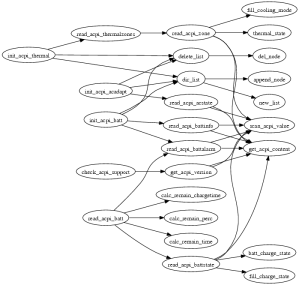
I was interested in having a function call graph especially to see if the interface looks somehow clean and to include it in the documentation of the library. Of course I wanted to do it with open source tools. There are several tools for static call graphs but if you want dynamic call graphs you have to use additional features of your compiler to generate a graph based on code during runtime.

The first variant I tried was using egypt a small perl script to generate a dot file. Dot (today included into graphviz? is a tool originally developed at AT&T to generate hierarchical or layered drawings of directed graphs.

So what is needed?
First install software (here on a Debian systen, egypt is not included in Debian):
$ aptitude install graphviz graphicsmagick (+ download egypt from the homepage)

Compile your software using gcc with the option -dr to dump an RTL file of the source.
Most of gcc's work is done in an intermediate representation of your code, called register transfer language (RTL). This pretty much describes the instructions in plain text and is inspired by LISP lists.
Ok, here we go:
$ gcc -dr list.c libacpi.c test.c
This generates three RTL files, for every source file one. Depending on the gcc version the names may vary, here the names are libacpi.c.00.expand list.c.00.expand and test.c.00.expand.

Now use egypt to create a dot file (I don't want one for test.c now):
$ egypt libacpi.c.00.expand list.c.00.expand dot -Gsize=100,100 -Grankdir=LR -Tps -o graph.ps
Egypt will create dot-output and by piping it to dot with -Tps -o graph.ps you get the resulting graph as a ps file. -Grankdir is used to generate a graph which runs from the left to the right, default is up-down which looks a bit strange.

Now convert the ps file into a png:
$ gm convert graph.ps graph.png
The result looks like this (looks cool huh? :-)):


The second variant I tested is a bit different and in my opinion the resulting graph looks a bit better.
The gcc commandline switch -finstrument-functions allows easy creations of call-graphs for C/C++ (script languages used but I haven't tried).
You need to compile every file with the -finstrument-functions switch. Then gcc places a call to the functions __cyg_profile_func_enter upon entering a function and __cyg_profile_func_exit on leaving a function.

Compile your sources with -g and -finstrumental-functions:
$ gcc -g -finstrumental-functions list.c libacpi.c test.c -o test
Now you need to get some source code by Sebastian Krahmer (SuSE):
$ wget http://www.suse.de/~krahmer/instrumental/instrumental.tgz && tar xvfz instrumental.tgz && cd instrumental
Compile a shared object file:
$ cc -fPIC -c instrumental.c && ld -Bshareable instrumental.o -o inst.so
This generates a shared object file you can preload with LD_PRELOAD
$ LD_PRELOAD=./inst.so test
.....

Now you will find a log.inst.dot.<pid> and log.inst.ascii.<pid> in /tmp (path can be modified in instrumental.c).
The first file is a dot file you can now create a ps and a png file with but you need to attach a closing bracket at the end of the file since the package is not
able to intercept exit() or aborts. echo ' ' >> log.inst.dot.<pid>
$ dot -Gsize=15,20 -Grankdir=LR -Tps -o graph.ps log.inst.dot.<pid> && gm convert graph.ps graph.png
The result looks like:


PDF file which scales a bit better

The other file represents the call graph in ascii:
~ [1000 1000 1000] -- main (0x8049ea4)
~ [1000 1000 1000] -- check_acpi_support (0x8048984)
~ [1000 1000 1000] -- get_acpi_version (0x8048782)
~ [1000 1000 1000] -- get_acpi_content (0x80486b4)
~ [1000 1000 1000] -- scan_acpi_value (0x8048837)
~ [1000 1000 1000] -- init_acpi_batt (0x80489d6)
~ [1000 1000 1000] -- dir_list (0x804a447)
~ [1000 1000 1000] -- new_list (0x804a23c)
~ [1000 1000 1000] -- append_node (0x804a309)
~ [1000 1000 1000] -- read_acpi_battinfo (0x80497d3)
~ [1000 1000 1000] -- get_acpi_content (0x80486b4)
....

So both methods work but the first seems to be more useful if you want a graph for a specific file, not a specific program since you get an RTL file for each source file and you don't need all to create the dot file. The second method however looks better but has the limitation that you actually need to run the program (but that's dynamic and not static) and you can't (correct me if I miss something) create graphs for single files.

Have fun creating graphs for your favorite software and have a look into Sebastian Krahmers paper http://www.suse.de/~krahmer/instrumental/instrumental.pdf and http://www.ibm.com/developerworks/library/l-graphvis/. He also created a graph for openssh http://www.suse.de/~krahmer/ossh4.6.pdf.

Stefano Zacchiroli: crappy ooimpress styles

Crappy OpenOffice.org Impress Styles The "GNOME suite" (mainly AbiWord and Gnumeric) is quite nice and I usually prefer it to the bloated OpenOffice.org counterparts. Unfortunately it is missing a good presenter. Yeah, I know, I should use beamer, and I fact I often do for academic stuff, but for quick and dirty presentations, where you care more than you should about visual aspects and WYSIWYG ... I often resort to ooimpress. It is not that bad, if you can stand its memory consumption and startup time, but for a long time I was convinced that I was wrong about a feature I was not finding in the UI. My reading of the ooimpress manual this morning seems to contradicts this belief. Here is the simple scenario. I do not play with fonts, the default styles inherited by the master page are fine. I just want from time to time to select some text and mark it as "verbatim text": the use cases are those you guessed: markup a shell command, a command output, or a code snippet. Of course I can't stand doing it again and again by hand, having to keep in mind each time the font I chose and its size for ensuring uniformity. I want to use a style. That's it, nothing less, nothing more. Is it asking too much? It seems so. ooimpress supports two kind of styles. One type (sorry, forgot the name) can be applied to built-in content types, e.g.: heading1-9, titles, subtitles, .... Changing such a style will affect all slides. Fair enough, that's good. The other type can be applied only to "graphics" elements, including text boxes. Fair enough as well, this way I can change at once all the text boxes or labels I've used in my document. But wait ... how can I solve my problem now? I see only two awful ways:
  1. devote a high heading level (e.g. 9) to my verbatim text
  2. use a graphic style
of course, a graphic style can not be applied inside non-floating text boxes and I do not want to use tons of text boxes, especially because they are not anchored to ordinary text Dear lazyweb, please prove me wrong.

Julien Blache: WTF Award of the week

Quoting from the Release Notes for the firmware v1.54.2 for the Thomson ST2030 VoIP telephone, in the “Relevant known limitations” section:
3.1 The display doesn’t show the name of the incoming call when received display name starts with the letter “O” (uppercase).
This raised quite a few eyebrows here, and raised quite a few concerns too. I refuse to even imagine how this kind of bug can happen. And for those who will have a hard time believing this, we did the test, and, indeed, the CallerID name doesn’t appear on the phone when it starts with an “O”. Shrug.

Neil Williams: Functional cross-building chroot, based on pbuilder

The pbuilder-based chroot script (empdebuild) in Emdebian SVN is now functional - that is it can run from a directory created by emsource, patch the Debian source using emdebian-patch files ( = emdebianising the package), get the build dependencies and install them, run emdebuild to cross-build the package and copy the updated patches, build log, .changes, .dsc and .deb files out to a nominal location before cleaning up the chroot. Only the basic pbuilder options and setup is supported and some values that can be configured for pbuilder are calculated automatically by empdebuild.

The embootstrap script that creates the chroot used by empdebuild needs some more work before this can be released as part of emdebian-tools 0.2.2 and there is no support (yet) for installing the cross-dependencies required for some packages. I'll be experimenting with Gyrosgeier's debian/xcontrol idea to specify these Build-Cross-Depends: using information already gathered on an ad-hoc basis. xcontrol files can then be committed to Emdebian SVN as patches. The pbuilder code is sufficiently flexible that the same code that parses debian/control for Build-Depends can be adapted to parse debian/xcontrol for Build-Cross-Depends.

In theory, empdebuild can become the basis of a cross-buildd, significantly improving the rate at which packages can be emdebianised.

The script does, currently, have to use apt pinning to retain the Emdebian toolchains because of problems with gcc-4.2 on arm.

(And yes, I do realise that emdebuild and empdebuild are very similar names but then so are debuild and pdebuild upon which the respective Emdebian scripts are based.)


http://buildd.emdebian.org/svn/browser/current/host/trunk/emdebian-tools/trunk/pbuilder

Clint Adams: DDecade

I thought I might indulge myself in the traditional 10-year anniversary lookback (not in Angora), but I decided that it would be far too negative. So I contemplated describing what future accomplishments and events currently excited me, but as I iterated through these I realized that about half of them were blocked or fettered by other persons who may or may not deserve the brunt of my wrath in any of its various forms. Thus I stalled, hoping that people would eventually move their asses and live up to their commitments, so I could write a charming little piece about the sunny times to come instead of reciting a litany of complaints. There has been little motion on that front. So, what to do? I will tally the Debian-related highlights of the past decade, excluding all items for which there is a but . Here is the complete list: An excellent conference

Peter Makholm: inotify: procmail for IMAP folders

Moving mail to an IMAP folder is easy. Often easier than “pipe the mail through this command” or even “forward the mail with all headers to this address”. But what magic can you use to get something done with the mail after moving it to the correct IMAP folder? Using Courier IMAP and thus Mairdirs I came up with the following shell snippet:
cd $MAILDIR
inotifywait -m -q -e CREATE --format %f cur  
  while read mail ; do
        [ -f cur/$mail ] && $HOME/bin/process_mail < cur/$mail > /dev/null ;
        [ -f cur/$mail ] && rm cur/$mail ;
  done
It’s is not completely race condition free. cur/$mail can get renamed and will then be reprocessed. Interesting note: mail is moved from $MAILDIR/tmp to $MAILDIR/cur by link/unlink so the inotify-event is CREATE and not the expected MOVED_TO. Any better solution?

Next.

Previous.