Search Results: "ed"

5 April 2012

Paul Tagliamonte: Processing Geo-location data

I m in the middle of plotting and designing a library to handle loading, processing and interpreting Geo-location data. I have a fairly substantial corpus of data (latitude data since 2010-ish, on and off), and a bit of motivation to hack something up. So far, I would like to see a lib to do most (or all) of the following: Not everything is settled, but this is on my list for 1.0, I think.

M nica Ram rez Arceda: Dunetna reloaded

Welcome to new dunetna website!!! After some years of low maintenance of this site, it's time to update it. It has more or less the same content as it had, but some new features have been added. For example, this blog. The main change is that dunetna website was a home-made application and now it's based in dokuwiki software. You can read more about this site at about page.

M nica Ram rez Arceda: blog:dunetna_reloaded

Dunetna reloaded
Welcome to new dunetna website!!! After some years of low maintenance of this site, it's time to update it. It has more or less the same content as it had, but some new features have been added. For example, this blog. The main change is that dunetna website was a home-made application and now it's based in dokuwiki software. You can read more about this site at about page.

M nica Ram rez Arceda: blog:dunetna_reloaded

Welcome to new dunetna website!!! After some years of low maintenance of this site, it's time to update it. It has more or less the same content as it had, but some new features have been added. For example, this blog. The main change is that dunetna website was a home-made application and now it's based in dokuwiki software.

4 April 2012

Pietro Abate: mancoosi tools in debian testing

Finally the dose3 libraries and tools landed in testing this weekend. We solved a couple of bugs already and it seems nobody complained too loudly. If you used the edos tools in the past you might be interested to check out our new tools in the package dose-extra. Actually @mancoosi we will be delighted to ear about you experience with our tools and how to make them better and more useful. Please drop me a line ! The next major release of dose will be multi-arch aware and provide performance improvements and other minor features. If you missed it, and you are now curious, I delivered a talk at fosdem regarding our tools: A big thanks to ralf of course for packaging everything !

Bernhard R. Link: The wonders of debian/rules build-arch

It has taken a decade to get there, but finally the buildds are able to call debian/rules build-arch. Compare the unfinished old build
 Finished at 20120228-0753
 Build needed 22:25:00, 35528k disc space
with the new one on the same architecture finally only building what is needed
 Finished at 20120404-0615
 Build needed 00:11:28, 27604k disc space

James Bromberger: Goodbye Linux.2.6.x

It s taken some time, but now none of my personal Linux hosts (4 in total) are running the 2.6 kernel any more. From the start (January) my company web host on Amazon EC2 has been running a 3.x kernel. My little Acer Aspire Revo low power home server, with attached disk pack that sits in my shed in a network cabinet has run 3.x for the last 6 months or so. My Linux laptop (Dell Studio 1558) which only recently got installed (and, since removing Windows, hasn t overheated once!) went to 3.x immediately. And the last piece of the puzzel is a virtual machine I ve had for many years with Bytemark.co.uk they re now offering a 3.2 kernel in their menu of selectable kernels. Not that 3.x is that much different than 2.6.3x; but its a line in the sand of feature and security thats easy to identify. But with nearly 15 years of looking at a 2.x kernel, its about time we moved to 3.x!

Christian Perrier: 2012 update 18 for Debian Installer localization

Status for D-I level 1 (core D-I files): Status for D-I level 2 (packages that have localized material that may appear during default installs, such as iso-codes, tasksel, etc.): Status for D-I level 3 (packages that have localized material that may appear during non-default installs, such as win32-loader) Full 100% completeness (hall of fame) for 19 languages: Belarusian, Bulgarian, Catalan, Czech, German, Spanish, French, Indonesian, Italian, Japanese, Kazakh, Dutch, Polish, Portuguese, Russian, Slovak, Swedish, Turkish, Simplified Chinese

3 April 2012

Axel Beckert: Tools for CLI Road Warriors: Hidden Terminals

Some networks have no connection to the outside except that they allow surfing through an HTTP(S) proxy. Sometimes you are happy and the HTTPS port (443) is unrestricted. The following server-side tools allow you to exploit these weaknesses and get you a shell on your server. sslh sslh is an SSH/SSL multiplexor. If a client connects to sslh, it checks if the clients speaks the SSH or the SSL protocol and then passes the connection to the according real port of SSL or some SSL enabled service, e.g. an HTTPS, OpenVPN, Tinc or XMPP server. That way it s possible to connect to one of these services and SSH on the same port. The usual scenario where this daemon is useful are firewalls which block SSH, force HTTP to go through a proxy, but allow HTTPS connections without restriction. In that case you let sslh listen on the HTTPS port (443) and to move the real HTTPS server (e.g. Apache) to listen on either a different port number (e.g. 442, 444 or 8443) or on another IP address, e.g. on localhost, port 443. On an Debian or Ubuntu based Apache HTTPS server, you just have to do the following to run Apache on port 442 and sslh on port 443 instead:
  1. apt-get install sslh as root.
  2. Edit /etc/default/sslh, change RUN=no to RUN=yes and --ssl 127.0.0.1:443 to --ssl 127.0.0.1:442.
  3. Edit /etc/apache2/ports.conf and all files in /etc/apache2/sites-available/ which contain a reference to port 443 (which is only /etc/apache2/sites-available/default-ssl.conf in the default configuration) and change all occurrences of 443 to 442.
  4. service apache2 restart
  5. service sslh start
Now you should be able to ssh to your server on port 443 (ssh -p 443 your.server.example.org) while still being able to surf to https://your.server.example.org/. sslh works as threaded or as preforking daemon, or via inetd. It also honors tcpwrapper configurations for sshd in /etc/hosts.allow and /etc/hosts.deny. sslh is available as port or package at least in Gentoo, in FreeBSD, in Debian and in Ubuntu. AjaxTerm A completely different approach takes AjaxTerm. It provides a terminal inside a web browser with login and ssh being its server-side backend. Properly safe-guarded by HTTPS plus maybe HTTP based authentication this can be an interesting emergency alternative to the more common but also more often blocked remote login mechanisms. AjaxTerm is available as package at least in Debian and in Ubuntu.

Happily I never were forced to use either of them myself. :-)

Iustin Pop: M nned rfler Waldlauf 2012

Last Saturday I went to another running event: M nned rfler Waldlauf, a run through very nice woods on the eastern side of Lake Z rich. It was a somewhat hot day (the race started at 15:20), and it was a bit more difficult than the last race, and just a tiny bit longer (11.5km); all this plus not enough training in the past two weeks resulted in me doing a worse time: 5:38/km according to my Garmin. At least, the race was my last run in March and it concluded/achieved my overall running goal for the month: 100km (was in fact ~107km). I known I have to raise this for longer races, but I'm not in a hurry I think I need a couple of months at this level before increasing the training level. Results aside , I really enjoyed the atmosphere of the place and the lively crowd possibly because of the nice weather. The run was also nice, both through woods and through open hills; the only small downside was crossing about four times circulated roads (of course, with traffic stopped when runners were crossing it). The view from the hills east of the lake is very nice, especially as one is nearing the end of the race. I'll have to see if at the next race I can improve my time it should be a completely flat city run, so I mean I can still blame the heat, right? And in somewhat related news, Garmin's training effect index is surprisingly accurate. It "knows" when I'm not pushing myself hard enough, and instead of a 4.5-5 (out of 5) score it just gives me a meh-level 4.0 or even 3.5. Quite nifty, using one's own conscience as motivation

Julien Danjou: mod_defensible 1.5 released

Apache 2.4 being out, I noticed that my good old mod_defensible did not compile anymore. The changes in the new Apache 2.4 API were small for its concern, so it was pretty easy to update this software to make it compile again. Honestly, I'm not sure that this module is really used into the wild, but I still think that it can serve as a good prototype for doing other things so I like keeping it around. :-) All this has been triggered by the Apache 2.4 arrival into Debian experimental. Therefore I've updated the mod_defensible package to use the new dh_apache2, and imported it into Git at the same time.

Rémi Vanicat: When to be supicious.

Every day I receive email from my server resuming what have been logged for the day. From time to time (but really rarely) there is no attempt at break in on my web server. The eternal question is :

Michal Čihař: Weblate 0.8

After quite big delay, Weblate 0.8 is finally ready. There are many fixes and improvements like grouping of Git commits, improved checks or activity logging. All in all this should be feature complete for 1.0 release. Now it's time to stabilize all the features and release 0.9 (AKA 1.0rc) and then we'll be ready to fire 1.0. Full list of changes for 0.8: You can find more information about Weblate on it's website, the code is hosted on Github. If you are curious how it looks, you can try it out on demo server. You can login there with demo account using demo password or register your own user. Weblate is also being used https://l10n.cihar.com/ as official translating service for phpMyAdmin, Gammu, Weblate itself and others. PS: If you're about to use Weblate, rather use Git version than tagged 0.8, you will get bunch of bug fixes for free :-).

Filed under: English Weblate 0 comments Flattr this!

Philipp Kern: The state of Debian s390x

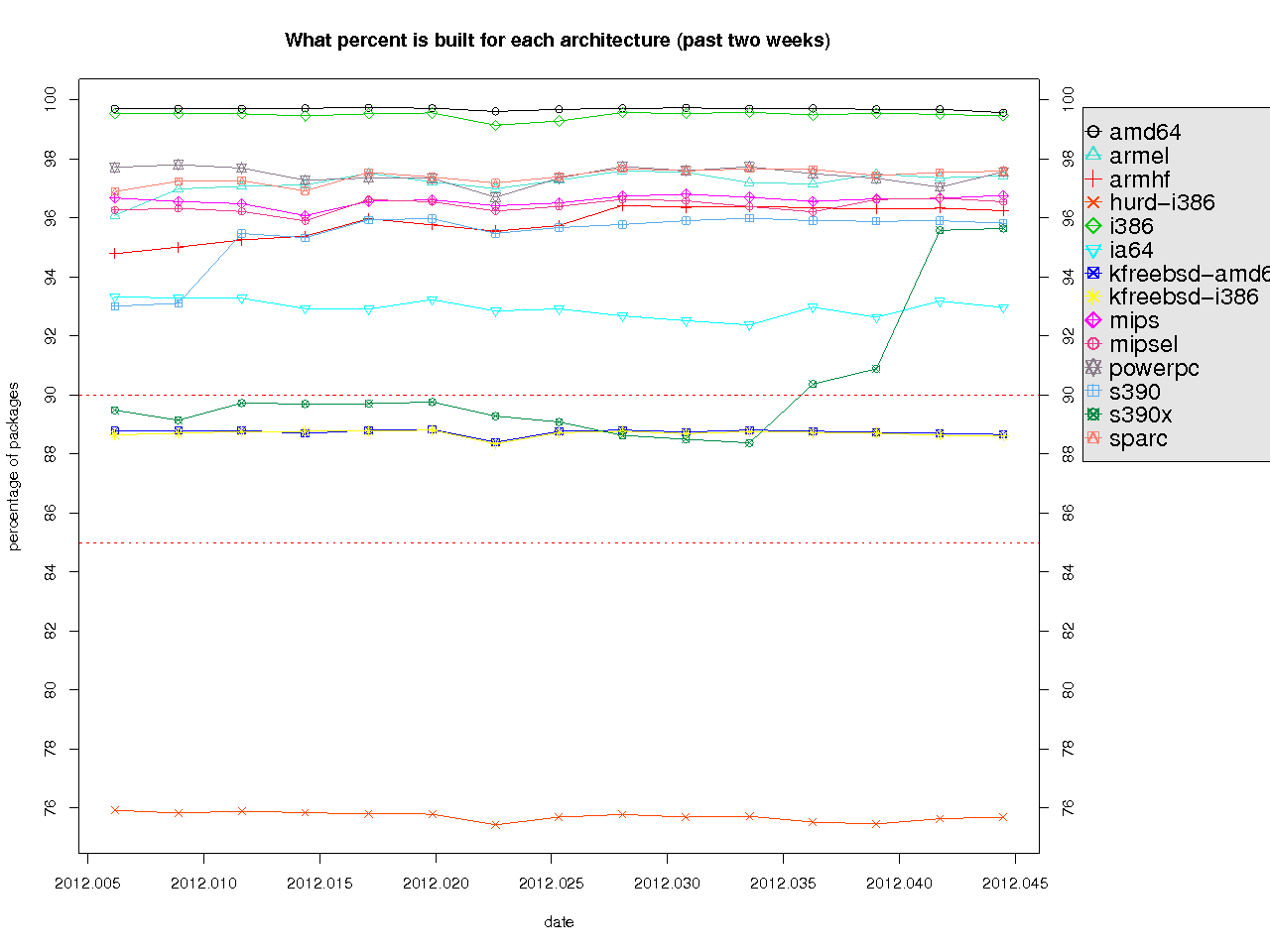
When we added s390x to the main archive, coming from Debian Ports, we were unlucky. A new glib release had assumptions that weren't true on 64bit big endian architectures and it entered the archive just a few days before we made the initial import. This weekend we finally got a new major release into Debian unstable that fixed these issues. So we're almost on par with s390 now. It all untangled quite nicely after glib-networking was able to complete its testsuite. Only one build-dependency loop between nautilus and tracker had to be broken manually.

So what's left? There's a bunch of usertagged bugs (with both general FTBFSes and arch-specific issues; kudos to Aur lien Jarno providing a lot of patches) and we still need to file some, like iceweasel segfaulting during its build. That's important because another bunch of packages needs it to build (well, mozjs and/or xulrunner, or some package that needs those).

2 April 2012

Bartosz Feński: i18n.debian. net,org

How about switch translations to Weblate? Maybe it s time to move on some more user friendly translation system? I believe Michal iha (cheers!) is going to help us (as a community) to make changes relevant to Debian s infrastructure.

Christian Perrier: Just do it

Please, pretty please, just do it. However, don't forget: Debian localization material is spread in thousands of packages, with dozens of different VCS, hundreds of developers and hundreds of thousands of strings for up to seventy languages. And there are less than 5 people running all this. So, yeah, there are fancy "insert your favourite l10n tool of the day here" everywhere and we should rather be using them. But nobody prevents anybody to build something better than we we have now. Really, nothing. Do-ocracy, as we use to say. Just do it and, in the meantime, suffer with us with what we have.

Michal Čihař: phpMyAdmin translations status

phpMyAdmin 3.5 should be released this weekend, so let's look at translations status for last time before release. Here comes seventh round of translation status update. Since last update we have one more translation and one less (due to some not translated strings in it) summing up to 11 translations at 100%: There are few which are really close to 100% and I hope they will get there till release: As you can see, there is still lot of languages missing, this might be your opportunity to contribute to phpMyAdmin. Also you are welcome to translate phpMyAdmin 3.5 using translation server.

Filed under: English Phpmyadmin 0 comments Flattr this!

Julian Andres Klode: Currying in the presence of mutable parameters

In the language introduced yesterday, mutable parameters play the important role of representing the side effects of actions in the type system and thus ensure referential transparency. One of the questions currently unaddressed is how to handle currying in the presence of mutable parameters. In order to visualise this problem, consider a function
    printLn(mutable IO, String line)
If we bind the the first parameter, what should be the type of the function, and especially important how do we get back the mutable parameter? Consider the partially applied form printLn1:
    printLn1(String line)
The mutability parameter would be lost and we could not do any further I/O (and the curried form would appear as a pure function, so a good compiler would not even emit a call to it) An answer might be to put the thing into the result when currying:
    printLn2(String line) -> mutable IO
But how can we explain this? In the end result, do we maybe have to use a signature like:
    printLn(String, mutable in IO io1, mutable out IO io2)
We could then introduce syntax to call that as
    printLn(string, mutable io)
Where as the mutable io argument basically expands to io and io1 for the first call, and for later calls to io1, io2 , and so on. It can also be easily curried by allowing currying to take place on variables not declared as output parameters. We can then curry the function as:
    printLn3(mutable in IO io1, mutable out IO io2)
    printLn4(mutable out IO io2)
If so, we can rename mutable back to unique and make that easier by introducing the unary operator & for two locations, just like Mercury uses ! for it. We could then write calls looking like this:
    printLn("Hello", &io);
    printLn("Hello", io, io1);
How out parameters are explained is a different topic; we could probably say that an out parameter defines a new variable. Another option is to forbid currying of mutable parameters entirely. This would have the advantage of maintaining the somewhat simple one parameter style. The programming language Clean does not provide any special syntactic sugar for having mutable variables. In Clean, the function gets a unique object and returns a unique object (noted by *). For example, the main entry point in a Clean program (with state) looks like this:
    Start:: *World -> *World
In short, the function Start gets a abstract world passed that is unique and at the end returns a new unique world. In Clean syntax, our example function would most likely have the signature:
    printLn :: String *IO -> *IO
You know have to either maintain one additional variable for the new unique object, which gets a bit complicated with time. On the other hand, you can do function composition on this (if you have a function composition operator that preserves uniqueness when available, as should be possible in Clean):
    printTwoLines :: *IO -> *IO
    printTwoLines = (printLn "World") o (printLn "Hello")
Function composition on mutable things however, does not seem like it is needed often enough in a functional programming language with a C syntax. People might also ask why monads are not used instead. Simon L Peyton Jones and Philip Wadler described monadic I/O in their paper Imperative Functional Programming (http://research.microsoft.com/en-us/um/people/simonpj/papers/imperative.ps.Z) in 1993, and it is used in Haskell (the paper was about the implementation in Haskell anyway), one of the world s most popular and successful functional programming languages. While monadic I/O works for the Haskell crowd, and surely some other people, the use of Monads also limits the expressiveness of code, at least as far as I can tell. At least as soon as you want to combine multiple monads, you will have to start lifting stuff from one monad to another (liftIO and friends), or perform all operations in the IO monad, which prevents obvious optimizations (such as parallelizing the creation of two arrays) in short dependencies between actions are more strict than they have to be. For a functional language targeting imperative programmers, the lifting part seems a bit too complicated. One of the big advantages of monads is that they are much easier to implement, as they do not require extensions to the type system and the Hindley-Milner type inference algorithm used by the cool functional programming languages. If you want uniqueness typing however, you need to modify the algorithm or infer the basic types first and then infer uniqueness in a second pass (as Clean seems to do it).
Filed under: General

Gerfried Fuchs: Squeeze RCs's Squashing 2012 #2

This is the third summary of my squeeze RC bug squashing. If you take a look at the bug graph you will notice that the blue line went up a bit over a two week's period. I would like to claim that confirming the samhain RC bug 618728 did cost me the time (I actually gave it the time to finish), but the real reason was that I was looking at other stuff. I came back with a vengeance though, so here is the list of the bugs squashed for squeeze since the last report: Current stats: 119 bugs in 93 days, still got the margin up by five more bugs. :) Enjoy!

/debian permanent link Comments: 0 Flattr this

Niels Thykier: Kudos to Jakub Adam, Miguel Landaeta and James Page

Credit where it is due and I believe it is due for Jakub Adam for packaging eclipse packages. If you use any of the eclipse packages provided the apt repositories for Wheezy or sid, it is very likely you have Jakub Adam to thank for it. I also believe that Miguel Landaeta and James Page deserve praise for their work. Miguel is to thank for the removal of libservlet2.4-java and updating its reverse dependencies not in that order ;-) . James Page, on the other hand, has been introducing and updating a lot of packages, noticeably the jenkins packages. Thank you and keep up the good work.

Next.

Previous.