Search Results: "tar"

19 November 2006

MJ Ray: ePassport 0-day crack

And now, just when you thought the ID State couldn't get any dafter, it turns out the ePassport chips are an identity thief's friend. The UK is adopting ePassports when even the United States of Paranoia concluded its Radio-Frequency ID (RFID) technology:
"increases risks to personal privacy and security, with no commensurate benefit for performance or national security."
More from NO2ID:
"With a standard RFID reader bought over the internet for just 95.73, the campaign was able to prove that the same "contactless" microchips that are also to be incorporated into ID cards will "dramatically decrease [citizens'] security and privacy, and increase risk of identity theft" [FIDIS Press Release] ."
Time to get a RFID-proof wallet, like Benjamin Mako Hill and Andreas Metzler Mick commented:
"The more I hear about the UK in recent years the less I want to vist:
  • Fingerprints for beer.
  • Fingerprints to hire a car.
  • Biometric data on passports that are easily compromised.
  • Video Cameras on every corner.
  • Mandatory IDs in a few years.
  • British children claimed to be worst-behaved in Europe."
"The UK is starting to sound like The Clockwork Orange." "And then the plonkers claim "if you've nothing to hide what's the problem"?"

Robert Collins: 18 Nov 2006

Well, UDS mountain view is over, and all-hands. I found the USA fun in a number of ways. However, for some reason I recieved the 'SSSS' ("Selected for Secondary Security Screening") marker on my boarding pass in both directions, which is known to not be a coincidence. So someone out there with my name is a security risk, or its because I flew from .au to .us on a .nz passport or perhaps they think I'm this guy. I think its time we did something about this. I urge every American to start writing to your senator or representative about this.. Bruce Schneier and others have already commented on how ineffective the SSSS mechanism is. For my part, I'm now boycotting as much as possible every company based in the USA. And I shall never visit the USA except when work compels me to. Which is of course a shame, as many of the people in the USA are nice: but unless they collectively *do something* and fix their out of control government, the USA is heading into being a surveillance state.

18 November 2006

Biella Coleman: Interestingness ranking of media objects

I now need to start looking for a flickr replacement. Yes, I am offended by the patent.

Enrico Zini: pbuilder-tips

pbuilder tips Many thanks to Arnaud Fontaine for providing me with the solutions to all pbuilder problems I had during the last years. This is what happens to me: someone reports a bug in debtags, and it turns out that the bug needs fixing in libwibble. I start by fixing libwibble, then I need to recompile libtagcoll2-dev, then use it to recompile libept-dev, which I can finally use to rebuild debtags. A normal pbuilder setup would only take dependencies from apt sources, so I need to create an APT source with the packages I just built and feed it to pbuilder. Now, thanks to Arnaud's suggestion, I have the easy way to create the APT repository:
$ cat update-aptsource
#!/bin/sh
cd /var/cache/pbuilder/result
dpkg-scanpackages . /dev/null   gzip -9 > Packages.gz
echo "Running pbuilder update..."
su -c "pbuilder update"
Since pbuilder works in a chroot environment, the easiest way of making it access the repository is via http. First I put the new repository online:
ln -s /var/cache/pbuilder/result /var/www/debian
Then I add it to /etc/pbuilderrc:
OTHERMIRROR="deb http://localhost/debian/ ./"
Then I tell pbuilder to update the configuration inside the chroots:
pbuilder update --override-config
And finally I can build my stack of packages. This is probably not rocket science for many DDs. What I'm really appreciating here is using the minimum amount of pbuilder customization and of lines of code of extra infrastructure to maintain. Now, at every compile round, I just need to run that update-aptsource script to inject into the system the dependencies that I have just built. Update: Josh Triplett sent the configuration options to avoid using an HTTP server and use pbuilder's bind-mount facility:
OTHERMIRROR="deb file:/var/cache/pbuilder/result/ ./"
BINDMOUNTS="/var/cache/pbuilder/result/"

Martin F. Krafft: Online in the skies

I am sitting on Singapore Airlines flight SQ 25 from Frankfurt to Singapore and have wireless connectivity, reasonable for SSH usage. The service provider ConnexionByBoeing is phasing out of business, and in a move to appease the passengers, made the service free of charge in October, throughout the end of the year. This is definitely a first for me, to be able to "surf" several thousand metres above the ground. And while it certainly makes the next twelve hours seem like a lot less [*], I do wonder whether I'd even want broadband on every (long-distance) flight. Flying has always been relaxation to me, time off to read or watch movies I'd otherwise never see, to sleep, dream, stare at clouds, talk, think, be, drift. With the Internet available, work could creep into this time for those who lack control over their use of time. While I tend to disagree that I fall into this group, my dear friend Hanspeter seems to think otherwise. And isn't it great how in such situations, denial does nothing but reconfirm the position of the proponents? It's like smoking, which I do on the occasion. Tell someone that you're "only an occasional smoker" and you'll likely earn an expression of pity and averseness as your peer marks you down as a smoke addict.
[*]

Singapore Airlines is making this a very enjoyable experience. Asian hospitality really amazes and captures me every time. I only wish I had more time than a few days in Singapore.

We're flying in a Boeing 747-400, either very new or completely redone. The in-flight entertainment spans 80 on-demands movies, 90 TV shows, about 200 audio CDs, and several documentaries and live news channels. Add the Internet and those long hours are history.

Ross Burton: Contacts 0.2

Although I'm announcing Contacts 0.2, I hardly did any of the work on it. Brace yourself, Chris and Thomas have been very busy. Updated packages are already in Debian. Have fun!

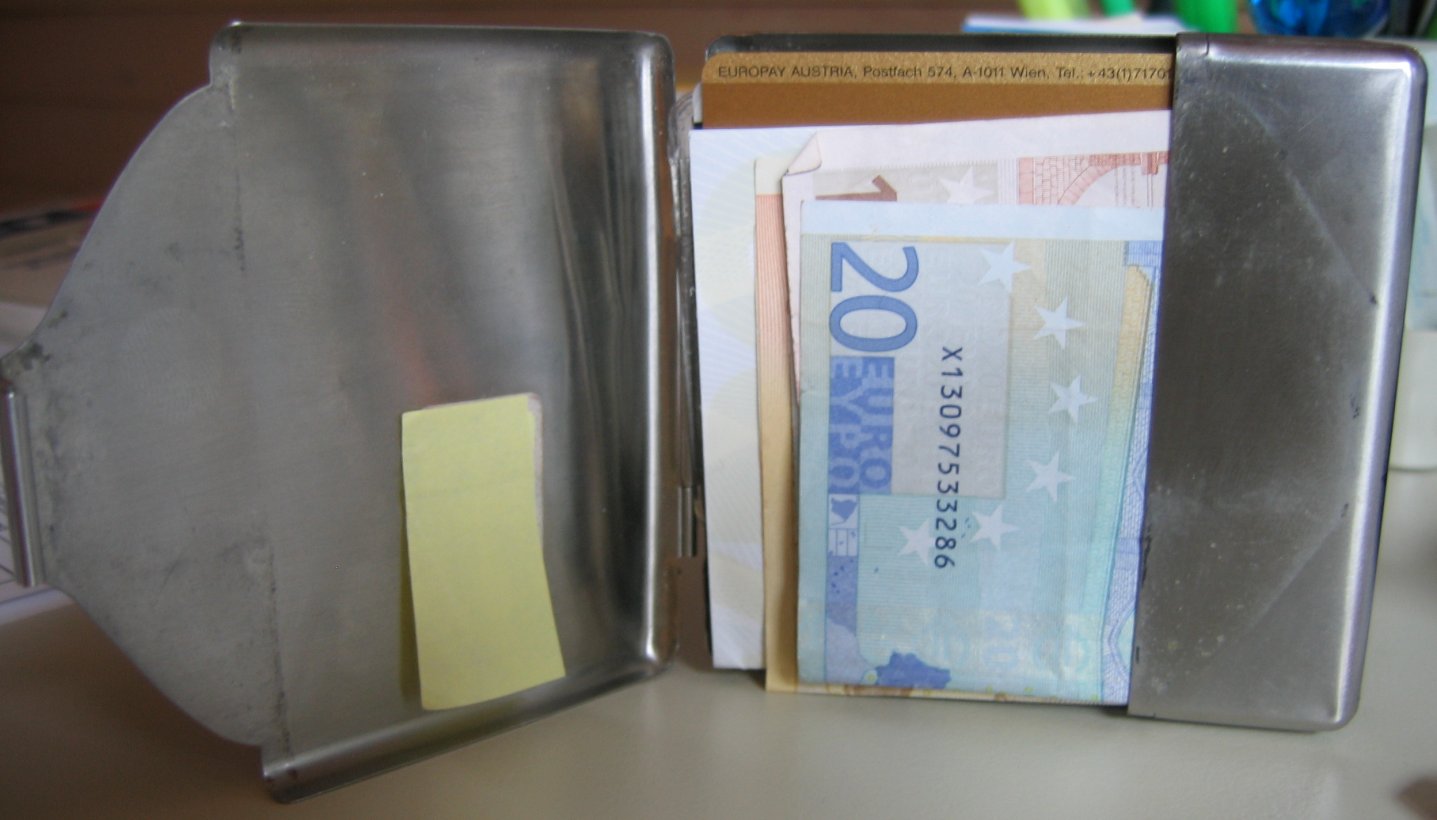
Andreas Metzler: anti RFID wallet

Mako asks for a RFID-proof, vegan wallet. This is what I have been using for a couple of years:
cigarette case I started using it since my maestro/credit/whatever cards broke frequently, being RFID proof is just a nice side effect. The obvious downside is that I need to carry change separately in my pocket, but I wouldn't want a wallet big enough to carry the huge Euro coinage anyway.

17 November 2006

David Welton: Padova Hacking Society

I couldn't think of a better name, so that's what I came up with for a "cross-platform" group including a variety of people who are knowledgeable in different fields. Thanks to Matteo, we had our first meeting yesterday for (what else, being in Italy), pizza and beer. I continue to be very impressed by the amount of technical talent here in Padova. It is a university town, but it's only got about 200,000 people. At our dinner yesterday, we had guys from OFBiz, Mono, FreeBSD, and various other open source projects, as well as people expert in C, Perl, Python, Ruby, Java, Erlang, and counting myself, Tcl. Furthermore, the guys from the nascent startup seesaw.it were there as well. It was a lot of fun to meet up with people to talk tech in person. Even the level of diversity lead to some heated debate at times, I think I much preferred it to a monothematic event. With age, I tend to get less excited about things, and realize that it's all fascinating and worth knowing, and just wishing I had more time to soak up knowledge in the many fields that interest me. Hopefully, we'll be able to repeat the event sometime soon.

MJ Ray: Want a Pint? Give us your prints!

As if the underhand registration of children wasn't bad enough, this NO2ID newsletter describes another way to encourage people to submit to scanning:
"The scheme which is backed by the Home Office was first trialled in Yeovil but plans are afoot to expand the system to Coventry, Hull, Sheffield, Leeds, Gwent, Nottingham, Taunton and possibly Swindon. Drinkers must have their thumbprints scanned and supply their name, address and date of birth to enrol onto the system before they are allowed to enter licensed premises taking part in the scheme." "If you are in any of the towns affected, especially Yeovil, and are willing to do something then send an e-mail to phil@no2id.net (please put "pub fingerprinting" in the Subject).Don't get depressed, don't give in and get a home-brew kit - get angry and do something!" "PS. If anyone knows a pub that would like to take NO2ID beer mats, Newcastle NO2ID has created some with our logo on the front and key counter-arguments on the back, ideal for starting the discussions of the scheme that we need."
Not even our beer is safe from the ID State!

Evan Prodromou: 25 Brumaire CCXV

Interesting Techcrunch article about aboutus.org, the wiki about every domain on the Internet. It was started by Ray King, an extremely nice guy that we've met at a couple of Wiki events, and it seems to be doing really well. I guess he just closed an initial round of investments, which is great. There was an article about Aboutus in the Portland Business Journal. Although I don't think it's a "potential Google" (!), as the reporter does (gotta love the home town crowd), Aboutus is a neat idea and it's a good group of people, too. tags:

Puck Quebecois Speaking of things that are rocking, I just got an invite to Le Puck Quebecois. It's the Montreal tournament of the Hocky Association of the Arts, a group of artists and musicians nationwide who love to play hockey against each other. The organizer is Jeff Waye of Ninjatune, who combines in one person an unhealthy obsession with music with an unhealthy addiction to hockey. It should be a really fun amateur hockey tournament. All proceeds go to charity, of course. tags:

Not only but also Next week, 30 Brumaire, (or 22 November for those of you who need some math help) there's a meeting of MSLUG, the Montreal Scheme/Lisp Users Group. I have get to get out to an MSLUG meeting, but I think this one will be my first. It's admirable that the group has pulled off so many meetings in the last 3 years. tags:

Lenny So, at the bottom of this release message, we get the name of the post-etch Debian release: Lenny. Is Debian now using codenames from The Simpsons? I think Lenny Leonard is as nice as the next guy, but we're still going through the minor characters in Toy Story. I've scoured the Toy Story credits and Toy Story 2 credits, and "Lenny" is the name of the little binoculars character, which gets about 12 seconds of screen time, if I remember correctly. Man, we're really scraping the bottom of the barrel on this naming convention. tags:

Hey Doc! Don Marti's intro to OpenID for Doc Searls is cracking me up. I'd mentioned in my articles for LinuxWorld last week that I'd written an OpenID extension for MediaWiki, and I guess now Doc wants to know how to use it. tags:

Evan Prodromou: 26 Brumaire CCXV

I've been pretty interested in making Web sites WebSoftwareFriendly for a while, so I'm pretty psyched to see that Yahoo and Microsoft have embraced the Google Sitemaps format. They've started a site for the format, http://www.sitemaps.org/ , which lists out the protocol, which seems to be unmodified from the original Google version. Sitemaps have been a necessary part of Web sites for years. Netscape -- back when it was a browser -- had an RDF-based sitemap format that had a brief flare of popularity just before Netscape went into its weird late-90s spiral. Then RDF people got really abstract and academic, and decided that sitemaps weren't what RDF was all about, and RDF sitemaps were forgotten. So sitemaps went off the air, and we've had to wait for a standard on the idea until today. Yahoo lets you submit sitemaps today, as does Google; Microsoft Live supposedly will support it sometime in 2007. One thing that's interesting is a new "ping" protocol, for when the site is updated. I'm not sure how well it works or if it's even implemented, but it's interesting to see it working. I think the weak part of this whole thing is that site owners have to submit sitemaps to each search engine; it would be nice if there were some sort of discovery, like an HTML <link> element, so that other types of Web software besides the big search engines would benefit. tags:

Knowing when to hold 'em From O'Reilly's wrapup of the Web 2.0 Summit, I got a good link to some other Evan's Knowing When to Hold Em. It's a little discourse on the growth of Web 2.0 sites after they've been acquired. Evan Williams, the author and the guy who sold Blogger to Google, knows whereof he speaks. He has some graphs that show traffic for various Web 2.0 sites sloping precipitously upwards after their sale to some big company. The implication being, I guess, that the sites would have been more valuable to sell later. He also points out that few of the sites have benefited visibly from being acquired. I'm not sure the argument makes sense. Traffic is a cost centre as well as a potential source of revenue for companies. Keeping servers up, running, and cogent is hard work. Most small Web sites have been throwing labor and cash into their sites for a while, and the ability to keep such a site going into the Alexa top 100 is beyond most small companies. Paying for a lot of servers, developers, designers, sysadmins and bandwidth for another couple of years may make the site bigger and more desirable for acquisition, but it's a big risk to take. My favourite part of the discussion is that my friend Kevin Fox shows up at the end with some good points about when and how to invest. tags:

Free Software Java I've been programming in Java off and on since the first beta versions of the VM and JDK in 1995. The language has always had a certain cachet with the Open Source set -- the free-as-in-beer tools, good documentation, and cross-platform compatibility made it an Open Enough system, roughly equivalent to proprietary C compilers shipped with every Unix variant. Its release was roughly synchronous with the growth of the Web, and Java applet support in Netscape made the first round of rich client applications conceivable, if not exactly elegant. And then Java grew onto the Web server; and into other parts of the network; and then all of a sudden everything had to be Java. The system grew from this nifty little tool to The Enterprise Solution For Your Enterprise. Serious people worked on Java. I worked on Java when I needed to be serious. Java stopped being fun. Early efforts at getting Open Source Java VMs and development kits working were pretty successful, but they just couldn't catch up with the rapid pace of development on Sun's core product. But inclusion of the language in the Gnu Compiler Collection, the great JBoss J2EE system, the growth of Apache's Jakarta project, and the growing Java Community Process made Java less and less a regular product, built in a silo behind a corporate firewall, and more of an Open-Source-y project. So I guess it was inevitable that Sun would either Open Source its codebase, or end up irrelevant. They probably squeezed just about all they could out of it without going Free, so that's pretty impressive. I think Free Software advocates are supposed to be grateful about this; my main reaction is: why did you put everyone through all this crap for so long? You've wasted 12 years that could have gone into making Java really incredible. We'll see what happens. My main interface with the JVM for the last year or so has been through scripting languages like Rhino JavaScript engine (very fun) and Pnuts. Who's got time for Java programming any more? tags:

Jacobo Tarr&#237;o Barreiro: Above the Spanish translations and other unpurposes

The last fashion in certain channel of IRC is disemboweling the Spanish translation of subversion. I refer myself to that is so strange and twisted and full of anglicisms, that it gives laughter. In an opinion poll improvised, nobody has wanted to recognize that they use Linux in Spanish. I, personally, do not utilize those translations because my refined sensibility excites itself (negatively) at the time of seeing certain barbarities. To share the pain, especially among the monolingual English speakers who never have seen software translated, I have written this story in Spanish and later I have translated it semiliterally to English utilizing techniques as advanced as the employed in the translation of subversion. If wishes to rip your eyes out have entered you, I have accomplished my objective. (It sees itself that I know the English too much well, for that my first sketch was too much correct and I had to revise it various times).

Alexis Sukrieh: Logger::Syslog, my first CPAN-candidate Perl module

I wrote a Perl module a couple of years ago, and got used to it, I just cannot code without that module now. It’s called Logger::Syslog and is a wrapper over Sys::Syslog that lets you deal with syslog in a very simple manner. Use the module and enjoy the easiness of calling info(), warning(), error() or whichever Syslog message level you like, there is a function wrapping it. It also works properly under a mod_perl environment an logs your message with additional information coming from the Perl stack (module, function name, line number, …). I use that module quite everywhere I use Perl : at work but also in my Free Software projects, like Backup Manager. It’s really time to release an “official” version that I can rely on in the future. Next step is submitting the module to the CPAN (it’s pending) and then, debianize it so backup-manager can depend on it. Todo: set up a public SVN repo to handle the sources. Updates

Steve Langasek: On setting and meeting goals, and statistical fun

While NMUing plays an important part in getting us to a release, as shown by the thousand or so fixed-in-NMU RC bugs that we recently cleaned up the BTS state on, it's evident after doing this whole release-managing thing for a while that there is a very high (non-linear) correlation between the age of an open RC bug and the likelihood that a release manager is going to have to touch it at some point in order to get it fixed. By and large, maintainers really do a good job of fixing their own packages, which is probably something we don't say enough - maybe 75% of all RC bugs, I'd guess, will (or would) get fixed by maintainers in the first week without anyone needing to poke them about it, and of the remainder, probably another 80-90% get taken care of by BSPers and serial-NMUers like bug-a-day mascot Steinar Gunderson. That's why I'm not bothered overly much by the idea of full-archive searches for hidden RC bugs, like Lucas's piuparts tests, affecting the release timeline, because I know that 95-98% of those bugs are going to be gone two weeks after they're filed anyway, especially when they're no-brainer fixes to maintainer scripts or dependencies. But then that leaves the other 2-5%, which are the ones nobody else has fixed. And why hasn't anyone fixed them? Because they're the hard ones, of course... So although I follow the debian-bugs-rc list and occasionally swat a few non-bugs closed to save the maintainers time, and also provide some nudges when it looks like a package is causing RC bugs to be filed on other packages, my goal for the last full week of my Dunc-Tank contract was to get the count of etch RC bugs unfixed in unstable that are 20 days old or older down from around 50 to under 30. This seemed a reasonable goal, since it had been at 80 the week before, and it would go a long way towards helping the real blockers on the release. Initially I was aiming to bring down the count of RC bugs unfixed in testing that are 20 days old or older to this number, but quickly realized that this wasn't going to be realistic because it depended too much on the autobuilders all operating optimally and there wasn't time to both help fix 20 of the hardest RC bugs and handhold 60 RC bugfixes into testing in one week. In the end, we did miss this lesser target by a day or two. Still not a bad week's work, given that I'm pretty sure I fixed about 20 of these bugs myself in that time period (through NMUs, removals, and analysis+downgrades) and they seem to average 3 hours of work for a fix. And we've been holding at or below 30 on this list of bugs since then, so we're successfully keeping up with new bugs aging past the 20-day mark, which is also a good sign. Unfortunately, I seem to have left myself to fix the alpha Xorg 7.1 bugs on my own time. :) By now the announcement has made the rounds that the release team doesn't think we can hit the Dec. 4 target date because more time is needed for a final release candidate of the installer. Does that mean that RC bugs were the wrong thing to be focusing on for the past weeks? Well, no; if you want one place in Debian where Brooks' Law holds, I think you'll find that getting a d-i release out is it, and we still have a hard road ahead to make sure we do get our other RC issues sorted out in the same time frame. The installer just happens to put a lower limit on a release date, we still have an opportunity to screw it up from there. ;) At least the statistics suggest that we're going in the right direction. Only 13% of RC bugs fall into the "20 days or older and unfixed" category. Half of all RC bugs over 10 days old have a fix of some kind in unstable, and 64% of all reported RC bugs are less than 10 days old. We'll see whether this graph backs me up on this in a couple more days.

Amaya Rodrigo: Bendito viernes!

Yes!.

Michael Janssen: I work hard, every day of my life

Most of my fitness transition plan has been focused on exercise. Get more exercise and eat the same as you did before, and you will lose weight. This has to be true, based simply on physics. Back when I was using the Hacker's Diet, it worked like a charm. Then it was all about eating less calories, because I wasn't really keen on doing exercise in my olden days. It worked for a while. Unfortunately I got stressed and stopped countign calories, and weighing every day. I've started the weighing again, and maybe I can actually fire up gnuplot again and produce some pretty graphs like the one on the left.


I've had an iPod for approximately 5 years now. That puts me a bit ahead of the curve. I still remember seeing the original iPod commercial, and looking literally seconds later for how much it was, and seeing how much I could sell my old player on eBay for. Having been in the mp3 scene for a while at that point, I knew that it would turn everything on it's head. I got it and replaced my normal player for walking to and from class and listening while coding. Now I have a new iPod video, and it is the chief entertainment while I'm in the exercise room. At first I was just listening to my fairly large music collection. Then I started listening to podcasts again - they are about the right length, and I enjoyed them. Now I've harnessed the power of the video iPod to kill two birds with one stone: I'm watching my large collection of Anime at an hour a day. This means about 3 episodes if I skip the openings and endings. I also watch Heroes on Tuesday nights, after I transfer it from the TiVo. The only problem I'm having with this setup is that the screen is small, so I need to hold it fairly close to my face in order to read the subtitles.

Today marks one month on the diet and exercise regimen. I started on the scale at 344 and this week's average was 337, 7 pounds lighter. I'm going a little slower than my goal of 2 pounds per week, but I seem to be hitting the right buttons at least.

This week (Nov 10 - Nov 16):
Minimum: 335.5 (-2.5) (Nov 14)
Maximum: 339.5 (-0.5) (Nov 16)
Average: 337.2 (-2.05) (137.2 to goal)
Exercise Calories: 2563 on 5 days
Average Calories per session: 512.16

16 November 2006

Russell Coker: biometrics and passwords

In a comment on my post more about securing an office someone suggested using biometrics. The positive aspect of biometrics is that they can't be lost, no-one is accidentally going to leave a finger or an eye in their car while they go to a party while other authentication devices are regularly lost in such a manner.

The down-side is that having your finger or eye stolen would be a lot less pleasant than having a USB device, swipe-card, key, or other security device stolen. I think that it's good to have an option of surrendering your key when under threat (for the person who might be attacked at least).

Rumor has it that some biometric sensors look for signs of life (EG temperature and pulse), but I believe that these could be faked with a suitable amount of effort. A finger attached to a mini heart/lung machine should make it possible to pass the temperature and pulse checks (although I don't think that I have access to any data that is important enough to justify such effort on the part of an attacker).

One thing that biometrics could be useful for is screen-blankers. It would be good to be able to have a screen-blanker for your computer that operates when you go to get a coffee. For a period of 10 minutes after leaving a biometric method could be used to re-enable access. After that time a different method would ave to be used. This gives the convenience of biometrics for when you need it most (the many short trips away from your computer that you make during the day) but removes the benefit for an attacker who might consider removing part of your body. Also I am not convinced in the general security of biometrics. There are claims that you can make a finger based on a fingerprint which can fool a biometric sensor. If those claims are correct then a biometric sensor would still work for a coffee break (presumably you are not far away and will be back soon, and other people are in the area). The coffee break security is usually to prevent casual snooping such as colleagues who want to see what was on your screen but not actually do anything invasive to get it. Another benefit of biometrics for a screen saver is that although I trust people in the same office as me (whichever office that may be) not to try anything when they might get caught I still don't want them shoulder-surfing my password. Replacing the trivial authentication cases with a fingerprint reader would prevent that.

In the KDE 1.x days I had a shell script launched when the lid closed on my laptop which would lock the screen (the screen-saver ran in the background and a signal could make it lock the screen). This meant that I could merely close the lid of my laptop to lock the screen, this is fast and easy and also is not immediately recognised as locking the screen. Some people get offended if you lock your laptop screen when in their presence as they think that you should trust them enough to leave your most secret data open to them (generally people who aren't serious about computers - I'm sure that the same people would happily lock their diary if I was ever in the same room as it). Being able to lock the screen in a non-obvious way is a security benefit.

Regarding the comment about using a USB device to store passwords, there are two problems with this, one is that all passwords will be available all the time, this means a program that is permitted to access password A would also be given access to password B. The other is that the passwords can be accessed easily. The ideal solution is to have an encryption device that uses public key cryptography and stores the private keys on the device with no way of removing them. It would also permit the user to authorise each transaction.

I would like to see a USB device that stores multiple GPG keys and implements the GPG algorithm (with no way for anyone with less resources than the NSA to extract the keys). The device would have a display and a couple of buttons. When it is accessed it would display messages such as "signing attempt on key 1" and allow me to press a button to authorise or reject that operation.

This means that if I insert the key to sign an email I won't have a background trojan start issuing sign and decrypt commands. The only viable attack that would be permitted is the case where I want to sign a message and my message is sent to /dev/null and a message from an attacker is signed again. The non-arrival of my original message would hopefully alert me to this problem. I am not aware of any hardware which supports these functions.

Also I have just received a couple of RSA SecurID tokens as a sample. An RSA representative phoned me to ask about my use of the tokens, I said that I am an independent consultant and I have been having trouble getting my clients to accept my recommendations to use such devices and that I want to implement them on a test network so that I can give more detailed advice to my clients and hopefully get them to improve their security. For some reason the RSA rep found that funny, but I got my sample hardware so it's fine.

Andreas Barth: Release update sent, and upgrade testing

On Thursday, the release update we have been busy preparing was finally sent out by Steve. This has clarified some of the questions people have been asking for some time. Also, more comments on the release notes have been merged. We are now at an state where I'm happy to let users work with the release notes - though one large section still needs work: What is the appropriate order for upgrades of kernel and packages. After that was done, I started myself with some upgrade tests to see how the packages really behave. More on that on one of the next days ...

Joachim Breitner: Kofi-Annan Center for Excellence in ICT

Until now, I always had to tell the not very joyful story of the motivated volunteer who came to Ghana to run against a wall of disinterest and misunderstandings. Luckily, things will change:Yesterday, I had an appointment with the Director of the Ghana-India Kofi-Annan Center for Excellence in ICT (KACE), where I asked, with little hope, if they might make more use of me in the next weeks, until I will most likely return to Europe. To my surprise, She found that an excellent idea and immediately referred me to the techies to discuss the details. Today I saw the principal of the SOSHGIC and my current employer, trying to find out if this would be possible. She agreed that it makes more sense for me to work at KACE instead of the school, and would lend me to them while still being empoyed by SOSHGIC. I will be around the school a few times, to finish some reports and two more club meetings and luckily I am still allowed to live in the flat. I think I ll spend another one or two weeks in January at KACE (as a real volunteer then), before I head back to my boring standard safe study life.The first, smaller, project at KACE came up spontaniously during the meeting yesterday: I mentioned the game infon (see my last blog entry), and she was very interested in that as a programming teaching aid. My idea is now to polish it a bit, make it a bit easier to use for beginners, improve documentation, create debian packages and maybe work on some lessen plan suggestions. The author of infon, dividuum, is also quite happy about the news and the attention that his work might get now.The other project is my idea about an internet caf distribution. It happens that the team at KACE is working on a very similar thing (called Community Information Center ) for the government, and they will start a Linux version in very few weeks, so I think I can help there as well. I expect that a lot of work for Skolelinux can be used here, so I m looking forward to work with the DebianEDU team a bit.

I m also looking forward to work with my future collegues at KACE. All of them qualify as geeks, in my opinion, most are Free Software advocates (or at least approvers), and the work athmosphere is very relaxed. Seven weeks of (almost) DebCamp! I ll keep you up to date...

Jordi Mallach: Debconf7 travel options

The Debconf team just announced that registration is now open for next year's Debconf7, to be held in Edinburgh next June. The preparations seem to go at good pace, and they already have a Travel wiki page with information so attendees can start looking for the best option for them. I am delighted to see they have been thinking about every case out there and it will be possible to swim all the way over to Leith, not even getting a bad cold. Thanks! This of course is yet another reason to plan ahead so I don't miss out, like last year in Mexico. Erinn, remind me about it in late May or so, mkay?

Next.

Previous.