Search Results: "will"

8 June 2007

MJ Ray: Comments on dropping and not subscribing to feeds

tm suggested:
"delete the feeds you find yourself reading less and less frequently"
In general, maybe, but there are always exceptions, like feeds which rarely update but carry important information when they do. I guess I should scan my subscriptions to see if there are any extremely unupdated feeds. Update: tm clarified:
"I meant those feeds you've subscribed to, but find out you don't read so often, regardless of how often they're updated. for me, one of those is/was: http://feeds.howstuffworks.com/DailyStuff"
That's not so easy for me to tell. I read my subscriptions through a planet-like page, so they appear in the page flow whether or not I expand them or not. Matt Palmer replied:
"I've got to say that I've never had a problem commenting on Limes & Lycopene. I suspect that the problem you had with Alexis Sukrieh's blog was likely unrelated to SpamKarma2 (or if it was SK2, it was a dodgy deployment -- you don't sound too sure what the cause of his breakage was). On the other hand, if there is anything broken on a blog, the polite thing to do is to tell the owner about it -- it might not necessarily be a problem for everyone (although with SQL errors and things like that, it should be possible for the site owner to get error reports via e-mail, but how often do you reckon that gets done?). And yes, Captchas give me the faeces too. For L&L, at least, I know for a fact that any problems will get looked at and fixed up damn quick. Contact e-mail is on Kathryn's site."
I sent a pingback. No response yet. I'll try email if there's no response later.
"Oh, and a comment on your comment system -- the text entry box is tiny (6 lines by maybe 35 characters just isn't enough for a literate comment)."
My preference is for 40x20 but if I make it that big, I get feedback that it's too big. It's always a compromise. It's meant to be about 22x8 now, but what size should it be?
Ian Murdock: Where do I download OpenSolaris ?

Quick poll: What do you think of when you hear the name “OpenSolaris”? It’s an operating system? The community version of Solaris? Right? Not quite. Like Linux, OpenSolaris is a kernel. Except that it’s more than a kernel. Or, rather, more than a kernel but not quite a complete operating system. Are you confused yet? This comment from a recent Register article sums up the problem quite nicely:
If you go to the OpenSolaris web site, all bright eyed and eager to download a new operating system, you will walk away in bitter disappointment. Sure, it says the word “open” in two dozen languages on the web page, but when you go hunting for an installer disk to download, suddenly you are cast into a maze. Nevada builds? What the hell is Nevada? Oh, it’s what they’re calling the OpenSolaris code base. You’ll need to download these components and build them. Well, how do I install it? Oh, you can’t do that, you need to have a Solaris machine up already to build on. But you can get started if you go to Sun’s site and download their Solaris Express Enterprise Pro Champion Edition (after dutifully registering), and then enjoy that pleasant install experience. And when that’s done, you still have the work ahead of you of getting ON (what the hell is that? Oh, OS and Network. Sorry, I don’t work at Sun) built and updated. Did I miss anything? We haven’t gotten to packages to make the system usable yet.
Now, I’m willing to wager most of you reading this have probably heard about DTrace, ZFS, Zones, and the other great stuff Solaris has to offer, not to mention that Solaris is about as enterprise grade as they come, having been at the heart of the data center longer than many of the alternatives have even existed. And don’t forget about more mundane but critical things like backward compatibility, where Solaris has excelled for a very long time. But how many of you have actually experienced this great stuff first hand? How many hands go down if you’re under 30 and don’t remember the Sun workstation—i.e., you’re one of the many for whom Linux = Unix for as long as you’ve been in the computer business? How many of you would take Solaris for a spin if doing so was as easy as, say, downloading the latest version of Ubuntu and installing it? In other words, with all the buzz about making Solaris more familiar to Linux users, it turns out the widest part of the familiarity gap isn’t even technological. So, how do we bridge it? We need to make “OpenSolaris” something you can touch, something you can “Download Now!” and run on your laptop to try out the latest and greatest from the OpenSolaris community. We need to clearly articulate the link between Solaris and OpenSolaris in ways the industry understands—namely, that OpenSolaris is the rapidly moving version that delivers the latest innovations, and that Solaris is the enterprise-grade, supported-for-many-years, backward-compatibility- guaranteed version for the data center. Furthermore, the link needs to be more than just “OpenSolaris as upstream for Solaris”. Given how many more copies of Fedora and Ubuntu are running in the world than the enterprise Linuxes, there is significant opportunity here if we can get the model right. In short, to make OpenSolaris (and, by extension, Solaris) more familiar to Linux users, the first thing we need to do is make it a “distro” in the Linux sense of the word. After all, when people say they know “Linux”, that’s what they’re talking about—how many people really care about the Linux kernel underneath? What they care about is the GNU tools, the desktop, the development environment, and all the other things their favorite distro bundles—and the package system that holds it all together. There’s no reason in the world why (Open)Solaris can’t deliver those same things. Oh yeah, and DTrace, ZFS, Zones, enterprise grade security/scalability/performance/etc., backward compatibility, etc. too. Put this way, it’s easy to imagine what OpenSolaris needs to look like. That’s why the issues here are not primarily technological. This is the essence of the Project Indiana you’ve read so much about in the past several weeks. Our goal is to create a binary distribution of OpenSolaris that simultaneously delivers what people have come to expect from “Linux” alongside the great stuff that make Solaris unique. What comes next? We’re working that out in real time. If you’re interested in following along, participating, or just giving us your two cents, I encourage you to join the indiana-discuss mailing list we just created. We’re particularly interested in hearing from you if you consider yourself a “Linux user” and have been interested in taking Solaris for a spin but, for whatever reason, have considered the gap too wide. What would it take to get you running Solaris?

Biella Coleman: Michael Moore wants to hear your horror stories

Not so long ago, I blogged about my trials and tribulations with Blue Cross Blue Shield of NJ. I got a very interesting response that I will blog about later today or tomorrow, though I can’t say the outcome has been to my liking. While my problems with BCBS have not reached the status of truly horrific, I do think they are indicative of the how many insurance companies operate: with total lack of transparency and often, integrity (again more on this later). For those of you who have had horror stories, Michael Moore is now calling for collecting your horror stories as a consequence of the American health care system and health insurance companies. Do take the time to make a video if you have a story to tell.

Thijs Kinkhorst: Opentaal word list gets official approval

Good news: the OpenTaal Dutch word list (and spell checker) has gotten official approval from the TaalUnie, official authority on the Dutch language, which means that it's considered to be "just as correct" as the Green Booklet. The list is released under the LGPL licence. I've only contributed a bit to the project so far, but the next step will of course be to get it into Debian. The project originated to create a free update of the exising 1996 word list, according to the new spelling rules. Now that this is "finished", next projects are a grammar checker and thesaurus.

Russell Coker: Heartbeat service scripts

A service script for Heartbeat needs to support at least three operations, start, stop, and status. The operations will return 0 on success, 7 on failure (which in the case of the monitor script means that the service is not running) and any other value to indicate that something has gone wrong. In the second half of this post (not in the feed) I have included an example service script. It is a very brief script and does not support some of the optional parameters (monitor, validate-all, and meta-data). So this script is not of a quality that would be accepted for inclusion in a Heartbeat release but is adequate to demonstrate the concepts. The XML configuration for a service can have an arbitrary set of name-value pairs, and they are passed to the script as environment variables. For example the below script expects that the XML configuration item named ip will have the IP address used by the service, my script receives this as a variable named OCF_RESKEY_ip. My script doesn’t use the address, it merely allows it to be inherited by the IPaddr2 script (which is part of the Heartbeat distribution) and that script assigns the address to an Ethernet interface. The script is for testing Heartbeat, it mounts a filesystem and starts Apache (which is configured to serve web pages from the filesystem in question on the IP address supplied by the ip parameter). For test purposes the script looks for a file named /root/fail, if this file exists then the status check will always abort. An aborting status script means that Heartbeat can not be certain that the node in question has released all resources that it was using for the service. This means that Heartbeat will have to kill the node via the STONITH service. Such test scripts are the only way to test that STONITH works, and I believe that it’s a necessary part of pre-production testing of a Heartbeat cluster. Update: Made it display error messages in all cases and also reformatted it for better cut/paste.
(more…)

7 June 2007

DebConf team: DebConf7 accommodation: breakfasts (Posted by Jon Dowland)

Hi there! We are working away on preparing an infomail for DebConf7 attendees, which will cover the specifics of Hostel check-in times, what to bring, key arrangements, etc. etc. However, we could really use some figures on who might make use of the breakfast facilities offered by one of the two hostels, Budget Backpackers. BB offer an uncooked breakfast (cereal, toast, tea and coffee, etc.) at a rate of 2 GBP per morning, payable on the morning. They are keen to know who might be interested in this service in advance, so they can prep the kitchen if the numbers are huge. Both hostels have very good kitchen facilities and I’d expect that most people would be more inclined to group together and buy communal milk, cereal, etc. which is likely to work out cheaper too. If you are staying in Budget Backpackers (check here if you are not sure) and you think you will be using the breakfast service, please mail accommodation@debconf.org as soon as possible with the days you may be doing this so I can let the hostel know and they can ensure they are adequately prepared for the demand. Thank you!

Joerg Jaspert: Laptop suspend

Dear Lazyweb, some time ago I got a new notebook, a HP nw9440. It’s all nice and great and stuff and does what I want. Except two little things that I couldn’t fix yet, but maybe you have some suggestions? The first is only a little bit annoying. X does not like DPMS after a suspend/resume cycle. Running
xset dpms force off
will turn off the display, but the next acpi event received (according to acpi_listen) turns it on again. Restarting acpid fixes this, until next resume/suspend. For some reason the restart trick only works if done some time after the whole resume finished. Adding it to the scripts so its done automagically doesn’t fix this. The second thing, mostly time consuming, is the fact that this laptop does not like Suspend-to-RAM, so only Suspend-to-Disk working. It happily suspends to ram and goes to sleep and it also gets back on. Just that it doesnt turn the display back on, no matter what I try. I tried all combinations of options for s2ram I could find, nothing. Is there someone out there that has the same laptop and got it to suspend to ram and can tell me what screw he had to jump on? Update: Looks like the first problem is fixed in Xorg upstream.. Just that it didn’t got into etch anymore. Looking at xserver-xorg that probably means updating to sid right now, which I don’t want to do. So well, lets wait until a newer version is in lenny, maybe someone backports Xorg at some point? :)

Thijs Kinkhorst: Package Sponsorship

Miriam is worried that getting packages sponsored is a burden on DD's and that she's asking them a favour. I can understand where that comes from, but at least for me personally, that's definitely not the case. When I spend time to review and upload a package prepared by someone else, I don't do that just to help a friend, I do it because I've got a genuine desire to improve Debian. One way to do that is to work on my own packages, another is to help get the work done by others incorporated into Debian proper. I see that not as a burden or something they should be thankful for. Rather, I make it a habit to explicitly thank the sponsoree for their work after I've uploaded it. Just like I would thank someone that has provided a patch for my personal project. It's great that so many people are willing to contribute to Debian, and this needs to be encouraged wherever we can.

MJ Ray: Working feedback routes attract subscribers

As I mentioned before, I'm getting quite harsh in unsubscribing from buggy feeds. I'm also being quite harsh in not subscribing to sites which have broken feedback systems like no comment box or email address, broken (rather than non-existant) trackback/pingback support, eyetests, or dumb tools like Spam Karma 2. Therefore, I'm not subscribing to Limes & Lycopene, recommended by Brane Dump: The Thoughts of Matt Palmer, because although it's an interesting site it has a broken feedback route, which makes it less attractive. It's more than a bit annoying to want to interact and then be blocked by a broken site. I still subscribe to about 100 sites, but that number will probably fall further. How do you decide what sites to drop?

Daniel Burrows: Wallet arghness

This morning, when I got up, I couldn't find my wallet. I had it yesterday when I got on the bus (I pulled it out to pay my fare), and I went straight home from the bus, so I figured I might have left it on the bus. I called the lost & found office, and they said nothing with my name on it had been turned in to them.

When I got home I had a message on my answering machine from a guy named "Sidney":

"Hi, Daniel, my name is Sidney, and I, uh, found your wallet here, and just want to know ... is there a reward for it, or, uh ... you can reach me at (206)*BEEP*"

So, yay, I get to change my bank card number while hoping that the question above was intended more innocently than it sounded. And the new card won't arrive until after I leave town for a week, so this should be an interesting vacation (luckily I'm staying with family the whole time so money shouldn't be too much of a problem outside the airports). Meanwhile, I can see if I need to replace all the less important cards that I didn't get back, or if I can retrieve them from the guy who has the wallet. Obviously that last bit will require him calling me back and giving his entire phone number.

The one bright spot is that I just got an official Washington driver's license on Saturday, so my "real" license will hopefully arrive in the mail in the near future...that would be the most painful thing to be missing.

DebConf team: Wireless setup for DebConf7 (Posted by Holger Levsen)

Only in the beginning of May it became clear that we need a new wireless sponsor this year, which quite quickly was found: www.freifunk.net, which is a german grassroot movement, connecting people and communities with mesh networks. As some of them are also upstream OpenWRT developers, we didn’t only get 19 accesspoints, but I also got quite some intensive training, which resulted in this wikipage with quite extensive documentation and a nice 3D map, how+where+why to place accesspoints. So we’ll use the Kamikaze version of OpenWRT, whereever possible. Despite it’s name, Kamikaze is the new stable release of OpenWRT, the successor of WhiteRussian. The accesspoints will be simply running in bridge mode (and using DHCP to get their IP and not running a DHCP server themselves) and provide unencrypted wireless (authentification via chillispot, you’ll have to login once via a webfrontend, then your MAC address will be recorded and you don’t need to login again) on the ESSID DebConf7. We’ll have 802.11b+g everywere and additionally 802.11a in some places. We calculated that for Teviot we’ll need approximatly 15 accesspoints and three extra for the hackcenter we’ll be using at night. As we got 19 from freifunk, we should have enough. But I like to have some more, to be on the safe side and to be able to replace the least powerful ones with better ones. If you can bring an accesspoint that runs OpenWRT, please send a short mail to debconf-infrastructure@lists.debconf.org. We prefer OpenWRT, so we can easily include them into our monitoring with munin and because it’s a PITA to deal with lots of different web interfaces for administration (and look up lots of different manuals on different webpages…). If you really want to bring an AP which doesn’t run OpenWRT, make sure the config described above is possible and please pre-configure it like that. You can check if your accesspoint can run OpenWRT, a modell with broadcom or atheros chips would be best, simply because I already have preconfigured images. Alternativly, the above mentioned wikipage has instructions how to build an image. (And I have a build environment on my laptop. But that’s easy to setup.) On a personal note, I intend not to be much involved in the wireless setup this year after unpacking the hardware, there is a nice admin team this year and I want to concentrate on the video team and our work there. And last but not least, but again: don’t just plug your AP into the network in Teviot. God might kill a kitten, and we might loose our uplink if you do :-)

6 June 2007

Michael Prokop: Python on the console

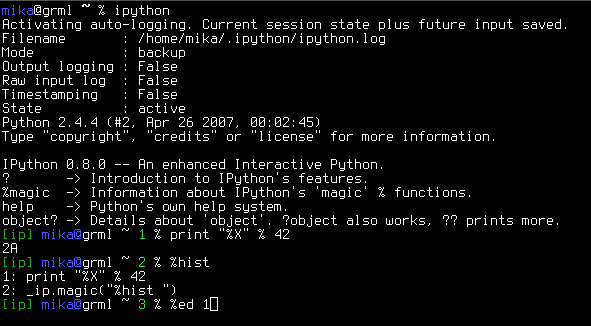
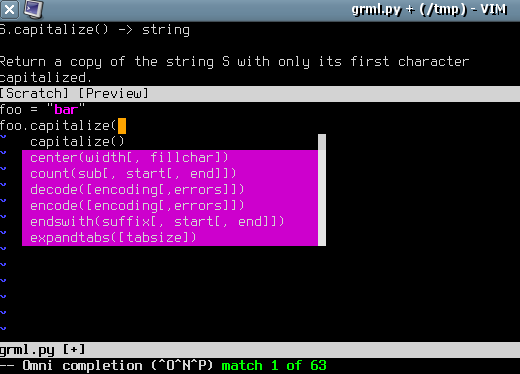
I wrote a small python webpage for the grml-wiki to provide some information regarding Python-development on grml. I just upgraded Vim on my main system to version 7.1 and omnicompletion with vim-python became better once more. So time for a short demo of ctrl-x-o: Python coding in Vim 7.1 - Screenshot I also very much like ‘%ed’ within ipython using the following snippet in my ~/.ipython/ipythonrc:
editor 1
editor /usr/bin/vim.python
Notice: Don’t wonder about the prompt style of the following ipython-screenshot, I customized it a little bit (see python-webpage in the grml-wiki again to get an idea). ipython demo - Screenshot So running the last line containing ‘%ed 1′ will execute /usr/bin/vim.python providing the code from the first command line of ipython and I can use all the magic of Vim for editing the code. When exiting the editor I have the code within ipython. Rocking. :) Oh, don’t forget to check out the Quick tips of ipython when exploring it. Now what’s missing in ipython is the edit-command-line feature of Zsh. That would allow me to edit already typed (but not yet executed) code with an external editor. Anyone out there with an according tip? ;-)

Paul van Tilburg: Master Project Finished

Yesterday, I have completed my master project with a presentation of my work and a defence of my thesis. I got awarded a 9 (out of 10) for my entire project. It is a result that I am very happy with and am very proud of. This result will allow me to get my Master of Science degree with honours on June 19, after the exam committee has checked everything. Note that the diploma will be handed out not on June 19, but on August 28, because I am on my holiday and at Debconf in Edinburgh the next two weeks. Thanks everyone for attending my presentation, joining the “celebration lunch” afterwards, and all the encouraging words and kudos. :-)

Jonathan McDowell: Indexing documents

Dear Lazyweb, I am prone to downloading random documents (usually PDFs) from the interweb. Often these have helpful filenames like 30430.pdf. Renaming them helps, but I seem to collect lots of them. Is there a simple document management system I can import them into that will let me at least categorise things, and then search for titles etc (bonus points if I can actually search the text in the documents, but I can cope if I need to manually enter the info on import)? PDF is the most useful format for me, but I'm sure I'd end up using Word or whatever support too. apt-cache search dms turns up MyDMS and Owl though both look a little heavy - I only need it for local personal use.

Jan Wagner: PHP packages in etch and binary compatibility to 3rd party extensions

Since etch php is compiled with large file support. This breakes binary compatibility to other packages, which are commonly not compiled with LFS and leads into trouble with 3rd party extensions, cause these are precompiled against the ABI of upstream and LFS not turned on. One example is Zend Optimizer. You may say this will only hit closed source applications, but if these are customer requirements, you have to solve the issue in some way.
You can do this by compiling your php and all extension from source without LFS enabled, but here you have to care about bugs, regressions and exploits for your own.
An other solution is to rebuild the packages from etch with LFS disabled. I’ve done this with the source packages of php4 and php5 from etch. Additionaly I did backport php-suhosin from unstable against this php packages for php4 and php5. Packages are available at http://ftp.cyconet.org/debian/archive/special/ or via

deb http://ftp.cyconet.org/debian etch-special-cyconet main non-free contrib If there are any DSA popping up, you can expect updates with a short delay. Please keep in mind, that you cant install php extension directly from etch. You need to rebuild them against php[45]-dev with disabled LFS. Other php packages may apear later. , , , , ,

5 June 2007

Martin-Éric Racine: E-stonia

If these two links [1] [2] don't manage to convince you that Estonia is the place to be if you're really serious about innovating in the ICT sector, then I really don't know what will.

Martin-Éric Racine: Eesti keele spelleri arendus

As I mentioned in a previous post, I maintain the Debian and Ubuntu package of ispell-et (Estonian dictionaries for the Aspell, Ispell and MySpell spell checkers - plus an hyphenation pattern for OpenOffice). Packaging this software was a natural choice for someone like me who is learning the language and who needs something to highlight obvious mistakes. This being said, the Estonian wordlists that serve as raw material to generate those dictionaries are in desperate need of Language Love; the vocabulary appears frozen in Soviet time and rather incomplete to begin with: obsolete words nobody can even remember (probably of importance only to linguists or philologists), omission of even the most basic colloquial slangs, complete absence of contemporary technical vocabulary, etc. Therefore, I am hereby inviting all Estonians to contribute to the development of the wordlist. The procedure is fairly simple: install the Estonian dictionary package for your favorite text editor or word processor (on Ubuntu 6.04, simply install language-support-et), load a few documents and report all words that were mistakenly marked as misspelled to Jaak Pruulmann. As an incentive, please note that all improvements will go into the Estonian version of Edubuntu, providing free language learning tools to Estonian children and thus benefiting the entire Estonian community. Tore homma, eks ole? :-)

Martin-Éric Racine: Buzzword opportunism won't do

Being involved in no less than four different projects, all with excellent prospects for a permanent job, reminds me of why riding the Free Software bandwagon as yet another opportunistic buzzword won't do: In three of the projects, people insist upon communicating using the closed source VoIP application Skype. There indeed is a crude port for Linux on i386 (though not for amd64, powerpc, or any other architecture), but the dependencies are broken and my friends at Skype emphasize that Linux is a non-market for them, so I should not expect any solution any time soon. Still, the people behind some of these projects regularly threaten that I'm wasting their time by "refusing" to install Skype on my computer. Free Software promoters who don't understand what "non-free" means. In two of the projects, the corporate homepage is made as a single Flash animation. Mentioning that Flash support is extremely broken and thus essentially non-existent on Free Software platforms is pointless: the people behind the project are Windows users and yet they insist that their project is about promoting the free circulation of ideas using Free Software. Free Software promoters who don't understand interoperability. In one particular project, the product follows the Googlesque model of "the Web as my application and file server". Great idea, except that ― once again ― the people behind the project are Windows users and they insist that the Thin Client hardware must have a standard set of applications pre-installed and some storage media, thus defeating the purpose of this business model. Promoters of "the Web as my application and file server" model who don't understand the implications of a Thin Client solution. In all cases, the people behind the project mean well, but ― not being Free Software users themselves ― they clearly don't understand the profound implications of the Free Software agenda; they only see it as a license-free technology to connect the masses for cheap and they evidently find it difficult to think outside the Windows PC framework. Free Software as a business model, in a nutshell: data interoperability and the client-server model. Either get it or you're wasting my time ...and yours too. Nothing personal; just business. PS: I sincerely hope that anybody who recognizes themselves in the above rant will acknowledge my honest concerns and embrace this opportunity to truly adopt Free Software. Just do it! It doesn't matter where you get the FOSS. Just make sure that the FOSS gets you! (inspired by a great Candy Dulfer song currently blasting through the headphones).

Eddy Petrișor: Customizing D-I

An interesting opportunity appeared at work. I am going to make a custom D-I image.
It will involve:
This way I will probably get back in touch with D-I development ;-) .
Fun, fun fun. Doing Debian stuff at work, payed by my employer!

MJ Ray: Wondering about Fon Rangers

While I was in Paris, I used a FON WiFi Access Point a couple of times. The rate seemed very reasonable - EUR 3 for a day's access compared to 10 (EUR 15) per day for The Cloud - and I paid with some money that's currently trapped by paypal's incompetence (they wouldn't accept letters in a UK Companies House registration number). I'm wondering whether to run a FON point. I've line-of-sight down the hill to a holiday park less than 400m away. If I aim a 6dBi directional antenna at it from inside a window, will it reach? Would the 2dBi built-in antenna reach the pub and shops 100m away? I used wifi while on a city break, but do people want internet while on a seaside holiday? Fon has adopted Ubuntu as its preferred operating system and the CEO also wrote:
"Fon already is an Open Source company and our software is an Open Source project called http://www.openwrt.org and we should support other Open Source movements/companies"
which is a good cooperative viewpoint, in my opinion. I'm a bit troubled by its Skype, Paypal and Google promotions, BBC Panorama: Wi-Fi: a warning signal and Andrew Savory's Fon not so much fun but it seems like a good idea at the moment because it would save or make money and I'd finally have OpenWRT on a router. Are those good enough reasons? Are there other options? What are they?

Next.

Previous.