Search Results: "tar"

26 November 2006

Russell Coker: supporting an electrion campaign

Yesterday I handed out "how to vote" cards for the Greens at the state election. It did seem to be a significant waste to have so much paper produced. Slightly more than half the voters who visited my polling booth took cards from all parties, which was obviously of little use. There is some useful information to be gained from reading the cards from all parties, but nothing that you can analyse during the short period spent waiting in line. I expect that most people decide who to vote for before they get anywhere near the polling booth and just accept the cards because they feel that it may be rude to reject them. While ironically some people who didn't like the Greens refused to accept a card from me and told me that they didn't want it with the impression that they would offend me, I'd rather save the trees and not give cards to people who don't want to use them...

I spoke to a representative of the Family First party who tried to convince me that the Greens should be against homosexuality because the Greens are "against unnatural things", he also claimed that people who choose not to have children (being gay is apparently choosing not to have children) are selfish - unless of course they are a celibate priest. He also managed to offend a supporter of the ALP in two different ways which led to an amusing heated debate and then left before I could have any more fun. For the reference of other Family First people, I've pasted in the dictionary definitions of "homo" and "hetero", when used as prefixes those Greek derived words mean "like attracting like" and "opposites attract". An example of such usage is the term "homo-charged electrets" used in electronics.

From The Collaborative International Dictionary of English v.0.48 [gcide]:
Hetero- \Het"er*o-\ [Gr. "e teros other.]
A combining form signifying other, other than usual,
different; as, heteroclite, heterodox, heterogamous.
[1913 Webster]

From The Collaborative International Dictionary of English v.0.48 [gcide]:
Homo- \Ho"mo-\
A combining form from Gr. "omo s, one and the same, common,
joint.
[1913 Webster]

From Bouvier's Law Dictionary, Revised 6th Ed (1856) [bouvier]:
HOMO. This Latin word, in its most enlarged sense, includes both man and
woman. 2 Inst. 45. Vide Man.


The ALP (usually known as Labor) supporters had unfortunately believed the lies of their own apparatchiks. They were convinced that the Greens were directing preferences to the Liberal party, even though in most districts the Greens actually directed preferences to the ALP! The only exceptions were a small number of districts with split preferences (favoring neither Liberal nor ALP). It continually amazes me that while helping the ALP they were attacking us! Once I showed the ALP supporters the cards I was distributing they became quite friendly, as the Greens had a very low chance of winning the lower house in the districts for the polling place in question the preferences would go to the ALP.

It was interesting to talk to a Liberal supporter, he supports the workplace reforms implemented by the Federal government (Liberal) because he was hired for his current job because his employer can easily get rid of him if the business has a down-turn. It is hard to argue with someone who has only got a job because of the policy in question, but I did point out that continuity of employment is a major factor when applying for a mortgage. I recently bought a house and had a significant amount of hassle from the banks due to the fact that I work as a contractor. I had previously enquired about borrowing twice as much money while at my last permanent position and had much fewer problems from the banks.

I mentioned some of the other bad things the Liberal government has done (such as invading Iraq for no good cause), but the Liberal supporter was too sensible to comment on any of the issues where he would only lose. This however left him with not very much to say.

Most of the work of handing out the cards was quite boring and very tiring. Fortunately a friend decided to visit and help out so there were three people handing out Greens cards instead of the scheduled two which made it easier work. The ALP apparently had four people which seems to be an optimal number as there were voters arriving from two directions and no matter where they came from at least two ALP supporters would be able to intercept them.

Surprisingly the work was easier at the most busy times. When the queue stretched out into the street I could stoll along the queue and give the cards to the voters. When the queue disappeared later in the day the voters were walking past at high speed and I had to move quickly to get to them.

Now it's time to start planning for the next Federal election.

John Goerzen: Society's Views of Dads

Back before Jacob was born, I was reading The Expectant Father: Facts, Tips, and Advice for Dads-to-Be, 2nd ed. by Armin A. Brott and Jennifer Ash. It was a good book and I recommend it.

Towards the end, there was a section that the author clearly was passionate about, and it made me mad too.

He was talking about society's attitudes towards dads. He started by looking at messages that are sent out in commercials. One study of commercials said that "100% of jerks singled out in male-female relationships were male. There were no exceptions. . ." That study also said that 100% of the ignorant and incompetant people in commercials were male as well.

He went on to cite some examples. Tons of slogans like "kid tested, mother approved", "choosy moms choose Jif", Robitussin's "recommended by Dr. Mom", etc. And one for Post Raisin Bran in which a father and daughter are impressed by their cereal. Dad says, "somebody must really love us. Who do you think it is?" The daughter answers, "Mommy!"

Of course, these were just some examples from commercials, but they seem to reflect a message that dads are, at best, incompetant. Brott mentions studies that show that men display the same decision-making skill and affection as parents as women do.

Brott went on to talk about some of his experiences. One time, while he was in a park playing with his children, a little girl started to fall off the top of a slide. He was right there and was able to catch her as she fell -- probably saving her from, at best, a broken bone. The girl's mother rushed over, ignored Brott, and said to the girl, "did he hurt you?"

I started to see this sort of thing all over the place even before Jacob was born. In stores, there would be tons of infant shirts, bibs, etc. saying things like "I love mommy," rarely even one thing that mentioned daddy. Similar patterns were there for greeting cards and pretty much everything else baby-related.

I've noticed this even more since Jacob was born. There have been times when Terah and I are somewhere together, standing right beside each other, and someone will ask Terah all about Jacob, and totally ignore me. Even if I'm the one holding him. I'm sure people are well-intentioned; some of them that have done this are people we know well and I know they mean well. Somtimes, I don't even notice when this is going on (though Terah does and when she mentions it later, I remember it).

Do they just expect that men don't care? Or do they think that since Terah is working part time, and I'm working full time, that we must be "traditional" enough that I don't care to be involved in Jacob's life? (Though I'm not sure that the "detached & uninvolved dad" stereotype ever was true, at least from the examples I can think of) It's hard to miss out on so many moments of Jacob's life during the day that Terah gets to be there for. But that doesn't mean that I'm an uninvolved or clueless dad.

Now, despite this little rant, there are quite a few people out there that have no problem including me in discussions about Jacob -- relatives, friends, people at church, co-workers, etc. In fact, probably more people include me than don't. I really appreciate that, and especially the extra effort some of them go to in order to include me. (I know how much effort it took to find baby clothes that mention dad, for instance) Terah is best at all this, making sure that I get to be part of Jacob's life as much as I possibly can be, and I really appreciate that.

But to Wyeth (makers of Robitussin): Don't think I haven't noticed that Walgreens sells "Wal-Tussin", same active ingredients as your product, and at a lower price. Dr. Dad knows how to buy generic.

Evan Prodromou: 4 Frimaire CCXV

It was a pretty day in Montreal today, and since I was taking care of Amita today I knew I wasn't going to get any computer stuff done. So I decided to take care of some tasks that needed doing around the house -- cleaning up our storage room, changing some light bulbs, fixing some furniture and putting plastic on the windows for winter. This is one of my least favorite jobs for preparing for winter. Probably the biggest sink of heat for an apartment is the windows and doors, so we do our best to insulate them. Doors get insulated foam around the cracks, and windows get covered in a thin film of clear plastic, which forms a pocket of air and provides an extra insulating barrier from the outside. It sounds crazy, but it's remarkably effective -- it really makes the difference between a cold house and a cozy home. It's extremely labor-intensive, though: it involves putting up lots of double-sided tape, cutting just-right rectangles of gossamer micron-thin plastic sheeting, climbing up and down ladders, hanging, measuring, moving. Probably the silliest part is that you blow on the plastic with a hot hair drier to make it contract tightly over the window so it's easier to see out. That takes like 10 minutes to do. Last year I waited until mid-January to do the job, and we were all walking around the house shivering and wheezing. This year I'm getting it done before winter's really upon us, but that doesn't mean I like it any better. I guess I'll just be happy when it's done. tags:

My JavaScript workbench So, I've been working on making a Wikiwyg plugin for PmWiki. Wikiwyg is an ingenious Javascript library for doing WYSIWYG editing in the browser, but keeping all communications with the server in wiki syntax. Every wiki engine should be using it, but for some reason it's not well-implemented. I think it's mostly a community-marketing problem, but that's a separate subject. I want to eventually get it working on Wikitravel, which runs MediaWiki, but I wanted to give it a try on an little more deterministic wiki syntax. So I started an extension for PmWiki. I've learned a lot so far; I'm far from done, but if you use darcs you can see my work so far by running:
darcs get http://evan.prodromou.name/darcs/pmwikiwyg/
Since the code's mostly in Javascript, I've been getting my JS workbench back into shape. By "workbench", of course, I mean "loose collection of tools for documentation, debugging, and editing". For documentation, I've been using the excellent JavaScript and DOM docs from Mozilla Developer Center -- itself a wiki. The docs are (almost) complete, well-written, and well organized. And, of course, Free -- it's all under the CC attribution-sharealike. For debugging, I've been using the Venkman JavaScript debugger for Firefox. It's been a while since I've worked with a half-decent debugger, so it's been a pleasure to use. And for editing, I'm sticking to my favorite programmer's editor, JED. I first started using JED because it had the same name as the founder of Spock Mountain Research Labs, but eventually I've grown to like it on its own merits. I was a longtime Emacs addict, and JED has been my editorial methadone. It's got all of Emacs's advantages -- same keyset, different but valuable extensibility -- without the long load times and heavy weight on system resources. I'm at the point where JED is my only editor. One nice thing about JED is that writing language modes is pretty easy, so there are a lot of them out there. I found a half-decent one for JavaScript floating around on the Internet a few years ago, and it seems to still be the best there is. As mentioned above, I've pretty much transitioned fully to Darcs as my version control system for whatever projects I can help it. It's a great piece of software -- all the strengths of GNU arch without the idiosyncratic naming conventions. And that's my workbench. It's no Eclipse, but I'm having fun working with these tools. tags:

Brett Parker: Google vs Gaia

Clint I can see where you're coming from, but as it's the access to proprietary data, that is licenced, I can see exactly where google are coming from - it's not "evil", it's just data protection - it's not thier data after all, they have deals with other people for that data, there is money transferring between google and other companies for that data. The source that was being provided was misusing the data itself, though not a bad goal, it did break the EULA of the data. This is the data age - you want things to be non-evil, make the content providers open the content, don't claim $company is being evil because they're trying to keep their EULA with the content providers.

Clint Adams: A harmless explanation

Sebastian, I see a veiled threat in that letter. Furthermore, I see more promotion of proprietary data and software, and defense of the ideals of intellectual property law. You may argue that this is good business sense or necessary or what-have-you, but it ain't not-evil.

25 November 2006

Sven Mueller: live-cd-on-removable-disk

Enrico said in live-cd-on-removable-disk: Mostly it boils down to running the xorg-creation script at every boot time. There are various tools to do that. Some are here, but there is surely more. (Enrico’s note: do we have anything in Debian that we can install and just does that?)
Well, Enrico, a tool I really grew fond of, which auto-configures X on Debian systems is xdebconfigurator, it lacks being auto-run on each system start, which I consider a feature on normal systems, but for your proposed usage (i.e. a portable USB-storage based Debian system), it would certainly be the right thing. Essentially, it never failed on me. Except for VMware virtual machines, where all it did wrong was that it proposed too high resolutions which resulted from my dual-screen Windows setup I ran VMware on. You might want to give it a try.

Biella Coleman: Play Money by Julian Dibbel

A few months ago I finished Play Money by Julian Dibbel and like his My Tiny Life before it, the writing style is simple yet sumptuous, or I guess just simply sumptuous. Like the travel writings that pre-figured anthropological writing, Dibbel takes us to a far-away exotic land (but only a click or two away) that are populated by a motley crew of wizard (or is lizard)? slayers, gold-diggers, money-makers, and virtual-world-builders. For many, these MMOGsare no strange-lands but are becoming weaved firmly and intimately into the fabric of everyday life, whether as entertainment, sociality, and or for a cadre of folks, as a source of income generation. I think the book has gotten enough coverage that I don’t need to rehearse its content in any detail but the basic story is that Julian embarks on a real world quest in the virtual land of quests to try to make enough money (to be specific make a little more than his monthly salary as a freelance writer) from trading and selling a slew of virtual objects and gold. In taking us along, he gives a compelling entry into the imaginative and morally complex world of these games. And better is that whether you know nothing about them or are a seasoned player, the book has much to offer. One of the reasons I respect Julian Dibbel is because he takes his sweeeet time to churn out a book-length manuscript. In a day and age when there is so much pressure to release quick and often, especially when writing about anything in the so-called virtual plane of existence, he waited nearly 8 years from the publication of his last book on gaming, My Tiny Life before publishing on a considerably higher-tech phenomenon. Following him on his most recent adventure, you learn that he threw himself into a variety of gaming environments persistently and consistently and did at least 3 years of research and writing (at one point in the book he confesses how excruciating writing for him, which is hard to believe as the words slip so nicely off the paper but whatever the extent of his writing angst is, he clearly spends a lot of care in crafting his sentences). And I am starting to think that if more people followed this ethic of long-term immersion, coupled with slow-brewed productive sparsity, we would get higher quality products (Yes, kinda like the Debian release cyclce). Like any good ethnographer, he gives an intimate portrait of life in these worlds of copious play where various types of real world economies have mushroomed apace with new technological developments. That is, he gives us a taste of what it is like, as he cleverly puts it to own unreality. Couched within tales of gaming gone real world economic, are hearty reflections on the place of play in social and economic life, the close resemblance and conceptual affinity between computers and games (and not just computer games, and here he does a fantastic job at explaining the Turing Test), self-doubts about writing in general and in particular about this topic, commodity fetishism, and the changing nature of capitalism in a world of ever-greater abstractions. All of this makes for an enjoyable read that if used in the classroom (which like A Tiny Life, I am sure will become standard for courses on Virtual Worlds) allows you to bring in some good supplemental material whether Edward Castranova’s Synthetic Worlds, Greg Lastowka and Dan Hunter’s The Laws of Virtual Worlds and or older heavy-hitters like Max Weber and Karl Marx. The only topic I think I would have liked to seen included is that of capitalist finance, because there are, I think, some real affinities, phenomenologically and conceptually, between finance capitalism and gaming the virtual game. Otherwise some of my favorite sections were on hackers and the object of the computer, but of course, I am biased that way. So here I leave you with a tasty morsel of something that was sumptuous to ingest: It is this endlessly repeatable collusion of freedom and determinism-the warp and woof of fixed rules and free play, of running code and variable input that sets both games and computers apart, together from the larger universe of information technologies they inhabit…. But only games share the universal machine’s game’s thoroughgoing commitment to the principle of recursion: the chained repetition of simple operations, each building on both the input of the moment and the outcomes of preceding steps. And only games, therefore, come close to capturing that precise mi of unpredictability and inevitability that makes the computer such a powerful simulator of our lived experience of the world. p. 104

24 November 2006

Evan Prodromou: 3 Frimaire CCXV

I think there's a certain special sloth that Americans get to experience on the day after Thanksgiving that we don't get on other parts of the year. Something about the combination of gluttony and wholesomeness makes Black Friday a very mellow, enjoyable time. Maybe it's the fact that it's officially now The Holiday Season, but the stressful tasklist of December hasn't started yet. Or maybe just that it's a day off of work for no good reason except it just is. Maybe it's the fridge full of leftovers that still taste kind of good. I dunno. We had a good Thanksgiving dinner yesterday evening. Maj, Amita June and I had planned to go visit family in New Brunswick (New Jersey) for the holiday, which was really nice to do last year. But our visas are running out in December, and although we're (probably) not going to have a problem renewing them, our lawyer said it was a bad time to leave the country. So, we stayed in Montreal for Thanksgiving. Canadians have their own Thanksgiving, of course, on the 2nd Monday of October, but not having grown up with that day as Thanksgiving, and with most of our family celebrating in November, it's hard to get motivated around Canadian Thanksgiving. And it's just not that big a deal in Quebec, anyways. So we had a good dinner here; John Usher, Niko, Jeff Waye, Meg and Patti all came over and had a good time of it. I cooked my first Thanksgiving dinner -- a big salmon, potatoes and sweet potatoes, roasted broccoli and wax beans, a great big salad. Every family has a Thanksgiving dish tradition -- one of the Prodromous' is a big pot of macaroni and cheese. So I made that, too. We all ate pretty well, drank some wine, talked about the future of music and how fun it is to play hockey. Unfortunately, I managed to miss my Blinky Hockey practice last night -- I tried to put the (overtired) baby to bed at 10PM and ended up falling asleep myself. All in all a good TG, even though far from family. tags:

Speaking of home All of Canada is abuzz right now about a recently-proposed bill by the ruling Conservative Party in Parliament to declare the Quebecois to be a nation within Canada. Sovereignty of Quebec has been an extremely contentious issue in Canada over the last 50 years (two sovereignist parties are major players at the federal and provincial level), and this form of recognition is an interesting step. The whole thing began with Michael Ignatieff, a candidate for the leadership of the opposition Liberal Party. He has stated publicly that Quebec is indeed a nation, and his followers are pushing to have that be part of the Liberal Party platform. The sovereignist Bloc Quebecois tried to steal their thunder by introducing a bill in parliament to the same effect. Their thunder was in turn stolen by the Government with the latest bill, which now has the support of all the parties and will almost definitely pass. The wording of the bill is interesting. First, it calls the Quebecois a nation -- the people themselves, not Quebec qua territory or government. Although the government has stated that this includes all people in Quebec, it's still pretty obviously targeted towards recognition of an ethnic group, French-speaking Quebecois, more than everybody who's living inside the borders. Second, it recognizes this group as a nation within Canada -- deflating the suggestion that it may become an independent state. I have to admit that the ambiguous nature of Quebec's status is one of the things I find fascinating about living in Montreal. As far as I can tell, few sovereignists hope for anything like a total split with Canada, but instead are looking for some sort of autonomous status. On the other side, even the staunchest federalists have seemed comfortable with granting Quebec more of an international profile, such as giving Quebec a formal role in UNESCO. My guess is that the nature of Quebec's relationship with Canada will change gradually until it reaches some stable point where everyone's comfortable. I don't know where that stable point is, but I think it'll be interesting to find out. At the turn of the 20th century, if you had told people that the British, Austrian, Turkish and Russian Empires would be dissolved and almost forgotten within 100 years, they would have scoffed. But in that short span of time, the idea of empire, spheres of influence, and Great Powers has passed from the world stage. We simply don't think in terms of Empire any more, but in terms of nation-states. My guess is that the 21st century will see a similar change in the idea of nation-state. With pressure from supranational organizations like the UN, EU, GATT and the International Criminal Court, as well as pressure from unrecognized nations like Quebec and Catalunya and Wales, I think the firm borders of the nation-state are going to loosen up a lot. What it will mean is anyone's guess, but I think if we're lucky we'll have a richer tapestry of nations and people participating in global politics and culture. And I think Quebec will be an important part of those changes. tags:

Thanks, Biella! I'm glad to see that Biella is going to give us the goods on PR. Our Wikitravel 2007 Get-together is going to be on the island of Puerto Rico, and Biella's from there, so she's going to make up a list of good places to check out. Great news! tags:

Edd Dumbill: New release of XmlIndexer search server

About 18 months or so ago I released the first version of XmlIndexer, a general purpose XML indexing web service based on Mono and Lucene.Net.I'm happy to announce now version 0.4 of this software which, thanks to improvements in Lucene.Net and patches from the Beagle hackers, is a lot more stable. Previous versions had some nasty locking issues that could kill the server quite dead.XmlIndexer is a simple indexer. Given a rulefile that maps XPaths to Lucene keys, it can be taught to index any XML file you should care to give it. I use it to provide search functionality to legacy applications, which then need only to expose their data as XML and call a few simple web services to perform a search.Of related interest is the new Apache Incubator Solr project, which provides a fancy search server based on Lucene, doing the same as my indexer, and much more.XmlIndexer requires Lucene.Net version 1.9.1. For extra points, apply the locking patches from Beagle to Lucene.Net before building. As a courtesy I include a Lucene.Net DLL I made this way in the download.Download: searchxml-0.4.tar.gz

Lars Wirzenius: Random thought: Bzr book outline

While cleaning up my hard disk, I found the beginning of an outline for a book on Bazaar (bzr), the version control system. I wrote it one weekend this summer, when I felt I had lots of free time. I don't, and won't, for the foreseeable future. Therefore I'll dump the outline here in my web log, so that perhaps someone will be inspired to write it for me. The Bazaar distributed version control system For most of the 1990s, the free software world relied on CVS for version control. It was the best free system for the purpose. During the early 2000s, a number of new systems started getting into public knowledge. One such system is Bazaar. This is the outline for a book to explain how Bazaar is used in different kinds of scenarios. The book is not a reference manual: the software's own documentation is best suitable for that; this avoids having to constantly update the book. The book is structured as a series of case studies of common scenarios, starting with the simplest one, and getting increasingly more complicated. This approach allows the reader to quickly learn the things they need for a particular kind of situation. Introduction This chapter explains what version control systems are, and gives a summary of their history so far. It explains various basic concepts, such as centralized versus distributed, but briefly; these will be expounded on later in the book. It compares Bazaar to other well-known systems. It explains the cumbersome naming history of Bazaar. It explains how to install Bazaar by referring to the website and to the package repositories of various Linux distributions. Quick overview This chapter is intended for those with some experience with other version control systems, such as Subversion. It gives a quick run-through of the central concepts of Bazaar, and how to do common tasks on the command line. The web page project This is the first case study chapter. It explains how to use Bazaar to keep track of changes to a web site. A web site only changes linearly: only one version exists at a time. My little program This chapter explains how to use Bazaar to maintain the source code for a one-person programming project. The program has a stable version, which gets bug fixes, but no new features. There is also a development version, which gets the new features. Sometimes a bug needs to be fixed in both, and Bazaar can help with this. Additionally, sometimes it is not clear whether a new feature can be implemented cleanly, or there are several possible approach to how it can be implemented. Thus, the chapter also explains these so called feature branches. Further topics for this chapter include making releases, and using repositories to avoid excessive disk usage. Tight teamwork This chapter explains how to use Bazaar when the one-person program becomes an internal project in a company, with a well-defined set of developers. Thus, we discuss how to set up a centralized branch in a way that all the developers can commit to it. Distributed free software development This chapter concentrates on a typical successful free software project, with contributors from all over the world, and the problems that this involves. Thus, we discuss how to publish a branch for anyone to see (but not change); how to share changes (patches/bundles) between developers; how to co-ordinate the development of the whole project (at least from the version control point of view). Switching a project to Bazaar That's it. If you write it, please send me a note when it's published so that I can get a copy. Thanks.

Michael Janssen: She keeps a picture of me

This is a picture of me before I started this whole diet watching and exercising regimen. Hopefully I will be able to take regular pictures that can document my progress. This is one thing which I don't plan on doing very regularly, maybe every two or three months. Pictures have been known to be a great motivator to people on diets - they remind people how they used to look, and more importantly point out how far they have gone so far. Usually the most dramatic change is seen in the picture, even if you don't see much movement on the scale. The picture is so powerful that it is usually used alongside actual insane weight loss claims in TV commercials. Anyway, this is how I looked when I started this whole thing.

As this week's entry falls on turkey day, it may be interesting to note something which has been at the back of my mind during these “special” days in which you are urged by almost every sane diet plan to just forget the plan on that day. Many websites say that cheating on your diet may actually be good for you in the long run. While some emphasize the psychological aspects of having a day off, others actually cite scientific reasoning involving a hormone called Leptin. At any rate, the line between cheating and giving your diet a little boost is getting quite a bit blurred. So on this turkey day and days after, don't feel like you have to work out extra hard just because you're eating more.

This week I started using a new diet tracking site. This one is more closely in line with the method I used before. It's Physics Diet, and is basically an online notebook like you would keep if you were on the hacker's diet. This also calculates some more stuff that would be a little complicated to keep track of yourself, like Total Energy Expended (calories). It also has a nice CSV export which still allows me to give all of you your weekly stats. I've continued with the watching of anime while I am exercising, but am supplementing it with some podcasts and some episodes of a BBC show called QI or Quite Interesting. There is a downside to watching QI while exercising: I am laughing so hard sometimes I need to re-concentrate on the exercise so that I don't fall over. I'm sure it's not a bad thing for my calories expended in total.

This Week (Nov 17 - Nov 23):
Minimum: 335.0 (-0.5) (Nov 22)
Maximum: 339.0 (-0.5) (Nov 17)
Average: 336.8 (-0.4) (136.8 to goal)
Exercise Calories: 2719 on 6 days
Average Calories per session: 453.1

John Goerzen: Updates

I haven't had a lot of time to blog lately, so it's time to catch up on a few things.

Jacob is now almost 12 pounds. He's been growing well. As Terah mentioned, he has been colicy. He seems a bit better in the past few days. He usually has started getting fussy just before I get home from work, and continue through the evening. So I hadn't been able to see him happy all that often for a few weeks there. It's a lot of fun to be around him when he's happy.

The house is coming along nicely, too. Drywall is up inside, siding is up outside, the propane line is installed, water line is installed, power is run to the house, and phone service is installed as well. Bathtubs have been set in place. The furnace is set in place, though not yet hooked up to the duct system. Network/phone cable (CAT6 for it all) is run, as is coax cable. Interior painting starts next week. The house has changed appearance dramatically over the past few weeks.

We were looking at some "before" pictures to figure out how we wanted to structure our porch. It looked bad back then, but compared to how it is now -- well, it looked even worse.

The annual pillars banquet for Bethesda Home was a few weeks ago. I'm on the board at Bethesda (which has been a good experience), and board members pitch in to make the event happen -- it's our largest fundraiser event of the year. I took photos last year, and again this year. They're posted online. Bethesda was founded in 1899 and has been an important feature of our small community ever since. I'll write more about it sometime.

Things still seem busy here. Between taking care of Jacob, being in a temporary residence (everything takes longer because so many things are in boxes or just not accessible), keeping on top of all the decisions for the renovation, and all the mundane things of moving twice, there's not a lot of free time. Hopefully that situation will improve a bit, but then we will of course have the big move into the house -- probably in January sometime.

Gunnar Wolf: Honest spammers

Wow...This time I'm truly amazed. A spam just hit my debian-devel mailbox. That's sadly not strange at all, I know. Only that I started reading it. It says:
Spammers don't seem to target us for their random alias generation
tools, or        maybe they haven't got to the letter 'o' yet. com
for subsequent posts, but that whole barn door thing comes to mind.
In so doing, values are overlooked often and mistakes are made. Maybe
Microsoft will let me        change my alias.
Maybe some of it would actually be useful to me. For whatever reason, my
Microsoft email address didn't ever get        spam.
Then it goes on talking nonsense splattered with all kinds of garbage talk, some news (or whatever) about stock options of a China Health thing, and goes on throwing nonsense blabber.
Sorry, I'm not linking to it (I'll probably later update this entry), it's still not available in the Web archive of debian-devel.">

23 November 2006

Pierre Habouzit: Firefox 2.0, two time worse than the previous ?

When I started firefox 2.0 for the first time, well, my reaction was "woah, it's amazingly fast", meaning that it took it really less than 10seconds to launch, like its predecessor. But my joy ended way too soon. After many releases, firefox is still completely unable to be a decent application in many trivial points, that separately are completely insignificant, but put together make me freak out: But you know what's the worse ? I've had a SINGLE firefox instance to type that blog post. a top revealed me that this instance ended up with: Guys, what are you writing ? I remember days when a browser could run in less than 16megabytes of RAM. Oh yeah, I do use firefox a lot for web developpement, it has a lot of very nice and full featured extensions (like the web developper one). But please, with the years, none of the itchy and frustrating problems of firefox have been fixed, making it completely unsuited for my daily use. Firefox is completely poorly integrated in the standard Unix environment, and its memory consumption is a real shame[1]. Well, at least firefox is now vista-ready I presume. EDIT: just for the sake of it: children, close your firefox when you go to sleep, else it makes your computer explode. I've let a firefox run for more than 10minutes now, at least it's what my kernel pretends, and I dare to belive it. firefox now is the most greedy application on my system, it eats no less than 10.8% of my 1Go of RAM. with that incredible result:
3  PID %MEM  VIRT SWAP  RES CODE DATA  SHR nFLT nDRT COMMAND
 12524 10.8  309m 209m 108m  14m 180m  23m  287    0 firefox-bin
So my recomendation of the day: children, don't do this at home!!!
Notes [1] Just for the record, since the moment where I copied the top output, the firefox instance now uses: 269, 191, 78, 14, 135 and 22m for the same numbers, meaning that it managed to leak - yes leak how can typing 200 characters use so many memory ? - more than 2Meg of RAM, damn the time it too me to write that footnote it leaked 3 more Megs.

Russell Coker: Linux support by politicians

In two days time we are having a state election in Victoria (Australia). For this election there is only one party with policies that are positive towards free software, that is the Australian Greens. The policy documents include an IT policy (note that the IT policy is on a link that may change while the policy documents is a permanent link).

The Greens IT policy has three sections under the goals, one of those is about open standards (ensuring that government data is in documented file formats for use by all with no need to purchase software) and another is about Open Source which directly advocates the use of free software by government agencies. The principles part of the document is also very positive towards free software and explains why it's beneficial for Australia.

Any Greens representatives that are elected on the weekend have to abide by the party policy, that means that they must advocate the use of open standards and Open Source in government use and vote accordingly when any legislation related to computers is being considered!

Some of the members of the Greens are also members of the free software community, we were able to explain to the other party members the benefits for Australia and for social justice in the use of free software, and thus we reached an agreement about on a policy that suits people who use free software - not to benefit such people, but because of the benefits to society of the use of free software.

I think it would be good if members of the free software community in other countries would also join their local Green party and promote similar policies. While there is no direct connection between the Green parties in different countries the aims are very similar and therefore the arguments that persuaded Green members in Australia can be expected to work reasonably well in other countries (I am happy to provide advise in this regard via private mail if requested).

Also it would be good if other parties could be persuaded to have similar policies. If you want to help the free software community but for some reason you don't support the Greens then please join a party that matches your views and advocate an IT policy that promotes free software.

Currently people who want to vote for free software in the Victorian election have no option other than to vote for the Greens. As a member of the Greens I am happy to document this as a reason to vote Green. But as a member of the free software community I would like to see other parties adopt policies that promote free software.

The Greens adoption of a policy that promotes free software was largely driven by the issue of social justice. We believe that every Australian citizen has the right to access all public government data. If government data is available in proprietary formats then access is only granted to people who can afford the latest software ($800 for a full copy of MS Office) and hardware to run it ($600 at least). We believe that unemployed people who receive free Linux computers from Computerbank should be able to access government data. We also believe that when FOI laws apply in 30 years time all current data should be accessible, there's no chance that whatever version of Office is being sold in 30 years time will read current MS file formats, and there's no guarantee that MS will even be in business then. File formats for which there are authoritative open-source programs written to use them will be accessible in 30 years time and more.

Uwe Hermann: How to make Firefox/Iceweasel bearable

Firefox/Iceweasel TABs After a recent apt-get dist-upgrade I noticed that I'm using Firefox/Iceweasel 2.0 now. Which is nice and all, but it doesn't really fit my way of browsing and TAB-handling. I always have lots of TABs open simultaneously. And by lots I mean 100-600. I'm not kidding. Firefox 2.0 changed TAB sizes and behaviour which makes it completely unusable for me. A quickfix to make it at least bearable:
  1. Type about:config in the URL bar.
  2. Search for browser.tabs.tabMinWidth default integer 100
  3. Change 100 to 8.
  4. Restart the browser.
A lot better now... Now I need an extention which provides me with a scrollbar for the TAB-bar, I cannot click 200 times just to move to a TAB which is 200 TABs away from the current one...

MJ Ray: Driving a car? Give us your prints!

After registering children and alcohol drinkers, now they're going to fingerprint drivers at roadside checks, according to Motorists to give fingerprints [BBC News]. The report says
"Officers promise prints will not be kept on file"
but as Mark Wallace of civil liberties group the Freedom Association told them:
"I don't think we should be reassured by the fact that at the moment it's voluntary and at the moment they won't be recorded. Both of those things are actually only happening in the trial because the laws haven't been passed to do this on a national basis compulsorily and with recording."
ken lewis commented:
"My response to being asked for my fingerprints will be to say no and ask to prove my identity at the police station. That's non-violent resistance to this liberty-threatening move." "And that reminds me -- as a lurker on Planet Debian, I'm struck by the references to mailing-list flamewars. Why are people so keen on freedom able to discuss so violently that freedom?"

Edd Dumbill: Really really getting the testing religion

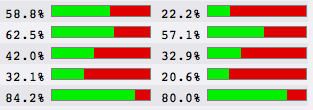
Writing tests is virtuous. It's the wholemeal bread of programming. Do it, and you'll be so much fitter. Except it tastes like cardboard and gets in the way of consuming the yummy treacle sponge of programming. But now I've got the testing religion. I view the lack of tests with the disapprobation of a reformed smoker tutting and huffing at the merest suggestion of a Marlboro Light. How did this happen and how can I be sure I won't backslide? The moment of transition was the first time that a test saved me from releasing software with a bad bug in it. The theoretical knowledge of virtue was translated into the palpitating relief of not disgracing myself in public. After that happened a few more times, I found myself desperately uncomfortable with the idea of releasing anything that didn't have decent test coverage. And so a virtuous habit is formed. It's not just driven by fear. With the right tools to hand, writing tests can be a lot of fun. You don't always need to be "in the zone". If you've got a spare half hour here and there, you can use it to increase the coverage of your tests. Getting better at testing is one of the ways I've become a much more proficient Rails developer over the last year of work on Expectnation. In case it helps anybody else, I thought I'd share some of the tools and techniques that are part of making Rails testing fun and effective. Continuous testing Whenever a checkin is made to our source repository, tests are run and the results emailed to everybody working on the project. As with the "you broke the build" disincentive, you need to be kept honest by frequent running of the tests. There are a variety of tools around to help you do continuous integration with Rails, most of which have some dependence on you using Subversion for source control. In the event, I just created my own script to do what we required. Coverage reports rcov coverage barsOne of the big mental hurdles with testing is knowing how many tests you should aim for.  You can't prove a negative: even if your tests are all passing it still doesn't tell you much about the tests you haven't written that might fail! We use rcov as part of the continuous integration process, and post the results to our project web site. The pretty red and green bars give you some idea of when you're starting to get adequate test coverage, and the line-by-line breakdown is invaluable. Tainting strings One of the easiest errors to make in Rails templates is to miss the call to h(), to escape any HTML in an output string. The only real way to catch these errors is through automation. The wonderful safe_erb plugin helps you do just that. By using Ruby's tainting mechanism for strings, it throws an exception if you render any external data unescaped. One of the beneficial side effects of safe_erb is that you then become very particular about ensuring your functional tests properly cover every action in your application.  Tests such as get 'index', which before seemed mundane and redundant, are now essential, as you want to test for tainted strings. In addition to the above techniques, there are a lot of fun shiny gadgets to help you write tests, such as ZenTest, but the three things above are the ones I've found to be of significant value. I ought to conclude with words of praise for Rails. It goes out of its way to make testing an important part of the development lifecycle, and the availability of the of unit, functional and integration test functionality makes it easy to get started. Every time I teach somebody about Rails' testing features, they end up finding it very enjoyable.
Don't forget, testing can be fun!

MJ Ray: Spam: Under Seige

At the start of this week, one of the mailservers I run came heavily under attack. As well as the continuing surge in the sheer volume of spam - which has been reported widely in articles like Spam up by 59 per cent [Spannerworks Search Marketing News] - there were dozens of clients opening connections and then just sitting there idle. Very strange. To bring things back under control, I added a mixture of new anti-spam methods, but some things will always be attractive enough for bad people to attack manually and defeat whatever anti-spam you put in place. The only anti-spam which can't be defeated is one that will defeat all real people - and that helps spammers to pollute the network, IMO, making everyone else waste yet more time as a result of their spamming. My main anti-spam at the moment is a mix of: I always argue against doing a hard reject for a dnsbl match. In general, dnsbls are way too trigger-happy and too prone to false positives, especially for things like new mailservers coming online. Just this month, one of my ISP mailservers ended up in sbl-xbl and I couldn't find out why. Once I had added the extra anti-spam, the spam volume dropped significantly. Total message volume reduced by about 20%. I can't tell reliably how many of the 20% (or the remaining 80%) are spam, of course. But then the network connection failed, which may have been the cause of the idle connections that turned this into a crisis in the first place.

Biella Coleman: Hay Papito, que cold it is!

So it is hard to believe that in less than a month I will be somewhere, to be exact, Puerto Rico, that will be 80 degrees warmer than it is right now. And after weekend, it will be 100-105 degrees warmer. Yep, the cold (frikken) snap has arrived to Edmonton and it is preety intimidating. So long as there is no wind, it is tolerable but so long as there is some wind, it is unbearable. And I will park myself at home if that is the case. We were going to make a big trip to the mountains this weekend but with that type of weather, that may have been the end of me. And being that I think I am the only person in Edmonton from Puerto Rico…. that would be a shame. And speaking of the RICO… WikiTravel has chosen La Isla del Encanto as the spot for the Wiki Travel Get-Together. HAY Mamita y Papito, que HOT, as one would say… Evan Prodromou a.ka. MrBad, also a Debian developer, kick started the travelpedia and is going to be lucky enough to go. I am not sure if I can make it but I hearby promise to provide a detailed “map” of where the travelpedias should venture as I know the really good goods.. And they range from the Nuyorican cafe in El Viejo San Juan to hitting a couple of beaches on the amazing island of Culebra, going to Pinones Sunday night to listen to Rumba and anyway the list goes ON AND ON… I will be inspired while baking in 86 degrees (as opposed to freezing in-20 of Edmonton) and will provide le map.

Next.

Previous.