Search Results: "sf"

20 June 2016

Joey Hess: twenty years of free software -- part 1 ikiwiki

I'm forty years old. I've been developing free software for twenty years. A decade ago, I wrote a series of posts about my first ten years of free software, looking back over projects I'd developed. These retrospectives seem even more valuable in retrospect; there are things in the old posts that jog my memory, and other details I've forgotten by now. So, I'm doing it again. Over the next two weeks (with a week off in the middle for summer vacation), I'll be writing one post each day about a free software project I've developed in the past decade.
We begin with Ikiwiki. I started it 10 years ago, and still use it to this day; it's the engine that builds this website, and nearly all my other websites, as well as wikis and websites belonging to tons and tons of other projects, like NetBSD, X.org, Freedesktop.org, FreedomBox and many other users. Indeed I'm often reading a website and find myself wondering "hey.. is this using Ikiwiki?", and glance at the html and find that yes, it is. So, Ikiwiki is a reasonably successful and widely used peice of software, at least in its niche. More important to me, it was a static site generator before we knew what those were. It wasn't the first, but it broke plenty of new ground. I'm particularly proud of the way it combines a wiki with blogging support seamlessly, and the incremental updating of the static pages including updating wikilinks and backlinks. Some of these and other features are still pretty unique to Ikiwiki despite the glut of other static site generators available now. Ikiwiki is written in Perl, which was great for getting lots of other contributions (including many of its 113 plugins), but has also held it back some lately. There are less Perl programmers these days. And over the past decade, concurrency has become very important, but Ikiwiki's implementation is stubbornly single threaded, and multithreading such a Perl program is a losing propoisition. I occasionally threaten to rewrite it in Haskell, but I doubt I will. Ikiwiki has several developers now, and I'm the least active of them. I stepped back because I can't write Perl very well anymore, and am mostly very happy with how Ikiwiki works, so only pop up now and then when something annoys me. Next: twenty years of free software -- part 2 etckeeper

Daniel Pocock: WebRTC and communications projects in GSoC 2016

This year a significant number of students are working on RTC-related projects as part of Google Summer of Code, under the umbrella of the Debian Project. You may have already encountered some of them blogging on Planet or participating in mailing lists and IRC. WebRTC plugins for popular CMS and web frameworks There are already a range of pseudo-WebRTC plugins available for CMS and blogging platforms like WordPress, unfortunately, many of them are either not releasing all their source code, locking users into their own servers or requiring the users to download potentially untrustworthy browser plugins (also without any source code) to use them. Mesut is making plugins for genuinely free WebRTC with open standards like SIP. He has recently created the WPCall plugin for WordPress, based on the highly successful DruCall plugin for WebRTC in Drupal. Keerthana has started creating a similar plugin for MediaWiki. What is great about these plugins is that they don't require any browser plugins and they work with any server-side SIP infrastructure that you choose. Whether you are routing calls into a call center or simply using them on a personal blog, they are quick and convenient to install. Hopefully they will be made available as packages, like the DruCall packages for Debian and Ubuntu, enabling even faster installation with all dependencies. Would you like to try running these plugins yourself and provide feedback to the students? Would you like to help deploy them for online communities using Drupal, WordPress or MediaWiki to power their web sites? Please come and discuss them with us in the Free-RTC mailing list. You can read more about how to run your own SIP proxy for WebRTC in the RTC Quick Start Guide. Finding all the phone numbers and ham radio callsigns in old emails Do you have phone numbers and other contact details such as ham radio callsigns in old emails? Would you like a quick way to data-mine your inbox to find them and help migrate them to your address book? Jaminy is working on Python scripts to do just that. Her project takes some inspiration from the Telify plugin for Firefox, which detects phone numbers in web pages and converts them to hyperlinks for click-to-dial. The popular libphonenumber from Google, used to format numbers on Android phones, is being used to help normalize any numbers found. If you would like to test the code against your own mailbox and address book, please make contact in the #debian-data channel on IRC. A truly peer-to-peer alternative to SIP, XMPP and WebRTC The team at Savoir Faire Linux has been busy building the Ring softphone, a truly peer-to-peer solution based on the OpenDHT distribution hash table technology. Several students (Simon, Olivier, Nicolas and Alok) are actively collaborating on this project, some of them have been fortunate enough to participate at SFL's offices in Montreal, Canada. These GSoC projects have also provided a great opportunity to raise Debian's profile in Montreal ahead of DebConf17 next year. Linux Desktop Telepathy framework and reSIProcate Another group of students, Mateus, Udit and Balram have been busy working on C++ projects involving the Telepathy framework and the reSIProcate SIP stack. Telepathy is the framework behind popular softphones such as GNOME Empathy that are installed by default on the GNU/Linux desktop. I previously wrote about starting a new SIP-based connection manager for Telepathy based on reSIProcate. Using reSIProcate means more comprehensive support for all the features of SIP, better NAT traversal, IPv6 support, NAPTR support and TLS support. The combined impact of all these features is much greater connectivity and much greater convenience. The students are extending that work, completing the buddy list functionality, improving error handling and looking at interaction with XMPP. Streamlining provisioning of SIP accounts Currently there is some manual effort for each user to take the SIP account settings from their Internet Telephony Service Provider (ITSP) and transpose these into the account settings required by their softphone. Pranav has been working to close that gap, creating a JAR that can be embedded in Java softphones such as Jitsi, Lumicall and CSipSimple to automate as much of the provisioning process as possible. ITSPs are encouraged to test this client against their services and will be able to add details specific to their service through Github pull requests. The project also hopes to provide streamlined provisioning mechanisms for privately operated SIP PBXes, such as the Asterisk and FreeSWITCH servers used in small businesses. Improving SIP support in Apache Camel and the Jitsi softphone Apache Camel's SIP component and the widely known Jitsi softphone both use the JAIN SIP library for Java. Nik has been looking at issues faced by SIP users in both projects, adding support for the MESSAGE method in camel-sip and looking at why users sometimes see multiple password prompts for SIP accounts in Jitsi. If you are trying either of these projects, you are very welcome to come and discuss them on the mailing lists, Camel users and Jitsi users. GSoC students at DebConf16 and DebConf17 and other events Many of us have been lucky to meet GSoC students attending DebConf, FOSDEM and other events in the past. From this year, Google now expects the students to complete GSoC before they become eligible for any travel assistance. Some of the students will still be at DebConf16 next month, assisted by the regular travel budget and the diversity funding initiative. Nik and Mesut were already able to travel to Vienna for the recent MiniDebConf / LinuxWochen.at As mentioned earlier, several of the students and the mentors at Savoir Faire Linux are based in Montreal, Canada, the destination for DebConf17 next year and it is great to see the momentum already building for an event that promises to be very big. Explore the world of Free Real-Time Communications (RTC) If you are interesting in knowing more about the Free RTC topic, you may find the following resources helpful: RTC mentoring team 2016 We have been very fortunate to build a large team of mentors around the RTC-themed projects for 2016. Many of them are first time GSoC mentors and/or new to the Debian community. Some have successfully completed GSoC as students in the past. Each of them brings unique experience and leadership in their domain. Helping GSoC projects in 2016 and beyond Not everybody wants to commit to being a dedicated mentor for a GSoC student. In fact, there are many ways to help without being a mentor and many benefits of doing so. Simply looking out for potential applicants for future rounds of GSoC and referring them to the debian-outreach mailing list or an existing mentor helps ensure we can identify talented students early and design projects around their capabilities and interests. Testing the projects on an ad-hoc basis, greeting the students at DebConf and reading over the student wikis to find out where they are and introduce them to other developers in their area are all possible ways to help the projects succeed and foster long term engagement. Google gives Debian a USD $500 grant for each student who completes a project successfully this year. If all 2016 students pass, that is over $10,000 to support Debian's mission.

18 June 2016

Manuel A. Fernandez Montecelo: More work on aptitude

The last few months have been a bit of a crazy period of ups and downs, with a tempest of events beneath the apparent and deceivingly calm surface waters of being unemployed (still at it). The daily grind Chief activities are, of course, those related to the daily grind of job-hunting, sending applications, and preparing and attending interviews. It is demoralising when one searches for many days or weeks without seeing anything suitable for one's skills or interests, or other more general life expectations. And it takes a lot of time and effort to put one's best in the applications for positions that one is really, really, interested in. And even for the ones which are meh, for a variety of reasons (e.g. one is not very suitable for what the offer demands). After that, not being invited to interviews (or doing very badly at them) is bad, of course, but quick and not very painful. A swift, merciful end to the process. But it's all the more draining when waiting for many weeks when not a few months with the uncertainty of not knowing if one is going to be lucky enough to be summoned for an interview; harbouring some hope one has to appear enthusiastic in the interviews, after all , while trying to keep it contained lest it grows too much ; then in the interview hearing good words and some praises, and feeling the impression that one will fit in, that one did nicely and that chances are good letting the hope grow again ; start to think about life changes that the job will require to make a quick decision should the offer finally arrives ; perhaps make some choices and compromises based on the uncertain result; then wait for a week or two after the interview to know the result... ... only to end up being unsuccessful. All the effort and hopes finally get squashed with a cold, short email or automatic response, or more often than not, complete radio silence from prospective employers, as an end to a multi-month-long process. An emotional roller coaster [1], which happened to me several times in the last few months. All in a day's work The months of preparing and waiting for a new job often imply an impasse that puts many other things that one cares about on hold, and one makes plans that will never come to pass. All in a day's (half-year's?) work of an unemployed poor soul. But not all is bad. This period was also a busy time doing some plans about life, mid- and long-term; the usual and some really unusual! family events; visits to and from friends, old and new; attending nice little local Debian gatherings or the bigger gathering of Debian SunCamp2016, and other work for side projects or for other events that will happen soon... And amidst all that, I managed to get some work done on aptitude. Two pictures worth (less than) a thousand bugs To be precise, worth 709 bugs 488 bugs in the first graph, plus 221 in the second. In 2015-11-15 (link to the post Work on aptitude): aptitude BTS Graph, 2015-11-15 In 2016-06-18: aptitude BTS Graph, 2016-06-18 Numbers The BTS numbers for aptitude right now are: Highlights Beyond graphs and stats, I am specially happy about two achievements in the last year:
  1. To have aptitude working today, first and foremost Apart from the abandon that suffered in previous years, I mean specifically the critical step of getting it through the troubles of the last summer, with the GCC-5/C++11 transition in parallel with a transition of the Boost library (explained in more detail in Work on aptitude). Without that, possibly aptitude would not have survived until today.
  2. Improvements to the suggestions of the resolver In the version 0.8, there were a lot of changes related with improving the order of the suggestions from the resolver, when it finds conflicts or other problems with the planned actions. Historically, but specially in the last few years, there have been many complaints about the nonsensical or dangerous suggestions from the resolver. The first solution offered by the resolver was very often regarded as highly undesirable (for example, removal of many packages), and preferable solutions like upgrades of one or only a handful of packages being offered only after many removals; and keeps only offered as last resort.
Perhaps these changes don't get a lot of attention, given that in the first case it's just to keep working (with few people realising that it could have collapsed on the spot, if left unattended), and the second can probably go unnoticed because it just works or it started to work more smoothly doesn't get as much immediate attention as it suddenly broke! . Still, I wanted to mention them, because I am quite proud of those. Thanks Even if I put a lot of work on aptitude in the last year, the results of the graph and numbers have not been solely achieved by me. Special thanks go to Axel Beckert (abe / XTaran) and the apt team, David Kalnischkies and Julian Andres Klode who, despite the claim in that page, does not mostly work python-apt anymore... but also in the main tools. They help with fixing some of the issues directly, or changing things in apt that benefit aptitude, testing changes, triaging bugs or commenting on them, patiently explaining to me why something in libapt doesn't do what I think it does, and good company in general. Not the least, for holding impromptu BTS group therapy / support meetings, for those cases when prolonged exposure to BTS activity starts to induce very bad feelings. Thanks also to people who sent their translation updates, notified about corrections, sent or tested patches, submitted bugs, or tried to help in other ways. Change logs for details. Notes [1] ^ It's even an example in the Cambridge Dictionaries Online website, for the entry of roller coaster:
He was on an emotional roller coaster for a while when he lost his job.

Kevin Avignon: GSOC 2015 : From NRefactory 6 to RefactoringEssentials

Hey guys, In spirit of my withdraw from the Google Summer of Code program this summer, I thought I d do a piece of the project I successfully completed last summer. So what brought me to the program last year ? I spent a few weeks on working on a new thing in .NET called Roslyn. Continue reading GSOC 2015 : From NRefactory 6 to RefactoringEssentials

15 June 2016

Andrew Shadura: Migrate to systemd without a reboot

Yesterday I was fixing an issue with one of the servers behind kallithea-scm.org: the hook intended to propagage pushes from Our Own Kallithea to Bitbucket stopped working. Until yesterday, that server was using Debian s flavour of System V init and djb s d montools to keep things running. To make the hook asynchronous, I wrote a service to be managed to d montools, so that concurrency issued would be solved by it. However, I didn t implement any timeouts, so when last week wget froze while pulling Weblate s hook, there was nothing to interrupt it, so the hook stopped working since d montools thought it s already running and wouldn t re-trigger it. Killing wget helped, but I decided I need to do something with it to prevent the situation from happening in the future. I ve been using systemd at work for the last year, so I am now confident I m happier with systemd than with d montools, so I decided to switch the server to systemd. Not surprisingly, I prepared unit files in about 5 minutes without having to look into the manuals again, while with d montools I had to check things every time I needed to change something. The tricky thing was the switch itself. It is a virtual server, presumably running in Xen, and I don t have access to the console, so if I bork break something, I need to summon Bradley Kuhn or someone from Conservancy, who s kindly donated the server to the project. In any case, I decided to attempt to upgrade without a reboot, so that I have more options to roll back my changes in the case things go wrong. After studying the manpages of both systemd s init and sysvinit s init, I realised I can install systemd as /sbin/init and ask already running System V init to re-exec. However, systemd s init can t talk to System V init, so before installing systemd I made a backup on it. It s also important to stop all running services (except probably ssh) to make sure systemd doesn t start second instances of each. And then: /tmp/init u and we re running systemd! A couple of additional checks, and it s safe to reboot. Only when I did all that I realised that in the case of systemd not working I d probably not be able to undo my changes if my connection interrupted. So, even though at the end it worked, probably it s not a good idea to perform such manipulations when you don t have an alternative way to connect to the server :)

Russ Allbery: Review: Matter

Review: Matter, by Iain M. Banks
Publisher: Orbit
Copyright: February 2008
ISBN: 0-316-00536-3
Format: Hardcover
Pages: 593
Sursamen is an Arithmetic, Mottled, Disputed, Multiply Inhabited, Multi-million Year Safe, and Godded Shellworld. It's a constructed world with multiple inhabitable levels, each lit by thermonuclear "suns" on tracks, each level supported above the last by giant pillars. Before the recorded history of the current Involved Species, a culture called the Veil created the shellworlds with still-obscure technology for some unknown purpose, and then disappeared. Now, they're inhabited by various transplants and watched over by a hierarchy of mentor and client species. In the case of Sursamen, both the Aultridia and the Oct claim jurisdiction (hence "Disputed"), and are forced into an uneasy truce by the Nariscene, a more sophisticated species that oversees them both. On Sursamen, on level eight to be precise, are the Sarl, a culture with an early industrial level of technology in the middle of a war of conquest to unite their level (and, they hope, the next level down). Their mentors are the Oct, who claim descendance from the mysterious Veil. The Deldeyn, the next level down, are mentored by the Aultridia, a species that evolved from a parasite on Xinthian Tensile Aranothaurs. Since a Xinthian, treated by the Sarl as a god, lives in the heart of Sursamen (hence "Godded"), tensions between the Sarl and the Aultridians run understandably high. The ruler of the Sarl had three sons and a daughter. The oldest was killed by the people he is conquering as Matter starts. The middle son is a womanizer and a fop who, as the book opens, watches a betrayal that he's entirely unprepared to deal with. The youngest is a thoughtful, bookish youth pressed into a position that he also is not well-prepared for. His daughter left the Sarl, and Sursamen itself, fifteen years previously. Now, she's a Special Circumstances agent for the Culture. Matter is the eighth Culture novel, although (like most of the series) there's little need to read the books in any particular order. The introduction to the Culture here is a bit scanty, so you'll have more background and understanding if you've read the previous novels, but it doesn't matter a great deal for the story. Sharp differences in technology levels have turned up in previous Culture novels (although the most notable example is a minor spoiler), but this is the first Culture novel I recall where those technological differences were given a structure. Usually, Culture novels have Special Circumstances meddling in, from their perspective, "inferior" cultures. But Sursamen is not in Culture space or directly the Culture's business. The Involved Species that governs Sursamen space is the Morthanveld: an aquatic species roughly on a technology level with the Culture themselves. The Nariscene are their client species; the Oct and Aultridia are, in turn, client species (well, mostly) of the Nariscene, while meddling with the Sarl and Deldeyn. That part of this book reminded me of Brin's Uplift universe. Banks's Involved Species aren't the obnoxious tyrants of Brin's universe, and mentoring doesn't involve the slavery of the Uplift universe. But some of the politics are a bit similar. And, as with Uplift, all the characters are aware, at least vaguely, of the larger shape of galactic politics. Even the Sarl, who themselves have no more than early industrial technology. When Ferbin flees the betrayal to try to get help, he ascends out of the shellworld to try to get assistance from an Involved species, or perhaps his sister (which turns out to be the same thing). Banks spends some time here, mostly through Ferbin and his servant (who is one of the better characters in this book), trying to imagine what it would be like to live in a society that just invented railroads while being aware of interstellar powers that can do practically anything. The plot, like the world on which it's set, proceeds on multiple levels. There is court intrigue within the Sarl, war on their level and the level below, and Ferbin's search for support and then justice. But the Sarl live in an artifact with some very mysterious places, including the best set piece in the book: an enormous waterfall that's gradually uncovering a lost city on the level below the Sarl, and an archaeological dig that proceeds under the Deldeyn and Sarl alike. Djan Seriy decides to return home when she learns of events in Sarl, originally for reasons of family loyalty and obligation, but she's a bit more in touch with the broader affairs of the galaxy, including the fact that the Oct are acting very strangely. There's something much greater at stake on Sursamen than tedious infighting between non-Involved cultures. As always with Banks, the set pieces and world building are amazing, the scenery is jaw-dropping, and I have some trouble warming to the characters. Dramatic flights across tower-studded landscapes seeking access to forbidden world-spanning towers largely, but don't entirely, make up for not caring about most of the characters for most of the book. This did change, though: although I never particularly warmed to Ferbin, I started to like his younger brother, and I really liked his sister and his servant by the end of the book. Unfortunately, the end of Matter is, if not awful, at least exceedingly abrupt. As is typical of Banks, we get a lot of sense of wonder but not much actual explanation, and the denouement is essentially nonexistent. (There is a coy epilogue hiding after the appendices, but it mostly annoyed me and provides only material for extrapolation about the characters.) Another SF author would have written a book about the Xinthian, the Veil, the purpose of the shellworlds, and the deep history of the galaxy. I should have known going in that Banks isn't that sort of SF author, but it was still frustrating. Still, Banks is an excellent writer and this is a meaty, complex, enjoyable story with some amazing moments of wonder and awe. If you like Culture novels in general, you will like this. If you like set-piece-heavy SF on a grand scale, such as Alastair Reynolds or Kim Stanley Robinson, you probably like this. Recommended. Rating: 8 out of 10

13 June 2016

Keerthana Krishnan: Installing reSIProcate with apt-get source package

I had earlier tried to install telepathy according to the instructions I found here. But that gave me a an unexplainable error. So after a few unsuccessful attempts, I decided to install it from the apt-get source. First, install telepathy-qt. This is the part that gave me all the errors and this is where I had made changes from the source I had been using.
  1. Check and make sure you have the proper dependencies installed for the package.
    $ sudo apt-get build-dep telepathy-qt
  2. If you are installing the package in the home folder, you can skip this step, but usually, it s better to have a dedicated file/file structure. If you do have one, cd into that folder
    $ mkdir ~/telepathy-qt-stuff
    $ cd ~/telepathy-qt-stuff
  3. Next, get telepathy-qt from the source :
    $ apt-get source telepathy-qt
    $ apt-get source -b telepathy-qt
  4. Check and make sure that there are a list of libtelepathy-qt* and telepathy-qt* .deb packages. You just have to install a few more packages:
    $ ls *.deb
  5. Next, you have to install a few more packages:
    $ dpkg -i libtelepathy-qt4-2_0.9.6.1-?_amd64.deb libtelepathy-qt4-dev_0.9.6.1-?_amd64.deb libtelepathy-qt4-farstream2_0.9.6.1-?_amd64.deb

    Obviously, we have to replace the ? with the version number of the .deb package.
  6. After that you have the necessary packages to install reSIProcate:
    $ dpkg -l grep telepathy-qt
    This should return something like :
    ii libtelepathy-qt4-2:amd64 0.9.6.1-2 amd64 Telepathy framework Qt 4 library
    ii libtelepathy-qt4-dev 0.9.6.1-2 amd64 Qt 4 Telepathy library (headers and static library)
    ii libtelepathy-qt4-farstream2:amd64 0.9.6.1-2 amd64 Telepathy/Farsight integration Qt 4 library
The next part is to install and configure reSIProcate.
  1. Include the proper backport line in the /etc/apt/sources.list file. Be sure to run sudo apt-get update after any changes to the source file
  2. Clone the code from the git repo :
    $ git clone https://github.com/resiprocate/resiprocate
    $ cd resiprocate
  3. Check the build dependencies and install what s required:
    $ apt-get install libpq-dev dh-autoreconf
    $ apt-get build-dep resiprocate
    $ apt-get install -t jessie-backports libradcli-dev
  4. Build the packages:
    $ ./build/debian.sh
    $ sudo make
  5. Finally, ensure all your packages are built right by running sudo make check
And then you re done!

12 June 2016

Mario Lang: A Raspberry Pi Zero in a Handy Tech Active Star 40 Braille Display

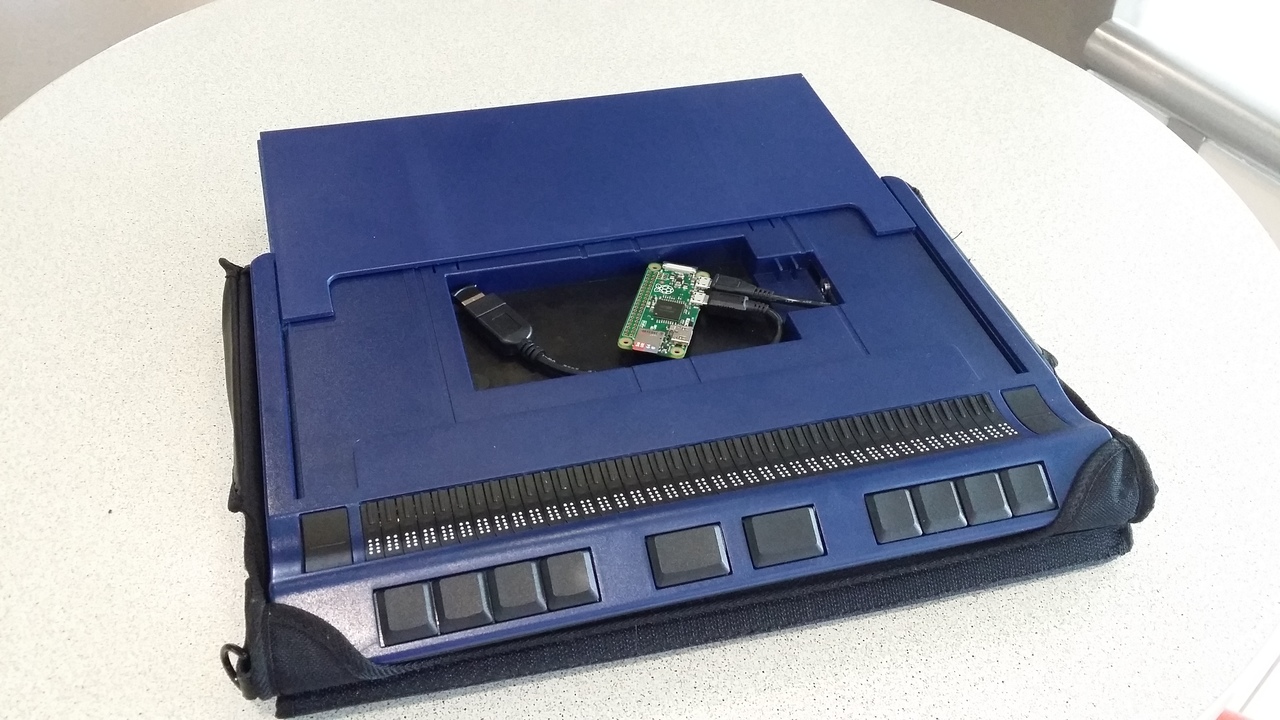
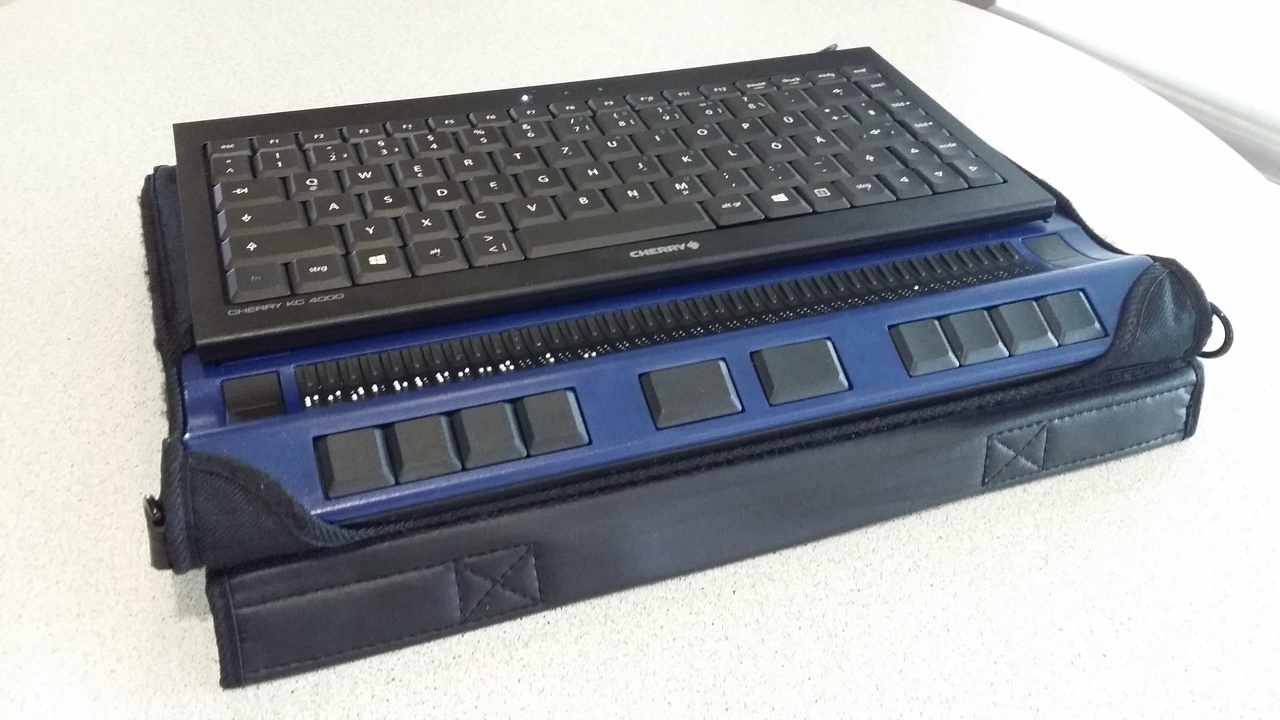
TL;DR: I put a $5 Raspberry Pi Zero, a Bluetooth USB dongle, and the required adapter cable into my new Handy Tech Active Star 40 braille display. An internal USB port provides the power. This has transformed my braille display into an ARM-based, monitorless, Linux laptop that has a keyboard and a braille display. It can be charged/powered via USB so it can also be run from a power bank or a solar charger, thus potentially being able to run for days, rather than just hours, without needing a standard wall-jack. [picture: a Raspberry Pi Zero embedded within an Active Star 40] [picture: a braille display with a keyboard on top and a Raspberry Pi Zero inside]
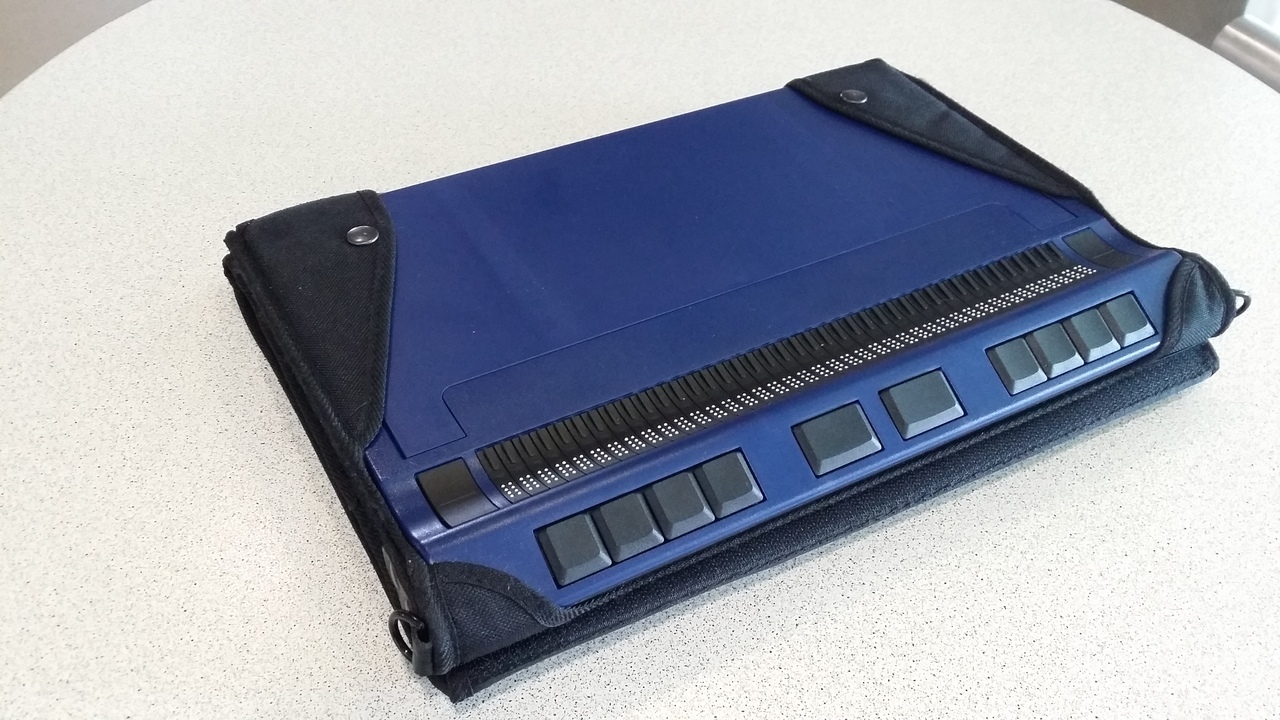
Some Background on Braille Display Form Factors Braille displays come in various sizes. There are models tailored for desktop use (with 60 cells or more), models tailored for portable use with a laptop (usually with 40 cells), and, nowadays, there are even models tailored for on-the-go use with a smartphone or similar (with something like 14 or 18 cells). Back in the old days, braille displays were rather massive. A 40-cell braille display was typically about the size of a 13" laptop. In modern times, manufacturers have managed to reduce the size of the internals such that a 40-cell display can be placed in front of a laptop or keyboard instead of placing the laptop on top of the braille display. While this is a nice achievement, I personally haven't found it to be very convenient because you now have to place two physically separate devices on your lap. It's OK if you have a real desk, but, at least in my opinion, if you try to use your laptop as its name suggests, it's actually inconvenient to use a small form factor, 40-cell display. For this reason, I've been waiting for a long-promised new model in the Handy Tech Star series. In 2002, they released the Handy Tech Braille Star 40, which is a 40-cell braille display with enough space to put a laptop directly on top of it. To accommodate larger laptop models, they even built in a little platform at the back that can be pulled out to effectively enlarge the top surface. Handy Tech has now released a new model, the Active Star 40, that has essentially the same layout but modernized internals. [picture: a plain Active Star 40] You can still pull out the little platform to increase the space that can be used to put something on top. [picture: an Active Star 40 with extended platform and a laptop on top] But, most conveniently, they've designed in an empty compartment, roughly the size of a modern smartphone, beneath the platform. The original idea was to actually put a smartphone inside, but this has turned out (at least to me) to not be very feasible. Fortunately, they thought about the need for electricity and added a Micro USB cable terminating within the newly created, empty compartment. My first idea was to put a conventional Raspberry Pi inside. When I received the braille display, however, we immediately noticed that a standard-sized rpi is roughly 3mm too high to fit into the empty compartment. Fortunately, though, a co-worker noticed that the Raspberry Pi Zero was available for order. The Raspberry Pi Zero is a lot thinner, and fits perfectly inside (actually, I think there's enough space for two, or even three, of them). So we ordered one, along with some accessories like a 64GB SDHC card, a Bluetooth dongle, and a Micro USB adapter cable. The hardware arrived a few days later, and was immediately bootstrapped with the assistance of very helpful friends. It works like a charm!
Technical Details The backside of the Handy Tech Active Star 40 features two USB host ports that can be used to connect devices such as a keyboard. A small form-factor, USB keyboard with a magnetic clip-on is included. When a USB keyboard is connected, and when the display is used via Bluetooth, the braille display firmware additionally offers the Bluetooth HID profile, and key press/release events received via the USB port are passed through to it. I use the Bluetooth dongle for all my communication needs. Most importantly, BRLTTY is used as a console screen reader. It talks to the braille display via Bluetooth (more precisely, via an RFCOMM channel). The keyboard connects through to Linux via the Bluetooth HID profile. Now, all that is left is network connectivity. To keep the energy consumption as low as possible, I decided to go for Bluetooth PAN. It appears that the tethering mode of my mobile phone works (albeit with a quirk), so I can actually access the internet as long as I have cell phone reception. Additionally, I configured a Bluetooth PAN access point on my desktop machines at home and at work, so I can easily (and somewhat more reliably) get IP connectivity for the rpi when I'm near one of these machines. I plan to configure a classic Raspberry Pi as a mobile Bluetooth access point. It would essentially function as a Bluetooth to ethernet adapter, and should allow me to have network connectivity in places where I don't want to use my phone.
BlueZ 5 and PAN It was a bit challenging to figure out how to actually configure Bluetooth PAN with BlueZ 5. I found the bt-pan python script (see below) to be the only way so far to configure PAN without a GUI. It handles both ends of a PAN network, configuring a server and a client. Once instructed to do so (via D-Bus) in client mode, BlueZ will create a new network device - bnep0 - once a connection to a server has been established. Typically, DHCP is used to assign IP addresses for these interfaces. In server mode, BlueZ needs to know the name of a bridge device to which it can add a slave device for each incoming client connection. Configuring an address for the bridge device, as well as running a DHCP server + IP Masquerading on the bridge, is usually all you need to do.
A Bluetooth PAN Access Point with Systemd I'm using systemd-networkd to configure the bridge device. /etc/systemd/network/pan.netdev:
[NetDev]
Name=pan
Kind=bridge
ForwardDelaySec=0
/etc/systemd/network/pan.network:
[Match]
Name=pan
[Network]
Address=0.0.0.0/24
DHCPServer=yes
IPMasquerade=yes
Now, BlueZ needs to be told to configure a NAP profile. To my surprise, there seems to be no way to do this with stock BlueZ 5.36 utilities. Please correct me if I'm wrong. Luckily, I found a very nice blog post, as well as an accommodating Python script that performs the required D-Bus calls. For convenience, I use a Systemd service to invoke the script and to ensure that its dependencies are met. /etc/systemd/system/pan.service:
[Unit]
Description=Bluetooth Personal Area Network
After=bluetooth.service systemd-networkd.service
Requires=systemd-networkd.service
PartOf=bluetooth.service
[Service]
Type=notify
ExecStart=/usr/local/sbin/pan
[Install]
WantedBy=bluetooth.target
/usr/local/sbin/pan:
#!/bin/sh
# Ugly hack to work around #787480
iptables -F
iptables -t nat -F
iptables -t mangle -F
iptables -t nat -A POSTROUTING -o eth0 -j MASQUERADE
exec /usr/local/sbin/bt-pan --systemd --debug server pan
This last file wouldn't be necessary if IPMasquerade= were supported in Debian right now (see #787480). After the obligatory systemctl daemon-reload and systemctl restart systemd-networkd, you can start your Bluetooth Personal Area Network with systemctl start pan.
Bluetooth PAN Client with Systemd Configuring the client is also quite easy to do with Systemd. /etc/systemd/network/pan-client.network:
[Match]
Name=bnep*
[Network]
DHCP=yes
/etc/systemd/system/pan@.service:
[Unit]
Description=Bluetooth Personal Area Network client
[Service]
Type=notify
ExecStart=/usr/local/sbin/bt-pan --debug --systemd client %I --wait
Now, after the usual configuration reloading, you should be able to connect to a specific Bluetooth access point with:
systemctl start pan@00:11:22:33:44:55
Pairing via the Command Line Of course, the server and client-side service configuration require a pre-existing pairing between the server and each of its clients. On the server, start bluetoothctl and issue the following commands:
power on
agent on
default-agent
scan on
scan off
pair XX:XX:XX:XX:XX:XX
trust XX:XX:XX:XX:XX:XX
Once you've set scan mode to on, wait a few seconds until you see the device you're looking for scroll by. Note its device address, and use it for the pair and (optional) trust commands. On the client, the sequence is essentially the same except that you don't need to issue the trust command. The server needs to trust a client in order to accept NAP profile connections from it without waiting for manual confirmation by the user. I'm actually not sure if this is the optimal sequence of commands. It might be enough to just pair the client with the server and issue the trust command on the server, but I haven't tried this yet.
Enabling Use of the Bluetooth HID Profile Essentially the same as above also needs to be done in order to use the Bluetooth HID profile of the Active Star 40 on Linux. However, instead of agent on, you need to issue the command agent KeyboardOnly. This explicitly tells bluetoothctl that you're specifically looking for a HID profile.
Configuring Bluetooth via the Command Line Feels Vague While I'm very happy that I actually managed to set all of this up, I must admit that the command-line interface to BlueZ feels a bit incomplete and confusing. I initially thought that agents were only for PIN code entry. Now that I've discovered that "agent KeyboardOnly" is used to enable the HID profile, I'm not sure anymore. I'm surprised that I needed to grab a script from a random git repository in order to be able to set up PAN. I remember, with earlier version of BlueZ, that there was a tool called pand that you could use to do all of this from the command-line. I don't seem to see anything like that for BlueZ 5 anymore. Maybe I'm missing something obvious?
Performance The data rate is roughly 120kB/s, which I consider acceptable for such a low power solution. The 1GHz ARM CPU actually feels sufficiently fast for a console/text-mode person like me. I'll rarely be using much more than ssh and emacs on it anyway.
Console fonts and screen dimensions The default dimensions of the framebuffer on the Raspberry Pi Zero are a bit unexpectedly strange. fbset reports that the screen dimension is 656x416 pixels (of course, no monitor connected). With a typical console font of 8x16, I got 82 columns and 26 lines. With a 40 cell braille display, the 82 columns are very inconvenient. Additionally, as a braille user, I would like to be able to view Unicode braille characters in addition to the normal charset on the console. Fortunately, Linux supports 512 glyphs, while most console fonts do only provide 256. console-setup can load and combine two 256-glyph fonts at once. So I added the following to /etc/default/console-setup to make the text console a lot more friendly to braille users:
SCREEN_WIDTH=80
SCREEN_HEIGHT=25
FONT="Lat15-Terminus16.psf.gz brl-16x8.psf"

Note

You need console-braille installed for brl-16x8.psf to be available.

Further Projects There's a 3.5mm audio jack inside the braille display as well. Unfortunately, there are no converters from Mini-HDMI to 3.5mm audio that I know of. It would be very nice to be able to use the sound card that is already built into the Raspberry Pi Zero, but, unfortunately, this doesn't seem possible at the moment. Alternatively, I'm looking at using a Micro USB OTG hub and an additional USB audio adapter to get sound from the Raspberry Pi Zero to the braille display's speakers. Unfortunately, the two USB audio adapters I've tried so far have run hot for some unknown reason. So I have to find some other chipset to see if the problem goes away. A little nuisance, currently, is that you need to manually power off the Raspberry, wait a few seconds, and then power down the braille display. Turning the braille display off cuts power delivery via the internal USB port. If this is accidentally done too soon then the Raspberry Pi Zero is shut down ungracefully (which is probably not the best way to do it). We're looking into connecting a small, buffering battery to the GPIO pins of the rpi, and into notifying the rpi when external power has dropped. A graceful, software-initiated shutdown can then be performed. You can think of it as being like a mini UPS for Micro USB.
The image If you are a happy owner of a Handy Tech Active Star 40 and would like to do something similar, I am happy to share my current (Raspbian Stretch based) image. In fact, if there is enough interest by other blind users, we might even consider putting a kit together that makes it as easy as possible for you to get started. Let me know if this could be of interest to you.
Thanks Thanks to Dave Mielke for reviewing the text of this posting. Thanks to Simon Kainz for making the photos for this article. And I owe a big thank you to my co-workers at Graz University of Technology who have helped me a lot to bootstrap really quickly into the rpi world.
P.S. My first tweet about this topic is just five days ago, and apart from the soundcard not working yet, I feel like the project is already almost complete! By the way, I am editing the final version of this blog posting from my newly created monitorless ARM-based Linux laptop via an ssh connection to my home machine.

11 June 2016

Shirish Agarwal: The road to debconf 2016, tourism and arts.

A longish blog post, please bear, a second part of the blog post would be published in few days from now. My fixed visa finally arrived, yeah:) But this story doesn t start here, it starts about a year back. While I have been contributing to Debian in my free time over the years, and sometimes paid time as well, I had never thought of going overseas as the experiences I knew from friends and relatives, it isn t easy to get all the permissions and paperwork done to say the least (bureaucracy @ work). But last year, when Debconf 15 was being launched, there are/were 2-3 friends of mine who are studying, doing their Ph.D. in some computer/web stuff, living in Germany currently that they goaded me to apply. The first few times I gave some standard excuses, but when they kept on for a while, just to shut them up I applied to the debconf team applying for food, accommodation and travel sponsorship. I didn t have high hopes as there obviously are many more talented peers around me who understand FOSS and Debian at a much more fundamental, philosophical as well as technical level than me. Much to my surprise though, about a month (and around two or three weeks just before the event was about to take place) I got the bursary/sponsorships for food, accommodation as well as travel. I was unsure that the remaining time was enough to get a visa hence declined that time around. That whole episode gave me the confidence that perhaps my application would be accepted if I applied again. Using my previous years understanding, decided to give it a shot again as this would also enable me to get a feel of visa bureaucracy as well as gain a bit of novice understanding about what factors go in choosing a flight and believe me the latter part proved to be pretty confusing. While the visa business seems easy, the form at least is easy and what they ask, it can be troublesome as far as visa-processing process is concerned. It took a better part of the month to get the visa which I needed. The in-between time is and can be a bit stressful as you have committed funds for travel i.e. the airline tickets and are in a limbo as you didn t know that if the visa is cancelled for some reason, your tickets would be refunded or not. A little history is needed and hopefully is helpful for anybody who s applying for a short-stay Visa in South Africa. Exactly, A month and day back I had applied for visa. The visa I had applied for is 17 days as the flights within my budget was for those days only. The visa I got was for 10 days only which was ending in the middle of the conference. I tried many avenues to get information and was told that I needed to write a correction letter telling/sharing the information about the correct time period and dates in BOLD with a heavier weight/point which is what I did and gave to VFS office without any further payment on my part. It took a bit more time than the first time around but the consulate co-operated. While I can understand the oversight as they probably get more visas requests along with special and urgent requests so such occurrences can happen. I am and was happy that there was a recourse rather than starting from scratch which probably would have made me more anxious due to the first experience . Apparently I was lucky that I had done with Qatar Airways as later came to know that there are other airways which don t refund money even after visa rejection . This information I got to know pretty late in the game otherwise I wouldn t have been much stressed. As had committed knew had to go the whole hog and whatever barriers are there, have overcome at least as far as the visa part/process is concerned. Now after few days, will probably start to worry about the actual travel, part nervousness, part excitement, nervousness as it will be an alien land, am obese so traveling economy on 787-8 and 777-300 ER will be tricky. The 787-8 will probably be a rough ride as it s a 9 hr. journey and the seat are a mere 18 , the cattle class as shared by one of our esteemed politicians. This blame has to do with Boeing 787 rather than anybody else. Hopefully, if there is a next time, would make better choices. Anyways,have selected an aisle seat so that will be able to walk every hr. or so to get the circulation in legs going as leg room in economy is not much from my domestic air travel experiences. If I do survive the travel, then will see South Africa and try to get some free time and explore South Africa and try to figure out how are they able to get one and half time tourists while we get around half figure for a whole year even though we are bigger (area-wise) to South Africa. I did find something positive for us as well, it s not all doldrums all around. Now, I had been thinking about if I know any South African music and movies. I had explored djembe while growing up in teens but other than that, not much. The only music I have heard is Harry Belafonte . So I hope to bring some Indian movies and music with me so that people if they have not explored Bollywood as well as Indian classical music could explore some of it, of course it will be pale imitation of what Sawai Gandharva Music Festival for instance gives. I also hope to hear and get some music and movies to learn more about South Africa.
Filed under: Miscellenous Tagged: #bollywood, #Debconf Germany 2015, #Debconf South Africa 2016, #Debconf15, #Debconf16, #djembe, #South-African consulate, music, tourism, visa

Paul Tagliamonte: It's all relative

As nearly anyone who's worked with me will attest to, I've long since touted nedbat's talk Pragmatic Unicode, or, How do I stop the pain? as one of the most foundational talks, and required watching for all programmers. The reason is because netbat hits on something bigger - something more fundamental than how to handle Unicode -- it's how to handle data which is relative. For those who want the TL;DR, the argument is as follows: Facts of Life:
  1. Computers work with Bytes. Bytes go in, Bytes go out.
  2. The world needs more than 256 symbols.
  3. You need both Bytes and Unicode
  4. You cannot infer the encoding of bytes.
  5. Declared encodings can be Wrong
Now, to fix it, the following protips:
  1. Unicode sandwich
  2. Know what you have
  3. TEST
Relative Data I've started to think more about why we do the things we do when we write code, and one thing that continues to be a source of morbid schadenfreude is watching code break by failing to handle Unicode right. It's hard! However, watching what breaks lets you gain a bit of insight into how the author thinks, and what assumptions they make. When you send someone Unicode, there are a lot of assumptions that have to be made. Your computer has to trust what you (yes, you!) entered into your web browser, your web browser has to pass that on over the network (most of the time without encoding information), to a server which reads that bytestream, and makes a wild guess at what it should be. That server might save it to a database, and interpolate it into an HTML template in a different encoding (called Mojibake), resulting in a bad time for everyone involved. Everything's awful, and the fact our computers can continue to display text to us is a goddamn miracle. Never forget that. When it comes down to it, when I see a byte sitting on a page, I don't know (and can't know!) if it's Windows-1252, UTF-8, Latin-1, or EBCDIC. What's a poem to me is terminal garbage to you. Over the years, hacks have evolved. We have magic numbers, and plain ole' hacks to just guess based on the content. Of course, like all good computer programs, this has lead to its fair share of hilarious bugs, and there's nothing stopping files from (validly!) being multiple things at the same time. Like many things, it's all in the eye of the beholder. Timezones Just like Unicode, this is a word that can put your friendly neighborhood programmer into a series of profanity laden tirades. Go find one in the wild, and ask them about what they think about timezone handling bugs they've seen. I'll wait. Go ahead. Rants are funny things. They're fun to watch. Hilarious to give. Sometimes just getting it all out can help. They can tell you a lot about the true nature of problems. It's funny to consider the isomorphic nature of Unicode rants and Timezone rants. I don't think this is an accident. U n i c o d e timezone Sandwich Ned's Unicode Sandwich applies -- As early as we can, in the lowest level we can (reading from the database, filesystem, wherever!), all datetimes must be timezone qualified with their correct timezone. Always. If you mean UTC, say it's in UTC. Treat any unqualified datetimes as "bytes". They're not to be trusted. Never, never, never trust 'em. Don't process any datetimes until you're sure they're in the right timezone. This lets the delicious inside of your datetime sandwich handle timezones with grace, and finally, as late as you can, turn it back into bytes (if at all!). Treat locations as tzdb entries, and qualify datetime objects into their absolute timezone (EST, EDT, PST, PDT) It's not until you want to show the datetime to the user again should you consider how to re-encode your datetime to bytes. You should think about what flavor of bytes, what encoding -- what timezone -- should I be encoding into? TEST Just like Unicode, testing that your code works with datetimes is important. Every time I think about how to go about doing this, I think about that one time that mjg59 couldn't book a flight starting Tuesday from AKL, landing in HNL on Monday night, because United couldn't book the last leg to SFO. Do you ever assume dates only go forward as time goes on? Remember timezones. Construct test data, make sure someone in New Zealand's +13:45 can correctly talk with their friends in Baker Island's -12:00, and that the events sort right. Just because it's Noon on New Years Eve in England doesn't mean it's not 1 AM the next year in New Zealand. Places a few miles apart may go on Daylight savings different days. Indian Standard Time is not even aligned on the hour to GMT (+05:30)! Test early, and test often. Memorize a few timezones, and challenge your assumptions when writing code that has to do with time. Don't use wall clocks to mean monotonic time. Remember there's a whole world out there, and we only deal with part of it. It's also worth remembering, as Andrew Pendleton pointed out to me, that it's possible that a datetime isn't even unique for a place, since you can never know if 2016-11-06 01:00:00 in America/New_York (in the tzdb) is the first one, or second one. Storing EST or EDT along with your datetime may help, though! Pitfalls Improper handling of timezones can lead to some interesting things, and failing to be explicit (or at least, very rigid) in what you expect will lead to an unholy class of bugs we've all come to hate. At best, you have confused users doing math, at worst, someone misses a critical event, or our security code fails. I recently found what I regard to be a pretty bad bug in apt (which David has prepared a fix for and is pending upload, yay! Thank you!), which boiled down to documentation and code expecting datetimes in a timezone, but accepting any timezone, and silently treating it as UTC. The solution is to hard-fail, which is an interesting choice to me (as a vocal fan of timezone aware code), but at the least it won't fail by misunderstanding what the server is trying to communicate, and I do understand and empathize with the situation the apt maintainers are in. Final Thoughts Overall, my main point is although most modern developers know how to deal with Unicode pain, I think there is a more general lesson to learn -- namely, you should always know what data you have, and always remember what it is. Understand assumptions as early as you can, and always store them with the data.

10 June 2016

Jaminy Prabaharan: Weekly Report for GSoC16-week 1 and week2

After introducing ourselves to the community, we start contributing to the open and free source software. Since this is the first week, I have went through theories which would help me in coding. Before coding it is always safer to refer to theories so that we don t need to spare time in debugging. The following were my week 1-4 plans:

These two weeks I have completed my first two tasks in the list.I have committed and pushed my works in GitHub.https://github.com/Jaminy/GSoC

Successfully logged into the email account using IMAP and examined each folders.Examined inbox to extract To , From and CC of the last message received.Trying to extract all message details to put in CSV file.


8 June 2016

Daniel Pocock: Working to pass GSoC

GSoC students have officially been coding since 23 May (about 2.5 weeks) and are almost half-way to the mid-summer evaluation (20 - 27 June). Students who haven't completed some meaningful work before that deadline don't receive payment and in such a large program, there is no possibility to give students extensions or let them try and catch up later. Every project and every student are different, some are still getting to know their environment while others have already done enough to pass the mid-summer evaluation. I'd like to share a few tips to help students ensure they don't inadvertently fail the mid-summer evaluation Kill electronic distractions As a developer of real-time communications projects, many people will find it ironic or hypocritical that this is at the top of my list. Switch off the mobile phone or put it in silent mode so it doesn't even vibrate. Research has suggested that physically turning it off and putting it out of sight has significant benefits. Disabling the voicemail service can be an effective way of making sure no time is lost listening to a bunch of messages later. Some people may grumble at first but if they respect you, they'll get into the habit of emailing you and waiting for you to respond when you are not working. Get out a piece of paper and make a list of all the desktop notifications on your computer, whether they are from incoming emails, social media, automatic updates, security alerts or whatever else. Then figure out how to disable them all one-by-one. Use email to schedule fixed times for meetings with mentors. Some teams/projects also have fixed daily or weekly times for IRC chat. For a development project like GSoC, it is not necessary or productive to be constantly on call for 3 straight months. Commit every day Habits are a powerful thing. Successful students have a habit of making at least one commit every day. The "C" in GSoC is for Code and commits are a good way to prove that coding is taking place. GSoC is not a job, it is like a freelance project. There is no safety-net for students who get sick or have an accident and mentors are not bosses, each student is expected to be their own boss. Although Google has started recommending students work full time, 40 hours per week, it is unlikely any mentors have any way to validate these hours. Mentors can look for a commit log, however, and simply won't be able to pass a student if there isn't code. There may be one day per week where a student writes a blog or investigates a particularly difficult bug and puts a detailed report in the bug tracker but by the time we reach the second or third week of GSoC, most students are making at least one commit in 3 days out of every 5. Consider working away from home/family/friends Can you work without anybody interrupting you for at least five or six hours every day? Do you feel pressure to help with housework, cooking, siblings or other relatives? Even if there is no pressure to do these things, do you find yourself wandering away from the computer to deal with them anyway? Do family, friends or housemates engage in social activities, games or other things in close proximity to where you work? All these things can make a difference between passing and failing. Maybe these things were tolerable during high school or university. GSoC, however, is a stepping stone into professional life and that means making a conscious decision to shut those things out and focus. Some students have the ability to manage these distractions well, but it is not for everybody. Think about how leading sports stars or musicians find a time and space to be "in the zone" when training or rehearsing, this is where great developers need to be too. Some students find the right space in a public library or campus computer lab. Some students have been working in hacker spaces or at empty desks in local IT companies. These environments can also provide great networking opportunities. Managing another summer job concurrently with GSoC It is no secret that some GSoC students have another job as well. Sometimes the mentor is aware of it, sometimes it has not been disclosed. The fact is, some students have passed GSoC while doing a summer job or internship concurrently but some have also failed badly in both GSoC and their summer job. Choosing one or the other is the best way to succeed, get the best results and maximize the quality of learning and community interaction. For students in this situation, now it is not too late to make the decision to withdraw from GSoC or the other job. If doing a summer job concurrently with GSoC is unavoidable, the chance of success can be greatly increased by doing the GSoC work in the mornings, before starting the other job. Some students have found that they actually finish more quickly and produce better work when GSoC is constrained to a period of 4 or 5 hours each morning and their other job is only in the afternoon. On the other hand, if a student doesn't have the motivation or energy to get up and work on GSoC before the other job then this is a strong sign that it is better to withdraw from GSoC now.

Tanguy Ortolo: Process command line arguments in shell

When writing a wrapper script, one often has to process the command line arguments to transform them according to his needs, to change some arguments, to remove or insert some, or perhaps to reorder them.Naive approach The naive approach to do that is :
# Process arguments, building a new argument list
new_args=""
for arg in "$@"
do
    case "$arg"
    in
        --foobar)
            # Convert --foobar to the new syntax --foo=bar
            new_args="$args --foo=bar"
        ;;
        *)
            # Take other options as they are
            new_args="$args $arg"
        ;;
    esac
done
# Call the actual program
exec program $new_args
This naive approach is simple, but fragile, as it will break on arguments that contain a space. For instance, calling wrapper --foobar "some file" (where some file is a single argument) will result in the call program --foo=bar some file (where some and file are two distinct arguments). Correct approach To handle spaces in arguments, we need either: except standard shell does support arrays, or rather, it does support one specific array: the positional parameter list "$@" . This leads to one solution to process arguments in a reliable way, which consists in rebuilding the positional parameter list with the built-in command set --:
# Process arguments, building a new argument list in "$@"
# "$@" will need to be cleared, not right now but on first iteration only
first_iter=1
for arg in "$@"
do
    if [ "$first_iter" -eq 1 ]
    then
        # Clear the argument list
        set --
        first_iter=0
    fi
    case "$arg"
    in
        --foobar) set -- "$@" --foo=bar ;;
        *) set -- "$@" "$arg" ;;
    esac
done
# Call the actual program
exec program "$@"
Notes
  1. I you prefer, for arg in "$@" can be simplified to just for arg.
  2. As a reminder, and contrary to what it looks like, quoted "$@" does not expand to a single field, but to one field per positional parameter.

6 June 2016

John Goerzen: How git-annex replaces Dropbox + encfs with untrusted providers

git-annex has been around for a long time, but I just recently stumbled across some of the work Joey has been doing to it. This post isn t about it s traditional roots in git or all the features it has for partial copies of large data sets, but rather for its live syncing capabilities like Dropbox. It takes a bit to wrap your head around, because git-annex is just a little different from everything else. It s sort of like a different-colored smell. The git-annex wiki has a lot of great information both low-level reference and a high-level 10-minute screencast showing how easy it is to set up. I found I had to sort of piece together the architecture between those levels, so I m writing this all down hoping it will benefit others that are curious. Ir you just want to use it, you don t need to know all this. But I like to understand how my tools work. Overview git-annex lets you set up a live syncing solution that requires no central provider at all, or can be used with a completely untrusted central provider. Depending on your usage pattern, this central provider could require only a few MBs of space even for repositories containing gigabytes or terabytes of data that is kept in sync. Let s take a look at the high-level architecture of the tool. Then I ll illustrate how it works with some scenarios. Three Layers Fundamentally, git-annex takes layers that are all combined in Dropbox and separates them out. There is the storage layer, which stores the literal data bytes that you are interested in. git-annex indexes the data in storage by a hash. There is metadata, which is for things like a filename-to-hash mapping and revision history. And then there is an optional layer, which is live signaling used to drive the real-time syncing. git-annex has several modes of operation, and the one that enables live syncing is called the git-annex assistant. It runs as a daemon, and is available for Linux/POSIX platforms, Windows, Mac, and Android. I ll be covering it here. The storage layer The storage layer simply is blobs of data. These blobs are indexed by a hash, and can be optionally encrypted at rest at remote backends. git-annex has a large number of storage backends; some examples include rsync, a remote machine with git-annex on it that has ssh installed, WebDAV, S3, Amazon Glacier, removable USB drive, etc. There s a huge list. One of the git-annex features is that each client knows the state of each storage repository, as well as the capability set of each storage repository. So let s say you have a workstation at home and a laptop you take with you to work or the coffee shop. You d like changes on one to be instantly recognized on another. With something like Dropbox or OwnCloud, every file in the set you want synchronized has to reside on a server in the cloud. With git-annex, it can be configured such that the server in the cloud only contains a copy of a file until every client has synced it up, at which point it gets removed. Think about it that is often what you want anyhow, so why maintain an unnecessary copy after it s synced everywhere? (This behavior is, of course, configurable.) git-annex can also avoid storing in the cloud entirely if the machines are able to reach each other directly at least some of the time. The metadata layer Metadata about your files includes a mapping from the file names to the storage location (based on hashes), change history, and information about the status of each machine that participates in the syncing. On your clients, git-annex stores this using git. This detail is very useful to some, and irrelevant to others. Some of the git-annex storage backends can support only storage (S3, for instance). Some can support both storage and metadata (rsync, ssh, local drives, etc.) You can even configure a backend to support only metadata (more on why that may be useful in a bit). When you are working with a git-backed repository for git-annex, it can hold data, metadata, or both. So, to have a working sync system, you must have a way to transport both the data and the metadata. The transport for the metadata is generally rsync or git, but it can also be XMPP in which Git changesets are basically wrapped up in XMPP presence messages. Joey says, however, that there are some known issues with XMPP servers sometimes dropping or reordering some XMPP messages, so he doesn t encourage that method currently. The live signaling layer So once you have your data and metadata, you can already do syncs via git annex sync --contents. But the real killer feature here will be automatic detection of changes, both on the local and the remote. To do that, you need some way of live signaling. git-annex supports two methods. The first requires ssh access to a remote machine where git-annex is installed. In this mode of operation, when the git-annex assistant fires up, it opens up a persistent ssh connection to the remote and runs the git-annex-shell over there, which notifies it of changes to the git metadata repository. When a change is detected, a sync is initiated. This is considered ideal. A substitute can be XMPP, and git-annex actually converts git commits into a form that can be sent over XMPP. As I mentioned above, there are some known reliability issues with this and it is not the recommended option. Encryption When it comes to encryption, you generally are concerned about all three layers. In an ideal scenario, the encryption and decryption happens entirely on the client side, so no service provider ever has any details about your data. The live signaling layer is encrypted pretty trivially; the ssh sessions are, of course, encrypted and TLS support in XMPP is pervasive these days. However, this is not end-to-end encryption; those messages are decrypted by the service provider, so a service provider could theoretically spy on metadata, which may include change times and filenames, though not the contents of files themselves. The data layer also can be encrypted very trivially. In the case of the dumb backends like S3, git-annex can use symmetric encryption or a gpg keypair and all that ever shows up on the server are arbitrarily-named buckets. You can also use a gcrypt-based git repository. This can cover both data and metadata and, if the target also has git-annex installed, the live signalling layer. Using a gcrypt-based git repository for the metadata and live signalling is the only way to accomplish live syncing with 100% client-side encryption. All of these methods are implemented in terms of gpg, and can support symmetric of public-key encryption. It should be noted here that the current release versions of git-annex need a one-character patch in order to fix live syncing with a remote using gcrypt. For those of you running jessie, I recommend the version in jessie-backports, which is presently 5.20151208. For your convenience, I have compiled an amd64 binary that can drop in over /usr/bin/git-annex if you have this version. You can download it and a gpg signature for it. Note that you only need this binary on the clients; the server can use the version from jessie-backports without issue. Putting the pieces together: some scenarios Now that I ve explained the layers, let s look at how they fit together. Scenario 1: Central server In this scenario, you might have a workstation and a laptop that sync up with each other by way of a central server that also has a full copy of the data. This is the scenario that most closely resembles Dropbox, box, or OwnCloud. Here you would basically follow the steps in the git-assistant screencast: install git-annex on a server somewhere, and point your clients to it. If you want full end-to-end encryption, I would recommend letting git-annex generate a gpg keypair for you, which you would then need to copy to both your laptop and workstation (but not the server). Every change you make locally will be synced to the server, and then from the server to your other PC. All three systems would be configured in the client transfer group. Scenario 1a: Central server without a full copy of the data In this scenario, everything is configured the same except the central server is configured with the transfer transfer group. This means that the actual data synced to it is deleted after it has been propagated to all clients. Since git-annex can verify which repository has received a copy of which data, it can easily enough delete the actual file content from the central server after it has been copied to all the clients. Many people use something like Dropbox or OwnCloud as a multi-PC syncing solution anyhow, so once the files have been synced everywhere, it makes sense to remove them from the central server. This is often a good ideal for people. There are some obvious downsides that are sometimes relevant. For instance, to add a third sync client, it must be able to initially copy down from one of the existing clients. Or, if you intend to access the data from a device such as a cell phone where you don t intend for it to have a copy of all data all the time, you won t have as convenient way to download your data. Scenario 1b: Split data/metadata central servers Imagine that you have a shell or rsync account on some remote system where you can run git-annex, but don t have much storage space. Maybe you have a cheap VPS or shell account somewhere, but it s just not big enough to hold your data. The answer to this would be to use this shell or rsync account for the metadata, but put the data elsewhere. You could, for instance, store the data in Amazon S3 or Amazon Glacier. These backends aren t capable of storing the git-annex metadata, so all you need is a shell or rsync account somewhere to sync up the metadata. (Or, as below, you might even combine a fully distributed approach with this.) Then you can have your encrypted data pushed up to S3 or some such service, which presumably will grow to whatever size you need. Scenario 2: Fully distributed Like git itself, git-annex does not actually need a central server at all. If your different clients can reach each other directly at least some of the time, that is good enough. Of course, a given client will not be able to do fully automatic live sync unless it can reach at least one other client, so changes may not propagate as quickly. You can simply set this up by making ssh connections available between your clients. git-annex assistant can automatically generate appropriate ~/.ssh/authorized_keys entries for you. Scenario 2a: Fully distributed with multiple disconnected branches You can even have a graph of connections available. For instance, you might have a couple machines at home and a couple machines at work with no ability to have a direct connection between them (due to, say, firewalls). The two machines at home could sync with each other in real-time, as could the two machines at work. git-annex also supports things like USB drives as a transport mechanism, so you could throw a USB drive in your pocket each morning, pop it in to one client at work, and poof both clients are synced up over there. Repeat when you get home in the evening, and you re synced there. The USB drive s repository can, of course, be of the transport type so data is automatically deleted from it once it s been synced everywhere. Scenario 3: Hybrid git-annex can support LAN sync even if you have a central server. If your laptop, say, travels around but is sometimes on the same LAN as your PC, git-annex can easily sync directly between the two when they are reachable, saving a round-trip to the server. You can assign a cost to each remote, and git-annex will always try to sync first to the lowest-cost path that is available. Drawbacks of git-annex There are some scenarios where git-annex with the assistant won t be as useful as one of the more traditional instant-sync systems. The first and most obvious one is if you want to access the files without the git-annex client. For instance, many of the other tools let you generate a URL that you can email to people, and then they can download files without any special client software. This is not directly possible with git-annex. You could, of course, make something like a public_html directory be managed with git-annex, but it wouldn t provide things like obfuscated URLs, password-protected sharing, time-limited sharing, etc. that you get with other systems. While you can share your repositories with others that have git-annex, you can t share individual subdirectories; for a given repository, it is all or nothing. The Android client for git-annex is a pretty interesting thing: it is mostly a small POSIX environment, providing a terminal, git, gpg, and the same web interface that you get on a standalone machine. This means that the git-annex Android client is fully functional compared to a desktop one. It also has a quick setup process for syncing off your photos/videos. On the other hand, the integration with the Android ecosystem is poor compared to most other tools. Other git-annex features git-annex has a lot to offer besides the git-annex assistant. Besides the things I ve already mentioned, any given git-annex repository including your client repository can have a partial copy of the full content. Say, for instance, that you set up a git-annex repository for your music collection, which is quite large. You want some music on your netbook, but don t have room for it all. You can tell git-annex to get or drop files from the netbook s repository without deleting them remotely. git-annex has quite a few ways to automate and configure this, including making sure that at least a certain number of copies of a file exist in your git-annex ecosystem. Conclusion I initially started looking at git-annex due to the security issues with encfs, and the difficulty with setting up ecryptfs in this way. (I had been layering encfs atop OwnCloud). git-annex certainly ticks the box for me security-wise, and obviously anything encrypted with encfs wasn t going to be shared with others anyhow. I ll be using git-annex more in the future, I m sure.

Petter Reinholdtsen: The new "best" multimedia player in Debian?

When I set out a few weeks ago to figure out which multimedia player in Debian claimed to support most file formats / MIME types, I was a bit surprised how varied the sets of MIME types the various players claimed support for. The range was from 55 to 130 MIME types. I suspect most media formats are supported by all players, but this is not really reflected in the MimeTypes values in their desktop files. There are probably also some bogus MIME types listed, but it is hard to identify which one this is. Anyway, in the mean time I got in touch with upstream for some of the players suggesting to add more MIME types to their desktop files, and decided to spend some time myself improving the situation for my favorite media player VLC. The fixes for VLC entered Debian unstable yesterday. The complete list of MIME types can be seen on the Multimedia player MIME type support status Debian wiki page. The new "best" multimedia player in Debian? It is VLC, followed by totem, parole, kplayer, gnome-mpv, mpv, smplayer, mplayer-gui and kmplayer. I am sure some of the other players desktop files support several of the formats currently listed as working only with vlc, toten and parole. A sad observation is that only 14 MIME types are listed as supported by all the tested multimedia players in Debian in their desktop files: audio/mpeg, audio/vnd.rn-realaudio, audio/x-mpegurl, audio/x-ms-wma, audio/x-scpls, audio/x-wav, video/mp4, video/mpeg, video/quicktime, video/vnd.rn-realvideo, video/x-matroska, video/x-ms-asf, video/x-ms-wmv and video/x-msvideo. Personally I find it sad that video/ogg and video/webm is not supported by all the media players in Debian. As far as I can tell, all of them can handle both formats.

3 June 2016

Gunnar Wolf: Stop it with those short PGP key IDs!

Debian is quite probably the project that most uses a OpenPGP implementation (that is, GnuPG, or gpg) for many of its internal operations, and that places most trust in it. PGP is also very widely used, of course, in many other projects and between individuals. It is regarded as a secure way to do all sorts of crypto (mainly, encrypting/decrypting private stuff, signing public stuff, certifying other people's identities). PGP's lineage traces back to Phil Zimmerman's program, first published in 1991 By far, not a newcomer PGP is secure, as it was 25 years ago. However, some uses of it might not be so. We went through several migrations related to algorithmic weaknesses (i.e. v3 keys using MD5; SHA1 is strongly discouraged, although not yet completely broken, and it should be avoided as well) or to computational complexity (as the migration away from keys smaller than 2048 bits, strongly prefering 4096 bits). But some vulnerabilities are human usage (that is, configuration-) related. Today, Enrico Zini gave us a heads-up in the #debian-keyring IRC channel, and started a thread in the debian-private mailing list; I understand the mail to a private list was partly meant to get our collective attention, and to allow for potentially security-relevant information to be shared. I won't go into details about what is, is not, should be or should not be private, but I'll post here only what's public information already. What are short and long key IDs? I'll start by quoting Enrico's mail:

there are currently at least 3 ways to refer to a gpg key: short key ID (last 8 hex digits of fingerprint), long key ID (last 16 hex digits) and full fingerprint. The short key ID used to be popular, and since 5 years it is known that it is computationally easy to generate a gnupg key with an arbitrary short key id. A mitigation to this is using "keyid-format long" in gpg.conf, and a better thing to do, especially in scripts, is to use the full fingerprint to refer to a key, or just ship the public key for verification and skip the key servers. Note that in case of keyid collision, gpg will download and import all the matching keys, and will use all the matching keys for verifying signatures.
So... What is this about? We humans are quite bad at recognizing and remembering randomly-generated strings with no inherent patterns in them. Every GPG key can be uniquely identified by its fingerprint, a 128-bit string, usually encoded as ten blocks of four hexadecimal characters (this allows for 160 bits; I guess there's space for a checksum in it). That is, my (full) key's signature is:
AB41 C1C6 8AFD 668C A045  EBF8 673A 03E4 C1DB 921F
However, it's quite hard to recognize such a long string, let alone memorize it! So, we often do what humans do: Given that strong cryptography implies a homogenous probability distribution, people compromised on using just a portion of the key the last portion. The short key ID. Mine is then the last two blocks (shown in boldface): C1DB921F. We can also use what's known as the long key ID, that's twice as long: 64 bits. However, while I can speak my short key ID on a single breath (and maybe even expect you to remember and note it down), try doing so with the long one (shown in italics above): 673A03E4C1DB921F. Nah. Too much for our little, analog brains. This short and almost-rememberable number has then 32 bits of entropy I have less than one in 4,000,000,000 chance of generating a new key with this same short key ID. Besides, key generation is a CPU-intensive operation, so it's quite unlikely we will have a collision, right? Well, wrong. Previous successful attacks on short key IDs Already five years ago, Asheesh Laroia migrated his 1024D key to a 4096R. And, as he describes in his always-entertaining fashion, he made his computer sweat until he was able to create a new key for which the short key ID collided with the old one. It might not seem like a big deal, as he did this non-maliciously, but this easily should have spelt game over for the usage of short key IDs. After all, being able to generate a collision is usually the end for cryptographic systems. Asheesh specifically mentioned in his posting how this could be abused. But we didn't listen. Short key IDs are just too convenient! Besides, they allow us to have fun, can be a means of expression! I know of at least two keys that would qualify as vanity: Obey Arthur Liu's 0x29C0FFEE (created in 2009) and Keith Packard's 0x00000011 (created in 2012). Then we got the Evil 32 project. They developed Scallion, started (AFAICT) in 2012. Scallion automates the search for a 32-bit collision using GPUs; they claim that it takes only four seconds to find a collision. So, they went through the strong set of the public PGP Web of Trust, and created a (32-bit-)colliding key for each of the existing keys. And what happened now? What happened today? We still don't really know, but it seems we found a first potentially malicious collision that is, the first "nonacademic" case. Enrico found two keys sharing the 9F6C6333 short ID, apparently belonging to the same person (as would be the case of Asheesh, mentioned above). After contacting Gustavo, though, he does not know about the second That is, it can be clearly regarded as an impersonation attempt. Besides, what gave away this attempt are the signatures it has: Both keys are signed by what appears to be the same three keys: B29B232A, F2C850CA and 789038F2. Those three keys are not (yet?) uploaded to the keyservers, though... But we can expect them to appear at any point in the future. We don't know who is behind this, or what his purpose is. We just know this looks very evil. Now, don't panic: Gustavo's key is safe. Same for his certifiers, Marga, Agust n and Maxy. It's just a 32-bit collision. So, in principle, the only parties that could be cheated to trust the attacker are humans, right? Nope. Enrico tested on the PGP pathfinder & key statistics service, a keyserver that finds trust paths between any two arbitrary keys in the strong set. Surprise: The pathfinder works on the short key IDs, even when supplied full fingerprints. So, it turns out I have three faked trust paths into our impostor. What next? There are several things this should urge us to do. And there are surely many other important recommendations. But this is a good set of points to start with. [update] I was pointed at Daniel Kahn Gillmor's 2013 blog post, OpenPGP Key IDs are not useful. Daniel argues, in short, that cutting a fingerprint in order to get a (32- or 64-bit) short key ID is the worst of all worlds, and we should rather target either always showing full fingerprints, or not showing it at all (and leaving all the crypto-checking bits to be done by the software, as comparing 160-bit strings is not natural for us humans). [update] This post was picked up by LWN.net. A very interesting discussion continues in their comments.

Joey Hess: electrum ssl vulnerabilities

The electrum bitcoin wallet seems to use SSL insecurely. Here are two bug reports I filed about it: ignores invalid ssl certs with CERT_NONE, allowing MITM fails to verify ssl cert hostname for cached certs
(update: Seems I was wrong about this bug) One full month after I filed these, there's been no activity, so I thought I'd make this a little more widely known. It's too hard to get CVEs assigned, and resgistering a snarky domain name is passe. I'm not actually using electrum myself currently, as I own no bitcoins. I only noticed these vulnerabilities when idly perusing the code. I have not tried to actually exploit them, and some of the higher levels of the SPV blockchain verification make them difficult to exploit. Or perhaps there are open wifi networks where all electrum connections get intercepted by a rogue server that successfully uses these security holes to pretend to be the entire electrum server network. I'm not particularly surprised to find code that's supposed to be securing a connection with SSL but actually fails to verify the SSL certificate. That's the common failure mode of SSL libraries. It is a bit surprising to find such mistakes in a bitcoin wallet though. And, electrum seems to go out of its way to complicate its SSL certificate handling, which directly led to these security holes. Kind of makes me wonder about the security of the rest of it.

1 June 2016

Jamie McClelland: Signal and Google Cloud Services

I just installed Signal on my Android phone. It wasn't an easy decision. I have been running Cyanogenmod, a Google-free version of Android, and installing apps from F-Droid, a repository of free software android apps, for several years now. This setup allows me to run all the applications I need without Google accessing any of my cell phone data. It has been a remarkably successful experiment leaving me with all the phone software I need. And it's consistent with my belief that Google's size, reach and goals are a menace to the left's ability to develop the autonomous communications systems on the Internet that we need to achieve any meaningful political change. However, if I want to install Signal, I have to install Google Play, and the only way to install Google Play is to install Google's base line set of apps and to connect your cell phone to a Gmail account. Why in the world would Signal require Google Play? There is plenty of discussion of the technical debate on this topic, but politically it boils down to this: security is about trade-offs, and the trade-offs you find important are based on your politics. While I consider Signal to be on the same team in the big picture, I think Signal's winning a short term victory for more massively adopted end-to-end encryption at the expense of a longer term and more important struggle for autonomous communication systems specifically for communities fighting corporate power (of which Google itself is an important target) and fighting US hegemony on a global scale. Furthermore, Signal's lead developer's outright hostility to alternate clients connecting to the centralized signal servers demonstrates another political decision that favors central control over any confidence in a broader movement control over what could have become a power new protocol for secure communication. And his refusal to grant an exemption for other developers to use just the encryption algorythm is frustrating to say the least. Given this reasoning, why install Signal? The main reason is because I have yet to convince anyone to remove Google Apps from their phone and Signal, right now, represents a dramatic improvement over most people's current communications habit. And, when it comes down to it, I need to run what I recommend. I'm still running both conversations and Antox which are far better alternatives in the long run. However until they gain more widespread adoption, I'll be experimenting with Signal. Technical Details Oh, and by the way, installing Google Apps nearly bricked my phone. Cyanogenmod's web site conveniently provides instructions for installing Google Apps. However, confusingly, they provide two different links to choose from, one is from OpenGapps which provided my a link to download the zip file to flash on a non-https page (the link itself was over https). The other link was to an https-enabled page on androidfilehost.com that offered a non-https download (but did provide a md5 checksum). I am now sure why people offering software downloads don't enable https from start to finish (well, maybe I do - I haven't yet enabled https on this site...). However, more confusing is that both links were to different files. The OpenGapps one seemed to be a daily build and the androidfilehost was to a file with the date 20140606 in it's name, suggesting it was built nearly 2 years ago. I went with the daily build. When I restarted, I got the error "Unfortunately, Android Keyboard (Aosp) Has Stopped." If you search the web for this error you will see loads of people getting it. However, none of them seem to be using an encrypted disk. Yes, that is a bigger problem since you can't enter your encrypted disk passphrase if your keyboard app has crashed and you can't boot your phone if you can't even hit enter at the passphrase prompt. If you can't boot, you can't clear the keyboard app cache or most of the suggestions. In fact, when you press and hold the power key you don't even get the option to reboot into recovery mode. And, if you connect your device to your USB cable and run the adb tool on your computer, the tool reports that you are not authorized to connect your device. Oh damn. Did I just brick my phone? Fortunately, you can still boot into recovery mode on a Samsung S4 by powering it off. Then, press and hold the up volume button while turning it on. In recovery mode, I as able to convince the adb tool to connect to my device and I copied over the other Gapps zip file from androidfilehost.com and flashing that one seems to have fixed the problem. Once I booted, I ran Google Play and opted to create a new Google Account. I chose the option to not sync my data. Then, I checked in Settings -> Accounts I saw that a Google Account was there and was synchronizing. Great. What was it synchronizing? I clicked the account, then clicked "Accounts and Privacy" and ensured that everything was turned off. Let's hope that works. [Update] Signal's option to take over as your default SMS client and send un-encrypted normal SMS messages while sending encrypted messages to other Signal users is a very good way to smooth adoption. Unfortunately I had some problems with MMS message for which I found a work-around. But sheesh, lots of MMS problems at the moment.

31 May 2016

Chris Lamb: Free software activities in May 2016

Here is my monthly update covering a large part of what I have been doing in the free software world (previously):
Debian My work in the Reproducible Builds project was covered in our weekly reports. (#53, #54, #55, #56 & #57)
Debian LTS

This month I have been paid to work 18 hours on Debian Long Term Support (LTS). In that time I did the following:
  • A week of "frontdesk" duties, triaging CVEs, assigning tasks, etc.
  • Issued DLA 464-1 for libav, a multimedia player, server, encoder and transcoder library that fixed a use-after free vulnerability.
  • Issued DLA 469-1 for libgwenhywfar (an OS abstraction layer that allows porting of software to different operating systems like Linux, *BSD, Windows, etc.) correcting the use of an outdated CA certificate bundle.
  • Issued DLA 470-1 for libksba, a X.509 and CMS certificate support library. patching a buffer vulnerability.
  • Issued DLA 474-1 for dosfstools, a collection of utilities for making and checking MS-DOS FAT filesystems, fixing an invalid memory and heap overflow vulnerability.
  • Issued DLA 482-1 for libgd2 graphics library, rectifying a stack consumption vulnerability.

Uploads
  • python-django (1.9.6-1) New upstream bugfix release.
  • redis (3.2.0-1, etc.) New upstream release, correct build on more exotic architectures and minor packaging fixups.
  • gunicorn (19.5.0-1 & 19.6.0-1) New upstream releases and minor packaging fixups.


30 May 2016

Russ Allbery: Review: By the Sword

Review: By the Sword, by Mercedes Lackey
Series: Vows and Honor #4
Publisher: DAW
Copyright: February 1991
ISBN: 0-88677-463-2
Format: Mass market
Pages: 492
By the Sword is the next book in my (slow) Valdemar re-read. This one is a bit hard to classify in the series; it's technically a stand-alone novel, and it doesn't require a lot of prior series knowledge. But the heroine, Kerowyn, is a relative of Tarma and Kethry, and Tarma and Kethry appear in this novel. Most of the book also deals with similar themes as the rest of the Tarma and Kethry books, even though it's also a bridge into Valdemar proper. I'm going to follow Fantastic Fiction and call it book four of the Vows and Honor series, even though the publisher doesn't refer to it that way and it's not strictly correct. I think that creates the right impression, and it's mildly better to read the other Tarma and Kethry novels first. This book is also a bit confusing for reading order. It was published just before the Mage Winds trilogy, and happens before them in series chronological order (between that trilogy and the Talia series). But some of the chronologies in some of the Valdemar books show it after the Mage Winds trilogy. I think I originally read it afterwards, but both natural reading order and publication order puts it first, and that's the ordering I followed this time. Series ordering trivia aside (sometimes the comic book shared universe continuity geek in me raises its head), By the Sword is a hefty, self-contained novel about a very typical Lackey protagonist. Kerowyn is the daughter of a noble house, largely ignored by her father in favor of her brother and tasked with keeping the keep running since her mother died. She wants to learn to fight and ride, but that's not part of her father's plans for her. But those plans become suddenly irrelevant when the keep is attacked during her brother's wedding and the bride kidnapped. Unless someone at least attempts to recover her, this will be taken as an excuse for conquest of the keep by the bride's family. (Spoilers for the start of the book in the following paragraph. I think the outcomes are reasonably obvious given the type of book this is, but skip it if you don't want to know anything about the plot.) If you're familiar with Lackey's musical work (most probably won't be, but you might if you follow filk), "Kerowyn's Ride" is the start of this book. Kerowyn goes to her grandmother Kethry, who is semi-legendary to Kerowyn but well-known to readers of the rest of the series. From Kethry, she acquires Need; with Need's help, she improbably manages to rescue her brother's bride. It seems like a happy ending, but it completely disrupts and destroys her life. Her role as hero does not fit any of the expectations the remaining members of the household have for her. But it also gives her an escape: she ends up as Tarma and Kethry's student, learning all the things about fighting she'd craved to learn and preparing for a life as a mercenary. Quite a few adventures follow, all of which are familiar to Lackey readers and particularly to readers of the Tarma and Kethry books. But I think this is one of Lackey's better-written books. The pacing is reasonably good despite the length of the book, Kerowyn is a likable and interesting character, and I like the pragmatism and practicalities that Lackey brings to sword and sorcery mercenary groups. In style and subject matter, it's the closest to Oathbreakers, which was also my favorite of the Tarma and Kethry novels. By the Sword is both the natural conclusion of the Tarma and Kethry era and arc, and vital foundational material for what I think of as the "core" Valdemar story: Elspeth's adventures during Selany's reign, which start in the Mage Winds trilogy immediately following this. Kerowyn becomes a vital supporting character in the rest of the story, and Need is hugely important in events to come. But even if you're not as invested in the overall Valdemar story arc as I am, this is solid, if a bit predictable and unspectacular, sword and sorcery writing presented in a meaty and satisfying novel with a good coming-of-age story. This is one of my favorites of the Valdemar series as measured by pure story-telling. There are other books that provide more interesting lore and world background, but there are few characters I like as well as Kerowyn, and I find the compromise she reaches with Need delightful. If you liked Oathbreakers, I'm pretty sure you'd like this as well. And, of course, recommended if you're reading the whole Valdemar series as a fairly key link in the plot and a significant bridge between the Heralds and Tarma and Kethry's world, a bridge that Elspeth is about to cross in the other direction. Rating: 8 out of 10

Next.

Previous.